 ManualGo.com
ALPHA 7S - Digital Camera SONY - Free user manual and instructions
Find the device manual for free ALPHA 7S SONY in PDF.



Download the instructions for your Digital Camera in PDF format for free! Find your manual ALPHA 7S - SONY and take your electronic device back in hand. On this page are published all the documents necessary for the use of your device. ALPHA 7S by SONY.
USER MANUAL ALPHA 7S SONY
Refer to “Help Guide” for in-depth instructions on the many functions of the camera. Interchangeable Lens Digital Camera/Instruction Manual
© 2014 Sony Corporation Printed in Thailand
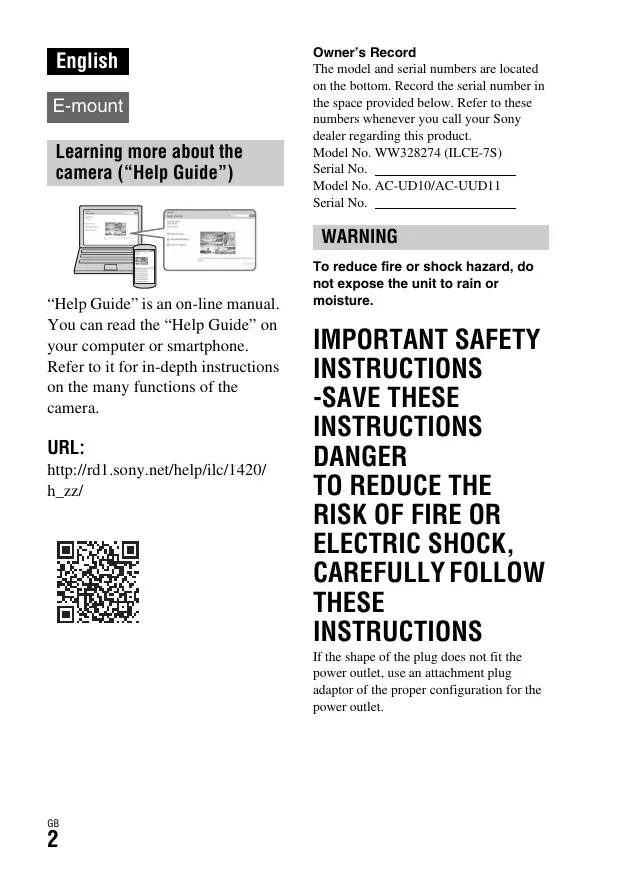
English E-mount Learning more about the camera (“Help Guide”) Owner’s Record The model and serial numbers are located on the bottom. Record the serial number in the space provided below. Refer to these numbers whenever you call your Sony dealer regarding this product. Model No. WW328274 (ILCE-7S) Serial No. Model No. AC-UD10/AC-UUD11 Serial No. WARNING “Help Guide” is an on-line manual. You can read the “Help Guide” on your computer or smartphone. Refer to it for in-depth instructions on the many functions of the camera. URL: http://rd1.sony.net/help/ilc/1420/ h_zz/ To reduce fire or shock hazard, do not expose the unit to rain or moisture. IMPORTANT SAFETY INSTRUCTIONS -SAVE THESE INSTRUCTIONS DANGER
TO REDUCE THE
RISK OF FIRE OR
ELECTRIC SHOCK, CAREFULLY FOLLOW THESE INSTRUCTIONS If the shape of the plug does not fit the power outlet, use an attachment plug adaptor of the proper configuration for the power outlet.
CAUTION Battery pack If the battery pack is mishandled, the battery pack can burst, cause a fire or even chemical burns. Observe the following cautions.
- Do not crush and do not expose the battery pack to any shock or force such as hammering, dropping or stepping on it.
- Do not short circuit and do not allow metal objects to come into contact with the battery terminals.
- Do not expose to high temperature above 60°C (140°F) such as in direct sunlight or in a car parked in the sun.
- Do not incinerate or dispose of in fire.
- Do not handle damaged or leaking lithium ion batteries.
- Be sure to charge the battery pack using a genuine Sony battery charger or a device that can charge the battery pack.
- Keep the battery pack out of the reach of small children.
- Keep the battery pack dry.
- Replace only with the same or equivalent type recommended by Sony.
- Dispose of used battery packs promptly as described in the instructions. AC Adaptor Use the nearby wall outlet (wall socket) when using the AC Adaptor. Disconnect the AC Adaptor from the wall outlet (wall socket) immediately if any malfunction occurs while using the apparatus. Battery charger Even when the CHARGE lamp of this battery charger is off, the power is not disconnected. If any trouble occurs while this unit is in use, unplug it from the wall outlet (wall socket) to disconnect the power. The power cord (mains lead), if supplied, is designed specifically for use with this camera only, and should not be used with other electrical equipment. For Customers in the U.S.A. and Canada
RECYCLING LITHIUM-ION BATTERIES Lithium-Ion batteries are recyclable. You can help preserve our environment by returning your used rechargeable batteries to the collection and recycling location nearest you. For more information regarding recycling of rechargeable batteries, call toll free 1-800-822-8837, or visit http://www.call2recycle.org/ Caution: Do not handle damaged or leaking Lithium-Ion batteries. Battery pack and lens (if lens supplied) This device complies with Part 15 of the FCC Rules. Operation is subject to the following two conditions: (1) This device may not cause harmful interference, and (2) this device must accept any interference received, including interference that may cause undesired operation.
CAN ICES-3 B/NMB-3 B
This equipment complies with FCC/IC radiation exposure limits set forth for an uncontrolled environment and meets the FCC radio frequency (RF) Exposure Guidelines and RSS-102 of the IC radio frequency (RF) Exposure rules. This equipment has very low levels of RF energy that are deemed to comply without testing of specific absorption ratio (SAR). For Customers in the U.S.A. If you have any questions about this product, you may call: Sony Customer Information Center 1-800-222-SONY (7669). The number below is for the FCC related matters only. Regulatory Information Declaration of Conformity Trade Name: SONY Model No.: WW328274 Responsible Party: Sony Electronics Inc. Address: 16530 Via Esprillo, San Diego, CA 92127 U.S.A. Telephone No.: 858-942-2230 This device complies with Part15 of the FCC Rules. Operation is subject to the following two conditions: (1) This device may not cause harmful interference, and (2) this device must accept any interference received, including interference that may cause undesired operation. This equipment must not be co-located or operated in conjunction with any other antenna or transmitter.
CAUTION You are cautioned that any changes or modifications not expressly approved in this manual could void your authority to operate this equipment. Note: This equipment has been tested and found to comply with the limits for a Class B digital device, pursuant to Part 15 of the FCC Rules. These limits are designed to provide reasonable protection against harmful interference in a residential installation. This equipment generates, uses, and can radiate radio frequency energy and, if not installed and used in accordance with the instructions, may cause harmful interference to radio communications. However, there is no guarantee that interference will not occur in a particular installation. If this equipment does cause harmful interference to radio or television reception, which can be determined by turning the equipment off and on, the user is encouraged to try to correct the interference by one or more of the following measures: – Reorient or relocate the receiving antenna. – Increase the separation between the equipment and receiver. – Connect the equipment into an outlet on a circuit different from that to which the receiver is connected. – Consult the dealer or an experienced radio/TV technician for help. The supplied interface cable must be used with the equipment in order to comply with the limits for a digital device pursuant to Subpart B of Part 15 of FCC Rules. For Customers in Canada This device complies with Industry Canada licence-exempt RSS standard(s). Operation is subject to the following two conditions: (1) this device may not cause interference, and (2) this device must accept any interference, including interference that may cause undesired operation of the device. For Customers in Europe Notice for the customers in the countries applying EU Directives Manufacturer: Sony Corporation, 1-7-1 Konan Minato-ku Tokyo, 108-0075 Japan For EU product compliance: Sony Deutschland GmbH, Hedelfinger Strasse 61, 70327 Stuttgart, Germany Hereby, Sony Corporation, declares that this equipment is in compliance with the essential requirements and other relevant provisions of Directive 1999/5/EC. For details, please access the following URL: http://www.compliance.sony.de/ Notice If static electricity or electromagnetism causes data transfer to discontinue midway (fail), restart the application or disconnect and connect the communication cable (USB, etc.) again. This product has been tested and found compliant with the limits set out in the EMC regulation for using connection cables shorter than 3 meters (9.8 feet). The electromagnetic fields at the specific frequencies may influence the picture and sound of this unit. Disposal of waste batteries and electrical and electronic equipment (applicable in the European Union and other European countries with separate collection systems) This symbol on the product, the battery or on the packaging indicates that the product and the battery shall not be treated as household waste. On certain batteries this symbol might be used in combination with a chemical symbol. The chemical symbols for mercury (Hg) or lead (Pb) are added if the battery contains more than 0.0005% mercury or 0.004% lead. By ensuring these products and batteries are disposed of correctly, you will help prevent potentially negative consequences for the environment and human health which could otherwise be caused by inappropriate waste handling. The recycling of the materials will help to conserve natural resources. In case of products that for safety, performance or data integrity reasons require a permanent connection with an incorporated battery, this battery should be replaced by qualified service staff only. To ensure that the battery and the electrical and electronic equipment will be treated properly, hand over these products at endof-life to the applicable collection point for the recycling of electrical and electronic equipment. For all other batteries, please view the section on how to remove the battery from the product safely. Hand the battery over to the applicable collection point for the recycling of waste batteries.
For more detailed information about recycling of this product or battery, please contact your local Civic Office, your household waste disposal service or the shop where you purchased the product or battery. For Customers in Singapore For customers who purchased their camera from a store in Japan that caters to tourists Note Some certification marks for standards supported by the camera can be confirmed on the screen of the camera. Select MENU t (Setup) 6 t [Certification Logo]. If display is not possible due to problems such as camera failure, contact your Sony dealer or local authorized Sony service facility. For details on Wi-Fi functions, see the flyer “Wi-Fi Connection/One-touch (NFC) Guide.”
Before use Notes on using your camera Screen language You can select the language displayed on the screen using the menu. Shooting procedure This camera has 2 modes for monitoring subjects: the monitor mode using the monitor, and the viewfinder mode using the viewfinder. Functions built into this camera
- This manual describes 1080 60icompatible devices and 1080 50icompatible devices. To check whether your camera is a 1080 60i-compatible device or 1080 50icompatible device, check for the following marks on the bottom of the camera. 1080 60i-compatible device: 60i 1080 50i-compatible device: 50i
- This camera is compatible with 1080 60p or 50p-format movies. Unlike standard recording modes up to now, which record in an interlacing method, this camera records using a progressive method. This increases the resolution, and provides a smoother, more realistic image. Creating an image database file If you insert a memory card that does not contain an image database file into the camera and turn on the power, the camera automatically creates an image database file using some of the memory card’s capacity. The process may take a long time and you cannot operate the camera until the process is completed. If a database file error occurs, export all images to your computer using PlayMemories Home™, and then format the memory card using the camera. Shooting with an E-mount lens compatible APS-C size This camera is equipped with a 35 mm, full-frame CMOS sensor. However, the image size is automatically set to that of the APS-C size setting and the image size is smaller when an E-mount lens compatible APS-C size is used (default settings). No compensation for damaged content or recording failure Sony cannot compensate for failure to record or loss or damage of recorded content due to a malfunction of the camera or recording media, etc. Back up recommendation To avoid the data loss, always copy (back up) data to other media. Notes on the monitor, electronic viewfinder, lens, and image sensor
- The monitor and electronic viewfinder are manufactured using extremely highprecision technology, and over 99.99% of the pixels are operational for effective use. However, there may be some small black dots and/or bright dots (white, red, blue or green in color) that constantly appear on the monitor and electronic viewfinder. These dots are normal due to the manufacturing process and do not affect the images in any way.
- Do not hold the camera by the monitor.
- When using the power zoom lens, be careful not to draw your fingers or any other objects caught in the lens.
- Do not expose the camera to sunlight or shoot sunward for a long time. The internal mechanism may be damaged. If sunlight is focused on a nearby object, it may cause a fire.
Notes on using your camera
- Images may trail across on the screen in a cold location. This is not a malfunction. When turning on the camera in a cold location, the screen may become temporarily dark. When the camera warms up, the screen will function normally.
- The recorded image may be different from the image you monitored before recording. Notes on shooting with the viewfinder This camera is equipped with an Organic Electro-Luminescence viewfinder with high resolution and high contrast. This viewfinder achieves a wide viewing angle and a long eye relief. This camera is designed to provide an easily viewable viewfinder by appropriately balancing various elements.
- The image may be slightly distorted near the corners of the viewfinder. This is not a malfunction. When you want to see the full composition with all its details, you can also use the monitor.
- If you pan the camera while looking into the viewfinder or move your eyes around, the image in the viewfinder may be distorted or the color of the image may change. This is a characteristic of the lens or display device and is not a malfunction. When you shoot an image, we recommend that you look at the center area of the viewfinder.
- When shooting with the viewfinder, you may experience symptoms such as eyestrain, fatigue, travel sickness, or nausea. We recommend that you take a break at regular intervals when you are shooting with the viewfinder. The required length or frequency of the break may differ depending on the individuals, so you are advised to decide at your own discretion. In case you may feel uncomfortable, refrain from using the viewfinder until your condition recovers, and consult your doctor as necessary. Notes on recording for long periods of time
- Depending on the camera and battery temperature, you may be unable to record movies or the power may turn off automatically to protect the camera. A message will be displayed on the screen before the power turns off or you can no longer record movies. In this case, leave the power off and wait until the camera and battery temperature goes down. If you turn on the power without letting the camera and battery cool enough, the power may turn off again or you may be unable to record movies.
- Under high ambient temperatures, the temperature of the camera rises quickly.
- When the temperature of the camera rises, the image quality may deteriorate. It is recommended that you wait until the temperature of the camera drops before continuing to shoot.
- The surface of the camera may get warm. This is not a malfunction. Notes on using your camera Notes on importing XAVC S movies and AVCHD movies to a computer When importing XAVC S movies or AVCHD movies to a computer, download and use the software PlayMemories Home from the following website: www.sony.net/pm/ Notes when playing movies on other devices
- This camera uses MPEG-4 AVC/H.264 High Profile for AVCHD format recording. Movies recorded in AVCHD format with this camera cannot be played with the following devices. – Other devices compatible with AVCHD format that do not support High Profile – Devices incompatible with the AVCHD format This camera also uses MPEG-4 AVC/ H.264 Main Profile for MP4 format recording. For this reason, movies recorded in MP4 format with this camera cannot be played on devices other than those that support MPEG-4 AVC/H.264.
- Discs recorded with HD (high definition) image quality can be played back only on AVCHD format-compatible devices. DVD-based players or recorders cannot play back HD image quality discs, as they are incompatible with the AVCHD format. Also, DVD-based players or recorders may fail to eject HD image quality discs.
- Movies recorded in 1080 60p/1080 50p format can be played back only on 1080 60p/1080 50p-supported devices. The pictures used in this manual The photographs used as examples of pictures in this manual are reproduced images, and are not actual images shot using this camera. On the data specifications described in this manual The data on performance and specifications are defined under the following conditions, except as described in this manual: at an ordinary ambient temperature of 25ºC (77°F), and using a battery pack that has been fully charged until the charge lamp has turned off. How to turn off wireless network functions (Wi-Fi and NFC, etc.) temporarily When you board an airplane, etc., you can turn off all wireless network functions temporarily. Select MENU button t (Wireless) 1 t [Airplane Mode] t [On]. If you set [Airplane Mode] to [On], an (airplane) mark will be displayed on the screen. Notes on wireless LAN If your camera is lost or stolen, Sony bears no responsibility for the loss or damage caused by illegal access or use of the registered access point on the camera. Warning on copyright Television programs, films, videotapes, and other materials may be copyrighted. Unauthorized recording of such materials may be contrary to the provisions of the copyright laws.
Before use Checking the supplied items The number in parentheses indicates the number of pieces.
- AC Adaptor AC-UD10/ACUUD11 (1)
- Body cap (1) (Attached on the camera) The shape of the AC Adaptor may differ depending on the country/region.
- Battery charger BC-TRW (1)
- Power cord (mains lead) (1)* (not supplied in the U.S.A. and Canada)
- Cable Protector (1) For how to attach the cable protector to the camera, refer to page 15.
- Multiple power cords may be supplied with your camera. Use the appropriate one that matches your country/region.
- Rechargeable battery pack NPFW50 (2)
- Micro USB cable (1) For how to attach the shoulder strap to the camera, refer to page 15.
- Shoe cap (1) (Attached on the camera)
- Eyepiece Cup (1) (Attached on the camera)
- Instruction Manual (1) (this manual)
- Wi-Fi Connection/One-touch (NFC) Guide (1) This guide explains the functions that require a Wi-Fi connection. Identifying parts See the pages in parentheses for details on operation for the parts. Front side
When the lens is removed G Mount index H Image sensor*2 I Mount J Contacts*2 *1 Do not cover this part during movie recording. Doing so may cause noise or lower the volume. *2 Do not directly touch these parts. A AF illuminator/Self-timer lamp B Front dial C Wi-Fi sensor (built-in) D Remote sensor E Lens release button F Built-in microphone*1
Identifying parts Rear side F Diopter-adjustment dial
- Adjust the diopter-adjustment dial according to your eyesight until the display appears clearly in the viewfinder. E Monitor
- You can adjust the monitor to an easily viewable angle and shoot from any position. G For shooting: C2 (Custom2) button For viewing: button (Enlarge) H AF/MF/AEL switch lever I Rear dial
Identifying parts J For shooting: AF/MF (Auto focus/manual focus) button/ AEL button For viewing: (Image index) button K MOVIE button (36) L For shooting: Fn button (19) For viewing: (Send to Smartphone) button
- You can display the screen for [Send to Smartphone] by pressing this button.
M Control wheel N For shooting: C3 (Custom3) button For viewing: (38) (Delete) button O Access lamp
Identifying parts Top side/Side view A Speaker H Multi interface shoe* Image sensor position mark C m (Microphone) jack
- When an external microphone is connected, the microphone is turned on automatically. If the external microphone is a plugin-power type, the power of the microphone is supplied by the camera. D i (Headphones) jack E Charge lamp F Multi/Micro USB Terminal*
- Supports Micro USB compatible device.
- Some of the accessories may not be inserted fully and protrude backward from the Multi interface shoe. However, when the accessory reaches the front end of the shoe, the connection is completed. I Mode dial (39) J Power switch/Shutter button K C1 (Custom 1) button L Exposure compensation dial Identifying parts M Hooks for shoulder strap
- Attach both ends of the strap onto the camera.
- For details on compatible accessories for the multi interface shoe and the Multi/Micro USB Terminal, visit the Sony website, or consult your Sony dealer or local authorized Sony service facility. You can also use accessories that are compatible with the accessory shoe. Operations with other manufactures’ accessories are not guaranteed.
- This mark indicates the touch point for connecting the camera and an NFC-enabled Smartphone. For details on the location of the (N mark) on your Smartphone, refer to the operating instructions of the Smartphone.
- NFC (Near Field Communication) is an international standard of shortrange wireless communication technology. O Memory card cover P Memory card slot Attaching a cable protector Use the cable protector to prevent the HDMI cable from being disconnected when shooting images connected by the HDMI cable. Raise the monitor and insert the HDMI cable, and then attach the cable protector as shown below.
- Make sure the connector cover is outside the cable protector when you attach the cable protector.
Identifying parts Bottom view A Battery insertion slot (22) Connection plate cover B Battery cover (22) Use this when using an AC-PW20 AC Adaptor (sold separately). Insert the connection plate into the battery compartment, and then pass the cord through the connection plate cover as shown below. C Tripod socket hole
- Use a tripod with a screw less than 5.5 mm (7/32 inches) long. Otherwise, you cannot firmly secure the camera, and damage to the camera may occur.
- Make sure that the cord is not pinched when you close the cover.
Functions list Operating the camera How to use the control wheel
- You can turn the control wheel or press up/down/left/right on the control wheel to move the selection frame. Press z in the center of the control wheel to set the selected item. In this manual, the action of pressing the up/down/left/right side of the control wheel is indicated by v/V/b/B.
- The following functions are assigned to v/b/B on the control wheel. You can also change the ISO sensitivity immediately by turning the control wheel.
DISP Changes the screen display.
- Cont. Shooting/Bracket
- You can assign a desired function to the V/b/B/z buttons and to the control wheel turning position in shooting mode.
- When you turn the control wheel or press b/B on the control wheel in playback mode, you can display the previous or next image.
Operating the camera How to use the front dial/rear dial You can turn the front dial or rear dial to change the settings required for each shooting mode with immediate effect.
Selecting a function using the Fn (Function) button This button is used for setting up or executing functions used frequently in shooting, except for functions from the Quick Navi screen. 1 Press the DISP on the control wheel to set the screen mode to other than [For viewfinder]. 3 Select the desired item using v/V/b/B on the control wheel. The setting screen appears. 4 Select the desired setting by turning the front dial, then press z on the control wheel.
- Some setting values can be finely adjusted by turning the rear dial. To set the individual settings in the dedicated screen In step 3, select a setting item and press z on the control wheel to switch to the dedicated screen for the setting item. Set the items according to the Operation guide. Operation guide
Functions that can be selected using the MENU button You can set up the basic settings for the camera as a whole, or execute functions such as shooting, playback, or other operations. 1 Press MENU button to display the menu screen. 2 Select the desired setting item using v/V/b/B on the control wheel or by turning the control wheel, and then press z on the center of the control wheel.
- Select an icon at the top of the screen and press the b/B on the control wheel to move to another MENU item. 3 Select the setting value, then press z to confirm. To display the Tile Menu Allows you to select whether to always display the first screen of the menu when you press the MENU button. MENU button t
(Setup) 2 t [Tile Menu] t [On] Using the In-Camera Guide You can use [Custom Key Settings] to assign In-Camera Guide to the desired button. The In-Camera Guide displays explanations for the currently selected menu function or setting. Select MENU button t (Custom Settings) 6 t [Custom Key Settings] t desired functions assigned to the button t [InCamera Guide]. Press the MENU button and use the control wheel to select a MENU item whose explanation you want to read, and then press the button to which [In-Camera Guide] is assigned.
Preparing the camera Charging the battery pack When using the camera for the first time, be sure to charge the NP-FW50 battery pack (supplied). The InfoLITHIUM™ battery pack can be charged even when it has not been fully depleted. It can also be used when it has not been fully charged. The charged battery pack is discharged little by little, even when you do not use it. To avoid missing an opportunity to shoot, charge the battery pack again before shooting. Charging the battery pack using the battery charger 1 Attach the battery pack.
- Push in the battery pack as the arrow shows, until the battery pack is set in parallel to the battery charger. 2 Connect the battery charger to the wall outlet (wall socket).
- The CHARGE lamp lights orange when charging is started.
- The CHARGE lamp turns off when charging is finished.
- For countries/regions other than the USA and Canada, connect the power cord to the battery charger, and connect the battery charger to the wall outlet (wall socket).
CHARGE lamp Charging the battery pack Charging the battery pack using the AC Adaptor 1 Set the ON/OFF (Power) switch to OFF. 2 Slide the lever to open the cover.
3 Insert the battery pack Lock lever completely, using the tip of the battery to press the lock lever. 4 Close the cover.
Charging the battery pack 5 Connect the camera to the AC Adaptor (supplied) using the micro USB cable (supplied), and connect the AC Adaptor to the wall outlet (wall socket). The charge lamp lights orange, and charging starts.
- Turn off the camera while charging the battery.
- When the charge lamp flashes and charging is not finished, remove and reinsert the battery pack.
- For countries/regions other than the USA and Canada, connect the power Charge lamp cord to the AC Adaptor, and connect Lit: Charging the AC Adaptor to the wall outlet (wall Off: Charging finished Flashing: socket). Charging error or charging paused temporarily because the camera is not within the proper temperature range
Charging the battery pack Notes
- The charging time differs depending on the remaining capacity of the battery pack or charging conditions.
- If the charge lamp on the camera flashes when the AC Adaptor is connected to the wall outlet (wall socket), this indicates that charging is temporarily stopped because the temperature is outside the recommended range. When the temperature gets back within the appropriate range, the charging resumes. We recommend charging the battery pack in an ambient temperature of between 10°C to 30°C (50ºF to 86ºF).
- Connect the AC Adaptor (supplied) or the battery charger (supplied) to the nearest wall outlet (wall socket). If malfunctions occur while using the AC Adaptor or the battery charger, disconnect the plug from the wall outlet (wall socket) immediately to disconnect from the power source.
- When the camera is being used for the first time or when you use a battery pack that has not been used for a long time, the charge lamp/CHARGE lamp may flash quickly when the battery is charged for the first time. If that happens, remove the battery pack from the camera and then re-insert it to recharge.
- Do not continuously or repeatedly charge the battery without using it if it is already fully charged or close to fully charged. Doing so may cause a deterioration in battery performance.
- When charging is finished, disconnect the AC Adaptor from the wall outlet (wall socket).
- Be sure to use only genuine Sony brand battery packs, micro USB cable (supplied) and AC Adaptor (supplied). Charging time (Full charge) The charging time is approximately 150 min. using the AC Adaptor (supplied), and approximately 220 min. using the battery charger (supplied). Notes
- The above charging time applies when charging a fully depleted battery pack at a temperature of 25°C (77°F). Charging may take longer depending on conditions of use and circumstances.
Charging the battery pack Charging by connecting to a computer The battery pack can be charged by connecting the camera to a computer using a micro USB cable. Connect the camera to the computer with the camera turned off. Notes
- Note the following points when charging via a computer: – If the camera is connected to a laptop computer that is not connected to a power source, the laptop battery level decreases. Do not charge for an extended period of time. – Do not turn on/off or restart the computer, or wake the computer to resume from sleep mode when a USB connection has been established between the computer and the camera. The camera may cause a malfunction. Before turning on/off, or restarting the computer or waking the computer from sleep mode, disconnect the camera and the computer. – No guarantees are made for charging using a custom-built computer or a modified computer. Checking the remaining battery charge A remaining charge indicator appears on the screen. High Low Notes
- The remaining charge indicator may not be correct under certain circumstances.
Charging the battery pack To remove the battery pack Turn off the camera. Slide the lock lever after confirming that the access lamp (page 13) is off, and remove the battery pack. Be sure not to drop the battery pack. Lock lever
Inserting a memory card (sold separately) 1 Slide the lever to open the cover. 2 Insert the memory card (sold separately).
- With the notched corner facing as illustrated, insert the memory card until it clicks into place. Ensure the notched corner faces correctly. 3 Close the cover. To remove the memory card Make sure that the access lamp (page 13) is not lit, then push the memory card in once.
Inserting a memory card (sold separately) Memory cards that can be used You can use the following types of memory cards with this camera. However, proper operation cannot be guaranteed for all types of memory cards. Memory card For still images For movies A Memory Stick PRO-HG Duo™ Memory Stick XC-HG Duo™ SD memory card (Class 4 or faster) B SDHC memory card (Class 4 or faster) SDXC memory card (Class 4 or faster)
- In this manual, the products in the table are collectively referred to as follows: A: Memory Stick PRO Duo media B: SD card When recording XAVC S format movies Use the following memory cards: – SDXC memory card (64 GB or more and Class 10 or faster) – SDXC memory card (64 GB or more and UHS-I-compatible) – Memory Stick XC-HG Duo media Notes
- Images recorded on a Memory Stick XC-HG Duo media or an SDXC memory card cannot be imported to or played on computers or AV devices that are not compatible with exFAT*. Make sure that the device is compatible with exFAT before connecting it to the camera. If you connect your camera to an incompatible device, you may be prompted to format the card. Never format the card in response to this prompt, as doing so will erase all data on the card.
- exFAT is the file system used on Memory Stick XC-HG Duo media and SDXC memory cards.
Attaching a lens Set the power switch of the camera to OFF before you attach or remove the lens. 1 Remove the body cap from the Front lens cap camera and the rear lens cap from the rear of the lens.
- When changing the lens, quickly change the lens away from dusty locations to keep dust or debris from getting inside the camera.
- When shooting, remove the front lens cap from the front of the lens. Body cap Rear lens cap 2 Mount the lens by aligning the white index marks (mounting indexes) on the lens and camera.
- Hold the camera with the lens facing down to prevent dust from entering into the camera. White index marks 3 While pushing the lens lightly toward the camera, turn the lens clockwise until it clicks into the locked position.
- Be sure to put the lens on straight.
Attaching a lens Notes
- When attaching a lens, do not press the lens release button.
- Do not use force when attaching a lens.
- The Mount Adaptor (sold separately) is required to use an A-mount lens (sold separately). To use the Mount Adaptor, refer to the operating manual supplied with the Mount Adaptor.
- When you want to shoot full-frame images, use a lens designed for a full-frame camera.
- When carrying the camera with a lens attached, hold both the camera and the lens firmly.
- Do not hold the part of the lens that is extended for the zoom or focus adjustment. 1 Press the lens release button all the way in and turn the lens counterclockwise until it stops. Lens release button 2 Attach the caps to the front and rear of the lens and the body cap to the camera.
- Before you attach them, remove any dust from them. Notes on changing the lens When changing the lens, if dust or debris gets inside the camera and adheres to the surface of the image sensor (the part that converts the light to an electric signal), it may appear as dark spots on the image, depending on the shooting environment. The camera is equipped with an anti-dust function to prevent dust from landing on the image sensor. However, always make sure to quickly change the lens away from dusty locations when attaching/removing a lens.
Setting the date and time When you turn on the camera for the first time or after you initialize the functions, the screen to set the date and time appears. 1 Set the power switch to ON to turn on the camera. The screen to set the date and time appears.
- To turn the camera off, set the power switch to OFF. 2 Check that [Enter] is selected on the screen, then press z on the control wheel. 3 Select a desired geographic location, and then press z. 4 Press v/V on the control wheel, or select a setting item by turning the control wheel, then press z. 5 Press v/V/b/B, or select a desired setting by turning the control wheel, then press z. 6 Repeat steps 4 and 5 to set other items, then select [Enter] and press z on the control wheel. To cancel the date and time setting operation Press the MENU button.
Setting the date and time Setting the date/time and area again The date and time setup screen appears automatically when the power is turned on for the first time or when the internal rechargeable backup battery has been discharged. To reset the date and time, use the menu. Notes
- This camera does not have a function to insert the date on an image. You can insert the date and save or print the image by using PlayMemories Home (page 46). Maintaining the date and time setting This camera has an internal rechargeable battery for maintaining the date and time and other settings regardless of whether the power is on or off, or the battery is installed or not.
Shooting and viewing images Shooting still images In [Auto Mode], the camera analyzes the subject and allows you to shoot with the appropriate settings. 1 Set the power switch to ON to turn on the camera. 2 Set the mode dial to (Auto Mode). 3 Look into the viewfinder and hold the camera. 4 Determine the size of a subject. When using a lens with a zoom lever: Move the zoom lever. When using a lens with a zoom ring: Turn the zoom ring.
- The optical zoom is not available when a fixed focal length lens is mounted.
- If the zoom range of the optical zoom is exceeded when a Power zoom lens is mounted, the camera automatically switches over to the zoom other than the optical zoom. 5 Press the shutter button halfway down to focus.
- When the image is in focus, a beep sounds and the z or indicator lights.
Zoom ring Shooting still images 6 Press the shutter button fully down to shoot an image.
- If [Auto Obj. Framing] is set to [Auto], when shooting faces, close-up (macro) subjects, or subjects tracked by Lock-on AF, the camera analyzes the scene and automatically trims the captured image into a suitable composition. Both the original and the trimmed images will be saved.
Recording movies 1 Press the MOVIE button to start recording.
- Since the [MOVIE Button] is set to [Always] in the default setting, movie recording can be started from any shooting mode. MOVIE button 2 Press the MOVIE button again to stop recording. Notes
- The sound of the camera in operation may be recorded while recording a movie. You can disable the sound recording by setting [Audio Recording] to [Off].
- To prevent the operating sound of the zoom ring from being recorded during movie recording when a Power zoom lens is used, we recommend recording movies using the zoom lever. When you move the zoom lever, place your finger lightly on the lever and operate it without flicking.
- The continuous recording time of a movie depends on the ambient temperature or the condition of the camera. See “Notes on continuous movie recording” (page 52).
- When the icon appears, the temperature of the camera is too high. Turn the camera off and wait until the temperature of the camera decreases.
- When you are recording continuously for a long time, you may feel that the camera is warm. This is normal. Also, [Internal temp. high. Allow it to cool.] may appear. In such cases, turn the camera off and wait until the camera is ready to shoot again.
- When shooting, the sound of the shoulder strap hooks (triangular hook) could be recorded, depending on the situation used.
Playing back images 1 Press the button. button 2 Select an image by pressing the b/B on the control wheel.
- To play back movies, press z on the control wheel.
- If you press V on the control wheel while playing back a movie, the control panel will be displayed. Control panel Action during movie playback
Forward slow playback
Rewind slow playback
Frame rewind Volume settings Closes the control panel Notes
- Movies recorded using other devices may not play back on this camera.
Deleting images Once you have deleted an image, you cannot restore it. Be sure that you want to delete the image before proceeding. 1 While displaying the image you want to delete, press the (Delete) button. (Delete) button 2 Select [Delete] with v/V on the control wheel, then press z.
- To delete several images at a time, select MENU button t (Playback) 1 t [Delete]. Notes
- Protected images cannot be deleted.
Selecting a shooting mode Selecting a shooting mode Turn the mode dial and set to the desired shooting mode. The following shooting modes are available. (Auto Mode) Allows you to shoot still images with the settings adjusted automatically. (Program Auto) (Aperture Priority)
Allows you to shoot with the exposure (the shutter speed and the aperture value) adjusted automatically. The other settings can be adjusted manually. Shoots by adjusting the aperture and changing the focus range, or by defocus the background. (Shutter Priority) Adjusts the shutter speed to show the movement of the subject. (Manual Exposure) Allows you to shoot after manually adjusting the exposure (the shutter speed and the aperture value) using the front or rear dial. 1/2 (Memory recall) Calls up settings pre-registered in [Memory] in the (Camera Settings). (Scene Selection) Allows you to shoot with preset settings according to the scene. (Sweep Panorama) Allows you to shoot panoramic images by combining multiple images. (Movie) Allows you to change shooting settings and shoot a movie.
Using the Wi-Fi and NFC one-touch functions You can perform the following operations using the camera’s Wi-Fi and NFC One-touch functions. Saving images to a computer. Transferring images from the camera to a smartphone. Using the smartphone as a remote control for the camera. Viewing still images on a TV. For details on the Wi-Fi and NFC One-touch functions, refer to the attached document “Wi-Fi Connection/One-touch (NFC) Guide” or to the “Help Guide” (page 2).
Using the Wi-Fi and NFC one-touch functions Connecting the camera to a wireless access point Connect the camera to your wireless access point. Before starting the procedure, make sure you have the SSID (name of the access point) and password of your wireless access point with you. 1 MENU button t (Wireless) 2 t [Access Point Set.]. 2 Use v/V on the control wheel to select the access point you want to connect to. Press z in the center of the control wheel and enter the password if a key icon is displayed with a wireless access point, then select [OK].
- If a connection is not established, see the wireless access point operating instructions or contact the administrator of the access point.
- To save images to a computer, install the following dedicated software on your computer. When using Windows: PlayMemories Home www.sony.net/pm/ When using Mac: Wireless Auto Import http://www.sony.co.jp/imsoft/Mac/
Using applications Adding applications to the camera (Application downloading) You can add the desired functions to your camera by connecting to the application downloading website (PlayMemories Camera Apps) via the Internet. For example, the following functions are available:
- You can use various effects for shooting images.
- You can upload images to network services directly from the camera. Downloading applications 1 Access the application downloading website. http://www.sony.net/pmca/ 2 Follow the instructions on the screen and acquire a service account.
- If you have an account, sign in to the application download site. 3 Select the desired application and download the application to the camera following the instructions on the screen. 1 To a USB terminal of the computer Notes
- The application downloading function may not be available in some countries and regions. For details, refer to the application downloading website above.
Adding applications to the camera (Application downloading) How to download applications directly using the Wi-Fi function of the camera You can download applications using the Wi-Fi function without connecting to a computer. Select MENU button t (Application) t [Application List] t (PlayMemories Camera Apps), then follow the instructions on the screen to download applications. Acquire a service account in advance. Select MENU button t (Wireless) 2 t [Access Point Set.] t access point to be connected t change [IP Address Setting] to [Auto] if it is set to [Manual].
Launching the application (Application) t [Application List] t desired application to launch.
- You can use the [One-touch (NFC)] menu to install NFC one-touch functions and call up the applications by simply touching the smartphone to the mark on the camera. Before using the NFC One-touch functions, set the applications that you want to call up using the following procedure:
- MENU button t (Wireless) 1 t [One-touch (NFC)] t desired application
- After displaying the shooting screen on the camera, touch the smartphone to the camera.
- “Smart Remote Embedded” is assigned to [One-touch (NFC)] in the default setting.
Viewing images on a computer Using the software Use the following applications to optimize use of the images shot with your camera.
- Image Data Converter
- Remote Camera Control For details on installation, see pages 45 to 48. System requirements You can find the system requirements for the software at the following URL: www.sony.net/pcenv/
Using the software Using Image Data Converter With Image Data Converter, you can do the following:
- You can play back and edit images recorded in RAW format with various corrections, such as tone curve and sharpness.
- You can adjust images with white balance, exposure, and [Creative Style], etc.
- You can save the images displayed and edited on a computer. You can either save the image as RAW format or save it in a general file format.
- You can display and compare the RAW images and JPEG images recorded by this camera.
- You can rank images in 5 grades.
- You can apply color labels. To use Image Data Converter, refer to Help. Click [Start] t [All Programs] t [Image Data Converter] t [Help] t [Image Data Converter Ver.4]. Image Data Converter support page (English only) http://www.sony.co.jp/ids-se/ Installing Image Data Converter 1 Download the software from the following URL and install it on your computer. Windows: http://www.sony.co.jp/imsoft/Win/ Mac: http://www.sony.co.jp/imsoft/Mac/ Notes
- Log on as Administrator.
Using the software Using PlayMemories Home The software PlayMemories Home allows you to import still images and movies to your computer and use them. PlayMemories Home is required for importing XAVC S movies or AVCHD movies to your computer. Playing back imported images Importing images from your camera For Windows, the following functions are also available: Viewing images on a calendar Creating movie discs Sharing images on PlayMemories Online™ Uploading images to network services
- You can download Image Data Converter or Remote Camera Control, etc. by performing the following procedure: Connect the camera to your computer t launch PlayMemories Home t click [Notifications].
Using the software Notes
- An Internet connection is required to install PlayMemories Home.
- An Internet connection is required to use PlayMemories Home or other network services. PlayMemories Home or other network services may not be available in some countries or regions.
- Refer to the following URL for Mac software: http://www.sony.co.jp/imsoft/Mac/
- If the software PMB (Picture Motion Browser), supplied with models released before 2011, has already been installed on your computer, it will be overwritten by PlayMemories Home during the installation. Use PlayMemories Home, the successor software of PMB.
- Movies recorded using the [60p 28M(PS)]/[50p 28M(PS)], [60i 24M(FX)]/[50i 24M(FX)] or [24p 24M(FX)]/[25p 24M(FX)] setting in [ Record Setting] are converted by PlayMemories Home to create an AVCHD recording disc. This conversion can take a long time. Also, you cannot create a disc with the original image quality. If you want to keep the original image quality, store your movies on a Blu-ray Disc. Installing PlayMemories Home 1 Using the Internet browser on your computer, go to the following URL, then click [Install] t [Run]. www.sony.net/pm/ 2 Follow the instructions on the screen to complete the installation.
Using the software Using Remote Camera Control Connect the camera to your computer. With Remote Camera Control you can:
- Set up the camera or record an image from the computer.
- Record an image directly to the computer.
- Perform an Interval Timer Shooting. Set up the following before use: MENU button t Connection] t [PC Remote] (Setup) 4 t [USB Installing Remote Camera Control 1 Using the Internet browser on your computer, go to the following URL. Windows: http://www.sony.co.jp/imsoft/Win/ Mac: http://www.sony.co.jp/imsoft/Mac/ 2 Follow the instructions on the screen to download and install Remote Camera Control. Notes
- An Internet connection is required to install Remote Camera Control.
Others Checking the number of images and recordable time of movies When you insert a memory card into the camera and set the power switch to ON, the number of images that can be recorded (should you continue to shoot using the current settings) is displayed on the screen. Notes
- When “0” (the number of recordable images) flashes in yellow, the memory card is full. Replace the memory card with another one, or delete images from the current GB memory card (page 38).
- When “NO CARD” (the number of recordable images) flashes in yellow, it means no memory card has been inserted. Insert a memory card. The number of images that can be recorded on a memory card The table below shows the approximate number of images that can be recorded on a memory card formatted with this camera. The values are defined using Sony standard memory cards for testing. The values may vary depending on the shooting conditions and the type of memory card used. Image Size: L: 12M Aspect Ratio: 3:2* Memory card formatted with this camera (Units: Images) Capacity 2 GB 4 GB 8 GB 16 GB 32 GB 64 GB
- When [ Aspect Ratio] is set to [16:9], you can record more images than the numbers shown in the table above (except when [RAW] is selected).
Checking the number of images and recordable time of movies The number of images that can be recorded using a battery pack Note that the actual numbers may differ depending on the conditions of use. Shooting (still images) Actual shooting (movies) Continuous shooting (movies) Viewing (still images) Screen Number of images Approx. 380 images Viewfinder Screen Notes
- The above number of images applies when the battery pack is fully charged. The number of images may decrease depending on the conditions of use.
- The number of images that can be recorded is for shooting under the following conditions: – The battery pack is used at an ambient temperature of 25°C (77°F). – Using the lens FE 28-70 mm F3.5-5.6 OSS (sold separately) – Using Sony Memory Stick PRO Duo (Mark2) media (sold separately) – [Viewfinder Bright.] is set to [Manual] [±0]. – [Monitor Brightness] is set to [Manual] [±0]. – [Display Quality] is set to [Standard].
- The number for “Shooting (still images)” is based on the CIPA standard, and is for shooting under the following conditions: (CIPA: Camera & Imaging Products Association) – [Focus Mode] is set to [Single-shot AF]. – Shooting once every 30 seconds. – The power turns on and off once every ten times.
- The number of minutes for movie shooting is based on the CIPA standard, and are for shooting under the following conditions: Record Setting] is set to [60i 17M(FH)]/[50i 17M(FH)]. – Typical movie shooting: Battery life based on repeatedly shooting, zooming, shooting stand-by, turning on/off, etc. – Continuous movie shooting: Battery life based on non-stop shooting until the limit (29 minutes) has been reached, and then continued by pressing the MOVIE button again. Other functions, such as zooming, are not operated.
Checking the number of images and recordable time of movies Available recording time for a movie The table below shows the approximate total recording times using a memory card formatted with this camera. The recording time for XAVC S and AVCHD movies is when [Dual Video REC] set to [Off]. Memory card formatted with this camera (h (hour), m (minute)) Capacity Record Setting 60p 50M/50p 50M 30p 50M/25p 50M 24p 50M* 120p 50M/100p 50M 60i 24M(FX)/ 50i 24M(FX) 60i 17M(FH)/ 50i 17M(FH) 60p 28M(PS)/ 50p 28M(PS) 24p 24M(FX)/ 25p 24M(FX) 24p 17M(FH)/ 25p 17M(FH) 1440×1080 12M VGA 3M 2 GB 4 GB 8 GB 16 GB 32 GB 64 GB
10 m 20 m 40 m 1 h 30 m
15 m 35 m 1 h 15 m 2 h 30 m 5 h 5 m 10 m 20 m 40 m 1 h 30 m
20 m 40 m 1 h 20 m 2 h 45 m 5 h 30 m 1 h 10 m 2 h 45 m 4 h 55 m 10 h 20 h
- Only for 1080 60i compatible models.
- Continuous shooting is possible for approximately 29 minutes (a product specification limit). The maximum continuous recording time of an MP4 (12M) format movie is about 20 minutes (limited by the 2 GB file size restriction). Notes
- The recordable time of movies varies because the camera is equipped with VBR (Variable Bit-Rate), which automatically adjusts image quality depending on the shooting scene. When you record a fast-moving subject, the image is clearer but the recordable time is shorter because more memory is required for recording. The recordable time also varies depending on the shooting conditions, the subject or the image quality/size settings.
Checking the number of images and recordable time of movies
- The values shown are not for continuous recording time.
- The recording time may differ depending on shooting conditions and the memory card used.
- When is indicated, stop recording the movie. The temperature inside the camera has increased to an unacceptable level.
- For details on movie playback, see page 37. Notes on continuous movie recording
- It requires a lot of power to perform high quality movie recording or continuous shooting using the image sensor. Therefore, if you continue to shoot, the temperature inside the camera will rise, especially that of the image sensor. In such cases, the camera turns off automatically since higher temperatures affect the quality of the images or affect the internal mechanism of the camera.
- The duration of time available for movie recording is as follows when the camera starts recording after the power of the camera has been turned off for a while. (The following values indicate the continuous time from when the camera starts recording until the camera stops recording.) Ambient temperature Continuous recording time for movies 20°C (68°F) About 29 minutes 30°C (86°F) About 29 minutes 40°C (104°F) About 29 minutes
- The duration of time available for movie recording varies with the temperature or condition of the camera before you start recording. If you frequently recompose or shoot images after the power is turned on, the temperature inside the camera will rise and the recording time available will be shorter.
- If the camera stops recording due to the temperature, leave it for several minutes with the power turned off. Start recording after the temperature inside the camera drops fully.
- If you observe the following points, the recording time will be longer. – Keep the camera out of direct sunlight. – Turn the camera off when it is not being used.
- The maximum size of a movie file is about 2 GB. When the file size is about 2 GB, recording stops automatically when [ File Format] is set to [MP4], and a new movie file is created automatically when [ File Format] is set to [AVCHD].
- The maximum continuous recording time is 29 minutes.
Specifications Camera [System] Camera Type: Interchangeable Lens Digital Camera Lens: Sony E-mount lens [Image sensor] Image format: 35 mm full size (35.6 mm ×
23.8 mm), CMOS image sensor
Total pixel number of camera: Approx. 12 430 000 pixels Effective pixel number of camera: Approx. 12 200 000 pixels [Anti-Dust] System: Charge protection coating on image sensor and image sensor shift mechanism [Auto focus system] System: Contrast detection system, 25 points Sensitivity Range: –4 EV to +20 EV (at ISO 100 equivalent with F2.0 lens) AF illuminator: Approx. 0.3 m to 3 m (0.99 ft. to 9.8 ft.) (When using an FE 28-70 mm F3.5-5.6 OSS) [Electronic viewfinder] Type: Electronic viewfinder Total number of dots: 2 359 296 dots Frame coverage: 100% Magnification: 0.71 × with 50 mm lens at infinity, –1 m–1 Eye Point: Approximately 27 mm from the eyepiece, 22 mm from the eyepiece frame at –1 m–1 (CIPA standard compliant) Diopter Adjustment: –4.0 m–1 to +3.0 m–1 [LCD monitor] LCD panel: 7.5 cm (3.0 type) TFT drive Total number of dots: 921 600 dots [Exposure control] Metering method: 1 200-zone evaluative metering Metering Range: –3 EV to +20 EV (at ISO 100 equivalent with F2.0 lens) ISO sensitivity (Recommended exposure index): Still images: ISO 100 to 409 600 (Extended ISO 50), [ISO AUTO] (ISO 100 to 12 800) Movies: ISO 200 to 409 600 equivalent, [ISO AUTO] (ISO 200 to 25 600 equivalent) Exposure compensation: ±5.0 EV (switchable between 1/3 EV and 1/2 EV steps) When using exposure compensation dial: ±3.0 EV (1/3 EV step)
Specifications [Shutter] Type: Electronically-controlled, vertical-traverse, focal-plane type Speed range: Still images: 1/8 000 second to 30 seconds, BULB Movies: 1/8 000 second to 1/4 second (1/3 step) 1080 60i-compatible device up to 1/60 second in AUTO mode (up to 1/30 second in Auto slow shutter mode) 1080 50i-compatible device up to 1/50 second in AUTO mode (up to 1/25 second in Auto slow shutter mode) Flash sync speed: 1/250 second [Continuous shooting] Continuous shooting speed: Maximum 2.5 images per second* When shooting in [Spd Priority Cont.] mode: Maximum 5 images per second
- Based on our measurement conditions. The speed of continuous shooting can be slower, depending on the shooting conditions. The number of continuous shots: When shooting in [Spd Priority Cont.] mode: Extra fine 65 images During continuous shooting: Extra fine 88 images [Recording format] File format: JPEG (DCF Ver. 2.0, Exif Ver. 2.3, MPF Baseline) compliant, RAW (Sony ARW 2.3 format) Movie (XAVC S format): MPEG-4 AVC/H.264 XAVC S ver.1.0 format compliant Video: MPEG-4 AVC/H.264 Audio: LPCM 2ch (48 kHz 16 bit) Movie (AVCHD format): AVCHD format Ver. 2.0 compatible Video: MPEG-4 AVC/H.264 Audio: Dolby Digital 2ch, equipped with Dolby Digital Stereo Creator
- Manufactured under license from Dolby Laboratories. Movie (MP4 format): Video: MPEG-4 AVC/H.264 Audio: MPEG-4 AAC-LC 2ch [Recording media] Memory Stick PRO Duo media, SD card [Input/output terminals] Multi/Micro USB Terminal*: Hi-Speed USB (USB 2.0) HDMI: HDMI type D micro jack m (Microphone) Terminal:
3.5 mm Stereo mini jack
i (Headphones) Terminal:
3.5 mm Stereo mini jack
- Supports Micro USB compatible devices.
Specifications [Power, general] Battery pack: Rechargeable battery pack NP-FW50 [Power consumption] When using an FE 28-70 mm F3.55.6 OSS When using the viewfinder: Approx. 3.0 W When using the monitor: Approx. 2.4 W [Others] Exif Print: Compatible DPOF: Compatible PRINT Image Matching III: Compatible Dimensions: 126.9 mm × 94.4 mm ×
48.2 mm (5 inches ×
3 3/4 inches × 1 15/16 inches) (W/H/D, excluding protrusions) Mass: Approx. 489 g (1 lb 1.2 oz) (with battery and Memory Stick PRO Duo media) Approx. 446 g (15.7 oz) (body only) Operating temperature: 0°C to 40°C (32°F to 104°F) [Wireless LAN] Supported format: IEEE 802.11 b/g/n Frequency band: 2.4 GHz bandwidth Security: WEP/WPA-PSK/WPA2PSK Connection method: WPS (Wi-Fi Protected Setup)/Manual Access method: Infrastructure mode NFC: NFC Forum Type 3 Tag compliant Model No. WW328274 Battery charger BC-TRW Input rating: AC 100 V to 240 V, 50 Hz/60 Hz, 6 W Output rating: 8.4 V DC, 0.4 A Operating temperature range: 0°C to 40°C (32°F to 104°F) Storage temperature range: –20°C to +60°C (–4°F to +140°F) AC Adaptor AC-UD10/AC-UUD11 Power requirements: AC 100 V to 240 V, 50 Hz/60 Hz, 70 mA Output voltage: DC 5 V, 0.5 A
Rechargeable battery pack NP-FW50 Battery type: Lithium-ion battery Maximum voltage: DC 8.4 V Nominal voltage: DC 7.2 V Maximum charge voltage: DC 8.4 V Maximum charge current: 1.02 A Capacity: Typical 7.7 Wh (1 080 mAh) Minimum: 7.3 Wh (1 020 mAh) Design and specifications are subject to change without notice.
Specifications On image data compatibility
- This camera conforms with DCF (Design rule for Camera File system) universal standard established by JEITA (Japan Electronics and Information Technology Industries Association).
- Playback of images recorded with your camera on other equipment and playback of images recorded or edited with other equipment on your camera are not guaranteed.
- Memory Stick and are trademarks or registered trademarks of Sony Corporation.
- XAVC S and are registered trademarks of Sony Corporation.
- “AVCHD Progressive” and the “AVCHD Progressive” logotype are trademarks of Panasonic Corporation and Sony Corporation.
- Dolby and the double-D symbol are trademarks of Dolby Laboratories.
- The terms HDMI and HDMI HighDefinition Multimedia Interface, and the HDMI Logo are trademarks or registered trademarks of HDMI Licensing LLC in the United States and other countries.
- Windows is a registered trademark of Microsoft Corporation in the United States and/or other countries.
- Mac is a registered trademark of Apple Inc. in the United States and other countries.
- iOS is a registered trademark or trademark of Cisco Systems, Inc.
- iPhone and iPad are registered trademarks of Apple Inc. in the United States and other countries.
- SDXC logo is a trademark of SD-3C, LLC.
- Android, Google Play are trademarks of Google Inc.
- Wi-Fi, the Wi-Fi logo and Wi-Fi PROTECTED SET-UP are registered trademarks of the Wi-Fi Alliance.
- The N Mark is a trademark or registered trademark of NFC Forum, Inc. in the United States and in other countries. Specifications
- DLNA and DLNA CERTIFIED are trademarks of Digital Living Network Alliance.
- Facebook and the “f” logo are trademarks or registered trademarks of Facebook, Inc.
- YouTube and the YouTube logo are trademarks or registered trademarks of Google Inc.
- Eye-Fi is a trademark of Eye-Fi, Inc.
- In addition, system and product names used in this manual are, in general, trademarks or registered trademarks of their respective developers or manufacturers. However, the ™ or ® marks may not be used in all cases in this manual.
Additional information on this product and answers to frequently asked questions can be found at our Customer Support Website.
- Batterie rechargeable NP-FW50 (2)
H Griffe multi-interface* C Prise m (Microphone) 2 Câble microUSB (fourni) Installation de Remote Camera Control
(h (heure), m (minute)) Capacité 2 Go 4 Go 8 Go 16 Go 32 Go 64 Go
2 h 35 m 2 h 35 m 10 m 20 m 40 m 1 h 30 m
15 m 35 m 1 h 15 m 2 h 30 m 5 h 5 m 10 m 20 m 40 m 1 h 30 m
URL: http://rd1.sony.net/help/ilc/1420/ h_zz/
60i 24M(FX)/50i 24M(FX) 60i 17M(FH)/50i 17M(FH) 60p 28M(PS)/50p 28M(PS) 24p 24M(FX)/25p 24M(FX) 24p 17M(FH)/25p 17M(FH) 1440×1080 12M VGA 3M 4 h 5 m 8 h 15 m 20 m 40 m 1 h 20 m 2 h 45 m 5 h 30 m 1 h 10 m 2 h 45 m 4 h 55 m 10 h 20 h 11 h 40 h URL: http://rd1.sony.net/help/ilc/1420/ h_zz/
AF/MF/AEL
60i 24M(FX)/50i 24M(FX) 60i 17M(FH)/50i 17M(FH) 60p 28M(PS)/50p 28M(PS) 24p 24M(FX)/25p 24M(FX) 24p 17M(FH)/25p 17M(FH) 1 440×1 080 12M URL: http://rd1.sony.net/help/ilc/1420/ h_zz/ 24p 24M(FX)/25p 24M(FX) 10 m 20 m 40 m 1 h 30 m
Caricabatterie BC-TRW URL: http://rd1.sony.net/help/ilc/1420/ h_zz/ MF/AEL I Seletor traseiro
F Multi Terminal/Terminal Micro Instalar Image Data Converter Instalar PlayMemories Home Instalar Remote Camera Control 20 m 40 m 1 h 20 m 2 h 45 m 5 h 30 m 1 h 10 m 2 h 45 m 4 h 55 m 10 h 20 h
11 h 40 h URL: http://rd1.sony.net/help/ilc/1420/ h_zz/
Remote Camera Control installeren Adres URL: http://rd1.sony.net/help/ilc/1420/ h_zz/
- Akumulator NP-FW50 (2) 3 Wsuń do końca akumulator, Dźwignia blokady 24p 24M(FX)/25p 24M(FX) 10 m 20 m 40 m 1 h 30 m
2 h 35 m 2 h 35 m 2 h 35 m 2 h 35 m 1 h 30 m
4 h 5 m 8 h 15 m 1 h 15 m 2 h 30 m 5 h 5 m 1 h 30 m
2 h 45 m 5 h 30 m 10 h 20 h
11 h 40 h 24p 24M(FX)/25p 24M(FX) 10 m 20 m 40 m 1 h 30 m
URL: http://rd1.sony.net/help/ilc/1420/ h_zz/ (Installation) 2 t [Brickmeny] t [På] URL: http://rd1.sony.net/help/ilc/1420/ h_zz/
- Ladattava akku NP-FW50 (2) MENU-painike t (Asetus) 4 t [Pvm/aika-asetus] tai [Alueasetus] MENU-painike URL: http://rd1.sony.net/help/ilc/1420/ h_zz/ (Oppsett) 4 t [USB- Installere Remote Camera Control URL: http://rd1.sony.net/help/ilc/1420/ h_zz/
Installation af Remote Camera Control