 ManualGo.com
 1366 PICASSO CIALDISSIMA - Machine à café ARIETE - Free user manual and instructions
Find the device manual for free 1366 PICASSO CIALDISSIMA ARIETE in PDF.


Download the instructions for your Machine à café in PDF format for free! Find your manual 1366 PICASSO CIALDISSIMA - ARIETE and take your electronic device back in hand. On this page are published all the documents necessary for the use of your device. 1366 PICASSO CIALDISSIMA by ARIETE.
USER MANUAL 1366 PICASSO CIALDISSIMA ARIETE
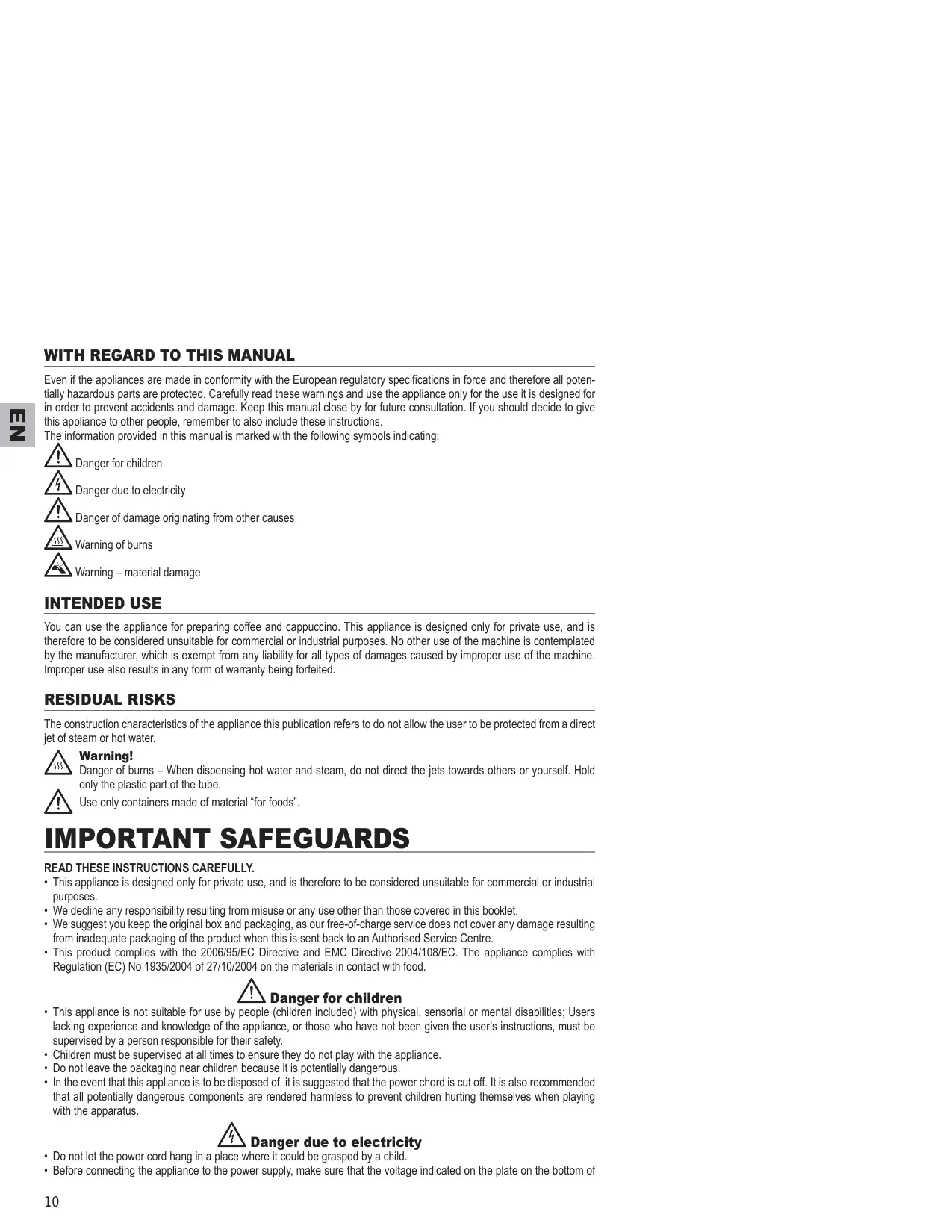
WITH REGARD TO THIS MANUAL EN Even if the appliances are made in conformity with the European regulatory specifications in force and therefore all potentially hazardous parts are protected. Carefully read these warnings and use the appliance only for the use it is designed for in order to prevent accidents and damage. Keep this manual close by for future consultation. If you should decide to give this appliance to other people, remember to also include these instructions.
The information provided in this manual is marked with the following symbols indicating: Danger for children Danger due to electricity Danger of damage originating from other causes Warning of burns Warning – material damage
INTENDED USE You can use the appliance for preparing coffee and cappuccino. This appliance is designed only for private use, and is therefore to be considered unsuitable for commercial or industrial purposes. No other use of the machine is contemplated by the manufacturer, which is exempt from any liability for all types of damages caused by improper use of the machine.
Improper use also results in any form of warranty being forfeited.
RESIDUAL RISKS The construction characteristics of the appliance this publication refers to do not allow the user to be protected from a direct jet of steam or hot water.
Warning! Danger of burns – When dispensing hot water and steam, do not direct the jets towards others or yourself. Hold only the plastic part of the tube. Use only containers made of material “for foods”.
IMPORTANT SAFEGUARDS READ THESE INSTRUCTIONS CAREFULLY.
• This appliance is designed only for private use, and is therefore to be considered unsuitable for commercial or industrial purposes. • We decline any responsibility resulting from misuse or any use other than those covered in this booklet. • We suggest you keep the original box and packaging, as our free-of-charge service does not cover any damage resulting from inadequate packaging of the product when this is sent back to an Authorised Service Centre. • This product complies with the 2006/95/EC Directive and EMC Directive 2004/108/EC. The appliance complies with Regulation (EC) No 1935/2004 of 27/10/2004 on the materials in contact with food.
• This appliance is not suitable for use by people (children included) with physical, sensorial or mental disabilities; Users lacking experience and knowledge of the appliance, or those who have not been given the user’s instructions, must be supervised by a person responsible for their safety.
• Children must be supervised at all times to ensure they do not play with the appliance. • Do not leave the packaging near children because it is potentially dangerous. • In the event that this appliance is to be disposed of, it is suggested that the power chord is cut off. It is also recommended that all potentially dangerous components are rendered harmless to prevent children hurting themselves when playing with the apparatus.
Danger due to electricity
• Do not let the power cord hang in a place where it could be grasped by a child.
• Before connecting the appliance to the power supply, make sure that the voltage indicated on the plate on the bottom of
Danger of damage originating from other causes
Do not lift the appliance by grasping its water tank or its tray, but only by grasping its body.
Choose a sufficiently well lit and clean environment, with an easily accessible electric socket. Avoid putting excessive quantities of water into the tank. Never leave the appliance unattended when it is connected to the power supply. The appliance must be used and rested on a stable surface. The appliance is not to be used if it has been dropped, if there are visible sign of damage or if it is leaking. Do not use the appliance if the power cord or the plug are damaged, or if the appliance is faulty. To prevent any accident, all repairs, including the replacement of the power cord, must be carried out by an Authorised Service Centre or, in any case, by qualified personnel.
• Never direct the steam or hot water jet towards parts of the body; handle the steam spout with care: risk of scalding!
• The outer metallic parts of the appliance and of the filter holder must not be touched with the appliance in operation, because it could cause burns. • If water does not come out of the filter holder, it may be because the Thermocream® filter is clogged. In this case, remove and disconnect the filter slowly because any remaining pressure can cause spillage or splashing. Then clean as explained in the relevant paragraph.
• • • • • • • • • • •
Warning – material damage
Place the machine on a stable surface where it cannot be knocked over.
Never use the machine without water because the pump will burn out. Never fill the water tank with hot or boiling water. Do not place the machine on very hot surfaces or near open flames in order to prevent damage to the body. The cable must not touch any hot parts of the machine. Do not use sparkling (carbonated) water. Use only pods bearing the E.S.E. standard mark (MOD. 1366). Never put in the Thermocream ® filter substances other than coffee powder. They could cause serious damage to the appliance. Do not leave the machine at a room temperature below 0°C because the water remaining in the boiler could freeze and cause damage. Never use the appliance outdoors. Do not expose the appliance to atmospheric agents (rain, sun, etc.). Before cleaning the appliance always unplug it and allow it cool down. Clean only with a non-abrasive cloth that has been slightly dampened with water, adding a few drops of mild, non-aggressive detergent (never use solvents that damage plastic).
• SAVE THESE INSTRUCTIONS FOR FUTURE REFERENCE
the machine corresponds to the local mains voltage.
• The use of extension leads, which have not been authorised by the appliance manufacturer, may cause damage and accidents. • Before filling the tank with water, remember to always disconnect the appliance at the socket. • If the electric cable is damaged it must be replaced by the manufacturer or its Technical Assistance Service, or in any case by a person with similar qualifications, in order to avoid any risk. • Never let the live parts come into contact with water: this may cause a short circuit • Unplug before any cleaning or maintenance operations. • Do not immerse the appliance in water or other liquids. • Always turn off the appliance and remove the power cable plug from the socket-outlet before filling the tank with water.
DESCRIPTION OF THE APPLIANCE EN A B C D E F G
Perforated silicone disc Powder dripper Filter holder Pod filter (MOD. 1366) Pod dripper (MOD. 1366) Maxi Cappuccino attachment and wand for water and steam supply
H - Power cord + Plug
I - Machine body J - Tank cover K - On-off switch
Removable water tank
Cup-resting grill Coffee measure/presser Drip tray Steam function switch Brewing knob: central: machine in standby : coffee distribution
: steam distribution
R - Steam ready indicator lamp S - Coffee dispensing indicator lamp
The following machine identification data are shown on the plate placed underneath the machine’s standing base:
• manufacturer and CE mark • model (Mod.) • serial number (SN) • electrical supply voltage (V) and frequency (Hz) • absorbed electric power (W) • assistance toll-free number Always give the model and serial number to the Authorised Service Centres when requesting assistance.
INSTRUCTIONS FOR USE Using the appliance for the first time
Check that the voltage of the domestic network is the same as that indicated on the technical information plate of the appliance. Place the appliance on a stable surface.
Wash the tank (L) on first use and fill it with cool tap water (Fig. 3) to the level marked "MAX", taking care to push it into place (Fig. 4). Check that the tank is properly inserted; otherwise, the machine may not dispense coffee. Insert the plug into the socket, which must be earthed.
Starting the first time
After having filled the tank with cool tap water, start the machine by pressing the button (K) (Fig. 5). Place a container under the connection flange of the filter holder and turn the knob (Q) to the coffee position ( ), until you see water flowing from the filter holder (Fig. 6).
HOW TO MAKE COFFEE In the filter holder (D) insert the powder dripper (C), the perforated silicone disc (B) and the Thermocream ® filter (A) in the order indicated (Fig. 7).
Measure out the coffee in the filter and lightly press with the specially provided presser: completely fill two measures for two cups of coffee, and fill only one for one cup. Insert the filter holder into its seat. Tighten well by turning it from left to right while making sure you have hooked it properly onto the flange (Fig. 8). Warning! If an excessive amount of coffee powder is inserted inside the filter, the rotation of the filter holder can be difficult and/or during the coffee brewing there may be leaks from the filter holder. To have also the first coffee very hot is advisable to let the filter holder heat into its housing it for a few minutes before making coffee. This will not be necessary for the cups of coffee that follow. Place one or two cups under the spouts of the filter holder (Fig. 9). The machine will be ready for the coffee when the indicator lamp (S) turns on. Start brewing by turning the knob (Q) to the coffee position ( ): the coffee will start coming out
Wait about ten seconds after the coffee has been dispensed before removing the filter holder; To remove it, turn it slowly from right to left so as to prevent splashes or spurts of water or coffee. When the machine is in standby mode, the light (R) will go on and off periodically, showing the operation of the boiler thermostat, which is keeping the water at the best temperature. It is appropriate, for the first coffee and for the next ones, to start the coffee brewing when the light is off.
How to make coffee with a pod (MOD. 1366)
To make the coffee with a pod it is necessary to remove the filter (A), the silicone disc (B) and the powder coffee dripper
(C) from the filter holder (D). 1 In the filter holder (D) insert the pod dripper (F) and the pod filter (E) (Fig. 15). 2 Place the pod in the filter ring (Fig. 16). 3 Push the pod towards the bottom of the filter with your fingers (Fig. 17). 4 The pod must be well centred and placed inside the filter. 5 Now it is possible to put the filter holder in its seat. Tighten the filter holder while making sure you have hooked it properly onto the flange (Fig. 8). 6 The pod could remain stuck in the upper part of the machine after making the coffee and when removing filter holder. To remove it, tilt the filter holder (Fig. 18) so the pod can fall onto it. In order to always get an excellent cup of coffee, buy the pod that bears the E.S.E. compatibility mark. If the pod is not inserted well, or if the filter holder is not tightened firmly, a few drops of water could leak from the filter holder.
Filling the water tank during use
It is recommended to fill the water tank before it is completely empty.
Turn off the machine. Unplug it from the socket-outlet. Remove the tank. Fill the tank up to the "MAX" mark with cool tap water. Place the tank on the machine making sure it is securely inserted in and turn it on again. In the event that the tank remained completely without water, it can happen that air enters the circuit preventing the flow of coffee. To reactivate the machine it will be necessary to turn it off and let it cool. Place a container under the coupling seat of the filter holder and turn on the machine by immediately turning the knob (Q) to the coffee position ( ). Drain at least a cup of water from the coupling seat of the filter holder to reactivate the hydraulic circuit. Stop the draining returning the knob (Q) to the central standby position. At this point the machine will resume normal operation.
HOW TO MAKE CAPPUCCINO Turn the knob (Q) to the steam dispensing position ( ), making sure to place a glass under the Maxi Cappuccino device
(G), Fig. 10. Wait for the steam ready light (r) to turn on. In the steam waiting phase small puffs of steam may be released from the flange of the filter holder, this phenomenon is perfectly normal. Hold down the button (P): first a bit of water will come out and immediately after a steam jet whose intensity increases within a few seconds. Release the button (P). Place the jug of milk to whip under the foam accessory. Immerse the whip to the bottom the milk jug (Fig. 11) and press the button (P) again to obtain the desired result. During these operations you may notice that the warning light (R) goes on and off from time to time, indicating that the boiler thermostat is keeping the water required for the steam supply at the right temperature. Release the button (P). Turn the knob (Q) in central standby position to terminate the steam dispensing. It is opportune you start dispensing the steam only when this indicator lamp is off. Dispense the steam for a few seconds after every use in order to free the hole of any milk residue.
USEFUL TIPS FOR PREAPARING A GOOD ITALIAN ESPRESSO The ground coffee in the filter holder has to be pressed lightly. Whether the coffee is stronger or weaker depends on the degree the coffee is ground, the quantity put into the filter holder and the pressing. Just a few seconds are needed for the
of the spouts of the filter holder. To stop return the handle to the central standby position. The maximum dose for one cup of espresso is 50 ml.
Warning! As in professional coffee machines, do not remove the filter holder when the brewing is in progress; danger of burns!
coffee to flow down into the cups. If the dispensing time is longer, this means that the coffee is ground too fine or that the coffee put into the filter holder has been pressed too much.
EN HOW TO MAKE TEA AND INFUSIONS After performing the operations described in the "Preliminary steps for use" chapter, place a cup underneath the Maxi Cappuccino wand (G). Turn the brewing knob (Q) to position ( ). Press the steam function switch (P); in this way hot water will come out of the Maxi Cappuccino device. The maximum quantity for two cups is 200 ml.
APPLIANCE CLEANING Warning!
All cleaning operations described below must be performed with the machine off and with the electric plug disconnected from the socket-outlet. Warning! Regular maintenance and cleaning preserve and keep the machine efficient for a longer amount of time. Never wash machine components in the dishwasher. Do not use direct jets of water. Warning! All operations must be performed when the machine is cold.
Cleaning the filter containing the grounds
Check that the holes are not clogged and if so, clean them with a small brush (Fig. 12). Dispense boiling water from the filter holder with the filter inside, without coffee grounds, after placing a glass underneath the dispenser in order to dissolve or remove any coffee residue or impurities.
Warning! Slowly remove and disconnect the filter holder because any remaining pressure could cause splashes or squirts. It is advisable to thoroughly clean the filter (A) about every 3 months using Ariete COFFEE CLEAN detergent tabs, which can be found at retail stores and the Authorised Service Centres, following the instructions inside the package. As an alternative, you: • Put a dishwasher detergent tab into the filter (without coffee) when the machine is hot (after heating for at least five minutes). • Couple the filter holder to the machine and put a container underneath the filter holder. • Turn the knob (Q) to the coffee position ( ) to start the water flow and dispense water for 15-20 seconds. • Stop the water supply and let the tab act for at least 15 minutes while keeping the filter holder coupled on the machine. • Repeat the water dispensing operation by operating the pump for about 15-20 seconds, and then letting it rest for another 15-20 seconds, until two tanks of water are used up. • Remove the filter holder from the machine, remove the filter and rinse it well under running tap water. • Turn off the machine, disconnect the power cable from the socket-outlet and clean the coupling seat of the filter holder with a sponge in order to remove any detergent residue from the shower disc. • Turn the machine back on, couple the filter holder once again and dispense at least 2 cups of water again to complete the rinsing. If the coffee machine is used daily, it is advisable to carry out the cleaning operation at least every three months.
Cleaning the pod filter holder
With the filter holder attached, without the pod inserted, start the dispensing by turning the knob (Q) to the coffee position
( ) after placing a glass under the filter holder. In this way any coffee residue or impurities present in the filter holder will dissolve and be removed.
Cleaning the silicone disc
Wash the silicone disc (B) under running water, bending it slightly on the sides in order to free the centre hole of any residue of coffee grounds that could clog it (Fig. 13).
Cleaning the filter holder seat
With time, coffee residue may accumulate on the filter holder seat. It can be removed with a toothpick, a sponge (Fig. 14), or by letting water run through without fitting the filter holder (Fig. 6).
Perform this operation when the chrome-plated pipe is cold so as to prevent burns. Unscrew the device (G) from the small pipe and wash it with running water. The small pipe can be cleaned with a nonabrasive cloth. Screw the cappuccino maker back on as far as it will go. If necessary, clean the small steam outlet hole again with a pin. After use, always let the steam nozzle run for a few seconds so to free the outlet from any possible residue.
Periodically clean the inside of the tank with a sponge or damp cloth.
Cleaning the grill and drip tray
Remember to empty the drip tray from time to time (O). Remove the grill (M) and wash it under running water; remove the drip tray (O) from the machine, empty it and wash it under running water.
Cleaning the machine body
Warning! Clean the fixed parts of the machine using only a damp, non-abrasive cloth so as to not damage the body.
DECALCIFICATION Good maintenance and regular cleaning preserve and keep the machine efficient for a longer amount of time, considerably limiting the risks of lime deposits forming inside the appliance. However, should your coffee machine fail to work properly as a result of the frequent use of hard, high calcium content water, you may perform a decalcification procedure to restore its operational efficiency. For this purpose you must use only Ariete’s NOCAL, citric acid-based decalcifying products. This product is easily found at the Ariete technical service centres. Ariete does not assume any responsibility whatsoever for damage to components inside the coffee machine caused by the use of non-compliant products containing chemical additives. Should you need to decalcify your appliance, please follow the instructions which come with the decalcifying product.
PUTTING OUT OF SERVICE If you want to put the machine out of service, you must disconnect it electrically, empty the water tank and drip tray and clean it (see the paragraph on “Cleaning the appliance”). In the case of scrapping, you must separate the various materials used in making the machine and dispose of them based on their composition and on the legal provisions in force in the country of use.
EN Cleaning the Maxi Cappuccino device
TROUBLESHOOTING If there are problems with operation, immediately turn off the machine and unplug it from the socket-outlet.
Causes The coffee maker There is little water and the pump does not supply does not suck it up. steam. The steam exit hole on the dispenser wand is clogged Coffee overProbably an excess amount of flowing from the ground coffee has been placed edges of the filter in the filter ring preventing the filter ring from being correctly ring. tightened into its housing. Residues of ground coffee have remained on the gasket of the filter holder coupling seat. The hole of the silicone disc is clogged.
Make sure the tank is firmly attached and check that the water level in the tank is normal. Fill with cool tap water up to the "MAX" level mark. Unclog any deposits that may have formed in the hole of the dispenser wand with a pin. Slowly remove and disconnect the filter holder because any remaining pressure could cause splashes or squirts. Clean the coupling seat with a sponge (Fig. 14). Repeat the operation placing the correct quantity of coffee in the filter. Clean the seal with a toothpick or a sponge (Fig. 14).
Wash the silicone disc (B) under running water, bending it slightly on the sides in order to free the centre hole of any residue of coffee grounds that could clog it (Fig. 13).
The exit holes of the filter contai- Slowly remove and disconnect the filter holder because any ning coffee grounds are clogged. remaining pressure could cause splashes or squirts. Clean the clogged filter holes with a small brush or a pin. Clean the filter using Ariete COFFEE CLEAN tabs, following the instructions provided in the package. Faulty pod (MOD. 1366) Replace the pod in the filter holder (MOD. 1366) The coffee is not The perforated disc located in the Turn on the machine without the filter holder, making the water run. Turn on the machine without the filter holder, making supplied or flows coupling seat of the filter holder has clogged holes. the water run. If the water still does not come out from all the too slowly. holes evenly, carry out the descaling cleaning operation using the Ariete NOCAL product found at Ariete service centres, following the instructions provided in the package. The filter containing ground cofSlowly remove and disconnect the filter holder because any fee has the output hole clogged. remaining pressure could cause splashes or squirts. Clean the clogged hole of the filter with the pin provided. Clean the filter using Ariete COFFEE CLEAN tabs, following the instructions provided in the package. The coffee blend is ground too Try using coarser coffee blends. fine. The coffee blend is pressed down amper coffee inside the filter using less pressure. too much. The tanks is not inserted well. Fit the tank securely by pushing it as far as it will go. The hole of the silicone disc is Wash the silicone disc (B) under running water, bending it clogged. slightly on the sides in order to free the centre hole of any residue of coffee grounds that could clog it (Fig. 13). There is little water and the pump Make sure the tank is firmly attached and check that the water does not suck it up. level in the tank is normal. Fill with cool tap water up to the "MAX" level mark. Faulty pod (MOD. 1366) Replace the pod in the filter holder (MOD. 1366) Broken pod (MOD. 1366) Remove the filter holder, clean the seat with a sponge and insert a new pod (MOD. 1366) The coffee is too The blend has been ground too A more finely ground blend must be used to obtain a more concentrated and hotter coffee. Anyhow, this problem is easily watery and cold. coarsely. solved thanks to the Thermocream® System, which always guarantees hot coffee accompanied by a reach cream, even with coarsely ground beans.