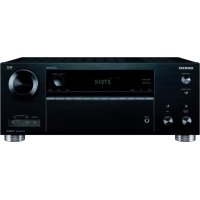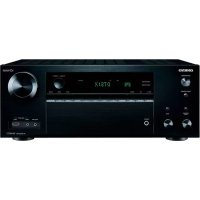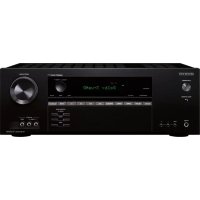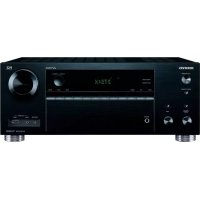
TX-NR575E - AV receiver ONKYO - Free user manual and instructions
Find the device manual for free TX-NR575E ONKYO in PDF.



| Product Type | Audio-Video Receiver |
| Brand | ONKYO |
| Model | TX-NR575E |
| Channels | 5.1 (expandable to 3.1.2) |
| Rated Output Power | 5 × 135 W (6 ohms, 1 kHz, 1 channel driven) |
| Speaker Impedance | 4 Ω to 16 Ω |
| HDMI Connectivity | Multiple HDMI inputs, HDMI output with ARC |
| Network Connectivity | Ethernet, Wi-Fi 802.11 a/b/g/n |
| Bluetooth | Version 4.1+LE, max. range 15 m |
| Supported Audio Formats | Dolby Atmos, DTS:X, Dolby TrueHD, DTS-HD Master Audio, etc. |
| Digital Audio Inputs | 2 optical, 1 coaxial |
| Analog Audio Inputs | Multiple (AUDIO IN) |
| Speaker Outputs | FRONT L/R, CENTER, SURROUND or HEIGHT L/R, SUBWOOFER PRE OUT |
| USB Port | 1 rear, USB 2.0, 5 V/1 A |
| AM/FM Radio | Yes, with RDS |
| Power Supply | AC 220-240 V, 50/60 Hz |
| Power Consumption | 400 W (operation), 0.15 W (standby) |
| Dimensions (W × H × D) | 435 × 160 × 328 mm |
| Weight | 8.5 kg |
| Supplied Accessories | Remote control, calibration microphone, FM/AM antennas |
| Maintenance | Clean with a soft, dry cloth. Avoid solvents. |
| Safety | Unplug before cleaning. Use only in a dry location. |
Frequently Asked Questions - TX-NR575E ONKYO
User questions about TX-NR575E ONKYO
0 question about this device. Answer the ones you know or ask your own.
Ask a new question about this device
Download the instructions for your AV receiver in PDF format for free! Find your manual TX-NR575E - ONKYO and take your electronic device back in hand. On this page are published all the documents necessary for the use of your device. TX-NR575E by ONKYO.
USER MANUAL TX-NR575E ONKYO
Installation procedure 8
Step1:Speaker Layout 9
Step2: Connect the Speakers 14
Step3: Connect the TV & AV Components 15
Initial Setup 20
Initial Setup with Auto Start-up Wizard 20
Playback 22
AV Component Playback 22
BLUETOOTH®Playback 23
Internet Radio 24
Spotify 26
AirPlay 27
USB Storage Device 28
Listening To the AM/FM Radio 29
Music Server 32
Supplementary information for player functions ....34
Listening Mode 35
Advanced Setup 52
Setup Menu 52
Quick Menu 66
Web Setup 68
Firmware Update 69
Supplementary Information 72
Supplementary Information 72
Others 73
Troubleshooting 73
General Specifications 78
Reference Information 80
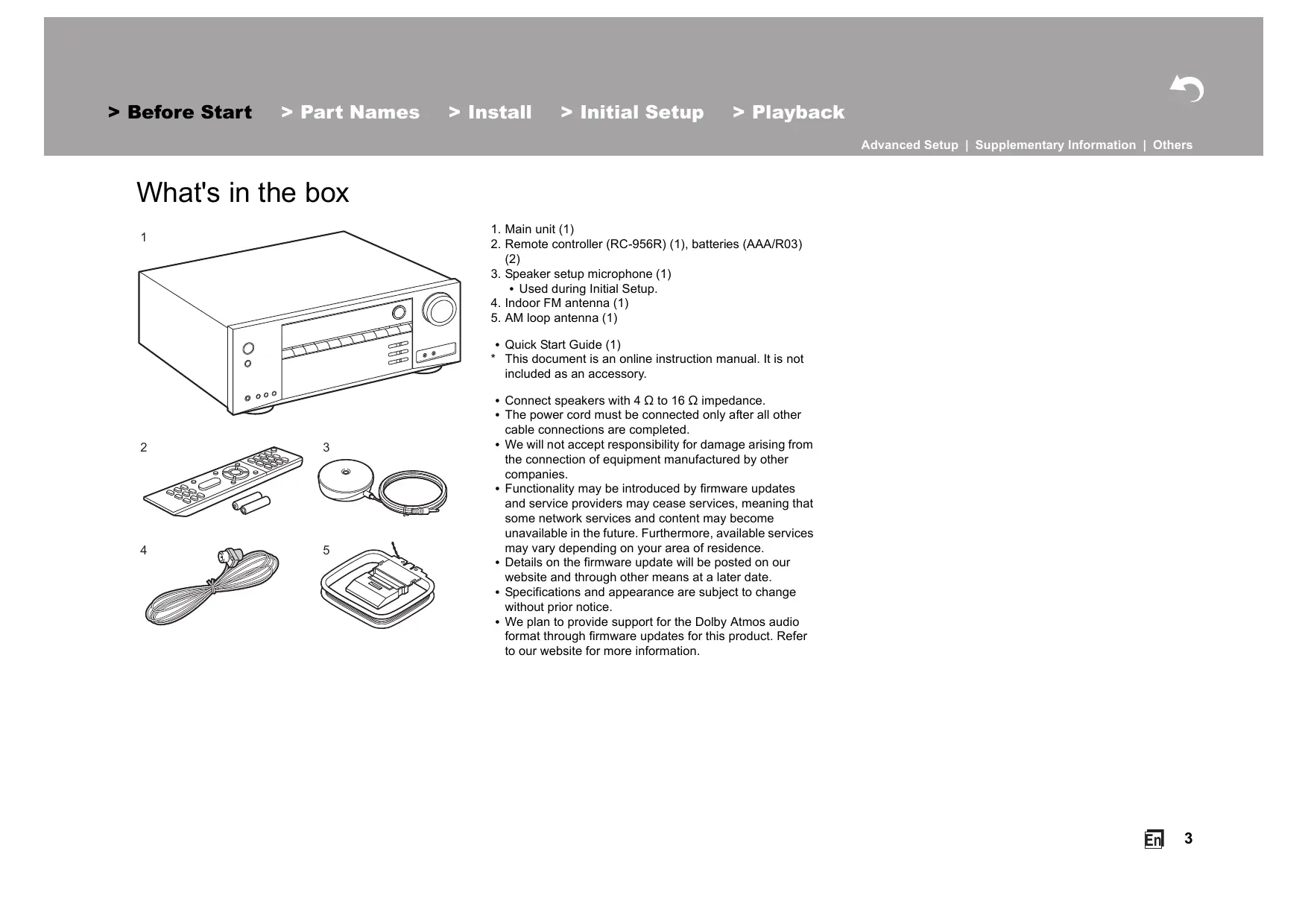
What's in the box
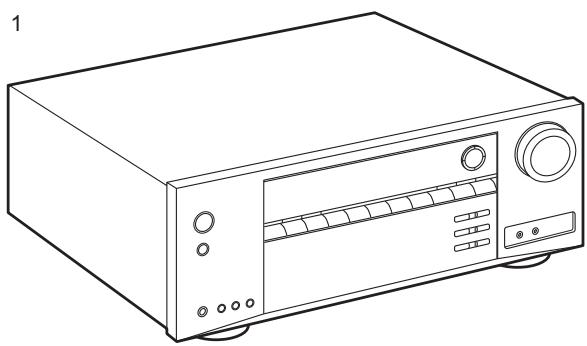
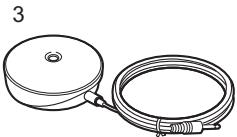
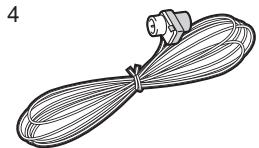
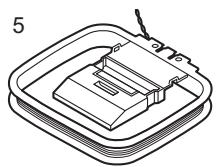
- Main unit (1)
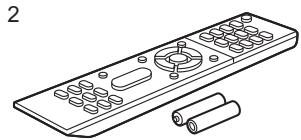
- Remote controller (RC-956R) (1), batteries (AAA/R03) (2)
- Speaker setup microphone (1)
Used during Initial Setup.
- Indoor FM antenna (1)
-
AM loop antenna (1)
-
Quick Start Guide (1)
-
This document is an online instruction manual. It is not included as an accessory.
-
Connect speakers with 4 to 16 impedance.
- The power cord must be connected only after all other cable connections are completed.
- We will not accept responsibility for damage arising from the connection of equipment manufactured by other companies.
- Functionality may be introduced by firmware updates and service providers may cease services, meaning that some network services and content may become unavailable in the future. Furthermore, available services may vary depending on your area of residence.
- Details on the firmware update will be posted on our website and through other means at a later date.
- Specifications and appearance are subject to change without prior notice.
- We plan to provide support for the Dolby Atmos audio format through firmware updates for this product. Refer to our website for more information.
Part Names
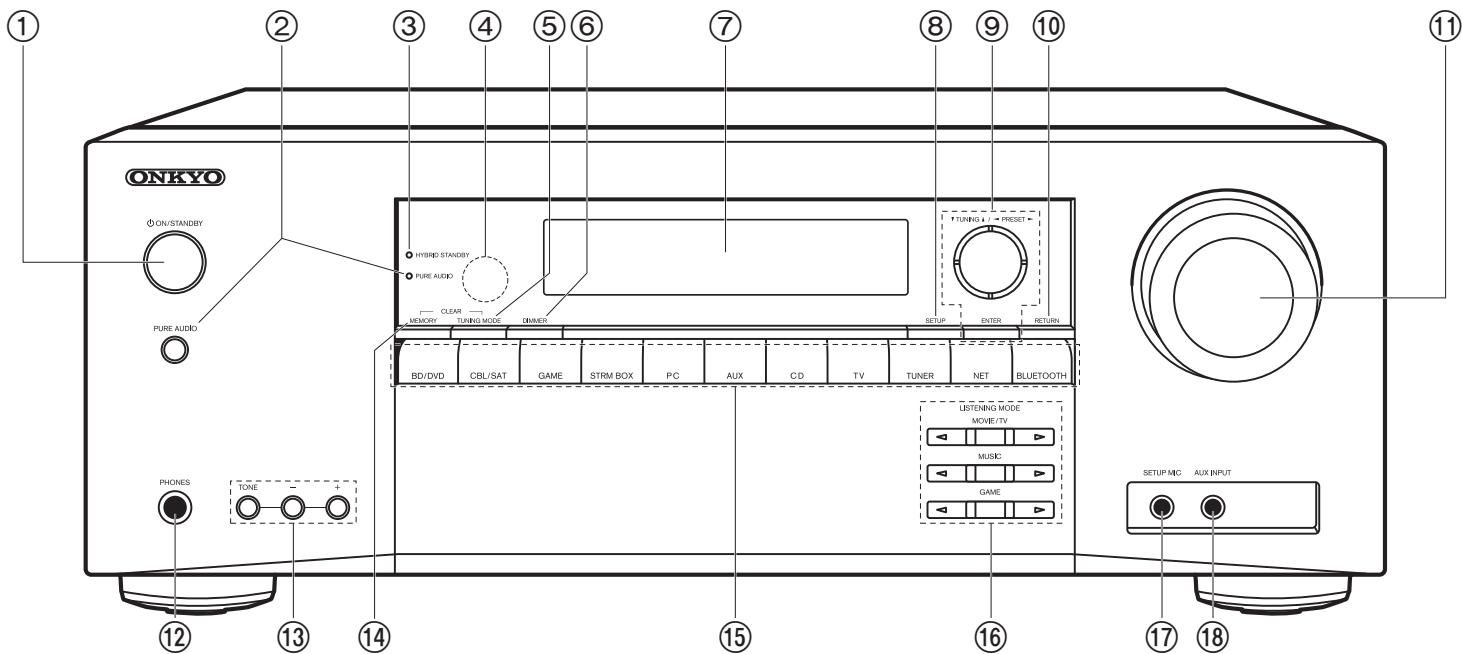
Front Panel
- ON/STANDBY button
- PURE AUDIO button/indicator: Switches the unit to Pure Audio mode (P38).
- HYBRID STANDBY indicator: Lights if the unit enters standby mode when the features are enabled that continue to work when this unit is in standby, such as HDMI Standby Through and Network Standby.
-
Remote control sensor: Receives signals from the remote controller.
-
The signal range of the remote controller is within about 16^ / 5m , at an angle of 20^ on the perpendicular axis and 30^ to either side.
-
TUNING MODE button: Switches tuning to an AM/FM station between automatic tuning and manual tuning.
-
DIMMER button: You can adjust the brightness of the display in three steps. It cannot be turned off completely.
-
Display(P5)
- SETUP button: You can show advanced setting items on the TV and display to provide you with an even better experience (P52).
- Cursor ( / / / ) , ENTER button: Select the item with the cursors and press ENTER to confirm. Use them to tune to stations when using TUNER (P29).
- RETURN button: Returns the display to the previous state during setting.
- MASTER VOLUME
12.PHONES jack: Connect stereo headphones with a standard plug (Ø 1/4''/6.3 mm diameter). - TONE and Tone Level buttons: You can adjust the sound quality of the front speakers. Press TONE to select the desired setting from "Bass" and "Treble", and adjust with the Tone Level buttons (- / +) .
- MEMORY button: Used to register AM/FM radio stations.
- Input selector buttons: Switches the input to be played.
16.LISTENING MODE buttons: Select listening modes (P35).
17. SETUP MIC jacks: Connect the supplied speaker setup microphone.
18.AUX INPUT jacks: Connect a video camera, etc., using a stereo mini plug cable (Ø 1/8''/3.5 mm).
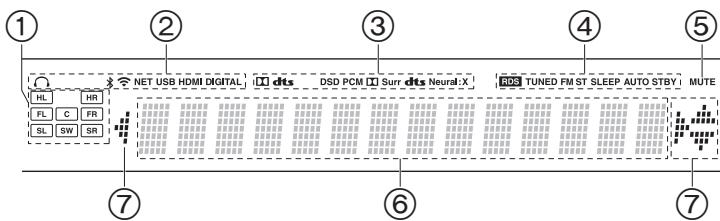
Display
- Speaker/Channel display: Displays the output channel that corresponds to the selected listening mode.
- Lights in the following conditions.
: When headphones are connected
: When connected via BLUETOOTH
: When connected by Wi-Fi
NET: When "NET" is selected with the input selector and the unit is connected to the network. It will flash if the connection to the network is not correct.
USB: When "NET" is selected with the input selector and the unit is connected by USB and the USB device is selected. Flashes if the USB is not properly connected.
HDMI: HDMI signals are input and the HDMI input selector is selected. DIGITAL: Digital signals are input and the digital input selector is selected.
- Lights according to the type of input digital audio signals and the listening mode.
- Lights in the following conditions.
RDS: Receiving RDS broadcasting.
TUNED: Receiving AM/FM radio.
FM ST: Receiving FM stereo.
SLEEP: Sleep timer has been set.
AUTO STBY: Auto Standby has been set.
- Flashes when muting is on.
- Displays various information of the input signals.
- This may light when performing operations with the "NET" input selector.
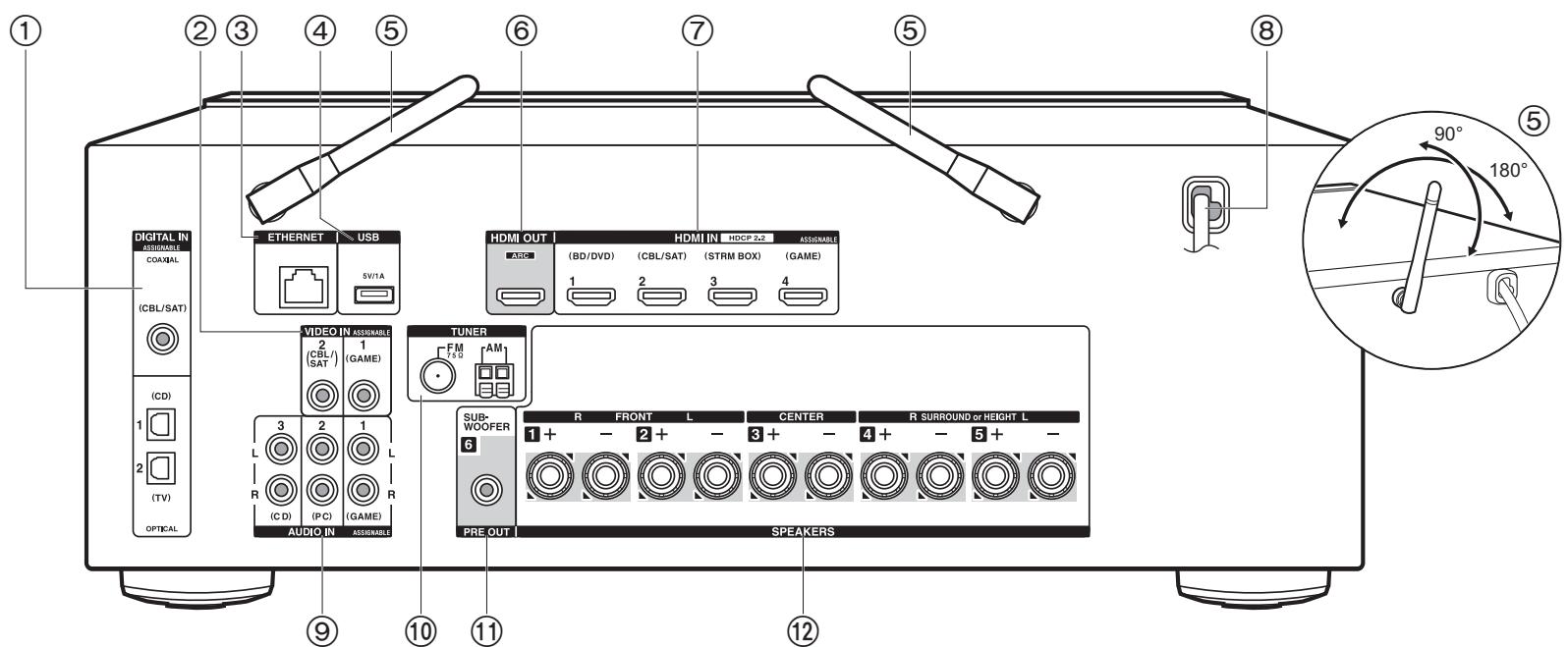
Rear Panel
- DIGITAL IN OPTICAL/COAXIAL jacks: Input TV or AV component digital audio signals with a digital optical cable or digital coaxial cable.
- VIDEO IN jacks: Input the video signals of an AV component with an analog video cable.
- ETHERNET jack: Connect to the network with an Ethernet cable.
- USB jack: A USB storage device is connected so that music files stored in it can be played. You can also supply power (5 V/1 A) to USB devices with a USB cable.
- Wireless antenna: Raise for Wi-Fi connection or when using a BLUETOOTH wireless technology enabled device. Adjust their angles according to the connection status.
- HDMI OUT jack: Connect a HDMI cable to transfer video signals and audio signals to a TV.
-
HDMI IN jacks: Input video signals and audio signals with a HDMI cable connected to an AV component.
-
Power cord
- AUDIO IN jacks: Input AV component audio signals with an analog audio cable.
- TUNER AM/FM 75Ω jacks: Connect the supplied antenna.
- SUBWOOFER PRE OUT jack: Connect a powered subwoofer with a subwoofer cable.
- SPEAKERS jacks: Connect speakers with speaker cables.
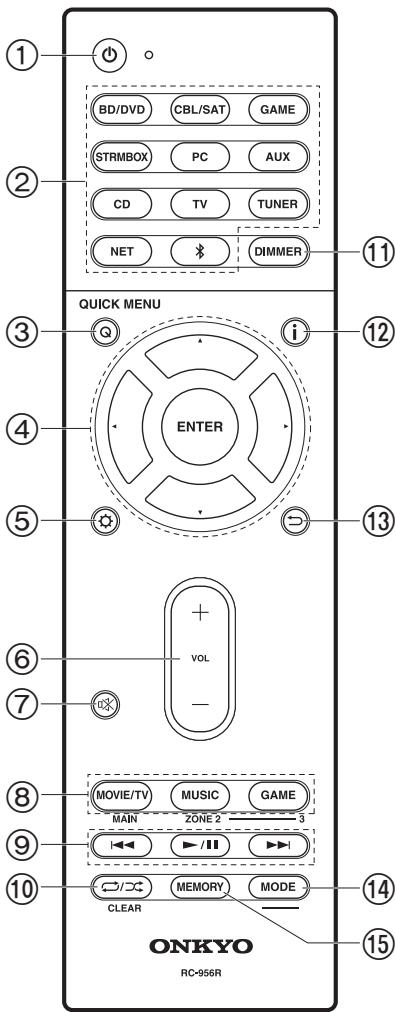
Remote Controller
- ON/STANDBY button
- Input selector buttons: Switches the input to be played.
- Q (QUICK MENU) button: Settings such as "Tone" and "Level" can be made quickly during play on the TV screen (P66).
- Cursor, ENTER button: Select the item with the cursors and press ENTER to confirm. When the folder or file lists are not shown on one screen on the TV, press to change the screen.
- button: You can show advanced setting items on the TV and display to provide you with an even better experience (P52).
- Volume buttons
- 品 button:Temporarily mutes audio. Press again to cancel muting.
- LISTENING MODE buttons: Select listening modes (P35).
- Play button: Used for play operations when playing Music Server or USB.
- button: Used for repeat or random play operations when playing Music Server or USB. Each time you press the button, the mode switches from 1 (1-track repeat), to 2 (folder repeat), to 3 (random). CLEAR button: Deletes all characters you have entered when entering text on the TV screen.
- DIMMER button: You can adjust the brightness of the display in three steps. It cannot be turned off completely.
- i button: Switches the information on the display and is used to operate RDS (P30).
- button: Returns the display to the previous state during setting.
14.MODE button: Switches tuning to an AM/FM station between automatic tuning and manual tuning. - MEMORY button: Used to register AM/FM radio stations.
- MAIN and ZONE buttons are not used.
Installation procedure
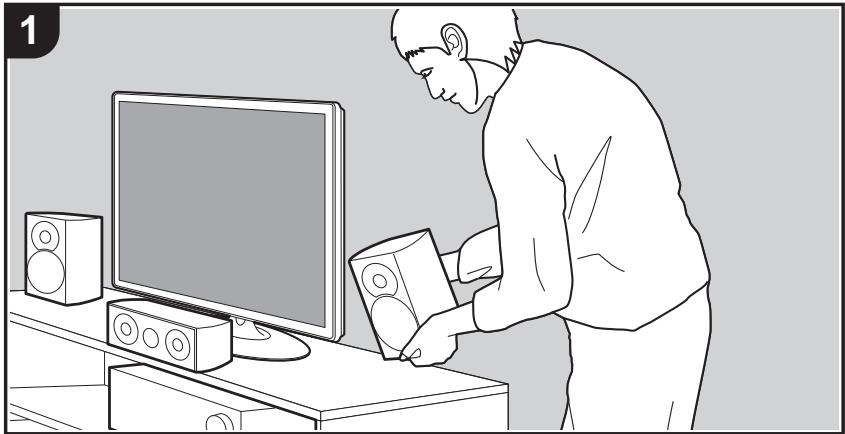
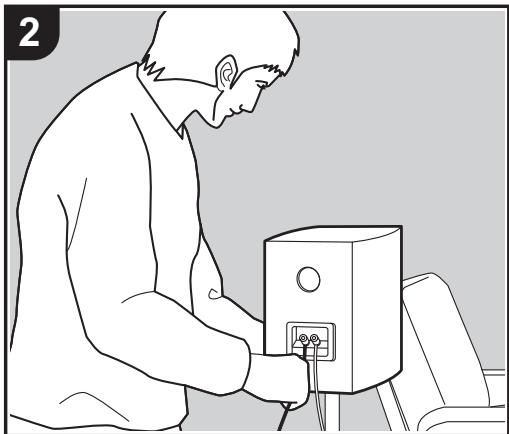
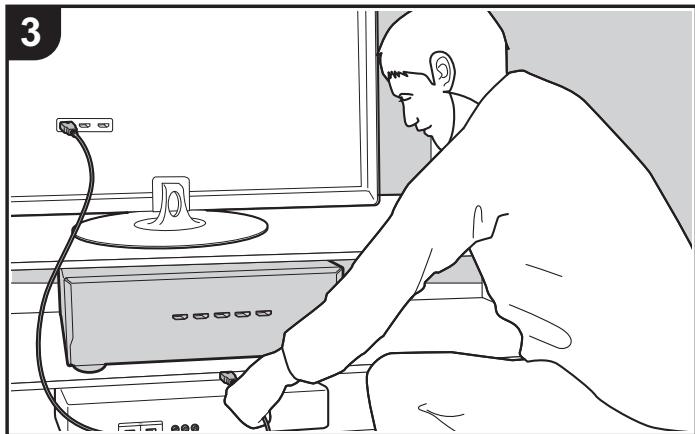
This unit can be used in a number of ways, depending on the layout of the speakers you are installing, and the connections made to external devices. Read the following to help make the installation process smoother.
Step1: Speaker Layout
Select the speaker layout that suits the types of speakers you have and the conditions they will be used in from the choices presented on pages P9 to P12, then install the speakers by referring to the illustrations and explanations on the relevant page. Speaker layouts include systems that use surround speakers and systems that use height speakers. Also refer to the combinations available in "Speaker combinations" on P13.
Step2: Connect the Speakers
Connect the speaker system to this unit. The connection process will be smoother if you refer to the illustrations and explanations and prepare the required cables before hand.
Step3: Connect the TV & AV Components
Refer to P15 to P19 to connect your external devices such as your TV, Blu-Ray Disc Player, and also supplied accessories such as the antennas. The connection process will be smoother if you refer to the illustrations and explanations, confirm the connection types on the external devices, and prepare the required cables before hand.
Step1: Speaker Layout
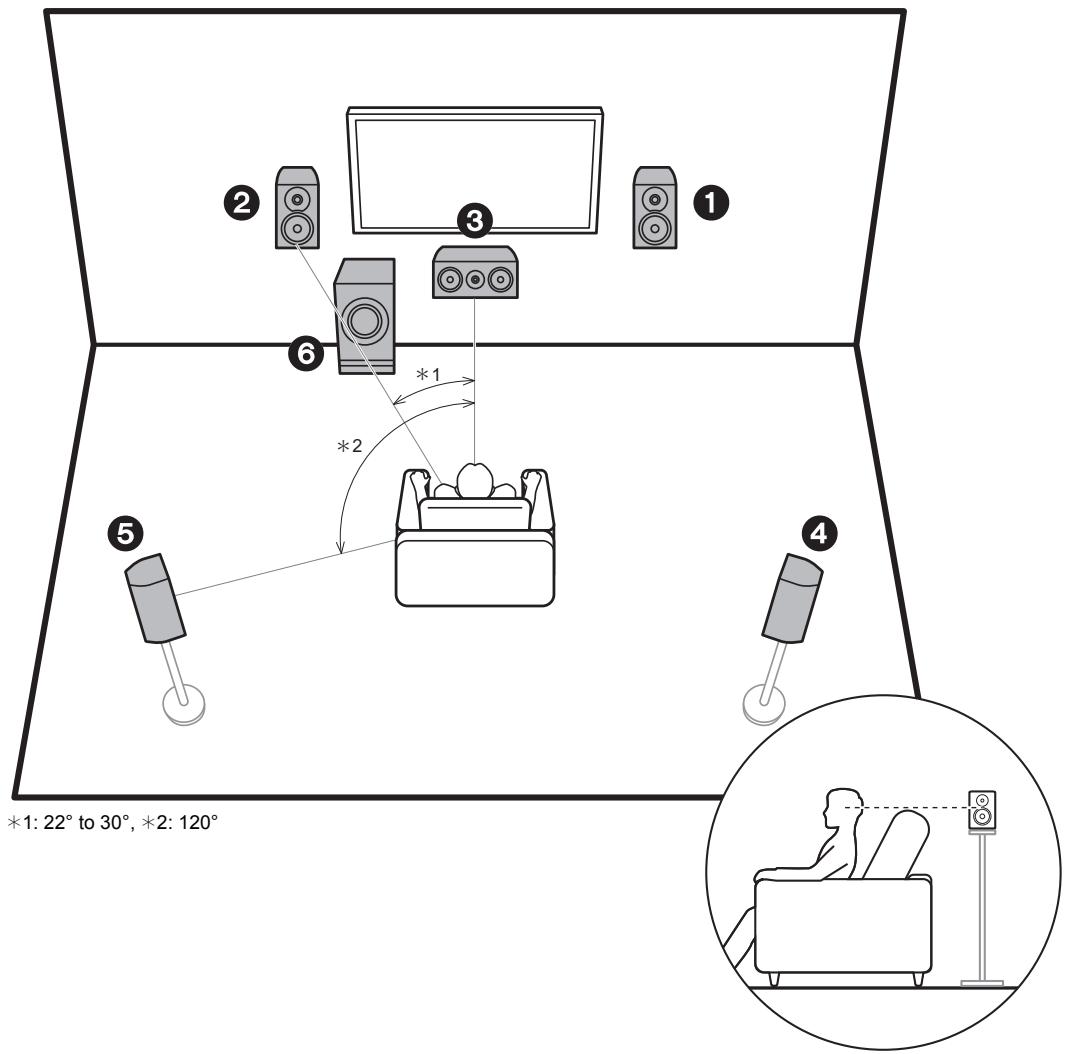
5.1 Channel System
Front speakers output front stereo sound and the center speaker outputs sounds emanating from the center of the screen, such as dialog and vocals. Surround speakers create the sound field at the rear. The powered subwoofer reproduces bass sounds and enriches the sound field. The optimal positioning for front speakers is at ear height, and for surround speakers it is just above ear height. The center speaker should be set up at an angle to face the listening position. Placing the powered subwoofer between the center speaker and a front speaker gives you a natural sound even when playing music.
1,2 Front Speakers
3 Center Speaker
4,5 Surround Speakers
6 Powered Subwoofer
*1: 22° to 30°
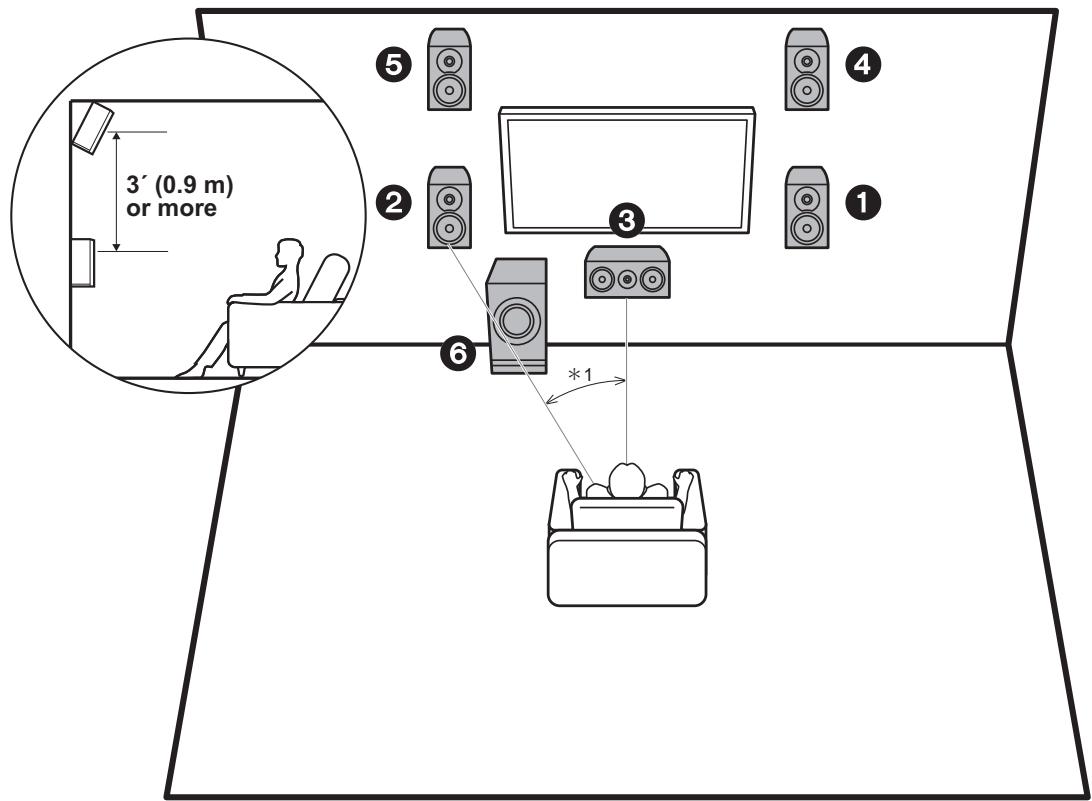
3.1.2 Channel System-1
(Front High Speakers)
This is a 3.1-channel system consisting of front speakers, a center speaker, and a powered subwoofer, with the addition of front high speakers, a type of height speaker. Front high speakers should be situated at least 3^ / 0.9 m higher than the front speakers. They should also be put directly above the front speakers, angled to face the listening position.
- We plan to provide support for the Dolby Atmos audio format through firmware updates for this unit. After this firmware update, by installing height speakers, you can select the Dolby Atmos listening mode, which realizes the most up-to-date 3D sound including overhead sounds, when the input format is Dolby Atmos. Visit our website for details about firmware updates.
1,2 Front Speakers
3 Center Speaker
4,5 Front High Speakers
6 Powered Subwoofer
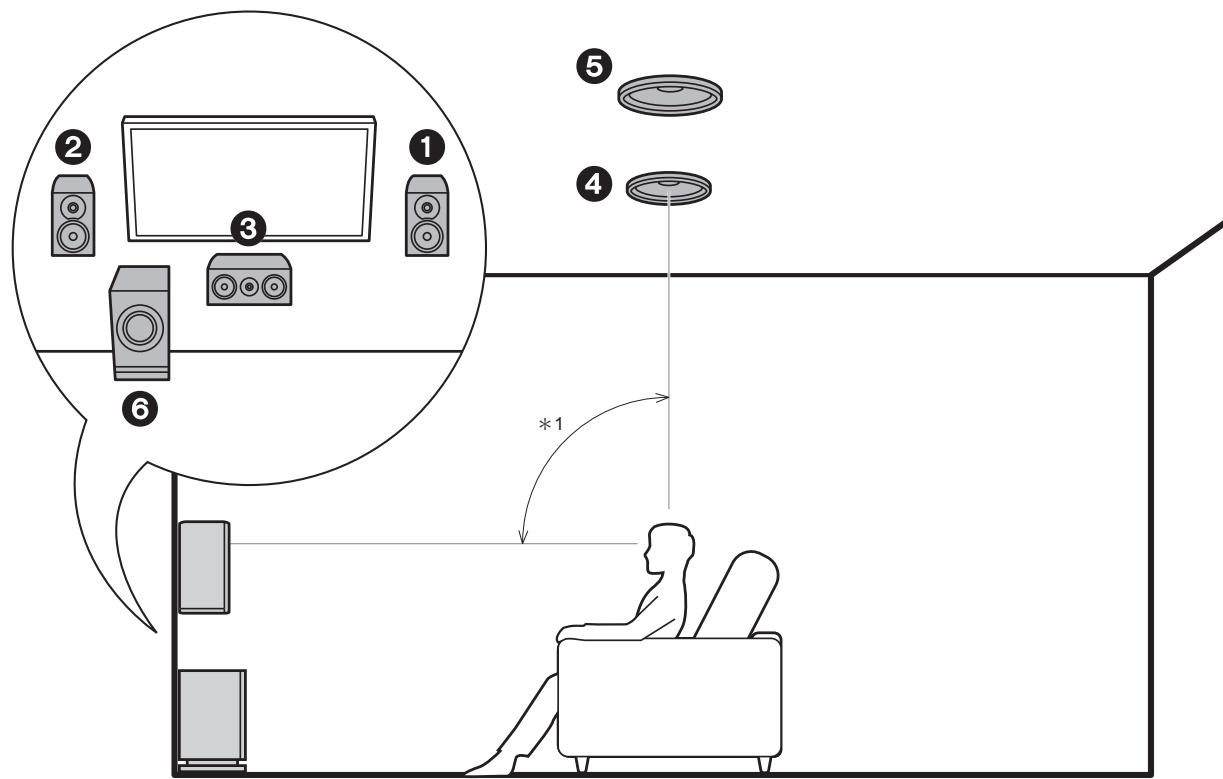
*1: 65° to 100°
3.1.2 Channel System-2 (Ceiling Speakers)
This is a 3.1-channel system consisting of front speakers, a center speaker, and a powered subwoofer, with the addition of top middle speakers, a type of height speaker. Fit top middle speakers on the ceiling directly above the listening position. The distance between each pair should match the distance between the two front speakers.
-
We plan to provide support for the Dolby Atmos audio format through firmware updates for this unit. After this firmware update, by installing height speakers, you can select the Dolby Atmos listening mode, which realizes the most up-to-date 3D sound including overhead sounds, when the input format is Dolby Atmos. Visit our website for details about firmware updates.
-
Dolby Laboratories recommends placing this type of height speakers to obtain the best Dolby Atmos effect.
1,2 Front Speakers
3 Center Speaker
4,5 Top Middle Speakers
6 Powered Subwoofer
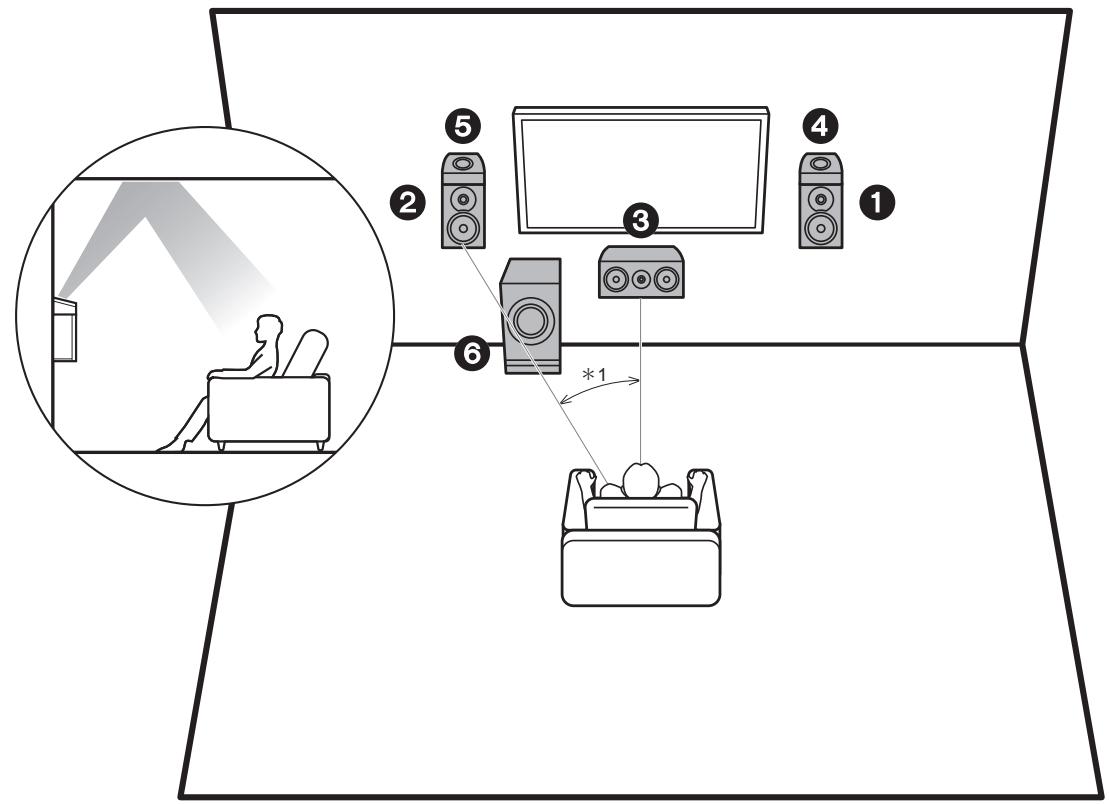
*1: 22° to 30°
3.1.2 Channel System-3
(Dolby Enabled Speakers (Dolby Speakers))
This is a 3.1-channel system consisting of front speakers, a center speaker, and a powered subwoofer, with the addition of Dolby enabled speakers (front), a type of height speaker. Dolby enabled speakers are special speakers designed to face the ceiling so that sound is heard after bouncing off the ceiling so that sound appears to be coming from overhead. Place Dolby enabled speakers (front) above the front speakers.
- We plan to provide support for the Dolby Atmos audio format through firmware updates for this unit. After this firmware update, by installing height speakers, you can select the Dolby Atmos listening mode, which realizes the most up-to-date 3D sound including overhead sounds, when the input format is Dolby Atmos. Visit our website for details about firmware updates.
1,2 Front Speakers
3 Center Speaker
4,5 Dolby Enabled Speakers (Front)
6 Powered Subwoofer
Speaker combinations
| Speaker Channels | FRONT | CENTER | SURROUND | HEIGHT |
| 2.1 ch | ✓ | |||
| 3.1 ch | ✓ | ✓ | ||
| 4.1 ch | ✓ | ✓ | ||
| 5.1 ch | ✓ | ✓ | ✓ | |
| 2.1.2 ch | ✓ | ✓ | ||
| 3.1.2 ch | ✓ | ✓ | ✓ |
Step2: Connect the Speakers
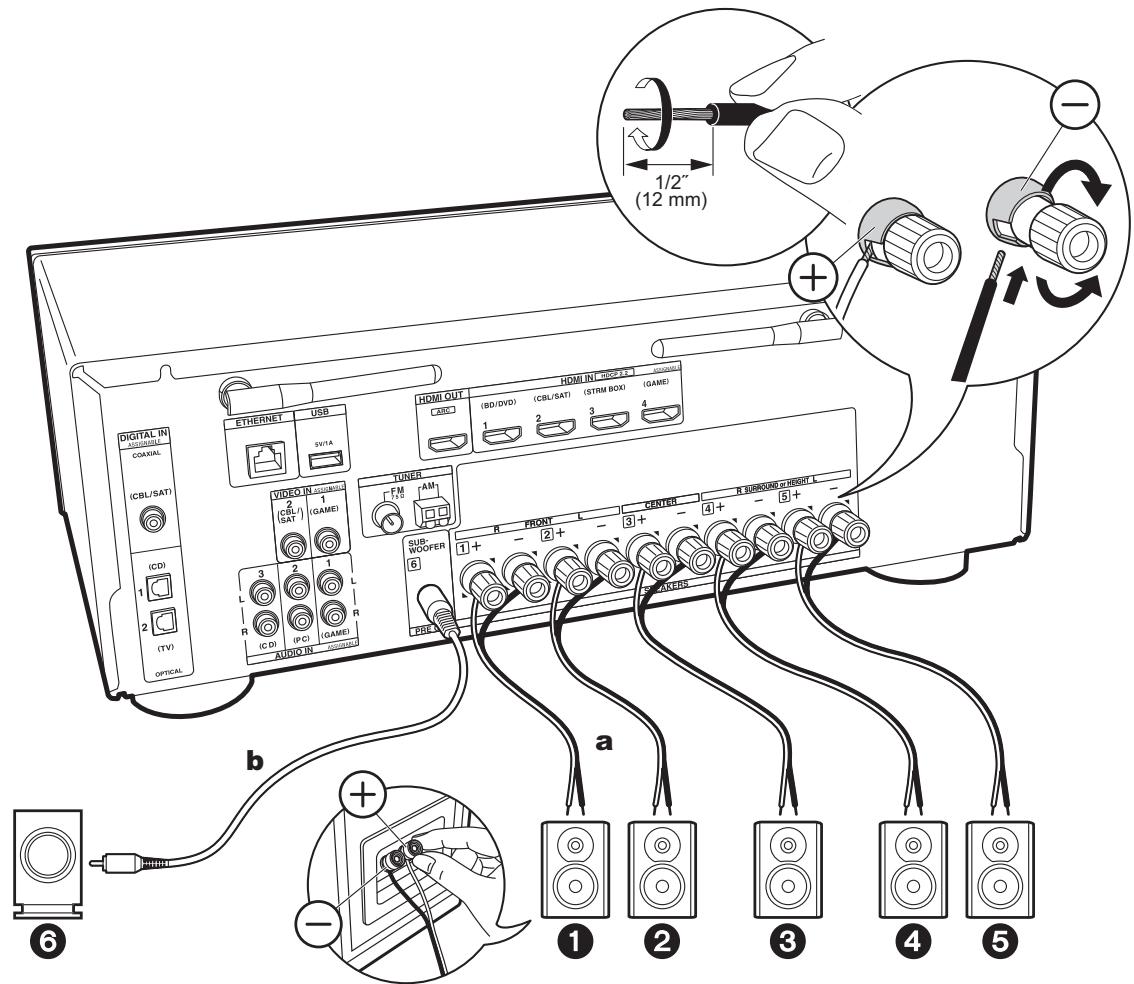
a Speaker cable, b Subwoofer cable
Make correct connection between the unit's jacks and speaker's jacks (+ to + and - to -) for each channel. If connection is wrong, reverse phase may make bass output poor.

Setup
- Settings for the speaker configuration you have connected need to be made in "1. AccuEQ Room Calibration" in Initial Setup (P20).
- If any of the connected speakers have an impedance of 4 or more to less than 6 , after completing Initial Setup, you need to make some settings in the Setup menu. Press on the remote controller, select "2. Speaker" - "Configuration" and set "Speaker Impedance" to "4ohms".
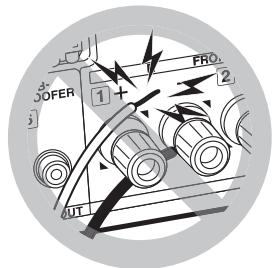
Connect the speaker cable so the wires do not protrude from the speaker jacks.
If the exposed wires of the speakers touch the rear panel or the + and - wires touch each other, the protection circuit will be activated.
Step3: Connect the TV & AV Components
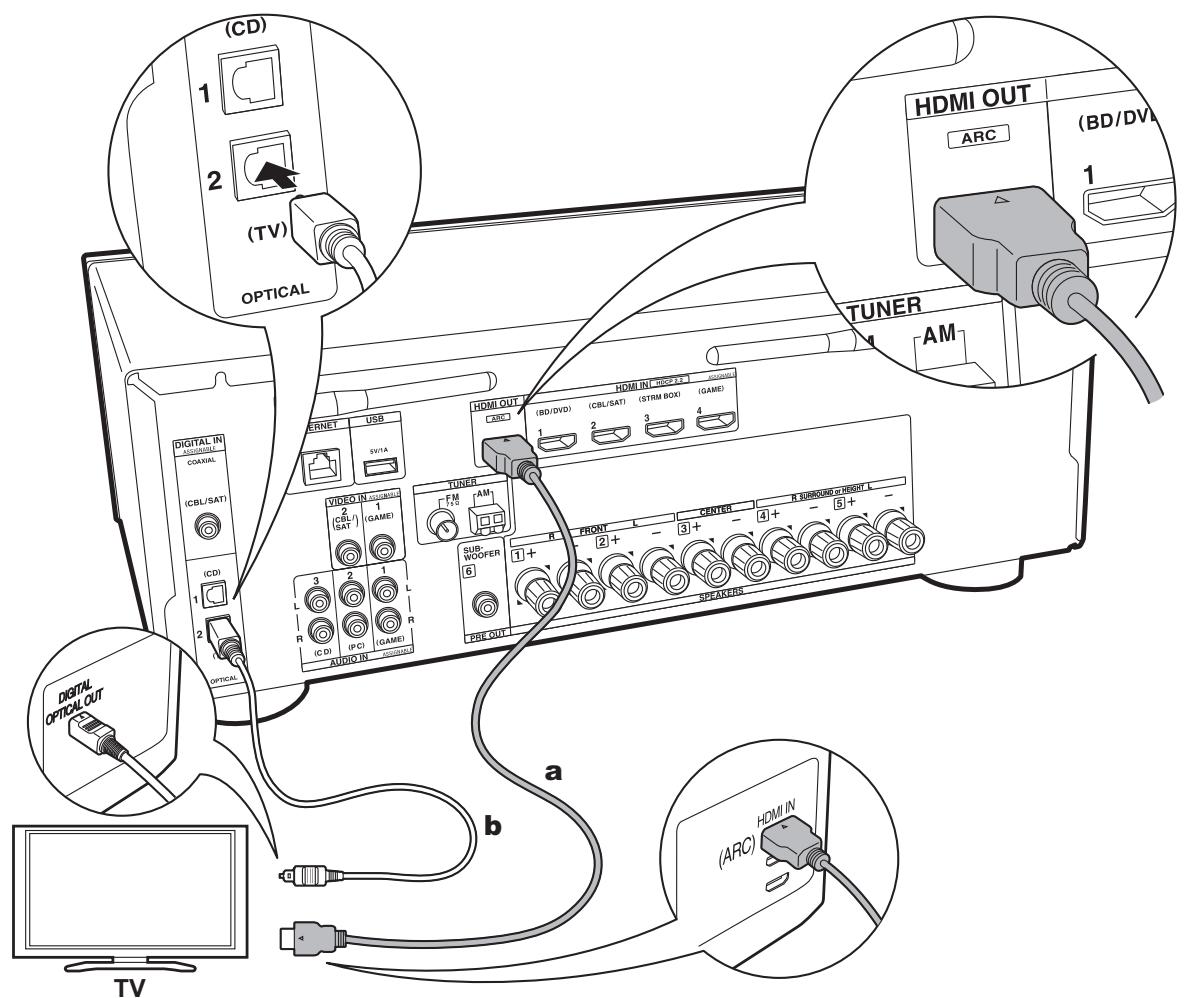
a HDMI cable, b Digital optical cable
1. Connect the TV
To ARC TV
For a TV that supports the ARC (Audio Return Channel) feature, use an HDMI cable and connect according to illustration "a". Choose an HDMI IN jack on the TV that supports ARC when connecting.

Setup
- Settings are required to use the ARC function. For "4. Audio Return Channel" (P21) in Initial Setup, select "Yes".
Refer to the instruction manual for the TV for TV connections and instructions regarding settings for CEC features and audio output.
To Non-ARC TV
For a TV that does not support the ARC (Audio Return Channel) feature (^*) , connect both the HDMI cable in illustration "a" and the digital optical cable in "b".
- Connection with a digital optical cable is not necessary if you will watch TV through a device such as a cable set-top box (that is, not use a tuner built into the TV) that you have connected to the input jack on this unit.
(*) The ARC feature: This feature transfers TV audio signals via HDMI cable so that you can play the audio from the TV through this unit. Connection to an ARC compatible TV is complete with one HDMI cable. Refer to the instruction manual for your TV to see if it supports ARC.
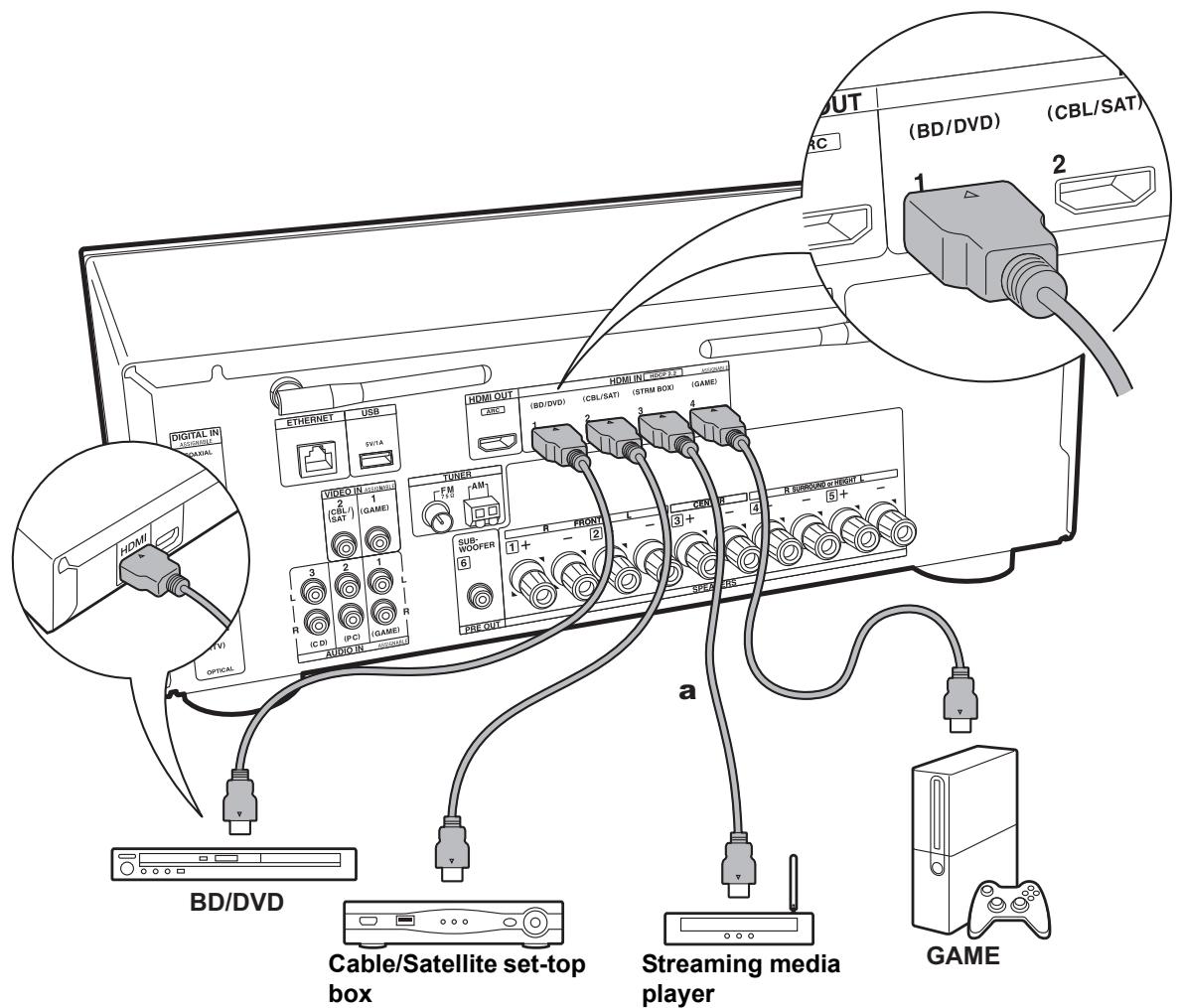
a HDMI cable
2. Connect the HDMI AV Component
This is an example of connection with an AV component that has an HDMI jack. With connection to an AV component that conforms with the CEC (Consumer Electronics Control) standard, you can use features such as the HDMI CEC feature (*) that links with the input selector, and the HDMI Standby Through feature which allows you to play video and audio from AV components on the TV even when this unit is in standby mode.
- To play 4K or 1080p video, use the high speed HDMI cable.

Setup
- When "Yes" is selected for "4. Audio Return Channel" in Initial Setup (P21), the HDMI CEC function and HDMI Standby Through function are automatically enabled. If "No, Skip" is selected, settings are required in the Setup menu after Initial Setup is complete. Press on the remote controller and make the settings in "5. Hardware" - "HDMI".
To enjoy digital surround sound including Dolby Digital, audio output should be set to "Bitstream output" on the connected Blu-ray Disc player or other device.
(*) The HDMI CEC feature: You can control features such as linking input switching with the input selector and players conforming to the CEC standard, switching audio to output it from the TV or from this unit, and adjusting the volume using the remote controller of a CEC-compliant TV, and automatically switching this unit to standby when the TV is turned off.
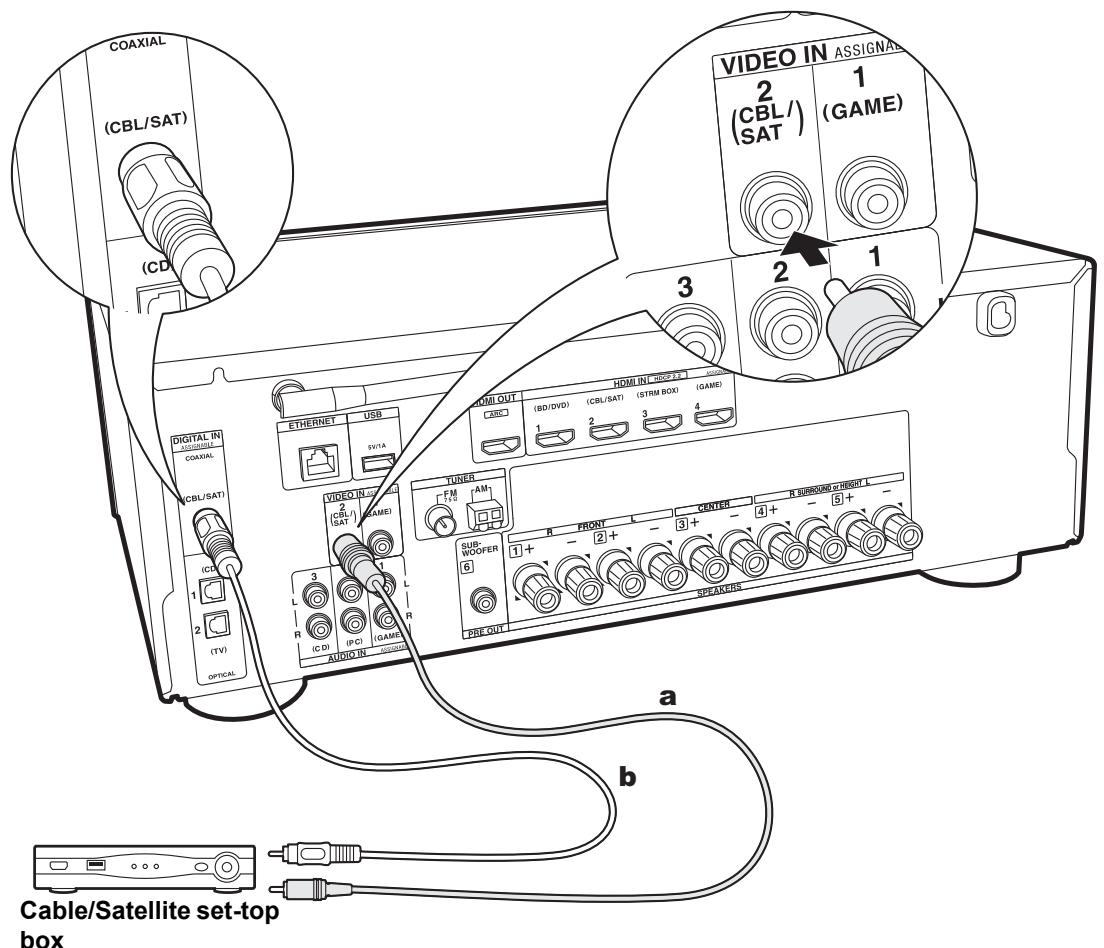
a Analog video cable, b Digital coaxial cable
3. Connect the Non-HDMI AV Component
This is an example of connection with an AV component that does not have an HDMI jack. Select the cables to make the connections to the AV component to match the jacks it has. When video input connection is to the CBL/SAT jack, the audio input connection should also be to the CBL/SAT jacks, and so on, so that you connect the video input jacks to the jacks with the same name as the audio input jacks. Note that video signals input to the VIDEO IN jack will be converted to HDMI video signals and then output from the HDMI OUT output jack.
- To enjoy digital surround playback, such as Dolby Digital, the audio signals need to pass through a connection via digital coaxial cable or digital optical cable.
- It is possible to change assignment of the input jacks you see in the illustration at left, so you can also connect to any jack other than CBL/SAT (P53, 54).

Setup
- To enjoy digital surround sound including Dolby Digital, audio output should be set to "Bitsstream output" on the connected Cable/Satellite set-top box or other device.
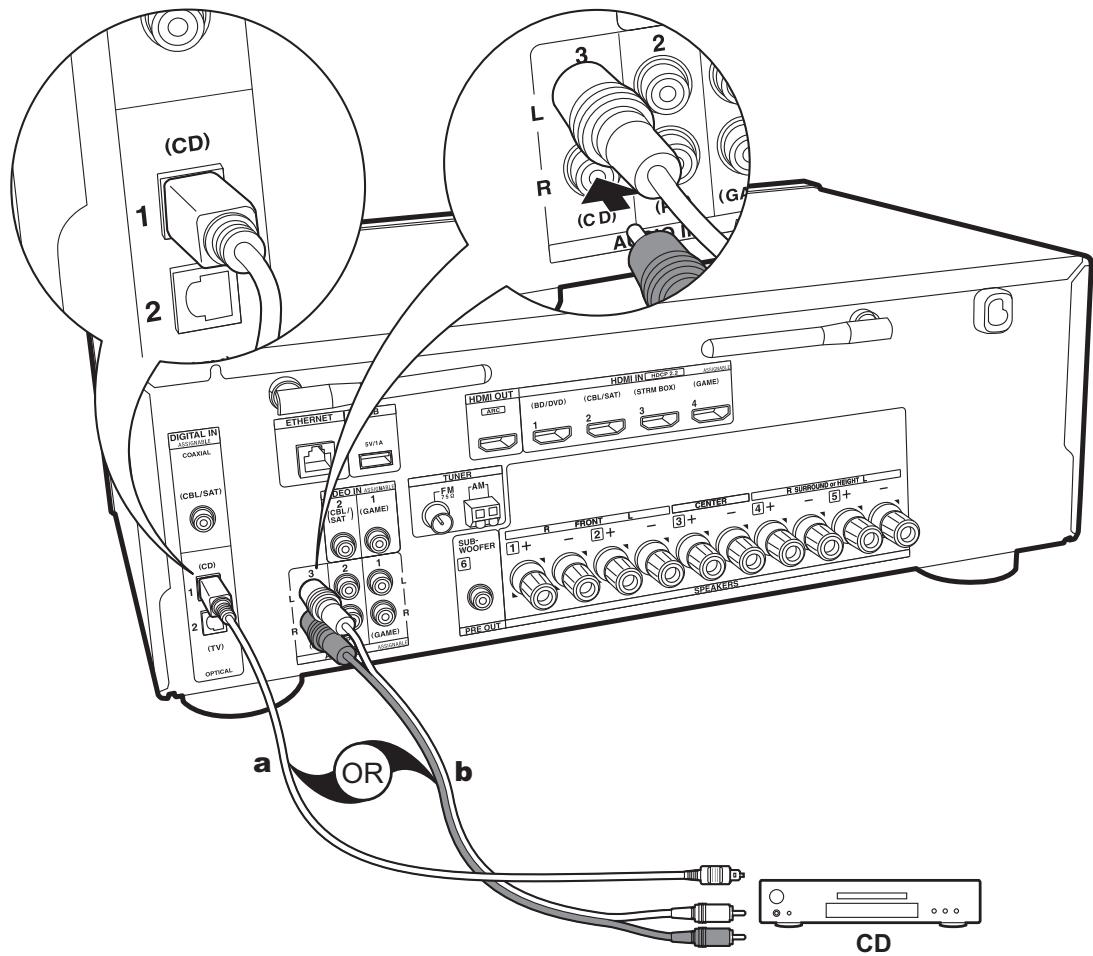
a Digital optical cable, b Analog audio cable
4. Connect the Audio Component
Example of a connection with an Audio component. Connect a CD player using a digital optical cable or analog audio cable.
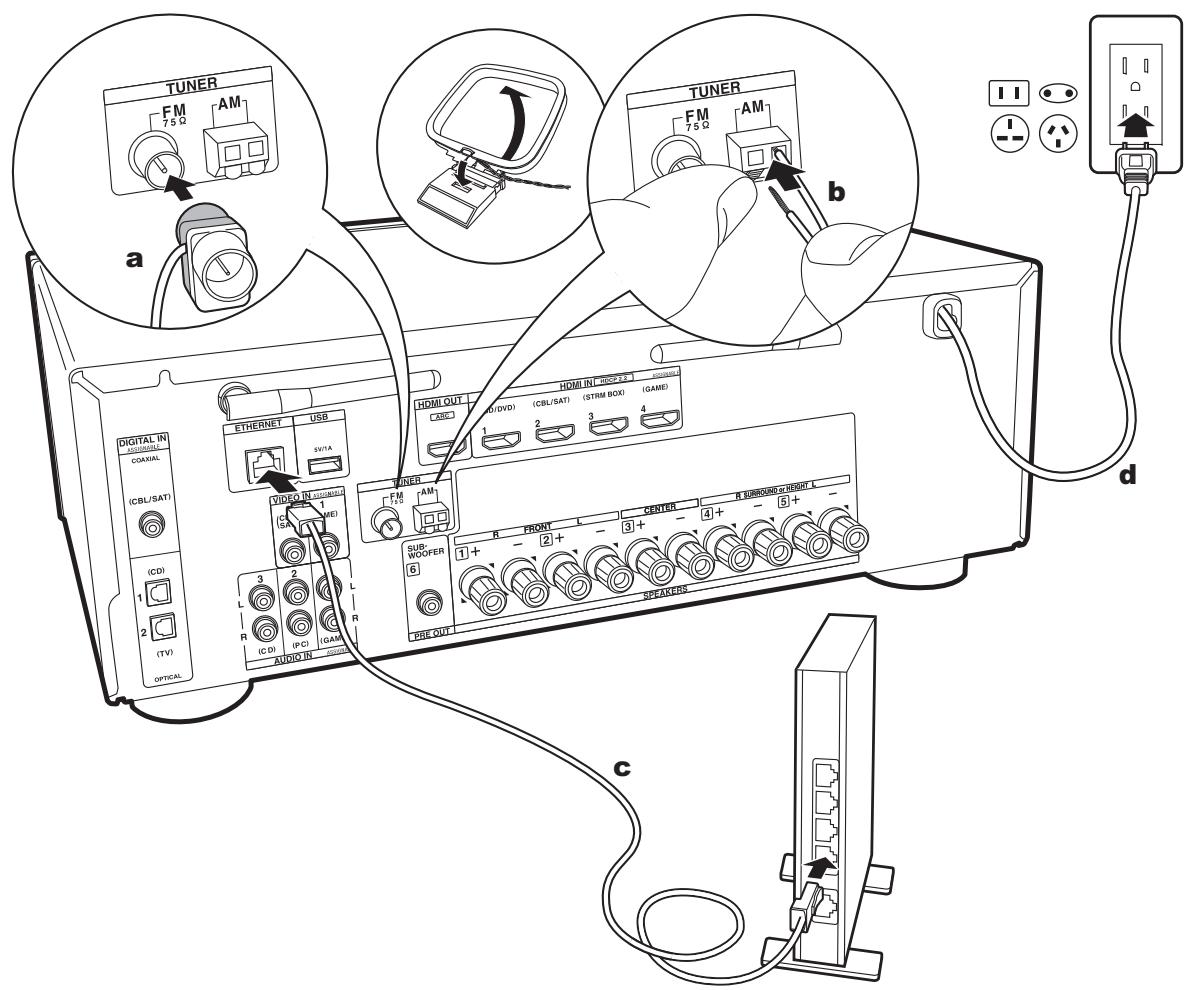
a FM indoor antenna, b AM indoor antenna, c Ethernet cable, d Power cord
5. Connect Other Cables
Antenna Hookup
Move the antenna around while playing the radio to find the position with the best reception. Use a thumb tack or similar to attach the FM indoor antenna to a wall.
Network Hookup
Connect this unit to the network using wired LAN or Wi-Fi (wireless LAN). You can enjoy Network Functions such as internet radio by connecting to the network. If you connect by wired LAN, connect to the router with an Ethernet cable to the ETHERNET port as shown in the illustration. To connect by Wi-Fi, after selecting "Wireless" in "3. Network Connection" (P21) in Initial Setup, select the desired setting method and follow the onscreen instructions to configure the connection.
Power Cord Hookup
The power cord must be connected only after all other connections are completed.
Initial Setup with Auto Start-up Wizard
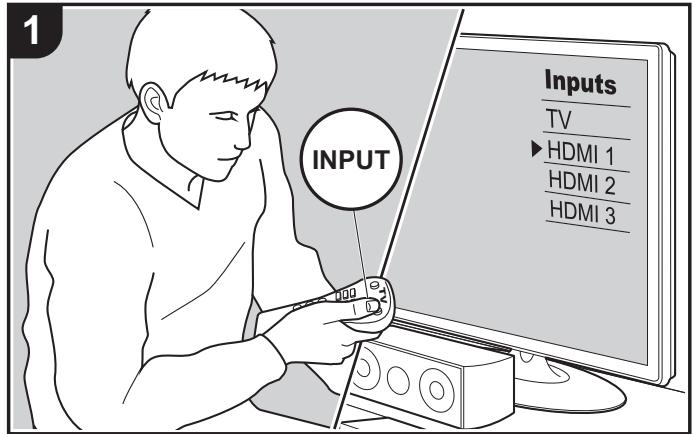
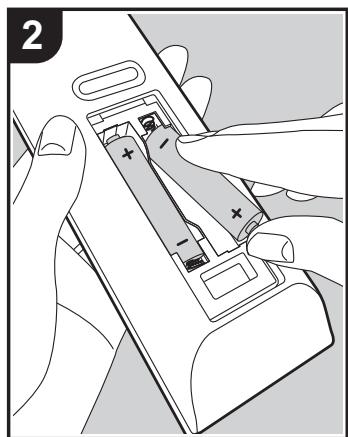
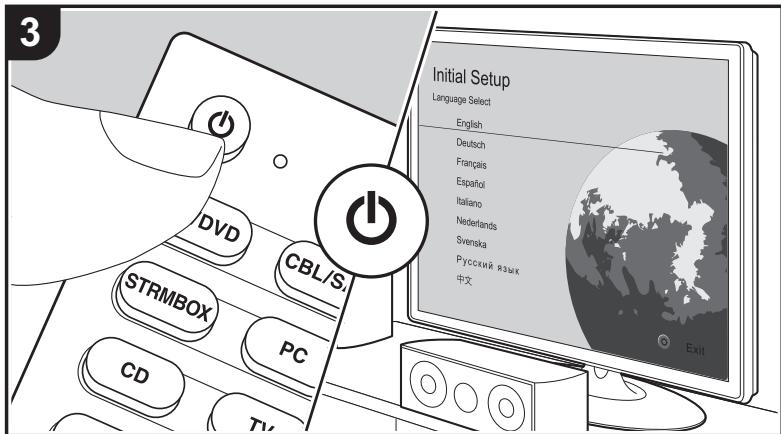
Initial Setup starts automatically
When you turn the unit on for the first time after purchasing it, Initial Setup is automatically shown on the TV to enable you to make settings required for startup using simple operations following onscreen guidance.
- Switch the input on the TV to that assigned to the unit.
- Put batteries into the remote controller of this unit.
- Press on the remote controller to turn the unit on.
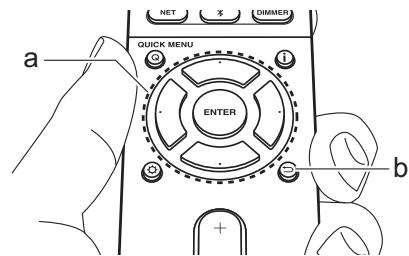
- Select the item with the cursors of the remote controller and press ENTER (a) to confirm your selection. To return to the previous screen, press (b).
- If you terminate the procedure on the way or want to change a setting made during Initial Setup, press on the remote controller, and select "6. Miscellaneous" - "Initial Setup" and press ENTER. To select the language displayed again, change "OSD Language" (P52).
1. AccuEQ Room Calibration
Place the supplied speaker setup microphone in the listening position, measure the test tones emitted by the speakers, then the unit automatically sets the optimum volume level for each speaker, the crossover frequencies, and the distance from the listening position. This also automatically adjusts the equalizers for the speakers and enables correction of distortion caused by the acoustic environment of the room.
- Calibration takes between 3 and 12 minutes to be completed. The speakers emit the test tone at high volume during measurement, so be careful of your surroundings. Also, keep the room as quiet as possible during measurement.
- If you have connected a subwoofer, check the power and volume of the subwoofer. Set the subwoofer volume to more than halfway.
-
If the power of this unit suddenly turns off, the wires in the speaker cables may have touched the rear panel or other wires and tripped the protection circuit. Twist the wires again properly and make sure they do not stick out of the speaker terminals when connecting.
-
Place the supplied speaker setup microphone in the listening position, and connect to the SETUP MIC jack on the main unit.
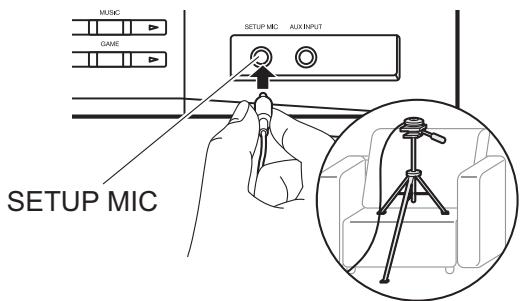
When putting the speaker setup microphone on a tripod, refer to the illustration when putting it in place.
- Select the connected speaker configuration.
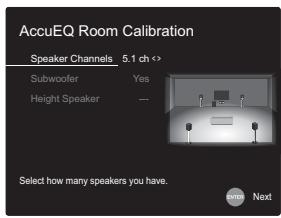
The image on the screen changes as you choose the number of channels in "Speaker Channels", so refer to it when performing the settings.
- Test tones are emitted by the speakers, and firstly the unit detects the speakers connected and the noise in the environment.
- After the results of the measurements in step 3 above are displayed, select "Next", press ENTER on the remote controller, and the test tones are emitted again, and the unit automatically makes settings such as the optimum volume level and the crossover frequency.
- When the measurement is completed, the measurement result is displayed. Press the cursors / on the remote controller to check the settings. Select "Save" and press ENTER to save the settings.
- Select whether to enable or disable the equalizer function that corrects for distortion caused by the acoustic environment of the room. If this is to be enabled, then normally you should select "On (All Channels)", and to disable just the front speakers you should select "On (Except Front Left / Right)".
- Disconnect the speaker setup microphone.
2. Source Connection
Check that each input source is connected correctly. Follow the guidance, select the input you want to confirm, start play of the selected player, and confirm that the images appear on the TV and that sound is played.
■ 3. Network Connection
Set up Wi-Fi connection with an access point such as a wireless LAN router. There are the following two methods of connecting by Wi-Fi:
"Scan Networks": Search for an access point from this unit. Find out the SSID of the access point beforehand.
"Use iOS Device (iOS7 or later)": Connect by sharing the iOS device's Wi-Fi settings with this unit.
If you select "Scan Networks", there are a further two choices of connection method. Check the following.
"Enter Password": Enter the password (or key) of the access point to connect.
"Push Button": If the access point has an automatic connection button, you can connect without entering a password.
- If the SSID of the access point is not displayed, then in the screen listing the SSIDs, select "Other..." with the cursor on the remote controller and press ENTER, then follow the onscreen instructions.
Keyboard input
To switch between upper and lower case, select "A/a" on the screen and press ENTER. To select whether to mask the password with ^ 串 or display it in plain text, press MEMORY on the remote control. Pressing CLEAR will delete all the input characters.
- A confirmation screen asking you to agree to the privacy policy is displayed during network setting. Select "Accept" and press ENTER to indicate agreement.
4. Audio Return Channel
If you have connected a TV that supports ARC, select "Yes". This unit's ARC setting turns on and you can listen to the TV's audio through this unit.
AV ComponentPlayback
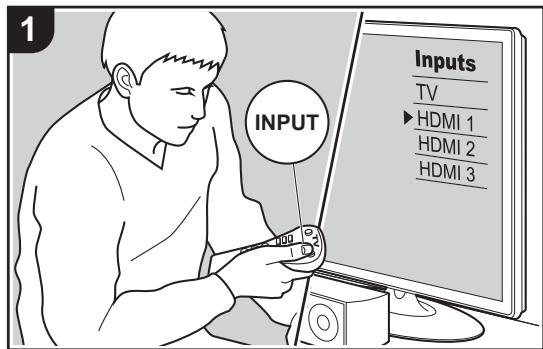
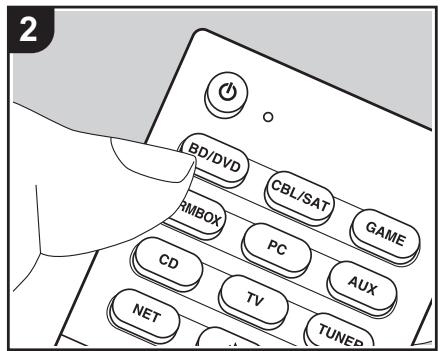
Basic operations
You can play the audio from AV components such as Blu-ray Disc players through this unit.
Perform the following procedure when the unit is on.
- Switch the input on the TV to that assigned to the unit.
-
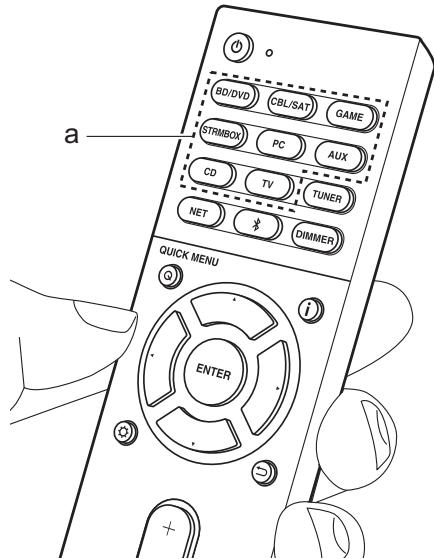
Press the input selector (a) on the remote controller with the same name as the jack to which you connected the player to switch the input. For example, press the BD/DVD button to play the player connected to the BD/DVD jack. Press TV to listen the TV's sound. To play a device connected to the AUX INPUT jack on the front panel, press AUX.
-
When the CEC link function works, the input switches automatically when you have connected a CEC compliant TV and player to this unit using HDMI connection.
-
Start play on the AV component.
BLUETOOTH® Playback
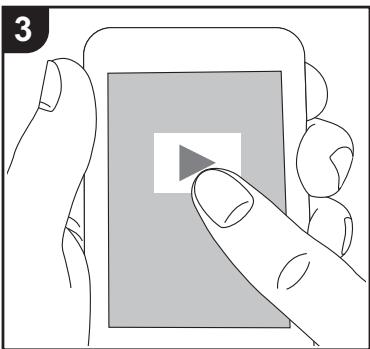
You can wirelessly play music on a smartphone or other BLUETOOTH wireless technology enabled device. Perform the following procedure when the unit is on.
Pairing
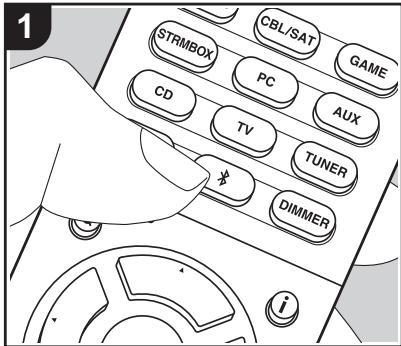
- When you press the button, "Now Pairing..." is displayed on this unit's display, and the pairing mode is enabled.
Now Fairing.
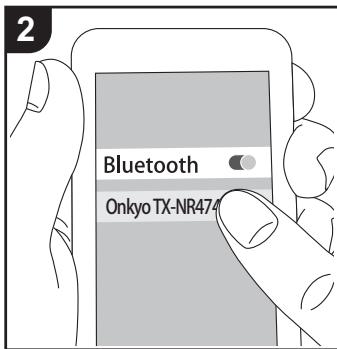
- Enable (turn on) the BLUETOOTH function of the BLUETOOTH wireless technology enabled device, then select this unit from amongst the devices displayed. If a password is requested, enter "0000".
This unit is displayed as "Onkyo TXNR474XXXXX".
- To connect another BLUETOOTH wireless technology enabled device,
press and hold 喜 until "Now
Pairing..." is displayed, then perform step 2. This unit can store the data of up to eight paired devices.
- The coverage area is 48^ / 15 meters. Note that connection is not always guaranteed with all BLUETOOTH wireless technology enabled devices.
Playing Back
- Perform the connection procedure on the BLUETOOTH wireless technology enabled device.
The input on this unit automatically switches to "BLUETOOTH".
-
Play the music files. Increase the volume of the BLUETOOTH wireless technology enabled device to an appropriate level.
-
Due to the characteristics of BLUETOOTH wireless technology, the sound produced on this unit may slightly be behind the sound played on the BLUETOOTH wireless technology enabled device.
Internet Radio
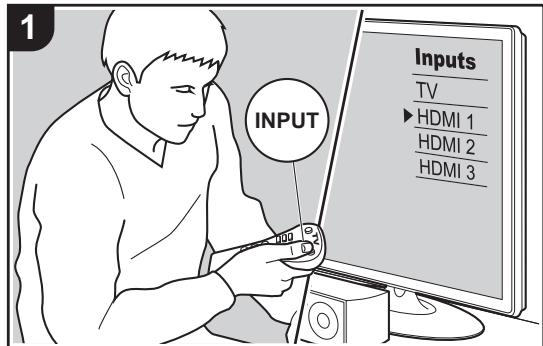
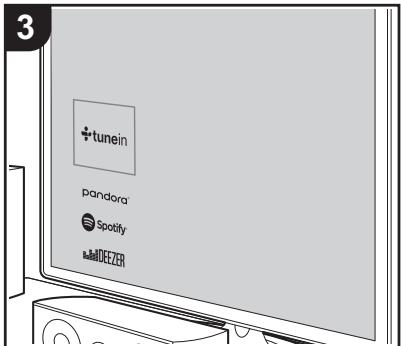
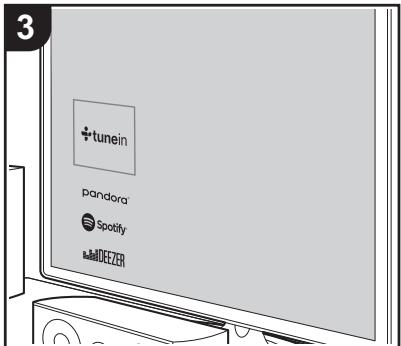
You can use internet radio services such as Tuneln Radio, Pandora, Deezer, and TIDAL by connecting this unit to a network that has an internet connection.
- The network needs to be connected to the internet in order to play internet radio services.
Depending on the internet radio service, the user may need to register from their computer first. Refer to the websites for each of the services for details about them. - Functionality may be introduced by firmware updates and service providers may cease services, meaning that some network services and content may become unavailable in the future.
Playing Back
Perform the following procedure when the unit is on.
- Switch the input on the TV to that assigned to the unit.
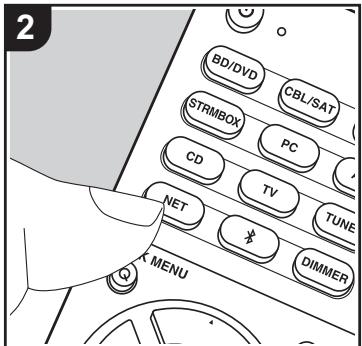
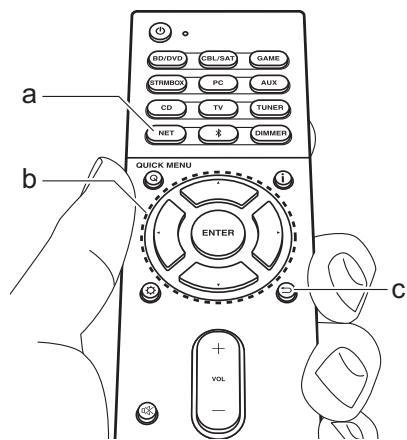
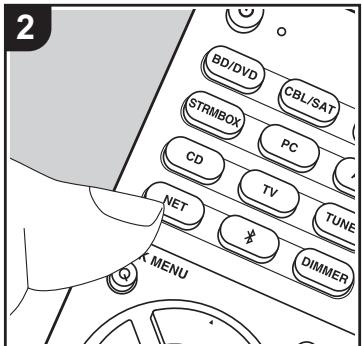
- Press NET (a) on the remote controller
to display a list of Network Functions on the TV.
- Select the internet radio service you want with the cursors of the remote controller and press ENTER (b) to confirm your selection.
- Follow the on-screen instructions, using the cursors to select radio stations and programs, then press ENTER to play. Play starts when 100% is displayed for buffering.
To return to the previous screen, press (c).
Internet radio service menus
You can register certain stations as your favorites or delete stations you have registered from your favorites. The menu displayed depends on the service currently selected.
Menu icons are displayed at the bottom right of the screen while playing a station. When just this icon is displayed, you can display the menu on the screen just by pressing ENTER on the remote controller. When multiple icons are displayed, select an icon with the cursors of the remote controller and press ENTER.
Regarding the Tuneln Radio Account
Creating an account on the Tuneln Radio website (tunein.com) and logging in it from the unit allows you to automatically add your favorite radio stations and programs to your "My Presets" on the unit as you
follow them on the website. "My Presets" are displayed in the level under TuneIn Radio.
To display a radio station registered in "My Presets", you must log into Tuneln Radio from the unit. To log in, select "Login" - "I have a Tuneln account" in the "Tuneln Radio" top list on the unit, and then enter your user name and password.
- If you select "Login" on this unit, you can use the displayed registration code to associate this device on the My Page section of the Tuneln Radio website so that you can login to "Login" - "Login with a registration code" without having to enter your user name and password.
Spotify
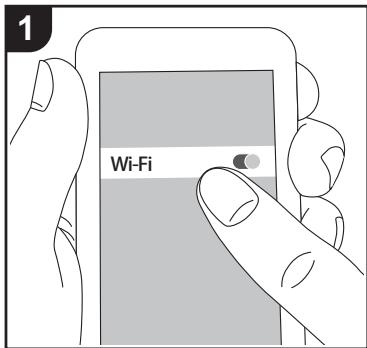
Spotify Connect play is possible by connecting this unit to the same network as a smart phone or tablet.
-
To play Spotify Connect, you need to install the Spotify application on your smartphone or tablet. You also need to create a Spotify premium account.
-
Refer to the following for Spotify settings: www.spotify.com/connect/
Setup menu, manually turn the unit on and then press NET on the remote controller.
Playing Back
- Connect the smartphone to the access point that this unit is connected to.
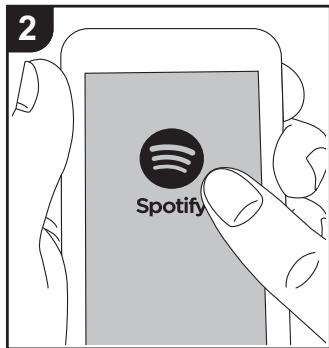
- Start the Spotify app.
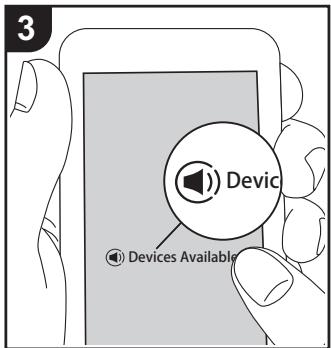
- Play the track in the Spotify app, then after switching to the screen for controlling play, tap "Devices Available" at the bottom of the screen.
- Select this unit.
- This unit turns on automatically and the input selector changes to NET and streaming of Spotify starts.
- If "5. Hardware" - "Power Management" - "Network Standby" is set to "Off" in the
AirPlay®

e.g., iOS 10
Basic operations
You can wirelessly enjoy the music files on an iPhone®, iPod touch®, or iPad® connected to the same access point as this unit.
- Update the OS version on your iOS device to the latest version.
-
There may be some differences in the operations screens and how operations are performed on the iOS device depending on the iOS version. For details, see the operating instructions for the iOS device.
-
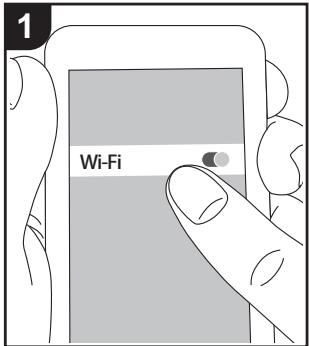
Connect the iOS device to the access point.
- Press NET.
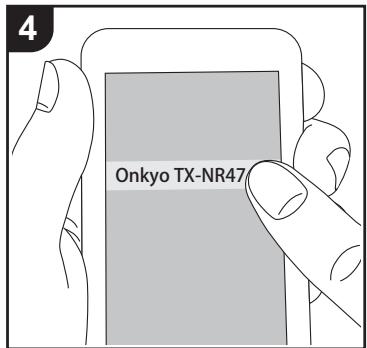
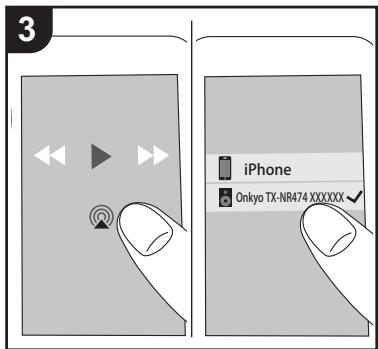
- Tap the AirPlay icon in the play screen of the music app on the iOS device and select this unit from the list of devices displayed.
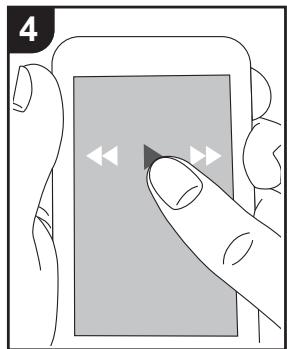
- Play the music files on the iOS device.
- The default status is for the Network Standby feature to be on, so when you do steps 3 and 4 above, this unit
automatically comes on and input switches to "NET". To reduce the amount of power consumed in standby mode, press the button on the remote controller, then in the Setup menu displayed set "5. Hardware" - "Power Management" - "Network Standby" to "Off".
- Due to the characteristics of AirPlay wireless technology, the sound produced on this unit may slightly be behind the sound played on the AirPlay-enabled device.
You can also play the music files on a computer with iTunes (Ver. 10.2 or later). Before operation, make sure this unit and the PC are connected to the same network, then press NET on this unit. Next, click the AirPlay icon in iTunes, select this unit from the list of devices displayed, and start play of a music file.
USB Storage Device

Basic operations
You can play music files stored on a USB storage device.
Perform the following procedure when the unit is on.
- Switch the input on the TV to that assigned to the unit.
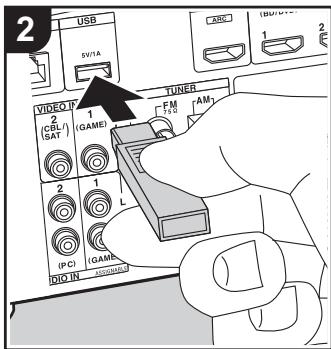
- Plug your USB storage device with the music files into the USB port of this unit's rear panel.
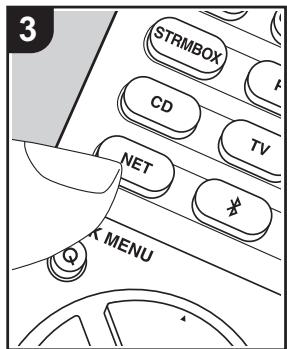
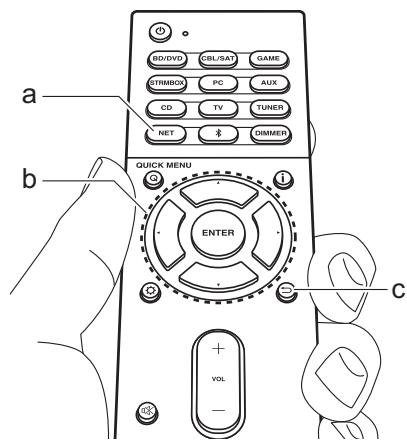
- Press NET (a) on the remote controller to display the network service list screen.
-
With the cursors on the remote controller, select "USB", and then press ENTER (b).
-
If the "USB" indicator flashes on the display, check whether the USB storage device is plugged in properly.
-
Do not unplug the USB storage device while "Connecting..." is on the display. This may cause data corruption or malfunction.
-
Press ENTER on the remote controller again in the next screen. The list of folders and music files on the USB storage device are displayed. Select the folder with the cursors and press ENTER to confirm your selection.
- With the cursors on the remote controller, select the music file, and then press ENTER to start playback.
To return to the previous screen, press (c). - The USB port of this unit conforms with the USB 2.0 standard. The transfer speed may be insufficient for some content you play, which may cause some interruption in sound.
Note that operation is not guaranteed with all USB storage devices. - This unit can use USB storage devices that comply with the USB mass storage device class standard. The unit is also compatible with USB storage devices using the FAT16 or FAT32 file system formats.
Listening To the AM/FM Radio
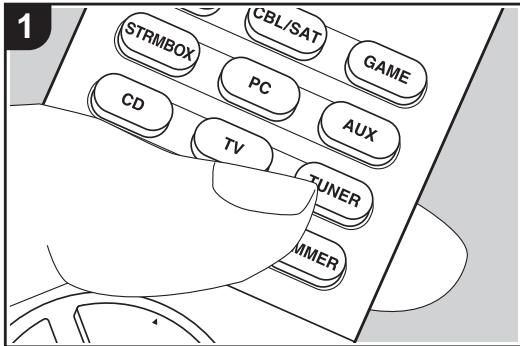
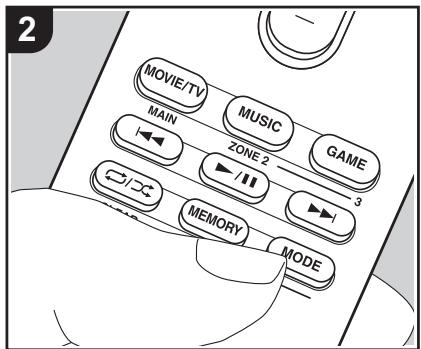
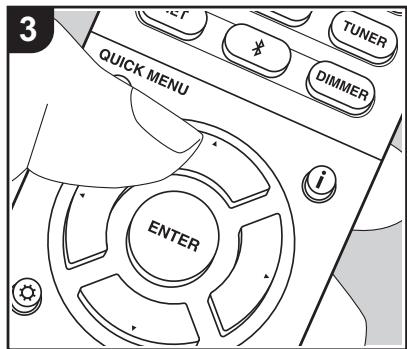
You can receive FM and AM radio stations on this unit with the built-in tuner. Perform the following procedure when the unit is on.
Tuning into a Radio Station
Tuning Automatically
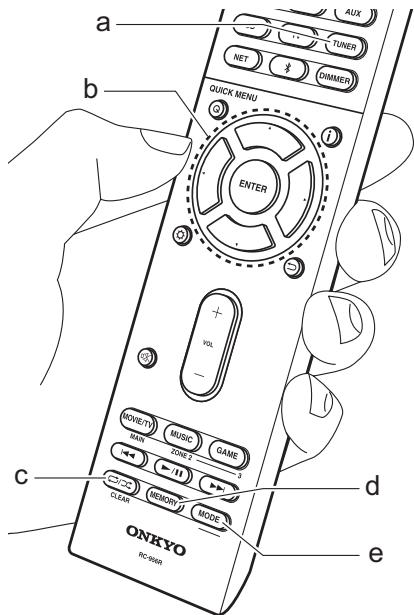
- Repeatedly press TUNER (a) on the remote controller and select "AM" or "FM".
- Press MODE (e) on the remote controller so that "TunMode:Auto" appears on the display.
TunModeAuto
- When you press the cursor / buttons (b) on the remote controller, automatic tuning starts, and searching stops when a station is found. When tuned into a radio station, the "TUNED" indicator on the display lights. When tuned into an FM radio station, the "FM ST" indicator
lights.
When FM broadcasts reception is poor: Perform the procedure for "Tuning Manually" in the following section. Note that if you tune manually, the reception for FM broadcasts will be monaural rather than stereo, irrespective of the sensitivity of the reception.
Tuning Manually
If you tune manually, the reception for FM broadcasts will be monaural rather than stereo, irrespective of the sensitivity of the reception.
- Repeatedly press TUNER (a) on the remote controller and select "AM" or "FM".
- Press MODE (e) on the remote controller so that "TunMode:Manual" appears on the display.
TurnMode:Manual
-
While pressing the cursor / buttons (b) on the remote controller, select the desired radio station.
-
The frequency changes by 1 step each time you press / . The frequency changes continuously if the button is held down and stops when the button is released.
Frequency step setting
Press on the remote controller, then use the cursor buttons and ENTER on the remote controller to select "6.
Miscellaneous" - "Tuner" - "AM Frequency Step", and select the frequency step for your region. Note that when this setting is changed, all radio presets are deleted.
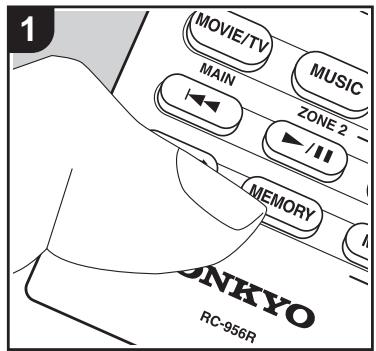
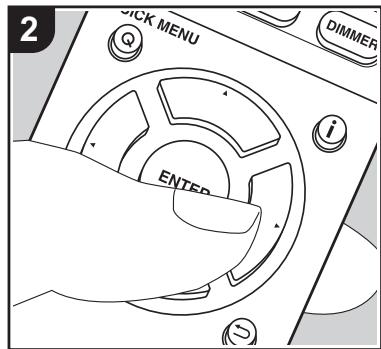
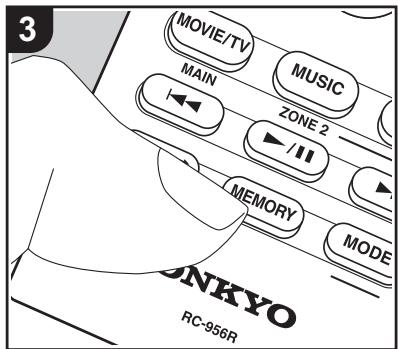
Registering a station
You can register up to 40 of your favorite AM/FM radio stations.
Registering
After tuning into the AM/FM radio station you want to register, perform the following procedure.
- Press MEMORY (d) on the remote controller so that the preset number on the display flashes.
FM 87.5 MHz

- While the preset number is flashing (about 8 seconds), repeatedly press the cursor buttons (b) on the remote controller to select a number between 1 and 40.
- Press MEMORY on the remote controller again to register the station. When the station is registered, the
preset number stops flashing. Repeat this procedure for all of your favorite AM/ FM radio stations.
Selecting a Preset Radio Station
- Press TUNER (a) on the remote controller.
- Press the cursor buttons (b) on the remote controller to select a preset number.
Deleting a Preset Radio Station
- Press TUNER (a) on the remote controller.
- Press the cursor / buttons (b) on the remote controller to select the preset number to delete.
- After pressing MEMORY (d) on the remote controller, press CLEAR (c) while the preset number is flashing to delete the preset number. When deleted, the number on the display goes off.
Using RDS
RDS stands for Radio Data System and is a method of transmitting data in FM radio signals. In regions using RDS, the radio station name is displayed when you tune into a radio station broadcasting program information. Further, when you press i on the remote controller in this state, you can use the following functions.
Displaying text information (Radio Text)
- While the name of the station is being displayed on the display, press i on the remote controller once.
Text information broadcast by the station (Radio Text) is displayed scrolling across the display. "No Text Data" is displayed when no text information is available.
Search for stations by Program Type
- While the name of the station is being displayed on the display, press i on the remote controller twice.
- Press the cursors on the remote controller to select the Program Type you want to find, then press ENTER to start the search.
The Program Types displayed are as follows: None / News (News reports) / Affairs (Current affairs) / Info (Information) / Sport / Educate (Education) / Drama / Culture / Science (Science and technology) / Varied / Pop M (Pop music) / Rock M (Rock music) / Easy M (Middle of the road music) / Light M (Light classics) / Classics (Serious classics) / Other M (Other music) / Weather / Finance / Children (Children's programmes) / Social (Social affairs) / Religion / Phone In / Travel / Leisure / Jazz (Jazz music) / Country (Country music) / Nation M (National music) / Oldies (Oldies music) / Folk M (Folk music) / Document (Documentary)
- The information displayed may sometimes not match the content being broadcast by the station.
- When a station is found, the station flashes on the display. Press ENTER while this is happening to start receiving that station. If you don't press ENTER, the unit continues to search for another station.
- If no stations are found, the message "Not Found" is displayed.
- Unusual characters may be displayed when the unit receives unsupported characters. However, this is not a malfunction. Also, if the signal from a station is weak, information may not be displayed.
Music Server
It is possible to stream music files stored on PCs or NAS devices connected to the same network as this unit.
- The network servers compatible with the Music Server feature are those PCs with players installed that have the server functionality of Windows Media Player 11 or 12, or NAS that are compatible with home network functionality. Note that with PCs, only music files registered in the library of Windows Media Player can be played.
- You may need to make some settings on the PC in advance to use Windows Media® Player 11 or 12 with the Music Server feature.
Windows Media® Player settings
On Windows Media® Player 11
- Turn on your PC and start Windows Media® Player 11.
- In the "Library" menu, select "Media Sharing" to display a dialog box.
- Select the "Share my media" check box, and then click "OK" to display the compatible devices.
- Select this unit, click "Allow" and put a check mark next to the icon for this unit.
-
Click "OK" to close the dialog.
-
Depending of the version of Windows Media® Player, there may be differences in the names of items you can select.
On Windows Media® Player 12
- Turn on your PC and start Windows Media® Player 12.
-
In the "Stream" menu, select "Turn on media streaming" to display a dialog box.
-
If media streaming is already turned on, select "More streaming options..." in the "Stream" menu to list players in the network, and then go to step 4.
- Click "Turn on media streaming" to list players in the network.
- Select this unit in "Media streaming options" and check that it is set to "Allow".
- Click "OK" to close the dialog.
- Depending of the version of Windows Media® Player, there may be differences in the names of items you can select.
■ Playing Back
Before performing the operations below, start the server (Windows Media Player 11, Windows Media Player 12, or NAS device) containing the music files to play, and make sure that the PCs and/or NASs are properly connected to the same network as this unit.
Perform the following procedure when the unit is on.
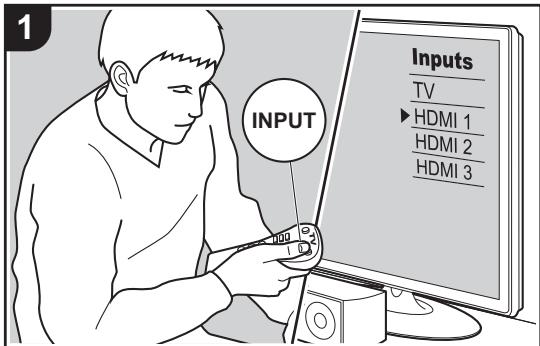
- Switch the input on the TV to that assigned to the unit.
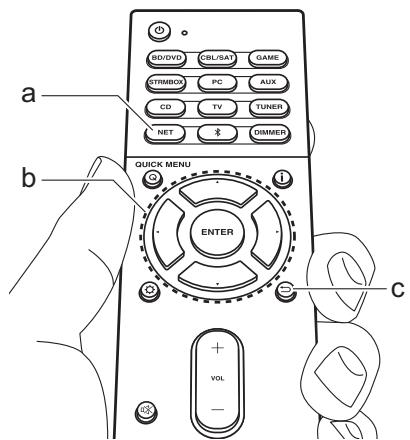
- Press NET (a) on the remote controller to display a list of Network Functions on the TV.
- Select "Music Server" with the cursors of the remote controller and press ENTER (b) to confirm your selection.
- Select the target server with the cursors on the remote controller and press ENTER to display the items list screen.
- With the cursors on the remote controller, select the music file to play,
and then press ENTER to start playback.
To return to the previous screen, press (c).
- If "No Item." is displayed, check whether the network is properly connected.
Depending on the server and share settings, the unit may not recognize it, or may not be able to play its music files. Furthermore, the unit cannot access pictures and videos stored on servers.
- For music files on a server, there can be up to 20,000 tracks per folder, and folders may be nested up to 16 levels deep.
Controlling Remote Playback from a PC
You can use this unit to play music files stored on your PC by operating the PC inside your home network. The unit supports remote playback with Windows Media Player 12.
- Turn on your PC and start Windows Media® Player 12.
- Open the "Stream" menu and check that "Allow remote control of my Player..." is checked. Click "Turn on media streaming" to list players in the network.
- Switch the input on the TV to that assigned to the unit.
- Select and right-click the music file to play with Windows Media® Player 12. To remotely play a music file on another server, open the target server from "Other Libraries" and select the music file to play.
- Select this unit in "Play to" to open the "Play to" window of Windows Media Player 12 and start playback on the unit. If your PC is running on Windows® 8.1, click "Play to", and then select this unit. If your PC is running on Windows® 10, click "Cast to Device", and select this unit. Operations during remote playback are possible from the "Play to" window on the PC. The playback screen is displayed on the TV connected to the HDMI output of the unit.
- Adjust the volume using the volume bar on the "Play to" window.
- Sometimes, the volume displayed on the remote playback window may differ from that appeared on the display of the unit.
Also, when the volume is adjusted from this unit, this is not reflected in the "Play to" window.
- Remote playback is not possible when using a network service or playing music files on a USB storage device.
- Depending of the version of Windows® there may be differences in the names of items you can select.
Supplementary information for player functions
Due to firmware (the software for the system) updates after you make your purchase or firmware changes during production of the product, there may be additions or changes to the features available compared to what is in the instruction manual.
For information about player functions that have been added or changed, see the following references. Refer to "Supplementary Information" (P72) for information about changes to settings, etc., other than player functions.
Supplementary information for player functions Click here
Listening Mode
Selecting Listening Modes
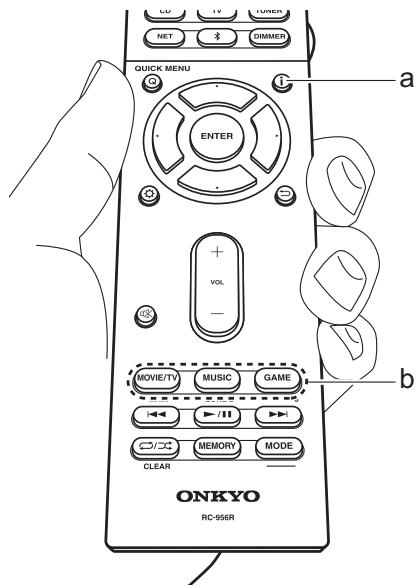
This unit is equipped with a variety of listening modes, and you can select the optimum listening mode for movies, TV, music, and games using the MOVIE/TV, MUSIC, and GAME buttons (b).
- During play, press one of the three buttons (b) on the remote controller.
- Press the selected button repeatedly to switch the modes displayed on the display of the unit.
Dolby D
- For details on the effects of each of the listening modes see "Listening Mode Effects" (P36). For listening modes selectable for each of the audio formats in the input signals, refer to "Selectable listening modes" (P38).
- The listening mode last selected for the source is remembered for each of the MOVIE/TV, MUSIC, and GAME buttons. If content you play is not supported by the listening mode you selected last, the listening mode that is standard for that content is selected automatically.
- The Pure Audio listening mode (P38) can also be selected by pressing PURE AUDIO on the front of the main unit. Selecting this mode lights the PURE AUDIO indicator on the unit. Pressing PURE AUDIO again reselects the previous listening mode.
Checking the input format and listening mode
Press i (a) on the remote controller several times to switch the display of the main unit as follows.

Listening Mode Effects
Updating of listening modes
We plan to provide support for the Dolby Atmos audio format through firmware updates for this unit. This means that the selectable listening modes depend on the version of firmware.
On firmware version before Dolby Atmos support
- Dolby Pro Logic II-related modes can be selected.
On firmware versions supporting Dolby Atmos
- You can select Dolby Atmos, Dolby Surround, and Surround Enhancer. (Dolby Pro Logic II-related modes cannot be selected after updating.) Also, when Surround Enhancer can be selected, T-D (Theater-Dimensional) cannot be selected.
In alphabetical order
AllCh Stereo
Ideal for background music, this mode fills the entire listening area with stereo sound from the front, surround, and surround back speakers.
Direct
This listening mode can be selected for all input signals. Processing that affects sound quality is shut down so sound closer to the original is reproduced. Speakers play the sound field according to the number of channels in the input signal, so there would be output from only the front speakers for a two-channel signal, for example.
Dolby Atmos
This mode faithfully reproduces the sound design recorded in the Dolby Atmos format.
The Dolby Atmos audio format has been implemented in movie theaters equipped with the latest facilities and enables a revolutionary sound experience in home theaters. Unlike existing surround systems, Dolby Atmos doesn't rely on channels, but rather enables the accurate
placement of sound objects that have independent motion in a three-dimensional space with even greater clarity. Dolby Atmos is an optional audio format on Blu-ray Discs and achieves a three-dimensional sound field by introducing a sound field above the listener.
- To enable transfer of this audio format, connect via HDMI cable and set audio output on the player to bitstream output.
Dolby D (Dolby Digital)
This mode faithfully reproduces the sound design recorded in the Dolby Digital format.
Dolby Digital is a multi-channel digital format developed by Dolby Laboratories, Inc. widely adopted for use in movie production. It is also a standard audio format on DVD-Video and Blu-ray Discs. It is possible to record a maximum of 5.1 channels on a DVD-Video or Blu-ray Disc; two front channels, a center channel, two surround channels, and the LFE channel dedicated to the bass region (sound elements for the subwoofer).
- To enable transfer of this audio format, connect via digital cable and set audio output on the player to bitstream output.
Dolby D+ (Dolby Digital Plus)
This mode faithfully reproduces the sound design recorded in the Dolby Digital Plus format.
The Dolby Digital Plus format is a revision based on Dolby Digital, increasing the number of channels and endeavoring to improve sound quality by giving more flexibility in data bit rates. Dolby Digital Plus is used as an optional audio format on Blu-ray Discs, based on 5.1 channels, but with additional channels such as the surround back channel added for a maximum of 7.1 channels.
- To enable transfer of this audio format, connect via HDMI cable and set audio output on the player to bitstream output.
Dolby PL II (Dolby Pro Logic II)
This listening mode allows you to expand the playback
signal to 5.1 channels to suit the connected speaker configuration when the input signal is 2 channel.
Broadening the sound field provides you with a seamless sound with more depth and realism. Along with CD and movie sources, games can also benefit from the vivid sound localization. Choose from a mode ideal for movies (Movie), a mode ideal for music (Music), and a mode ideal for gaming (Game).
Dolby Surround
This listening mode allows you to expand input signals with 2 channels, etc., to multiple channels to suit the configuration of connected speakers. Along with past speaker setups, this is also compatible with playback systems for Dolby Atmos that include Dolby speaker technology.
Dolby TrueHD
This mode faithfully reproduces the sound design recorded in the Dolby TrueHD format.
The Dolby TrueHD audio format is a reversible format expanded based on the lossless compression technology referred to as MLP, and it makes it possible to faithfully reproduce the master audio recorded in the studio. Dolby TrueHD is used as an optional audio format on Blu-ray Discs, based on 5.1 channels, but with additional channels such as the surround back channel added for a maximum of 7.1 channels. 7.1 channels can be recorded using 96 kHz/24 bit, and 5.1 channels can be recorded using 192 kHz/24 bit.
- To enable transfer of this audio format, connect via HDMI cable and set audio output on the player to bitstream output.
DSD
Mode suitable for playing sources recorded in DSD.
-
This unit supports DSD signals input through HDMI IN. However, depending on the connected player, better sound is possible when output from the PCM output of the player.
-
This listening mode cannot be selected if the output setting on your Blu-ray Disc/DVD player is not set to DSD.
DTS
This mode faithfully reproduces the sound design recorded in the DTS format.
The DTS audio format is a multi-channel digital format developed by DTS, Inc.. This format is an optional audio format on DVD-Video and a standard on Blu-ray Discs. It enables recording of 5.1 channels; two front channels, a center channel, two surround channels, and the LFE channel dedicated to the bass region (sound elements for the subwoofer). The content is recorded with a rich volume of data, with maximum sampling rate of 48kHz at a resolution of 24 bits and a bit rate of 1.5 Mbps.
- To enable transfer of this audio format, connect via digital cable and set audio output on the player to bitstream output.
DTS 96/24
This mode faithfully reproduces the sound design recorded in the DTS 96/24 format.
DTS 96/24 is an optional audio format on DVD-Video and Blu-ray Discs. It enables recording of 5.1 channels; two front channels, a center channel, two surround channels, and the LFE channel dedicated to the bass region (sound elements for the subwoofer). Detailed reproduction is achieved by recording the content at a sampling rate of 96 kHz at a resolution of 24 bits.
- To enable transfer of this audio format, connect via digital cable and set audio output on the player to bitstream output.
DTS Express
This mode faithfully reproduces the sound design recorded in the DTS Express format.
DTS Express is used as an optional audio format on Blu-ray Discs, based on 5.1ch, but with channels such as the
surround back channel added for a maximum of 7.1ch. It also supports low bit rates.
- To enable transfer of this audio format, connect via HDMI cable and set audio output on the player to bitstream output.
DTS-HD HR (DTS-HD High Resolution Audio)
This mode faithfully reproduces the sound design recorded in the DTS-HD High Resolution Audio format.
DTS-HD High Resolution Audio is used as an optional audio format on Blu-ray Discs, based on 5.1ch, but with additional channels such as the surround back channel added for a maximum of 7.1ch. It can be recorded at a sampling rate of 96kHz with a resolution of 24 bits.
- To enable transfer of this audio format, connect via HDMI cable and set audio output on the player to bitstream output.
DTS-HD MSTR (DTS-HD Master Audio)
This mode faithfully reproduces the sound design recorded in the DTS-HD Master Audio format.
DTS-HD Master Audio is used as an optional audio format on Blu-ray Discs, based on 5.1ch, but with additional channels such as the surround back channel added for a maximum of 7.1ch, recorded using lossless audio reproduction technology. 96 kHz/24bit is supported with 7.1 channel, and 192 kHz/24bit is supported with 5.1 channel.
- To enable transfer of this audio format, connect via HDMI cable and set audio output on the player to bitstream output.
DTS Neural:X
This listening mode allows you to expand input signals with 2 channels, etc., to multiple channels to suit the configuration of connected speakers.
DTS:X
This mode faithfully reproduces the sound design recorded in the DTS:X format.
The DTS:X audio format is a combination of the mixing
methodology based on past channel based formats and object based dynamic audio mixing, and it is characterized by the precise positioning of sounds and the ability to express movement.
- To enable transfer of this audio format, connect via HDMI cable and set audio output on the player to bitstream output.
Full Mono
In this mode, all speakers output the same sound in mono, so the sound you hear is the same regardless of where you are within the listening room.
Game-Action
In this mode, sound localization is distinct with emphasis on bass.
Game-Rock
In this mode, sound pressure is emphasized to heighten live feel.
Game-RPG
In this mode, the sound has a dramatic feel with a similar atmosphere to Orchestra mode.
Game-Sports
Suitable for audio source with much reverberation.
Mono
In this mode, when the input signal is analog or PCM, the left and right front speakers output the sound in monaural.
Multich (Multichannel)
Mode suitable for playing sources recorded in multichannel PCM.
Orchestra
Suitable for classical or operatic music, This mode emphasizes the surround channels in order to widen the stereo image, and simulates the natural reverberation of a large hall.
Pure Audio
This mode reproduces the original sound more faithfully. The display and analog video circuit are turned off to provide purer sound.
- Selecting this mode turns off the analog video circuitry, so the video signals input through the jacks other than the HDMI IN jack cannot be displayed on the TV.
Stereo
In this mode, sound is output from the front left and right speakers and subwoofer.
Studio-Mix
Suitable for rock or pop music, Listening to music in this mode creates a lively sound field with a powerful acoustic image, like being at a club or rock concert.
Surround Enhancer
This mode allows you to enjoy sound with a rich sound field, enveloping you naturally without relying on reflections from walls. A virtual surround channel is created to give you a broader sound field.
T-D (Theater-Dimensional)
In this mode, you can enjoy a virtual playback of multichannel surround sound even when surround speakers have not been installed. This works by controlling how sounds reach the listener's left and right ears.
TV Logic
Suitable for TV shows broadcast from TV studios. This mode enhances the surround effects to the entire sound to give clarity to voices and create a realistic acoustic image.
Unplugged
Suitable for acoustic instruments, vocals and jazz, This mode emphasizes the front stereo image, giving the impression of being right in front of the stage.
Selectable listening modes
You can select a variety of listening modes to suit the audio format of the signal being input.
- Listening modes available when headphones are connected are Pure Audio, Mono, Direct, and Stereo only.
Updating of listening modes
We plan to provide support for the Dolby Atmos audio format through firmware updates for this unit. This means that the selectable listening modes depend on the version of firmware.
On firmware version before Dolby Atmos support
- Dolby Pro Logic II-related modes can be selected.
On firmware versions supporting Dolby Atmos
- You can select Dolby Atmos, Dolby Surround, and Surround Enhancer. (Dolby Pro Logic II-related modes cannot be selected after updating.) Also, when Surround Enhancer can be selected, T-D (Theater-Dimensional) cannot be selected.
MOVIE/TV
This is a list of listening modes you can select according to the audio format of the input signal.
| Input format | Listening Mode |
| Analog | Direct |
| Mono | |
| Dolby Surround | |
| Surround Enhancer | |
| PL II Movie*1 | |
| DTS Neural:X | |
| TV Logic*2 | |
| AllCh Stereo*3 | |
| Full Mono*3 | |
| T-D |
1: A center speaker or surround speakers need to be installed.
2: Surround speakers or height speakers need to be installed.
*3: A center speaker, surround speakers, or height speakers need to be installed.
| Input format | Listening Mode |
| PCM | Direct |
| Music files (except DSD/Dolby TrueHD) | Mono |
| Dolby Surround | |
| Surround Enhancer | |
| PL II Movie*1 | |
| DTS Neural:X | |
| TV Logic*2 | |
| AllCh Stereo*3 | |
| Full Mono*3 | |
| T-D |
1: A center speaker or surround speakers need to be installed.
2: Surround speakers or height speakers need to be installed.
*3: A center speaker, surround speakers, or height speakers need to be installed.
| Input format | Listening Mode |
| Multich PCM | Direct |
| Multich*1 | |
| Dolby Surround | |
| Surround Enhancer | |
| DTS Neural:X | |
| TV Logic*2 | |
| AllCh Stereo*3 | |
| Full Mono*3 | |
| T-D |
1: A center speaker or surround speakers need to be installed.
2: Surround speakers or height speakers need to be installed.
*3: A center speaker, surround speakers, or height speakers need to be installed.
| Input format | Listening Mode |
| DSD | Direct |
| DSD*1*2 | |
| Dolby Surround | |
| Surround Enhancer | |
| PL II Movie*3 | |
| DTS Neural:X | |
| TV Logic*4 | |
| AllCh Stereo*5 | |
| Full Mono*5 | |
| T-D |
1: Cannot be selected when the input format is monaural or 2 ch.
2: A center speaker or surround speakers need to be installed.
3: Can only be selected when the input format is 2 ch and a center speaker or surround speakers are installed.
4: Surround speakers or height speakers need to be installed.
*5: A center speaker, surround speakers, or height speakers need to be installed.
| Input format | Listening Mode |
| Dolby Atmos | Direct |
| Dolby Atmos | |
| Surround Enhancer | |
| TV Logic | |
| AllCh Stereo | |
| Full Mono | |
| T-D |
| Input format | Listening Mode |
| Dolby D | Direct |
| Dolby D*1*2 | |
| Dolby Surround | |
| Surround Enhancer | |
| PL II Movie*3 | |
| TV Logic*4 | |
| AllCh Stereo*5 | |
| Full Mono*5 | |
| T-D |
1: Cannot be selected when the input format is 2 ch.
2: A center speaker or surround speakers need to be installed.
3: Can only be selected when the input format is 2 ch and a center speaker or surround speakers are installed.
4: Surround speakers or height speakers need to be installed.
*5: A center speaker, surround speakers, or height speakers need to be installed.
| Input format | Listening Mode |
| Dolby D+ | Direct |
| Dolby D+*1*2*3 | |
| Dolby Surround | |
| Surround Enhancer | |
| PL II Movie*4 | |
| TV Logic*5 | |
| AllCh Stereo*6 | |
| Full Mono*6 | |
| T-D |
1: Cannot be selected when the input format is 2 ch.
2: A center speaker or surround speakers need to be installed.
3: Dolby D+ cannot be selected if the input source is Blu-ray Disc. You can select the Dolby D listening mode instead.
4: Can only be selected when the input format is 2 ch and a center speaker or surround speakers are installed.
5: Surround speakers or height speakers need to be installed.
6: A center speaker, surround speakers, or height speakers need to be installed.
| Input format | Listening Mode |
| Dolby TrueHD | Direct |
| Dolby TrueHD*1*2 | |
| Dolby Surround | |
| Surround Enhancer | |
| PL II Movie*3 | |
| TV Logic*4 | |
| AllCh Stereo*5 | |
| Full Mono*5 | |
| T-D |
1: Cannot be selected when the input format is 2 ch.
2: A center speaker or surround speakers need to be installed.
3: Can only be selected when the input format is 2 ch and a center speaker or surround speakers are installed.
4: Surround speakers or height speakers need to be installed.
*5: A center speaker, surround speakers, or height speakers need to be installed.
| Input format | Listening Mode |
| DTS | Direct |
| DTS*1*2 | |
| DTS Neural:X | |
| TV Logic*3 | |
| AllCh Stereo*4 | |
| Full Mono*4 | |
| T-D |
1: Cannot be selected when the input format is 2 ch.
2: A center speaker or surround speakers need to be installed.
3: Surround speakers or height speakers need to be installed.
4: A center speaker, surround speakers, or height speakers need to be installed.
| Input format | Listening Mode |
| DTS 96/24 | Direct |
| DTS 96/24*1*2 | |
| DTS Neural:X | |
| TV Logic*3 | |
| AllCh Stereo*4 | |
| Full Mono*4 | |
| T-D |
1: Cannot be selected when the input format is 2 ch.
2: A center speaker or surround speakers need to be installed.
3: Surround speakers or height speakers need to be installed.
4: A center speaker, surround speakers, or height speakers need to be installed.
| Input format | Listening Mode |
| DTS Express | Direct |
| DTS Express*1*2 | |
| DTS Neural:X | |
| TV Logic*3 | |
| AllCh Stereo*4 | |
| Full Mono*4 | |
| T-D |
1: Cannot be selected when the input format is 2 ch.
2: A center speaker or surround speakers need to be installed.
3: Surround speakers or height speakers need to be installed.
4: A center speaker, surround speakers, or height speakers need to be installed.
| Input format | Listening Mode |
| DTS-HD HR | Direct |
| DTS-HD HR*1*2 | |
| DTS Neural:X | |
| TV Logic*3 | |
| AllCh Stereo*4 | |
| Full Mono*4 | |
| T-D |
1: Cannot be selected when the input format is 2 ch.
2: A center speaker or surround speakers need to be installed.
3: Surround speakers or height speakers need to be installed.
4: A center speaker, surround speakers, or height speakers need to be installed.
| Input format | Listening Mode |
| DTS-HD MSTR | Direct |
| DTS-HD MSTR*1*2 | |
| DTS Neural:X | |
| TV Logic*3 | |
| AllCh Stereo*4 | |
| Full Mono*4 | |
| T-D |
1: Cannot be selected when the input format is 2 ch.
2: A center speaker or surround speakers need to be installed.
3: Surround speakers or height speakers need to be installed.
4: A center speaker, surround speakers, or height speakers need to be installed.
| Input format | Listening Mode |
| DTS:X | Direct |
| DTS:X | |
| TV Logic*1 | |
| AllCh Stereo*2 | |
| Full Mono*2 | |
| T-D |
1: Surround speakers or height speakers need to be installed.
2: A center speaker, surround speakers, or height speakers need to be installed.
MUSIC
This is a list of listening modes you can select according to the audio format of the input signal.
| Input format | Listening Mode |
| Analog | Pure Audio |
| Direct | |
| Stereo | |
| Dolby Surround | |
| Surround Enhancer | |
| PL II Music*1 | |
| DTS Neural:X | |
| Orchestra*2 | |
| Unplugged*2 | |
| Studio-Mix*2 | |
| AllCh Stereo*3 | |
| Full Mono*3 |
1: A center speaker or surround speakers need to be installed.
2: Surround speakers or height speakers need to be installed.
*3: A center speaker, surround speakers, or height speakers need to be installed.
| Input format | Listening Mode |
| PCM Music files (except DSD/Dolby TrueHD) | Pure Audio |
| Direct | |
| Stereo | |
| Dolby Surround | |
| Surround Enhancer | |
| PL II Music*1 | |
| DTS Neural:X | |
| Orchestra*2 | |
| Unplugged*2 | |
| Studio-Mix*2 | |
| AllCh Stereo*3 | |
| Full Mono*3 |
1: A center speaker or surround speakers need to be installed.
2: Surround speakers or height speakers need to be installed.
*3: A center speaker, surround speakers, or height speakers need to be installed.
| Input format | Listening Mode |
| Multich PCM | Pure Audio |
| Direct | |
| Stereo | |
| Multich*1 | |
| Dolby Surround | |
| Surround Enhancer | |
| DTS Neural:X | |
| Orchestra*2 | |
| Unplugged*2 | |
| Studio-Mix*2 | |
| AllCh Stereo*3 | |
| Full Mono*3 |
1: A center speaker or surround speakers need to be installed.
2: Surround speakers or height speakers need to be installed.
*3: A center speaker, surround speakers, or height speakers need to be installed.
| Input format | Listening Mode |
| DSD | Pure Audio |
| Direct | |
| Stereo | |
| DSD*1*2 | |
| Dolby Surround | |
| Surround Enhancer | |
| PL II Music*3 | |
| DTS Neural:X | |
| Orchestra*4 | |
| Unplugged*4 | |
| Studio-Mix*4 | |
| AllCh Stereo*5 | |
| Full Mono*5 |
1: Cannot be selected when the input format is monaural or 2 ch.
2: A center speaker or surround speakers need to be installed.
3: Can only be selected when the input format is 2 ch and a center speaker or surround speakers are installed.
4: Surround speakers or height speakers need to be installed.
*5: A center speaker, surround speakers, or height speakers need to be installed.
| Input format | Listening Mode |
| Dolby Atmos | Pure Audio |
| Direct | |
| Stereo | |
| Dolby Atmos | |
| Surround Enhancer | |
| Orchestra | |
| Unplugged | |
| Studio-Mix | |
| AllCh Stereo | |
| Full Mono |
| Input format | Listening Mode |
| Dolby D | Pure Audio |
| Direct | |
| Stereo | |
| Dolby D*1*2 | |
| Dolby Surround | |
| Surround Enhancer | |
| PL II Music*3 | |
| Orchestra*4 | |
| Unplugged*4 | |
| Studio-Mix*4 | |
| AllCh Stereo*5 | |
| Full Mono*5 |
1: Cannot be selected when the input format is 2 ch.
2: A center speaker or surround speakers need to be installed.
3: Can only be selected when the input format is 2 ch and a center speaker or surround speakers are installed.
4: Surround speakers or height speakers need to be installed.
*5: A center speaker, surround speakers, or height speakers need to be installed.
| Input format | Listening Mode |
| Dolby D+ | Pure Audio |
| Direct | |
| Stereo | |
| Dolby D*1*2*3 | |
| Dolby Surround | |
| Surround Enhancer | |
| PL II Music*4 | |
| Orchestra*5 | |
| Unplugged*5 | |
| Studio-Mix*5 | |
| AllCh Stereo*6 | |
| Full Mono*6 |
1: Cannot be selected when the input format is 2 ch.
2: A center speaker or surround speakers need to be installed.
3: Dolby D+ cannot be selected if the input source is Blu-ray Disc. You can select the Dolby D listening mode instead.
4: Can only be selected when the input format is 2 ch and a center speaker or surround speakers are installed.
5: Surround speakers or height speakers need to be installed.
6: A center speaker, surround speakers, or height speakers need to be installed.
| Input format | Listening Mode |
| Dolby TrueHD | Pure Audio |
| Direct | |
| Stereo | |
| Dolby TrueHD*1*2 | |
| Dolby Surround | |
| Surround Enhancer | |
| PL II Music*3 | |
| Orchestra*4 | |
| Unplugged*4 | |
| Studio-Mix*4 | |
| AllCh Stereo*5 | |
| Full Mono*5 |
1: Cannot be selected when the input format is 2 ch.
2: A center speaker or surround speakers need to be installed.
3: Can only be selected when the input format is 2 ch and a center speaker or surround speakers are installed.
4: Surround speakers or height speakers need to be installed.
*5: A center speaker, surround speakers, or height speakers need to be installed.
| Input format | Listening Mode |
| DTS | Pure Audio |
| Direct | |
| Stereo | |
| DTS*1*2 | |
| DTS Neural:X | |
| Orchestra*3 | |
| Unplugged*3 | |
| Studio-Mix*3 | |
| AllCh Stereo*4 | |
| Full Mono*4 |
1: Cannot be selected when the input format is 2 ch.
2: A center speaker or surround speakers need to be installed.
3: Surround speakers or height speakers need to be installed.
4: A center speaker, surround speakers, or height speakers need to be installed.
| Input format | Listening Mode |
| DTS 96/24 | Pure Audio |
| Direct | |
| Stereo | |
| DTS 96/24*1*2 | |
| DTS Neural:X | |
| Orchestra*3 | |
| Unplugged*3 | |
| Studio-Mix*3 | |
| AllCh Stereo*4 | |
| Full Mono*4 |
1: Cannot be selected when the input format is 2 ch.
2: A center speaker or surround speakers need to be installed.
3: Surround speakers or height speakers need to be installed.
4: A center speaker, surround speakers, or height speakers need to be installed.
| Input format | Listening Mode |
| DTS Express | Pure Audio |
| Direct | |
| Stereo | |
| DTS Express*1*2 | |
| DTS Neural:X | |
| Orchestra*3 | |
| Unplugged*3 | |
| Studio-Mix*3 | |
| AllCh Stereo*4 | |
| Full Mono*4 |
1: Cannot be selected when the input format is 2 ch.
2: A center speaker or surround speakers need to be installed.
3: Surround speakers or height speakers need to be installed.
4: A center speaker, surround speakers, or height speakers need to be installed.
| Input format | Listening Mode |
| DTS-HD HR | Pure Audio |
| Direct | |
| Stereo | |
| DTS-HD HR*1*2 | |
| DTS Neural:X | |
| Orchestra*3 | |
| Unplugged*3 | |
| Studio-Mix*3 | |
| AllCh Stereo*4 | |
| Full Mono*4 |
1: Cannot be selected when the input format is 2 ch.
2: A center speaker or surround speakers need to be installed.
3: Surround speakers or height speakers need to be installed.
4: A center speaker, surround speakers, or height speakers need to be installed.
| Input format | Listening Mode |
| DTS-HD MSTR | Pure Audio |
| Direct | |
| Stereo | |
| DTS-HD MSTR*1*2 | |
| DTS Neural:X | |
| Orchestra*3 | |
| Unplugged*3 | |
| Studio-Mix*3 | |
| AllCh Stereo*4 | |
| Full Mono*4 |
1: Cannot be selected when the input format is 2 ch.
2: A center speaker or surround speakers need to be installed.
3: Surround speakers or height speakers need to be installed.
4: A center speaker, surround speakers, or height speakers need to be installed.
| Input format | Listening Mode |
| DTS:X | Pure Audio |
| Direct | |
| Stereo | |
| DTS:X | |
| Orchestra*1 | |
| Unplugged*1 | |
| Studio-Mix*1 | |
| AllCh Stereo*2 | |
| Full Mono*2 |
1: Surround speakers or height speakers need to be installed.
2: A center speaker, surround speakers, or height speakers need to be installed.
GAME
This is a list of listening modes you can select according to the audio format of the input signal.
| Input format | Listening Mode |
| Analog | Direct |
| Dolby Surround | |
| Surround Enhancer | |
| PL II Game*1 | |
| DTS Neural:X | |
| Game-RPG*2 | |
| Game-Action*2 | |
| Game-Rock*2 | |
| Game-Sports*2 | |
| AllCh Stereo*3 | |
| Full Mono*3 | |
| T-D |
1: A center speaker or surround speakers need to be installed.
2: Surround speakers or height speakers need to be installed.
*3: A center speaker, surround speakers, or height speakers need to be installed.
| Input format | Listening Mode |
| PCM Music files (except DSD/Dolby TrueHD) | Direct |
| Dolby Surround | |
| Surround Enhancer | |
| PL II Game*1 | |
| DTS Neural:X | |
| Game-RPG*2 | |
| Game-Action*2 | |
| Game-Rock*2 | |
| Game-Sports*2 | |
| AllCh Stereo*3 | |
| Full Mono*3 | |
| T-D |
1: A center speaker or surround speakers need to be installed.
2: Surround speakers or height speakers need to be installed.
*3: A center speaker, surround speakers, or height speakers need to be installed.
| Input format | Listening Mode |
| Multich PCM | Direct |
| Multich*1 | |
| Dolby Surround | |
| Surround Enhancer | |
| DTS Neural:X | |
| Game-RPG*2 | |
| Game-Action*2 | |
| Game-Rock*2 | |
| Game-Sports*2 | |
| AllCh Stereo*3 | |
| Full Mono*3 | |
| T-D |
1: A center speaker or surround speakers need to be installed.
2: Surround speakers or height speakers need to be installed.
*3: A center speaker, surround speakers, or height speakers need to be installed.
| Input format | Listening Mode |
| DSD | Direct |
| DSD*1*2 | |
| Dolby Surround | |
| Surround Enhancer | |
| PL II Game*3 | |
| DTS Neural:X | |
| Game-RPG*4 | |
| Game-Action*4 | |
| Game-Rock*4 | |
| Game-Sports*4 | |
| AllCh Stereo*5 | |
| Full Mono*5 | |
| T-D |
1: Cannot be selected when the input format is monaural or 2 ch.
2: A center speaker or surround speakers need to be installed.
3: Can only be selected when the input format is 2 ch and a center speaker or surround speakers are installed.
4: Surround speakers or height speakers need to be installed.
*5: A center speaker, surround speakers, or height speakers need to be installed.
| Input format | Listening Mode |
| Dolby Atmos | Direct |
| Dolby Atmos | |
| Surround Enhancer | |
| Game-RPG | |
| Game-Action | |
| Game-Rock | |
| Game-Sports | |
| AllCh Stereo | |
| Full Mono | |
| T-D | |
| Dolby D | Direct |
| Dolby D*1*2 | |
| Dolby Surround | |
| Surround Enhancer | |
| PL II Game*3 | |
| Game-RPG*4 | |
| Game-Action*4 | |
| Game-Rock*4 | |
| Game-Sports*4 | |
| AllCh Stereo*5 | |
| Full Mono*5 | |
| T-D |
1: Cannot be selected when the input format is 2 ch.
2: A center speaker or surround speakers need to be installed.
3: Can only be selected when the input format is 2 ch and a center speaker or surround speakers are installed.
4: Surround speakers or height speakers need to be installed.
*5: A center speaker, surround speakers, or height speakers need to be installed.
| Input format | Listening Mode |
| Dolby D+ | Direct |
| Dolby D*1*2*3 | |
| Dolby Surround | |
| Surround Enhancer | |
| PL II Game*4 | |
| Game-RPG*5 | |
| Game-Action*5 | |
| Game-Rock*5 | |
| Game-Sports*5 | |
| AllCh Stereo*6 | |
| Full Mono*6 | |
| T-D |
1: Cannot be selected when the input format is 2 ch.
2: A center speaker or surround speakers need to be installed.
3: Dolby D+ cannot be selected if the input source is Blu-ray Disc. You can select the Dolby D listening mode instead.
4: Can only be selected when the input format is 2 ch and a center speaker or surround speakers are installed.
5: Surround speakers or height speakers need to be installed.
6: A center speaker, surround speakers, or height speakers need to be installed.
| Input format | Listening Mode |
| Dolby TrueHD | Direct |
| Dolby TrueHD*1*2 | |
| Dolby Surround | |
| Surround Enhancer | |
| PL II Game*3 | |
| Game-RPG*4 | |
| Game-Action*4 | |
| Game-Rock*4 | |
| Game-Sports*4 | |
| AllCh Stereo*5 | |
| Full Mono*5 | |
| T-D |
1: Cannot be selected when the input format is 2 ch.
2: A center speaker or surround speakers need to be installed.
3: Can only be selected when the input format is 2 ch and a center speaker or surround speakers are installed.
4: Surround speakers or height speakers need to be installed.
*5: A center speaker, surround speakers, or height speakers need to be installed.
| Input format | Listening Mode |
| DTS | Direct |
| DTS*1*2 | |
| DTS Neural:X | |
| Game-RPG*3 | |
| Game-Action*3 | |
| Game-Rock*3 | |
| Game-Sports*3 | |
| AllCh Stereo*4 | |
| Full Mono*4 | |
| T-D |
1: Cannot be selected when the input format is 2 ch.
2: A center speaker or surround speakers need to be installed.
3: Surround speakers or height speakers need to be installed.
4: A center speaker, surround speakers, or height speakers need to be installed.
| Input format | Listening Mode |
| DTS 96/24 | Direct |
| DTS 96/24*1*2 | |
| DTS Neural:X | |
| Game-RPG*3 | |
| Game-Action*3 | |
| Game-Rock*3 | |
| Game-Sports*3 | |
| AllCh Stereo*4 | |
| Full Mono*4 | |
| T-D |
1: Cannot be selected when the input format is 2 ch.
2: A center speaker or surround speakers need to be installed.
3: Surround speakers or height speakers need to be installed.
4: A center speaker, surround speakers, or height speakers need to be installed.
| Input format | Listening Mode |
| DTS Express | Direct |
| DTS Express*1*2 | |
| DTS Neural:X | |
| Game-RPG*3 | |
| Game-Action*3 | |
| Game-Rock*3 | |
| Game-Sports*3 | |
| AllCh Stereo*4 | |
| Full Mono*4 | |
| T-D |
1: Cannot be selected when the input format is 2 ch.
2: A center speaker or surround speakers need to be installed.
3: Surround speakers or height speakers need to be installed.
4: A center speaker, surround speakers, or height speakers need to be installed.
| Input format | Listening Mode |
| DTS-HD HR | Direct |
| DTS-HD HR*1*2 | |
| DTS Neural:X | |
| Game-RPG*3 | |
| Game-Action*3 | |
| Game-Rock*3 | |
| Game-Sports*3 | |
| AllCh Stereo*4 | |
| Full Mono*4 | |
| T-D |
1: Cannot be selected when the input format is 2 ch.
2: A center speaker or surround speakers need to be installed.
3: Surround speakers or height speakers need to be installed.
4: A center speaker, surround speakers, or height speakers need to be installed.
| Input format | Listening Mode |
| DTS-HD MSTR | Direct |
| DTS-HD MSTR*1*2 | |
| DTS Neural:X | |
| Game-RPG*3 | |
| Game-Action*3 | |
| Game-Rock*3 | |
| Game-Sports*3 | |
| AllCh Stereo*4 | |
| Full Mono*4 | |
| T-D |
1: Cannot be selected when the input format is 2 ch.
2: A center speaker or surround speakers need to be installed.
3: Surround speakers or height speakers need to be installed.
4: A center speaker, surround speakers, or height speakers need to be installed.
| Input format | Listening Mode |
| DTS:X | Direct |
| DTS:X | |
| Game-RPG*1 | |
| Game-Action*1 | |
| Game-Rock*1 | |
| Game-Sports*1 | |
| AllCh Stereo*2 | |
| Full Mono*2 | |
| T-D |
1: Surround speakers or height speakers need to be installed.
2: A center speaker, surround speakers, or height speakers need to be installed.
Setup Menu
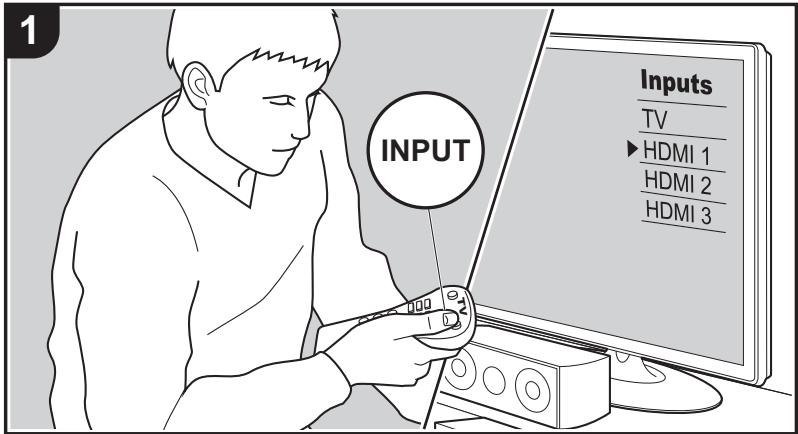
The unit allows you to configure advanced settings to provide you with an even better experience.
- Switch the input on the TV to that assigned to the unit.
- Press on the remote controller to display the Setup menu screen.

-
Select the item with / on the remote controller and press ENTER to confirm your selection.
-
Change the initial values for each of the settings with the cursors / .
To return to the previous screen, press - To exit the settings, press
1. Input/Output Assign
1. TV Out / OSD
| OSD Language | Select the on-screen display language. English, German, French, Spanish, Italian, Dutch, Swedish, Russian, Chinese |
| Impose OSD | Set whether or not to display the information on the TV when the volume is adjusted or input is changed, for example. "On (default value): Display OSD on the TV "Off": Do not display OSD on the TV • OSD may not be displayed depending on the input signal even if "On" is selected. If the operation screen is not displayed, change the resolution of the connected device. |
| Mini Player OSD | You can play on the TV the images from another input selected immediately prior while you are playing the audio from NET or BLUETOOTH input. After switching to NET or BLUETOOTH, play the images and audio, then when you press MODE on the remote controller, the image is displayed in full-screen mode, and the audio information (Mini Player) for NET or BLUETOOTH is displayed in the corner of the screen. You can set whether to display this Mini Player on the screen all the time. "Always On (default value): The Mini Player is displayed all the time. "Auto Off": The Mini Player turns off automatically 30 seconds after being displayed. It is displayed for 30 seconds after operations such as changing the volume. · Each press of the MODE button displays or turns off the video. · This cannot be selected if "Impose OSD" is set to "Off". · The Mini Player display feature is not available when Chinese is selected as the OSD language. |
| Screen Saver | Set the time to start the screen saver. Select "3 minutes (default value)", "5 minutes", "10 minutes", or "Off". |
2.HDMI Input
You can change input assignment between the input selectors and HDMI IN jacks.
| BD/DVD | "HDMI 1 (HDCP 2.2)" to "HDMI 4 (HDCP 2.2): Assign a desired HDMI IN jack to the BD/DVD input selector. If you do not assign a jack, select "-". To select an HDMI IN jack already assigned to another input selector, change the input selector setting to "-" first. (Default Value is "HDMI 1 (HDCP 2.2)" |
| CBL/SAT | "HDMI 1 (HDCP 2.2)" to "HDMI 4 (HDCP 2.2): Assign a desired HDMI IN jack to the CBL/SAT input selector. If you do not assign a jack, select "-". To select an HDMI IN jack already assigned to another input selector, change the input selector setting to "-" first. (Default Value is "HDMI 2 (HDCP 2.2)" |
| GAME | "HDMI 1 (HDCP 2.2)" to "HDMI 4 (HDCP 2.2): Assign a desired HDMI IN jack to the GAME input selector. If you do not assign a jack, select "...". To select an HDMI IN jack already assigned to another input selector, change the input selector setting to "... first. (Default Value is "HDMI 4 (HDCP 2.2)" |
| STRM BOX | "HDMI 1 (HDCP 2.2)" to "HDMI 4 (HDCP 2.2): Assign a desired HDMI IN jack to the STRM BOX input selector. If you do not assign a jack, select "...". To select an HDMI IN jack already assigned to another input selector, change the input selector setting to "... first. (Default Value is "HDMI 3 (HDCP 2.2)" |
| PC | "HDMI 1 (HDCP 2.2)" to "HDMI 4 (HDCP 2.2): Assign a desired HDMI IN jack to the PC input selector. If you do not assign a jack, select "...". To select an HDMI IN jack already assigned to another input selector, change the input selector setting to "... first. (Default Value is "...") |
| CD | "HDMI 1 (HDCP 2.2)" to "HDMI 4 (HDCP 2.2): Assign a desired HDMI IN jack to the CD input selector. If you do not assign a jack, select "...". To select an HDMI IN jack already assigned to another input selector, change the input selector setting to "... first. (Default Value is "...") |
| TV | "HDMI 1 (HDCP 2.2)" to "HDMI 4 (HDCP 2.2): Assign a desired HDMI IN jack to the TV input selector. If you do not assign a jack, select "...". To select an HDMI IN jack already assigned to another input selector, change the input selector setting to "... first. (Default Value is "...") |
3. Video Input
You can change input assignment between the input selectors and VIDEO IN jacks. If you do not assign a jack, select "--".
| BD/DVD | "VIDEO 1", "VIDEO 2": Assign a desired VIDEO IN jack to the BD/DVD input selector. (Default Value is "--") |
| CBL/SAT | "VIDEO 1", "VIDEO 2": Assign a desired VIDEO IN jack to the CBL/SAT input selector. (Default Value is "VIDEO 2") |
| GAME | "VIDEO 1", "VIDEO 2": Assign a desired VIDEO IN jack to the GAME input selector. (Default Value is "VIDEO 1") |
| STRM BOX | "VIDEO 1", "VIDEO 2": Assign a desired VIDEO IN jack to the STRM BOX input selector. (Default Value is "--") |
| PC | "VIDEO 1", "VIDEO 2": Assign a desired VIDEO IN jack to the PC input selector. (Default Value is "--") |
| CD | "VIDEO 1", "VIDEO 2": Assign a desired VIDEO IN jack to the CD input selector. (Default Value is "--") |
| TV | "VIDEO 1", "VIDEO 2": Assign a desired VIDEO IN jack to the TV input selector. (Default Value is "--") |
4. Digital Audio Input
You can change input assignment between the input selectors and DIGITAL IN COAXIAL/OPTICAL jacks. If you do not assign a jack, select "---".
| BD/DVD | "COAXIAL", "OPTICAL 1", "OPTICAL 2": Assign a desired DIGITAL IN jack to the BD/DVD input selector. (Default Value is "...") |
| CBL/SAT | "COAXIAL", "OPTICAL 1", "OPTICAL 2": Assign a desired DIGITAL IN jack to the CBL/SAT input selector. (Default Value is "COAXIAL") |
| GAME | "COAXIAL", "OPTICAL 1", "OPTICAL 2": Assign a desired DIGITAL IN jack to the GAME input selector. (Default Value is "-- -") |
| STRM BOX | "COAXIAL", "OPTICAL 1", "OPTICAL 2": Assign a desired DIGITAL IN jack to the STRM BOX input selector. (Default Value is "--") |
| PC | "COAXIAL", "OPTICAL 1", "OPTICAL 2": Assign a desired DIGITAL IN jack to the PC input selector. (Default Value is "--") |
| CD | "COAXIAL", "OPTICAL 1", "OPTICAL 2": Assign a desired DIGITAL IN jack to the CD input selector. (Default Value is "OPTICAL 1") |
| TV | "COAXIAL", "OPTICAL 1", "OPTICAL 2": Assign a desired DIGITAL IN jack to the TV input selector. (Default Value is "OPTICAL 2") |
- Supported sampling rates for PCM signals (stereo, mono) from a digital input are 32kHz , 44.1kHz , 48kHz , 88.2kHz , 96kHz/16 bit, 20 bit, 24 bit.
5. Analog Audio Input
You can change input assignment between the input selectors and AUDIO IN jacks. If you do not assign a jack, select "--".
| BD/DVD | "AUDIO 1", "AUDIO 2", "AUDIO 3": Assign a desired AUDIO IN jack to the BD/DVD input selector. (Default Value is "--") |
| CBL/SAT | "AUDIO 1", "AUDIO 2", "AUDIO 3": Assign a desired AUDIO IN jack to the CBL/SAT input selector. (Default Value is "--") |
| GAME | "AUDIO 1", "AUDIO 2", "AUDIO 3": Assign a desired AUDIO IN jack to the GAME input selector. (Default Value is "AUDIO 1") |
| STRM BOX | "AUDIO 1", "AUDIO 2", "AUDIO 3": Assign a desired AUDIO IN jack to the STRM BOX input selector. (Default Value is "--") |
| PC | "AUDIO 1", "AUDIO 2", "AUDIO 3": Assign a desired AUDIO IN jack to the PC input selector. (Default Value is "AUDIO 2") |
| CD | "AUDIO 1", "AUDIO 2", "AUDIO 3": Assign a desired AUDIO IN jack to the CD input selector. (Default Value is "AUDIO 3") |
| TV | "AUDIO 1", "AUDIO 2", "AUDIO 3": Assign a desired AUDIO IN jack to the TV input selector. (Default Value is "--") |
2. Speaker
You can make changes to the connection environment of the speakers and change the volume level. Settings are automatically configured if you use AccuEQ Room Calibration. This setting cannot be selected if headphones are connected or if "5. Hardware" - "HDMI" - "Audio TV Out" is set to "On" so audio is output from the speakers of the TV.
1. Configuration
| Speaker Channels | Select from "2.1 ch", "3.1 ch", "4.1 ch", "5.1 ch (default value)", "2.1.2 ch", or "3.1.2 ch" to suit the number of speaker channels connected. |
| Subwoofer | Set whether a subwoofer is connected or not. "Yes (default value): When subwoofer is connected "No": When subwoofer is not connected |
| Height Speaker | Set the speaker type if height speakers are connected to the SURROUND or HEIGHT terminals. Select from "Front High", "Top Middle (default value)", or "Dolby Speaker (Front)" to suit the type and layout of the connected speakers. • If an item cannot be selected even though connection is correct, check that the settings in "Speaker Channels" matches the number of connected channels. |
| Speaker Impedance | Set the impedance of the connected speakers. "4ohms": When any of the connected speakers have 4 Ω or more to less than 6 Ω impedance "6ohms (default value)": When the connected speakers all have 6 Ω or more impedance • For impedance, check the indications on the back of the speakers or their instruction manual. |
2. Crossover
| Front | Select the crossover frequency from "40Hz" to "200Hz" to start outputting frequencies for each channel. (Default Value is "100Hz") "Full Band": Full band will be output. • If "Configuration" - "Subwoofer" is set to "No", "Front" will be fixed to "Full Band" and the bass range of the other channels will be output from the front speakers. Refer to the instruction manual of your speakers to make the setting. |
| Center | Select the crossover frequency from "40Hz" to "200Hz" to start outputting frequencies for each channel. (Default Value is "100Hz") "Full Band": Full band will be output. • "Full Band" can be selected only when "Front" is set to "Full Band". • If an item cannot be selected even though connection is correct, check that the settings in "Configuration" - "Speaker Channels" matches the number of connected channels. |
| Height | Select the crossover frequency from "40Hz" to "200Hz" to start outputting frequencies for each channel. (Default Value is "100Hz") "Full Band": Full band will be output. • "Full Band" can be selected only when "Front" is set to "Full Band". • If an item cannot be selected even though connection is correct, check that the settings in "Configuration" - "Speaker Channels" matches the number or connected channels. |
| Surround | Select the crossover frequency from "40Hz" to "200Hz" to start outputting frequencies for each channel. (Default Value is "100Hz") "Full Band": Full band will be output. • "Full Band" can be selected only when "Front" is set to "Full Band". • If an item cannot be selected even though connection is correct, check that the settings in "Configuration" - "Speaker Channels" matches the number o connected channels. |
| LPF of LFE | Set the low-pass filter for LFE (low-frequency effect) signals in order to pass lower frequency signals than the set value and thus cancel unwanted noises. The low-pass filter will be effective only on sources with LFE channel. The value from "80Hz" to "120Hz (default value)" can be set. "Off": When this function is not to be used |
| Double Bass | This can be selected when the "Configuration" - "Subwoofer" setting is "Yes" and the "Front" setting is "Full Band". Boost bass output by sending the bass of the front speakers and center speaker to the subwoofer. "On": Bass output will be boosted. "Off": Bass output will not be boosted. The setting will not automatically be configured even if you performed AccuEQ Room Calibration. |
3. Distance
Set the distance from each speaker to the listening position.
| Front Left | Specify the distance between each speaker and the listening position. (Default Value is "3.60 m") |
| Center | Specify the distance between each speaker and the listening position. (Default Value is "3.60 m") |
| Front Right | Specify the distance between each speaker and the listening position. (Default Value is "3.60 m") |
| Height Left | Specify the distance between each speaker and the listening position. (Default Value is "2.70 m") |
| Height Right | Specify the distance between each speaker and the listening position. (Default Value is "2.70 m") |
| Surround Right | Specify the distance between each speaker and the listening position. (Default Value is "2.10 m") |
| Surround Left | Specify the distance between each speaker and the listening position. (Default Value is "2.10 m") |
| Subwoofer | Specify the distance between each speaker and the listening position. (Default Value is "3.60 m") |
- Distance units can be switched by pressing MODE on the remote controller. When the unit is set as feet, you can set between 0.1 ft and 30.0 ft in increments of 0.1 ft. When the unit is set as meters, you can set between 0.03 m and 9.00 m in increments of 0.03 m.
4. Level Calibration
| Front Left | Select a value between "-12 dB" and "+12 dB" (in 1 dB increments). A test tone will be output each time you change the value. Select the desired level. (Default Value is "0 dB") |
| Center | Select a value between "-12 dB" and "+12 dB" (in 1 dB increments). A test tone will be output each time you change the value. Select the desired level. (Default Value is "0 dB") |
| Front Right | Select a value between "-12 dB" and "+12 dB" (in 1 dB increments). A test tone will be output each time you change the value. Select the desired level. (Default Value is "0 dB") |
| Height Left | Select a value between "-12 dB" and "+12 dB" (in 1 dB increments). A test tone will be output each time you change the value. Select the desired level. (Default Value is "0 dB") |
| Height Right | Select a value between "-12 dB" and "+12 dB" (in 1 dB increments). A test tone will be output each time you change the value. Select the desired level. (Default Value is "0 dB") |
| Surround Right | Select a value between "-12 dB" and "+12 dB" (in 1 dB increments). A test tone will be output each time you change the value. Select the desired level. (Default Value is "0 dB") |
| Surround Left | Select a value between "-12 dB" and "+12 dB" (in 1 dB increments). A test tone will be output each time you change the value. Select the desired level. (Default Value is "0 dB") |
| Subwoofer | Select a value between "-15 dB" and "+12 dB" (in 1 dB increments). A test tone will be output each time you change the value. Select the desired level. (Default Value is "0 dB") |
5. Dolby Enabled Speaker
| Dolby EnabledSpeaker to Ceiling | Set the distance between the Dolby enabled speaker and theceiling. Select a value between "0.1 ft/0.03 m" and "15.0 ft/4.50 m" (in 0.1 ft/0.03 m increments, default value is "1.80 m")The unit of distance (feet/meters) shown is the unit selectedfor use in "Distance". |
| AccuReflex | You can enhance the reflection effect of Dolby enabled speaker from the ceiling. "On": When this function is to be used "Off (default value)"': When this function is not to be used • The function is not effective if the listening mode is Pure Audio or Direct. |
- This setting can only be selected when you have set "Configuration" - "Height Speaker" to "Dolby Speaker".
6. Equalizer Settings
You can adjust the output volume of the range of each connected speaker. You can adjust the volume of the different sound ranges for each of the speakers. You can set three different equalizers in Preset 1 to 3. You can select up to five bands for the Subwoofer and nine bands for all other speakers. To use the set equalizer effects, select the preset number in "Quick Menu" - "AccuEQ" - "Equalizer"(P66).
| Front | After selecting the speaker frequency from between "25 Hz" and "16 kHz" with the cursors \( \triangleleft \) / \( \triangleright \) ,adjust the volume of that frequency between "-6.0 dB" and "+6.0 dB" with \( \bigtriangleup /\nabla \) . (Default Value is "0.0 dB") |
| Center | After selecting the speaker frequency from between "25 Hz" and "16 kHz" with the cursors \( \triangleleft \) / \( \triangleright \) ,adjust the volume of that frequency between "-6.0 dB" and "+6.0 dB" with \( \bigtriangleup /\nabla \) . (Default Value is "0.0 dB") |
| Height | After selecting the speaker frequency from between "25 Hz" and "16 kHz" with the cursors \( \triangleleft \) / \( \triangleright \) ,adjust the volume of that frequency between "-6.0 dB" and "+6.0 dB" with \( \bigtriangleup /\nabla \) . (Default Value is "0.0 dB") |
| Surround | After selecting the speaker frequency from between "25 Hz" and "16 kHz" with the cursors \( \triangleleft \) / \( \triangleright \) ,adjust the volume of that frequency between "-6.0 dB" and "+6.0 dB" with \( \bigtriangleup /\nabla \) . (Default Value is "0.0 dB") |
| Subwoofer | After selecting the speaker frequency from between "25 Hz" and "160 Hz" with the cursors \( \blacktriangleleft \) / \( \blacktriangleright \) ,adjust the volume of that frequency between "-6.0 dB" and "+6.0 dB" with \( \blacktriangle /\nabla \) . (Default Value is "0.0 dB") - This cannot be selected if "No" is set in "Configuration" - "Subwoofer". |
- The result may not be as expected depending on the input source and listening mode setting.
3. Audio Adjust
1. Multiplex/Mono
| Multiplex Input Channel | Set the audio channel or language to be output when playing multiplex audio or multilingual TV broadcasts etc. "Main (default value)" : Main channel only "Sub": Sub channel only "Main / Sub": Main and sub channels will be output at the same time. • If multiplex audio is being played, "1+1" will be displayed when i on the remote controller is pressed. |
| Mono Input Channel | Set the input channel to use for playing any 2 channel digital source such as Dolby Digital, or analog/PCM source in the Mono listening mode. "Left": Left channel only "Right": Right channel only "Left + Right (default value)" : Left and right channels |
2. Dolby
| Loudness Management | When playing Dolby TrueHD, enable the dialog normalization function which keeps the volume of dialog at a certain level. Note that when this setting is Off while playing Dolby Digital Plus/ Dolby TrueHD, the Late Night function that allows you to enjoy surround at low volumes is fixed to Off. "On (default value): When this function is to be used" "Off": When this function is not to be used |
3.DTS
| DTS Auto Surround | When inputting DTS signals that include extended channel information, the optimum listening mode is automatically selected according to the extended information contained in the input signal and the speaker configuration of this unit when playing in the straight decoding listening mode. "On (default value): When this function is to be used" "Off": Audio is played using the same amount of channels in the input signal according to the speaker configuration of this unit. |
4. LFE Level
Set the low-frequency effect (LFE) level for Dolby Digital series, DTS series, Multichannel PCM, and DSD signals.
| LFE Level | Select the low-frequency effect (LFE) level of each type of signal from "0dB (default value)" to "-∞dB". If the low-frequency effect sound is too strong, select "-20dB" or "-∞dB". |
5. Volume
| Mute Level | Set the volume lowered from the listening volume when muting is on. Select a value from "-∞dB (default value)", "-40dB", and "-20dB". |
| Maximum Volume | Set the maximum value to avoid too high volume. Select "Off (default value)" or a value between "50" to "99". |
| Power On Volume | Set the volume level of when the power is turned on. Select "Last (default value)" (volume level before entering standby mode), "Min", "1" to "99" and "Max".You cannot set a higher value than that of "Maximum Volume". |
| Headphone Level | Adjust the output level of the headphones. Select a value between "-12 dB" and "+12 dB". (Default Value is "0dB") |
4. Source
1. IntelliVolume
Adjust the volume level difference between the devices connected to the unit. Select the input selector to configure.
| IntelliVolume | Select a value between "-12 dB" and "+12 dB". Set a negative (-) value if the volume of the target device is larger than the others and a positive (+) value if smaller. To check the audio, start playback of the connected device. (Default Value is "0dB") |
2. Name Edit
Set an easy name to each input. The set name will be shown on the main unit display. Select the input selector to configure.
| Name Edit | 1. Select a character or symbol with the cursors and press ENTER. Repeat it to input 10 or less characters. "A/a": Switches between upper and lower cases. (Pressing MODE on the remote controller also toggles between upper and lower cases.) "←" "→": Moves the cursor to the arrow direction. "×": Removes a character on the left of the cursor. "⊥": Enters a space. • Pressing CLEAR on the remote controller will remove all the input characters. 2. After inputting, select "OK" with the cursors and press ENTER. The input name will be saved. |
- To name a preset radio station, press TUNER on the remote controller, select AM/FM and select the preset number.
- It cannot be set if the "NET" or "BLUETOOTH" input is selected.
Audio Select
Select the priority for input selection when multiple audio sources are connected to one input selector, such as connections to both the "GAME" HDMI IN jack and the "GAME" AUDIO IN jack. The setting can be separately set to each input selector. Select the input selector to
configure. Note that there are some default values you cannot change.
| Audio Select | "ARC": When giving priority to input signal from ARC compatible TV. · The setting can be selected only when "5. Hardware" - "HDMI" - "Audio Return Channel" is set to "Auto" and also the "TV" input is selected. "HDMI": When giving priority to input signal from HDMI IN jacks. · The setting can be selected only when the input is assigned to the HDMI jack in the "1. Input/Output Assign" - "HDMI Input" setting. "COAXIAL": When giving priority to input signal from DIGITAL IN COAXIAL jacks. · The setting can be selected only when the input is assigned to the COAXIAL jack in the "1. Input/Output Assign" - "Digital Audio Input" setting. "OPTICAL": When giving priority to input signal from DIGITAL IN OPTICAL jacks. · The setting can be selected only when the input is assigned to the OPTICAL jack in the "1. Input/Output Assign" - "Digital Audio Input" setting. "Analog": To always output analog audio independently of the input signal · The setting can be selected only when the input is assigned to the AUDIO jack in the "1. Input/Output Assign" - "Analog Audio Input" setting. (Default value: BD/DVD: HDMI, CBL/SAT: HDMI, GAME: HDMI, STRM BOX: HDMI, PC: Analog, AUX: Analog, CD: OPTICAL, TV: OPTICAL) |
| PCM Fixed Mode | Select whether to fix input signals to PCM (except multi-channel PCM) when you have selected "HDMI", "COAXIAL", or "OPTICAL" in the "Audio Select" setting. Set this item to "On" if noise is produced or truncation occurs at the beginning of a track when playing PCM sources. Select "Off (default value)" normally. · The setting to changes to "Off" each time the "Audio Select" setting is changed. |
- This setting cannot be changed if the "TUNER", "NET" or "BLUETOOTH" input is selected.
Video Select
When "TUNER", "NET", or "BLUETOOTH" input is selected, you can set the input from which video is displayed on the TV.
| Video Select | "Last (default value): Select the video input played immediately prior. "BD/DVD", "CBL/SAT", "GAME", "STRM BOX", "PC", "CD", "TV": Play the video from the selected input. · This setting is effective for input selectors assigned in "1. Input/Output Assign" - "HDMI Input" and "Video Input". |
- If the OSD language is set to Chinese, you can only select this setting when "TUNER" is selected as input.
5. Hardware
1.HDMI
HDMI CEC
Setting to "On" enables the input selection link and other link functions with HDMI connected CEC compliant device.
"On": When this function is to be used
"Off (default value): When this function is not to be used When changing this setting, turn off and then on again the power of all connected components.
Depending on the TV you have, link settings may be needed on the TV.
- Setting to "On" and closing the on-screen menu displays the name of the CEC-compatible components and "CEC On" on the display.
- Power consumption in standby mode may increase if "On" is set. (Depending on the TV status, the unit will enter the normal standby mode.)
- If you operate the volume dial on this unit when this setting is "On" and audio is output from the TV speakers, audio will be output also from the speakers connected to the unit. If you want to output from only one of them, change the unit or TV settings, or reduce the volume of the unit.
- If abnormal operation occurs when you set the setting to "On", set it to "Off".
- When connecting a non-CEC compatible component, or when you are not sure whether it is compatible, set the setting to "Off".
| HDMI Standby Through | When this is set to anything other than "Off", you can play the video and audio of an HDMI connected player on the TV even if the unit is in standby mode. Only "Auto" and "Auto (Eco)" can be selected if "HDMI CEC" is set to "On". If you select anything else, set "HDMI CEC" to "Off". (Default Value is "Off") • Power consumption when this unit is in standby mode increases if set to anything other than "Off". "BD/DVD", "CBL/SAT", "GAME", "STRM BOX", "PC", "CD", "TV": For example, if you select "BD/DVD", you can play the equipment connected to the "BD/DVD" jack on the TV even if the unit is in standby mode. Select this setting if you have decided which player to use with this function. "Last": You can play the video and audio of the input selected immediately prior to the unit being switched to standby on the TV. When "Last" is selected, you can switch the input of the unit with the remote controller even in the standby mode. "Auto", "Auto (Eco): Select one of these settings when you have connected equipment that conforms to the CEC standard. You can play the video and audio of the input selected on the TV, irrespective of what input was selected immediately prior to the unit being switched to standby, using the CEC link function. • To play players on the TV that do not conform to the CEC standard, you will need to turn the unit on and switch to the relevant input. • When using a TV that conforms to the CEC standard, you can reduce the power consumption in standby mode by selecting "Auto (Eco)". |
| Audio TV Out | You can enjoy audio through the speakers of the TV while this unit is on. "On": When this function is to be used "Off (default value)": When this function is not to be used • The setting is fixed to "Auto" if "HDMI CEC" is set to "On". If you change this setting, set "HDMI CEC" to "Off" • The listening mode cannot be changed while "Audio TV Out" is set to "On" and audio is being output through the speakers of the TV. • Depending on your TV set or input signal of the component, audio may not output through the speakers of the TV even if this setting is set to "On". In such case, audio is output from the speakers of the unit. • If you operate the volume dial on this unit when audio that is being input through this unit for output from the TV speakers, audio is output from this unit. If you do not want to output audio from the unit, change the unit or TV settings, or reduce the volume of the unit. |
| Audio Return Channel | You can enjoy sound of the HDMI connected ARC compatible TV through the speakers connected to the unit. To use this function, set "HDMI CEC" to "On" in advance. "Auto": To enjoy the TV sound through the speakers connected to this unit "Off": When not using the ARC function |
| Auto Lip Sync | This setting automatically corrects any desynchronization between the video and audio signals based on data from the HDMI LipSync compatible TV. "On (default value)": Automatic correction will be enabled. "Off": Automatic correction will be disabled. |
2. Network
- When LAN is configured with a DHCP, set "DHCP" to "Enable" to configure the setting automatically. Further, to assign fixed IP addresses to each component, you must set "DHCP" to "Disable" and assign an address to this unit in "IP Address" as well as set information related to your LAN, such as Subnet Mask and Gateway.
| Wi-Fi | Connect the unit to network via wireless LAN router. "On": Wireless LAN connection "Off (Wired) (default value): To connect via wired LAN |
| Wi-Fi Setup | You can configure wireless LAN settings by pressing ENTER when "Start" is displayed. Refer to "3. Network Connection" (P21) in Initial Setup for Wi-Fi settings. |
| Wi-Fi Status | The information for the connected access point is displayed. "SSID": The SSID of the connected access point "Signal": The signal strength of the connected access point "Status": The status of the connected access point |
| MAC Address | This is the MAC address of the AV receiver. This value is specific to the component and cannot be changed. |
| DHCP | "Enable (default value): Auto configuration by DHCP "Disable": Manual configuration without DHCP If "Disable" is selected, you must set "IP Address", "Subnet Mask", "Gateway", and "DNS Server" manually. |
| IP Address | Displays/Sets the IP address. |
| Subnet Mask | Displays/Sets the subnet mask. |
| Gateway | Displays/Sets the gateway. |
| DNS Server | Displays/Sets the primary DNS server. |
| Proxy URL | Displays/Sets the proxy server URL. |
| Proxy Port | Displays/Sets the proxy server port number when you enter "Proxy URL". |
| Friendly Name | Change the device name for this unit which is shown on other devices connected to the network to an easily recognized name. This is set to Onkyo TX-NR474**** at the time of purchase. (* stand for alphanumeric characters identifying each unit) 1. Press ENTER to display the Edit screen. 2. Select a character or symbol with the cursors and press ENTER. Repeat it to input 31 or less characters. "A/a": Switches between upper and lower cases. (Pressing MODE on the remote controller also toggles between upper and lower cases.) "←" "→": Moves the cursor to the arrow direction. "×": Removes a character on the left of the cursor. "□": Enters a space. • Pressing CLEAR on the remote controller will remove all the input characters. 3. After inputting, select "OK" with the cursors and press ENTER. The input name will be saved. |
| AirPlay Password | You can set a password of up to 31 characters so that only registered users can use AirPlay. 1. Press ENTER to display the Edit screen. 2. Select a character or symbol with the cursors and press ENTER. Repeat it to input 31 or less characters. "A/a": Switches between upper and lower cases. (Pressing MODE on the remote controller also toggles between upper and lower cases.) "←" "→": Moves the cursor to the arrow direction. "×": Removes a character on the left of the cursor. "□": Enters a space. To select whether to mask the password with "* or display it in plain text, press MEMORY on the remote control. • Pressing CLEAR on the remote controller will remove all the input characters. 3. After inputting, select "OK" with the cursors and press ENTER. The input password will be saved. |
| Usage Data | As a means of improving the quality of our products and services, we may collect information about your usage over the network. Select "Yes" if you agree to our collecting this information. Select "No" if you do not want us to collect this information. (Default Value is "No") You can set this after confirming the Privacy Policy. When you select "Usage Data" and press ENTER, the Privacy Policy is displayed. (The same screen is displayed once also when setting up the network connection.) If you agree to the collection of the information, this setting also becomes "Yes". Note that if you agree to the Privacy Policy but select "No" for this setting, the information will not be collected. |
| Network Check | You can check the network connection. Press ENTER when "Start" is displayed. |
- Wait for a while if "Network" cannot be selected. It will appear when the network feature is started.
3. Bluetooth
| Bluetooth | Select whether or not to use the BLUETOOTH function. "On (default value): Enables connection with a BLUETOOTH wireless technology enabled device by using the BLUETOOTH function. Select "On" also when making various BLUETOOTH settings. "Off": When the BLUETOOTH function is not to be used |
| Auto Input Change | The input of the unit will automatically be switched to "BLUETOOTH" when connection is made from a BLUETOOTH wireless technology enabled device to the unit. "On (default value): The input will automatically become "BLUETOOTH" when a BLUETOOTH wireless technology enabled device is connected. "Off": The function is disabled. • If the input is not switched automatically, set to "Off" and change the input manually. |
| Auto Reconnect | This function automatically reconnects to the BLUETOOTH wireless technology enabled device connected last when you change the input to "BLUETOOTH". "On (default value): When this function is to be used" "Off": When this function is not to be used · This may not work with some BLUETOOTH wireless technology enabled devices. |
| Pairing Information | You can initialize the pairing information saved on this unit. Pressing ENTER when "Clear" is displayed initializes the pairing information stored in this unit. · This function does not initialize the pairing information on the BLUETOOTH wireless technology enabled device. When pairing the unit again with the device, be sure to clear the pairing information on the BLUETOOTH wireless technology enabled device in advance. For information on how to clear the pairing information, refer to the BLUETOOTH wireless technology enabled device's instruction manual. |
| Device | Displays the name of the BLUETOOTH wireless technology enabled device connected to the unit. · The name is not displayed when "Status" is "Ready" or "Pairing". |
| Status | Displays the status of the BLUETOOTH wireless technology enabled device connected to the unit. "Ready": Not paired "Pairing": Pairing "Connected": Successfully connected |
- Wait for a while if "Bluetooth" cannot be selected. It will appear when the BLUETOOTH function is started up.
4. Power Management
| Sleep Timer | Allows the unit to enter standby automatically when the specified time elapses. Select "30 minutes", "60 minutes", or "90 minutes". "Off (default value): Does not turn the unit to standby automatically. |
| Auto Standby | This setting places the unit on standby automatically after 20 minutes of inactivity without any video or audio input. (When "USB Power Out at Standby" or "Network Standby" is on, this becomes the HYBRID STANDBY mode which reduces the increase in power consumption to a minimum.) "On (default value): The unit will automatically enter standby mode. "AUTO STBY" lights on the display. "Off": The unit will not automatically enter standby mode. • "Auto Standby" is displayed on the display and TV screen 30 seconds before the Auto Standby comes on. |
| Auto Standby in HDMI Standby Through | Enable or disable "Auto Standby" while "HDMI Standby Through" is on. "On": Enable this function "Off": The setting will be disabled. • This setting cannot be set to "On" if "Auto Standby" and "HDMI" - "HDMI Standby Through" are set to "Off". |
| USB Power Out at Standby | Devices connected to the USB port are supplied with electricity even when this unit is in standby mode when this function is "On". (Default Value is "Off") • When using this feature, power consumption increases even when this unit is on standby, however, the increase in power consumption is kept to a minimum by automatically entering the HYBRID STANDBY mode, where only essential circuits are operating. |
| Network Standby | When this feature is turned "On (default value)", you can turn on the power of the unit via the network using an application that can control this unit. ·When using "Network Standby", power consumption increases even when this unit is on standby, however, the increase in power consumption is kept to a minimum by automatically entering the HYBRID STANDBY mode, where only essential circuits are operating. ·When the connection to the network is lost, "Network Standby" is disabled to reduce power consumption. Use the power button on the remote controller or main unit to turn the unit on if this happens. |
| Bluetooth Wakeup | This function wakes up the unit on standby by connecting a BLUETOOTH wireless technology enabled device. "On": When this function is to be used "Off (default value)": When this function is not to be used ·When this setting is turned "On", power consumption increases even when this unit is on standby, however, the increase in power consumption is kept to a minimum by automatically entering the HYBRID STANDBY mode, where only essential circuits are operating. ·The setting is fixed to "Off" if "5. Hardware" - "Bluetooth" - "Auto Input Change" is set to "Off". |
- Wait for a while if "Network Standby" or "Bluetooth Wakeup" cannot be selected. It will appear when the network feature is started.
6. Miscellaneous
1. Tuner
| AM Frequency Step | Select a frequency step depending on your area of residence. Select "10 kHz" or "9 kHz (default value)". · When this setting is changed, all radio presets are deleted. |
2. Remote ID
| Remote ID | Select an ID for the unit's remote controller from "1 (default value)", "2", and "3" to prevent interference between the unit and other ONKYO components that are installed in the same room. After changing the ID on the main unit, change the ID on the remote controller accordingly with the following procedure. While holding down MODE, press the following buttons for about 3 seconds. ·To change the remote controller ID to "1": ↓(The remote indicator flashes once.) ·To change the remote controller ID to "2": ↑(The remote indicator flashes twice.) ·To change the remote controller ID to "3": ↑(The remote indicator flashes three times.) |
■ 3. Firmware Update
| Update Notice | Availability of a firmware update will be notified via network. "Enable (default value): Notify updates "Disable": Disable notifications |
| Version | The current firmware version will be displayed. |
| Update via NET | Press ENTER to select when you want to update the firmware via network. • You will not be able to select this setting if you do not have Internet access or there is nothing to update. |
| Update via USB | Press ENTER to select when you want to update the firmware via USB. • You will not be able to select this setting if a USB storage device is not connected or there is nothing to update in the USB storage device. |
- Wait for a while if "Firmware Update" cannot be selected. It will appear when the network feature is started.
4. Initial Setup
You can make the Initial Setup from the Setup menu.
- Wait for a while if "Initial Setup" cannot be selected. It will appear when the network
feature is started.
5. Lock
| Setup Parameter | Lock the Setup menu to protect the settings. "Locked": The menu is locked. "Unlocked (default value)"': Unlocked |
Quick Menu
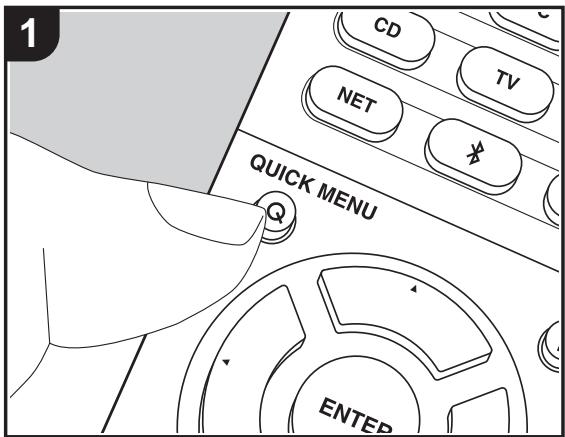
By pressing the Q button on the remote controller during play, you can adjust frequently used settings, such as the sound quality, using on-screen menus.
- Press Q on the remote controller to display the Quick Menu.
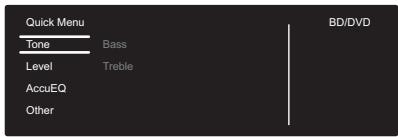
-
Select the item with / on the remote controller and press ENTER to confirm your selection.
-
Change the initial values for each of the settings with the cursors / .
To return to the previous screen, press - To exit the settings, press Q.
■ Tone
Bass: Enhance or moderate the bass range of the front speakers.
Treble: Enhance or moderate the treble range of the front speakers.
- It cannot be set if the listening mode is Pure Audio or Direct.
Level
Center: Adjust the speaker level of the center speaker while listening to some sound.
Subwoofer: Adjust the speaker level of the subwoofer while listening to some sound.
- The adjustment you made will be reset to the previous status when you turn the unit to standby mode.
AccuEQ
AccuEQ Room Calibration: Enable or disable the equalizer function that corrects for distortion caused by the acoustic environment of the room. If this is to be enabled, then normally you should select "On (All Ch)", and to disable just the front speakers you should select "On (ex. L/R)". The setting can be separately set to each input selector.
- This setting cannot be selected if AccuEQ Room Calibration has not been performed.
Equalizer: Select "Preset 1" to "Preset 3" configured in "2. Speaker" - "Equalizer Settings"
(P57) in the Setup menu. The same sound field setting is applied all ranges when set to "Off".
Cinema Filter: Adjust the soundtrack that was processed to enhance its high pitch range, in order to make it suitable for home theater. This function can be used in the following listening modes: Dolby Digital, Dolby Digital Plus, Dolby PL II Movie, Dolby Surround, Dolby TrueHD, Multichannel, DTS, DTS 96/24, DTS-HD High Resolution Audio, DTS-HD Master Audio, DTS Neural:X, DTS Express and DSD.
- It cannot be set if the listening mode is Pure Audio or Direct.
Other
A/V Sync: If the video is behind the audio, you can delay the audio to offset the gap. Different settings can be set for each input selector.
- It cannot be set if the listening mode is Pure Audio or Direct.
Music Optimizer: Improve the quality of the compressed audio. Playback sound of lossy compressed files such as MP3 will be improved. The setting can be separately set to each input selector. The setting is effective in the signals of 48kHz or less. The setting is not effective in the bitstream signals.
- It cannot be set if the listening mode is Pure Audio or Direct.
Late Night: Make small sounds easily heard. It is useful when you need to reduce the volume while watching a movie late night. You can enjoy the effect only when playing Dolby series and DTS series input signals.
-
The setting cannot be used in the following cases.
-
When "3. Audio Adjust" - "Dolby" - "Loudness Management" (P57) in the Setup menu is set to "Off" and Dolby Digital Plus or Dolby TrueHD is being played
-
When the input signal is DTS:X and "Dialog Control" is other than 0 dB
Panorama: Broaden the sound field laterally when playing in the Dolby Pro Logic II Music listening mode.
Dimension: Adjust the depth of the sound field in the front to back direction when playing in the Dolby Pro Logic II Music listening mode. Set a small number to move the sound towards the front. Set a large number to move the sound back.
Center Width: Adjust the width of the sound field of the front channel when playing in the Dolby Pro Logic II Music listening mode. Set a small number to concentrate sound in the middle. Set a large number to distribute the central sound out to the left and right.
Dialog Control: You can increase volume of the dialog portion of the audio in 1 dB steps up to 6 dB so that you can make dialog easier to hear over background noise.
- This cannot be set for content other than DTS:X.
- The effect may not be selectable with some content.
We plan to provide support for the Dolby Atmos audio format through firmware updates for this unit. This means that the settings available depend on the version of firmware.
On firmware version before Dolby Atmos support
- Panorama, Dimension, and Center Width can be set.
On firmware versions supporting Dolby Atmos
- Panorama, Dimension, and Center Width cannot be set after updating.
Web Setup
You can make the settings for network features for this unit in an internet browser on a PC, smartphone, etc.
- Press on the remote controller to display the Setup menu.
- Select "5. Hardware" - "Network" with the cursors, then take a note of the IP address displayed in "IP Address".
- Start the internet browser on your PC or smartphone and enter the IP address of the unit in the URL field.
- Information for the unit (Web Setup screen) is displayed in the internet browser.
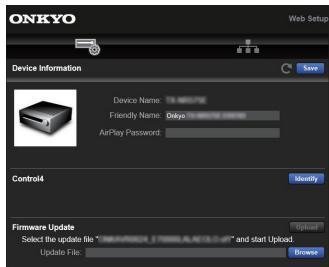
- After changing the settings, select "Save" to save the settings.
Device Information
You can change the Friendly Name, set an AirPlay Password, etc.
Control4: Register this unit if you are using a Control4 system.
Firmware Update: Select the firmware update you have downloaded to your PC so you can update this unit.
Network Setting
Status: You can see information for the network such as the MAC address and IP address for this unit.
Network Connection: You can select how to connect to the network. If you select "Wireless", select an access point from "Wi-Fi Setup" to connect.
DHCP: You can change DHCP settings. If you select "Off", set "IP Address", "Subnet Mask", "Gateway", and "DNS Server" manually.
Proxy: Display and set the URL for the proxy server.
Firmware Update
The updating function on this unit
This unit has functionality to update the firmware (the system software) over a network or by the USB port. This enables us to make improvements to a variety of operations and to add features.
How to update
There are two methods for updating the firmware: via network and via USB. The update may take about 20 minutes to complete for either method: via network or via USB. Furthermore, settings you have changed are maintained regardless of the method used for update. Note that when this unit is connected to a network, you may see notifications about firmware updates on the display. To execute updating, select "Update Now" with the cursors of the remote controller and press ENTER. "Completed!" is displayed when the update is complete.
- For the latest information on updates, visit our website.
There is no need to update the firmware on this unit if there is no update available. - Before updating, make sure that the speaker setup microphone is not connected.
During an update, do not - Disconnect and reconnect any cable, USB storage device, speaker setup microphone or headphones, or perform any operation on the component such as turn off its power
- Accessing this unit from a PC or smartphone using an application
Disclaimer: The program and accompanying online documentation are furnished to you for use at your own risk.
We will not be liable and you will have no remedy for damages for any claim of any kind whatsoever concerning your use of the program or the accompanying online documentation, regardless of legal theory, and whether arising in tort or contract.
In no event will we be liable to you or any third party for any special, indirect, incidental, or consequential damages of any kind, including, but not limited to, compensation, reimbursement or damages on account of the loss of present or prospective profits, loss of data, or for any other reason whatsoever.
Updating the Firmware via Network
- Check that the unit is turned on, and the connection to the Internet is secured.
- Turn off the controller component (PC etc.) connected to the network.
- Stop any playing Internet radio, USB storage device, or server content.
- When "5. Hardware" - "HDMI" - "HDMI CEC" is set to "On" in the Setup menu, set to "Off".
-
The description may differ from the on-screen display but that will not change operations or functionality.
-
Switch the input on the TV to that assigned to the unit.
- Press on the remote controller.
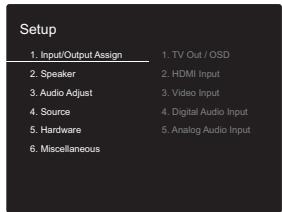
- Select "6. Miscellaneous" - "Firmware Update" - "Update via NET" with the cursors in order and press ENTER.
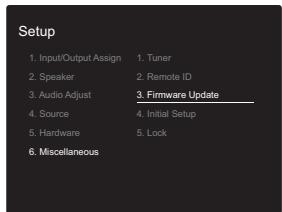
- If "Firmware Update" is grayed out and cannot be selected, wait for a while until it starts up.
-
You will not be able to select "Update via NET" if there is no firmware update.
-
Press ENTER with "Update" selected to start update.
-
During the update, the TV screen may go black depending on the updated program. In that case, check the progress on the display of the unit. The TV screen will remain black until the update is complete and the power is turned on again.
-
"Completed!" is displayed when the update is complete.
-
Press ON/STANDBY on the main unit to switch the unit to standby. The process is completed and your firmware is updated to the latest version.
- Do not use on the remote controller.
If an Error Message is Displayed: When an error occurs, "**Error!" is displayed on the display of the unit. ("" represents an alphanumeric character.) Check the following:
- -01, -10 : Cannot recognize Ethernet cable. Connect the Ethernet cable properly.
-
*- 02 ^ 串 - 03 ^ 串 - 04 ^ 串 - 05 ^ 串 - 06 ^ 串 - 11 ^ 串 - 13 ^ 串 - 14 ^ 串 - 16 ^ 串 - 17 ^ 串 - 18 ^ 串 - 20 ^ 串 - 21 : Internet connection error. Check the following:
-
Whether the router is turned on
- Whether this unit and router are connected to the network
Try to disconnect and then connect again the power to the unit and router. This may solve the problem. If you are still unable to connect to the Internet, the DNS server or proxy server may be temporarily down. Check the service status with your ISP provider.
- Others: Disconnect then reconnect the power cord, then repeat from the beginning.
Updating via USB
-
Prepare a 128MB or larger USB storage device. FAT16 or FAT32 file system format.
-
Media inserted in a USB card reader may not be used for this function.
- USB storage devices with security function are not
supported.
-
USB hubs and USB devices with hub function are not supported. Do not connect these devices to the unit.
-
Delete any data stored on the USB storage device.
- Turn off the controller component (PC etc.) connected to the network.
- Stop any playing Internet radio, USB storage device, or server content.
- When "5. Hardware" - "HDMI" - "HDMI CEC" is set to "On" in the Setup menu, set to "Off".
- Some USB storage devices may take long to load, may not be loaded correctly, or may not be correctly fed depending on the device or their content.
- We will not be liable whatsoever for any loss or damage of data, or storage failure arising from the use of the USB storage device with this AV receiver. Thank you for your understanding.
-
The description may differ from the on-screen display but that will not change the way to operate or the function.
-
Connect the USB storage device to your PC.
- Download the firmware file from the our website to your PC and unzip.
Firmware files are named in the following way:
ONKAVR***_***********.zip
Unzip the file on your PC. The number of unzipped files and folders varies depending on the model.
-
Copy all unzipped files and folders to the root folder of the USB storage device.
-
Make sure to copy the unzipped files.
-
Connect the USB storage device to the USB port on the main unit.
-
If you connect a USB hard disk drive to the USB port of the unit, we recommend that you use its AC adapter to power it.
-
If the USB storage device has been partitioned, each section will be treated as an independent device.
-
Switch the input on the TV to that assigned to the unit.
- Press on the remote controller.
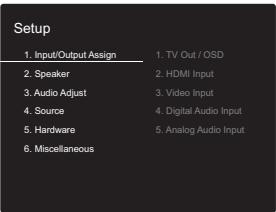

7. Select "6. Miscellaneous" - "Firmware Update" - "Update via USB" with the cursors in order and press ENTER.
- If "Firmware Update" is grayed out and cannot be selected, wait for a while until it starts up.
-
You will not be able to select "Update via USB" if there is no firmware update.
-
Press ENTER with "Update" selected to start update.
-
During the update, the TV screen may go black depending on the updated program. In that case, check the progress on the display of the unit. The TV screen will remain black until the update is complete and the power is turned on again.
- During the update, do not turn off, or disconnect then reconnect the USB storage device.
-
"Completed!" is displayed when the update is complete.
-
Disconnect the USB storage device from the main unit.
- Press ON/STANDBY on the main unit to switch the unit to standby. The process is completed and your firmware is updated to the latest version.
- Do not use on the remote controller.
If an Error Message is Displayed: When an error occurs,
"- Error!" is displayed on the display of the unit. ("" represents an alphanumeric character.) Check the following:
- -01, -10 : USB storage device not found. Check whether the USB storage device or USB cable is correctly inserted to the USB port of this unit.
Connect the USB storage device to an external power source if it has its own power supply. - -05, -13, -20, -21 : The firmware file is not present in the root folder of the USB storage device, or the firmware file is for another model. Retry from the download of the firmware file.
- Others: Disconnect then reconnect the power cord, then repeat from the beginning.
Supplementary Information
Due to firmware (the software for the system) updates after you make your purchase or firmware changes during production of the product, there may be additions or changes to the settings and operation available compared to what is in the instruction manual.
For information about the settings and operations that have been added or changed, see the following references.
Refer to "Supplementary information for player functions" (P34) for information about changes to player functions.
Supplementary Information
Click here <<
Troubleshooting
Before starting the procedure
Problems may be solved by simply turning the power on/off or disconnecting/connecting the power cord, which is easier than working on the connection, setting and operating procedure. Try the simple measures on both the unit and the connected device. If the problem is that the video or audio is not output or the HDMI linked operation does not work, disconnecting/connecting the HDMI cable may solve it. Turn off the device connected to this unit, then disconnect and reconnect the cable. When reconnecting, be careful not to wind the HDMI cable since if wound the HDMI cable may not fit well.
- The AV receiver contains a microPC for signal processing and control functions. In very rare situations, severe interference, noise from an external source, or static electricity may cause it to lockup. In the unlikely event that this happens, unplug the power cord from the wall outlet, wait at least 5 seconds, and then plug it back in.
- We are not responsible for reparations for damages (such as CD rental fees) due to unsuccessful recordings caused by the unit's malfunction. Before you record important data, make sure that the material will be recorded correctly.
If operation becomes unstable
Try restarting the unit
The issue may be fixed by restarting this unit. After switching this unit to standby, press and hold ON/STANDBY on this unit for 5 or more seconds to restart the unit. (The settings in the unit are maintained.) If the issue is not fixed by restarting, try unplugging the power cords of the unit and connected devices, and then plugging them in again.
Resetting the unit (this resets the unit settings to the default)
If restarting the unit doesn't fix the problem, resetting the
unit to the status at the time of shipment may solve the problem. Your settings will also be initialized when you reset, so note down your settings before doing the following.
- While holding down CBL/SAT on the main unit, press ON/STANDBY.
- The unit switches to standby and the settings are reset. To reset the remote control, while holding down MODE, press until the remote indicator flashes twice (3 seconds or more).
Power
Cannot turn on the unit
- Make sure that the power cord is properly plugged into the wall outlet.
- Unplug the power cord from the wall outlet, wait 5 seconds or more, then plug it in again.
The unit turns off unexpectedly
- The unit automatically switches to standby when the "5. Hardware" - "Power Management" - "Auto Standby" setting in the Setup menu functions.
- The protective circuit function may have been activated. If this has occurred, "AMP Diag Mode" appears on the display when the unit is turned on again, and the unit enters diagnostic mode. If the results of the diagnosis is that there is no problem, the "AMP Diag Mode" display disappears and you can use the unit normally again. If "CHECK SP WIRE" appears on the display, the speaker cables may be short-circuited. Make sure bare speaker wires are not touching each other or the back panel of the unit, then turn the unit on again. If "NG" is displayed, immediately unplug the power cord from the wall outlet and contact your dealer.
- The protective circuit function may have been activated because the temperature of the unit rose abnormally. If this happens, then the power will continue to turn off after you have turned the unit on again. Make sure the unit has plenty of space for ventilation around it, wait for the unit to cool down sufficiently, and then try turning it on again.
WARNING: If smoke, smell or abnormal noise is produced by the unit, unplug the power cord from the wall outlet immediately and contact the dealer or customer support.
Audio
-
Make sure that the speaker setup microphone is not still connected.
-
Confirm that the connection between the output jack on the device and the input jack on this unit is correct.
- Make sure that none of the connecting cables are bent, twisted, or damaged.
- If the MUTE indicator on the display flashes, press on the remote controller to cancel muting.
- While headphones are connected to the PHONES jack, no sound is output from the speakers.
- When "4. Source" - "Audio Select" - "PCM Fixed Mode" in the Setup menu is set to "On", no sound is played when signals other than PCM are input. Change the setting to "Off".
Check the following if the above does not fix the problem:
There is no sound from the TV
- Change the input selector on this unit to the position of the terminal to which the TV is connected.
- If the TV doesn't support the ARC function, along with connection by HDMI, connect the TV and this unit using a digital optical cable, digital coaxial cable, or analog audio cable.
No sound from a connected player
- Change the input selector on this unit to the position of the terminal to which the player is connected.
- Check the digital audio output setting on the connected component. On some game consoles, such as those that support DVD, the default setting is off.
- With some DVD-Video discs, you need to select an audio output format from a menu.
A speaker produces no sound
- Make sure that the polarity of the speaker cables (+/-) is correct, and that no bare wires are in contact with the metal part of speaker terminals.
- Make sure that the speaker cables have not shorted.
- Make sure the speakers are connected correctly (P14). Settings for the speaker connection environment need to be made in "1. AccuEQ Room Calibration" (P20) in Initial
Setup.
- Depending on the source and current listening mode, not much sound may be produced. Select another listening mode to see if sound is output.
The subwoofer produces no sound
If the setting of the front speakers is "Full Band" and during 2ch input such as from the TV or music, the low range elements will be output from the front speakers rather than from the subwoofer. If you would rather output from the subwoofer, make one of the following settings.
- Change the front speakers settings to a setting other than "Full Band" for the crossover frequency value.
The range below the frequency you specify will be output from the subwoofer rather than the front speakers. We do not recommend changing this if your front speakers have good low range reproduction capabilities.
- Change "Double Bass" to "On".
The low range elements will be output from both the front speakers and the subwoofer. This may mean that there is too much bass. Do not change if this happens, or choose option 1.
- Refer to "2. Speaker" - "Crossover" (P55) in the Setup menu for details.
- When you play source material that contains no information in the LFE channel, the subwoofer produces no sound.
Noise can be heard
- Using cable ties to bundle analog audio cables, power cords, speaker cables, etc. may degrade the audio performance, so refrain from doing it.
- An audio cable may be picking up interference. Try repositioning your cables.
The beginning of audio received by an HDMI IN cannot be heard
- Since it takes longer to identify the format of an HDMI signal than it does for other digital audio signals, audio output may not start immediately.
Sound suddenly reduces
- When the temperature inside the unit exceeds a certain temperature for extended periods, the volume may be reduced automatically to protect the circuits.
■ Listening mode
- To enjoy digital surround playback, such as Dolby Digital, the audio signals need to pass through a connection via HDMI cable, digital coaxial cable, or digital optical cable. Audio output should be also set to bitstream output on the connected Blu-ray disc player or other device.
- Press on the remote controller several times to switch the display of the main unit to check the input format.
Check the following if the above does not fix the problem:
Cannot select a desired listening mode
- Depending on the connecting status of the speaker, some listening modes may not be selected (P38).
There is no sound with Dolby TrueHD, Dolby Atmos, DTS-HD Master Audio, or DTS:X
- If you cannot output formats such as Dolby TrueHD, Dolby Atmos, DTS-HD Master Audio, or DTS:X according to the format of the source, in the Blu-ray Disc player settings try setting "BD video supplementary sound" (or re-encode, secondary sound, video additional audio, etc.) to "Off". Change the listening mode for each source after changing the setting to confirm.
- We plan to provide support for the Dolby Atmos audio format through firmware updates for this unit.
About DTS signals
- With media that switches suddenly from DTS to PCM, PCM playback may not start immediately. In such cases, you should stop your player for about 3 seconds and then resume playback.
- With some CD and LD players, you will not be able to
playback DTS material properly even though your player is digitally connected to this unit. This is usually because the DTS signal has been processed (e.g., output level, sampling rate, or frequency response changed) and the unit does not recognize it as a genuine DTS signal. In such cases, you may hear noise.
- When playing DTS program material, if you use operations such as pause or skip on your player, you may notice a short audible noise. This is not a malfunction.
Video
- Confirm that the connection between the output jack on the device and the input jack on this unit is correct.
- Make sure that none of the connecting cables are bent, twisted, or damaged.
- There may be interference from the power cords or other connection cables to this unit if the picture on the TV is poor. Try separating the TV antenna cable and other cables of the unit.
- Check the screen input on the monitor, such as the TV.
Check the following if the above does not fix the problem:
There is no video
- Change the input selector on this unit to the position of the terminal to which the player is connected.
- While the Pure Audio listening mode is selected, the analog video circuitry is turned off and only video signals input through HDMI input jacks can be output.
There is no picture from a source connected to an HDMI IN terminal.
- To display video from the connected player on the TV screen while the unit is in standby, you need to enable "5. Hardware" - "HDMI" - "HDMI Standby Through" in the Setup menu. Refer to (P60) for information about HDMI Standby Through.
- Check if "Resolution Error" is displayed on the main unit
display when video input via HDMI IN jack is not displayed. In this case, the TV does not support the resolution of the video input from the player. Change the setting on the player.
- Reliable operation with an HDMI-to-DVI adapter is not guaranteed. In addition, video signals from a PC are not supported.
Images flicker
- It is possible that the resolution of the player is not compatible with the TV's resolution. If you have connected the player to this unit with an HDMI cable, try changing the output resolution on the player. There also may be an improvement if you change the screen mode on the TV.
Video and audio are out of sync
- Video may be delayed relative to audio depending on the settings and connections with your TV. To adjust, press Q on the remote controller, and adjust in "Other" - "A/V Sync" in "Quick Menu".
■ Linked operation
There is no linked operation with CEC compliant devices, such as a TV.
- The "5. Hardware" - "HDMI" - "HDMI CEC" setting in the Setup menu needs to be set to "On".
- It is also necessary to set HDMI linking on the CEC compliant device. Check the instruction manual.
Tuner
Radio reception is poor or there is a lot of noise.
- Re-check the antenna connection.
- Separate the antenna from speaker cables and the power cord.
- Move the unit away from your TV or PC.
Passing cars and airplanes can cause interference.
Concrete walls weaken radio signals.
- Listen to the station in mono.
- When listening to an AM station, operating the remote controller may cause noise.
- FM reception may become clearer if you use the antenna jack on the wall used for the TV.
The BLUETOOTH feature
- Try plugging/unplugging the power of the unit and try turning on/off the BLUETOOTH wireless technology enabled device. Restarting the BLUETOOTH wireless technology enabled device may be effective.
- The BLUETOOTH wireless technology enabled devices must support the A2DP profile.
- Radio wave interference may occur in the vicinity of components, such as microwave ovens or cordless phones, which use radio waves in the 2.4 GHz range. This interference may render this unit unusable.
- If there is a metallic object near the unit, BLUETOOTH connection may not be possible as the metal can effect on the radio waves.
Check the following if the above does not fix the problem:
Cannot connect with this unit
- Check that the BLUETOOTH function of the BLUETOOTH wireless technology enabled device is enabled.
Music playback is unavailable on the unit even after successful BLUETOOTH connection
- When the audio volume of your BLUETOOTH wireless technology enabled device is set low, the playback of audio may be unavailable. Turn up the volume on the BLUETOOTH wireless technology enabled device.
- Some BLUETOOTH wireless technology enabled devices may be equipped with a Send/Receive selector switch. Select Send mode.
- Depending on the characteristics or specifications of
your BLUETOOTH wireless technology enabled device, playback on this unit may not be possible.
Sound is interrupted
- There may be a problem with the BLUETOOTH wireless technology enabled device. Check the information on the Internet.
The audio quality is poor after connection with a BLUETOOTH wireless technology enabled device
- The BLUETOOTH reception is poor. Move the BLUETOOTH wireless technology enabled device closer to the unit or remove any obstacle between the BLUETOOTH wireless technology enabled device and this unit.
Network Functions
- If you cannot select a network service, it will become selectable when the network function is started. It may take about a minute to start up.
- When NET is blinking, the AV receiver is not properly connected to the home network.
- Try plugging/unplugging the power supply of this unit and the router, and try rebooting the router.
- If the desired wireless LAN router is not in the access point list, it may be set to hide SSID or the ANY connection may be off. Change the setting and try again.
Check the following if the above does not fix the problem:
Cannot access the Internet radio
- Certain network service or contents available through the unit may not be accessible in case the service provider terminates its service.
- Make sure that your modem and router are properly connected, and make sure they are both turned on.
- Make sure that the LAN side port on the router is properly connected to the AV receiver.
- Make sure that connecting to Internet from other
components is possible. If connecting is not possible, turn off all components connected to the network, wait for a while, and then turn on the components again.
- If a specific radio station is unavailable for listening, make sure the registered URL is correct, or whether the format distributed from the radio station is supported by the AV receiver.
- Depending on ISP, setting the proxy server is necessary.
- Make sure that the router and/or modem you are using is supported by your ISP.
Cannot access the network server
- This unit needs to be connected to the same router as the network server.
- This unit is compatible with Windows Media® Player 11 or 12 network servers or NAS that are compatible with home network functionality.
- You may need to make some settings on Windows Media® Player (P32).
- When using a PC, only music files registered in the Windows Media® Player library can be played.
Playback stops while listening to music files on the network server
- Make sure the network server is compatible with this unit.
- When the PC is serving as the network server, try quitting any application software other than the server software (Windows Media® Player 12 etc.).
- If the PC is downloading or copying large files, the playback may be interrupted.
USB storage device
USB storage device is not displayed
- Check whether the USB storage device or USB cable is correctly inserted to the USB port of the unit.
- Disconnect the USB storage device from the unit, and then try reconnecting.
-
Performance of hard disks that receive power from the USB port of the unit is not guaranteed.
-
Depending on the type of format, the playback may not be performed normally. Check the type of the file formats that is supported.
- USB storage devices with security functions may not be played.
Wireless LAN Network
- Try plugging/unplugging the power supply of wireless LAN router and the unit, check the wireless LAN router power-on status, and try reboot of the wireless LAN router.
Check the following if the above does not fix the problem:
Cannot access wireless LAN network
- The wireless LAN router setting may be switched to Manual. Return the setting to Auto.
- Try the manual set-up. The connection may succeed.
- When the wireless LAN router setting is at stealth mode (mode to hide the SSID key) or when ANY connection is off, the SSID is not displayed. Change the setting and try again.
- Check that the setting of SSID and encryption (WEP, etc.) is correct. Make sure the network settings of the unit is properly set.
- Connection to an SSID that includes multi-byte characters is not supported. Name the SSID of the wireless LAN router using single-byte alphanumeric characters only and try again.
Connected to an SSID different to the SSID selected
- Some wireless LAN routers allow you to set multiple SSIDs for one unit. If you use the automatic setting button on such a router, you may end up connecting with a different SSID from the SSID you wanted to connect to. Use the connection method requiring you to enter a password if this happens.
Playback is interrupted and communication does not
work
- You may not receive radio waves due to bad radio wave conditions. Shorten the distance from the wireless LAN router or remove obstacles to improve visibility, and try again. Place the unit away from microwave ovens or other access points. It is recommended to place the wireless LAN router and the unit in the same room.
- If there is a metallic object near the unit, wireless LAN connection may not be possible as the metal can effect on the radio wave.
- When other wireless LAN devices are used near the unit, several issues such as interrupted playback and communication may occur. You can avoid these issues by changing the channel of your wireless LAN router. For instructions on changing channels, see the instruction manual provided with your wireless LAN router.
- There may not be enough bandwidth available in the band for wireless LAN. Connect using an Ethernet cable.
Remote Controller
- Make sure that the batteries are installed with the correct polarity.
- Install new batteries. Do not mix different types of batteries, or old and new batteries.
- Make sure that the unit is not subjected to direct sunshine or inverter-type fluorescent lights. Relocate if necessary.
- If the unit is installed in a rack or cabinet with colored-glass doors or if the doors are closed, the remote controller may not work reliably.
Display
The display doesn't light
- The display may go dim while the Dimmer is working. Press DIMMER to change the brightness level of the display.
- The display is turned off when the Pure Audio listening
mode is selected.
Others
Strange noises can be heard from the unit
- If you have connected another unit to the same wall outlet as this unit, this noise may be an effect from the other unit. If the symptoms improve by unplugging the power cord of the other unit, use different wall outlets for this unit and the other unit.
The message "Noise Error" is displayed during AccuEQ Room Calibration
- This can be caused by a malfunction in your speaker unit. Check if the speakers produce normal sounds.
The results of AccuEQ Room Calibration give a different distance to the speakers than the actual distance
- There may be some discrepancies in the results depending on the speakers you are using. If this is the case, make the settings in "2. Speaker" - "Distance" in the Setup menu.
General Specifications
Amplifier (Audio) section
Rated Output Power (IEC) 5 ch × 135 W at 6 ohms, 1 kHz, 1 ch driven of 1% THD
Maximum Effective Output Power (JEITA) (Australian) 5 ch × 160 W at 6 ohms, 1 kHz, 1 ch driven of 10% THD
Dynamic Power (^*)
(*)IEC60268-Short-term maximum output power 160 W (3 Ω, Front) 125 W (4 Ω, Front) 85 W (8 Ω, Front)
THD+N (Total Harmonic Distortion+Noise) 0.08% (20 Hz - 20,000 Hz, half power)
Input Sensitivity and Impedance (1 kHz, 100 W/8 Ω) 200 mV/47 kΩ (LINE (Unbalance))
Rated RCA Output Level and Impedance 1 V/470 Ω (SUBWOOFER PRE OUT)
Frequency Response 10 Hz - 100 kHz/+1 dB, -3 dB (Direct/Pure Audio)
Tone Control Characteristics ±10 dB, 90 Hz (BASS) ±10 dB, 7.5 kHz (TREBLE
Signal to Noise Ratio 106 dB (IHF-A, LINE IN, SP OUT)
Speaker Impedance 4Ω-16Ω
Headphone Output Impedance 330Ω
Headphone Rated Output 80 mW (32 Ω, 1 kHz, 10% THD)
Video Section
Signal level 1 Vp-p/75 Ω (Composite Video)
Tuner Section
FM Tuning Frequency Range 87.5 MHz - 108.0 MHz, RDS
AM Tuning Frequency Range 522/530 kHz - 1611/1710 kHz
Preset Channel 40
Network Section
Ethernet LAN 10BASE-T/100BASE-TX
Wireless LAN IEEE 802.11 a/b/g/n standard (Wi-Fi® standard) 5 GHz/2.4 GHz band
BLUETOOTH Section
Communication system BLUETOOTH Specification version 4.1+LE
Frequency band 2.4 GHz band
Modulation method FHSS (Frequency Hopping Spread Spectrum)
Compatible BLUETOOTH profiles A2DP 1.2
AVRCP 1.3 HOGP-Host (Client)
HOGP-HID Device (Server)
HID Service (HIDS)
Supported Codecs SBC AAC
Transmission range (A2DP) 20 Hz - 20 kHz (Sampling frequency 44.1 kHz)
Maximum communication range Line of sight approx. 15m^()
(*)The actual range will vary depending on factors such as obstacles between devices, magnetic fields around a microwave oven, static electricity, cordless phone, reception sensitivity, antenna's performance, operating system, software application, etc.
General
Power Supply AC 220 - 240 V, 50/60 Hz
Power Consumption 400 W
0.15 W (Stand-by)
40 W (No-sound)
4.5 W (HDMI Standby Through)
2.8 W (Network Standby)
Dimensions (W × H × D) 435 mm × 160 mm × 328 mm
Weight 8.6 k
HDMI
Input IN1 (BD/DVD), IN2 (CBL/SAT), IN3 (STRM BOX), IN4 (GAME)
Output OUT (HDCP2.2)
Supported Deep Color, x.v.ColorTM, LipSync, Audio Return Channel, 3D, 4K 60Hz, CEC, Extended Colorimetry (sYCC601, Adobe RGB, Adobe YCC601), Content Type, HDR
Audio Format Dolby Atmos (to be supported in a future update), Dolby TrueHD, Dolby Digital, Dolby Digital Plus, DTS, DTS:X, DTS-HD Master Audio, DTS-HD High Resolution Audio, DTS 96/24, DTS-HD Express, DSD, PCM
Maximum Video Resolution 4k 60 Hz (YCbCr 4:4:4)
Video Inputs
Composite IN1 (GAME), IN2 (CBL/SAT)
Compatible input resolutions
HDMI input 4K, 1080p/24, 1080p, 1080i, 720p, 480p/576p
Composite input 480i/576i
- The output from the HDMI OUT jack to the TV is the same resolution as the input.
Audio Inputs
Digital OPTICAL IN1 (CD), IN2 (TV) COAXIAL IN (CBL/SAT)
Analog IN1 (GAME), IN2 (PC), IN3 (CD), AUX (Front, 0.3.5 mm)
Audio Outputs
Analog SUBWOOFER PRE OUT
Speaker Outputs FRONT L/R, CENTER, SURROUND or HEIGHT L/R
Phones PHONES (Front, 6.3 mm)
Others
USB: 1 (Rear, Ver.2.0, 5 V/1 A)
Ethernet:1 Setup Mic:1 (Front)
Power consumption in standby mode
In the following cases, the power consumption in standby mode may reach up to a maximum of 12 W:
- When "Network Standby" is set to "On"
- When "HDMI CEC" is set to "On"
- When "HDMI Standby Through" is set to other than "Off"
- When "Bluetooth Wakeup" is set to "On"
- When "USB Power Out at Standby" is set to "On"
Reference Information
About HDMI
Compatible functions
HDMI (High Definition Multimedia Interface) is a digital interface standard for connecting TVs, projectors, Blu-ray Disc/DVD players, set-top boxes, and other video components. Until now, several separate video and audio cables have been required to connect AV components. With HDMI, a single cable can carry control signals, digital video, and digital audio (2-channel PCM, multichannel digital audio, and multichannel PCM).
HDMI CEC feature: By connecting devices and HDMI cables that comply with the CEC (Consumer Electronics Control) specification of the HDMI standard, a variety of linked operation become possible between devices. You can enjoy features such as linking input switching with input and players, control volume using the remote controller of the TV, and automatically switching this unit to standby when the TV is turned off. The unit is designed to link with products that comply with the CEC standard, and that linked operation is not always guaranteed with all CEC devices. For linked functions to work properly, do not connect more CEC-compliant components than the quantities specified below, to the HDMI jack.
- Blu-ray Disc/DVD players: up to 3 units.
- Blu-ray Disc/DVD recorders: up to 3 units.
- Cable TV tuner, terrestrial digital tuner, and satellite broadcasting tuner: up to 4 units.
Operation has been confirmed on the following devices: (As of April 2017)
Toshiba brand televisions; Sharp brand televisions; Onkyo and Integra brand RIHD-compatible players; Toshiba brand players and recorders; Sharp brand players and recorders (when used with a Sharp brand television)
ARC (Audio Return Channel): By connecting a TV that supports ARC with a single HDMI cable, you can not only output the audio and video from this unit to the TV, but also
input the audio from the TV to this unit.
HDMI Standby Through: Even if this unit is in standby, the input signals from AV components are transmitted to the TV.
Deep Color: By connecting devices supporting Deep Color, video signals input from the devices can be reproduced on the TV with even more colors.
x.v.Color™: This technology realizes even more realistic colors by broadening the color gamut.
3D: You can transmit 3D video signals from AV components to the TV.
4K: This unit supports 4K (3840×2160p) and 4K SMPTE (4096×2160p) video signals.
LipSync: This setting automatically corrects any desynchronization between the video and audio signals based on data from the HDMI Lip-Sync compatible TV.
Supported Audio Formats
2-channel linear PCM: 32 kHz, 44.1 kHz, 48 kHz, 88.2 kHz, 96 kHz, 176.4 kHz, 192 kHz, 16/20/24 bit
Multi-channel linear PCM: Maximum 5.1 channels, 32 kHz, 44.1 kHz, 48 kHz, 88.2 kHz, 96 kHz, 176.4 kHz, 192 kHz, 16/20/24 bit
Bitstream: Dolby Atmos (to be supported in a future update), Dolby Digital, Dolby Digital Plus, Dolby TrueHD, DTS, DTS:X, DTS-HD High Resolution Audio, DTS-HD Master Audio
DSD: Supported sampling rates: 2.8 MHz
Your Blu-ray Disc/DVD player must also support HDMI output of the above audio formats.
Supported resolutions
Copyright protection technology: HDCP1.4/HDCP2.2
Color Depth: 720 × 480i 60Hz, 720 × 576i 50Hz, 720 × 480p 60Hz, 720 × 576p 50Hz, 1920 × 1080i 50/60Hz, 1280 × 720p 24/25/30/50/60Hz, 1680 × 720p 24/25/30/50/60Hz, 1920 × 1080p 24/25/30/50/60Hz, 2560 × 1080p 24/25/30/50/60Hz, 4K (3840 × 2160p) 24/25/30Hz, 4K SMPTE (4096 × 2160p) 24/25/30Hz : RGB/YCbCr4:4:4 (8/10/12 bit), YCbCr4:2:2 (12 bit) 4K (3840 × 2160p) 50/60Hz, 4K SMPTE (4096 × 2160p) 50/60Hz : RGB/YCbCr4:4:4 (8 bit), YCbCr4:2:2 (12 bit), YCbCr4:2:0 (8/10/12 bit)
Supported Audio Formats
USB Storage
This unit supports the following music file formats. Note that sound files that are protected by copyright cannot be played on this unit.
MP3 (.mp3/.MP3):
- Supported formats: MPEG-1/MPEG-2 Audio Layer 3
Supported sampling rates: 44.1 kHz, 48 kHz - Supported bitrates: Between 8 kbps and 320 kbps and VBR
WMA (.wma/.WMA):
Supported sampling rates: 44.1 kHz and 48 kHz
- Supported bitrates: Between 5 kbps and 320 kbps and VBR
- WMA Pro/Voice/WMA Lossless formats are not supported
WAV (.wav/.WAV):
WAV files include uncompressed PCM digital audio.
Supported sampling rates: 44.1 kHz, 48 kHz, 88.2 kHz, 96 kHz, 176.4 kHz, 192 kHz
- Quantization bit: 8 bit, 16 bit, 24 bit
AIFF (.aiff/.aif/.AIFF/.AIF):
AIFF files include uncompressed PCM digital audio.
Supported sampling rates: 44.1 kHz, 48 kHz, 88.2 kHz, 96 kHz, 176.4 kHz, 192 kHz
- Quantization bit: 8 bit, 16 bit, 24 bit
AAC (.aac/.m4a/.mp4/.3gp/.3g2/.AAC/.M4A/.MP4/.3GP/.3G2):
- Supported formats: MPEG-2/MPEG-4 Audio
Supported sampling rates: 44.1 kHz, 48 kHz, 88.2 kHz, 96 kHz - Supported bitrates: Between 8 kbps and 320 kbps and VBR
FLAC (.flac/.FLAC):
Supported sampling rates: 44.1 kHz, 48 kHz, 88.2 kHz, 96 kHz, 176.4 kHz, 192 kHz
- Quantization bit: 8 bit, 16 bit, 24 bit
Apple Lossless (.m4a/.mp4/.M4A/.MP4):
Supported sampling rates: 44.1 kHz, 48 kHz, 88.2 kHz, 96 kHz, 176.4 kHz, 192 kHz
- Quantization bit: 16 bit, 24 bit
DSD (.dsf/.dff/.DSF/.DFF):
- Supported formats: DSF/DSDIFF
Supported sampling rates: 2.8 MHz and 5.6 MHz
Dolby TrueHD (.vr/.mlp/.VR/.MLP):
Supported sampling rates: 44.1 kHz, 48 kHz, 88.2 kHz, 96 kHz, 176.4 kHz, 192 kHz
- Variable bit-rate (VBR) files are supported. However, playback times may not be displayed correctly.
- This unit supports the gapless playback of the USB storage device in the following conditions. When playing WAV, FLAC and Apple Lossless, and the same format, sampling frequency, channels and quantization bit rate are played continuously
Music Server
This unit supports the following music file formats. Remote play of FLAC, DSD, and Dolby TrueHD is not supported.
MP3 (.mp3/.MP3):
- Supported formats: MPEG-1/MPEG-2 Audio Layer 3
Supported sampling rates: 44.1 kHz, 48 kHz - Supported bitrates: Between 8 kbps and 320 kbps and VBR
WMA (.wma/.WMA):
Supported sampling rates: 44.1 kHz, 48 kHz
- Supported bitrates: Between 5 kbps and 320 kbps and VBR
- WMA Pro/Voice/WMA Lossless formats are not supported
WAV (.wav/.WAV):
WAV files include uncompressed PCM digital audio.
Supported sampling rates: 44.1 kHz, 48 kHz, 88.2 kHz, 96 kHz, 176.4 kHz, 192 kHz
- Quantization bit: 8 bit, 16 bit, 24 bit
AIFF (.aiff/.aif/.AIFF/.AIF):
AIFF files include uncompressed PCM digital audio.
Supported sampling rates: 44.1 kHz, 48 kHz, 88.2 kHz, 96 kHz, 176.4 kHz, 192 kHz
- Quantization bit: 8 bit, 16 bit, 24 bit
AAC (.aac/.m4a/.mp4/.3gp/.3g2/.AAC/.M4A/.MP4/.3GP/.3G2):
Supported formats: MPEG-2/MPEG-4 Audio
Supported sampling rates: 44.1 kHz, 48 kHz, 88.2 kHz, 96 kHz
- Supported bitrates: Between 8 kbps and 320 kbps and VBR
FLAC (.flac/.FLAC):
Supported sampling rates: 44.1 kHz, 48 kHz, 88.2 kHz, 96 kHz, 176.4 kHz, 192 kHz
- Quantization bit: 8 bit, 16 bit, 24 bit
LPCM (Linear PCM):
Supported sampling rates: 44.1 kHz and 48 kHz
- Quantization bit: 16 bit
Apple Lossless (.m4a/.mp4/.M4A/.MP4):
Supported sampling rates: 44.1 kHz, 48 kHz, 88.2 kHz, 96 kHz
- Quantization bit: 16 bit, 24 bit
DSD (.dsf/.dff/.DSF/.DFF):
Supported formats: DSF/DSDIFF
Supported sampling rates: 2.8 MHz, 5.6 MHz
- Variable bit-rate (VBR) files are supported. However, playback times may not be displayed correctly.
- Remote playback does not support the gapless playback.
Device Requirements
USB Storage
Note that operation is not guaranteed with all USB storage devices.
- This unit can use USB storage devices that comply with the USB mass storage device class standard. The unit is also compatible with USB storage devices using the FAT16 or FAT32 file system formats.
- If the USB storage device has been partitioned, each section will be treated as an independent device.
- Up to 20,000 tracks per folder can be displayed, and folders may be nested up to 16 levels deep.
- USB hubs and USB storage devices with hub functions are not supported. Do not connect these devices to the unit.
- USB storage devices with security function are not supported on this unit.
- If you connect a USB hard disk drive to the USB port of the unit, we recommend that you use its AC adapter to power it.
Media inserted to the USB card reader may not be
available in this function. Furthermore, depending on the USB storage device, proper reading of the contents may not be possible.
- We accepts no responsibility whatsoever for the loss or damage to data stored on a USB storage device when that device is used with this unit. We recommend that you back up your important music files beforehand.
License and Trademark
DOLBY ATMOS DOLBY VISION COMPATIBLE
Manufactured under license from Dolby Laboratories. Dolby, Dolby Atmos, Pro Logic, Dolby Surround, Dolby Vision and the double-D symbol are trademarks of Dolby Laboratories.

For DTS patents, see http://patents.dts.com. Manufactured under license from DTS, Inc. DTS, the Symbol, DTS in combination with the Symbol, DTS:X, and the DTS:X logo are registered trademarks or trademarks of DTS, Inc. in the United States and/or other countries. © DTS, Inc. All Rights Reserved.

HIGHDEFINITION MULTIMEDIA INTERFACE
The terms HDMI and HDMI High-Definition Multimedia Interface, and the HDMI Logo are trademarks or registered trademarks of HDMI Licensing LLC in the United States and other countries.

CERTIFIED
The Wi-Fi CERTIFIED Logo is a certification mark of Wi-Fi Alliance®.
Made for

iPhone


AirPlay
AirPlay, iPad, iPhone, iPod, iPod classic, iPod nano and iPod touch are trademarks of Apple Inc., registered in the U.S. and other countries.
iPad Air and iPad mini are trademarks of Apple Inc.
"Made for iPod", "Made for iPhone" and "Made for iPad" mean that an electronic accessory has been designed to connect specifically to iPod, iPhone, or iPad, respectively, and has been certified by the developer to meet Apple performance standards. Apple is not responsible for the operation of this device or its compliance with safety and regulatory standards.
Please note that the use of this accessory with iPod, iPhone or iPad may affect wireless performance.
AirPlay works with iPhone, iPad, and iPod touch with iOS 4.3.3 or later, Mac with OS X Mountain Lion or later, and PC with iTunes 10.2.2 or later.
pandora
PANDORA, the PANDORA logo, and the Pandora trade dress are trademarks or registered trademarks of Pandora Media, Inc. Used with permission.
Bluetooth
The BLUETOOTH® word mark and logos are registered trademarks owned by Bluetooth SIG, Inc.
The Spotify software is subject to third party licenses found here: https://developer.spotify.com/esdk-third-party-licenses/

BLACKFIRE
This Mark Certifies that this product is compliant with the BLACKFIRE ALLIANCE Standard. Please refer to WWW.BLACKFIREALLIANCE.COM for more information. BLACKFIRE™ is a Registered Trademark (No. 85,900,599) of BLACKFIRE RESEARCH CORP. All rights reserved.

Fire Connect
FireConnect™ is technology powered by BlackFire Research.
This product is protected by certain intellectual property rights of Microsoft. Use or distribution of such technology outside of this product is prohibited without a license from Microsoft.
Windows 7, Windows Media, and the Windows logo are trademarks or registered trademarks of Microsoft Corporation in the United States and/or other countries.
"x.v.Color" and "x.v.Color" logo are trademarks of Sony Corporation.
DSD and the Direct Stream Digital logo are trademarks of Sony Corporation.

Theater-Dimensional
"Theater-Dimensional" and "Theater-Dimensional (logo)" are trademarks of Onkyo Corporation.
All other trademarks are the property of their respective owners. / Toutes les autres marques commerciales sont la propriété de leurs détenteurs respectifs. / El resto de MARCAS commerciales son propidade de sus respectivos propriétarios. / Tutti gli altri marchi di fabbrica sono di propietà dei rispettivi proprietari. / Alle
anderen Warenzeichen sind das Eigentum ihrer jeweiligen Eigentümer. / Alle andere handelsmerken zijn eigendom van de desbetreffende rechtsbenden. / Alla andra verumärken tilhör deras respektive ägare. / Kaikk muut tuotemerkit ovat omistajensa omaisuuttta. /所有其他商標為各自所有者所有。
ONKYO
2-3-12 Yaesu, Chuo-ku, Tokyo 104-0028 JAPAN
http://www.onkyo.com/
18 Park Way, Upper Saddle River, N.J. 07458, U.S.A.
For Dealer, Service, Order and all other Business Inquiries:
Tel: 201-785-2600 Fax: 201-785-2650
http://www.us.onkyo.com/
For Product Support Team Only:
1-800-229-1687
http://www.us.onkyo.com/
Gutenbergstrasse 3, 82178 Puchheim, Germany
Tel: +49-8142-4401-0 Fax: +49-8142-4208-213
http://www.eu.onkyo.com/
Anteros Building, Odyssey Business Park, West End Road, South Ruislip, Middlesex,
HA4 6QQ United Kingdom
Tel: +44 (0)871-200-1996 Fax: +44 (0)871-200-1995
For Product Support only: +44 (0)208-836-3510
http://www.uk.onkyo.com/en/
6, Avenue de Marais F - 95816 Argenteuil Cedex FRANCE
For Product Support only: +33 969 368 138
Unit 1033, 10/F, Star House, No 3, Salisbury Road, Tsim Sha Tsui Kowloon, Hong Kong.
Tel: +852-2429-3118 Fax: +852-2428-9039
http://www.hk.onkyo.com/
302, Building 1, 20 North Chaling Rd., Xuhui District, Shanghai, China 200032,
Tel: +86-21-52131366 Fax: +86-21-52130396
http://www.cn.onkyo.com/
Please contact an Onkyo distributor referring to Onkyo SUPPORT site.
http://www.intl.onkyo.com/support/
Kopnpaia O 3Hn
The above-mentioned information is subject to change without prior notice.
Visit the Onkyo web site for the latest update.
TX-NR474
AV RECEIVER
Instruction Manual
Mode d'emploi
1. AccuEQ Room Calibration
2. Source Connection
T-D (Theater-Dimensional)
4. Level Calibration
- Dolby Enabled Speaker
6. Equalizer Settings
AVRCP 1.3 HOGP-Host (Client)
Péripétrique HOGP-HID (Serveur)
Service HID (HIDS)
Codes pris en charge SBC AAC
Composite IN1 (GAME), IN2 (CBL/SAT)
COAXIAL IN (CBL/SAT)
Analogue
IN1 (GAME), IN2 (PC), IN3 (CD), AUX (Avant,
0 3,5 mm)
Sorties audio
Analogue
SUBWOOFER PRE OUT
AAC (.aac/.m4a/.mp4/.3gp/.3g2/.AAC/.M4A/.MP4/.3GP/.3G2):
DSD (.dsf/.dff/.DSF/.DFF) :
Dolby TrueHD (.vr/.mlp/.VR/.MLP):
AAC (.aac/.m4a/.mp4/.3gp/.3g2/.AAC/.M4A/.MP4/.3GP/.3G2):
DSD (.dsf/.dff/.DSF/.DFF) :
Manufactured under license from Dolby Laboratories. Dolby, Dolby Atmos, Pro Logic, Dolby Surround, Dolby Vision and the double-D symbol are trademarks of Dolby Laboratories.

For DTS patents, see http://patents.dts.com. Manufactured under license from DTS, Inc. DTS, the Symbol, DTS in combination with the Symbol, DTS:X, and the DTS:X logo are registered trademarks or trademarks of DTS, Inc. in the United States and/or other countries. © DTS, Inc. All Rights Reserved.

HIGH-DEFINITION MULTIMEDIA INTERFACE
The terms HDMI and HDMI High-Definition Multimedia Interface, and the HDMI Logo are trademarks or registered trademarks of HDMI Licensing LLC in the United States and other countries.

CERTIFIED
The Wi-Fi CERTIFIED Logo is a certification mark of Wi-Fi Alliance®.
Made for

iPhone


AirPlay
AirPlay, iPad, iPhone, iPod, iPod classic, iPod nano and iPod touch are trademarks of Apple Inc., registered in the U.S. and other countries.
iPad Air and iPad mini are trademarks of Apple Inc.
"Made for iPod", "Made for iPhone" and "Made for iPad" mean that an electronic accessory has been designed to connect specifically to iPod, iPhone, or iPad, respectively, and has been certified by the developer to meet Apple performance standards. Apple is not responsible for the operation of this device or its compliance with safety and regulatory standards.
Please note that the use of this accessory with iPod, iPhone or iPad may affect wireless performance.
AirPlay works with iPhone, iPad, and iPod touch with iOS 4.3.3 or later, Mac with OS X Mountain Lion or later, and PC with iTunes 10.2.2 or later.
pandora
PANDORA, the PANDORA logo, and the Pandora trade dress are trademarks or registered trademarks of Pandora Media, Inc. Used with permission.
Bluetooth
The BLUETOOTH® word mark and logos are registered trademarks owned by Bluetooth SIG, Inc.
The Spotify software is subject to third party licenses found here: https://developer.spotify.com/esdk-third-party-licenses/

BLACKFIRE
This Mark Certifies that this product is compliant with the BLACKFIRE ALLIANCE Standard. Please refer to WWW.BLACKFIREALLIANCE.COM for more information. BLACKFIRE™ is a Registered Trademark (No. 85,900,599) of BLACKFIRE RESEARCH CORP. All rights reserved.

Fire Connect
FireConnect™ is technology powered by BlackFire Research.
This product is protected by certain intellectual property rights of Microsoft. Use or distribution of such technology outside of this product is prohibited without a license from Microsoft.
Windows 7, Windows Media, and the Windows logo are trademarks or registered trademarks of Microsoft Corporation in the United States and/or other countries.
"x.v.Color" and "x.v.Color" logo are trademarks of Sony Corporation.
DSD and the Direct Stream Digital logo are trademarks of Sony Corporation.

Theater-Dimensional
"Theater-Dimensional" and "Theater-Dimensional (logo)" are trademarks of Onkyo Corporation.
All other trademarks are the property of their respective owners. / Toutes les autres marques commerciales sont la propriété de leurs détenteurs respectifs. / El resto de MARCAS commerciales son propresdad es sus respectivos propriétarios. / Tutti gli altri marchi di fabbrica sono di proprietà dei rispettivi propriétari. / Alle
anderen Warenzeichen sind das Eigentum ihrer jeweiligen Eigentümer. / Alle andere handelsmerken zijn eigendom van de desbetreffende rechtsbenden. / Alla andere verumärken tilhör deras respektive ägare. / Kaikkmuut tuotemerkit ovat omistajensa omaisuuttta. /所有其他商標為各自所有者所有。
ONKYO
2-3-12 Yaesu, Chuo-ku, Tokyo 104-0028 JAPAN
http://www.onkyo.com/
18 Park Way, Upper Saddle River, N.J. 07458, U.S.A.
For Dealer, Service, Order and all other Business Inquiries:
Tel: 201-785-2600 Fax: 201-785-2650
http://www.us.onkyo.com/
For Product Support Team Only:
1-800-229-1687
http://www.us.onkyo.com/
Gutenbergstrasse 3, 82178 Puchheim, Germany
Tel: +49-8142-4401-0 Fax: +49-8142-4208-213
http://www.eu.onkyo.com/
Anteros Building, Odyssey Business Park, West End Road, South Ruislip, Middlesex,
HA4 6QQ United Kingdom
Tel: +44 (0)871-200-1996 Fax: +44 (0)871-200-1995
For Product Support only: +44 (0)208-836-3510
http://www.uk.onkyo.com/en/
6, Avenue de Marais F - 95816 Argenteuil Cedex FRANCE
For Product Support only: +33 969 368 138
Unit 1033, 10/F, Star House, No 3, Salisbury Road, Tsim Sha Tsui Kowloon, Hong Kong.
Tel: +852-2429-3118 Fax: +852-2428-9039
http://www.hk.onkyo.com/
302, Building 1, 20 North Chaling Rd., Xuhui District, Shanghai, China 200032,
Tel: +86-21-52131366 Fax: +86-21-52130396
http://www.cn.onkyo.com/
Please contact an Onkyo distributor referring to Onkyo SUPPORT site.
http://www.intl.onkyo.com/support/
Kopnpaia O 3Hn
The above-mentioned information is subject to change without prior notice.
Visit the Onkyo web site for the latest update.
TX-NR474
AV RECEIVER
Instruction Manual
Mode d'emploi
1. AccuEQ Room Calibration
2. Source Connection
3. Network Connection
T-D (Theater-Dimensional)
4. Level Calibration
6. Equalizer Settings
- Bombie "Double Bass" a "On".
106 dB (IHF-A, LINE IN, SP OUT)
Impedancia de altovoz
4Ω-16Ω
80 mW (32 Ω, 1 kHz, 10% THD)
Sección de video
Nivel de senal
87,5 MHz - 108,0 MHz, RDS
522/530 kHz - 1611/1710 kHz
Channel, 3D, 4K 60Hz, CEC, Extended Colorimetry
(sYCC601, Adobe RGB, Adobe YCC601), Content Type,
HDR
Formato de Audio
Dolby Atmos (sera compatible enproximas
HD High Resolution Audio, DTS 96/24, DTS-HD
Express, DSD, PCM
Resolución de video maxima
4k 60 Hz (YCbCr 4:4:4)
Entradas de video
Compuesto
IN1 (GAME), IN2 (CBL/SAT)
COAXIAL IN (CBL/SAT)
Analógico
IN1 (GAME), IN2 (PC), IN3 (CD), AUX (Delantero, Ø)
3,5 mm)
Salidas de audio
Analógico
PRESALIDA DE SUBWOOFER
AAC (.aac/.m4a/.mp4/.3gp/.3g2/.AAC/.M4A/.MP4/.3GP/.3G2):
DSD (.dsf/.dff/.DSF/.DFF):
- Formatos compatibles: DSF/DSDIFF
- Tasas de muestreo compatibles: 2,8 MHz 5,6 MHz
Dolby TrueHD (.vr/.mlp/.VR/.MLP):
AAC (.aac/.m4a/.mp4/.3gp/.3g2/.AAC/.M4A/.MP4/.3GP/.3G2):
DSD (.dsf/.dff/.DSF/.DFF):
Manufactured under license from Dolby Laboratories. Dolby, Dolby Atmos, Pro Logic, Dolby Surround, Dolby Vision and the double-D symbol are trademarks of Dolby Laboratories.

For DTS patents, see http://patents.dts.com. Manufactured under license from DTS, Inc. DTS, the Symbol, DTS in combination with the Symbol, DTS:X, and the DTS:X logo are registered trademarks or trademarks of DTS, Inc. in the United States and/or other countries. © DTS, Inc. All Rights Reserved.

HIGH-DEFINITION MULTIMEDIA INTERFACE
The terms HDMI and HDMI High-Definition Multimedia Interface, and the HDMI Logo are trademarks or registered trademarks of HDMI Licensing LLC in the United States and other countries.

CERTIFIED
The Wi-Fi CERTIFIED Logo is a certification mark of Wi-Fi Alliance®.
Made for

iPhone


AirPlay
AirPlay, iPad, iPhone, iPod, iPod classic, iPod nano and iPod touch are trademarks of Apple Inc., registered in the U.S. and other countries.
iPad Air and iPad mini are trademarks of Apple Inc.
"Made for iPod", "Made for iPhone" and "Made for iPad" mean that an electronic accessory has been designed to connect specifically to iPod, iPhone, or iPad, respectively, and has been certified by the developer to meet Apple performance standards. Apple is not responsible for the operation of this device or its compliance with safety and regulatory standards.
Please note that the use of this accessory with iPod, iPhone or iPad may affect wireless performance.
AirPlay works with iPhone, iPad, and iPod touch with iOS 4.3.3 or later, Mac with OS X Mountain Lion or later, and PC with iTunes 10.2.2 or later.
pandora
PANDORA, the PANDORA logo, and the Pandora trade dress are trademarks or registered trademarks of Pandora Media, Inc. Used with permission.
Bluetooth
The BLUETOOTH® word mark and logos are registered trademarks owned by Bluetooth SIG, Inc.
The Spotify software is subject to third party licenses found here: https://developer.spotify.com/esdk-third-party-licenses/

BLACKFIRE
This Mark Certifies that this product is compliant with the BLACKFIRE ALLIANCE Standard. Please refer to WWW.BLACKFIREALLIANCE.COM for more information. BLACKFIRE™ is a Registered Trademark (No. 85,900,599) of BLACKFIRE RESEARCH CORP. All rights reserved.

Fire Connect
FireConnect™ is technology powered by BlackFire Research.
This product is protected by certain intellectual property rights of Microsoft. Use or distribution of such technology outside of this product is prohibited without a license from Microsoft.
Windows 7, Windows Media, and the Windows logo are trademarks or registered trademarks of Microsoft Corporation in the United States and/or other countries.
"x.v.Color" and "x.v.Color" logo are trademarks of Sony Corporation.
DSD and the Direct Stream Digital logo are trademarks of Sony Corporation.

Theater-Dimensional
"Theater-Dimensional" and "Theater-Dimensional (logo)" are trademarks of Onkyo Corporation.
All other trademarks are the property of their respective owners. / Toutes les autres marques commerciales sont la propriété de leurs détenteurs respectifs. / El resto de MARCAS commerciales son propidade de sus respectivos propriétarios. / Tutti gli altri marchi di fabbrica sono di propietà dei rispettivi proprietari. / Alle
anderen Warenzeichen sind das Eigentum ihrer jeweiligen Eigentümer. / Alle andere handelsmerken zijn eigendom van de desbetreffende rechtsbembenden. / Alla andere verumärken tilhör deras respektive ägare. / Kaikkmuut tuotemerkit ovat omistajensa omaisuuttta. /所有其他商標為各自所有者所有。
ONKYO
2-3-12 Yaesu, Chuo-ku, Tokyo 104-0028 JAPAN
http://www.onkyo.com/
18 Park Way, Upper Saddle River, N.J. 07458, U.S.A.
For Dealer, Service, Order and all other Business Inquiries:
Tel: 201-785-2600 Fax: 201-785-2650
http://www.us.onkyo.com/
For Product Support Team Only:
1-800-229-1687
http://www.us.onkyo.com/
Gutenbergstrasse 3, 82178 Puchheim, Germany
Tel: +49-8142-4401-0 Fax: +49-8142-4208-213
http://www.eu.onkyo.com/
Anteros Building, Odyssey Business Park, West End Road, South Ruislip, Middlesex,
HA4 6QQ United Kingdom
Tel: +44 (0)871-200-1996 Fax: +44 (0)871-200-1995
For Product Support only: +44 (0)208-836-3510
http://www.uk.onkyo.com/en/
6, Avenue de Marais F - 95816 Argenteuil Cedex FRANCE
For Product Support only: +33 969 368 138
Unit 1033, 10/F, Star House, No 3, Salisbury Road, Tsim Sha Tsui Kowloon, Hong Kong.
Tel: +852-2429-3118 Fax: +852-2428-9039
http://www.hk.onkyo.com/
302, Building 1, 20 North Chaling Rd., Xuhui District, Shanghai, China 200032,
Tel: +86-21-52131366 Fax: +86-21-52130396
http://www.cn.onkyo.com/
Please contact an Onkyo distributor referring to Onkyo SUPPORT site.
http://www.intl.onkyo.com/support/
Kopnpaia O 3Hn
2-3-12,Яэсу,Чу-o-кy,г.Tokио,104-0028,ЯПОИЯ
The above-mentioned information is subject to change without prior notice.
Visit the Onkyo web site for the latest update.
TX-NR474
AV RECEIVER
Instruction Manual
Mode d'emploi
1. AccuEQ Room Calibration
2. Source Connection
T-D (Theater-Dimensional)
4. Level Calibration
6. Equalizer Settings
106 dB (IHF-A, LINE IN, SP OUT)
87,5 MHz - 108,0 MHz, RDS
522/530 kHz - 1611/1710 kHz
Canale predefinito
40
Sezione rete
Ethernet LAN
10BASE-T/100BASE-TX
LAN Wireless
Standard IEEE 802.11 a/b/g/n
(Wi-Fi® standard)
Banda 5 GHz/2,4 GHz
Sezione BLUETOOTH
Specifications BLUETOOTH version 4.1+LE
Banda di frequenza
Banda 2,4 GHz
FHSS (Frequency Hopping Spread Spectrum)
Profili BLUETOOTH compatibili
A2DP 1.2
AVRCP 1.3
HOGP-Host (Client)
Dispositivo HOGP-HID (Server)
Servizio HID (HIDS)
Codec supportati
SBC
AAC
Channel, 3D, 4K 60Hz, CEC, Extended Colorimetry
(sYCC601, Adobe RGB, Adobe YCC601), Content Type,
HDR
Formato audio
IN1 (GAME), IN2 (CBL/SAT)
COAXIAL IN (CBL/SAT)
Analogico
IN1 (GAME), IN2 (PC), IN3 (CD), AUX (Anteriore, Ø)
3,5 mm)
Output Audio
Analogico
SUBWOOFER PRE OUT
PCM lineare a 2 canali: 32 kHz, 44,1 kHz, 48 kHz, 88,2 kHz, 96 kHz, 176,4 kHz, 192 kHz, 16/20/24 bit
PCM lineare multicanale: Massimo 5.1 canali, 32 kHz, 44,1 kHz, 48 kHz, 88,2 kHz, 96 kHz, 176,4 kHz, 192 kHz, 16/20/24 bit
Bitstream: Dolby Atmos (verrà supportato in un aggiornamento futuro), Dolby Digital, Dolby Digital Plus, Dolby TrueHD, DTS, DTS:X, DTS-HD High Resolution Audio, DTS-HD Master Audio
AAC (.aac/.m4a/.mp4/.3gp/.3g2/.AAC/.M4A/.MP4/.3GP/.3G2):
DSD (.dsf/.dff/.DSF/.DFF):
Dolby TrueHD (.vr/.mlp/.VR/.MLP):
AAC (.aac/.m4a/.mp4/.3gp/.3g2/.AAC/.M4A/.MP4/.3GP/.3G2):
DSD (.dsf/.dff/.DSF/.DFF):
Manufactured under license from Dolby Laboratories. Dolby, Dolby Atmos, Pro Logic, Dolby Surround, Dolby Vision and the double-D symbol are trademarks of Dolby Laboratories.

For DTS patents, see http://patents.dts.com. Manufactured under license from DTS, Inc. DTS, the Symbol, DTS in combination with the Symbol, DTS:X, and the DTS:X logo are registered trademarks or trademarks of DTS, Inc. in the United States and/or other countries. © DTS, Inc. All Rights Reserved.

HIGHDEFINITION MULTIMEDIA INTERFACE
The terms HDMI and HDMI High-Definition Multimedia Interface, and the HDMI Logo are trademarks or registered trademarks of HDMI Licensing LLC in the United States and other countries.

CERTIFIED
The Wi-Fi CERTIFIED Logo is a certification mark of Wi-Fi Alliance®.
Made for

iPhone


AirPlay
AirPlay, iPad, iPhone, iPod, iPod classic, iPod nano and iPod touch are trademarks of Apple Inc., registered in the U.S. and other countries.
iPad Air and iPad mini are trademarks of Apple Inc.
"Made for iPod", "Made for iPhone" and "Made for iPad" mean that an electronic accessory has been designed to connect specifically to iPod, iPhone, or iPad, respectively, and has been certified by the developer to meet Apple performance standards. Apple is not responsible for the operation of this device or its compliance with safety and regulatory standards.
Please note that the use of this accessory with iPod, iPhone or iPad may affect wireless performance.
AirPlay works with iPhone, iPad, and iPod touch with iOS 4.3.3 or later, Mac with OS X Mountain Lion or later, and PC with iTunes 10.2.2 or later.
pandora
PANDORA, the PANDORA logo, and the Pandora trade dress are trademarks or registered trademarks of Pandora Media, Inc. Used with permission.
Bluetooth
The BLUETOOTH® word mark and logos are registered trademarks owned by Bluetooth SIG, Inc.
The Spotify software is subject to third party licenses found here: https://developer.spotify.com/esdk-third-party-licenses/

BLACKFIRE
This Mark Certifies that this product is compliant with the BLACKFIRE ALLIANCE Standard. Please refer to WWW.BLACKFIREALLIANCE.COM for more information. BLACKFIRE™ is a Registered Trademark (No. 85,900,599) of BLACKFIRE RESEARCH CORP. All rights reserved.

Fire Connect
FireConnect™ is technology powered by BlackFire Research.
This product is protected by certain intellectual property rights of Microsoft. Use or distribution of such technology outside of this product is prohibited without a license from Microsoft.
Windows 7, Windows Media, and the Windows logo are trademarks or registered trademarks of Microsoft Corporation in the United States and/or other countries.
"x.v.Color" and "x.v.Color" logo are trademarks of Sony Corporation.
DSD and the Direct Stream Digital logo are trademarks of Sony Corporation.

Theater-Dimensional
"Theater-Dimensional" and "Theater-Dimensional (logo)" are trademarks of Onkyo Corporation.
All other trademarks are the property of their respective owners. / Toutes les autres marques commerciales sont la propriété de leurs détenteurs respectifs. / El resto de MARCAS commerciales son propresdades du ses proportivos propriétarios. / Tutti gli altri marchi di fabbrica sono di proprietà dei rispettivi propriétari. / Alle
anderen Warenzeichen sind das Eigentum ihrer jeweiligen Eigentümer. / Alle andere handelsmerken zijn eigendom van de desbetreffende rechtsbembenden. / Alla andere verumärken tilhör deras respektive ägare. / Kaikkmuut tuotemerkit ovat omistajensa omaisuuttta. /所有其他商標為各自所有者所有。
ONKYO
2-3-12 Yaesu, Chuo-ku, Tokyo 104-0028 JAPAN
http://www.onkyo.com/
18 Park Way, Upper Saddle River, N.J. 07458, U.S.A.
For Dealer, Service, Order and all other Business Inquiries:
Tel: 201-785-2600 Fax: 201-785-2650
http://www.us.onkyo.com/
For Product Support Team Only:
1-800-229-1687
http://www.us.onkyo.com/
Gutenbergstrasse 3, 82178 Puchheim, Germany
Tel: +49-8142-4401-0 Fax: +49-8142-4208-213
http://www.eu.onkyo.com/
Anteros Building, Odyssey Business Park, West End Road, South Ruislip, Middlesex,
HA4 6QQ United Kingdom
Tel: +44 (0)871-200-1996 Fax: +44 (0)871-200-1995
For Product Support only: +44 (0)208-836-3510
http://www.uk.onkyo.com/en/
6, Avenue de Marais F - 95816 Argenteuil Cedex FRANCE
For Product Support only: +33 969 368 138
Unit 1033, 10/F, Star House, No 3, Salisbury Road, Tsim Sha Tsui Kowloon, Hong Kong.
Tel: +852-2429-3118 Fax: +852-2428-9039
http://www.hk.onkyo.com/
302, Building 1, 20 North Chaling Rd., Xuhui District, Shanghai, China 200032,
Tel: +86-21-52131366 Fax: +86-21-52130396
http://www.cn.onkyo.com/
Please contact an Onkyo distributor referring to Onkyo SUPPORT site.
http://www.intl.onkyo.com/support/
Kopnpaia O 3Hn
The above-mentioned information is subject to change without prior notice.
Visit the Onkyo web site for the latest update.
TX-NR474
AV RECEIVER
Instruction Manual
Mode d'emploi
1. AccuEQ Room Calibration
2. Source Connection
T-D (Theater-Dimensional)
6. Equalizer Settings
106 dB (IHF-A, LINE IN, SP OUT)
Speaker Impedance
4Ω-16Ω
87,5 MHz-108,0 MHz, RDS
522/530 kHz - 1611/1710 kHz
FHSS (Frequency Hopping Spread Spectrum)
Ko mpatible BLUETOOTH Profile
A2DP 1.2
AVRCP 1.3
HOGP-Host (Client)
HOGP-HID-Gerat (Server)
HID-Service (HIDS)
Unterstützte Codes
SBC
AAC
Channel, 3D, 4K 60Hz, CEC, Extended Colorimetry
(sYCC601, Adobe RGB, Adobe YCC601), Content Type,
HDR
Audioformat
IN1 (GAME), IN2 (CBL/SAT)
Ko m p a t i b l e E i n g a n g s a u f l o s u n g e n
HDMI-Eingang
4K, 1080p/24, 1080p, 1080i, 720p, 480p/576p
Composite-Eingang
480i/576i
COAXIAL IN (CBL/SAT)
Analog
Lineares 2-Kanal-PCM: 32 kHz, 44,1 kHz, 48 kHz, 88,2 kHz, 96 kHz, 176,4 kHz, 192 kHz, 16/20/24 Bit
Lineares Mehrkanal-PCM: Maximal 5.1-Kanal; 32 kHz; 44,1 kHz; 48 kHz; 88,2 kHz; 96 kHz; 176,4 kHz; 192 kHz; 16/20/24 Bit
AAC (.aac/.m4a/.mp4/.3gp/.3g2/.AAC/.M4A/.MP4/.3GP/.3G2):
DSD (.dsf/.dff/.DSF/.DFF):
Dolby TrueHD (.vr/.mlp/.VR/.MLP):
AAC (.aac/.m4a/.mp4/.3gp/.3g2/.AAC/.M4A/.MP4/.3GP/.3G2):
DSD (.dsf/.dff/.DSF/.DFF):
Manufactured under license from Dolby Laboratories. Dolby, Dolby Atmos, Pro Logic, Dolby Surround, Dolby Vision and the double-D symbol are trademarks of Dolby Laboratories.

For DTS patents, see http://patents.dts.com. Manufactured under license from DTS, Inc. DTS, the Symbol, DTS in combination with the Symbol, DTS:X, and the DTS:X logo are registered trademarks or trademarks of DTS, Inc. in the United States and/or other countries. © DTS, Inc. All Rights Reserved.

HIGHPDEFINITION MULTIMEDIA INTERFAGE
The terms HDMI and HDMI High-Definition Multimedia Interface, and the HDMI Logo are trademarks or registered trademarks of HDMI Licensing LLC in the United States and other countries.

CERTIFIED
The Wi-Fi CERTIFIED Logo is a certification mark of Wi-Fi Alliance®.
Made for

iPhone


AirPlay
AirPlay, iPad, iPhone, iPod, iPod classic, iPod nano and iPod touch are trademarks of Apple Inc., registered in the U.S. and other countries.
iPad Air and iPad mini are trademarks of Apple Inc.
"Made for iPod", "Made for iPhone" and "Made for iPad" mean that an electronic accessory has been designed to connect specifically to iPod, iPhone, or iPad, respectively, and has been certified by the developer to meet Apple performance standards. Apple is not responsible for the operation of this device or its compliance with safety and regulatory standards.
Please note that the use of this accessory with iPod, iPhone or iPad may affect wireless performance.
AirPlay works with iPhone, iPad, and iPod touch with iOS 4.3.3 or later, Mac with OS X Mountain Lion or later, and PC with iTunes 10.2.2 or later.
pandora
PANDORA, the PANDORA logo, and the Pandora trade dress are trademarks or registered trademarks of Pandora Media, Inc. Used with permission.
Bluetooth
The BLUETOOTH® word mark and logos are registered trademarks owned by Bluetooth SIG, Inc.
The Spotify software is subject to third party licenses found here: https://developer.spotify.com/esdk-third-party-licenses/

BLACKFIRE
This Mark Certifies that this product is compliant with the BLACKFIRE ALLIANCE Standard. Please refer to WWW.BLACKFIREALLIANCE.COM for more information. BLACKFIRE™ is a Registered Trademark (No. 85,900,599) of BLACKFIRE RESEARCH CORP. All rights reserved.

Fire Connect
FireConnect™ is technology powered by BlackFire Research.
This product is protected by certain intellectual property rights of Microsoft. Use or distribution of such technology outside of this product is prohibited without a license from Microsoft.
Windows 7, Windows Media, and the Windows logo are trademarks or registered trademarks of Microsoft Corporation in the United States and/or other countries.
"x.v.Color" and "x.v.Color" logo are trademarks of Sony Corporation.
DSD and the Direct Stream Digital logo are trademarks of Sony Corporation.

Theater-Dimensional
"Theater-Dimensional" and "Theater-Dimensional (logo)" are trademarks of Onkyo Corporation.
All other trademarks are the property of their respective owners. / Toutes les autres marques commerciales sont la propriété de leurs détenteurs respectifs. / El resto de MARCAS commerciales son propidade de sus respectivos propriétarios. / Tutti gli altri marchi di fabbrica sono di propietà dei rispettivi proprietari. / Alle
anderen Warenzeichen sind das Eigentum ihrer jeweiligen Eigentümer. / Alle andere handelsmerken zijn eigendom van de desbetreffende rechtsbebenden. / Alla andere verumärken tilhör deras respektive ägare. / Kaikkmuut tuotemerkit ovat omistajensa omaisuuttta. /所有其他商標為各自所有者所有。
ONKYO
2-3-12 Yaesu, Chuo-ku, Tokyo 104-0028 JAPAN
http://www.onkyo.com/
18 Park Way, Upper Saddle River, N.J. 07458, U.S.A.
For Dealer, Service, Order and all other Business Inquiries:
Tel: 201-785-2600 Fax: 201-785-2650
http://www.us.onkyo.com/
For Product Support Team Only:
1-800-229-1687
http://www.us.onkyo.com/
Gutenbergstrasse 3, 82178 Puchheim, Germany
Tel: +49-8142-4401-0 Fax: +49-8142-4208-213
http://www.eu.onkyo.com/
Anteros Building, Odyssey Business Park, West End Road, South Ruislip, Middlesex,
HA4 6QQ United Kingdom
Tel: +44 (0)871-200-1996 Fax: +44 (0)871-200-1995
For Product Support only: +44 (0)208-836-3510
http://www.uk.onkyo.com/en/
6, Avenue de Marais F - 95816 Argenteuil Cedex FRANCE
For Product Support only: +33 969 368 138
Unit 1033, 10/F, Star House, No 3, Salisbury Road, Tsim Sha Tsui Kowloon, Hong Kong.
Tel: +852-2429-3118 Fax: +852-2428-9039
http://www.hk.onkyo.com/
302, Building 1, 20 North Chaling Rd., Xuhui District, Shanghai, China 200032,
Tel: +86-21-52131366 Fax: +86-21-52130396
http://www.cn.onkyo.com/
Please contact an Onkyo distributor referring to Onkyo SUPPORT site.
http://www.intl.onkyo.com/support/
Kopnpaia O 3Hn
2-3-12, J3cy, Yyo-Ky, r. Tokno, 104-0028, JIOHINJ
The above-mentioned information is subject to change without prior notice.
Visit the Onkyo web site for the latest update.
TX-NR474
AV RECEIVER
Instruction Manual
Mode d'emploi
AUTO STBY: Auto Standby is ingesteld.
1. AccuEQ Room Calibration
2. Source Connection
T-D (Theater-Dimensional)
4. Level Calibration
6. Equalizer Settings
- Verander "Double Bass" in "On".
106 dB (IHF-A, LINE IN, SP OUT)
Speaker Impedance
4Ω-16Ω
80 mW (32 Ω, 1 kHz, 10% THD)
Video gedelte
SignaIniveau
1 Vp-p/75 Ω (Composiet Video)
Tuner gedeelte
FM-afstem-frequentiebereik
87,5 MHz - 108,0 MHz, RDS
AM-afstem-frequentiebereik
522/530 kHz - 1611/1710 kHz
Voorkeuzezender
40
Netwerksectie
Ethernet LAN
10BASE-T/100BASE-TX
Draadloze LAN
IEEE 802.11 a/b/g/n standard
(Wi-Fi® standard)
5 GHz/2,4 GHz band
BLUETOOTH Sectie
Communicatie-system
FHSS (Frequency Hopping Spread Spectrum)
Compatible BLUETOOTH profielen
A2DP 1.2
AVRCP 1.3
HOGP-Host (Client)
HOGP-HID Apparaat (Server)
HID Service (HIDS)
Ondersteunde codes
SBC
AAC
Zendbereik (A2DP)
20 Hz - 20 kHz (Bemonsteringsfrequentie 44,1 kHz)
Maximum communicatiebereik
2.8 W (Network Stand-by)
Channel, 3D, 4K 60Hz, CEC, Extended Colorimetry
(sYCC601, Adobe RGB, Adobe YCC601), Content Type,
HDR
Audioformulaat
Resolution Audio, DTS 96/24, DTS-HD Express, DSD,
PCM
Maximum Videoresolutie
4k 60 Hz (YCbCr 4:4:4)
Video-ingangen
Composiet
IN1 (GAME), IN2 (CBL/SAT)
Compatible ingangresoluties
HDMI-ingang
4K, 1080p/24, 1080p, 1080i, 720p, 480p/576p
Compositie ingang
480i/576i
COAXIAL IN (CBL/SAT)
Analoog
IN1 (GAME), IN2 (PC), IN3 (CD), AUX (Voorkant, Ø)
3,5 mm)
Audio-uitgangen
Analogog
SUBWOOFER PRE OUT
- Ondersteunde bemonsteringsfrequencies: 44,1 kHz, 48 kHz, 88.2 kHz, 96 kHz, 176.4 kHz, 192 kHz
Kwantiseringsbit: 8 bit, 16 bit, 24 bit
AIFF (.aiff/.aif/.AIFF/.AIF):
- Ondersteunde bemonsteringsfrequencies: 44.1 kHz, 48 kHz, 88.2 kHz, 96 kHz, 176.4 kHz, 192 kHz
Kwantiseringsbit: 8 bit, 16 bit, 24 bit
AAC (.aac/.m4a/.mp4/.3gp/.3g2/.AAC/.M4A/.MP4/.3GP/.3G2):
- Ondersteunde formaten: MPEG-2/MPEG-4 Audio
- Ondersteunde bemonsteringsfrequencies: 44,1 kHz, 48 kHz, 88,2 kHz, 96 kHz
- Ondersteunde bitsnelheden: Tussen 8 kbps en 320 kbps en VBR
FLAC (.flac/.FLAC):
- Ondersteunde bemonsteringsfrequencies: 44.1 kHz, 48 kHz, 88.2 kHz, 96 kHz, 176.4 kHz, 192 kHz
Kwantiseringsbit: 8 bit, 16 bit, 24 bit
Apple Lossless (.m4a/.mp4/.M4A/.MP4):
- Ondersteunde bemonsteringsfrequencies: 44.1 kHz, 48 kHz, 88.2 kHz, 96 kHz, 176.4 kHz, 192 kHz
Kwantiseringsbit: 16 bit, 24 bit
DSD (.dsf/.dff/.DSF/.DFF):
- Ondersteunde formaten: DSF/DSDIFF
- Ondersteunde bemonsteringsfrequencies: 2,8 MHz en 5,6 MHz
Dolby TrueHD (.vr/.mlp/.VR/.MLP):
AAC (.aac/.m4a/.mp4/.3gp/.3g2/.AAC/.M4A/.MP4/.3GP/.3G2):
- Ondersteunde formaten: MPEG-2/MPEG-4 Audio
- Ondersteunde bemonsteringsfrequencies: 44,1 kHz, 48 kHz, 88,2 kHz, 96 kHz
- Ondersteunde bitsnelheden: Tussen 8 kbps en 320 kbps en VBR
FLAC (.flac/.FLAC):
- Ondersteunde bemonsteringsfrequencies: 44,1 kHz, 48 kHz, 88,2 kHz, 96 kHz, 176,4 kHz, 192 kHz
Kwantiseringsbit:8bit,16bit,24bit
LPCM (Linear PCM):
- Ondersteunde bemonsteringsfrequencies: 44,1 kHz en 48 kHz
Kwantiseringsbit: 16 bit
Apple Lossless (.m4a/.mp4/.M4A/.MP4):
- Ondersteunde bemonsteringsfrequencies: 44,1 kHz, 48 kHz, 88,2 kHz, 96 kHz
Kwantiseringsbit: 16 bit, 24 bit
DSD (.dsf/.dff/.DSF/.DFF):
Manufactured under license from Dolby Laboratories. Dolby, Dolby Atmos, Pro Logic, Dolby Surround, Dolby Vision and the double-D symbol are trademarks of Dolby Laboratories.

For DTS patents, see http://patents.dts.com. Manufactured under license from DTS, Inc. DTS, the Symbol, DTS in combination with the Symbol, DTS:X, and the DTS:X logo are registered trademarks or trademarks of DTS, Inc. in the United States and/or other countries. © DTS, Inc. All Rights Reserved.

HIGHPDEFINITION MULTIMEDIA INTERFAGE
The terms HDMI and HDMI High-Definition Multimedia Interface, and the HDMI Logo are trademarks or registered trademarks of HDMI Licensing LLC in the United States and other countries.

CERTIFIED
The Wi-Fi CERTIFIED Logo is a certification mark of Wi-Fi Alliance®.
Made for

iPhone


AirPlay
AirPlay, iPad, iPhone, iPod, iPod classic, iPod nano and iPod touch are trademarks of Apple Inc., registered in the U.S. and other countries.
iPad Air and iPad mini are trademarks of Apple Inc.
"Made for iPod", "Made for iPhone" and "Made for iPad" mean that an electronic accessory has been designed to connect specifically to iPod, iPhone, or iPad, respectively, and has been certified by the developer to meet Apple performance standards. Apple is not responsible for the operation of this device or its compliance with safety and regulatory standards.
Please note that the use of this accessory with iPod, iPhone or iPad may affect wireless performance.
AirPlay works with iPhone, iPad, and iPod touch with iOS 4.3.3 or later, Mac with OS X Mountain Lion or later, and PC with iTunes 10.2.2 or later.
pandora
PANDORA, the PANDORA logo, and the Pandora trade dress are trademarks or registered trademarks of Pandora Media, Inc. Used with permission.
Bluetooth
The BLUETOOTH® word mark and logos are registered trademarks owned by Bluetooth SIG, Inc.
The Spotify software is subject to third party licenses found here: https://developer.spotify.com/esdk-third-party-licenses/

BLACKFIRE
This Mark Certifies that this product is compliant with the BLACKFIRE ALLIANCE Standard. Please refer to WWW.BLACKFIREALLIANCE.COM for more information. BLACKFIRE™ is a Registered Trademark (No. 85,900,599) of BLACKFIRE RESEARCH CORP. All rights reserved.

Fire Connect
FireConnect™ is technology powered by BlackFire Research.
This product is protected by certain intellectual property rights of Microsoft. Use or distribution of such technology outside of this product is prohibited without a license from Microsoft.
Windows 7, Windows Media, and the Windows logo are trademarks or registered trademarks of Microsoft Corporation in the United States and/or other countries.
"x.v.Color" and "x.v.Color" logo are trademarks of Sony Corporation.
DSD and the Direct Stream Digital logo are trademarks of Sony Corporation.

Theater-Dimensional
"Theater-Dimensional" and "Theater-Dimensional (logo)" are trademarks of Onkyo Corporation.
All other trademarks are the property of their respective owners. / Toutes les autres marques commerciales sont la propriété de leurs détenteurs respectifs. / El resto de MARCAS commerciales son propidade de sus respectivos propriétarios. / Tutti gli altri marchi di fabbrica sono di propietà dei rispettivi proprietari. / Alle
anderen Warenzeichen sind das Eigentum ihrer jeweiligen Eigentümer. / Alle andere handelsmerken zijn eigendom van de desbetreffende rechtsbenden. / Alla andere verumärken tilhör deras respektive ägare. / Kaikk muut tuotemerkit ovat omistajensa omaisuuttta. /所有其他商標為各自所有者所有。
ONKYO
2-3-12 Yaesu, Chuo-ku, Tokyo 104-0028 JAPAN
http://www.onkyo.com/
18 Park Way, Upper Saddle River, N.J. 07458, U.S.A.
For Dealer, Service, Order and all other Business Inquiries:
Tel: 201-785-2600 Fax: 201-785-2650
http://www.us.onkyo.com/
For Product Support Team Only:
1-800-229-1687
http://www.us.onkyo.com/
Gutenbergstrasse 3, 82178 Puchheim, Germany
Tel: +49-8142-4401-0 Fax: +49-8142-4208-213
http://www.eu.onkyo.com/
Anteros Building, Odyssey Business Park, West End Road, South Ruislip, Middlesex,
HA4 6QQ United Kingdom
Tel: +44 (0)871-200-1996 Fax: +44 (0)871-200-1995
For Product Support only: +44 (0)208-836-3510
http://www.uk.onkyo.com/en/
6, Avenue de Marais F - 95816 Argenteuil Cedex FRANCE
For Product Support only: +33 969 368 138
Unit 1033, 10/F, Star House, No 3, Salisbury Road, Tsim Sha Tsui Kowloon, Hong Kong.
Tel: +852-2429-3118 Fax: +852-2428-9039
http://www.hk.onkyo.com/
302, Building 1, 20 North Chaling Rd., Xuhui District, Shanghai, China 200032,
Tel: +86-21-52131366 Fax: +86-21-52130396
http://www.cn.onkyo.com/
Please contact an Onkyo distributor referring to Onkyo SUPPORT site.
http://www.intl.onkyo.com/support/
Kopnpaia O 3Hn
2-3-12, J3cy, Yyo-Ky, r. Tokno, 104-0028, JIOHINJ
The above-mentioned information is subject to change without prior notice.
Visit the Onkyo web site for the latest update.
TX-NR474
AV RECEIVER
Instruction Manual
Mode d'emploi
1. AccuEQ Room Calibration
2. Source Connection
3. Network Connection
Sok after stationer after programtyp
T-D (Theater-Dimensional)
4. Level Calibration
6. Equalizer Settings
"1. AccuEQ Room Calibration" (P20) i Initial Setup.
Meddelandet "Noise Error" visas under AccuEQ Room Calibration
THD+N (total harmonisk distorsion+brus)
0,08% (20 Hz - 20 000 Hz, halv effekt)
106 dB (IHF-A, LINE IN, SP OUT)
Speaker Impedance
4Ω-16Ω
Hörlursimpedans uteffekt
330Ω
80 mW (32 Ω, 1 kHz, 10% THD)
Video
Signalniva
1 Vp-p/75 Ω (Kompositvideo)
Radio
FM-mottagningsfrekvenser
87,5 MHz - 108,0 MHz, RDS
522/530 kHz - 1611/1710 kHz
Antal forvalda kanaler
40
Nätverk
Ethernet-natverk
10BASE-T/100BASE-TX
Trädlöst natverk
IEEE 802.11 a/b/g/n standard
(Wi-Fi®-standard)
5 GHz/2,4 GHz-band
BLUETOOTH-avsnitt
FHSS (Frequency Hopping Spread Spectrum)
Kompatbla BLUETOOTH profiler
A2DP 1.2
AVRCP 1.3
HOGP-vard (client)
HOGP-HID-enhet (server)
HID-tjänst (HIDS)
Channel, 3D, 4K 60Hz, CEC, Extended Colorimetry
(sYCC601, Adobe RGB, Adobe YCC601), Content Type,
HDI
Ljudformat
IN1 (GAME), IN2 (CBL/SAT)
COAXIAL IN (CBL/SAT)
Analoga
IN1 (GAME), IN2 (PC), IN3 (CD), AUX (främre, Ø)
3,5 mm)
Ljudutgangar
Analoga
SUBWOOFER PRE OUT
Högtalaransluttingar
FRONT L/R, CENTER, SURROUND ellr HEIGHT L/R
Hörlursanslutning
PHONES (framre, 6,3 mm)
Övrigt
USB: 1 (bakre, Ver. 2.0, 5 V/1 A)
Etherene: 1
2-channel linear PCM: 32 kHz, 44,1 kHz, 48 kHz, 88,2 kHz, 96 kHz, 176,4 kHz, 192 kHz, 16/20/24 bitar
Flerkanalers linjär PCM: Maximalt 5.1-kanaler, 32 kHz, 44,1 kHz, 48 kHz, 88,2 kHz, 96 kHz, 176,4 kHz, 192 kHz, 16/20/24 bitar
Bitstream: Dolby Atmos (kommmer att stödjas i en fremtida upppatering), Dolby Digital, Dolby Digital Plus, Dolby TrueHD, DTS, DTS:X, DTS-HD High Resolution Audio, DTS-HD Master Audio
AAC (.aac/.m4a/.mp4/.3gp/.3g2/.AAC/.M4A/.MP4/.3GP/.3G2):
DSD (.dsf/.dff/.DSF/.DFF):
Dolby TrueHD (.vr/.mlp/.VR/.MLP):
AAC (.aac/.m4a/.mp4/.3gp/.3g2/.AAC/.M4A/.MP4/.3GP/.3G2):
DSD (.dsf/.dff/.DSF/.DFF):
Manufactured under license from Dolby Laboratories. Dolby, Dolby Atmos, Pro Logic, Dolby Surround, Dolby Vision and the double-D symbol are trademarks of Dolby Laboratories.

For DTS patents, see http://patents.dts.com. Manufactured under license from DTS, Inc. DTS, the Symbol, DTS in combination with the Symbol, DTS:X, and the DTS:X logo are registered trademarks or trademarks of DTS, Inc. in the United States and/or other countries. © DTS, Inc. All Rights Reserved.

HIGH-DEFINITION MULTIMEDIA INTERFACE
The terms HDMI and HDMI High-Definition Multimedia Interface, and the HDMI Logo are trademarks or registered trademarks of HDMI Licensing LLC in the United States and other countries.

CERTIFIED
The Wi-Fi CERTIFIED Logo is a certification mark of Wi-Fi Alliance®.
Made for

iPhone


AirPlay
AirPlay, iPad, iPhone, iPod, iPod classic, iPod nano and iPod touch are trademarks of Apple Inc., registered in the U.S. and other countries.
iPad Air and iPad mini are trademarks of Apple Inc.
"Made for iPod", "Made for iPhone" and "Made for iPad" mean that an electronic accessory has been designed to connect specifically to iPod, iPhone, or iPad, respectively, and has been certified by the developer to meet Apple performance standards. Apple is not responsible for the operation of this device or its compliance with safety and regulatory standards.
Please note that the use of this accessory with iPod, iPhone or iPad may affect wireless performance.
AirPlay works with iPhone, iPad, and iPod touch with iOS 4.3.3 or later, Mac with OS X Mountain Lion or later, and PC with iTunes 10.2.2 or later.
pandora
PANDORA, the PANDORA logo, and the Pandora trade dress are trademarks or registered trademarks of Pandora Media, Inc. Used with permission.
Bluetooth
The BLUETOOTH® word mark and logos are registered trademarks owned by Bluetooth SIG, Inc.
The Spotify software is subject to third party licenses found here: https://developer.spotify.com/esdk-third-party-licenses/

BLACKFIRE
This Mark Certifies that this product is compliant with the BLACKFIRE ALLIANCE Standard. Please refer to WWW.BLACKFIREALLIANCE.COM for more information. BLACKFIRE™ is a Registered Trademark (No. 85,900,599) of BLACKFIRE RESEARCH CORP. All rights reserved.

Fire Connect
FireConnect™ is technology powered by BlackFire Research.
This product is protected by certain intellectual property rights of Microsoft. Use or distribution of such technology outside of this product is prohibited without a license from Microsoft.
Windows 7, Windows Media, and the Windows logo are trademarks or registered trademarks of Microsoft Corporation in the United States and/or other countries.
"x.v.Color" and "x.v.Color" logo are trademarks of Sony Corporation.
DSD and the Direct Stream Digital logo are trademarks of Sony Corporation.

Theater-Dimensional
"Theater-Dimensional" and "Theater-Dimensional (logo)" are trademarks of Onkyo Corporation.
All other trademarks are the property of their respective owners. / Toutes les autres marques commerciales sont la propriété de leurs détenteurs respectifs. / El resto de MARCAS commerciales son propidade de sus respectivos propriétarios. / Tutti gli altri marchi di fabbrica sono di propietà dei rispettivi proprietari. / Alle
anderen Warenzeichen sind das Eigentum ihrer jeweiligen Eigentümer. / Alle andere handelsmerken zijn eigendom van de desbetreffende rechtsbebenden. / Alla andere verumärken tilhör deras respektive ägare. / Kaikkmuut tuotemerkit ovat omistajensa omaisuuttta. /所有其他商標為各自所有者所有。
ONKYO
2-3-12 Yaesu, Chuo-ku, Tokyo 104-0028 JAPAN
http://www.onkyo.com/
18 Park Way, Upper Saddle River, N.J. 07458, U.S.A.
For Dealer, Service, Order and all other Business Inquiries:
Tel: 201-785-2600 Fax: 201-785-2650
http://www.us.onkyo.com/
For Product Support Team Only:
1-800-229-1687
http://www.us.onkyo.com/
Gutenbergstrasse 3, 82178 Puchheim, Germany
Tel: +49-8142-4401-0 Fax: +49-8142-4208-213
http://www.eu.onkyo.com/
Anteros Building, Odyssey Business Park, West End Road, South Ruislip, Middlesex,
HA4 6QQ United Kingdom
Tel: +44 (0)871-200-1996 Fax: +44 (0)871-200-1995
For Product Support only: +44 (0)208-836-3510
http://www.uk.onkyo.com/en/
6, Avenue de Marais F - 95816 Argenteuil Cedex FRANCE
For Product Support only: +33 969 368 138
Unit 1033, 10/F, Star House, No 3, Salisbury Road, Tsim Sha Tsui Kowloon, Hong Kong.
Tel: +852-2429-3118 Fax: +852-2428-9039
http://www.hk.onkyo.com/
302, Building 1, 20 North Chaling Rd., Xuhui District, Shanghai, China 200032,
Tel: +86-21-52131366 Fax: +86-21-52130396
http://www.cn.onkyo.com/
Please contact an Onkyo distributor referring to Onkyo SUPPORT site.
http://www.intl.onkyo.com/support/
Kopnpaia O 3Hn
The above-mentioned information is subject to change without prior notice.
Visit the Onkyo web site for the latest update.