
PKS 55 A - Circular saw BOSCH - Free user manual and instructions
Find the device manual for free PKS 55 A BOSCH in PDF.



User questions about PKS 55 A BOSCH
0 question about this device. Answer the ones you know or ask your own.
Ask a new question about this device
Download the instructions for your Circular saw in PDF format for free! Find your manual PKS 55 A - BOSCH and take your electronic device back in hand. On this page are published all the documents necessary for the use of your device. PKS 55 A by BOSCH.
USER MANUAL PKS 55 A BOSCH
Power Tools Division
70745 Leinfelden-Echterdingen
Germany
www.bosch-pt.com
1609929 S13 (2009.01) O / 150 WEU
PKS
55 | 55 A | 66 A | 66 AF

BOSCH
de Originalbetriebsanleitung
el PpwtuO obnyw xphons
en Original instructions
tr Original isletmet talimati
fr Notice originale
es Manual original
pt Manual original
it Istruzioni originali
nl Oorspronkelijke
gebruiksaanwijzing
da Original brugsanvisning
sv Bruksanvisning i original
no Original driftsinstruks
fi Alkuperäiset ojeet

Deutsch. 6
English. Page 18
Francais.. Page 28
Espanol . 40
Portugues . Pagina 52
Italiano 63
Nederlands.. 75
Dansk . 86
Svenska. 96
Norsk. Side 106
Suomi . 116
Eληνικά Σελδα 126
Türkce Sayfa 138
Sicherheitshinweise
Dr. Egbert Schneider Senior Vice President Engineering
Dr. Eckerhard Strötgen
Head of Product Certification

Robert Bosch GmbH, Power Tools Division
D-70745 Leinfelden-Echterdingen
24.09.2008
Montage
General Power Tool SafetyWarnings
WARNING
Read all safety warnings and all instructions. Failure to follow
the warnings and instructions may result in electric shock, fire and/or serious injury.
Save all warnings and instructions for future reference.
The term "power tool" in the warnings refers to your mains-operated (corded) power tool or battery-operated (cordless) power tool.
1) Work area safety
a) Keep work area clean and well lit. Cluttered or dark areas invite accidents.
b) Do not operate power tools in explosive atmospheres, such as in the presence of flammable liquids, gases or dust. Power tools create sparks which may ignite the dust or fumes.
c) Keep children and bystanders away while operating a power tool. Distractions can cause you to lose control.
2) Electrical safety
a) Power tool plugs must match the outlet. Never modify the plug in any way. Do not use any adapter plugs with earthed (grounded) power tools. Unmodified plugs and matching outlets will reduce risk of electric shock.
b) Avoid body contact with earthed or grounded surfaces, such as pipes, radiators, ranges and refrigerators. There is an increased risk of electric shock if your body is earthed or grounded.
c) Do not expose power tools to rain or wet conditions. Water entering a power tool will increase the risk of electric shock.
d) Do not abuse the cord. Never use the cord for carrying, pulling or unplugging the power tool. Keep cord away from heat, oil, sharp edges and moving parts. Damaged or entangled cords increase the risk of electric shock.
e) When operating a power tool outdoors, use an extension cord suitable for outdoor use. Use of a cord suitable for outdoor use reduces the risk of electric shock.
f) If operating a power tool in a damp location is unavoidable, use a residual current device (RCD) protected supply. Use of an RCD reduces the risk of electric shock.
3) Personal safety
a) Stay alert, watch what you are doing and use common sense when operating a power tool. Do not use a power tool while you are tired or under the influence of drugs, alcohol or medication. A moment of inattention while operating power tools may result in serious personal injury.
b) Use personal protective equipment. Always wear eye protection. Protective equipment such as dust mask, non-skid safety shoes, hard hat, or hearing protection used for appropriate conditions will reduce personal injuries.
c) Prevent unintentional starting. Ensure the switch is in the off-position before connecting to power source and/or battery pack, picking up or carrying the tool. Carrying power tools with your finger on the switch or energising power tools that have the switch on invites accidents.
d) Remove any adjusting key or wrench before turning the power tool on. A wrench or a key left attached to a rotating part of the power tool may result in personal injury.
e) Do not overreach. Keep proper footing and balance at all times. This enables better control of the power tool in unexpected situations.
f) Dress properly. Do not wear loose clothing or jewellery. Keep your hair, clothing and gloves away from moving parts. Loose clothes, jewellery or long hair can be caught in moving parts.
g) If devices are provided for the connection of dust extraction and collection facilities, ensure these are connected and properly used. Use of dust collection can reduce dust-related hazards.
4) Power tool use and care
a) Do not force the power tool. Use the correct power tool for your application. The correct power tool will do the job better and safer at the rate for which it was designed.
b) Do not use the power tool if the switch does not turn it on and off. Any power tool that cannot be controlled with the switch is dangerous and must be repaired.
c) Disconnect the plug from the power source and/or the battery pack from the power tool before making any adjustments, changing accessories, or storing power tools. Such preventive safety measures reduce the risk of starting the power tool accidentally.
d) Store idle power tools out of the reach of children and do not allow persons unfamiliar with the power tool or these instructions to operate the power tool. Power tools are dangerous in the hands of untrained users.
e) Maintain power tools. Check for misalignment or binding of moving parts, breakage of parts and any other condition that may affect the power tool's operation. If damaged, have the power tool repaired before use. Many accidents are caused by poorly maintained power tools.
f) Keep cutting tools sharp and clean. Properly maintained cutting tools with sharp cutting edges are less likely to bind and are easier to control.
g) Use the power tool, accessories and tool bits etc. in accordance with these instructions, taking into account the working conditions and the work to be performed. Use of the power tool for operations different from those intended could result in a hazardous situation.
5) Service
a) Have your power tool serviced by a qualified repair person using only identical replacement parts. This will ensure that the safety of the power tool is maintained.
SafetyWarnings for Circular Saws
DANGER: Keep hands away from cutting area and the blade. Keep your second hand on auxiliary handle, or motor housing. If both hands are holding the saw, they cannot be cut by the blade.
Do not reach underneath the workpiece. The guard cannot protect you from the blade below the workpiece.
Adjust the cutting depth to the thickness of the workpiece. Less than a full tooth of the blade teeth should be visible below the workpiece.
- Never hold the workpiece being cut in your hands or across your leg. Secure the workpiece to a stable platform. It is important to support the work properly to minimize body exposure, blade binding, or loss of control.
Hold the power tool only by the insulated gripping surfaces when performing an operation where the cutting tool may contact hidden wiring or its own cord. Contact with a "live" wire will also make exposed metal parts of the power tool "live" and shock the operator.
- When ripping always use a rip fence or straight edge guide. This improves the accuracy of cut and reduces the chance of blade binding.
Always use blades with correct size and shape (diamond versus round) of arbour holes. Blades that do not match the mounting hardware of the saw will run eccentrically, causing loss of control.
- Never use damaged or incorrect blade washers or bolt. The blade washers and bolt were specially designed for your saw, for optimum performance and safety of operation.
Causes and operator prevention of kickback:
- Kickback is a sudden reaction to a pinched, bound or misaligned saw blade, causing an uncontrolled saw to lift up and out of the workpiece toward the operator.
- When the blade is pinched or bound tightly by the kerf closing down, the blade stalls and the motor reaction drives the unit rapidly back toward the operator.
- If the blade becomes twisted or misaligned in the cut, the teeth at the back edge of the blade can dig into the top surface of the wood causing the blade to climb out of the kerf and jump back toward the operator.
Kickback is the result of saw misuse and/or incorrect operating procedures or conditions and can be avoided by taking proper precautions as given below.
- Maintain a firm grip with both hands on the saw and position your arms to resist kickback forces. Position your body to either side of the blade, but not in line with the blade. Kickback could cause the saw to jump backwards, but kickback forces can be controlled by the operator, if proper precautions are taken.
- When blade is binding, or when interrupting a cut for any reason, release the trigger and hold the saw motionless in the material until the blade comes to a complete stop. Never attempt to remove the saw from the work or pull the saw backward while the blade is in motion or kickback may occur. Investigate and take corrective actions to eliminate the cause of blade binding.
- When restarting a saw in the workpiece, centre the saw blade in the kerf and check that saw teeth are not engaged into the material. If saw blade is binding, it may walk up or kickback from the workpiece as the saw is restarted.
Support large panels to minimise the risk of blade pinching and kickback. Large panels tend to sag under their own weight. Supports must be placed under the panel on both sides, near the line of cut and near the edge of the panel.
Do not use dull or damaged blades. Unsharpened or improperly set blades produce narrow kerf causing excessive friction, blade binding and kickback.
- Blade depth and bevel adjusting locking levers must be tight and secure before making cut. If blade adjustment shifts while cutting, it may cause binding and kickback.
Use extra caution when making a "plunge cut" into existing walls or other blind areas. The protruding blade may cut objects that can cause kickback.
- Check lower guard for proper closing before each use. Do not operate the saw if lower guard does not move freely and close instantly. Never clamp or tie the lower guard into the open position. If saw is accidentally dropped, lower guard may be bent. Raise the lower guard with the retracting handle and make sure it moves freely and does not touch the blade or any other part, in all angles and depths of cut.
- Check the operation of the lower guard spring. If the guard and the spring are not operating properly, they must be serviced before use. Lower guard may operate snug-gishly due to damaged parts, gummy deposits, or a build-up of debris.
Lower guard should be retracted manually only for special cuts such as "plunge cuts" and "compound cuts". Raise lower guard by retracting handle and as soon as blade enters the material, the lower guard must be released. For all other sawing, the lower guard should operate automatically.
Always observe that the lower guard is covering the blade before placing saw down on bench or floor. An unprotected, coasting blade will cause the saw to walk backwards, cutting whatever is in its path. Be aware of the time it takes for the blade to stop after switch is released.
Do not reach into the saw dust ejector with your hands. They could be injured by rotating parts.
Do not work overhead with the saw. In this manner you do not have sufficient control over the power tool.
- Use suitable detectors to determine if utility lines are hidden in the work area or call the local utility company for assistance.
Contact with electric lines can lead to fire and electric shock. Damaging a gas line can lead to explosion. Penetrating a water line causes property damage or may cause an electric shock.
Do not operate the power tool stationary. It is not designed for operation with a saw table.
Do not use high speed steel (HSS) saw blades. Such saw blades can easily break.
Do not saw ferrous metals. Red hot chips can ignite the dust extraction.
- When working with the machine, always hold it firmly with both hands and provide for a secure stance. The power tool is guided more secure with both hands.
- Secure the workpiece. A workpiece clamped with clamping devices or in a vice is held more secure than by hand.
Always wait until the machine has come to a complete stop before placing it down. The tool insert can jam and lead to loss of control over the power tool.
- Never use the machine with a damaged cable. Do not touch the damaged cable and pull the mains plug when the cable is damaged while working. Damaged cables increase the risk of an electric shock.
Functional Description

Read all safety warnings and all instructions. Failure to follow the warnings and instructions may result in electric shock, fire and/or serious injury.
Intended Use
The machine is intended for lengthways and crossways cutting of wood with straight cutting lines as well as litre cuts in wood while resting firmly on the workpiece. With suitable saw blades, thin-walled non-ferrous metals, e. g., profiles, can also be sawed.
Working ferrous metals is not permitted.
Product Features
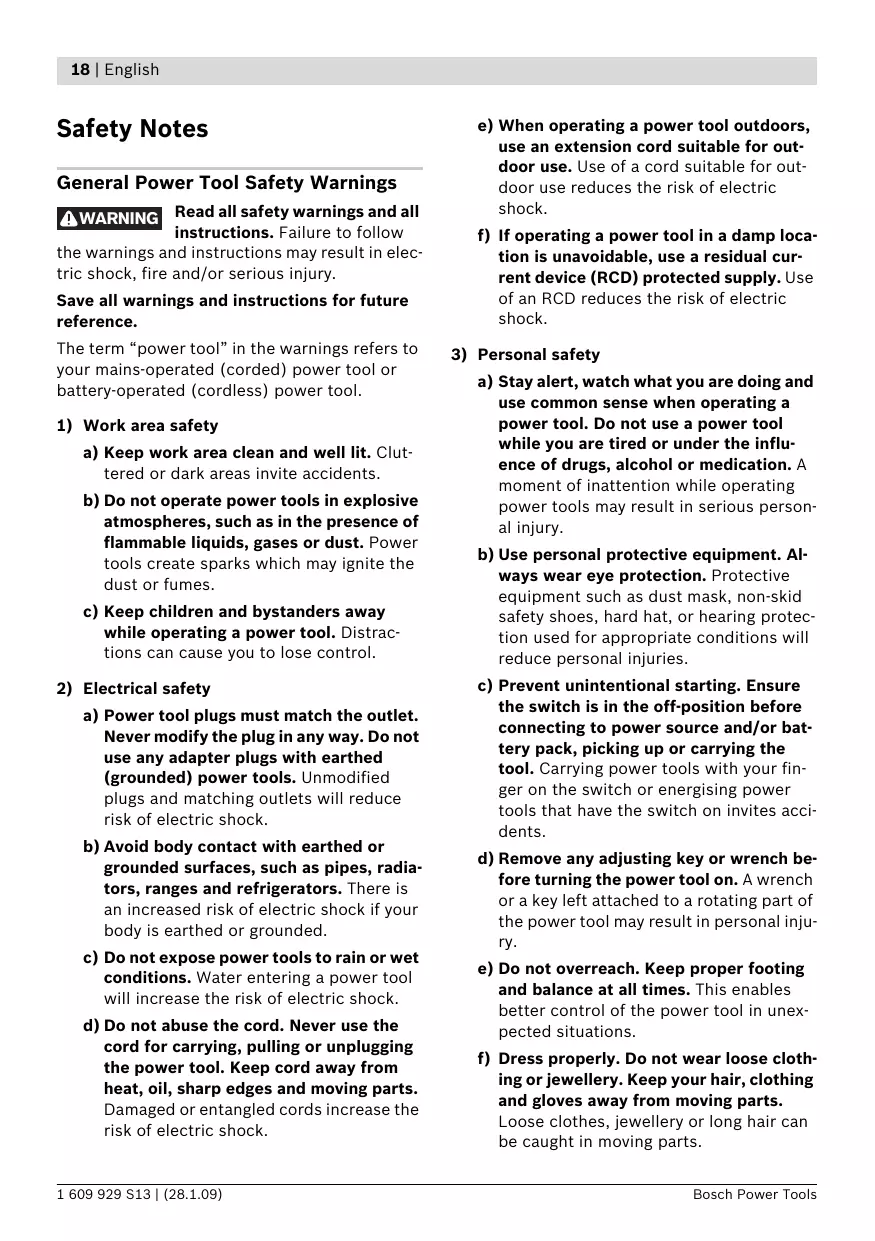
The numbering of the product features refers to the illustration of the machine on the graphics page.
1 Lock-off button for On/Off switch
2 On/Off switch
3 Auxiliary handle
4 Spindle lock button
5 Scale for metre angle
6 Allen key
7 Wing bolt for bevel-angle preselection
8 Wing bolt for parallel guide
9 "CutControl" - Viewing window for cutting line (PKS 55 A/PKS 66 A/PKS 66 AF)
10 Parallel guide
11 Retracting blade guard
12 Base plate
13 Lever for retracting blade guard
14 Wing bolt for bevel-angle preselection
15 Blade guard
16 Sawdust ejector
17 Clamping bolt with washer
18 Clamping flange
19 Saw blade
20 Mounting flange
21 Saw spindle
22 Vacuum hose
23 Deflection tube for chips
24 Dust/chip box
25 Slider of dust/chip box
26 Clamping lever for cutting-depth preselection
27 Cutting-depth scale
28 Cutting mark, 45^
29 Cutting mark, 0^
30 Quick-action clamp
31 Guide rail*
32 Button for guide-rail lock
*Accessories shown or described are not part of the standard delivery scope of the product. A complete overview of accessories can be found in our accessories program.
Technical Data
| Circular Saw | PKS 55 | PKS 55 A | PKS 66 A PKS 66 AF* | |
| Article number | 3 603 E00 0.. | 3 603 E01 0.. | 3 603 E02 0.. | |
| Rated power input | W | 1200 | 1200 | 1600 |
| No-load speed | min-1 | 5600 | 5600 | 5000 |
| Cutting depth, max. | ||||
| - for 0° bevel angle | mm | 55 | 55 | 66 |
| - for 45° bevel angle | mm | 38 | 38 | 48 |
| Spindle lock | ● | ● | ● | |
| CutControl | - | ● | ● | |
| Dust/chip box | - | ● | ● | |
| Base plate dimensions | mm | 288 x 153 | 288 x 153 | 327 x 160 |
| Saw blade diameter, max. | mm | 160 | 160 | 190 |
| Saw blade diameter, min. | mm | 150 | 150 | 184 |
| Blade thickness, max. | mm | 1.8 | 1.8 | 1.8 |
| Mounting bore | mm | 20 | 20 | 30 |
| Weight according to EPTA-Procedure 01/2003 | kg | 3.9 | 3.9 | 5.4 |
| Protection class | ☐ / II | ☐ / II | ☐ / II | |
The values given are valid for nominal voltages [U] of 230/240 V. For lower voltage and models for specific countries, these values can vary.
Please observe the article number on the type plate of your machine. The trade names of the individual machines may vary.
PKS 66 A/PKS 66 AF: Starting cycles generate brief voltage drops. Interference with other equipment/machines may occur in case of unfavourable mains system conditions. Malfunctions are not to be expected for system impedances below 0.36 ohm.
* PKS 66 AF with guide rail
Noise/Vibration Information
Measured values determined according to EN 60745.
Typically the A-weighted noise levels of the product are: Sound pressure level 101 dB(A); Sound power level 112 dB(A). Uncertainty K = 3 dB.
Wear hearing protection!
Vibration total values (triax vector sum) determined according to EN 60745:
Vibration emission value a_h = 4.0m / s^2 Uncertainty K = 1.5m / s^2
The vibration emission level given in this information sheet has been measured in accordance with a standardised test given in EN 60745 and may be used to compare one tool with another. It may be used for a preliminary assessment of exposure.
The declared vibration emission level represents the main applications of the tool. However if the tool is used for different applications, with different accessories or poorly maintained, the vibration emission may differ. This may significantly increase the exposure level over the total working period.
An estimation of the level of exposure to vibration should also take into account the times when the tool is switched off or when it is running but not actually doing the job. This may significantly reduce the exposure level over the total working period.
Identify additional safety measures to protect the operator from the effects of vibration such as: maintain the tool and the accessories, keep the hands warm, organisation of work patterns.
Declaration of Conformity C
We declare under our sole responsibility that the product described under "Technical Data" is in conformity with the following standards or standardization documents: EN 60745 according to the provisions of the directives 2004/108/EC, 98/37/EC (until 28 Dec 2009), 2006/42/EC (from 29 Dec 2009).
Technical file at: Robert Bosch GmbH, PT/ESC, D-70745 Leinfelden-Echterdingen
Dr. Egbert Schneider Senior Vice President Engineering
Dr. Eckerhard Ströttgen
Head of Product Certification
i.v. Mo7gc
Robert Bosch GmbH, Power Tools Division
D-70745 Leinfelden-Echterdingen
24.09.2008
Assembly
Mounting/Replacing the Saw Blade
Before any work on the machine itself, pull the mains plug.
- When mounting the saw blade, wear protective gloves. Danger of injury when touching the saw blade.
Only use saw blades that correspond with the characteristic data given in the operating instructions.
Do not under any circumstances use grinding discs as the cutting tool.
Selecting a Saw Blade
An overview of recommended saw blades can be found at the end of this manual.
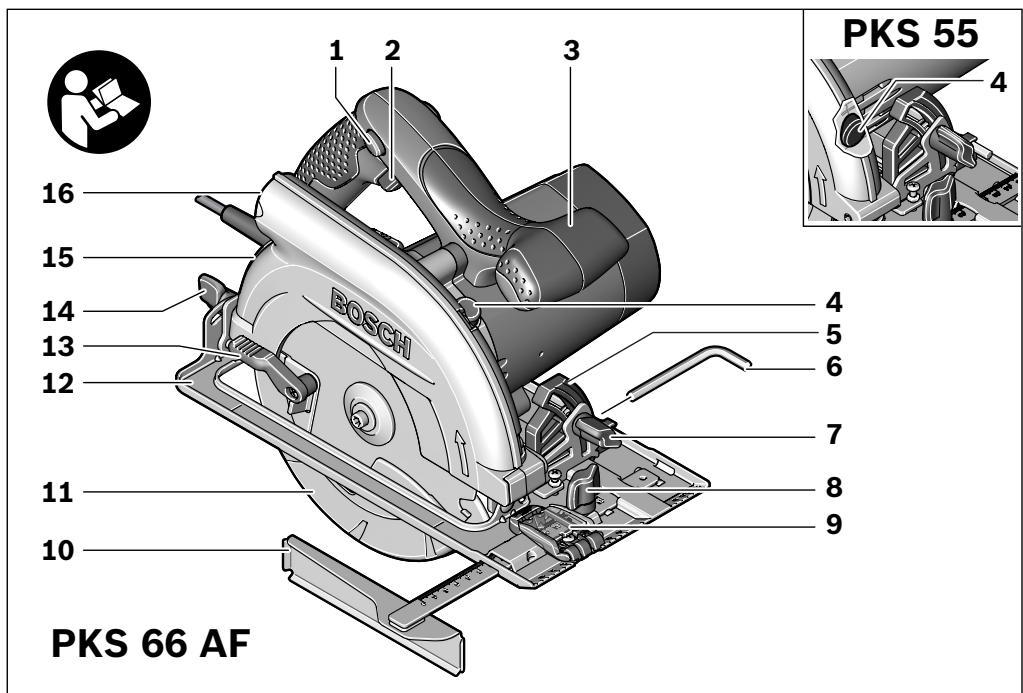
Removal of the Saw Blade (see figure A)
For changing the cutting tool, it is best to place the machine on the face side of the motor housing.
- Press the spindle lock button 4 and keep it pressed.
The spindle lock button 4 may be actuated only when the saw spindle is at a standstill. Otherwise, the power tool can be damaged. - With the Allen key 6, unscrew the clamping bolt 17 turning in rotation direction 0.
- Tilt back the retracting blade guard 11 and hold firmly.
- Remove the clamping flange 18 and the saw blade 19 from the saw spindle 21.
Mounting the Saw Blade (see figure A)
For changing the cutting tool, it is best to place the machine on the face side of the motor housing.
- Clean the saw blade 19 and all clamping parts to be assembled.
- Tilt back the retracting blade guard 11 and hold firmly.
- Place the saw blade 19 on to the mounting flange 20. The cutting direction of the teeth (direction or arrow on saw blade) and the direction-of-rotation arrow on the blade guard 15 must correspond.
- Mount the clamping flange 18 and screw in the clamping bolt 17 turning in rotation direction. Observe correct mounting position of mounting flange 20 and clamping flange 18.
- Press the spindle lock button 4 and keep it pressed.
- With the Allen key 6, tighten the clamping bolt 17 turning in rotation direction Ⓢ. The tightening torque is between 6–9 Nm, which corresponds to hand tight plus 14 turn.
Dust/Chip Extraction (see figures B-E)
Before any work on the machine itself, pull the mains plug.
Dusts from materials such as lead-containing coatings, some wood types, minerals and metal can be harmful to one's health. Touching or breathing-in the dusts can cause allergic reactions and/or lead to respiratory infections of the user or bystanders.
Certain dusts, such as oak or beech dust, are considered as carcinogenic, especially in connection with wood-treatment additives (chromate, wood preservative). Materials containing asbestos may only be worked by specialists.
- Use dust extraction whenever possible.
- Provide for good ventilation of the working place.
- It is recommended to wear a P2 filter-class respirator.
Observe the relevant regulations in your country for the materials to be worked.
Note: While sawing, always use the deflection tube 23 or the dust/chip box 24 so that you will not be hit by thrown about chips.
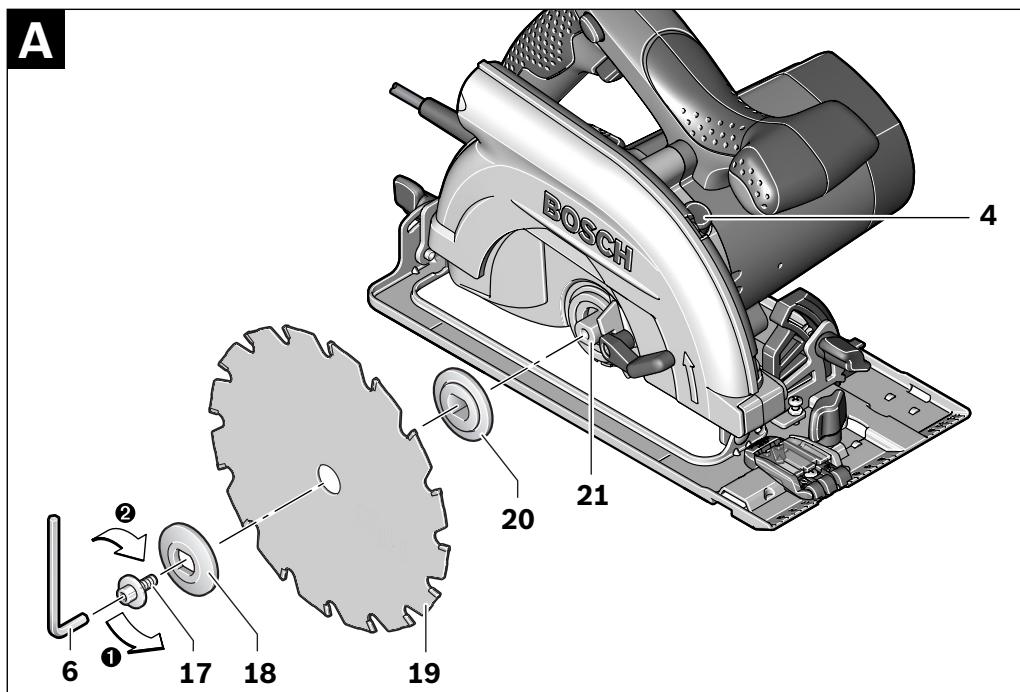
The deflection tube 23 can be used with or without dust/chip extraction. Depending on the application, turn the deflection tube 23 in such a manner that you are not hit by chips and insert it firmly into the sawdust ejector 16.
External Dust Extraction (see figure B)
Mount the vacuum hose 22 (accessory) on to the saw dust ejector 16. Connect the vacuum hose 22 to a vacuum cleaner (accessory). An overview for connecting to various vacuum cleaners can be found at the end of this manual.
The machine can be plugged directly into the receptacle of a Bosch all-purpose vacuum cleaner with remote starting control. The vacuum cleaner starts automatically when the machine is switched on.
The vacuum cleaner must be suitable for the material being worked.
When vacuuming dry dust that is especially detrimental to health or carcinogenic, use a special vacuum cleaner.
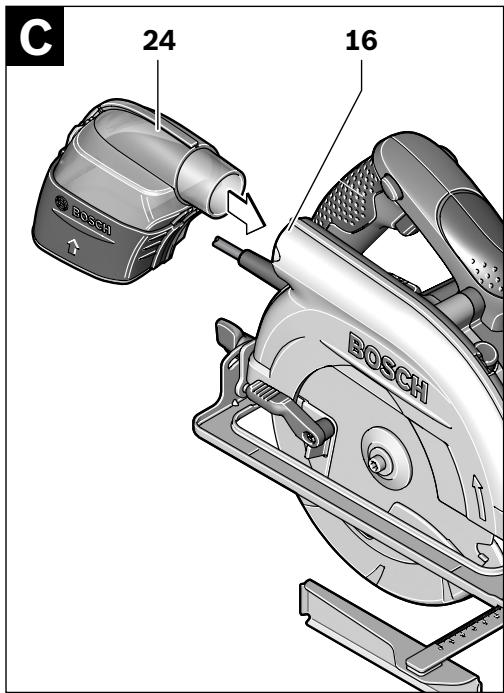
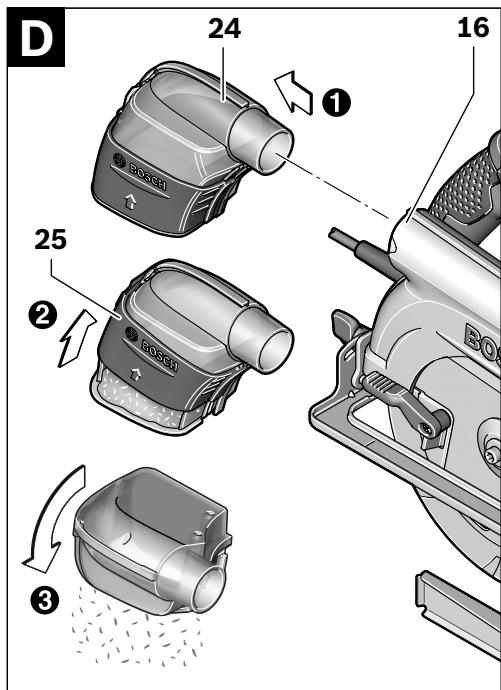
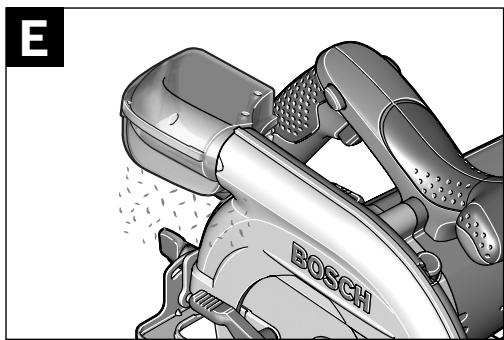
Integrated Dust Extraction (see figures C-E)
For smaller jobs, the dust/chip box 24 can be used with the slider 25 shut. For larger jobs, the slider 25 should be open so that the chips can fall out.
Insert the dust/chip box 24 firmly into the chip ejector 16.
Empty the dust/chip box 24 in time to maintain optimum efficiency.
To empty the dust/chip box 24, pull it off of the sawdust ejector 16. Press the slider 25 upward, turn the dust/chip box 24 aside and empty it.
Before reattaching, clean the connection sleeve of the dust/chip box 24.
Operation
Operating Modes
Before any work on the machine itself, pull the mains plug.
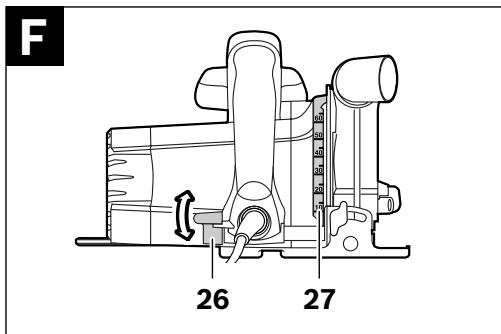
Adjusting the Cutting Depth (see figure F)
Adjust the cutting depth to the thickness of the workpiece. Less than a full tooth of the blade teeth should be visible below the workpiece.
Loosen the clamping lever 26. For a smaller cutting depth, pull the saw away from the base plate 12; for a larger cutting depth, push the saw toward the base plate 12. Adjust the desired cutting depth at the cutting-depth scale. Tighten the clamping lever 26 again.
Adjusting the Cutting Angle
Loosen the wing bolts 7 and 14. Tilt the saw sideways. Adjust the desired measure on the scale 5. Tighten the wing bolts 7 and 14 again.
Note: For bevel cuts, the cutting depth is smaller than the setting indicated on the cutting-depth scale 27.
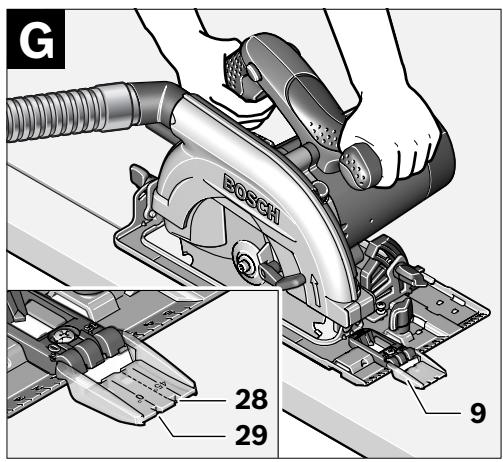
Cutting Marks (see figure G) (PKS 55 A/PKS 66 A/PKS 66 AF)
The "CutControl" 9 viewing window, which folds out to the front, is used for precise guiding of the circular saw alongside the cutting line on the workpiece. The "CutControl" 9 viewing window has a mark each for right-angled cuts and for 45^ cuts.
The 0^ cutting mark (29) indicates the position of the saw blade for right-angled cuts. The 45^ cutting mark (28) indicates the position of the saw blade for 45^ cuts.
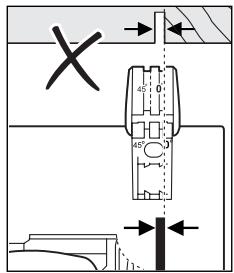
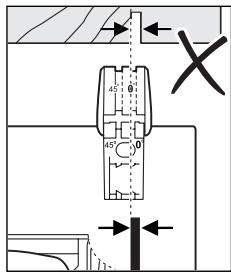
For precise cuts, position the circular saw against the workpiece as shown in the figure. It is best to carry out a trial cut.
Cutting Marks (PKS 55)
The 0^ cutting mark (29) indicates the position of the saw blade for right-angled cuts. The 45^ cutting mark (28) indicates the position of the saw blade for 45^ cuts.
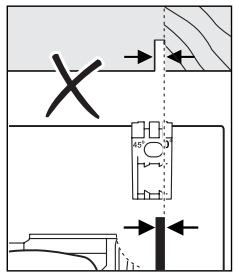
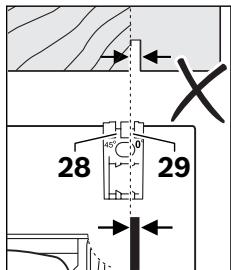
For precise cuts, position the circular saw against the workpiece as shown in the figure. It is best to carry out a trial cut.
Starting Operation
Observe correct mains voltage! The voltage of the power source must agree with the voltage specified on the nameplate of the machine. Power tools marked with 230V can also be operated with 220V .
Switching On and Off
To start the machine, first push the lock-off button for the On/Off switch 1 and then press the On/Off switch 2 and keep it pressed.
To switch off the machine, release the On/Off switch 2.
Note: For safety reasons, the On/Off switch 2 cannot be locked; it must remain pressed during the entire operation.
Working Advice
Protect saw blades against impact and shock.
Guide the machine evenly and with light feed in the cutting direction. Excessive feed significantly reduces the service life of the saw blade and can cause damage to the power tool.
Sawing performance and cutting quality depend essentially on the condition and the tooth form of the saw blade. Therefore, use only sharp saw blades that are suited for the material to be worked.
Sawing Wood
The correct selection of the saw blade depends on the type and quality of the wood and whether lengthway or crossway cuts are required.
When cutting spruce lengthways, long spiral chips are formed.
Beech and oak dusts are especially detrimental to health. Therefore, work only with dust extraction.
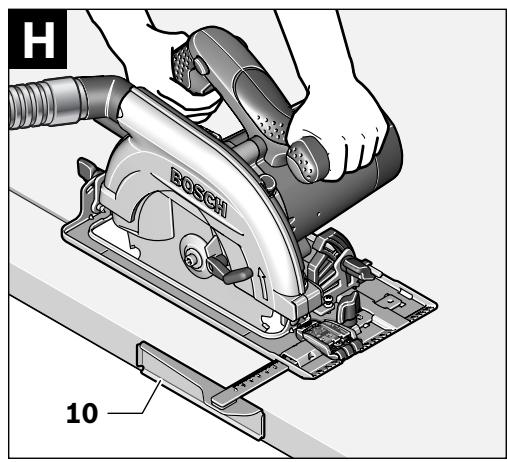
Sawing with Parallel Guide (see figure H)
The parallel guide 10 enables exact cuts along a workpiece edge and cutting strips of the same dimension.
Loosen wing bolt 8 and slide the scale of the parallel guide 10 through the guide in the base plate 12. Adjust the desired cutting width as the scale setting at the respective cutting mark 29 or 28; see Section "Cutting Marks". Tighten wing bolt 8 again.
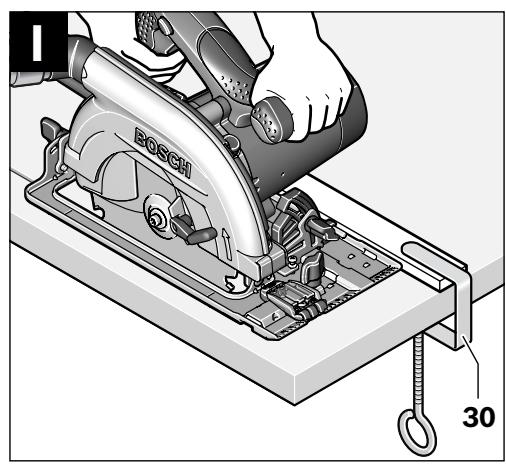
Sawing with Auxiliary Guide (see figure 1)
For sawing large workpieces or straight edges, a board or strip can clamped to the workpiece as an auxiliary guide; the base plate of the circular saw can be guided alongside the auxiliary guide.
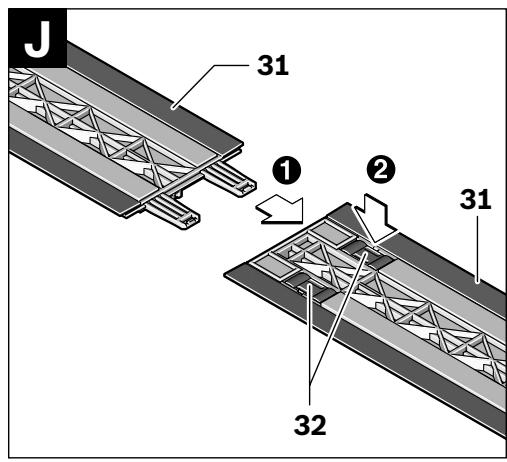
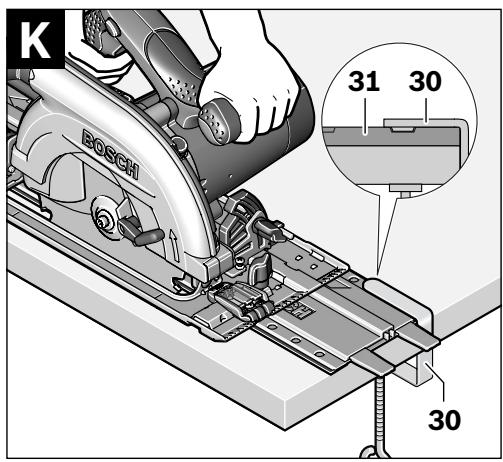
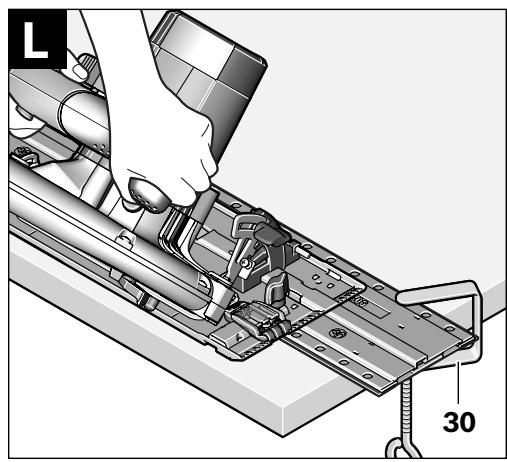
Sawing with Guide Rail (see figures J-L)
The guide rail 31 is used to carry out straight cuts.
The adhesive coating prevents the guide rail from slipping and protects the surface of the workpiece.
The guide rail 31 can be extended. For this, turn around both guide rails 31 by 180^ and connect both guide rails 31 by inserting them. Press button 32 to lock the guide rails. To disassemble the guide rails, press the opposite button 32 and pull the guide rails 31 apart.
The guide rail 31 has two marks on the top side. The side with the 90^ mark is used for right-angled cuts, and the side with the 45^ mark is used for all other metre cuts.
The rubber lip on the guide rail acts as a splinter guard for 90^ and 45^ cuts; it prevents fraying of the surface while sawing wooden materials.
Upon initial sawing, the rubber lip is adapted to your circular saw, and slightly cut off in this process.
Note: On the workpiece side where the cut is being started, the guide rail 31 must always face flush against the workpiece, and may not project beyond it.
Should the guide rail 31 project beyond the workpiece end, do not rest the circular saw on the guide rail 31 without holding the circular saw. The guide rail 31 is made of plastic and cannot hold the circular saw.
Fasten the guide rail 31 to the workpiece using the special screw clamps 30. Take care that the cam on the inside of the screw clamp 30 is seated in the corresponding recess of the guide rail 31.
Switch the machine on and guide it in the cutting direction applying moderate and steady feed.
Maintenance and Service
Maintenance and Cleaning
Before any work on the machine itself, pull the mains plug.
For safe and proper working, always keep the machine and ventilation slots clean.
The retracting blade guard must always be able to move freely and retract automatically. Therefore, always keep the area around the retracting blade guard clean. Remove dust and chips by blowing out with compressed air or with a brush.
Saw blades that are not coated can be protected against corrosion with a thin coat of acid-free oil. Before use, the oil must be removed again, otherwise the wood will become soiled.
Resin and glue residue on the saw blade produces poor cuts. Therefore, clean the saw blade immediately after use.
If the machine should fail despite the care taken in manufacturing and testing procedures, repair should be carried out by an after-sales service centre for Bosch power tools.
In all correspondence and spare parts order, please always include the 10-digit article number given on the type plate of the machine.
WARNING! Important instructions for connecting a new 3-pin plug to the 2-wire cable.
The wires in the cable are coloured according to the following code:
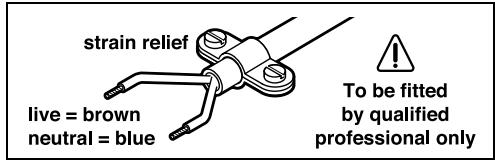
Do not connect the blue or brown wire to the earth terminal of the plug.
Important: If for any reason the moulded plug is removed from the cable of this power tool, it must be disposed of safely.
Products sold in AUS an NZ only: Use a residual current device (RCD) with a rated residual current of 30mA or less.
After-sales Service and Customer Assistance
Our after-sales service responds to your questions concerning maintenance and repair of your product as well as spare parts. Exploded views and information on spare parts can also be found under:
www.bosch-pt.com
Our customer consultants answer your questions concerning best buy, application and adjustment of products and accessories.
Great Britain
Robert Bosch Ltd. (B.S.C.)
P.O.Box 98
Broadwater Park
North Orbital Road
Denham
Uxbridge
UB95HJ
Tel. Service: +44 (0844) 736 0109
Fax: +44 (0844) 736 0146
Australia, New Zealand and Pacific Islands
Robert Bosch Australia Pty. Ltd.
Power Tools
Locked Bag 66
Clayton South VIC 3169
Customer Contact Center
Inside Australia:
Phone: +61 (01300) 307 044
Fax: +61 (01300) 307 045
Inside New Zealand:
Phone: +64 (0800) 543 353
Fax: +64 (0800) 428 570
Outside AU and NZ:
Phone: +61 (03) 9541 5555
www.bosch.com.au
Disposal
The machine, accessories and packaging should be sorted for environmental-friendly recycling.
Only for EC countries:
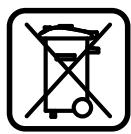
Do not dispose of power tools into household waste!
According the European Guideline 2002/96/EC for Waste Electrical and Electronic Equipment and its implementation into national
right, power tools that are no longer usable must be collected separately and disposed of in an environmentally correct manner.
Subject to change without notice.
Dr. Egbert Schneider Senior Vice President Engineering
Dr. Eckerhard Strötgen
Head of Product Certification
i.v. Moju
Robert Bosch GmbH, Power Tools Division
D-70745 Leinfelden-Echterdingen
24.09.2008
Montage
Robert Bosch (France) S.A.S.
Dr. Egbert Schneider Senior Vice President Engineering
Dr. Eckerhard Strötgen
Head of Product Certification

Robert Bosch GmbH, Power Tools Division
D-70745 Leinfelden-Echterdingen
24.09.2008
Montaje
Dr. Egbert Schneider Senior Vice President Engineering
Dr. Eckerhard Strötgen
Head of Product Certification
i.v. Moju
Robert Bosch GmbH, Power Tools Division
D-70745 Leinfelden-Echterdingen
24.09.2008
Montagem
Dr. Egbert Schneider Senior Vice President Engineering
Dr. Eckerhard Strötgen
Head of Product Certification
Robert Bosch GmbH, Power Tools Division
D-70745 Leinfelden-Echterdingen
24.09.2008
Montaggio
Dr. Egbert Schneider Senior Vice President Engineering
Dr. Eckerhard Strötgen
Head of Product Certification
Robert Bosch GmbH, Power Tools Division
D-70745 Leinfelden-Echterdingen
24.09.2008
Montage
Cirkelzaagblad inzetten of verrangen
Dr. Egbert Schneider Senior Vice President Engineering
Dr. Eckerhard Strötgen
Head of Product Certification
Robert Bosch GmbH, Power Tools Division D-70745 Leinfelden-Echterdingen 24.09.2008
Montering
Bosch Service Center
Telegrafvej 3
2750 Ballerup
Tel. Service Center: +45 (4489) 8855
Fax: +45 (4489) 87 55
E-Mail: vaerktoej@dk.bosch.com
Bortskaffelse
Dr. Egbert Schneider Senior Vice President Engineering
Dr. Eckerhard Strötgen
Head of Product Certification
Robert Bosch GmbH, Power Tools Division
D-70745 Leinfelden-Echterdingen
24.09.2008
Montage
Bosch Service Center
Telegrafvej 3
2750 Ballerup
Danmark
Tel.: +46 (020) 41 44 55
Fax: +46 (011) 187691
Avfallshantering
Endast for EU-lander:
Dr. Egbert Schneider Senior Vice President Engineering
Dr. Eckerhard Strötgen
Head of Product Certification
Robert Bosch GmbH, Power Tools Division
D-70745 Leinfelden-Echterdingen
24.09.2008
Montering
Dr. Egbert Schneider Senior Vice President Engineering
Dr. Eckerhard Strötgen
Head of Product Certification
Robert Bosch GmbH, Power Tools Division D-70745 Leinfelden-Echterdingen 24.09.2008
Asennus
IIInpoopoeic yia OpuBo kal dovnoeiC
Oi tuec metpnonc eEaekpiBwOngav ouuwova nTnv npoDiaypaqn EN 60745.
H ouoovva u n v kaunA eKtiuonieoa xapaKtnpOtiKn oTAtouaakouotiknc pieoontou unxavmuatoc avepxeta 101 dB(A). Taaouaakouotiknc pieoont 112 dB(A). Avoopaaleia meTpOanC K=3 dB.
Φopáte ωταοπiδες!
Olaikec TmuC kpaedaaowv (a0poia auvuamTw vpiw dieuovaeuw) eakpiBw0nkav oupwaue To npotuno EN 60745:
Tun eknoptnc kpaadagawah=4,0m/s²,avao- a K = 1,5 m / s^2
H 0a0n Kpa0a0nV nou avapepetai o' autec TIC odnyiec exei metp0e i ouppwva me ia diaikkaio aetponoT tunonoinvev ot naio Tou npotunou EN 60745 kai mopei va xnpoi0n0n0e iOn ouykpian twv diapopwv unxavmuWv. Eiva enioc katalnn yia evav npoowpio uno loyoio tnc eniapuvoc ano touc kpadaoouc. H 0a0n Kpa0a0nV nou avapepetai avtinpoowneuei tic baoikc xnpoeic Tou nlektipko epyaleiou. Zepintwn, oomega, nou to nlektpiKO epyaoleo 8a xnpoi0n0e i diaopoptika, pe napekklovovta epyaleia nxpic enapkn ouvtphon, toe n 0a0n Kpa0a0wmv npoei va eiva kI autn diapopetik. Auto npoei va auEnoi onavtkaTnv eniapuvan ano touc kpadaoouc kata tn ouvo1k diapkeia oloknpou Tou xpvikou diaatmuoc nou epyaceo.
Tia nV akpiñ eKtiunon tnc emiBapuvoc ano touc kpaabaouc 0a npene i va laibavovtai enianc unown kal oXpovoi kat a Tn diapkeia twv onoiwTv mnxavna bpiaketai EKTc leitoupyiac nLeitoupyei, xwpic owc stnv npayatokntva xaonmuonoieital. Auto mnpoei va meiwcei onuavtik aTnv emiBapuvan ano touc kpaabaouc kat a Tn diapkeia oloknpou Tou Xpvikoudelta taotma-toc nou epyazeoThe.
T'auto, npiv apxioe i npao Twv kpaabaov, va kathetae npo0eTa mtpa aopaaieiac yia tnV npoostaiou xeiipoi nOnw; ouvtnpon Tou nEeKtpiok epyaleiou kai twv epyaleiw nou xpnoiopoite, zotama twv xepiw, opyawon tnc ekteoic twv diapopw epyaowv.
Anwn ouubaotntra C
UeUoVocTo Tpoov Nou nepiypaFetal Ota «Texvika xapaKtnpiaTiká» EknAnPwveI Touc EHCavovioooun KataKeuaotikeCouTaeic:EN60745 ouuwova Teic diataEicTwv obnyiw 2004/108/EK,98/37/EK (ewc 28.12.2009), 2006/42/EK (ano 29.12.2009).
TeXviKoC aKeLoc aio: Robert Bosch GmbH, PT/ESC, D-70745 Leinfelden-Echterdingen
Dr. Egbert Schneider Senior Vice President Engineering
Dr. Eckerhard Strötgen
Head of Product Certification
ppa.
i.v. Mo7gcu
Robert Bosch GmbH, Power Tools Division
D-70745 Leinfelden-Echterdingen
24.09.2008
Euvaopoloyon
Tnpoupe to 6ikaiomega aalayow.
Güvenlik Talimati
Elektrikli El Aletleri icin Genel Uyari Talimati
AUYARI
Dr. Egbert Schneider Senior Vice President Engineering
Dr. Eckerhard Strötgen
Head of Product Certification
Robert Bosch GmbH, Power Tools Division D-70745 Leinfelden-Echterdingen 24.09.2008
Montaj
Daire testere bicakalarinin takilmasi/deigistirilmesi
Bosch San. ve Tic. A.S.
Ahi Evran Cad. No:1 Kat:22
Polaris Plaza
80670 Maslak/Istanbul
Müstéri Danismani: +90 (0212) 335 06 66
Müsteri Servis Hatti: +90 (0212) 335 07 52