RCS36 - Chain saw RYOBI - Free user manual and instructions
Find the device manual for free RCS36 RYOBI in PDF.



| Product Type | Corded electric chainsaw |
| Brand | RYOBI |
| Model | RCS36 |
| Rated Power | 2000 W |
| Rated Voltage | 220-240 V~ / 50 Hz |
| Chain Speed (no load) | 13 m/s |
| Cutting Length (guide bar) | 400 mm |
| Oil Tank Capacity | 200 ml |
| Weight (with chain, guide bar and empty tank) | 5.2 kg |
| Chain Brake | Yes, stopping time < 0.15 s |
| Sound Pressure Level (LpA) | 95 dB(A) |
| Guaranteed Sound Power Level (LwA) | 107 dB(A) |
| Vibration (no load) | 5.7 m/s² (uncertainty 1.5 m/s²) |
| Chain Type | Low kickback chain (Oregon, Carlton or Tri-link) |
| Chain Tension Adjustment | Tool-less, via knob and adjustment screw |
| Lubrication | Automatic, visible oil tank |
| Voltage Indicator | LiveTool™ integrated |
| Chain Protection | Included for transport and storage |
| Insulation Class | Class II (double insulation) |
| Warranty | 24 months (private use) |
| Intended Use | Cutting wood, trees and logs (domestic use) |
Frequently Asked Questions - RCS36 RYOBI
User questions about RCS36 RYOBI
0 question about this device. Answer the ones you know or ask your own.
Ask a new question about this device
Download the instructions for your Chain saw in PDF format for free! Find your manual RCS36 - RYOBI and take your electronic device back in hand. On this page are published all the documents necessary for the use of your device. RCS36 by RYOBI.
USER MANUAL RCS36 RYOBI
CHARACTERISTIQUES PRODUIT
English (Original instructions)
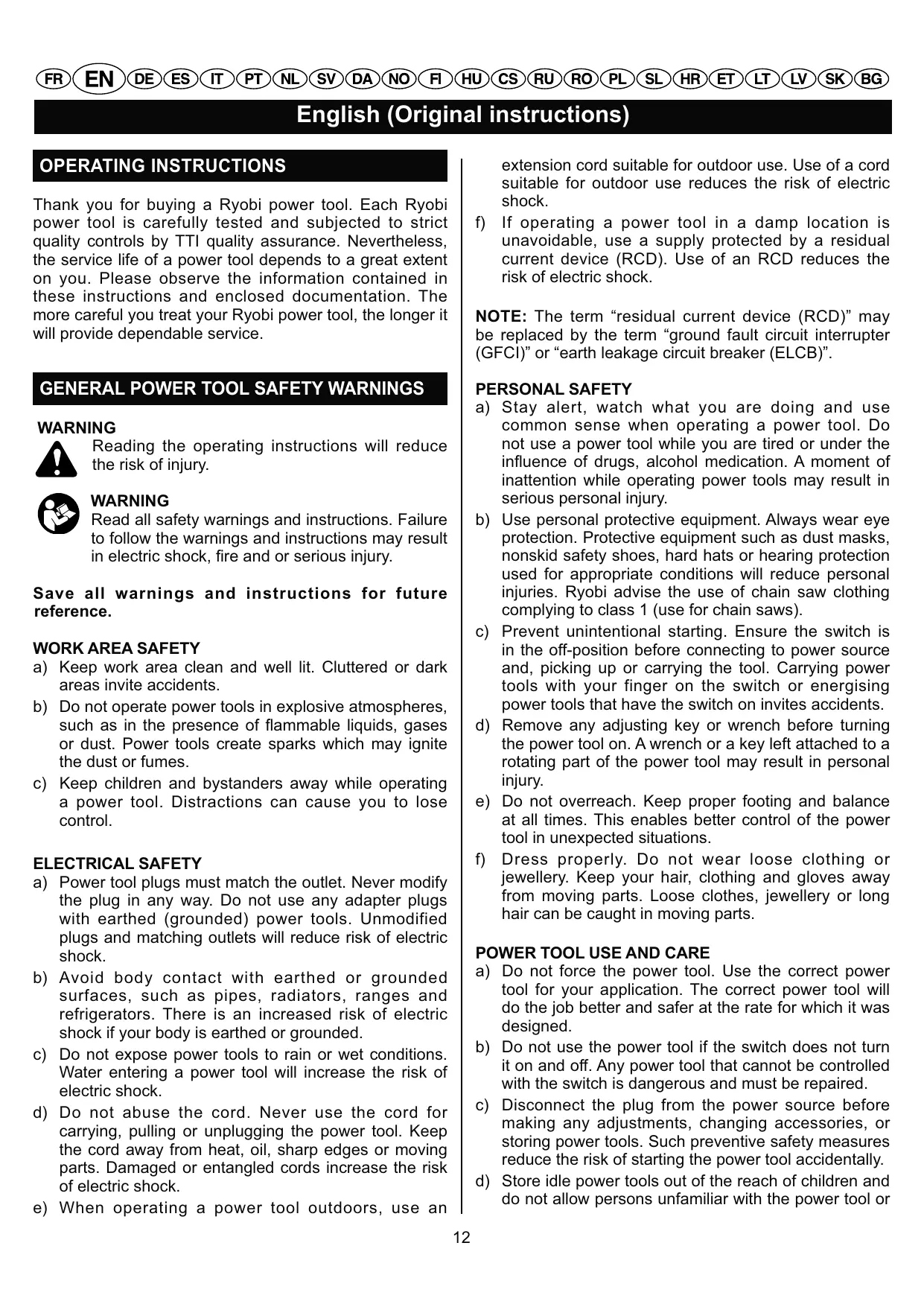
OPERATING INSTRUCTIONS
Thank you for buying a Ryobi power tool. Each Ryobi power tool is carefully tested and subjected to strict quality controls by TTI quality assurance. Nevertheless, the service life of a power tool depends to a great extent on you. Please observe the information contained in these instructions and enclosed documentation. The more careful you treat your Ryobi power tool, the longer it will provide dependable service.
GENERAL POWER TOOL SAFETY WARNINGS
WARNING

Reading the operating instructions will reduce the risk of injury.

WARNING
Read all safety warnings and instructions. Failure to follow the warnings and instructions may result in electric shock, fire and or serious injury.
Save all warnings and instructions for future reference.
WORK AREA SAFETY
a) Keep work area clean and well lit. Cluttered or dark areas invite accidents.
b) Do not operate power tools in explosive atmospheres, such as in the presence of flammable liquids, gases or dust. Power tools create sparks which may ignite the dust or fumes.
c) Keep children and bystanders away while operating a power tool. Distractions can cause you to lose control.
ELECTRICAL SAFETY
a) Power tool plugs must match the outlet. Never modify the plug in any way. Do not use any adapter plugs with earthed (grounded) power tools. Unmodified plugs and matching outlets will reduce risk of electric shock.
b) Avoid body contact with earthed or grounded surfaces, such as pipes, radiators, ranges and refrigerators. There is an increased risk of electric shock if your body is earthed or grounded.
c) Do not expose power tools to rain or wet conditions. Water entering a power tool will increase the risk of electric shock.
d) Do not abuse the cord. Never use the cord for carrying, pulling or unplugging the power tool. Keep the cord away from heat, oil, sharp edges or moving parts. Damaged or entangled cords increase the risk of electric shock.
e) When operating a power tool outdoors, use an
extension cord suitable for outdoor use. Use of a cord suitable for outdoor use reduces the risk of electric shock.
f) If operating a power tool in a damp location is unavoidable, use a supply protected by a residual current device (RCD). Use of an RCD reduces the risk of electric shock.
NOTE: The term "residual current device (RCD)" may be replaced by the term "ground fault circuit interrupter (GFCI)" or "earth leakage circuit breaker (ELCB)".
PERSONAL SAFETY
a) Stay alert, watch what you are doing and use common sense when operating a power tool. Do not use a power tool while you are tired or under the influence of drugs, alcohol medication. A moment of inattention while operating power tools may result in serious personal injury.
b) Use personal protective equipment. Always wear eye protection. Protective equipment such as dust masks, nonskid safety shoes, hard hats or hearing protection used for appropriate conditions will reduce personal injuries. Ryobi advise the use of chain saw clothing complying to class 1 (use for chain saws).
c) Prevent unintentional starting. Ensure the switch is in the off-position before connecting to power source and, picking up or carrying the tool. Carrying power tools with your finger on the switch or energising power tools that have the switch on invites accidents.
d) Remove any adjusting key or wrench before turning the power tool on. A wrench or a key left attached to a rotating part of the power tool may result in personal injury.
e) Do not overreach. Keep proper footing and balance at all times. This enables better control of the power tool in unexpected situations.
f) Dress properly. Do not wear loose clothing or jewellery. Keep your hair, clothing and gloves away from moving parts. Loose clothes, jewellery or long hair can be caught in moving parts.
POWER TOOL USE AND CARE
a) Do not force the power tool. Use the correct power tool for your application. The correct power tool will do the job better and safer at the rate for which it was designed.
b) Do not use the power tool if the switch does not turn it on and off. Any power tool that cannot be controlled with the switch is dangerous and must be repaired.
c) Disconnect the plug from the power source before making any adjustments, changing accessories, or storing power tools. Such preventive safety measures reduce the risk of starting the power tool accidentally.
d) Store idle power tools out of the reach of children and do not allow persons unfamiliar with the power tool or
English (Original instructions)
these instructions to operate the power tool. Power tools are dangerous in the hands of untrained users.
e) Maintain power tools. Check for misalignment or binding of moving parts, breakage of parts and any other condition that may affect the power tool's operation. If damaged, have the power tool repaired before use. Many Accidents are caused by poorly maintained power tools.
f) Keep cutting tools sharp and clean. Properly maintained cutting tools with sharp cutting edges are less likely to bind and are easier to control.
g) Use the power tool and accessories in accordance with these instructions, taking into account the working conditions and the work to be performed. Use of the power tool for operations different from those intended could result in a hazardous situation.
SERVICE
- Have your power tool serviced by a qualified repair person using only identical replacement parts. This will ensure that the safety of the power tool is maintained.
If the replacement of line supply cord is necessary, this has to be done by the manufacturer or his agent in order to avoid a safety hazard.
OTHER GENERAL WARNINGS
- Know your power tool. Read owner's manual carefully. Learn its applications and limitations as well as the specific potential hazards related to this tool.
- Use the right tool. Do not force small tool or attachments to do the job of a heavy duty tool. Do not use the tool for purposes not intended.
- Protect your lungs. Wear a dust mask if operation is dusty.
- Do not operate in poor lighting. Use the unit only in daylight or good artificial light.
Pull the plug immediately if the mains or extension lead is damaged or severed. - Stay alert and exercise control. Watch what you are doing and use common sense. Do not operate tool when you are tired. Do not rush operation of the tool.
- Check for damaged parts. Inspect your before every use. Check for alignment of moving parts, binding of moving parts, breakage of parts, mounting and any other conditions that may affect its operation. Any part that is damaged should be properly repaired or replaced by an authorised service centre.
- Do not use the tool if the switch does not turn it on and off. Have defective switches replaced by an authorised service centre.
- Do not operate this tool while under the influence of drugs, alcohol or any medication.
The appliance is not intended for use by young or infirm persons. - Young children should be supervised to ensure that
they do not play with the appliance.
The use of an earth-leakage circuit breaker of residual current device in conjunction with this tool is recommended.
- Maintain the chain saw with care. Keep the cord clear of the chain at any time. Never carry the saw by the cord or pull on the cord to disconnect it from the socket.
- Chain tension. Make sure that the chain tension is correct, as specified in these instructions. Incorrect tension may cause the chain to disengage from the guide bar, which is extremely dangerous.
Power cord : if the replacement of the supply cord is necessary, this has to be done by the manufacturer or his agent in order to avoid a safety hazard.
Extension cord. When an extension cord is used make sure:
(a) That pins on the plug of the extension cord are the same in number, size and shape as those of the plug on the saw.
(b) That extension cord is properly wired and in good electrical condition.
(c) That the wire size is large enough for the AC power rating of the chain saw.
CHAIN SAW SAFETY WARNINGSPPECIAL SAFETY INSTRUCTIONS
- Keep all parts of the body away from the saw chain when the chain saw is operating. Before you start the chain saw, make sure the saw chain is not contacting anything. A moment of inattention while operating chain saws may cause entanglement of your clothing or body with the saw chain.
Always hold the chain saw with your right hand on the rear handle and your left hand on the front handle. Holding the chain saw with a reversed hand configuration increases the risk of personal injury and should never be done. - Wear safety glasses and hearing protection. Further protective equipment for head, hands, legs and feet is recommended. Adequate protective clothing will reduce personal injury by flying debris or accidental contact with the saw chain.
- Do not operate a chain saw in a tree. Operation of a chain saw while up in a tree may result in personal injury.
Always keep proper footing and operate the chain saw only when standing on fixed, secure and level surface. Slippery or unstable surfaces such as ladders may cause a loss of balance or control of the chain saw. - When cutting a limb that is under tension be alert for spring back. When the tension in the wood fibres
English (Original instructions)
is released, the spring loaded limb may strike the operator and/or throw the chain saw out of control.
Use extreme caution when cutting brushes and saplings. The slender material may catch the saw chain and be whipped toward you or pull you off balance.
- Carry the chain saw by the front handle with the chain saw switched off and away from your body. When transporting or storing the chain saw always fit the guide bar cover. Proper handling of the chain saw will reduce the likelihood of accidental contact with the moving saw chain.
- Follow instructions for lubrication, chain tensioning and changing accessories. Improperly tensioned or lubricated chains may either break or increase the chance for kickback.
- Keep handles dry, clean, and free from oil and grease. Greasy, oily handles are slippery and can causing the loss of control.
Cut wood only. Do not use chain saw for purposes not intended. For example: do not use the chain saw for cutting plastic, masonry or non-wood building materials. Use of the chain saw for operations different than intended can result in a hazardous situation.
Causes and operator prevention of kickback
a) Kickback may occur when the nose or tip of the guide bar touches an object, or when the wood closes in and pinches the saw chain in the cut.
b) Tip contact in some cases may cause a sudden reverse reaction, kicking the guide bar up and back towards the operator.
c) Pinching the saw chain along the top of the guard bar may push the guide bar rapidly back towards the operator.
d) Either of these reactions may cause you to lose control of the saw which could result in serious injury. Do not rely exclusively upon the safety devices built into your saw. As a chain saw user, you should take several steps to keep your cutting jobs free from accident or Injury.
e) Kickback is the result of tool misuse and /or incorrect operating procedures or conditions and can be avoided by taking proper precautions as given below:
1) Maintain a firm grip, with thumbs and fingers encircling the chain saw handles, with both hands on the saw and position your body and arm to allow you to resist kickback force. Kickback forces can be controlled by the operator, if proper precautions are taken. Do not let go of the chain saw.
2) Do not overreach and do not cut above shoulder height. This helps to prevent
intended tip contact and enables better control of the chain saw in unexpected situations.
3) Only use replacement bars and chains specified by the manufacturer. Incorrect replacement bars and chains may cause chain breakage and/or kickback.
4) Follow the manufacturer's sharpening and maintenance instructions for the saw chain. Decreasing the depth gauge height can lead to increased kickback.
It is recommended to use a residual current device with a tripping current of 30mA or less.
- Ensure that the power cord and the extension cord of the chain saw cannot become entangled in branches or any other objects during the usage of the chain saw.
If you are an inexperienced user of the chain saw, you should practice cutting logs on a saw-horse or cradle before using the chain saw without these supporting tools.
- The chain saw has a high starting current and should be connected to a robust power supply. The chain saw should be connected to a power source with an impedance of Z_sysmax = 0.12 + 0.08 or less. Please consult your electricity provider or authority if necessary.
INTENDED USE
INTENDED USE
This chain saw is intended for use to cut wood pieces, trees and wooden logs in domestic use.
Do not use for any task other than those specified in the chapter 'INTENDED USE'. Furthermore, this product is not intended to be used for professional tree services.
RESIDUAL RISKS:
Even with the intended use of the appliance there is always a residual risk, which can not prevent. According to the type and construction of the appliance the following potential hazards might apply:
- Contact with exposed saw teeth of the saw chain (cutting hazards)
Access to the rotating saw chain (cutting hazards)
Unforeseen, abrupt movement of the guide bar (cutting hazards)
Flung out of parts from the saw chain (Cutting / injection hazards)
Flung out of parts of the work piece
Inhalation of work peace particles
Skin contact with the fuel oil
Loss of hearing, if no required ear protection used during work.
English (Original instructions)
SYMBOLS
Some of the following symbols may be used on this tool. Please study them and learn their meaning for safe operation of this product.
| SYMBOLS | NAME | EXPLANATION |
| Safety Alert | Precautions that involve your safety. | |
| Class II tool | Tool in which protection against electric shock rely on double insulation or reinforced insulation. | |
| Wet conditions alert | Do not expose to rain or use in damp locations. | |
| Read the operator's manual | To reduce the risk of injury, user must read and understand. "operator's manual before using this product." | |
| Electric shock precaution | Remove plug from the mains immediately if cable is damaged or cut. | |
| Eye protection | Always wear safety goggles or safety glasses when operating this product. | |
| Ear protection | Always wear safety ear protectors when operating this product. | |
| LwA 107dB | Sound power level | Guaranteed sound power level is 107dB. |
| Safety Alert: Kickback danger | Kickback is very dangerous and can result in serious injury. Always follow the instructions in this manual to reduce kickback. | |
| Two hands operation | Always use two hands to operate the machine, don't use it with one hand. | |
| CE | Conforms to all regulatory standards in the country in the EU where the product is purchased. | |
| GOST-R conformity | ||
| Waste electrical products should not be disposed of with household waste. Please recycle where facilities exist. Check with your local authority or retailer for recycling advice. |
English (Original instructions)
SYMBOLS
The following signal words and meanings are intended to explain the levels of risk associated with this product.
| SYMBOL | SIGNAL | MEANING |
|  | DANGER | Indicates an imminently hazardous situation, which, if not avoided, will result in death or serious injury. |
|  | WARNING | Indicates a potentially hazardous situation, which, if not avoided, could result in death or serious injury. |
|  | CAUTION | Indicates a potentially hazardous situation, which, if not avoided, may result in minor or moderate injury. |
| CAUTION | (Without Safety Alert Symbol) Indicates a situation that may result in property damage. |
SERVICE
Servicing requires extreme care and knowledge and should be performed only by a qualified service technician. For service we suggest you return the product to your nearest AUTHORISED SERVICE CENTRE for repair. When servicing, use only identical replacement parts.

WARNING:
To avoid serious personal injury, do not attempt to use this product until you read thoroughly and completely understood the operator's manual. Save this operator's manual and review frequently for safe operation and instructing others who may use this product.

WARNING:
Observe all normal safety precautions related to avoiding electrical shock.
SAVE THESE INSTRUCTIONS
DESCRIPTION
Fig. 1
- Chain Brake
- Front Handle
- Oil Tank Cap
- Safety Lock-off Button
- Rear Handle
- Live tool indicatorTM
- Switch Trigger
-
Oil Tank Sight Gauge
-
Chain Tension Adjust Knob
-
Sprocket Cover
- Knob w/nut
- Chain Bar
- Saw Chain
Fig. 2
- Safety Lock-off Button
- Spike
- Chain Cover
Fig. 3
- Sprocket
- Chain Tension Bolt
- Bar Guide
- Oil Outlet
Fig. 5
- Bar Groove
- Chain Drive Links
- Cutter
Fig. 9
- Felling direction
- Danger Zone
- Escape route
Fig.10
- Direction of fall
- Notch
- Felling back cut
- Hinge
Fig.11
- Limb cut
- Keep work off ground leave support limbs until log is cut
Fig.12
English (Original instructions)
- Log supported along the entire length
- Cut from top (overbuck) avoid cutting earth
Fig.13
- Log supported one end
- 1st cut underbuck (1/3 diameter) to avoid splintering
- 2nd cut overbuck (2/3 diameter) to meet 1st cut (to avoid pinching)
Fig.14
-
Log supported both ends
-
1st cut underbuck (1/3 diameter) to avoid splintering
- 2nd cut overbuck (2/3 diameter) to meet 1st cut (to avoid pinching)
Fig.15
- Bucking a log
- Stand on uphill side when cutting because log may roll
TECHNICAL DATA
| Unit | RCS1835 | RCS2040 | |
| Rated voltage | V~ / Hz | 220~240/50 | 220~240/50 |
| Power rating | W | 1800 | 2000 |
| Rated no-load speed | m/s | 13 | 13 |
| Cutting length | mm | 350 | 400 |
| Chain brake | s | < 0.15 | < 0.15 |
| Chain stop | s | < 0.15 | < 0.15 |
| Chain oil tank capacity | ml | 200 | 200 |
| Weight (with guide bar, chain and empty tank) | kg | 5.1 | 5.2 |
| Emission sound pressure level LpA | dB(A) | 95 | 95 |
| Uncertainty KpA | dB(A) | 3 | 3 |
| Sound power level LWA | dB(A) | 104 | 104 |
| Uncertainty KWA | dB(A) | 3 | 3 |
| Guaranteed sound power level LWA(G) | dB(A) | 107 | 107 |
| Vibration total value an (no load work mode) | m/s2 | 5.7 | 5.7 |
| Uncertainly K | m/s2 | 1.5 | 1.5 |
Remarks to the specifications:
The declared vibration value has been measured with a standard test method and may be used to compare one tool with another.
The declared vibration value may be used in a preliminary assessment of exposure.

Warning:
The actual vibration values during use of the tool can be different from the above stated and are depending on the use of the tool; and
Of the need to identify safety measures to protect the operator that are based on an estimation of exposure in the actual conditions of use (taking account of all parts of the operating cycle such as the times when the tool is switched off and when it is running idle in addition to the trigger time).
English (Original instructions)
CHAIN & BAR INFORMATION
| Model | Chain | Bar |
| RCS1835 | Carlton N1C-BL-52E SK B | Carlton 14-10W-MHC UNB Y |
| Oregon 91PJ052X | Oregon 140SDEA041 | |
| Oregon 91PJ052X | Carlton 14-10W-MHC UNB Y | |
| Tri-link JL9d-3*52 | Tri-link DCR14B-050-3/8LP-52-B | |
| RCS2040 | Carlton N1C-BL-56E SK B | Carlton 16-10W-N156-MHC |
| Oregon 91PJ056X | Oregon 160SDEA041 | |
| Tri-link JL9d-3 x 56 | Tri-link DCR16C-050-Y56LD |
Note: Chain must be fitted with bar according to above combinations.
SPECIAL PRODUCT FEATURES
The product is using a special safety wrap-spring chain break mechanism to stop the chain within one tenth of a second if the chainbrake is engaged or the trigger is released.
The saw chain's safety drive links are designed to reduce the risk of kickback.
Large chain brake element. In case of a "kickback, the chain brake is pushed forward" by the back of the operator's hand and trips the quick brake of the chain saw.
The lock-off Switch with lock to protect against unintentional start of the chain saw.
The unique Ryobi Live tool indicator™ indicate the good connection with the power supply.
COMMISSIONING
Assembling the chain bar and saw chain

Pull the mains plug out of the socket. Wear protective gloves.
■ Unscrew the knob w/nut and remove the sprocket cover. (Fig. 3)
The saw chain should face in the direction of chain rotation. If they face backwards, turn the loop over. (Fig. 4)
- Place the chain drive links into the bar groove. (Fig. 5)
Position the chain so there is a loop at the back of the bar.
Hold the chain in position on the bar and place the loop around the sprocket and make sure it is correctly mounted. (Fig.6)
- Swing the chain tension adjust knob, turn the chain tensioning bolt clockwise until the saw chain is correctly tensioned. While the bolt is being tightened, the chain bar must then be pushed upwards, check chain tension again, do not tension the chain too tightly (Fig. 7)
- Replace the sprocket cover on top and tighten gently with the knob w/nut.
Note: the saw chain is correctly tensioned if, in the middle of the cutter, it can be lifted 3mm to 4mm from the cutter upper edge. Starting the saw again with a new saw chain, allow it to run in for 2 3 minutes.

WARNING:
After the run-in time, check the chain tension and retighten the chain if necessary.
Chain&Bar lubricant
The chain saws are delivered without any oil in the oiltank. Prior to initial operation of the machine, the oil tank must be filled with lubricating oil.
Ryobi bar and chain lubricant permits chain saw operation at temperatures as low as -15^ .
To refill the chain & bar lubricant the cap on top of the oil tank needs to be removed. When filling the oil in, ensure that no dirt gets into the oil tank. The oil level can be monitored at the oil sight gauge. One filling of the oil tank (capacity 0.2l) is sufficient for 25~40 minutes chain saw operation.
Checking chain lubrication
If the saw chain is running dry (i.e. without lubricant), the cutter and saw chain can be damaged. It is therefore essential to check the oil level in the oil sight gauge frequently and every time before starting to use the chain saw.
English (Original instructions)

WARNING:
Never work without chain lubrication!
To prevent dirt getting inside the tank, clean the oil tank cap before opening. Check the contents of the oil tank during sawing work by checking the oil gauge. Close the oil tank cap tightly and wipe away any spills
Chain Brake
The integrated chain brake brings the saw chain to a standstill within 1/10 of a second if:
- The chain brake in front is pushed to its forward (engaged) position or during work with the chain saw with the back of the operator's hand (due to a kickback) pushing the chain brake forward, or
- The chain saw is switched off by releasing the trigger
If the chainbrake is engaged (i.e. the chain brake guard is pushed to the front) do not try to start the chain saw or actuate the trigger switch.

WARNING:
Before operating the chain saw, always check that the chain brake is in perfect working order (by actuating the hand protection and releasing the trigger). Have the machine repaired if braking time is lengthened.
Mains connection

WARNING:
Before plugging in, check to see that the rated mains voltage and mains frequency, as stated on the rating label, match your power supply.
WARNING:
Prior to starting work, check the mains connection cable and extension cable for damage. Only use mains connection cables and extension cables in perfect condition.

WARNING:
The electrical system to which the chain saw is connected should be equipped with a differential current safety switch (with a max. of 30mA release current).
It is advisable to use the cord retainer in the back handle of the chain saw to avoid accidental disconnection of the power supply.
BEFORE OPERATION
In order to prevent kickback, please follow these safety instructions:
- Never cut with the tip of the chain bar! Be careful when continuing cuts you are already working on!
Always start cuts with the chain saw already running.
Make sure that the saw chain is always properly sharpened.
- Never cut through more than one branch at a time! When lopping off branches, be careful not to touch any other branches.
a) When cross-cutting, pay attention to trunks standing very close to each other. If possible use a sawing trestle.
Transporting the chain saw
Before transporting the chain saw, always remove the plug from the power socket and slide the chain cover over the bar and chain. If several cuts are to be performed with the chain saw, the saw must be switched off between cuts.
Chain guard (Fig. 2)
The chain cover must be clipped onto the chain and bar as soon as the sawing work has been completed and whenever the machine has to be transported.
OPERATION

WARNING:
Wear eye, ear and body clothing protection while using your saw. Ensure the oil tank is full before use.
Releasing the chain brake
To be able to use the chain saw again, the saw chain must be unlocked, firstly switch off the saw release the on/off switch completely and then pull the chain brake back towards the back of the chain saw until it locks into place. The chain will now move when it is switched on.
Holding the chain saw (Fig. 8)
Always grip both handles with the thumbs and fingers encircling the handles. Ensure that your left hand is holding the handle so that your thumb is underneath.
Using the chain saw
Always be sure of your footing and hold the chain saw firmly with both hands while the motor is running.
Felling a tree (Fig. 9)
When bucking and felling operations are being performed by two or more persons at the same time, the felling operation should be separated from the bucking operation by a distance of at least twice the height of the tree being felled. Trees should not be felled in a manner that would endanger any person, strike any utility line or cause any property damage. If the tree does make contact with any utility line, the
English (Original instructions)
utility company should be notified immediately.
The chain saw operator should keep on the uphill side of the terrain as the tree is likely to roll or slide downhill after it is felled an escape path
An escape path should be planned and cleared as necessary before cuts are started. The escape path should extend back and diagonally to the rear of expected line of fall as illustrated in Fig. 9.
Before felling is started, consider the natural lean of the tree, the location of larger branches and the wind direction to judge which may the tree will fall.
Remove dirt, stones, loose bark, nails, stapes and wire from the tree.
Notching undercut (A notch cut in a tree to direct the fall) (Fig.10)
Make the notch 1/3 the diameter of the tree, perpendicular to the direction of falls. Make the lower horizontal notching cut first, this will help to avoid pinching of either the saw chain or the guide bar when the second notch is being made.
Felling back cut (the final cut in a tree felling operation, made on the opposite side of the tree from the notching undercut) (Fig.10)
Make the felling back cut at least 50mm higher than the horizontal notching cut. Keep the felling back cut parallel to the horizontal notching cut. Make the felling back cut so enough wood is left to act as a hinge. The hinge wood keeps the tree from twisting and falling in the wrong direction. Do not cut through the hinge. As the felling cut gets close to the hinge, the tree should begin to fall. If there is any chance that the tree may not fall in the desired direction or it may rock back and bind the saw chain, stop cutting before the felling back cut is complete and use wedges of wood, plastic or aluminium to open the cut and drop the tree along the desired line off all. When the tree begins to fall remove the chain saw from the cut, stop the motor, put the chain saw down, and then use the retreat path planned. Be alert for overhead limbs falling and watch your footing.
- Limbing a tree (Fig.11)
Limbing is removing the branches from a fallen tree. When limbs, leave larger lower limbs to support the log off the ground. Remove the small limbs in one cut. Branches under tension should be cut from the bottom up, to avoid binging the chain saw.
- Bucking a log (Fig.12-15) Bucking is cutting a log into lengths. It is important to make sure your footing is firm and your weight is evenly distributed on both feet. When possible the log should be raised and supported by the use of limbs, logs or chocks.
Follow the simple direction for easy cutting:
a) When the log is supported along the entire length, it is cut from the top (overbuck). (Fig.12)
b) When the log is supported on one end, cut 1/3 of the diameter from the underside (underbuck). Then make the finished cut by overbucking to meeting the first cut. (Fig.13)
c) When the log is supported on both ends, cut 1/3 of that diameter from the top(overbuck). Then make the finished cut by underbucking the lower 2/3 to meet the first cut. (Fig.14)
d) When bucking on a slope always stand on the uphill side of the log. When cutting through, to maintain complete control, release the cutting pressure near the end of the cut without relaxing your grip on the chain saw handles. (Fig.15).
Do not let the chain contact the ground. After completing the cut, wait for the saw chain to stop before you move the chain saw. Always stop the motor before moving from tree to tree.
MAINTENANCE
(Fig. 16-21)
Chain Sharpening
When the chain penetrates into wood with difficulty, it needs sharpening as follows:
Put the chain under tension.
Fasten the bar in a vice so that the chain can slide.
Fasten the file to the file holder and place it on cutter at a 35^ angle.
File with forward strokes only until all the worn out part of the cutting edge is taken away.
- Count the number of strokes given to the cutter taken as a reference basis and file away for the same number of strokes on all other cutters.
If after sharpening a few times, the depth gauge protrudes from the template, you must reset its level use a flat file.
Finally, round off the depth gauge.
NOTE: We advise you to have the deep or important
English (Original instructions)
sharpening carried out by a service agent who is equipped with electric sharpener.
GUIDE BAR MAINTENANCE
- When you have finished working, clean out the groove and the oil passages, with a scraping hook.
Periodically trim the sides of rails using a flat file.
If not done in the long run, the featheredges might break away and damage the bar.
If one rail is higher than the other one, it is necessary to make it even with a flat file and then smooth them with a file or fine grain abrasive paper.
ACCESSORIES OR REPAIR PARTS
Use only genuine Ryobi accessories or repair parts.
If you need any accessories, check with your dealer.
The main accessories (Chain & Bar) are listed in the specifications section earlier in this manual.
| Model | Chain & Bar |
| RCS1835 | Carlton Chain N1C-BL-52E SK B & Carlton Bar 14-10W-MHC UNB Y |
| Oregon Chain 91PJ052X & Oregon Bar 140SDEA041 | |
| Oregon Chain 91PJ052X & Carlton Bar 14-10W-MHC UNB Y | |
| Tri-link Chain JL9d-3 x 52 & Tri-link Bar DCR14B-050-3/8LP-52-B | |
| RCS2040 | Carlton Chain N1C-BL-56E SK B & Carlton Bar 16-10W-N156-MHC |
| Oregon Chain 91PJ056X & Oregon Bar 160SDEA041 | |
| Tri-link Chain JL9d-3 x 56 & Tri-link Bar DCR16C-050-Y56LD |
DISPOSAL


Power tools and accessories contain large amounts of valuable resources and plastics that can be recycled. Waste electrical products should not be disposed of together with household waste. Please recycle where facilities exist. Check with your local authority or retailer for recycling advice.
Even with the intended use of the appliance there is always a residual risk, which can not prevent. According to the type and construction of the appliance the following potential hazards might apply:
- Contact with exposed saw teeth of the saw chain (cutting hazards)
Access to the rotating saw chain (cutting hazards)
Unforeseen, abrupt movement of the guide bar (cutting hazards)
Flung out of parts from the saw chain (Cutting / injection hazards)
Flung out of parts of the work piece
Inhalation of work peace particles
Skin contact with the oil
Loss of hearing, if no required ear protection used during work.
SYMBOLEN
- Valrichting
- Inkeeping
- Velzaagsnede
- Scharnier
VEDLIKEHOLD AV SVERDET
USCHOVEJTE TYTO POKYNY
POPIS
Obr. 1
HNCtpymeHTa H/INn He npabnIbHbIX OepaOnHHbIX
npoceDyp INn ycNoBn, N MOxHO n36eRaTb,
PnKpeJIy HaIeXaUne PpeOCTOpOXHocTN KaK
yKa3aHO HNXe:
1) O6cIyJxNtB yCTOuHByU BlaCTb, C 60JIbIaMn IaIbIaMn, I naJIbIaMn, OKpyXaHOzIMn pyuKn, OBeIMn pyKamn Ha nIe n NOMEuaTb BaWeT eLo n pyKy, UTO6bl IO3BOJNTb Bam COnpOTNBraTbcS cIIne OTdauN. CIna OTdaun MoKeT ynpabLaTbcr OepaTopoM, ecn HndIeXaUne PpeOcTOpOXHocTn npinraTbI. He OTnyCTnte ZenHyIO nnly.
2) He nepeha npraTaB n He pe3aTb BbIe BbICOTbl Pteya. Ero nOMoUb npeDToBpaUaet HnpeDHaMepeHHbI BXOD hAKOHeuHnKa B KOHTK, I N03BOJAE TnyUe KOHTpOJI b OTHOCTeJIbHO PINbI B HEOXNuAHHbIX CNTyaCunX.
3) TóIbKO IcNoJIb3OBAbT 3aMeHbI IuHbI IeENyka3aHHbIe I3rToBHTeIeM. HenpaBnJIbHbIe 3aMeHbIuHbI IeEN MOrTy IpruHNrTb IOnOMKy IeEN / IJNOTdauY.
4) Cnéduyute 3a oboctpeneHem n3rotobnteJI, n HnctpykUOn OBcIyXuBaHnДJI cEN, yMeHbShaOuJa BbICOTy 7a6JHOHa rJy6HbIMoKET BECTN K yBeJInueHIO OTdaUH.
DOnonHeHne
a) PeKOMeHdaZnI yJN IcNoJIb3OBAHnI OCTaTOUHOro TeKyuIero yCTpOInCTBa C NOTOKom NepemEHORo TOKa 30MA nIIM MeHbIe.
6) PeKOMeHDoBaHo, yTo6bI o6OpyDoBaHne 6blO CBra3aHO C NoCTaBkoJ f YTO He3aBnCmMa IIN MeHbWee KOJIInueCTBO Zsysmax=0.12+0.08j. PeKOMeHdyUOT NOlb3OBaTeJIa, yTo6bI KOHCyJIbTnPoBAtbcr C NOJHOMOChEM NoCTaBKn EcJI N Heo6xOdIMo.
B) YCTaHOBnTb, YTO6bl NOMeCTnTb IHHyp TaK, YTO6bIOH He 6blI NOnMaH Ha OTDeJIeHNJx I.T.I., B TeYeHne Cpe3a.
r) Pekomehdaqna, yTO nepBbI-pa3OBbI NOlb3ObaTeJIb DOJKeH dJa MHHMaJIbHOINpaKTUN, cpe3aTb 6peBHa NIOJ Ha KO3Ne IIN KOnbI6eII.
OBJACTb IPIPMEHEHNA
OBJACTb IPNMEHEHNA
3Ta ZenHnA NIIa PnpHa3NaueHa DnI NIIeHn NIIOMaTePnaIOB, DepeBBeB IN 6peBcH B 6bITOBbIX CJIeX. He IcNoIb3yIte yCTpoiCTBO dIy KaKx-1N6O dpYnx cIeN, KpOME OnIscAHbIX B pa3dJe «HA3HAUEHNE». Kpome TOrO, DaHHoe yCTpoiCTBO He npEHa3NaueHO dIra NcNoIb3OBAHnI pOoPeCCNOHaJIbHbIMN CnyJbAMN O3eJIeHEnH.
БудытBECEГДA OCTOPOЖнbl!
ДалkeВслучaeИСпОЛьЗOBАнгДаHHOROустpoICTBa
No Ha3HaueHnIO, npi 3KcNJIyatauyn yCTpoiCTBO BceIda ocTaeTcOaChbIM. B 3aBncmOCTn OT Tnpa N KOHCTpykun yCTpoiCTBa onaCHOCTb npeiCTaBJAre TcJeDyUoee.
KoHTaKT C OTKpbITbIMN 3y6bMaM NINlbHOI cENI (OnaCHOCTb IOnyuYeHnI NOpe3OB)
CoppNKoCHOBeHne C BpaUaIOUeIcR NJIbHOJ cIeIbIO (ONaCHOCTb IOnyUeHnI NOpe3OB)
Bhe3aHoe pe3Koe DnIXeHne PINbHOI 1INbI (onachoctb nOlyuyeHna Iope3OB)
OtpbV ZaTei NJIbHOI cENI (OnaCHOCb IOnyueHnnape3OB/KoJOTbIX paH)
BbIbIpcoc uacteN o6pa6aTaBbIAeMOro MaTePnAJa
Bdbyxahne yactnuc o6pa6aTbIbAmoro mATEpnaJa
Понадане macla Ha koxhble nokpoBbl
Uxydshene cnyxa B cnyae OTCyTCTBnB BO BpeMa pa60tbi Heo6xOIMbIX CpeIcTB 3aIITbI OprAHOB cnyxa.
Pycckni (IepeBOiN3 IepBOHaayalbHbIX INHCTpyKcni)
CNMBOJIbI
HeKoTOpbIe n3 cIeNyUOxN CmBBOJOB MOryT nCnOJIb3OBAtbcra Ha 3ToM nHCTpyMeHTe. IoxaJIyIcTa, n3yUHTe nx, n3yUHTe nx 3HaueHne dIg 6e3OpaCHoro DeIcTBn 3TOr n3dEInn.
TEXHINUeCKNE XAPAKTEPNUCTNIK
CNEUJAHbIEOCOSEHHOCTN N3DEJIY
CneuaJIbHaJa 6e3OaNCHocTb IppyHnHjaa BepeBka oBeptKn TOpMo3a Zem. B " Cnyuae OTdauH nIi ecnn CnyCKOBoM MExaHn3M BbInyuSeH, " UnpKylbHaJ NIIa npINbBaet B 6e3JeIcTBnE B npedeJax 1/10 (!) I3 cKeYHdbI.
PacnIOBka cenbIO C 6e3OpaHocTbIO BeNyuei CBa3N yMeHbShaET pNCK OTdaH.
BolbwoI anemt Topmo3a cenn. B cnyae " otdaun Topmo3 cenn BBIDBnHyT Bnpei 3aHne YacTBIO pyKN onepaTopa I npVBOD b6ictpbI TOpMo3 cenHOIINbl.
BbIKIHOaTeNb C 3aMKOM, YTO6bl 3aUHTb npOTNB HeymblJeHHoro Hauana LcENHO nnbl.
■ KINBOH INDINKATOP yka3bIbaet XopoUee coeINHeHneT c NITAHnEM.
YKOMПЛЕКТOBAHNE
C6opka shnblcenn n cenn nnilbI

BbITaHInTe 7TeNceIb MaHcTpAIN n3 rHe3da. HaDeBaTb 3aunTHbIe nepuATKn.
OTBHTb KHONky w/6oJTa, u ydaJIte NOKpbITne UenHoro kOleca. (Pnc. 3)
Lcenb nIJIbI DOnJXHa CToaTb HAnpaBHeHn BpaUeHnA ceHn. EcIn OHa cToiT Ha3aI, nepeBopauBaIOT peTIO. (Pnc. 4)
Pa3mecnte cB3n DvraTeJeIe IeNe B yry6JIeHne 1nnbl. (Pnc.5)
IOMeCTnTe cenb KaK NMeetcra netTBA 3aDHey qactu
■ПювебиTe ueNB b NOLOXeHn Ha ⅢHHe,И pa3MeCTIte neTJIIO BOKpyr ueHOrO KOleCa,И ydoctOBepHTecb,чTo OHO npaBnIbHo yctaHOBNeHo. (Pnc.6)
KauaTeCb HnprJKeHNOCTb CEIN peYIpyET KHOJky, NOBOpaUNBaET cENbHaTJKeHne, 3aDBrXKy no YacOBo CTpeJIke Noka Pnla, He B - npaBnIbHOM HATJKeHN. B TO BpemKa Ka3aDbNkKa HnprJaetc, UInHa cEN dONKeHa TOrda 6bIT bblDnHyTa BBepx, nPoBeprTb HnprJKeHHOCtB CEIN CHOBA, He DeJaIte HnprJKeHHOCtB cEN cNIuKOM CnIbHoN (pnc.7)
3aMeHnTe NOKpbITne cENHOro KOleca Ha BepuHHe, HAnprrnte MrgkOc KhoNkoW/6oNTa.
OBCJYXKBAHNE HANPABJIIOUJII IINHbI
Korda Bbl 3aKOHyHJIN pa6oTaTb, YnCTnTb yrny6JIeHne n HeΦTЯHbIe pOxOДbl, C KpOkOM OuNCTKN
■Периондуескп постpoиTe CTOPOHbI peьсOB, И спользуюши плоский д.
Ecn He cdeNaHO npuOnro pa6Ote, "Bek nepa" Mo6bl Nomatb n NobpeKdaTb uHy.
EcnOINpeIbC BbIe, Yem dpyroH, Heo6xOIMO DeIaTb 3TO DaJce C PINOCKM paIOM n 3aTeM npnIJaXBaTb nx C paIOM nnPnIgpaHHoB 6ymaroi.
3aNoJIHeHne MacJa B cIeN
YTo6bI npedOTBpaaTb rpa3b, noJyauHouBHyTpEHHIOU
caCTb pe3epByapa uCTnTe KpbIuKy HeoTahOH cNCTepHbI
peed OTkpItnEM. IpOBepBe CoepKaHne HeoTahOH
cNCTepHbIB TeueHne pacnHIOBKn IpOBepra MacJraHyO
UkaNo. 3akpoTe KpbIuKy HeoTahOH cNCTepHbI, CInbHO n
cotpTe IIO6bIe IpOHTnA.
ПИHAДЛEXHXOCTN ИЛN 3APACHEYACTN
IcnoJIb3yIte ToJIbKO IOdIIINHbIe Ryobi npHaIeXHOCTn IIN 3aNaChbIe YactN
EcnBbI HxKdaeTecb B IIObIx PpINHaIJIeXHOCTaX, pOBepbTe C BaIIM dIInepOM. IJaBHbIe PpINHaIJIeXHOCTn (Cenb N Shnbl) - KaK HIXKe:
HnctpymEnTb MOU IN PnHaJdJIeXHoCTN CoDePxat 6oJIbIooe KOJIInueCTBO ueHHbIX pecypcoB I nJaactMaCC, KOTOpbl E MOrY T 6bITb nepepa60TaHbI.
BEZPIECZENSTWO W MIEJSCU PRACY
a) Mielese pracy musi byc utrzymywane w czystosci iOCRbrze oswietlone. "Zagracone" i slabo oswietlone..., mejejsca to czesta przyczyna zranien.
b) Nie wolno uruchamiać urzadzen elektrycznych w.),规模最大,最喜欢的人. 最大,最喜欢的人. 最大,最喜欢的人. 最大,最喜欢的人. 最大,最喜欢的人. 最大,最喜欢的人. 最大,最喜欢的人. 最大,最喜欢的人. 最大,最喜欢的人. 最大,最喜欢的人. 最大,最喜欢的人. 最大,最喜欢的人. 最大,最喜欢的人. 最大,最喜欢的人. 最大,最喜欢的人. 最大,最喜欢的人. 最大,最喜欢的人. 最大,最喜欢的人.
(2017 秋・上海中考)
c) Podczas uzywania naręźdi elektrycznych sąȩz utrzymywać osoby postronne i;dzieci z dala od mistręska pracy. Odwrócenie uwagi operatora要去 spowodowej utrata kontroli nad urzadzeniem.
ZASADY BEZPIECZENSTWA DOTYCZACE PRADU ELEKTRYCZNEG
SIGURNOST RADNOG PROSTORA
a) Neka je radni prostor Čist i dobro osvijetljen. Prenatrpani i mračni prostori izazivaju nezgode.
b) Ne radite alatkama na struju u eksplozivnoj atmosferi, kao sto je prisutnost zapaljivih tekućina, plinova ili prasine. Elektrčni alati iskre sto moze zapaliti prasinu ili pare.
c) Neka djeca i promatrači budu podalje kada koristite elektricnu ataku. Odvlačenje pažnje要考虑 izazvati gubitak kontrole.
MJERE SIGURNOSTI S ELEKTRICNOM STRUJOM
a) Utikač elektricnog alata mora odgovarati utičnici. Nikada ni na bilo koji način ne modificirajte utikač. Ne koristite bilo kakav adapter utikač s alatkom koja ima uzemljenje. Utikač koji nisu preinačeni i koji odgovaraju utičnici smanjit ce rizik od elektricnog udara.
b) Izbjegavaje dodir tijela s uzemljenim povrsinama, kao sto su cijevi, radijatori, stednjaci i hladnjaci. Povecava se rizik od elektricnog udara ukoliko je vaše tijelo uzemljeno.
c) Ne izlažite elektrčne alatke kiši niti vlažnim uvjetima. Ukolko voda prodre u elektrčnu alatku povećava se rizik od elektrčnog udara.
d) Nemojte nepravilno koristiti priključni kabel. Nikadane koristite kabel za nošenje, vučenje ili iskapćanje elektricne alatke. Čuvajte kabel podalje od izvora toplote, oštrih ivica iliPokretnih dijelova. Oštećeni ili zamršeni kablovi povećavaju rizik od elektricnog udara.
e) Kada koristite elektricnu ataku vani koristite
Chranič ret'aze (obr. 2)
Kryt re'aze sa musí nasadit' na re'taz a lištu ihned' po dokončeni pilenia a vždy pri prenášani stroja.
PREVÁDZKA

VYSTRAHA:
HANbTCTBn3A yNOTPEEA
Благогарим Ви, че стгд Зakуплг Рядун Ксьг Дугн Ha Ryobi. Всяng Рядун eNeKtpnueckn Рядун Ha RYOBI e BHMATEHNO ПОВЕРЕН И NOДLEЖИ HA CTPOR KauceCTBeH KOHTPON OT TTI. OCBEN TOBа obaue, JxIBOTbT Ha eNeKtpnueckn Урет 3aBUCN Do ГOLЯMa CTepeH И OT Bac. Мога спаЗBaIte ИЗИСКВанЯТа NOCOUeH N Te3N HANbTCTBn I npINLOXeHaTA DOKUMENTaцnia. KolkOTO NO BHMATEHNO pa6OTITE C BaSInя eNeKtpnueckn Урет TOKKOBA NO ДЛПTO Use ВИ сLУЖИ TOI.
OBUH MEPK 3A B3OONACTHOCT C EJEKTPNUECKN NHCTPYMEHTN

PPEyPEXKDEHNE
П两点到到到到到到到到到到到到到到到到到到到到到到到到到到到到到到到到到到到到到到到到到到到到到到到到到到到到到到到到到到到到到到到到到到

PNEyPPEKDEHNE
Пючete BCNUKи р dedурждени 3a cnrypnoctи habtCTBnH. Hecna3BaHeTo Ha npedyprjckdennya n HanbTCTBnTa MoKeJa DoBede Do ynap OT eJneKtpnueckn TOK, Bb3PnAmeHЯBaHe n/nn CepNo3HO HapaHЯBaHe.
3ana3eTe BCnukn npedynpexKdHnHaHbTCTBn 3a6bdeesa ynoTppe6a.
БЕЗПАСHA PABOTA HA PABOTHOTO мЯСТО
a) Подьржаи te pa6OTHOTc mЯстocbeteHo, chstO n nopeDeHo. Pa3xBpJIAHOTOnnTbMHO npoctpaHCTBO npedIN3BVKBa INHCIDeHTN.
6) He pa6oTe c eIeKtpOnHcTpymEHTa B cpeJa C NOBnUeHa ONaCHOCT OT Bb3HnKBAHe Ha EKCnIO3n, B 6JIn3OCT Do IeChO3aIaNIMu TeyHOCTn, Ra3OBe nn Ipaxoo6pa3HN MaTePnaJI. EJeKtpOnHcTpymEHTnte PpeiN3BnKBaT NCKpN, KOINTo MOrAT Da Bb3PiMaMeHrT IpaxOBe nn rA3OBe.
c)ДрьжтЕ Deцa И CTpaHnUHи Лцa Ha 6e3OpaNacHO pa3CToRnHe,doKaTo pa6OTnte c eNeKtpOnHCTpyMenta. Pa3KoHZeHTpnpBaHeto MoKe Da BV DoBeDe Do 3aγ6a Ha KOHTpOJ.
БЕЗПАСHОCT ПРИ PавOTа СЕLEКТРИЧЕСКИ TOK
a) ΜεπçeŋbT ha eJelKtpoHcTpymeHTa Tp86Ba da e NODXODIa 3a NOL3BaHnja KOtAaT. B HnKaKbB CnyaH He ce DOnycka N3MeHnE Ha KOHCTpyKuYraTa Ha ZIeNcena. Korato pa6oTnte cbc 3aHyJeHn (3a3eMeHn) eJelKtpoUpeDi, He n3NoJI3BaIte aAdanTepn 3a ZIeNcena. Hen3MeHeH NcIeCenn i CbBnaDaAsn KOHTaKTn Ⅲe HamaJIaT pNcKa OT eJelKtpueckn ydap.
6) I36yBaIte DoInpa Ha TAnOTo Bn Do 3a3eMeHn TeNa, HAp. TpbBn, OTOpJIteJHn UpeN, Neck N XlaIINHnCn. Ima NobuWeH pNCK OT eNeKTpUeCKn yDap, aKO TAnOTo BV e 3aHyJeHO INI 3a3eMeHO.
c) Празаьiate eekponHctpymehta cn ot JBxD n Bnara. POnHKBaHeto Ha Boda B eektponHCTpymehta NOBnwaBa ONachocTta OT TOKOB ydap. d) He n3PON3BaIte 3axpaHbAun Ka6e 3a ceN, 3a KOnTO Toi He e npDeBUnen, HAp. 3a Da Hocnte eektpoHCTpyMeHTa 3a Ka6eNa Nn Da N3BaAdnte ⅢeCenaOT KOtAKTa. PpePa3BaIte Ka6eNa OT HarpRABaHe, OmacJbAHe, DOnIp Do OCTpn Pb6OBe Nn DO NOdBnKHN 3BeHa Na MaShInn. POBpeHNTe Ka6eNIOBnWabAT pNcKa OT eekTpnuCeKn ydap.
e) Korato pa60nte c eIektpoHnCTpyMeHT haBbH, 3no3BaTe caMo ydbJXHTeHN Ka6eN, npedHa3HaueHn 3a pa6ota Ha oTKpTO. 3no3BaHTo Ha ydbJXHTeT, npedHa3HaueH 3a pa6ota Ha oTKpTO, HamaJIyBa pNCKa OT Bb3HnKBAHe Ha TOKOB ynap.
f) Ako n3noJ3BaHeTo Ha eJekTpueckn HNCTpyMeHT BbB BnaJHa cpeJa e Hen36eJHo, n3noJ3BaJTe npncnocOBeHne 3a npedna3BaHe ot octatbHu N TokObe (RCD). Ynotpe6ata Ha RCD hamalraBa pNcKa ot eJekTpueckn ydap BCJeDCTBHe Ha cnUyauHNo npemHaBaHe Ha nbJ3aIu IIn OCTaTbUHn TokObe npE3 noJ3BaTeJIa Ha eJekTpueckn ypeD BbB BnaJHa cpeJa.
БЕLEЖKA: Терминьт "усторостvo 3a OCTaTbUHn/плзяши TOKOBe (RCD)" може за Бдe 3amEn c TepmHa "празКьСВач Ha OCTaTbUHn/плзяши TOKOBe пи 3a3eMeHn/3aHyJIeHу урdi (GFCI)" пи"празКьСВач Ha ВерURA 3a Плзяши TOKOBe пи 3a3eMeHn/3aHyJIeHинсталачи (ELCB)".
Лична БЕЗОПACTHOCT
a)Бьдete KOHcHTpnpaHn,CpeTe BHNMaTeJIHO DeICTBnIa TcN I NOCTbINBaIte NpeIpa3JIbO pa3ymHo.He 3IOJ3BaIte eJEKTPoIHcTpymeHTa, KOrato cTe yMOpEH INI IOD BInyHHeTo Ha HapKOTnUH BeIeCTBa,aIKOXON INI yNoIBaU INeKapCTBa.Moment HeBHNMaHne npi pa6Ota c eJeKTPnueckn IHcTpymeHTn MoKe Da DoBeDe Do Cepno3HN HapaHraBaHH.
6) Pa6oTeTe c npeDn3BaIo pa6oTHO o6NeKIO n BnHaTc npeDn3Hn OuHJa. 3aUHTHO o6OpyDbAHe KaTo npaxOBA MACKa, HEnJIb3raUc Ce 3aUHTN O6yBKn, KAcKa IIN HayuHNu, HOCEH pN IOxOJUu YCJOBnI Ye HAMAJT Bb3MOXHOCTTa OT 3JLOJnyKn. PpeOpbVbame yNoTp6bata Ha 3aUHTHO o6NeKIO 3a pa6oTa C BepNXeH TpNOH, B CbOTBeTCTBnE CbC CTeEN Ha 3aUNTa 1 (3a yNoTp6bCa BepNXeH TpNOH).
c) N36raBae Te onachocCTa OT BkJIIOUbaHe Ha
TTI warrants this outdoor product to be free of defects in material and workmanship for 24 months from the date of purchase by the original purchaser, subject to the limitations below. Please keep your invoice as proof of date of purchase.
This warranty is only applicable where the product is used for personal and non-commercial purposes. This warranty does not cover damage or liability caused by / due to misuse, abuse, accidental or intentional acts by user, improper handling, unreasonable use, negligence, failure by end user to follow operating procedures outlined in the user's manual, attempted repair by non-qualified professional, unauthorized repair, modification, or use of accessories and/or attachments not specifically recommended by authorized party. Please see your local dealer for list of authorized service centers in your area.
This warranty does not cover belts, brushes, bags, bulbs or any part which ordinary wear and tear results in required replacement during warranty period. This warranty does not cover transportation cost or consumable items such as fuses and batteries.
This limited warranty is void if the product's original identification (trade mark, serial number) markings have been defaced, altered or removed or if product is not purchased from an authorized reseller or if product is sold AS IS and / or WITH ALL FAULTS.
Subject to all applicable local regulations, the provisions of this limited warranty are in lieu of any other written warranty, whether express or implied, written or oral, including any warranty of MERCHANTABILITY OR FITNESS FOR A PARTICULAR PURPOSE. IN NO EVENT SHALL WE BE LIABLE FOR SPECIAL, INCIDENTAL, CONSEQUENTIAL OR INCIDENTAL DAMAGES. OUR MAXIMUM LIABILITY SHALL NOT EXCEED THE ACTUAL PURCHASE PRICE PAID BY YOU FOR THE PRODUCT.
This warranty is valid only in the European Union, Australia and New Zealand. Outside these areas, please contact your authorized Ryobi dealer to determine if another warranty applies.
AUTHORISED SERVICE CENTRE
To find an authorised service centre near you, visit ryobotools.eu.

EINGESCHRANKTE GARANTIE
Fabricant: Techtronic Product Development Limited
Adresse: 24/F, CDW Building, 388 Castle Peak Road, Tsuen Wan, Hong Kong
Vice-President of Product Development
Techtronic Industries (UK) Limited
Medina House, Fieldhouse Lane, Marlow, Bucks, SL7 1TB, United Kingdom
EC DECLARATION OF CONFORMITY
Manufacturer: Techtronic Product Development Limited
Address: 24/F, CDW Building, 388 Castle Peak Road, Tsuen Wan, Hong Kong
Name and address of the person authorised to compile the technical file:
Klaus Hahn
Vice-President of Product Development
Techtronic Industries (UK) Limited
Medina House, Fieldhouse Lane, Marlow, Bucks, SL7 1TB, United Kingdom
Herewith we declare that the product
Category: Chainsaw
Model: RCS1835 / RCS2040
Serial number: See product rating label
Year of Construction: See product rating label
is in conformity with the relevant provisions of the Machinery Directive 2006/42/EC; is in conformity with the provisions of the following other EC-Directives 2004/108/EC (EMC-Directive), and 2000/14/EC (Noise Directive) incl. modifications (2005/88/EC), 2011/65/EU (RoHS Directives)
the following (parts/clauses of) European harmonised standards have been used: EN55014-1, EN55014-2, EN61000-3-2, EN61000-3-3, EN60745-1, EN60745-2-13, EN ISO 3744
the following (parts/clauses of) other technical standards and specifications have been used: ISO 11094
Measured sound power level: LwA: 104 dB(A); KwA: 3.0 dB(A)
Guaranteed sound power level: 107 dB(A)
Conformity assessment method to Annex V Directive 2000/14/EC
The EC type-examination certificate number: 08SHW2947-05 issued by Intertek Deutschland GmbH (Notified body 0905).

Andrew John Eyre (BEng, CEng, MIET)
Vice President of Engineering
Adresse: 24/F, CDW Building, 388 Castle Peak Road, Tsuen Wan, Hong Kong
Vice-President of Product Development
Techtronic Industries (UK) Limited
Medina House, Fieldhouse Lane, Marlow, Bucks, SL7 1TB, United Kingdom
Vice President of Engineering
Vice-President of Product Development
Techtronic Industries (UK) Limited
Medina House, Fieldhouse Lane, Marlow, Bucks, SL7 1TB, United Kingdom
Vice President Ontwerp
Hong Kong,Aug.31,2011

EC-DEKLARATION ANGÄENDE ÖVERENSSTÄMMIGHET
Andrew John Eyre (BEng, CEng, MIET)
Vice president of Engineering
Hong Kong, Aug. 31, 2011
Fabrikant: Techtronic Product Development Limited
Adresse: 24/F, CDW Building, 388 Castle Peak Road, Tsuen Wan, Hong Kong
Vice-President of Product Development
Techtronic Industries (UK) Limited
Medina House, Fieldhouse Lane, Marlow, Bucks, SL7 1TB, United Kingdom
Vi erklær hermed, atproduktet
Kategori: Motorsav
Model: RCS1835 / RCS2040
Serienummer: Se Produkts klassificeringsetiket
Adresse: 24/F, CDW Building, 388 Castle Peak Road, Tsuen Wan, Hong Kong
Vice-President of Product Development
Techtronic Industries (UK) Limited
Medina House, Fieldhouse Lane, Marlow, Bucks, SL7 1TB, United Kingdom
Herved erklaerer vi atprodukter
Kategori: Kjedesag
Modell; RCS1835 / RCS2040
Serienummer: Se produitetiketten
Produksjonsar: Se produitetiketten
er i samsvar med relevante bestemmelser i Maskindirektivet 2006/42/EC; er i samsvar med bestemmelsene i folgende øvriere EC-direktiver 2004/108/EC (EMC-Direktiv), og 2000/14/EC (stydirektiv) inkl. endringer (2005/88/EC), 2011/65/EU (RoHS-Direktiv).
Vice-President of Product Development
Techtronic Industries (UK) Limited
Medina House, Fieldhouse Lane, Marlow, Bucks, SL7 1TB, United Kingdom
Cim: 24/F, CDW Building, 388 Castle Peak Road, Tsuen Wan, Hong Kong
Vice-President of Product Development
Techtronic Industries (UK) Limited
Medina House, Fieldhouse Lane, Marlow, Bucks, SL7 1TB, United Kingdom
Adresa: 24/F, CDW Building, 388 Castle Peak Road, Tsuen Wan, Hong Kong
Vice-President of Product Development
Techtronic Industries (UK) Limited
Medina House, Fieldhouse Lane, Marlow, Bucks, SL7 1TB, United Kingdom
Ampes: 24/F, CDW Building, 388 Castle Peak Road, Tsuen Wan, Hong Kong
IIMn aIepc IInuca, OTBETCTBEHORO 3a NOIROTOBky TexHHuecko JOKymeHaUm:
Klaus Hahn
Vice-President of Product Development
Techtronic Industries (UK) Limited
Medina House, Fieldhouse Lane, Marlow, Bucks, SL7 1TB, United Kingdom
HaTcToaIIMMbI3aBbIeM,HTOdaHbI pnoyKT
Adresa: 24/F, CDW Building, 388 Castle Peak Road, Tsuen Wan, Hong Kong
Vice-President of Product Development
Techtronic Industries (UK) Limited
Medina House, Fieldhouse Lane, Marlow, Bucks, SL7 1TB, United Kingdom
Vice president of Engineering
Hong Kong,Aug.31,2011

DEKLARACJA ZGODNOSCI EC
Producent: Techtronic Product Development Limited
Adres: 24/F, CDW Building, 388 Castle Peak Road, Tsuen Wan, Hong Kong
Vice-President of Product Development
Techtronic Industries (UK) Limited
Medina House, Fieldhouse Lane, Marlow, Bucks, SL7 1TB, United Kingdom
Naslov: 24/F, CDW Building, 388 Castle Peak Road, Tsuen Wan, Hong Kong
Ime in naslov osebe, ki je pooblascena za sestavljanje tehnicne dokumentacije:
Klaus Hahn
Vice-President of Product Development
Techtronic Industries (UK) Limited
Medina House, Fieldhouse Lane, Marlow, Bucks, SL7 1TB, United Kingdom
Adresa: 24/F, CDW Building, 388 Castle Peak Road, Tsuen Wan, Hong Kong
Ime i prezime, i adresa osobe ovlstene da sastavi tehnicku datoteku:
Klaus Hahn
Vice-President of Product Development
Techtronic Industries (UK) Limited
Medina House, Fieldhouse Lane, Marlow, Bucks, SL7 1TB, United Kingdom
Aaddress: 24/F, CDW Building, 388 Castle Peak Road, Tsuen Wan, Hong Kong
Vice-President of Product Development
Techtronic Industries (UK) Limited
Medina House, Fieldhouse Lane, Marlow, Bucks, SL7 1TB, United Kingdom
Kinnitame, et see toode
Nimetus: Kettsaag
Mudel: RCS1835 / RCS2040
Seerianumber:vaadake toote tehasesilti
Adresas: 24/F, CDW Building, 388 Castle Peak Road, Tsuen Wan, Hong Kong
Vice-President of Product Development
Techtronic Industries (UK) Limited
Medina House, Fieldhouse Lane, Marlow, Bucks, SL7 1TB, United Kingdom
Razotajs: Techronic Product Development Limited
Adrese: 24/F, CDW Building, 388 Castle Peak Road, Tsuen Wan, Hong Kong
Personas, kas atbildigs par tehniska faila apkopošanu, vards un adrese:
Klaus Hahn
Vice-President of Product Development
Techtronic Industries (UK) Limited
Medina House, Fieldhouse Lane, Marlow, Bucks, SL7 1TB, United Kingdom
Ar so pazinojam, ka produkti
Adresa: 24/F, CDW Building, 388 Castle Peak Road, Tsuen Wan, Hong Kong
Vice-President of Product Development
Techtronic Industries (UK) Limited
Medina House, Fieldhouse Lane, Marlow, Bucks, SL7 1TB, United Kingdom
Ampes: 24/F, CDW Building, 388 Castle Peak Road, Tsuen Wan, Hong Kong
Ime n aDPEC Ha IINcTeO, ynbJIHOMOSeHO Da CbCTaBn TexHHueckna faJI:
Klaus Hahn
Vice-President of Product Development
Techtronic Industries (UK) Limited
Medina House, Fieldhouse Lane, Marlow, Bucks, SL7 1TB, United Kingdom
C HactoIeTo DeKJIapInpame, Ye npOdykTnTe
Kateropn:A:BepnKeH TpnoH
MoTeI:RCS1835/RCS2040
CepneH HOMeP: BIX eTiketa C HOMHaHInTe cToHocTH
TOnHa Ha npOn3BOvCTBO: .BnK etIKeTa C HOMHaJIHInTe CToHOCTH
OTROBAPHa CbOTBeTCTBaUNITE pa3nope6n Ha DInpeKTHBATA OTHOCHO MaUNHNTe 2006/42/EC; e B CbOTBeTCTBNE C kNaay3NITE Ha CnEaHNTe DpyrN DInpeKTHBn HA EC 2004/108/EC (DInpeKTHBa 3a EMC), n 2000/14/EC (V3NbUbaH wym ot MaUNHNi N cbOpBXHeNn, KOtO pa6oTAT Ha OTKpntO), BKN. IpomehNTe (2005/88/EC), 2011/65/EU (DInpeKTHBa 3a RoHS).
Ocben TOBaДeKnapnPame, Ye
ca npinloxKeHn cIeHnTe (cactn/KIay3n OT) eBponeNCKnte XapMOHN3npaHn
CTaHdapTn: EN55014-1, EN55014-2, EN61000-3-2, EN61000-3-3,
EN60745-1, EN60745-2-13, EN ISO 3744
ca cna3eHn (yactn/Klay3n OT) CneHNTE npyTnTexHnueckn CTaHdapTN
cneuФикалn ISO 11094
Izhmepeho HnBO Ha shm: LwA: 104 dB(A); Kwa: 3.0 dB(A)
TapaHTnpaHO HnBO Ha 7yM:107 dB(A)
Meto3a ouenBaHe Na cB0TBeTCTBnETo C npJIOXeHne V DUnpeKtNbA 2000/14/EC
Homep Ha cepTnФикат Ha ekCnePrtu3a TIN EC: 08SHW2947-05, n3daen ot Intertek Deutschland GmbH (KomneteHTen opran 0905).

Andrew John Eyre (BEng, CEng, MIE)
Buienpe3nIeHT, MaunHocTpoEne