
YM52 - Wristwatch BREIL - Free user manual and instructions
Find the device manual for free YM52 BREIL in PDF.



| Product type | Multi-display analog watch |
| Brand | BREIL |
| Model | YM52 |
| Category | Watch |
| Case dimensions | Approximately 42 mm |
| Thickness | Approximately 12 mm |
| Weight | Approximately 150 g |
| Power supply | Button cell battery |
| Display | Hour, minute, second hands; digital date; alarm hands; chronograph hands |
| Main functions | Time, date, alarm, chronograph (30 min), tachymeter (on some models) |
| Calendar | Date display |
| Alarm | Programmable in 12-hour cycle, duration 20 seconds |
| Chronograph | Measures up to 30 minutes in 1/5 second, cumulative and split time |
| Tachymeter | Graduated scale for average speed calculation (selected models) |
| Water resistance | 50 meters (5 bar) – resistant to swimming and shallow diving |
| Battery life indicator | Small second hand moves in 2-second increments when battery low |
| Adjustment | Two crowns for time, date, alarm; buttons A, B, C for chronograph |
| Maintenance | Periodic inspection every 1 to 2 years at an authorized center |
| Cleaning | Soft cloth; metal bracelet: soapy toothbrush; plastic/rubber: water; leather: alcohol |
| Safety | Avoid strong shocks, strong magnetic fields, chemicals, static electricity |
| Repairability | Consult an authorized service center for any repairs |
| Warranty | Warranty included, must be presented for service |
Frequently Asked Questions - YM52 BREIL
User questions about YM52 BREIL
0 question about this device. Answer the ones you know or ask your own.
Ask a new question about this device
Download the instructions for your Wristwatch in PDF format for free! Find your manual YM52 - BREIL and take your electronic device back in hand. On this page are published all the documents necessary for the use of your device. YM52 by BREIL.
USER MANUAL YM52 BREIL
Thank you very much for purchasing a BREIL WATCH. To ensure its correct use, please read these instructions carefully.
In order to be able to make full use of the guarantee service (subject to the guarantee terms), please ensure that the Breil international guarantee card is supplied with the watch at the time of purchase.
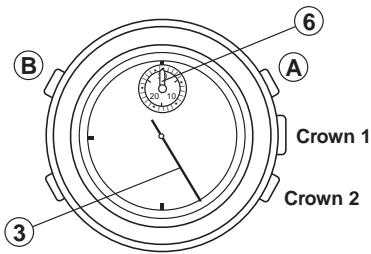
When reading this instruction booklet, keep the watch diagram on the left unfolded and in full view. The symbols (A, B, etc.) on the diagram are those referred to in the section describing the operating instructions.
① Hour hand
② Minute hand
③ Stopwatch second hand
④ Alarm hour hand
⑤ Alarm minute hand
⑥ Stopwatch minute hand
⑦ Continuous second small hand
Crown 1
0) Normal position: Free
1) First click:
Clockwise: Date setting
Counterclockwise: Free
2) Second click: Main time setting
Crown 2
0) Normal position: Free
1) First click: Alarm engagement
2) Second click: Alarm hour and minute hand setting
A Botton
B Botton
C Botton
Crown 2
E Crown 1
SCREW DOWN CROWN
(For the models with a screw down crown)
How to unlock the crown
Unscrew the crown by turning it counterclockwise until you no longer feel the threads turning.
The crown can be pulled out to the first or second click for time/calendar setting.
How to lock the crown
After all the adjustments are completed, push the crown back to the normal position. Turn the crown clockwise while pressing it lightly until tight.
FEATURES
This is a multi-display analogue watch featuring alarm and stopwatch functions.
MAINTIME DISPLAY
Hour and minute hands with a continuous second small hand.
CALENDAR
Date in displayed in numerals.
ALARM
The alarm is set on a 12-hour basis with 2 small hands displaying the designated alarm time.
STOPWATCH
It can measure up to 30 minutes.
BATTERY LIFE INDICATOR
The continuous second small hand moves at two-second intervals when the battery needs to be replaced.
TACHYMETER
Some models are provided with a tachymeter with a graduated dial.

TIME SETTING
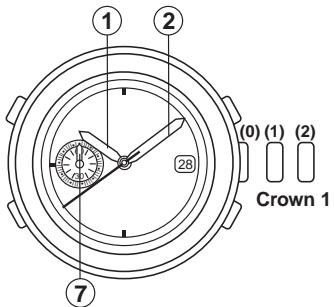
- Pull out crown "I" all the way to the second click when the continuous second small hand ⑦ is at the 12 o'clock position.
- Turn crown "1" to set the hour and minute hands ① and ② to the current time.
- Push crown "1" back in to the normal position in accordance with a time signal.
Notes:
- When setting the hour hand, check that AM/PM is correctly set. The watch is so designed that the date changes once in 24 hours. Turn crown "1" clockwise until the hour hand passes the 12 o'clock marker to determine whether the watch is set for the A.M. or PM period. If the date does not change, the time is set for the A.M. period. If the date does not change, the time is set for the PM period.
- When setting the minute hand, advance it 4 to 5 minutes ahead of the desired time and then turn it back to the exact minute.
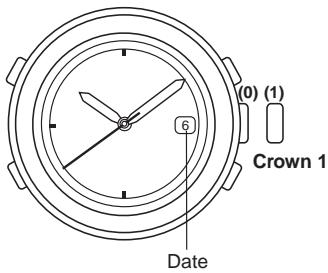
- Pull out crown "1" to the first click.
- Turn crown "1" clockwise till the date for the previous day appears.
- Pull out crown "1" to the second click, advance the hour and minute hands till the desired date appears. Reset the time according to time setting.
- Push crown "1" back in to the normal position.
Note
Do not set the date between 9:00 p.m. and 3:00 a.m. Otherwise, the date may not change properly. If it is necessary to set the date during that time period, first change the time to any time outside this period, set the date and then reset the correct time.
ALARM
The alarm time is set on a 12-hour basis and indicated by the alarm hour and minute hands that move independently of the main time hands.
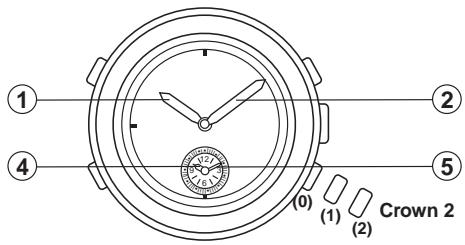
Alarm setting
For alarm setting, first set the alarm hands to the current time (time indicated by the main time hands), and then set them to the alarm time.
- Pull out crown "2" all the way to the second click.
There is a beep for one second.
-
Turn crown "2" to set the alarm hands to the time that the main time hands indicate.
-
When setting the alarm minute hand, advance it 4 to 5 minutes ahead of the desired alarm time and then turn it back to the exact minute.
-
Push back crown "2" all the way in to the normal position.
Then, pull it out again to the first click. The alarm demonstration sound beeps, if crown "2" is pulled out to the first click within one minute after being pushed back in to the normal position. Press © repeatedly to set the desired alarm time.
- With each press of © the alarm hands move one minute.
They move quickly if © is kept pressed.
- Push back crown "2" in to the normal position.
The alarm hands move to show the current time.
Alarm engagement/disengagement
To engage the alarm, pull out crown "2" to the first click. The alarm hands move to indicate the designated alarm time set previously.
* The alarm rings at the designated time for 20 seconds. To stop it manually, press A, B or C, or push back crown "2" in to the normal position.
- When crown "2" is at the normal position, the alarm is disengaged, and the alarm hands indicate the current time.
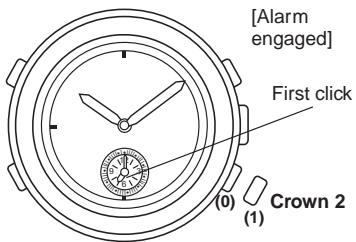
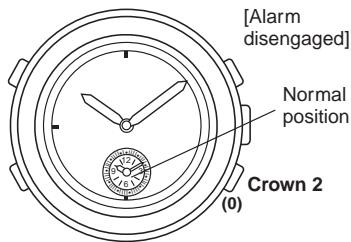
Note:
Please note, if crown "2" is pulled out to the second click, the designated alarm time is canceled with a beep. In that case, set the alarm hour and minute hands to the main time again, push crown "2" back in to the normal position, and then, pull it out to the first click and set the desired alarm time again by pressing ©. However, if crown "2" is pushed back in to the normal position before the beep stops, the designated alarm time will not be canceled.
STOPWATCH
The stopwatch can measure up to 30 minutes at 1 second intervals. After 30 minutes, it will start counting again from "0" repeatedly up to 6 hours.
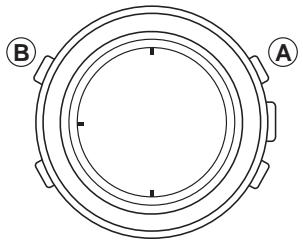
- Before using the stopwatch, be sure to check that crowns "1" and "2" are set at the normal position, and press "B" to reset the stopwatch hands to "0" position.
1. Standard measurement
To start :Press A
To stop :Press A
To reset :Press ⑧
2. Accumulated elapsed time measurement
To start :Press A
To stop : Press A
To restart :Press A
To stop
- Restart and stop of the stopwatch can be repeated by pressing @. :Press ®
To reset
3. Split (intermediate) time measurement
To start :Press A
To measure split time : Press ⑧
To release split time :Press 8
- Measurement and release of the split time can be repeated by pressing “B”.
To stop : Press A
To reset :Press 8
4. Measurement of two competitors
To start :Press A
To measure the finish time of the first competitor : Press ⑧
When the second competitor finishes : Press (A)
To measure the finish time of the second competitor : Press (B)
To reset :Press 8
Notes on crown operation while the stopwatch is in use
Crown "1": Even if crown "1" is pulled out to the first click, the stopwatch continues measuring. However, if it is pulled out to the second click, the stopwatch hands are reset to "0" position.
Crown "2": If crown "2" is pulled out to the first or second click, the stopwatch hands are reset to "0" position.
- When the stopwatch has been reset and is pressed before the hand reaches "0" position, the stopwatch still starts counting time when is pressed.

HOWTO USETHTACHYMETER
(For the models with a tachymeter scale on the dial)
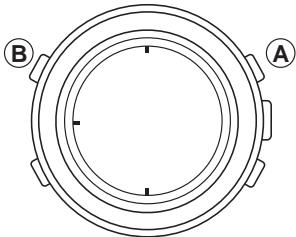
- Use the tachymeter with the stopwatch.
Stopwatch operation (Standard measurement) Press ④
To start : Press A
To stop : Press ⑧ To reset
The tachymeter can be used for the following purposes.
(1) To measure the hourly average speed of a vehicle
- Use the stopwatch to determine how many seconds it takes to go one kilometer (or one mile). The tachymeter scale indicated by the stopwatch second hand gives the average speed per hour.
- Please note that the tachymeter scale can be used only when the time required is less than 60 seconds. If it exceeds 60 seconds, shorten the measuring distance. (Refer to "Ex. 2" below.)
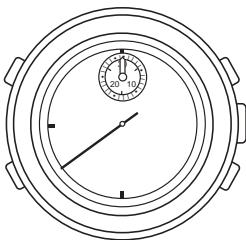
Ex.:1)
If it takes 40 seconds to go one kilometer (or one mile), the stopwatch second hand indicates "90" on the tachymeter scale. This means that the average speed of the vehicle is 90 kilometers (or miles) per hour.
$$ \begin{array}{l} 9 0 \left( \begin{array}{c c} & \text {T a c h y m e t e r s c a l e} \ & \text {f i g u r e a t 4 0 s e c o n d s} \ & \text {p o s i t i o n} \end{array} \right) \times 1 (\text {k m o r m i l e}) \ = 9 0 \mathrm {k m} / \mathrm {h} (\mathrm {o m p h}) \ \end{array} $$
Ex.:2)
If the measuring distance is extended to 2 kilometers (or miles) or shortened to 0.5 kilometers (miles), multiply the figure on the tachymeter scale by 2 or 0.5 respectively. We recommend that you utilize the tachymeter in a rally, speedway or circuit race.
90 (at 40 seconds position) x 2 (Kilometers or miles)
$$ = 1 8 0 \mathrm {k m} / \mathrm {h} (\mathrm {o m p h}) $$
90 (at 40 seconds position) x 0,5 (Kilometers or miles)
$$ = 4 5 \mathrm {k m} / \mathrm {h} (\mathrm {o m p h}) $$
(2) To measure the hourly rate of operation
The tachymeter is extremely useful in calculating factory operation efficiency or machine products amount.
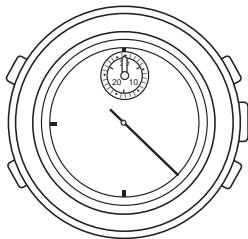
Ex.:1)
Use the stopwatch to measure the time required to complete one job.
If it takes 20 seconds, the stopwatch second hand indicates "180" on the tachymeter scale. This means that 180 jobs will be accomplished in one hour.
$$ \begin{array}{l} 1 8 0 \left( \begin{array}{c c} T a c h e m e t e r s c a l e \ f i g u r e a t 2 0 s e c o n d s \ p o s i t i o n \end{array} \right) \quad x 1 j o b \ = 1 8 0 \text {j o b s} \ \end{array} $$
Ex.:2)
Use the stopwatch to determine how many jobs are accomplished in a specific period of time.
If 15 jobs are completed in 20 seconds, multiply "180", the figure on the tachymeter scale indicated by the stopwatch second hand, by 15. Thus, it is estimated that 2,700 jobs will be accomplished in one hour.
180
Tachymeter scale figure at 20 seconds position
x 15 jobs
$$ = 2, 7 0 0 \text {j o b s p e r h o u r} $$
14
H
ADJUSTING THE HAND POSITION
- If the stopwatch hands ③ and ⑥ will not return to the 12 o'clock position when the stopwatch is reset or when the battery is replaced with a new one, follow the procedure below to reset the hands to the 12 o'clock position.
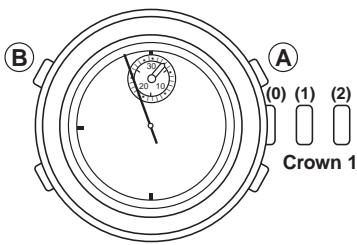
- Pull out crown "1" to the second click.
- Press ④ and ⑧ repeatedly but separately to reset the stopwatch hands to the 12 o'clock position, respectively. * The hands move quickly if the respective buttons are kept pressed.
- Push crown "1" back in to the normal position.

RESETTING THE BUILT-IN IC
- In case any of the watch hands should move improperly, follow the procedure below to adjust the hand movement.
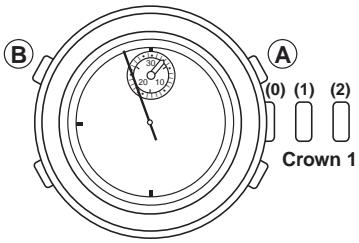
- Pull out crown "1" to the second click.
- Press A and B simultaneously.
- Push back crown "1" in to the normal position. The built-in IC will be reset, and normal movement of the hands will return. Before using the watch again, be sure to set the main time and alarm hands to the desired time and adjust the position of the stopwatch hands following the procedure in "Adjusting the hand position".

BATTERY LIFE INDICATOR
When the battery nears to its end, the small second hand moves at two-second intervals instead of normal one-second intervals to indicate that the battery needs to be replaced with a new one.
Note:
If the alarm is used while the small second hand is moving at two-second intervals, the watch may stop operating.
Therefore, if you see the small second hand moving at two-second intervals replace the battery with a new one as soon as possible.
PRECAUTIONS AND USEFUL INFORMATION
| Indication | Use in | |||
| Degree of water resistance | Dial | Case | Spray, sweat, light rain, washing, etc. | Swimming, etc. |
| A | - | - | NO | NO |
| B | - | WATER RESISTANT | YES | NO |
| C | WATER RESISTANT 50M (5bar) | WATER RESISTANT | YES | YES |
| D | WATER RESISTANT 100M (10bar) | WATER RESISTANT | YES | YES |
| E | WATER RESISTANT 200M (20bar) or more | WATER RESISTANT | YES | YES |
| The words “WATER RESISTANT” may sometimes be abbreviated to “WATER RESIST”. | ||||
- In order to prevent water coming into contact with the internal mechanism, never pull the crown out when the watch is wet.
- If any watches designed for sportswear or use in water come into contact with salt water or heavy sweating, they should be rinsed in fresh water and dried thoroughly.
- Contact with water may cause a deterioration in the quality of some leather straps.
| water | ||
| Skin-diving | Scuba diving | Water-resistance characteristics |
| NO | NO | Not water resistant. Must be kept away from water and moisture |
| NO | NO | Average water resistance. Can withstand spray, sweat, light rain, washing, etc. during daily use |
| NO | NO | Can be worn while swimming but not diving |
| YES | NO | Suitable for skin-diving |
| YES | YES | Suitable for scuba diving |
- As the internal parts of the watch can retain moisture, when the outside temperature is lower than the inside, the watch glass may mist-up. This phenomenon is purely temporary and should not create any problems. However, if it persists for any length of time, the watch should be checked by the shop where it was purchased or by the nearest Authorised Service Centre.
Temperature
Do not leave the watch exposed to direct sunlight or temperature extremes for long periods of time.
Long exposure, in fact, may adversely affect the operation of the watch and actually shorten battery life, causing it to gain or lose time and affect its other functions.
Impact
This watch can withstand normal everyday impacts and shocks and those normally imparted by non-contact sports such as golf and baseball. Serious damage, however, may result if the watch is dropped or subjected to severe shock.
Magnetic fields
This watch is antimagnetic up to 60 gauss, and is therefore not affected by magnetic fields produced by normal domestic appliances. If used near strong magnetic fields, its operation may be temporarily affected.
Static electricity
The integrated circuits present inside the watch are sensitive to static electricity. If the watch is exposed to intense electrical fields, the time display may temporarily lose some of its accuracy.
Chemicals and gases
Avoid wearing the watch in the presence of strong gases or chemical substances. Parts of the watch may discolour, dissolve or even break if brought into contact with benzol or petroleum based products such as solvents, thinners, detergents, adhesives etc.
Pay special attention to avoiding contact with chemicals.
The watch case and strap may discolour if they come into contact with mercury from a broken thermometer or other equipment.
Keeping the watch clean
Use an absorbent soft cloth to clean off any dirt or damp from the watch glass. Wearing the watch when the strap or back of the case is dirty can cause skin irritation. Keeping the watch clean also keeps shirt cuffs clean.
Cleaning the watch strap.
Metal bands: Use a toothbrush and soapy warm water to wash the dirt off.
- Plastic or rubber straps: Wash with water. Do not use solvents.
- Leather straps: Gently rub the face of the strap using a soft dry cloth. Clean the opposite side with a cloth and alcohol.
Periodic inspection
In order to guarantee long trouble-free operation, it is advisable to have the watch checked by an authorised assistance centre once every 12 months or two years.
Keep batteries out of the reach of children
If a battery is accidentally swallowed, consult a doctor immediately.
INDEX
A COMPONENTES PRINCIPALES 24
B CHARACTERISTIQUES 26
C REGLAGE DE L'HEURE 27
D REGLAGE DE LA DATE 28
E SONNERIE 29
F CHRONOMETRE 32
G UTILISATION DUTACHYMETRE 34
AJUSTEMENT DE LA POSITION DES AIGUILLES 37
RE-INITIALISATION DU CIRCUIT INTEGRE INCORPORE 38
J TEMOIN DE CHARGE DE LA PILE 39
K PRECAUTIONS D'UTILISATION ET INFORMATIONST UTILES 40

PIECES PRINCIPALES
$$ = 2. 7 0 0 \text {l a v o r i} $$

AZZERAMENTO DEL C.I. INCORPORATO
- SCREW DOWN CROWN
- (For the models with a screw down crown)
- FEATURES
- MAINTIME DISPLAY
- CALENDAR
- ALARM
- STOPWATCH
- BATTERY LIFE INDICATOR
- TACHYMETER
- TIME SETTING
- Notes:
- Note
- Alarm setting
- Alarm engagement/disengagement
- Note:
- Standard measurement
- Accumulated elapsed time measurement
- Split (intermediate) time measurement
- Measurement of two competitors
- Notes on crown operation while the stopwatch is in use
- HOWTO USETHTACHYMETER
- (For the models with a tachymeter scale on the dial)
- To measure the hourly average speed of a vehicle
- Ex.:1)
- Ex.:2)
- To measure the hourly rate of operation
- H
- ADJUSTING THE HAND POSITION
- RESETTING THE BUILT-IN IC
- PRECAUTIONS AND USEFUL INFORMATION
- Temperature
- Impact
- Magnetic fields
- Static electricity
- Chemicals and gases
- Keeping the watch clean
- Periodic inspection
- Keep batteries out of the reach of children
- INDEX
- PIECES PRINCIPALES
- AZZERAMENTO DEL C.I. INCORPORATO
Brand : BREIL
Model : YM52
Category : Wristwatch