
DSP-12 - Sound system JBSYSTEMS LIGHT - Free user manual and instructions
Find the device manual for free DSP-12 JBSYSTEMS LIGHT in PDF.


| Product type | Modular 12-channel Dimmer/Switch |
| Brand | JBSYSTEMS LIGHT |
| Model | DSP-12 |
| Category | Sound system |
| Number of channels | 12 |
| Maximum load per channel | 10 A (10 A automatic circuit breakers) |
| DMX input | 3-pin XLR male |
| DMX output | 3-pin XLR female |
| Analog input | 15-pin SUB-D connector, 0~10 VDC |
| Power supply | Single-phase 230 Vac 50-60 Hz or three-phase 230 Vac 50-60 Hz |
| Dimensions (W x H x D) | 483 x 176 x 470 mm |
| Weight | 25 kg |
| Display | LCD showing output status of each channel |
| DMX fail function | Hold, Analog, or 12 internal programs |
| Preset function | Level setting 0-100% per channel or global |
| Dimming curves | Linear, logarithmic, switch |
| Preheat | 0-50% per channel or global |
| DMX addressing | By block (soft patch) or individual |
| Phase correction | Yes (enable/disable) |
| Power failure memory | Yes |
| Modular construction | Removable output modules |
| Circuit breakers | Automatic 10 A per channel |
| Safety | Grounding mandatory, do not expose to moisture |
| Maintenance | Clean with a slightly damp soft cloth |
| Spare parts | Replaceable output modules (available from dealer) |
Frequently Asked Questions - DSP-12 JBSYSTEMS LIGHT
User questions about DSP-12 JBSYSTEMS LIGHT
0 question about this device. Answer the ones you know or ask your own.
Ask a new question about this device
Download the instructions for your Sound system in PDF format for free! Find your manual DSP-12 - JBSYSTEMS LIGHT and take your electronic device back in hand. On this page are published all the documents necessary for the use of your device. DSP-12 by JBSYSTEMS LIGHT.
USER MANUAL DSP-12 JBSYSTEMS LIGHT
Copyright © 2005 by BEGLEC cva.
Reproduction or publication of the content in any manner, without express permission of the publisher, is prohibited.
C
Version: 1.2



EN - DISPOSAL OF THE DEVICE
Dispose of the unit and used batteries in an environment friendly manner according to your country regulations.
FR-DECLASSES L'APPAREIL
Thank you for buying this JB Systems product. To take full advantage of all possibilities, please read these operating instructions very carefully.
FEATURES
- 12 channel modular Dimmer + Switch pack
- Max load 10A per channel with automatic 10A circuit breakers
- DMX and analog 0/10V inputs
- Block or individual channel addressing (soft patch)
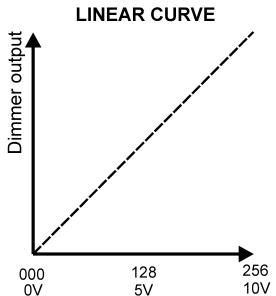
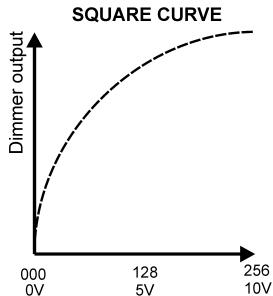
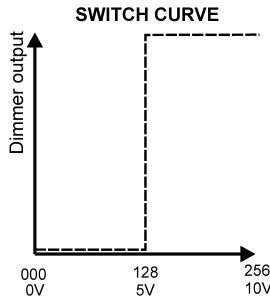
- General or individual channel curve selection: switch, linear or square curve
- General or individual channel presets 0-100% (no control panel needed)
- General or individual channel preheats 0 - 50%
- DMX-failure: auto DMX-hold, auto analog 0/10V or auto built-in patterns
- Completely modular setup: very service friendly!
- Phase Correction for perfect, linear dimming curves
- LCD display with channel output indications
- Menu driven setup
3-Phase and single phase 230Vac 50 60Hz inputs
Power failure memory
BEFORE USE
Check the contents:
Check that the carton contains the following items:
DSP12 dimmer/switchnpack
- Operating instructions
CAUTIONS REGARDING HANDLING
SAFETY INSTRUCTIONS:

CAUTION
RISK OF ELECTRIC SHOCK DO NOT OPEN

CAUTION: To reduce the risk of electric shock, do not remove the top cover. No user-serviceable parts inside. Refer servicing to qualified service personnel only.

The lightning flash with arrowhead symbol within the equilateral triangle is intended to alert the use or the presence of un-insulated "dangerous voltage" within the product's enclosure that may be of sufficient magnitude to constitute a risk of electric shock.

The exclamation point within the equilateral triangle is intended to alert the user to the presence of important operation and maintenance (servicing) instructions in the literature accompanying this appliance.
To prevent fire or shock hazard, do not expose this appliance to rain or moisture.
Do not place metal objects or spill liquid inside the unit. Electric shock or malfunction may result.
INSTALLATION GUIDELINES:
- Placing and using the unit for long periods near heat-generating sources such as amplifiers, spotlights, etc. will affect its performance and may even damage the unit.
- Take care to minimize shocks and vibrations during transport.
- When installed in a booth or flight case, please make sure to have good ventilation to improve heat evacuation of the unit.
- To avoid condensation to be formed inside, allow the unit to adapt to the surrounding temperatures when bringing it into a warm room after transport. Condense sometimes prevents the unit from working at full performance.
- Choose the place where you put your installation very carefully. Avoid presence of heat sources. Avoid places with vibrations or places that are dusty and humid.
- To prevent fire or shock hazard, do not expose this appliance to rain or moisture.
- In order to prevent electric shock, do not open the top cover. If a problem occurs, contact your dealer.
- Do not place metal objects or spill liquid inside the unit. Electric shock or malfunction may result.
- This unit may cause interference to radio and television reception.
- Very important: this product must be earthed!
MAINTENANCE
Clean by wiping with a polished cloth slightly dipped with water. Avoid getting water inside the unit. Do not use volatile liquids such as benzene or thinner which will damage the unit.
FRONT PANEL
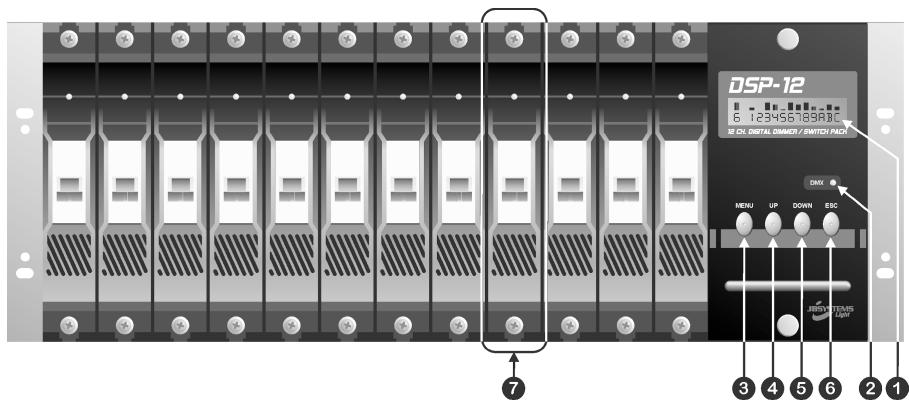
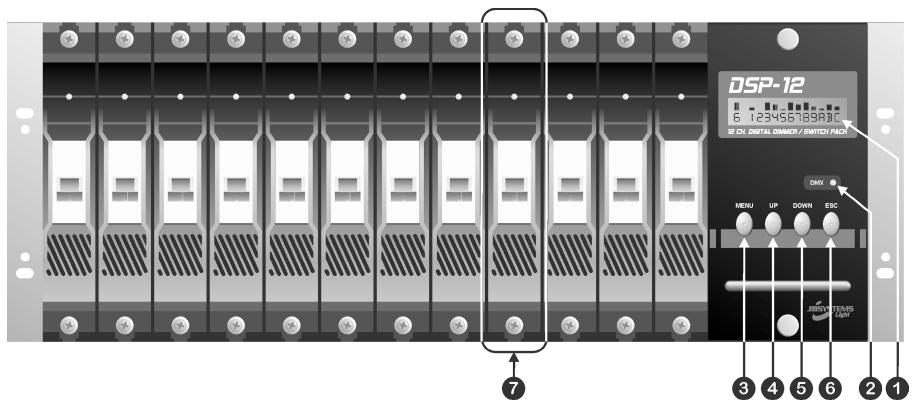
- LCD DISPLAY: monitors the current output states of the channels and helps the user with the setup of the different menus.
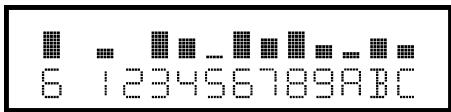
In normal working condition the display shows the output states of the channels (see picture): The screen shows 12 channels where A, B and C correspond to channels 10, 11 and 12. Above each channel there's a bar indicating the dimming level of that channel. The first digit shows the name of the channel that has been last modified. (in the picture the dimming value of channel 6 was the last modified)
- DMX LED: Blinks when a DMX signal is detected.
- MENU Button: Used to access the different setup menus. See "Setup menus" for more information.
- UP Button: Used to scroll the menus or to increase the values.
- DOWN Button: Used to scroll the menus or to decrease the values
- ESC Button: Used to go one step back in the menu level or to leave the menu system.
- OUTPUT MODULES: Each module houses the power stage for one channel. On the front of the modules you'll see automatic 10A circuit breakers. In case of a short circuit these circuit breakers will switch off to protect the output stages of the DSP12. After inspection of the installation you can switch them back on. In normal working condition these circuit breakers are always switched on. In addition to the LCD display there's also a led showing the output condition of the channel. If there's something wrong with a module, you can simply loosen both screws and tear the module from the cabinet and bring it to your dealer for servicing.
CONNECTIONS (control signals)
-
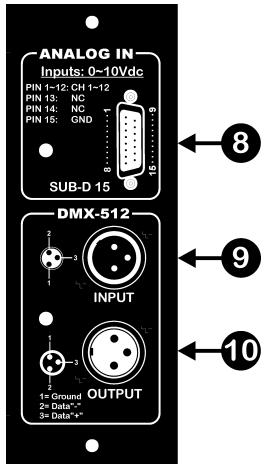
ANALOGUE INPUTS: SUB-D 15 connector used for the analogue 0 10Vdc inputs.
-
Pins 1 to 12 correspond to channels 1 to 12.
- Pins 13 and 14 are not used
Pin 15 is ground (GND)
Attention: The analogue input only works when the "DMX fail" option is set to "Analog" and no DMX-signal is connected to the DSP12 (DMX led is off)
- DMX INPUT: male XLR-connector used to connect the DSP12 to a DMX controller or any other DMX unit in the chain.
10.DMX OUTPUT: female XLR-connector used to connect the DSP12 to the next unit in the DMX chain.
CONNECTIONS (Mains inputs/outputs)
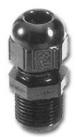
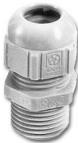
This unit may only be installed by qualified personal, following the rules for electrical installations in your country! After installation always put the metal covers back in place and make sure to use proper cable entry glands (see picture) to protect the wires from unwanted traction and friction.
-
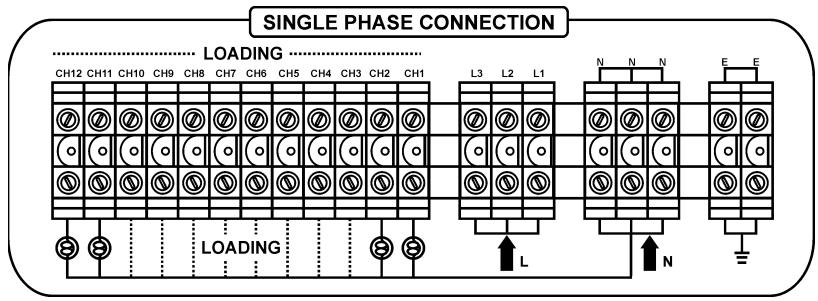
SINGLE PHASE INSTALLATION (2 wires “L”+“N”+ earth wire “E”:
-
Since you have only 1 phase wire (L) you must make bridges between the L1/L2/L3 inputs and connect the phase wire to these inputs.
- Connect the neutral (N) to the N-input.
- Connect the outputs between each channel output and the neutral wire (N).
- Don't forget to connect the earth connection properly!
-
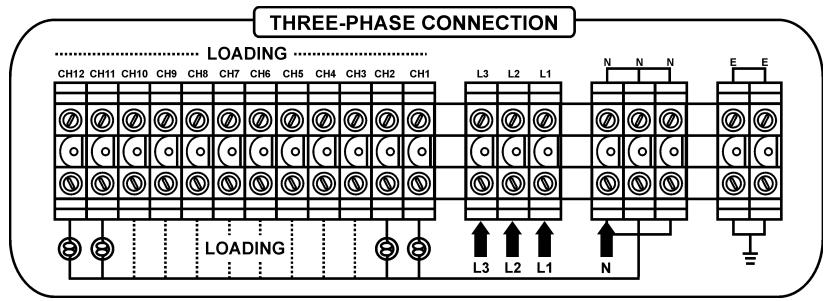
THREE PHASE INSTALLATION (4wires “L1+L2+L3+N” + earth wire “E”:
-
Since you have 3 phase wires you can connect these directly to the corresponding L1/L2/L3 inputs. (see drawing)
- Connect the neutral (N) to the N-input. (see drawing)
- Connect the outputs between each channel output and the neutral wire (N).
- Don't forget to connect the earth connection properly!
SETUP MENUS
Please refer to the overview below to fully understand the menu structure of the DSP12:
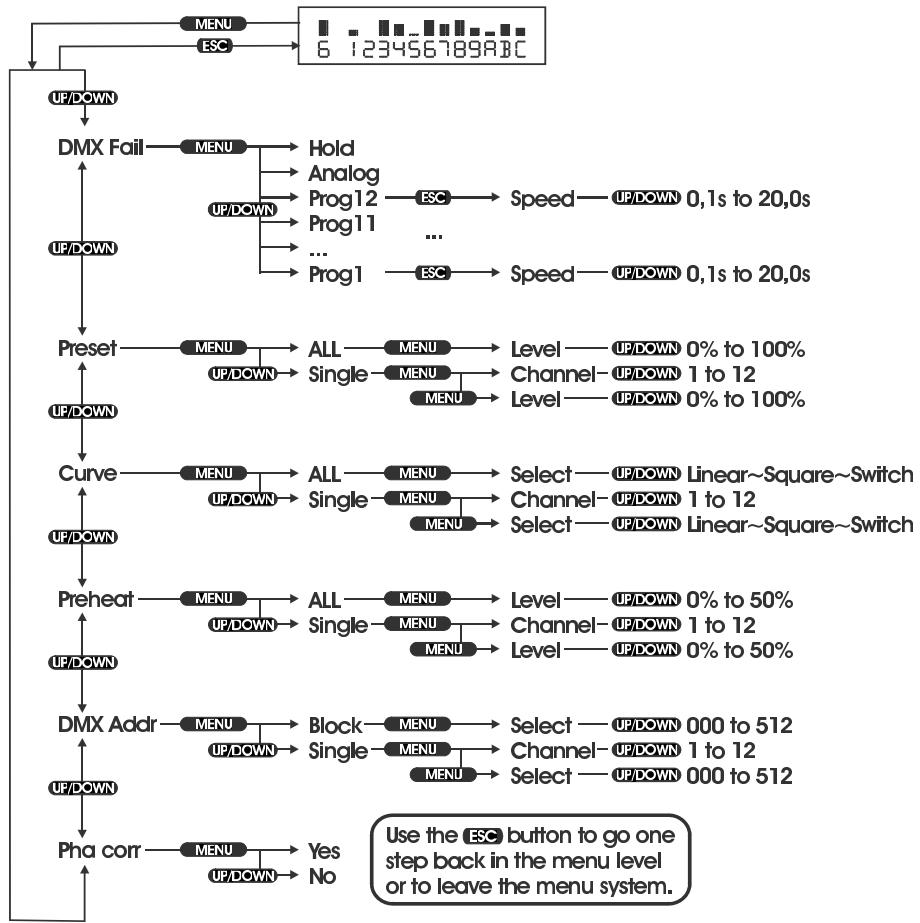
You can clearly see which buttons to push to select a certain function. In most cases the DSP12 is in normal working condition (display shows channel output condition). Push the "menu" button to enter the setup menus. With the "up/down" buttons you can scroll through the 6 available menus. With the "esc" button you can go one step back in the menu. After +/-30 sec the DSP12 returns automatically to the normal working mode.
In the next chapter you can read more about each function.
MENU ITEMS
- DMX FAIL:
The DSP12 works with analog 0/10V or digital DMX-512 input signals. DMX-signals have priority to the analog inputs. This means that you can only use the analog inputs when no DMX-signal is detected. When the DMX-signal is not present you have 3 options:
Hold:
In case of DMX-fail the DSP12 keeps the last scene on the outputs.
- Press "menu" and "up/down" until the display shows "Dmx fail".
- Press "menu" again: the display shows one of the 3 options.
- Press "up/down" until the display shows "Hold"
- Press "esc" to store this option and leave the menu.
Analog:
In case of DMX-fail the DSP12 goes in analog 0/10V mode.
- Press "menu" and "up/down" until the display shows "Dmx fail".
- Press "menu" again: the display shows one of the 3 options.
- Press "up/down" until the display shows "Analog"
- Press "esc" to store this option and leave the menu.
Prog 01 ... Prog 12:
In case of DMX-fail the DSP12 shows one of the 12 built-in patterns.
- Press "menu" and "up/down" until the display shows "Dmx fail".
- Press "menu" again: the display shows one of the 3 options.
- Press "up/down" until the display shows the desired program (Prog 01 ... 12)
- Press "esc" and "up/down" buttons to select the proper speed.
- Press "esc" to store the selected speed and leave the menu.
- PRESET:
The DSP12 can work without a controller for the input signals. This is a good option if you just need a certain output level on each channel over a long time (shops, exhibition booths, pubs etc...) This can be done with the Preset option. You can set a certain level for all channels at once or for each individual channel.
- Preset All channels:
- Press "menu" and "up/down" until the display shows "Preset".
- Press "menu" again: the display shows one of the 2 options.
- Press "up/down" until the display shows "All"
- Press "menu" to select this option.
- Press "up/down" to set the desired overall level.
- Press "esc" to store the selected level and leave the menu.
- Preset individual channels:
- Press "menu" and "up/down" until the display shows "Preset".
- Press "menu" again: the display shows one of the 2 options.
- Press "up/down" until the display shows "Single"
- Press "menu" to select this option: the display shows the channel number on the first row and the dimming value on the second row.
- Press "menu" to toggle between both rows.
-
Press "up/down" to set the desired dimming levels and channel numbers until all channels are set.
-
Press "esc" to store the selected presets and leave the menu.
CURVE:
With the DSP12 you can select a different working mode (curve) for each individual channel. This is a nice feature if you need to switch light effects on/off while at the same time you have to dim lamps. 3 Curves are available:
- Select a curve for all channels:
- Press "menu" and "up/down" until the display shows "Curve".
- Press "menu" again: the display shows one of the 2 options.
- Press "up/down" until the display shows "All"
- Press "menu" to select this option.
- Press "up/down" to select one of the 3 curves
- Press "esc" to store the selected curve and leave the menu.
- Select a curve for individual channels:
- Press "menu" and "up/down" until the display shows "Curve".
- Press "menu" again: the display shows one of the 2 options.
- Press "up/down" until the display shows "Single"
- Press "menu" to select this option: the display shows the channel number on the first row and the curve on the second row.
- Press "menu" to toggle between both rows.
- Press "up/down" to set the desired curves and channel numbers until all channels are set.
- Press "esc" to store the selected curves and leave the menu.
- PREHEAT:
On the DSP12 you can set a preheat level up to 50% for all channels in one time or for each channel separately. While the preheat function keeps the lamp filament at a certain temperature, the turn on current of the lamp is much lower. This extends the lamp life considerably in many cases.
- Preheat on all channels:
- Press "menu" and "up/down" until the display shows "Preheat".
- Press "menu" again: the display shows one of the 2 options.
- Press "up/down" until the display shows "All"
- Press "menu" to select this option.
- Press "up/down" to set the desired overall level.
- Press "esc" to store the selected level and leave the menu.
- Preheat on individual channels:
- Press "menu" and "up/down" until the display shows "Preheat".
- Press "menu" again: the display shows one of the 2 options.
- Press "up/down" until the display shows "Single"
- Press "menu" to select this option: the display shows the channel number on the first row and the preheat level on the second row.
- Press "menu" to toggle between both rows.
- Press "up/down" to set the desired preheat levels and channel numbers until all channels are set.
- Press "esc" to store the selected preheat levels and leave the menu.
- DMX ADDRESSING:
On the DSP12 you can set the DMX start address for the complete unit or for each channel separately. Due to this "soft patch" option DMX addressing becomes extremely flexible.
- Setting the start address for the complete unit:
- Press "menu" and "up/down" until the display shows "Dmx addr"
- Press "menu" again: the display shows one of the 2 options.
- Press "up/down" until the display shows "Block"
- Press "menu" to select this option.
- Press "up/down" to set the desired start address for the DSP12.
- Press "esc" to store the selected level and leave the menu.
- Setting the start address for individual channels:
- Press "menu" and "up/down" until the display shows "Dmx addr"
- Press "menu" again: the display shows one of the 2 options.
- Press "up/down" until the display shows "Single"
- Press "menu" to select this option: the display shows the channel number on the first row and the DMX address on the second row.
- Press "menu" to toggle between both rows.
- Press "up/down" to set the desired DMX addresses and channel numbers until all channels are set.
- Press "esc" to store the selected DMX addresses and leave the menu.
PHASE CORRECTION:
To be able to produce perfectly linear curves the DSP12 has phase correction on board. Normally this option should always be switched on. However some control desks have built-in phase correction that can't be switched off. In these cases the phase correction of the DSP12 can be switched off.
- Switching phase correction on/off:
- Press "menu" and "up/down" until the display shows "Pha corr"
- Press "menu" again: the display shows one of the 2 options (on/off)
- Press "up/down" until the display shows the desired option.
- Press "esc" to store the selected option and leave the menu.
SPECIFICATIONS
Power Input:
Single Phase 230Vac 50 60Hz (2 wires)
Power outputs:
Three Phase 230Vac 50 60Hz (4 wires)
DMX-512 in/out:
Max. 12x 10A (max.10A per channel)
in: male 3pin XLR
out: female 3pin XLR
Analog input:
SUB-D 15pin connector: 0 10Vdc
Size (WxHxD):
483 × 176 × 470 mm
Weight:
25kg
MODE D'EMPLOI
MANUEL D'INSTALLATION:
FONCTIONS (FACE AVANT)
ENKELE FASE AANSLUITING (2 draden “L + N” + aardleiding “E”)
out: female 3pin XLR
Analoger Input:
SUB-D 15pin Verbinder: 0 10Vdc
MaBe (LxHxB):
483 x 176 x 470mm
Gewicht:
25kg