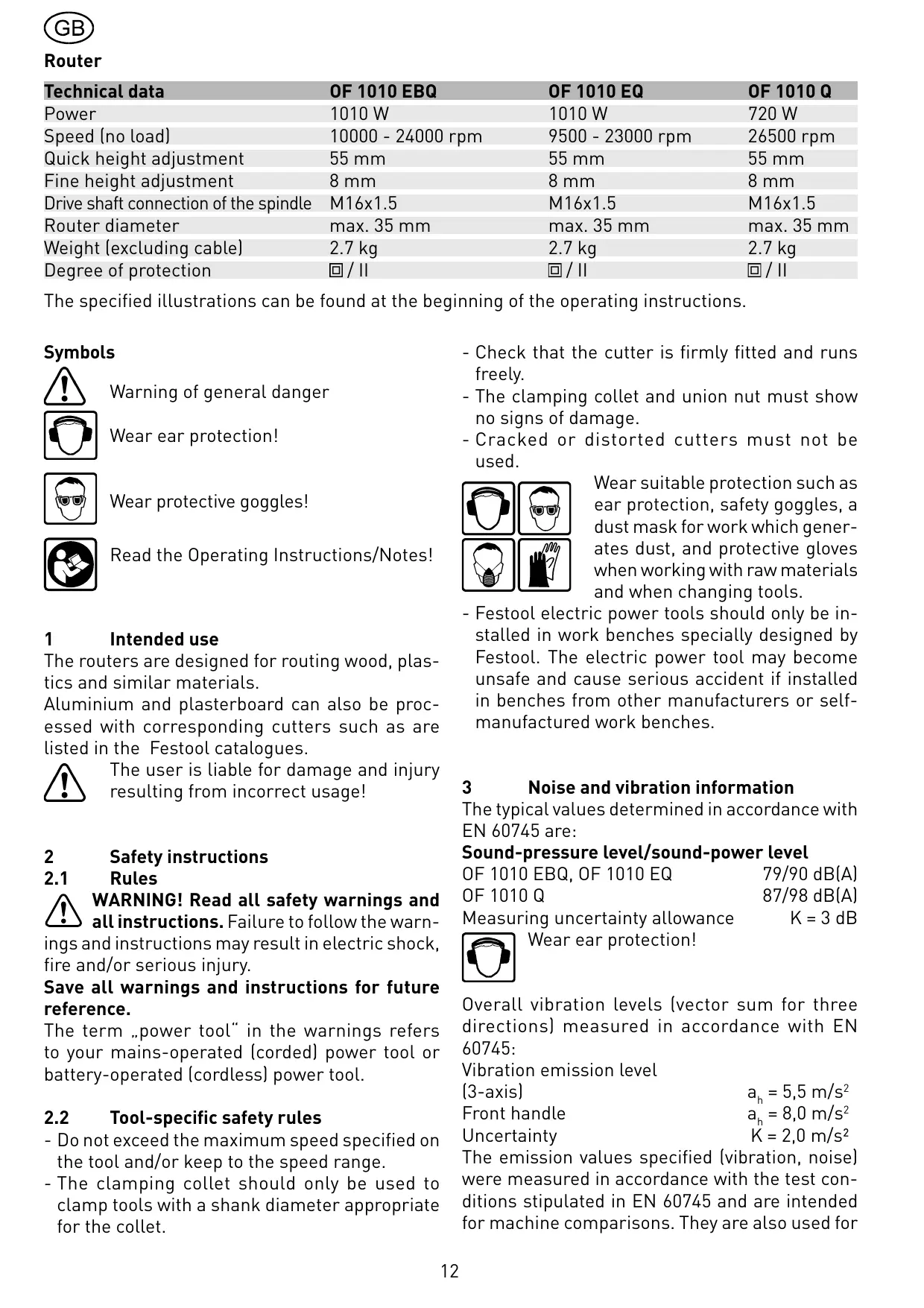
USER MANUAL OF 1010 EQ FESTOOL
The specified illustrations can be found at the beginning of the operating instructions.
Symbols

Warning of general danger

Wear ear protection!

Wear protective goggles!

Read the Operating Instructions/Notes!
1 Intended use
The routers are designed for routing wood, plastics and similar materials.
Aluminium and plasterboard can also be processed with corresponding cutters such as are listed in the Festool catalogues.

The user is liable for damage and injury resulting from incorrect usage!
2 Safety instructions
2.1 Rules

WARNING! Read all safety warnings and all instructions. Failure to follow the warn-
ings and instructions may result in electric shock, fire and/or serious injury.
Save all warnings and instructions for future reference.
The term „power tool" in the warnings refers to your mains-operated (corded) power tool or battery-operated (cordless) power tool.




Wear suitable protection such as ear protection, safety goggles, a dust mask for work which generates dust, and protective gloves when working with raw materials and when changing tools.
- Festool electric power tools should only be installed in work benches specially designed by Festool. The electric power tool may become unsafe and cause serious accident if installed in benches from other manufacturers or self-manufactured work benches.
The typical values determined in accordance with EN 60745 are:
Sound-pressure level/sound-power level
OF 1010 EBQ, OF 1010 EQ 79/90 dB(A)
OF 1010 Q 87/98 dB(A)
Measuring uncertainty allowance K = 3 ~dB
Wear ear protection!
Overall vibration levels (vector sum for three directions) measured in accordance with EN 60745:
Vibration emission level
(3-axis) a_h = 5.5 ~m / s^2
Front handle a_b = 8,0m / s^2
Uncertainty K = 2,0m / s^2
The emission values specified (vibration, noise) were measured in accordance with the test conditions stipulated in EN 60745 and are intended for machine comparisons. They are also used for
making preliminary estimates regarding vibration and noise loads during operation.
The emission values specified refer to the main applications for which the power tool is used. If the electric power tool is used for other applications, with other tools or is not maintained sufficiently prior to operation, however, the vibration and noise load may be higher when the tool is used. Take into account any machine idling times and downtimes to estimate these values more accurately for a specified time period. This may significantly reduce the load during the machine operating period.
4 Power supply and start-up

The mains voltage must correspond to the specification on the rating plate.
Switch (1.2) serves as an On/Off switch ( l = 0n / 0 = 0ff ). It may be latched with the locking knob on the side (1.1) for continuous operation. Pressing the switch again releases the lock. See Fig. 1A for connection and disconnection of the power cable.
5 Machine settings
Always remove the power supply plug from the socket before carrying out any work on the machine.
5.1 Electronics
Do not operate the tool if the electronics are faulty as this can lead to the tool operating at excessive speeds. If the start-up is not smooth or speed adjustment is not possible, this indicates that the electronics are faulty.

The OF 1010 EBQ, OF 1010 EQ features full-wave electronics with the following properties:
Smooth start-up
The smooth start-up ensures the router starts up jolt-free.
Speed adjustment
You can regulate the speed steplessly between 10000 and 24000min^-1 (OF 1010 EQ: 9500 - 23000 min^-1 ) using the adjusting wheel (1.16). This enables you to optimise the cutting speed to suit the material:
| Material | Cutterdiameter [mm] | Recommended cutter material |
| 3 - 14 | 15 - 25 | 16 - 35 |
| Rotary control setting |
| Hardwood | 6 - 4 | 5 - 3 | 3 - 1 | HW (HSS) |
| Softwood | 6 - 5 | 6 - 3 | 4 - 1 | HSS (HW) |
| Laminated chipboard | 6 - 5 | 6 - 3 | 4 - 2 | HW |
| Plastic | 6 - 4 | 5 - 3 | 2 - 1 | HW |
| Aluminium | 3 - 1 | 2 - 1 | 1 | HSS (HW) |
| Plaster-board | 2 - 1 | 1 | 1 | HW |
Constant speed
The pre-selected speed remains constant whether the machine is in operation or in neutral position.
Temperature control
To prevent overheating, the safety electronics switches the machine off when it reaches a critical motor temperature. Let the machine cool down for approx. 3-5 minutes before using it again. The machine requires less time to cool down if it is running, i.e. in neutral position.
Brake (OF 1010 EBQ)
The OF 1010 EBQ has an electronic brake which brings the spindle with tool to a standstill within approx. 2 seconds of the tool being switched off.
You can turn the machine upside down when changing the tool.
- Insert the router into the open clamping collet as far as possible, but at least up to the mark ( ) on the router shank.
- Turn the spindle until the spindle stop (1.14) catches when pressed and the spindle is locked in place.
- Tighten the locking nut (1.13) with a 19 mm open-end spanner.
- Turn the spindle until the spindle stop (1.14) catches when pressed and the spindle is locked in place.
- Loosen the locking nut (1.13) using a 19 mm open-ended spanner until a resistance is felt. Overcome this resistance by turning the open-ended spanner even further.
- Remove the cutter.
5.3 How to change the clamping collet
Clamping collets are available for following shank diameters: 6.0 mm, 6.35 mm, 8 mm (order numbers see Festool catalogue or Internet „www.festool.com".
- Fully unscrew the nut (1.13) and remove from spindle together with the clamping collet.
- Insert a new clamping collet with nut into the spindle and slightly tighten the nut. Do not tighten the nut until a milling cutter has been fitted.
5.4 Adjusting the milling depth
The milling depth is adjusted in three stages:
a) Setting the zero point
- Open the clamping lever (1.6) so that the stop cylinder (1.7) can move freely.
- Place the router with router table (1.11) onto a smooth surface. Open the rotary knob (1.15) and press the machine down until the milling cutter rests on the base.
- Clamp the machine in this position by tightening the rotary knob (1.15).
- Press the stop cylinder against one of the three sensing stops of the pivoted turret stop (1.9).
The individual height of each sensing stop can be adjusted with a screwdriver:
| Sensing stop | min. height/max. height |
| A | 38 mm/44 mm |
| B | 44 mm/54 mm |
| C | 54 mm/67 mm |
- Push the pointer (1.4) down so that it shows 0 mm on the scale (1.5).
b) Setting the milling depth
The desired milling depth can be set either with the quick depth adjustment or with the fine depth adjustment.
- Quick depth adjustment: Pull the stop cylinder (1.7) up until the pointer shows the desired milling depth. Clamp the stop cylinder in this position with the clamping lever (1.6).
- Fine depth adjustment: Clamp the stop cylinder with the clamping lever (1.6). Set the desired milling depth by turning the adjusting wheel (1.3) in. Turn the adjusting wheel to the next mark on the scale to adjust the milling depth by 0.1 ~mm . One full turn adjusts the milling depth by 1 ~mm . The maximum adjustment range with the adjusting wheel is 8 ~mm .
c) Increasing the milling depth
- Open the rotary knob (1.15) and press the tool down until the stop cylinder touches the sensing stops.
- Clamp the machine in this position by tightening the rotary knob (1.15).

Always connect the machine to a dust extractor. A connection for extracting dust and chips (1.8) is a standard feature on the routers.
At the same time a chip guard [2.2] on the side stop prevents flying chips.
With edge routing, the best extraction effect is obtained with the extractor hood AH-OF, available as an accessory.
KSF-OF chip catcher
Using the KSF-OF chip catcher (9.1) (sometimes included in the scope of delivery), the efficiency of the extraction can be increased when routing edges. Installation is similar to that of the copying ring.
The hood can be cut off along the grooves (9.2) using a hacksaw and can thus be reduced in size. The chip catcher can then be used for interior radiuses up to a minimum radius of 40 mm .
6 Working with the machine

Always secure the workpiece in such a manner that it cannot move while being sawed.

The machine must always be held with both hands by the designated handles [1.15, 1.17].
Always advance the router in the direction opposite to the direction of rotation of the cutter (counter-routing)!
When routing (ensure feed direction of power tool is the same as cutting direction of tool, Fig. 5).
6.1 Aluminium processing
When processing aluminium, the following measures must be taken for safety reasons:
- Pre-connect a residual current circuit-breaker (FI, PRCD).
- Connect the machine to a suitable dust extractor.
- Clean tool regularly of dust accumulations in the motor housing.
6.2 Freehand routing
Freehand routing is the method normally used for lettering or shapes, and for routing edges using cutters with a guide pin or ring.
6.3 Routing with the parallel guide
The parallel guide (3.2) supplied can be used for routing parallel to the edge of the workpiece (not supplied with „Module 5A}):
- Secure both guide rods (3.7) with the two rotary knobs (3.3) on the side stop.
- Insert the guide rods into the grooves (1.10) on the router base to the required distance and secure them by turning the rotary knob (3.1).
This distance can be adjusted faster and more precisely with the fine precision adjustment (3.6), available as an accessory:
- Turn the adjusting screw (3.4) in the plastic part of the guide,
- clamp the guide rods with the rotating knobs (3.5) in the precision adjustment,
- loosen the rotating knobs (3.3) of the parallel guide,
- set the desired distance with the adjusting screw and retighten the rotating knobs.
6.4 Routing with the TV-OF extension table
The extension table TV-OF, available as an accessory, can be used to enlarge the support area of the router and thus improve guidance, e.g. when routing close to edges.
The extension table is fitted in the same way as the parallel guide.
6.5 Routing with the FS guide system
The guide system, available as an accessory, facilitates routing straight grooves.
- Fasten the guide stop (4.1) to the platen with the guide rails (3.7) of the parallel guide.
- Fasten the guide rail (4.3) with FSZ screw clamps (4.4) to the workpiece. Make sure that the safety distance X (Fig. 4) of 5 ~mm between the front edge of the guide rail and cutter or groove is observed.
- Place the guide stop onto the guide rail as shown in Fig. 4. To ensure a backlash-free guidance of the router stop you can adjust two guide cheeks with a screwdriver through the side openings [4.2].
- Screw the height-adjustable support (4.6) of the router table's threaded bore (6.6) in such a way
that the underside of the router table is parallel to the surface of the workpiece.
When working with marking-up lines, the marks on the platen (4.5) and the scale on the support (4.6) show the centre axis of the cutter.
With the SZ-OF 1000 beam compasses, which are available as an accessory, you can make circular cuts or segments of circles with diameters from 153 to 760~mm .
- The beam compasses are pushed into the front groove of the platen until the desired radius is set.
- Lock the beam compasses with the rotating knob (1.12).
Practical hint
To prevent the tip of the compasses from making a hole in the workpiece, fix a thin board at the centre point by means of double-sided adhesive tape.
6.7 Copy cutting
A copying ring or the copying device is used to exactly reproduce existing workpieces (both available as accessories).
a) Copying ring
Fasten the copying rings to the platen instead of the cover ring (2.1) from below.
When choosing the size of the copying ring (5.1) make sure that the cutter used (5.2) fits through the ring's opening.
The distance Y (Fig. 5) between the workpiece and template is calculated by
$$
Y = \frac {\left(\emptyset \text {c o p y i n g r i n g} - \emptyset \text {c u t t e r}\right)}{2}
$$
The copying ring can be centred exactly with the centring cone ZF-OF (Order No. 486035).
b) Copying device
The angle arm WA-OF (6.5) and copier scanning set KT-OF, consisting of roller holder (6.2) and three copying rollers (6.1), are required for the copying device.
- Screw the angle arm at the desired height in the platen's threaded bore (6.6) with the rotating knob (6.4).
- Fit a copying roller in the roller holder and bolt this to the angle arm with the rotating knob (6.3). Make sure that the copying roller and cutter have the same diameter!
- Turn the adjusting wheel (6.7) to adjust the distance between the copying roller and cutter axis.
Protruding edge bands can be flush trimmed with the angle arm WA-0F (7.6) in connection with the guide plate UP-0F (7.3).
- Screw the angle arm into the platen's threaded bore (7.7) with the rotating knob (7.5).
- Bolt the guide plate to the angle arm with the rotating knob [7.4].
- Adjust the milling depth so that this is equal to the thickness of the edge band +2 ~mm .
- Move the guide plate (8.1) as close as possible to the cutter by loosening the rotating knob (8.3).
- Adjust the depth of the guide plate with the adjusting wheel (8.2) so that during trimming a few decimillimetres of the edge band are left protruding which can then be sanded down by hand.
The chip guard SF-0F (7.2), available as an accessory, improves dust extraction when trimming edge bands. It is fastened to the side of the platen with the rotating knob (7.1) and cover the cutter from above during work (Fig. 8).
7 Accessories

For your own safety, use only original Festool accessories and spare parts.
Festool offers extensive accessories that enable you to use your machine effectively for a wide variety of applications, e.g.: routing circle, guide rails with rows of holes, routing aid, router base for bench-mounted use.
The accessory and tool order number can be found in the Festool catalogue or on the Internet under „www.festool.com“.
8 Maintenance and care

Always remove the power supply plug from the socket before carrying out any work on the machine.

All maintenance and repair work which requires the motor casing to be opened may only be carried out by an authorised service centre.
Always keep the machine and the ventilation slots clean.
The tool is fitted with special motor brushes with an automatic cut-out. When the brushes become worn the power supply is shut off automatically and the tool comes to a standstill.
9 Disposal
Do not throw the power tool in your household waste! Dispose of machines, accessories and packaging at an environmentally-responsible recycling centre. Observe the valid national regulations.
EU only: European Directive 2002/96/EC stipulate that used electric power tools must be collected separately and disposed of at an environmentally responsible recycling centre.
10 Warranty
Our equipment is under warranty for at least 12 months with regard to material or production faults in accordance with national legislation. In the EU countries, the warranty period is 24 months (an invoice or delivery note is required as proof of purchase). Damage resulting from, in particular, normal wear and tear, o-verloading, improper handling, or caused by the user or other damage caused by not following the operating instructions, or any fault acknowledged at the time of purchase, is not covered by the warranty. Damage caused by the use of non-original accessories and consumable material (e.g. sanding pads) is also excluded.
Complaints will only be acknowledged if the equipment has not been dismantled before being sent back to the suppliers or to an authorised Festool customer support workshop. Store the operating instructions, safety notes, spare parts list and proof of purchase in a safe place. In addition, the manufacturer's current warranty conditions apply.
Note
We reserve the right to make changes to the technical data contained in this information as a result of ongoing research and development work.
11 EU Declaration of Conformity
| Router | Serial no. |
| OF 1010 Q | 490108 |
| OF 1010 EQ | 491991 |
| OF 1010 EBQ | 490174 |
| Year of CE mark: 2000 |
We declare under sole responsibility that this product complies with the following norms or normative documents:
EN 60745-1, EN 60745-2-17, EN 55014-1, EN 55014-2, EN 61000-3-2, EN 61000-3-3 in accord
ance with the regulations stipulated in Directive 98/37/EC (until 28 Dec. 2009), 2006/42/EC (from 29 Dec. 2009), 2004/108/EC.
paa. D. Jdaannn Snnn
Dr. Johannes Steimel 11.01.2010
Head of Research, Development and Technical Documentation
Wertstr. 20, D-73240 Wendlingen, Germany
REACH is a European Chemical Directive that came into effect in 2007. As „downstream users“ and product manufacturers, we are aware of our duty to provide our customers with information. We have set up the following website to keep you updated with all the latest news and provide you with information on all the materials used in our existing products: www.festool.com/reach
Défonseuse
Varning for allman risk!
Använd hörskydd!

Pa6oTaIe B 3aUHTbIx OUYkA.

1 PpIMHeHne No Ha3HaueHnIO
O6pa6aTbIBaTscr MOryT TaKHe aIOMHHn I rH6COBbI KapTOH npn pRIMHeHNn Fpe3epHbIX HNCTpyMeHTOB, CneuansHO npedncaHHbIX dJa 3TOTO DOKyMeHTaMn IO npoJae Festool. FacoHHO Fpe3epHbIe MaunHKn PpeDyCMOTpeHbI NO CBOeMy Ha3NaueHIO dJa Fpe3epOBKn JecA, CNHTeTnueCKNX MaTePnaIOB IN CXODHBIX C JECOM MaTePnaIOB.

3a yüep6 n HeCuaCTHbIe CnyuAn, CBraHHbIE C npIMHeHHeM He No Ha3HaueHnO, OTBeuayT POnb3OBaTeIb.
2 Yka3aHnno TcXHKe 6e3oNaChOCTn
2.1 6e3aHnno 6e3oNaCHocTH BHNMAHNE! PpOHTte Bce yka3aHnno TeXnke 6e3oNaChocTn peKomeHdaun.
Ou6Kn npn co6JIoJeHnn npnbedeHbIX yKa3aHn n peKoMeHdauzn MOyT npNBecTu K noPapKeHIO 3JIeKTPnueckn M TokOM, POKApY, /nIn Bbl3BaTb TjXeJIbIe TpaBMbl.
CoxpaHЯTe Bce yka3aHnI NO TexHnke 6e3Opac-HocTn I PyKOBoDcTBa nO 3KcPnyaTuZn IN BaKaueCTBe cnpaBOUHO MaTePnAJa.
IcnoJIb3OBAHHoe B HactoIux INHCTpyKzIax Nyka3aHnx POnyTne «JleKtpoIHCTpyMeHT» pac-
IpoctpaHareTcHa 3JektpoHnCTpyMeHT C nHTaHnE mOT cETn (co shypom nHTaHnO T 3Jektpocetn) H aKKymyIaTophbl 3JektpoHnCTpyMeHT (6e3 shypom nHTaHnO T 3Jektpocetn).
2.2 CneuΦnueckne npaBnla TexHnKn 6e30nacHoCTn
- MaKcHMaJIbHOe YIcIIO O6OpOTOB, yKa3aHHoe Ha IHCTpyMHeTe, He IOnJXHO 6bITb IpeBbIWeHO, IpyrIMN CNOBaMn, CJIeDyET BceIaIprNiDePJKBaTbCBy Ka3aHHOrO KOIynchecTBA O6OpOTOB.
- IcnoJIb3yIte HnCTpyMeHT CДnAmEtPOM XBOCTOBnKa, NOdXoJrIeRo IOp pa3Mepy 3aJxIMHOu ZaHrN.
- PpOKoHTpOJIpyTe JkEcTKoCTs NocaIKN Φpe3bl 6e3ynpueHOCTs eE XOJa.
- 3aЖHMHацангa ИнakнДнагаКа He ДОЛЖНыИМеть ПОВржден.
- Φpe3bl C TpeuHAmn nIITe,ΦOpMa KOTopbIX npTeeppeIa N3MeHeHnI, pIIMeHrTscr He DOJIKHbl.


3 DaaHbIe IIO Wymu N Bn6paunn
OnpeJeHbIe B COOTBeTcTBn c EN 60745 TINOBblE 3HaueHnR:
ypoBeHb 3yMa/3ByKOBa MoUHOCTb 103 I6(A)
OF 1010 EBQ, OF 1010 EQ 79/90 έБ(A)
06uKo3ΦnueHT KoJIe6aHn (cymma BeKTOpB Tpex HaIpaBJIeHn) paCCHTbIBaeTcR B COOTBeTCTBne c EN 60745:
Ko3ΦΦnζηENT 3Mnccnn KoJIe6aHn
(3-ocbeBoi) a_b = 5,5M / c K^2
PykoTka a_b^m = 8,0M / c K^2
Iorpeuhoctb K=2,0M/ceK²
YkaaHbIe 3HaueHnry uPoBnry UyMa/Bu6paunn H3-Mepenbl B COOTBeTCTBnC yCNoBnAMn NcPiTaHn no EN 60745 n CnyKat dJa cPaBHeHn YHCTpyMeHTOB. 3Tu 3HaueHnry MoXHo TaKKe NcNoB3oBaTb dJa npEdbapntelbHO OceHKn UyMoBOu N Bu6paunHOHn HaRpy3Kn BO BpeM pa6Otbl.
YkaaHbIe 3HaueHn yPoBn YUMa/Bn6paun OTo6paKaIoT OChOBhIe OblaCTn npImeHn 3JeKtpOnHcTpymEnTa. Ppi nCpOJIb3OBAHN 3JeKtpOnHcTpymEnTa B DpyrNx CpeJx, C DpyrMn CMeHHbIMn (pa6oUmN) INHcTpymEnTam nIIN B Clyuae Ix HeyDoBLeTBOpHTelbHOrO 6CbJyXNBaHN, ShyMOBaI N Bn6paCaIOHNa HArpy3Kn MOryT 3HauchTeJIbHO Bo3paCTaTb Ha npOTJxKeHn BCErO cPoka 3KcPnyatauN.ДЯ ToCHNo OceHKn HArpy3OK B TeueHne Yka3aHnHO cPoka 3KcPnyatauN Heo6xOdmo TAKKe CO6JIbOdaTb pInBOdMblE B HAcTOraIe m PyKOBoDCTBe 3HaueHn BpeMeHn pa60tBI Ha XoJIocTOM XoNy i BpeMeHn IpocToR. 3TO pONoKet 3HauchTeJIbHO UMeHbShITb HArpy3Ky B TeueHne BCero cPoka 3KcPnyatauN 3JeKtpOnHcTpymEnTa.
4 ΘЯктуескoe NOДКЛЮЧЕнne I BVOДВ 3KcnpyaTaцnIO

Hanpajxehne B cETn DOJIxHO COOTBcTCTBOBaTb 3HaueHnM, yKa3aHHbIM Ha 3aBOdCKoT Ta6nUKe MaunHbl.
BbIKHouateIb(1.2) cIyJNT dJI BJIIOUeHn/ BbIKHOueHn (I = BKn. / 0 = BbIKI.). PpN dIINTeIbHOJ pa6Ote ero MOxHOb 3aΦHKcnpOBaTb 6OKOBON KHONKON (1.1). PpN IOBTOPHOM HaKaTHN BbIKHOUaTeJI pONCXODHT OCBO6OXdHHe ΦHKcaTopa. CoeINHeHne n OTcoEHNHeJIHN CTeBOrO NITAHN - CM. PNC. 1A.
5 HactpoJaMaunHbI
IpeH NaHApOM IIO6o paObI C MaUHHoB BceIa BbIHMaTe 1TEnCeJIb n3 PO3eTK!
5.1 ΘЛeКТрОнHaЯЧаТь
Bcerda ykpePnIe o6pa6aTbIbAemyo DeTaIb TaK, uTo6bI OHa He DBrIraIacb npN o6pa6oTke.
Bcerda depxnte MaunHy DByMpykamn 3a npedHa3HaueHHbIe dIy eTOro pyuKn (1.15, 1.17).
Pa6otaIte BceIa TaKIM O6pa3OM, yTO6bI HApBaJIeHne IODaUHΦpe3epHO-ΦacOHHO MaIINHKI 6blIO npOTnBOJIOJXHO HApBaJIeHNO BpaIeHnH Φpe3bl (Φpe3epOBaHne npOTnB IOdaUH)!
Φpe3epoBaHne TólbKo Ha BCTpeHOM BpaUeHHN
(Ha npaBJIeHne IIOJauN MaIINHb I Ha npaBJIeHn pe3AHnIHCTpyMeHTa, pnc. 5).
6.1 Pa6oTa c aJIbOMHHem

Pn pa6ote c aIOMHHem n3 COOpaJKeHn 6e3OpacHOCTN HeoXoHMo CObIoJaTb CLeDyUOuNe MepbI:
-ПОДКЛЮЧИТЕ ВБИКЛЮЧАТЕЛ 3ацитBI OT ПпeВыIшЕнЯ TOka (FI, PRCD).
-ПОДКЛЮЧNTe Maшину K ПОДХODЯсEmу yCTpoIcTBy ДЯ OТсаСыВаня Пьл.
- PerylnpHo OunuMaTe MaunHy OT OTIOXeHn PbJIN B Kopnyce 3JIeKTpOdBnIraTeJIa.

Pa6oTaIe B 3aIHTbIX OUYkAx.
6.2 PuyhoeΦpe3epoBaHne
Φpe3epHO-φacOHnHa MaunHka BeTeTc pyKoI ΓλaBhbIM o6pa3OM npi 7prnΦTOBOM nHxUdoJXeCTBeHHOM Φpe3epOBaHH, a TaKKe npi O6pa6OTke KpOMOK Φpe3amN C ynpHBIM KOIsC0M nHn HapBaJIHOuIm uHnom.
6.3 Φpe3epoBaHHe c 60KOBbIM ynpom
IJIpa6OT, pOBOdIMbIX npaJIpeJlsHO K KpOMKe 3aROTOBKN, MOKET nPImeHrTSCR BXODaUcN B KOMnEKT NOCTaBKn 6OKOBYuOp (3.2) (He BXoDHT B KOMnEKT NOCTaBKn ,Modul 5A"):
- 3aKpeHnte Ha npablaHoune cTeprKHN (3.7) IOBOPOTbIMn pyuKaMn (3.3) Na 6OKOBOM yNope.
- YctaHOBHTe HappaBJIIOUne CTepeKHN B Na3bI (1.10) Ha Heo6XoDNMyO rny6HHy N 3aTARHTe IOBOPOTHyO pyuKy (3.1)ДлЯnxФИКСациN.
БыICTpeи И Точпee Данhoe paCCTOЯHne IOCTnpyeTcI npICnOco6JIeHem IJIЯ TOnHoi YcTaHOBKn (3.6), BXODIaIM B KOMPJIeKT PrINHaДJIeJHKHOCTeI:
- BBeHnTe HoctnpoBouhBn BnHT (3.4) B nJaCTMaCCOByIO DeTals 6OKOBOrO yNopa,
- 3aЖмITE HappaBЯЮше Шанги Ha npincnoCo6JIeHnДЯTOUHOY UCTaHOBKN NOBOPOTbIMN KHOJIKaMn (3.5),
- OTBepHnTe IOBOpOTHbIe KHOPIK (3.3) Ha 6OKOBOM yNope,
- OTperylnpuyte Tpe6yeMoe pacctoHne IOCTnpoBOUhBM BnHTOM n CHOBa 3aTAHnte IOBOPOTbIe KHOPIK.
6.4 Φpe3epoBaHne c npHMeHeHem pIHTbIpacShnPteTJ TV-OF
UTo6bI paacUnpHTs ONOpHyIO NOBepXHOCTs faoCHHOpe3epHoi MaunHKn IyUyUnTSe TM CaMbIM eHaPpaBHeHne, HApnpMep, pNfpe3epHbIX pa6Otax B HeNocpeDCTBeHHo 6JIn3N KpOMOK, BO3MOxHO npImeHne PInTBi-pacUnpHTeJIa TV-OF, BXoJaueB INKOMnLEKT pINHaJLeJEXHOCTeI.
ПлNTа-расингпелS MOHTИpyETС NO aHaIaIgH N C 6OKOBbIM yNOpOM.
6.5 Φpe3epoBaHne c npImeHHeM HappaBlaHouSe cnCTembl FS
BxOJaIaB KOMnJIeK TpHnAJIeJXHOCTe HAnpaBIAIOUaI CnCTema OJIeIgauET φpe3epoBaHne npMbIX Na3OB.
- Пркpenfte habpaBЯюшуnp(4.1)с habpaBЯюшIMN StaHramn (3.7) bOKOBOro ynpaK Фpe3epHomy cToIHKy.
-Прикpeniteшну-hanpaBЯIoу(4.3)CTpy6uHaMn(4.4)K3aIOTOBke.IpocneIte 3aTeM,yTObIMeJMypeHmKpaemShHbI HapBaJIIOSeiHpe3OJIb6oNa3OMcoxpaHnICr 3aIacHOINTEpBaX(pnc.4)B5MM.
- Bctabste HaprablaIounn ynop B shnHyHaprablaIOyTO TaK, KaK 3TO yka3aHO Ha pnc.4. YTo6bI oBeCneuNTs HaprabJIeHne fpe3epHoro ynpa 6e3 3a3Opa, Upe3 o6a 6OKOBbIX OTBepCTN (4.2) Bbl MoJKeTe OTpeYlnpOBaTS OTBepTKoI Dba HaprablaIOx KylaKa.
- BBHNTHe IpeEcTaBJIeMbI NO BbICOTE IOJNOp (4.6) B pe3s6oBOe OTBepCTne (6.6) Φpe3ePHoro CTOLnka TaKIM O6pa3OM, YTObI HIXKHrC TOpOHa CTOLnka paCnOlaRaJacs napaJIeJShO K NOBepXHOCTN 3aTOTOBKN.
Ipn pa6oTax no pa3MeTOUHOn IINHH CpeEDHHHyO OCS fpe3bI Bam IOKaKyt MapKnpoBka fpe3epHoro cToJIkka (4.5) n Shkala Ha NoDnope (4.6).
6.6 Φpe3epoBaHne c npImeHeHnem штангнц- рkyя SZ-OF 1000
C NOMOUSIO WtahreHnKpyJIa SZ-OF 1000, BXODIeRO B KOMNJIeKT PpHaJdJIeXHOCTeI, MOyT H3ROTAB-JINBaTcR KpyJIbIe DeTaJIH N OKpyxHOCTH DnaMeTpOM OT 153 Do 760 MM.
- BboHnte штангнцИркуnsВпередни па3фpeЗерно CTолиka Do Text nop, NOKa He yCTaHOBHTcH HxKhbl paDnyc.
- 3actonopnte 7tahreHnnpKyI s NOBOPOTHO KhoNko (1.12).
Yka3aHHe
Bo n36bexaHne Ha 3aTOrTOBKe py6ua, octaBJIeMOrO OCTpniE M 7TaHReHcNpKyJIA, MbI peKOMeHdyem PrnKpeNTs K cHTpy TOHeHSkyIO DoUeUky KJIeIKoC O6Enx CToPOH JeHTOn.
6.7 KonnpoBaJshHoe fpe3epoBaHne
IЯ ToUHOrO BOCpOn3BedeHn 3aTOrTOBOK
ПриMuHЯOTcK KOnuPoBaIshOe KOLSQU
КоMuPoBaIshOe yCTpoIcTBO (BXoJrT B KOMJIeKT
ПриHaIJIeJxHocTeN).
a) KonnipoBaJshHoe Konsuo
Ha MecTe 3aunTHoro Konsua (2.1) 3akpenite C HnKHei CTOpOHbI φpe3epHoro CToJnKa KOINPOBaJNSHOE Konsuo.