SOLEA ELEGANCE - Wood stove WANDERS - Free user manual and instructions
Find the device manual for free SOLEA ELEGANCE WANDERS in PDF.



| Product type | Wood stove |
| Brand | WANDERS |
| Model | SOLEA ELEGANCE |
| Nominal power | 7 kW |
| Flue pipe diameter | 150 mm |
| Maximum wood loading | 3 kg (about 3 logs) |
| Combustion chamber volume | 0.05 m³ |
| Hearth surface area | 0.08 m² |
| Efficiency | 78.9 % |
| Flue gas temperature | 292 °C |
| CO rate at 13% O₂ | 0.07 % |
| Fine particles | 26 mg/m³ |
| Required draft pressure | 0.12 mbar |
| Burn time per load | About 1 hour |
| Permitted fuel | Dry wood (moisture content 12-20 %) |
| Main functions | Convection (70 %) and radiation (30 %), preheated glass wash, gas recombustion |
| Interior materials | High quality cast iron, vermiculite lining |
| Routine maintenance | Glass cleaning with ceramic cleaner, ash removal, soft brush for grate, oiling hinges |
| Annual maintenance | Chimney sweeping by a professional, check of seals, joints, shaking grate |
| Safety distances | 10 cm to rear wall, 80 cm in front of glass, 100 cm from combustible materials |
| Warranty | 5 years (excluding glass and wear parts), 1 year for cast iron/vermiculite parts |
| Standard | EN 13240 |
Frequently Asked Questions - SOLEA ELEGANCE WANDERS
User questions about SOLEA ELEGANCE WANDERS
0 question about this device. Answer the ones you know or ask your own.
Ask a new question about this device
Download the instructions for your Wood stove in PDF format for free! Find your manual SOLEA ELEGANCE - WANDERS and take your electronic device back in hand. On this page are published all the documents necessary for the use of your device. SOLEA ELEGANCE by WANDERS.
USER MANUAL SOLEA ELEGANCE WANDERS
User's Guide and Installation Manual Solea
Dear Client,
Congratulations on your new wood-burning stove, which will be a comfortable source of heat to enjoy for many years on end.
When designing this fireplace we took particular care regarding the ease of use, the operational safety and the design. The Solea is developed and produced at our own factory in Netterden (the Netherlands) and is for the greater part handmade. Only the best materials are used for the construction and comply with current international standards. This will guarantee that your woodstove has a long life.
The first part of this user's guide gives you tips and directions about how to use your wood-burning stove correctly and safely. The second part of the manual contains the installation instructions and the technical specifications of the Solea. They are of particular importance to the installer.
We advise you to read this manual thoroughly before using your new stove and to keep the manual in a handy place. Your installer may need the manual for the yearly maintenance of your fireplace.
We wish you much warmth with your new fireplace!
The WANDERS team
Table of Contents
Your Solea wood-burning stove at a single glance 15
Installation 15
Lighting the stove 15
Lighting the stove for the first time 16
Fuel: wood 16
The best way to burn your stove 17
Chimney and flue 17
Maintenance 17
Safety 18
Guarantee 18
Installation instructions 21
Technical drawings 48
Notes 50
Your Solea wood-burning stove at a single glance
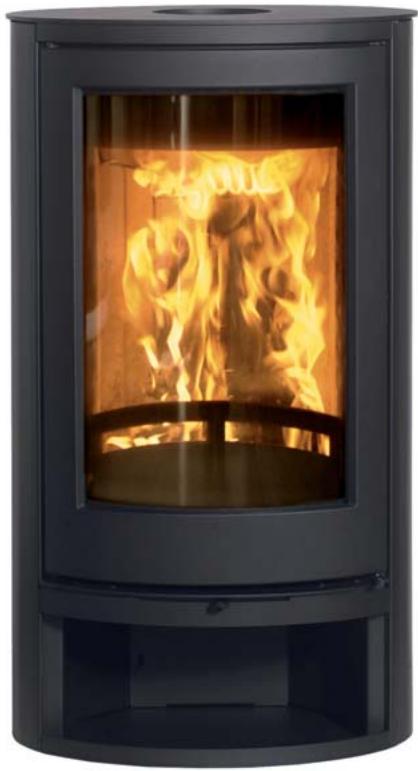
The Solea Elegance
The Solea is a combination of comfort and efficient heat output. The stove has an outside cover and an interior chamber. This ensures that the stove radiates 70% of the heat output through convection to your room while the remaining 30% heat is released through radiation via the glass area.
The Solea has a preheated glass pane cleaning system and an ingenious extra air circulation system which uses flue gases for afterburning. High-quality cast iron and the vermiculite internal lining ensure optimum heat yield.
Installation
It is common practice for the dealer where you purchased your stove to also take care of installing it. If this is not the case, please ensure that the installation is done by a certified installer. A certified installer can also give you the right advice about the flue tube to which the stove must be connected. Connecting wood-burning stoves by unqualified persons is prohibited, in which case we cannot give any guarantee about proper functioning of your stove. Please bear the fire safety in mind when installing the stove. See also page 19.
The wood-burning stove is suitable as an extra heat source and does not replace your principal heating device.
It is not allowed to have wood-burning stoves connected by unqualified installers. In such case we cannot give any guarantee that the Solea will work properly.
Lighting your stove early in autumn or late in winter
When the external and internal temperatures do not differ much, a proper chimney draught is a real challenge. You can help chimney draught get started by burning some wood while keeping all air inlets maximally open. An abundant air supply speeds up quick heating which in turn increases the draught in the chimney. Lighting up the stove with only a little wood prevents smoke from streaming into the room.
Lighting the stove
The stove will become very hot when you light it and will need at least two hours to cool off. Don't touch the stove without protection during firing and for two hours after. Handle the stove always with a glove to avoid getting serious burns.
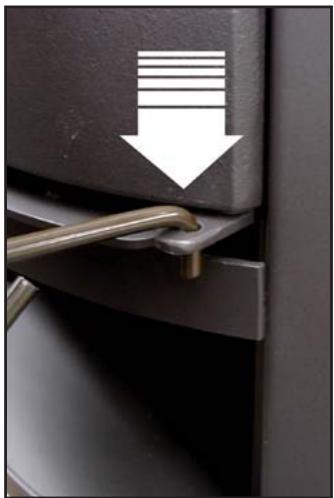
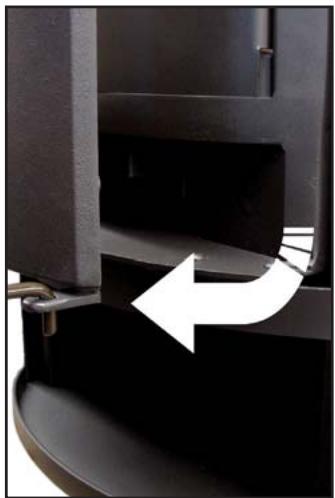
Opening the door
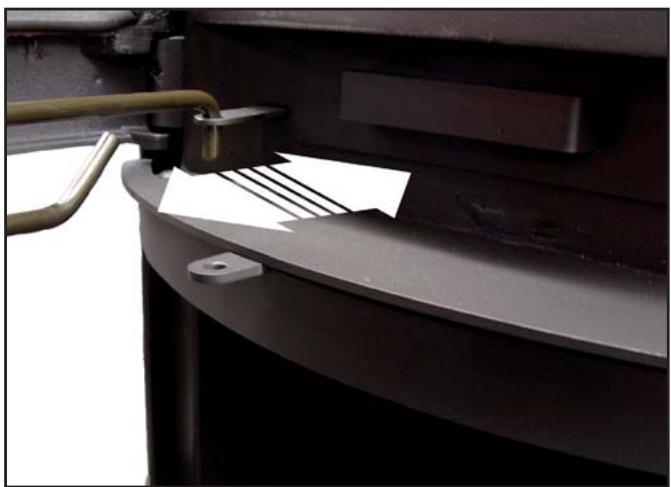
The shaking bar
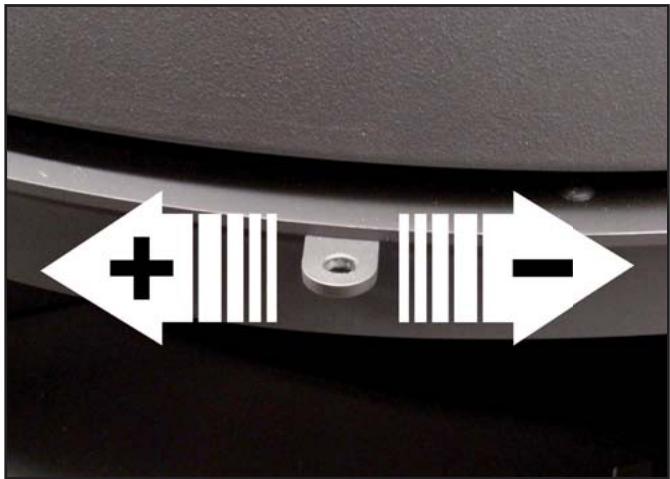
The air supply handle
Open the door and put some balls of paper or firefighters in the stove and place some wood kindling on top. Fully open the air supply handle (see photograph). Open the grate shaker with the shaking bar and keep the ash pan open for the first five to ten minutes to let extra air in. Light the kindling and leave the door ajar for extra air supply. Once the stove is burning you can add extra fuel and close the door, the grate shaker and the ash pan. Do not place more than three logs in the stove at a time. Once the stove is burning the air supply can be controlled by using the air supply handle. Be sure that there is always enough ventilation when the stove is burning.
Avoid finger marks
Do not touch the glass of the stove with your fingers. Finger marks will burn into the glass and cannot be removed later.
It is prohibited to light the stove with liquids like petrol or spirits. Do not have the cooker hood on in the room where you operate your stove.
Never touch the varnished parts when you heat your stove.
Lighting the stove for the first time
Discolouration of walls, ceilings and grates
The walls, ceilings and grates may show some discolouration after lighting your hearth. This is caused by the dust particles that burn in the convection cover. This is a natural process for which WANDERS cannot be held responsible. To minimize discolouring we refer to the advice given for atmospheric hearths. Your installer can give you more information about this.
When you light the stove for the first time, the hearth must still 'anneal' and temper itself. The unit has a
heat resistant lacquer which must burn in the stove at temperatures above 400^ Celsius. This will happen during the first few times of lighting the stove and temperatures rise to 600^ C. Though this may give an unpleasant smell, it is otherwise harmless. It is advisable to keep the stove burning with limited fuel for at least 6 hours when lighting the stove for the first 4 or 5 times. Air the room well when the stove is burning. Make sure that any cooking hood is not turned on when the stove is burning; a cooking hood extracts the combustion air that the stove needs.
Some deposit may form on the glass panes of the stove when you 'anneal' your hearth. You can easily remove this deposit with a damp cloth after the stove has cooled down. You can also use some cleansing agent for ceramic rings. Please make sure you do not leave any finger marks on the clean glass. Finger marks burn into the glass and cannot be removed later.
Newly-built house or recently renovated?
It is advisable to wait six weeks before lighting the stove in a newly-built house that has recently been completed, or in a space that has recently been renovated drastically. The walls and ceilings still contain gases, softeners and moisture from plasterwork or paint. The warm air-streams may discolour the dust particles in the space which may stick to walls and ceilings. Even the moisture in the walls and ceilings will become warm and may cause yellow stains.
Fuel: wood
| Wood species | Drying time | |
| Fir, Poplar | 1 | year |
| Lime, Willow, Spruce, Birch, Ash, Alder | 1.5 | years |
| Fruit trees, Beech | 2 | years |
| Oak | 2.5 | years |
The stove only burns on wood. Do not put more than 3 to 4kg of fuel in the stove at the time. Always use clean and cut logs, which have sufficiently dried. Please see the above list for drying times. Wet wood does not burn well and gives heavy smoke emission. It may blacken the glass pane of your stove with soot and build up smut in the flue pipe. This may increase the risk of chimney fire.
Fresh, moist wood contains about 50 % moisture. Cleaved wood still contains 20 % moisture after drying it for a year and moisture percentage will be decreased to 12 to 15 % after drying it for two years. Dry wood gives nice flames and little or no smoke, and the fire will crackle when burning. Wet wood makes a hissing sound, gives much smoke and only small flames which
will considerably dampen the pleasure of burning your stove and the heat output.
Do not put any paraffin-containing logs in your stove. When the door is closed, the high heat will melt the paraffin from the logs too quickly. The polluted flue gasses which consequently develop will deposit on and burn in the glass of your stove and cannot be removed later.
Do not use any wood that is painted, impregnated, glued together or processed in any other way. The flue gases are very harmful to the environment and may affect your stove. It is also prohibited to burn plastics and other waste matter due to poisonous smoke development.
The best way to burn your stove
All WANDERS' stoves are designed so that they give a maximum output. A well-lit wood-burning stove can produce a yield of about 75% . This means that you need less wood for the same amount of heat. Moreover, a well-lit stove produces less smoke pollution. Below are a few tips to give you optimum pleasure:
- For a regular combustion, close the grate shaker when the stove is fuelled with wood.
- Always burn your stove with its door closed; this will improve the output within 8 to 10 times. When the door of the stove is open, the chimney will draw more air than is needed for proper combustion. The relatively cold air will cool the fire. It will also preclude fire damage by any sputtering sparks, especially from softwood.
- Do not put more than 3 logs on the fire at one time. Too much fuel at one time thwarts efficient combustion and burdens the environment unnecessarily.
- Ventilate the space well when you have the stove on. A crackling fire has a minimum air consumption of 25 cubic metres an hour. Never put on your cooking hood when you have a stove burning in the same space.
- Be careful with lighting the stove when it is foggy or when there is no wind outside. There is hardly any draught in the cold chimney when the weather is calm. Since smoke is heavier than air there is the chance of smoke streaming into the room. In foggy weather, the smoke from the chimney (outside) cools quickly and may descend and become a nuisance in your neighbourhood.
- Don't smother the fire suddenly with water, but let it burn out. The materials inside the stove may deform or crack as a result of sudden or great differences in temperature.
- If you want to temper the fire, first close the valve in the flue tube and then close the air supply.
- Avoid loading too much fuel into the stove. To much
heat can be produced and may damage the stove permanently.
Chimney and flue
What to do in case of chimney fire.
In case of chimney fire, immediately close the shut-off valve in the chimney and all air supply ducts. Call the fire department. After the fire is extinguished, the chimney and the stove must be inspected again by your installer.
The chimney is the most important part of your wood-burning hearth.
When the chimney is right it will not distribute any smoke into your room, leave any deposit on the glass pane or create bad combustion. Before starting the installation of the stove, your installer or a qualified chimney sweep must check whether the chimney flue has a diameter of at least 150 millimetres over the entire length, and whether the channel is clean, smooth and leak-proof.
Chimney with a proper draught
Warm air wants to ascend. This is the principle of every chimney. It helps when the wind near the chimney mouth draws the air from the chimney. Fall wind may give the opposite effect and blow the air back into the chimney. Relatively cold foggy air may thwart proper draught in your chimney as does a long flue pipe with a rough inside and many bends. If the natural draught in your chimney is poor your installer can give you information about using a ventilator for your flue tube.
Maintenance
Small maintenance
- Remove the cooled ash from the ash pan twice or thrice a week. It is advisable to use an ash bucket. An empty ash pan is important since the stove also draws in combustion air via the ash pan.
- It is advisable to leave an ash layer of two to three centimetres. It will protect the fire plate.
- Clean the shaking grid inside the stove with a soft brush.
- Clean the exterior of the stove with a damp cloth that does not give off fluff. Do not use any aggressive cleansing agents or abrasives.
- Clean the cold glass pane with a cleaning agent for ceramic cooking rings. Do not touch the clean glass with your fingers. Finger marks burn into the glass.
- Oil the hinges and the door fastener once in a while.
Do not use any aggressive cleaning agents or abrasives to maintain your stove.
When the stove is not used
- Close all doors and air inlets in summer season
- Place absorbent salt inside the stove if it is stored in a humid space.
- Rub some neutral Vaseline on the clean cast iron stakehold parts.
Yearly maintenance
- Have your chimney properly cleaned by a qualified chimney sweep every year; this is for safety reasons and any fire insurance.
- Have the flue gas outlet and the combustion air supply of the double-walled flue tube system checked for airtightness every year.
- Have the grate shaker checked for breakage.
- Have the complete tube system checked every year; this includes the roof or wall ducts and the outlet just outside the wall.
- Have the valves and/or flaps checked for their functioning.
- Have the sealing of doors and glass panes checked for wear and tear.
Safety
A WANDERS wood-burning stove is a comfortable and safe heat source in your home. Fire safety starts with proper installation and a flue tube that is in good working order. That is why your installer must adhere to the installation requirements as given in page 19 and further. To burn your stove safely, the following points are important:
- Burn your stove as much as possible with its door closed; it will improve the output and is much better for the environment.
- Prevent small children or the infirm from getting too close to a burning stove, and never leave them alone in the room when the stove is burning. You could use a fire-screen.
- Do not pour combustible liquids or put combustible materials on the stove, as it may damage the fireplace beyond repair.
- Never place the stove in front of a wall covered with combustible materials (such as wallpaper).
- The Solea wood-burning stove should never be built in.
- There must be a distance of at least 10cm measured from the Solea stove to the fire-proof wall behind it.
-
For safety reasons, there must always be a distance of over 80~cm measured from the glass area of the hearth to the wall.
-
Do not place any combustible materials, such as curtains, wooden objects (cupboards, paintings) close to the fireplace or the flue tube. A minimum distance of 100cm is required, measured from the exterior of the stove or from the flue tube.
- If the floor around the fireplace is made of combustible material you must use a floor slab. Please see the installation requirements on page 19 for minimum distances.
- Have your wood-burning stove only repaired by a certified installer and use original parts.
Guarantee
WANDERS Metaalproducten B.V. in Netterden, the Netherlands, gives a guarantee of five years after the purchase date of your wood-burning stove, provided that the fireplace is properly installed and used in accordance with the instructions in the manual.
The guarantee includes all defects which can be reduced to flaws in material and construction, in which case you will receive the new parts free of charge. Labour costs or other expenses are not covered by the guarantee. You can send defect parts (shipping paid) to WANDERS Metaalproducten B.V., Amtweg 4, 7077 AL in Netterden [The Netherlands].
Before installing your stove you must check if there is any visible damage to the unit. If there is, do not accept the unit and contact your supplier.
The guarantee does not include: the glass, failure due to improper use; non-compliance with the national regulations and enclosed installation and operating instructions; installation by an installer of dealer who is not acknowledged by WANDERS, negligence of the unit and change of owner. The guarantee is also disclaimed when a wrong fuel is used and the stove is damaged by overheating.
There is a guarantee period of one year for all cast iron and vermiculite parts, and the lacquer.
WANDERS disclaims responsibility for any cracks in stuccoed walls or discolouration of walls, ceilings and/ or grates after burning the fireplace. Discolouration can be caused when dust particles burn in the convection cover. To minimize the chance of cracks in stucco and discolouration we refer to the advice given for decorative hearths. Your installer can give you more information.
Any complaints will be dealt with after the sales firm, the installer has filed a complaint and sent a copy of the purchase receipt with purchase date. Any repairs do not entitle you to extend the guarantee term. All consequential damages or loss are excluded.
Installation Instructions
| General instructions | 19 |
| Preparation | 19 |
| Fire Safety | 19 |
| Installation | 20 |
| Repairs | 20 |
| Technical details Solea | 21 |
General instructions
The Solea is tested in accordance with the international EN 13240 standardization, and has an extra additional standardization for optimally environment-friendly heating devices related to flue gases (Section 15a B-Vg. Des BmfWA). The stove can be connected to a flue tube to which several stoves are connected. The Solea should never been integrated into the construction of the room.
The heating device must be placed by an acknowledged installer and according to the installation instructions given below. The national and local rules and regulations for placing and using wood-burning stoves are equally applicable. WANDERS does not give any guarantee if the stove is connected or installed incompletely or incorrectly.
It is not allowed to place the stove in:
Arcades and corridors accessible to the public.
- Stairwells, except in buildings with no more than 2 dwellings.
- Spaces where highly flammable or explosive materials are used.
- Spaces where an exhaust system is used or where a mechanical exhaust system is placed, except when the air supply is taken directly from outside to assure a hazardous combustion.
Preparation
The chimney flue
Before placing the stove you must observe the following points:
- If the stove is connected to an existing chimney, you must first have the chimney professionally cleaned and checked by a qualified chimney sweep company. Any cut-off valves or stop valves must be removed.
-
The flue tube of the stove must be connected with the chimney without diversions.
-
The underpressure in the chimney must be at least 12 Pa or 0.12 mbar.
- The chimney flue must always end up in outlet area 1 (see the drawing below)
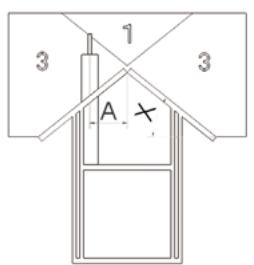
Roof slope × larger than 23^
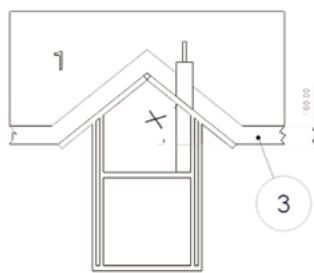
Roof slope × smaller than 23^
- At the time of placing the stove, the chimney flue must be clean, leak-proof and without obstructions, and must have a diameter of 150 ~mm .
- Any bends in the flue tube must not exceed 45 degrees.
- Ensure that the chimney tube can discharge the flue gases adequately, properly and safely.
- The values for calculating the chimney tube is given in the section on Technical Information, see above.
Fire Safety
For reasons of fire safety is it important to observe the instructions below before installing the stove.
- The free distance from the fire-proof rear wall is at least 10cm in each rotated position.
- Keep at least a distance of 80~cm between the stove and combustible objects such as curtains, wooden objects (cupboards and paintings) and glass objects. Keep the same distance from the flue tube.
-
Wooden construction parts within the radiation range of the stove (80 cm from the exterior of the stove) must be covered with fireproof material.
-
If the flue tube goes through a ceiling and/or roof that consist of flammable materials, the ceiling and the roof must be covered with fireproof materials all around (about 80~cm ). Pay also attention to joisted floor layers and any electric wiring.
- Keep a distance of at least 50~cm (in all directions) between the stove and supporting steel construction parts.
- Shield off all combustible materials within a radius of 80~cm from the stove openings with non-combustible materials.
- The wall behind the stove must consist of, or be insulated with, fire-proof materials. The insulation material must resist a temperature of 700^ C and have a density of 80 ~kg / m^3 . Please see for insulation materials table on page 22).
- Avoid heat transmission when placing the stove. Heat transmission of a burning stove can penetrate the wall and even cause fire damage on the other side of the wall. Prevention is better than cure.
Installation
The Solea is tested in accordance with the international EN 13240 standardization, and has an extra additional standardization for optimally environment-friendly heating devices related to flue gases (Section 15a B-Vg. Des BmfWA). The stove can be connected to a flue tube to which several stoves are connected. The Solea should never been integrated into the construction of the room.
The heating device must be placed and connected by an acknowledged installer and according to the installation instructions given below. The national and local rules and regulations for placing and using wood-burning stoves are equally applicable. WANDERS does not give any guarantee if the Solea is connected or installed incompletely or incorrectly.
Supply of combustion air
The stove must have a sufficient fresh supply of combustion air. To avoid draft, make if necessary an extra air supply opening as close to the stove as possible. An extra air supply opening is definitely required if:
the room has a heat recovery system.
the room has a central exhaust system.
the same space has a cooker hood.
The air supply opening must be sealable if it goes through a fire-resistant wall. If there are several heating devices in the same room there must be enough air openings to guarantee proper combustion.
Connecting the fireplace
Be sure that the floor is strong enough to hold the weight of the hearth without problem.
Before mounting the hearth, follow the instructions given in the previous chapter. Protect the floor when you mount the stove, and mind your back.
- Connect the Solea Elegance to an existing chimney.
- The under-pressure in the flue tube must be 10 to 12 Pa (0.1 to 0.12 millibars).
- Take precautionary measures against fire (see points 1 to 8 on page 19)
- Place the stove at the selected place.
- Level the stove.
- Place the pipe between the stove and the outlet channel. Connect a 0.150 ~mm tube to the coupling unit (the mouthpiece) in the straightest possible line from the stove to the chimney. The tube must be made of steel with a thickness of at least 2 ~mm . Please keep in mind that the tube will expand in the length by about 1 ~cm per meter, and verify that the outlet is not jammed between the mouthpiece and the ceiling.
Repairs
Replacing the glass
Remove the 4 screws and the spring plates in the inside corners of the door. Carefully remove the glass and any fragments. Remember the glass is very sharp.
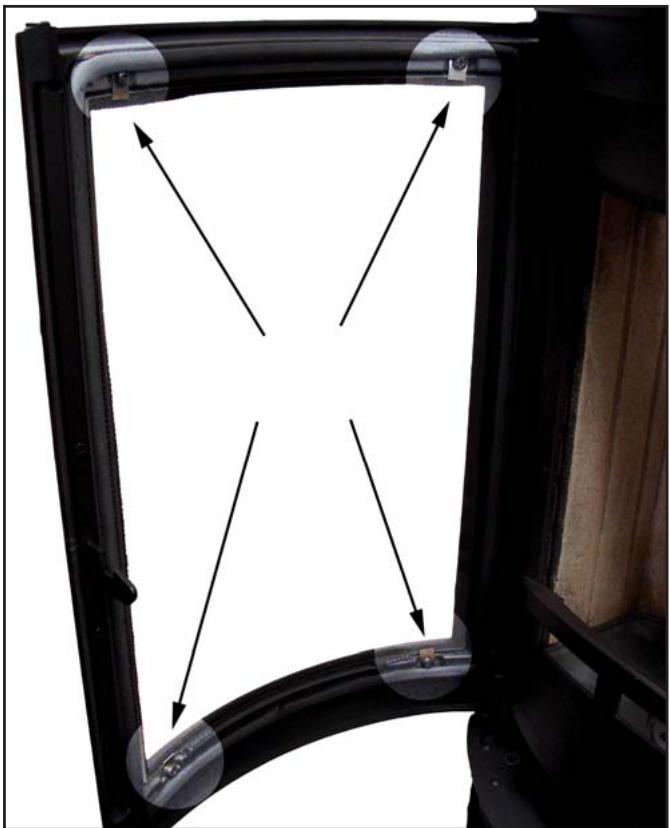
Replacing the glass of Solea Elegance
Technical details Solea
Technical details
| Door latch | Ba | I/II |
| Nominal capacity* | 7 | kW |
| Diameter tube for combustion gases | 150 | mm |
| Maximum lumber supply in the stove | 3 | kg |
| Maximum brown coal supply | - | kg |
| Volume of the combustion chamber | 0.05 | m3 |
| Surface bottom of combustion chamber | 0.08 | m2 |
- a nominal heat of 7 kW is obtained with a chimney draught of 0.10 mbar
Fuel, wood logs, 30 × 10 ~cm
| Maximum supply | 3 pieces |
| Primary air valve | max. |
| Secondary air outlet | max. |
| Fuel burning period | about 1 hour |
Flue gas values in accordance with DIN 4705, DIN 18895 part 2
| When door is closed | logs | |
| Flue gas quantity | 7,6 | g/s |
| Flue gas temperature | 292 | °C |
| Pre-pressure | 0.10 | mbar |
| Yield | 78.9 | % |
| CO at 13% O2 | 0.07 | % |
| Particulate matter | 26 | mg/m3 |
| Certificate Institute 1625. Test standard EN 13240. Test report no. RRF-400169 | ||
Target value for the volume of the space to be heated:
Not all spaces meet the present insulating values. According to DIN 18893, the following values can be taken for the volume of the space to be heated:
If heating circumstances are favourable: Calculate according to DIN 4701
In less favourable circumstances: 120 m3
In unfavourable circumstances: 82 m3
For temporary heating you may assume a reduction of 25% for the volume to be heated if the interval is more than 8 hours.
Table for insulation material. Only use products in the shaded area
| Insulation | Packed | Thermal conduction | Maximum appliance temp. | Density | |||||
| nr | article | nr | form | nr | packed | nr | °C | nr | kg/m3 |
| 10 | mineral wool | 01 | bands | 01 | stitched mats | 10 | 100 | 02 | 20 |
| 11 | glass wool | 02 | loose wool | stitched mats | 12 | 120 | 03 | 30 | |
| 12 | rock wool | 03 | wool | 02 | stitched mats | 14 | 140 | 04 | 40 |
| 13 | waste prod. | granule | g. curve 2 | 16 | 160 | 05 | 50 | ||
| 04 | felt | 06 | 60 | ||||||
| 05 | lamella mat | 10 | flakes | 07 | 70 | ||||
| g. curve 1 | 08 | 80 | |||||||
| 06 | stitched mats | 11 | flakes | 09 | 90 | ||||
| 07 | plates | g. curve 2 | 10 | 100 | |||||
| 08 | scales | 72 | 720 | 11 | 110 | ||||
| 09 | segments | 20 | plates | 74 | 740 | 12 | 120 | ||
| 10 | interwoven | g. curve 1 | 76 | 760 | 13 | 130 | |||
| 21 | plates | ||||||||
| g. curve 2 | 18 | 180 | |||||||
| 99 | otherwise | 99 | single | 99 | 99 | ||||
Select the insulation material from this table. Group 99 is NOT allowed.