
SOLIDTUBE - Tube Microphone AKG - Free user manual and instructions
Find the device manual for free SOLIDTUBE AKG in PDF.


| Product Type | Tube (valve) microphone with tube preamplifier |
| Brand | AKG |
| Model | SOLIDTUBE |
| Polar Pattern | Cardioid |
| Frequency Response | 20 to 20,000 Hz ±2.5 dB |
| Sensitivity (1 kHz) | 20 mV/Pa (-34 dBV) |
| Electrical Impedance | 200 ohms ±25% |
| Recommended Load Impedance | ≥ 1000 ohms |
| Preattenuation | 0 dB and -20 dB (switch on microphone) |
| Bass Cut | 12 dB/octave at 100 Hz (on power supply) |
| Equivalent Noise Level (CCIR 468-2) | 30 dB |
| Equivalent Noise Level (A-weighted) | 20 dB-A |
| Signal-to-Noise Ratio (1 Pa, A-weighted) | 74 dB |
| Maximum SPL (3% distortion) | 130 dB SPL (0 dB) / 145 dB SPL (-20 dB) |
| Vacuum Tube | ECC83 (12AX7) |
| Power Supply | N-SOLIDTUBE power supply, 115/230 V AC, 50-60 Hz |
| Dimensions (diameter x length) | 63/57 Ø x 219 mm |
| Net Weight | 920 g |
| Gross Weight (with accessories and case) | 5.0 kg |
| Included Accessories | N-SOLIDTUBE power supply, MK-SOLID 10 m cable, H-SOLID elastic suspension, W-SOLID windscreen, EUR and US power cables, transport case, PF 80 pop filter, St 102 A and St 200 stands |
| Cleaning | Exterior surfaces with denatured alcohol; foam windscreens washable in mild detergent solution |
| Safety | Disconnect before opening; dangerous voltages inside power supply; do not expose to water |
Frequently Asked Questions - SOLIDTUBE AKG
User questions about SOLIDTUBE AKG
0 question about this device. Answer the ones you know or ask your own.
Ask a new question about this device
Download the instructions for your Tube Microphone in PDF format for free! Find your manual SOLIDTUBE - AKG and take your electronic device back in hand. On this page are published all the documents necessary for the use of your device. SOLIDTUBE by AKG.
USER MANUAL SOLIDTUBE AKG
Stabiler Transportkoffer
IMPORTANT SAFETY INSTRUCTIONS
Please read, follow and keep these instructions for later consultations. Please heed all warnings for your own safety!
Do not block any ventilation openings on the power supply unit and do not install the unit near any heat sources such as radiators, heat registers, stoves, or other apparatus (including amplifiers) that produce heat!
Do not use this device near water!
Clean the power supply unit from time to time with a damp cloth only!
Do not defeat the safety purpose of the grounding type plug on the power cord! A grounding type plug has two blades and a third grounding prong. This third prong is provided for safety. When the provided plug does not fit into your power outlet, consult an electrician for replacement of the obsolete outlet.
Should another type of power plug be usual in a country in which the unit is to be operated then you should buy and use in that country a complete power cord which complies with the international safety regulations and which has a plug with device grounding!
Protect the power cord from being walked on or pinched particularly at plugs and convenience receptacles.
Use only attachment/accessories specified by the manufacturer!
Unplug this apparatus during lighting storms or when unused for long periods of time!
Refer all servicing to qualified service personnel. Servicing is required when the apparatus has been damaged in any way, such as power-supply cord or plug is damaged, liquid has been spilled or objects have fallen into the apparatus, the apparatus has been exposed to rain or moisture, does not operate normally, or has been dropped.
CAUTION: RISK OF FIRE!
Should the fuse in the power supply unit ever be damaged, replace with the same Type "T 0.125A, 250V" fuse!

1. The Microphone
The SOLIDTUBE was developed because of the great demand for the so-called "tube sound" in a price range suitable for many people, to which it goes without saying that our special know-how in the production of large-diaphragm microphones has had its influence.
It should be stressed at this point that the vacuum tube used with its inbuilt heater element is significantly more sensitive to mechanical shocks than is transistor technology. Therefore, the user of this
microphone should always exercise the greatest care and attention. Even shocks caused by falls from low levels can lead to the breaking of the hot heating element and, consequently, to the total failure of the microphone. It is advisable, therefore, to buy and keep in reserve a spare tube which you can get in any good music shop which sells, for example, guitar amplifiers, or in the next AKG Service Center.
The microphone incorporates an ECC 83 (12AX7) vacuum tube. Be sure to use replacement tubes of the same type only.
How is the tube replaced?
IMPORTANT: Prior to disassembling the microphone, make sure to disconnect the microphone from the N 12 VR power supply.
Remove the three Philips head screws visible on the underside (connector side) of the housing and push the lower half of the housing downwards so far from the upper grid cap part until the vacuum tube is exposed. This can now be removed by carefully pushing away the lower part of the elasticated cushioning for the tube and, simultaneously, carefully levering the tube out of the socket with a small flat screwdriver.
Inserting a new tube is done in reverse order of the above description. Finally, please push the lower part of the housing forwards again to the grid part and, while doing so, take care that the attenuator switch remains free so that the three Philips head screws can be screwed in again fully and tightly.
If you should have doubts as to whether you can carry out the procedure described above without help then consult with confidence the nearest AKG Service Center.
How is the microphone mounted?
A special elastic shockmount - "H-Solid" is supplied and should always be used to connect the microphone to floor stands or booms. The clamp of the shockmount is pushed on to the microphone from below while turning gently until the SOLIDTUBE type block can be seen again below the clamp. This makes it impossible for the microphone to slide out of the mounting unintentionally because this is prevented, on the one side, by the raised type block and, on the other side, by the grid cap with its larger external diameter. Intentional removal of the microphone from the shockmount is then only possible by simultaneously turning and pulling the microphone body away from the shockmount.
After fitting the microphone into the shockmount, it can be screwed on to stands or booms with standard 3/8 or 5/8 inch threaded
connections. It may also be swivelled against the stand axis in order to position the microphone optimally for recording.
Only in exceptional cases – for example, on loss or breakage of parts of the elastic shockmount – should the microphone be screwed on to stands or booms directly with the screw adapter on the lower part of the housing. By doing this, the impact sound absorbing effect of the shockmount is, naturally, lost. Therefore, replacement of this important accessory part should be obtained as quickly as possible.
Powering the microphone:
The "N-SOLIDTUBE" power supply unit needed for the powering is included in the delivery. From the type of connector and the markings on the rear of the power supply unit housing, it is easy to see how the microphone should be connected to the power supply. For this, please use only the 10m (30 ft.) long multi-core cable "MK-SOLID" which is likewise included in the delivery. The audio can likewise be taken balanced from the power supply unit by means of an XLR-3 connector.
On the operation of the microphone:
The SOLIDTUBE is equipped with a large diaphragm capsule with cardioid characteristics which can thus handle nearly all tasks occurring in recording studios.
Although the microphone is provided with an built-in pop screen, an adequate distance to the microphone of at least 20 to 30~cm (approx. 1 ft.) should be maintained, or the "W-SOLID" wind/pop screen supplied should be used in order to prevent unwanted popping noises on the sensitive microphone diaphragm, especially when using the microphone for singing.
Another way to prevent popping noises is by using the Studio-Popfilter PF 80 which can be obtained as an option from AKG.
After switching on the microphone power on the power supply unit,
please allow a few minutes for the tube to warm up so as to get the full, warm "tube sound".
If the microphone should be used with extremely loud sources of sound e.g. in front of guitar amplifier speakers etc., then it is advisable to push the attenuation switch on the microphone housing downwards to the -20 dB position. With this you can be certain that any distortions do not come from the microphone but either from the sound source itself or from the equipment connected after the microphone such as, for example, input stages of mixing consoles or other causes.
2. The N-SOLIDTUBE Power Supply Unit
SAFETY INSTRUCTIONS: Use the equipment in dry rooms only. Do not expose the equipment to rain or splash water. Never place objects containing liquids (e.g., vases) on or near the equipment.
The power supply unit does not only supply the vacuum tube with heater and anode voltage but also contains the switchable bass cut for the microphone at about 100Hz in order to be able to filter out possible low frequency interference noise components. The control knob for this is found on the front of the power supply.
For any external wiring, do not use any cables other than those recommended in this manual.
PLEASE OBSERVE CLOSELY!
Dangerous voltages occur in the N-SOLIDTUBE. Opening the mains unit must definitely, therefore, be done only by qualified service personnel. WARNING: Parts inside the equipment may carry dangerous voltages. Make sure to disconnect the equipment from power before opening the equipment!
Before starting-up the power supply unit please satisfy yourself about the local mains voltage and compare this with the value set on the unit's voltage selector (next to the power switch). If a change-
over of the accepted operating voltage should be necessary then this can be done very easily with a small flat-bladed screwdriver.
Before doing this, please remove the mains connection cable from the mains supply!
Place the screwdriver in the notch provided for this on the fuse holder, press the spring-loaded tongue gently to the right in the direction of the voltage indicator and lever the whole fuse holder out of the socket. Then, please pull the light plastic part with the fuse out of the carrier part, turn the fuse link through 180^ and insert it again in the carrier part until it engages. The desired mains voltage should now appear in the window. The complete carrier part can then be inserted into the socket again until this also engages.
You can also proceed in exactly the same way should the unit fuse ever be damaged.
WARNING: Make sure to replace the built-in fuse with a standard fuse of the same type only. Using any other type of fuse may cause excessive heating and/or a risk of fire.
Should another type of power plug be usual in a country in which the unit is to be operated then you should buy and use in that country a complete power cable which complies with the international safety regulations and which has a plug with device grounding.
Prior to connecting the equipment to power, check that the power outlet is a standard type with a protective ground connection. Disconnecting the protective ground lead or using non-standard power plugs or non-standard power outlets is illegal.
If all the above checking steps have been completed, the connecting cable has been plugged in between the microphone and the power supply, the audio connection to the after-connected equipment has been made with standard audio cable, and the plugged-in power cable
has been connected to a power socket, then both the control light on the front of the power supply should light up after switching on the power supply unit mains switch and also the tube's heating element should glow red-orange through the window (AKG logo) on the microphone itself. With this the microphone is essentially ready for operation.
Note: A gentle humming noise can sometimes occur on the audio output due to ground loops which, as an initial remedy, can possibly be removed with the "Ground Lift" switch by the audio output socket on the power supply. When pressed, this switch interrupts
the connection from pin 1 of the XLR socket to the zero volt / ground level of the power supply unit.
Should this measure provide no remedy for the interfering hum then you must locate and remove the cause of the interference from the rest of the sound system in the usual way.
Cleaning information:
All surfaces can be cleaned from time to time with (industrial) methylated spirits or alcohol. The foam windscreen is best cleaned with a mild detergent solution and is immediately ready for use when dry.
- Technical Specifications
| Operating principle: | Large diaphragm pressure gradient microphone with vacuum tube preamplifier |
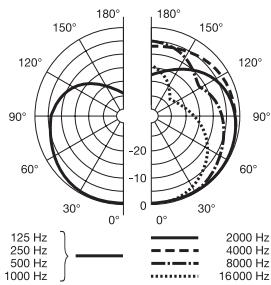
| Directional characteristics: | Cardioid |
| Sensitivity at 1000 Hz: | 20 mV / Pa ≅ -34 dBV re. 1 V / Pa |
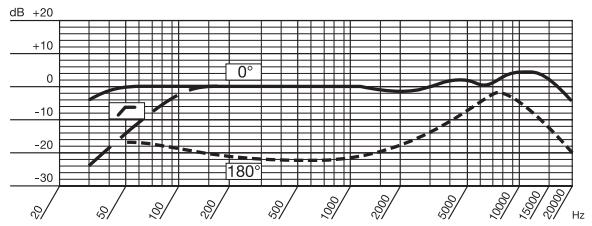
| Frequency range: | 20-20,000 Hz ± 2.5 dB from published curve |
| Electrical impedance: | 200 ohms ± 25% |
| Recommended load impedance: | ≥ 1000 ohms |
| Pre-attenuation: | Switchable to 0 dB and -20 dB |
| Bass cut: | At 100 Hz 12 dB / octave, can be switched-on on the mains unit |
| Equivalent noise level conforming to DIN 45405 (CCIR 468-2): | 30 dB |
| Equivalent noise level conforming to DIN 45412 (A-weighted): | 20 dB-A |
| Signal-to-noise ratio ref. 1 Pa (A-weighted): | 74 dB |
| Max. sound pressure for k = 3%: (pre-attenuation 0/-20 dB) | 63 Pa ≅ 130 dB SPL / 355 Pa ≅ 145 dB SPL |
| Powering: | With the delivered N-SOLIDTUBE power supply unit via 115 / 230 VAC, ±15/-10% (50-60 Hz) |
| Connector: | 6 pin XLR |
| External dimensions: | 63/57 Ø x 219 mm (2.5/2.25 Ø x 8.6 inch) |
| Weight: | 920 g (2 lbs.) net |
| Gross weight incl. packaging: | 5.0 kg (11 lbs.) incl. accessories and travelling case |
This product conforms to the specifications of the European Union EMC and Low Voltage Directives in accordance with applied standards EN 61 000-6-1:2001, EN 61 000-3-3:2001, EN 60 065:2002, as well as UL 6500.
Frequency Response Curve
Polar Response Curve
Included Accessories:
N-SOLIDTUBE, Power supply unit
MK-SOLID, 10 m (30 ft.) connecting cable
H-SOLID, Elastic shockmount
W-SOLID, Foam windscreen
EUR-power cable
US-power cable
Robust carrying case
Recommended Accessories:
PF 80, Pop screen filter
St 102 A, Floor stand
St 200, Floor stand
1. Le microphone
H A Harman International Company
AKG Acoustics GmbH
BodenseestraBe 228, D-81243 Munchen/GERMANY, Tel: (+49 89) 87 16-0, Fax: (+49 89) 87 16-200, www.akg-acoustics.de, e-mail: info@akg-acoustics.de
AKG ACOUSTICS, U.S.
914 Airpark Center Drive, Nashville, TN 37217, U.S.A., Tel: (+1 615) 620-3800, Fax: (+1 615) 620-3875, www.akgusa.com, e-mail: akgusa@harman.com
For other products and distributors worldwide see our website: www.akg.com
- IMPORTANT SAFETY INSTRUCTIONS
- The Microphone
- How is the tube replaced?
- How is the microphone mounted?
- Powering the microphone:
- On the operation of the microphone:
- The N-SOLIDTUBE Power Supply Unit
- PLEASE OBSERVE CLOSELY!
- Before doing this, please remove the mains connection cable from the mains supply!
- Cleaning information:
- Frequency Response Curve
- Polar Response Curve
- Included Accessories:
- Recommended Accessories:
- Le microphone
Brand : AKG
Model : SOLIDTUBE
Category : Tube Microphone