LIQUA-FLANGE - Modulation effect LINE 6 - Free user manual and instructions
Find the device manual for free LIQUA-FLANGE LINE 6 in PDF.



User questions about LIQUA-FLANGE LINE 6
0 question about this device. Answer the ones you know or ask your own.
Ask a new question about this device
Download the instructions for your Modulation effect in PDF format for free! Find your manual LIQUA-FLANGE - LINE 6 and take your electronic device back in hand. On this page are published all the documents necessary for the use of your device. LIQUA-FLANGE by LINE 6.
USER MANUAL LIQUA-FLANGE LINE 6
Pilot's Handbook for Liqua-Flange
Pilotenhandbuch für Liqua-Flange Manuel de pilotage pour Liqua-Flange Pilotenhandboek voor Liqua-Flange
Patent Pending
LINE 6
TONE
Line 6, ToneCore, Dr. Distorto, Constrictor, Crunchtone, Echo Park, Liqua-Flange, Otto Filter, Roto-Machine, Space Chorus, Tap Tremolo, Uber Metal and Verbzilla are trademarks of Line 6, Inc.
CAUTION
This equipment has been tested and found to comply with the limits for a Class B digital device pursuant to Part 15 of FCC Rules. Operation is subject to the following two conditions: (1) This device may not cause harmful interference, and (2) this device must accept any interference received, including interference that may cause undesired operation.
WARNING
To reduce the risk of fire or electric shock, do not expose this appliance to rain or moisture.

The exclamation point within a triangle means, "Caution!" Please read the information next to all caution signs.

The lightning symbol within a triangle means, "Electrical caution!" It indicates the presence of information about operating voltage and potential risks of electrical shock.

You should read these Important Safety Instructions. Keep these instructions in a safe place.

Before using your ToneCore, carefully read the applicable items of these operating instructions and the safety suggestions.
- Obey all warnings on the pedal and in the ToneCore Pilot's Handbook.
- Connect optional power supply only to AC power outlets rated 100-120V or 200-240V 47-63Hz (see indications on optional power supply).
-
Do not perform service operations beyond those described in the ToneCore Pilot's Handbook. Service is required when the apparatus has been damaged in any way, such as:
-
power-supply cord or plug is damaged
liquid has been spilled or objects have fallen into the apparatus
the unit has been exposed to rain or moisture
the unit does not operate normally or changes in performance in a significant way
the unit is dropped or the enclosure is damaged. -
Do not place near heat sources, such as radiators, heat registers, or appliances which produce heat..
- Guard against objects or liquids entering the enclosure. Do not use or place unit near water.
- Unplug the power supply when not in use for extended periods of time. Unplug the power supply during lightning storms.
- Clean only with a damp cloth.
- Only use attachments/accessories specified by the manufacturer.
- Prolonged listening at high volume levels may cause irreparable hearing loss and/or damage. Always be sure to practice "safe listening."
Liqua-Flange Pilot's Handbook
Output your effects mono to a standard amplifier, or to a stereo setup.
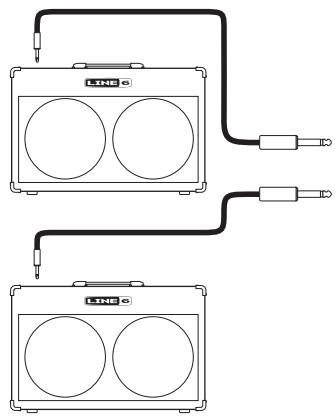
Be sure to connect your guitar to the mono input jack on your ToneCore.
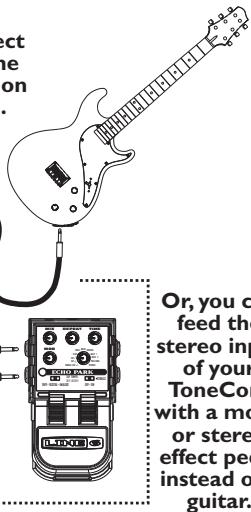
Or, you can feed the stereo input of your ToneCore with a mono or stereo effect pedal instead of a guitar.
Greetings and salutations! Thank you for inviting the Line 6 Liqua-Flange delay pedal into your life.
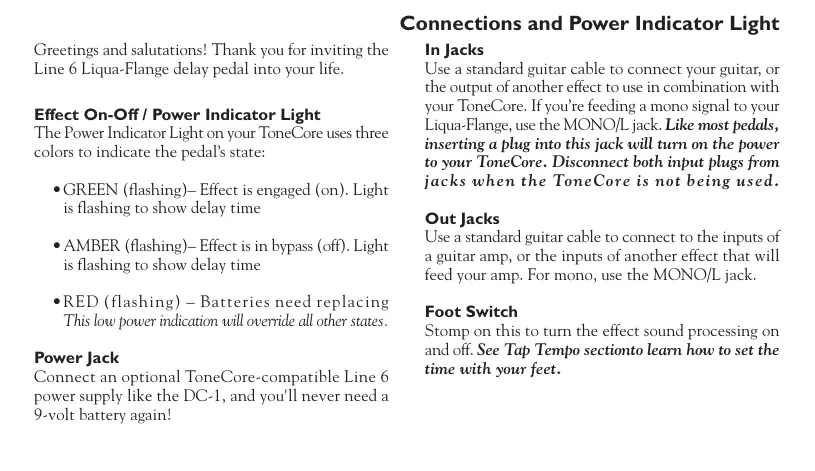
Effect On-Off / Power Indicator Light
The Power Indicator Light on your ToneCore uses three colors to indicate the pedal's state:
GREEN (flashing)- Effect is engaged (on). Light is flashing to show delay time
- AMBER (flashing) - Effect is in bypass (off). Light is flashing to show delay time
- RED (flashing) - Batteries need replacing This low power indication will override all other states.
Power Jack
Connect an optional ToneCore-compatible Line 6 power supply like the DC-1, and you'll never need a 9-volt battery again!
Connections and Power Indicator Light
In Jacks
Use a standard guitar cable to connect your guitar, or the output of another effect to use in combination with your ToneCore. If you're feeding a mono signal to your Liqua-Flange, use the MONO/L jack. Like most pedals, inserting a plug into this jack will turn on the power to your ToneCore. Disconnect both input plugs from jacks when the ToneCore is not being used.
Out Jacks
Use a standard guitar cable to connect to the inputs of a guitar amp, or the inputs of another effect that will feed your amp. For mono, use the MONO/L jack.
Foot Switch
Stomp on this to turn the effect sound processing on and off. See Tap Tempo sectionto learn how to set the time with your feet.
Liqua-Flange Pilot's Handbook
SPEED

FDBK
DEPTH
TIME
SINE STEP RANDOM
ENV UP
ENV DOWN
SAW UP
SAW DOWN

VINTAGE
CHORUS
TRIG UP
TRIG DOWN

LIQUA-FLANGE

TAP TEMPO: TAP LIGHTLY

DIGITAL·LIQUID·ANALOG
NEG·POS
Model Switch
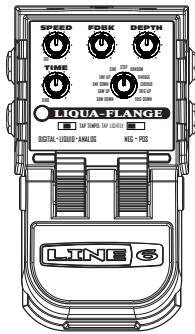
Give this a flick to reconfigure the virtual circuitry inside your Liqua-Flange, and enjoy three distinctly different sound "flavors".
Digital
Gives you straight up Flanging, with crystal clear fidelity. The wet signal has a flat frequency response.
Liquid
This model captures the sound of the original 70's studio rack flangers. It gives you classic dual delay lines whose modulation is offset from each other.
Analog
Gives a vintage analog bucket brigade delay sound, with its darker distorted tone. Wet signal has a filtered frequency response.
Controls
Polarity Switch
Allows you to flip the phase of the flangers delay line. When summed together with the original signal, polarity is very effective in altering the intensity of the flange effect (in combination with the feedback control).
Tap Tempo
Put your foot to work and get your Flange in the groove! Using the innovative ToneCore double-action footswitch, you can tap a couple times and have your flange speed match your tempo. Here's what you need to know:
-
Whether the effect is active or bypassed, you can tap the footswitch lightly to set the speed. Your first two taps establish the tempo. Any additional taps within 3 seconds will be averaged in.
-
Taps will be ignored if the footswitch is pressed all the way down to turn the effect processing on/off.
- Any time the Tap Tempo switch is used to alter the speed, the tapped value overrides the current setting of the Speed knob. Whenever the Speed knob is turned, it overrides the last value entered with the Tap Tempo switch.
- Liqua-Flange's indicator light flashes the tempo in green when the effect is on and amber when the effect is off. The light will always flash at quarter note speed.
Liqua-Flange Pilot's Handbook
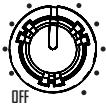
SPEED
FDBK
DEPTH
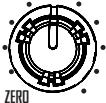
TIME
SINE STEP RANDOM
VINTAGE
CHORUS
TRIG UP
TRIG DOWN

LIQUA-FLANGE

TAP TEMPO: TAP LIGHTLY

DIGITAL·LIQUID·ANALOG
NEG·POS
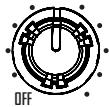
Speed controls the rate at which the delay line's delay time is modulated. Turning the speed control fully counter clockwise, to the OFF position, stops the modulation of the delay line completely.
FDBK increases the amount of wet signal fed back into the input of the effect. Increasing feedback (clockwise rotation) will increase the intensity of the effect.
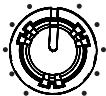
Depth controls how widely the delay line will be modulated.
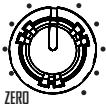
Time controls the amount the delay line is delayed as compared to the original signal. The fully counter clockwise position, labeled ZERO, indicates the time difference between the delay line and the original signal is zero. At this point the two signals are said to be "in phase". If you were to switch the polarity to negative, what is common between the two signals would cancel out completely.
Controls
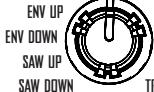
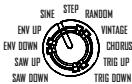
LFO Wave Shape Knob
- Saw Down: A sawtooth wave has a shape that resembles the teeth on the blade of a saw. Within one cycle this wave falls linearly, then immediately rises to it's starting point
- Saw Up: Is an inverted version of 'Saw Down', where the wave has a smooth linear rise and an immediate drop at the end of its cycle.
- Env Down: This modulation source uses an envelope follower to track the amplitude variations of the input signal and produce a control signal that modulates the flanger's delay time..
- Env Up: An inverted version of 'Env Down'.
- Sine: Sinusoidal waveform as the modulation source.
-
Step: Uses a modulation waveform produced by a random value generator where each cycle of the LFO produces a different modulation level.
-
Random: Same as 'Step' but with a smoothing filter applied to the output of the LFO, producing smooth value changes with each LFO cycle.
- Vintage: Simulates the unique waveform of the classic MXR flanger.
- Chorus: Uses a triangle modulation waveform with an extended offset and range to produce a chorus effect.
- Trig Up: Uses a modulation source derived from attack detection tsp, this in turn triggers an envelope which rises linearly. The rise time is determined by the speed knob.
- Trig Down: Same as 'Trig Up' but with a falling envelope.
The functions marked by the * combine your left and right inputs for processing, so the effected part of the signal will be summed to mono, while your dry signal remains stereo.
Battery Access Instructions
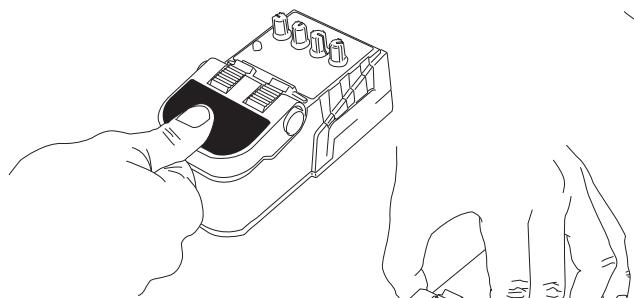
1)Depress pedal fully.
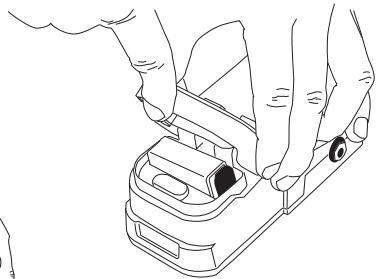
3) Squeezing hinge, raise pedal to reveal battery.
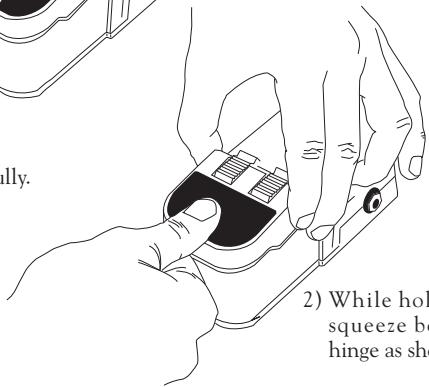
2) While holding pedal, squeeze both sides of hinge as shown.
Battery Access Instructions
Power Supply
Connect an optional Line 6 DC-1 power supply and you'll never need a 9-volt battery again! It is also compatible with most popular 9 Volt DC stomp boxes. Using the power supply will disconnect the battery.
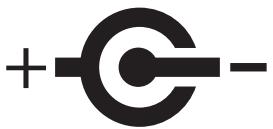
POWER REQUIREMENTS
| Min | Nominal | Max | |
| Supply Voltage | 6 VDC | 9.6 VDC | 16 VDC |
| Supply Current @ 9.6VDC | 40mADC | 60mADC | 100mADC |
| Power @ 9.6VDC | 0.4 Watt | 0.6 Watt | 1 Watt |
ExampleTones

SPEED

FBK

DEPTH

TIME

LIQUA-FLANGE

TAP TEMPO: TAP LIGHTLY

DIGITAL · LIQUID · ANALOG
NEG·POS
Pass Through Zero Flange
For ultra cool 60's & 70's flanger sound. Pass through zero is that great sound you've heard on classic records!

SPEED

FDBK

DEPTH
Here's a big, slow, wide supra-stereo flanging sound. Give the feeling of two 747 jets taking off on either side of you.

SPEED

FDBK

DEPTH

TIME


LIQUA-FLANGE

TAP TEMPO: TAP LIGHTLY

DIGITAL·LIQUID·ANALOG
NEG·POS
Flange-Queen
Try these settings... maybe you too can be a champion.

SPEED

FDBK

DEPTH

TIME

STEP RANDOM
YINAVLT CHORIS TREE UP TBS DOWN

LIQUA-FLANGE

TAP TEMPO: TAP LIGHTLY

DIGITAL · LIQUID · ANALOG
NEG·POS

SPEED

FDBK

DEPTH

TIME
SINE
RANDOM
ENVUF ENVDOWN SAWUP SAWD
N
TAGE HORUS DIG UP DOWN
LIQUA-FLANGE

TAP TEMPO: TAP LIGHTLY

DIGITAL · LIQUID · ANALOG
NEG·POS

SPEED

FDBK

DEPTH

TIME


LIQUA-FLANGE

TAP TEMPO: TAP LIGHTLY

DIGITAL·LIQUID·ANALOG
NEG·POS
LINE 6
TONE
Line 6, ToneCore, Dr. Distorto, Constrictor, Crunchtone, Echo Park, Liqua-Flange, Otto Filter, Roto-Machine, Space Chorus, Tap Tremolo, Über Metal und Verbzilla sind Warenzeichen der Line 6, Inc.
VORSICHT
TAP TEMPD: TAP LIGHTLY

DIGITAL·LIQUID·ANALOG
NEG·POS

SPEED

FDBK

DEPTH

TIME


LIQUA-FLANGE

TAP TEMPO: TAP LIGHTLY

DIGITAL·LIQUID·ANALOG
NEG·POS