
BIZHUB C10P - Laser printer KONICA - Free user manual and instructions
Find the device manual for free BIZHUB C10P KONICA in PDF.


User questions about BIZHUB C10P KONICA
0 question about this device. Answer the ones you know or ask your own.
Ask a new question about this device
Download the instructions for your Laser printer in PDF format for free! Find your manual BIZHUB C10P - KONICA and take your electronic device back in hand. On this page are published all the documents necessary for the use of your device. BIZHUB C10P by KONICA.
USER MANUAL BIZHUB C10P KONICA
bizhub C10P User's Guide
A00V-9574-00A
Trademarks
KONICA MINOLTA and the KONICA MINOLTA logo are trademarks or registered trademarks of KONICA MINOLTA HOLDINGS, INC.
PageScope andbizhub are registered trademarks or trademarks of KONICA MINOLTA BUSINESS TECHNOLOGIES, INC
All other trademarks and registered trademarks are the property of their respective owners.
Copyright Notice
Copyright © 2006 KONICA MINOLTA BUSINESS TECHNOLOGIES, INC., Marunouchi Center Building, 1-6-1 Marunouchi, Chiyoda-ku, Tokyo, 100-0005, Japan. All Rights Reserved. This document may not be copied, in whole or part, nor transferred to any other media or language, without written permission of KONICA MINOLTA BUSINESS TECHNOLOGIES, INC.
Notice
KONICA MINOLTA BUSINESS TECHNOLOGIES, INC. reserves the right to make changes to this guide and to the equipment described herein without notice. Considerable effort has been made to ensure that this guide is free of inaccuracies and omissions. However, KONICA MINOLTA BUSINESS TECHNOLOGIES, INC. makes no warranty of any kind including, but not limited to, any implied warranties of merchantability and fitness for a particular purpose with regard to this guide. KONICA MINOLTA BUSINESS TECHNOLOGIES, INC. assumes no responsibility for, or liability for, errors contained in this guide or for incidental, special, or consequential damages arising out of the furnishing of this guide, or the use of this guide in operating the equipment, or in connection with the performance of the equipment when so operated.
SOFTWARE LICENSE AGREEMENT
This package contains the following materials provided by Konica Minolta Business Technologies, Inc. (KMBT): software included as part of the printing system, the digitally-encoded machine-readable outline data encoded in the special format and in the encrypted form ("Font Programs"), other software which runs on a computer system for use in conjunction with the Printing Software ("Host Software"), and related explanatory written materials ("Documentation"). The term "Software" shall be used to describe Printing Software, Font Programs and/or Host Software and also include any upgrades, modified versions, additions, and copies of the Software.
The Software is being licensed to you under the terms of this Agreement.
KMBT grants to you a non-exclusive sublicense to use the Software and Documentation, provided that you agree to the following:
- You may use the Printing Software and accompanying Font Programs for imaging to the licensed output device(s), solely for your own internal business purposes.
- In addition to the license for Font Programs set forth in Section 1 ("Printing Software") above, you may use Roman Font Programs to reproduce weights, styles, and versions of letters, numerals, characters and symbols ("Typefaces") on the display or monitor for your own internal business purposes.
- You may make one backup copy of the Host Software, provided your backup copy is not installed or used on any computer. Notwithstanding the above restrictions, you may install the Host Software on any number of computers solely for use with one or more printing systems running the Printing Software.
- You may assign its rights under this Agreement to an assignee of all of Licensee's right and interest to such Software and Documentation ("Assignee") provided you transfer to Assignee all copies of such Software and Documentation Assignee agrees to be bound by all of the terms and conditions of this Agreement.
- You agree not to modify, adapt or translate the Software and Documentation.
- You agree that you will not attempt to alter, disassemble, decrypt, reverse engineer or decompile the Software.
- Title to and ownership of the Software and Documentation and any reproductions thereof shall remain with KMBT and its Licensor.
- Trademarks shall be used in accordance with accepted trademark practice, including identification of the trademark owner's name. Trademarks can only be used to identify printed output produced by the Software. Such use of any trademark does not give you any rights of ownership in that trademark.
- You may not rent, lease, sublicense, lend or transfer versions or copies of the Software that the Licensee does not use, or Software contained on any unused media, except as part of the permanent transfer of all Software and Documentation as described above.
-
In no event will KMBT or its licensor be liable to you for any consequential, incidental INDI-RECT, PUNITIVE or special damages, including any lost profits or lost saving, even if KMBT has been advised of the possibility of such damages, or for any claim by any third party. KMBT or its licensor disclaims all warranties with regard to the software, express or implied, including, without limitation implied warranties of merchantability, fitness for a particular purpose, title and non-infringement of third party rights. Some states or jurisdictions do not allow the exclusion or limitation of incidental, consequential or special damages, so the above limitations may not apply to you.
-
Notice to Government End Users: The Software is a "commercial item," as that term is defined at 48 C.F.R.2.101, consisting of "commercial computer software" and "commercial computer software documentation," as such terms are used in 48 C.F.R. 12.212. Consistent with 48 C.F.R. 12.212 and 48 C.F.R. 227.7202-1 through 227.7202-4, all U.S. Government End Users acquire the Software with only those rights set forth herein.
- You agree that you will not export the Software in any form in violation of any applicable laws and regulations regarding export control of any countries.
About Adobe Color Profile
ADOBE SYSTEMS INCORPORATED COLOR PROFILE LICENSE AGREEMENT
NOTICE TO USER: PLEASE READ THIS CONTRACT CAREFULLY. BY USING ALL OR ANY PORTION OF THE SOFTWARE YOU ACCEPT ALL THE TERMS AND CONDITIONS OF THIS SOFTWARE YOU ACCEPT ALL THE TERMS AND CONDITIONS OF THIS AGREEMENT. IF YOU DO NOT AGREE WITH THE TERMS OF THIS AGREEMENT, DO NOT USE THE SOFTWARE.
- DEFINITIONS In this Agreement, "Adobe" means Adobe Systems Incorporated, a Delaware corporation, located at 345 Park Avenue, San Jose, California 95110. "Software" means the software and related items with which this Agreement is provided.
- LICENSE Subject to the terms of this Agreement, Adobe hereby grants you the worldwide, non-exclusive, nontransferable, royalty-free license to use, reproduce and publicly display the Software. Adobe also grants you the rights to distribute the Software only (a) as embedded within digital image files and (b) on a standalone basis. No other distribution of the Software is allowed; including, without limitation, distribution of the Software when incorporated into or bundled with any application software. All individual profiles must be referenced by their ICC Profile description string. You may not modify the Software. Adobe is under no obligation to provide any support under this Agreement, including upgrades or future versions of the Software or other items. No title to the intellectual property in the Software is transferred to you under the terms of this Agreement. You do not acquire any rights to the Software except as expressly set forth in this Agreement.
-
DISTRIBUTION If you choose to distribute the Software, you do so with the understanding that you agree to defend, indemnify and hold harmless Adobe against any losses, damages or costs arising from any claims, lawsuits or other legal actions arising out of such distribution, including without limitation, your failure to comply with this Section 3. If you distribute the Software on a standalone basis, you will do so under the terms of this Agreement or your own license agreement which (a) complies with the terms and conditions of this Agreement; (b) effectively disclaims all warranties and conditions, express or implied, on behalf of Adobe; (c) effectively excludes all liability for damages on behalf of Adobe; (d) states that any provisions that differ from this Agreement are offered by you alone and not Adobe and (e) states that the Software is available from you or Adobe and informs licensees how to obtain it in a reasonable manner on or through a medium customarily used for software exchange. Any distributed Software will include the Adobe copyright notices as included in the Software provided to you by Adobe.
-
DISCLAIMER OF WARRANTY Adobe licenses the Software to you on an "AS IS" basis. Adobe makes no representation as to the adequacy of the Software for any particular purpose or to produce any particular result. Adobe shall not be liable for loss or damage arising out of this Agreement or from the distribution or use of the Software or any other materials. Adobe AND ITS SUPPLIERS DO NOT AND CANNOT WARRANTY THE PERFORMANCE OR RESULTS YOU MAY OBTAIN BY USING THE SOFTWARE, EXCEPT FOR ANY WARRANTY, CONDITION, REPRESENTATION OR TERM TO THE EXTENT TO WHICH THE SAME CANNOT OR MAY NOT BE EXCUSED OR LIMITED BY LAW APPLICABLE TO YOU IN YOUR JURISDICTION, Adobe AND ITS SUPPLIERS MAKE NO WARRANTYES, CONDITIONS, REPRESENTATIONS OR TERMS, EXPRESS OR IMPLIED, WHETHER BY STATUTE, COMMON LAW, CUSTOM, USAGE OR OTHERWISE AS TO ANY OTHER MATTERS, INCLUDING BUT NOT LIMITED TO NON-INFRINGEMENT OF THIRD PARTY RIGHTS, INTEGRATION, SATISFACTORY QUALITY OR FITNESS FOR ANY PARTICULAR PURPOSE. YOU MAY HAVE ADDITIONAL RIGHTS WHICH VARY FROM JURISDICTION TO JURISDICTION. The provisions of Sections 4, 5 and 6 shall survive the termination of this Agreement, howsoever caused, but this shall not imply or create any continued right to use the Software after termination of this Agreement.
- LIMITATION OF LIABILITY IN NO EVENT WILL ADOBE OR ITS SUPPLIERS BE LIABLE TO YOU FOR ANY DAMAGES, CLAIMS OR COSTS WHATSOEVER OR ANY CONSEQUENTIAL, INDIRECT, INCIDENTAL DAMAGES, OR ANY LOST PROFITS OR LOST SAVINGS, EVEN IF AN ADOBE REPRESENTATIVE HAS BEEN ADVISED OF THE POS-SSIBILITY OF SUCH LOSS, DAMAGES, CLAIMS OR COSTS OR FOR ANY CLAIM BY ANY THIRD PARTY. THE FOREGOING LIMITATIONS AND EXCLUSIONS APPLY TO THE EXTENT PERMITTED BY APPLICABLE LAW IN YOUR JURISDICTION. ADOBE'S AGGREGATE LIABILITY AND THAT OF ITS SUPPLIERS UNDER OR IN CONNECTION WITH THIS AGREEMENT SHALL BE LIMITED TO THE AMOUNT PAID FOR THE SOFTWARE. Nothing contained in this Agreement limits Adobe's liability to you in the event of death or personal injury resulting from Adobe's negligence or for the tort of deceit (fraud). Adobe is acting on behalf of its suppliers for the purpose of disclaiming, excluding and/or limiting obligations, warranties and liability as provided in this Agreement, but in no other respects and for no other purpose.
- TRADEMARKS Adobe and the Adobe logo are the registered trademarks or trademarks of Adobe in the United States and other countries. With the exception of referential use, you will not use such trademarks or any other Adobe trademark or logo without separate prior written permission granted by Adobe.
- TERM This Agreement is effective until terminated. Adobe has the right to terminate this Agreement immediately if you fail to comply with any term hereof. Upon any such termination, you must return to Adobe all full and partial copies of the Software in your possession or control.
-
GOVERNMENT REGULATIONS If any part of the Software is identified as an export controlled item under the United States Export Administration Act or any other export law, restriction or regulation (the "Export Laws"), you represent and warrant that you are not a citizen, or otherwise located within, an embargoed nation (including without limitation Iran, Iraq, Syria, Sudan, Libya, Cuba, North Korea, and Serbia) and that you are not otherwise prohibited under the Export Laws from receiving the Software. All rights to use the Software are granted on condition that such rights are forfeited if you fail to comply with the terms of this Agreement.
-
GOVERNING LAW This Agreement will be governed by and construed in accordance with the substantive laws in force in the State of California as such laws are applied to agreements entered into and to be performed entirely within California between California residents. This Agreement will not be governed by the conflict of law rules of any jurisdiction or the United Nations Convention on Contracts for the International Sale of Goods, the application of which is expressly excluded. All disputes arising out of, under or related to this Agreement will be brought exclusively in the state Santa Clara County, California, USA.
- GENERAL You may not assign your rights or obligations granted under this Agreement without the prior written consent of Adobe. None of the provisions of this Agreement shall be deemed to have been waived by any act or acquiescence on the part of Adobe, its agents, or employees, but only by an instrument in writing signed by an authorized signatory of Adobe. When conflicting language exists between this Agreement and any other agreement included in the Software, the terms of such included agreement shall apply. If either you or Adobe employs attorneys to enforce any rights arising out of or relating to this Agreement, the prevailing party shall be entitled to recover reasonable attorneys' fees. You acknowledge that you have read this Agreement, understand it, and that it is the complete and exclusive statement of your agreement with Adobe which supersedes any prior agreement, oral or written, between Adobe and you with respect to the licensing to you of the Software. No variation of the terms of this Agreement will be enforceable against Adobe unless Adobe gives its express consent, in writing, signed by an authorized signatory of Adobe.
ICC Profile for TOYO INK Standard Color on Coated paper (TOYO Offset Coated 2.0)
This ICC Profile (TOYO Offset Coated 2.0) characterizes Japanese offset press on Coated paper and is fully compatible with ICC profile format.
About "TOYO INK Standard Color on Coated paper"
This is the standard for color reproduction of sheet-fed offset press on Coated paper made by TOYO INK MFG.CO., LTD. ("TOYO INK").
This standard is made from printing test with using TOYO INK's sheet-fed offset printing inks and TOYO INK's own printing conditions.
"TOYO INK Standard Color on Coated paper" is compatible with "JAPAN COLOR".
Agreement
- The reproduction of images on a printer or a monitor using this ICC Profile do not completely match the TOYO INK Standard Color on Coated paper.
- Any and all copyrights of this ICC Profile shall remain in TOYO INK; therefore you shall not transfer, provide, rent, distribute, disclose, or grant any rights in this ICC Profile to any third party without the prior written consent of TOYO INK.
- In no event will TOYO INK its directors, officers, employees or agents be liable to you for any consequential or incidental, either direct or indirect, damages(including damages for loss of business profits, business interruption, loss of business information, and the like)arising out of the use or inability to use this ICC Profile.
-
TOYO INK shall not be responsible for answering any question related to this ICC Profile.
-
All company names and product names used in this document is the trademarks or registered trademarks of their respective holder.
This ICC Profile made by GretagMacbeth ProfileMaker and granted TOYO INK certain license to distribute by GretagMacbeth AG.
TOYO Offset Coated 2.0 © TOYO INK MFG. CO., LTD. 2004
For EU member states only
This symbol means: Do not dispose of this product together with your household waste!
Please contact the Local Authority for appropriate disposal instructions. In the case of a new device being purchased, the used one can also be given to our dealer for appropriate disposal. Recycling of this product will help to conserve natural resources and prevent potential negative consequences for the environment and human health caused by inappropriate waste handling.


This product complies with RoHS (2002/95/EC) directive.
Contents
1 Introduction 1
Getting Acquainted with Your Printer 2
Space Requirements 2
Printer Parts 3
Front View 3
Rear View 4
Front View with Options 4
Rear View with Options 4
2 About the Software 5
Software Utilities CD-ROM 6
PostScript Drivers 6
PCL Drivers 6
PPD Files 7
Utilities 7
System Requirements 9
Selecting Driver Options/Defaults (for Windows) 10
Windows XP/Server 2003/2000/NT 4.0 10
Uninstalling the Printer Driver (for Windows) 11
Displaying Printer Driver Settings (for Windows) 12
Windows XP/Server 2003 12
Windows 2000/NT 4.0 12
Using the PostScript and PCL Printer Driver 13
Common Buttons 13
OK 13
Cancel 13
Apply 13
Help 13
Easy Set 14
Paper View 14
Printer View 14
Watermark View 14
Quality View 14
Default 14
Advanced Tab(PostScript Printer Driver Only) 15
Basic Tab 15
Layout Tab 15
Cover Page Tab 16
Overlay Tab 16
Watermark Tab 16
Quality Tab 17
Version Tab 17
3 Using the Status Monitor (Windows Only) 19
Working with the Status Monitor 20
Introduction 20
Operating Environment 20
Opening the Status Monitor 20
Using the Status Monitor 20
Recognizing Status Monitor Alerts 21
Recovering from a Status Monitor Alert 21
Closing the Status Monitor 21
4 Printer Control Panel and Configuration Menu 23
About the Control Panel 24
Control Panel Indicators and Keys 24
Toner Supply Indicators 26
Configuration Menu Overview 27
Main Menu 27
PROOF/PRINT MENU 28
Entering the Password 29
PRINT MENU 30
PAPER MENU 31
QUALITY MENU 35
INTERFACE MENU 38
SYSTEM DEFAULT MENU 42
5 Using Media 49
Media Specifications 50
Media Types 51
Plain Paper 51
Thick Stock 52
Envelopes 53
Labels 54
Letterhead 55
Postcards 55
Transparencies 56
Glossy Stock 57
What Is the Guaranteed Imageable (Printable) Area? 58
Imageable Area—Envelopes 58
Page Margins 58
Loading Media 59
Tray 1 (Multipurpose Tray) 59
Loading Plain Paper 59
Other Media 61
Loading Envelopes 62
Loading Labels/Postcard/Thick Stock/Glossy Stock and Transparency 66
Tray 2 67
Loading Plain Paper 67
Duplexing 71
Output Tray 72
Media Storage 73
6 Replacing Consumables 75
Replacing Consumables 76
About Toner Cartridges 76
Replacing a Toner Cartridge 79
Replacing the Drum Cartridge 84
Replacing the Backup Battery 87
7 Maintaining the Printer 91
Maintaining the Printer 92
Cleaning the Printer 94
Exterior 94
Interior 95
Cleaning the Media Feed Roller and Laser Lens 95
Cleaning the Duplex Option Feed Rollers 98
Cleaning the Media Feed Rollers for Tray 2 99
Storing the Printer 100
8 Troubleshooting 103
Introduction 104
Printing a Configuration Page 104
Preventing Media Misfeeds 105
Understanding the Media Path 106
Clearing Media Misfeeds 106
Media Misfeed Messages and Clearing Procedures 107
Clearing a Media Misfeed in the Printer 107
Clearing a Media Misfeed From Tray 2 112
Clearing a Media Misfeed from the Duplex Option 114
Solving Problems with Media Misfeeds 116
Solving Other Problems 119
Solving Problems with Printing Quality 123
Status, Error, and Service Messages 129
Standard Status Messages 129
Error Messages (Warning) 130
Error Messages (Operator Call) 132
Service Messages 134
9 Installing Accessories 135
Introduction 136
Antistatic Protection 136
Dual In-Line Memory Module (DIMM) 137
Required Memory during Printing 137
Installing a DIMM 137
Hard Disk 140
Installing a Hard Disk 140
Duplex Option 143
Installing the Duplex Option 143
Tray 2 147
Installing Tray 2 147
A Appendix 149
Safety Specifications 150
Technical Specifications 150
Printer 150
Consumable Life Expectancy Chart 153
Our Concern for Environmental Protection 154
What is an ENERGY STAR product? 154
Introduction
1
Getting Acquainted with Your Printer
Space Requirements
To ensure easy operation, consumable replacement and maintenance, adhere to the recommended space requirements detailed below.
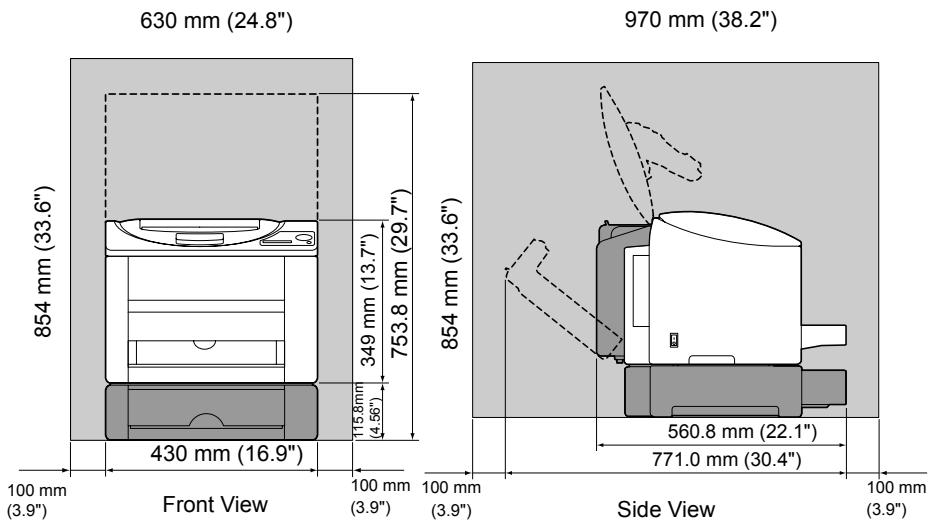

The options appear shaded in the above illustration.
Printer Parts
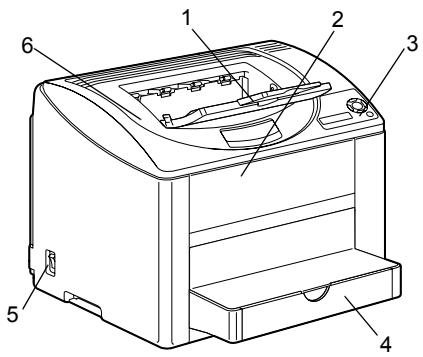
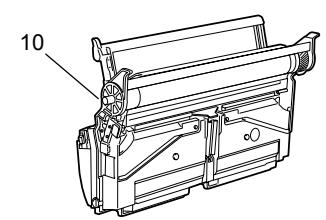
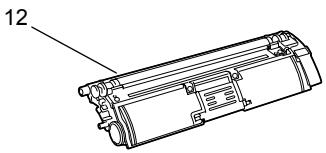
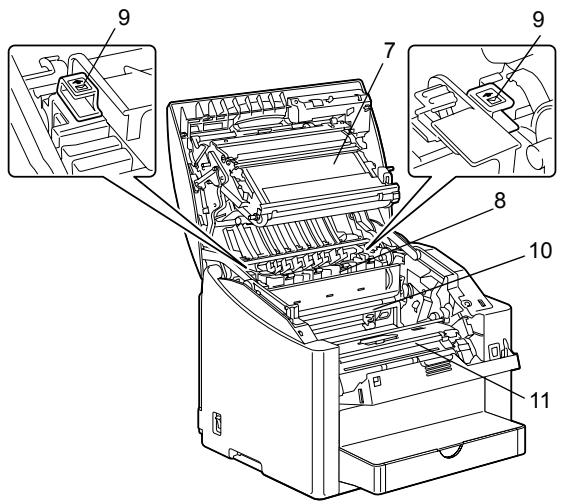
The following drawings illustrate the parts of your printer referred to throughout this guide, so please take some time to become familiar with them.
Front View
1—Output tray
2—Front cover
3-Control panel
4—Tray 1 (Multipurpose tray)
5—Power switch
6—Top cover
7—Transfer belt unit
8—Fuser unit
9—Fuser separator levers
10—Drum cartridge
11—Toner cartridge carousel (containing 4 toner cartridges: C, M, Y and K)
12—Toner cartridge
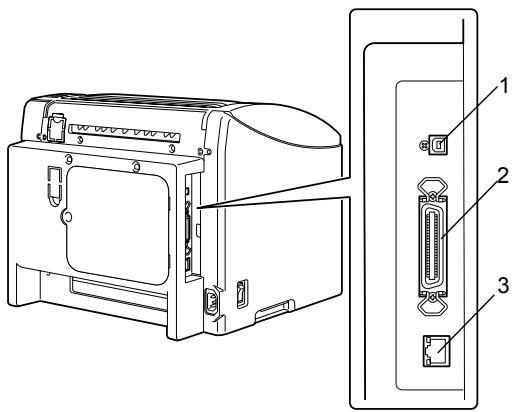
Rear View
1-USB port
2-Parallel port
3—10Base-T/100Base-TX (IEEE 802.3) Ethernet Interface port
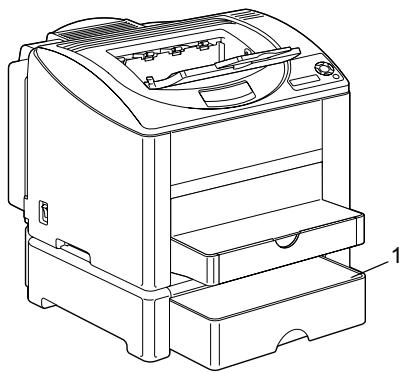
Front View with Options
1—Tray 2
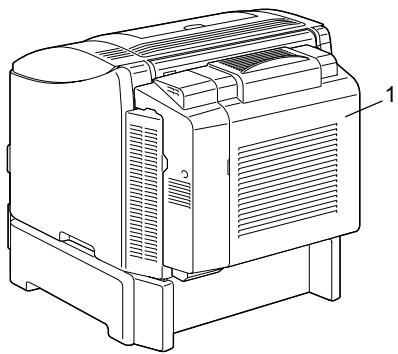
Rear View with Options
1—Duplex option
About the Software
2
PostScript Drivers
| Operating System | Use/Benefit |
| Windows XP/Server 2003/2000 | These drivers give you access to all of the printer features, including finishing and advanced layout. See also “Displaying Printer Driver Settings (for Windows)” on page 12. |

A specific PPD file has been prepared for applications (such as PageMaker and Corel Draw) that require that a PPD file be specified when printing.
When specifying a PPD file while printing on Windows XP, Server 2003, 2000 and NT 4.0, use the specific PPD file provided on the Software Utilities CD-ROM.
PCL Drivers
| Operating System | Use/Benefit |
| Windows XP/Server 2003/2000 | These drivers give you access to all of the printer features, including finishing and advanced layout. See also “Displaying Printer Driver Settings (for Windows)” on page 12. |
| Windows NT 4.0 |
PPD Files
| Operating System | Use/Benefit |
| Macintosh OS 9/X | These files are required in order to use the printer driver for each operat-ing system. For details of the Macintosh and Linux printer drivers, refer to the bizhub C10P Reference Guide on the Docu-mentation CD-ROM. |
| Linux |

For details on the installation of the Windows printer drivers, refer to the bizhub C10P Installation Guide on the Documentation CD-ROM.
Utilities
| Utility | Use/Benefit |
| Download Manager (Windows XP/Server 2003/2000/NT 4.0, Macintosh OS 10.2.x or later) | This utility, which can be used only if the optional hard disk is installed, enables fonts and overlay data to be downloaded to the printer hard disk. For details, refer to the Download Managers online help for all of the functions. |
| Crown Print Monitor for Windows | Using the TCP/IP protocol, print jobs can be sent directly to the printer. For details, refer to the bizhub C10P Reference Guide on the Documentation CD-ROM. |
| Status Monitor (Windows only) | The current status of the printer in addition to the status of consumables and error information can be viewed. For details, refer to “Using the Status Monitor (Windows Only)” on page 19. |
| PageScope Net Care | Printer management functions such as status monitoring and network settings can be accessed.For details, refer to the PageScope Net Care Quick Guide on the Docu-mentation CD-ROM. |
| PageScope Web Connection | With a Web browser, the status of printers can be checked, and the various settings can be changed.For details, refer to the bizhub C10P Reference Guide on the Documenta-tion CD-ROM. |
| PageScope Network Setup | Using the TCP/IP and IPX protocols, basic network printer settings can be specified.For details, refer to the PageScope Network Setup User Manual on the Documentation CD-ROM. |
| PageScope Plug and Print | This utility automatically detects a new printer connected to the network and creates a print object on the Windows print server.For details, refer to the PageScope Plug and Print Quick Guide on the Documentation CD-ROM. |
| PageScope NDPS Gateway | This network utility enables printers and KONICA MINOLTA multifunctional products to be used in an NDPS environ-ronment.For details, refer to the PageScope NDPS Gateway User Manual on the Documentation CD-ROM. |
System Requirements
Personal computer
Pentium 2: 400 MHz (Pentium 3: 500 MHz or higher is recommended)
Power Mac G3 or later (G4 or later is recommended)
Intel Core Duo or later
Operating System
- Microsoft Windows XP Home Edition/Professional (Service Pack 1 or later), Windows Server 2003, Windows 2000 (Service Pack 4 or later), Windows NT 4.0 (Service Pack 6 or later)

The 64-bit driver supports x64 operating systems running on AMD64 or Intel Pentium 4 with EM64T platforms.
Mac OS 9 (9.1 or later)
Mac OS X (10.2 or later), Mac OS X Server (10.2 or later)
Red Hat Linux 9.0, SuSE Linux 8.2
Free hard disk space
- Approximately 128 MB of free hard disk space for printer driver and Status Monitor
Approximately 128 MB of free hard disk space for image processing
RAM
128 MB or more than OS recommendation
CD-ROM/DVD drive
I/O interface
10Base-T/100Base-TX (IEEE 802.3) Ethernet interface port
USB Revision 2.0 and USB Revision 1.1 compliant port
IEEE 1284 compatible parallel port

For details on the Macintosh and Linux printer drivers, refer to the bizhub C10P Reference Guide on the Documentation CD-ROM.
Selecting Driver Options/Defaults (for Windows)
Before you start working with your printer, you are advised to verify/change the default driver settings. Also, in case you have options installed, you should "declare" the options in the driver.
Windows XP/Server 2003/2000/NT 4.0
1 Choose the driver's properties as follows:
- (Windows XP/Server 2003) From the Start menu, choose Printers and Faxes to display the Printers and Faxes directory. Right-click the KONICA MINOLTA bizhub C10P PCL6 or KONICA MINOLTA bizhub C10P PS printer icon and choose Properties.
- (Windows 2000/NT 4.0) From the Start menu, choose Settings and then Printers to display the Printers directory. Right-click the KONICA MINOLTA bizhub C10P PCL6 or KONICA MINOLTA bizhub C10P PS printer icon and choose Properties.

PostScript printer driver for Windows NT 4.0 is not supported.
2 If you have installed options, proceed with the next step. Otherwise, skip to step 9.
3 Select the Configure tab.
4 Check that the installed options are correctly listed. If not, proceed with the next step. Otherwise, continue with step 8.
5 Click the Refresh to automatically configure installed options.

The Refresh is available only if bi-directional communication is available with the printer; otherwise it is grayed out.
6 From the Device Options list, select an option, one at a time, and then select Enable or Disable from the Settings menu.

If Printer Memory is selected, select 128 MB, 256 MB, 384 MB or 640 MB, according to the installed memory. The factory default setting is 128 MB.
7 Click Apply.

Depending on the version of the operating system, Apply may not appear. If this is the case, continue with the next step.

With Windows NT 4.0, right-click the KONICA MINOLTA bizhub C10P PCL6 printer icon in the Printers directory, and then click Document Defaults. Skip to step 10.
8 Select the General tab.
9 Click Printing Preferences.
The Printing Preference dialog box appears.
10 Select the default settings for your printer, such as the default media format you use, on the appropriate tabs.
11 Click Apply.
12 Click OK to exit from the Print preference dialog box.
13 Click OK to exit from the Properties dialog box.
Uninstalling the Printer Driver (for Windows)
This section describes how to uninstall the KONICA MINOLTA bizhub C10P printer driver if necessary.
1 Close all applications.
2 Open the Printers directory.
- (Windows XP/Server 2003) From the Start menu, choose Printers and Faxes to display the Printers and Faxes directory.
- (Windows 2000/NT 4.0) From the Start menu, choose Settings and then Printers to display the Printers directory.
3 Right-click the KONICA MINOLTA bizhub C10P PCL6 or KONICA MINOLTA bizhub C10P PS printer icon and choose Delete.
4 Click Yes to verify the driver deletion.

When using Windows /NT 4.0, Skip to Step 8.
5 (Windows XP/Server2003/2000) Select File / Server Properties from the menu.
6 (Windows XP/Server2003/2000) Go to the Driver tab and select KONICA MINOLTA bizhub C10P PCL6 or KONICA MINOLTA bizhub C10P PS driver and then click on Remove.
7 (Windows XP/Server2003/2000) Click Yes to verify the driver removal.
8 Restart your computer.
9 The KONICA MINOLTA bizhub C10P printer driver will be uninstalled from your computer.
Displaying Printer Driver Settings (for Windows)
Windows XP/Server 2003
1 From the Start menu, choose Printers and Faxes to display the Printers and Faxes directory.
2 Right-click the KONICA MINOLTA bizhub C10P PCL6 or KONICA MINOLTA bizhub C10P PS printer icon and choose Printing Preferences.
Windows 2000/NT 4.0
1 From the Start menu, point to Settings, and then click Printers to display the Printers directory.
2 Display the printer driver settings:
Windows 2000—Right-click the KONICA MINOLTA bizhub C10P PCL6 or KONICA MINOLTA bizhub C10P PS printer icon and choose Printing Preferences.
Windows NT 4.0—Right-click the KONICA MINOLTA bizhub C10P PCL6 printer icon and choose Document Defaults.
Using the PostScript and PCL Printer Driver
Common Buttons
The buttons described below appear on each tab.
OK
Click to exit the Properties dialog box, saving any changes made.
Cancel
Click to exit the Properties dialog box without saving any changes made.
Apply
Click to save all changes without exiting the Properties dialog box.

Depending on the version of the operating system, Apply may not appear.
Help
Click to view the help.
Easy Set
To save the current settings, enter a name, and then click Save. Afterward, the saved settings can be selected from the drop-down list. To change the registered setting, click Edit.
Select Defaults from the drop-down list to reset the functions in all tabs to their default values.
Name: Type in the name of the settings to be saved.
Comment: Add a simple comment to the settings to be saved.
- Sharing: Specify whether or not the settings to be saved can be used by other users logged onto the computer.
Paper View
Click the button to display a sample of the page layout in the figure area.

This button does not appear on the Advanced, Watermark, Quality and Version tabs.
Printer View
Click the button to display an image of the printer (with all installed options) in the figure area.

This button does not appear on the Advanced and Version tabs.
Watermark View
Click this button to display a preview of the watermark.

This button only appears when the Watermark tab is selected.
Quality View
Click this button to display a sample of the settings selected in the Quality tab.

This button only appears when the Quality tab is selected.
Default
Click this button to reset the settings to their defaults.

This button does not appear on the Advanced and Version tabs.
Advanced Tab (PostScript Printer Driver Only)
The Advanced Tab allows you to
- Specify the PostScript output method
- Specify whether or not the error messages of a print job are printed
Print a mirror image - Specify whether or not the application can directly output PostScript data
Basic Tab
The Basic Tab allows you to
-
Specify the orientation of the media
-
Specify the size of the original document
Select the output media size
Zoom (expand/reduce) documents
Specify the paper source
Specify the type of media
Specify the number of copies
Turn on/off job collation
Save a print job on the printer and print it later (Job Retention)
Save a confidential job on the printer and protect it with a password
Print a single copy for proofing
-
Send a notification by e-mail when printing is finished
-
Specify user information such as e-mail addresses and passwords
Layout Tab
The Layout Tab allows you to
■ Print several pages of a document on the same page (N-up printing)
- Specify booklet printing
Rotate the print image 180 degrees
Specify duplex printing
- Specify whether or not blank pages are printed (PCL printer driver only)
Adjust the binding margin (PCL printer driver only)
Adjust the printing position (PCL printer driver only)
Cover Page Tab
The Cover Page Tab allows you to
■ Print front and back cover pages and separator pages
- Specify the paper tray that contains the paper for the front and back cover pages and separator pages
Overlay Tab

Be sure to use overlays with print jobs with a paper size and orientation that matches the overlay form.
In addition, if settings have been specified for "N-up" or "Booklet" in the printer driver, the overlay form cannot be adjusted to match the specified settings.
The Overlay Tab allows you to
Select the form to use
Add or delete overlay files
- Launch Download Manager to download a form (PostScript printer driver only)

Download Manager Application should be installed earlier.
Create a form (PCL printer driver only)
- Specify that the document and form are printed overlapping (PCL printer driver only)
Display the form information (PCL printer driver only)
■ Print the form on All Pages, First Page, Even Pages and Odd Pages
- Place the form in back of the document or in front on the printed document (PCL printer driver only)
Watermark Tab
The Watermark Tab allows you to
Select the watermark to be used
Create,edit or delete watermarks
■ Print the watermark on the background
Lighten the density of the watermark
■ Print the watermark on only the first page
■ Print the watermark repeatedly throughout the all pages
Quality Tab
The Quality Tab allows you to
Switch between color and grayscale printing
- Specify the printer color settings (Quick Color)
- Specify the resolution for the printout
- Specify the format of fonts that are to be downloaded
Print using the printer's fonts
Version Tab
The Version Tab allows you to view information about the printer driver.
Using the Status Monitor (Windows Only)
3
Working with the Status Monitor
Introduction
The Status Monitor shows information about the current status of the printer.
The Status Monitor can be installed from the Software Utilities CD-ROM.
For details on the installation, refer to the bizhub C10P Reference Guide on the Documentation CD-ROM.
Operating Environment
The Status Monitor can be used on computers running Windows XP/Server 2003/2000/NT 4.0 connected to the printer using the Ethernet connection.
Opening the Status Monitor
Use one of the following steps to open the Status Monitor:
Windows XP/Server 2003—From the Start menu, choose All Programs, KONICA MINOLTA, and then Status Monitor. Double-click the Status Monitor icon displayed in the taskbar.
Windows 2000/NT 4.0—From the Start menu, choose Programs, KON-ICA MINOLTA, and then Status Monitor. Double-click the Status Monitor icon displayed in the taskbar.
Using the Status Monitor
Status Tab
- Select Printer—Selects the printer whose status is displayed. In addition, the messages that appear in the message window of the selected printer are displayed.
- Graphic—Shows a graphic representation of the printer and indicates where the problem is. The printer graphics will highlight the location error on the printer.
■ Advanced Options—Click Advanced Options to display the Advanced Options dialog box. From the Advanced Options dialog box, select whether the Status Monitor automatically starts when the operating system is started and whether error notifications are sent by e-mail.
■ Printer Alerts—Displays text messages that alert you of conditions such as low toner.
Recovery Instructions—Provides you with explanations of what you need to do in order to correct problems and recover from error conditions.
Consumables Tab
Displays the usage status (approximate percentage remaining) of each toner consumables.
Refresh—Rechecks the supplies and displays their status.

Click Help to display windows containing explanations of the Status Monitor functions. Refer to this help for detailed information.
Recognizing Status Monitor Alerts
When the Status Monitor detects a printing problem, the icon on the Windows task bar changes from green (normal) to yellow (warning), orange or red (error), depending on the severity of the printer problem.
Recovering from a Status Monitor Alert
When the Status Monitor notifies you of a printing problem, double-click its icon on the Windows task bar to open the Status Monitor. The Status Monitor identifies what type of error has occurred.
Closing the Status Monitor
Click Close to close the Status Monitor window. To exit Status Monitor, right-click the Status Monitor icon in the taskbar, and then click Exit.
Printer Control Panel and Configuration Menu
4
About the Control Panel
The control panel, located on the top of the printer, allows you to direct the printer's operation. In addition, it displays the current status of the printer, including any condition that needs your attention.
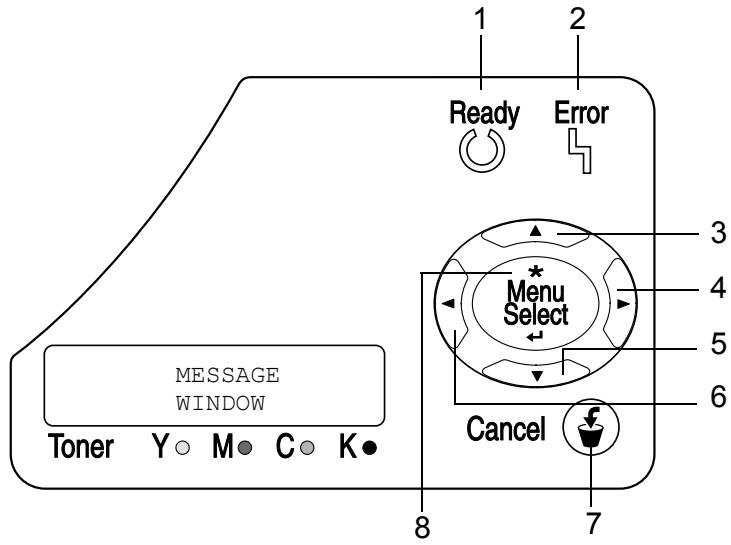
Control Panel Indicators and Keys
| No. | Indicator | Off | On |
| 1 | Ready | The printer is not ready to accept data. | The printer is ready to accept data. |
| 2 | Error | No problem. | The printer requires operator attention (usually accompanied by a status message in the message window.) |
| No. | Key | Function |
| 3 | ■ Moves up in the menu structure ■ Within a menu choice that is changeable character by character, scrolls upward through the available characters | |
| 4 | ■ Moves right in the menu structure ■ Moves right through the available menu choices | |
| 5 | ■ Moves down in the menu structure. ■ Within a menu choice that is changeable character by character, scrolls downward through the available characters | |
| 6 | ■ Moves left in the menu structure ■ Moves left through the available menu choices | |
| 7 | Cancel | ■ Cancels the currently displayed menu choice ■ Allows you to cancel one or all print jobs that are currently being printed or processed: 1. Press the Cancel key. 2. Press the Right or Left keys to select either JOB CANCEL/CURRENT JOB or JOB CANCEL/ALL JOBS. 3. Press the Select key. The print job(s) is (are) cancelled. |
| 8 | * Menu Select← | ■ Enters the menu system ■ Moves down in the menu structure ■ Selects the displayed menu choice |
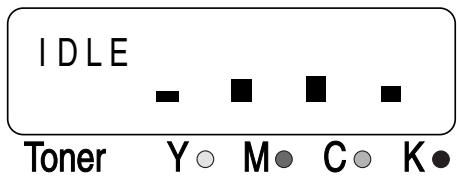
Toner Supply Indicators
The indicators shown below will appear, indicating the amount of toner that remains in the yellow (Y), magenta (M), cyan (C), and black (K) toner cartridges.
Configuration Menu Overview
The bizhub C10P configuration menu accessible from the control panel is structured as shown below.
Main Menu
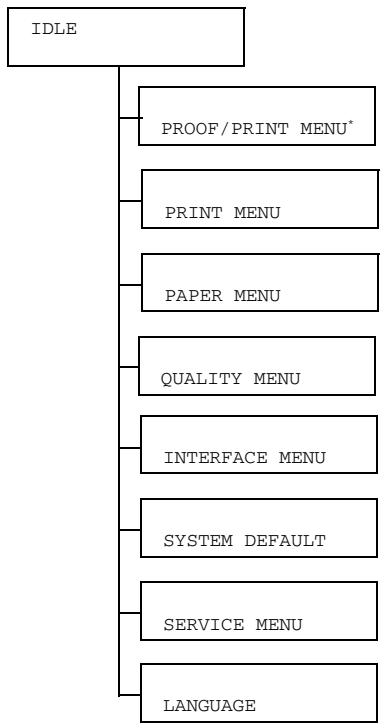

- This menu item appears only if an optional hard disk is installed.
PROOF/PRINT MENU

This menu item appears only if an optional hard disk is installed.
With this menu item, print jobs that were set to be saved on the hard disk by using Job Retention on the Basic tab of the printer driver can be printed or deleted.

All factory default values are shown in bold.
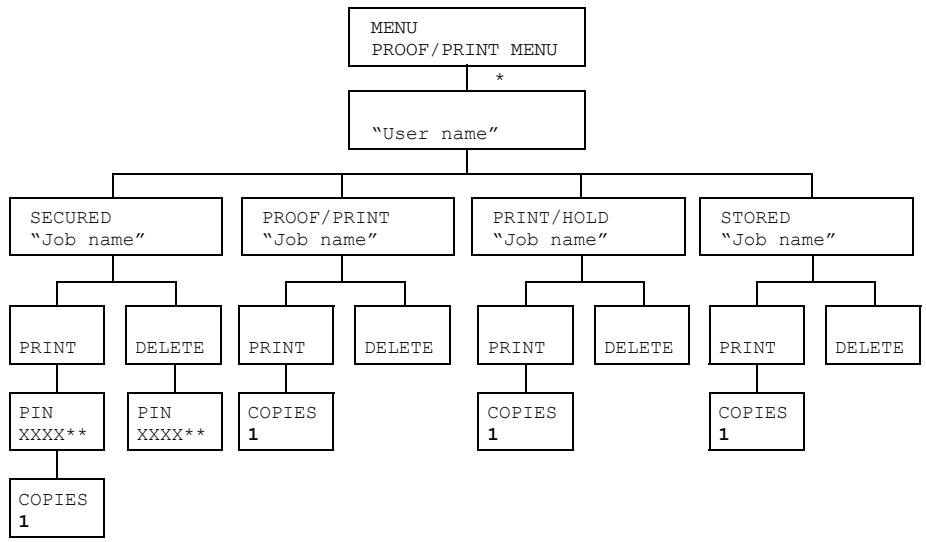

- If no jobs have been stored on the hard disk, NO STORED JOBS appears.
** In order to print or delete a secured job, enter the four-digit password specified from the printer driver. For details on entering the password, refer to “Entering the Password” on page 29.
Entering the Password
In order to print or delete a secured job, the four-digit password specified from the printer driver must be entered. Follow the procedure described below to type in the four-digit password specified from the printer driver.
1 Press the Up and Down keys to increase or decrease the first digit of the password.
2 Press the Right key to move the cursor to the next digit.
3 Press the Up and Down keys to increase or decrease the second digit of the password.
4 Continue these steps until all four digits of the password are specified.
5 Press the Menu/Select key.
The PRINT/DELETE selection screen appears.

If an incorrect password is entered, INVALID ENTRY appears and the screen for entering the password appears again.
PRINT MENU
With this menu, printer information, such as the configuration page and the demo page, can be printed.
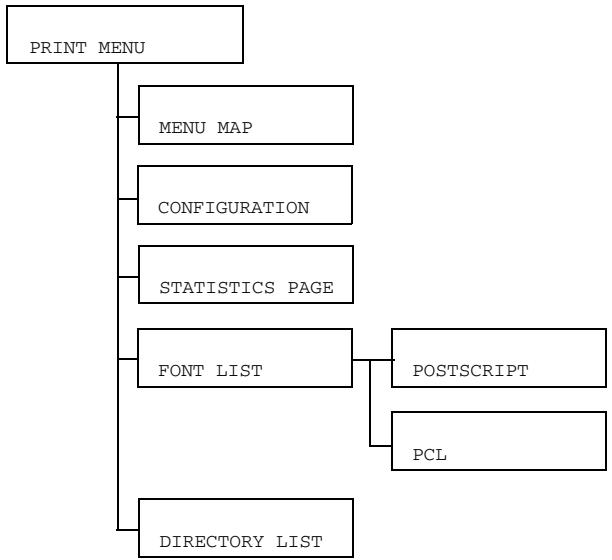

All factory default values are shown in bold.
| MENU MAP | Settings | YES /NO | |
| Prints the menu map. | |||
| CONFIGURA-TION | Settings | YES /NO | |
| Prints the configuration page. | |||
| STATISTICS-PAGE | Settings | YES /NO | |
| Prints the statistics page such as the number of pages printed. | |||
| FONT LIST | POST-SCRIPT | Settings | YES /NO |
| Prints the PostScript font list. | |||
| PCL | Settings | YES /NO | |
| Prints the PCL font list. | |||
| DIRECTORY LIST | Settings | YES /NO | |
| Prints the directory list of the hard disk and flash. | |||
| If the hard disk drive is not installed, only the flash directory list is printed. | |||
PAPER MENU
With this menu, the media used for printing can be managed.
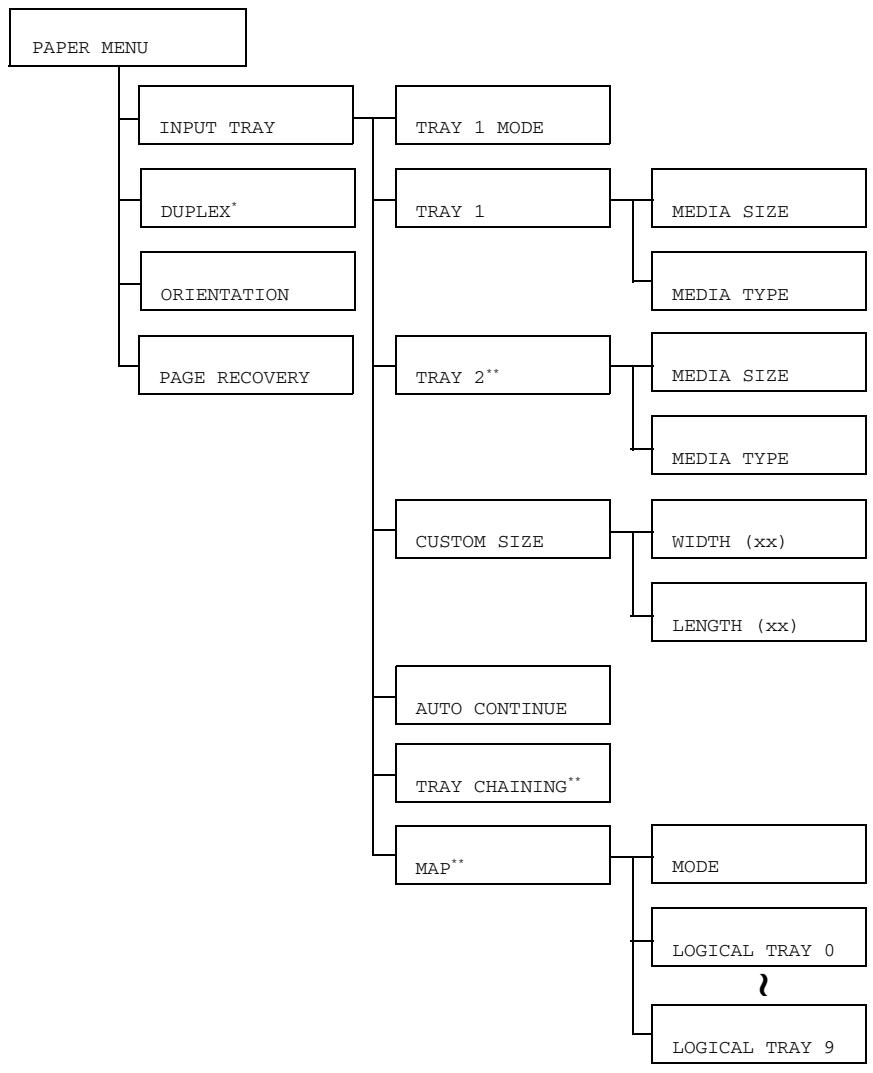

- This menu item appears only if the duplex option is installed.
** These menu items appear only if the optional lower feeder unit is installed.
| INPUT TRAY | TRAY 1 MODE | Settings | AUTO/CASSETTE | |
| When printing from Tray 1, select whether the paper size and paper type set from the printer driver or the MEDIA SIZE and MEDIA TYPE settings set by selecting PAPER MENU/INPUT TRAY/TRAY 1 in the control panel have priority. If AUTO is selected, the printer driver settings have priority during printing. If CASSETTE is selected, printing is performed when the printer driver settings and the control panel settings are all the same. | ||||
| TRAY 1 | MEDIA SIZE | Settings | LETTER/LEGAL/ EXECTIVE/A4/A5/ B5(JIS)/B5(ISO)/GOVT LETTER/STATEMENT/FOLIO/SP FOLIO/UK QUARTO/FOOLSCAP/GOVT LEGAL/ENV#10/ENVC5/ENV C6/ENV DL/ENVMONARCH/ENV CHOU#3/ENV CHOU#4/JPOST/KAI16/32K/JPOST-D/16K/ENV YOU#4/PHOTO SIZE/CUSTOM | |
| Select the setting for the size of paper loaded into Tray 1. The default setting for North America is LETTER. The default setting for all other regions is A4. | ||||
| MEDIA TYPE | Settings | PLAIN PAPER/ TRANSPARENCY/LABEL/ LETTERHEAD/ENVELOPE/ POSTCARD/THICK/GLOSSY | ||
| Select the setting for the type of paper loaded into Tray 1. | ||||
| TRAY 2 | MEDIA SIZE | Settings | LETTER/A4 | |
| Select the setting for the size of paper loaded into Tray 2. The default setting for North America is LETTER. The default setting for all other regions is A4. | ||||
| MEDIA TYPE | Settings | PLAIN PAPER/ LETTERHEAD | ||
| Select the setting for the type of paper loaded into Tray 2. | ||||
| CUSTOM SIZE | WIDTH (xx) | Settings | 92-216 mm (3.63-8.50 in.) | |
| Specify the width of the custom-sized paper loaded into Tray 1. On the model for North America, the settings appear in inches and the menu item appears as WIDTH (IN). On the models for all other regions, the settings appear in millimeters and the menu item appears as WIDTH (MM). | ||||
| LENGTH (xx) | Settings | 148-356 mm (5.83-14.01 in.) | ||
| Specify the length of the custom-sized paper loaded into Tray 1. On the model for North America, the settings appear in inches and the menu item appears as LENGTH (IN). On the models for all other regions, the settings appear in millimeters and the menu item appears as LENGTH (MM). | ||||
| AUTO CONTINUE | Settings | OFF/ON | ||
| Select whether or not printing continues if the size or type of paper in the selected paper tray is different from the size or type of paper for the print job. | ||||
| TRAY CHAINING | Settings | YES/NO | ||
| If YES is selected and the specified paper tray runs out of paper during printing, a paper tray loaded with paper of the same size is automatically selected so printing can continue.If NO is selected and the specified paper tray runs out of paper, printing stops. | ||||
| MAP | MODE | Settings | ON/OFF | |
| Select whether or not the Tray Mapping function is used. | ||||
| LOGI- CAL TRAY 0-9 | Settings | PHYSICAL TRAY 1/PHYSICAL TRAY 2 | ||
| Specify whether jobs received from another manufacturer's printer driver are printed using Tray 1 or Tray 2.PHYSICAL TRAY 2 is the default only for LOGICAL TRAY 2. The default for all other logical trays is PHYSICAL TRAY 1. | ||||
| DUPLEX | Settings | OFF/SHORTEDGE/LONGEDGE | ||
| If OFF is selected, duplex printing is not possible.If LONGEDGE is selected, the pages will be printed on both sides of the paper for long-edge binding.If SHORTEDGE is selected, the pages will be printed on both sides of the paper for short-edge binding. | ||||
| ORIEN-TATION | Settings | PORTRAIT/LANDSCAPE | ||
| Specify the orientation of the media. | ||||
| PAGE RECOV-ERY | Settings | ON/OFF | ||
| Select whether or not the page is printed again after recovering from a paper misfeed.If ON is selected, the page that was misfed is printed again.If OFF is selected, printing continues with the next page without printing the misfed page. | ||||
QUALITY MENU
With this menu, settings for the print quality can be specified.
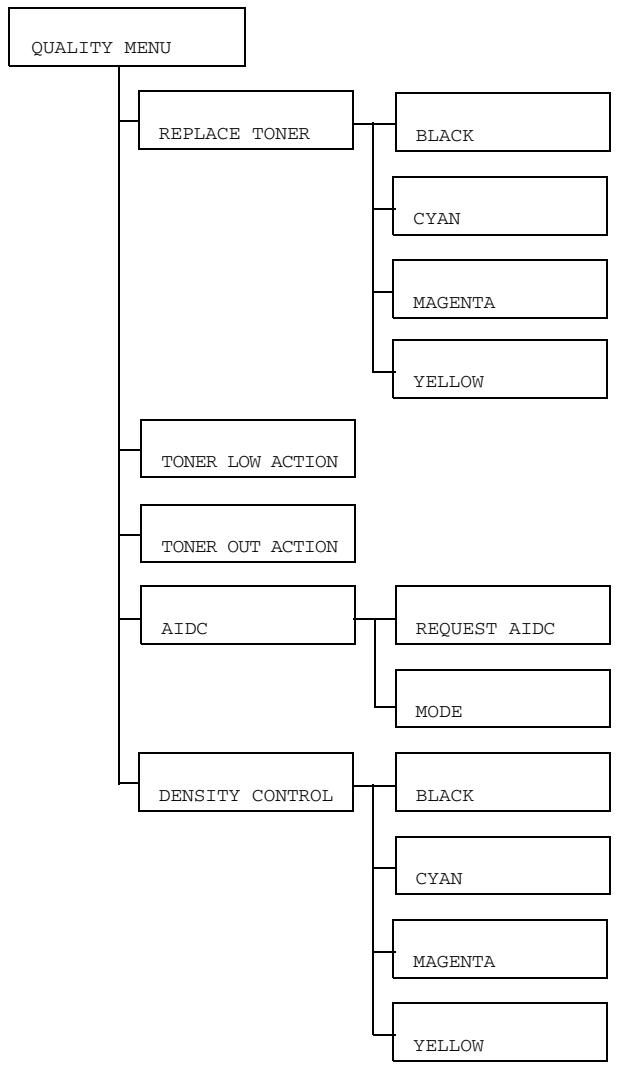
| REPLACE TONER | BLACK | Settings | YES/NO |
| When YES is selected, the carousel rotates to the black toner cartridge, so that it can be replaced. For details on replacing the toner cartridge, refer to “Replacing a Toner Cartridge” on page 79. | |||
| CYAN | Settings | YES/NO | |
| When YES is selected, the carousel rotates to the cyan toner cartridge, so that it can be replaced. For details on replacing the toner cartridge, refer to “Replacing a Toner Cartridge” on page 79. | |||
| MAGENTA | Settings | YES/NO | |
| When YES is selected, the carousel rotates to the magenta toner cartridge, so that it can be replaced. For details on replacing the toner cartridge, refer to “Replacing a Toner Cartridge” on page 79. | |||
| YELLOW | Settings | YES/NO | |
| When YES is selected, the carousel rotates to the yellow toner cartridge, so that it can be replaced. For details on replacing the toner cartridge, refer to “Replacing a Toner Cartridge” on page 79. | |||
| TONER LOW ACTION | Settings | YES / NO | |
| When set to YES, Toner low indication will show up on the control panel when one or more toner cartridges reach to the low condition. | |||
| TONER OUT ACTION | Settings | STOP/CONTINUE | |
| When set to CONTINUE, printing continues even if the toner cartridge is empty. When set to STOP, printing stops when the toner cartridge is empty. | |||
| AIDC | REQUESTAIDC | Settings | NO/YES |
| If YES is selected, image adjustments are performed. | |||
| MODE | Settings | ON/OFF | |
| If ON is selected, the image adjustments are applied.If OFF is selected, image adjustments are not applied. | |||
| DENSITYCONTROL | BLACK | Settings | 1/2/3/4/5 |
| Adjust the density of the black toner to one of five levels.If 1 is selected, the density is at its lightest level. If 5 is selected, the density is at its darkest level. | |||
| CYAN | Settings | 1/2/3/4/5 | |
| Adjust the density of the cyan toner to one of five levels.If 1 is selected, the density is at its lightest level. If 5 is selected, the density is at its darkest level. | |||
| MAGENTA | Settings | 1/2/3/4/5 | |
| Adjust the density of the magenta toner to one of five levels.If 1 is selected, the density is at its lightest level. If 5 is selected, the density is at its darkest level. | |||
| YELLOW | Settings | 1/2/3/4/5 | |
| Adjust the density of the yellow toner to one of five levels.If 1 is selected, the density is at its lightest level. If 5 is selected, the density is at its darkest level. | |||
INTERFACE MENU
With this menu, interface settings can be specified.

Restart the printer after changing settings in the ETHERNET menu.
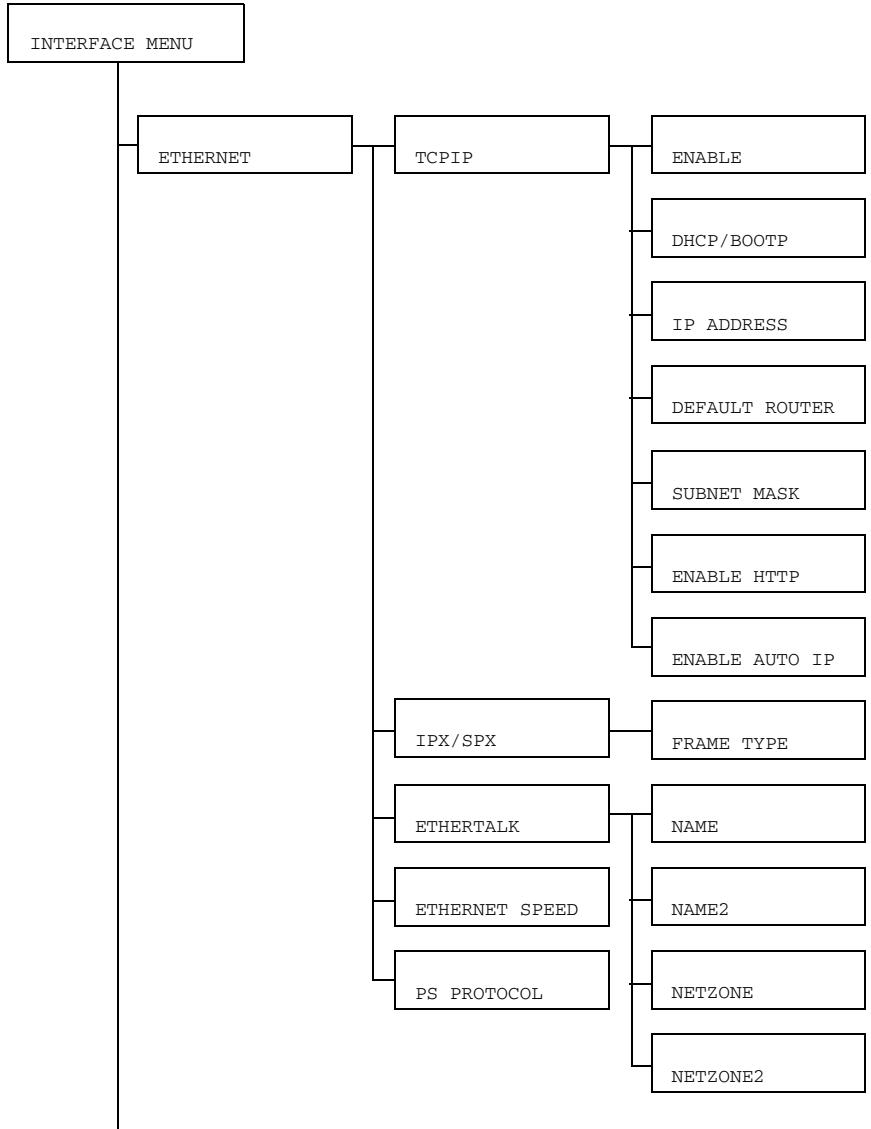
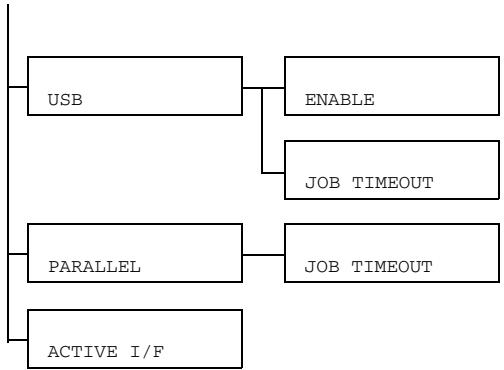

All factory default values are shown in bold.
| ETHER-NET | TCPIP | ENABLE | Settings | YES/NO |
| If YES is selected, TCP/IP is enabled. If NO is selected, TCP/IP is disabled. | ||||
| DHCP/BOOTP | Settings | YES/NO | ||
| Select whether or not the IP address is automatically acquired. If YES is selected, the IP address is automatically acquired. If NO is selected, the IP address is not automatically acquired. | ||||
| IP ADDRESS | Setting | 192.168.1.2 | ||
| Set the IP address for this printer on the network. Use the Up, Down, Left, and Right keys to specify the value. If the IP address is manually specified, DHCP/BOOTP is automatically set to NO. | ||||
| DEFAULTROUTER | Setting | 192.168.1.2 | ||
| Specify the IP address of the router if one is on the network. Use the Up, Down, Left, and Right keys to specify the value. | ||||
| SUBNETMASK | Setting | 0.0.0.0 | ||
| Specify the subnet mask for the network.Use the Up, Down, Left, and Right keys to specify the value. | ||||
| ENABLEHTTP | Setting | YES/NO | ||
| Specify whether or not HTTP is used.If YES is selected, the Web page pro-vided to the printer by the built-in HTTP server is enabled.If NO is selected, the Web page cannot be used. | ||||
| ENABLEAUTOIP | Setting | YES/NO | ||
| Select whether or not the IP address is automatically acquired when DHCP/BOOTP and PING, ARP are not functioning or when there is no response.If NO is selected, the IP address is not automatically acquired.If YES is selected, the IP address is automatically acquired. | ||||
| IPX/SPX | FRAMETYPE | Settings | AUTO/802.2/802.3/ETHER II/SNAP | |
| Specify the protocol used with NetWare. | ||||
| ETHERTALK | NAME | Settings | bizhub C10P | |
| Specify the name of the printer for finding printers with Macintosh EtherTalk.The printer name can contain a maximum of 16 characters. | ||||
| NAME2 | Settings | - | ||
| Specify the name of the printer for finding printers with Macintosh EtherTalk.The printer name can contain a maximum of 16 characters. | ||||
| NET ZONE | Settings | * | ||
| Specify the Macintosh EtherTalk zone.The zone name can contain a maximum of 16 characters. | ||||
| NET ZONE2 | Settings | - | ||
| Specify the Macintosh EtherTalk zone.The zone name can contain a maximum of 16 characters. | ||||
| ETHERNET SPEED | Settings | AUTO/100 FULL DUPLEX/100 HALF DUPLEX/10 FULL DUPLEX/10 HALF DUPLEX | ||
| Specify the transmission speed for the network and the transmission method for bi-directional transmission. | ||||
| PS PROTOCOL | Settings | BINARY/QUOTED BINARY | ||
| Select whether PostScript jobs are received in the binary format or the quoted format. | ||||
| USB | ENABLE | Settings | YES/NO | |
| If YES is selected, USB is enabled.If NO is selected, USB is disabled. | ||||
| JOB TIMEOUT | Settings | 0-60-999 | ||
| Specify the length of time (in seconds) until the print job being received is timed out when USB is being used. | ||||
| PARAL-LEL | JOB TIMEOUT | Settings | 0-30-999 | |
| Specify the length of time (in seconds) until the print job being received is timed out when Parallel is being used. | ||||
| ACTIVE I/F | Settings | ETHERNET / PARALLEL | ||
| Specify the interface to be used.An Ethernet and parallel connection cannot be used at the same time. | ||||
SYSTEM DEFAULT MENU
With this menu, settings can be specified to adjust the operation of the printer, such as the time until the machine enters Energy Saver mode.
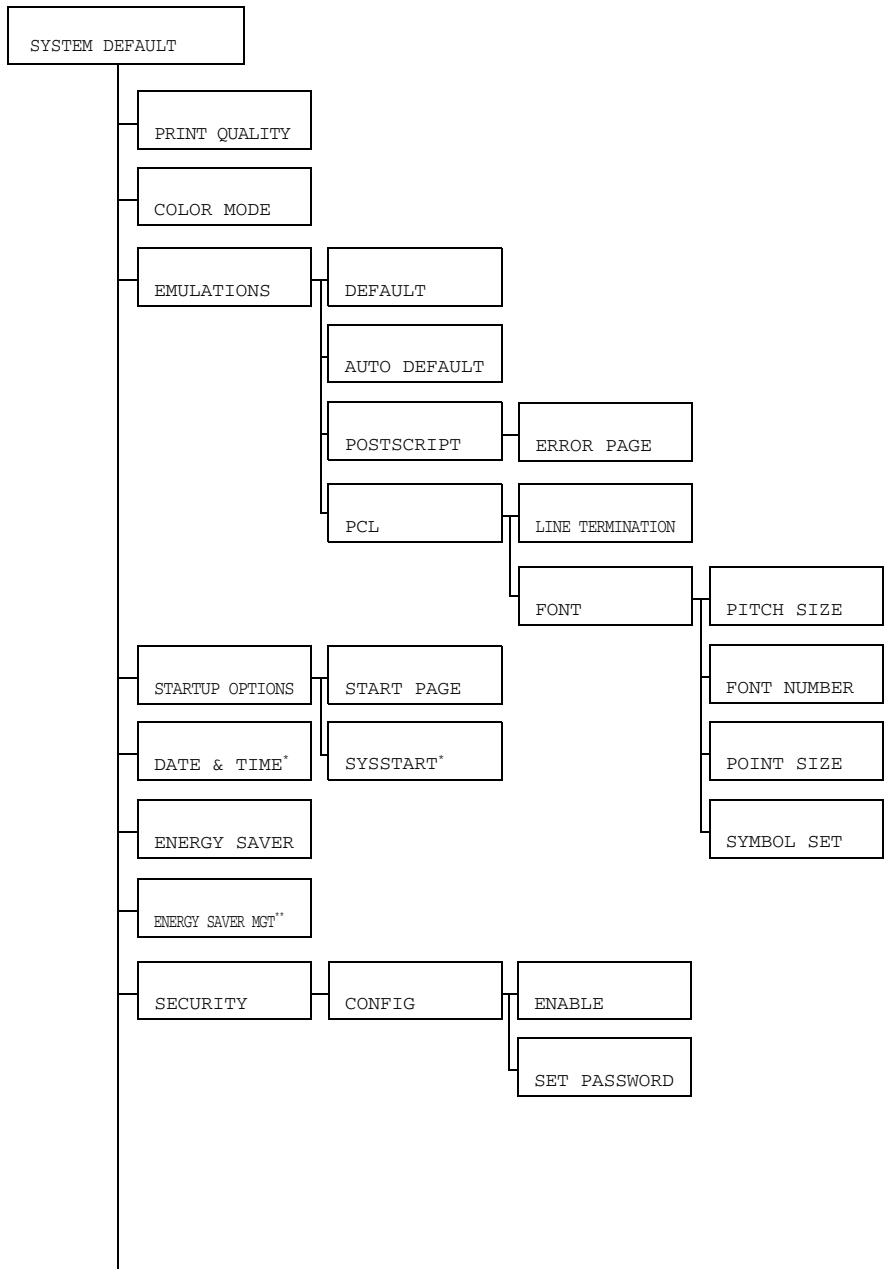


- These menu items appear only if an optional hard disk is installed. ** This menu item appears only on 120 V units.

All factory default values are shown in bold.
| PRINT QUALITY | Settings | HIGH/STANDARD | |
| Select the image quality for prints. | |||
| COLOR MODE | Settings | COLOR/GRAYSCALE | |
| Specify whether printing is in full color or grayscale. | |||
| EMULATIONS | DEFAULT | Settings | AUTOMATIC/POSTSCRIPT/PCL5/PCL XL/HEX DUMP/PDF |
| Specify the printer control language.If AUTO is selected, the printer automatically selects the printer control language from the data stream. | |||
| AUTO DEFAULT | Settings | PCL5/POSTSCRIPT | |
| Select the printer description language when it cannot be identified from the data and DEFAULT is set to AUTOMATIC. | |||
| POST-SCRIPT | ERROR PAGE | Settings ON/OFFSelect whether or not an error page is printed when a PostScript error occurs. | |
| PCL | LINE TERMI- NATION | Settings | CR=CR LF=CRLF/ CR=CR LF=LF/ CR=CRLF LF=LF/ CR=CRLF LF=CRLF | ||
| Select the definitions of the CR/LF codes in the PCL language. | |||||
| FONT | PITCH SIZE | Settings | 44-1000-9999 | ||
| Specify the bitmap font size in the PCL language. | |||||
| FONT NUMBER | Settings | 0-32767 | |||
| Specify the font used with the PCL language. The font numbers that appear correspond to the PCL font list. For details on printing the font list, refer to “PRINT MENU” on page 30. | |||||
| POINT SIZE | Settings | 400-1200-99975 | |||
| Specify the outline font size in the PCL language. | |||||
| SYMBOL SET | Specify the symbol set used with the PCL language. The default setting is PC8. | ||||
| STARTUP OPTIONS | START PAGE | Settings | NO/YES | ||
| Select whether or not a startup page is printed when the printer is turned on. If YES is selected, the startup page is printed when the printer is turned on. If NO is selected, the startup page is not printed. | |||||
| SYSSTART | Settings | NO/YES | |||
| Select whether or not the PostScript format definitions file is applied when the printer is turned on.If YES is selected, the PostScript format definitions file is applied.If NO is selected, the PostScript format definitions file is not applied. | |||||
| DATE & TIME | Settings | yyyymmdd:hhmmss | |||
| Set the date and time on the hard disk's time-of-day (TOD) clock.The settings appear in the following order: year, month, day:hour, minutes, seconds. | |||||
| ENERGY Saver | Settings | 15 MINUTES/30 MINUTES/1 HOUR/2 HOURS | |||
| Specify the length of time until the machine enters Energy Saver mode.This menu item appears only when ENERGY Saver is set to ON.2 HOURS is displayed only on 120 V units. | |||||
| ENERGY Saver MGT | Settings | ON/OFF | |||
| If ON is selected, the machine will enter Energy Saver mode.If OFF is selected, the machine will not enter Energy Saver mode.This menu item is displayed only on 120 V units. | |||||
| SECURITY | CONFIG | ENABLE | Settings | OFF/ON |
| Select whether or not the menus are protected with a password.If ON is selected, all menus are protected with a password. | ||||
| SET PASS-WORD | Settings | SYSADMIN | ||
| Specify the password for displaying the menus. The specified password is applied only if SECURITY/CONFIG/ ENABLE is set to ON.The password can contain a maximum of 16 characters. | ||||
| CAP-TUREPRTJOB | Settings | OFF/ON/PRINT | ||
| Select whether or not received print jobs are saved on the hard disk.If OFF is selected, print jobs are not saved on the hard disk.If ON is selected, received print jobs are saved on the hard disk without being printed.If PRINT is selected, received print jobs are printed and saved on the hard disk. | ||||
| FORMAT | FORMAT FLASH | Settings | NO/YES | |
| Select whether or not to initialize the flash RAM.If YES is selected, the flash RAM is initialized. | ||||
| FORMAT DISK | Settings | NO/YES | ||
| Select whether or not to initialize the hard disk.If YES is selected, the hard disk is initialized. | ||||
| RESTORE/SAVE | RESTOREFACTORY | Settings | NO/YES |
| Select whether or not all menu items are reset to their initial settings.If YES is selected, all menu items are reset to their initial settings. | |||
| SAVECUSTOM | Settings | NO/YES | |
| Select whether or not all changed menu settings are saved.If YES is selected, all changes are saved. | |||
| RESTORECUSTOM | Settings | NO/YES | |
| Select whether or not menu items are reverted to the previously saved settings.If YES is selected, the menu items revert to the previously saved settings. | |||
SERVICE MENU
With this menu, the service representative can adjust the printer and perform maintenance operations. This menu cannot be used by the user.
LANGUAGE MENU
| ENGLISH/FRANCAIS/ DEUTSCH/ESPANOL/ ITALIANO/PORTUGES/ CESKY/JAPANESE | The display language of the message window can be changed to the required language. The default setting is English. |
Using Media
5
Media Specifications
What types and sizes of media can I load?
| Media | Media Size | Tray* | Duplex | |
| Inch | Millimeter | |||
| A4 | 8.2 x 11.7 | 210.0 x 297.0 | 1/2 | Yes |
| A5 | 5.9 x 8.3 | 148.0 x 210.0 | 1 | No |
| B5 (JIS) | 7.2 x 10.1 | 182.0 x 257.0 | 1 | No |
| B5 (ISO) | 6.9 x 9.8 | 176.0 x 250.0 | 1 | No |
| Executive | 7.25 x 10.5 | 184.0 x 267.0 | 1 | No |
| Folio | 8.3 x 13.0 | 210.0 x 330.0 | 1 | Yes |
| Foolscap | 8.0 x 13.0 | 203.2 x 330.2 | 1 | Yes |
| Kai 16 | 7.3 x 10.2 | 185.0 x 260.0 | 1 | No |
| 16K | 7.7 x 10.6 | 195.0 x 270.0 | 1 | No |
| 32K | 5.1 x 7.3 | 130.0 x 185.0 | 1 | No |
| Legal | 8.5 x 14.0 | 215.9 x 355.6 | 1 | Yes |
| Government Legal | 8.5 x 13.0 | 216.0 x 330.0 | 1 | Yes |
| Letter | 8.5 x 11.0 | 215.9 x 279.4 | 1/2 | Yes |
| SP Folio | 8.5 x 12.69 | 215.9 x 322.3 | 1 | Yes |
| Government Letter | 8.0 x 10.5 | 203.2 x 266.7 | 1 | No |
| Statement | 5.5 x 8.5 | 140.0 x 216.0 | 1 | No |
| UK Quarto | 8.0 x 10.0 | 203.2 x 254.0 | 1 | No |
| Japanese Postcard | 3.9 x 5.8 | 100.0 x 148.0 | 1 | No |
| Japanese Postcard-D | 5.8 x 7.9 | 148.0 x 200.0 | 1 | No |
| Envelope C5 | 6.4 x 9.0 | 162.0 x 229.0 | 1 | No |
| Envelope C6 | 4.5 x 6.4 | 114.0 x 162.0 | 1 | No |
| Envelope Com10 | 4.125 x 9.5 | 104.7 x 241.3 | 1 | No |
| Envelope DL | 4.3 x 8.7 | 110.0 x 220.0 | 1 | No |
| Envelope Monarch | 3.875 x 7.5 | 98.4 x 190.5 | 1 | No |
| Envelope Chou #3 | 4.7 x 9.2 | 120.0 x 235.0 | 1 | No |
| Envelope Chou #4 | 3.5 x 8.1 | 90.0 x 205.0 | 1 | No |
| Envelope You #4 | 4.1 x 9.3 | 105.0 x 235.0 | 1 | No |
| Photo Size 4x6"/10x15 | 4.0 x 6.0 | 102.0 x 152.0 | 1 | No |
| Thick Stock, Glossy —Only supported for letter, A4, or smaller media. | ||||
| Custom Size, Minimum | 3.6 x 5.9 | 92.0 x 148.0 | 1 | No** |
| Custom Size, Maximum | 8.5 x 14.0 | 216.0 x 356.0 | 1 | Yes |
| Notes: * Tray 1 = MultipurposeTray 2 = Plain paper only** The minimum possible size for duplex printing is 92.0 x 276.0 mm(3.63 x 10.87"). | ||||

For custom sizes, use the printer driver to specify the settings within the ranges shown in the above table.
Media Types
Before purchasing a large quantity of special media, do a trial print with the same media and check the print quality.
Keep media on a flat, level surface in its original wrapper until it is time to load it. For a list of approved media, refer to printer.konicaminolta.com.
Plain Paper
| Capacity | Tray 1 | Up to 200 sheets, depending on the paper weight |
| Tray 2 | Up to 500 sheets, depending on the paper weight | |
| Orientation | Face up | |
| Driver Media Type | Plain paper | |
| Weight | 60 to 90 g/m2(16 to 24 lb bond) | |
| Duplexing | See page 50 for supported sizes. | |
Use plain paper that is
Suitable for plain paper laser printers, such as standard or recycled office paper.
Note
Do not use the media types listed below. These could cause poor print quality, media misfeeds, or damage to the printer.
DO NOT use media that is
Coated with a processed surface (such as carbon paper, digitally gloss-coated media, and colored paper that has been treated)
Carbon backed
Unapproved iron-on transfer media (such as heat-sensitive paper, heat-pressure paper, and heat-press transfer paper)
Cold-water-transfer paper
Pressure sensitive
■ Designed specifically for inkjet printers (such as superfine paper, glossy film, and postcards)
Already been printed on by another printer, copier, or fax machine
Dusty
Wet (or damp)
Layered
Adhesive
■ Folded, creased, curled, embossed, warped, or wrinkled
Perforated, three-hole punched, or torn
Too slick, too coarse, or too textured
Different in texture (roughness) on the front and back
Too thin or too thick
Stuck together with static electricity
Composed of foil or gilt; too luminous
Heat sensitive or cannot withstand the fusing temperature (180°C [356°F])
Irregularly shaped (not rectangular or not cut at right angles)
■ Attached with glue, tape, paper clips, staples, ribbons, hooks, or buttons
Acidic
Any other media that is not approved
Thick Stock
Paper thicker than 90g / m^2 (24 lb bond) is referred to as thick stock. Test all thick stock to ensure acceptable performance and to ensure that the image does not shift.
| Capacity | Tray 1 | Up to 50 thick stock sheets, depending on their thickness |
| Tray 2 | Not supported | |
| Orientation | Face up | |
| Driver Media Type | Thick | |
| Weight | 91 to 163 g/m2(25 to 43 lb) | |
| Duplexing | Not supported | |

43 lb bond is also referred to as 90 lb index stock.
DO NOT use thick stock that is
Mixed with any other media in the trays (as this will cause printer misfeeding)
Envelopes
Print on the front (address) side only. Some parts of the envelope consist of three layers of paper—the front, back, and flap. Anything printed in these layered regions may be lost or faded.
| Capacity | Tray 1 | Up to 10 envelopes, depending on their thickness |
| Tray 2 | Not supported | |
| Orientation | Face up | |
| Driver Media Type | Envelope | |
| Weight | 60 to 163 g/m2(16 to 43 lb bond) | |
| Duplexing | Not supported | |
Use envelopes that are
Common office envelopes approved for laser printing with diagonal joints, sharp folds and edges, and ordinary gumed flaps

Because the envelopes pass through heated rollers, the gumed area on the flaps may seal. Using envelopes with emulsion-based glue avoids this problem.
Approved for laser printing
Dry
DO NOT use envelopes that have
Sticky flaps
Tape seals, metal clasps, paper clips, fasteners, or peel-off strips for sealing
Transparent windows
Too rough of a surface
Material that will melt, vaporize, offset, discolor, or emit dangerous fumes
■ Been presealed
Labels
A sheet of labels consists of a face sheet (the printing surface), adhesive, and a carrier sheet:
The face sheet must follow the plain paper specification.
- The face sheet surface must cover the entire carrier sheet, and no adhesive should come through on the surface.
You can print continuously with label sheets. However, this could affect the media feed, depending on the media quality and printing environment. If problems occur, stop the continuous printing and print one sheet at a time.
Try printing your data on a sheet of plain paper first to check placement. Check your application documentation for more information on printing labels.
| Capacity | Tray 1 | Up to 50 label sheets, depending on their thickness |
| Tray 2 | Not supported | |
| Orientation | Face up | |
| Driver Media Type | Label | |
| Weight | 60 to 163 g/m2(16 to 90 lb) | |
| Duplexing | Not supported | |
Use label sheets that are
Recommended for laser printers
DO NOT use label sheets that
Have labels that easily peel off or have parts of the label already removed
Have backing sheets that have peeled away or have exposed adhesive

Labels may stick to the fuser, causing them to peel off and media misfeeds to occur.
Are precut or perforated
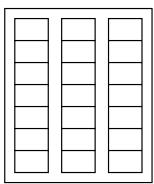
Do not use
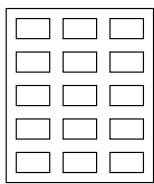
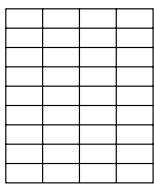
Shiny backed paper

OK to use
Full-page labels (uncut)
Letterhead
Try printing your data on a sheet of plain paper first to check placement.
| Capacity | Tray 1 | Up to 50 sheets, depending on their size and thickness |
| Tray 2 | Not supported | |
| Orientation | Face up | |
| Driver Media Type | Letterhead | |
| Weight | 60 to 90 g/m2(16 to 24 lb bond) | |
| Duplexing | See page 50 for supported sizes (face up—top of page first). | |
Postcards
Try printing your data on a sheet of plain paper first to check placement.
| Capacity | Tray 1 | Up to 50 postcards, depending on their thickness |
| Tray 2 | Not supported | |
| Orientation | Face up | |
| Driver Media Type | Postcard | |
| Weight | 60 to 163 g/m2(16 to 90 lb) | |
| Duplexing | Not supported | |
Use postcards that are
Approved for laser printers
DO NOT use postcards that are
Coated
Designed for inkjet printers
Precut or perforated
Preprinted or multicolored

If the postcard is warped, press on the warped area before putting it in Tray 1.
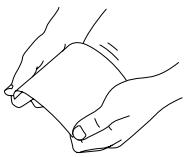
- Folded or wrinkled

Transparencies

Do not fan transparencies before loading them. Resulting static electricity may cause printing errors.

If you touch the face of the transparencies with your bare hands, print quality may be affected.

Keep the printer path clean. Transparency are especially sensitive to a dirty media path. If there are shadows on either the top or the bottom of the sheets, see chapter 7, "Maintaining the Printer".

Remove transparencies as soon as possible from the output tray to avoid static buildup.
You can print continuously with transparencies. However, this could affect the media feed, depending on the media quality, static buildup, and printing environment.
Try printing your data on a sheet of plain paper first to check placement.
| Capacity | Tray 1 | Up to 50 transparencies, depending on their thickness |
| Tray 2 | Not supported | |
| Orientation | Face up | |
| Driver Media Type | Transparency | |
| Duplexing | Not supported | |

Always first test a small quantity of a particular type of transparency.
Use transparencies that are
Approved for laser printing
DO NOT use transparencies that
Have static electricity that will cause them to stick together
Are specified for inkjet printers only
Glossy Stock
Test all glossy stock to ensure acceptable performance and to ensure that the image does not shift.
| Capacity | Tray 1 | Up to 50 glossy sheets, depending on their thickness |
| Tray 2 | Not supported | |
| Orientation | Face up | |
| Driver Media Type | Glossy | |
| Weight | 60 to 90 g/m2(16 to 24 lb) | |
| Duplexing | Not supported | |
DO NOT use glossy stock that is
Mixed with any other media in the trays (as this will cause printer misfeeding)
■ Specified for inkjet printers only
What Is the Guaranteed Imageable (Printable) Area?
The printable area on all media sizes is up to 4 mm (0.157") from the edges of the media.
Each media size has a specific imageable area, the maximum area on which the printer can print clearly and without distortion.
This area is subject to both hardware limits (the physical media size and the margins required by the printer) and software constraints (the amount of
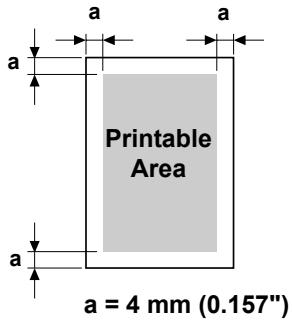
memory available for the full-page frame buffer). The guaranteed imageable (printable) area for all media sizes is the page size minus 4 mm (0.157") from all edges of the media.

When printing in color on legal-size media, the bottom margin is 17.0 mm (0.669").

When printing on glossy stock, the top margin is 10 mm (0.394").
Imageable Area—Envelopes
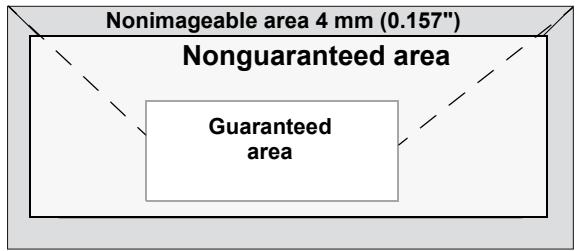
Envelopes have a nonguaranteed imageable area that varies with envelope type.

The envelope print orientation is determined by your application.
Page Margins
Margins are set through your application. Some applications allow you to set custom page sizes and margins while others have only standard page sizes and margins from which to choose. If you choose a standard format, you may lose part of your image (due to imageable area constraints). If you can custom-size your page in your application, use those sizes given for the imageable area for optimum results.
Loading Media
How do I load media?
Take off the top and bottom sheets of a ream of paper. Holding a stack of approximately 200 sheets at a time, fan the stack to prevent static buildup before inserting it in a tray.
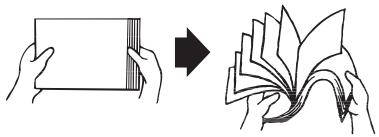

Although this printer was designed for printing on a wide range of media types, it is not intended to print exclusively on a single media type except plain paper. Continuous printing on media other than plain paper (such as envelopes, labels, thick stock, or transparencies) may adversely affect print quality or reduce engine life.
When refilling media, first remove any media remaining in the tray. Stack it with the new media, even the edges, then reload it.
Do not mix media of different types and sizes, as this will cause media misfeeds.
Tray 1 (Multipurpose Tray)
For details on the types and sizes of media that can be printed from Tray 1, refer to "Media Specifications" on page 50.
Loading Plain Paper
1 Remove the lid from Tray 1, and then open the front panel of Tray 1.

2 Slide the media guides to provide more space between them.
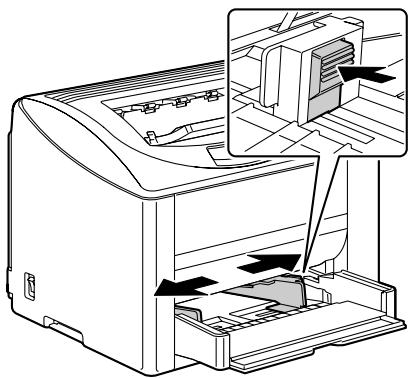
3 Load the paper face up in the tray.
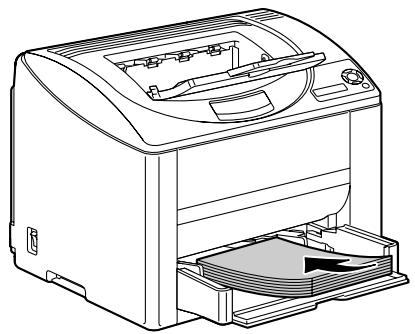

Do not load paper above the mark. Up to 200 sheets (80g / m^2 [22 lb]) of plain paper can be loaded into the tray at one time.
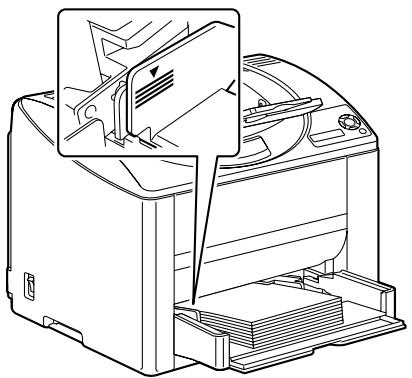
4 Slide the media guides against the edges of the paper.
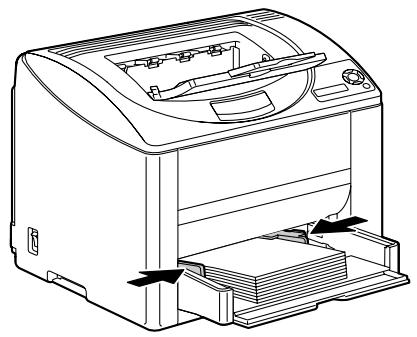
5 Close the front panel of Tray 1 tray, and then reattach the lid.
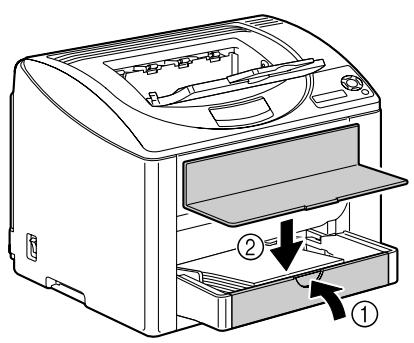
Other Media
When loading media other than plain paper, set the media mode (for example, Envelope, Glossy, Label, Thick Stock or Transparency) in the driver for optimum print quality.
Loading Envelopes
1 Remove the lid from Tray 1, and then open the front panel of Tray 1.
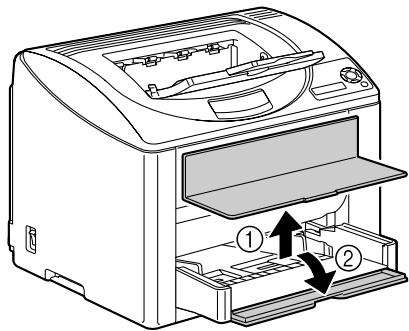
2 Remove any media from the tray.
3 Slide the media guides to provide more space between them.
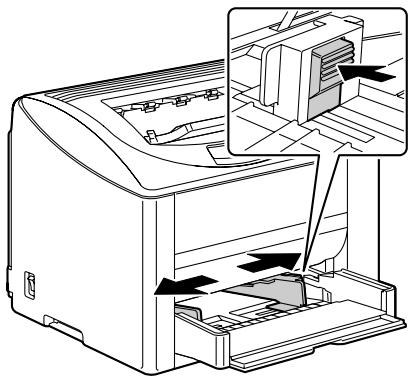
4 Load the envelopes flap side down in the tray.

Before loading envelopes, press them down to make sure that all air is removed, and make sure that the folds of the flaps are firmly pressed; otherwise the envelopes may become wrinkled or a media misfeed may occur.
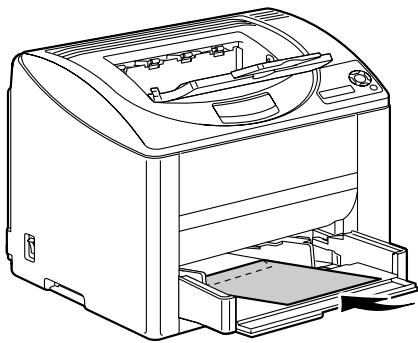

Up to 10 envelopes can be loaded into the tray at one time.

For envelopes with the flap along the long edge, load the envelopes with the flap toward the left of the printer.
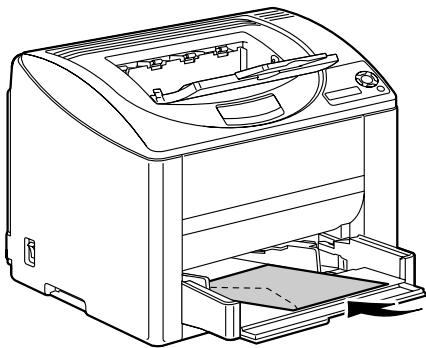
5 Slide the media guides against the edges of the envelopes.

6 Close the front panel of Tray 1 tray, and then reattach the lid.
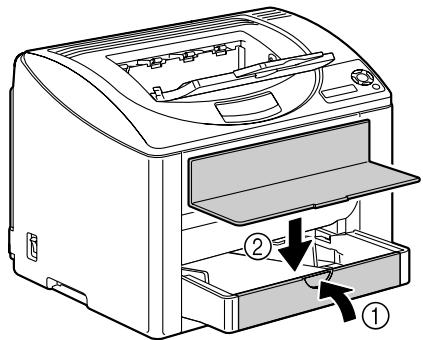
7 Pull the lever, and then open the top cover.

If there is paper in the output tray, remove it. Fold up the output tray before opening the top cover.

Do not touch the transfer belt.
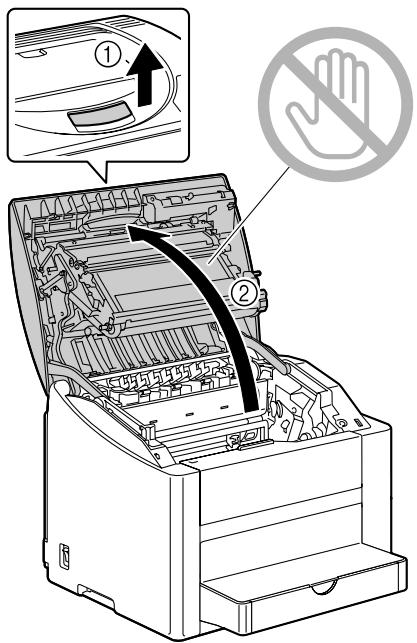
8 Raise the fuser separator levers on the fuser unit.
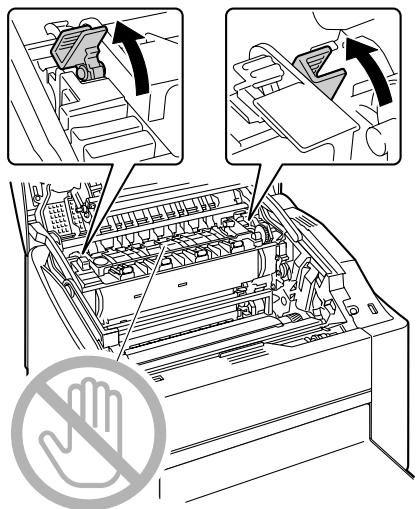
Since a media misfeed or decreased print quality may occur, be sure to return the levers on the fuser unit to the setting for plain paper before printing on media other than envelopes.
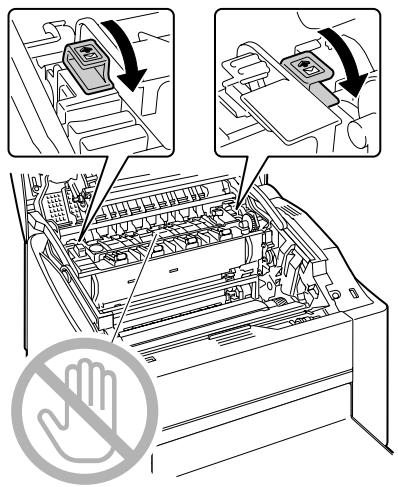
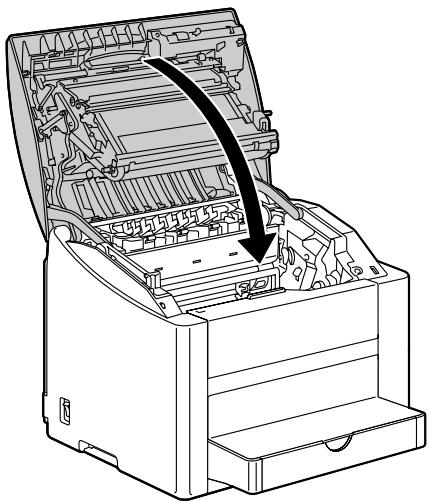
9 Carefully close the top cover.

Before printing on media other than envelopes, be sure to move the fuser separator levers on the fuser unit to its original position.
Loading Labels/Postcard/Thick Stock/Glossy Stock and Transparency
1 Remove the lid from Tray 1, and then open the front panel of Tray 1.
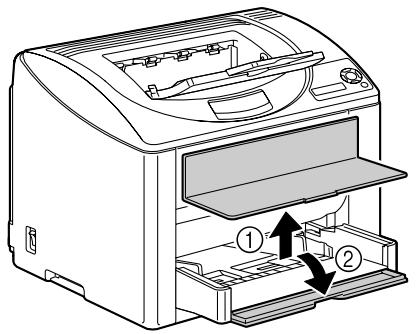
2 Remove any media from the tray.
3 Slide the media guides to provide more space between them.
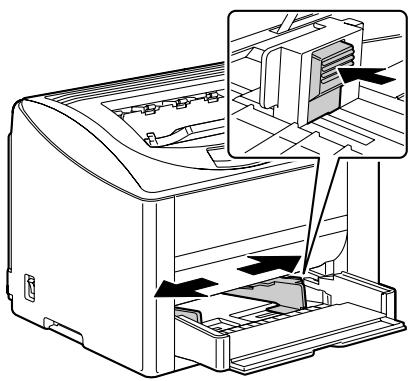
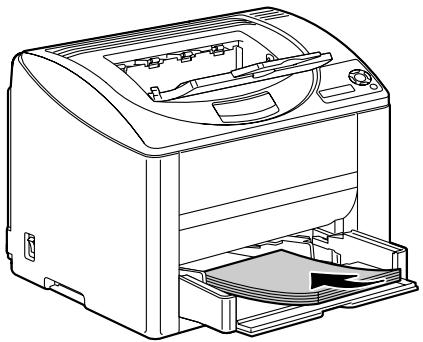
4 Load the media face up in the tray.

Up to 50 sheets can be loaded into the tray at one time.
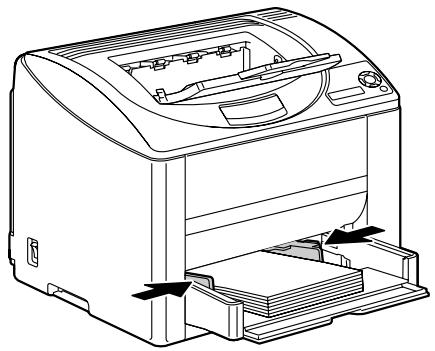
5 Slide the media guides against the edges of the media.
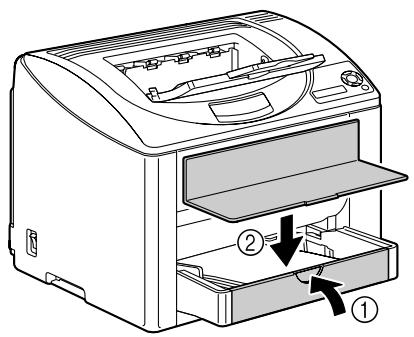
6 Close the front panel of Tray 1 tray, and then reattach the lid.
Tray 2
Loading Plain Paper
1 Pull out Tray 2 as far as possible.

2 Lift up Tray 2 to remove it.
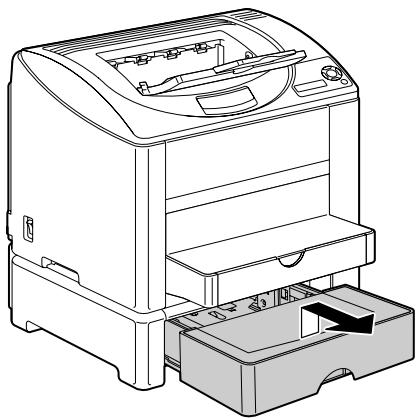
3 Remove the lid from Tray 2.
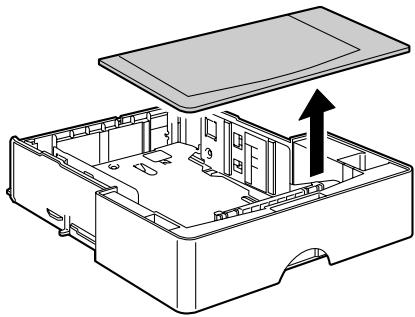
4 Press down the media pressure plate to lock it into place.
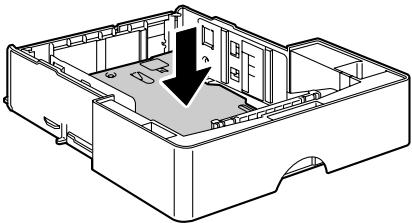
5 Load the paper face up in the tray.
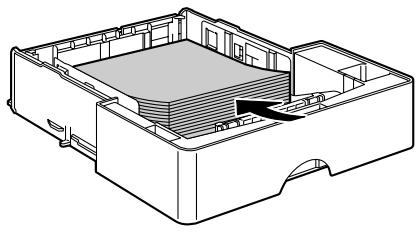

Do not load above the 100% line. Up to 500 sheets (80g / m^2 [22 lb]) of plain paper can be loaded into the tray at one time.
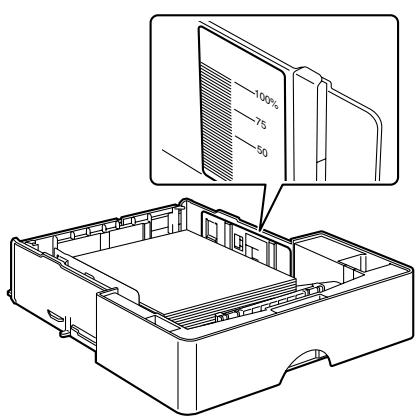
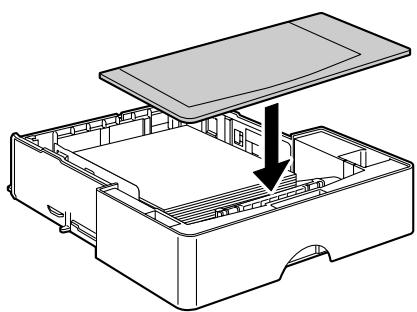
6 Reattach the lid to Tray 2.
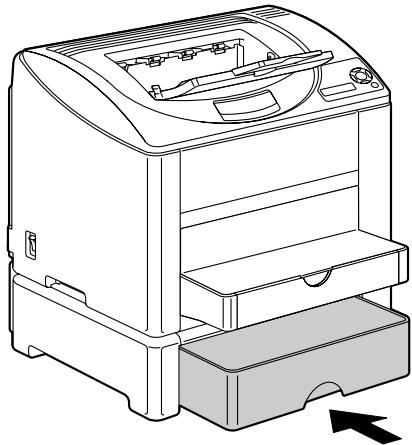
7 Reinsert Tray 2 into the printer.
Duplexing
Select paper with high opacity for duplex (double sided) printing. Opacity refers to how effectively paper blocks out what is written on the opposite side of the page. If the paper has low opacity (high translucency), then the printed data from one side of the page will show through to the other side. Check your application for margin information. For best results, print a small quantity to make sure the opacity is acceptable.
Duplex (Double sided) printing can be done automatically with the duplex option installed and selected.
Note
Only plain paper, 60 - 90g / m^2 (16-24 lb bond) can be autoduplexed. See "Media Specifications" on page 50.
Duplexing envelopes, labels, transparencies, or glossy is not supported.
How do I autoduplex?
You should verify that the duplex option is physically installed on the printer to successfully duplex the job.
Check your application to determine how to set your margins for duplex printing.
The following Binding Position settings are available.
| If “Short Edge” is selected, the pages will be laid out to flip at the top. | |
| If “Long Edge” is selected, the pages will be laid out to flip at the sides. |
In addition, if "N-up" has been set to "Booklet", autoduplex printing is performed.
The following Order settings are available when "Booklet" is selected.
| 1 3 1 | If “Left Binding” is selected, the pages can be folded as a left-bound booklet. |
| 3 1 1 | If “Right Binding” is selected, the pages can be folded as a right-bound booklet. |
1 Load plain paper into the tray.
2 From the printer driver, specify the layout for duplex printing.
3 Click OK.

With autoduplexing, the back side is printed first, and then the front side is printed.
Output Tray
All printed media is output to the face-down output tray on top of the printer. This tray has a capacity of approximately 200 sheets (A4/Letter) of 80g / m^2 (22 lb) paper.

If the media is stacked too high in the output tray, your printer may experience media misfeeds, excessive media curl, or static buildup.

Remove transparencies as soon as possible from the output tray to avoid static buildup.
Media Storage
How do I store media?
- Keep media on a flat, level surface in its original wrapper until it is time to load it.
Media that has been stored for a long time out of its packaging may dry up too much and cause misfeeding.
If media has been removed from its wrapper, place it in its original packaging and store in a cool, dark place on a level surface.
- Avoid moisture, excessive humidity, direct sunlight, excessive heat (above 35^ C [95°F]), and dust.
- Avoid media leaning against other objects or placing it in an upright position.
Before using stored media, do a trial print and check print quality.
Replacing Consumables
6
Note
Failure to follow instructions as outlined in this manual could result in.
voiding your warranty..
About Toner Cartridges
Your printer uses four toner cartridges: black, yellow, magenta, and cyan. Handle the toner cartridges carefully to avoid spilling toner inside the printer or on yourself.

Install only new toner cartridges in your printer. If a used toner cartridge is installed, the indicator message will not clear and the supplies status in the Status Display will not be updated.

The toner is nontoxic. If you get toner on your skin, wash it off with cool water and a mild soap. If you get toner on your clothes, lightly dust them off as best as you can. If some toner remains on your clothes, use cool, not hot water, to rinse the toner off.

CAUTION
If you get toner in your eyes, wash it out immediately with cool water and consult a doctor.
Note
Do not use refilled toner cartridges or unapproved toner cartridges. Any damage to the printer or quality problems caused by a refilled toner cartridge or unapproved toner cartridge will void your warranty. No technical support is provided to recover from these problems.
When replacing a toner cartridge, refer to the following table. For optimum print quality and performance, use only approved KONICA MINOLTA toner cartridges for your specific printer type, as listed in the table below. If you open the top cover, you can find your printer type and the toner cartridge part numbers on the consumables reorder label inside your printer.
| Printer Type | Printer Part Number | Toner Cartridge Type | Toner Cartridge Part Number |
| AM | A00V-015 | Standard-Capacity Toner Cartridge -Yellow (Y) | 1710587-001 |
| Standard-Capacity Toner Cartridge -Magenta (M) | 1710587-002 | ||
| Standard-Capacity Toner Cartridge -Cyan (C) | 1710587-003 | ||
| High-Capacity Toner Cartridge - Black (K) | 1710587-004 | ||
| High-Capacity Toner Cartridge - Yellow (Y) | 1710587-005 | ||
| High-Capacity Toner Cartridge - Magenta (M) | 1710587-006 | ||
| High-Capacity Toner Cartridge - Cyan (C) | 1710587-007 | ||
| EU | A00V-025 | Standard-Capacity Toner Cartridge -Yellow (Y) | 1710589-001 |
| Standard-Capacity Toner Cartridge -Magenta (M) | 1710589-002 | ||
| Standard-Capacity Toner Cartridge -Cyan (C) | 1710589-003 | ||
| High-Capacity Toner Cartridge - Black (K) | 1710589-004 | ||
| High-Capacity Toner Cartridge - Yellow (Y) | 1710589-005 | ||
| High-Capacity Toner Cartridge - Magenta (M) | 1710589-006 | ||
| High-Capacity Toner Cartridge - Cyan (C) | 1710589-007 |
Keep toner cartridges:
In their packaging until you're ready to install them.
In a cool, dry location away from sunlight (due to heat).
The maximum storage temperature is 35^ ( 95^ ) and the maximum storage humidity is 85% (noncondensing). If the toner cartridge is moved from a cold place to a warm, humid place, condensation may occur, degrading print quality. Allow the toner to adapt to the environment for about one hour before use.
Level during handling and storage.
Do not hold, stand or store cartridges on their ends or turn them upside down; the toner inside the cartridges may become caked or unequally distributed.
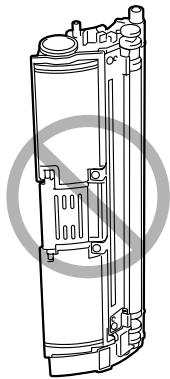
Away from salty air and corrosive gases such as aerosols.
Note
Be careful not to spill toner while replacing a toner cartridge. If toner spills, immediately wipe it off with a soft, dry cloth.
If TONER OUT ACTION on the QUALITY/TONER OUT ACTION menu is set to STOP, the message REPLACE X TONER (where "X" represents the color of the toner) appears when a toner cartridge becomes empty. Follow the steps below to replace the toner cartridge.

If TONER OUT ACTION on the QUALITY/TONER OUT ACTION menu is set to CONTINUE, the message X EMPTY appears.
1 Check the message window to see which color of toner is empty. Perform the operation described below to automatically rotate the carousel to move the toner cartridge for the specified color, so that it can be replaced.
| Press Key | Until Display Reads |
| REPLACE X TONER or X EMPTY | |
| * Menu Select ← | MENU PRINT MENU If the hard disk drive is installed, the PROOF/PRINT MENU appears. |
| ×2 (or ×3) | MENU QUALITY MENU |
| * Menu Select ← | REPLACE TONER |
| ▼ | BLACK |
| Press until appropriate color (X) is displayed. | X |
| * Menu Select ← | PLEASE WAIT |
| Then, it displays OPEN DOOR AND/REPLACE X TONER |
2 Pull the lever, and then open the top cover.

If there is paper in the output tray, remove it. Fold up the output tray before opening the top cover.

Do not touch the transfer belt.
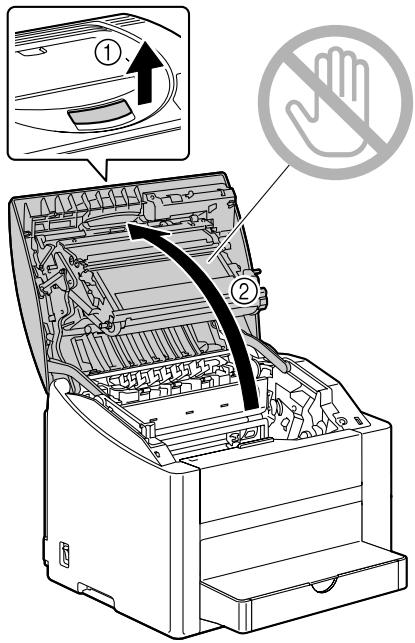
3 Open the front cover and check that the toner cartridge to be replaced has rotated to the exchange position.
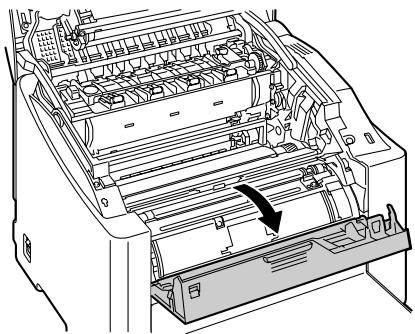

You can identify the toner cartridge by the color of the handle and by the letter molded into the handle: C (cyan), M (magenta), Y (yellow) and K (black).
4 Pull the handle on the toner cartridge toward you, and then pull the toner cartridge up to remove it.

Do not manually rotate the toner cartridge carousel. In addition, do not rotate the carousel with force; otherwise it may be damaged.
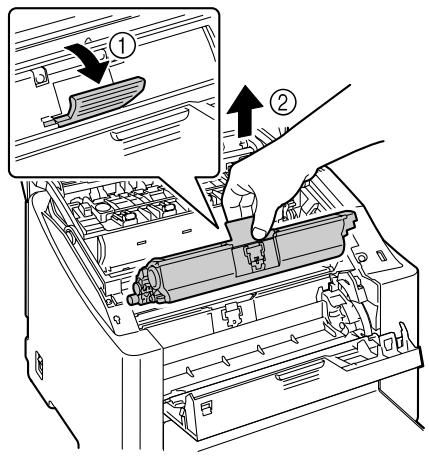
Note
Dispose of the empty toner cartridge according to your local regulations. Do not burn the toner cartridge.
5 Prepare a new toner cartridge.
6 Shake the cartridge a few times to distribute the toner.

Make sure that the toner roller cover is securely attached before shaking the toner cartridge.
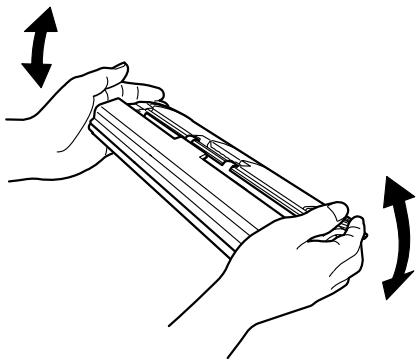
7 Remove the cover from the toner roller.

Do not touch or scratch the toner roller.
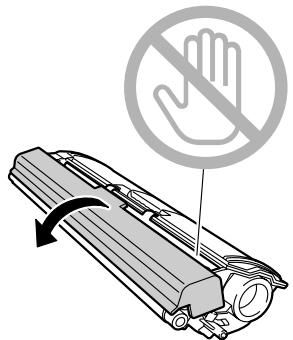
Align the shaft on each end of the toner cartridge with its holders, and then insert the cartridge.

Before inserting the toner cartridge, make sure that the color of the toner cartridge to be installed is the same as the label on the toner cartridge carousel.
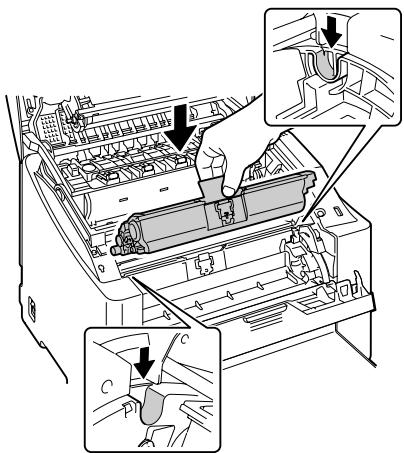
9 Press down on the toner cartridge until it snaps into place.
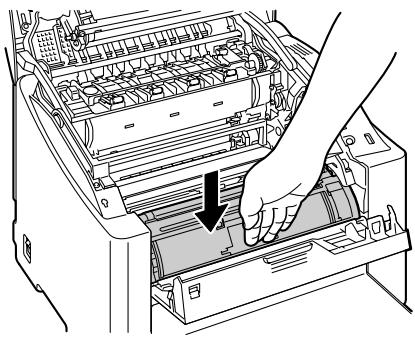
10 Close the front cover.
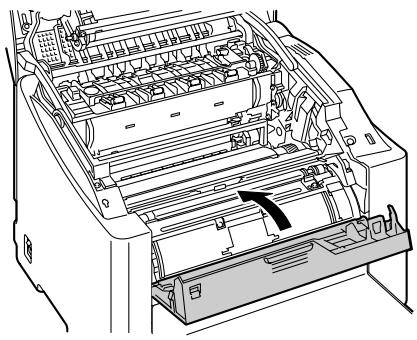
11 Carefully close the top cover.
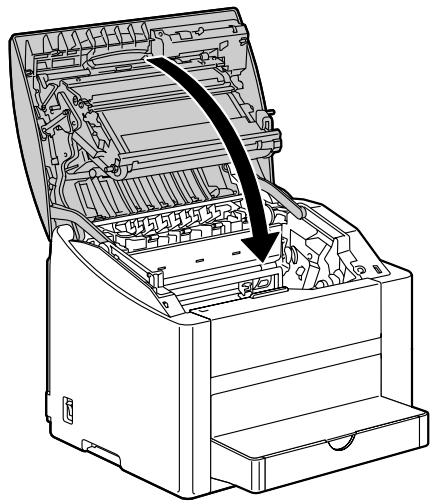

The printer must complete a calibration cycle (less than 2 minutes) after the toner cartridge has been replaced. If you open the top cover before the message IDLE appears, the printer stops and repeats the calibration cycle.
Replacing the Drum Cartridge
1 Pull the lever, and then open the top cover.

If there is paper in the output tray, remove it. Fold up the output tray before opening the top cover.

Do not touch the transfer belt.
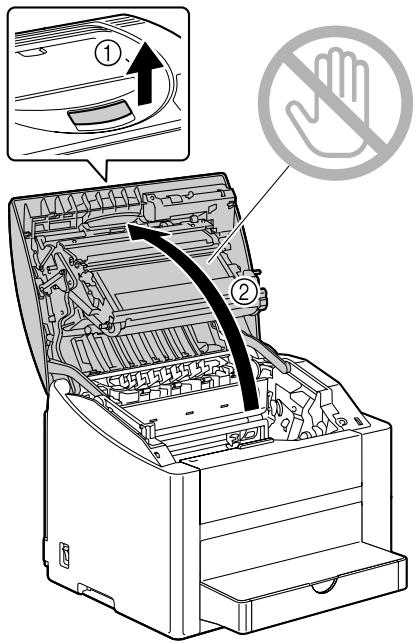
2 Carefully pull out the drum cartridge.
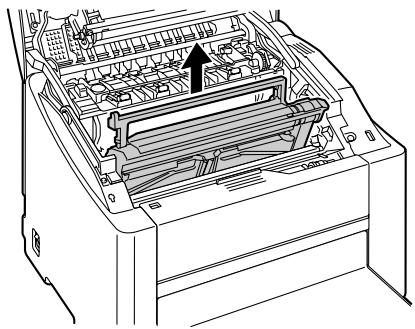
Note
Dispose of the used drum cartridge according to your local regulations. Do not burn the drum cartridge.
3 Prepare a new drum cartridge.

Do not touch the PC drum on the drum cartridge.
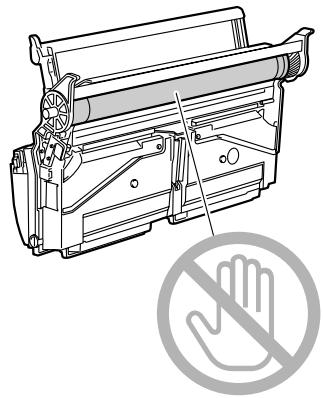
4 Install the new drum cartridge.
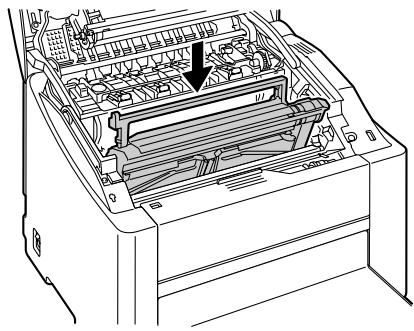
5 Carefully close the top cover.
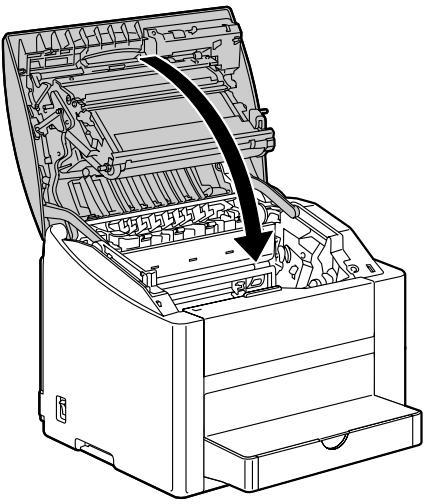

The printer must complete a calibration cycle (less than 2 minutes) after the drum cartridge has been replaced. If you open the top cover before the message IDLE appears, the printer stops and repeats the calibration cycle.
Replacing the Backup Battery
If the backup battery is dead, the printer's date and time cannot be retained. Follow the procedure described below to replace the backup battery.
Note
It's very important to protect the printer controller board and any associated circuit boards from electrostatic damage. Before performing this procedure, review the antistatic caution on Page 136. In addition, always handle circuit boards by the edges only.
1 Turn off the printer and disconnect the power cord and interface cables.

If the duplex option is installed, remove it.
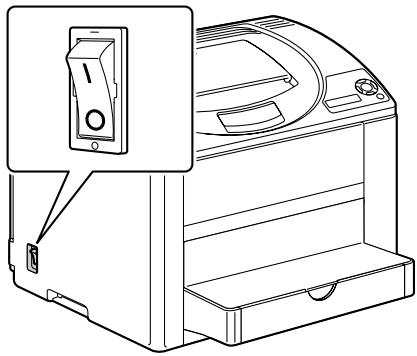
2 Using a screwdriver, remove the screw on the back of the printer.
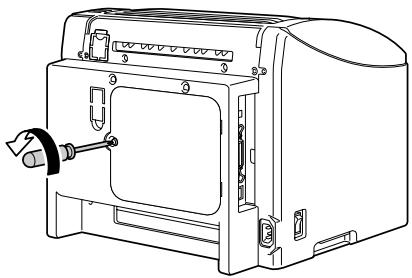
3 Remove the rear panel.

Since there are two hooks on the right side of the panel, remove the rear panel by slightly pulling the left side of the panel toward you, then sliding the panel off to the left.
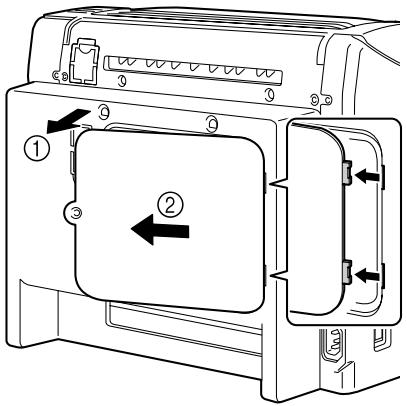
4 While holding the tab on the hard disk mounting pin slid to the left, remove the hard disk.
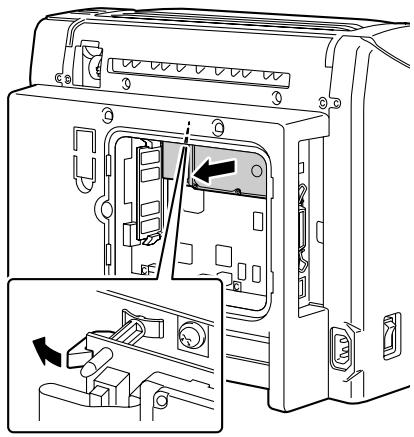
5 Remove the backup battery from the back of the hard disk.
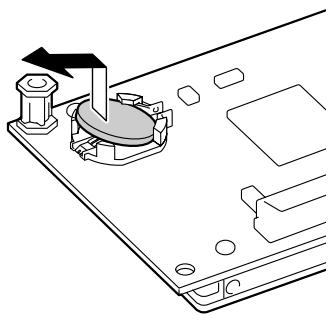
6 Install a new backup battery.

When installing the new backup battery, make sure that the + side faces up.
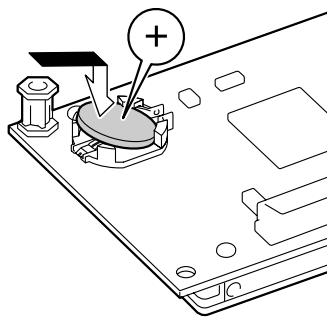
7 Attach the hard disk to the printer controller board.
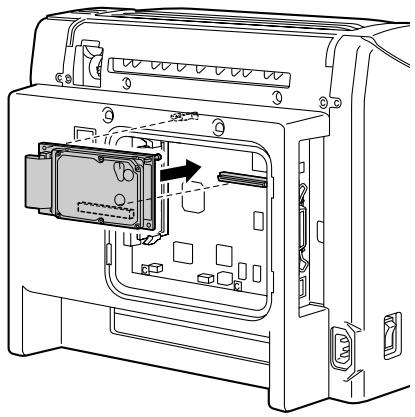
8 Reinstall the panel and tighten the screw.

If you removed the duplex option in step1, reinstall it.
9 Reconnect all interface cables.
10 Reconnect the power cord, and turn on the printer.
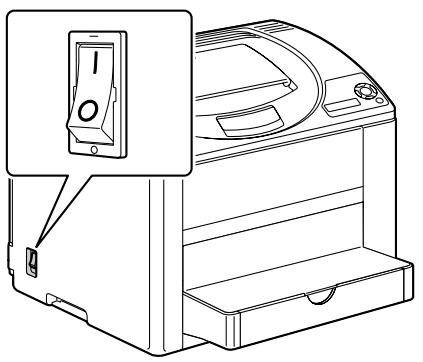
11 From the control panel, select SYSTEM DEFAULT/DATE & TIME, and then set the date and time.
Maintaining the Printer
7
Maintaining the Printer

CAUTION
Read all caution and warning labels carefully, making sure to follow any instructions contained in them. These labels are located on the inside of the printer's covers and the interior of the printer body.
Handle the printer with care to preserve its life. Abuse handling may cause damage and void your warranty. If dust and paper scraps remain on the inside or outside of the printer, printer performance and print quality will suffer, so the printer should be cleaned periodically. Keep the following guidelines in mind.

WARNING!
Turn off the printer, unplug the power cord, and disconnect all interface cables before cleaning. Do not spill water or detergent into the printer; otherwise the printer will be damaged and an electric shock may occur.

CAUTION
The fuser unit is hot. When the top cover is opened, the fuser unit temperature drops gradually (one hour wait time).

■ Be careful when cleaning the inside of the printer or removing media misfeeds, as the fuser unit and other internal parts may be very hot.
Do not place anything on top of the printer.
Use a soft cloth to clean the printer.
- Never spray cleaning solutions directly on the printer's surface; the spray could penetrate through the air vents of the printer and damage the internal circuits.
- Avoid using abrasive or corrosive solutions or solutions that contain solvents (such as alcohol and benzene) to clean the printer.
Always test any cleaning solution (such as mild detergent) on a small inconspicuous area of your printer to check the solution's performance.
- Never use sharp or rough implements, such as wire or plastic cleaning pads.
Always close the printer's covers gently. Never subject the printer to vibration.
- Do not cover the printer immediately after using it. Turn it off and wait until it cools down.
- Do not leave the printer's covers open for any length of time, especially in well-lit places; light may damage the drum cartridge.
Do not open the printer during printing. - Do not tap media stacks on the printer.
Do not lubricate or disassemble the printer.
Do not tilt the printer. - Do not touch the electrical contacts, gears, or laser devices. Doing so may damage the printer and cause the print quality to deteriorate.
- Keep media in the output tray at a minimum level. If the media is stocked too high, your printer may experience media misfeeds and excessive media curl.
- Keep the printer level to avoid toner spillage.
When lifting the printer, grasp the areas shown in the figure.

If you have the duplex option or Tray 2 installed, remove the option before lifting the printer. Do not lift the printer with the options.
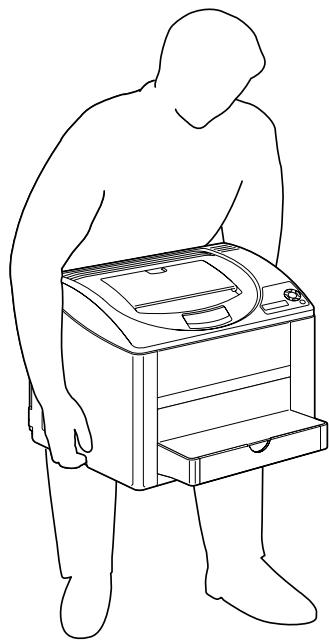
If you get toner on your skin, wash it off with cool water and a mild soap.

CAUTION
If you get toner in your eyes, wash it out immediately with cool water and consult a doctor.
Make sure any parts removed during cleaning are replaced before you plug in the printer.

CAUTION
Be sure to turn off the printer and unplug the power cord before cleaning.
Exterior
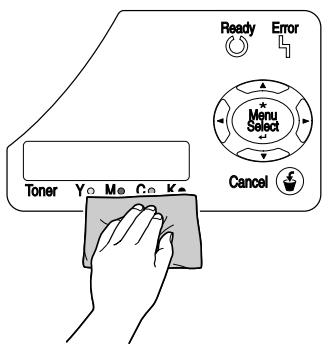
Control Panel
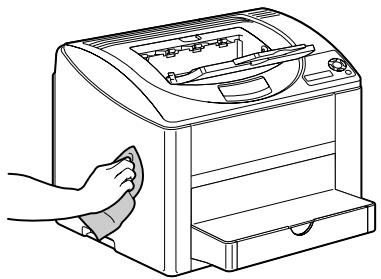
Printer Exterior
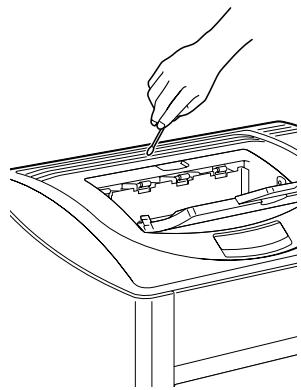
Ventilation Grill
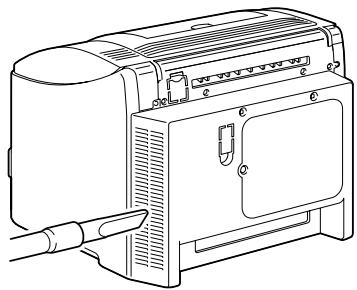
Filter
Interior
Cleaning the Media Feed Roller and Laser Lens
1 Pull the lever, and then open the top cover.

If there is paper in the output tray, remove it. Fold up the output tray before opening the top cover.

Do not touch the transfer belt.
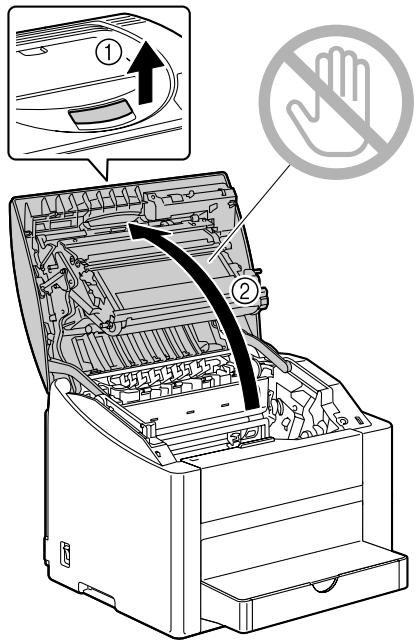
2 Carefully pull out the drum cartridge.
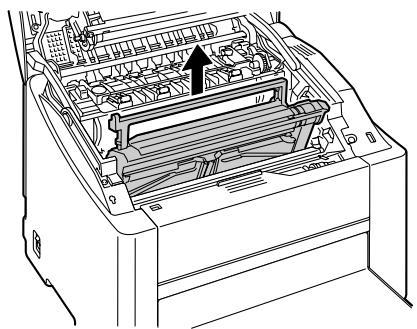
Position the removed drum cartridge as shown in the illustration at the right. Be sure to keep the drum cartridge horizontal and place it where it will not become dirty. Do not leave the drum cartridge removed for more than 15 minutes, and do not place the removed drum cartridge in a location where it would be exposed to direct light (such as sunlight).
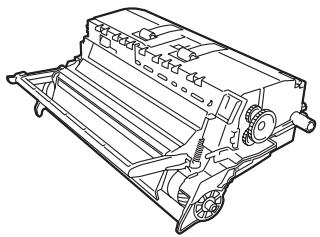
3 Clean the media feed rollers by wiping them with a soft, dry cloth.
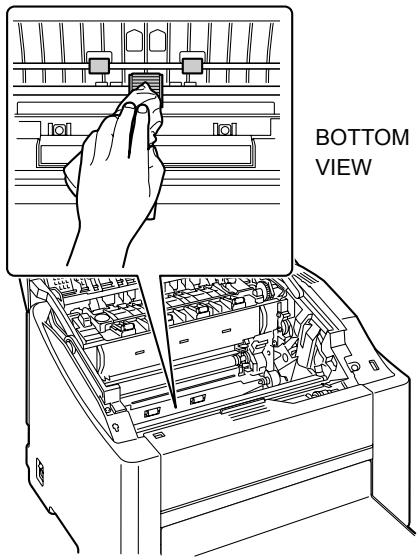
4 Clean the laser lens by wiping it with a soft, dry cloth.
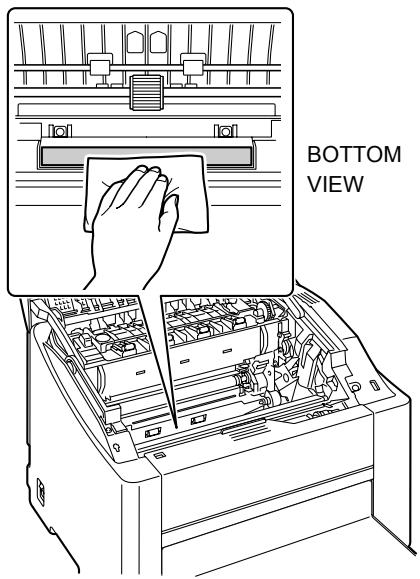
5 Reinstall the drum cartridge.
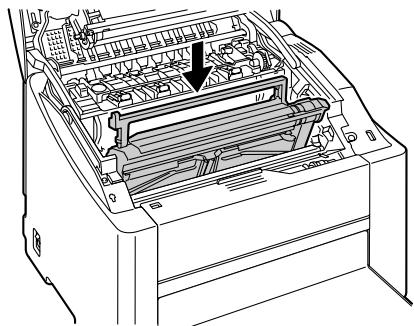
6 Carefully close the top cover.
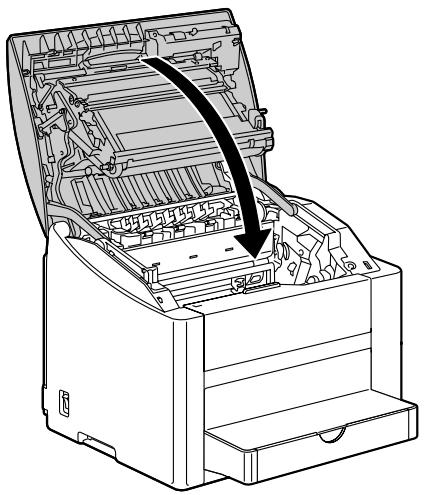
Cleaning the Duplex Option Feed Rollers
1 Open the duplex cover.
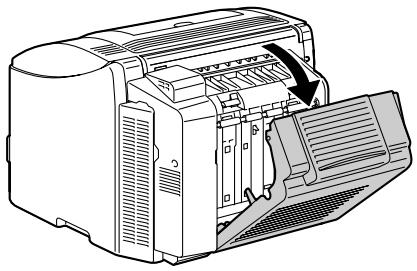
2 Clean the feed rollers by wiping them with a soft, dry cloth.
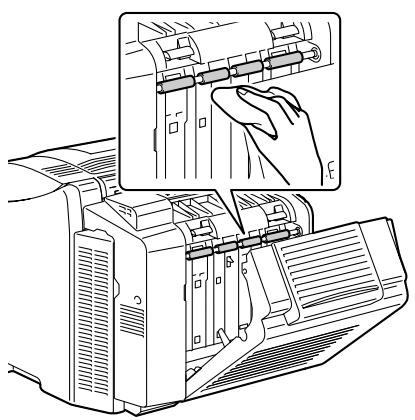
3 Carefully close the duplex cover.
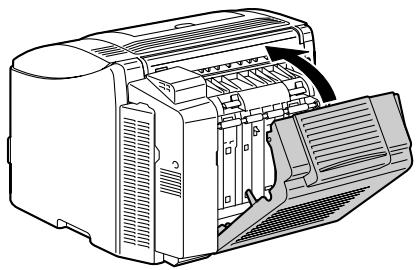
Cleaning the Media Feed Rollers for Tray 2
1 Lift the printer off of Tray 2 and temporarily place it on a sturdy flat surface.
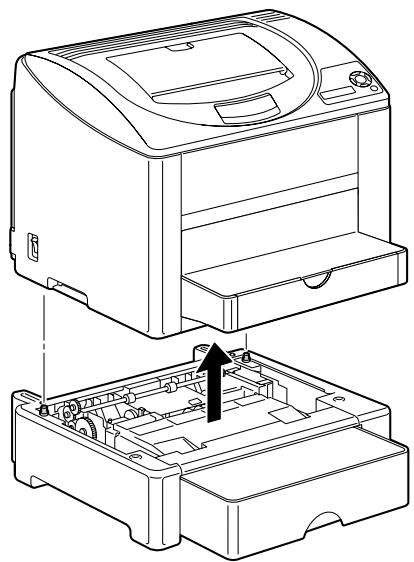
2 Clean the media feed rollers by wiping them with a soft, dry cloth.
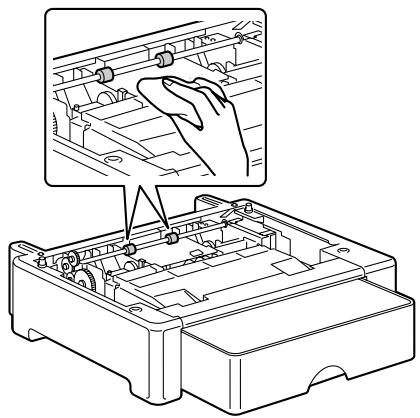
3 Lift the printer and reinstall it on top of Tray 2.
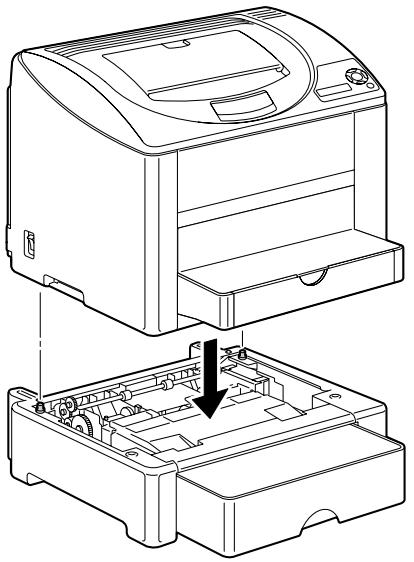
Storing the Printer
Note
If this printer is not to be used for an extended period of time, store the printer with the fuser separator levers raised (set to the envelope position).
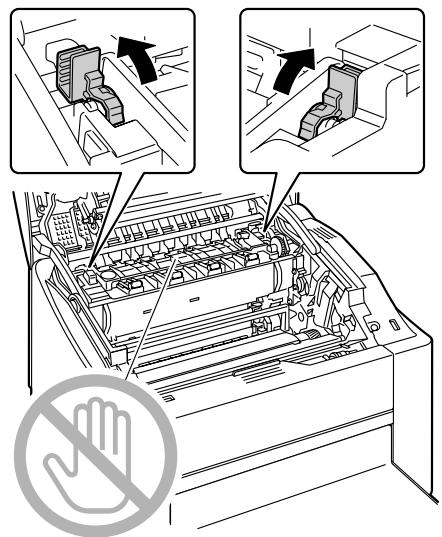
Note
Since a media misfeed or decreased print quality may occur, be sure to return the levers on the fuser unit to the setting for plain paper before printing on media other than envelopes.
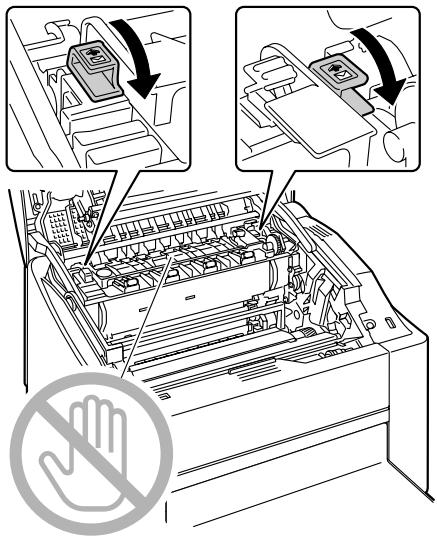
Troubleshooting
8
Introduction
This chapter provides information to aid you in resolving printer problems you may encounter, or at least guide you to the proper sources for help.
| Printing the configuration page | Page 104 |
| Preventing media misfeeds | Page 105 |
| Understanding the media path | Page 106 |
| Clearing media misfeeds | Page 106 |
| Solving problems with media misfeeds | Page 116 |
| Solving other problems | Page 119 |
| Solving problems with printing quality | Page 123 |
| Status, error, and service messages | Page 129 |
Printing a Configuration Page
Print a configuration page to verify the printer is configured correctly.
| Press Key | Until Display Reads |
| IDLE | |
| * Menu Select ← | PRINT MENU If the hard disk is installed, the PROOF/PRINT MENU appears. Press the Right key to select PRINT MENU. |
| * Menu Select ← | MENU MAP |
| → | CONFIGURATION |
| * Menu Select ← | The configuration page prints and the printer goes back to IDLE. |
Preventing Media Misfeeds
| Make sure that... |
| Media matches the printer specifications. |
| Media is flat, especially on the leading edge. |
| The printer is on a hard, flat, level surface. |
| You store media in a dry location away from moisture and humidity. |
| You remove transparencies from the output tray immediately after printing to avoid static buildup. |
| You always adjust the media guides in Tray 1 after inserting the media (a guide that is not properly adjusted can cause poor print quality, media mis-feeds, and printer damage). |
| You load the media printing-side up in the tray (many manufacturers place an arrow on the end of the wrapper to indicate the printing side). |
| Avoid... |
| Media that is folded, wrinkled, or excessively curled. |
| Double feeding (remove the media and fan the sheets—they may be sticking together). |
| Fanning transparencies since this causes static. |
| Loading more than one type/size/weight of media in a tray at the same time. |
| Overfilling the trays. |
| Allowing the output tray to overfill (the output tray has a 200-sheet capacity—misfeeding may occur if you allow more than 200 sheets of media to accumulate at one time). |
| Allowing the output tray to fill with more than a few transparencies. |
Understanding the Media Path
Understanding the printer's media path will help you locate media misfeeds.
1 Output tray
2 Transfer belt unit
3 Toner cartridge carousel
4 Drum cartridge
5 Tray 1
6 Tray 2 (optional)
7 Duplex option
8 Fuser unit
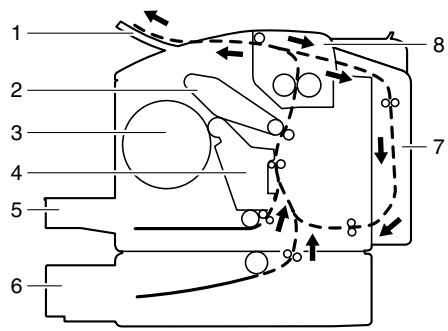
Clearing Media Misfeeds
To avoid damage, always remove misfed media gently, without tearing it. Any piece of media left in the printer, whether large or small, can obstruct the media path and cause further misfeeds. Do not reload media that has misfed.
Note
The image is not fixed on the media before the fusing process. If you touch the printed surface, the toner may stick to your hands, so be careful not to touch the printed face when removing the misfed media. Make sure not to spill any toner inside the printer.

CAUTION
Unfused toner can dirty your hands, clothes, or anything else it gets on. If you accidentally get toner on your clothes, lightly dust them off as best as you can. If some toner remains on your clothes, use cool, not hot water, to rinse the toner off. If toner gets on your skin, wash it off with cool water and a mild soap.

CAUTION
If you get toner in your eyes, wash it out immediately with cool water and consult a doctor.
If, after clearing the media misfeed, the misfeed message in the control panel window persists, open and close the printer's top cover. This should clear the misfeed message.
Media Misfeed Messages and Clearing Procedures
| Media Misfeed Message | Page Reference |
| PAPER JAM TRAY 1 | Page 107 |
| PAPER JAM FUSER | Page 107 |
| PAPER JAM EXIT | Page 107 |
| PAPER JAM TRANSFER | Page 107 |
| PAPER JAM TRAY 2 | Page 112 |
| PAPER JAM DUPLEX | Page 114 |
Clearing a Media Misfeed in the Printer
1 Pull the lever, and then open the top cover.

If there is paper in the output tray, remove it. Fold up the output tray before opening the top cover.

Do not touch the transfer belt.

2 Carefully pull out the drum cartridge.
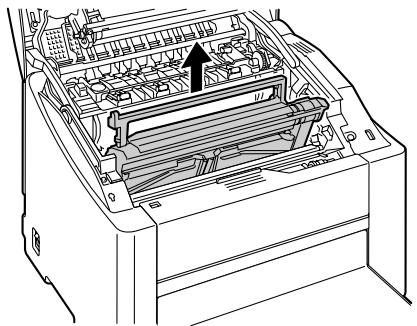
Note
Position the removed drum cartridge as shown in the illustration at the right. Be sure to keep the drum cartridge horizontal and place it where it will not become dirty. Do not leave the drum cartridge removed for more than 15 minutes, and do not place the removed drum cartridge in a location where it would be exposed to direct light (such as sunlight).
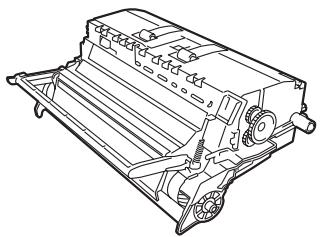
3 Push the fuser separator levers back as far as possible.
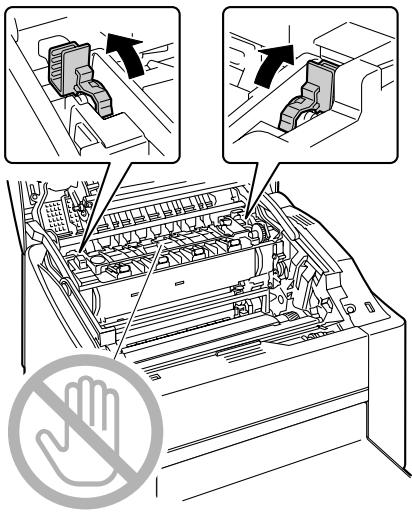
4 Remove any misfed media.

Always remove the misfed media in the feed direction as shown only. If it is difficult to remove the media from the fuser unit, raise the fuser separator levers to the position for envelope printing, and then remove the media. After removing the media, set the fuser separator levers to their original positions.
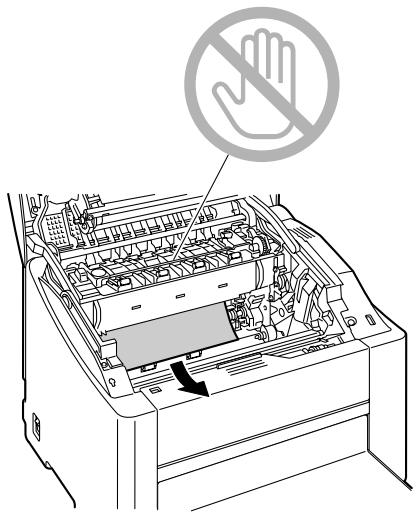
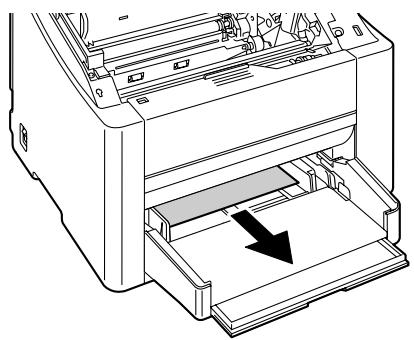
5 Return the fuser separator levers to their original positions.
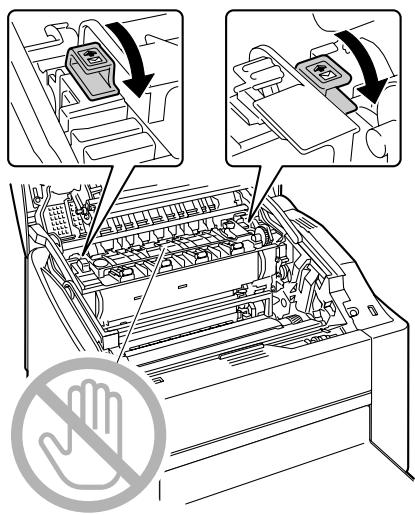
6 Reinstall the drum cartridge.
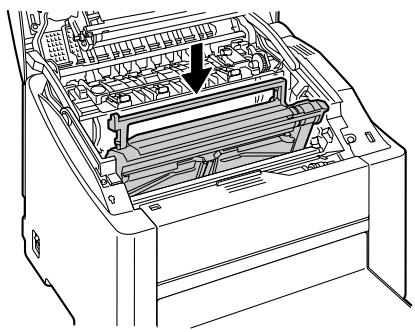
7 Carefully close the top cover.
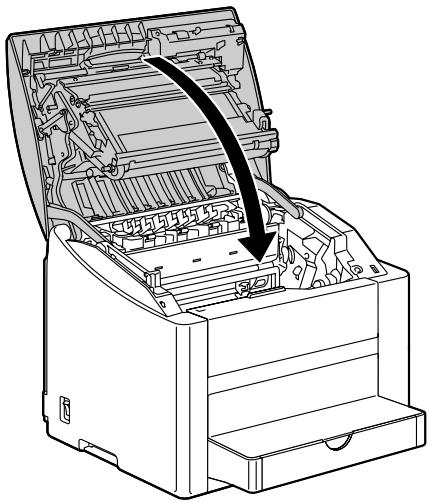
Clearing a Media Misfeed From Tray 2
1 Pull out Tray 2 as far as possible.
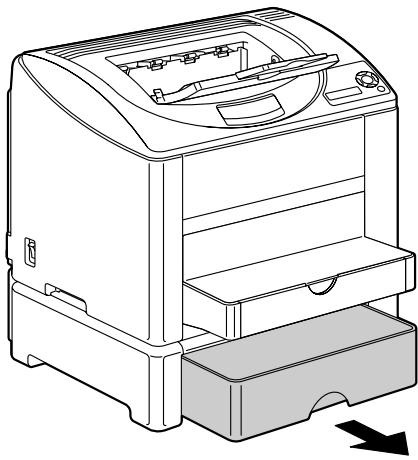
2 Lift up Tray 2 to remove it.
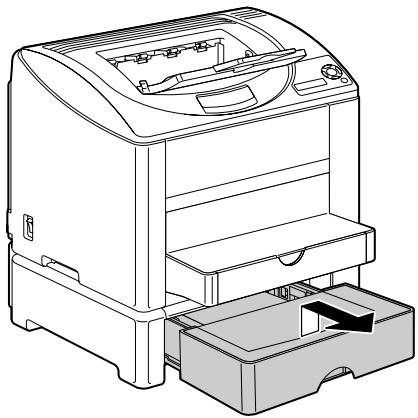
3 Remove any misfed paper.
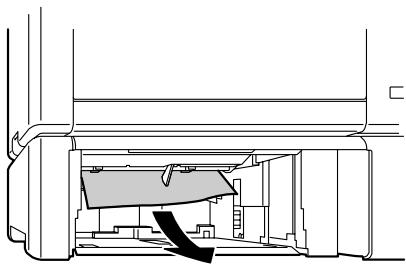
4 Remove the lid from Tray 2, and then remove all paper from the tray.
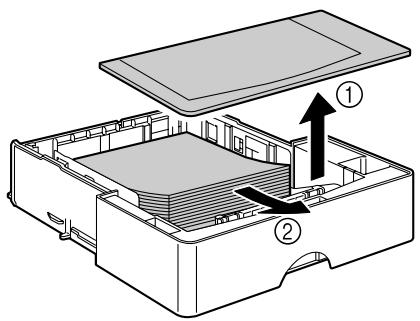
5 Fan the paper, and align its edges.
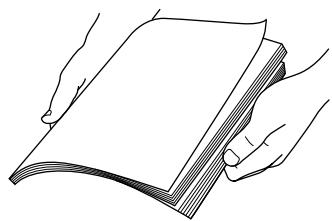
6 Load the media in Tray 2, and attach the lid.

7 Reinsert Tray 2.
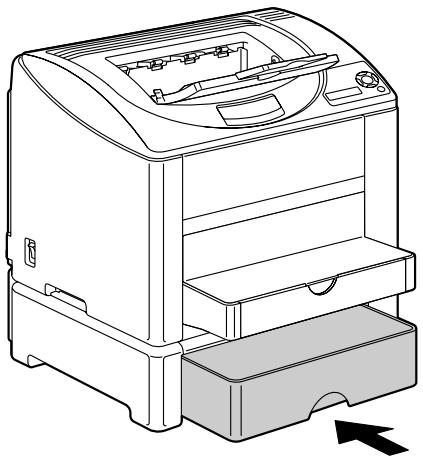
Clearing a Media Misfeed from the Duplex Option
1 Open the duplex cover.
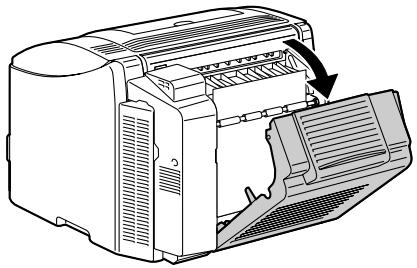
2 Carefully pull out the misfed media.

Always remove the misfed media in the feed direction as shown only.
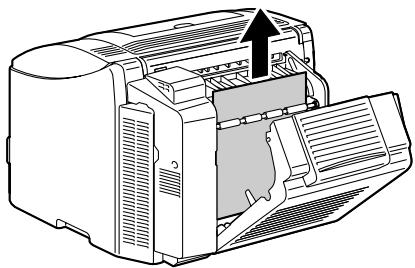
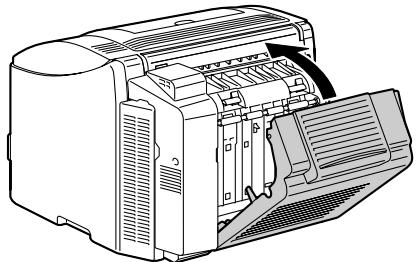
3 Close the duplex cover.
Solving Problems with Media Misfeeds

Frequent misfeeds in any area indicate that area should be checked, repaired, or cleaned. Repeated misfeeds may also happen if you're using unsupported print media.
| Symptom | Cause | Solution |
| Several sheets go through the printer together. | The front edges of the media are not even. | Remove the media and even up the front edges, then reload it. |
| The media is moist from humidity. | Remove the moist media and replace it with new, dry media. | |
| Too much static electricity is present. | Do not fan transparencies. | |
| Media mis-feed message stays on. | Top cover needs to be opened and closed again to reset the printer. | Open and close the top cover of the printer again. |
| Some media remains misfed in the printer. | Recheck the media path and make sure that you have removed all of the misfed media. | |
| Duplex option mis-feeds. | Unsupported media (wrong size, thickness, type, etc.) is being used. | Use KONICA MINOLTA-approved media. See “Media Specifications” on page 50. |
| Plain paper, recycled paper, and letter head can be autoduplexed if the duplex option is installed and the media type is set properly in the driver. See “Media Specifications” on page 50. | ||
| Make sure that you have not mixed media types in Tray 1. | ||
| Do not duplex envelopes, labels, transparencies, thick stock, postcard, or glossy stock. | ||
| Media is still being misfed. | Recheck the media path inside the duplex option and make sure that you have removed all of the misfed media. | |
| Media is misfeeding. | The media is not correctly positioned in the tray. | Remove the misfed media and reposition the media properly in the tray. |
| The number of sheets in the tray exceeds the maximum allowed. | Remove the excess media and reload the correct number of sheets in the tray. | |
| The media guides are not correctly adjusted to the media size. | Adjust the media guides in the Tray 1 to match the size of the media. | |
| Warped or wrinkled media is loaded in the tray. | Remove the media, smooth it out, and reload it. If it still misfeeds, do not use that media. | |
| The media is moist from humidity. | Remove the moist media and replace it with new, dry media. | |
| Custom-sized media, envelopes, labels, postcards, thick stock, or transparencies are loaded in Tray 2. | Special media must be loaded in Tray 1 only. | |
| The recommended transparency or label sheet is facing the wrong way in Tray 1. | Load the transparencies or label sheets according to the manufacturer's instructions. | |
| Envelopes are facing the wrong way in Tray 1. | Load the envelopes in Tray 1 with the flaps facing down. | |
| If the flaps are on the long edge, load the envelopes with the flap toward the left of the printer with the flaps facing down. | ||
| Media is misfeeding. | Transparencies have collected static eletricity in the tray. | Remove the transparencies and load them in Tray 1 one sheet at a time. Do not fan transparencies before loading them. |
| Unsupported media (wrong size, thickness, type, etc.) is being used. | Use KONICA MINOLTA-approved media. See “Media Specifications” on page 50. | |
| The media feed roller is dirty. | Clean the media feed roller. For more details, refer to “Interior” on page 95. |
Solving Other Problems

To order KONICA MINOLTA consumables, go to www.q-shop.com.
| Symptom | Cause | Solution |
| Printer power is not on. | The power cord is not correctly plugged into the outlet. | Turn off the printer, confirm that the power cord is correctly plugged into the outlet, and then turn on the printer. |
| Something is wrong with the outlet connected to the printer. | Plug another electrical appliance into the outlet and see whether it operates properly. | |
| The power switch is not correctly turned on (I position). | Turn the power switch off (O position), then turn it back to the on (I position). | |
| The printer is connected to an outlet with a voltage or frequency that does not match the printer specifications. | Use a power source with the specifications listed in appendix A, “Technical Specifications.” | |
| The control panel displays X LOW much sooner than expected. | One of the toner cartridges may be defective. | Remove the toner cartridges and check each for damage. If one or more is damaged, replace it. |
| You printed with heavy toner coverage. | See specifications in Appendix A. | |
| You can’t print the configuration page. | The tray is empty. | Check that at least Tray 1 is loaded with media, in place, and secure. |
| The printer’s covers aren’t closed securely. | Make sure the covers are closed securely. Close all covers gently to avoid jarring the printer. | |
| There is a media misfeed. | Clear the media misfeed. | |
| Printing takes too much time. | The printer is set to a slow printing mode (for example, thick stock or transparency). | It takes more time to print with special media. When using regular paper, make sure that the media type is set properly in the driver. |
| The printer is set to power saving mode. | It takes time for printing to start in power saving mode. If you do not want to use this mode, disable it. (SYSTEM DEFAULT/ENERGY Saver MGT menu) | |
| The job is very complex. | Wait. No action needed. | |
| The printer memory is insufficient. | Add more memory. | |
| A toner cartridge for a different region is installed (X INCOR-RECT is displayed in the message window). | Install a correct KONICA MINOLTA toner cartridge approved for your spe-cific printer. | |
| Blank pages are printed. | One or more of the toner cartridges are defective or empty. | Check the toner cartridges. The image will not print correctly or not at all, if a cartridge is empty. |
| The wrong media is being used. | Check that the media type set in the driver matches the media loaded in the printer. | |
| Printer returned to IDLE before the configu-ration menu was changed. | The printer was in the configuration menu structure without a selection being made within two minutes. | When in the configuration menu struc-ture, select your choice within 2 min-utes. |
| Not all pages print. | The Cancel key was pressed. | Make sure no one pressed the Cancel key while your job was printing. |
| The tray is empty. | Check that the tray is loaded with media, in place, and secure. | |
| A document is printed with an overlay file which has been created by a non-bizhub C10P driver. | Print the overlay file using a bizhub C10P driver. | |
| Printer resets or turns off frequently. | The power cord is not correctly plugged into the outlet. | Turn off the printer, confirm that the power cord is correctly plugged into the outlet, and then turn on the printer. |
| A system error occurred. | Contact Technical Support with the error information. | |
| You are experiencing duplex problems. | Media or settings are not correct. | For autoduplexing, make sure that you have a duplex option installed. |
| Make sure that you are using correct media.■ See "Media Specifications" on page 50.■ Do not duplex custom-sized media, envelopes, labels, postcards, thick stock, or transparencies.■ Make sure that you have not mixed media types in Tray 1. | ||
| Make sure the duplex option is installed and declared in the Windows printer driver (Properties/Configure tab). | ||
| In the printer driver (Layout/Double-sided), choose "Double-sided". | ||
| For N-up on duplexed pages, choose Collate only in the driver's Basic Tab. Do not set collation in the application. | ||
| With N-up on multiple copies, the output is incorrect. | Both the driver and the application have been set for collation. | For N-up on multiple copies, choose Collate only in the driver's Basic Tab. Do not set collation in the application. |
| You hear unusual noises. | The printer is not level. | Place the printer on a flat, hard, level surface. |
| The tray is not installed correctly. | Remove the tray that you are printing from and reinsert it completely into the printer. | |
| There is a foreign object stuck inside the printer. | Turn off the printer and remove the object. If you cannot remove it, contact Technical Support. | |
| The web-based utility cannot be accessed. | The PageScope Web Connection Adminis-trator's password is incorrect. | The PageScope Web Connection Administrator password has a 6-character minimum and a 16-character maximum. For details of the Page-Scope Web Connection administrator password, refer to the bizhub C10P Reference Guide on the Documenta-tion CD-ROM. |
| Media is wrinkled. | The media is moist from humidity or having water spilled on it. | Remove the moist media and replace it with new, dry media. |
| The media feed roller or fuser unit is defective. | Check them for damage. If necessary, contact Technical Support with the error information. | |
| Unsupported media (wrong size, thickness, type, etc.) is being used. | Use KONICA MINOLTA-approved media. See "Media Specifications" on page 50. | |
| Envelopes are being printed with the fuser separator levers in the plain paper position. | Before printing envelopes, place the fuser separator levers in the envelope position. | |
| The date and time is not correctly maintained on the printer. | The backup battery has reached the end of its service life. | Replace the backup battery. For details, see "Replacing the Backup Battery" on page 87. |
Solving Problems with Printing Quality
| Symptom | Cause | Solution |
| Nothing is printed, or there are blank spots on the printed page. | One or more of the toner cartridges may be defective. | Remove the toner cartridges and check if any is damaged. |
| The drum cartridge may be defective. | Remove the drum cartridge and check for damage. If it is damaged, replace it. | |
| The media is moist from humidity. | Adjust the humidity for media storage. Remove the moist media and replace it with new, dry media. | |
| The media set in the printer driver mismatches the media loaded in the printer. | Load the correct media in the printer. | |
| The power source does not match the printer specifications. | Use a power source with the proper specifications. | |
| Several sheets are being fed at the same time. | Remove the media from the tray and check for static electricity. Fan plain paper or other media (but not transparencies), and replace it in the tray. | |
| Media is not set properly in the tray(s). | Remove the media, tap it to straighten it out, return it into the tray, and realign the media guides. | |
| Entire sheet is printed in black or color. | One or more of the toner cartridges may be defective. | Remove the toner cartridges and check each for damage. If one or more is damaged, replace it. |
| The drum cartridge may be defective. | Remove the drum cartridge and check for damage. If it is damaged, replace it. | |
| Image is too light; there is low image density. | Laser lens is dirty. | Clean the laser lens. |
| The media is moist from humidity. | Remove the moist media and replace with new, dry media. | |
| There is not much toner left in the car- tridge. | Replace the toner cartridge. | |
| One or more of the toner cartridges may be defective. | Remove the toner cartridges and check each for damage. If one or more is damaged, replace it. | |
| Media type is set incorrectly. | When printing envelopes, labels, post-cards, thick stock, or transparencies, specify the appropriate media type in the printer driver. | |
| Image is too dark. | One or more of the toner cartridges may be defective. | Remove the toner cartridges and check each for damage. If one or more is damaged, replace it. |
| Printer Printer Printer Printer | The drum cartridge may be defective. | Remove the drum cartridge and check for damage. If it is damaged, replace it. |
| Image is blurred; background is lightly stained; there is insufficient gloss of the printed image. | One or more of the toner cartridges may be defective. | Remove the toner cartridges and check each for damage. If one or more is damaged, replace it. |
| The drum cartridge may be defective. | Remove the drum cartridge and check for damage. If it is damaged, replace it. | |
| The print or color density is uneven. | One or more of the toner cartridges may be defective or low. | Remove the toner cartridges and check for damage. If it is damaged, replace it. |
| The drum cartridge is defective. | Remove the drum cartridge and check for damage. If it is damaged, replace it. | |
| The printer is not level. | Place the printer on a flat, hard, level surface. | |
| Irregular print or mottled image appears. | The media is moist from humidity. | Adjust the humidity in the media storage area. Remove the moist media and replace it with new, dry media. |
| Unsupported media (wrong size, thickness, type, etc.) is being used. | Use KONICA MINOLTA-approved media. See “Media Specifications” on page 50. | |
| One or more of the toner cartridges may be defective. | Remove the toner cartridges and check each for damage. If one or more is damaged, replace it. | |
| The drum cartridge is defective. | Remove the drum cartridge and check for damage. If it is damaged, replace it. | |
| The fuser separator levers are adjusted for envelope printing. | Return the fuse separator levers to the plain paper setting. | |
| There is insufficient fusing or the image comes off when rubbed. | The media is moist from humidity. | Remove the moist media and replace it with new, dry media. |
| Unsupported media (wrong size, thickness, type, etc.) is being used. | Use KONICA MINOLTA-approved media. See “Media Specifications” on page 50. | |
| Media type is set incorrectly. | When printing envelopes, labels, post-cards, thick stock, or transparencies, specify the appropriate media type in the printer driver. | |
| The fuser separator levers are adjusted for envelope printing. | Return the fuse separator levers to the plain paper setting. | |
| There are toner smudges or residual images. | One or more of the toner cartridges are defective or installed incorrectly. | Remove the toner cartridges and check each for damage. If one or more is damaged, replace it. |
| The fuser separator levers are adjusted for envelope printing. | Return the fuse separator levers to the plain paper setting. | |
| There are toner smudges on the back side of the page (whether or not it has been duplexed). | The media transfer roller is dirty. | Clean the media transfer roller. |
| If you think the transfer roller should be replaced, contact Technical Support with the error information. | ||
| The media path is dirty with toner. | Print several blank sheets and the excess toner should disappear. | |
| One or more of the toner cartridges are defective. | Remove the toner cartridges and check each for damage. If one or more is damaged, replace it. | |
| The drum cartridge is defective. | Remove the drum cartridge and check for damage. If it is damaged, replace it. | |
| Abnormal areas (white, black, or color) appear in a regular pattern. | The laser lens is dirty. | Clean the laser lens. |
| A toner cartridge may be defective. | Remove the toner cartridge with the color causing the abnormal image. Replace it with a new toner cartridge. | |
| The drum cartridge is defective. | Remove the drum cartridge and check for damage. If it is damaged, replace it. | |
| Image defects. | The laser lens is dirty. | Clean the laser lens. |
| A toner cartridge may be leaking. | Remove the toner cartridges and check for damage. If it is damaged, replace it. | |
| A toner cartridge may be defective. | Remove the toner cartridge with the color causing the abnormal image. Replace it with a new toner cartridge. | |
| The drum cartridge may be defective. | Remove the drum cartridge and check for damage. If it is damaged, replace it. | |
| Lateral lines or bands appear on image. | The printer is not level. | Place the printer on a flat, hard, level surface. |
| The media path is dirty with toner. | Print several sheets and the excess toner should disappear. | |
| One or more of the toner cartridges may be defective. | Remove the toner cartridges and check each for damage. If one or more is damaged, replace it. | |
| The drum cartridge is defective. | Remove the drum cartridge and check for damage. If it is damaged, replace it. | |
| Colors look drastically wrong. | One or more of the toner cartridges may be defective. | Remove the toner cartridges and verify that the toner is distributed evenly on each cartridge roller, and reinstall the toner cartridges. |
| One or more of the toner cartridges may be low or empty. | Check the control panel for an X LOW or X EMPTY message. If necessary, replace the specified toner cartridge. | |
| Colors are not registering properly; colors are mixed or have page-to-page variation. | The drum cartridge is not correctly seated. | Remove the drum cartridge and rein stall it. |
| One or more of the toner cartridges may be defective. | Remove the toner cartridges and check each for damage. If one or more is damaged, replace it. | |
| The media is moist from humidity. | Remove the moist media and replace it with new, dry media. | |
| The color has a poor reproduction or has poor color density. | The drum cartridge may be defective. | Remove the drum cartridge and check for damage. If it is damaged, replace it. |
| Perform AIDC. (On the control panel menu, go to QUALITY MENU/AIDC/REQUEST AIDC, then select YES.) | ||
| Printer Printer Printer Printer |
If the problem is not resolved, even after all of the above have been performed, contact Technical Support with the error information.
For contact information, refer to the Need Assistance Sheet.
Status, Error, and Service Messages
Status, error, and service messages are displayed in the control panel message window. They provide information about your printer and help you locate many problems. When the condition associated with a displayed message has changed, the message is cleared from the window.
Standard Status Messages
| This message... | means... | do this... |
| CALIBRATING | Whenever you replace a toner cartridge or reboot the printer after making environmental changes, the printer automatically pauses to do an Auto-Image Density Control (AIDC) cycle. This process is provided to make reliable printer operation with optimum output quality possible. | No action needed. |
| CANCELLING JOB | The job is being cancelled. | |
| COPYING XX/XX | The printer is printing with the collating function. | |
| ENERGY Saver | The printer is in Energy Saver mode to reduce power consumption during periods of inactivity. When a print job is received, the printer returns to normal power within 35 seconds. In addition, the machine will return to its normal operating condition when any key on the control panel is pressed. | |
| IDLE | The printer is on and ready to receive data. | |
| INITIALIZING | The printer is being initialized. | |
| PRINTING | The printer is printing. | |
| PROCESSING | The printer is processing data. | No action needed. |
| bizhub C10P STARTING SYSTEM | The printer is being started up. | |
| WARMING UP | The printer is warming up. |
Error Messages (Warning)
| This message... | means... | do this... |
| CANNOT ROTATE CARTRIDGE | A problem occurred, such as a media mis- feed, that prevents the toner cartridge carousel from rotat- ing. | If a media misfeed occurred, clear the mis- fed media. |
| DISK NEAR FULL | The optional hard disk is full. | Delete print jobs saved on the hard disk. |
| X EMPTY | The X toner cartridge is empty. This message appears when the QUALITY/TONER OUT ACTION menu is set CONTINUE. | Replace the toner car- tridge. |
| X INCORRECT | The X toner cartridge is an unapproved type. | Install a KONICA MINOLTAtoner cartridge of the appropri- ate type (AM or EU). See Page 77. |
| OPC DRUM LOW | The drum cartridge is near the end of its life. | Prepare a new drum car- tridge. |
| OPC DRUM OUT | The drum cartridge has reached the end of its life. | Replace the drum car- tridge. |
| PAPER MISMATCH | When using Tray 1: The paper size set from the printer driver is different from the size of paper loaded into Tray 1. This message appears when PAPER MENU/INPUT TRAY/TRAY 1 MODE is set to AUTO and AUTO CONTINUE is set to OFF. | Printing continues with paper of a different size, even if this message appeared. To print using paper of the desired size, load paper of the correct size, and then try printing again. |
| When using Tray 2: The paper size set from the printer driver is different from the size of paper loaded into Tray 2. This message appears when PAPER MENU/INPUT TRAY/AUTO CONTINUE is set to ON. | ||
| X TONER LOW | The X toner cartridge is low and should be replaced within 200 pages at 5% coverage of letter/A4 pages. (Appears when QUALITY MENU/TONER LOW ACTION is set to YES.) | Prepare the specified color toner cartridge. |
| TRAY 2 OPEN | Tray 2 is not installed or is not fully closed. | Close Tray 2 or print from another tray. |
Error Messages (Operator Call)
| This message... | means... | do this... |
| DISK ERROR | The hard disk is full or damaged. | Initialize the hard disk or, if the error continues to occur, replace the hard disk. To initialize the hard disk, select SYSTEM DEFAULT/FORMAT/FORMAT DISK. |
| DISK FULL | The hard disk is full or damaged. | Initialize the hard disk. To initialize the hard disk, select SYSTEM DEFAULT/FORMAT/FORMAT DISK. |
| DUPLEX UNIT PANEL OPEN | Duplex cover is open. | Close the duplex cover. |
| AIDC ERROR | AIDC sensor error. | Open and close front cover to automatically clean AIDC parts. |
| MAIN UNIT COVER OPEN | The printer's top cover is open. | Close the top cover. |
| OPC DRUM MISSING | The drum cartridge is not installed. | Install the drum cartridge. |
| PAPER JAM DUPLEX | Media has misfed in the duplex option. | Locate and remove the mis-feed. |
| PAPER JAM EXIT | Media has misfed in the fuser area. | |
| PAPER JAM FUSER | ||
| PAPER JAM TRANSFER | Media has misfed in the transfer roller area. This type of misfeed means that the media did not make it to the paper exit area. | |
| PAPER JAM TRAY X | Media has misfed while being pulled from the specified tray (x). | Locate and remove the mis-feed. |
| PUT "SIZE" "TYPE" IN TRAY 1 | The paper size set from the printer driver is different from the size of paper loaded into Tray 1. This message appears when PAPER MENU/INPUT TRAY/TRAY 1 MODE is set to CASSETTE. | When PAPER MENU/INPUT TRAY/AUTO CONTINUE is set to ON: Printing continues with paper of a different size, even if this message appeared. To print using paper of the desired size, load paper of the correct size, and then try printing again. When PAPER MENU/INPUT TRAY/AUTO CONTINUE is set to OFF: Load paper of the correct size. In addition, press the Down key to be able to print using the loaded paper. |
| PUT "SIZE" "TYPE" IN TRAY 2 | The paper size set from the printer driver is different from the size of paper loaded into Tray 2. This message appears when PAPER MENU/INPUT TRAY/AUTO CONTINUE is set to OFF. | Load paper of the correct size. In addition, press the Down key to be able to print using the loaded paper. |
| REPLACE OPC DRUM | Waste toner bottle is full. | Replace the drum cartridge. |
| REPLACE X TONER | The x toner cartridge is empty. This message appears when the QUALITY/TONER OUT ACTION menu is set to STOP. | Replace the toner cartridge. |
| X TONER MISSING | The x toner cartridge is not installed. | Install a x toner cartridge. |
| MEDIA MISMATCH | The media type set in the printer driver is different from the type of media loaded. | Load the correct media type. |
| PAPER MISMATCH | When using Tray 1: The paper size set from the printer driver is different from the size of paper loaded into Tray 1. This message appears when PAPER MENU/ INPUT TRAY/TRAY 1 MODE is set to CASSETE and AUTO CONTINUE is set to OFF. | To print using paper of the desired size, load paper of the correct size, and then try printing again. |
Service Messages
These messages indicate a more serious error that can only be corrected by a customer service engineer. If one of these messages appears, turn the printer off, then turn it on again. If the problem persists, contact your local vendor or authorized service provider.
| This service message... | means... | do this... |
| SERVICE CALL XX | An error has been detected with the item indicated “XX” in the service message. | Reboot the printer. This often clears the service message, and printer operation can resume. If the problem persists, contact Technical Support. |
Installing Accessories
9
Note
Use of accessories not manufactured or supported by KONICA MINOLTA will void your warranty.
This chapter provides information about the following accessories.
| Dual In-Line Memory Module (DIMM) | 128 MB, 256 MB, 512 MB DIMM |
| Duplex Option | Auto duplexing |
| Tray 2 | 500-sheet tray |
| Hard Disk | 40 GB Hard Disk |
Note
Installing accessories always requires that the printer and accessories are turned off and unplugged during installation.

For details on the available options, refer to printer.konicaminolta.com.
Antistatic Protection
Note
It's very important to protect the printer controller board from electrostatic damage while performing any task involving the controller board.
Turn off all power switches first. If an antistatic wrist strap is provided in your printer option kit, attach one end of it to your wrist and the other end to the bare metal chassis on the back of your printer. Never attach the wrist strap to any piece of equipment with an electrical current present. Plastic, rubber, wood, painted metal surfaces, and telephones are not acceptable grounding points.
If you don't have an antistatic wrist strap, discharge your body's static electric charge by touching a grounded surface before you handle any printer boards or components. Also avoid walking around after grounding yourself.
Dual In-Line Memory Module (DIMM)
A dual in-line memory module (or DIMM) is a compact circuit board with surface-mount memory chips.
Your printer comes with 128 MB SDRAM printer memory on board. However, you can upgrade to a maximum of 640 MB of RAM through the installation of an additional unbuffered SDRAM DIMM. Your printer comes with one free DIMM slot.
Required Memory during Printing
| Monochrome | Full Color | Full Color | ||||
| Simplex / Duplex | Simplex | Duplex | ||||
| Resolution Paper Size | Stan-dard | High Quality | Stan-dard | High Quality | Stan-dard | High Quality |
| Letter/A4 | 128 MB | 128 MB | 128 MB | 128 MB | 128 MB | 256 MB |
| Legal | 128 MB | 128 MB | 128 MB | 256 MB | 128 MB | 384 MB |
Installing a DIMM
Note
It's very important to protect the printer controller board and any associated circuit boards from electrostatic damage. Before performing this procedure, review the antistatic caution on Page 136. In addition, always handle circuit boards by the edges only.
1 Turn off the printer and disconnect the power cord and interface cables.

If the duplex option is installed, remove it.
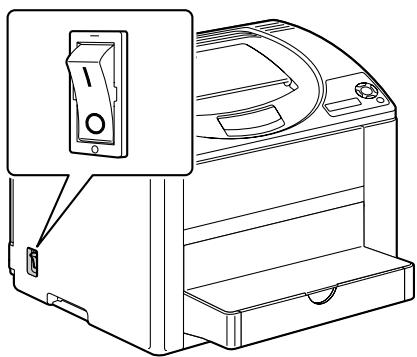
2 Using a screwdriver, remove the screw on the back of the printer.
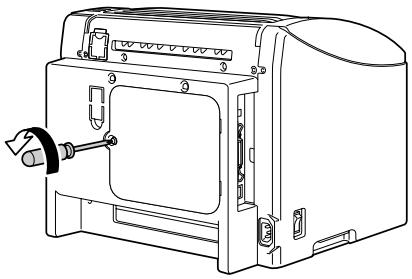
3 Remove the rear panel.

Since there are two hooks on the right side of the panel, remove the rear panel by slightly pulling the left side of the panel toward you, then sliding the panel off to the left.
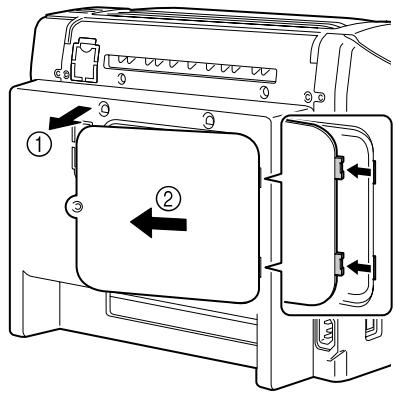
4 Insert the new DIMM straight into the DIMM connector until the latches snap into the locked position.
Observe the keyed side of the DIMM to align it with the connector. If you cannot snap the DIMM into place, do not force it. Reposition it, making sure that the DIMM is seated completely in the connector.
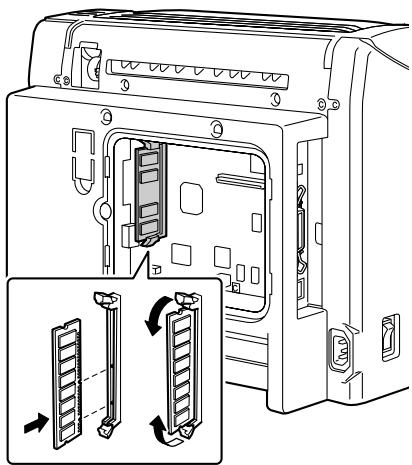
5 Reinstall the panel and tighten the screw.

If you removed the duplex option in step1, reinstall it.
6 Reconnect all interface cables.
7 Reconnect the power cord, and turn on the printer.
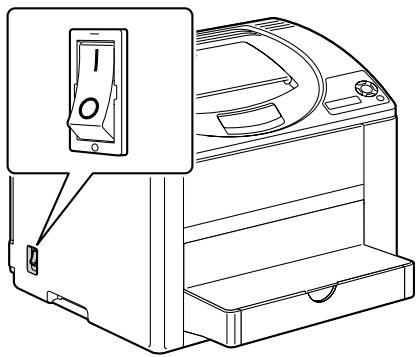
8 Declare the additional RAM in the Windows printer driver (Properties/Configure tab, see Page 10).
If a hard disk is installed, fonts can be downloaded and saved, and the overlay function can be used.
Installing a Hard Disk
Note
It's very important to protect the printer controller board and any associated circuit boards from electrostatic damage. Before performing this procedure, review the antistatic caution on Page 136. In addition, always handle circuit boards by the edges only.
1 Turn off the printer and disconnect the power cord and interface cables.

If the duplex option is installed, remove it.
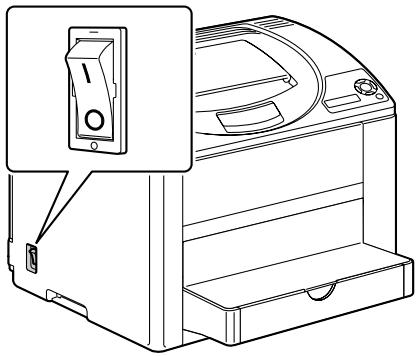
2 Using a screwdriver, remove the screw on the back of the printer.
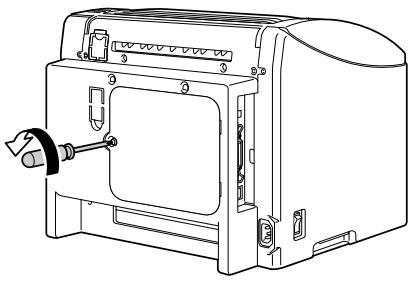
3 Remove the rear panel.

Since there are two hooks on the right side of the panel, remove the rear panel by slightly pulling the left side of the panel toward you, then sliding the panel off to the left.
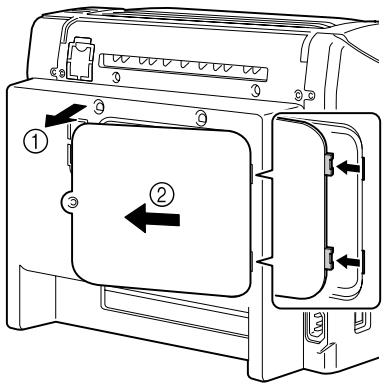
4 Attach the mounting pin on the printer controller board.

Be sure to slide the tab on the hard disk mounting pin to the left during installation.
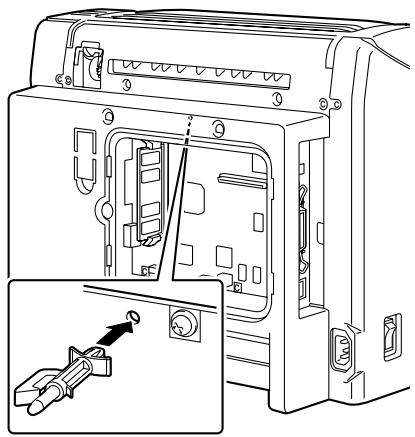
5 Remove the plastic strip between the battery and the disk controller board. Attach the spacer to the disk controller board.
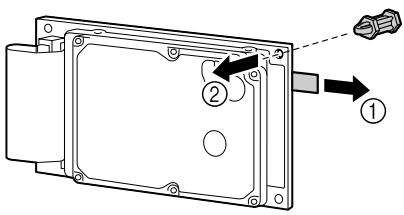
6 Attach the hard disk to the printer controller board.
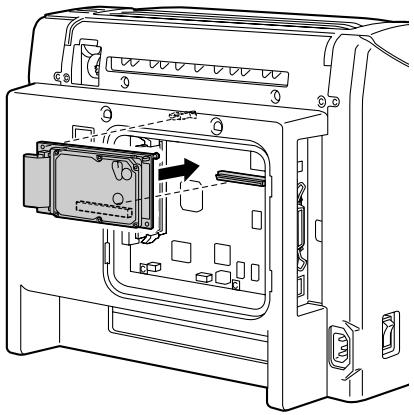
7 Reinstall the panel and tighten the screw.

If you removed the duplex option in step1, reinstall it.
8 Reconnect all interface cables.
9 Reconnect the power cord, and turn on the printer.

10 Declare the hard disk in the Windows printer driver (Properties/Configure tab, see Page 10).
Duplex Option
Duplex (Double Sided) printing can be performed automatically with the duplex option and enough memory installed. See "Required Memory during Printing" on page 137.
Installing the Duplex Option
1 Turn off the printer.
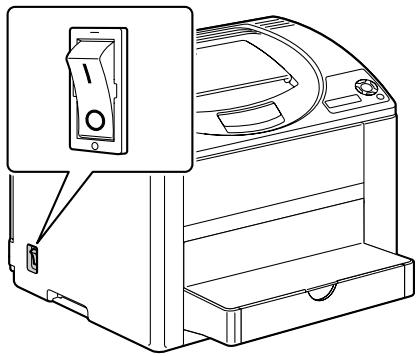
2 Remove the two knockout plates and the tape.
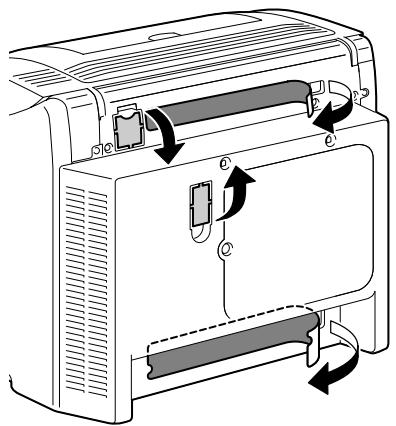
3 Prepare the duplex option.

Before installing the duplex option, open the duplex cover and check that the knob is positioned vertically. After checking the knob, close the cover.
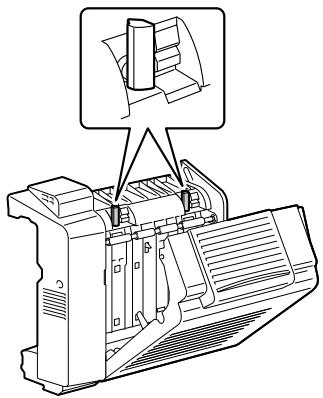
4 Install the duplex option.
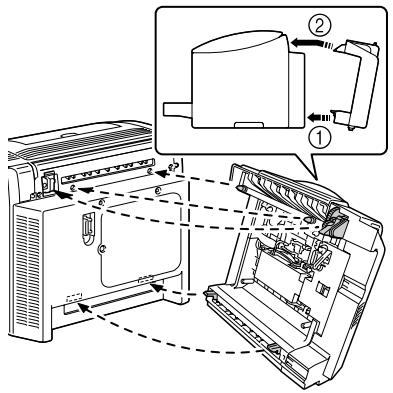
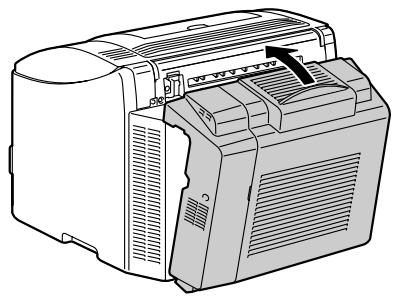
Note
When attaching the duplex option, attach the bottom of the option first, as shown. If the duplex option is attached incorrectly, it may be damaged.
5 Open the cover of the duplex option.

Since the duplex option is not yet secured to the printer, hold the duplex option in place when opening its cover.
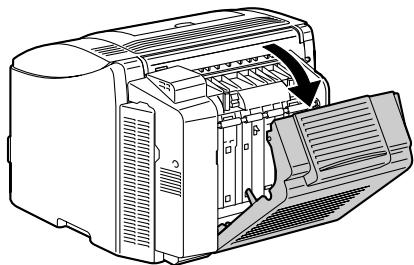
6 While pushing in the knobs, turn them clockwise until they are horizontal. The duplex option is secured in place.

Make sure that both knobs are securely locked.
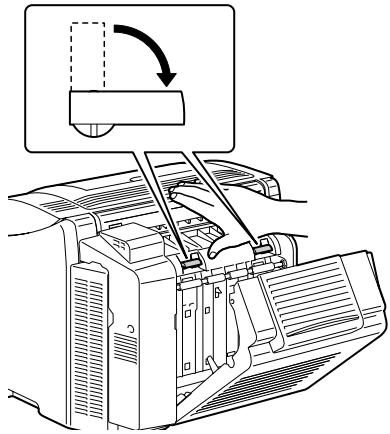
7 Close the duplex cover.
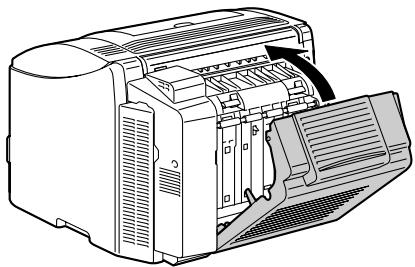
8 Declare the duplex in the Windows printer driver (Properties/Configure tab, see Page 10).
Tray 2
If Tray 2 is installed, up to 500 additional sheets of A4/Letter-size paper can be loaded.
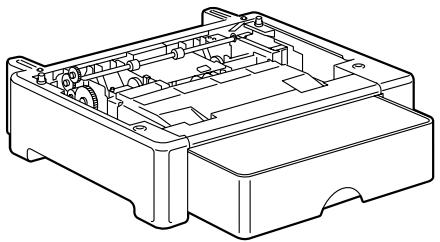
Installing Tray 2
Note
Since consumables are installed in the printer, be sure to keep the printer level when moving it in order to prevent accidental spills.
1 Turn off the printer and disconnect the power cord and interface cables.
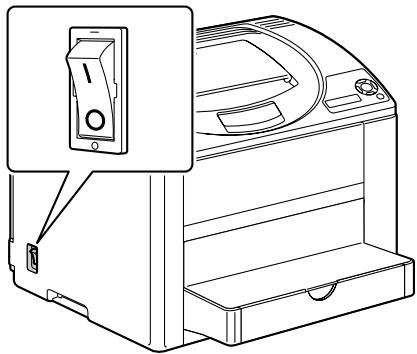
2 Prepare Tray 2.

Be sure to place Tray 2 on a level surface.
3 Lift the printer and place it on top of Tray 2, making sure that the positioning pins on Tray 2 correctly fit into the holes in the bottom of the printer.
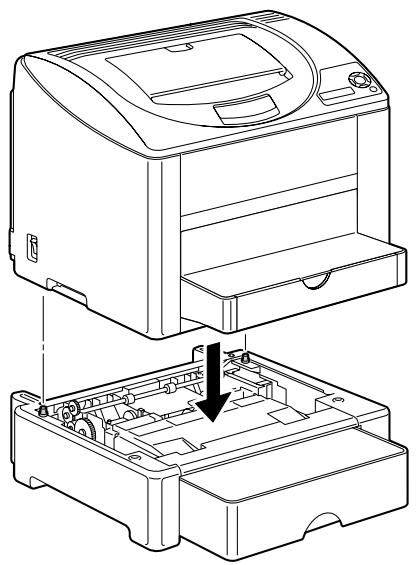
4 Declare the Tray 2 in the Windows printer driver (Properties/Configure tab, see Page 10).
Appendix
A
Safety Specifications
| Printer | ||
| Safety standards | U.S. model | UL 60950-1, CSA C22.2 No. 60950-1-03 |
| European model | EU Directive 73/23/EEC EU Directive 93/68/EEC EN 60950-1 (IEC 60950-1) | |
| China model | GB 4943 | |
| EMC standards | U.S. model | FCC part 15 subpart B class B ICES-003 |
| European model | EU Directive 89/336/EEC EU Directive 93/68/EEC EN 55022 (CISPR Pub. 22) class B EN 61000-3-2 EN 61000-3-3 EN 55024 | |
| China model | GB 9254 class B, GB 17625.1 | |
| Australian model | AS/NZS CISPR22 class B | |
Technical Specifications
Printer
| Type | Desktop full color laser beam printer |
| Printing system | 2 laser diodes and polygon mirror |
| Developing system | Mono-component toner developing |
| Resolution | 600 dpi × 600 dpi × 4 bits or 600 dpi × 600 dpi × 1 bit |
| First print | Simplex Monochrome: 13.0 seconds for A4, Letter (pplain paper) Full color: 22.0 seconds for A4, Letter (pplain paper) Duplex Monochrome: 26.0 seconds for A4, Letter (pplain paper) Full color: 35.0 seconds for A4, Letter (pplain paper) |
| Print speed | Simplex Monochrome: 20.0 pages per minute for A4, Letter (plain paper) Full color: 5.0 pages per minute for A4, Letter (plain paper) Duplex Monochrome: 11.4 pages per minute for A4, Letter (plain paper) Full color: 5.0 pages per minute for A4, Letter (plain paper) |
| Warm-up time | 120 V: 61 seconds or less 220 to 240 V: 65 seconds or less |
| Media sizes | Tray 1 Paper width: 92 to 216 mm (3.6 to 8.5") Paper length: 148 to 356 mm (5.9 to 14.0") Tray 2 (Optional) A4/Letter |
| Paper/Media | • Plain paper (60 to 90 g/m²; 16 to 24 lb bond) • Transparency • Envelope • Thick Stock (91 to 163 g/m²; 25 to 43 lb) • Postcard • Letterhead • Label sheet • Glossy stock |
| Input capacity | Tray 1 Plain paper: 200 sheets Envelope: 10 envelopes Label/Postcard/Thick Stock/Transparency/Glossy stock: 50 sheets Tray 2 (Optional) Plain paper: 500 sheets |
| Output capacity | Output tray: 200 sheets (A4, Letter) |
| Operating temperature | 10 to 35°C (50 to 95°F) |
| Operating humidity | 15 to 85% |
| Power supply | 110 to 127 V, 50 to 60 Hz 220 to 240 V, 50 to 60 Hz |
| Power consumption | 120 V: 1100 W 220 to 240 V: 1100 W Energy Saver Mode: 15 W or less |
| Amperage | 110 to 127 V: 11 A or less 220 to 240 V: 7 A or less |
| Acoustic Noise | Printing: 52 dB or less Standby: 35 dB or less |
| External dimensions | Height: 349 mm (13.7") |
| Width: 430 mm (16.9") | |
| Depth: 395 mm (15.6") | |
| Weights | Printer: 17.3 kg (38.1 lb) (excluding TC, DC, and the dust cover) 21.0 kg (46.2 lb) (including TC, DC, and the dust cover) Toner cartridge: Standard in-box cartridge = 0.65 kg (1.43 lb) (Y, M, C) 0.66 kg (1.46 lb) (K) Replacement cartridge (with toner roller cover)=Standard-capacity: 0.61 kg (1.34 lb) (Y, M, C) High-capacity: 0.70 kg (1.54 lb) (Y, M, C) 0.71 kg (1.57 lb) (K) |
| Interface | USB 2.0 and USB 1.1 compliant, 10Base-T/100Base-TX (IEEE 802.3) Ethernet, Parallel |
| Standard memory | 128 MB |
Consumable Life Expectancy Chart
User-Replaceable
| Item | Average Life Expectancy (in Simplex Pages) |
| Toner cartridge | Standard in-box Cartridge = 4,500 pages (Y, M, C, K) Replacement Cartridge = Standard-capacity: 1,500 pages (Y, M, C) High-capacity: 4,500 pages (Y, M, C, K) |
| Drum cartridge | Monochrome: 45,000 pages (Continuous) Full color: 11,250 pages (Continuous) |
Service-Replaceable
| Item | Average Life Expectancy |
| Transfer unit | Monochrome: 135,000 pages (Continuous) Full color: 33,700 pages (Continuous) |
| Transfer roller | 120,000 pages |
| Fuser unit | 120,000 pages |

The values listed in the above table indicate the number of pages for simplex printing using A4/Letter-size media with 5% coverage.
The actual life may differ (be shorter) depending on the printing conditions (coverage, paper size, etc.), differences in the printing method, such as continuous printing or intermittent printing (when print jobs of one page are often printed), or the type of paper used, for example, thick paper. In addition, the life will be affected by the temperature and humidity of the operating environment.
Our Concern for Environmental Protection

As an ENERGY STAR® Partner, we have determined that this machine meets the ENERGY STAR Guidelines for energy efficiency.
What is an ENERGY STAR product?
An ENERGY STAR product has a special feature that allows it to automatically switch to a "low-power mode" after a period of inactivity. An ENERGY STAR product uses energy more efficiently, saves you money on utility bills and helps protect the environment.
Index
A
Accessories 136
DIMMs 137
Duplex option 143
Hard disk 140
Tray 2 147
Antistatic protection 136
C
Configuration menu 27
Consumables
Backup battery 87
Drum cartridge 84
Toner cartridge 76
Control panel 24
D
Dual in-line memory module 137
Duplexing 71
Duplex option 143
E
Electrostatic discharge 136
Envelope 53
Error messages 130
G
Glossy stock 57
H
Hard disk 140
1
Imageable area 58
L
Labels 54
Letterhead 55
Loading media 59
M
Maintenance 92
Media
Clearing misfeeds 106
Imageable area 58
Loading 59
Path 106
Preventing misfeeds 105
Media misfeed
Duplex option 114
Interior 106
Tray 2 112
Media path 106
Media storage 73
Media type
Envelope 53
Glossy stock 57
Labels 54
Letterhead 55
Plain paper 51
Postcard 55
Thick stock 52
Transparency 56
Message window 24
Messages 129
Misfeed problems 116
Clearing 106
Media path 106
Preventing 105
0
Output tray 72
P
Plain paper 51
Postcard 55
Preventing media misfeeds 105
Print quality 123
Printer
Parts 3
Printer driver (Postscript, PCL) 13
Advanced tab 15
Basic tab 15
Cover page tab 16
Displaying 12
Layout tab 15
Overlay tab 16
Quality tab 17
Uninstalling 11
Version tab 17
Watermark tab 16
S
Service messages 134
Status monitor 20
Opening 20
Using 20
T
Thick stock 52
Transparency 56
Tray 2 147
Troubleshooting 103