
DW433 - Sander DEWALT - Free user manual and instructions
Find the device manual for free DW433 DEWALT in PDF.



| Product Type | Belt Sander |
| Brand | DEWALT |
| Model | DW433 |
| Supply Voltage | 230 V |
| Power Input | 800 W |
| Belt Speed (variable) | 260 - 420 m/min |
| Belt Dimensions | 533 mm x 75 mm (L x W) |
| Sanding Surface | 140 mm x 75 mm |
| Weight | 5.6 kg |
| Sound Pressure Level (L_pA) | 85.3 dB(A) |
| Sound Power Level (L_WA) | 94 dB(A) |
| Vibration Emission Value (EN 50144) | < 2.5 m/s² |
| Insulation | Double insulation (Class II) |
| Electronic Speed Control | Yes (DW433 model) |
| Adjustable Front Handle | Yes, two positions (top and front) |
| Dust Extraction System | With shutter and dust bag |
| Recommended Fuse | 10 A (230 V tools) |
| Package Contents | 1 sander, 1 dust bag, 1 set of belts, 1 manual, 1 exploded view |
| Warranty | 30-day satisfaction, 1 year free maintenance, 1 year manufacturing defects |
| Maintenance | No lubrication required; regular cleaning of ventilation slots |
Frequently Asked Questions - DW433 DEWALT
User questions about DW433 DEWALT
0 question about this device. Answer the ones you know or ask your own.
Ask a new question about this device
Download the instructions for your Sander in PDF format for free! Find your manual DW433 - DEWALT and take your electronic device back in hand. On this page are published all the documents necessary for the use of your device. DW433 by DEWALT.
USER MANUAL DW433 DEWALT
A
D2
BÅNDPUDSER DW432/DW433
Tillykke!
You have chosen a DeWALT tool. Years of experience, thorough product development and innovation make DeWALT one of the most reliable partners for professional power tool users.
Technical data
| DW432 | DW433 | ||
| Voltage | V | 230 | 230 |
| (U.K. & Ireland only) | V | 230/115 | 230/115 |
| Power input | W | 800 | 800 |
| Belt speed | m/min | 420 | 260 - 420 |
| Sanding surface | mm | 140 x 75 | 140 x 75 |
| Belt length | mm | 533 | 533 |
| Belt width | mm | 75 | 75 |
| Weight | kg | 5.6 | 5.6 |
| Fuses: | ||
| Europe | 230 V tools | 10 Amperes, mains |
| U.K. & Ireland | 230 V tools | 13 Amperes, in plugs |
The following symbols are used throughout this manual:

Denotes risk of personal injury, loss of life or damage to the tool in case of non-observance of the instructions in this manual.

Denotes risk of electric shock.

Fire hazard.

Explosion hazard.
EC-Declaration of conformity

DW432/DW433
DEWALT declares that these power tools have been designed in compliance with: 98/37/EEC, 89/336/EEC, 73/23/EEC, EN 50144, EN 55014-2, EN 55014-1, EN 61000-3-2 & EN 61000-3-3.
For more information, please contact DEWALT at the address below, or refer to the back of the manual.
Level of sound pressure according to 86/188/EEC & 98/37/EEC, measured according to EN 50144:
| DW432 | DW433 | ||
| L_pA (sound pressure) | dB(A)* | 85.3 | 85.3 |
| L_WA (acoustic power) | dB(A) | 94 | 94 |
* at the operator's ear

Take appropriate measures for the protection of hearing.
Weighted root mean square acceleration value according to EN 50144:
| DW432 | DW433 | |
| < 2.5 m/s^2 | < 2.5 m/s^2 |
Director Engineering and Product Development Horst Großmann
When using power tools, always observe the safety regulations applicable in your country to reduce the risk of fire, electric shock and personal injury.
Read all of this manual carefully before operating the tool.
Save this manual for future reference.
General
1 Keep work area clean
Cluttered areas and benches can cause accidents.
2 Consider work area environment
Do not expose the tool to rain. Do not use the tool in damp or wet conditions. Keep the work area well lit (250 - 300 Lux). Do not use the tool where there is a risk of causing fire or explosion, e.g. in the presence of flammable liquids and gases.
3 Keep children away
Do not allow children, visitors or animals to come near the work area or to touch the tool or the mains cable.
4 Dress properly
Do not wear loose clothing or jewellery, as these can be caught in moving parts. Wear protective hair covering to keep long hair out of the way.
When working outdoors, preferably wear suitable gloves and non-slip footwear.
5 Personal protection
Always use safety glasses. Use a face or dust mask whenever the operations may produce dust or flying particles. If these particles might be considerably hot, also wear a heat-resistant apron. Wear ear protection at all times. Wear a safety helmet at all times.
6 Guard against electric shock
Prevent body contact with earthed surfaces (e.g. pipes, radiators, cookers and refrigerators).
When using the tool under extreme conditions (e.g. high humidity, when metal swarf is being produced, etc.), electric safety can be improved by inserting an isolating transformer or a (FI) earth-leakage circuit-breaker.
7 Do not overreach
Keep proper footing and balance at all times.
8 Stay alert
Watch what you are doing. Use common sense. Do not operate the tool when you are tired.
9 Secure workpiece
Use clamps or a vice to hold the workpiece. It is safer and it frees both hands to operate the tool.
10 Connect dust extraction equipment
If devices are provided for the connection of dust extraction and collection facilities, ensure that these are connected and properly used.
11 Remove adjusting keys and wrenches
Always check that adjusting keys and wrenches are removed from the tool before operating the tool.
12 Extension cables
Before use, inspect the extension cable and replace if damaged. When using the tool outdoors, only use extension cables intended for outdoor use and marked accordingly.
13 Use appropriate tool
The intended use is described in this instruction manual. Do not force small tools or attachments to do the job of a heavy-duty tool. The tool will do the job better and safer at the rate for which it was intended. Do not force the tool.
Warning! The use of any accessory or attachment or performance of any operation with this tool other than those recommended in this instruction manual may present a risk of personal injury.
14 Check for damaged parts
Before use, carefully check the tool and mains cable for damage. Check for misalignment and seizure of moving parts, breakage of parts, damage to guards and switches and any other conditions that may affect its operation. Ensure that the tool will operate properly and perform its intended function. Do not use the tool if any part is damaged or defective. Do not use the tool if the switch does not turn it on and off. Have any damaged or defective parts replaced by an authorised DEWALT repair agent. Never attempt any repairs yourself.
15 Unplug tool
Switch off and wait for the tool to come to a complete standstill before leaving it unattended. Unplug the tool when not in use, before changing any parts of the tools, accessories or attachments and before servicing.
16 Avoid unintentional starting
Do not carry the tool with a finger on the switch. Be sure that the tool is switched off before plugging in.
17 Do not abuse cord
Never carry the tool by its cord. Never pull the cord to disconnect from the socket. Keep the cord away from heat, oil and sharp edges.
18 Store idle tools
When not in use, tools must be stored in a dry place and locked up securely, out of reach of children.
19 Maintain tools with care
Keep the tools in good condition and clean for better and safer performance. Follow the instructions for maintenance and changing accessories. Keep all handles and switches dry, clean and free from oil and grease.
20 Repairs
This tool is in accordance with the relevant safety regulations. Have your tool repaired by an authorised DEWALT repair agent. Repairs should only be carried out by qualified persons using original spare parts; otherwise this may result in considerable danger to the user.
Sanding paint
Observe the applicable regulations for sanding paint. Pay special attention to the following:
1 Whenever possible, use a vacuum extractor for dust collection.
2 Take special care when sanding paint which is possibly lead based:
- Do not let children or pregnant women enter the work area.
- All persons entering the work area should wear a mask specially designed for protection against lead paint dust and fumes.
- Do not eat, drink or smoke in the work area.
3 Dispose of dust particles and any other removal debris safely.
Package contents
The package contains:
1 Belt sander
1 Dustbag
1 Set of sanding belts
1 Instruction manual
1 Exploded drawing
- Check for damage to the tool, parts or accessories which may have occurred during transport.
- Take the time to thoroughly read and understand this manual prior to operation.
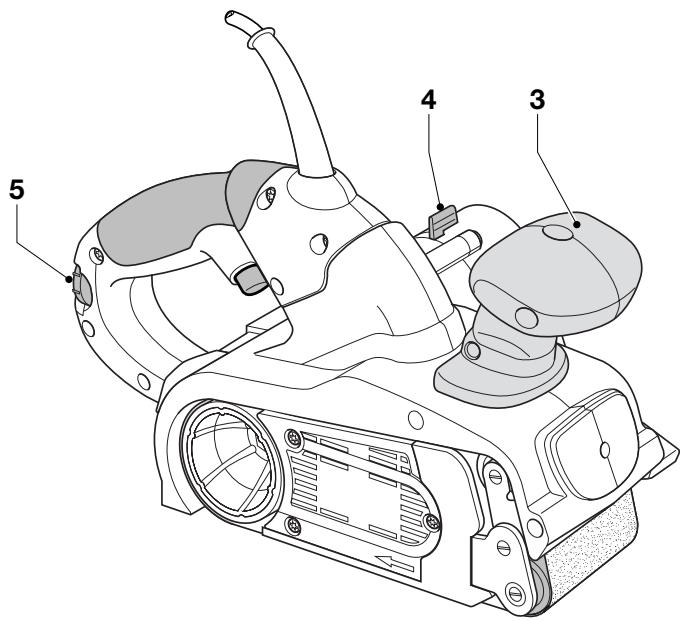
Description (fig. A)
Your belt sander DW432/DW433 has been designed for professional applications.
1 On/off switch
2 Lock-on button
3 Front handle
4 Dust extraction shut-off
5 Speed control dial (DW433)
6 Roller
7 Clamping lever
8 Belt centring knob
9 Dustbag
Electrical safety
The electric motor has been designed for one voltage only. Always check that the power supply corresponds to the voltage on the rating plate.

Your DeWALT tool is double insulated in accordance with EN 50144; therefore no earth wire is required.
Mains plug replacement (U.K. & Ireland only)
- Should your mains plug need replacing and you are competent to do this, proceed as instructed below. If you are in doubt, contact an authorized DeWALT repair agent or a qualified electrician.
- Disconnect the plug from the supply.
- Cut off the plug and dispose of it safely; a plug with bared copper conductors is dangerous if engaged in a live socket outlet.
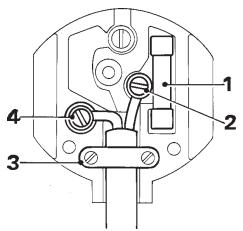
- Only fit 13 Amperes BS1363A approved plugs fitted with the correctly rated fuse (1).
- The cable wire colours, or a letter, will be marked at the connection points of most good quality plugs. Attach the wires to their respective points in the plug (see below). Brown is for Live (L) (2) and Blue is for Neutral (N) (4).
- Before replacing the top cover of the mains plug ensure that the cable restraint (3) is holding the outer sheath of the cable firmly and that the two leads are correctly fixed at the terminal screws.

Never use a light socket.
Never connect the live (L) or neutral (N) wires to the earth pin marked E or 12 .
For 115 V units with a power rating exceeding 1500 W, we recommend to fit a plug to BS4343 standard.
Using an extension cable
If an extension cable is required, use an approved extension cable suitable for the power input of this tool (see technical data). The minimum conductor size is 1.5 mm2.
When using a cable reel, always unwind the cable completely.
Also refer to the table below.
| Conductor size (mm2) | Cable rating (Amperes) |
| 0.75 | 6 |
| 1.00 | 10 |
| 1.50 | 15 |
| 2.50 | 20 |
| 4.00 | 25 |
| Cable length (m) | |||||||
| 7.5 | 15 | 25 | 30 | 45 | 60 | ||
| Voltage | Amperes | Cable rating (Amperes) | |||||
| 115 | 0 - 2.0 | 6 | 6 | 6 | 6 | 6 | 10 |
| 2.1 - 3.4 | 6 | 6 | 6 | 6 | 15 | 15 | |
| 3.5 - 5.0 | 6 | 6 | 10 | 15 | 20 | 20 | |
| 5.1 - 7.0 | 10 | 10 | 15 | 20 | 20 | 25 | |
| 7.1 - 12.0 | 15 | 15 | 20 | 25 | 25 | - | |
| 12.1 - 20.0 | 20 | 20 | 25 | - | - | - | |
| 230 | 0 - 2.0 | 6 | 6 | 6 | 6 | 6 | 6 |
| 2.1 - 3.4 | 6 | 6 | 6 | 6 | 6 | 6 | |
| 3.5 - 5.0 | 6 | 6 | 6 | 6 | 10 | 15 | |
| 5.1 - 7.0 | 10 | 10 | 10 | 10 | 15 | 15 | |
| 7.1 - 12.0 | 15 | 15 | 15 | 15 | 20 | 20 | |
| 12.1 - 20.0 | 20 | 20 | 20 | 20 | 25 | - | |
Assembly and adjustment

Prior to assembly and adjustment always unplug the tool.
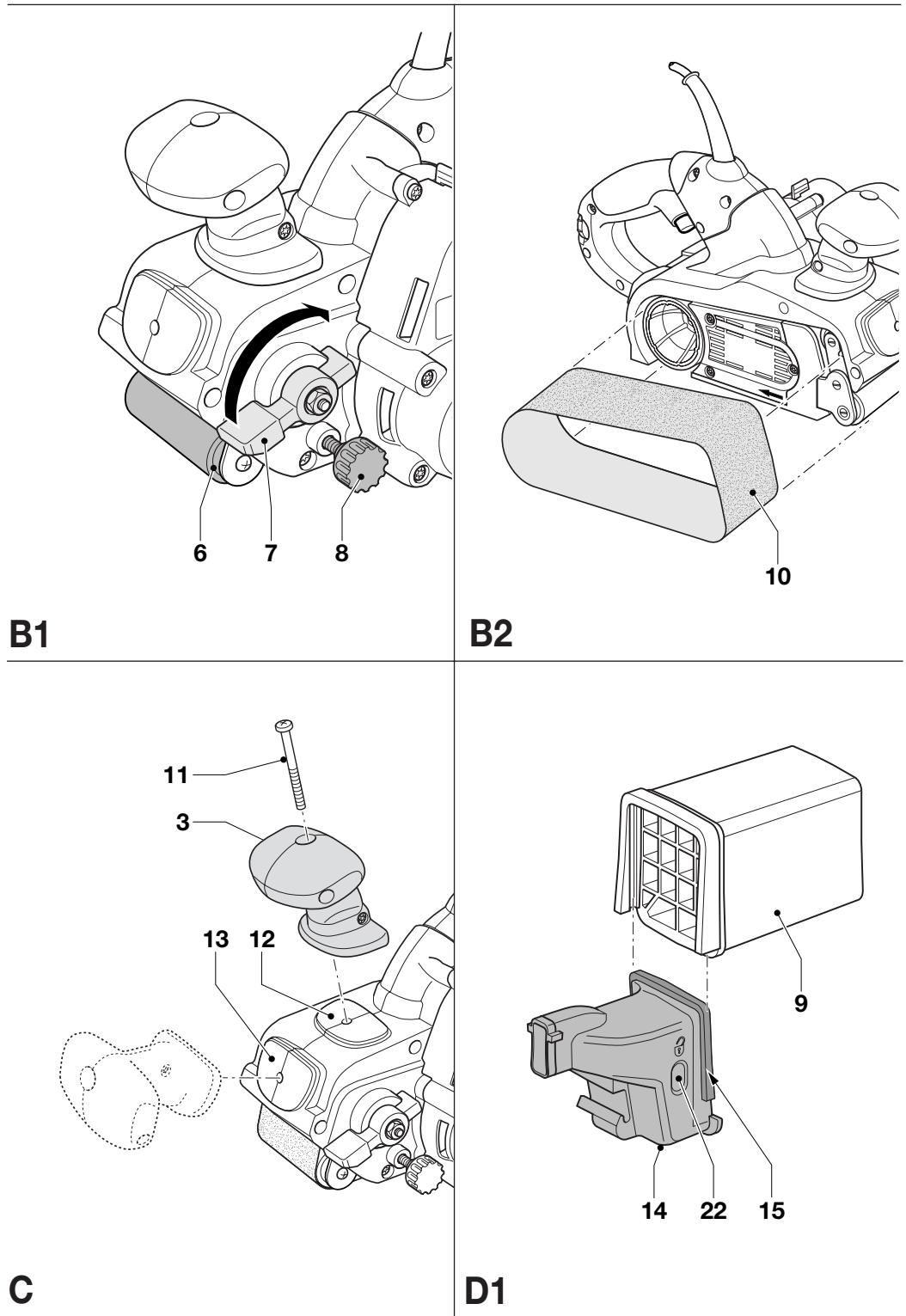
Fitting and centring the sanding belt (fig. B1 & B2)
The tool uses 75 x 533 mm sanding belts.
- Turn the clamping lever (7) clockwise until it is in the release position.
- Remove the sanding belt (10).
- Place a new sanding belt making sure that the arrow on the inside of the sanding belt points in the same direction as the arrow on the machine.
- Turn the clamping lever counter-clockwise until it is in the clamp position.
- Switch the machine on and turn the belt centring knob (8) until the sanding belt is centred on the roller (6).
Adjusting the front handle (fig. C)
The position of the front handle can be adjusted for optimum control. The default position is on top of the tool.
- Loosen the screw (11) located in the centre of the front handle (3).
- Take the handle from the socket and place it on the alternative socket either on top (12) or on the front (13) of the tool.
- Make sure that the handle is properly seated.
- Tighten the screw.
DW433 - Setting the electronic speed control (fig. A)
The belt speed is infinitely variable from 260 to 420 m/min using the electronic speed control dial (5).
- Turn the electronic speed control dial to the required level. The correct setting, however, is a matter of experience.
- Generally, harder materials require a higher setting.
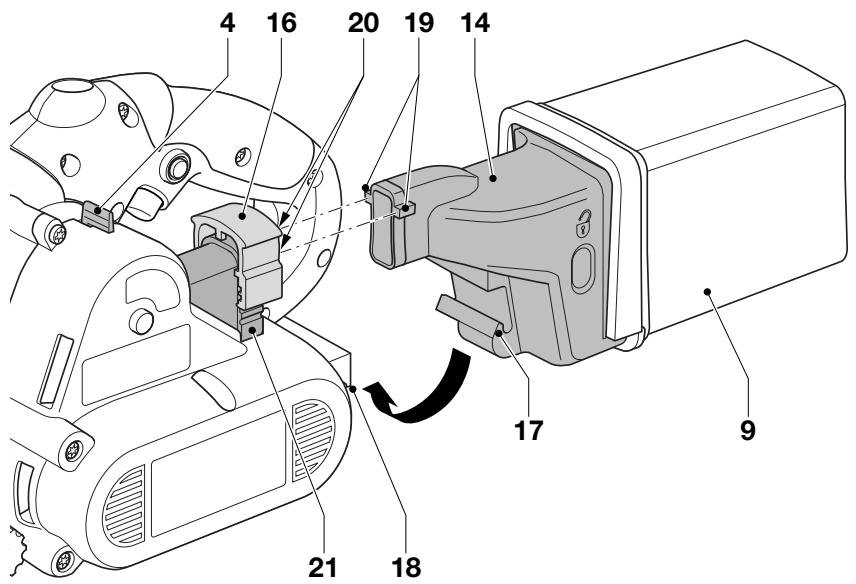
Dust extraction (fig. D1 & D2)

Since woodworking with a sander produces dust, always install a dustbag designed in compliance with the applicable directives regarding dust emission.

Do not use a dustbag or vacuum extractor without proper spark protection when sanding metal.
- Slide the dustbag (9) onto the adaptor (14) over the edges (15).
- Pull the locking collar (16) up.
- Locate the rim (17) behind the edge (18).
- Align the lugs (19) with the recesses (20).
- Firmly push the adaptor (14) into the dust extraction outlet (21) until it clicks in place.
- Push the locking collar down.
Dust extraction shut-off
The dust extraction system can be disabled by activating the dust extraction shut-off valve. This will prevent the dust being blown toward the operator.
- To close the valve, push the switch (4) forward.
- To open the valve, pull the switch backward.

While using the dustbag, always make sure the dust extraction shut-off valve is open.
Instructions for use

- Always observe the safety instructions and applicable regulations.
- Make sure all materials to be sanded are well secured.
- Apply only a gentle pressure to the workpiece. Excessive pressure does not improve the sanding effect, but only results in an increased load on the machine and causes the abrasive to tear.
- Avoid overloading.

Do not sand magnesium!
Switching on and off (fig. A)
- Switching on: press the on/off switch (1).
- For continuous operation, also press the lock-on button (2).
- Switching off: press the on/off switch again.
Sanding (fig. A)
- Start with the coarsest grit size.
- Move the tool in long, sweeping strokes.
- Check your work at short intervals.
- Always switch off the tool when work is finished and before unplugging.
Emptying the dustbag (fig. D1 & D2)
For efficient dust extraction empty the dustbag when it is about one third full.
- Pull the locking collar (16) up.
- Remove the dustbag (9) and the adaptor (14) together.
- Squeeze the marked locations (22) to remove the adaptor from the dustbag.
• Gently shake out the dustbag.
Consult your dealer for further information on the appropriate accessories.
Maintenance
Your DEWALT power tool has been designed to operate over a long period of time with a minimum of maintenance. Continuous satisfactory operation depends upon proper tool care and regular cleaning.

Lubrication
Your power tool requires no additional lubrication.

Cleaning
Keep the ventilation slots clear and regularly clean the housing with a soft cloth.

Unwanted tools and the environment
Take your tool to an authorized DEWALT repair agent where it will be disposed of in an environmentally safe way.
GUARANTEE
• 30 DAY NO RISK SATISFACTION GUARANTEE •
If you are not completely satisfied with the performance of your DeWALT tool, simply return it within 30 days, complete as purchased, to the point of purchase, for a full refund or exchange. Proof of purchase must be produced.
- ONE YEAR FREE SERVICE CONTRACT •
If you need maintenance or service for your DEWALT tool, in the 12 months following purchase, it will be undertaken free of charge at an authorized DEWALT repair agent. Proof of purchase must be produced. Includes labour and spare parts for Power Tools. Excludes accessories.
• ONE YEAR FULL WARRANTY •
If your DEWALT product becomes defective due to faulty materials or workmanship within 12 months from the date of purchase, we guarantee to replace all defective parts free of charge or, at our discretion, replace the unit free of charge provided that:
- The product has not been misused.
- Repairs have not been attempted by unauthorized persons.
- Proof of purchase date is produced. This guarantee is offered as an extra benefit and is additional to consumers statutory rights.
For the location of your nearest authorized DEWALT repair agent, please use the appropriate telephone number on the back of this manual. Alternatively, a list of authorized DEWALT repair agents and full details on our after-sales service are available on the Internet at
www.2helpU.com
Director Engineering and Product Development Horst Großmann
$$ \chi . f o p s m a n $$
L'emballage contient:
Director Engineering and Product Development Horst Großmann
$$ \chi . f o p s m a n $$
DEWALT, Richard-Klinger-Straße 11, D-65510, Idstein, Duitsland
Director Engineering and Product Development Horst Großmann
DEWALT, Richard-Klinger-Straße 11, D-65510, Idstein, Tyskland
Director Engineering and Product Development Horst Großmann
DEWALT, Richard-Klinger-Straße 11, D-65510, Idstein, Alemanha
11 Retire as chaves de ajuste
Director Engineering and Product Development Horst Großmann
$$ \chi . f o p s m a n $$
Director Engineering and Product Development Horst Großmann
$$ \chi . f o p s m a n $$
DEWALT, Richard-Klinger-Straße 11, D-65510, Idstein, Tyskland
- BÅNDPUDSER DW432/DW433
- Tillykke!
- EC-Declaration of conformity
- DW432/DW433
- General
- Do not abuse cord
- Store idle tools
- Maintain tools with care
- Repairs
- Sanding paint
- Package contents
- Description (fig. A)
- Electrical safety
- Mains plug replacement (U.K. & Ireland only)
- Using an extension cable
- Assembly and adjustment
- Fitting and centring the sanding belt (fig. B1 & B2)
- Adjusting the front handle (fig. C)
- DW433 - Setting the electronic speed control (fig. A)
- Dust extraction (fig. D1 & D2)
- Dust extraction shut-off
- Instructions for use
- Switching on and off (fig. A)
- Sanding (fig. A)
- Emptying the dustbag (fig. D1 & D2)
- Maintenance
- Lubrication
- Cleaning
- Unwanted tools and the environment
- GUARANTEE
- • 30 DAY NO RISK SATISFACTION GUARANTEE •
- - ONE YEAR FREE SERVICE CONTRACT •
- • ONE YEAR FULL WARRANTY •
Brand : DEWALT
Model : DW433
Category : Sander