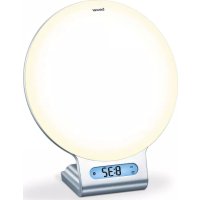
TL 30 - Light therapy BEURER - Free user manual and instructions
Find the device manual for free TL 30 BEURER in PDF.



| Product type | Light therapy lamp |
| Brand | BEURER |
| Model | TL 30 |
| Dimensions (L x H x D) | 270 x 207 x 80 mm |
| Weight | 800 g |
| Power supply | 220-240 V ~, 50 Hz |
| Power consumption | 45 W |
| Maximum light intensity | 10,000 lux at 15 cm |
| Color temperature | 6,500 K |
| Lamp type | Fluorescent tube 3U, 45 W, daylight |
| Safety class | II |
| Protection rating | IPX0 |
| Operating conditions | +10 °C to +25 °C, 30–90% RH |
| Recommended distance | 20 to 40 cm |
| Recommended exposure time | Up to 2 hours/day depending on distance |
| Wall mountable | Yes (screws not included) |
| Maintenance | Clean with damp cloth |
| Replacement part | Fluorescent tube ref. 163.242 |
| Warranty (bulbs and starter) | Excluded from warranty |
| Repairability | Only by authorized service center |
| Standards | CE, Medical Device Directive 93/42/EEC |
| Intended use | Light therapy to compensate for lack of light |
Frequently Asked Questions - TL 30 BEURER
User questions about TL 30 BEURER
0 question about this device. Answer the ones you know or ask your own.
Ask a new question about this device
Download the instructions for your Light therapy in PDF format for free! Find your manual TL 30 - BEURER and take your electronic device back in hand. On this page are published all the documents necessary for the use of your device. TL 30 by BEURER.
USER MANUAL TL 30 BEURER
Instruction for Use. 8-12
WEEE (Waste Electrical and Electronic Equipment).
1. About the daylight lamp
Dear valued customer,
Thank you for choosing one of our products. Our name stands for high-quality, thoroughly tested products for applications in the areas of heat, weight, blood pressure, body temperature, pulse, gentle therapy, massage and air.
With kind regards
Your Beurer team
Why use a daylight lamp?
When the hours of daylight are noticeably decreased in autumn and people increasingly stay inside, the effects of a lack of light may cumulate. This is often described as "winter depression". The symptoms can present themselves in a number of ways:
- Imbalance
- Subdued mood
-
Lack of energy and listlessness
Generally feeling under the weather -
Need for more sleep
- Loss of appetite
- Difficulty concentrating
The cause of these symptoms is the fact that light, particularly sunlight, is essential for life and has a direct effect upon the human body. Sunlight indirectly controls the production of melatonin, which is released into the blood only in darkness. This hormone tells the body when it is time to sleep. In the months when there is less sunlight, therefore, production of melatonin increases. This makes it harder to get up in the morning, since the body's functions are shut down. If you use the daylight lamp immediately after waking up in the morning—thus as early as possible—you can end the production of melatonin so that your mood takes a positive turn. In addition, light deficiency also hinders production of the happiness hormone serotonin, which decisively affects our well-being. So application of light involves quantitative changes in hormones and neurotransmitters in the brain, which can affect our level of activity, our feelings and our well-being. Light can help reverse this hormone imbalance. To compensate for such a hormonal imbalance, the brightlight creates a suitable replacement for natural sunlight.
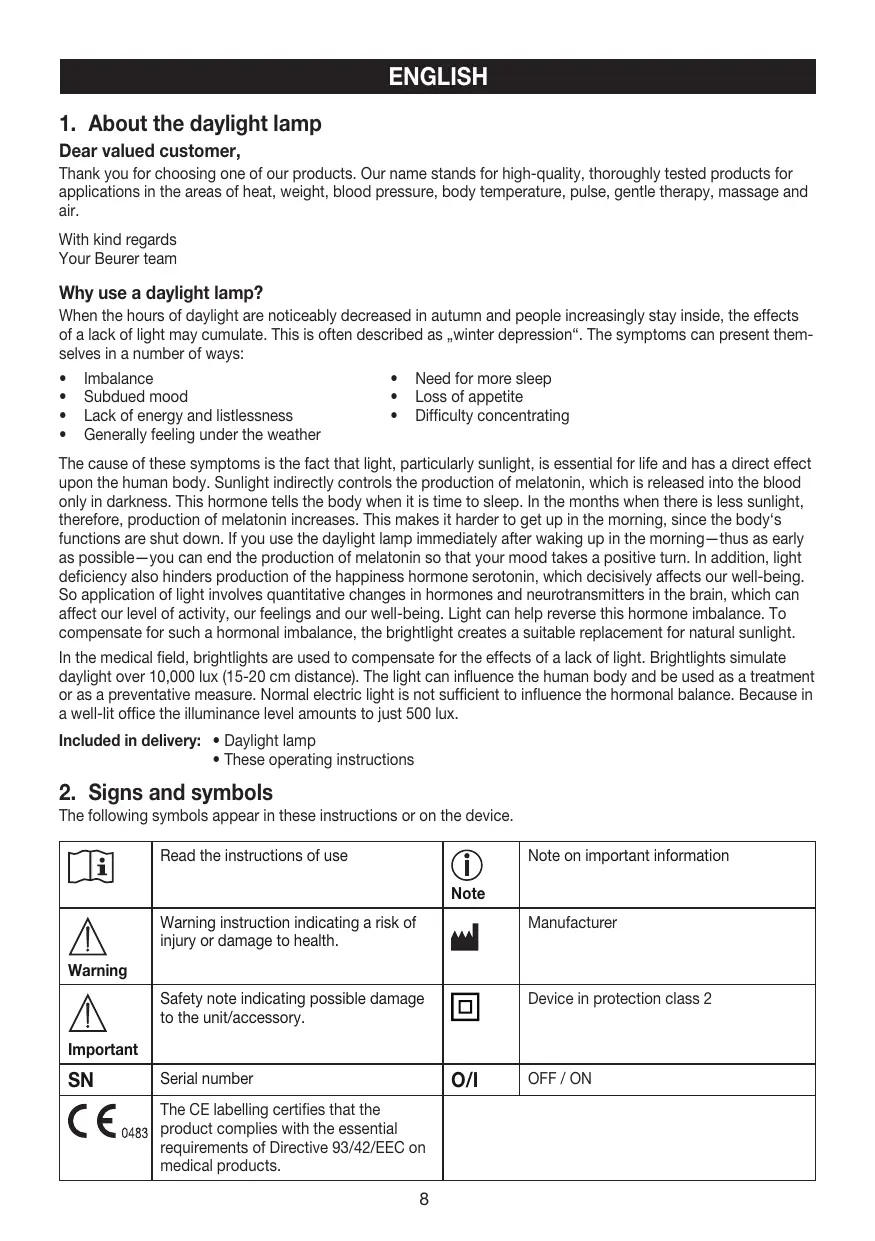
In the medical field, brightlights are used to compensate for the effects of a lack of light. Brightlights simulate daylight over 10,000 lux (15-20 cm distance). The light can influence the human body and be used as a treatment or as a preventative measure. Normal electric light is not sufficient to influence the hormonal balance. Because in a well-lit office the illuminance level amounts to just 500 lux.
Included in delivery: Daylight lamp
These operating instructions
2. Signs and symbols
The following symbols appear in these instructions or on the device.
| i | Read the instructions of use | Note | Note on important information |
| Warning | Warning instruction indicating a risk of injury or damage to health. | Manufacturer | |
| Important | Safety note indicating possible damage to the unit/accessory. | Device in protection class 2 | |
| SN | Serial number | O/I | OFF / ON |
| CE0483 | The CE labelling certifies that the product complies with the essential requirements of Directive 93/42/EEC on medical products. | ||
3. Notes
Please read these instructions for use carefully and keep them for later use, be sure to make them accessible to other users and observe the information they contain.
Safety notes
Warning
- The light of the daylight lamp is only intended for use on the human body.
- Before use, ensure that all packaging materials are removed and that there is no visible damage to the unit or accessories. When in doubt, do not use the unit and contact your dealer or the customer service address provided.
- Also ensure that the daylight lamp has a firm footing.
- The housing of the lamp gets warm during operation. Touching it may result in burns! Always let the lamp cool off before touching it.
- The mandatory minimum distance between the daylight lamp and flammable objects is 1.0m .
- Connect the unit only to the mains voltage listed on the type plate.
- Do not dip the unit into water and do not use it in wet rooms.
- Do not use it in the vicinity of people who are helpless, children under age 3 or people who are insensitive to heat (people with skin lesions due to illness); do not use after taking painkillers or drugs or drinking alcohol.
- Keep children away from packaging materials (risk of suffocation).
- Do not cover up or pack away the unit while it is warm.
- Always remove the mains plug and let the unit cool off before you touch it.
- Do not touch the unit with wet hands while it is plugged in; do not allow any water to be sprayed onto the unit. The unit must be operated only when it is completely dry.
- Keep the mains cable away from hot objects and naked flames.
- Protect the unit from strong impacts.
- Do not pull the mains plug from the socket by the cord.
- If the cord or the housing is damaged, contact customer service or the dealer, since special tools are needed to make repairs.
- Disconnection from the mains supply is only guaranteed if the mains plug has been removed from the socket.
- The fluorescent tube in the device contains a small amount of mercury. If a fluorescent tube breaks in your home, part of the mercury escapes in the form of mercury vapour. To ensure the least possible contact with the mercury vapour released in this case, open the windows and air the room for 5-10 minutes.
- Do not use the device in the presence of flammable anaesthetic gas connections with air, oxygen or nitrogen oxide.
- No calibration and no preventative checks or maintenance is to be carried out on this device.
- You cannot repair the device. The device contains no parts that you can repair.
- Do not make any changes to the device without the manufacturer's permission.
- If the device has been changed, thorough tests and checks must be carried out to ensure the continued safety of further use of the device.
General notes
Important
- If you are taking medication such as pain relievers, antihypertensives or antidepressants, consult your doctor before using the daylight lamp.
- People with retinal diseases as well as diabetics need to be examined by an ophthalmologist before beginning to use the daylight lamp.
- Please do not use if you have an eye disease such as cataracts, glaucoma, diseases of the optic nerve in general and inflammation of the vitreous humour.
- If you have health concerns of any kind, contact your general practitioner!
- Before you use the unit for the first time, remove all packaging materials.
- The lamp tubes and starter are excluded from the warranty.
Repairs
Important
- Please do not attempt to repair the unit yourself. This could result in serious injuries. Failure to observe this regulation shall void the warranty.
- If you need to have the unit repaired, contact customer service or an authorised dealer.
4. Unit description
Overview
- Fluorescent screen
- Rear of the device housing
- Support feet
- On/off button
- Mains cable with plug
- Stand
- Hole for wall-mounting fixture

5. Initial use
After opening the packaging check to ensure it contains all the parts to be included in delivery.
Take the device out of the plastic wrapping. Check the device for damage or faults. If you notice any damage or faults on the device, do not use it and contact customer services or your supplier.
Positioning the device
Place the device on an even surface. The position should be chosen to ensure a distance of between 20~cm and 40~cm between the user and the device. The lamp is most effective at this distance.
Mounting the device on the wall
Alternatively, you can also mount the device on the wall. This requires a solid wall with a stable suspension device (for concrete walls e.g. a 25 mm long M4 stainless steel self-tapping screw and wall plug). Only mount the device on the suspension device at the hole (located centrally on the rear of the device). Self-tapping screw and wall plug are not included in delivery.
Important:
If the area around the hole in the rear of the device is cracked or damaged, do not mount the device on the wall! For help, please contact customer services or your retailer.
Mains connection
Connect the unit only to the mains voltage listed on the type plate. Push the plug completely into the mains socket.
Note:
- Ensure that there is a socket near the place where the lamp will stand.
- Lay the mains cable in such a way that no one can trip over it.
6. Operation
1 Switching on the lamp
Press the On/Off button. The tubes turn on. The tubes develop their full luminosity after a couple of minutes.
| 2 | Enjoying the light Sit as close as possible to the lamp, between 20 cm and 40 cm. You can go about your normal activi- ties while using it. You can read, write, make telephone calls, etc. • Every so often, briefly look directly into the light, since the effect results from the eyes/ retina recei- ving the light. • Use the brightlight as often as you want. However, the treatment is at its most effective if you carry out the light therapy according to the prescribed time period of at least 7 successive days. • The most effective time of day for the treatment is between 6am and 8pm and we recommend that it is used for 2 hours per day. • Do not look directly into the light the whole time you are using it, however, since that could lead to overstimulation of the retina. • Start with shorter periods of illumination, which you increase over the course of a week. Note: Eye aches and headaches may arise after the first times using the lamp. These will go away in later sessions, as the nervous system will become accustomed to the new stimulation. | |
| 3 | Important instructions When using the lamp, maintain the recommended distance of 20 - 40 cm between your face and the lamp. The duration of the application depends on the distance: | |
| Distance | Duration | |
| Up to 20 cm | 1½ hour/day | |
| Up to 30 cm | 1 hour/day | |
| Up to 40 cm | 2 hours/day | |
| Basically, the closer you are to the source of light, the less time you should use it. | ||
| 4 | Enjoying light over longer periods Repeat your use of the lamp in the dark seasons for at least 7 successive days, or even longer, depen- ding on your individual needs. If possible, conduct the treatment in the morning hours. | |
| 5 | Switching off the lamp Press the On/Off button. The tubes turn off. Pull the mains plug from the socket. CAUTION! The lamp is hot after being used. Let the lamp cool off first long enough before you put it away and/or pack it up! | |
7. Cleaning and care of the unit
The unit should be cleaned occasionally.
Important
- Ensure that no water penetrates inside the unit!
Before you clean the unit, always switch it off, unplug it and let it cool off.
- Do not wash the unit in a washing machine!
Clean using a damp cloth, to which you can apply a little detergent if necessary.
- Do not touch the unit with wet hands while it is plugged in; do not allow any water to be sprayed onto the unit. The unit must be operated only when it is completely dry.
Do not use abrasive detergents and never immerse the unit in water.
8. Replacing the fluorescent tube
Only the following tube is approved as a replacement:
The manufacturer's tube is available with the order number 162.242 from customer support.
9. Storage
If you are not going to use the device for an extended period of time, disconnect it and store it in a dry place, out of the reach of children.
Follow the storage instructions provided in the "Technical data" chapter.
10.Disposal
In the interest of protecting the environment, the unit must not be thrown out with the household waste at the end of its service life. Dispose of the unit at a suitable local collection or recycling point.
Dispose of the device in accordance with EC Directive 2002/96/EC - WEEE (Waste Electrical and Electronic Equipment). If you have any questions, please contact the local authorities responsible for waste disposal.

11.What if there are problems?
| Problem | Possible cause | Solution |
| Device does not light up | On/off button switched off | Switch on the on/off button. |
| No electricity | Connect the mains plug correctly. | |
| No electricity | The mains cable is defective. Contact customer services or your retailer. | |
| The fluorescent tube is not correctly inserted | Insert the fluorescent tube correctly. (For a description, see the Quick guide “Replacing the fluorescent tube”) | |
| Fluorescent tube has reached the end of its service life. Fluorescent tube is defective. | Replace the fluorescent tube. (For a description, see the Quick guide “Replacing the fluorescent tube”) |
- Technical specifications
| Dimensions (WHD) | 270 x 207 x 80 cm |
| Weight | 800 g |
| Lighting elements | MP 45 3U 45W tubes, Daylight |
| Power | 45 watts |
| Light intensity | 10,000 lux (15 cm) |
| Radiation | Output of radiation beyond the visible spectrum (infrared and UV) is so low that it is harmless to eyes and skin. |
| Mains connection | 220-240 V ~, 50 Hz |
| Operating conditions | +10°C to +25°C, < 30-90% relative humidity, 700-1060 hPa ambient pressure |
| Storage conditions | -20°C to +50°C, relative humidity < 90%, 700-1060 hPa ambient pressure |
| Transport conditions | -20°C to +50°C, relative humidity < 90%, 700-1060 hPa ambient pressure |
| Product classification | Protection class II, IPX0, no AP or APG, continuous operation, no ancillary parts |
| Degree of efficiency of the ballast | ~ 96% |
| Source efficiency (lm/W) of the bulb | 67-71 lm/W |
| Color temperature of tubes | 6.500 Kelvin |
Subject to technical modifications.
This device meets the requirements of the European Directive 93/42/EEC and 2007/47/EEC Medical Devices as well as the Medical Devices Act.
This device complies with European Standard EN60601-1-2 and is subject to particular precautions with regard to electromagnetic compatibility. Please note that portable and mobile HF communication systems may interfere with this unit. More details can be requested from the stated customer service address or found at the end of the instructions for use.
FRANÇAIS
Chere cliente, Cher client,
Electrical and Electronic Equipment).
Ipeed kackno chstkO np6Op HxHBOBikIOuHTb,OTCOeINHTb OT cTeN I daT b Emy OCTbITb.
3aPpeaaetc ynCTntb npnbop B CTnpalbHO nn nocydomoeuHO MaunHe!
He nCnoJIb3yIte a6pa3nIBhIe MOIOUJIe cpeCDTBA, He nOgrpyKaIte npIbOp B VbOy.
8. 3aMeHa JIOMHHeCzEHTHOJ NaMnbl
IЯЗмениразретаetсИСПОЛБ3OBaTTOBJKO CLEDEUOJIYIOJIHOMINECHETHYIOJaMny:
Opunnabna lamma npoun3bOndTeIa, Hmep dny 3aka3a 163.242, moXho npno6pctn B aBTOPn3OBaHHbx cepBnchbIX ceHTpaX.
9. XpaHeHne
Ecnn Bbl dnlntelbHoe Bpem He nCnIob3yeTe npibop, xpaHITe erO B bBkJIoueHHOM COCToHm B cyXOM MeCTe, KOTOpoe HedeocTyuH No Ia DeTne.
CobioaTe ycnoBna xpaHHeNya, yka3aHHbIe B rnaBe "Texnueckne xaapKtepcntmKn".
10.Ytlinna
B cIeJx oxpaHbI okpykaIOUe Cpebl npi6Op HeJIb3y yTINnI3npoBaT BMeCTe C
DOMaUSHIM MYCOPOM. YTNIN3aIgA DOLXHa IPOIN3BOIDITbCBy B COOTBETCTBm C MecTHbIMN 3aKOHoJaTeJIbHbIMN HOpMaMn.
Cpok 3KcnpyatauHn 3dEJnA: MIn. 5 neT.
| Guidance and manufacturer's declaration - electromagnetic immunity | |||
| The "Mini Daylight" is intended for use in the electromagnetic environment specified below. The customer or the user of the "Mini Daylight" should ensure that it is used in such an environment. | |||
| Immunity test | IEC 60601 test level | Compliance level | Electromagnetic environment - guidance |
| Electrostatic discharge (ESD) IEC 61000-4-2 | ±6 kV contact ±8 kV air | ±6 kV contact ±8 kV air | Floors should be wood, concrete or ceramic tile. If floors are covered with synthetic material, the relative humidity should be at least 30 %. |
| Electrical fast transient/burst IEC 61000-4-4 | ±2 kV for power supply lines ±1 kV for input/output lines | ±2 kV for power supply lines ±1 kV for input/output lines | Mains power quality should be that of a typical commercial or hospital environment. |
| Surge IEC 61000-4-5 | ±1 kV differential mode ±2 kV common mode | ±1 kV differential mode ±2 kV common mode | Mains power quality should be that of a typical commercial or hospital environment. |
| Voltage dips, short interruptions and voltage variations on power supply input lines IEC 61000-4-11 | <5 % UT (>95 % dip in UT) for 0,5 cycle | <5 % UT (>95 % dip in UT) for 0,5 cycle | Mains power quality should be that of a typical commercial or hospital environment. If the user of the "Mini Daylight" requires continued operation during power mains interruptions, it is recommended that the "Mini Daylight" be powered from an uninterruptible power supply or a battery. |
| 40 % UT (60 % dip in UT) for 5 cycles | 40 % UT (60 % dip in UT) for 5 cycles | ||
| 70 % UT (30 % dip in UT) for 25 cycles | 70 % UT (30 % dip in UT) for 25 cycles | ||
| <5 % UT (>95 % dip in UT) for 5 sec | <5 % UT (>95 % dip in UT) for 5 sec | ||
| Power frequency (50/60 Hz) magnetic field IEC 61000-4-8 | 3 A/m | 3 A/m | Power frequency magnetic fields should be at levels characteristic of a typical location in a typical commercial or hospital environment. |
| NOTE UTis the a.c. mains voltage prior to application of the test level. | |||
| Conducted RF | 3 Vrms | 3 V | Portable and mobile RF communications equipment should be used no closer to any part of the "Mini Daylight", including cables, than the recommended separation distance calculated from the equation applicable to the frequency of the transmitter. Recommended separation distance d=1.2 √P |
| IEC 61000-4-6 | 150 kHz to 80 MHz | d=1.2 √P 80MHz to 800MHz | |
| Radiated RF | 3 V/m | 3 V/m | d=2.3 √P 800MHz to 2.5 GHz where P is the maximum output power rating of the transmitter in watts (W) according to the transmitter manufacturer and d is the recommended separation distance in metres (m). Field strengths from fixed RF transmitters, as determined by an electromagnetic site survey, a should be less than the compliance level in each frequency range.b Interference may occur in the vicinity of equipment marked with the following (()) |
| IEC 61000-4-3 | 80 MHz to 2,5 GHz | ||
| NOTE 1 At 80 MHz and 800 MHz, the higher frequency range applies. NOTE 2 These guidelines may not apply in all situations. Electromagnetic propagation is affected by absorpti-on and reflection from structures, objects and people. | |||
| aField strengths from fixed transmitters, such as base stations for radio (cellular/cordless) telephones and land mobile radios, amateur radio, AM and FM radio broadcast and TV broadcast cannot be predicted theoretically with accuracy. To assess the electromagnetic environment due to fixed RF transmitters, an electromagnetic site survey should be considered. If the measured field strength in the location in which the "Mini Daylight" is used exceeds the applicable RF compliance level above, the Medical Daylight should be observed to verify normal operation. If abnormal performance is observed, additional measures may be necessary, such as reori-enting or relocating the "Mini Daylight".bOver the frequency range 150 kHz to 80 MHz, field strengths should be less than [V1] V/m. | |||
| Guidance and manufacturer's declaration - electromagnetic emissions | |||
| The "Mini Daylight" is intended for use in the electromagnetic environment specified below. The customer or the user of the "Mini Daylight" should ensure that it is used in such an environment. | |||
| Emissions test | Compliance | Electromagnetic environment - guidance | |
| RF emissions CISPR 11 | Group 1 | The "Mini Daylight" uses RF energy only for its internal function. Therefore, its RF emissions are very low and are not likely to cause any interference in nearby electronic equipment. | |
| RF emissions CISPR 11 | Class B | The "Mini Daylight" is suitable for use in all establishments, including domestic establishments and those directly connected to the public low-voltage power supply network that supplies buildings used for domestic purposes. | |
| Harmonic emissions IEC 61000-3-2 | Class A | ||
| Voltage fluctuations/ flicker emissions IEC 61000-3-3 | Complies | ||
| Recommended separation distances between portable and mobile RF communications equipment and the Mini Daylight | |||
| The "Mini Daylight" is intended for use in an electromagnetic environment in which radiated RF disturbances are controlled. The customer or the user of the Medical Daylight can help prevent electromagnetic interference by maintaining a minimum distance between portable and mobile RF communications equipment (transmitters) and the "Mini Daylight" as recommended below, according to the maximum output power of the communications equipment. | |||
| Rated maximum output power of transmitter W | Separation distance according to frequency of transmitter m | ||
| 150 kHz to 80 MHzd = [3,5/V1]√P | 80 MHz to 800 MHzd = [3,5/E1]√P | 800 MHz to 2,5 GHzd = [7/E1]√P | |
| 0,01 | 0.12 | 0.12 | 0.23 |
| 0,1 | 0.38 | 0.38 | 0.73 |
| 1 | 1.2 | 1.2 | 2.3 |
| 10 | 3.8 | 3.8 | 7.3 |
| 100 | 12 | 12 | 23 |
| For transmitters rated at a maximum output power not listed above, the recommended separation distance d in meters (m) can be estimated using the equation applicable to the frequency of the transmitter, where P is the maximum output power rating of the transmitter in watts (W) according to the transmitter manufacturer. NOTE 1 At 80 MHz and 800 MHz, the separation distance for the higher frequency range applies. NOTE 2 These guidelines may not apply in all situations. Electromagnetic propagation is affected by absorpti-on and reflection from structures, objects and people. | |||