 EasyManual
999 - Motorcycle DUCATI - Free user manual and instructions
Find the device manual for free 999 DUCATI in PDF.


User questions about 999 DUCATI
0 question about this device. Answer the ones you know or ask your own.
Ask a new question about this device
Download the instructions for your Motorcycle in PDF format for free! Find your manual 999 - DUCATI and take your electronic device back in hand. On this page are published all the documents necessary for the use of your device. 999 by DUCATI.
USER MANUAL 999 DUCATI
Hearty welcome among Ducati fans! Please accept our best compliments for choosing a Ducati motorcycle. We think you will ride your Ducati motorcycle for long journeys as well as short daily trips. Ducati Motor Holding s.p.a wishes you smooth and enjoyable riding.
We are steadily doing our best to improve our "Technical Assistance" service. For this reason, we recommend you to strictly follow the indications given in this manual, especially for motorcycle running-in. In this way, your Ducati motorbike will surely give you unforgettable emotions.
For any servicing or suggestions you might need, please contact our authorized service centres.
Enjoy your ride!

Note
Ducati Motor Holding S.p.A. declines any liability whatsoever for any mistakes incurred in drawing up this manual. The information contained herein is valid at the time of going to print. Ducati Motor Holding S.p.A. reserves the right to make any changes required by the future development of the above-mentioned products.
For your safety, as well as to preserve the warranty, reliability and worth of your motorcycle, use original Ducati spare parts only.

Warning
This manual forms an integral part of the motorcycle and - if a transfer of title occurs - must always be handed over to the new owner.
TABLE OF CONTENTS
General 6
Warranty 6
Symbols 6
Useful information for safe riding 7
Carrying the max load allowed 8
Identification data 9
Controls 10
Position of motorcycle controls 10
Instrument panel 11
LCD - main functions 12
LCD - how to set/display parameters 14
theimmobilizer system 19
Keys 19
Code card 20
Procedure to disable immobilizer engine block through
throttle twistgrip 21
Duplicate keys 22
Ignition switch and steering lock 23
Left switch 24
Clutch lever 25
Cold start lever 26
Right switch 27
Throttle twistgrip 27
Front brake lever 28
Rear brake pedal 29
Gear change pedal 29
Adjusting the gear change and rear brake pegs 30
Gear change pedal adjustment 31
Rear brake pedal adjustment 32
Main components and devices 33
Location 33
Tank filler plug 34
Seat/fuel tank adjustment 35
Seat catch and helmet hook 36
Side stand 38
Steering damper 39
Front fork adjusters 39
Shock absorber adjusters 41
Changing motorcycle track alignment 42
Directions for use 43
Running-in recommendations 43
Pre-ride checks 45
Starting the engine 46
Moving off 48
Braking 48
Stopping the motorcycle 49
Parking 49
Refueling 50
Tool kit and accessories 51
Main maintenance operations 52
Removing the fairing 52
Checking and topping up the coolant level 55
Checking brake and clutch fluid level 57
Checking brake pads for wear 58
Lubricating cables and joints 59
Throttle cable tension adjustment 60
Charging the battery 61
Adjusting steering head angle 62
Chain tension inspection 64
Chain lubrication 64
Changing the high and low beam bulbs 65
Changing the parking light bulb 66
Front turn indicators 67
Rear turn indicators 67
Stop light 68
Number plate light 68
Beam setting 69
Rear view mirror adjustment 70
Tubeless tyres 71
Checking engine oil level 73
Cleaning and replacing the spark plugs 74
Cleaning the motorcycle 75
Storing the bike away 76
Important notes 76
Technical data 77
Overall dimensions 77
Weights 77
Top-ups 78
Engine 79
Timing system 79
Performance data 80
Spark plugs 80
Brakes 80
Transmission 81
Frame 82
Wheels 82
Tyres 82
Suspensions 83
Exhaust system 83
Available colours 83
Electric system 84
For United States of America version only 88
Routine maintenance record 97
GENERAL
E
Warranty
In your own interest, and in order to guarantee product reliability, you are strongly advised to refer to a Ducati Dealer or Authorized Workshop for any servicing requiring particular technical expertise. Our highly skilled staff have access to the implements required to perform any servicing job at best, using Ducati original spare parts only as the best guarantee for full interchangeability, smooth running and long life.
All Ducati motorcycles come with a "Warranty Card". However, warranty does not apply to the motorcycles used in competitions. No motorcycle part may be tampered with, altered, or replaced with parts other than original Ducati spare parts during the warranty period, or the warranty will be automatically invalidated.
Symbols
Ducati Motor Holding S.p.A. advises you to read this manual carefully so as to become familiar with your motorcycle. In case of any doubts, please call a Ducati Dealer or Authorized Workshop. The information contained herein will prove useful on your trips - and Ducati Motor Holding S.p.A. wishes you smooth, enjoyable riding - and will help you keep the performance of your motorcycle unchanged for a long time.

Warning
Failure to comply with these instructions may put you at risk and lead to severe injury or death.

Important
Possibility of damaging the motorcycle and/or its components.

Note
Additional information concerning the job being carried out.
The terms right and left are referred to the motorcycle viewed from the riding position.
Useful information for safe riding

Warning
Read this section before riding your motorcycle.
Accidents are frequently due to inexperience. Always make sure you have your licence with you when riding; you need a valid licence to be entitled to ride your motorcycle.
Do not lend your motorcycle to inexperienced riders or who do not hold a valid licence.
Both rider and pillion passenger must always wear a safety helmet.
Wear proper clothing, with no loose items or accessories that may become tangled in the controls or limit your zone of vision.
Never start or run the engine indoors. Exhaust gases are poisonous and may lead to loss of consciousness or even death within a short time.
Both rider and pillion passenger should keep their feet on the footpegs when the motorcycle is in motion.
Always hold the handlebars firmly with both hands so you will be ready for sudden changes of direction or in the road surface. The pillion passenger should always hold on to the suitable belt on the rear seat with both hands.
Ride within the law and observe national and local rules. Always respect speed limits where these are posted. However, always adjust your speed to the visibility, road and traffic conditions you are riding in.
Always signal your intention to turn or pull to the next
lane in good time using the suitable turn indicators.
Be sure you are clearly visible and do not ride within the blind spot of vehicles ahead.
Be very careful when tackling road junctions, or when riding in the areas near exits from private grounds, car parks or on slip roads to access motorways.
Always turn off the engine when refueling.
Be extremely careful not to spill fuel on the engine or on the exhaust pipe when refueling.
Do not smoke when refueling.
While refueling, you may inhale noxious fuel vapors.
Should any fuel drops be spilled on your skin or clothing, immediately wash with soap and water and change your clothing.
Always remove the key when you leave your motorcycle unattended.
The engine, exhaust pipes, and mufflers stay hot for a long time.

Warning
The exhaust system might be hot, even after engine is switched off; pay particular attention not to touch exhaust system with any body part and do not park the vehicle next to inflammable material (wood, leaves etc.).
Park your motorcycle where no one is likely to hit it and use the side stand.
Never park on uneven or soft ground or your motorcycle may fall over.
Carrying the maximum load allowed
Your motorcycle is designed for long-distance riding, carrying the maximum load allowed in full safety. Even weight distribution is critical to preserving safety features and avoiding trouble when performing sudden manoeuvres or riding on bumpy roads.
Information about carrying capacity
The total weight of the motorcycle in running order including rider, pillion passenger, luggage and additional accessories should not exceed 375 Kg.
Arrange your luggage or heavy accessories in the lowest possible position and close to motorcycle centre.
Be sure to secure the luggage to the supports provided on the motorcycle as firmly as possible. Improperly secured luggage may affect stability.
Never fix bulky or heavy objects to the handlebar or to the front mud guard as this would affect stability and cause danger.
Do not insert any objects you may need to carry into the gaps of the frame as these may foul moving parts.
Make sure the tyres are inflated to the proper pressure indicated at page 71 and that they are in good condition.
Identification data
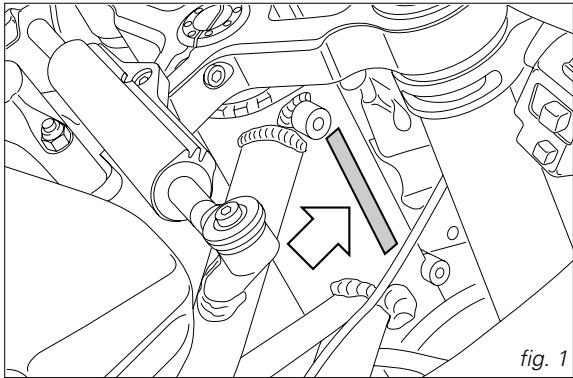
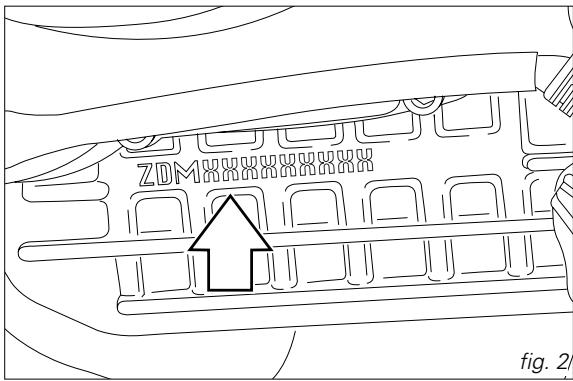
All Ducati motorcycles have two identification numbers, for frame (fig. 1) and engine (fig. 2).
Frame number
Engine number

Note
These numbers identify the motorcycle model and are required when ordering spare parts.
CONTROLS
E

Warning
This section details the position and function of all the controls you need to drive your motorcycle. Be sure to read this information carefully before you use the controls.
Position of motorcycle controls (fig. 3)
1) Instrument panel.
2) Key-operated ignition switch and steering lock.
3) Left switch.
4) Clutch lever.
5) Cold start control.
6) Right switch.
7) Throttle twistgrip.
8) Front brake lever.
9) Gear change pedal.
10) Rear brake pedal.
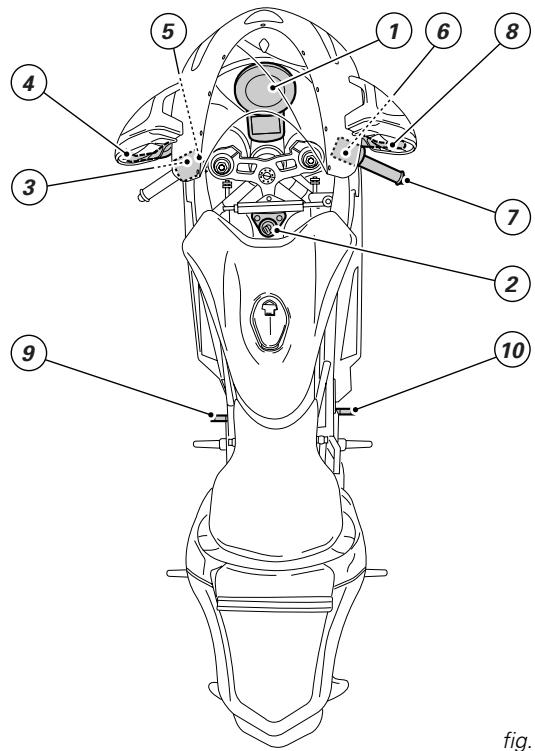
fig. 3
Instrument panel (fig. 4)
1) LCD (see page 12).
2) Engine revolution meter (rpm)
Indicates engine rpm.
3) Neutral light N (green).
"Come on when gearbox is in neutral."
4) Low fuel light (yellow).
Comes on when there are about 3 liters fuel left in the tank.
5) Turn indicator light (green).
"Comes on and flashes when a turn indicator is on."
6) Engine oil pressure light (red).
Comes on when engine oil pressure is too low. It comes on when the ignition is switched to ON and normally goes out a few seconds after engine starts.
It may shortly come on when the engine is hot, however, it should go out as the engine revs up.

Important
If this light (6) stays on, stop the engine or it may
suffer severe damage.
7) High beam light (blue).
"Comes on when high beam is on."
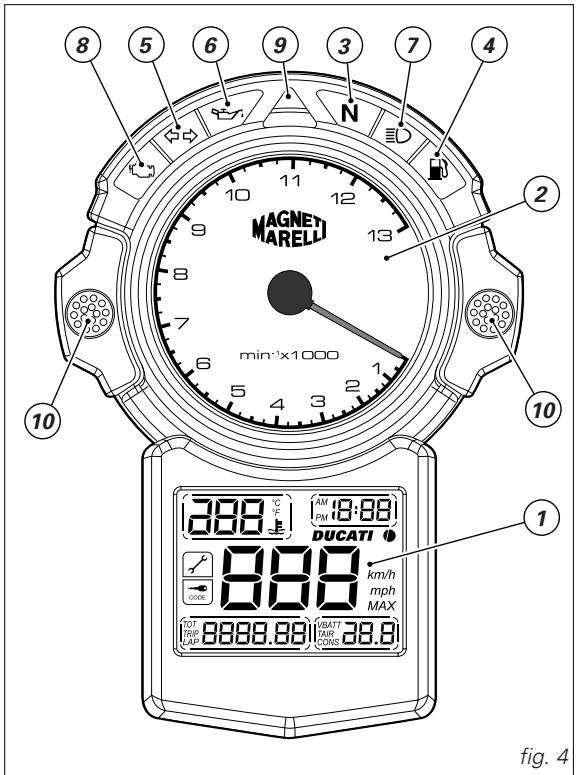
8)EOBD light (amber)
The engine control unit turns on this light permanently to indicate an error leading to engine block.
The light doubles as an indicator for the immobilizer override procedure using the throttle twistgrip.
When no errors are present, the light should come on when the ignition switch is set to ON and should go out after a few seconds (normally after 1.8 - 2 sec.).
9) Gear change threshold light (red)
Indicates that control unit has activated the injection limiter. The lower portion of the light comes on 200 rpm below injection limiter switch-on rpm; the top portion of the light comes on 100 rpm below injection limiter switch-on rpm.
10) Control buttons
These buttons are used to display and set instrument panel parameters.
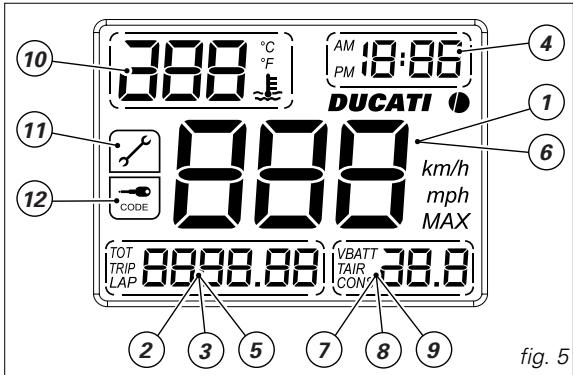
LCD - Main functions
Warning
7 Stop the motorcycle before using the instrument panel controls. Never operate the instrument panel controls while riding.
1) Speedometer
Gives road speed.
2) Odometer
Gives total distance covered.
3) Trip meter
Gives distance covered since last resetting.
4)Clock.
5) Lap time.
6) Lap top speed recording.
7) Battery voltage indicator.
8) Air temperature indicator.
9) Consumption indicator.
10) Coolant temperature indicator. Gives engine coolant temperature.
Important
Stop riding if the temperature reaches the max. value, otherwise the engine might damage.
11) Maintenance counter.
This light comes on upon reaching the mileage specified for preventive maintenance. The light will keep flashing until the motorcycle covers the next 50 km and then will stay on permanently until the counter is reset at an DUCATI Authorized Workshop within the preventive maintenance procedure.
12) Immobilizer indicator.
The indicator stays on when key code is wrong or is not acknowledged, and will flash after the immobilizer has been overridden using the throttle twistgrip (see page 21).

Important
The instrument panel is part of the on-board electronic injection/ignition system diagnostics. The relevant menus are for use by trained personnel only. If you accidentally access this function, turn the key to OFF and have the motorcycle inspected at an authorized Ducati Service Center.
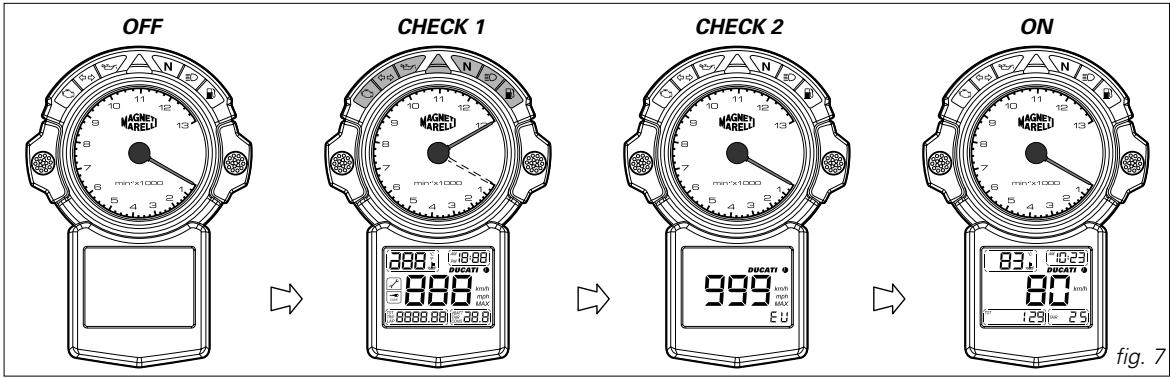
LCD - How to set/display parameters
When the key is turned from OFF to ON, the instrument panel runs a check-up routine of all instruments (pointers, display, lights) (See fig. 7).
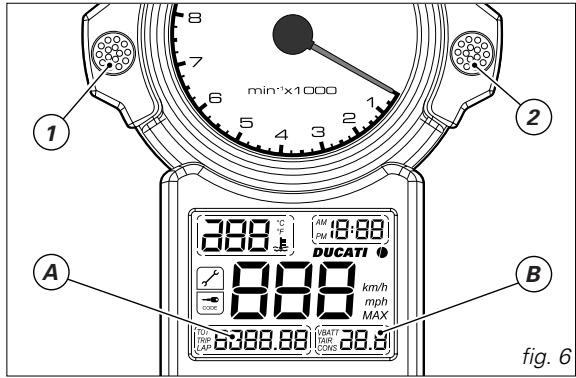
Calling up the left display functions (A).
Press the button (1) (fig. 6) with the key turned to ON to cycle through trip meter, odometer and lap time indication.
Calling up the right display functions (B)
Press the button (2) (fig. 6) with the key turned to ON to cycle through battery voltage, air temperature and consumption indication.
Clock setting
Hold down the button (1) for at least 2 seconds.
Press the button (2) to select AM/PM. Press the button (1) to confirm selection and enter hours setting mode.
Set hours using the button (2). Press the button (1) to confirm and enter minutes setting mode.
Set minutes using the button (2). Press the button (1) to confirm and exit the clock setting mode.
Resetting the trip meter
Select TRIP indication in the display (3). Hold down the button (2) for at least 2 seconds to reset displayed trip meter indication.
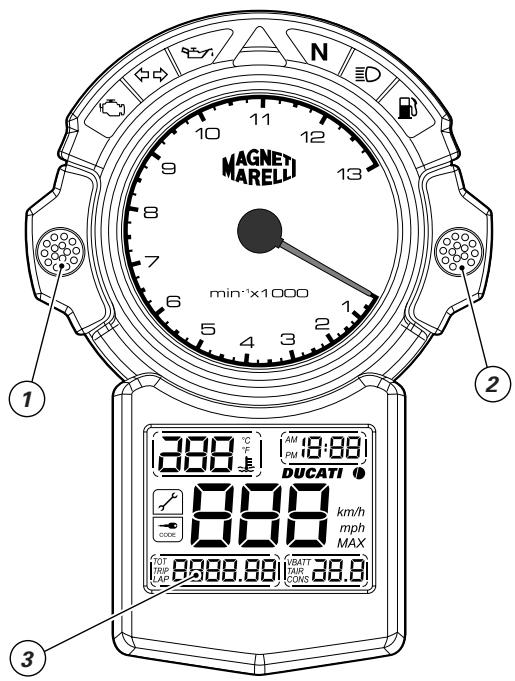
fig. 8
Setting special function (vehicle model and units of measurement)
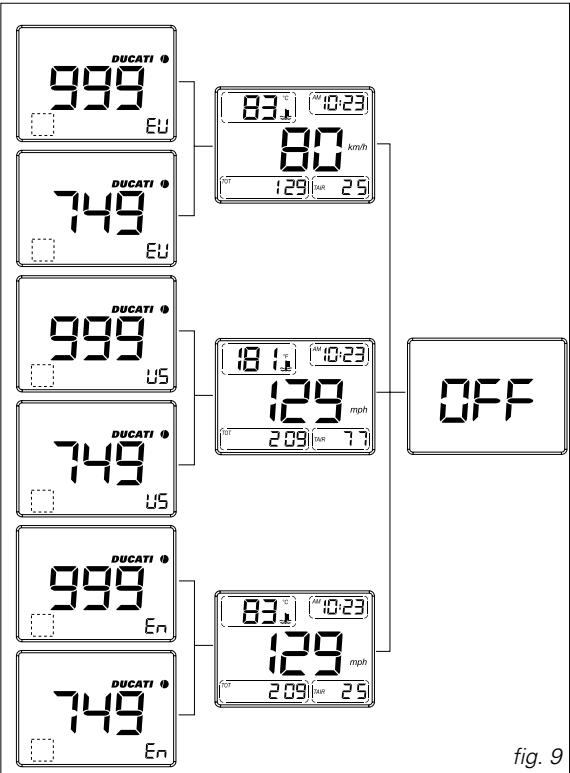
The engine control unit transmits the correct vehicle model and unit measurement information automatically for the instrument panel to display. To force a change of these parameters, turn the key from OFF to ON while holding down both buttons (1) and (2).
Press the button (1) to scroll through available configurations.
To store your selection, hold down the button (2) for 5 seconds, until the display will read OFF. Set the key to OFF.

Note
The dotted boxes in the figure are the display areas for vehicle version (normal, R or S).
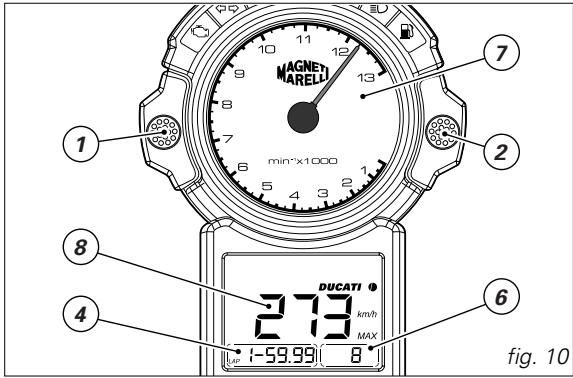
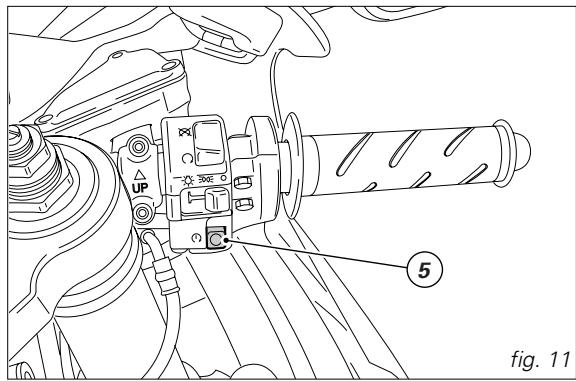
Lap time recording (fig. 10 and 11)
This function lets you record lap time and displays top speed and engine rpm during that lap.
Select the LAP mode in the display (4)(see page 14).
Press the engine start button (5) while riding to start the on-board chronometer. Pressing the button (5) again will stop the chronometer.

Note
In the LAP mode, the engine may not be started
using the starter button (5).
After measuring lap times, up to 19 times may be retrieved and displayed on the LCD. Pressing the button (1) will scroll through recorded times. The instrument panel provides the following information:
- Lap number (6)
- Top engine rpm (7) during selected lap
- Lap time (4)
- Top speed (8) during that lap.

Note
The tachometer reads a speed higher than the actual one, on average there is 8% difference. Maximum speed stored on the LCD is the actual speed of the vehicle during the lap concerned.
To wipe off recorded lap times, hold down the button (2) for over 5 seconds.
Coolant temperature function (fig. 12 and 13)
When coolant temperature drops below -40^ / - 40^, some flashing dots appear on the display and the amber EOBD light comes on (8, fig. 4).
When coolant temperature is between -39^ / - 38.2^ and +45^ / + 113^ or between +120^ / + 248^ and +124^ / + 255.2^, the display provides a flashing temperature indication.
When coolant temperature is between +46^ / + 114.8^ and +119~^ C / + 246.2~^ F, temperature indication stays on permanently.
When coolant temperature exceeds +125^ / + 257^ , a flashing 125^ / 257^ temperature indication appears on the display, and the amber EOBD light comes on (8, fig. 4).
Backlighting function
A light sensor detects light intensity and adjusts LCD and warning lights intensity accordingly.
When the parking light is on, the instrument panel lights up.
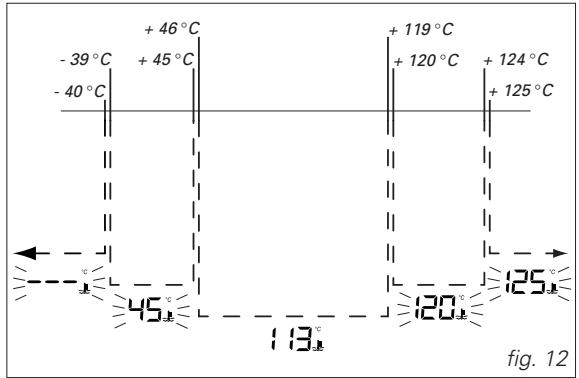
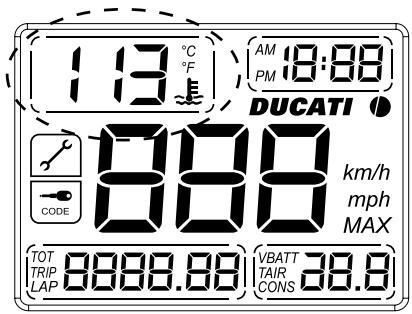
fig. 13
The immobilizer system
For improved anti-theft protection, the motorcycle is equipped with an IMMOBILIZER, an electronic system that inhibits engine operation whenever the ignition switch is turned off.
Accommodated in the handgrip of each ignition key is an electronic device that modulates an output signal. This signal is generated by a special antenna incorporated in the switch when the ignition is turned on and changes every time. The modulated signal acts as a "password" and tells the CPU that an "authorised" ignition key is being used to start up the engine. When the CPU recognises the signal, it enables engine start-up.
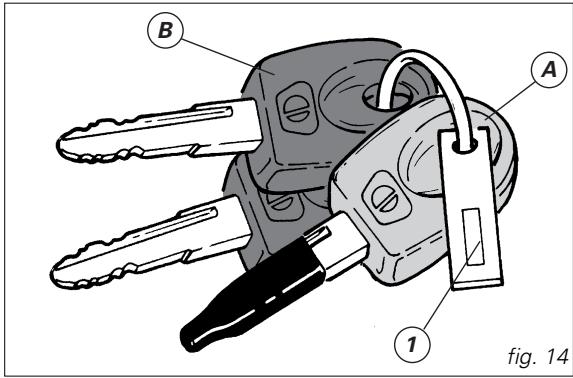
Keys (fig. 14)
The Owner receives a set of keys comprising:
-1 RED key A
-2BLACK keys B

Warning
Red key A has a rubber cover for preserving it in perfect conditions and avoiding contact with other keys. Never remove this protection unless really needed.
The keys B are regular ignition keys and are used to:
- start up the engine
- open the lock of the fuel tank filler plug
- open the seat lock (Biposto).
The key A performs the same functions as the keys B, and is also used to wipe off and re-program other black keys, if needed.

Note
The three keys have a small plate (1) attached that reports their identification number.

Warning
Keep the keys in different places. Store the plate (1) and the key A in a safe place.
It is also recommended to use always the same black key to use the bike.
Code card
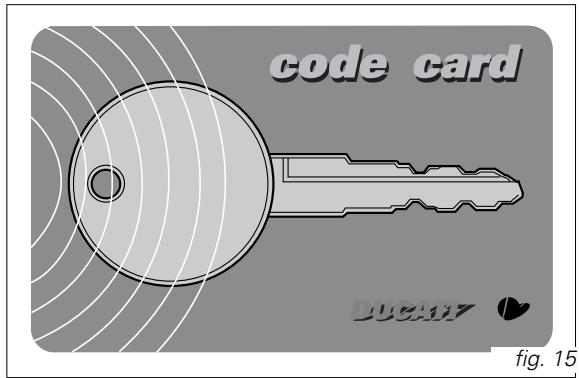
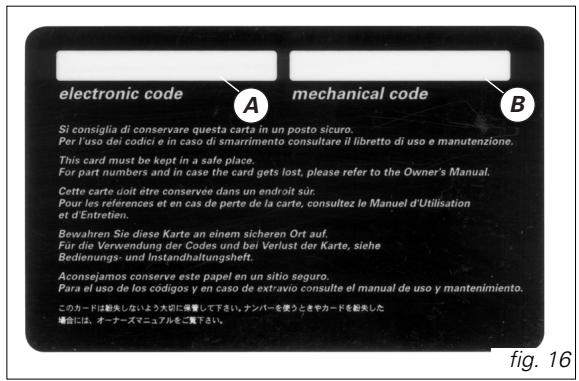
The keys come with a CODE CARD (fig. 15) that reports:
A) (fig. 16) the electronic code to be used in case of engine block, i.e. bike did not start after key-ON.
B) (fig. 16) the mechanical code for the keys to be reported to the DUCATI Service network when you are ordering any duplicate keys.

Important
4 Keep the CODE CARD in a safe place. However, it is advisable to keep the electronic code printed on the CODE CARD handy when you ride your motorcycle, in case it is necessary to override engine block through the procedure that uses the throttle twistgrip.
In case of faulty immobilizer system, the following procedure gives the chance to disable "engine block" function -signalled by the orange EOBD warning light that comes on (8, fig. 4).
But this operation can be carried out only if the electronic code indicated on the code card is known.
Procedure to disable immobilizer engine block through throttle twistgrip
1) Turn the key to ON and fully open throttle. Keep it open. The EOBD warning light turns off after 8 seconds.
2) Release the throttle as soon as the EOBD warning light turns off.
3) EOBD pilot light will flash. Count a number of flashes corresponding to the first figure of the code, open full throttle and keep the position for 2 seconds, then release. In this way the input of one figure is acknowledged, EOBD pilot light comes on and stays on for 4 seconds. Carry out the same procedure for the following figures of the code. Failure to do so will cause the EOBD pilot light to flash 20 times, then it will stay on. This means that the procedure has been aborted. It will be necessary to turn the key to OFF and restart from point (1).
4) Repeat operations described in point (3) up to the last figure of the code.
5) Release the throttle twistgrip, if the code is correct, the EOBD warning light shall flash signalling that engine block has been disabled. The warning light turns off after 4 seconds.
If the code is NOT correct, the EOBD warning light stays on and it is then possible to turn the key to OFF and repeat the procedure, starting from point (1), as many times as necessary (infinite).

Note
Should the throttle twistgrip be released before the set time, the warning light turns on again. It is then necessary to bring the key to OFF and restart the procedure from point (1).
Operation
When the ignition key is turned to OFF, the immobilizer inhibits engine operation.
When the ignition key is turned back to ON to start the engine, the following happens:
1) if the CPU recognised the code, the CODE light on the instrument panel will flash briefly. This means that the immobilizer system has recognised the key code and enabled engine ignition. When you press the START button, the engine will start up.
2) If the CODE light stays on, it means that the code has not been recognised. When this is the case, turn the ignition key back to OFF and then to ON again. If the engine still does not start, try with another black key. If the other key does not work out either, contact the DUCATI Service network.
3) Should the CODE pilot light still be flashing, it means that an immobilizer system fault was reset (e.g. with the overriding procedure through throttle grip). Turn the key to OFF and back to ON, the immobilizer pilot light should go back to its normal operation (see point 1).

Warning
inside. If dropped or hit, they might damage.
Use only one key during the procedure. Failure to do so might prevent the system from recognizing the code of the key in use.
Duplicate keys
If you need any duplicate keys, contact the DUCATI Service network with all the keys you have left and your CODE CARD.
DUCATI Service will program new keys and re-program your original keys, up to 8 keys in total.
You may be asked to identify yourself as the legitimate owner of the motorcycle. Be sure you have any documents you might need to this end ready.
The codes of any keys not submitted will be wiped off from the memory to make those keys unserviceable in case they have been lost.

Note
If you sell your motorcycle, do not forget to give all keys and the CODE CARD to the new owner.
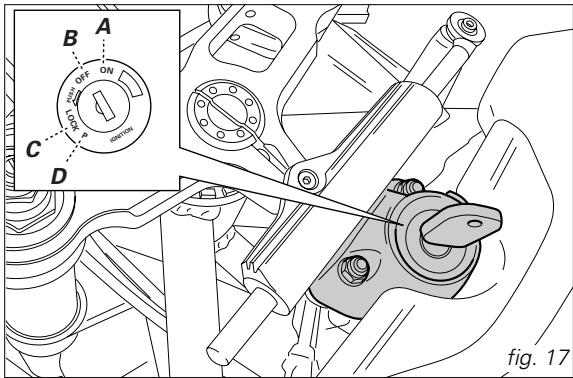
Ignition switch and steering lock (fig. 17)
It is located in front of the fuel tank and has four positions:
A) ON: lights and engine on;
B) OFF: lights and engine off;
C) LOCK: steering locked;
D) ±bP : parking light on and steering lock.

Note
To move the key to the last two positions, press it down before turning it. Switching to (B), (C) and (D), you will be able to take the key out.

Important
This vehicle is equipped with an energy-saving CPU. If the key stays ON for a long period but the ignition button is not pressed within 15 seconds, the CPU will stop operating to avoid current absorption. Move the key to OFF and then to ON again.
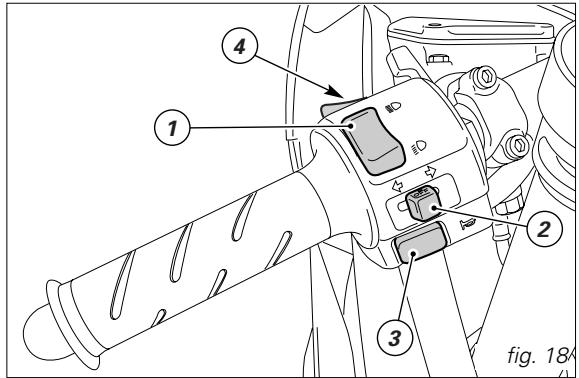
Left switch (fig. 18)
1) Dip switch, light dip switch, two positions:
position 四 = low beam on;
position 四 = high beam on.
2) Switch = 3-position turn indicator:
centre position = OFF;
position left turn;
position right turn.
To reset turn indicators, switch returns to central position, push in.
3) Button = warning horn.
4) Button 0 = passing.
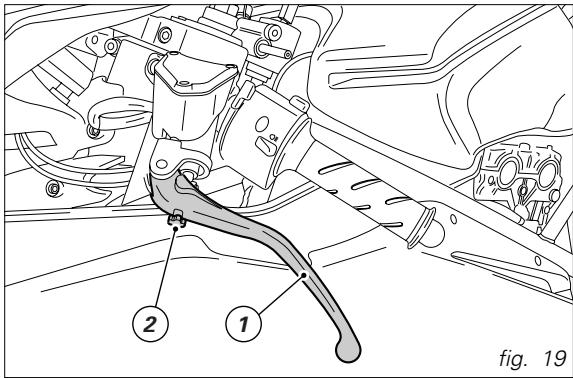
Clutch lever (fig. 19)
Lever (1) disengages the clutch. It features a dial adjuster (2) for lever distance from the twistgrip on handlebar.
Lever distance from twistgrip is set via knob (2) (10 click positions). Turn clockwise to push lever far from twistgrip, or counterclockwise to take it closer.
When you pull in the lever (1), you will disengage the engine from the gearbox and therefore from the driving wheel. Using the clutch properly is essential to smooth riding, especially when moving off.

Warning
Set clutch and brake lever when motorcycle is bed.

Important
Using the clutch properly will avoid damage to mission parts and spare the engine.

Note
It is possible to start the engine with side stand down and the gearbox in neutral. When starting the bike with a gear engaged, pull the clutch lever (in this case the side stand must be up).
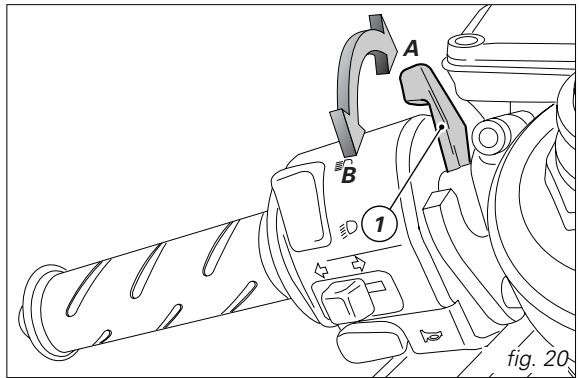
Cold start lever (fig. 20)
Use this device to start the engine from cold. It will increase the engine idling speed after starting.
Lever positions:
A) = closed
B) = fully open.
The lever can be opened and closed gradually to adjust speed until engine is fully warm (see page 46).

Important
Never use the cold start device when the engine is warm or leave it open when riding.
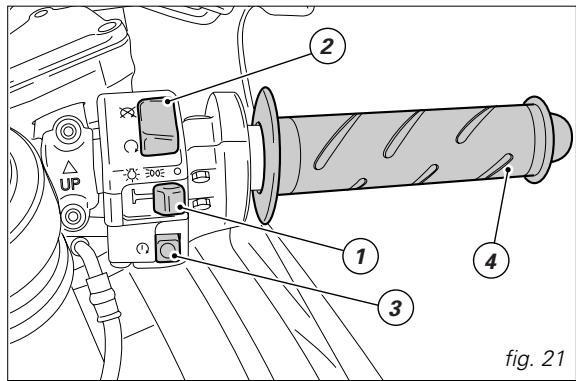
Right switch (fig. 21)
1) Switch, light switch, three positions:
right position = light off;
centre position = front and rear parking lights,
number plate and instrument panel lights on;
left position = headlight, front and rear parking lights,
number plate and instrument panel lights on.

Note
This device is not fitted on the Australia and Japan ons.
2) Switch for ENGINE STOP, two positions: position (RUN) = run. position 四 (OFF) = stop.

Warning
This switch is mainly intended for use in emergency cases when you need to stop the engine quickly. After stopping the engine, return the switch to the position to enable starting.

Important
Riding with the lights on, stopping the engine using switch (2) and leaving the ignition key in the ON position, may run the battery flat as the lights will remain on.
3) Button = engine start.
Throttle twistgrip (fig. 21)
The twistgrip (4) on the right handlebar opens the throttles. When released, it will spring back to the initial position (idling speed).
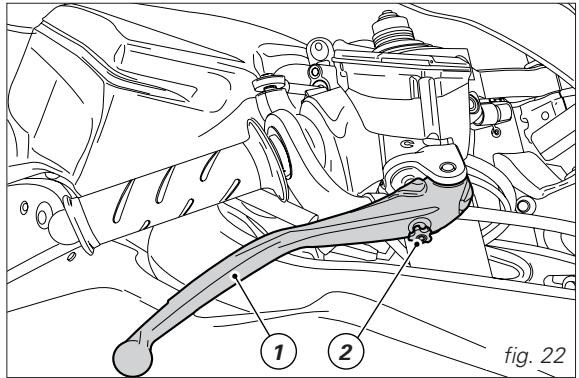
Front brake lever (fig. 22)
Pull in the lever (1) towards the twistgrip to operate the front brake. The system is hydraulically operated and you just need to pull the lever gently.
The brake lever is provided with an adjuster (2) for lever distance adjustment from twistgrip on handlebar. Lever distance from twistgrip is set via knob (2) (10 click positions). Turn clockwise to push lever far from twistgrip, or counterclockwise to take it closer.
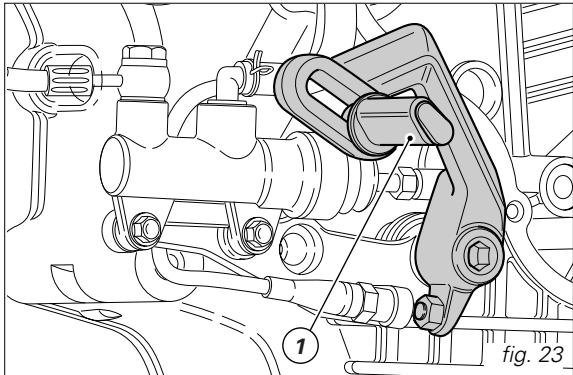
Rear brake pedal (fig. 23)
Push down on the pedal (1) with your foot to operate the rear brake.
The system is hydraulically operated.
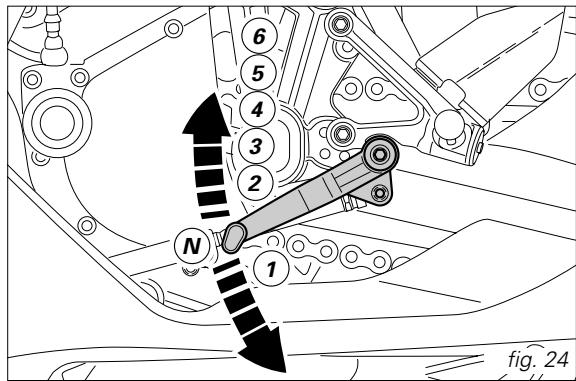
Gear change pedal (fig. 24)
The gear change pedal is at rest when in the central position N , and automatically returns to the central position. When in this position, light N (3, fig. 4) on instrument panel is on.
The pedal can be moved:
down = push down on the pedal to engage 1st gear and to shift down. The N light will go out.
up = lift the pedal to engage the 2^nd gear and then the 3^d , 4^th , 5^th and 6^th gear. Each time you move the pedal you will engage the next gear.
Adjusting the gear change and rear brake pegs

Note
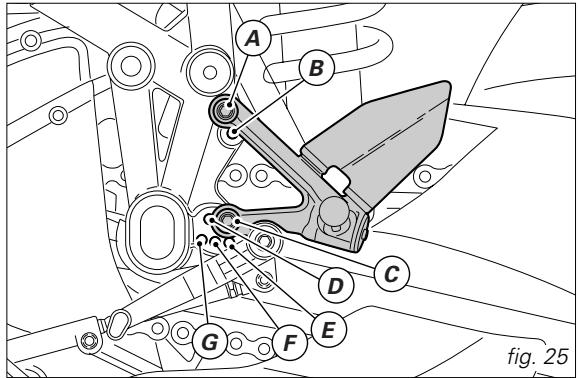
The position of the gear change and rear brake.
pedals may be changed by using different combinations
of the upper (A and B) and lower (C, D, E, F and G)
mounting holes to secure the footpeg brackets. The
figure shows gear change footpeg adjustment. The rear
brake footpeg is adjusted by the same procedure.

Warning
Gear change and rear brake footpegs are critical safety components. Have them adjusted at an Authorized DUCATI Workshop.
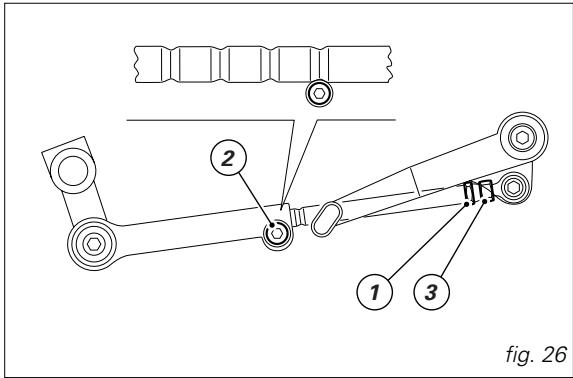
Gear change pedal adjustment (fig. 26)
Gear change pedal position relative to the footpeg may be adjusted to suit rider preferences. There are three different adjustments available:
Approximate adjustment of pedal position
Fit a wrench into the socket (1) to lock out removable linkage rotation and slacken the locknut (3). Release and remove the screw (2) and adjust the linkage axially so as to set the gear change pedal in the desired position. The linkage has four positions determined by the axis of the screw (2). When finished, tighten the screw (2) and the locknut (3).
Fine adjustment
Fit a wrench into the socket (1) to lock out removable linkage rotation and slacken the locknut (3). Rotate the linkage working the socket (1) so as to set pedal in the desired position. When finished, tighten the locknut (3).
Combined adjustment
Both adjustment techniques may be used together. Make sure to tighten locknut (3) and screw (2) when finished.
Rear brake pedal adjustment (fig. 27)
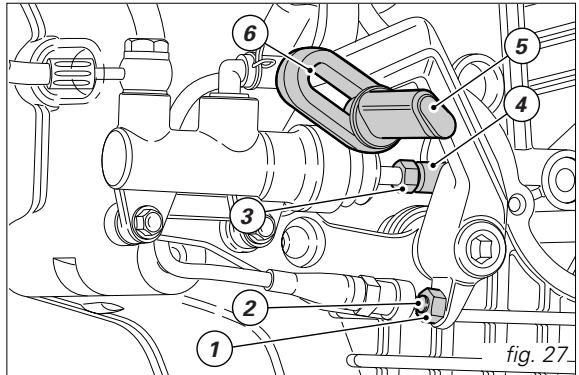
To set the rear brake pedal,
loosen check nut (1).
Turn pedal travel adjusting screw (2) until pedal is in the desired position.
Tighten check nut (1).
Work pedal by hand to make sure it has 1.5 - 2 mm free play before brake begins to bite.
If not so, set the length of cylinder linkage as follows.
Loosen the check nut (3) on cylinder linkage.
Tighten linkage into fork (4) to increase play, or unscrew linkage to reduce it.
Tighten check nut (3) and check pedal free play again.
For a fine adjustment of rear brake pedal position, slacken the retaining screw of the brake pedal (5) and slide the pedal inside the bracket slot (6) until setting it in the desired position. Tighten the retaining screw.
MAIN COMPONENTS AND DEVICES
Location (fig. 28)
1) Tank filler plug.
2) Seat catch (Biposto).
3) Side stand.
4) Hook for helmet fastening cable (Biposto).
5) Steering damper.
6) Rear view mirrors.
7) Front fork adjusters.
8) Rear shock absorber adjusters.
9)Motorcycle track alignment linkage.
10) Exhaust silencer (see note on page 49).
11) Catalyzer.
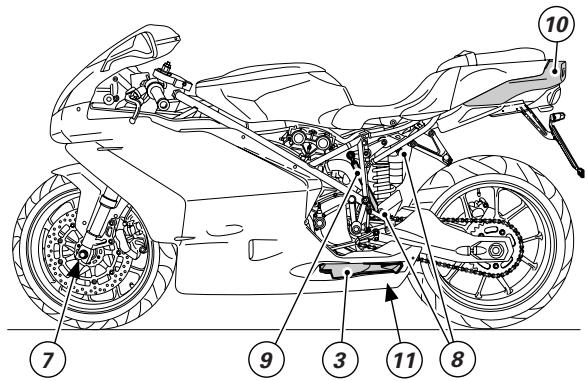
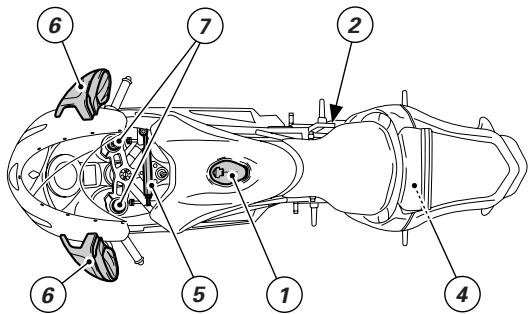
fig. 28
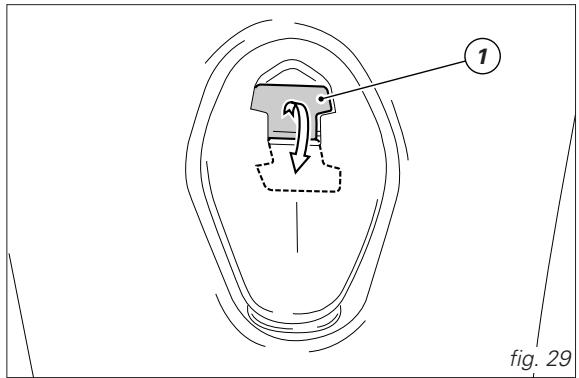
Tank filler plug (fig. 29)
Opening
- Lift the protection lid (1) and fit the ignition key into the lock. Turn the key clockwise 1/4 turn to unlock. Lift the plug.
Closing
Refit the plug with the key in it and push it down into its seat. Turn the key anticlockwise to its initial position and take it out. Close the lock protection lid (1).

Note
The plug can only be closed with the key in.

Warning
Always make sure you have properly refitted (see page 50) and closed the plug after each refueling.
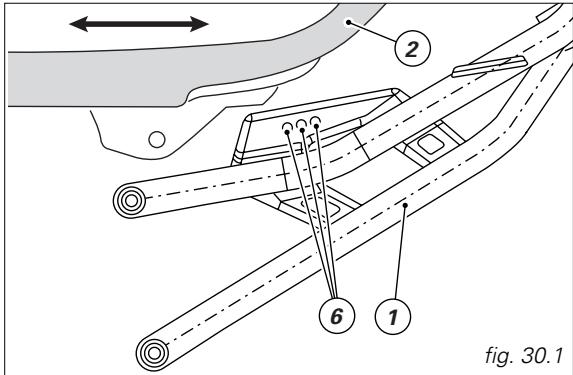
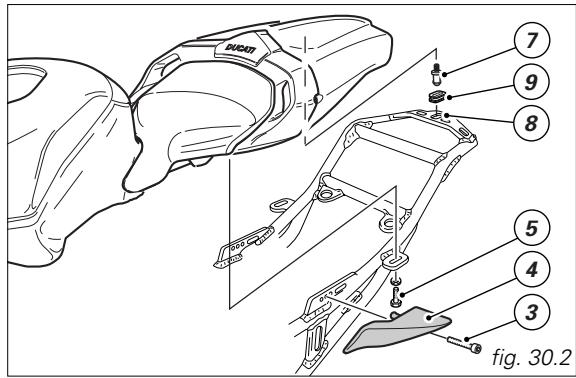
Seat/fuel tank adjustment (Monoposto)
On the single-seater version, the complete seat-fuel tank-tail guard assembly can be adjusted by sliding forward and rearward along rear subframe (1) axis.
This provides a 20-mm adjustment range for the seat (2) to meet rider's preferences.
Adjust as follows:
Release and remove the side screws (3) and remove the side grab handles (4).
Slacken the screws (5) and move the seat-fuel tank assembly forward or rearward.
The three holes (6) in the subframe (1) allow three different positions.
A stud (7) fixed in the centre of the tail guard slides in a slot (8) fitted with an "H" rubber (9).
Match the seat hole with the subframe hole that determines the desired seat position.
Tighten the screws (3) to the specified torque.
Position the side grab handles and tighten the side screws (1) to the specified torque.
Seat catch and helmet hook (Biposto)
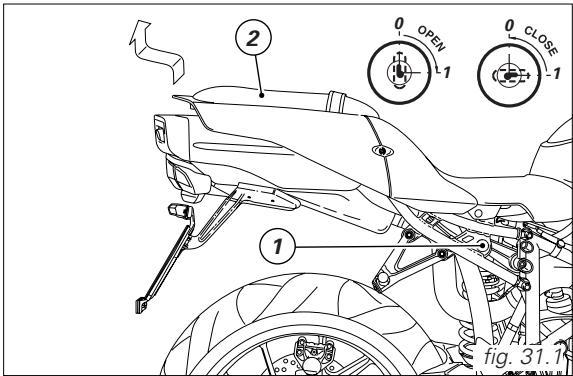
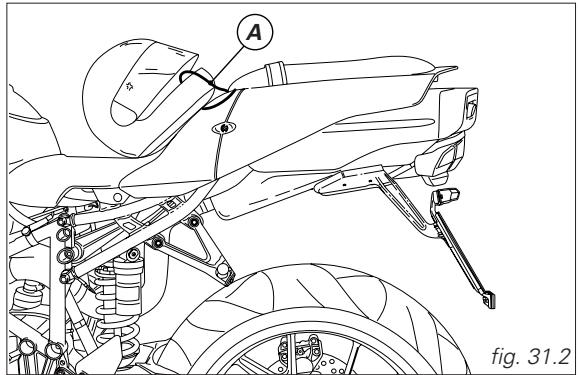
Opening (fig. 31.1 and 31.2)
Fit the ignition key into the lock (1) and turn the key clockwise until you hear the seat catch click.
Pull the rear end of the seat (2) gently upwards and lift until clear.
On the front end of the compartment underneath the seat, there is the helmet fastening cable. Insert the cable (A) into the helmet and insert the ends of the cable into the hook. Leave the helmet hanging outside (fig. 31) and refit the seat.

Warning
This system is intended to lock your helmet safely when you park your motorcycle. Never leave the helmet hanging from the hook when riding or it may get in the way and make you lose control of the motorcycle. Inserting the cable under the frame from the left side will enable to lock the seat.
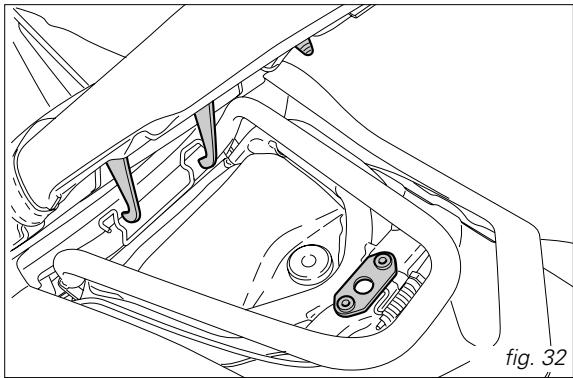
Closing (fig. 32)
Slide the hooks at the front bottom end of the seat underneath the frame cross tube.
Press on the passenger seat until you hear the catch click.
Pull the passenger seat gently up to make sure it is correctly engaged.

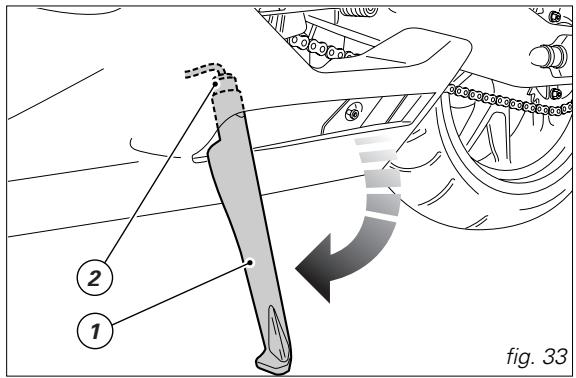
Side stand (fig. 33)

Important
Before lowering the side stand, make sure that the bearing surface is hard and flat.
Do not park on soft or pebbled ground or on asphalt melt by the sun heat and similar or the motorcycle may fall over.
When parking in downhill road tracts, always park the motorcycle with its rear wheel facing downhill.
To pull down the side stand, hold the motorcycle handlebars with both hands and push down on the thrust arm (1) with your foot until it is fully extended. Tilt the motorcycle until the side stand is resting on the ground.

Warning
Do not sit on the motorcycle when it is supported on the side stand.
To move the side stand to its rest position (horizontal position), tilt the motorcycle to the right and, at the same time, lift the thrust arm (1) with your foot.

Note
Check for proper operation of the stand mechanism (two springs, one into the other) and the safety sensor (2) at regular intervals.

Note
It is possible to start the engine with side stand down and the gearbox in neutral. When starting the bike with a gear engaged, pull the clutch lever (in this case the side stand must be up).
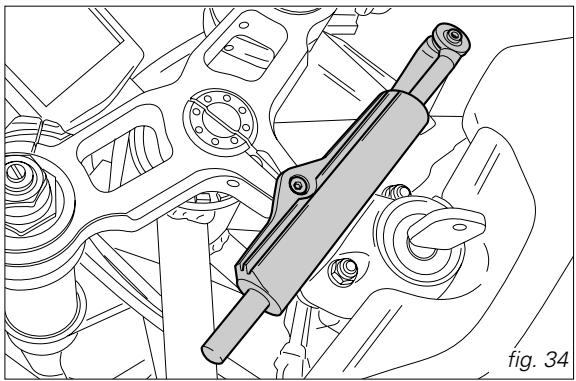
Steering damper (fig. 34)
The steering damper is before the tank and is secured to the frame and the steering head. It gives improved steering accuracy and stability, thus also improving motorcycle road behavior under any riding conditions.

Important
In case the steering angle is changed, the steering damper must be repositioned (see page 62).
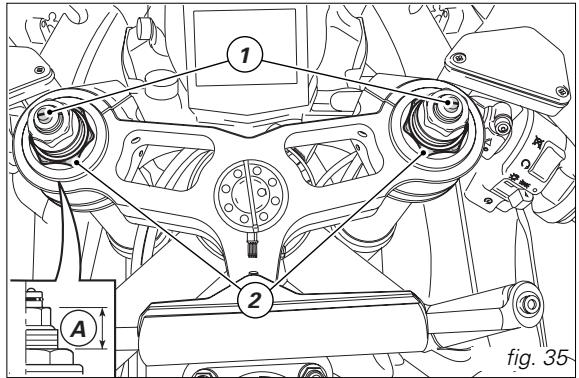
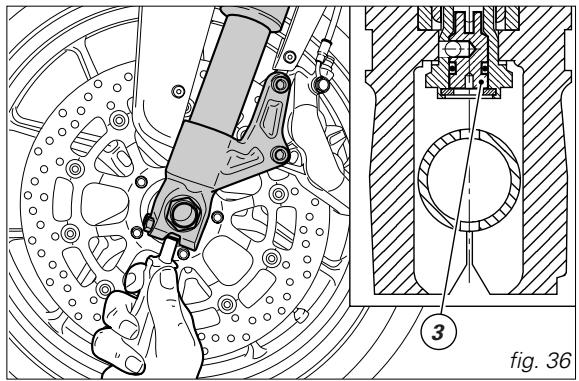
Front fork adjusters
The front fork has rebound, compression damping adjusters and spring preload adjuster.
This adjustment is done using the outer adjusters:
1) to adjust rebound damping (fig. 35);
2) to adjust inner springs preload (fig. 35);
3) to adjust compression damping (fig. 36).
Put and secure the motorcycle on side stand.
Turn the adjuster (1) on fork leg top with a flat screwdriver to adjust rebound damping.
To reach the adjuster (3), insert a screwdriver into the passing hole on the wheel shaft at fork leg axis.
As you turn the adjusting screws (1 and 3), you will hear them click. Each click identifies a setting. Turn the screw all the way in to set the hardest damping (position 0).
This will be your starting point. Now turn the screw anticlockwise and listen for the clicks that identify setting positions no. "1", "2" and so on.
STANDARD factory setting is as follows:
compression: 8 clicks;
rebound: 8 clicks.
To change the preload of the spring inside each fork leg, turn the hex. adjusting nut (2) with a 22-mm hexagon wrench.
Preload setting range (A, fig. 35) is from 25 to 10mm .
Factory setting is 20~mm
E

Important
Adjust both fork legs to same settings.
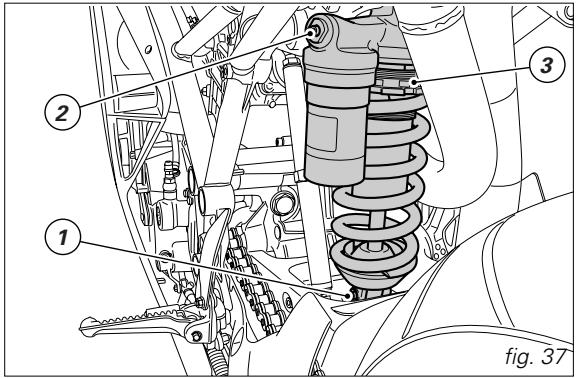
Shock absorber adjusters (fig. 37)
The rear shock absorber has outer adjusters that enable you to adjust your motorcycle to the load.
The adjuster (1) located on the left side, on the connection holding the shock absorber to the swingarm, controls rebound damping.
The adjuster (2) on the shock absorber expansion reservoir controls compression damping.
Turn the adjusters (1 and 2) clockwise to increase damping, anticlockwise to reduce it.
Rebound adjuster (1) STANDARD setting:
turn the adjuster all the way in (clockwise) then slacken it 1 turn and a half.
Compression adjuster (2) STANDARD setting:
turn the adjuster all the way in (clockwise) then slacken it 1 turn.
Two ring nuts (3), located on the top section of the shock absorber are used to adjust the outer spring preload.
To change spring preload, slacken the upper ring nut.
Then tighten or slacken the lower ring nut to increase or decrease spring preload as required. Once spring preload has been set, tighten upper ring nut.

Warning
Use a specific pin wrench to turn the preload adjusting nut. Be careful when turning the nut to avoid hurting your hand hitting motorcycle parts. The pin may slip out of the nut recess while carrying out such operation.

Warning
The shock absorber is filled with gas under pressure and may cause severe damage if taken apart by unskilled persons.
When carrying a passenger and a load, set the rear shock absorber spring to maximum preload to improve motorcycle handling and keep safe clearance from the ground. You may find that rebound damping needs readjusting.
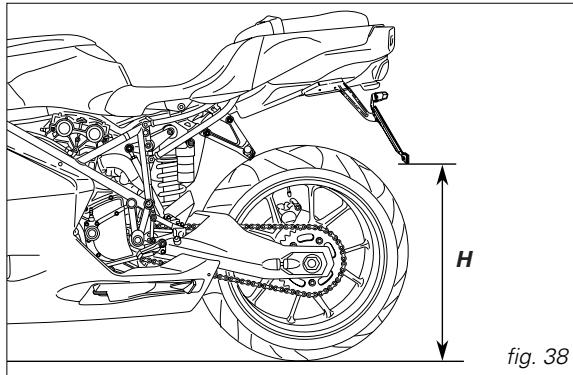
Changing motorcycle track alignment (fig. 38)
Motorcycle track alignment is the result of tests carried out under different riding conditions by our technical staff.
Modifying factory setting is a very delicate operation, which may lead to serious damages if carried out by unskilled people.
Before changing standard setting, measure the reference value (H, fig. 38).
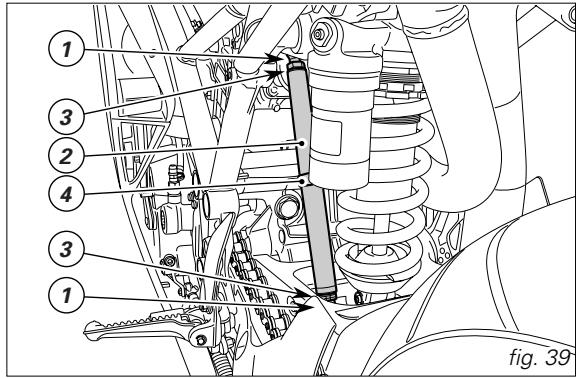
The rider can modify track alignment according to his/her needs by changing working position of the shock absorber, increasing/decreasing the distance between the centers of linkage (2), loosening the nuts (3) of the ball joints (1) by turning socket (4).
When finished, tighten the nuts (3) to 25 Nm.

Note
Please note that the lower nut (3) has a left-hand
thread.

Warning
Length of linkage (2), included between the two joint center lines (1), should not exceed 285 mm.
DIRECTIONS FOR USE
Running-in recommendations
Max. rotation speed (fig. 40)
Rotation speed for running-in period and during standard use (rpm):
1) up to 1000 km;
2) from 1000 to 2500~km ;
3) after 2500~km .
Up to 1000 km
During the first 1000km keep an eye on the revolution meter. The indicator must not exceed: 5500-6000 rpm.
During the first hours of riding, it is advisable to run the engine at varying load and rpm, though still within recommended limit.
To this end, roads with plenty of bends and even slightly hilly areas are ideal for a most efficient running-in of engine, brakes and suspensions.
For the first 100km , use the brakes gently. Do not brake violently or keep brake applied for too long. This will enable a correct break-in of friction material on brake pads against brake discs.
For all mechanical moving parts of the motorcycle to adapt to one another and above all not to adversely affect the life of basic engine parts, it is advisable to avoid harsh accelerations and not to run the engine at high rpm for too long, especially uphill.
Furthermore, the drive chain should be inspected frequently. Lubricate it as required.
From 1000 to 2500km
At this point, you can squeeze some more power out of your engine, being careful, however, to never exceed: 7000 rpm.

Important
During the whole running-in period, the maintenance and service rules recommended in the warranty card should be observed carefully. Failure to comply with these rules will release Ducati Motor Holding S.p.A. from any liability whatsoever for any engine damage or shorter engine life.
After 2500~km
After running-in, never exceed the following values during the motorcycle standard use:
10000 rpm.
Strict observance of running-in recommendations will ensure longer engine life and reduce the likelihood of overhauls and tune-ups.
E
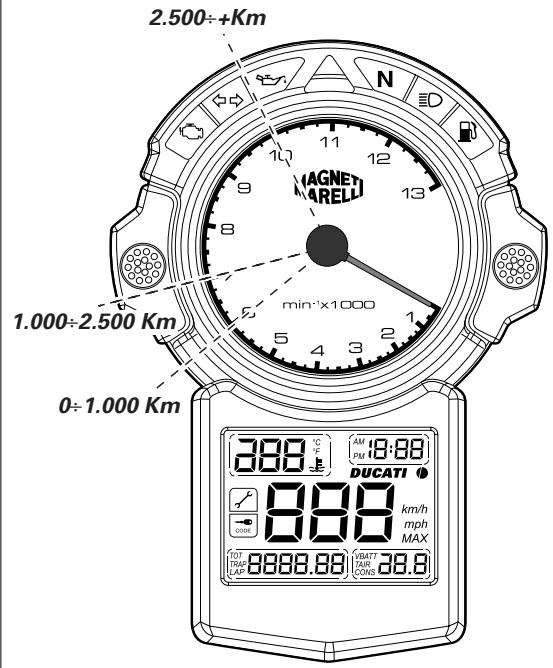
fig. 40
Pre-ride checks

Warning
Failure to carry out these checks before riding, may lead to motorcycle damage and injury to rider and passenger.
Before riding, perform a thorough check-up on your bike as follows:
Fuel level in the tank
Check fuel level in the tank. Fill tank if needed (page 50).
Engine oil level
Check oil level in the sump through the sight glass. Top up with recommended oil if needed (page 73).
Brake and clutch fluid
Check fluid level in the relevant reservoirs (page 57).
Coolant level
Check coolant level in the expansion reservoir. Top up if necessary (page 55).
Tyre condition
Check tyre pressure and condition (page 71).
Controls
Work the brake, clutch, throttle and gear change controls (levers, pedals and twistgrips) and check for proper operation.
Lights and indicators
Make sure lights, indicators and horn work properly. Replace any burnt-out bulbs (page 65).
Key-operated locks
Check that fuel filler plug (page 34) and seat catch locks (Biposto version) (page 36) are closed firmly.
Stand
Make sure side stand operates smoothly and is in the correct position (page 38).

Warning
In case of malfunctioning, do not start the motorcycle and call a DUCATI Dealer or Authorized Workshop.
Starting the engine

Note
Follow the "High ambient temperature" procedure to start the engine when it is warm.

Warning
Before starting the engine, become familiar with the controls you will need to use when riding (page 10).
Regular ambient temperature
(10 °C/50 °F to 35 °C/95 °F):
1) Move the ignition key to ON (fig. 41). Make sure both the green light N and the red light on the instrument panel come on.

Important
The oil pressure light should go out a few seconds after the engine has started (page 11).

Warning
The side stand must be fully up (horizontal position) as its safety sensor prevents engine start when down.

Note
It is possible to start the engine with side stand down and the gearbox in neutral. When starting the bike with a gear engaged, pull the clutch lever (in this case the side stand must be up).
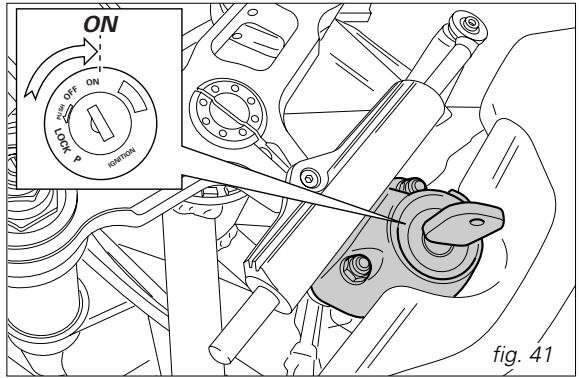
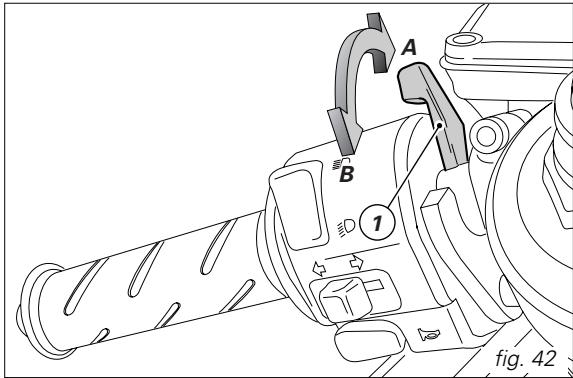
2) Move the cold start lever (1) to (B) (fig. 42).
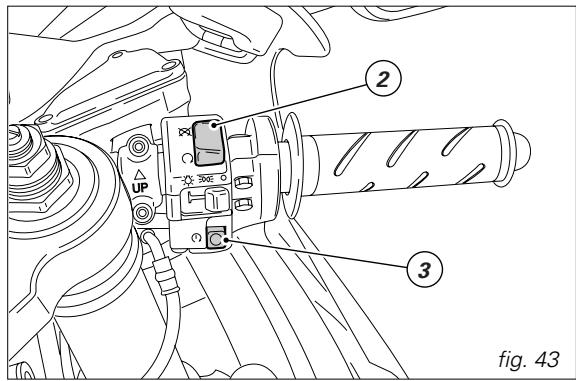
3) Check that the stop switch (2, fig. 41) is positioned to
(RUN), then press the starter button (3).
Let the engine start without using the throttle control.

Important
Never operate the electric start button more than 5 seconds at a time. If needed, allow 10 seconds before attempting to restart the engine.
4) Slowly move the cold start lever (1) to its vertical position (A) (fig. 42).

Important
Do not rev up the engine when it is cold. Allow some time for oil to reach all points that need lubricating.
High ambient temperature (over 35^ / 95^ ):
Follow the same procedure for "Regular ambient temperature", however, do not use the device (1, fig. 42).
Cold ambient temperature (below 10^ / 50^ ):
Follow the procedure for "Regular ambient temperature", however allow 5 minutes for the engine to warm up.
Moving off
1) Disengage the clutch squeezing the control lever.
2) Push down on gear change lever sharply with the tip of your foot to engage the first gear. Once released, the lever will spring back to its original position.
3) Speed up engine, by turning the throttle twistgrip and slightly releasing the clutch lever at the same time. The motorcycle will start moving off.
4) Let go of clutch lever and speed up.
5) To shift to second gear, close the throttle to slow down engine, disengage the clutch right away, lift the gear change lever and let go of clutch lever.
To shift down, release the twistgrip, pull the clutch control lever, shortly speed up to help gears synchronize, shift down and release the clutch.
The controls should be used correctly and timely: when riding uphill do not hesitate to shift down as soon as the motorcycle tends to slow down, so you will avoid lugging the engine and stressing the motorcycle abnormally.

Important
Avoid harsh accelerations, as this may lead to misfiring and transmission snatching. The clutch lever should not be pulled longer than necessary after gear is engaged, or friction parts may overheat and wear out.
Braking
Slow down in time, shift down to engine-brake first and then brake applying both brakes. Pull the clutch lever before stopping the motorcycle, to avoid sudden engine stop.

Warning
Use both brake lever and pedal for effective braking. Using only one of the brakes will give you less braking power.
Never use brake controls harshly or violently or you may lock the wheels and lose control of the motorcycle.
When riding in the rain or on slippery surfaces, braking will become less effective. Always use the brakes very gently and carefully when riding under these conditions.
Any sudden manoeuvres may lead to loss of control.
When tackling long, high-gradient downhill road tracts, shift down gears to use engine braking. Apply one brake at a time and use brakes sparingly. Keeping the brakes applied all the time would cause the friction material to overheat and reduce braking power dangerously.
Underinflated or overinflated tyres reduce braking efficiency and may affect safe riding and motorcycle good handling while turning.
Stopping the motorcycle
If you let go of the throttle twistgrip, the motorcycle will slow down gradually and smoothly. Then, shift down releasing the clutch, and finally change from first to neutral. Apply brakes and you will bring the motorcycle to a complete stop. To switch the engine off, simply turn the key to OFF (page 23).

Important
The engine control unit incorporates a power save feature. When the key is left accidentally in the ON position and the starter button is not operated within 15 seconds, the engine control unit shuts down automatically. When this is the case, turn the key to OFF and back to ON again. However, never leave the key turned to ON with the engine stopped.
Parking
Stop and park the motorcycle on the side stand (see page 38).
To avoid theft, turn the handlebar fully left and block it by pushing in the ignition key and turning it to the LOCK position.
If you park in a garage or other facilities, make sure that there is proper ventilation and that the motorcycle is not near a source of heat.
You may leave the parking lights on by turning the key to position ±bP .

Important
Do not leave the key turned to ±bP for long periods or the battery will run down. Never leave the ignition key in the switch when you are leaving your bike unattended.

Warning
The exhaust system might be hot, even after engine is switched off; pay particular attention not to touch exhaust system with any body part and do not park the vehicle next to inflammable material (wood, leaves etc.).

Warning
Using padlocks or other locks designed to prevent motorcycle motion, such as brake disc locks, rear sprocket locks, and so on is dangerous and may impair motorcycle operation and affect the safety of rider and passenger.
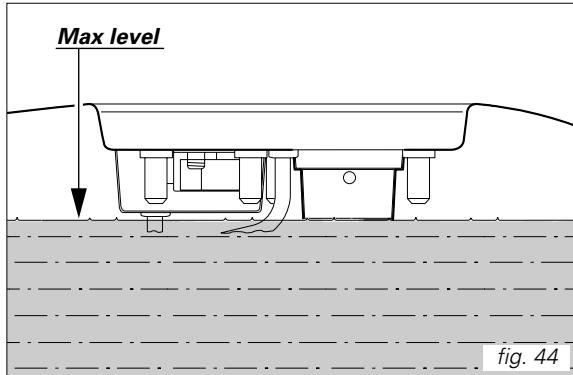
Refueling (fig. 44)
Never overfill the tank when refueling. Fuel should never be touching the rim of filler recess.

Warning
Use fuel with low lead content and an original octane number of 95 minimum (see table "Top-ups" on page 78).
Make sure there is no fuel trapped in the filler plug recess.
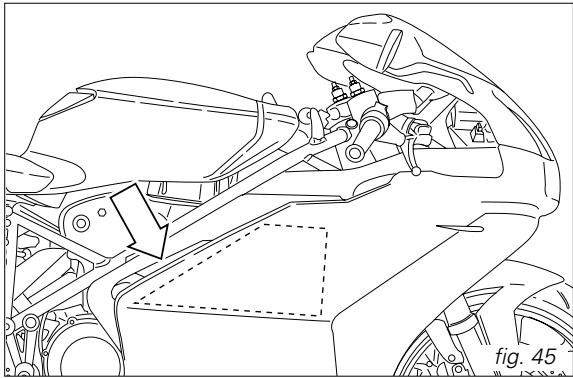
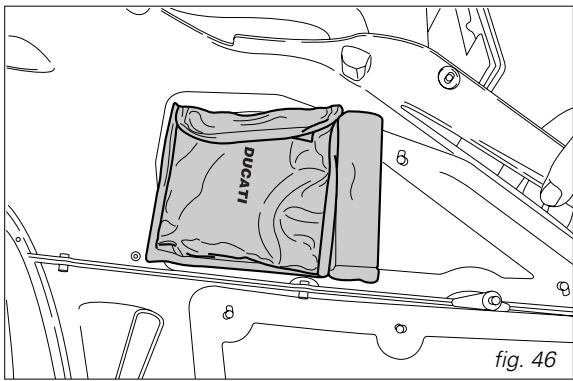
Tool kit and accessories (fig. 45 and 46)
Stored in a compartment inside the right fairing panel are:
An Owner's manual;
A helmet fastening cable;
A tool kit including:
- Box wrench for spark plugs; at the opposite end, combined wrench (inner diam. 10 + outer diam. 14);
Tommy bar for box wrench; - Double-bit screwdriver;
- Allen key for fairings (Monoposto version);
- Screwdriver for rear shock absorber adjustment.
The twin-seater version comes with a helmet fastening cable, which is stored underneath the passenger seat.
Removing the fairing
Some servicing operations need the motorcycle fairing to be removed.

Warning
Firmly and properly secure all removed parts when refitting them, otherwise some of them might suddenly come off when riding and you may lose control of your motorcycle.

Important
At reassembly always fit nylon washers when tightening fastening screws, not to damage painted parts and Plexiglas headlamp fairing.
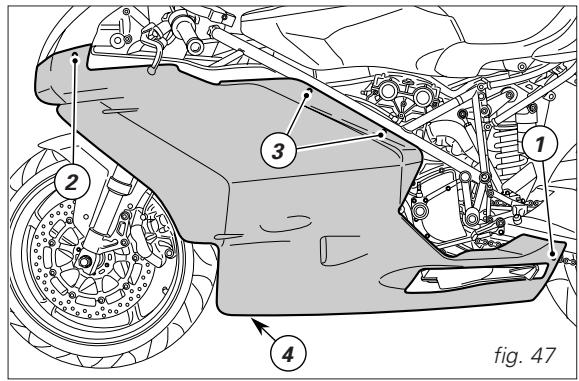
Side body panels - biposto
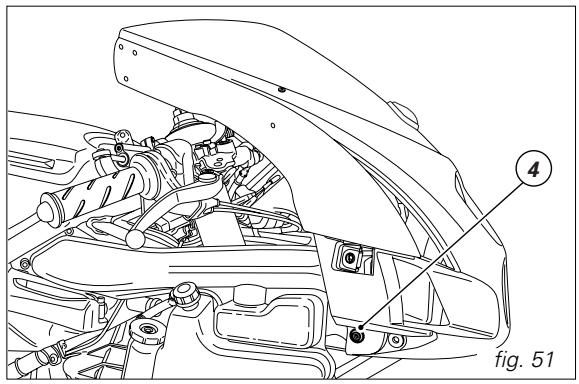
Remove the body panels as follows. Using the Allen key accommodated under the seat unscrew what follows: the two quick fasteners (1) securing the body panels to the brackets.
the two quick fasteners (2) securing the body panels to the headlamp fairing.
the four frame quick fasteners (3).
the screw (4) joining the right and left body panels at the bottom end.
Side body panels - monoposto
Remove the body panels as follows:
Remove the four quick fasteners (3) with their ring securing the body panels to the frame.
On the right-hand side, gain access to the tool kit, take the Allen key for the fairing and remove the following: the two quick fasteners (1) securing the body panels to the brackets.
the two quick fasteners (2) securing the body panels to the headlamp fairing.
the screw (4) joining the right and left body panels at the bottom end.

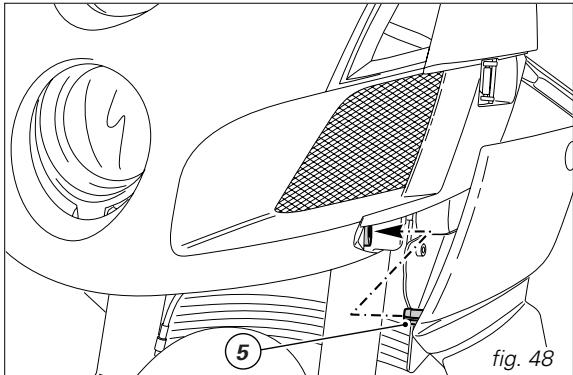
Note
When refitting the fairings, make sure that the front locating lug (5) becomes correctly seated into the hole in the headlamp fairing.

Note
To refit the left body panel, unfold the side stand and insert it into the opening in the body panel.
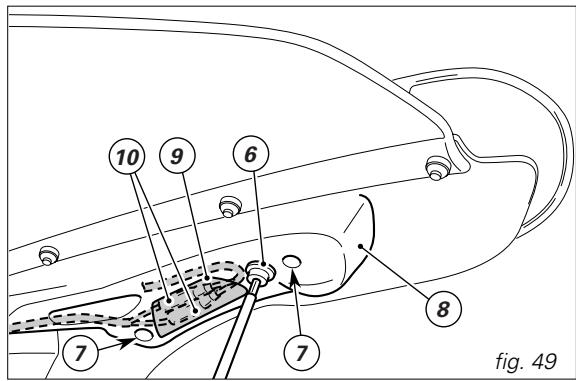
Rear-view mirrors
Unscrew the retaining screw (6) of the rear-view mirror. Release the retaining pins (7) from the clips secured to the headlamp support (8). Slip off the rubber gaiter (9) and disconnect the turn indicator connectors (10). Repeat the process for the other rear-view mirror.

Important
On refitting, smear the threads of the screws (6) with "medium-strength threadlocker".
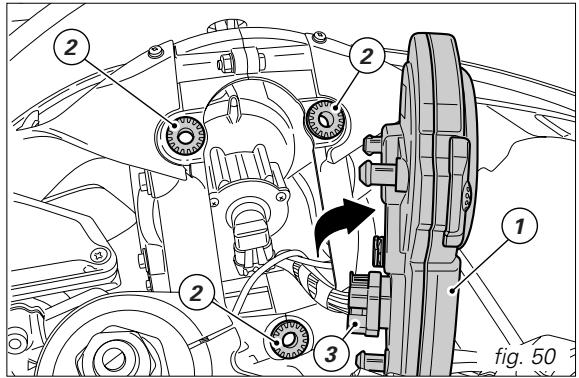
Headlamp fairing

Note
The rear-view mirrors and side body panels must first be removed as described above to allow removal of the headlamp fairing.
Pull the instrument panel (1) until clear of the rubber grommets (2) and disconnect the connector (3) at the main wiring harness end.
Disconnect the connectors of the parking light bulb. Unscrew the two screws (4) that secure the headlamp, fairing to the headlamp support at either side.

Note
After refitting the headlamp fairing, refit the side body panels and the rear-view mirrors.
Checking and topping up the coolant level (fig. 52)
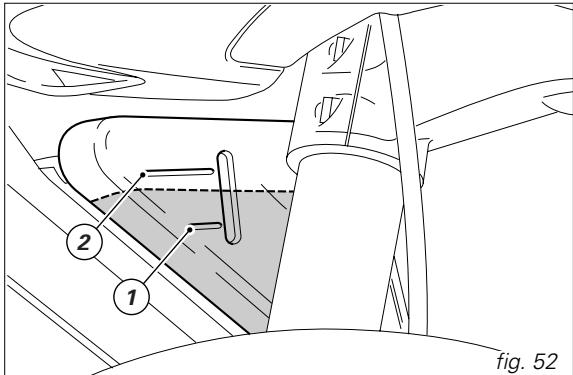
Check the coolant level in the expansion reservoir, on the RH side of the motorcycle. The coolant level must be between the marks (1) and (2). The longest mark (2) indicates MAX level, whereas the shortest mark (1) indicates MIN level.
Top up if the level is below the MINIMUM level.

Note
For a good view of the coolant level, look at the tank from the left side of the motorcycle. Look down between front wheel and right fairing.
Remove right fairing (page 52).
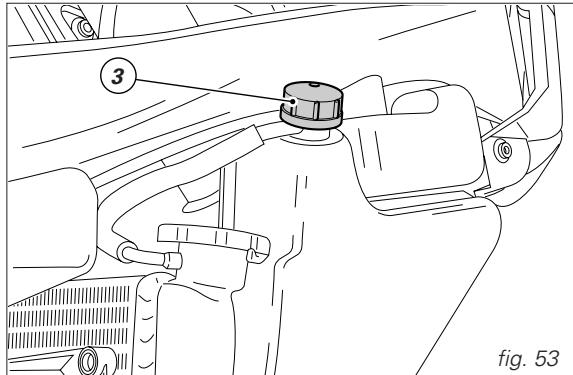
Unscrew the filler (3, fig. 53) and add a mixture consisting of water and antifreeze SHELL Adv
Coolant or Glycoshell (35-40% of the volume) up to MAX mark.
Refit the filler (3) and reassemble all removed parts. This mixture improves operating conditions (coolant will start freezing at -20^ / -4^ ).
Coolant circuit capacity: 2.8 cu dm (liters).

Warning
Place the motorcycle on a flat surface (vertical) and make sure the engine is cold before proceeding.
Checking brake and clutch fluid level
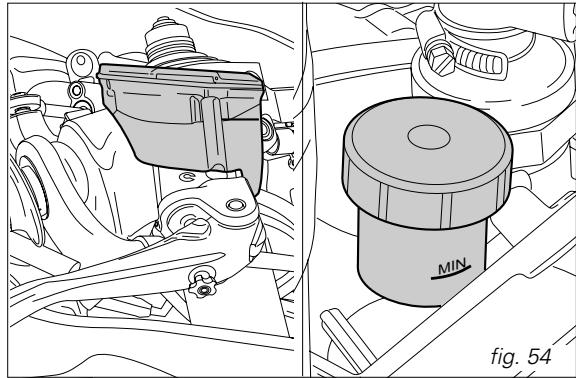
Fluid level should never fall below the MIN mark on each reservoir (fig. 54) (figure shows front and rear brake reservoirs).
If level drops below the limit, air might get into the circuit and affect the operation of the system involved.
Brake and clutch fluid must be topped up and changed at the intervals specified in the routine maintenance chart (see Warranty Card) by a Ducati Dealer or Authorized Workshop.

Important
It is recommended all brake and clutch lines be
changed every four years.
Clutch system
If the control lever has exceeding play and the transmission snatches or jams as you try to engage a gear, it means that there is air in the circuit. Contact a Ducati Dealer or Authorized Workshop to have the system inspected and air drained out.

Warning
Clutch fluid level in the reservoir tends to increase as the clutch plates friction material wears out. Do not exceed specified level (3 mm above minimum level).
Brake system
If you find exceeding play on brake lever or pedal and brake pads are still in good condition, contact a Ducati Dealer or Authorized Workshop to have the system inspected and any air drained out of the circuit.

Warning
Do not spill any brake and clutch fluid on the paintwork or on plastic parts or they will damage. Hydraulic oil is corrosive; it may cause damages and lead to severe injuries.
Never mix different quality oils.
Check for joint proper sealing.
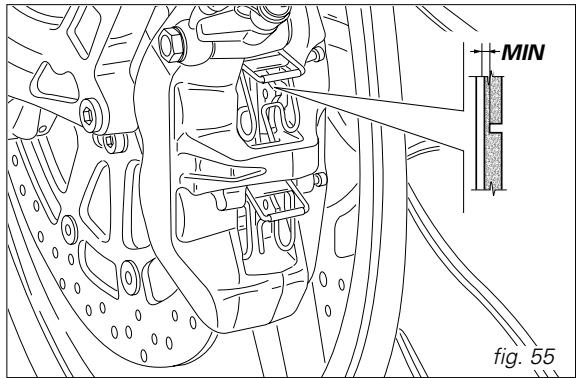
Checking brake pads for wear (fig. 55)
To facilitate inspection without removing the pads from the calipers, brake pads have a wear mark. If the grooves in the friction material are still visible, the pad is still in good condition.

Important
Have the brake pads replaced at a Ducati Dealer or Authorized Workshop.
Lubricating cables and joints
The condition of the outer sheath of the throttle/cold start cables should be checked at regular intervals. The sheath should show no signs of squeezing or cracking.
Work the controls to make sure the inner cables slide smoothly inside the sheath: if you feel any friction or hard spots, have the cable replaced by a Ducati Dealer or Authorized Workshop.
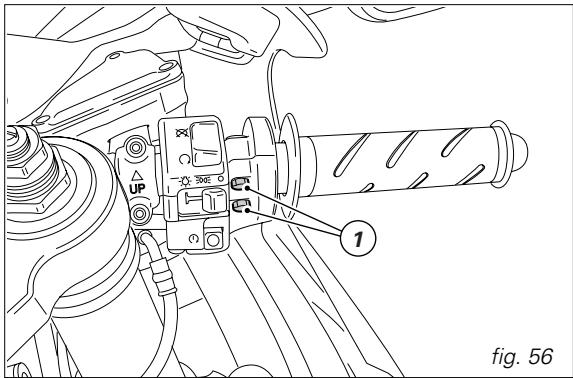
To prevent these failures, for the throttle cable, it is best to open the throttle control by unscrewing the two fastening screws (1, fig. 56) and then grease the cable ends and the pulley with SHELL Advance Grease or Retinax LX2.

Warning
When refitting the cover, be sure to slide the cables onto the suitable pulley.
Refit the cover and tighten the screws (1).
To ensure smooth operation of the side stand joint, clean off any dirt and apply SHELL Alvania R3 at all points exposed to friction.
Throttle cable tension adjustment
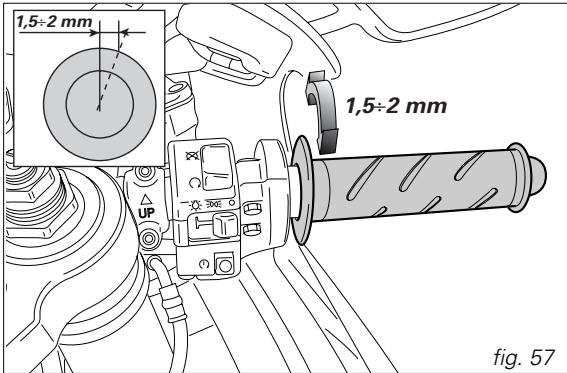
The throttle twistgrip must have a free play of 1.5-2.0 mm measured at the edge of the twistgrip, at all positions of the handlebars.
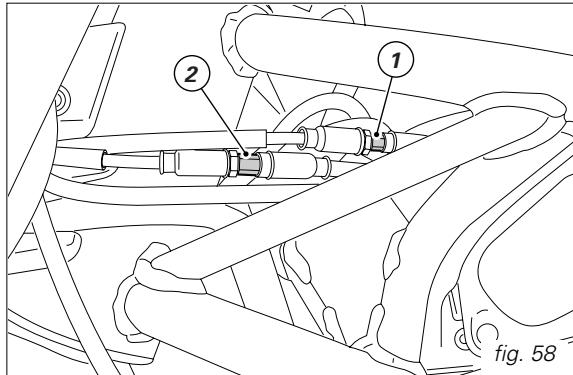
If needed, adjust using the adjusters (1 and 2, fig. 58) located on the steering tube on the left side of the motorcycle.
The adjuster (1) is for throttle opening, whereas adjuster (2) is for throttle closing.
Slip off the dust covers of the adjusters and slacken the locknuts. Work the adjusters as follows: turn clockwise to increase play, anti-clockwise to decrease play. When finished, tighten the locknuts and refit the dust covers.
Charging the battery (fig. 59)
Before charging the battery, it is best to remove it from the motorcycle.
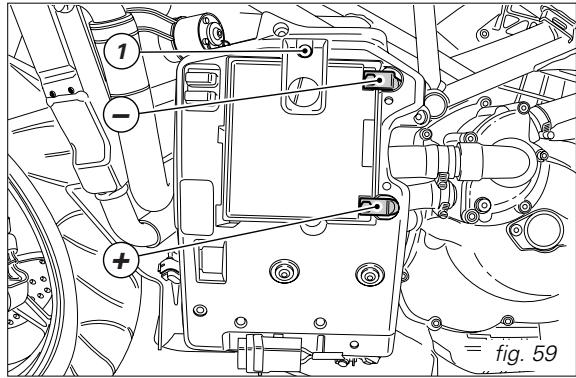
Remove the l.h. body panel (page 52), undo the screw (1) and remove the upper bracket.
Always disconnect the black negative terminal (-) first, and then the red positive terminal (+) .

Warning
Batteries develop explosive gases: keep it away
from heat sources and flames.
Charge the battery in a ventilated room.
Connect the battery charger leads to the battery terminals - red to positive terminal (+) , black to negative terminal (-) .

Important
Make sure the charger is off when you connect the battery to it, or you might get sparks at the battery terminals that could ignite the gases inside the cells.
Always connect the red positive terminal (+) first.
Reinstall the battery on its mount and secure the upper bracket with the screw (1). Connect the terminals. Use some grease on the fastening screws to improve conductive capacity.

Warning
Keep the battery out of the reach of children.
Charge the battery at 0.9 A for 5-10 hours.
Adjusting steering head angle
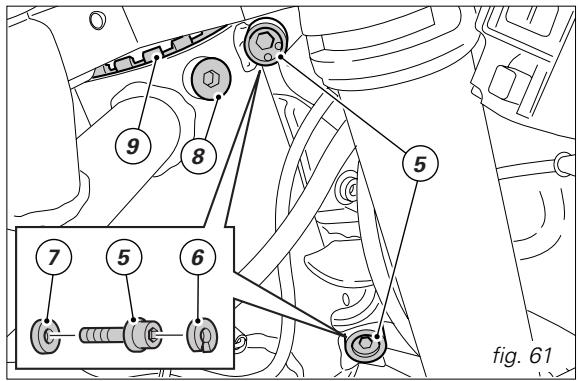
Before changing steering head angle, you must first remove the steering damper. Unscrew the retaining screws (1 and 2) to release the steering damper. The steering lock peg (3) is retained with a screw (2) and must be re-positioned farther back on refitting when steering head angle is modified.
Slacken the steering head retaining screw (4).
To change steering head angle, remove the circlips (6) and the washers (7) and loosen the two screws (5) on the frame right side.
Fully unscrew the screw (8) and turn the steering tube eccentric (9) by 180^ with a pin wrench.
Check that the hole on the eccentric is centred with the through hole in the steering tube. Look at the arrow etched in the top area of the eccentric to centre both holes accurately.
Fully screw the screw (8). Grease the threads of the screws (5) with SHELL Retinax HDX2 and tighten to 22 Nm. Refit the washer (7) and the circlip (6).

Note
While performing the above, the handlebars should be fully turned.
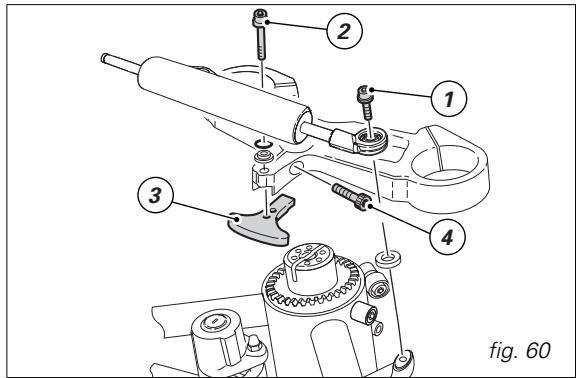
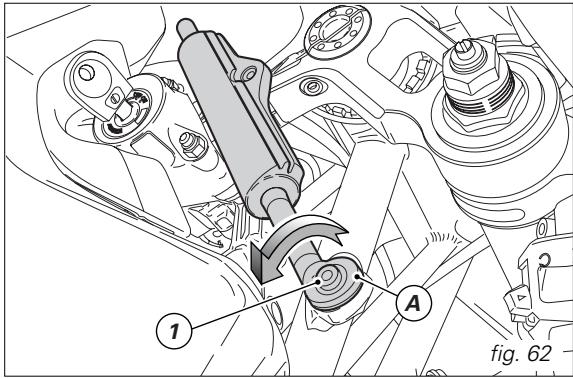
If you wish to set steering head angle at 23^30' , match the last hole at the front end of the steering lock peg (3) with the mounting hole in the steering head. Apply medium-strength threadlocker to the screw (2) and use the screw to secure the steering damper, after installing the steering lock peg (3).
Rotate the ball joint (A) of the steering damper rod through 180^ . Apply medium-strength threadlocker to the screw (1) you have removed previously and secure the steering damper with the screw.
Grease the screw (4) you have slackened previously and tighten.
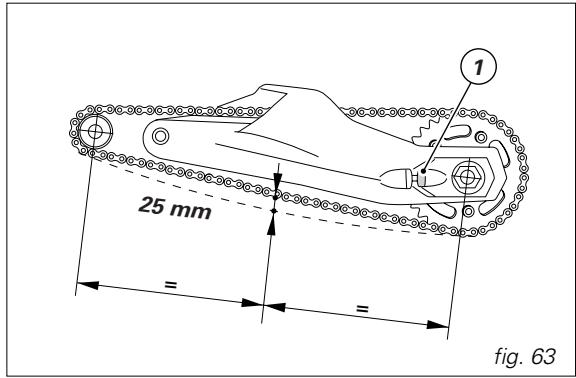
Chain tension inspection (fig. 63)

Important
Have the drive chain tensioned up at a Ducati
Dealer or Authorized Workshop.
When tension is correct, the slack of the lower portion of the chain should be 25mm
E

Warning
Correct tightening of the tensioner lock nuts (1) is essential to rider and pillion passenger's safety.

Important
Improper chain tension will lead to early wear of transmission parts.
Chain lubrication
The chain fitted on your motorcycle has O-rings that keep dirt out of and lubricant inside the sliding parts. The seals might be irreparably damaged if the chain is cleaned using any solvent other than those specific for O-ring chains or washed using steam or water jets. After cleaning, blow the chain dry or dry it using absorbent material and lubricate with SHELL Advance Chain or Advance Teflon Chain on each link.

Important
Using non-specific lubricants may lead to severe damage to chain, front and rear sprocket.
Changing the high and low beam bulbs
Before replacing a burnt-out bulb, make sure that the new one complies with voltage and wattage as specified on page 84, "Electric System", for that lighting device. Always check for new bulb proper operation before refitting removed parts.
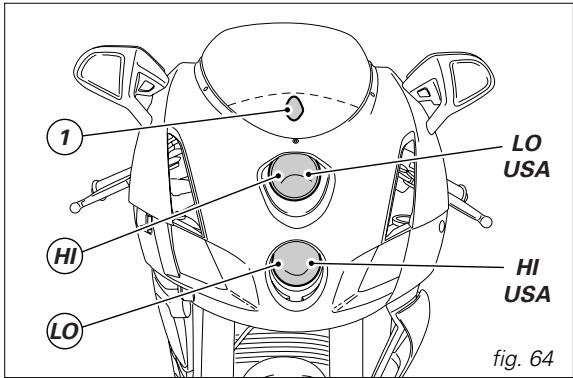
Figure 64 shows the position of the low beam (LO), high beam (HI) and parking light (1) bulbs.

Important
In the USA version, the position of the high and low beam bulbs is reversed.
Headlamp
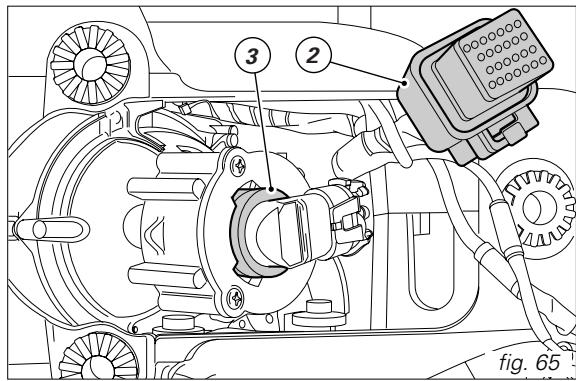
Remove the instrument panel (see page 54) to give access to the upper bulb. Disconnect the instrument panel connector (2) at the main wiring harness end. Rotate the locking ring nut (3) of the upper bulb body anti-clockwise and extract the burnt-out bulb. Replace with a bulb of equal rating.
On refitting, rotate the locking ring nut (3) clockwise to secure the bulb in place.
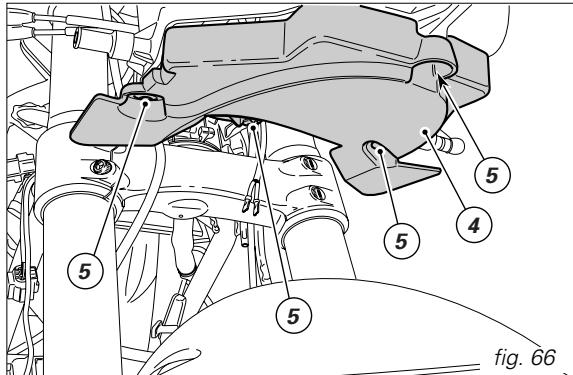
To gain access to the lower bulb, remove the headlamp fairing as described in paragraph "Removing the fairings" on page 52 and unscrew the screws (5) to release the bottom cover (4) of the headlamp support. Change the bulb as described for upper bulb removal.

Note
Main wiring harness cable does not need to be connected to replace the headlamp bulbs.

Note
Be careful to hold the new bulb at the base only.
Never touch the transparent body with your fingers or it will blacken resulting in reduced bulb brilliancy.
Refitting
After changing the burnt-out bulb, connect the instrument panel connector to the main wiring harness, locate the instrument panel to the rubber grommets and refit panel.
Refit the bottom cover and the headlamp fairing and secure them using the retaining screws. Make sure the turn indicator wires are correctly routed in the grooves inside headlamp supports.
Changing the parking light bulb
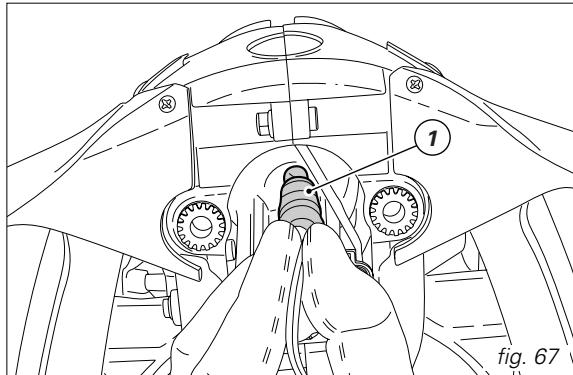
Remove headlight fairing (see page 54), detach instrument panel connector (2, fig. 65) from wiring and put your hand into the headlamp support to grasp the parking light bulb (1). Extract the bulb holder from its seat and change the bulb. Then reconnect instrument panel wiring and properly position it on its buffers.
Front turn indicators (fig. 68)

Note
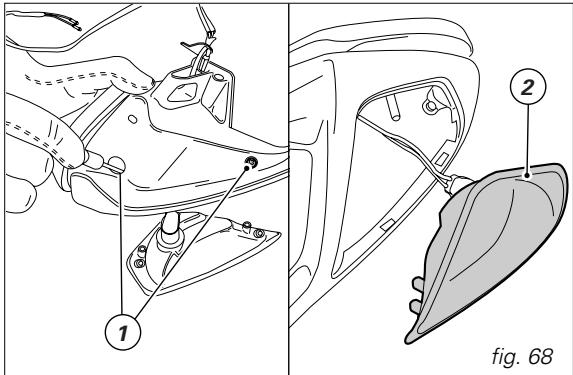
The rear-view mirror and incorporated turn indicator are shown detached from the headlamp fairing to simplify illustration.
Remove the screws (1) and detach the glass (2) from the indicator/mirror support.
The bulb is of the bayonet-type: press and rotate anticlockwise to remove; fit the spare bulb by pressing and turning clockwise until it clicks.
Refit the glass into the suitable slot in the indicator body and tighten the screws (1).
Rear turn indicators
To change the rear turn indicator bulbs, rotate indicator body (3) by one fourth of a turn so that glass is upward and extract it from indicator mount.
The bulb is of the bayonet-type: press and rotate anticlockwise to remove; fit the spare bulb by pressing and turning clockwise until it clicks.
Refit indicator body (3) to its mount and rotate by one fourth of a turn.
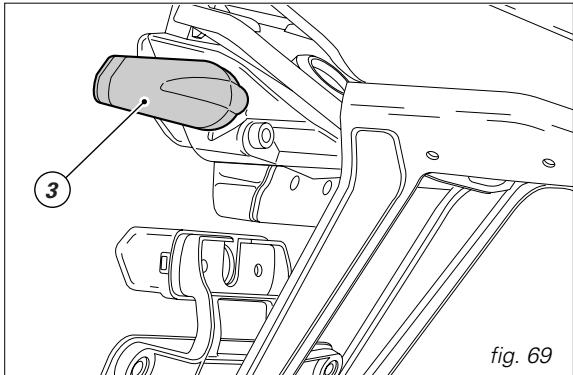
Stop light (fig. 70)
To replace the stop and parking light bulbs, unscrew the two screws (1) that secure the cover (2). The cover (2) has two retaining pins on the inner face that hold the tail light lens (3) in place. The bulb is of the bayonet-type: press and twist anti-clockwise to remove. Fit the spare bulb by pressing and turning clockwise until it locates into its seat with an audible click. Refit any parts you have removed.
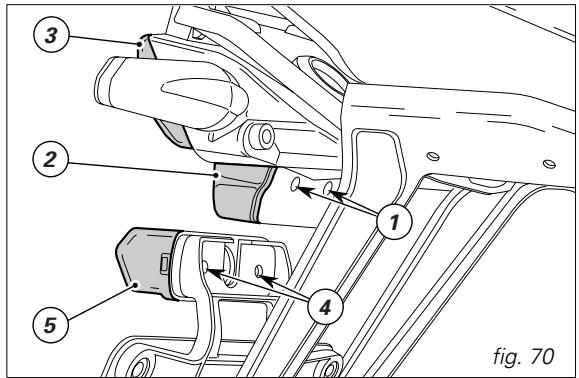
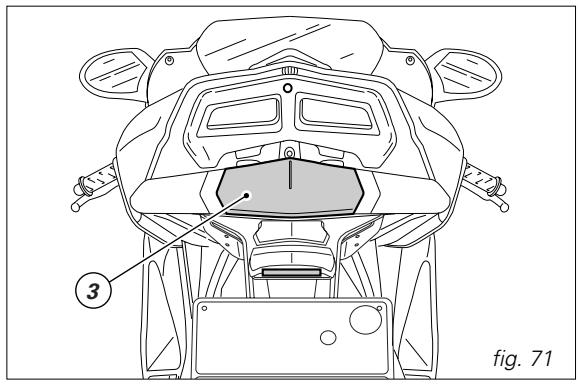
Number plate light (fig. 71)
To expose the number plate light bulb, unscrew the two retaining screws (4) securing the cover (5). Extract the bulb and replace.
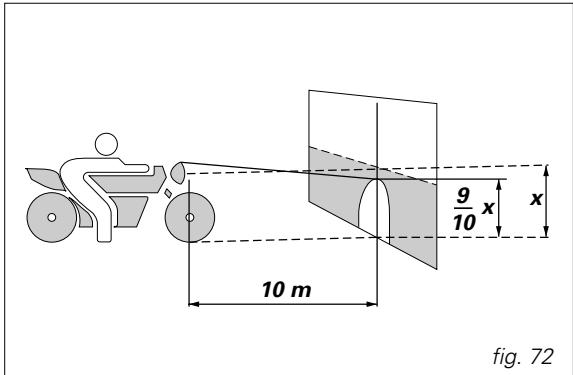
Beam setting (fig. 72)
When checking the beam setting, put the motorcycle upright. Tyres should be inflated at the correct pressure and one person should be sitting astride the motorcycle, keeping it at right angles to its longitudinal axis. Place the motorcycle opposite a wall or a screen, 10 meters apart from it, then draw a horizontal line dictated by headlamp center and a vertical one in line with the longitudinal axis of motorcycle.
If possible, perform this check in dim light.
Switch on the low beam. The height of the light spot (measured at the upper limit between dark and lighted-up area) should not exceed 9/10th of the height from ground of headlamp center.

Note
The procedure described here is in compliance with the "Italian Standard" establishing the maximum height of the light beam. Owners in other countries will adapt said procedure to the provisions in force in their countries.
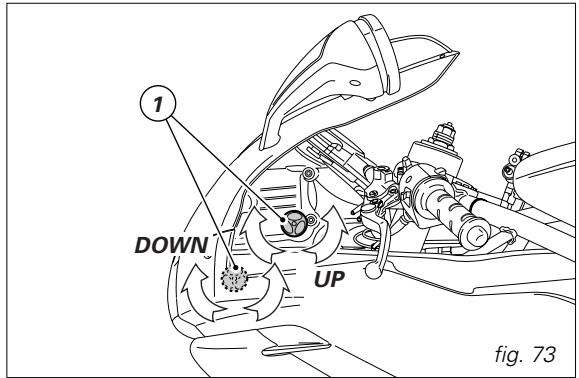
The vertical position of the headlamp is set by means of the adjusting knobs (1, fig. 73) on the left side of the headlamp. Rotate the knobs clockwise to lower the beam or anti-clockwise to raise it.

Note
To gain access to the lower knob, you must first remove the headlamp fairing as described on page 54.
Rear view mirror adjustment (fig. 74)
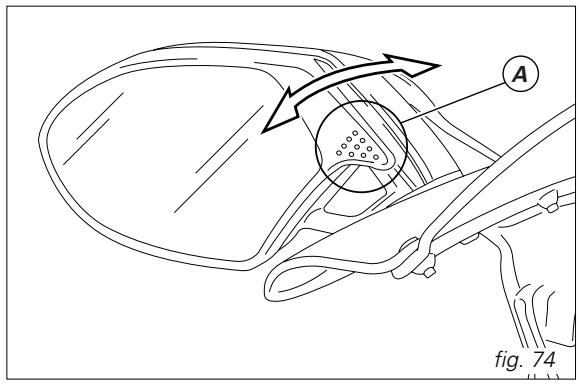
The rear view mirror is adjusted manually by pressing at position (A).
Tubeless tyres
Tyre pressure
Front:
2.1 bar - 2.3 Kg/sq cm
Rear:
2.2 bar - 2.4 Kg/sq cm
As tyre pressure is affected by temperature and altitude variations, you are advised to check and adjust it whenever you are riding in areas where ample variations in temperature or altitude occur.

Important
Check and adjust tyre pressure when tyres are
cold.
To avoid front wheel rim distortion, when riding on bumpy roads, increase tyre pressure by 0.2 - 0.3 bar.
Tyre repair or replacement (Tubeless)
In the event of a tiny puncture, tubeless tyres will take a long time to deflate, as they tend to keep air inside. If you find low pressure on one tyre, check the tyre for punctures.

Warning
A tyre must be replaced when punctured. Replace tyres with recommended standard tyres only. Be sure to tighten the valve caps securely to avoid leaks when riding. Never use tube type tyres. Failure to heed this warning may lead to sudden tyre bursting and to serious danger to rider and passenger.
After replacing a tyre, the wheel must be balanced.

Important
Do not remove or shift the wheel balancing weights.

Note
If tyres need replacing, contact a Ducati Dealer or Authorized Workshop to make sure wheels are removed and refitted correctly.
Minimum tread depth
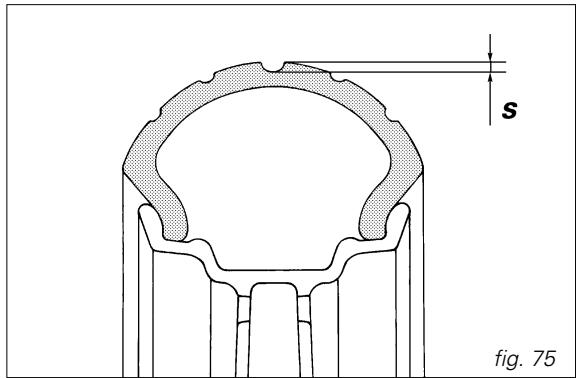
Measure tread depth (S, fig. 75) at the point where tread is most worn down. It should not be less than 2mm and anyway not below the legal limit.

Important
Visually inspect the tyres at regular intervals for detecting cracks and cuts, especially on the side walls, bulges or large spots that are indicative of internal damage. Replace them if badly damaged. Remove any stones or other foreign bodies caught in the tread.
Checking engine oil level (fig. 76)
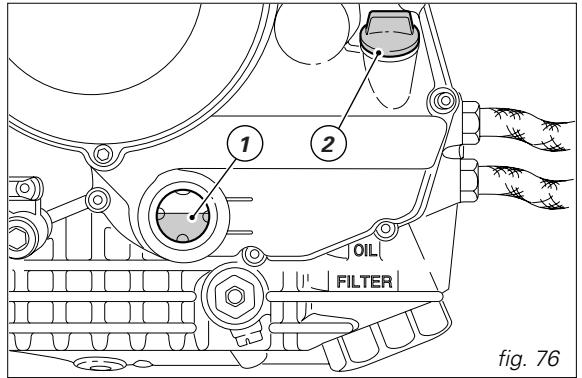
Engine oil level can be checked through the sight glass (1) provided on the clutch cover.
When checking oil level, the motorcycle should be upright and the engine cold.
Allow a few minutes for oil to settle to a steady level after stopping the engine.
Oil level should be between the marks near the sight glass. Top up oil level with SHELL Advance Ultra 4, if low. Undo the filler plug (2) and top up to correct level. Refit the plug.

Important
Engine oil and oil filters must be changed by a
Ducati Dealer or Authorized Workshop at regular intervals, as specified in the routine maintenance chart (see Warranty Card).
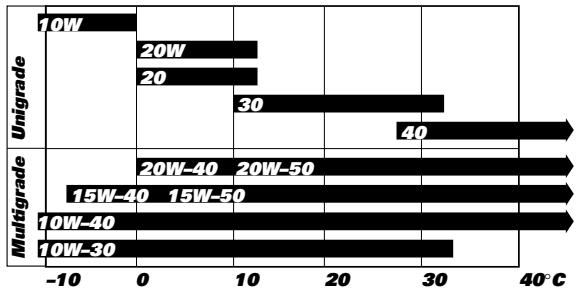
Viscosity
SAE 10W-40
The other viscosity degrees indicated in the table can be used if the local average temperature is within the limits specified for that oil viscosity.
Cleaning and replacing the spark plugs (fig. 77)
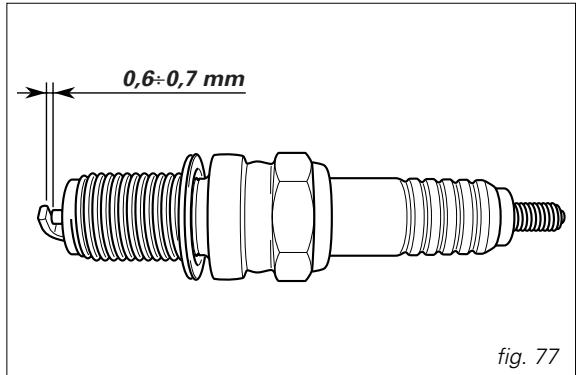
Spark plugs are essential to smooth engine running and should be checked at regular intervals. Spark plugs condition provides a good measure of engine condition. Have the spark plugs inspected or replaced at a Ducati Dealer or Authorized Workshop. Firstly, they will check the color of the ceramic insulator of the central electrode: a light brown, even color is a sign of good engine condition.
Secondly, they will check the central electrode for wear and measure electrode gap. Electrode gap should be: 0.6-0.7 mm.

Important
An electrode gap outside the specified limit will adversely affect engine performance and may lead to difficult starting or erratic idling.
Cleaning the motorcycle
To preserve the finish of metal parts and paintwork, wash and clean your motorcycle at regular intervals, anyway according to the road conditions you ride in. Use specific products only. Prefer biodegradable products. Avoid aggressive detergents or solvents.

Important
Do not wash your motorcycle right after use. When the motorcycle is still hot, water drops will evaporate faster and spot hot surfaces.
Never clean the motorcycle using hot or high-pressure water jets. Cleaning the motorcycle with water cleaners may lead to seizure or severe failure of front fork, wheel hub assembly, electric system, front fork seals, air inlets or exhaust silencers and adversely affect the operation of motorcycle safety features.
If needed, clean off stubborn dirt or exceeding grease from engine parts using a degreasing agent. Be sure to avoid contact with drive parts (chain, sprockets, etc.). Rinse with warm water and dry all surfaces with chamois leather.

Warning
Loss of braking may occur immediately after washing the motorcycle. Never grease or lubricate the brake discs. Loss of braking and further accidents may occur. Clean the discs with an oil-free solvent.
Storing the bike away
If the motorcycle is to be left unridden over long periods, it is advisable to carry out the following operations before storing it away:
clean the motorcycle;
drain the fuel from fuel tank;
pour a few drops of engine oil into the cylinders through the spark plug seats, then crank the engine by hand a few times so a protective film of oil will spread on cylinder inner walls;
place the motorcycle on the paddock stand;
disconnect and remove the battery. Battery should be checked and charged or replaced whenever the motorcycle has been left unridden for over a month; protect the motorcycle with a suitable canvas that will protect paintwork and let condensate breathe out.
The canvas is available from Ducati Performance.
Important notes
Some countries, such as France, Germany, Great Britain, Switzerland and so on, have compulsory emission and noise standards that include mandatory inspections at regular intervals.
Carry out any required inspection and replace any parts using Ducati original spare parts complying with local law.
TECHNICAL DATA
Weights
Dry weight:
197 Kg
Carrying full load:
375 Kg.
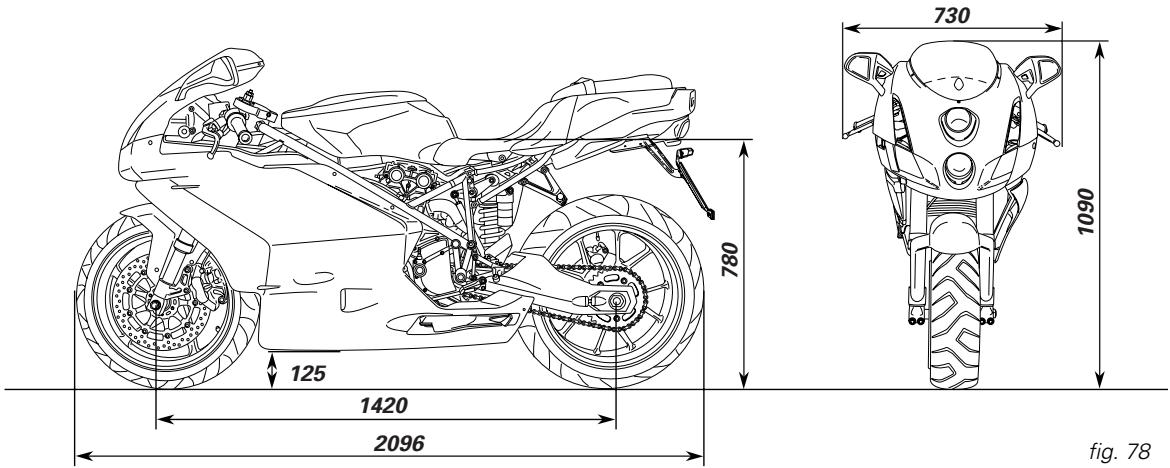
Overall dimensions (mm) (fig. 78)

Warning
Failure to observe weight limits could result in poor handling and impair the performance of your motorcycle, and you may lose control of the motorcycle.
| Top-ups | Type of fluid | cu dm (liters) |
| Fuel tank, including a reserve of 3 cu dm (liters) | Unleaded fuel | 15.5 |
| 95 fuel octane rating (at least) | ||
| Oil sump and oil filter | SHELL - Advance Ultra 4 | 3.7 |
| Front/Rear brake and clutch circuits | Special fluid for hydraulic systems | - |
| SHELL - Advance Brake DOT 4 | ||
| Protectant for electric contacts | Spray for electric systems | - |
| SHELL - Advance Contact Cleaner | ||
| Front fork | SHELL - Advance Fork 7.5 or Donax TA | 0.480 (each leg) |
| Cooling circuit | Antifreeze SHELL - Advance Coolant or Glycoshell 35-40% + water | 2.6 |

Important
Additives to fuel or lubricants are not allowed.
Engine
Twin cylinder, four-stroke, 90^ "L" type, longitudinal.
Bore:
100mm
Stroke:
63.5 mm
Total displacement:
998 cu.cm.
Compression ratio:
1:11.4±0.5
Max. power at crankshaft (95/1/EC):
91 kW - 124 HP at 9500 rpm
Max torque at crankshaft (95/1/EC):
102 Nm at 8000 rpm
Max. rotation speed:
11500 rpm

Important
Do not exceed specified rotation speed limits
under any running condition.
Timing system
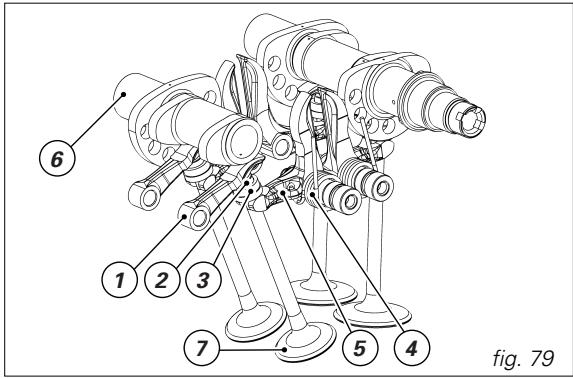
Desmodromic (type) with four valves per cylinder, operated by eight rocker arms (4 opening rockers and 4 closing rockers) and two overhead camshafts. It is operated by the crankshaft through spur gears, belt rollers and toothed belts.
Desmodromic timing system (fig. 79)
1) Opening (or upper) rocker.
2) Opening rocker shim.
3) Closing (or lower) rocker shim.
4) Return spring for lower rocker.
5) Closing (or lower) rocker.
6) Camshaft.
7) Valve.
Performance data
Maximum speed in any gear should be reached only after a correct running-in period with the motorcycle properly serviced at the recommended intervals.
Max. speed (rider alone):
270 Km/h
Spark plugs
Make:
CHAMPION
Type:
RG4HC
Brakes
Front brake
With double semi-floating drilled disc.
Material:
steel
Disc diameter:
320mm
Hydraulically operated by a control lever on right
handlebar.
Braking surface:
79 sq cm
Make brake calipers:
BREMBO
Type:
34-4 pistons.
Friction material:
TOSHIBA TT 2172
Master cylinder type:
PR 18.
Rear brake
With fixed drilled steel disc.
Disc diameter:
240mm
Hydraulically operated by a pedal on R.H. side.
Braking surface:
32 sq cm
Make:
BREMBO
Type:
34-2 pistons.
Friction material:
FERIT I/D 450 FF
Master cylinder type:
PS 11.

Warning
3 Brake fluid can dissolve paintwork and cause severe eye and skin injuries in the event of accidental spilling. Wash the affected area with abundant running water.
Transmission
Dry clutch operated by a control lever on left handlebar.
Drive is transmitted from engine to gearbox main shaft via spur gears.
Front sprocket/clutch sprocket ratio:
32/59
6-speed gearbox with constant mesh gears, gear change pedal on left side of motorcycle.
Gearbox/rear sprocket ratio:
15/36
Total gear ratios:
1^st gear 15/37
2^nd gear 17/30
3^rd gear 20/28
4^th gear 22/26
5^th gear 23/24
6^th gear 24/23
Drive chain from gearbox to rear wheel:
Make:
DID
Type:
525 HV
Size:
5/8"x/1/16"
Links:
96
Important
The above gear ratios are the homologated ones and under no circumstances must they be modified.
However, if you wish to tune up your motorcycle for competitive trials, you may refer to Ducati Motor Holding S.p.A. who will be glad to provide information about the special ratios available. Contact a Ducati Dealer or Authorized Workshop.
Warning
For the replacement of the rear sprocket, contact a Ducati Dealer or Authorized Workshop. The incorrect replacement of this component could seriously endanger your safety and that of your passenger and cause irreparable damage to the motorcycle.
Frame
Tubular trestle frame with upper section made of highstrength steel.
Steering angle (on each side):
28^30^
For improved performance on track the headstock angle can be changed (see page 62).
STANDARD steering setting for road riding is as follows: Steering head angle:
24^30'
Trail:
97 mm.
For track riding, setting can be modified to the following values:
Steering head angle:
23^ 30'
Trail:
91 mm.
Wheels
Five-Y-spoke, light-alloy rims.
Front wheel
Dimensions:
3.50 × 17^
Rear wheel
Dimensions:
5.50x17"
The wheel shaft can be removed.
Tyres
Front tyre
Tubeless, radial tyre.
Size:
120/70-ZR17
Rear tyre
Tubeless, radial tyre.
Size:
190/50-ZR17
Suspensions
Front
Hydraulic upside-down fork provided with outer adjuster for rebound, compression, and preload (for inner springs of fork legs).
Stanchion diameter:
43 mm
Travel along leg axis:
125 mm.
Rear
Of the progressive type, thanks to a rocker arm connecting frame and upper pivot point of the shock absorber. The shock absorber enables the adjustment of rebound and compression damping and spring preload. At the bottom pivot point it is connected to a light-alloy swingarm. The swingarm hinges on a pivot pin passing through the frame and engine.
The whole system gives the bike excellent stability.
Travel:
71 mm.
Exhaust system
Catalyzed in compliance with emission regulations.
Available colours
Available in:
Ducati anniversary red 473.101 (PPG);
metal-color frame and wheel rims.
Electric system
Basic electric items are:
front headlamp featuring two halogen lamps, consisting of the following:
HB3 12V-60W low beam unit;
HB3 12V-60W high beam unit;
12V-5W parking light.
Electrical controls on handlebars.
Turn indicators, 12V-10W bulbs.
Horn.
Stop light switches.
Sealed battery 12V-10 Ah.
Generator 12V-520W.
Electronic voltage regulator (rectifier), protected by a 40 A fuse near the battery.
DENSO starter motor, 12V-0.7 kW.
Tail light, 12V-5/21W double-filament bulb for stop light and parking light; 12V-5W bulb for number plate light.

Note
See "Replacing bulbs" on page 65 for relevant
instructions.
Fuses
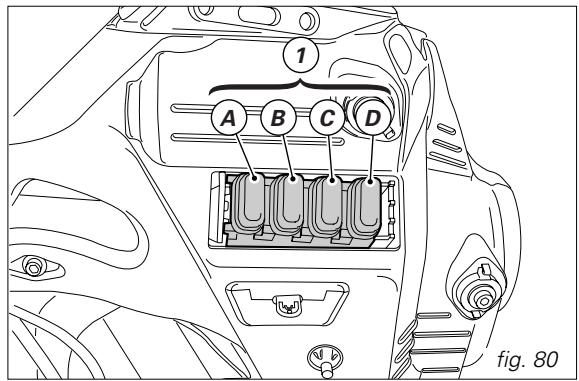
The main fuse box (1, fig. 80) is located between headlight mount and headlight fairing. To expose the fuses, take off the box protective cover. Mounting position and ampere capacity are marked on it.
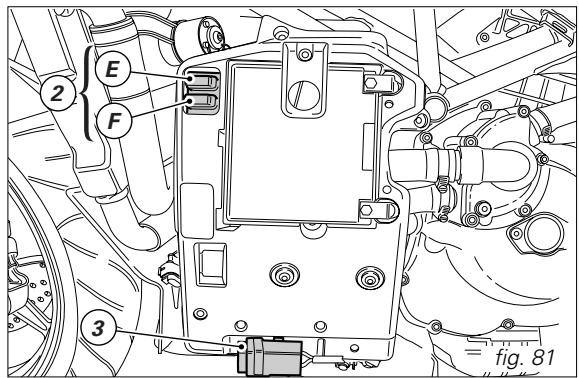
Two fuses (2, fig. 81) located at the side of the battery protect the relay of the injection system and engine control unit.
The fuse (3) protects the electronic regulator. Remove the protective cap to expose the fuses.
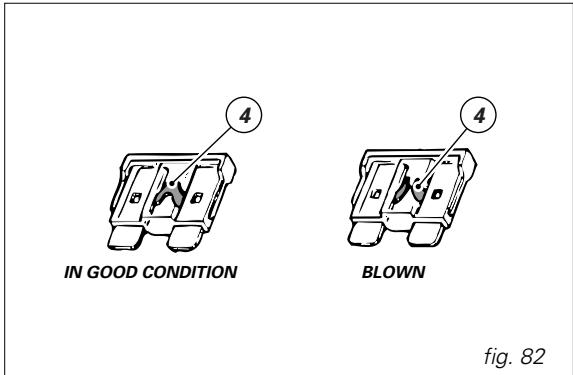
A blown fuse is identified by the interrupted inner filament (3, fig. 82).

Important
Switch the ignition key to OFF before replacing the fuse to avoid possible short circuits.

Warning
Never use a fuse with a rating other than specified. Failure to observe this rule may damage the electric system or even lead to fire.
Legend of the wiring diagram of electric system/injection
01 Right switch
02 Key-operated switch
03 Left electric fan
04 Right electric fan
05 Starter motor
06 Starter contactor
07 Battery
08 Regulator fuse
09 Regulator
10 Generator
11 Rear right-turn indicator
12 Tail light
13 Number plate light
14 Rear left-turn indicator
15 Fuel tank
16 Injection fuses
17 Injection relay
18 Self-diagnostics
19 Horizontal cylinder coil
20 Vertical cylinder coil
21 Horizontal cylinder spark plug
22 Vertical cylinder spark plug
23 Horizontal cylinder injector
24 Vertical cylinder injector
25 Throttle position sensor
26 RPM/timing sensor
27 Coolant temperature sensor
28 Speed sensor
29 Side stand
30 Neutral switch
31 Oil pressure switch
32 Rear stop light switch
33 Ignition/injection unit
34 Fuses
35 Clutch switch
36 Front stop light switch
37 Left switch
38 Transponder antenna
39 Air temperature sensor
40 Finish line
41 Instruments
42 Lights relay
43 Front left-turn indicator
44 Headlamp
45 Front parking light
46 Front right-turn indicator
47 Warning horn
Wire color coding
B Blue
W White
Violet
Bk Black
Y Yellow
R Red
Lb Light blue
Gr Grey
G Green
Bn Brown
0 Orange
P Pink
| Legend of fuse boxes (fig. 80 and 81) | ||
| Pos. | Description | Rtng. |
| 1A | High and low beams | 15 A |
| 1B | Stop light – horn – flasher | 20 A |
| 1C | Key on | 7.5 A |
| 1D | Instrument panel power supply | 3 A |
| 2E | Engine control unit | 3 A |
| 2F | Injection relay | 20 A |

Note
The system wiring diagram is at the end of this manual.
FOR UNITED STATES OF AMERICA VERSION ONLY
Reporting of safety defects
If you believe that your vehicle has a defect which could cause a crash or could cause injury or death, you should immediately inform the National Highway Traffic Safety Administration (NHTSA) in addition to notifying Ducati North America. If NHTSA receives similar complaints, it may open an investigation, and if it finds that a safety defect exists in a group of vehicles, it may order a recall and remedy campaign. However, NHTSA cannot become involved in individual problems between you, your dealer, or Ducati North America. To contact NHTSA, you may either call the Auto Safety Hotline toll-free at 1-800-424-9393 (or 366-0123 in Washington, D.C. area) or write to: NHTSA, U.S. Department of Transportation, Washington, D.C. 20590. You can also obtain other information about motor vehicle safety from the Hotline.
Safety warnings
Traffic Rules vary from jurisdiction to jurisdiction. Know the regulations in your jurisdiction before riding this motorcycle.

Warning
This motorcycle is designed and intended for use on streets and other smooth, paved areas only. Do not use this motorcycle on unpaved surfaces. Such use could lead to upset or other accident.
Noise emission warranty
Ducati Motor S.p.A. warrants that this exhaust system, at the time of sale, meets all applicable U.S. EPA Federal noise standards. This warranty extends to the first person who buys this exhaust system for purposes other than resale, and to all subsequent buyers. Warranty claims should be directed to: Ducati North America, Inc., 237 West Parkway, Pompton Plains, New Jersey, 07444-1028 Tel: 001.973.839-2600 Fax: 001.973.839-2331.
Noise and exhaust emission control system information
Source of Emissions
The combustion process produces carbon monoxide and hydrocarbons. Control of hydrocarbons is very important because under certain conditions, they react to form photochemical smog when subjected to sunlight. Carbon monoxide does not react in the same way, but is toxic. Ducati utilizes lean carburetor settings and other systems to reduce carbon monoxide and hydrocarbons.
Exhaust Emission Control System
The Exhaust Emission Control System is composed of lean carburetor settings, and no adjustments should be
made except idle speed adjustments with the throttle stop screw. The Exhaust Emission Control System is separate from the crankcase emission control system.
Crankcase Emission Control System
The engine is equipped with a closed crankcase system to prevent discharging crankcase emissions into the atmosphere. Blow-by gas is returned to the combustion chamber through the air cleaner and the throttle body. Evaporative Emission Control System California motorcycles are equipped with an evaporative emission control system which consists of a charcoal canister and associated piping. This system prevents the escape of fuel vapors from the throttle body and fuel tank.
Tampering warning
Tampering with Noise Control System Prohibited. Federal Law prohibits the following acts or causing thereof: (1) the removal or rendering inoperative by any person, other than for purposes of maintenance, repair, or replacement, of any device or element of design incorporated into any new vehicle for the purpose of noise control prior to its sale or delivery to the ultimate purchaser or while it is in use; or (2) the use of the vehicle after such device or element of design has been removed or rendered inoperative by any person.
Among those acts presumed to constitute tampering are the acts listed below:
(1) Removal of, or puncturing the muffler, baffles, header pipes or any other component which conducts exhaust gases.
(2) Removal or puncturing of any part of the intake system.
(3) Lack of proper maintenance.
(4) Replacing any moving part of the vehicle, or parts of the exhaust or intake system, with parts other than those specified by the manufacturer.
This product should be checked for repair or replacement if the motorcycle noise has increased significantly through use. Otherwise, the owner may become subject to penalties under state and local ordinances.
Problems that may affect motorcycle emissions
If you are aware of any of the following symptoms, have the vehicle inspected and repaired by your local Ducati dealer.
Symptoms:
Hard starting or stalling after starting.
Rough idle.
Misfiring or backfiring during acceleration.
After-burning (backfiring).
Poor performance (driveability) and poor economy.
Riding safety
The points given below are applicable for every day motorcycle use and should be carefully observed for safe and effective vehicle operation.
A motorcycle does not provide the impact protection of an automobile, so defensive riding in addition to wearing protective apparel is extremely important.
Do not let protective apparel give you a false sense of security.
Before changing lanes, look over your shoulder to make sure the way is clear. Do not rely solely on the rear view mirror; you may misjudge a vehicle's distance and speed, or you may not see it at all.
When going up steep slopes, shift to a lower gear so that there is plenty of power to spare rather than overloading the engine.
When applying the brakes, use both the front and rear brakes. Applying only one brake for sudden braking may cause the motorcycle to skid and lose control.
When going down long slopes, control vehicle speed by closing the throttle. Use the front and rear brakes for auxiliary braking.
Riding at the proper rate of speed and avoiding unnecessarily fast acceleration are important not only for safety and low fuel consumption but also for long vehicle life and quieter operation.
When riding in wet conditions or on loose roadway surfaces, the ability to maneuver will be reduced. All of your actions should be smooth under these conditions. Sudden acceleration, braking or turning may cause loss of control.
When the roadway is wet, rely more on the throttle to control vehicle speed and less on the front and rear brakes.
The throttle should also be used judiciously to avoid skidding the rear wheel from too rapid acceleration or deceleration.
On rough roads, exercise caution, slow down, and grip the fuel tank with your knees for better stability.
When quick acceleration is necessary as in passing, shift to a lower gear to obtain the necessary power.
Do not down shift at too high an r.p.m. to avoid damage to the engine from overreving.
Avoiding unnecessary weaving is important to the safety of both the rider and other motorists.
Do not exceed the legal speed limit or drive too fast for existing conditions. High speed increases the influence of any condition affecting stability and the loss of control.
Operate motorcycle only at moderate speed and out of traffic until you have become thoroughly familiar with its operation and handling characteristics under all conditions. This is a very high performance motorcycle, designed and intended for use by experienced careful riders only!
A new motorcycle must be operated according to a special break-in procedure (see Running in recommendations).

Warning
Before starting engine, check for proper operation of brake, clutch, shifter, throttle controls, correct fuel and oil supply.
Gasoline is extremely flammable and is explosive under certain conditions. Refuell in a well ventilated area with the engine stopped. Do not smoke or allow open flames or sparks when refuelling or servicing the fuel system. Always close the fuel petcock when the engine is not running to prevent flooding of the throttle body. Do not overfill fuel tank (see instructions page 49).
Motorcycle exhaust contains poisonous carbon monoxide gas. Do not inhale exhaust gases and never run the engine in a closed garage or confined area.
Use only Ducati approved parts and accessories.
This motorcycle was not intended to be equipped with a sidecar or to be used to tow any trailer or other vehicle. Ducati does not manufacture sidecars or trailers and cannot predict the effects of such accessories on handling or stability, but can only warn that the effects will be adverse and any damage to motorcycle components caused by the use of such accessories will not be remedied under warranty.

Warning
Do not ride the motorcycle with helmets attached to the hook; the helmets could cause an accident by distracting the operator or interfering with normal vehicle operation.
Protective apparel
Always wear a helmet. Most motorcycle accident fatalities are due to head injuries.
For safety eye protection, gloves, and high top, sturdy boots should also be worn.
The exhaust system becomes very hot during operation, never touch the exhaust system. Wear clothing that fully covers your legs. Do not wear loose clothing which could catch on the control levers, footrests, wheels, or chain. Any amount of alcohol will significantly interfere with your ability to safely operate your motorcycle. Don't drink and ride.
Vehicle identification number (VIN);
Every Ducati motorcycle is identified by two identification numbers (see page 9). Figure A specifically shows the frame identification numbers.
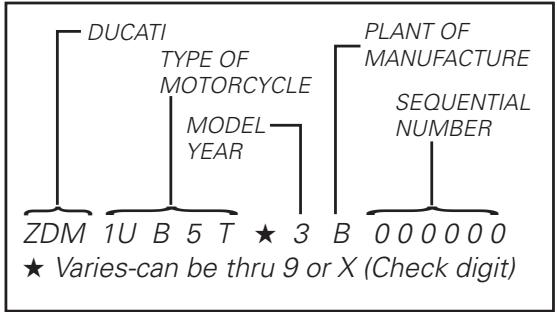
fig. A
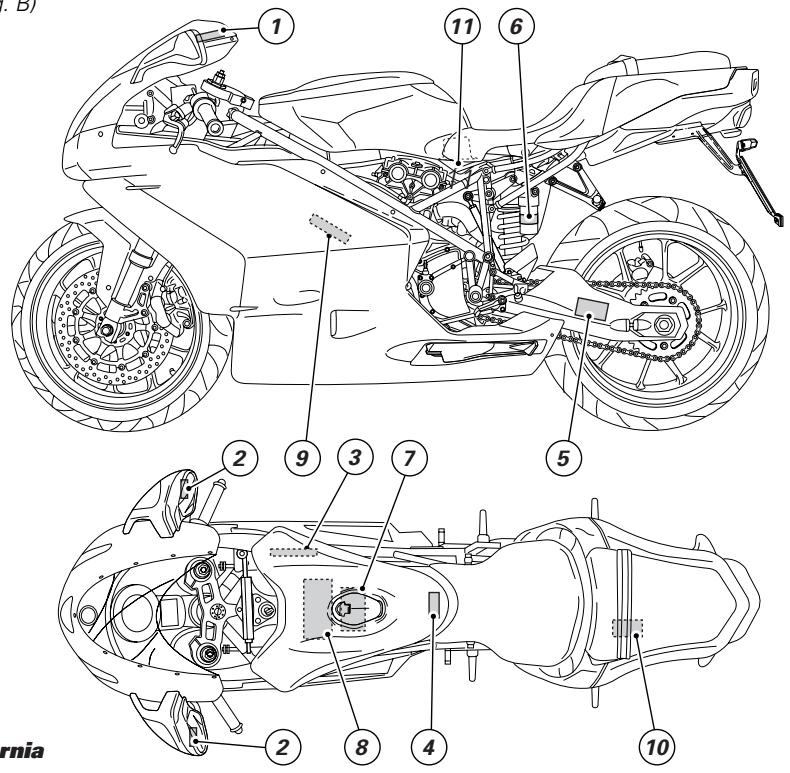
only for California
fig. B
WARNING
DO NOT ATTENPT TO LOOK THROUGH THIS FARRYING. THIS IS NOT A WINDSHIELD, BUT AN AEROHYDROIN FARRYING ONLY. FAILURE OF THE FARRYING WILL BE FROM THE COOLING. IF ANY COOLING ISSUES WITH OUTSTANDING UPSET AND CONSEQUENT SERIOUS BODYFULNESS ARE INTUALLY INJURY.
OBJECTS IN MIRROR ARE CLOSER THAN THEY APPEAR
God 456+961
T
2
Manufactured by DUCATIMOTOR SPA
DATE:

GVWR: Lbs (kg)
GAWR front: Lbs kg) with tire, RIM at PSI cold.
GAWR rear: Lbs (kg) with tire, RIM at PSI cold.
This vehicle conforms to all applicable Federal Motor Vehicle Safety standards in effect on the date of manufacture shown above. Type classification: Motorcycle
Vehicle I.D. No.:

Cell 1204 18
3
CAUTION
NEVER FILL TANK SO FUEL LEVEL RISES INTO FILLER NECK. IF TANK IS OVERFILLED, HEAT MAY CAUSE FUEL TO EXPAND AND FLOW INTO EVAPORATIVE EMISSION CONTROL SYSTEM RESULTING IN HARD STARTING AND ENGINE HESITATION.
4
Chain Tension Adjustment (on side stand)
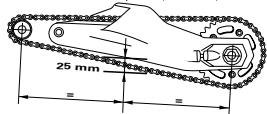
WARNING
CONTAINS HIGHLY COMPRESSED GAS. USE ONLY PERFECTLY DRY NITROGEN GAS,OTHER GASES MAY CAUSE EXPLOSION.DO NOT INCORPORATE REFER TO OWNERS MANUAL FOR REGULATING GAS
5
6
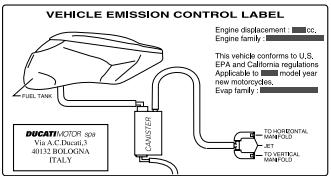
7
| VEHICLE EMISSION CONTROL INFORMATION | ||
| Engine displacement: ccEngine family: ccEngine exhaust control system: cc | THIS VEHICLE CONFORMS TO U.S. EPA REGULATIONS APPLICABLE TO 1998 MODEL YEAR NEW MOTORCYCLES | |
| ENGINE TUNE-UP SPECIFICATIONS | ||
| ITEM | SPECIFICATIONS | INSTRUCTIONS |
| IGNITION TIMING: | ■ bDC at idle speed | No adjustment |
| IDLE SPEED (RPM): | ± mm | No adjustment |
| IDLE MIXTURE: | Opening ± mm | No adjustment |
| VALVE CLEARANCE (in & ex): | Closing ± mm | See Service Manual |
| SPARK PLUG: CHAMPERSPARK PLUG GAP (mm): 0.5 + 0.6 | OIL: SAE 20W50FUEL: Unleaded gasoline | |
| DUCATI/MOTOR sp0 - BOLOGNA - ITALY | ||
8
MOTORCYCLE NOISE EMISSION CONTROL INFORMATION
THIS MOTORCYCLE. MEETS EPA NOISE EMISSION REQUIREMENTS OF dBA AT RPM BY THE FEDERAL TEST PROCEDURE. MODIFICATIONS WHICH ARE BOTH THE FEDERAL TEST PROCEDURE TO EXCEED FEDERAL NOISE STANDARDS ARE PROHIBITED BY FEDERAL LAW. SEE OWNERS MANUAL.
HELMET HOLDER UNDER THE SEAT
10

9
California evaporation emission system
This system consists of (fig. C):
1) Warn air inlet;
2) Canister;
3) Dell'Orto jet;
4) Intake manifolds;
5)Breather pipe;
6) Fuel tank.

Important
In the event of fuel system malfunction, contact
Ducati's authorized Service Centres.
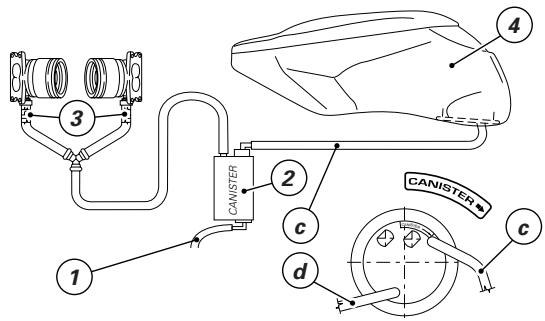
fig. C
Ducati limited warranty on emission control system
Ducati North America, Inc., 237 West Parkway, Pompton Plains, New Jersey 07444-1028 warrants that each new 1998 and later Ducati motorcycle, that includes as standard equipment a headlight, tail-light and stoplight, and is street legal:
A) is designed, built and equipped so as to conform at the time of initial retail purchase with all applicable regulations of the United States Environmental Protection Agency, and the California Air Resources Board; and
B) is free from defects in material and workmanship which cause such motorcycle to fail to conform with applicable regulations of the United States Environmental Protection Agency or the California Air Resources Board for a period of use, depending on the engine displacement, of 12,000 kilometers (7,456 miles), if the motorcycle's engine displacement is less than 170 cubic centimeters; of 18,000 kilometers (11,185 miles), if the motorcycle's engine displacement is equal to or greater than 170 cubic centimeters but less than 280 cubic centimeters; or of 30,000 kilometers (18,641 miles), if the motorcycle's engine displacement is 280 cubic centimeters or greater; or 5 (five) years from the date of initial retail delivery, whichever first occurs.
I. Coverage
Warranty defects shall be remedied during customary business hours at any authorized Ducati motorcycle dealer located within the United States of America in
compliance with the Clean Air Act and applicable regulations of the United States Environmental Protection Agency and the California Air Resources Board. Any part or parts replaced under this warranty shall become the property of Ducati.
In the state of California only, emissions related warranted parts are specifically defined by that state's Emissions Warranty Parts List. These warranted parts are: carburetor and internal parts; intake manifold; fuel tank, fuel injection system; spark advance mechanism; crankcase breather; air cutoff valves; fuel tank cap for evaporative emission controlled vehicles; oil filler cap; pressure control valve; fuel/vapor separator; canister; igniters; breaker governors; ignition coils; ignition wires; ignition points, condensers, and spark plugs if failure occurs prior to the first scheduled replacement, and hoses, clamps, fittings and tubing used directly in these parts. Since emission related parts may vary from model to model, certain models may not contain all of these parts and certain models may contain functionally equivalent parts.
In the state of California only, Emission Control System emergency repairs, as provided for in the California Administrative Code, may be performed by other than an authorized Ducati dealer. An emergency situation occurs when an authorized Ducati dealer is not reasonably available, a part is not available within 30 days, or a repair is not complete within 30 days. Any replacement part can be used in an emergency repair. Ducati will reimburse the owner for the expenses, including diagnosis, not to exceed Ducati's suggested retail price for all warranted
parts replaced and labor charges based on Ducati's recommended time allowance for the warranty repair and the geographically appropriate hourly labor rate. The owner may be required to keep receipts and failed parts in order to receive compensation.
II. Limitations
This Emission Control System Warranty shall not cover any of the following:
A. Repair or replacement required as a result of
(1) accident,
(2) misuse,
(3) repairs improperly performed or replacements improperly installed,
(4) use of replacement parts or accessories not conforming to Ducati specifications which adversely affect performance and/or
(5) use in competitive racing or related events.
B. Inspections, replacement of parts and other services and adjustments required for routine maintenance.
C. Any motorcycle on which odometer mileage has been changed so that actual mileage cannot be readily determined.
III. Limited liability
A. The liability of Ducati under this Emission Control Systems Warranty is limited solely to the remedying of defects in material or workmanship by an authorized Ducati motorcycle dealer at its place of business during customary business hours. This warranty does not cover inconvenience or loss of use of the motorcycle or
transportation of the motorcycle to or from the Ducati dealer. Ducati shall not be liable for any other expenses, loss or damage, whether direct, incidental, consequential or exemplary arising in connection with the sale or use of or inability to use the Ducati motorcycle for any purpose. Some states do not allow the exclusion or limitation of any incidental or consequential damages, so the above limitations may not apply to you.
B. No express emission control system warranty is given by Ducati except as specifically set forth herein. Any emission control system warranty implied by law, including any warranty of merchantability or fitness for a particular purpose, is limited to the express emission control systems warranty terms stated in this warranty. The foregoing statements of warranty are exclusive and in lieu of all other remedies. Some states do not allow limitations on how long an implied warranty lasts so the above limitation may not apply to you.
C. No dealer is authorized to modify this Ducati Limited Emission Control Systems Warranty.
IV. Legal rights
This warranty gives you specific legal rights, and you may also have other rights which vary from state to state.
V. This warranty is in addition to the Ducati limited motorcycle warranty.
VI. Additional information
Any replacement part that is equivalent in performance and durability may be used in the performance of any
maintenance or repairs. However, Ducati is not liable for these parts. The owner is responsible for the performance of all required maintenance. Such maintenance may be performed at a service establishment or by any individual. The warranty period begins on the date the motorcycle is delivered to an ultimate purchaser.
Ducati North America, Inc..
237 West Parkway
Pompton Plains, New Jersey, 07444-1028
001.973.839-2600