TI6K - Pregnant JBL - Free user manual and instructions
Find the device manual for free TI6K JBL in PDF.



User questions about TI6K JBL
0 question about this device. Answer the ones you know or ask your own.
Ask a new question about this device
Download the instructions for your Pregnant in PDF format for free! Find your manual TI6K - JBL and take your electronic device back in hand. On this page are published all the documents necessary for the use of your device. TI6K by JBL.
USER MANUAL TI6K JBL
JBL craftsmen have been involved in the art of sound for more than two generations – signal and source, wood and fabric, transducers and acoustics – all of it.
Today these craftsmen continue to perform to the most rigid standards any craftsmen can submit to: those impased upon themselves.
JBL loudspeakers are carefully engineered instruments, painstakingly crafted and assembled to watchmakers standards. JBL enclosures express the excitement of creative design; they are elegant, solid and flawlessly finished. JBL transducers and electronics offer what has been characterized by devoted music listeners as "the incomparable JBL sound".
By following the few simple suggestions contained in this booklet, you can look forward to superb high fidelity reproduction that will retain its clarity and realism year after year.
UNPACKING
The packing material of your Ti-Series speakers has been designed to protect the loudspeakers from any damage due to rough handling during shipment. We strongly suggest that you keep the packing material for future purposes, in case you are moving or your loud-speakers should require service.
PLACEMENT
The listening room and the location of the loudspeakers within the room affects bass level and bass response, imaging, clarity and overall quality of sound. No other single factor has the same level of effect on the final sound quality. The acoustics of the listening room are determined by the dimensions of the room, its construction and the furnishings it contains. Rooms that have different dimensions for ceiling height, length and width will give a more even, balanced sound than rooms where the dimensions are equal to each other. This is important, especially at low frequencies, as the room dimensions determine the pattern of standing waves within the room.
Consult your JBL dealer for information regarding the use of products or materials designed to control certain acoustic problems caused by room size, shape or construction. In many cases, significant improvement in performance can be achieved by careful attention to room acoustics.
Your JBL Ti-Series speakers are able to give a very satisfying sound in a great variety of listening rooms when set up in an even sided triangle with respect to the listener. However, a careful setup procedure will always be rewarding, and for best results we recommend placement well away from the boundaries of the room with preferably minimum 0.75 m (30 in) distance to the wall behind the speakers, and 0.75-10 m (30-40 in) distance to the side walls.
A good guideline to proper setup is to start by concentrating on the tonal balance of the sound, aiming for the most neutral reproduction. Is the bass too strong or too weak compared to the midrange and treble? Moving the speakers around in relatively large steps,
(20-30 cm or 8-12 in) will change the perceived tonal balance. When a satisfying balance is found, a proper sound stage and stereo localization is developed by smaller movements of the loudspeakers in combination with angling towards the listening position. We strongly recommend experimentation in order to find the most satisfying overall sound. Attention to every detail of the setup will be beneficial in terms of improved sound quality.
Your authorized JBL dealer will be happy to help you obtain the best possible performance from your JBL speakers.
NOTE: New loudspeakers require a certain amount of "exercise" before they perform their best. A steady level of performance is achieved after 8-12 hours of operation, depending on the nature of the music and the level. Should you want to speed up this process you can use inter-station FM noise as a signal during periods, where you would normally not be listening to the speaker. Alternatively a CD player on "Repeat" would be an appropriate signal source.
CONNECTIONS
IMPORTANT: When connecting or disconnecting loudspeakers from an amplifier, the amplifier must be turned off. Making connections while the amplifier is operating could seriously damage the loudspeaker system and void the warranty. The amplifier must also be turned off before connecting or disconnecting cables, at the amplifier or pre-amplifier inputs.
1mm^2 (18 AWG) insulated wire is the minimum size recommended for loudspeaker connection up to 5 meters (16 ft). Beyond this distance, heavier gauge wire is recommended: 1.5mm^2 (16 AWG) up to 10 meter (30 ft) and 2mm^2 (14 AWG) up to 20 meters (60 ft). These recommendation are given as MINIMUM requirements, and generally speaking, the speaker leads should be as short as possible.
Speaker wire and interconnect cables are important components in an audio system. With all other factors at an appropriate level of quality the speaker cable and the interconnect cable can make significant contributions to the perceived sound quality. Careful selection of cable and interconnect can add or subtract marked shadings in the tonal character. Likewise, different cables can have quite a dramatic impact on the dynamic contrasts experienced by listeners.
Your JBL dealer has the experience and knowledge to recommend suitable interconnects and speaker wire to best complement your system.
The length of the speaker wire will depend on the location of the loudspeakers and the amplifier. Since the final positioning of the loudspeaker will be determined by careful listening, you may want to arrange a temporary wiring layout that will allow the moving of the loudspeaker to experiment with placement. When the best loudspeaker position is determined, permanent connections may be made using the shortest cable runs possible. Both left and right speaker wires should be the same length. In some systems, the amplifier may be located near the loudspeaker system and may be connected using a short length of speaker wire. Although a relatively long cable between the preamplifier and main amplifier is required by such a hook-up, the benefit of a short amplifier-to-LOUDSPEAKER connection will often outweigh the drawbacks.
Connections to the loudspeaker system are made at the terminals located on the back of the enclosure. These terminals permit a variety of connection methods.
The most straightforward connection is made by directly connecting clean bare wire. This connection is made by stripping 8 - 10mm of insulation off the loudspeaker wire and passing the bare wire through the hole in the binding post. If the wire is too thick to pass through the hole in the terminal in one single bundle, separate the copper wire into three equal bundles, then pass the center bundle through the hole in the terminal. Wrap the remaining bundles around the binding post and twist the center stands. The knob can now be tightened securely, and any excess wire that is not in contact with the binding post surfaces should be trimmed to avoid short circuits.
A very convenient way of connection is the use of 4 mm banana connectors, which are then, in turn, connected to the binding posts. Bear in mind, however, that the number of contact points should be kept to a minimum, and at the same time each contact should be as tight as possible.
For the same reason, we recommend the use of the highest quality spade connectors, expertly connected to the selected cables. Spade lugs will make the best possible connection between the speaker wire and the loudspeaker system, minimizing any contact resistance that might degrade the sound ever so slightly.
Any connection in an audio system should not be considered "good forever". All connections should be inspected and cleaned or remade periodically. Frequency of maintenance depends on the materials involved in the connection, atmospheric conditions and other factors. Consult your dealer for specific recommendations.
It is essential that both loudspeakers in a stereo system have the same polarity with respect to the input signal (are in "phase"). JBL Ti-Series are designed to produce a positive pulse when a positive signal is applied to the red input terminal.
If the driver cones of the two loudspeakers do not move in the same direction for a given voltage at the input terminals, there will be a lack of stereo definition and a loss of deep bass.
We recommend experimenting with the polarity of the speakers, since recordings, program sources or power amplifiers can invert the polarity of the signal. The "correct" connection is the one that yields the best audible results. Be sure to reverse both left and right connections to keep the systems in polarity.
BIWIRING
JBL TI-Series loudspeakers may also be connected to the amplifier using two lengths of wire. The biwire connection method offers several options and advantages.
The system's internal dividing networks are electrically separated at the low frequency to midrange/tweeter transition. External strapping bars connect the two parts of the network when a single wire connection is used. The system is shipped from the factory with the strapping bars in place. By removing the bars, connections may be made to the individual network sections using two wires (four conductors) as shown in Figure 1. The wires used may be of the same type for both low frequency and high frequency sections. The advantages are that wire effect (resistance, inductance, etc.) are
reduced and intermodulation of low and high frequencies in the cable are avoided. Specialized wires for low frequency and high frequency sections may yield excellent results in some systems. In either case, low frequency cable should be as short as possible, and the left and right cable for each section must be the same length. If the cable to one speaker system is longer that the one to the other speaker due to the distance from the amplifier, make sure not to wind the excess cable up in the form of a coil. Instead, try to arrange it in figures of eight, as this will minimize the inductance of the cable run and thus minimize cable losses at high frequencies.
CAUTION: Never connect two amplifiers to the same loudspeaker without first removing the strapping bars. Operating two amplifier channels with the bars in place may seriously damage the amplifiers and void the warranty.
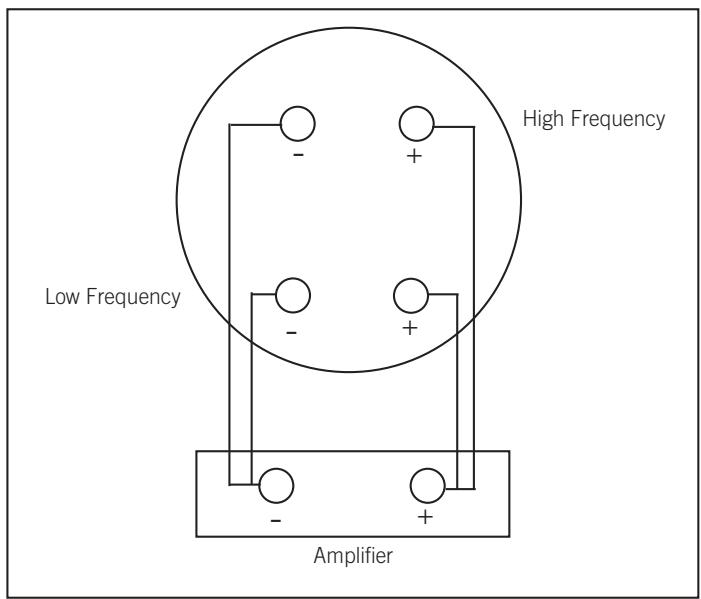
Fig. 1: Ti input
Fig. 2: Ti input
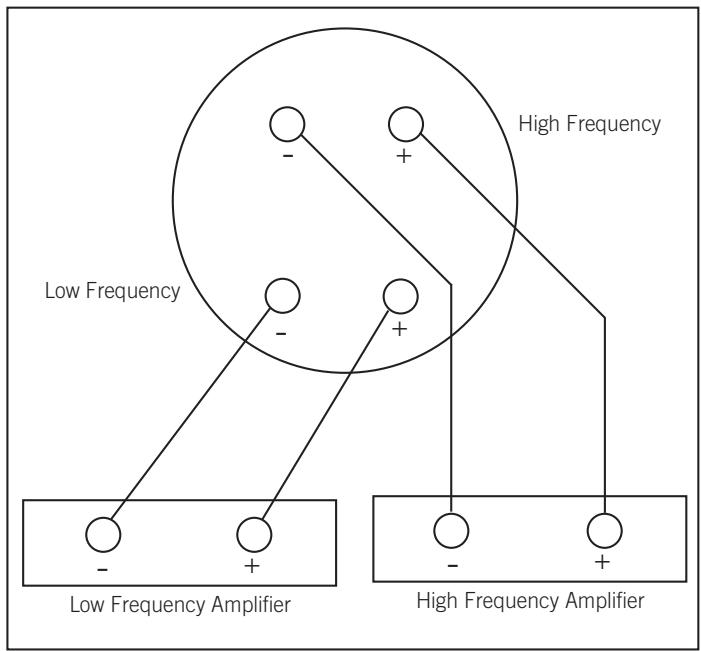
The biwire option also permits powering the system with two amplifiers as shown in Figure 2. Four identical amplifiers (or two dual channel units) may be used, although specialized low and high frequency amplifiers can offer clear advantages. Your JBL Ti-Series dealer can recommend amplifiers that best suit your needs. In all cases, the left and right amplifiers for each section must be identical. Ensure that the input sensitivity of the two amplifiers is equal or that input level controls are provided to maintain proper low to mid/high balance. If two identical stereo amplifiers are chosen, each amplifier may be located near a loudspeaker and drive low frequency and high frequency sections through short wire runs. Beware that some amplifiers invert the polarity of the signal. Input polarity should be the same for both low and high frequency section. If the polarity is reversed to one section, a discontinuity in the free-field response will be apparent in the crossover region. Feel free to experiment with the polarity of the individual section to find a position that will suit you best. Reverse the polarity to either high or low frequency sections of both loudspeakers if a problem is suspected. Amplifier polarity markings may not ensure correct polarity connections.
AMPLIFIER POWER RECOMMENDATIONS
The JBL Ti-Series speakers are capable of handling peak power far exceeding the continuous rating specified for the individual speakers.
The continuous ratings are based on an eight hour test using broadband noise shaped to simulate the power distribution of music. The peak rating of approximately 4 times the continuous rating indicates the system's ability to handle transient peaks well above the average power levels.
Amplifier power ratings are an INDICATION of how loud the system will play without distortion. Amplifier power is generally measured with steady state test signals and perhaps, in addition, dynamic measurements into resistive loads. Unfortunately none of these are firm indications of how loud the system will sound in a given listening room.
For these reasons, an amplifier should only be chosen after careful listening. If it is possible to achieve the desired volume level without distortion, then the amplifier has sufficient power regardless of the rating.
More important than the power rating is the quality of sound the amplifier is capable of. Unfortunately, amplifier specifications are not a reliable indicator of sound quality. Your JBL dealer can make recommendations and arrange auditions to aid selection of suitable amplification.
Fuses or circuit breakers of any kind should not be used between the amplifier and loudspeakers. All such devices will seriously degrade the sound quality and do not ensure protection from loudspeaker damage. The key to safe operation is adequate amplifier power to avoid distortion at the highest sound levels required.
GENERAL CARE
JBL Ti-Series loudspeaker systems are finished in materials that will retain its finish for many years to come. Occasional cleaning with a clean, soft cloth will maintain the original beauty of the finish. Only lint-free cotton cloths should be used for dusting. To remove fingerprints and smudges, an ammonia-free window cleaner may be used. Apply a small amount to a lint-free cotton cloth and gently clean the surface. Never use any abrasive cleaners or strong chemical to clean the enclosure. In case of deep scratches or damage, please consult a qualified furniture repair shop.
GRILLE
The grille is held in place by a pin located at each corner. To remove the grille, grasp two corners and gently pull the grille away from the enclosure. To replace the grille, position the mounting pins on the cups and gently press until the grille meets the enclosure. Although the grille has been engineered to minimize acoustical interference, high frequency response and stereo imaging will be improved by removing the grille.
Any dust on the grille should be removed using a cleaning brush or a vacuum cleaner.
SERVICE
JBL loudspeakers are designed to give years of trouble-free service. No periodic maintenance is required. If a problem is suspected, first make sure all connections are properly made. If a problem exists in one loudspeaker, reverse the speaker wires to the left and right system. If the problem remains in the same system, then the fault is in the loudspeaker. If the problem appears in the opposite system, the cause is in another component or cable.
Loudspeaker cones or diaphragms should not be moved by hand. The voice coil assembly is located with extreme precision and the clearance is very small. Any attempt to move the assembly by hand can easily force the voice coil out of alignment and cause distortion or failure.
Do not return products to the JBL factory without prior authorization. Address correspondence to: JBL Customer Service, 250 Crossways Park Drive, Woodbury, NY 11797, Telephone: 1-516-496-3400-Outside the United States, contact your local JBL distributor.