
G1N - Guitar effect pedals ZOOM - Free user manual and instructions
Find the device manual for free G1N ZOOM in PDF.


| Product Type | Guitar Effects Pedal |
| Brand | ZOOM |
| Model | G1N / G1XN |
| Number of Effects | 54 types |
| Simultaneous Effect Modules | Up to 8 |
| Patch Memory | 80 patches (40 user + 40 presets) |
| Sampling Frequency | 96 kHz |
| A/D Converter | 24-bit, 128x oversampling |
| Signal Processing | 32-bit |
| Dimensions (G1N) | 155 mm (Depth) x 136 mm (Width) x 52 mm (Height) |
| Dimensions (G1XN) | 155 mm x 234 mm x 52 mm |
| Weight (G1N) | 350 g (without batteries) |
| Weight (G1XN) | 600 g (without batteries) |
| Power Supply | 9V DC, 300mA AC adapter (center negative) or 4 AA alkaline batteries |
| Battery Life | Approximately 12 hours (alkaline) |
| Display | 2-digit 7-segment LED |
| Input | Standard mono jack (470 kΩ impedance) |
| Output | Stereo jack (line/headphones, 10 kΩ min impedance) |
| Control Input (G1N) | For FS01 footswitch or FP01/FP02 expression pedal |
| Built-in Expression Pedal | G1XN only |
| Tuner | Built-in with adjustable reference (435-445 Hz) |
| Rhythm Function | 40 rhythm patterns with adjustable tempo (40-250 BPM) |
| Noise Reduction | ZNR (ZOOM Noise Reduction) |
| Amp Simulation | Yes (multiple cabinet types) |
| Equalizer | 3-band (Lo 160 Hz, Mid 800 Hz, Hi 3.2 kHz) |
| Modulation Effects | Chorus, Flanger, Pitch Shift, Vibrato, etc. |
| Delay Effects | Delay, Tape Echo, Analog Delay, Ping Pong (up to 5000 ms) |
| Reverb | Hall, Room, Spring, Arena, Tiled Room |
| Cleaning | Soft, dry cloth. Do not use solvents. |
| Safety | Use specified AD-0006 adapter. Do not open. Avoid humidity and heat. |
| Optional Accessories | FP01/FP02 expression pedal, FS01 footswitch (G1N) |
Frequently Asked Questions - G1N ZOOM
User questions about G1N ZOOM
0 question about this device. Answer the ones you know or ask your own.
Ask a new question about this device
Download the instructions for your Guitar effect pedals in PDF format for free! Find your manual G1N - ZOOM and take your electronic device back in hand. On this page are published all the documents necessary for the use of your device. G1N by ZOOM.
USER MANUAL G1N ZOOM
GUITAR EFFECTS PEDAL
G1NEXT/G1XNEXT
Operation Manual
Thank you for selecting the ZOOM G1N/G1XN (hereafter simply called the "G1N/G1XN").
Please take the time to read this manual carefully to get the most out of the unit and to ensure optimum performance and reliability.
Keep this manual at hand for future reference.
| Contents | |
| SAFETY PRECAUTIONS / Usage Precautions 2 | Using the built-in expression pedal (G1XN only) 20 |
| Terms Used in This Manual 3 | [PEDAL ASSIGN] key operation 20 |
| Controls and Functions / Connections (G1N) 4 | Adjusting the expression pedal 20 |
| Controls and Functions / Connections (G1XN) 6 | Effect Types and Parameters 21 |
| Selecting a Patch for Playing 8 | Explanation of symbols 21 |
| Using the Tuner 10 | PATCH LEVEL 21 |
| Using the Rhythm Function 12 | COMP/EFX module 21 |
| Editing a Patch 14 | DRIVE module 22 |
| Storing/Copying Patches 16 | EQ module 23 |
| Restoring Factory Defaults 17 | ZNR/AMP module 23 |
| Changing the Way Patches Are Called Up 18 | MODULATION module 24 |
| Using an External Foot Switch or Pedal (G1N only) 18 | DELAY module 25 |
| Using a foot switch 18 | REVERB module 26 |
| Specifications 18 | Rhythm Function Preset Patterns 26 |
| Troubleshooting 19 | Specifications 27 |
SAFETY PRECAUTIONS / Usage Precautions
SAFETY PRECAUTIONS
In this manual, symbols are used to highlight warnings and cautions for you to read so that accidents can be prevented. The meanings of these symbols are as follows:

This symbol indicates explanations about extremely dangerous matters. If users ignore this symbol and handle the device incorrectly, serious injury or death could result.

This symbol indicates explanations about dangerous matters. If users ignore this symbol and handle the device incorrectly, bodily injury and damage to the equipment could result.
Please observe the following safety tips and precautions to ensure hazard-free use of the G1N/G1XN.
Power requirements

Since power consumption of this unit is fairly high, we recommend the use of an AC adapter whenever possible. When powering the unit from batteries, use only alkaline types.
[AC adapter operation]
- Be sure to use only an AC adapter which supplies 9 V DC, 300mA and is equipped with a "center minus" plug (Zoom AD-0006). The use of an adapter other than the specified type may damage the unit and pose a safety hazard.
- Connect the AC adapter only to an AC outlet that supplies the rated voltage required by the adapter.
- When disconnecting the AC adapter from the AC outlet, always grasp the adapter itself and do not pull at the cable.
- During lightning or when not using the unit for an extended period, disconnect the AC adapter from the AC outlet.
[Battery operation]
Use four conventional IEC R6 (size AA) batteries (alkaline).
- The G1N/G1XN cannot be used for recharging.
- Pay close attention to the labelling of the battery to make sure you choose the correct type.
- When not using the unit for an extended period, remove the batteries from the unit.
- If battery leakage has occurred, wipe the battery compartment and the battery terminals carefully to remove all remnants of battery fluid.
- While using the unit, the battery compartment cover should be closed.
Environment

To prevent the risk of fire, electric shock or malfunction, avoid using your G1N/G1XN in environments where it will be exposed to:
- Extreme temperatures
- Heat sources such as radiators or stoves
High humidity or moisture - Excessive dust or sand
- Excessive vibration or shock
Handling

- Never place objects filled with liquids, such as vases, on the G1N/G1XN since this can cause electric shock.
- Do not place naked flame sources, such as lighted candles, on the G1N/G1XN since this can cause fire.
- The G1N/G1XN is a precision instrument. Do not exert undue pressure on the keys and other controls. Also take care not to drop the unit, and do not subject it to shock or excessive pressure.
Take care that no foreign objects (coins or pins etc.) or liquids can enter the unit.
Connecting cables and input and output jacks

You should always turn off the power to the G1N/ G1XN and all other equipment before connecting or disconnecting any cables. Also make sure to disconnect all connection cables and the power cord before moving the G1N/G1XN.
Alterations

Never open the case of the G1N/G1XN or attempt to modify the product in any way since this can result in damage to the unit.
Volume

Do not use the G1N/G1XN at a loud volume for a long time since this can cause hearing impairment.
Usage Precautions
Electrical interference
For safety considerations, the G1N/G1XN has been designed to provide maximum protection against the emission of electromagnetic radiation from inside the device, and protection from external interference. However, equipment that is very susceptible to interference or that emits powerful electromagnetic waves should not be placed near the G1N/G1XN, as the possibility of interference cannot be ruled out entirely.
With any type of digital control device, the G1N/G1XN included, electromagnetic interference can cause malfunctioning and can corrupt or destroy data. Care should be taken to minimize the risk of damage.
Cleaning
Use a soft, dry cloth to clean the G1N/G1XN. If necessary, slightly moisten the cloth. Do not use abrasive cleanser, wax, or solvents (such as paint thinner or cleaning alcohol), since these may dull the finish or damage the surface.
Please keep this manual in a convenient place for future reference.
Terms Used in This Manual
This section explains some important terms that are used throughout the G1N/G1XN manual.
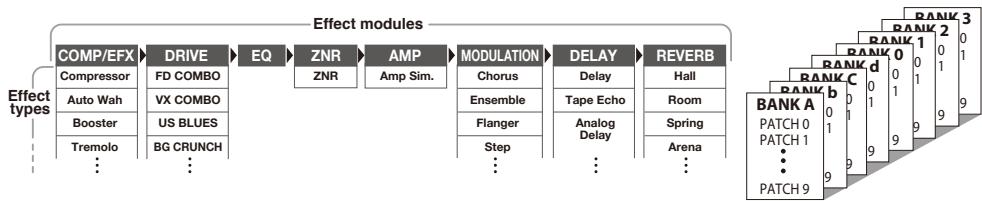
- Effect module
As shown in the illustration above, a patch in the G1N/G1XN can be thought of as a combination of up to eight single effects. Each such effect is referred to as an effect module.
- Effect type
Some effect modules have several different effects which are referred to as effect types. For example, the MODULATION module is comprised of chorus, flanger, pitch shifter, and other effect types. Only one of these can be selected at a time.
- Effect parameter
All effect modules have various parameters that can be adjusted. These are called effect parameters or simply parameters. When thinking of an effect module as a compact effect, the parameters change the tone and effect intensity similar to the knobs on the device.
Patch
In the G1N/G1XN, effect module combinations
are stored and called up in units referred to as patches. A patch is comprised of information about the on/off status and effect parameter settings used in each module.
Bank
A group of ten patches is called a bank
The memory of the G1N/G1XN comprises a total of 8 banks, labelled with letters A to d (user-editable banks) and numbers 0 to 3 (read-only preset banks), as shown in the illustration at top right.
Mode
The internal status of the G1N/G1XN is referred to as the operation mode. The function of keys and controls differs, depending on the respective mode. Modes of the G1N/G1XN include play mode for selecting and playing patches, rhythm mode for playing a rhythm pattern, edit mode for modifying effects, and store mode for saving patches.
Operating the G1N/G1XN on batteries
-
Turn the G1N/G1XN over and open the cover of the battery compartment on the bottom.
-
Insert four fresh IEC R6 (size AA) batteries.
-
Close the cover of the battery compartment.
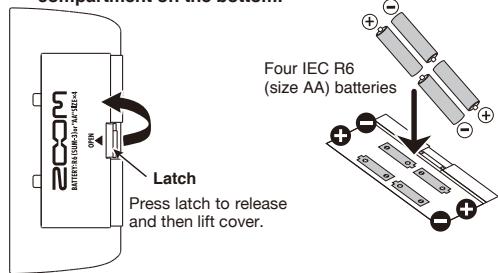
When the batteries are getting low, the indication "bt" appears on the display.
When operating the G1N/G1XN on batteries, it is advisable to disconnect the guitar cable plug from the [INPUT] jack when not using the unit, to conserve battery power.
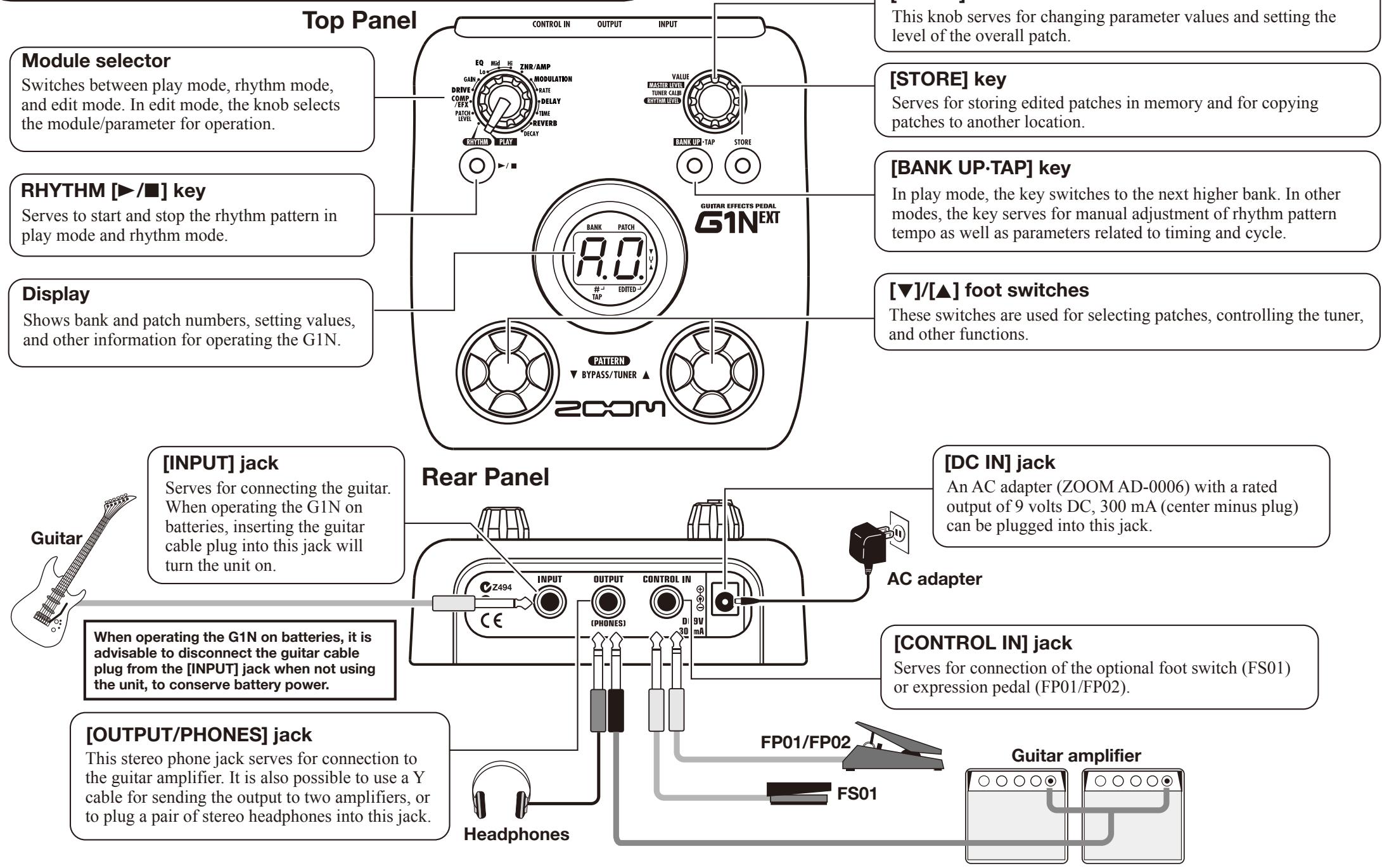
Controls and Functions / Connections (G1N)
Controls and Functions / Connections (G1XN)
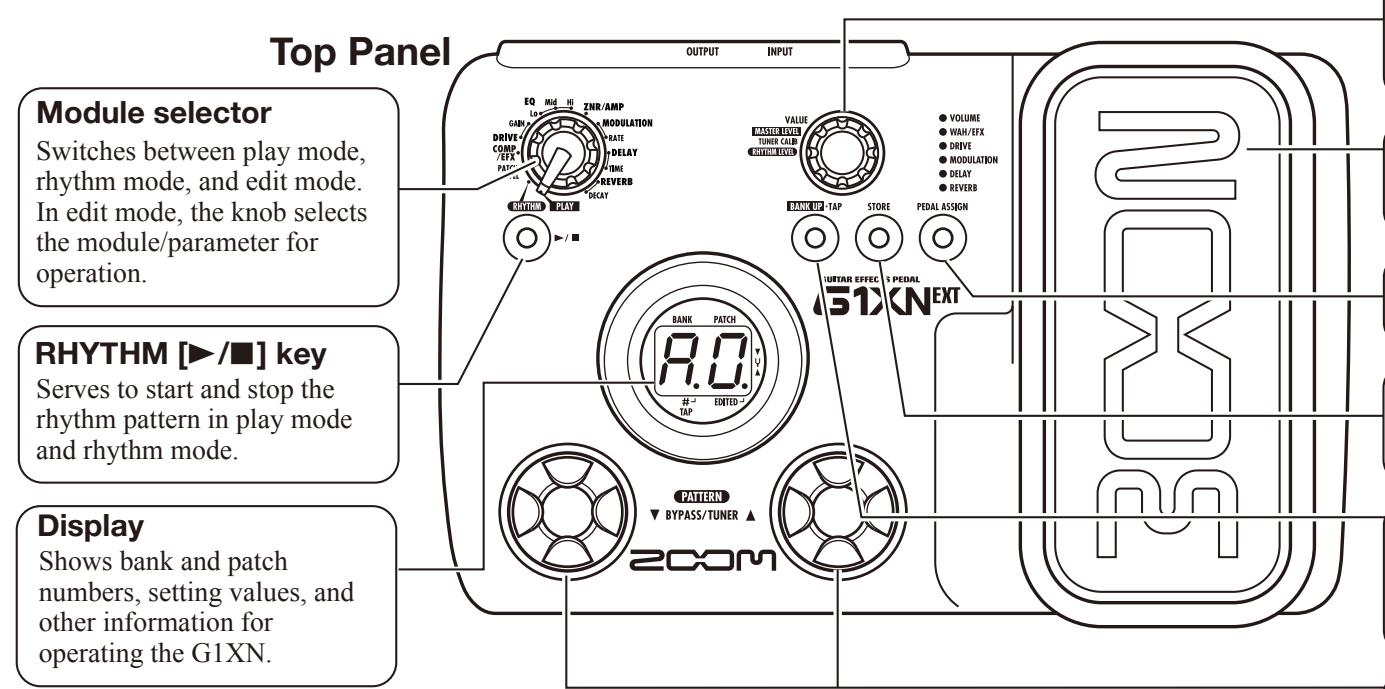
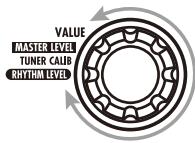
[VALUE] knob
This knob serves for changing parameter values and setting the level of the overall patch.
Expression pedal
Can be used as a volume pedal or as a real-time controller for adjusting effect parameters. (For details, see page 20.)
[PEDAL ASSIGN] key
Selects the module to be controlled by the built-in expression pedal.
[STORE] key
Serves for storing edited patches in memory and for copying patches to another location.
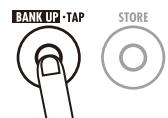
[BANK UP-TAP] key
In play mode, the key switches to the next higher bank. In other modes, the key serves for manual adjustment of rhythm pattern tempo as well as parameters related to timing and cycle.
![ZOOM G1N - [BANK UP-TAP] key - 1](/content/2025/01/152203/images/63a875d36ef885aff66cb1cf34ad7f6807a698e1502a6e9d98f9cff0e11da404.jpg)
Rear Panel
[ ] / [ ] foot switches
These switches are used for selecting patches, controlling the tuner, and other functions.
[DC IN] jack
An AC adapter (ZOOM AD-0006) with a rated output of 9 volts DC, 300mA (center minus plug) can be plugged into this jack.
[OUTPUT/PHONES] jack
This stereo phone jack serves for connection to the guitar amplifier. It is also possible to use a Y cable for sending the output to two amplifiers, or to plug a pair of stereo headphones into this jack.
Guitar amplifier
Selecting a Patch for Playing (Play Mode)
This section explains basic functions of the play mode.

Turn power on
The volume control on the connected amplifier should be turned down.
When using the unit on batteries
Plug a shielded cable into the [INPUT] jack.
When using the unit with an AC adapter
Plug the cable from the adapter into the [DC IN] jack.
Turn the guitar amplifier on and adjust the volume to a suitable position.
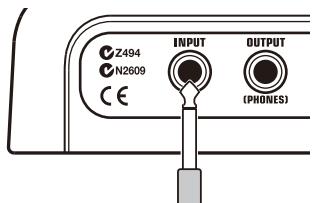
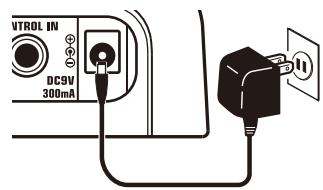

Set the G1N/G1XN to play mode
Set the Module selector to "PLAY".
The bank and patch number are shown on the display.

Immediately after turning the G1N/G1XN on, the unit will be in play mode, regardless of the position of the Module selector.
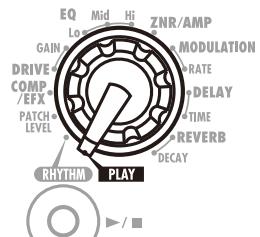
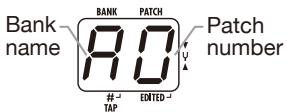

Select a patch
Use the foot switches.
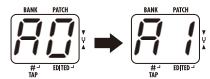
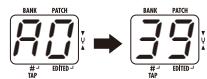
Press the [▲] foot switch to call up the next higher patch.
Press the [] foot switch to call up the next lower patch.
Repeatedly pressing one foot switch cycles through patches in the order A0-A9 ... d0-d9, 00-09 ... 30-39, A0.



Directly switch a bank
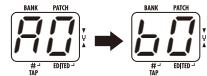
Press the [BANK UP·TAP] key.
Repeatedly pressing the key cycles through banks in the order A ... d, 0 ... 3, A.

With the G1N, using the foot switch (FS01) to switch banks is also possible ( p.18) .




Adjust the master level
Operate the [VALUE] knob.
The master level setting appears on the display.
The master level setting applies to all patches. The setting range is 0 - 98, 1.0. It will be reset to 80 when power is turned off and then on again.
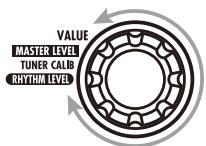


When using headphones, this knob adjusts the listening volume.
Using the Tuner
To use the tuner function of the G1N/G1XN, the built-in effects must be bypassed (temporarily turned off) or muted (original sound and effect sound turned off).

Switch to bypass or mute
- Setting the G1N/G1XN to the bypass condition
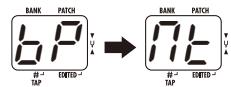
In play mode or rhythm mode ( p. 12), press both [ ] / [ ] foot switches together. When the indication "bP" appears on the display, release the switches within 1 second. - Setting the G1N/G1XN to the mute state
In play mode or rhythm mode ( p. 12), press both [ ] / [ ] foot switches together. Wait until the indication "bP" on the display changes to "Mt" and then release the foot switches.

The bypass or mute condition cannot be activated when the unit is in edit mode ( p.14) .
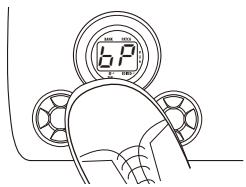

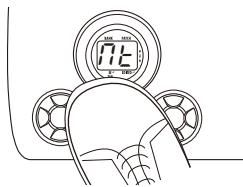
Patch change at bypass/mute
When you press both [] / [] foot switches together while playing your instrument, the sound may change momentarily just before the bypass/mute condition is activated. This is because the G1N/G1XN switches to the next higher or lower patch when one of the foot switches is pressed slightly earlier. (When you cancel the bypass/mute condition, the original patch number will be
active again.)
This behavior is not a defect. It is due to the very high speed at which the G1N/G1XN responds to patch switching. To prevent the sound change caused by the above condition, do not produce sound with your instrument until the bypass/mute condition is fully established.

Tune your instrument
Play the open string to tune, and adjust the pitch.
The left side of the display shows the note which is closest to the current pitch.
$$ \begin{array}{l} \mathrm {\bf A} = \bar {\mathrm {H}} \quad \mathrm {\bf C} ^ {#} = \bar {\mathrm {L}}. \mathrm {\bf F} = \bar {\mathrm {F}} \ \mathbf {A} ^ {#} = \bar {\mathsf {F}} _ {\cdot} \quad \mathbf {D} = \square^ {\top} \quad \mathbf {F} ^ {#} = \bar {\mathsf {F}} _ {\cdot}. \ \mathbf {B} = \square \quad \mathbf {D} ^ {#} = \square . \mathbf {G} = \square \ \mathbf {C} = \left[ \begin{array}{c c} & \mathbf {E} = \bar {\mathbf {E}} \ & \end{array} \right. \quad \mathbf {G} ^ {#} = \left[ \begin{array}{c} & \ & \end{array} \right.. \ \end{array} $$
The right side of the display shows a symbol that indicates by how much the tuning is off.
Pitch is high Pitch is correct Pitch is low
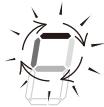

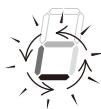
Indication turns faster the more the pitch is off

Adjusting the reference pitch of the tuner
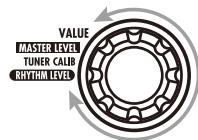
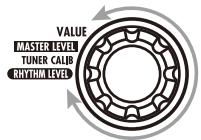
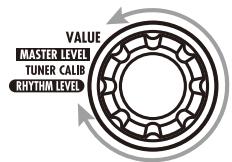
To fine-adjust the reference pitch of the G1N/G1XN tuner, turn the [VALUE] knob in the bypass/mute condition.
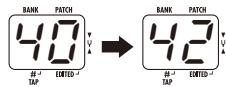
When you turn the knob, the current reference pitch is shown for a time on the display. The default setting is 40 (center A = 440Hz
While the reference pitch is shown, turn the [VALUE] knob to adjust the value in the range from 35 - 45 (center A = 435 to 445Hz ).

When power is turned off and on again, the reference pitch setting will be reset to 40 (center A = 440Hz


Return to play mode
Press one of the [] / [] foot switches.


Tune your instrument
Using the Rhythm Function (Rhythm Mode)
This section describes how to use the built-in rhythm function that plays realistic drum sounds in various patterns.

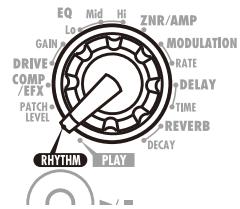
Select rhythm mode
Set the Module selector to the "RHYTHM" position.
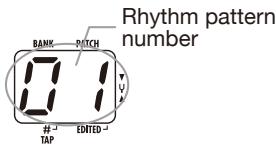
The number of the currently selected rhythm pattern (01 - 40) appears on the display.

Also while in rhythm mode, you can use the patch that was selected immediately before switching the mode. However, reverb effects are disabled in rhythm mode. The rhythm function can also be used in play mode.

Start the rhythm function
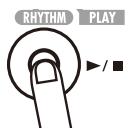
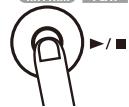
Press the RHYTHM [▶/■] key.

Rhythm pattern playback will start also if you press the RHYTHM [▶/■] key in play mode. However, changing the rhythm pattern or adjusting the rhythm volume and tempo is not possible.

Select a rhythm pattern
To switch between the 40 built-in rhythm patterns, press one of the [] / [] foot switches. (For information on pattern contents, see page 26.)
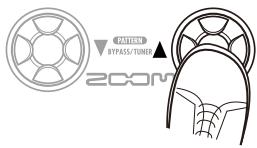

When you press both [] / [] foot switches in rhythm mode, the G1N/G1XN switches to the bypass/mute condition. The tuning function ( p, 10) can be used in this condition while playing the rhythm pattern.

Adjust the rhythm volume
Turn the [VALUE] knob.
The current setting (0 - 30) is shown briefly on the display.

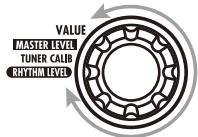

Adjust the tempo
The rhythm pattern tempo can be adjusted in the range of 40 - 250 BPM (beats per minute).
- To continuously change the tempo
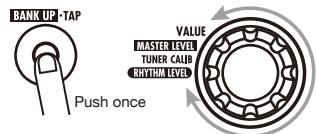
Hit the [BANK UP-TAP] key once and then turn the [VALUE] knob while the tempo value is being shown on the display.
- To manually specify the tempo
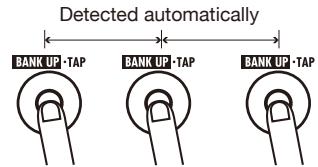
Hit the [BANK UP-TAP] key at least twice in the desired interval. The G1N/G1XN automatically detects the interval in which the key is pressed the second and subsequent times, and sets the tempo accordingly (tap tempo function).
While the above steps are carried out, the new tempo value (40 - 250) is shown briefly on the display. For values in the range from 100 to 199, a dot is shown in the center, and for values of 200 and above, dots are shown in the center and in the bottom right corner.

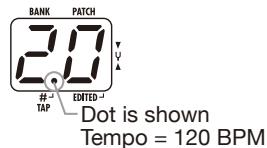

With the G1N, using a separately available foot switch to manually adjust the tempo is also possible ( p.18) . The G1XN does not support use of a foot switch.
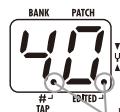
-Dots are shown Tempo = 240 BPM

Stop the rhythm
Press the RHYTHM [▶/■] key. The G1N/G1XN returns to the previous condition.
RHYTHM PLAY
Editing a Patch (Edit Mode)
The patches of the G1N/G1XN can be freely edited by changing the effect type used by the various modules and by changing the parameter settings. Try editing the currently selected patch to create your own sound.

Select the effect module/parameter
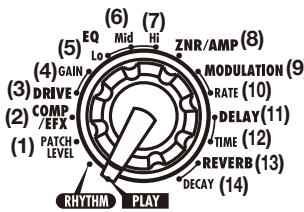
Turn the Module selector to select the effect module and parameter to edit. The available settings are listed below.
(1) PATCH LEVEL (Prm)
(2) COMP/EFX module (Type&Prm)
(3) DRIVE module (Type)
(4) DRIVE module (Prm)
(5)-(7) EQ module (Prm)
(8) ZNR/AMP module (Type&Prm)
(9) MODULATION module (Type&Prm1)
(10) MODULATION module (Prm2)
(11) DELAY module (Type&Prm1)
(12) DELAY module (Prm2)
(13) REVERB module (Type&Prm1)
(14) REVERB module (Prm2)
The "Type" and "Prm" indication in brackets indicates the item category.
- Type&Prm or Type&Prm1 (Type & Parameter)
Item where the effect type (left side of display) and parameter setting value (right side of display) are adjusted simultaneously. - Type
Item where the effect type only is selected. - Prm or Prm2 (Parameter)
Item where the parameter setting value only is adjusted.
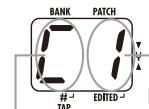
The EQ module has three parameters, and the
MODULATION, DELAY, and REVERB modules have two parameters each.
Switching the type gives access to the second and third parameter.
Effect type
Parameter
setting value
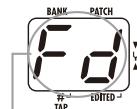
Effect type
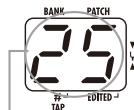
Parameter setting value

Change the setting
Turn the [VALUE] knob.
The setting of the selected item changes, and a dot (. ) appears in the bottom right of the display. This indicates that a setting has been changed from the currently stored value.

When you have selected a parameter that can be set with the tap function ( p.21) , you can repeatedly hit the [BANK UP-TAP] key at the desired interval to specify the timing.
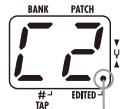
Dot indicates that setting has been changed

To switch an effect module on and off
Press one of the [] / [] foot switches.
The indication "oF" appears on the display and the module is turned off. Pressing one of the switches once more returns the setting to the previous condition.
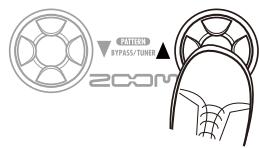


Terminate the edit mode
Set the Module selector to the "PLAY" position to return to the play mode.

When you return to play mode and have made any changes to the patch, the dot () will be shown in the bottom right of the display. If you select another patch in this condition, the changes you have made in edit mode will be lost unless you store the patch first. To retain the changes, store the patch as described on page 16.
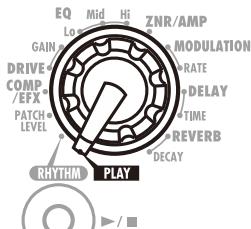
Storing/Copying Patches (Store Mode)
An edited patch can be stored in a user bank (A-d). It is also possible to store an existing patch in another location to create a copy.

In play mode or edit mode, press the [STORE] key
The bank and patch number flash on the display.
![ZOOM G1N - In play mode or edit mode, press the [STORE] key - 1](/content/2025/01/152203/images/75c2b6a07370aa74c79b25ff43cf1d19f1cbb17a174d56e667bc5771a645d253.jpg)
Patches of preset banks (0 - 3) are read-only. No patches can be stored or copied into these locations. If you press the [STORE] key while a patch from these banks is selected, the patch "A0" (bank A, patch number 0) will be selected automatically as default store/copy target.
![ZOOM G1N - In play mode or edit mode, press the [STORE] key - 2](/content/2025/01/152203/images/ae8bf52fa282ceb86af4371b38f327c46433a4ef9d15419c8f0143a6452bef35.jpg)
![ZOOM G1N - In play mode or edit mode, press the [STORE] key - 3](/content/2025/01/152203/images/d3ae0be2d169a6bf1eca996d34c922b80dc4bea1de09fe62161cb5b9c260ca3f.jpg)
![ZOOM G1N - In play mode or edit mode, press the [STORE] key - 4](/content/2025/01/152203/images/48d61c63f809a50285b8b0e031fa3c60e244e223d8b3040a2f44b072422c84fd.jpg)
Select the store/copy target bank and patch number
- Use the [] / [] foot switches to select the bank/patch number.
- To switch only the bank, use the [BANK UP-TAP] key.

Only a user bank (A - d) can be selected as store/copy target bank.
During the store/copy process, the foot switch (FS01) cannot be used to change banks.
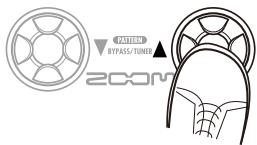
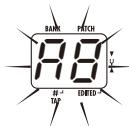
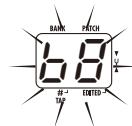

Press the [STORE] key once more
When the store/copy process is completed, the G1N/ G1XN returns to the previous mode, with the target patch selected.
![ZOOM G1N - Press the [STORE] key once more - 1](/content/2025/01/152203/images/5447c6aaad0c6711c49e2c383d46f5f212cea2b3fe4cf4f7ba572c4bad409b7d.jpg)
To cancel the store process, operate the [VALUE] knob before pressing the [STORE] key again.
![ZOOM G1N - Press the [STORE] key once more - 2](/content/2025/01/152203/images/885a0c40538a900252491ced6b3e5b7c6b3ca646a99c6f550a5067ab9a4f9e29.jpg)
![ZOOM G1N - Press the [STORE] key once more - 3](/content/2025/01/152203/images/c700f3a60c1cf0f0ffc3def7bf6d03a6e160699518e215d56cf73574f4e1a469.jpg)
Restoring Factory Defaults
Even after overwriting user patches with other patches, their original content can be restored in a single operation ("All Initialize" function).
To do this, turn power to the G1N/G1XN on while holding down the [STORE] key.
The indication "AL" appears on the display.
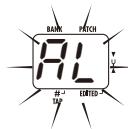
To carry out the All Initialize function, press the [STORE] key once more. All patch settings are returned to the factory default condition, and the unit switches to play mode.
To cancel All Initialize, press the RHYTHM
[/] key instead of the [STORE] key.

When you carry out All Initialize, any newly created patches that were stored in the user-editable bank will be deleted (overwritten). Perform this operation with care to prevent losing any patches that you want to keep.
Changing the Way Patches Are Called Up
This section describes how to change the patch selection method of the G1N/G1XN to "pre-select". In this mode, you first select the patch to use next, and then perform an additional step to activate the patch.
- Turn power to the G1N/G1XN on while holding down the [▲] foot switch.
The indication "PrE-SEIEct" scrolls on the display.
- In play mode, select the patch to use next.

The selected new bank and patch number flash on the display. The sound does not change yet.
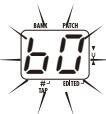
- When you have specified the patch to use, press both [] / [] foot switches together.
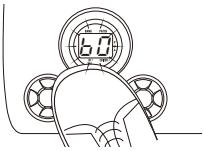
The patch change is accepted, causing the sound to change, and the display changes from flashing to permanently lit.
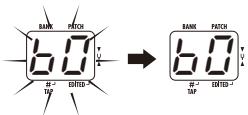
- To return the G1N/G1XN to the normal patch selection method, simply turn power off and then on again.
The patch selection method is automatically reset to conventional operation.
Using an External Foot Switch or Pedal (G1N only)
The [CONTROL IN] jack on the GIN allows connection of an optional foot switch or expression pedal to control effects and the rhythm function. This section explains how to use this capability.
Using a foot switch
Simply connect the optional foot switch (FS01) to the [CONTROL IN] jack of the G1N and turn the unit on. This allows you to switch banks and specify the tempo for rhythm patterns with the foot switch.
Depending on the currently selected mode, the foot switch operates as follows.
- Play mode
Pressing the foot switch selects the next higher bank.
Rhythm mode
When you press the foot switch two times or more, the G1N detects the interval and automatically adjusts the tempo accordingly (tap tempo function).
- Edit mode/Store mode
The foot switch has no effect.
Using an expression pedal
When the optional expression pedal (FP01/ FP02) is connected to the [CONTROL IN] jack of the G1N, you can change effect parameters in real time or use the pedal as a volume controller. The function of the expression pedal can be saved individually for each patch.
-
Plug the FP01 or FP02 into the [CONTROL IN] jack of the G1N.
-
In play mode, select a patch for which you want to use the expression pedal.
-
Set the Module selector to a position other than "PLAY" or "RHYTHM".
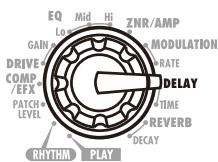
The G1N/G1XN goes into edit mode.
4.Hold down the RHYTHM [▶/■] key and turn the [VALUE] knob to select one of the following modules for control by the expression pedal.
| Display | Control target |
| OF | Off |
| UP | Volume |
| BP | COMP/EFX module |
| CP | DRIVE module |
| NP | MODULATION module |
| DP | DELAY module |
| RP | REVERB module |

In the section "Effect Types and Parameters" ( p.21) , effect types/parameters that can be controlled with the expression pedal are indicated by a pedal symbol.
- If a module is selected for which no pedal symbol is shown, the expression pedal will have no effect for that patch.
5.Save the patch.
The expression pedal setting is stored with the patch.
- In play mode, select the patch and operate the expression pedal.
The respective parameter changes. In bypass mode, the expression pedal always functions as a volume pedal, regardless of the setting.

The expression pedal operates also in edit mode.
Using the built-in expression pedal (G1XN only)
The G1XN lets you adjust the volume or parameters in real time using the expression pedal on the unit. This section explains how to use this capability.
[PEDAL ASSIGN] key operation
The top panel of the G1XN has a [PEDAL ASSIGN] key. The module to be controlled by the pedal can be selected with this key.
1. In play mode or edit mode, press the [PEDAL ASSIGN] key to select the control target module.
The module currently selected as control target is indicated by the row of LEDs above the [PEDAL ASSIGN] key.
All out Pedal is inactive
VOLUME Volume
OWAH/EFX COMP/EFX module
O DRIVE DRIVE module
MODULATION... MODULATION module
DELAY DELAY module
REVERB · · · · · · REVERB module
![ZOOM G1N - In play mode or edit mode, press the [PEDAL ASSIGN] key to select the control target module. - 1](/content/2025/01/152203/images/cf716f5d21706fa95476affedd8f79844a1c7c54126a213a58080689d4d49562.jpg)
PEDAL ASSIGN
![ZOOM G1N - In play mode or edit mode, press the [PEDAL ASSIGN] key to select the control target module. - 2](/content/2025/01/152203/images/a3aed7fec07ac73756988a478a4626071c8058ce031659d48a5750a821277083.jpg)
Besides the method described above, you can also select the module to control by holding down the [RHYTHM] key and turning the [VALUE] knob. This is the same as for the GIN. (For details, see page 19.)
2. Store the patch as required.
3. In play mode, select the patch and operate the expression pedal.
The respective parameter changes in real time.
4. To toggle the module assigned to the pedal between on and off, briefly push the pedal fully down.
When the module is off, the respective LED above the [PEDAL ASSIGN] key flashes. This function can also be used in edit mode.
Adjusting the expression pedal
The responsiveness of the expression pedal on the G1XN can be readjusted as necessary. If the effect change seems insufficient when pushing the pedal down, or if the volume or tone changes excessively even when the pedal is only lightly pushed, adjust the pedal as follows.
1. Hold down the [PEDAL ASSIGN] key while turning power to the G1XN on.
The indication "dn" appears on the display.
2. Fully raise the expression pedal and press the [STORE] key.
The indication "UP" appears on the display.
3. Push the expression pedal fully down and release it.

Push strongly, so that pedal touches here

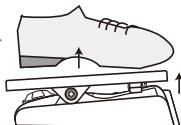
When foot is lifted, pedal returns slightly
4. Press the [STORE] key once more.
The adjustment is complete, and the unit returns to the play mode. If the indication "Er" is shown, repeat the procedure from step 2.
Effect Types and Parameters
Explanation of symbols
- Module selector

Shows the position of the knob at which this module/parameter is called up.
- Expression pedal

Indicates a parameter that can be controlled with the expression pedal.
- Tap

Indicates a parameter that can be set by repeatedly tapping the [BANK UP-TAP] key. When the module/effect type is selected in edit mode, the parameter (modulation rate or delay time, etc.) will be set according to the interval in which the key is pressed.
- Manufacturer names and product names mentioned in this listing are trademarks or registered trademarks of their respective owners. The names are used only to illustrate sonic characteristics after which the effects are modeled and do not indicate any affiliation with ZOOM CORPORATION.
For some effect modules, you can select an effect type from several possible choices.
PATCH LEVEL
| Patch Level (Prm) | |
| Sets the overall volume level of the patch. | |
| 2←10 | The setting range is 2 - 98, and 1.0. A setting of 80 corresponds to unity gain (input level and output level are equal). |
COMP/EFX (Compressor/Special Effects) module
| COMP/EFX (Type&Prm) | |
| Selects the COMP/EFX module effect type and parameter. | |
| Compressor | |
| This is an MXR Dynacomp type compressor which limits high-level signals and boosts low-level signals to compress the overall dynamics of the signal. Higher settings result in higher sensitivity. | |
| Auto Wah | |
| This effect varies wah in accordance with picking intensity. Higher settings result in higher sensitivity. | |
| Booster | |
| Raises signal gain and creates a dynamic sound. Higher settings result in higher gain. | |
| Tremolo | |
| This effect periodically varies the volume. Higher settings result in faster modulation rate. | |
| Phaser | |
| This effect produces sound with a pulsating character. Higher setting values result in faster modulation rate. | |
| Ring Mod (Ring Modulator) | |
| This effect produces a metallic ringing sound. Higher settings result in higher modulation frequency. | |
| 51→59 | Slow Attack |
| This effect reduces the attack rate of each individual note. Higher settings result in slower attack times. | |
| 61→69 | Pedal Vox |
| This effect simulates a vintage Vox wah pedal at half-open. Higher settings shift the emphasized frequency upwards. | |
| 71→89 | Pedal Cry |
| This effect simulates a vintage Jen Crybaby pedal at half-open. Higher settings shift the emphasized frequency upwards. | |
DRIVE module (distortion effects)
| DRIVE (Type) | |||
| Selects the effect type for the DRIVE module. | |||
| FD COMBO | VX COMBO | ||
| Sound of a Fender Twin Reverb ('65 model) favored by guitarists of many music styles. | Sound modeled on the Class A drive combo amp Vox AC30. | ||
| US BLUES | BG CRUNCH | ||
| Crunch sound of a Fender Tweed Bassman. | Crunch sound of the Mesa Boogie MkIII combo amp. | ||
| HW STACK | MS CRUNCH | ||
| Sound of the legendary all-tube Hiwatt Custom 100 from Britain. | Crunch sound of the Marshall 1959 that has become legendary. | ||
| MS DRIVE | PV DRIVE | ||
| High gain sound of the Marshall stack amp JCM2000. | High gain sound of a Peavey 5150 developed in cooperation with a world-famous hard rock guitarist. | ||
| DZ DRIVE | BG DRIVE | ||
| High gain sound based on the channel 3 of the hand-made German guitar amp Diezel Herbert with three separately controllable channels. | High gain sound of the Mesa Boogie Dual Rectifier red channel (vintage mode). | ||
| OVER DRIVE | GOVERNOR | ||
| Sound of the Boss OD-1 that first created the "overdrive" concept. | Sound of the Guv'nor distortion effect from Marshall. | ||
| SQUEAK | FUZZ SMILE | ||
| Simulation of the ProCo Rat famous for its edgy distortion sound. | Sound of the Fuzz Face that made rock history with its zany look and smashing sound. | ||
| HOT BOX | Z CLEAN | ||
| Simulation of the compact Matchless HotBox preamp with built-in tubes. | Zoom original flat clean sound. | ||
| Z MP1 | Z NEOS | ||
| Original sound that combines characteristics of the ADA MP1 and Marshall JCM800. | Crunch sound modeled on a modified Vox AC30. | ||
| LED | LEAD | ED | EXTREME DS |
| Smooth, bright distortion sound. | High gain sound with the most powerful gain of any distortion effect in the world. | ||
| AC | ACO.SIM (Acoustic Simulator) | ||
| This effect makes an electric guitar sound like an acoustic guitar. | |||
| GAIN (Prm) | |||
| Sets the DRIVE module parameters. The parameter action differs, depending on whether a distortion effect type (Fd – Ed) or Aco.Sim (Ac) is selected. | |||
| When distortion effect type (Fd – Ed) is selected | |||
| GAIN ≤ | |||
| Adjusts the gain (distortion intensity). | |||
| When Ac is selected | |||
| TOP ≤ | |||
| Adjusts the characteristic string tone of acoustic guitar. | |||
- Manufacturer names and product names mentioned in this listing are trademarks or registered trademarks of their respective owners. The names are used only to illustrate sonic characteristics after which the effects are modeled and do not indicate any affiliation with ZOOM CORPORATION.
EQ module (equalizer)
| EQ LO (Prm) | EQ MID (Prm) | EQ HI (Prm) | ||
| Adjusts the LO band of the EQ module. | Adjusts the MID band of the EQ module. | Adjusts the HI band of the EQ module. | ||
| Lo | Mid | Hi | ||
| Adjusts the low range (160 Hz) boost/cut. | Adjusts the midrange (800 Hz) boost/cut. | Adjusts the high range (3.2 kHz) boost/cut. | ||
ZNR/AMP (ZNR/Amp Simulator) module
| ZNR/AMP | ZNR/AMP (Type&Prm) |
| This module combines ZOOM's proprietary ZNR (removes noise during play pauses without affecting sound quality) with an amp simulator (recreates the sound of various speaker cabinets). Type and parameters are adjusted at the same time. | |
| 0→9 | ZNR (ZOOM Noise Reduction) |
| This is the noise reduction function only. Higher settings result in a stronger effect. Set the value as high as possible without causing the sound to be cut off unnaturally. | |
| 0→9 | Combo & ZNR |
| Combination of ZNR with amp simulator that recreates the sound of a combo amp with closed-back cabinet. The right-digit value controls ZNR sensitivity. | |
| 60→69 | Bright Combo & ZNR |
| Combination of ZNR with amp simulator that recreates the sound of a bright combo amp with open-back cabinet. The right-digit value controls ZNR sensitivity. | |
| 50→59 | Stack & ZNR |
| Combination of ZNR with amp simulator that recreates the sound of a stack amp cabinet. The right-digit value controls ZNR sensitivity. |
■ MODULATION module
| MODULATION (Type&Prm1) | MODULATION (RATE) | RATE (Prm2) | |
| Selects the MODULATION module effect type and controls parameter 1 at the same time. | Controls the value of parameter 2 of the MODULATION module. The parameter action differs, depending on the effect type. | ||
| Chorus | 1→50 | Rate | |
| This effect mixes a variable pitch-shifted component to the original signal. Higher right-digit settings result in higher effect sound mixing ratio. | Adjusts the modulation rate. | ||
| Ensemble | |||
| This is a chorus ensemble with three-dimensional movement. Higher right-digit settings result in higher effect sound mixing ratio. | |||
| Flanger | 1→50 | Rate TAP | |
| This effect produces a resonating and strongly undulating sound. Higher right-digit settings emphasize the characteristics of the effect. | Adjusts the modulation rate. | ||
| Step | |||
| Special effect that changes the sound in a staircase pattern. Higher right-digit settings emphasize the characteristics of the effect. | |||
| Pitch Shift | 12→-1 | Shift | |
| This effect shifts the pitch of the original sound up or down. Higher right-digit settings increase the mixing ratio of the effect sound. | Sets the pitch shift amount in semitones. "dt" results in a detune effect. | ||
| Mono Pitch | 1→12 | ||
| This is a monophonic pitch shifter (for single-note playing) with reduced flutter. Higher right-digit settings increase the mixing ratio of the effect sound. | |||
| HPS (Harmonized Pitch Shifter) | 1, 10 | Key | |
| This is an intelligent pitch shifter that automatically generates major scale harmonies according to a preset key. Higher right-digit settings increase the mixing ratio of the effect sound. | Specifies the tonic for the scale used for pitch shifting. The "o" symbol stands for #. | ||
| Vibrato | 1→50 | Rate TAP | |
| This is an effect with automatic vibrato. Higher right-digit settings emphasize the vibrato intensity. | Adjusts the modulation rate. | ||
| Pitch Bend | Pedal Position | ||||
| This effect allows using the expression pedal to change the pitch in real time. Right-digit settings select the pitch change type caused by the expression pedal (see Table 1). | Sets the initial value for the pitch shift amount (the value that is active when the pedal is at rest). The original sound/effect sound level balance also changes according to the parameter 1 setting. | ||||
| [Table 1] | |||||
| Type&Prm1 | Prm2=0 | Prm2=1.0 | Type&Prm1 | Prm2=0 | Prm2=1.0 |
| Pedal fully raised (minimum) | Pedal fully depressed (maximum) | Pedal fully raised (minimum) | Pedal fully depressed (maximum) | ||
| b1 | 0 cent | +1 octave | b6 | -1 octave + original sound | +1 octave + original sound |
| b2 | 0 cent | +2 octaves | b7 | -700 cent + original sound | +500 cent + original sound |
| b3 | 0 cent | -100 cent | b8 | Doubling | Detune + original sound |
| b4 | 0 cent | -2 octaves | b9 | -∞(0Hz) + original sound | +1 octave + original sound |
| b5 | 0 cent | -∞ | |||
| Delay | Time (Delay Time) TAF | ||||
| This is a delay with a maximum setting of 2000 msec. Higher right-digit settings increase the mixing ratio of the effect sound and the feedback amount. | Sets the delay time. In the 10 - 1000 millisecond range, the adjustment is performed in 10-msec steps (1 - 99, 1.0). Above 1 second, the adjustment is performed in 100-msec steps (1.1 - 2.0). | ||||
DELAY module
| DELAY (Type&Prm1) | |
| Selects the DELAY module effect type and controls parameter 1 at the same time. | |
| Delay | |
| This is a delay with a maximum setting of 5000 msec. The right-digit setting values control the mixing ratio of the effect sound and the feedback amount. | |
| Tape Echo | |
| This effect simulates a tape echo with a long delay time of up to 5000 msec. The right-digit setting values control the mixing ratio of the effect sound and the feedback amount. | |
| Analog Delay | |
| This effect simulates an analog delay with a long delay time of up to 5000 msec. The right-digit setting values control the mixing ratio of the effect sound and the feedback amount. | |
| Ping Pong Delay | |
| This is a ping-pong type delay where the delay sound alternates between left and right. The right-digit setting values control the mixing ratio of the effect sound and the feedback amount. | |
| TIME (Prm2) | |
| Controls parameter 2 of the DELAY module. | |
| Time (Delay Time) TAP | |
| Sets the delay time. In the 10 - 1000 millisecond range, the adjustment is performed in 10-msec steps (1 - 99, 1.0). Above 1 second, the adjustment is performed in 100-msec steps (1.1 - 5.0). |
REVERB module
| REVERB (Type&Prm1) | |
| Selects the REVERB module effect type and controls parameter 1 at the same time. | |
| Hall | |
| This reverb effect simulates the acoustics of a concert hall. Higher right-digit settings increase the mixing ratio of the effect sound. | |
| Room | |
| This reverb effect simulates the acoustics of a room. Higher right-digit settings increase the mixing ratio of the effect sound. | |
| Spring | |
| This effect simulates a spring-type reverb. Higher right-digit settings increase the mixing ratio of the effect sound. | |
| Arena | |
| This reverb effect simulates the acoustics of a large venue such as a sports arena. Higher right-digit settings increase the mixing ratio of the effect sound. | |
| Tiled Room | |
| This reverb effect simulates the acoustics of a tiled room. Higher right-digit settings increase the mixing ratio of the effect sound. | |
| DECAY (Prm2) | |
| Controls parameter 2 of the REVERB module. This parameter is common to all effect types. | |
| Decay | |
| Adjusts the decay duration. |
Rhythm Function Preset Patterns
| # | Name | TimSig | # | Name | TimSig | # | Name | TimSig | # | Name | TimSig |
| 1 | 8beat 1 | 4/4 | 11 | METAL 2 | 4/4 | 21 | POP 3 | 4/4 | 31 | BALLAD 1 | 4/4 |
| 2 | 8beat 2 | 4/4 | 12 | THRASH | 4/4 | 22 | DANCE 1 | 4/4 | 32 | BALLAD 2 | 3/4 |
| 3 | 8beat 3 | 4/4 | 13 | PUNK | 4/4 | 23 | DANCE 2 | 4/4 | 33 | BLUES 1 | 4/4 |
| 4 | 8shuffle | 4/4 | 14 | DnB | 4/4 | 24 | DANCE 3 | 4/4 | 34 | BLUES 2 | 3/4 |
| 5 | 16beat 1 | 4/4 | 15 | FUNK 1 | 4/4 | 25 | DANCE 4 | 4/4 | 35 | JAZZ 1 | 4/4 |
| 6 | 16beat 2 | 4/4 | 16 | FUNK 2 | 4/4 | 26 | 3per4 | 3/4 | 36 | JAZZ 2 | 3/4 |
| 7 | 16shuffle | 4/4 | 17 | HIPHOP | 4/4 | 27 | 6per8 | 3/4 | 37 | METRO 3 | 3/4 |
| 8 | ROCK | 4/4 | 18 | R'nR | 4/4 | 28 | 5per4 1 | 5/4 | 38 | METRO 4 | 4/4 |
| 9 | HARD | 4/4 | 19 | POP 1 | 4/4 | 29 | 5per4 2 | 5/4 | 39 | METRO 5 | 5/4 |
| 10 | METAL 1 | 4/4 | 20 | POP 2 | 4/4 | 30 | LATIN | 4/4 | 40 | METRO |
Specifications
| Effect types | 54 |
| Effect modules | max. 8 simultaneous modules |
| Patch memory | User area: 10 patches x 4 banks = 40 |
| Preset area: 10 patches x 4 banks = 40 | |
| Total 80 patches | |
| Sampling frequency | 96 kHz |
| A/D converter | 24 bit, 128 times oversampling |
| D/A converter | 24 bit, 128 times oversampling |
| Signal processing | 32 bit |
| Frequency response | 20 Hz - 40 kHz +1.0 dB -4.0 dB (10-kilohm load) |
| Display | 2-digit 7-segment LED |
| Input | Standard mono phone jack |
| Rated input level | -20 dBm |
| Input impedance | 470 kilohms |
| Output | Standard stereo phone jack (doubles as line/headphone jack) |
| Maximum output level | Line +3 dBm |
| (output load impedance of 10 kilohms or more) | |
| Phones 20 mW + 20 mW (into 32-ohm load) | |
| Control input | For FP02/FP01 or FS01 (G1 only) |
| Power requirements | |
| AC adapter | 9 V DC, 300 mA (center minus plug) (ZOOM AD-0006) |
| Batteries | G1N/G1XN Four IEC R6 (size AA) batteries, approx. |
| 12 hours continuous operation (alkaline batteries) | |
| Dimensions | G1N 155 mm (D) x 136 mm (W) x 52 mm (H) |
| G1XN 155 mm (D) x 234 mm (W) x 52 mm (H) | |
| Weight | G1N 350 g (without batteries) |
| G1XN 600 g (without batteries) | |
| Options | Expression pedal FP01/FP02 or Foot switch FS01 (G1N only) |
Troubleshooting
No power
Refer to "Turn power on" on page 8.
- Reverb effect does not operate
While a rhythm pattern is playing, the reverber effect is not available. Stop the rhythm pattern first ( p. 12).
- Patch switching does not change the sound
Is the patch selection method of the G1N/G1XN set to "pre-select" ( p. 18)? Turn power off and
then on again to return to normal operation.
High level of noise
Is ZOOM AC adapter being used? Be sure to use only an adapter for 9VDC 300mA with center minus plug (ZOOM AD-0006).
- Battery life is short
Are manganese batteries being used? Continuous operation time is about 12 hours with alkaline batteries.
The FCC regulation warning (for U.S.A.)
This equipment has been tested and found to comply with the limits for a Class B digital device, pursuant to Part 15 of the FCC Rules. These limits are designed to provide reasonable protection against harmful interference in a residential installation. This equipment generates, uses, and can radiate radio frequency energy and, if not installed and used in accordance with the instructions, may cause harmful interference to radio communications. However, there is no guarantee that interference will not occur in a particular installation. If this equipment does cause harmful interference to radio or television reception, which can be determined by turning the equipment off and on, the user is encouraged to try to correct the interference by one or more of the following measures:
- Reorient or relocate the receiving antenna.
- Increase the separation between the equipment and receiver.
- Connect the equipment into an outlet on a circuit different from that to which the receiver is connected.
- Consult the dealer or an experienced radio/TV technician for help.
For EU Countries
Declaration of Conformity: This product complies with the requirements of EMC Directive 2004/108/EG and Low Voltage Directive 2006/95/EC
Disposal of Old Electrical & Electronic Equipment (Applicable in European countries with separate collection systems)
This symbol on the product or on its packaging indicates that this product shall not be treated as household waste. Instead it shall be handed over to the applicable collection point for the recycling of electrical and electronic equipment. By ensuring this product is disposed of correctly, you will help prevent potential negative consequences for the environment and human health, which could otherwise be caused by inappropriate waste handling of this product. The recycling of materials will help to conserve natural resources. For more detailed information about recycling of this product, please contact your local city office, your household waste disposal service or the shop where you purchased the product.

ZOOM CORPORATION
4-4-3, Kandasurugadai, Chiyoda-ku, Tokyo 101-0062, Japan
Web Site: http://wwwzoomo.co.jp
G1NEXT/G1XNEXT PATCH LIST
| Patch | Patch Name | Comment | Pedal Assign | |
| DEMO | A0 | Arena Lead | Sharp-edged high-gain lead sound. | Volume |
| A1 | OG Rhythm | 70s British rock sound. | Pitch Bend | |
| A2 | Chorus Clean | Great clean sound for Arpeggios. | Chorus Mix | |
| A3 | Big Duck | Auto wah sound. The tone responds to volume knob changes. | Reverb Mix | |
| A4 | Jet Fly | Flanging jet sound. Great for chords or muted lower strings. | Flanger Rate | |
| A5 | Modern Punk | Powerful modern punk sound. Great for rhythm tracks. | Volume | |
| A6 | Trick Delay | Clean sound using two delays set for different delay times. | Delay Mix | |
| A7 | Multi Phaser | Clean sound with a dash of phaser. | Phaser Rate | |
| A8 | Lap Steel Key D | Lap Steel modeled sound. Great for slide parts. | HPS Mix | |
| A9 | Wet Wood Acoustic | Acoustic guitar sound. Use with a single coil neck pickup. | Volume | |
| ARTIST MODELING | b0 | Deep Sand | "Enter Sandman" style sound. Deep metal sound, great for heavy riffs. | Volume |
| b1 | Liverpool | Day Tripper intro style sound. | Volume | |
| b2 | Jimi Fuzz | The "Jimi" style an Octavia fuzz sound. | Pitch Mix | |
| b3 | Zep Standard | Early Page "Zep style" recording sound. Bright and crunchy. | Volume | |
| b4 | EC Lead | Layla style sound. Great with single coil pickups. | Volume | |
| b5 | BS Riff | Rockabilly sound for "Rock This Town" style sound. | Volume | |
| b6 | Brian Drive | "Queen" style sound. | Volume | |
| b7 | 335 Solo | "Room 335" style sound. | Volume | |
| b8 | EVH 1959 | Early "EVH" style sound. Sounds best with hum bucking pickups. | Volume | |
| Michael Amott | b9 | NEMESIS II RHYTHM | Patch reminiscent of the tone on Arch Enemy albums such as 'Doomsday Machine' (2005) and 'Rise Of The Tyrant' (2007). | Volume |
| C0 | BURIED DREAMS II LEAD WAH | "Carcass" wah lead tone. | Cry Wah | |
| C1 | REVOLUTION II CLEAN | Clean sound for the Arch Enemy song 'Revolution Begins' on the album 'Rise Of the Tyrant' (2007). | Reverb Mix | |
| Kiko Loureiro | C2 | No Gravity Lead | Lead sound for title track from Kiko's first solo album 'No Gravity'. | Volume |
| C3 | La Force Clean | Clean sound for "La Force de l'Âme" from solo album 'No Gravity'. | Volume | |
| C4 | Tremolo Hammond | Some of Kiko's arrangements. He uses this kind of effect as a pad, like a keyboard. | Volume | |
| Riche Kozen | C5 | Jazz Wet | Cool clean lead tone with chorus delay and reverb. | Volume |
| C6 | Pointed strat | Very sharp combo tone that sounds cool with a strat while finger picking. | Volume | |
| C7 | Go faster | Dirty rhythm tone for strat neck position. Dirty enough to be aggressive but clean enough to get funky! | Volume | |
| George Lynch | C8 | Mr. Scary | Re-create the 'Scary' tone. This quickly became a signature sound for me. | Volume |
| C9 | Dream Warriors | A clean chorus sound with delay makes this perfect for picking out chords. | Volume | |
| d0 | FTA | Dry, searing tone. | Volume | |
| Rob Caggiano | d1 | Vox haul | A cool Vox style sound with a little Vibrato added. Using the Bright Combo cab. | Vibrato Rate |
| d2 | Metal Crunch | Thrash sounds using the DZ amp into the stack. | Volume | |
| d3 | Metal Lead | Using the DZ Drive Head. The pick attack jumps out more making it ideal for fast shredding. | Volume | |
| Mike Stone | d4 | Jangle | Strum an electric and find yourself free falling. | Volume |
| d5 | GnK | British steel with an electric eye. | Volume | |
| d6 | CnC | Vintage warm tremolo vibes. Great on arpeggio chords. | Tremolo Rate | |
| Matt Bachard | d7 | Shadows rock | High mid range and not over saturated. Similar to the main tone of Jon Donais of Shadows Fall. | Volume |
| d8 | Shadows lead | Chorus and delay play a major role in this aggressive mid range lead tone. | Volume | |
| d9 | Shadows rock2 | Heavy saturation and cutting mid range similar to the main tone of Matt Bachand of Shadows Fall. | Volume |
- The preset area of banks 0 - 3 contains the same patches as A - d.
- We recommend you to adjust the Noise Reduction parameter according to your guitars, amps and recording or performance situation.
Manufacturer names and product names mentioned in this patch list are trademarks or registered trademarks of their respective owners and do not indicate any affiliation with ZOOM CORPORATION. All product and artist names are intended only to illustrate sonic characteristics that were used as reference in the development of this product.
- GUITAR EFFECTS PEDAL
- G1NEXT/G1XNEXT
- Operation Manual
- SAFETY PRECAUTIONS / Usage Precautions
- SAFETY PRECAUTIONS
- Power requirements
- [AC adapter operation]
- [Battery operation]
- Environment
- Handling
- Connecting cables and input and output jacks
- Alterations
- Volume
- Usage Precautions
- Electrical interference
- Cleaning
- Terms Used in This Manual
- - Effect module
- - Effect type
- - Effect parameter
- Patch
- Bank
- Mode
- Operating the G1N/G1XN on batteries
- Controls and Functions / Connections (G1N)
- Controls and Functions / Connections (G1XN)
- [VALUE] knob
- Expression pedal
- [PEDAL ASSIGN] key
- [STORE] key
- [BANK UP-TAP] key
- [ ] / [ ] foot switches
- [DC IN] jack
- [OUTPUT/PHONES] jack
- Selecting a Patch for Playing (Play Mode)
- Turn power on
- When using the unit on batteries
- When using the unit with an AC adapter
- Set the G1N/G1XN to play mode
- Select a patch
- Directly switch a bank
- Adjust the master level
- Using the Tuner
- Switch to bypass or mute
- Patch change at bypass/mute
- Tune your instrument
- Adjusting the reference pitch of the tuner
- Return to play mode
- Using the Rhythm Function (Rhythm Mode)
- Select rhythm mode
- Start the rhythm function
- Select a rhythm pattern
- Adjust the rhythm volume
- Adjust the tempo
- Stop the rhythm
- Editing a Patch (Edit Mode)
- Select the effect module/parameter
- Change the setting
- To switch an effect module on and off
- Terminate the edit mode
- Storing/Copying Patches (Store Mode)
- In play mode or edit mode, press the [STORE] key
- Select the store/copy target bank and patch number
- Press the [STORE] key once more
- Restoring Factory Defaults
- Changing the Way Patches Are Called Up
- Using an External Foot Switch or Pedal (G1N only)
- Using a foot switch
- Using an expression pedal
- Using the built-in expression pedal (G1XN only)
- [PEDAL ASSIGN] key operation
- In play mode or edit mode, press the [PEDAL ASSIGN] key to select the control target module.
- Store the patch as required.
- In play mode, select the patch and operate the expression pedal.
- To toggle the module assigned to the pedal between on and off, briefly push the pedal fully down.
- Adjusting the expression pedal
- Hold down the [PEDAL ASSIGN] key while turning power to the G1XN on.
- Fully raise the expression pedal and press the [STORE] key.
- Push the expression pedal fully down and release it.
- Press the [STORE] key once more.
- Effect Types and Parameters
- Explanation of symbols
- - Module selector
- - Expression pedal
- - Tap
- PATCH LEVEL
- COMP/EFX (Compressor/Special Effects) module
- Rhythm Function Preset Patterns
- Specifications
- Troubleshooting
- The FCC regulation warning (for U.S.A.)
- For EU Countries
- Disposal of Old Electrical & Electronic Equipment (Applicable in European countries with separate collection systems)
- ZOOM CORPORATION
- G1NEXT/G1XNEXT PATCH LIST
Brand : ZOOM
Model : G1N
Category : Guitar effect pedals