
KB-SERIES - Sports Watches SUUNTO - Free user manual and instructions
Find the device manual for free KB-SERIES SUUNTO in PDF.


| Product Type | Optical Bearing Compass |
| Available Models | KB-14D, KB-14/OPTI, KB-20, KB-Series |
| Main Functions | Bearing measurement, optical sight, adjustable declination correction (KB-14D model), cotangent table for distance calculation |
| Reading System | Dual scale: main graduation for the target, reverse graduation for back bearing |
| Declination Correction Range | ±13° |
| Declination Adjustment Accuracy | ±0.2° |
| Optical Lens | Adjustable eyepiece for focusing (KB-14D, KB-14/OPTI, KB-20 models) |
| Case Material | Not specified – estimated resistant plastic or non-magnetic metal |
| Dimensions | Not specified – approx. 10×5×2 cm (estimate) |
| Weight | Not specified – approx. 50 g (estimate) |
| Power | None – mechanical instrument |
| Maintenance and Cleaning | Clean with water and non-detergent soap; rinsing possible for optical models |
| Error Risks | Metallic objects, iron structures, tilting of the card outside usage zone |
| Warranty | 5 years |
| Included Accessories | Cotangent table on back, carrying strap |
| Country of Origin | Finland (Suunto brand) |
| Recommended Use | Land and marine navigation, orientation, topographic surveys |
Frequently Asked Questions - KB-SERIES SUUNTO
User questions about KB-SERIES SUUNTO
0 question about this device. Answer the ones you know or ask your own.
Ask a new question about this device
Download the instructions for your Sports Watches in PDF format for free! Find your manual KB-SERIES - SUUNTO and take your electronic device back in hand. On this page are published all the documents necessary for the use of your device. KB-SERIES by SUUNTO.
USER MANUAL KB-SERIES SUUNTO
Canada Phone +1 (800) 776-7770
This publication and its contents are proprietary to Suunto Oy.
Suunto, Wristop Computer, Suunto KB-series and their logos are registered or unregistered trademarks of Suunto Oy. All rights reserved.
While we have taken great care to ensure that information contained in this documentation is both comprehensive and accurate, no warranty of accuracy is expressed or implied. Its content is subject to change at any time without notice.
Suunto Kb-series
USER'S GUIDE
TABLE OF CONTENTS
USAGE 4
DETERMINING A LOCATION 4
DECLINATION 5
ADJUSTABLE DECLINATION CORRECTION (KB-14D):
PICK A SUITABLE TARGET 6
DEVIATION (DIVERGENCE) 9
INCLINATION-BALANCING 9
ADJUSTING THE OPTICS 9
CLEANING 10
WARRANTY 10
USAGE
Keep both eyes open and aim with the compass so that the sighting line meets the target when viewing through the lens. In R-models the main scale indicates the reading to the target you are aiming at and the reversed scale indicates the reading from your target to the aimed location. This feature is of great help, especially at sea, when determining exact locations. Use your left or right eye for reading the compass depending on your personal preferences. When both eyes are open, an optical illusion makes the sighting line extend above the body of the compass over the target. This increases reading accuracy and speed.
Heterophoria (an eye disorder some persons suffer from) may deteriorate the reading accuracy at times. This can be controlled in the following fashion: Keep both eyes open and take a reading. Then close one of your eyes. If there is no significant change in the reading, there is no directional discrepancy in the vision axes of your eyes and both eyes may be kept open during orienteering. If a charge is noted, keep only one eye open and aim half way over the compass body. The sighting line now rises above the instrument body and is visible against the target.
DETERMINING A LOCATION
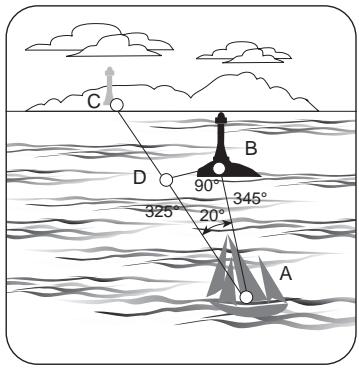
You can determine your own location on the map in case there are two targets in sight, which have known locations. For instance, look at the enclosed map. The bearings 325^ and 345^ to the land marks have been determined using the main scale. By drawing directional lines on the map, you will be able to see your own location where the two lines intersect (A). When determining an exact location, the bearings need to be corrected according to the local declination (variation).
The cotangent table at the back of the compass may be used for distance calculations and especially for determining locations when two landmarks appear in a very narrow angle. This situation is depicted on the same map. In this example the angle between the lighthouse and the sea mark is 20^ . Assisting line BD is drawn from the lighthouse advancing along the directional line of the sea mark. The assisting line is in a 90^ angle towards the directional line of the lighthouse. The segment BD of the line is measured on the sea card (in this example the length is 7/8 nautical miles). The distance between the boat and the lighthouse is then 20^ × 7/8 = 2.4 nautical miles on the directional line AB.
DECLINATION
Declination refers to the measured difference between the magnetic North indicated by the compass and the North of the map. The local declination is given on the map margin either as easterly plus declination (E) or as westerly minus declination (W). The local declination needs to be added to or subtracted from the compass bearing before the direction is determined using the compass may be read on the map. When the reading is taken from the map and this bearing is needed on the compass, the procedure is reversed. Sailors refer to declination as "variation".
ADJUSTABLE DECLINATION CORRECTION (KB-14D):PICK A SUITABLE TARGET
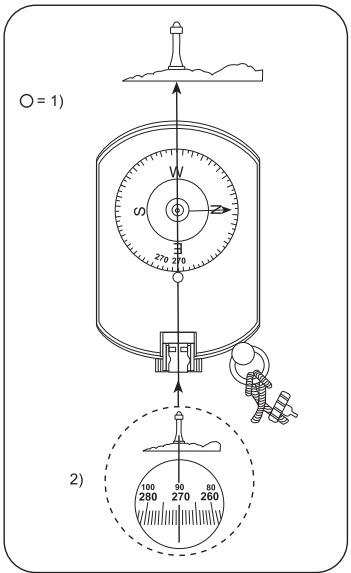
Keep both eyes open and aim with the compass so that the fixed sighting line (the one without E/W indication) meets the target (when viewing through the lens). Please note that the fixed sighting line always indicates the bearing without hour declination correction. We recommend a non-magnetic support to be used during the adjustment procedure if declination correction needs to be accurate.
Add the local declination to your bearing (easterly declination (+) or westerly declination (-). If, for instance, the declination is 20^ east, then the corrected reading is 270^ + 20^ = 290^ .
Adjust the maneuverable sighting line (the one with E/W indication) with the adjusting key attached to the compass lanyard so that, when aiming through the maneuverable sighting line at the same target, you get a corrected reading. In this case the adjustable sighting line is set from its centre position towards E (= easterly declination) or W (= westerly declination).
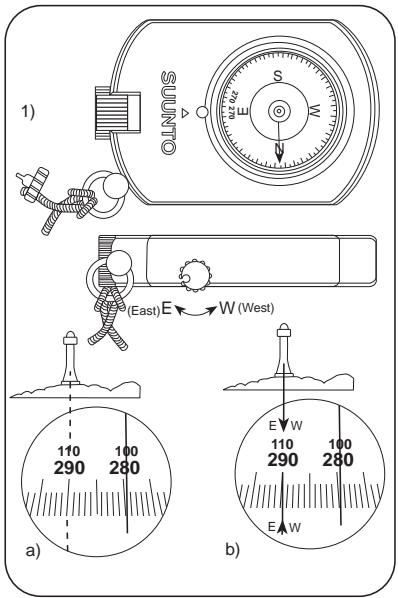
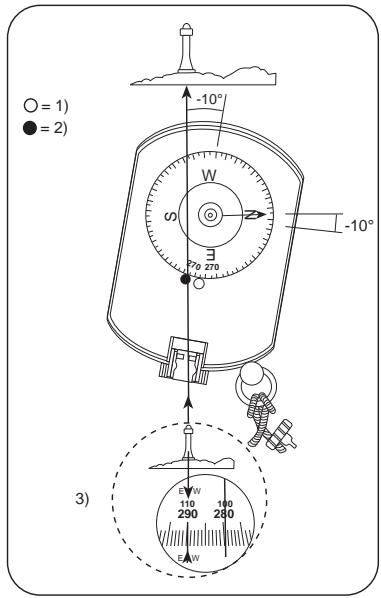
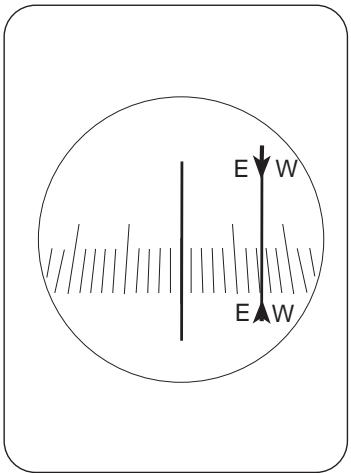
ATTENTION! When using the maneuverable sighting line, always take the reading at the same place of the scale line, for instance, at the end of the scale line. Please note that the difference on the scale between the fixed and maneuverable sighting lines is about half of the adjusted declination correction. This is due to the optical structure of the compass.
The adjusting accuracy of declination correction is ± 0.2^ . The adjusting range of declination correction totals 26^ (± 13^) .
DEVIATION (DIVERGENCE)
Iron and metal objects near the compass, e.g. some watches or glasses with metal frames, may cause deviation. If possible, such objects should be removed from the immediate proximity of the compass. Massive iron constructions, such as buildings, engines and piers made of metal reinforced concrete, are also potential causes for deviation. Reversed aiming from the opposite end of the target line will reveal possible deviation.
INCLINATION-BALANCING
The compass rose has been balanced to meet the conditions prevailing in the intended area of use. When using the compass elsewhere (e.g. during travel abroad), the vertical variation in the global magnetic field causes the rose to tilt. This may make it difficult to take a bearing.
ADJUSTING THE OPTICS
In models KB-14/D, KB-14/opti and KB-20, the optics of a bearing compass can be adjusted manually. Adjust the optics tube so that the reading grid remains upright.
CLEANING
Use only water and mild soap when cleaning the compass! Do not use detergents or solvents of any kind as these may damage the compass capsule. The models with adjustable optics can be cleaned internally by rinsing if the inner part of the compass is dirty or condensation has occurred. Turn the optics tube completely open and remove it. Rinse the compass internally using clean water. Dry the instrument and turn the optics tube back in place.
WARRANTY
5 years.
Suunto Kb-series
GUIDE DE L'UTILISATEUR
FR
TABLE DES MATIÈRES
UTILISATION 4
DEFINITION DU POSITIONNEMENT 5
DECLINAISON 6
SYTÉME DE CORRECTION DE LA DÉCLINAISON RÉGLABLE (KB-14D) ..7
RISQUES D'ERREURS 10
EKSYMÄ (DEVIAATIO, POIKKEAMA) 9
INKLINAATIO-TASAPAINOTUS 9
OPTIIKAN SÄATÖ 9
PUHDISTUS 10
TAKUU 10
KAYTTÖ
EKSYMA (DEVIAATIO, POIKKEAMA)
- Suunto Kb-series
- USER'S GUIDE
- TABLE OF CONTENTS
- USAGE
- DETERMINING A LOCATION
- DECLINATION
- ADJUSTABLE DECLINATION CORRECTION (KB-14D):PICK A SUITABLE TARGET
- DEVIATION (DIVERGENCE)
- INCLINATION-BALANCING
- ADJUSTING THE OPTICS
- CLEANING
- WARRANTY
- GUIDE DE L'UTILISATEUR
- TABLE DES MATIÈRES
- KAYTTÖ
- EKSYMA (DEVIAATIO, POIKKEAMA)
Brand : SUUNTO
Model : KB-SERIES
Category : Sports Watches