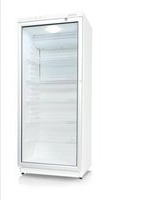
KS 9807 - CONGELATEUR BAR - Freezer SEVERIN - Free user manual and instructions
Find the device manual for free KS 9807 - CONGELATEUR BAR SEVERIN in PDF.

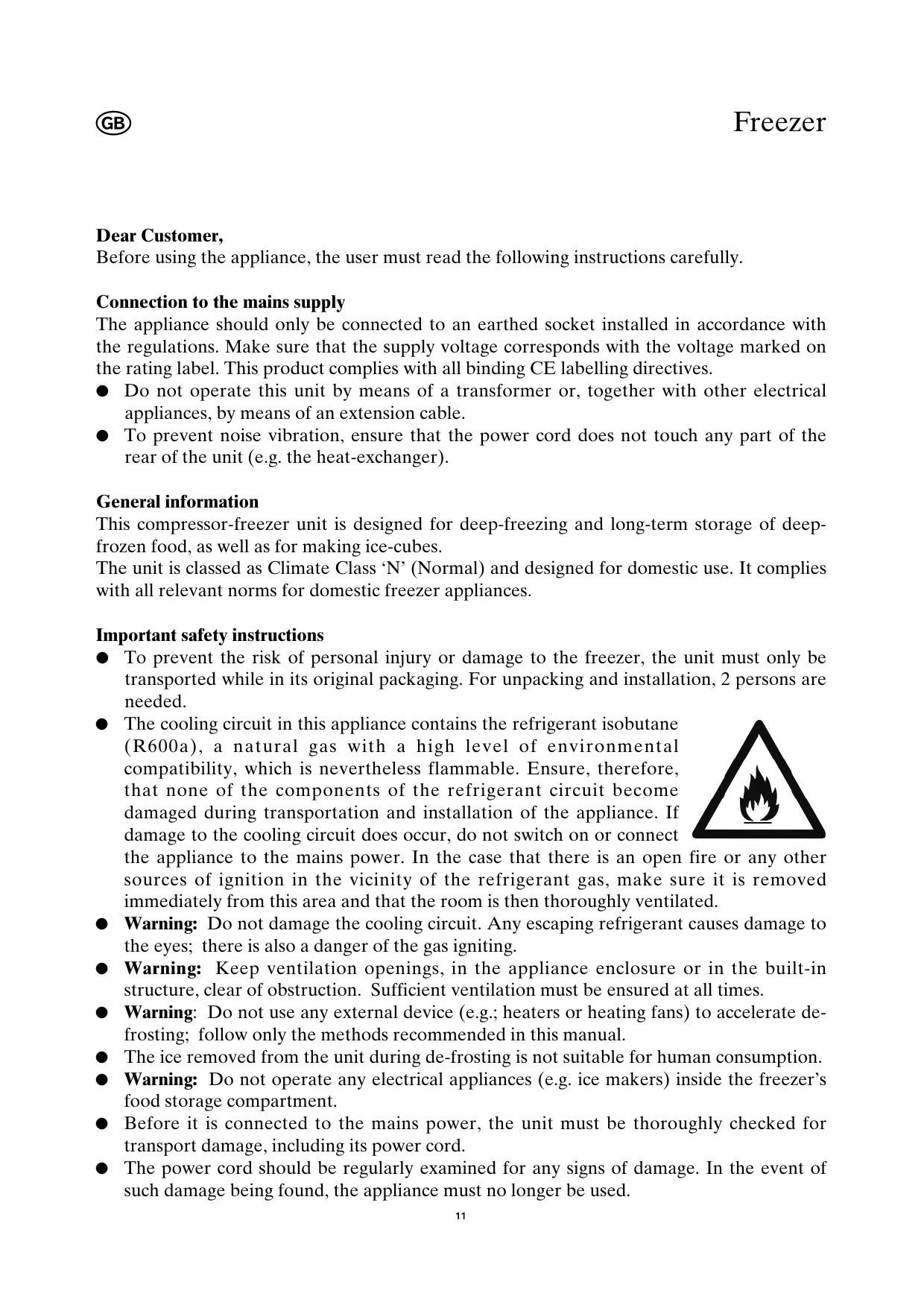


| Product type | Bar freezer |
| Brand | SEVERIN |
| Model | KS 9807 |
| Dimensions (WxDxH) | 520 x 450 x 500 mm |
| Weight | 19 kg |
| Power supply | See rating plate (220-240 V, 50 Hz typical) |
| Energy consumption | 0.42 kWh/24 h, 153 kWh/year (class A+) |
| Usable capacity | 38 liters |
| Climate class | N (ambient temperature 16-32 °C) |
| Freezing temperature | -18 °C |
| Freezing capacity | 2.5 kg/24 h |
| Power failure autonomy | 6 hours |
| Refrigerant | R 600a |
| Insulation | Cyclopentane |
| Reversible door | Yes (left or right mounting) |
| Controls | Rotary thermostat (positions 1-5) |
| Functions | Freezing and long-term storage, ice cube making |
| Cleaning | Manual defrosting (ice layer 3-5 mm), cleaning with warm water and mild detergent |
| Maintenance | Annual cleaning of the back, regular check of the door seal |
| Safety | Do not obstruct the grilles, do not use electrical appliances inside, do not accelerate defrosting |
| Warranty | 2 years against manufacturing defects (excluding normal wear and breakable parts) |
Frequently Asked Questions - KS 9807 - CONGELATEUR BAR SEVERIN
User questions about KS 9807 - CONGELATEUR BAR SEVERIN
0 question about this device. Answer the ones you know or ask your own.
Ask a new question about this device
Download the instructions for your Freezer in PDF format for free! Find your manual KS 9807 - CONGELATEUR BAR - SEVERIN and take your electronic device back in hand. On this page are published all the documents necessary for the use of your device. KS 9807 - CONGELATEUR BAR by SEVERIN.
USER MANUAL KS 9807 - CONGELATEUR BAR SEVERIN
Before using the appliance, the user must read the following instructions carefully.
Connection to the mains supply
The appliance should only be connected to an earthed socket installed in accordance with the regulations. Make sure that the supply voltage corresponds with the voltage marked on the rating label. This product complies with all binding CE labelling directives.
- Do not operate this unit by means of a transformer or, together with other electrical appliances, by means of an extension cable.
- To prevent noise vibration, ensure that the power cord does not touch any part of the rear of the unit (e.g. the heat-exchanger).
General information
This compressor-freezer unit is designed for deep-freezing and long-term storage of deep-frozen food, as well as for making ice-cubes.
The unit is classed as Climate Class 'N' (Normal) and designed for domestic use. It complies with all relevant norms for domestic freezer appliances.
Important safety instructions
-
To prevent the risk of personal injury or damage to the freezer, the unit must only be transported while in its original packaging. For unpacking and installation, 2 persons are needed.
-
The cooling circuit in this appliance contains the refrigerant isobutane (R600a), a natural gas with a high level of environmental compatibility, which is nevertheless flammable. Ensure, therefore, that none of the components of the refrigerant circuit become damaged during transportation and installation of the appliance. If damage to the cooling circuit does occur, do not switch on or connect
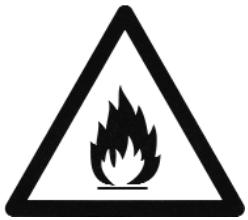
the appliance to the mains power. In the case that there is an open fire or any other sources of ignition in the vicinity of the refrigerant gas, make sure it is removed immediately from this area and that the room is then thoroughly ventilated.
- Warning: Do not damage the cooling circuit. Any escaping refrigerant causes damage to the eyes; there is also a danger of the gas igniting.
- Warning: Keep ventilation openings, in the appliance enclosure or in the built-in structure, clear of obstruction. Sufficient ventilation must be ensured at all times.
- Warning: Do not use any external device (e.g.; heaters or heating fans) to accelerate defrosting; follow only the methods recommended in this manual.
- The ice removed from the unit during de-frosting is not suitable for human consumption.
- Warning: Do not operate any electrical appliances (e.g. ice makers) inside the freezer's food storage compartment.
- Before it is connected to the mains power, the unit must be thoroughly checked for transport damage, including its power cord.
-
The power cord should be regularly examined for any signs of damage. In the event of such damage being found, the appliance must no longer be used.
-
To avoid the risk of fire, do not place any thermo-electric appliances on top of the unit. Do not place any liquid containers on top of the unit: this will prevent any leaking or escaping liquid damaging the electrical insulation.
- Only food commonly used in domestic households should be stored in the freezer.
- Alcoholic substances may be stored only in properly sealed containers and in upright positions.
- To avoid the risk of food poisoning, do not consume food after its storage time has expired. Thawed foods must not be frozen a second time.
- Do not lean or put undue weight on the shelves, compartments, door etc.
- Protect the inside of the freezer at all times from open flames and any other sources of ignition.
- Do not store any glass bottles containing carbonated or other freezable liquids in the unit: such bottles may burst during the freezing process.
-
Remove the plug from the wall socket
-
in case of any malfunction,
- before de-frosting,
-
during cleaning.
-
This appliance is not intended for use by any persons (including children) with reduced physical, sensory or mental capabilities, or lacking experience and knowledge, unless they have been given supervision or instruction concerning the use of the appliance by a person responsible for their safety.
Children should be supervised to ensure that they do not play with the appliance. - In order to comply with safety regulations and to avoid hazards, any repairs or modifications to this unit must be carried out by our authorised service personnel, including the replacement of the power cord.
- We reserve the right to introduce technical modifications.
- If the unit is not used for an extended period of time, we recommend keeping the door open.
- If the unit is sold, handed over to a third party or disposed of at a suitable recycling facility, attention must be drawn to the presence of the insulation agent 'Cyclopenthane' as well as to the refrigerant R 600 a.
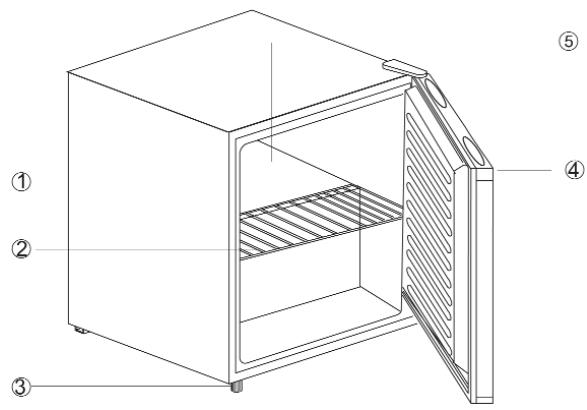
Familiarisation
- Temperature control (at rear)
- Removable shelf
- Adjustable feet
- Door
- Vaporiser
Before using for the first time
- Remove any exterior and interior packaging materials completely, including the adhesive strips.
- Caution: Keep any packaging materials well away from children: there is a risk of suffocation.
-
Before it is connected to the mains, the unit must be thoroughly checked for transport damage, including its power cord.
-
Clean the unit according to the instructions given in the De-frosting and cleaning section below.
Installation
The appliance should be set up in a well-ventilated, dry room. It should be operated in an ambient temperature of 16 to 32^ and a relative humidity of max. 70% . Ensure that the plug is accessible and can be removed from the wall socket at any time. Do not expose the freezer to direct sunlight, and do not position it next to any heat sources (radiators, cookers etc).
- In order to ensure sufficient heat dissipation, optimum cooling efficiency and minimal power consumption, ensure that air can circulate freely around the rear and top of the unit.
- The rear and the sides should have a minimum clearance of 10cm from the wall. The unit must not be installed inside a cabinet, nor directly below a hanging cupboard, shelf or similar object.
In the case of uneven floors, the adjustable foot on the unit can be used to compensate and ensure optimum stability. The freezer should be installed at a slight angle in such a way that it leans to the rear: this will ensure that the door will close automatically and cannot be left open by mistake. Ensure, however, that both front feet are set to the same height.
Ventilation
The heated air around the rear of the freezer must be able to circulate freely. Therefore, ensure that the air circulation behind the unit is not obstructed.
Reversible door
The design provides for the door to be reversed, i.e. for right-handed (default installation) to become left-handed.
- Remove the hinge cover (1).
- Use a suitable pointed tool to remove the cover (5).
- Use a suitable screw-driver to remove the two screws (2) holding the hinge to the freezer housing.
- Carefully lift up the door and place it on a soft surface to protect it from scratches.
- Remove the blind cover for the hinge mounting holes (9) and fit it in the corresponding place on the right. Ensure that the cover is firmly pushed down into the hole.
- Pull out the two bolts (7) which hold the lower right hinge plate (4) in position.
- Remove the bolt on the left and insert it into the corresponding thread on the right.
- Install the lower hinge plate on the left
- Replace the door in its new position. Ensure that the hinge pin is inserted into the guide bushing (hole) on the lower part.
- Install the upper hinge (3) on the left-hand side. Ensure that the hinge pin is inserted into the guide bushing (hole) on the upper part.
- Replace the cover (5) in the corresponding holes on the right.
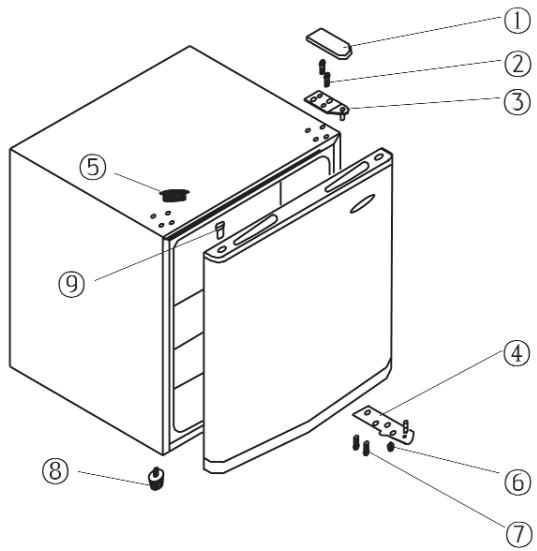
- Replace the hinge cover (1) on the upper hinge.
Temperature control
The temperature control automatically regulates the temperature of the freezer's interior. After switching on, the temperature control should be set to position 5. After approx. 20 minutes, the setting should be changed to position 3, which is usually sufficient for home or office use.
1 The cooling function is switched off; however, the appliance is still connected to the mains.
3 For long-term food storage, the temperature control should be set to the intermediate position.
5 This position is used for freezing fresh food. The appliance is switched on for a longer period. Once the food to be frozen has reached the required deep-freeze temperature, the temperature control can be re-set to the intermediate position.
Note: The operating temperature in the freezer largely depends on factors such as the ambient temperature and that of the food to be newly frozen. It also depends on how often the door is opened and how long it remains open. If necessary, the temperature control setting may be adjusted accordingly.
Freezing and storing food
- With an operating temperature of -18^ and below, the freezer can be used to store frozen or pre-frozen food for several months, to make ice cubes and to freeze fresh food.
- Fresh (i.e. non-frozen) or warm food must not come into contact with already frozen food; this prevents frozen food from becoming partially thawed.
- Prior to freezing, fresh food (e.g. meat, fish, minced meat) should be divided into smaller portions suitable for use after thawing).
- When storing pre-frozen food, strict attention should be paid to the manufacturer's information provided on the packaging. If no such information is to be found, however, a storage period of 3 months from the date of purchase must not be exceeded.
- When buying frozen food, verify that the food is properly frozen, and that the packaging does not show any sign of damage.
- To maintain the quality of deep-frozen food, it should be transported only in suitable containers and then placed inside the freezer without delay.
- Carefully check the packaging when buying frozen food: if the packaging shows signs of moisture, has bubbled up or is bulging, it indicates that the food may not have been stored properly and has spoiled.
- The storage times for frozen foods largely depend on the ambient temperature, the temperature control setting, the type of food and the time between shop and freezer, but mainly also on how often the freezer door is opened and how long it remains open. Always follow the instructions given on the food packaging, and do not exceed the specified maximum shelf life.
- Suitable packaging materials for frozen food are transparent (i.e. non-coloured) plastic foil, bags or aluminium foil. The packaging materials should be well aired before use and then checked for air-tightness before freezing the food. We strongly recommend that you label every item stored in the freezer with all relevant information such as type of food, freezing date and use-by date.
Use-by dates for frozen food are specified (in months) in the table below. Do not exceed these storage times.
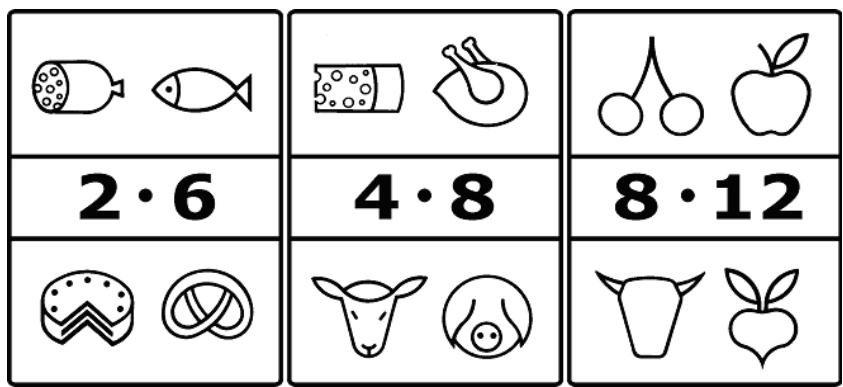
- The storage time will decrease if the internal temperature has increased, e.g. as a result of malfunction
Making ice cubes
A special ice-cube tray is provided for making ice cubes. Fill the tray 34 full with drinking water and place it in the freezer. The ice cubes are easier to remove from the tray if the tray is left standing at room temperature for 5 minutes.
De-frosting and cleaning
- Always remove the plug from the wall socket before cleaning.
- Do not pour water over the unit.
- Do not use abrasives or harsh cleaning solutions.
After a certain period of operation and depending on several factors (e.g. how often the door has been opened), a layer of ice will form inside the freezer compartment. Once the build-up of ice has reached a thickness of 3 to 5mm , the unit must be de-frosted.
The build-up of ice increases the power consumption of the appliance.
When de-frosting the unit
- Ensure that the plug has been removed from the wall socket,
- Remove all food from the freezer, place it into a plastic container, add pre-frozen freezer-packs and cover the container to keep the inside temperature down.
- Leave the freezer door open.
Warning: Do not use any external device or other means (e.g. heaters or heating fans) to accelerate de-frosting.
After de-frosting, the freezer should be thoroughly cleaned using warm water and, if necessary, a mild detergent. Wipe thoroughly dry and air afterwards before using again.
Take care not to remove or damage the rating plate in the freezer during cleaning.
Any dust deposits around the ventilation slots on the outside of the unit should be regularly removed using a suitable brush or a vacuum cleaner. The build-up of dust will cause an increase in energy consumption.
The rear of the appliance should be thoroughly cleaned with a soft brush or a vacuum
cleaner at least once a year.
Remark: Do not use abrasive tools or materials containing alcohol or harsh cleaning solutions. Do not use any electrical appliances, such as steam cleaners etc., for de-frosting or cleaning.
Trouble-shooting
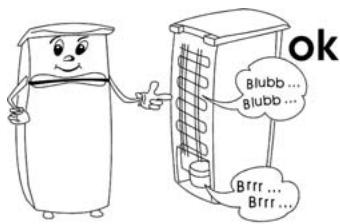
Certain typical sounds can be heard when the appliance is switched on. These sounds are:
- Caused by the electrical motor within the compressor assembly; during compressor start-up the sound level will be slightly higher for a limited period of time.
- Caused by the cooling agent flowing through the circuit.
The following table lists the possible malfunctions, their probable causes and solutions. In the event of operational problems, check first whether a solution can be found using this table. If the problem persists, disconnect the appliance from the mains power and contact our Customer Service Department.
| Problem | Possible cause and solution |
| The appliance is connected to the mains, but does not operate. | The wall socket has no power, or there are contact problems. Check the wall socket and the plug. |
| Abnormal noise can be heard during freezer operation. | Either the unit has been improperly set up (e.g. on an uneven floor) or there is contact between the rear-mounted cooling circuit and the power cord, the wall or other object or surface. Verify that all installation instructions in this manual have been correctly complied with. |
| When opening the door, the rubber seal pops out. | The seal must be re-fitted properly, by pressing in the inner part of the seal. If the seal shows signs of a greasy residue, the seal and the door must be properly cleaned with water and a mild detergent, and then thoroughly dried before the seal is replaced in the door. |
Transporting the appliance
The unit must be transported only in its vertical position.
Do not tilt it any more than 45^ . During transport, ensure that the unit is properly secured and protected against shock, vibration and shifting.
Disposal
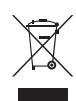
This appliance has been manufactured from recyclable materials. After removing the plug from the wall socket, the unit should be rendered unusable by cutting off the power cord before being disposed of through special waste collection points in place with local regulations. The refrigerant and the chemical agent in the insulation must be disposed of through a competent agency. Take special care not to damage the wiring circuit before the unit is handed over for competent disposal.
Guarantee
This product is guaranteed against defects in materials and workmanship for a period of two years from the date of purchase. Under this guarantee the manufacturer undertakes to repair or replace any parts found to be defective, providing the product is returned to one of our authorised service centres. This guarantee is only valid if the appliance has been used in accordance with the instructions, and provided that it has not been modified, repaired or interfered with by any unauthorised person, or damaged through misuse.
This guarantee naturally does not cover wear and tear, nor breakables such as glass and ceramic items, bulbs etc. This guarantee does not affect your statutory rights, nor any legal rights you may have as a consumer under applicable national legislation governing the purchase of goods. If the product fails to operate and needs to be returned, pack it carefully, enclosing your name and address and the reason for return. If within the guarantee period, please also provide the guarantee card and proof of purchase.
Information needed by the Customer Service
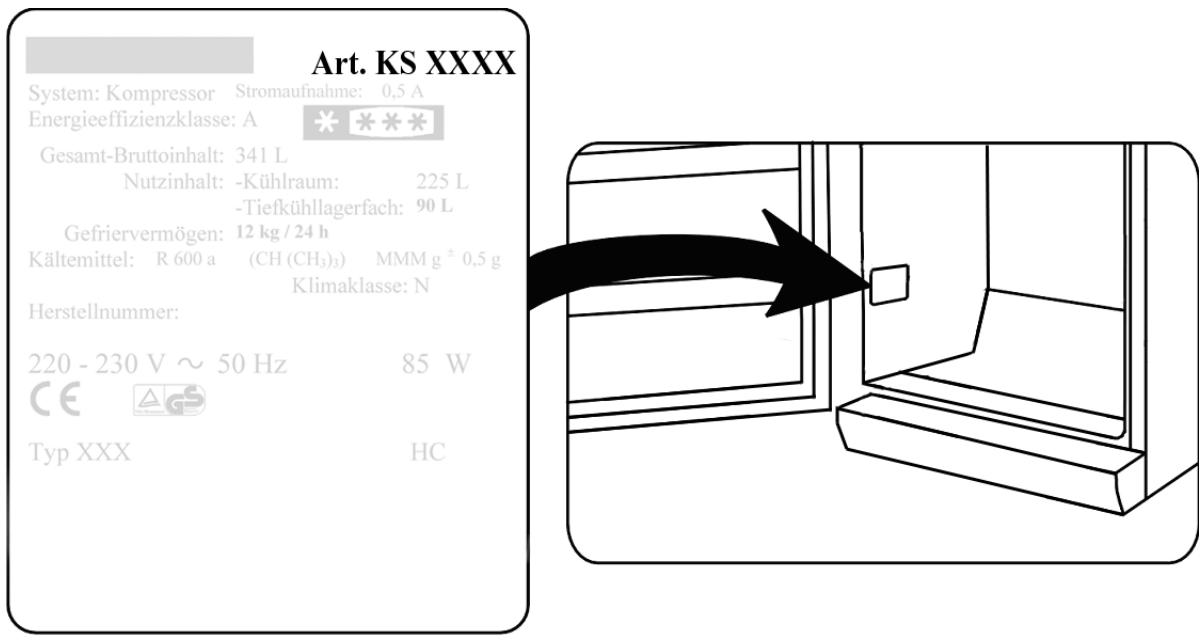
Should repairs to the appliance become necessary, please contact our Customer Service, providing a detailed fault description and quoting the article number KS ... on the rating plate of the appliance (see picture). This information will help us to handle your request efficiently.
Technical specifications
| Art.-No. | KS 9807 |
| Type of appliance | Freezer |
| Energy efficiency classification in compliance with directive 94/2 EC | A+ |
| Energy consumption : kWh/24 h kWh/year | 0.42 153 |
| The actual consumption depends on the pattern of use and the location of the appliance. | |
| Max. usable capacity (litres) | 38 |
| Climate classification | N |
| Ambient temperature range, °C | 16 - 32 |
| * * * * | |
| Safe storage time in case of malfunction, (hours) | 6 |
| Freezing capacity, kg/24h | 2.5 |
| Freezing temperature, °C | -18 |
| Dimensions (in mm) | 520 x 450 x 500 |
| Weight, kg | 19 |
| Electrical specifications | See rating plate |
| Insulation foam | Cyclopenthane |
Chère Cliente, Cher Client,
Regulator temperature
IpeHHe HOxKn yCTaHOBJIeHbI Ha OINHaKOBoB BBICOTE.
BeHTnJIaIINs
HarpeTbB 03dyx I0JIkeH CBO6OJHO IIpKUInpoBaTb BIOJIb 3aJIHei cTeHKI MOpO3HJIbHO rKFa. JIy eTOrO cJeIyEt y6eIHTbcR B 6ecIIpeIPTcTBehHOI INPKUJIaHH BO3dyxa 3a IkaΦom.
IepeBeeHbAemay Ibeepa
KoHcTpkykunia IIkaΦa IIO3BOJЯe T IpeBeIINBaTb IBePuy, To ectb ee MoXHO IpeBeBecNTb c IIpaBbIX IIeTeJIb (3aBOJcKa yCTaHOBKa) Ha JleBbie.
- CHHIMITE IeTeJIbHyIO KpbIiKy (1).
- Используй Te Для снгия Крьшки ПОДховший Инструмент с оctpbIM KOHцOM (5).
3.Bo3bMHTe IOxOJIyU OTBepTKU OTBepHITe IBa BnHTa (2) KpeJIeHnI PeTJN K KopIycu IIkaΦa. - OctopoJHo IOnHmIte IBepuY IIOCTaBbTe ee Ha MjaKyu IOBepxHocTb, YTO6bI 3aIHTb OT IapaHH.
- CHHMMTe TJIyXyIO KpbIiHKy c MOHTaJxHBIX OTBepCTn IeTJIN (9) n yctaHOBnTe ee Ha COOTBeTCTByIOIIee MeCTO Ha IIpaBOI CTOpOHe IIkaΦa. Y6eIInTEcB, YTO KpbIiKa IILOTHO IIocAxeHa HA OTBepCTne.
- BbIbePHTe IBa BNHTa (7), yIepXnBaIOIIne Ha MeCTe HNXHIOIO IIpaByIO IIeTJIIO (4).
- Виевернente вnett с Левий сторови в Стабыею в COOTBeTCTByIOОe pe3b6OBoe OTBepCTne Ha паовь стороHe.
- YcTaHOBInTe HnXHIOI PeTJIIO Ha JIEByIO CTOpOHy.
- IpebecebTe IBepb Ha HOBoe MeCTo. Y6eIHTecb, YTO cTepeXeHb IeTIN BOIIeJI B HaIIpaBIAIOIIee OTBepCTHe Ha HIXHeI YaCTn.
- YcTaHOBInTe BepXHIOI PeTIO (3) Ha JleByIO CTOpOHy. Y6eINTEcB, YTO cTePKeHB PeTJI N BOII E I H aIIpaBIAIOUIee OTBepCTHe Ha BepXHeY qAcTH.
- NepeycTaHOBInTe KpbIuKy (5) Ha COOTBeTcTByIOUHe OTBepCTnHa IpaBOi CTOpOHe.
- NepeycTaHOBInTe KpbIuKy IeTJIN (1) Ha BepXHIOIO IeTJIIO.
PeryJInpOBKa TemIepaTypbl
PeryJIaTOp TeMIIepaTpybI oBeCneuHBaet aBTOMaTHuecKyo peRyJIInpOBKy TeMIIepaTpybIBHyTpN MOpO3nJIbHOrO IkaΦa. IocJIe BKJIIOUeHnpeRyJIaTOp TeMIIepaTpybI HxKHO yCTaHOBHTB B IOJIoXeHne 5. IprIMepHo uepe3 20 MNHyT pyUKy HxKHO yCTaHOBHTB B IOJIoXeHne 3, YTO O6bIuHO 6bIBaET IOCTaTOUHO IJIa IOMa NII IN OΦHca.
Philippines Business Center
Agias Anastasias & Laertou, Pilea
Service Post of Thermi
570 01 Thessaloniki, Greece
Tel.: 0030-2310954020
Iran
IRAN-SEVERIN KISH CO. LTD.
No.668,7th.Floor
Bahar Tower
Ave. South Bahar
TEHRAN - IRAN
Tel.:009821-77616767
Fax:009821-77616534
Info@iranseverin.com
www.iranseverin.com
Israel
Eatay Agencies
109 Herzel St.
Haifa
Phone: 050-5358648
Email: service@severin.co.il
Italia
via Dino Col 52r-54r-56r,
I-16149 Genova
Green Number: 800240279
Tel.: 010/6 45 11 02 - 01041 86 09
Fax: 010/6425009
e-mail: videoelettronica@panet.it
Jordan
F.A. Kettaneh
P.O.Box 485
Amman, 11118, Jordan
Tel: 00962-6-4398642
e-mail: app@kettaneh.com.jo
Korea
Jung Shin Electronics co., Ltd.
501, Megaventuretower 77-9
Moonrae-Dong 3ga, Yongdeungpo-Gu
Seoul, Korea
Tel: +82-22-637 3245~7
Fax: +82-22-637 3244
Service Hotline: 080-001-0190
Latvia
SERVO Ltd.
Mr. Janis Pivovarenoks
Tel: +371 7279892
servo@apollo.lv
Lebanon
Khoury Home
7th Floor, Cité Dora 3 Building, Dora
P.O.Box 70611
Antelias, Lebanon
Telephone 01 244200, Fax 01 253535
eMail: info@khouryhome.com
Internet: www.khouryhome.com
Luxembourg
Ser-Tec
Serbia and Montenegro
tel: + 381-21-524-638
tel: +381-21-553-594
fax: +381-21-522-096
Slowak Republic
PREMT,s.r.o.
Skladova 1
91701Trnava
Tel: 033/544 7177
Finland
Oy Harry Marcell Ab
Rälssitie 6, PL 63
01511 Vantaa
Puh 0207 599 860
Fax 0207 599 803