USER MANUAL AC-33 ROLAND
Owner's Manual
ACOUSTIC CHORUS AC-33
Owner's Manual
Bedienungsanleitung
Mode d'emploi
Manuale dell'utente
Manual del usuario
IMPORTANT: THE WIRES IN THIS MAINS LEAD ARE COLOURED IN ACCORDANCE WITH THE FOLLOWING CODE.
GREEN-AND-YELLOW: EARTH, BLUE: NEUTRAL, BROWN: LIVE
As the colours of the wires in the mains lead of this apparatus may not correspond with the coloured markings identifying the terminals in your plug, proceed as follows:
The wire which is coloured GREEN-AND-YELLOW must be connected to the terminal in the plug which is marked by the letter E or by the safety earth symbol ⏻ or coloured GREEN or GREEN-AND-YELLOW.
The wire which is coloured BLUE must be connected to the terminal which is marked with the letter N or coloured BLACK.
The wire which is coloured BROWN must be connected to the terminal which is marked with the letter L or coloured RED.

For EU Countries
This product complies with the requirements of EMC Directive 2004/108/EC.
For the USA
FEDERAL COMMUNICATIONS COMMISSION RADIO FREQUENCY INTERFERENCE STATEMENT
This equipment has been tested and found to comply with the limits for a Class B digital device, pursuant to Part 15 of the FCC Rules. These limits are designed to provide reasonable protection against harmful interference in a residential installation. This equipment generates, uses, and can radiate radio frequency energy and, if not installed and used in accordance with the instructions, may cause harmful interference to radio communications. However, there is no guarantee that interference will not occur in a particular installation. If this equipment does cause harmful interference to radio or television reception, which can be determined by turning the equipment off and on, the user is encouraged to try to correct the interference by one or more of the following measures:
– Reorient or relocate the receiving antenna.
– Increase the separation between the equipment and receiver.
- Connect the equipment into an outlet on a circuit different from that to which the receiver is connected.
- Consult the dealer or an experienced radio/TV technician for help.
This device complies with Part 15 of the FCC Rules. Operation is subject to the following two conditions:
(1) this device may not cause harmful interference, and
(2) this device must accept any interference received, including interference that may cause undesired operation.
Unauthorized changes or modification to this system can void the users authority to operate this equipment.
This equipment requires shielded interface cables in order to meet FCC class B Limit.
For Canada
NOTICE
This Class B digital apparatus meets all requirements of the Canadian Interference-Causing Equipment Regulations.
AVIS
This product contains chemicals known to cause cancer, birth defects and other reproductive harm, including lead.
Owner's Manual
ACOUSTIC CHORUS AC-33
30 W acoustic guitar amp provides stereo sound in a compact unit
- High-efficiency 30 W stereo power amp (15 W + 15 W) (when using AC adaptor)
- Compact size for convenient portability or home use
- Two custom 5 inch (12 cm) speakers deliver ideal sound for acoustic instruments
Dual power allows operation using eight AA batteries or an AC adaptor (p. 4)
- Dual power supply lets you use the AC-33 to perform anywhere.
- Rechargeable (nickel-metal hydride) batteries are also supported.
Performing time is approximately 8 hours when using alkaline batteries, and approximately 9 hours when using nickel-metal hydride batteries.
Two-channel design lets you use a guitar simultaneously with a microphone or line source (p. 8)
- Flexibility to cover a wide range of uses, including a guitar duo or a singer/instrumentalist (p. 12).
- Stereo AUX IN connector lets you connect your CD or portable audio player (p. 6).
- You can connect the LINE OUT connector to an external PA system, and use the AC-33 as a monitor during your live performance (p. 9).
- The headphone jack is convenient for night-time practice or during a sound check (p. 6).
Looper function lets you easily record, play, and overdub without needing any other equipment (p. 10)
- You can record your own performance as a backing, and then play it back as an accompaniment for your solo (p. 13).
- Up to 40 seconds of recording time is available. You can also record the AUX IN signal in stereo.
- A separately available foot switch (FS-5U or FS-6) lets you control the Looper function with your foot (p. 11).
Easily-operated effects, plus an Anti-Feedback function (p. 11)
- Three types of onboard stereo effects are offered, so you can add a natural sense of spaciousness to the sound of your acoustic guitar (p. 7).
- Anti-Feedback function lets you suppress feedback simply by switching on this function (p. 11).
Before using this unit, carefully read the sections entitled: "USING THE UNIT SAFELY" and "IMPORTANT NOTES" (p. 2; p. 3). These sections provide important information concerning the proper operation of the unit. Additionally, in order to feel assured that you have gained a good grasp of every feature provided by your new unit, Owner's manual should be read in its entirety. The manual should be saved and kept on hand as a convenient reference.
INSTRUCTIONS FOR THE PREVENTION OF FIRE, ELECTRIC SHOCK, OR INJURY TO PERSONS
About ⚠️ WARNING and ⚠️ CAUTION Notices
| WARNING | Used for instructions intended to alert the user to the risk of death or severe injury should the unit be used improperly. |
| CAUTION | Used for instructions intended to alert the user to the risk of injury or material damage should the unit be used improperly.* Material damage refers to damage or other adverse effects caused with respect to the home and all its furnishings, as well to domestic animals or pets. |
About the Symbols
| The △symbol alerts the user to important instructions or warnings. The specific meaning of the symbol is determined by the design contained within the triangle. In the case of the symbol at left, it is used for general cautions, warnings, or alerts to danger. |
| The ⬆symbol alerts the user to items that must never be carried out (are forbidden). The specific thing that must not be done is indicated by the design contained within the circle. In the case of the symbol at left, it means that the unit must never be disassembled. |
| The ●symbol alerts the user to things that must be carried out. The specific thing that must be done is indicated by the design contained within the circle. In the case of the symbol at left, it means that the power-cord plug must be unplugged from the outlet. |
ALWAYS OBSERVE THE FOLLOWING
| WARNING |
| Connect mains plug of this model to a mains socket outlet with a protective earthing connection. | |
| Do not open (or modify in any way) the unit or its AC adaptor. | |
| Do not attempt to repair the unit, or replace parts within it (except when this manual provides specific instructions directing you to do so). Refer all servicing to your retailer, the nearest Roland Service Center, or an authorized Roland distributor, as listed on the “Information” page. | |
| Never install the unit in any of the following locations.Subject to temperature extremes (e.g., direct sunlight in an enclosed vehicle, near a heating duct, on top of heat-generating equipment); or areDamp (e.g., baths, washrooms, on wet floors); or areExposed to steam or smoke; or areSubject to salt exposure; or areHumid; or areExposed to rain; or areDusty or sandy; or areSubject to high levels of vibration and shakiness. | |
| Make sure you always have the unit placed so it is level and sure to remain stable. Never place it on stands that could wobble, or on inclined surfaces. | |
| Be sure to use only the AC adaptor supplied with the unit. Also, make sure the line voltage at the installation matches the input voltage specified on the AC adaptor’s body. Other AC adaptors may use a different polarity, or be designed for a different voltage, so their use could result in damage, malfunction, or electric shock. | |
| Use only the attached power-supply cord. Also, the supplied power cord must not be used with any other device. | |
| Do not excessively twist or bend the power cord, nor place heavy objects on it. Doing so can damage the cord, producing severed elements and short circuits. Damaged cords are fire and shock hazards! | |
| This unit, either alone or in combination with an amplifier and headphones or speakers, may be capable of producing sound levels that could cause permanent hearing loss. Do not operate for a long period of time at a high volume level, or at a level that is uncomfortable. If you experience any hearing loss or ringing in the ears, you should immediately stop using the unit, and consult an audiologist. | |
| Do not allow any objects (e.g., flammable material, coins, pins); or liquids of any kind (water, soft drinks, etc.) to penetrate the unit. | |
| WARNING |
| Immediately turn the power off, remove the AC adaptor from the outlet, and request servicing by your retailer, the nearest Roland Service Center, or an authorized Roland distributor, as listed on the “Information” page when:The AC adaptor, the power-supply cord, or the plug has been damaged; orIf smoke or unusual odor occursObjects have fallen into, or liquid has been spilled onto the unit; orThe unit has been exposed to rain (or otherwise has become wet); orThe unit does not appear to operate normally or exhibits a marked change in performance. | |
| In households with small children, an adult should provide supervision until the child is capable of following all the rules essential for the safe operation of the unit. | |
| Protect the unit from strong impact.(Do not drop it!) | |
| Do not force the unit’s power-supply cord to share an outlet with an unreasonable number of other devices. Be especially careful when using extension cords---the total power used by all devices you have connected to the extension cord’s outlet must never exceed the power rating (watts/amperes) for the extension cord. Excessive loads can cause the insulation on the cord to heat up and eventually melt through. | |
| Before using the unit in a foreign country, consult with your retailer, the nearest Roland Service Center, or an authorized Roland distributor, as listed on the “Information” page. | |
| Batteries must never be recharged, heated, taken apart, or thrown into fire or water. | |
| Never expose Battery to excessive heat such as sunshine, fire or the like. | |
| CAUTION |
| The unit and the AC adaptor should be located so their location or position does not interfere with their proper ventilation. | |
| Always grasp only the plug on the AC adaptor cord when plugging into, or unplugging from, an outlet or this unit. | |
| At regular intervals, you should unplug the AC adaptor and clean it by using a dry cloth to wipe all dust and other accumulations away from its prongs. Also, disconnect the power plug from the power outlet whenever the unit is to remain unused for an extended period of time. Any accumulation of dust between the power plug and the power outlet can result in poor insulation and lead to fire. | |
| CAUTION |
| Try to prevent cords and cables from becoming entangled. Also, all cords and cables should be placed so they are out of the reach of children. | |
| Never climb on top of, nor place heavy objects on the unit. | |
| Never handle the AC adaptor or its plugs with wet hands when plugging into, or unplugging from, an outlet or this unit. | |
| Before moving the unit, disconnect the AC adaptor and all cords coming from external devices. | |
| Before cleaning the unit, turn off the power and unplug the AC adaptor from the outlet (p. 4). | |
| Whenever you suspect the possibility of lightning in your area, disconnect the AC adaptor from the outlet. | |
| If used improperly, batteries may explode or leak and cause damage or injury. In the interest of safety, please read and observe the following precautions (p. 4).Carefully follow the installation instructions for batteries, and make sure you observe the correct polarity.Avoid using new batteries together with used ones. In addition, avoid mixing different types of batteries.Remove the batteries whenever the unit is to remain unused for an extended period of time.If a battery has leaked, use a soft piece of cloth or paper towel to wipe all remnants of the discharge from the battery compartment. Then install new batteries. To avoid inflammation of the skin, make sure that none of the battery discharge gets onto your hands or skin.Exercise the utmost caution so that none of the discharge gets near your eyes. Immediately rinse the affected area with running water if any of the discharge has entered the eyes.Never keep batteries together with metallic objects such as ballpoint pens, necklaces, hairpins, etc. | |
| Used batteries must be disposed of in compliance with whatever regulations for their safe disposal that may be observed in the region in which you live. | |
| Do not remove the speaker grille and speaker by any means. Speaker not user replaceable. Shock hazardous voltages and currents are present inside the enclosure. | |
Power Supply: Use of Batteries
- Do not connect this unit to same electrical outlet that is being used by an electrical appliance that is controlled by an inverter (such as a refrigerator, washing machine, microwave oven, or air conditioner), or that contains a motor. Depending on the way in which the electrical appliance is used, power supply noise may cause this unit to malfunction or may produce audible noise. If it is not practical to use a separate electrical outlet, connect a power supply noise filter between this unit and the electrical outlet.
- The AC adaptor will begin to generate heat after long hours of consecutive use. This is normal, and is not a cause for concern.
- When installing or replacing batteries, always turn off the power on this unit and disconnect any other devices you may have connected. This way, you can prevent malfunction and/or damage to speakers or other devices.
- Before connecting this unit to other devices, turn off the power to all units. This will help prevent malfunctions and/or damage to speakers or other devices.
Placement
- Using the unit near power amplifiers (or other equipment containing large power transformers) may induce hum. To alleviate the problem, change the orientation of this unit; or move it farther away from the source of interference.
- This device may interfere with radio and television reception. Do not use this device in the vicinity of such receivers.
- Noise may be produced if wireless communications devices, such as cell phones, are operated in the vicinity of this unit. Such noise could occur when receiving or initiating a call, or while conversing. Should you experience such problems, you should relocate such wireless devices so they are at a greater distance from this unit, or switch them off.
- Do not expose the unit to direct sunlight, place it near devices that radiate heat, leave it inside an enclosed vehicle, or otherwise subject it to temperature extremes. Also, do not allow lighting devices that normally are used while their light source is very close to the unit (such as a piano light), or powerful spotlights to shine upon the same area of the unit for extended periods of time. Excessive heat can deform or discolor the unit.
- When moved from one location to another where the temperature and/or humidity is very different, water droplets (condensation) may form inside the unit. Damage or malfunction may result if you attempt to use the unit in this condition. Therefore, before using the unit, you must allow it to stand for several hours, until the condensation has completely evaporated.
- Do not allow rubber, vinyl, or similar materials to remain on the unit for long periods of time. Such objects can discolor or otherwise harmfully affect the finish.
- Do not paste stickers, decals, or the like to this instrument. Peeling such matter off the instrument may damage the exterior finish.
- Depending on the material and temperature of the surface on which you place the unit, its rubber feet may discolor or mar the surface. You can place a piece of felt or cloth under the rubber feet to prevent this from happening. If you do so, please make sure that the unit will not slip or move accidentally.
Maintenance
- For everyday cleaning wipe the unit with a soft, dry cloth or one that has been slightly dampened with water. To remove stubborn dirt, use a cloth impregnated with a mild, non-abrasive detergent. Afterwards, be sure to wipe the unit thoroughly with a soft, dry cloth.
- Never use benzine, thinners, alcohol or solvents of any kind, to avoid the possibility of discoloration and/or deformation.
Additional Precautions
- Use a reasonable amount of care when using the unit's buttons, sliders, or other controls; and when using its jacks and connectors. Rough handling can lead to malfunctions.
- When connecting / disconnecting all cables, grasp the connector itself—never pull on the cable. This way you will avoid causing shorts, or damage to the cable's internal elements.
- To avoid disturbing your neighbors, try to keep the unit's volume at reasonable levels. You may prefer to use headphones, so you do not need to be concerned about those around you (especially when it is late at night).
- When you need to transport the unit, package it in the box (including padding) that it came in, if possible. Otherwise, you will need to use equivalent packaging materials.
- Some connection cables contain resistors. Do not use cables that incorporate resistors for connecting to this unit. The use of such cables can cause the sound level to be extremely low, or impossible to hear. For information on cable specifications, contact the manufacturer of the cable.
Copyright
- Recording, duplication, distribution, sale, lease, performance, or broadcast of copyrighted material (musical works, visual works, broadcasts, live performances, etc.) belonging to a third party in part or in whole without the permission of the copyright owner is forbidden by law.
- Do not use this unit for purposes that could infringe on a copyright held by a third party. We assume no responsibility whatsoever with regard to any infringements of third-party copyrights arising through your use of this unit.
The AC-33 can be operated using either an AC adaptor or batteries. Use the type of power that's appropriate for your situation.
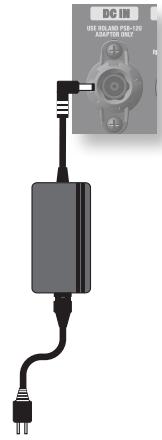
Connecting the AC adaptor
* Use only the AC adaptor that is supplied with the AC-33.
![1. Make sure that the [POWER] switch is off. 2. Connect the included power cord to the included AC adaptor. 3. Connect the AC adaptor to the DC-IN jack. 4. Plug the power cord into an AC outlet. Connect the electrical ground as well.](/content/2020/04/130942/images/b65be39a1bd23b89e10fac4b73769f02143951ac96f7531c4d18af23a310e9d2.jpg)
Installing batteries
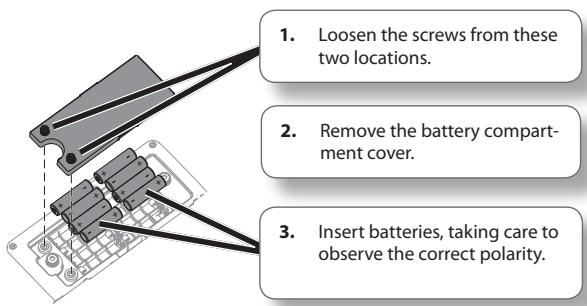
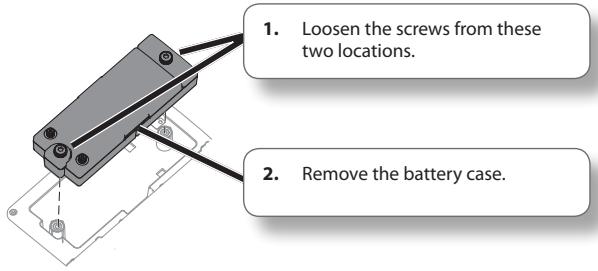
Removing the battery case
Although it is possible to replace the batteries without removing the battery case, battery replacement will be easier if you remove the battery case.
* We recommend that you keep batteries installed in the unit even though you'll be powering it with the AC adaptor. That way, you'll be able to continue a performance even if the cord of the AC adaptor gets accidentally disconnected from the unit.
* To prevent malfunction and speaker damage, make sure to switch off the AC-33's power before you insert or replace its batteries, and before connecting it to other devices.
* Take care that no metal object touches the contacts of the battery case. This can short-circuit the batteries, causing the case to overheat or burn.
About batteries
Batteries that can be used
The AC-33 uses eight AA alkaline or nickel-metal hydride batteries.
* Nickel-metal hydride batteries cannot be recharged by the AC-33 itself. You'll need to use a commercially available battery manufacturer.
* When using nickel-metal hydride batteries, please be aware that the battery life will normally shorten each time they are recharged.
Caution regarding batteries
- Insert the batteries as directed, taking care to observe the correct polarity (+/- orientation).
- Do not mix new and used batteries, or batteries of different types.
- Carefully read and observe the cautions and handling instructions that accompany the batteries.
When using nickel-metal hydride batteries, you must use the charger that is specified by the battery manufacturer.
- Remove the batteries if you won't be using the unit for several months.
- If any electrolyte leaks from a battery, use a dry cloth to carefully wipe off any electrolyte that might be on the battery case, and then install new batteries. Battery electrolyte that contacts your skin may cause a rash. Battery electrolyte is hazardous to your eyes; if any electrolyte gets into your eyes, flush them immediately with water.
- Do not carry or store batteries together with metallic objects such as pens, necklaces, or hairpins.
Turning the power on/off
Once the connections have been completed, turn on power to your various devices in the order specified. By turning on devices in the wrong order, you risk causing malfunction and/or damage to speakers and other devices.
- Make sure that the power to all equipment is turned off.
- Connect your external equipment.
- Set each of the AC-33's [VOLUME] knobs and the [MASTER] knob to 0.
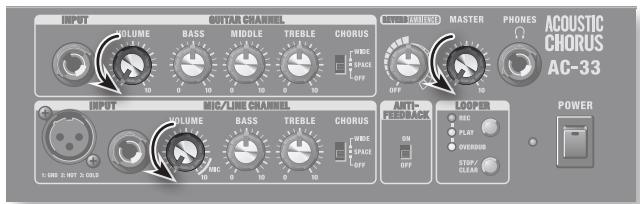
- Switch on the power to any external equipment connected to the AUX IN jacks.
- Switch on the AC-33's power.
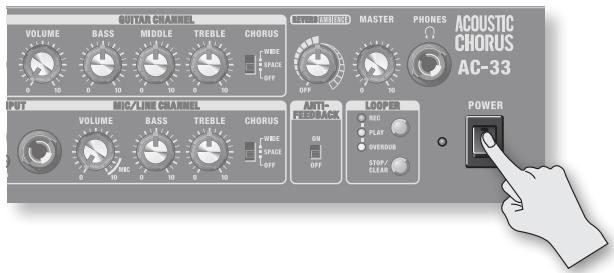
- Switch on any equipment connected to the LINE OUT jack.
To turn the power off, reverse these steps.
NOTE
- To prevent malfunction and/or damage to speakers or other devices, always turn down the volume, and turn off the power on all devices before making any connections.
- This unit is equipped with a protection circuit. A brief interval (a few seconds) after power up is required before the unit will operate normally.
- Always make sure to have the volume level turned down before switching on power. Even with the volume all the way down, you may still hear some sound when the power is switched on, but this is normal, and does not indicate a malfunction.
- If you're operating the AC-33 only on batteries, the POWER indicator will become dim as the batteries run low.
When the batteries run even lower, the POWER indicator will blink. Replace the batteries as soon as possible.
Playing your guitar
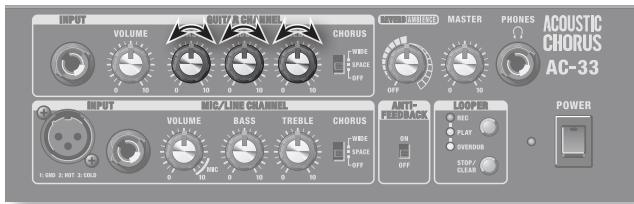
- Connect your guitar, and switch on the AC-33's power.
Connect your guitar to the INPUT jack of the GUITAR CHANNEL.
Any guitar that has a pickup can be connected.
If your guitar has a pickup as well as a built-in preamp, you can also connect it to the MIC/LINE CHANNEL.
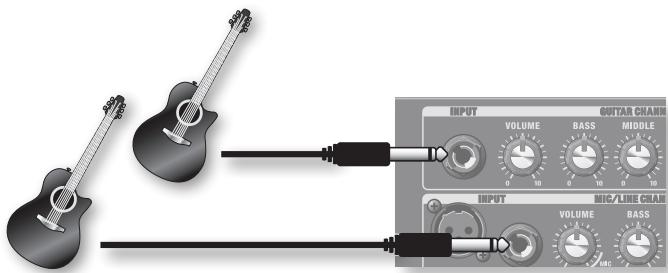
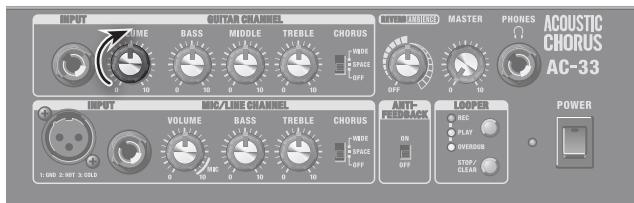
- Set the [VOLUME] knob of the input you're using to the 5 position (center).
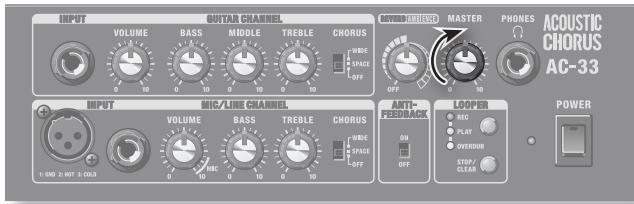
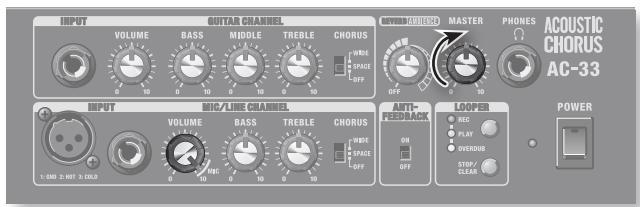
- While producing sound, use the [MASTER] knob to adjust the volume.
Adjusting the tone
- Use the [BASS] (low range), [MIDDLE] (mid range), and [TREBLE] (high range) knobs of the desired channel to adjust the tone.
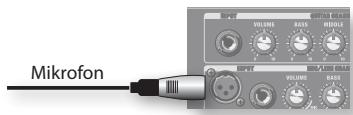
Outputting sound from your microphone
- Connect your microphone, and switch on the AC-33's power.
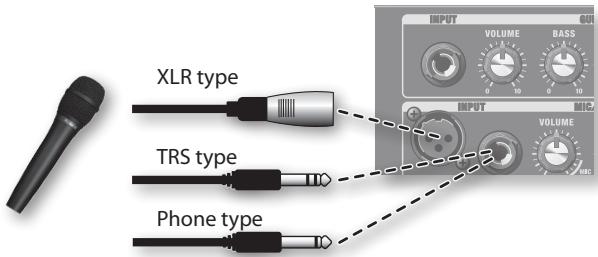
Connect your microphone to the INPUT jack of the MIC/LINE CHANNEL.
You can use any one of three types of plugs (XLR, TRS, phone).
You cannot use more than one microphone simultaneously (the TRS/ phone jack will take priority).
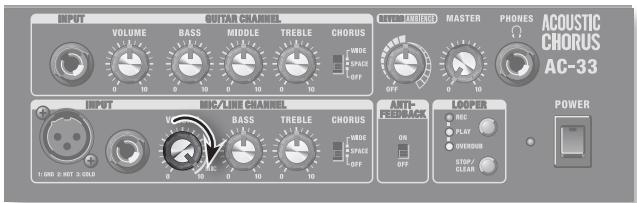
- Set the [VOLUME] knob of the MIC/LINE CHANNEL to the MIC position.
- While producing sound, use the [MASTER] knob to adjust the volume.
Adjusting the tone
- Use the [BASS] (low range), and [TREBLE] (high range) knobs of the desired channel to adjust the tone.
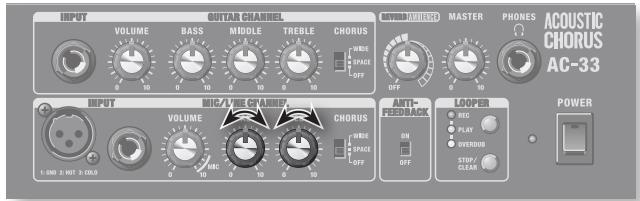
Outputting sound from a CD player
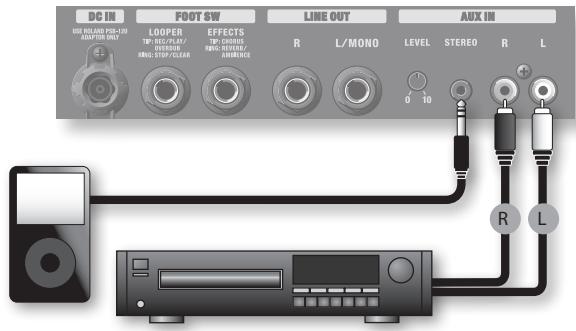
- Connect your CD player (or other audio device), then switch on the AC-33's power.
Connect your CD player or portable audio player to the AUX IN jacks on the AC-33's rear panel.
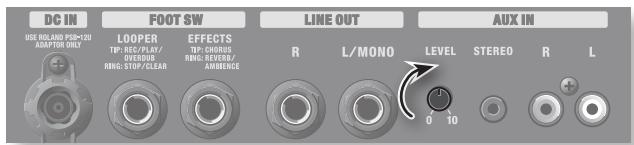
- Set the AUX IN [LEVEL] knob to 5 (center).
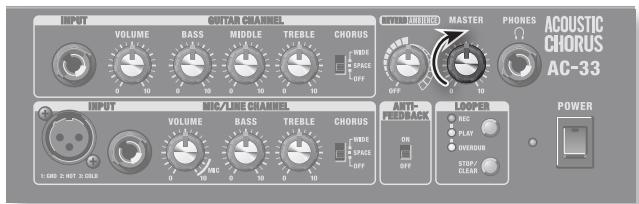
- While producing sound, use the [MASTER] knob to adjust the volume.
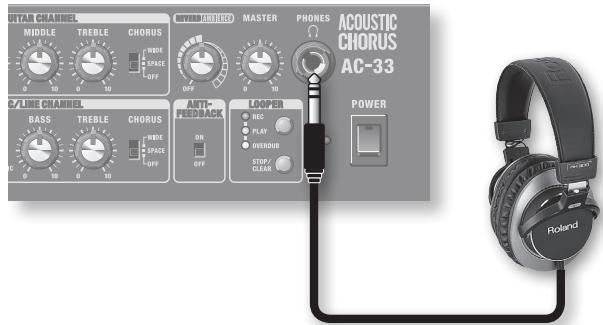
Using headphones
Connect your headphones to the PHONES jack.
If headphones are connected, sound will not be output from the AC-33's speakers.
Chorus
- Set each channel's [CHORUS] switch to the WIDE or SPACE position.
| WIDE | This is a stereo chorus that processes the three bands independently.By applying band-appropriate chorusing to each of the low, mid, and high-frequency bands, this effect creates a deep and spacious chorusing that is appropriate for the sound of an acoustic guitar.The low range remains firmly localized in the center, and the sound will become more spacious as you go from the mid to the high range. |
| SPACE | This is a chorus that mixes the sounds in the air, a method that is possible only with a stereo system. On the AC-33, the effect sound is emitted by the right speaker (as you face the unit), and the direct sound is emitted by the left speaker. The chorus effect is produced as the sound from the left and right speakers is mixed in the air.Compared to an electrically mixed chorus effect, this effect has a broader left/right spread and a more natural-sounding spaciousness. |
| OFF | No chorus effect will be applied. |
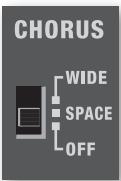
Turn the switch off if you don't want to apply chorus.
Reverb/Ambience
- Use the [REVERB/AMBIENCE] knob to adjust the amount of effect.
| REVERB | This is a stereo reverb that was developed specifically for acoustic instruments and produces a spacious and natural sound. The position of the knob adjusts the volume of the reverb. |
| AMBIENCE | This effect adds spatial depth. It produces a broader sound field and a sense of presence.The position of the knob adjusts the volume and depth of the ambience. |
![graph TD A["REVERB AMBIENCE"] -->|OFF| B["Reverb"] B --> C["AMBIENCE"] C --> A](/content/2020/04/130942/images/3aa7bf2bba9e88e4f8a5427491458476852dc7c31a8ec6262be9f47922592843.jpg)
The left half of the knob's range applies reverb, and the right half applies ambience.
Turning the knob toward the right will deepen the effect.
If you want to turn reverb/ambience off, turn the knob all the way to the left.
If you use a foot switch (BOSS FS-5U or FS-6; sold separately) you'll be able to turn chorus on/off and reverb/ambience on/off with your foot. If a foot switch is connected, the pedal(s) will operate as follows.
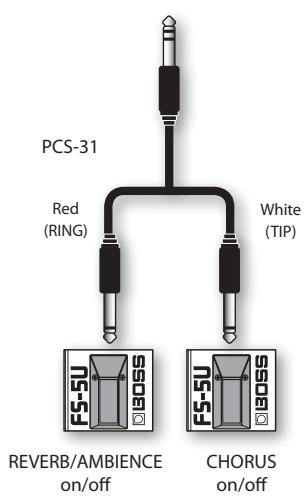
BOSS FS-5U
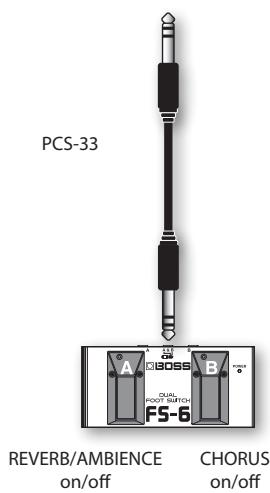
BOSS FS-6
Refer to p. 9 for details on the foot switch's polarity setting.
If you use a phone plug (mono) cable to connect only one foot switch, it will only turn chorus on/off.
Chorus on/off operations apply in common to the GUITAR CHANNEL and the MIC/LINE CHANNEL.
If the CHORUS switch is off, operating the foot switch will not turn the effect on/off.
Control Panel
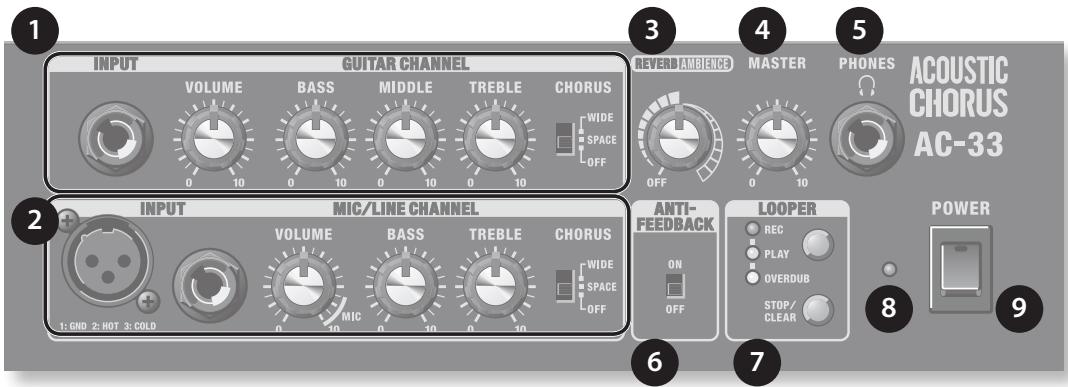

GUITAR CHANNEL
INPUT Jack
Connect your guitar here (p. 5).
[VOLUME] Knob
This adjusts the volume of the guitar channel (p. 5).
[BASS] Knob
This adjusts the tonal character of the low-frequency range (p. 5).
[MIDDLE] Knob
This adjusts the tonal character of the mid-frequency range (p. 5).
[TREBLE] Knob
This adjusts the tonal character of the high-frequency range (p. 5).
[CHORUS] Switch
This switches the type of chorus that is applied (p. 7).

MIC/LINE CHANNEL
INPUT Jack
Connect your microphone or line-level device here (p. 6).
* The AC-33 provides a balanced (XLR) connector that is wired as follows. Check the wiring of your device before you connect it.
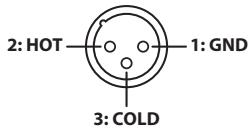
[VOLUME] Knob
This knob adjusts the volume of the mic/line channel (p. 6). If you're using a microphone, set this to the MIC position.
[BASS] Knob
This adjusts the tonal character of the low-frequency range (p. 6).
[TREBLE] Knob
This adjusts the tonal character of the high-frequency range (p. 6).
[CHORUS] Switch
This switches the type of chorus that is applied (p. 7).

[REVERB/AMBIENCE] Knob
This adjusts the amount of reverb or ambience (p. 7).

[MASTER] Knob
This adjusts the overall volume (p. 5, p. 6). This knob does not affect LINE OUT.

PHONES Jack
You can connect headphones here (p. 6).
* If headphones are connected, the AC-33's speakers will not produce sound.

[ANTI-FEEDBACK] Switch
You can prevent acoustic feedback by turning this on (p. 11).
Settings will be made automatically when you turn the switch on.
The settings will be reset when the AC-33's power is turned on again.

LOOPER
This function allows you to record a phrase and play it back repeatedly (p. 10).
The recorded phrase will be lost when you turn off the power.
REC Indicator
This will light red during recording.
PLAY Indicator
This will light green during playback.
OVERDUB Indicator
This will light yellow during overdubbing.
[REC/PLAY/OVERDUB] Button
Press this button when you want to record, play, or overdub.
[STOP/CLEAR] Button
Press this button to stop the looper or to erase the recording.

POWER Indicator
This will light if the power is on.
* The POWER indicator will become dim when the batteries run low. If the batteries become even lower, the POWER indicator will blink. Please replace the spent batteries with fresh ones.

[POWER] Switch
This turns the power on/off (p. 5).
* Due to a circuitry-protection feature, the AC-33 requires a few moments after it has been turned on before it is ready for normal operation.
* If you need to turn off the power completely, use this switch to turn off the AC-33's power, then disconnect the plug from the AC outlet. For details, refer to "Connecting the Power" (p. 4).
Jack Panel
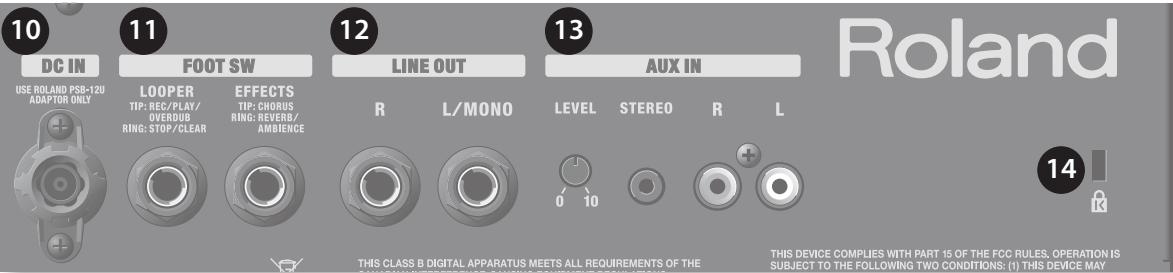

DC IN (AC Adaptor) Jack
Connect the included AC adaptor here (p. 4).
You must use only the AC adaptor that is supplied with the AC-33.

If foot switches are connected, you'll be able to control the Looper function or turn effects on/off using your foot.
You'll need momentary-type foot switches (BOSS FS-5U or FS-6; sold separately) and a connection cables (Roland PCS-31 or PCS-33; sold separately).
Set the polarity switch of the foot switches as shown in the illustration.
![graph TD A["DC IN"] --> B["BOSS FS-5U"] C["FOOT SW"] --> D["BOSS FS-5U"] E["LINE OUT"] --> F["BOSS FS-6"] G["AUX IN"] --> H["BOSS FS-6"] I["Polarity switch"] --> J["BOSS FS-5U"] K["PCS-31"] --> L["Red (RING)"] K --> M["White (TIP)"] K --> N["PCS-33"] O["Set the switches as follows"] --> P["B"] O -->…](/content/2020/04/130942/images/08ab614de851633aba23f1695ab24655f6554fa72d6dfe6ae6791eefaec6bece.jpg)

LINE OUT Jacks
![LINE OUT AUX IN R L/MONO LEVEL STEREO R 0 10 You can connect your mixer or recorder here. Connect to the L/MONO jack if you're outputting in mono. The [MASTER] knob does not affect the output from the LINE OUT jacks.](/content/2020/04/130942/images/7b1fe2acbb37b3a0d8b46273d651d6295405b28cfb5607e8369bb4c831f0d34b.jpg)

AUX IN Jack/[LEVEL] knob
![AUX IN LEVEL STEREO R L 0 10 R L Here you can connect a CD player or portable audio player. Use the [LEVEL] knob to adjust the volume. The effect is not applied to AUX IN jack.](/content/2020/04/130942/images/64a1e8438dbc88adb620f3378f21f36375dfabc79a2e2c2958e7e09fca7801f8.jpg)

Security Slot (K)
http://www.kensington.com/
NOTE
When connection cables with resistors are used, the volume level of equipment connected to the inputs (GUITAR CHANNEL, MIC/LINE CHANNEL, AUX IN,) may be low. If this happens, use connection cables that do not contain resistors.
NOTE
You may connect to both types of AUX IN jacks simultaneously, but this may cause the volume to be lower compared to using one type exclusively.
Looper function
This function lets you record a phrase you perform, and then play it back repeatedly. You can also overdub additional phrases onto the recording.
On the AC-33, this is called the Looper function.
REC Indicator
This will light red during recording.
PLAY Indicator
This will light green during playback.
OVERDUB Indicator
This will light yellow during overdubbing.
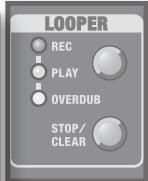
Press this button when you want to record, play, or overdub.
Press this button to stop the looper or to erase the recording.
Recording a phrase
Press the [REC/PLAY/OVERDUB] button to recording a phrase.
The basic operation will change as follows according to the state of the phrase.
Pressing the [REC/PLAY/OVERDUB] button
![graph TD A["Stop"] --> B["Record"] B --> C["Play"] C --> D["Play"] style A fill:#000,stroke:#000,color:#fff style B fill:#888,stroke:#000,color:#fff style C fill:#fff,stroke:#000,color:#fff style D fill:#fff,stroke:#000,color:#fff](/content/2020/04/130942/images/9586d8fb01bc1d13165269218395ae65c6dd059e4ff480848e1cee2a945fee14.jpg)
...
Pressing the [STOP/CLEAR] button
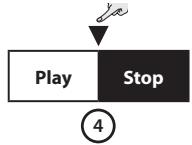
Phrase operation
① While producing sound, turn the [VOLUME] knob to adjust the recording level.
② Press the [REC/PLAY/OVERDUB] button to start recording.
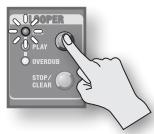
The AC-33 will enter recording-standby mode when you press the button. Recording will begin when you start performing.
If you're using a foot switch, recording will start when you press the foot switch.
The AC-33's memory can record a phrase approximately 40 seconds long. When you reach the maximum recording time, recording will stop automatically and playback will start.
③ Press the [REC/PLAY/OVERDUB] button to stop recording.
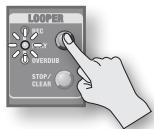
At the same time that you press the button, the recorded phrase will switch to playback.
The phrase will continue playing repeatedly until you stop it.
④ To stop playback or overdubbing, press the [STOP/CLEAR] button.
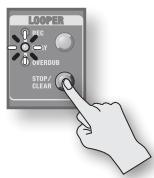
The phrase will stop playing.
If you want to play again, press the [REC/PLAY/OVERDUB] button.
MEMO
If a phrase has already been recorded, the PLAY indicator will blink.
NOTE
The recorded phrase will be erased when you switch off the AC-33's power.
Playing back the phrase
Pressing the [REC/PLAY/OVERDUB] button
![graph TD A["Stop"] --> B["Play"] B --> C["Play"] C --> D["Play"] D --> E["①"]](/content/2020/04/130942/images/b896fdebc554a8f00380f5e476ba6e6e99d75f51df0310ca7c8472b62f533dfb.jpg)
![graph TD A["Pressing the [STOP/CLEAR"] button] --> B["Play"] A --> C["Stop"] B --> D["②"]](/content/2020/04/130942/images/70ab5280e81cebf079a4254a4dfc3d5fc05376866d4df7f82df75d9073002c5a.jpg)
Phrase operation
① With the PLAY indicator blinking, press the [REC/PLAY/OVERDUB] button.
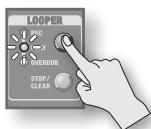
The PLAY indicator will light, and the phrase will play repeatedly from the beginning.
② Press the [STOP/CLEAR] button to stop playback.
The PLAY indicator will blink.
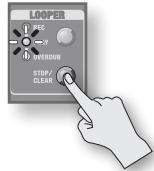
Overdubbing the phrase
Pressing the [REC/PLAY/OVERDUB] button
Pressing the [STOP/CLEAR] button
![graph LR A["Stop"] --> B["Play"] B --> C["Overdub"] C --> D["Play"] D --> E["Overdub"] E --> F["Play"] F --> G["Stop"] style A fill:#f9f,stroke:#333 style G fill:#f9f,stroke:#333](/content/2020/04/130942/images/09416e8a4cf3ba8b997c4e07ea85be09cfea97732287a4766248cc2514619e59.jpg)
Phrase operation
① With the PLAY indicator blinking, press the [REC/PLAY/OVERDUB] button.
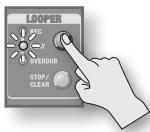
The PLAY indicator will light, and the phrase will play repeatedly from the beginning.
② Press the [REC/PLAY/OVERDUB] button once again.
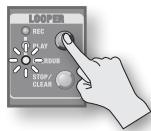
The OVERDUB indicator will light, and overdubbing will begin.
③ To stop recording, press the [REC/PLAY/OVERDUB] button.
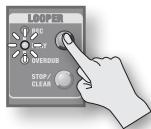
The PLAY indicator will light, and the phrase will play repeatedly from the beginning.
④ Press the [STOP/CLEAR] button to stop playback.
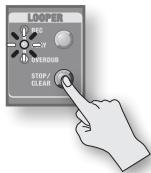
The PLAY indicator will blink.
Erasing the phrase
- Hold down the [STOP/CLEAR] button for two or more seconds.
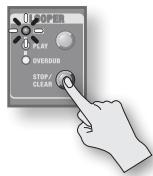
The REC indicator will blink, and the phrase will be erased.
NOTE
The erased phrase cannot be recovered.
Copyright
* Recording, duplication, distribution, sale, lease, performance, or broadcast of copyrighted material (musical works, visual works, broadcasts, live performances, etc.) belonging to a third party in part or in whole without the permission of the copyright owner is forbidden by law.
* Do not use this unit for purposes that could infringe on a copyright held by a third party. We assume no responsibility whatsoever with regard to any infringements of third-party copyrights arising through your use of this unit.
By using momentary-type foot switches (BOSS FS-5U or FS-6; sold separately) you can operate the Looper's [REC/PLAY/OVERDUB] button and [STOP/CLEAR] button with your foot.
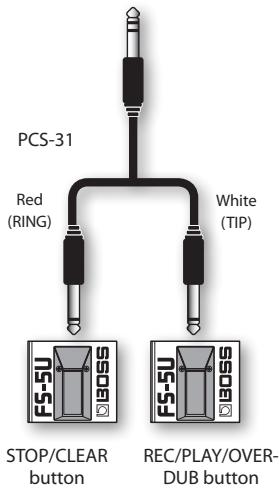
BOSS FS-5U
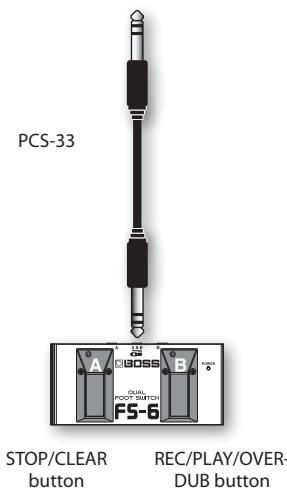
BOSS FS-6
- If you've used a cable with a phone plug (mono) to connect only one foot switch, the foot switch will operate only the [REC/PLAY/OVERDUB] button.
For details on foot switch polarity settings, refer to p. 9.
Anti Feedback Function
Anti Feedback function
What is acoustic feedback?
This is an unpleasant oscillation (a whine, buzz, or howl) that occurs when the output from a speaker is re-input to a microphone or pickup, amplified, and output again from the speaker.
This is more likely to occur when you point the microphone at a speaker or raise the volume to a high level.
![graph TD A["Music: Guitar"] --> B["Speaker"] B --> C["Power Station"] C --> D["Sound continues cycling, causing feedback"] D --> A](/content/2020/04/130942/images/ce39ce78595c6c345d4cb8e39cd0573ba60318ab50d4c853dd2f412a3cde0675.jpg)
Using the Anti Feedback function
What is the anti-feedback function?
This function suppresses the acoustic feedback that can occur between a guitar or microphone and the amp. It does this by attenuating the sound in the frequency range at which feedback is occurring.
Feedback will be suppressed automatically when you use the anti-feedback function.
1. Turn the [ANTI-FEEDBACK] switch ON.
![ROLAND AC-33 - Turn the [ANTI-FEEDBACK] switch ON. - 1](/content/2020/04/130942/images/394376b0989513572214ccbee6cf8da576a6840c6174a128ab56ca5cd9a32eeb.jpg)
The anti-feedback function will be applied to the microphone or guitar connected to the GUITAR CHANNEL and MIC/LINE CHANNEL inputs.
MEMO
In order to prevent feedback from occurring during your performance, we recommend that you turn the anti-feedback function on before you begin performing.
NOTE
The anti-feedback function will be reset when you turn the power off, then on again.
* If the anti-feedback function is not enough to suppress feedback, take the following steps
- Change the direction of the guitar or microphone
- Move the guitar or microphone away from the speakers
- Lower the volume
You can sing while playing your guitar.
- Connect your guitar to the GUITAR CHANNEL.
- Connect your microphone to the MIC/LINE CHANNEL.
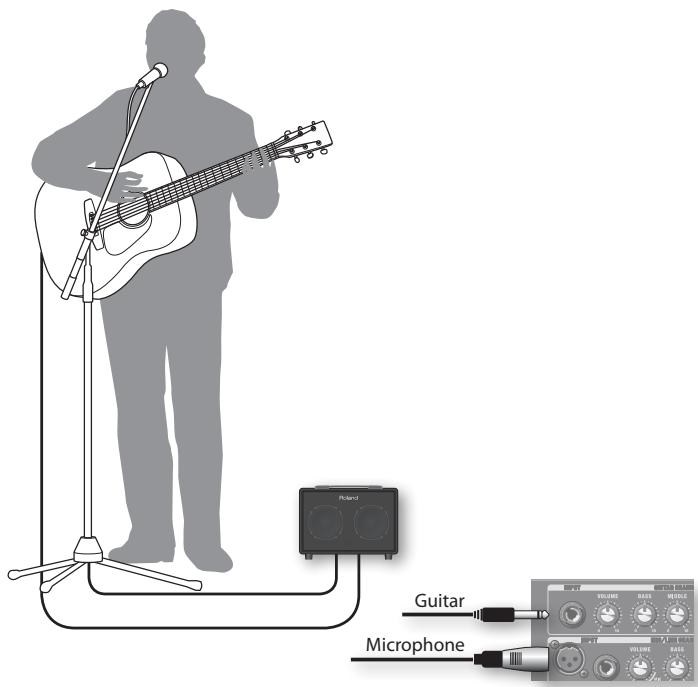
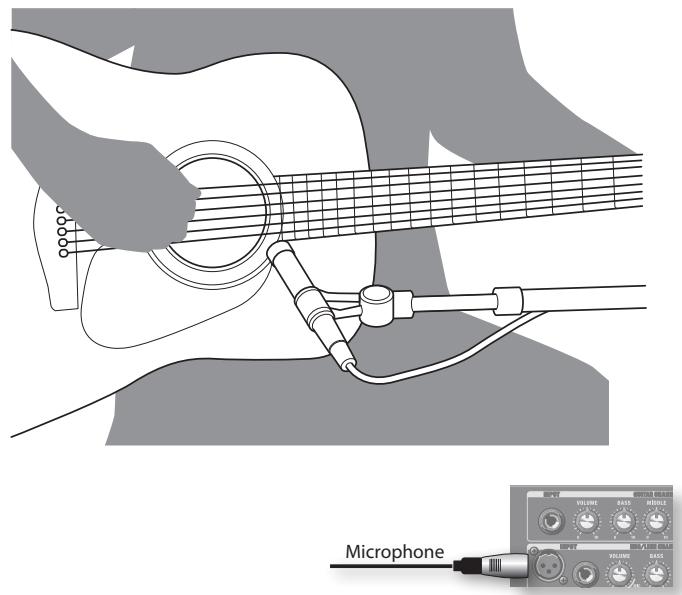
Miking your instrument
Point the microphone at your instrument to capture the sound.
- Connect your microphone to the MIC/LINE CHANNEL.
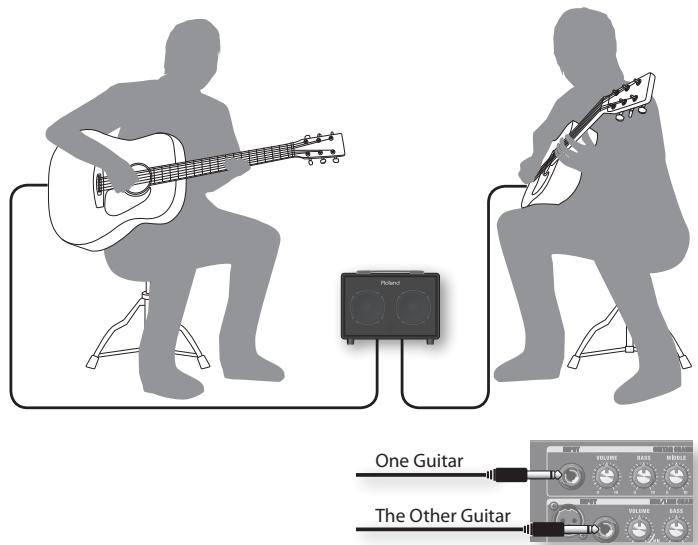
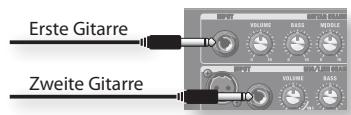
Guitar duo
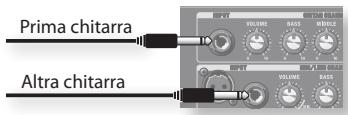
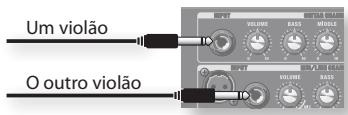
- Connect one guitar to the GUITAR CHANNEL.
- Connect the other guitar (with a built-in preamp) to the MIC/LINE CHANNEL.
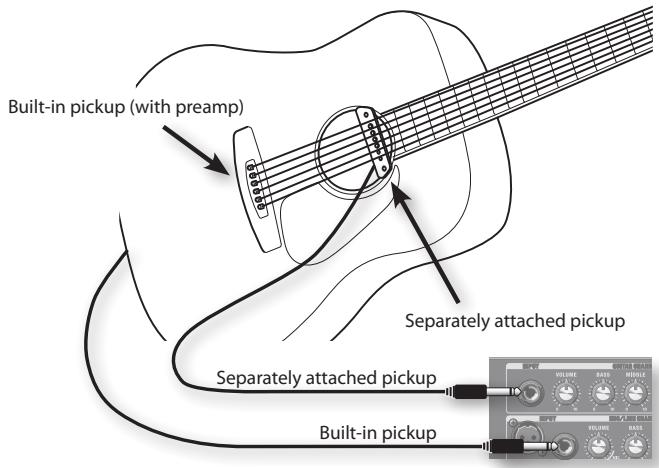
Blending sound from two types of pickups
If your guitar has two types of pickups, you can use the AC-33 to mix their outputs.
- Connect the pickup attached to the sound hole of your guitar to the GUITAR CHANNEL input.
- Connect the pickup (with internal preamp) built into your guitar to the MIC/LINE CHANNEL input.
Using the Looper function to record, play back, and play along with a rhythm
- Record the rhythm
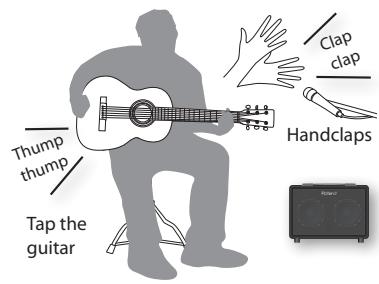
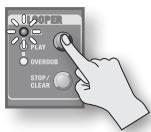
Press the [REC/PLAY/OVERDUB] button to start recording.
This will light red during recording.
REC Indicator
- Play back the rhythm


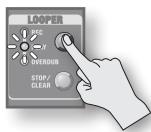
Press the [REC/PLAY/OVERDUB] button once again.
- Perform along with the recorded rhythm
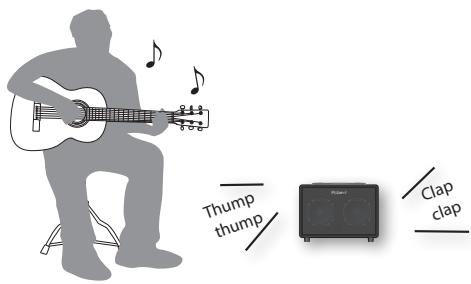
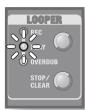
PLAY Indicator
This will light green during playback.
MEMO
By using a momentary-type foot switch (BOSS FS-5U or FS-6; sold separately) you can operate the Looper's [REC/PLAY/OVERDUB] button and [STOP/CLEAR] button with your foot.
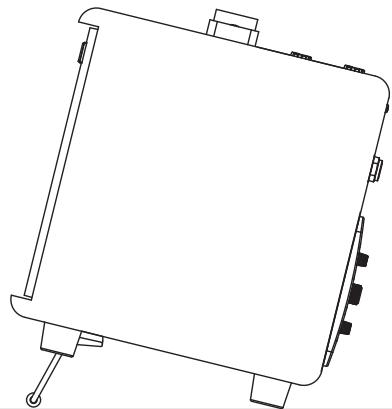
Using the Arm Stand
When using the AC-33 at a low position such as on the floor, extending the arm stand will make the sound from the speakers easier to hear.
NOTE
- If you use the arm stand, you must place the AC-33 on a horizontal surface.
- Fold the arm stand if you're not using it.
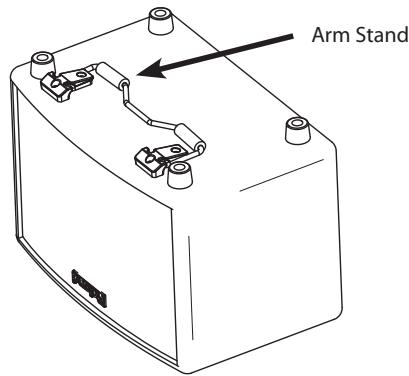
NOTE
- Do not lift or carry the AC-33 by grasping its arm stand.
- When using the arm stand, do not place objects on the AC-33, or sit or stand on the AC-33.
• Take care not to pinch your fingers when folding the arm stand.
If the system does not work as you expect, check the following points first.
| Symptom | Cause | Page |
| Power will not turn on | Power will not turn on: Are the AC adaptor and AC cord connected correctly? | p. 4 |
| Is the AC cord correctly connected to an AC outlet? | p. 4 |
| Are the batteries installed correctly?Could the batteries have run low? | p. 4 |
| No sound | Is the external equipment connected correctly? | p. 5 |
| If headphones are connected, no sound will be output from the speakers. | p. 6 |
| Are each channel's level knob and the [VOLUME] knob adjusted correctly? | p. 5, p. 6 |
| Is the AUX IN [LEVEL] knob adjusted correctly? | p. 9 |
| Could the batteries have run low?The POWER indicator will dim when the batteries run low. If the batteries run even lower, the POWER indicator will blink.Please install fresh batteries. | p. 4 |
| Sound is distorted | Could each channel's level knob or [VOLUME] knob be raised excessively? | p. 5 |
| Is the input level from the connected device appropriate? | p. 5 |
| Insufficient volume | Are each channel's level knob or [VOLUME] knob adjusted correctly? | p. 5 |
| Is the input level from the connected device appropriate? | p. 8 |
| Could multiple devices be connected to AUX IN jack? | p. 9 |
| Could the batteries have run low?The POWER indicator will dim when the batteries run low. If the batteries run even lower, the POWER indicator will blink.Please install fresh batteries. | p. 4 |
| Effect not applied | Could the [CHORUS] switch be turned off? | p. 7 |
| Is the [REVERB/AMBIENCE] knob adjusted correctly? | p. 7 |
| Could you have used a foot switch to turn off the effect? | p. 7 |
| The effect cannot be applied to AUX IN. | p. 9 |
Block Diagram
![graph TD A["GUITAR INPUT"] --> B["GUITAR CHANNEL"] B --> C["STEREO EFFECT CHORUS REVERB/AMBIENCE"] C --> D["LOOPER"] D --> E["ANTI FEEDBACK"] E --> F["MUTE"] F --> G["L"] G --> H["SPEAKER L"] G --> I["SPEAKER R"] J["MIC/LINE INPUT"] --> K["MIC/LINE CHANNEL"] K --> L["STEREO EFFECT CHORUS REVERB/AMBI…](/content/2020/04/130942/images/667096cc2edbee1eac5b7c8e51086e51c1f4db55d7514274ed5d9263815e1f6b.jpg)
AC-33: BATTERY POWERED STEREO ACOUSTIC AMPLIFIER
| Rated Power Output | 30 W (15 W + 15 W)20 W (10 W + 10 W) | (when using the AC adaptor)(when using the Alkaline batteries) |
| Nominal Input Level (1 kHz) | GUITAR CHANNELMIC/LINE CHANNELAUX IN | -10 dBu/1 MΩ-50 dBu (MIC) / -20 dBu (LINE)-10 dBu |
| Nominal Output Level (1 kHz) | LINE OUT | -10 dBu |
| Speakers | 12 cm (5 inches) × 2 | |
| Controls | GUITAR CHANNEL | VOLUME Knob, BASS Knob, MIDDLE Knob, TREBLE Knob, CHORUS Switch |
| MIC/LINE CHANNEL | VOLUME Knob, BASS Knob, TREBLE Knob, CHORUS Switch |
| AUX IN | LEVEL Knob |
| ANTI-FEEDBACK | ON/OFF Switch |
| LOOPER | REC/PLAY/OVERDUB Button, STOP/CLEAR Button |
| REVERB/AMBIENCE | REVERB/AMBIENCE Knob |
| Others | POWER Switch, MASTER Knob |
| Indicators | LOOPER | REC, PLAY, OVERDUB |
| POWER | POWER |
| Connectors | GUITAR CHANNELInput Jack (1/4" phone type) | |
| MIC/LINE CHANNELInput Connector (XLR type), Input Jack (TRS phone type) | |
| PHONES Jack (Stereo 1/4" phone type) | |
| AUX IN Jacks (RCA phono type, Stereo miniature phone type) | |
| LINE OUT (L/MONO, R) Jacks (1/4" phone type) | |
| FOOT SW Jack EFFECTS (TRS phone type)LOOPER (TRS phone type) | |
| DC IN Jack | |
| Power Supply | DC 13 V: AC Adaptor or Dry Battery (LR6 (AA) type) x 8 |
| Current Draw | 490 mA |
| Expected battery life under continuous use:(These figures will vary depending on the actual conditions of use.) | Alkaline batteries | approximately 8 hours |
| Nickel-metal hydride batteries | approximately 9 hours |
| Dimensions | 318 (W) x 223 (D) x 243 (H) mm12-9/16 (W) x 8-13/16 (D) x 9-5/8 (H) inches |
| Weight | 4.7 kg10 lbs 6 oz(Excluding Battery) |
| Accessory | Owner's Manual, AC Adaptor, AC Cord |
| Options | Foot Switch: BOSS FS-5U, FS-6Connection Cable: Roland PCS-31, PCS-33 |
* 0 dBu = 0.775 Vrms
* In the interest of product improvement, the specifications and/or appearance of this unit are subject to change without prior notice.
Roland
Bedienungsanleitung
ACOUSTIC CHORUS AC-33
10
DC IN-Buchse
(Netzadapter)
11
Mikrofon am Instrument
Gitarrenduo
HINWEIS
Mode d'emploi
ACOUSTIC CHORUS AC-33
10
11
REMARQUE
Manuale dell'utente
ACOUSTIC CHORUS AC-33
Pulsante [STOP/CLEAR]
10
Jack DC IN
(adattatore CA)
11
NOTA
Manual del usuario
ACOUSTIC CHORUS AC-33
FOOT SW
LOOPER
TIP: REC/PLAY/
OVERDUB
RING: STOP/CLEAR
EFFECTS
TIP: CHORUS
RING: REVERB/
AMBIENCE


12
LINE OUT
R

L/MONO

13
AUX IN
LEVEL
STEREO

R

Roland
THIS DEVICE COMPLIES WITH PART 15 OF THE FCC RULES. OPERATION IS SUBJECT TO THE FOLLOWING TWO CONDITIONS: (1) THIS DEVICE MAY
10
Conector DC IN (Adaptador de CA)
11
NOTA
10
Plugue DC IN (Adaptador AC)
BOSS FS-6
Captura de som de instrumentos
OBSERVAÇÃO
10
DC IN-ingang
11
OPMERKING
When you need repair service, call your nearest Roland Service Center or authorized Roland distributor in your country as shown below.
AFRICA
EGYPT
Al Fanny Trading Office
- EBN Hagar Al Askalany Street.
ARD E1 Golf. Heliopolis.
Cairo 11341, EGYPT
TEL: (022)-417-1828
REUNION
Royal Cape Park, Unit 24
Londonderry Road, Ottery 7800
Cape Town, SOUTH AFRICA
TEL: (021) 799 4900
ASIA
CHINA
Roland Shanghai Electronics
Co., Ltd.
5F. No.1500 Pingliang Road
Shanghai 200090, CHINA
TEL: (021) 5580-080
Roland Shanghai Electronics
Co., Ltd.
(BEIJING OFFICE)
10F. No.18 3 Section Anhuaxili
Chaoyang District Beijing 100011
CHINA
TEL:(010)6426-5050
HONG KONG
Tom Lee Music Co., Ltd. Service
Division
22-32 Pun Shan Street, Tsuen
Wan, New Territories,
HONG KONG
TEL: 2415 0911
Parsons Music Ltd.
8th Floor, Railway Plaza, 39
Chatham Road South, T.S.T,
Kowloon, HONG KONG
TEL: 2333 1863
INDIA
Rivera Digitec (India) Pvt. Ltd.
411, Nirman Kendra Mahalaxm
Flats Compound Off. Dr. Edwin
Moses Road, Mumbai-400011,
INDIA
TEL: (022) 2493 9051
INDONESIA
PT Citra IntiRama
VIET THUONG CORPORATION
386 CACH MANG THANG TAM ST.
DIST.3,
HO CHI MINH CITY
VIET NAM
TEL: 9316540
PHILIPPINES
G.A. Yupangco & Co. Inc.
339 Gil J. Puyat Avenue
Makati, Metro Manila 1200,
PHILIPPINES
TEL:(02) 899 9801
SINGAPORE
Theera Music Co., Ltd.
100-108 Soi Verng Nakornkasem,
New Road, Sumpantawongse,
Bangkok 10100 THAILAND
TEL: (02) 224-8821
OCEANIA
AUSTRALIA/
NEW ZEALAND
Roland Corporation
Australia Pty.,Ltd.
38 Campbell Avenue
Dee Why West. NSW 2099
AUSTRALIA
For Australia
Tel:(02)99828266
For New Zealand
Tel: (09) 3098 715
CENTRAL/LATIN AMERICA
ARGENTINA
Instrumentos Musicales S.A.
Av.Santa Fe 2055
(1123) Buenos Aires
ARGENTINA
TEL:(011)4508-2700
BARBADOS
A&B Music Supplies LTD
12 Webster Industrial Park
Wildey, St.Michael, Barbados
TEL: (246)430-1100
BRAZIL
Roland Brasil Ltda.
Rua San Jose, 211
Parque Industrial San Jose
Cotia - Sao Paulo - SP, BRAZIL
TEL: (011) 4615 5666
CHILE
Comercial Fancy II S.A.
Rut.: 96.919.420-1
Nataniel Cox #739, 4th Floor
Santiago - Centro, CHILE
TEL: (02) 688-9540
COLOMBIA
Centro Musical Ltda.
Cra 43 B No 25 A 41 Bododega 9
Medellin, Colombia
TEL:(574)3812529
COSTA RICA
JUAN Bansbach Instrumentos
Musicales
Ave.1. Calle 11, Apartado 10237,
San Jose, COSTA RICA
TEL: 258-0211
CURACAO
Zeelandia Music Center Inc.
Orionweg 30
Curacao, Netherland Antilles
TEL:(305)5926866
DOMINICAN REPUBLIC
Instrumentos Fernando Giraldez
Boulevard Andrews, Albrook,
Panama City, REP. DE PANAMA
TEL: 315-0101
PARAGUAY
155, New National Road
Patras 26442, GREECE
TEL: 2610 435400
HUNGARY
Roland East Europe Ltd.
有关产品中所含有害物质的说明
This symbol indicates that in EU countries, this product must be collected separately from household waste, as defined in each region. Products bearing this symbol must not be discarded together with household waste.


