EasyManual
C-30 - Musical instrument ROLAND - Free user manual and instructions
Find the device manual for free C-30 ROLAND in PDF.


User questions about C-30 ROLAND
0 question about this device. Answer the ones you know or ask your own.
Ask a new question about this device
Download the instructions for your Musical instrument in PDF format for free! Find your manual C-30 - ROLAND and take your electronic device back in hand. On this page are published all the documents necessary for the use of your device. C-30 by ROLAND.
USER MANUAL C-30 ROLAND
IMPORTANT: THE WIRES IN THIS MAINS LEAD ARE COLOURED IN ACCORDANCE WITH THE FOLLOWING CODE.
BLUE: NEUTRAL
BROWN: LIVE
As the colours of the wires in the mains lead of this apparatus may not correspond with the coloured markings identifying the terminals in your plug, proceed as follows:
The wire which is coloured BLUE must be connected to the terminal which is marked with the letter N or coloured BLACK.
The wire which is coloured BROWN must be connected to the terminal which is marked with the letter L or coloured RED.
Under no circumstances must either of the above wires be connected to the earth terminal of a three pin plug.

For EU Countries
This product complies with the requirements of EMC Directive 2004/108/EC.
-For the USA
FEDERAL COMMUNICATIONS COMMISSION RADIO FREQUENCY INTERFERENCE STATEMENT
This equipment has been tested and found to comply with the limits for a Class B digital device, pursuant to Part 15 of the FCC Rules. These limits are designed to provide reasonable protection against harmful interference in a residential installation. This equipment generates, uses, and can radiate radio frequency energy and, if not installed and used in accordance with the instructions, may cause harmful interference to radio communications. However, there is no guarantee that interference will not occur in a particular installation. If this equipment does cause harmful interference to radio or television reception, which can be determined by turning the equipment off and on, the user is encouraged to try to correct the interference by one or more of the following measures:
-
Reorient or relocate the receiving antenna.
-
Increase the separation between the equipment and receiver.
- Connect the equipment into an outlet on a circuit different from that to which the receiver is connected.
- Consult the dealer or an experienced radio/TV technician for help.
This device complies with Part 15 of the FCC Rules. Operation is subject to the following two conditions:
(1) this device may not cause harmful interference, and
(2) this device must accept any interference received, including interference that may cause undesired operation.
Unauthorized changes or modification to this system can void the users authority to operate this equipment.
This equipment requires shielded interface cables in order to meet FCC class B Limit.
For Canada
NOTICE
This Class B digital apparatus meets all requirements of the Canadian Interference-Caising Equipment Regulations.
AVIS
Before using this unit, carefully read the sections entitled: "USING THE UNIT SAFELY" and "IMPORTANT NOTES" (page 4-5; page 6). These sections provide important information concerning the proper operation of the unit. Additionally, in order to feel assured that you have gained a good grasp of every feature provided by your new unit, owner's manual should be read in its entirety. The manual should be saved and kept on hand as a convenient reference.
USING THE UNIT SAFELY
INSTRUCTIONS FOR THE PREVENTION OF FIRE, ELECTRIC SHOCK, OR INJURY TO PERSONS
About WARNING and CAUTION Notices
| ▲WARNING | Used for instructions intended to alert the user to the risk of death or severe injury should the unit be used improperly. |
| ▲CAUTION | Used for instructions intended to alert the user to the risk of injury or material damage should the unit be used improperly. * Material damage refers to damage or other adverse effects caused with respect to the home and all its furnishings, as well to domestic animals or pets. |
About the Symbols
| ▲ | The △ symbol alerts the user to important instructions or warnings. The specific meaning of the symbol is determined by the design contained within the triangle. In the case of the symbol at left, it is used for general cautions, warnings, or alerts to danger. |
| ◎ | The ⊙ symbol alerts the user to items that must never be carried out (are forbidden). The specific thing that must not be done is indicated by the design contained within the circle. In the case of the symbol at left, it means that the unit must never be disassembled. |
| ◆ | The ● symbol alerts the user to things that must be carried out. The specific thing that must be done is indicated by the design contained within the circle. In the case of the symbol at left, it means that the power-cord plug must be unplugged from the outlet. |
ALWAYS OBSERVE THE FOLLOWING
WARNING
- Do not open (or modify in any way) the unit or its AC adaptor.

- Do not attempt to repair the unit, or replace parts within it (except when this manual provides specific instructions directing you to do so). Refer all servicing to your retailer, the nearest Roland Service Center, or an authorized Roland distributor, as listed on the "Information" page.

-
Never use or store the unit in places that are:
-
Subject to temperature extremes (e.g., direct sunlight in an enclosed vehicle, near a heating duct, on top of heat-generating equipment); or are
- Damp (e.g., baths, washrooms, on wet floors); or are
- Humid; or are
- Exposed to rain; or are
- Dusty; or are
- Subject to high levels of vibration.


- Make sure you always have the unit placed so it is level and sure to remain stable. Never place it on stands that could wobble, or on inclined surfaces.

- Be sure to use only the AC adaptor supplied with the unit. Also, make sure the line voltage at the installation matches the input voltage specified on the AC adaptor's body. Other AC adaptors may use a different polarity, or be designed for a different voltage, so their use could result in damage, malfunction, or electric shock.

- Use only the attached power-supply cord. Also, the supplied power cord must not be used with any other device.

- Do not excessively twist or bend the power cord, nor place heavy objects on it. Doing so can damage the cord, producing severed elements and short circuits. Damaged cords are fire and shock hazards!

- This unit, either alone or in combination with an amplifier and headphones or speakers, may be capable of producing sound levels that could cause permanent hearing loss. Do not operate for a long period of time at a high volume level, or at a level that is uncomfortable. If you experience any hearing loss or ringing in the ears, you should immediately stop using the unit, and consult an audiologist.

- Do not allow any objects (e.g., flammable material, coins, pins); or liquids of any kind (water, soft drinks, etc.) to penetrate the unit.


- Immediately turn the power off, remove the AC adaptor from the outlet, and request servicing by your retailer, the nearest Roland Service Center, or an authorized Roland distributor, as listed on the "Information" page when:

- The AC adaptor, the power-supply cord, or the plug has been damaged; or
- If smoke or unusual odor occurs
- Objects have fallen into, or liquid has been spilled onto the unit; or
- The unit has been exposed to rain (or otherwise has become wet); or
- The unit does not appear to operate normally or exhibits a marked change in performance.
WARNING
- In households with small children, an adult should provide supervision until the child is capable of following all the rules essential for the safe operation of the unit.

- Protect the unit from strong impact. (Do not drop it!)

- Do not force the unit's power-supply cord to share an outlet with an unreasonable number of other devices. Be especially careful when using extension cords—the total power used by all devices you have connected to the extension cord's outlet must never exceed the power rating (watts/amperes) for the extension cord. Excessive loads can cause the insulation on the cord to heat up and eventually melt through.

- Before using the unit in a foreign country, consult with your retailer, the nearest Roland Service Center, or an authorized Roland distributor, as listed on the "Information" page.

CAUTION
- The unit and the AC adaptor should be located so their location or position does not interfere with their proper ventilation.

- Always grasp only the plug on the AC adaptor cord when plugging into, or unplugging from, an outlet or this unit.

- At regular intervals, you should unplug the AC adaptor and clean it by using a dry cloth to wipe all dust and other accumulations away from its prongs. Also, disconnect the power plug from the power outlet whenever the unit is to remain unused for an extended period of time. Any accumulation of dust between the power plug and the power outlet can result in poor insulation and lead to fire.

- Try to prevent cords and cables from becoming entangled. Also, all cords and cables should be placed so they are out of the reach of children.

- Never climb on top of, nor place heavy objects on the unit.

- Never handle the AC adaptor or its plugs with wet hands when plugging into, or unplugging from, an outlet or this unit.

CAUTION
- If you need to move the instrument, take note of the precautions listed below. At least two persons are required to safely lift and move the unit. It should be handled carefully, all the while keeping it level. Grasp the frame of the stand. Make sure to have a firm grip, to protect yourself from injury and the instrument from damage.

- Disconnect the power cord.
- Disconnect all cords coming from external devices.
- Fold down the music stand.
- Fasten the support bars into their hooks.
-
Close the lid.
-
Before cleaning the unit, turn off the power and unplug the AC adaptor from the outlet.

- Whenever you suspect the possibility of lightning in your area, disconnect the AC adaptor from the outlet.

- Be careful when opening/closing the lid so you do not get your fingers pinched (p. 9). Adult supervision is recommended whenever small children use the unit.

- When using the bench, please observe the following points:

- Do not use the bench as a toy, or as a stepping stool.

- Do not allow two or more persons to sit on the bench.

- Should you remove the screws for music stand, knob bolts, and decorative panel stoppers keep them in a safe place out of children's reach, so there is no chance of them being swallowed accidentally.

- Do not allow a source of flame such as a lighter or a cigarette to come near the netting on the top surface of the instrument.
Power Supply
- Do not connect this unit to same electrical outlet that is being used by an electrical appliance that is controlled by an inverter (such as a refrigerator, washing machine, microwave oven, or air conditioner), or that contains a motor. Depending on the way in which the electrical appliance is used, power supply noise may cause this unit to malfunction or may produce audible noise. If it is not practical to use a separate electrical outlet, connect a power supply noise filter between this unit and the electrical outlet.
- The AC adaptor will begin to generate heat after long hours of consecutive use. This is normal, and is not a cause for concern.
- Before connecting this unit to other devices, turn off the power to all units. This will help prevent malfunctions and/or damage to speakers or other devices.
Placement
- During operation, this device must be placed at a distance of no less than 10cm from any walls.
- Using the unit near power amplifiers (or other equipment containing large power transformers) may induce hum. To alleviate the problem, change the orientation of this unit; or move it farther away from the source of interference.
- This device may interfere with radio and television reception. Do not use this device in the vicinity of such receivers.
- Noise may be produced if wireless communications devices, such as cell phones, are operated in the vicinity of this unit. Such noise could occur when receiving or initiating a call, or while conversing. Should you experience such problems, you should relocate such wireless devices so they are at a greater distance from this unit, or switch them off.
- Do not expose the unit to direct sunlight, place it near devices that radiate heat, leave it inside an enclosed vehicle, or otherwise subject it to temperature extremes. Also, do not allow lighting devices that normally are used while their light source is very close to the unit (such as a piano light), or powerful spotlights to shine upon the same area of the unit for extended periods of time. Excessive heat can deform or discolor the unit.
- When moved from one location to another where the temperature and/or humidity is very different, water droplets (condensation) may form inside the unit. Damage or malfunction may result if you attempt to use the unit in this condition. Therefore, before using the unit, you must allow it to stand for several hours, until the condensation has completely evaporated.
- Do not allow rubber, vinyl, or similar materials to remain on the unit for long periods of time. Such objects can discolor or otherwise harmfully affect the finish.
- Do not allow objects to remain on top of the keyboard. This can be the cause of malfunction, such as keys ceasing to produce sound.
- Do not paste stickers, decals, or the like to this instrument. Peeling such matter off the instrument may damage the exterior finish.
Maintenance
- To clean the unit, use a dry, soft cloth; or one that is slightly dampened. Try to wipe the entire surface using an equal amount of strength, moving the cloth along with the grain of the wood. Rubbing too hard in the same area can damage the finish.
- Never use benzine, thinners, alcohol or solvents of any kind, to avoid the possibility of discoloration and/or deformation.
Repairs and Data
- Please be aware that all data contained in the unit's memory may be lost when the unit is sent for repairs. Important data should always be backed up in another MIDI device (e.g., a sequencer), or written down on paper (when possible). During repairs, due care is taken to avoid the loss of data. However, in certain cases (such as when circuitry related to memory itself is out of order), we regret that it may not be possible to restore the data, and Roland assumes no liability concerning such loss of data.
Additional Precautions
- Use a reasonable amount of care when using the unit's buttons, sliders, or other controls; and when using its jacks and connectors. Rough handling can lead to malfunctions.
- When connecting / disconnecting all cables, grasp the connector itself—never pull on the cable. This way you will avoid causing shorts, or damage to the cable's internal elements.
- A small amount of heat will radiate from the unit during normal operation.
- To avoid disturbing your neighbors, try to keep the unit's volume at reasonable levels. You may prefer to use headphones, so you do not need to be concerned about those around you (especially when it is late at night).
- When you need to transport the unit, pack it in shock-absorbent material. Transporting the unit without doing so can cause it to become scratched or damaged, and could lead to malfunction.
- Do not apply undue force to the music stand while it is in use.
- Some connection cables contain resistors. Do not use cables that incorporate resistors for connecting to this unit. The use of such cables can cause the sound level to be extremely low, or impossible to hear. For information on cable specifications, contact the manufacturer of the cable.
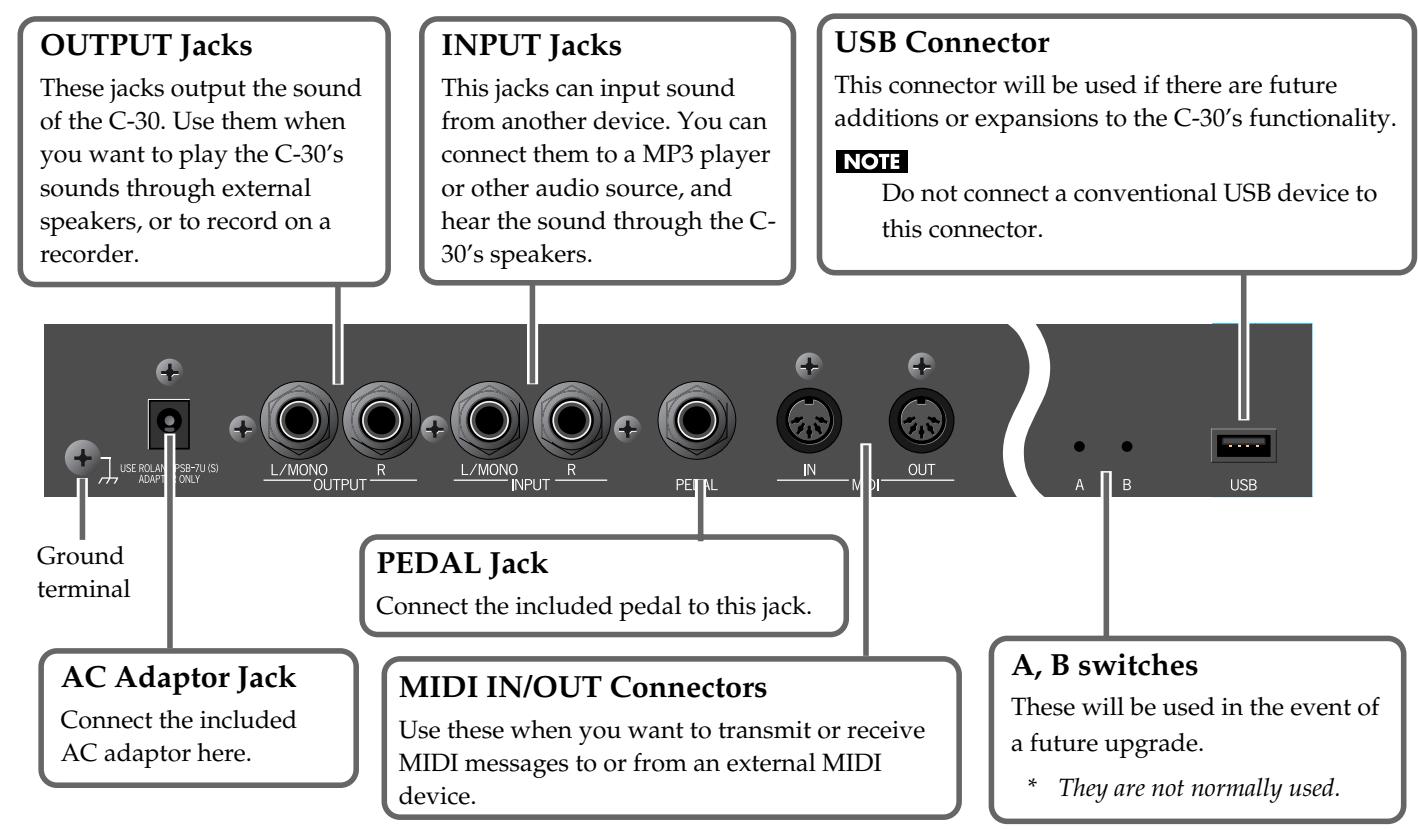
- Depending on the circumstances of a particular setup, you may experience a discomforting sensation, or perceive that the surface feels brittle to the touch when you touch the metal portions of other objects, such as guitars. This is due to an infinitesimal electrical charge, which is absolutely harmless. However, if you are concerned about this, connect the ground terminal (see figure) with an external ground. When the unit is grounded, a slight hum may occur, depending on the particulars of your installation. If you are unsure of the connection method, contact the nearest Roland Service Center, or an authorized Roland distributor, as listed on the "Information" page.
Unsuitable places for connection
Water pipes (may result in shock or electrocution)
Gas pipes (may result in fire or explosion)
- Telephone-line ground or lightning rod (may be dangerous in the event of lightning)
USING THE UNIT SAFELY 4
IMPORTANT NOTES 6
Introduction 9
About this owner's manual 9
Main features. 9
Before You Begin. 10
Opening and closing the lid 10
Using the music stand. 11
Removing the music stand 11
Panel Descriptions 12
Operating Panel 12
Jack Panel. 12
Getting Ready to Play 13
Connect the AC adaptor. 13
Turning the power on/off. 14
Using headphones 14
Playing 15
Adjusting the volume 15
Adjusting the tonal character 15
Adjusting the reverb 15
Choosing a sound 15
Switching sounds 15
Layering sounds 16
Switching the harpsichord type 16
Selecting the Celesta sound 16
Tone List 17
Selecting a temperament 18
Additional Convenient Functionality ............19
Listening to the demo songs 19
Selecting Baroque pitch 20
Matching the pitch of another instrument (Tuning) 20
Changing the pitch of the keyboard (Key Transpose) 21
Adjusting the volume of the keyboard noise 21
Using the pedal 22
Using the pedal to switch sounds. 22
Playing the sound through external speakers/Recording your performance 23
Listening to an external device's sound through the C-30's speakers 24
Connecting the C-30 with MIDI equipment 25
Setting the MIDI channel 25
Local On/Off setting 26
Using the V-LINK function 26
Demo Song List 27
MIDI Implementation Chart 28
Specifications. 29
Assembling the C-30 stand. 30
About this owner's manual
When you've finished assembling the stand and bench, please read the sections "Before you begin" through "Getting ready to play," and make the correct preparations for turning on the power.
This manual explains what you need to know to take full advantage of the C-30, divided into a Basic Operation section and an Advanced Operation section.
Conventions used in this manual
In order to present information as concisely as possible, this manual uses the following conventions.
Text enclosed in square brackets [ ] indicates the name of a button (or knob); e.g., "the [8'l] button."
Text preceded by a symbol such as NOTE or an asterisk (^) are warnings. Please be sure to read these.
Pages to which you can refer to for further information are indicated like this: (p. *)
Main features
Reproduces the beautiful sound of the harpsichord
The sound-producing mechanism of the harpsichord, the sound of the key release, and the resonance of the sounding board have been carefully analyzed, and digital technology is used to faithfully reproduce even the sound of the plectrum contacting the string when a key is released. You'll be able to enjoy beautiful and realistic harpsichord sound.
You can also select and play the sound of an early fortpiano, or the completely new "Dynamic Harpsichord," which lets you utilize expressive dynamics and the damper pedal while still enjoying the classic sound of the harpsichord.
In addition to harpsichord sounds and celesta sounds, you can also choose from positive organ sounds, which are indispensable to performance of early music.
A keyboard with click
The keyboard has a sense of click just like an acoustic harpsichord, so you can use it for practicing with a completely natural feel.
Five temperaments to support historically correct tuning
In addition to equal temperament, you can choose from Werckmeister, Kirnberger, Vallotti, and Meantone, giving you five temperaments that can be easily selected by pressing a single button.
There's also a Key Transpose function, which makes it easy to transpose the pitch for additional ways to vary your performance.
No maintenance and easy pitch changes
Not only will you never need to replace the plectrums or strings, you'll also never need to tune this instrument.
Moreover, the C-30 is not affected by vibration or changes in humidity or temperature. You'll always be performing with precisely accurate pitches guaranteed by digital technology.
It's also easy to adjust the tuning to match other instruments.
You can also use a single button to easily switch to Baroque pitch (A = 415.0Hz) or Versailles pitch (A = 392.0Hz)
■ Reverb that enhances the rich acoustics of chamber music
The built-in digital reverb lets you choose a variety of reverberation, ranging from a small room to a large hall. You can perform using acoustics that are appropriate for the space you're in.
Adjust the volume as appropriate for your situation
Whether you're at home, in a small hall, or in a large hall, you can adjust the volume as appropriate for your situation or the ensemble with whom you're performing. You can also use headphones, so you'll feel free to practice at any time.
- Compact form that encompasses both tradition and functionality
While reflecting the historical tradition of the harpsichord, the C-30 provides the advantage of light weight and compact form. Since the main body can be detached from the stand, transportation and setup are easy.
Opening and closing the lid
NOTE
Be careful not to pinch your hands when opening or closing the lid.
Opening the lid
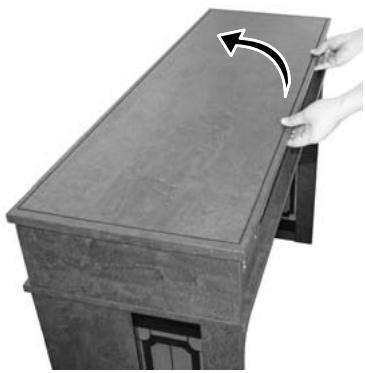
- Gently raise the edge of the lid.
-
Raise the support bars located at each side of the C-30, insert the tip of each support bar into the corresponding socket (A), and gently move it to position (B) to fasten it in place.
-
Don't take your hand off the lid.
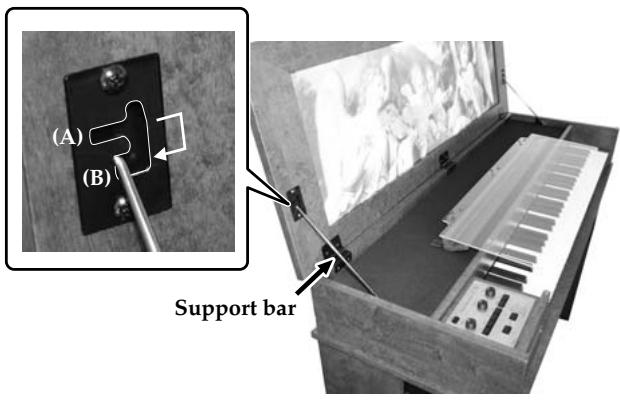
- The C-30 shown in the photograph has a separately sold picture board installed.
Closing the lid
- Fold down the music stand.
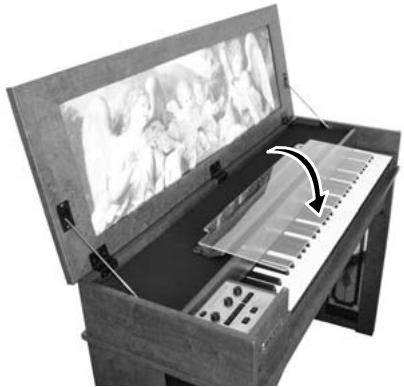
NOTE
If you close the lid while the music stand is still upright, you risk scratching the lid or the picture board inside.
-
Tilt the lid slightly toward the closed position, move the tip of each support bar from position (B) to position (A), and pull the tip of the support bars out of the sockets.
-
Don't take your hand off the lid.
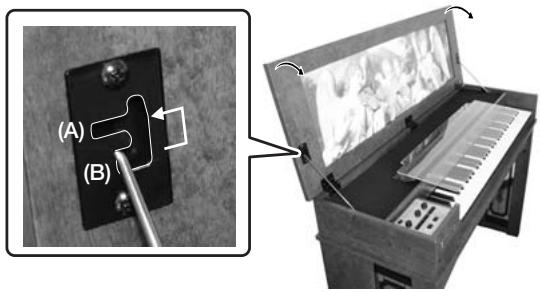
- Fold down the support bars toward the instrument, and fasten them using the hook.
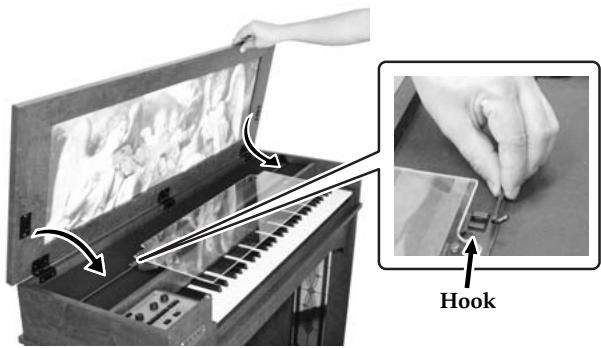
- Gently lower the lid.
Using the music stand
To use the music stand, gently raise it without applying undue stress.
NOTE
Do not apply undue stress to the music stand. Doing so may cause damage or accidents.
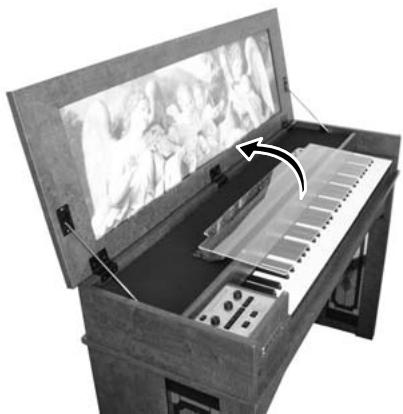
Removing the music stand
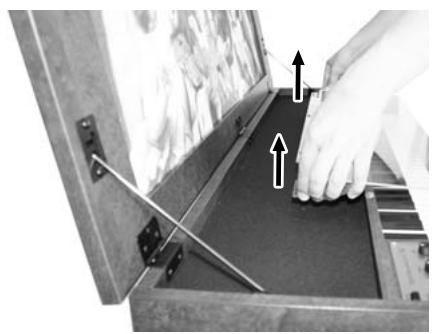
The music stand is attached to the C-30 when you purchase it. If you want to remove the music stand, proceed as follows.
- Gently lower the music stand.
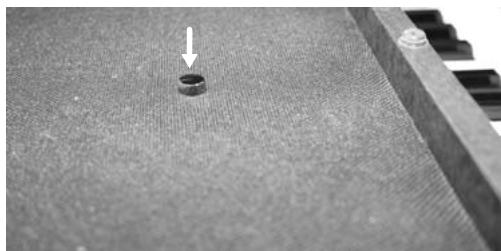
- From the locations shown in the illustration, remove the two screws that fasten the music stand.
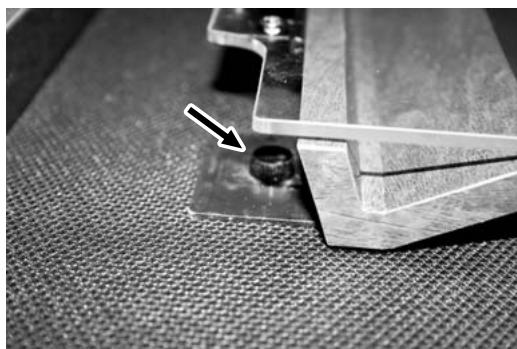
- Remove the music stand.
- Reinstall the removed screws in their original holes.
NOTE
Before moving or transporting the C-30, you must remove the music stand and fasten the support bars to the hooks.
Operating Panel
Jack Panel
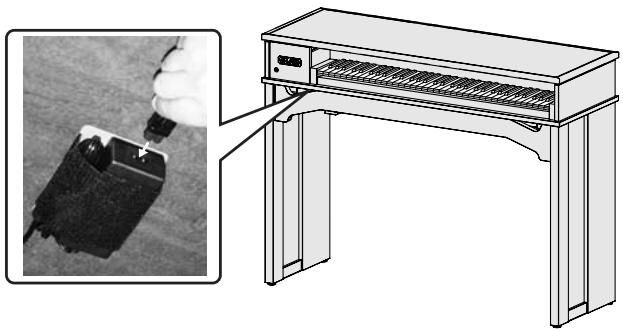
Connect the AC adaptor
- In the operating panel, turn the [Power] switch off (the switch should be in the outward position).
- Connect the power cord to the body of the AC adaptor, which is fastened to the underside of the C-30.
- Plug the power cord (AC adaptor) into an electrical outlet.
NOTE
- Do not use any AC adaptor other than the included one.
- If you won't be using the C-30 for an extended period of time, disconnect the power cord from the electrical outlet.
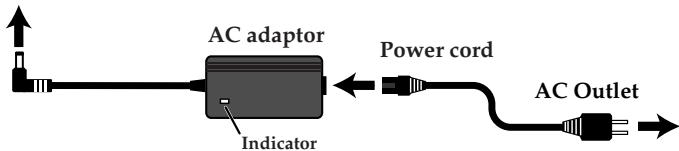
To the AC adaptor connector (already connected)
NOTE
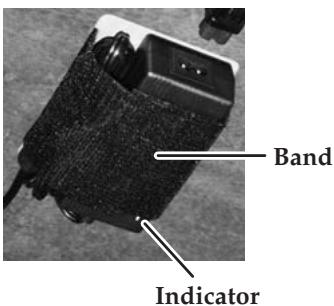
When you purchase the C-30, the AC adaptor is fastened to the bottom panel with a band. It is possible to remove the AC adaptor, but normally you should leave it attached to the C-30.
If you've removed the AC adaptor and wish to reattach it to the C-30, fasten it with the band so that the printed surface of the AC adaptor is facing up toward the bottom of the C-30, and the surface with the indicator is facing downward.
* Fasten the AC adaptor securely so that it will not fall.
Turning the power on/off
Turn on power to your various devices in the order specified. By turning on devices in the wrong order, you risk causing malfunction and/or damage to speakers and other devices.
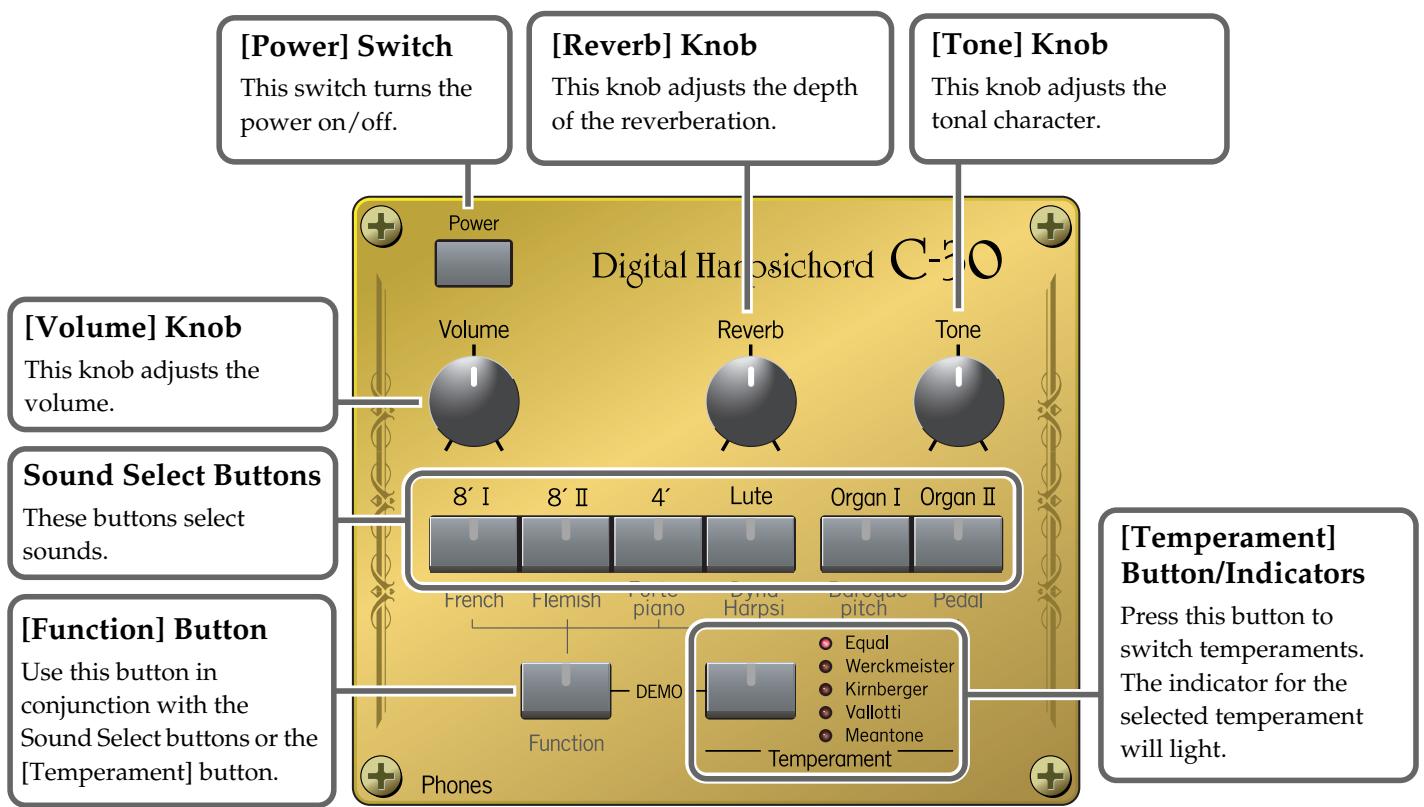
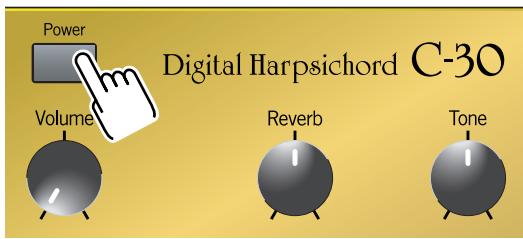
- Before you turn on the power, turn the [Volume] knob all the way to the left.
-
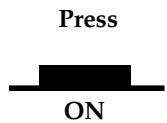
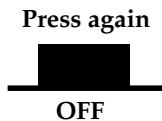
Press the [Power] switch.
-
This unit is equipped with a protection circuit. A brief interval (a few seconds) after power up is required before the unit will operate normally.
Turning the power off
- Before you turn off the power, turn the [Volume] knob all the way to the left.
- Press the [Power] switch.
Using headphones
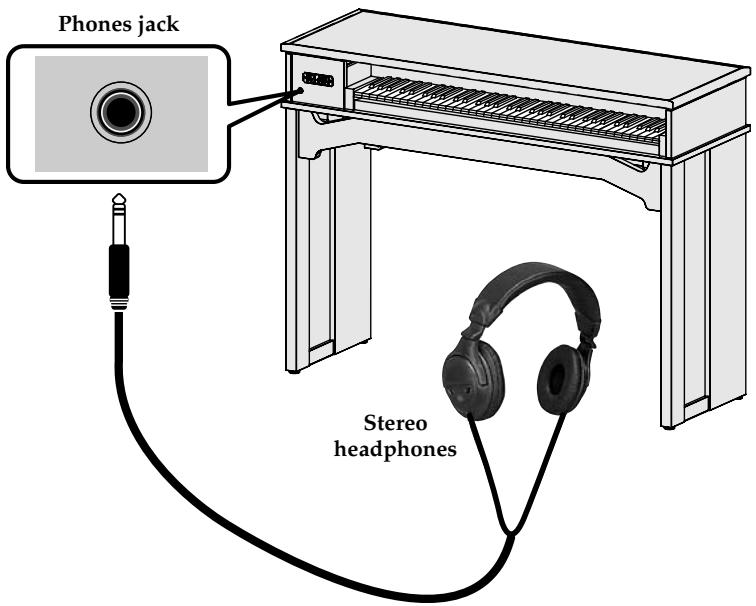
If you connect headphones, sound will no longer be produced from the C-30's internal speakers; you will hear only the sound from the headphones. This lets you enjoy practicing at night or at other times when you might not wish to be heard by other people nearby.
As shown in the illustration, connect the plug of your headphones to the headphone jack.
Use the [Volume] knob to adjust the volume of the headphones.
* Use stereo headphones.
NOTE
Please be aware that excessively high volume or extended use may contribute to hearing loss.
Adjusting the volume
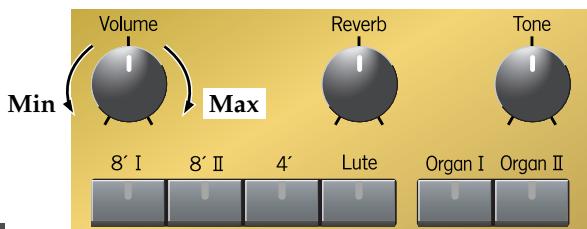
Turn the [Volume] knob to adjust the volume.
Turning the knob toward the right will increase the volume, and turning it toward the left will decrease the volume.
At the 12 o'clock position, the volume is standard and set at about the same level as a normal harpsichord.
Adjusting the tonal character
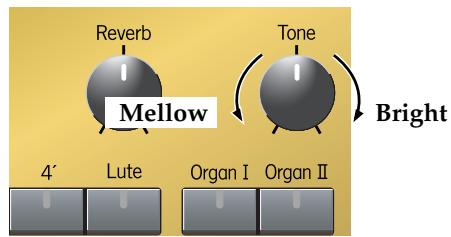
Turn the [Tone] knob to adjust the tone.
Turning the knob toward the right will make the tone brighter, and turning it toward the left will make the tone more mellow.
- You may hear faint noise if you turn the [Tone] knob while producing sound, but this is not a malfunction.
Adjusting the reverb
Reverberation is the sound that you hear reflected from the walls or other surface of a hall or room in addition to the sound that reaches your ears directly from the instrument.
The C-30 provides a reverb effect that lets you simulate the reverberation of a variety of environments ranging from a small room to a large hall, controlled by just a single knob.
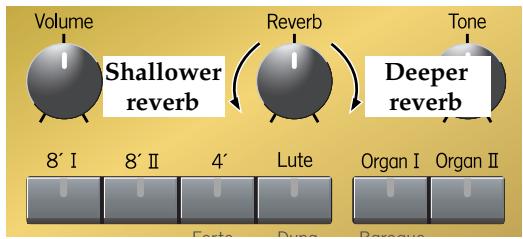
Turn the [Reverb] knob to adjust the amount of reverb effect.
- Turning the knob toward the right will produce deeper reverb, simulating the acoustics of a large hall.
- Turning the knob toward the left will produce shallower reverb, simulating the acoustics of a smaller room.
- If you turn the knob all the way to the left, you will hear the resonance of the harpsichord's own body.
Choosing a sound
Switching sounds
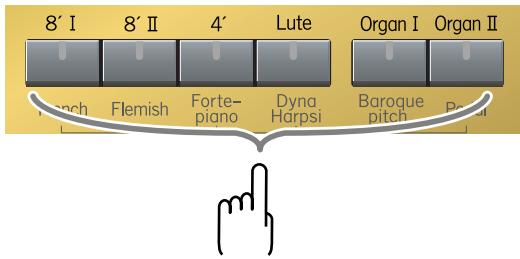
Press the button for the sound that you want to play, so its indicator is lit.
Now you can play the selected sound.
* If you press the [Organ II] button so its indicator is lit in orange, the "Celesta" sound will be selected. (See following page)
Layering sounds
Multiple harpsichord sounds can be layered and played together. The two organ sounds can also be selected simultaneously and played together.
Simultaneously press the buttons for the sounds you want to layer, making the indicators light.
NOTE
- You can't select the four harpsichord sounds simultaneously.
- You can't layer a harpsichord sound with an organ sound.
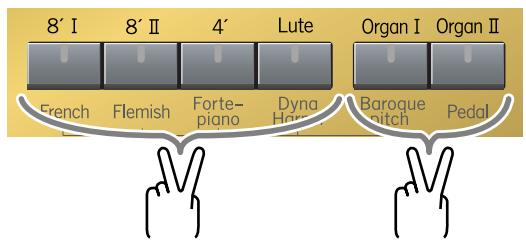
Switching the harpsichord type
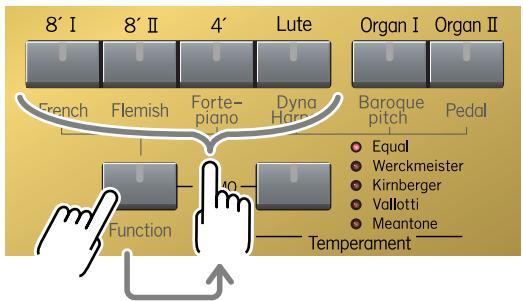
The C-30 contains "harpsichord" sounds and "positive organ" sounds, and you can switch between these as you perform. There are four types of harpsichord, and four sounds are provided for each type.
| French | The sound of a French type harpsichord. |
| Flemish | The sound of a Flemish type harpsichord. |
| Fortepiano | The sound of an early fortpiano. The sound-producing mechanism uses a hammer to strike three strings. |
| Dyna Harpsi (Dynamic Harpsichord) | The sound of a harpsichord with “touch sensitivity”; playing softly will produce a soft sound, and playing strongly will produce a louder sound. |
- For the French type, the button's indicator will light red; for other types, the indicator will light orange.
Hold down the [Function] button, and press one of the [French]-[Dyna Harpsi] buttons so its indicator is lit (green).
* When the power is turned on, the French type is selected.
Selecting the Celesta sound
While holding down the [Temperament] button, press the [Organ II] button. The [Organ II] indicator will light orange, and the Celesta sound will be selected instead of the Organ II sound.
* To return to the Organ II sound, hold down the [Temperament] button and press the [Organ II] button once again.
Tone List
French
| [8' I] | [8' II] | [4'] | [Lute] |
| The sound of the lower key-board 8'; this is the basic tone of the harpsichord. | The sound of the upper key-board 8'; this is the distinctively bright sound of when the plectrum is located closer to the bridge. | The sound of the lower key-board 8', one octave higher. | The sound in which the upper-per keyboard 8' is muted. The name reflects the similarity of this sound to that of the plucked string instrument called the lute. |
Flemish
| [8' I] | [8' II] | [4'] | [Lute] |
| The sound of the lower key-board 8'; this is the basic tone of the harpsichord. | The sound of the upper key-board 8'; this is the distinctively bright sound of when the plectrum is located closer to the bridge. | The sound of the lower key-board 8', one octave higher. | The sound in which the up-per keyboard 8' is muted. The name reflects the similarity of this sound to that of the plucked string instrument called the lute. |
Fortepiano
| [8' I] | [8' II] | [4'] | [Lute] |
| This sound plays only the first of the three strings. | This sound plays only the second of the three strings. | This sound plays only the third of the three strings. | This is the sound of a two-string fortepiano. |
MEMO
- Layering the three sounds [8' I] - [4'] will produce the basic tone of a fortepiano.
- Layering the two sounds [8' I] and [Lute] is one of the recommended sound.
Dyna Harpsi
| [8' I] | [8' II] | [4'] | [Lute] |
| The sound of the French type lower keyboard 8', with touch sensitivity. | The sound of the French type upper keyboard 8', with touch sensitivity. | The sound of the French type lower keyboard 8' one octave higher, with touch sensitivity. | The sound of the French type upper keyboard 8' muted, with touch sensitivity. |
MEMO
- The [4'] sound is not heard when you play with a soft touch; it will be heard when you play strongly. This sound is not used on its own, but rather in combination with [8' I] or [8' II] to create a more brilliant sound.
- The [Lute] sound is normally used by itself.
Positive Organ
| [Organ I] | [Organ II] |
| The sound of the Rohr Flute 8' | The sound of the Principal 8' +4'. |
Celesta
| [Organ II] |
The Celesta produces a distinctively charming sound by means of a mechanism that uses hammers to strike metal bars when you play the keyboard.
Harpsichord samples courtesy of the Hamamatsu Museum of Musical Instruments.
Selecting a temperament
The C-30 allows you to easily change the temperament.
Press the [Temperament] button until the indicator of the desired temperament is lit.
While you are pressing the [Temperament] button, the following temperament indicators will light; when you take your finger off the button, that temperament will be selected.
If you proceed past Meantone, you will "wrap around" to Equal.
MEMO
Equal will be selected every time the power is turned on.
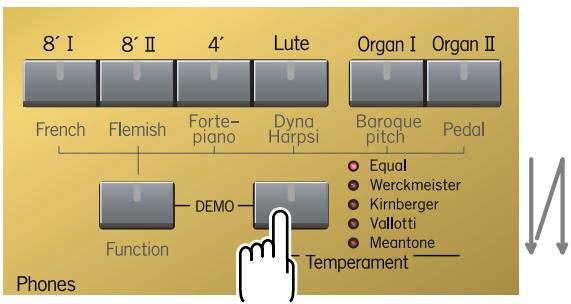
| Equal | Equal temperament |
| Werckmeister | Werckmeister temperament, type 1–3 |
| Kirnberger | Kirnberger temperament, type 3 |
| Vallotti | Vallotti |
| Meantone | Meantone temperament (E b) |
Using historical temperaments
By using historical temperaments to play music that is appropriate for the characteristics of each temperament, you can more strongly bring out the beauty or tension inherent in a composition. In particular, when playing a composition that uses a transposable temperament and includes transpositions, the sonority of the chords will change when a transposition occurs, creating subtle changes in the coloration of the song.
Werckmeister is a temperament that combines Meantone and Pythagorean scales to enhance the degree of transposability, and has been used ever since Bach up to the present. Kirnberger was conceived using similar methods, and is used mainly when playing the organ works of Bach.
Vallotti is the most recent of the temperaments described here. It is close to equal temperament, but since it is somewhat pure, it blends easily with other instruments, and today is often used in ensembles.
Meantone was popular throughout Europe during the Baroque era, and was used customarily by Baroque musicians such as Handel as well as in compositions of the Renaissance period.
Additional Convenient Functionality
Listening to the demo songs
The C-30 contains demo songs. You can use these for sound checks in a concert hall, or you can simply enjoy listening to the sounds of the C-30 as background music.
cf.
For the song titles and names of the performers, refer to the "Demo Song List" (p. 26).
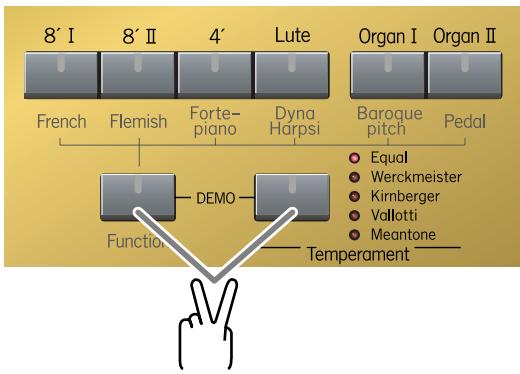
- While holding down the [Function] button, press the [Temperament] button.
The indicator for the [Organ II] button will light green, and the indicator for the [8^] button will blink orange.
The indicators for the [8^ II]-[Lute] buttons will light orange.
NOTE
You can't control the sounds or play the keyboard while a demo performance is in progress.
MEMO
The demo songs are organized into four groups.
Use the [8^] -[Lute] buttons to switch between groups.
You can perform the following operations while a demo song is playing.
- You can press the [8' I] -[Lute] buttons to move to the first demo song in the selected group.
Each time you press a button whose indicator is blinking, you will move to the next demo song within the group. - If you press [Organ II], playback will pause; when you press the [Organ II] button once again, playback will resume from where you paused.
- If you press [Organ I], playback of the current song will stop. When you press the [Organ II] button, playback will begin from the beginning of the same song.
-
Demo playback will continue repeating all the songs included until you stop it.
-
When you want to stop demo playback, press the [Function] button.
The C-30 will return to normal performance mode.
Selecting Baroque pitch
You can change from standard pitch "A = 440.0 Hz" to the "A = 415.0 Hz" tuning commonly used as Baroque pitch, or to the Versailles pitch of "A = 392.0 Hz."
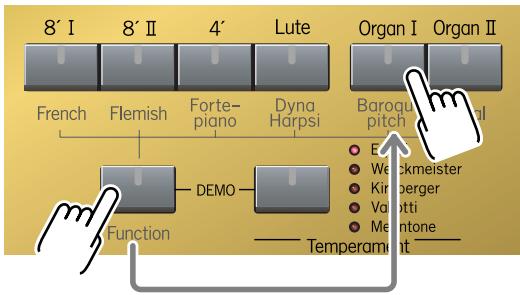
While holding down the [Function] button, press the [Baroque pitch] button.
Repeatedly pressing the button cycles the [Baroque pitch] indicator through its various states, like this: green orange unlit green ...
- When the indicator is lit green, the instrument is at Baroque pitch "A = 415.0 Hz," and the overall pitch will be a semitone lower.
- When the indicator is lit orange, the instrument is at Versailles pitch "A = 392.0 Hz," and the overall pitch will be a whole step lower.
- When the indicator is unlit, the instrument is at standard pitch "A = 440.0 Hz."
MEMO
If you want to change the tuning to a different pitch, refer to "Matching the pitch of another instrument (Tuning)" or "Changing the pitch of the keyboard (Key Transpose)" (p. 20).
Matching the pitch of another instrument (Tuning)
If you're playing the C-30 together with other instruments in an ensemble, you can adjust the pitch of the C-30 to match the other instruments if necessary.
MEMO
- You can adjust the reference pitch of the C-30 in the range of 415.3Hz to 466.2Hz .
- When you turn on the power, it is set to A = 440 Hz .
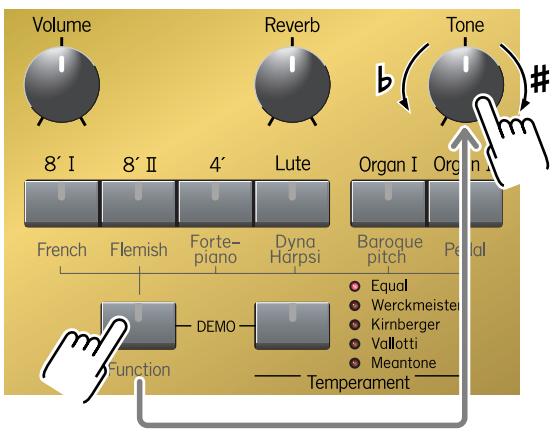
While holding down the [Function] button, turn the [Tone] knob.
The center position of the knob corresponds to A = 440Hz . Turn the knob toward the right to raise the overall pitch, or toward the left to lower it.
MEMO
The range of adjustment is ± 1 / 2 semitone (50 cents).
- The pitch will be adjusted around a center of A = 415.0Hz if Baroque pitch is selected, or around a center of A = 392.0Hz if Versailles pitch is selected.
Changing the pitch of the keyboard (Key Transpose)
You can transpose your playing without changing the position at which you play the keys. For example, if you're playing a song in a difficult key signature that contains numerous sharps (#) or flats (\b), you can transpose the pitch of the keyboard and play the piece in an easier key. This function is called "Key Transpose."
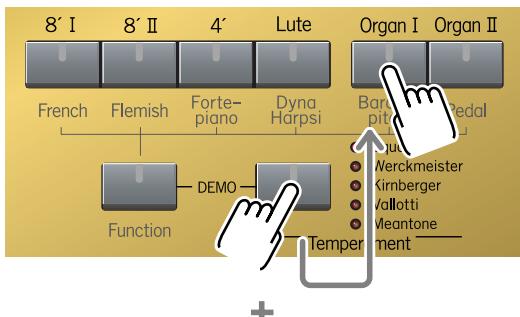
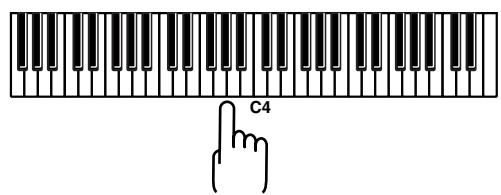
While holding down the [Temperament] button, press the [Organ I] button, and while continuing to hold down these two buttons, play the tonic note of the key to which you want to transpose the keyboard.
For example, if you want the E pitch to sound when you play the C key, hold down the [Temperament] button, press the [Organ I] button, and while continuing to hold down these two buttons, press the E key.
If this is set to any key other than C, the [Temperament] button's indicator will light.
To return the keyboard to its normal state, hold down the [Temperament] button, press the [Organ I] button, and while continuing to hold down these two buttons, press the C key.
- You can transpose the keyboard in a range of five semitones upward (F) or six semitones downward (F#) relative to C.
- You can specify the transpose setting by pressing a key of any octave.
MEMO
Immediately after you turn on the power, the key transpose setting will be in the normal state.
Adjusting the volume of the keyboard noise
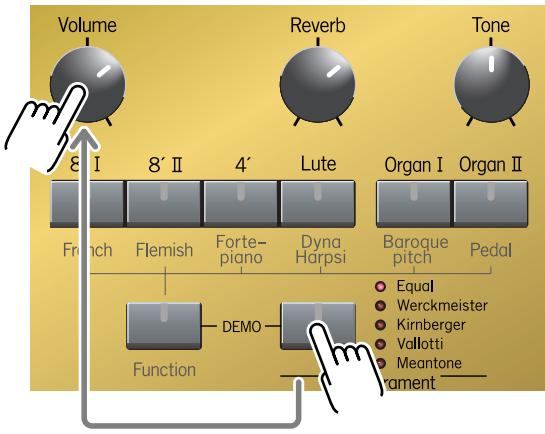
Adjusting the noise volume for strong keystrokes
While holding down the [Temperament] button, turn the [Volume] knob to adjust the volume of the noise produced by strong keystrokes.
The noise will be at the standard level when the knob is at the 2 o'clock position.
Once the power is switched off, the instrument reverts to the standard noise level.
Adjusting the noise volume for key releases
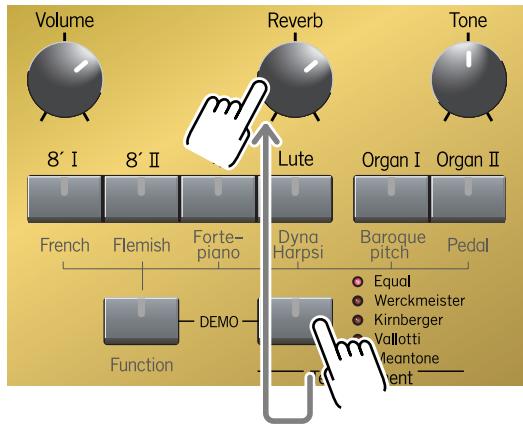
While holding down the [Temperament] button, turn the [Reverb] knob to adjust the volume of the noise heard when you release a key.
- The noise will be at the standard level when the knob is at the 2 o'clock position.
- Once the power is switched off, the instrument reverts to the standard noise level.
Using the pedal
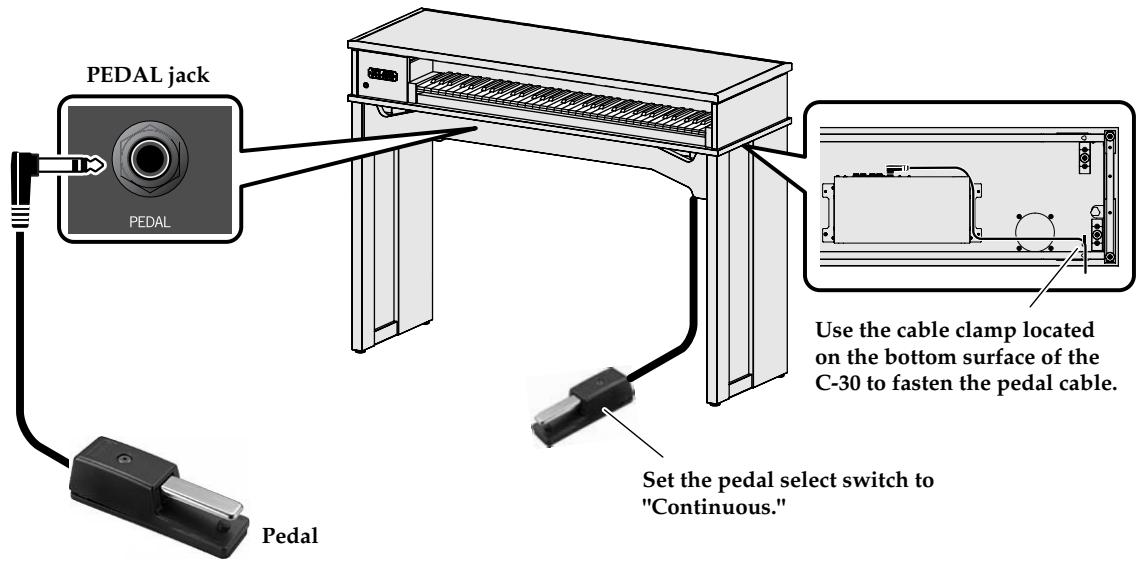
The included pedal can be connected to the C-30's PEDAL jack and used as the damper pedal of a piano.
If you press the pedal while performing, the decay will extend even after you take your fingers off the keyboard.
Using the pedal to switch sounds
You can use the connected pedal to switch between two sets of sounds.
We'll refer to a state in which one or more sounds are selected as a "sound set." Here's how you can switch between a "sound set stored in memory" and "the currently selected sound set."
| Example | Store the French [8' I] + [8' II], and switch to and from the [Organ I] sound |
- Select the sounds that you want to store in memory.
Hold down the French [8^] button and [8^] button simultaneously, so their indicators are lit.
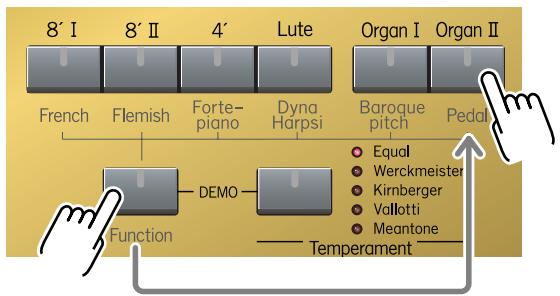
- While holding down the [Function] button, press the [Pedal] button to make the [Pedal] button's indicator light.
The sound(s) you selected in step 1 will be stored in memory.
- Select the other sound to which you want to switch.
Press the [Organ I] button so its indicator is lit.
- Press the pedal.
The French [8^] + [8^] sound will be selected while you hold down the pedal, and you'll return to the [Organ I] sound when you release the pedal.
- If you've assigned the pedal to switch sounds, pressing the [Function] button will make the [Pedal] button's indicator light.
- If you're using the pedal to switch between sound sets, you can't use it as a damper pedal.
If you want to use the pedal as a damper pedal, hold down the [Function] button once again and press the [Pedal] button to turn off the [Pedal] button's illumination.
MEMO
If you want to switch to a sound set that you've already stored in the C-30, perform the following steps.
1) Select the sounds that you want to store in memory.
2) While holding down the [Function] button, press the [Pedal] button to temporarily turn off the [Pedal] button's light.
3) Once again hold down the [Function] button and press the [Pedal] button so the [Pedal] button's light is turned on again.
Playing the sound through external speakers/Recording your performance
You can connect external speakers to the OUTPUT jacks for performance on stage, or connect a recorder to record your playing.
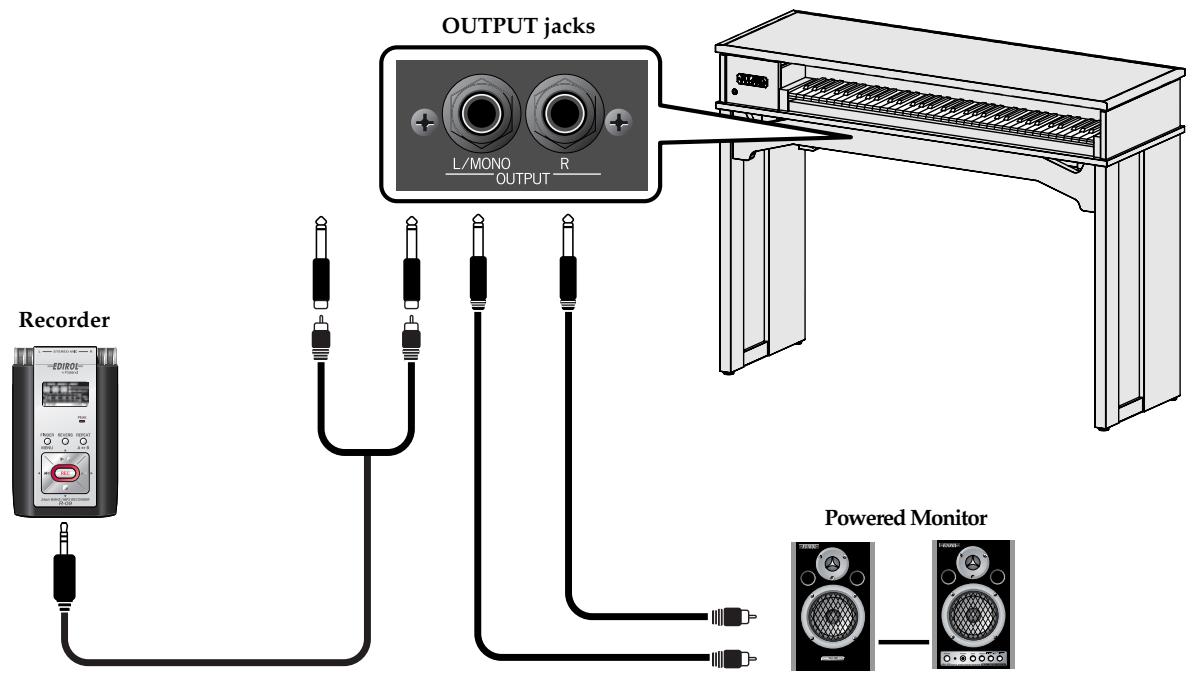
NOTE
To prevent malfunction and/or damage to speakers or other devices, always turn down the volume, and turn off the power on all devices before making any connections.
To turn the power on
- Switch on the C-30's power.
- Switch on the connected device.
- Adjust the volume of each device.
To record a performance from the C-30 onto a recorder
- Start recording on the connected device.
- Perform on the C-30.
- When you've finished performing, stop recording on the connected device.
To turn the power off
- Minimize the volume of the C-30 and of the connected device.
- Switch off the connected device.
- Switch off the C-30.
Listening to an external device's sound through the C-30's speakers
You can input the sound from a MP3 player or other audio device connected to the INPUT jacks, and hear it through the C-30's speakers.
NOTE
To prevent malfunction and/or damage to speakers or other devices, always turn down the volume, and turn off the power on all devices before making any connections.
- Minimize the volume of the C-30 and your audio device.
- Switch off power to the C-30 and your audio device.
- Use a commercially available audio cable to connect your audio device to the C-30.
- Switch on power to your audio device.
- Switch on the C-30's power.
- Adjust the volume of the C-30 and your audio device. The sound of your audio device will be heard from the C-30's speakers.
To change the volume, make adjustments on your audio device.
To turn the power off
- Minimize the volume of the C-30 and your audio device.
- Switch off the C-30.
- Switch off your audio device.
Adjusting the input volume
You can make adjustments on the C-30 to regulate the volume being input from your external audio device to the INPUT jacks.
NOTE
The volume may change abruptly when you adjust the volume of the input from an external device, so you should turn the C-30's [Volume] knob toward the left to lower the volume before you make this adjustment.
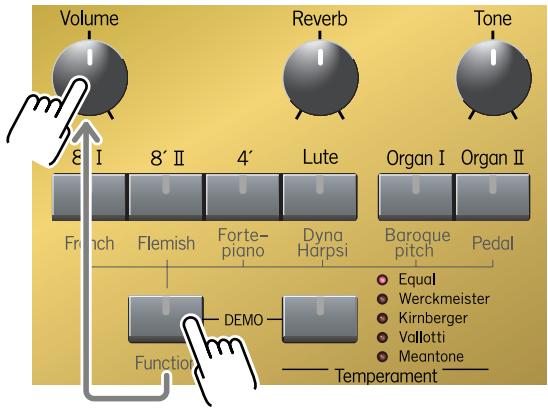
While holding down the [Function] button, turn the Volume knob.
Adjusting the amount of reverb
When you turn the Reverb knob of the operating panel, the reverb effect will be applied to the C-30's sound as well as to the sound being input via the INPUT jacks. You can adjust the amount of reverb that is applied to the input sound.
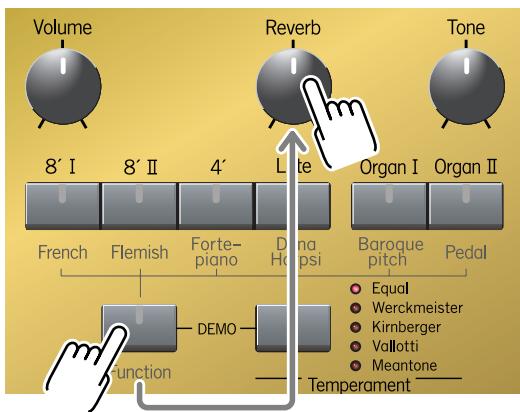
While holding down the [Function] button, turn the Reverb knob.
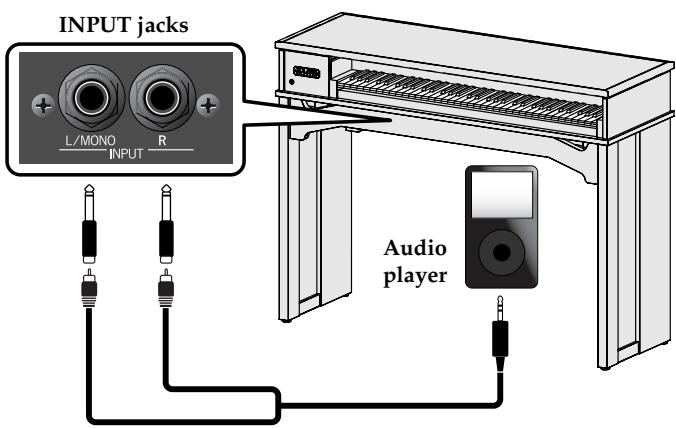
* When connection cables with resistors are used, the volume level of equipment connected to the INPUTs may be low. If this happens, use connection cables that do not contain resistors.
Connecting the C-30 with MIDI equipment
If you connect an external MIDI device to the C-30 to transmit or receive performance data, the two devices will be able to control each other's performance.
For example, you can use the C-30 to play sounds or select sounds on the external MIDI device.
What is MIDI?
"MIDI" stands for "Musical Instrument Digital Interface," and is a worldwide standard for exchanging performance data between electronic musical instruments and computers. The C-30 provides MIDI connectors that can send and receive performance data to and from an external device. By connecting the C-30 to other devices via these connectors, you can take advantage of a wide range of possibilities.
Connecting a MIDI sequencer to the C-30
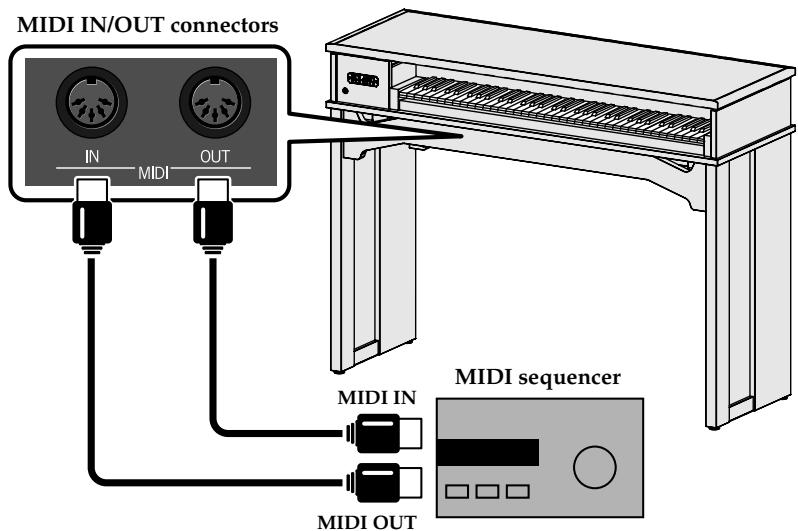
NOTE
- To prevent malfunction and/or damage to speakers or other devices, always turn down the volume, and turn off the power on all devices before making any connections.
- Before you carry out any operations using the C-30's panel, stop the MIDI sequencer.
Setting the MIDI channel
In order to send or receive MIDI data to or from another MIDI device, the MIDI channel of the transmitting device must match the MIDI channel of the receiving device.
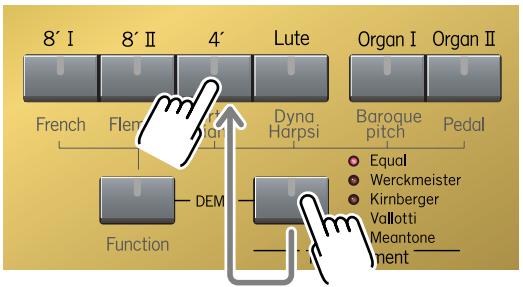
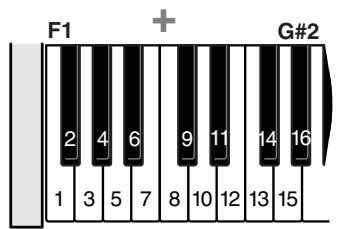
[While holding down the [Temperament] button, press the [4'] button and while continuing to hold down these two buttons, press the key (F1-G#2) that corresponds to the desired MIDI channel.
MEMO
Immediately after you've turned on the power, the MIDI channel will be set to 1.
Local On/Off setting
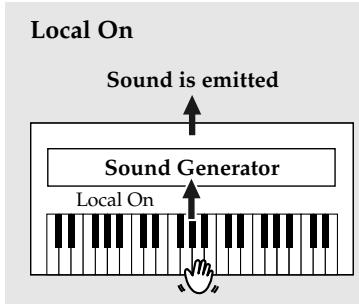
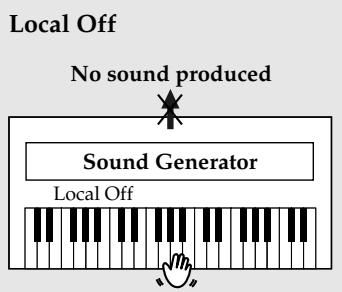
If you've connected the C-30 to a MIDI sequencer, you should set the C-30 to the Local Off state.
Most sequencers enable their Thru function, so that the notes that you play on the keyboard or that are played back by the recorder will reach the sound generator section by both routes (1) and (2) if the C-30 is in the Local On state, causing notes to be sounded in duplicate, or to be cut off unnaturally.
To prevent this, choose the "Local Off" setting so that route (1) is disconnected.
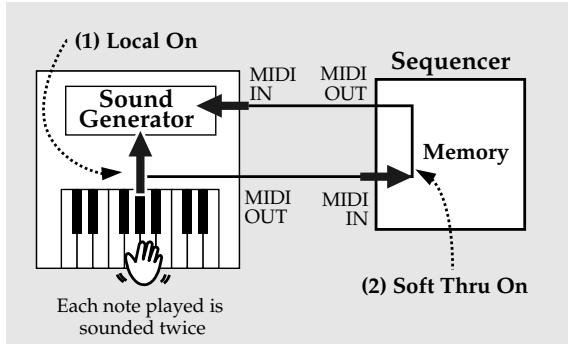
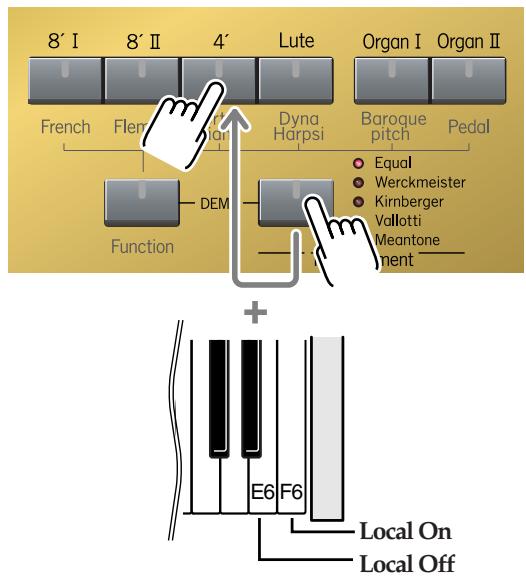
While holding down the [Temperament] button, press the [4^] button, and while continuing to hold down both buttons, press the rightmost key (F6) to select Local On or the (B6) key to select Local Off.
* If you've selected Local Off and no sequencer is connected, you won't hear any sound when you play the C-30's keyboard.
MEMO
The Local On setting is selected when you turn on the power.
Using the V-LINK function
V-LINK
V-LINK ( V-LINK ) is a function that allows music and images to be performed together. By using MIDI to connect two or more V-LINK compatible devices, you can easily enjoy a wide range of visual effects that are linked to the expressive elements of a music performance.
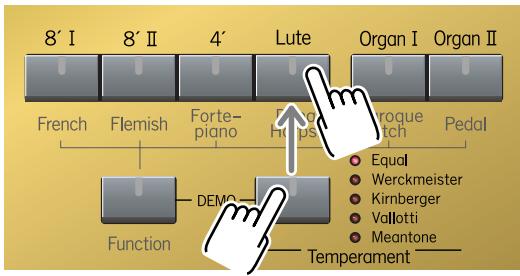
- While holding down [Temperament], press the [Lute] button. The [Function] button's indicator will light orange, and V-LINK will be on. The [Function] button's indicator will remain lit until you turn V-LINK off.
- To turn V-LINK off, once again hold down [Temperament] and press the [Lute] button.
| Song | Composer | Player |
| [8' 1] group | ||
| Les Baricades Mystérieuses | François Couperin | Shinichiro Nakano |
| Les Roseaux | ||
| Allemande | Jacques Duply | |
| La Marche des Scythes | Joseph-Nicolas-Pancrace Royer | |
| La Puce | Joseph Bodin de Boismortier | |
| Le Rappel des Oiseaux | Jean-Philippe Rameau | |
| New Ground | Henry Purcell | |
| La Rameau | Antoine Forqueray | |
| [8' II] group | ||
| Französische Suiten No. 5 Allemande | Johann Sebastian Bach | Makiko Mizunaga |
| Italienisches Konzert | Yuko Inoue | |
| Partita No.1 | Makiko Mizunaga | |
| Goldberg-Variationen Aria mit verschiedenen Veränderungen | ||
| Das Wohltemperierte Klavier, 1-1 | ||
| Invention No.1 | Tomoko Kakuma | |
| Invention No.4 | ||
| Invention No.13 | ||
| [4'] group | ||
| Herz und Mund und Tat und Leben | Johann Sebastian Bach | Makiko Mizunaga |
| Wachet auf, ruftuns die Stimme | ||
| Capriccio sobre la Bassa Fiamenga | Girolamo Frescobaldi | Tomoko Kakuma |
| Sonata a cembalo obbligato e travers solo No. 2 Siciliano | Johann Sebastian Bach | Makiko Mizunaga |
| Sonate für Querflote und bezifferten Bass op.1-5 Bourrée | Georg Friedrich Händel | |
| [Lute] group | ||
| Sonate für Klavier No. 8 "Pathétique" | Ludwig van Beethoven | Yuko Inoue |
| Miniature No.1 for Dynamic Harpsichord | John Maul | John Maul |
| Miniature No.2 for Dynamic Harpsichord | ||
| Miniature No.3 for Dynamic Harpsichord | ||
| Peer Gynt, Suite No.1 "Anitra's Dance" | Edvard Hagerup Grieg | |
- All rights reserved. Unauthorized use of this material for purposes other than private, personal enjoyment is a violation of applicable laws.
- No data for the music that is played will be output from MIDI OUT.
- Regarding "Das Wohltemperierte Klavier, 1-1 (Ave Maria)," "Wachet auf, reftuns die Stimme," "Sonata a cembalo obbligato e travers solo No.2 Siciliano," and "Sonate fur Querflote und bezifferten Bass op. 1-5 Bourree," these songs are arranged for ensemble with a flute or recorder melody. For play-along purposes, the songs do not include the flute, recorder, organ, or harpsichord (main theme) parts.
MIDI Implementation Chart
| Function... | Transmitted | Recognized | Remarks | |
| Basic Channel | Default Changed | 1 1-16 | 1 1-16 | |
| Mode | Default Messages Altered | Mode 3 X *** **** | Mode 3 X | |
| Note Number: | True Voice | 23-94 **** **** | 0-127 0-127 | |
| Velocity | Note ON Note OFF | O O | O X | |
| After Touch | Key's Ch's | X X | X X | |
| Pitch Bend | X | X | ||
| Control Change | 0, 32 6, 38 11 64 74 91 100, 101 | O O X O O (Tone) O (Reverb) O | O O O (Tone) O (Reverb) O | Bank select Data Entry Expression Hold 1 Brightness Effect 1 RPN LSB, MSB |
| Prog Change : True # | O **** **** | O 0-3 | ||
| System Exclusive | O | O | ||
| System Common | : Song Pos : Song Sel : Tune | X X X | X X X | |
| System Real Time | : Clock : Command | X X | X X | |
| Aux Message | : All sound off : Reset all controllers : Local ON/OFF : All Notes OFF : Active Sense : Reset | X X X X X O X | O O O O O O X | |
| Notes | ||||
Mode 1: OMNI ON, POLY
Mode 2: OMNI ON, MONO
O:Yes
Mode 3:OMNI OFF,POLY
Mode 4: OMNI OFF, MONO
X:No
| C-30: Digital Harpsichord | |
| Keyboard | 61 keys (F scale, haprsichord action mechanism) |
| Maximum Polyphony | 128 voices |
| Tones | 6 (8 feet I, 8 feet II, 4 feet, Lute, Organ I, Organ II, celesta) 4 types: French type, Flemish type, Fortepiano, Dynamic Harpsichord |
| Effect | Reverb |
| Controls | Volume knob, Reverb knob, Tone knob |
| Key Transpose | -6 to +5 (semitone steps) |
| Temperament | 5 types (Equal, Werckmeister, Kirnberger, Vallotti, Meantone) |
| Baroque Pitch | 415 Hz / 392 Hz |
| Master Tuning | 440/415 Hz, ±50 cents |
| Pedal | Damper / Tone change |
| Speakers | 12 cm x 2, 8 cm x 2 |
| Rated Output | 13 W x 2 |
| Connectors | Phones jack (Stereo) Output jacks (L/Mono, R) Input jacks (L/Mono, R) MIDI connectors (In, Out) Pedal jack AC adaptor jack |
| Power Supply | AC Adaptor |
| Power Consumption | 25 W (AC 117 V), 25 W (AC 230 V), 25 W (AC 240 V) |
| Cabinet Finish | Simulated mahogany |
| Dimensions (including the stand) | (Lid closed) 1,100 (W) x 380 (D) x 830 (H) mm 43-5/16 (W) x 15 (D) x 32-11/16 (H) inches (Lid opened) 1,100 (W) x 450 (D) x 1170 (H) mm 43-5/16 (W) x 17-3/4 (D) x 46-1/16 (H) inches |
| Weight (including the stand) | 25 + 13 kg: Total 38 kg (84 lbs) |
| Accessories | Owner's manual, AC adaptor, Power cord, Music stand, Damper pedal (DP-10), Picture board, Decorative panel |
| Option | Bench (BNC-29) Picture board (OP-C30PB series) Decorative panel (OP-C30DP series) |
- In the interest of product improvement, the specifications and/or appearance of this unit are subject to change without prior notice.
- Roland Corporation would like to thank the collection Molinari-Pradelli, for the authorization to reproduce the picture entitled 'Estasi de Santa Maria Madalena' by Marcantonio Franceschini, for this limited edition of the C-30 Harpsichord.
Assembling the C-30 stand

- Make sure that another person is on hand to help with the assembly and setup.
- When assembling the stand, be careful not to apply excessive force to any part. Doing so may deform the hardware or damage the wooden parts.
- When assembling or moving the stand, be careful not to pinch your hands or drop the unit on your feet.
- Should you remove the knob bolts, keep them in a safe place out of children's reach, so there is no chance of them being swallowed accidentally.
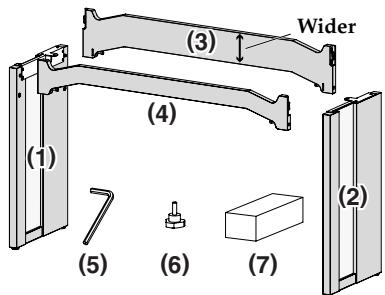
Check the included items
(1) Side board A
(2) Side board B
(3) Center board C
(4) Center board D
(5) Allen wrench
(6) Knob bolts (2 pcs.)
(7) DP-10 (Accessory pedal)
- refer to C-30 owner's manual
Assembly procedure
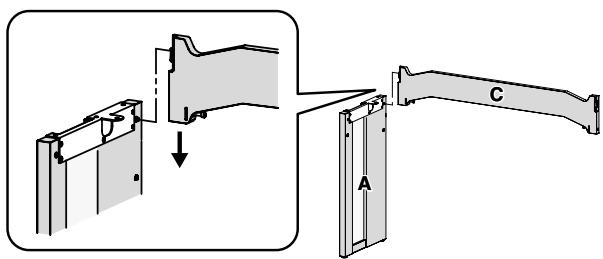
- Attach one end of center board "C" to side board "A."
Orient center board "C" so that the hardware is on the inside, and hook the hardware of center board "C" onto the pins of side board "A," and press center board "C" downward.
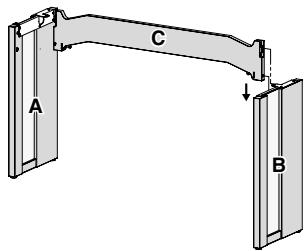
- Attach the other end of center board "C" to side board "B."
Use your hand to support center board "C," and hook the hardware of center board "C" onto the pins of side board "B," and press center board "C" downward.
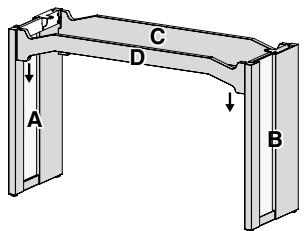
- Attach center board "D."
Orient center board "D" so that the hardware is on the inside, and hook the hardware at each end of center board "D" onto the pins of side boards "A" and "B" and press center board "D" downward.
- Using the included Allen wrench, tighten the bolts that are already installed in the center boards.
First, lightly tighten the bolts at the four locations, and then tighten the bolts firmly so that the stand does not rock or wobble.
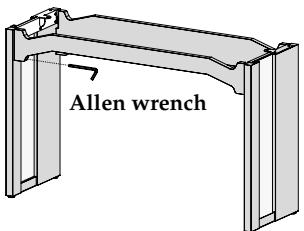
-
If you will be replacing the decorative panels, do so before placing the instrument on the stand. For details on how to replace them, refer to the instructions included with the decorative panels.
-
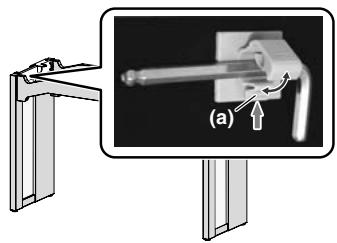
After you've finished assembling the stand, attach the included Allen wrench to the holder located on the inside of side board "A" to prevent it from being lost.
Unlock the holder, place the Allen wrench in position, and then re-lock the holder. When you unlock the holder, push up the parts marked (a) in the illustration.
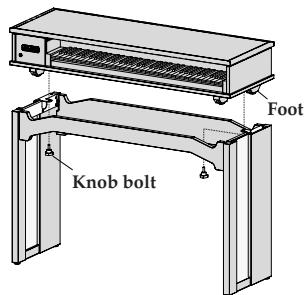
- Align the main unit with the stand.
Place the main unit on the stand so that the four feet on the bottom of the unit fit within the inside of the stand, and then firmly tighten the two knob bolts to fasten the unit onto the stand.
- Be careful not to pinch your hands.
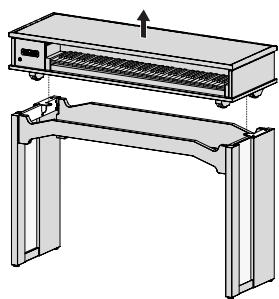
Caution when disassembling the stand
-
Remove the two knob bolts, separate the main unit from the stand, and then loosen the four bolts of the center boards to disassemble the stand in the reverse order of assembly.
-
Loosening the bolts until their heads are visible will allow you to disassemble the stand. Do not remove the bolts entirely.
When moving the instrument
- If the instrument is to be moved within the same room, it must be carefully moved by two people holding the instrument at the locations shown in the diagram.
- If the instrument is to be moved out of the room or into a different room, you must separate the main unit from the stand and carry them separately. The portion that connects the main unit and stand may be damaged if you attempt to transport the instrument without separating the main unit and stand.
- When moving the main unit and stand, carry them in a horizontal position.
Information
When you need repair service, call your nearest Roland Service Center or authorized Roland distributor in your country as shown below.
AFRICA
EGYPT
Al Fanny Trading Office
9, EBN Hagar Al Askalany Street,
ARD E1 Golf, Heliopolis,
Cairo 11341, EGYPT
TEL: (022) 418-5531
REUNION
Maison FO - YAM Marcel
25 Rue Jules Hermann,
Chaudron - BP79 97491
Ste Clotilde Cedex,
REUNION ISLAND
TEL: (0262) 218-429
SOUTH AFRICA
T.O.M.S. Sound & Music
(Pty)Ltd.
2 ASTRON ROAD DENVER
JOHANNESBURG ZA 2195, SOUTH AFRICA
TEL: (011)4173400
Paul Bothner(PTY)Ltd.
Royal Cape Park, Unit 24
Londonderry Road, Ottery 7800
Cape Town, SOUTH AFRICA
TEL: (021) 799 4900
ASIA
CHINA
Roland Shanghai Electronics Co., Ltd.
5F. No.1500 Pingliang Road
Shanghai 200090, CHINA
TEL: (021) 5580-0800
Roland Shanghai Electronics Co., Ltd. (BEIJING OFFICE) 10F.No.183 Section Anhuaxil Chaoyang District Beijing
100011 CHINA
TEL: (010) 6426-5050
HONG KONG
Tom Lee Music Co., Ltd.
Service Division
22-32 Pun Shan Street, Tsuen Wan, New Territories,
HONG KONG
TEL: 2415 0911
Parsons Music Ltd.
8th Floor, Railway Plaza, 39 Chatham Road South, T.S.T, Kowloon, HONG KONG
TEL: 2333 1863
INDIA
Rivera Digitec (India) Pvt. Ltd.
411, Nirman Kendra
Mahalaxmi Flats Compound
Off. Dr. Edwin Moses Road,
Mumbai-400011, INDIA
TEL: (022) 2493 9051
INDONESIA
PT Citra IntiRama
JL. Cideng Timur No. 15J-15O
Jakarta Pusat
INDONESIA
TEL: (021) 6324170
KOREA
Cosmos Corporation 1461-9, Seocho-Dong, Seocho Ku, Seoul, KOREA TEL: (02) 3486-8855
MALAYSIA
Roland Asia Pacific Sdn. Bhd. 45-1, Block C2, Jalan PJU 1/39, Dataran Prima, 47301 Petaling Jaya, Selangor, MALAYSIA TEL: (03) 7805-3263
VIET NAM
Suoi Nhac Company, Ltd
370 Cach Mang Thang Tam St.
Dist.3, Ho Chi Minh City,
VIET NAM
TEL: 9316540
PHILIPPINES
G.A. Yupangco & Co. Inc. 339 Gil J. Puyat Avenue Makati, Metro Manila 1200, PHILIPINES TEL: (02) 899 9801
SINGAPORE
SWEE LEE MUSIC
COMPANY PTE. LTD.
150 Sims Drive, SINGAPORE 387381
TEL: 6846-3676
TAIWAN
ROLAND TAIWAN
ENTERPRISE CO., LTD.
Room 5, 9f1, No. 112 Chung
Shan N, Road Sec.2, Taipei,
TAIWAN, R.O.C.
TEL: (02) 2561 3339
THAILAND
Theera Music Co., Ltd.
100-108 Soi Vermg
Nakornkasem, New
Road,Sumpantawongse,
Bangkok 10100 THAILAND
TEL: (02) 224-8821
AUSTRALIA/ NEW ZEALAND
AUSTRALIA/
NEW ZEALAND
Roland Corporation
Australia Pty., Ltd.
38 Campbell Avenue
Dee Why West, NSW 2099
AUSTRALIA
For Australia
Tel: (02) 9982 8266
For New Zealand
Tel: (09) 3098 715
CENTRAL/LATINAMERICA
ARGENTINA
Instrumentos Musicales S.A.
Av.Santa Fe 2055
(1123) Buenos Aires
ARGENTINA
TEL: (011) 4508-2700
BARBADOS
A&B Music Supplies LTD
12 Webster Industrial Park
Wildey, St.Michael, Barbados
TEL: (246)430-1100
BRAZIL
Roland Brasil Ltda.
Rua San Jose, 780 Sala B
Parque Industrial San Jose
Cotia - Sao Paulo - SP, BRAZIL
TEL: (011) 4615 5666
CHILE
Comercial Fancy II S.A.
Rut.: 96,919,420-1
Nataniel Cox #739, 4th Floor
Santiago - Centro, CHILE
TEL: (02) 688-9540
COLOMBIA
Centro Musical Ltda.
Cra 43 B No 25 A 41 Bododega 9
Medellin, Colombia
TEL: (574)3812529
COSTA RICA
JUAN Bansbach Instrumentos
Musicales
Ave.1. Calle 11, Apartado
10237,
San Jose, COSTA RICA
TEL: 258-0211
CURACAO
Zeelandia Music Center Inc.
Orionweg 30
Curacao, Netherland Antilles
TEL:(305)5926866
DOMINICAN REPUBLIC
Instrumentos Fernando Giraldez
Calle Proyecto Central No.3
Ens.La Esperilla
Santo Domingo,
Dominican Republic
TEL:(809)683 0305
ECUADOR
Mas Musika Rumichaca 822 y Zaruma Guayaquil - Ecuador TEL:(593-4)2302364
EL SALVADOR
OMNI MUSIC
75 Avenida Norte y Final
Alameda Juan Pablo II,
Edificio No.4010 San Salvador,
EL SALVADOR
TEL: 262-0788
GUATEMALA
Casa Instrumental
Calzada Roosevelt 34-01, zona 11
Ciudad de Guatemala
Guatemala
TEL: (502) 599-2888
HONDURAS
Almacen Pajaro Azul S.A. de C.V.
BO.Paz Barahona
3 Ave.11 Calhe S.O
San Pedro Sula, Honduras
TEL: (504) 553-2029
MARTINIQUE
Roland Ireland
G2 Calmount Park, Calmout
Avenue, Dublin 12
Republic of IRELAND
TEL: (01) 4294444
ITALY
MOCO INC.
No.41 Nike St., Dr.Shariyati Ave.,
Roberoye Cerahe Mirdamad
Tehran, IRAN
TEL: (021)-2285-4169
ISRAEL
Halilit P. Greenspoon & Sons Ltd.
8 Retzif Ha'alia Hashnia St.
Tel-Aviv-Yafo ISRAEL
TEL: (03) 6823666
JORDAN
MUSIC HOUSE CO. LTD.
FREDDY FOR MUSIC
P.O. Box 922846
Amman 11192 JORDAN
TEL: (06) 5692696
KUWAIT
EASA HUSAIN AL-YOUSIFI & SONS CO.
Al-Yousifi Service Center
P.O.Box 126 (Safat) 13002
KUWAIT
TEL: 00 965 802929
LEBANON
Chahine S.A.L.
George Zeidan St., Chahine
Bldg., Achrafieh, P.O.Box: 16-5857
Beirut LFBANON
TEL: (01) 20-1441
OMAN
TALENTZ CENTRE L.L.C.
Malatlan House No.1
Al Noor Street, Ruwi
SULTANATE OF OMAN
TEL: 2478 3443
QATAR
Al Emadi Co. (Badie Studio & Stores)
P.O. Box 62, Doha, QATAR
TEL: 4423-554
SAUDI ARABIA
aDawliah Universal Electronics APL Behind Pizza Inn Prince Turkey Street aDawliah Building, PO Box 2154, Alkohbar 31952 SAUDI ARABIA
TEL: (03) 8643601
SYRIA
Technical Light & Sound Center
Rawda, Abdul Qader Jaze
Bldg. No. 21, P.O.BOX 135
Damascus, SYRIA
TEL: (011) 223-5384
TURKEY
ZUHAL DIS TICARET A.S.
Galip Dede Cad. No.37
Beyoglu - Istanbul / TURKEY
TEL: (0212) 249 85 10
U.A.E.
Zak Electronics & Musical Instruments Co. L.L.C.
Zabeel Road, Al Sherooq Bldg., No. 14, Ground Floor, Dubai, U.A.E.
TEL: (04) 3360715
NORTH AMERICA
CANADA
Roland Canada Ltd.
(Head Office)
5480 Parkwood Way
Richmond B.C., V6V 2M4
CANADA
TEL: (604) 270 6626
Roland Canada Ltd. (Toronto Office)
170 Admiral Boulevard Mississauga On L5T 2N6 CANADA
TEL: (905) 362 9707
U. S. A.
Roland Corporation U.S.
5100 S. Eastern Avenue
Los Angeles, CA 90040-2938, U.S.A.
TEL: (323) 890 3700
For EU Countries


This symbol indicates that in EU countries, this product must be collected separately from household waste, as defined in each region. Products bearing this symbol must not be discarded together with household waste.