C-80 - Electronic musical instrument ROLAND - Free user manual and instructions

Find the device manual for free C-80 ROLAND in PDF.

📄 6 pages PDF ⬇️ English EN 💬 AI Question 🖨️ Print
Notice ROLAND C-80 - page 1
View the manual : Français FR English EN
Manual assistant
Powered by ChatGPT
Waiting for your message
Product information

Brand : ROLAND

Model : C-80

Category : Electronic musical instrument

Download the instructions for your Electronic musical instrument in PDF format for free! Find your manual C-80 - ROLAND and take your electronic device back in hand. On this page are published all the documents necessary for the use of your device. C-80 by ROLAND.
USER MANUAL C-80 ROLAND

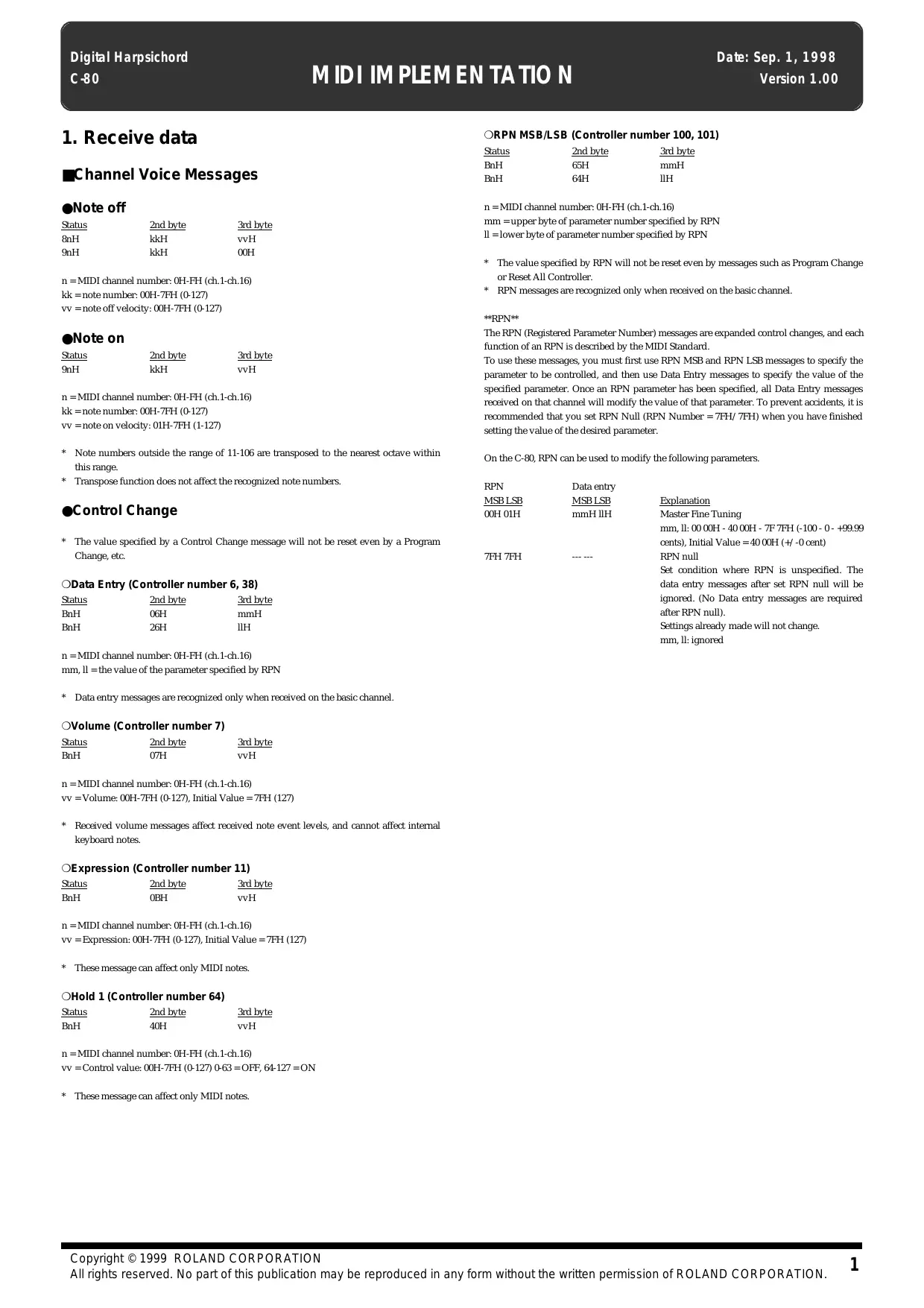
  • Note numbers outside the range of 11-106 are transposed to the nearest octave within this range. *_Transpose function does not affect the reongnized note numbers. @Control Change
  • The value specified by a Control Change message will not be reset even by a Program Change, ete. OData Entry (Controller number 6, 38) Satus 2nd byte Bd byte En OH mmH BnH 26H lH n = MIDI channel number: OH-FH (ch.1-ch.16) mm, ll =the value of the parameter sperified by RPN *_ Data entry messages are renognized only when received on the basic channel. OVolume (Controller number 7) Satus 2nd byte Bd byte BnH OH wH n = MIDI channel number: OH-FH (ch.1-ch.16) vv =Volume: C0H-7FH (0-127, Initial Value =7FH (127) *_ Recived volume messages affect received note event levels, and cannot affect internal Keyboard notes. OExpression (Controller number 11) Satus 2nd byte Bd byte En OBH wH n = MIDI channel number: OH-FH (ch.1-ch.16) wv = Expression: 00H-7FH (0127) Initial Value =7FH (127)
  • The value specified by RPN will not be reset even by messages such as Program Change or Reset AII Controller. *_ RPN messages are recognized only when received on the basic channel. RENE The RPN (Registered Parameter Number) messages are expanded control changes, and each function of an RPN is described by the MIDI Standard. ‘To use these messages, you must first use RPN MSB and RPN LSB messages to specify the parameter to be controlled, and then use Data Entry messages to specify the value of the specified parameter. Once an RPN parameter has been specified, all Data Entry messages received on that channel will modify the value of that parameter. To prevent accidents, it is recommended that you set RPN Null (RPN Number = 7FH/ 7FH) when you have finished setting the value of the desired parameter. On the C-80, RPN can be used to modify the following parameters. REN Data entry MSBLSB MSBLSB Bplanation 00H OH mm LH Master Fine Tuning mm, Il: 00 O0H - 40 00H - 7F 7FH (-100- O- 400.90 cents) Initial Value =40 00H (4 -0 cent) EH 7H RPN null Set condition where RPN is unspedfied. The data entry messages after set RPN null will be ignored. (No Data entry messages are required after RPN null) Settings already made will not change. mm, ll: ignored Copyright © 1999 ROLAND CORPORATION

All rights reserved. No part of this publication may be reproduced in any form without the written permission of ROLAND CORPORATION.

  • Program numbers not in the above table are ignored. After a Program Change message is received, the sound will change beginning with the next Note-on. Voices already sounding when the Program Change message was received will not be affected. When the program change is received through the basic channel, the tone of this channel part and the tone selected by the panel shall be changed to the designated tone: Channel Mode Messages eReset All Controllers (Controller number 121) Satus 2nd byte 3rd byte BH 7H 00H n = MIDI channel number: OH-FH (ch.1-ch.16) *_ When this message is reœived, the following controllers will be set to their reset values. Controller Reset value Expression 127 (max) Hold 1 O(off) RPN unset; previously set data will not change @Local Control Satus 2nd byte Brd byte BH 7BH 00H BH 7AH wi n=MIDI channel number: OH - FH (ch.1 - ch.16) vv=Value: 00H, 7FH (0, 127 O=OFF 127=ON @All Notes Off (Controller number 123) Satus 2nd byte Br byte BoH TEH 00H MIDI channel number: OH-FH (ch.1-ch.16) *_ When AÏL Notes Of is recived, all notes on the corresponding channel will be tumed off. However if Hold 1 is ON, the sound will be continued until these are turned off. @OMNI OFF (Controller number 124) Satus 2nd byte lyte BoH TCH 00H n = MIDI channel number: OH-FH (ch.1-ch.16)
  • ‘The same processing will be carried out as when AI Notes Off is reveived. @OMNI ON (Controller number 125) Satus 2nd byte lyte BoH TDH 00H n = MIDI channel number: OH-FH (ch.1-ch.16)
  • ‘The same processing will be carried out as when AI Notes Off is reveived. @MONDO (Controller number 126) Satus 2nd byte Br byte BoH TEH mmH n = MIDI channel number: OH-FH (ch.1-ch.16) mm =mono number: 00H-10H (0-16)
  • ‘The same processing will be carried out as when AI Notes Off is reveived. @POLY (Controller number 127) Satus 2nd byte Br byte BoH TH 00H MIDI channel number: OH-FH (ch.1-ch.16)
  • ‘The same processing will be carried out as when AI Notes Off is reveived. Æystem Realtime Message @aActive Sensing Sas

When Active Sensing is received, the unit will begin monitoring the intervals of all further messages, While monitoring, if the interval between messages exceeds 380 ms, the same processing will be caries out as when All Notes Off and Reset AIl Controllers are reveived, and message interval monitoring will be halted. Æystem Exclusive Message Satus Data byte Satus FH üH, ddH, …eH FH FOH: System Exdusive Message status ii = ID number an ID number (manufacturer ID) to indicate the manufacturer whose Exdusive message this is. Roland's manufacturer ID is 41H ID numbers 7EH and 7FH are extensions of the MIDI standard; Universal Non-realtime Messages (7H) and Universal Realtime Messages (7FH). dd.…ee =data: OOH-7FH (0-127) FH: EOX (End Of Exdusive) The System Exdusive Messages received by the C-80 are; Universal Non-realtime System Exdusive messages, and Data Set (DT)

@Universal Non-realtime System Exclusive Messages Oldentity Request Message Satus Data byte Satus FH TE, dev, 06H, O1 FH Byte Explanation FOH Exdusive status TFH ID number (universal non-realtime message) dev Device ID (dev: UNIT#1) 06H Sub ID# (General Information) oi Sub ID# (Identity Request) FH EOX (End Of Exdusive)

  • The dev” is own device number (UNIT#1) or 7FH (Broadcast) *_ UNIT#is always the same as the current basic channel. @Data transmission {C-80 can transmit and receive the various parameters using System Exdusive messages. The exdusive message of C-80 data has a model ID of 1AH, and device ID is defined by MIDI UNIT NUMBER. UNIT NUMBER is always the same as the current basic channel. Oata set 1 (DT1) This is the message that actually performs data transmission, and is used when you wish to transit the data. Satus Data byte Satus FH AH, dev, 1AH, 12H, aaH, bb, ccH, sum FH Bvte Explanation FH Exdusive status ax ID number (Roland) dev Device ID (dev: UNIT#1) 1AH Model ID (C-80) 12H Command ID (DT1) aaH Address MSB: upper byte of the starting address of the transmitted data bbH Address LSB: lower byte of the starting address of the transmitted data cH Data: the actual data to be transmitted. sum Checksum FH EOX (End Of Exclusive) If “Data Set 1° is transmitted successively, there must be an interval of at least 40 ms between packets. Regarding the address please refer to section 3 (Parameter Address Map) Regarding the checksum please refer to section 4 (Supplementary material).
  • Note numbers range can be changed with Key Transpose and Octave Shif. @Control Change
  • This will be transmitted constantiy at intervals of approximately 240 ms. ÆSystem exclusive messages identity Reply” and “Data St 1 (DTI)” are the only System Exdusive messages transritted by C-80. The exdusive message of C-80 data has a model ID of 1AH, and device ID is defined by MIDI UNIT NUMBER. UNIT NUMBER is always the same as the current basic channel @Universal Non-realtime System Exclusive Messages Oldentity Reply Satus Databyte Sas EH, dev, 06H, 2H, 1H, 1AH, 00H, 00H, 03H, OOH, OUH, OOH, 00H F7H

Byte Explanation FOH Exdusivestatus TEH ID number (universal non-realtime message) dev Device ID(dev: UNIT#-1) OH SubID# (General Information) @H SubiD#2 (Identity Reply) AH ID number (Roland) IAH Device family code (LSB) 0H Device family code (MSB) 00H Device family number code (LSB) CH Device family number code (MSB) 0H Software revision level OH Software revision level 0H Software revision level 00H Software revision level FH EOX (End of Exdusive)

  • Reply the message by the unique device ID (dev) when the device has received the “Identity Request Message’ in the Broadcast @Data transmission OData set 1 (DT1) Satus Databyte Status FH 41H dev, LAH, 12H, aaH, bbH, ocH, sum FH Be Explanation FH Exdusivestaus AH ID number (Roland) dev Device ID (dev: UNIT#1) AH Mode ID (C-80) 12H CommandID (DT) aaH Address MSB: upper byte ofthe starting address of the data to be sent bbH Address LSB: lower byte of the starting address of the data to be sent. œH Data:theactual data to besent. sum Chedsum FH EOX (End OfExdusive)
  • _ Regarding the address please refer to section 3 (Parameter Address Map).
  • _ Regarding the checksum please refer to section 4 (Supplementary material)

OH - 6H: temperament select Xkk OH - BH: key signature Temperament change value are assigned as follows: *_ When EQUAL temperament tuning is selected, the key signature change is ignored. [ key signature [

4. Supplementary material

@Basic Channel Setting C-80 has 2 MIDI reœive parts. Each part channel can receive program change individually. Together hold down the [Baroque Pitch] and [Temperament] buttons, and at the same time press a key from F1 through G#2 to set the desired basic channel. ‘The setting for the basic channel affect the reception channel (Rx. channel) for each part, as shown in the following table. The transmission channel (Tx. channel) is automatically set to the same channel as the basic key Basic (Tx.) Rx. Channel Channel Part 1/Part 2 Power-on 1 1, 2 F1 1 1, 2 F#1 2 2, 3 Gi 3 3, 4 G#1 a 4,5 Al 5 5, 6 41 6 6, 7 81 7 7, 8 a 8 8, 9 c#2 9 9, 10 02 10 10, 11 D#2 u 11, 12 E 12 12, 13 F 13 13, 4 F#2 14 14, 15 e 15 15, 16 G#2 16 16, 1 @Decimal and Hexadecimal table In MIDI documentation, data values and addresses/ sizes of exdusive messages etc. are expressed as hexadecimal values for each 7 bits. The following table shows how these correspond to decimal numbers. | Dec.| Hex.[| Dec.| Hex.[| Dec.| Hex.|| Dec.| Hex.| | O1 OoH| 321 20H[|[ 64| 40H]| 961] 60H | | 11 OHI| 331 2MH|| 651 4MWI| 97| 6H)

| 21 OHI| 341 224H|| 661 4HI| 98| 62]

Decimal values such as MIDI channel and program change are listed as one (1) greater than the values given in the above table. AA 7-bit byte can express data in the range of 128 steps. For data where greater prerision is required, we must use two or more bytes. For example, two hexadecimal numbers aa bbH expressing two 7-bit bytes would indicate a value of aa x 128 + bb.

  • In the case of values which have a # -sign, 00H =-64, 0H =# -0, and 7FH = 463, s0 that the decimal expression would be 64 less than the value given in the above chart. In the case of two types, 00 00H =-8192, 40 00H =# -0, and 7F 7FH =48191. For example if aa bbH were expressed as decimal this would be aa bb - 40 00H =aa x 128 +bb- 64x 128. <xample 1> What is the decimal expression of SAH? >From the precding table, 3AH =90 <Bample 2> What is the decimal expression of the value 12 MH given as hexadecimal for each 7 bits? >From the precding table, since 12H =18 and AH =52 18x 128 +52=2356 @Examples of actual MIDI messages <xample 1>-023E 5F On is the Note-on status, and n is the MIDI channel number. Since 2H 3EH =62, and 5FH =95, this is a Note-on message with MIDI CH =3, note number 62 (note name is D4), and velocity 96. <Bample 2> CES CH is the Program Change status, and n is the MIDI channel number. Since EH = 14 and OH = 05, this is a Program Change message with MIDI CH = 15, program number 05 (Celestain C-80) <Example 3> B3 64 00 65 01 06 4026 00 64 7F 65 7F BnH is the Control Change status, and n is the MIDI channel number. For Control Changes, the 2nd byte is the control number, and the 3rd byte is the value. In a case in which two or more messages consecutive messages have the same status, MIDI has a provision called “running status” which allows the status byte of the second and following messages to be omitted. Thus, the above messages have the following meaning: 836400 MIDI ch, lower byte of RPN parameter number: 00H.

(83) 0540 (MIDI ch 4) upper byte of parameter value: 40H (83) 2600 (MIDI ch 4) lower byte of parameter value: 00H BG (MIDI ch 4) lower byte of RPN parameter number: 7FH SF (MIDI ch 4) upper byte of RPN parameter number: 7FH In other words, the above messages sperifÿ a value of 40 00H for RPN parameter number 00 O1H on MIDI channel 4, and then set the RPN parameter number to 7F 7FH (RPN null) Onœ the parameter number has been sperified for RPN, all Data Entry. messages transmitted on that same channel will be valid, so after the desired value has been transmitted, it is a good idea to set the parameter number to 7F FH to prevent acridents. ‘This is the reason for the (B3) 64 7F (3) 65 7F' at the end.

@Example of an Exclusive message and calculating a Checksum Roland Exdusive messages (DT1) are transmitted with a checksum at the end (before F7 to. make sure that the message was comedly received. The value of the checksum is determined by the address and data of the transmitted exdusive message. Okow to calculate the checksum (hexadecimal numbers are indicated by

The checksum is a value derived by adding the address, size and checksum itself and inverting the lower 7 bits, Here's an example of how the checksum is calculated. We will assume that in the exclusive message we are transmitting, the address is aa bb and the data or size is œcH. ea +bb +cc=sum sum / 128= quotient... remainder