
PX-310 - Digital piano CASIO - Free user manual and instructions
Find the device manual for free PX-310 CASIO in PDF.
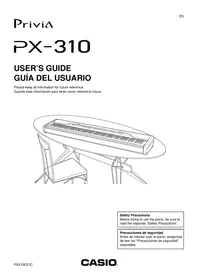


| Product Type | Digital Piano |
| Brand | CASIO |
| Model | PX-310 |
| Dimensions | 132.3 x 27.8 x 13.2 cm |
| Weight | Approx. 11.9 kg |
| Power Supply | CASIO AD-12 AC adaptor (12V DC, 18W) |
| Keyboard | 88 touch-responsive piano keys |
| Polyphonic | 32 notes max |
| Tones | 12 main tones + 12 variations + 40 advanced + 128 GM + 10 drums |
| Effects | Reverb (4 types), Chorus (4 types), DSP, Brilliance |
| Rhythms | 120 built-in rhythms |
| Auto Accompaniment | Normal, CASIO CHORD, FINGERED, FULL RANGE CHORD modes |
| Song Memory | 10 user songs (approx. 145 KB), part left/right |
| Recording Memory | 2 tracks, approx. 10,000 notes total |
| Setup Memory | 32 locations (4 areas × 8 banks) |
| Pedals | Damper, Soft/Sostenuto (selectable), connector for optional SP-30 pedal unit |
| MIDI | 16 multi-timbral channels, IN/OUT/THRU jacks |
| Inputs/Outputs | Headphones (2 × mini stereo jack), Pedal (2 × standard jack), LINE OUT (R, L/MONO), LINE IN (R, L/MONO) |
| Speakers | 2 × (12 cm × 6 cm) oval + 2 × 5 cm, power 8 W + 8 W |
| Care and Cleaning | Soft cloth slightly dampened (water and mild detergent), avoid solvents |
| Safety | Use only AD-12 adaptor, do not expose to water, unplug during storms |
| Spare Parts and Repairability | Optional SP-3/SP-30 pedal, internal lithium battery (5-year life), replacement by authorized service |
Frequently Asked Questions - PX-310 CASIO
User questions about PX-310 CASIO
0 question about this device. Answer the ones you know or ask your own.
Ask a new question about this device
Download the instructions for your Digital piano in PDF format for free! Find your manual PX-310 - CASIO and take your electronic device back in hand. On this page are published all the documents necessary for the use of your device. PX-310 by CASIO.
USER MANUAL PX-310 CASIO
Please keep all information for future reference.
Before trying to use the piano, be sure to read the separate "Safety Precautions".
IMPORTANT SAFETY INSTRUCTIONS
- Read these instructions.
- Keep these instructions.
- Heed all warnings.
- Follow all instructions.
- Do not use this apparatus near water.
- Clean only with dry cloth.
- Do not block any ventilation openings. Install in accordance with the manufacturer's instructions.
- Do not install near any heat sources such as radiators, heat registers, stoves, or other apparatus (including amplifiers) that produce heat.
- Do not defeat the safety purpose of the polarized or grounding-type plug. A polarized plug has two blades with one wider than the other. A grounding type plug has two blades and a third grounding prong. The wide blade or the third prong are provided for your safety. If the provided plug does not fit into your outlet, consult an electrician for replacement of the obsolete outlet.
- Protect the power cord from being walked on or pinched particularly at plugs, convenience receptacles, and the point where they exit from the apparatus.
- Only use attachments/accessories specified by the manufacturer.
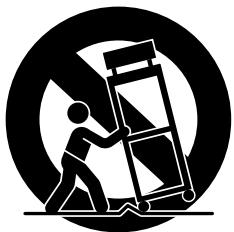
- Use only with the cart, stand, tripod, bracket, or table specified by the manufacturer, or sold with the apparatus. When a cart is used, use caution when moving the cart/apparatus combination to avoid injury from tip-over.
- Unplug this apparatus during lightning storms or when unused for long periods of time.
- Refer all servicing to qualified service personnel. Servicing is required when the apparatus has been damaged in any way, such as power-supply cord or plug is damaged, liquid has been spilled or objects have fallen into the apparatus, the apparatus has been exposed to rain or moisture, does not operate normally, or has been dropped.
The apparatus shall not be exposed to dripping or splashing and that no objects filled with liquids, such as vases, shall be placed on the apparatus.
The power indicator being unlit does not mean the apparatus is completely disconnected from the MAINS. When you need to have the apparatus completely disconnected from the MAINS, you must unplug the power cord. For that purpose, locate the apparatus in a way that secures easy access to the power cord.
NOTICE
This equipment has been tested and found to comply with the limits for a Class B digital device, pursuant to Part 15 of the FCC Rules. These limits are designed to provide reasonable protection against harmful interference in a residential installation. This equipment generates, uses and can radiate radio frequency energy and, if not installed and used in accordance with the instructions, may cause harmful interference to radio communications. However, there is no guarantee that interference will not occur in a particular installation. If this equipment does cause harmful interference to radio or television reception, which can be determined by turning the equipment off and on, the user is encouraged to try to correct the interference by one or more of the following measures:
- Reorient or relocate the receiving antenna.
- Increase the separation between the equipment and receiver.
- Connect the equipment into an outlet on a circuit different from that to which the receiver is connected.
- Consult the dealer or an experienced radio/TV technician for help.
FCC WARNING
Changes or modifications not expressly approved by the party responsible for compliance could void the user's authority to operate the equipment.
Important!
Please note the following important information before using this product.
- Before using the AD-12 Adaptor to power the unit, be sure to check the AC Adaptor for any damage first. Carefully check the power cord for breakage, cuts, exposed wire and other serious damage. Never let children use an AC adaptor that is seriously damaged.
- The product is not intended for children under 3 years.
- Use only CASIO AD-12 adaptor. The AC adaptor is not a toy.
- Be sure to disconnect the AC adaptor before cleaning the product.
This mark applies in EU countries only.

CASIO Europe GmbH Bornbarch 10, 22848 Norderstedt, Germany
General Guide E-2
Attachment of the Score Stand E-2
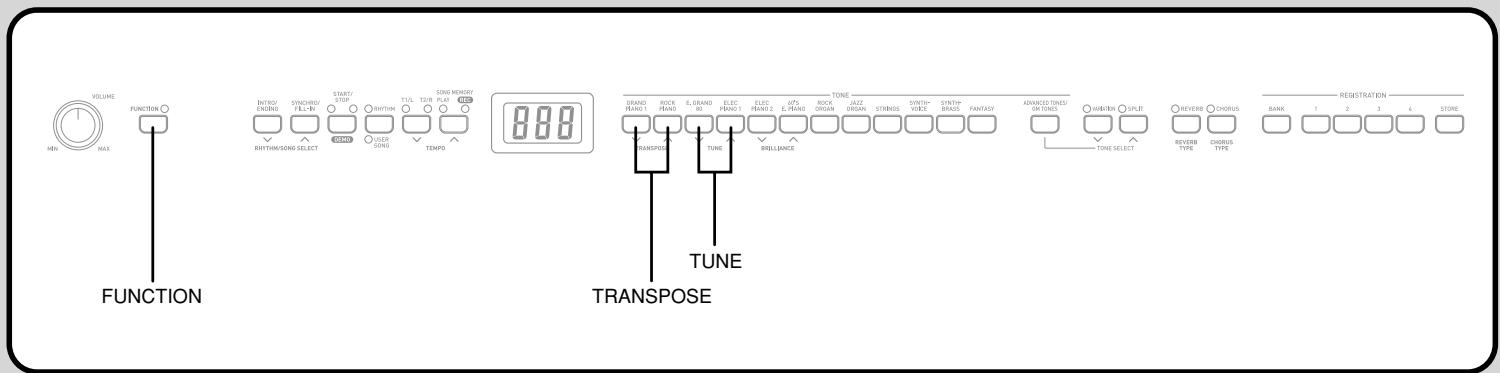
About the FUNCTION button. E-3
Numeric Input Keys and + / - Keys E-4
Playing Back All the demo Tunes E-4
Power Supply E-4
Using the AC Adaptor E-4
Connections E-5
Connecting Headphones E-5
Connecting an audio or musical instrument amplifier . E-5
Connecting to a PEDAL Jack E-6
Playing with Different Tones..... E-7
Selecting and Playing a Tone E-7
Selecting Main Tones and Variation Tones ... E-7
Selecting an Advanced Tone, GM Tone, or Drum Set E-7
Adjusting the Brilliance of a Tone E-8
Layering Two Tones. E-8
Assigning Different Tones to the Left and Right Sides of the Keyboard. E-9
Using Tone Effects E-10
Using the Piano's Pedals. E-11
Playing Rhythms......E-12
Using Auto Accompaniment. E-13
Playing Tunes You Download from the Internet .... E-16
Practicing a Tune E-17
Using Registration Memory .... E-18
What is registration memory? E-18
Recording to and Playing Back from Song Memory .E-20
Recording Your Keyboard Play. E-21
Playing Back from Song Memory .E-22
Deleting Song Memory Data E-23
Other Settings E-24
Adjusting Accompaniment Volume .E-24
Changing the Keyboard Touch E-24
Changing the Piano Key. E-25
Changing the Pitch of the Piano to Match Another Instrument E-25
Using Digital Piano Setup Memory. E-25
Using MIDI E-25
Saving the Song Data You Download from the Internet E-26
Troubleshooting. E-28
Specifications. E-29
Operational Precautions ......E-30
Locating the Unit E-30
Care of the Unit. E-30
Lithium Battery. E-30
Setting Control Key Chart ....E-31
Appendix A-1
Tone List A-1
Rhythm List. A-2
Drum Assignment List. A-3
Fingered Chord Chart. A-4
MIDI Implementation Chart
Company and product names used in this manual may be registered trademarks of others.
NOTE
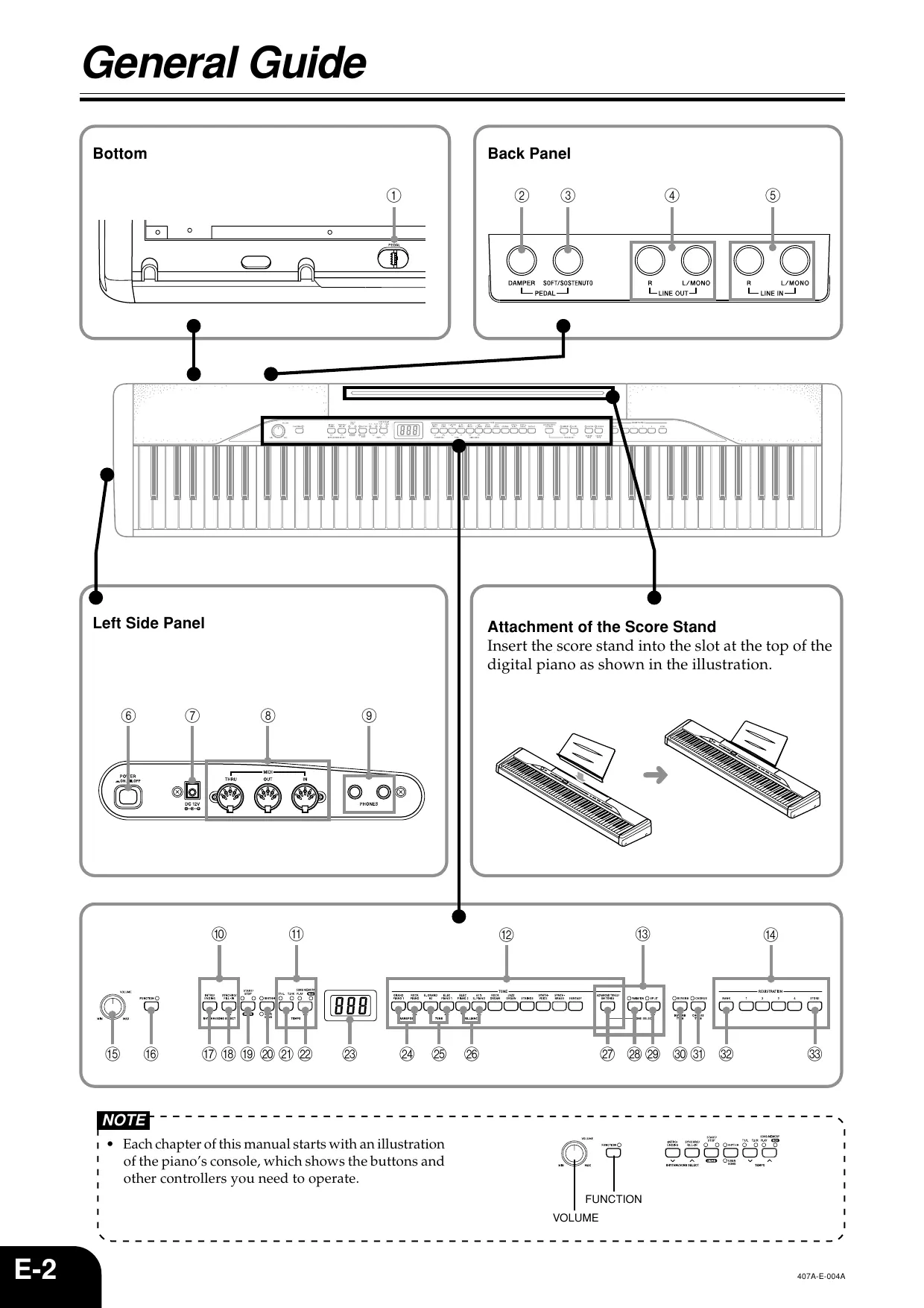
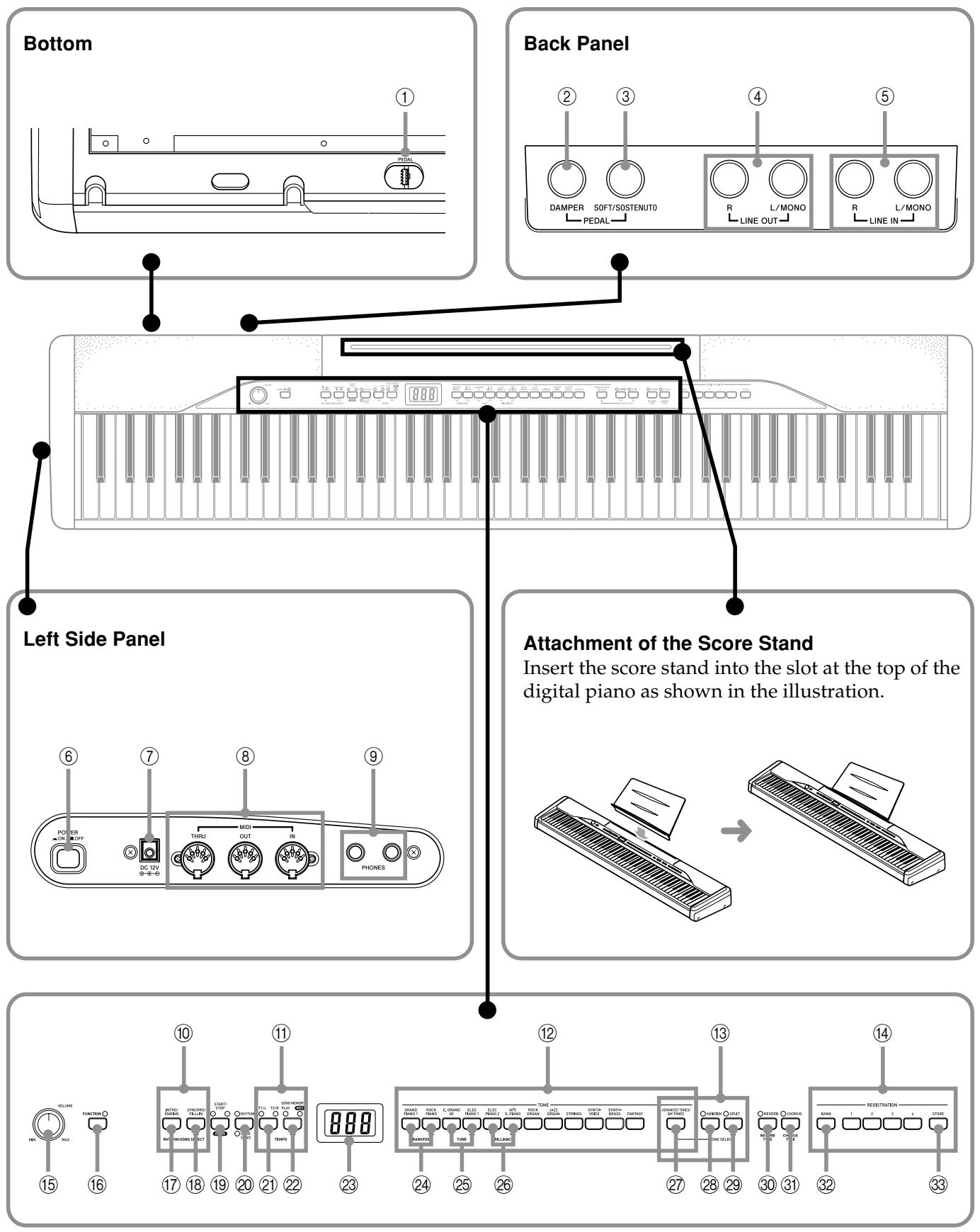
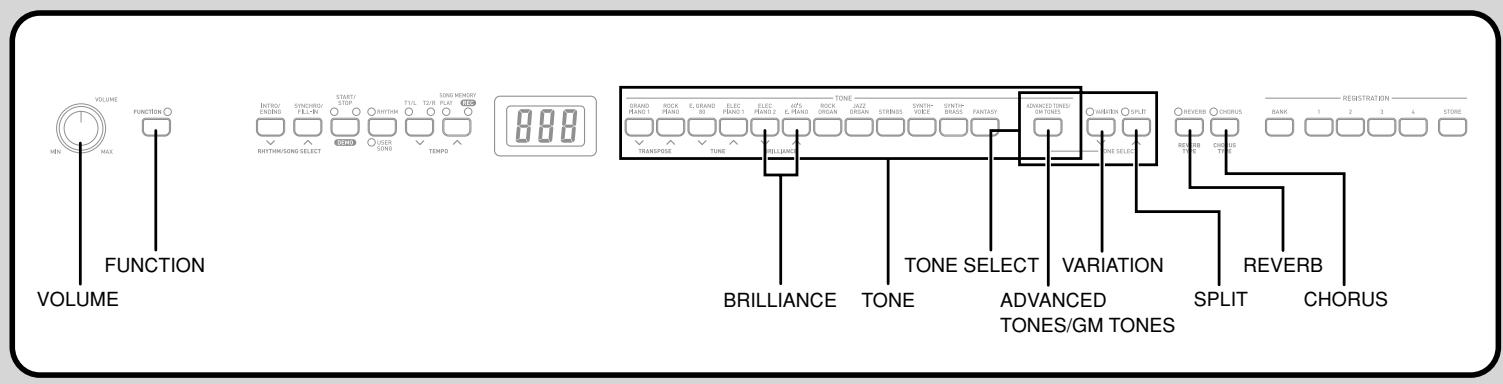
Each chapter of this manual starts with an illustration of the piano's console, which shows the buttons and other controllers you need to operate.
① PEDAL connector ② DAMPER PEDAL jack ③ SOFT/SOSTENUTO PEDAL jack LINE OUT R, L/MONO jacks LINE IN R, L/MONO jacks ⑥ POWER button ⑦ DC 12V jack ⑧ MIDI THRU/OUT/IN terminals 9 PHONES jacks 10 RHYTHM/SONG SELECT buttons ⑪ TEMPO buttons TONE buttons 13 TONE SELECT buttons ⑭ REGISTRATION buttons 15 VOLUME knob 16 FUNCTION button INTRO/ENDING button
18 SYNCHRO/FILL-IN button 19 START/STOP, DEMO button RHYTHM, USER SONG button ② T1/L T2/R button ② SONG MEMORY button 23 Display screen ②4 TRANSPOSE buttons 25 TUNE buttons 26 BRILLIANCE buttons 27 ADVANCED TONES/GM TONES button 28 VARIATION button 29 SPLIT button 30 REVERB, REVERB TYPE button ③ CHORUS, CHORUS TYPE button BANK button STORE button
NOTE
- Key, button, and other names are indicated in the text of this manual using bold type.
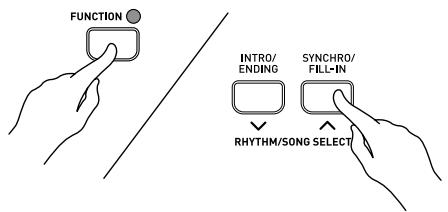
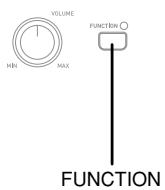
About the FUNCTION button
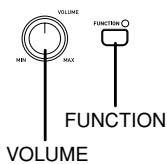
The FUNCTION button makes it possible to perform a variety of useful functions. Note the following general information about using the FUNCTION button.
- An indicator lamp above the FUNCTION button flashes while it is depressed. The lamp goes out when you release the FUNCTION button.
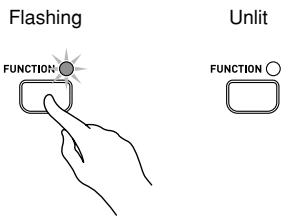
- The FUNCTION button is always used in combination with another button or keyboard key. You hold down the FUNCTION button as you press another button or keyboard key.
- The indicator lamp above the button flashes for a few seconds at high speed to let you know that the setting is complete. Example: "Adjusting the Brilliance of a Tone" on page E-8
- For details about all the keyboard key functions you can perform with the FUNCTION button, see "Setting Control Key Chart" on page E-31.
Numeric Input Keys and +/- Keys
- For a moment after you hold down the FUNCTION button and then press another button to activate a function, you can use certain keyboard keys to input numbers or to increase (+) and decrease (-) setting values.
- Since the keyboard keys operate as switches at this time, notes do not sound when you press keyboard keys.
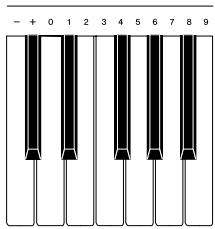
See "To adjust the tempo" on page E-12 for an actual example.
Power Supply
You can power this digital piano by plugging it into a standard household power outlet.
Be sure you turn off power and unplug the power cord from the electrical outlet whenever the digital piano is not in use.
Using the AC Adaptor
Make sure that you use only the AC adaptor specified for this digital piano.
Specified AC Adaptor: AD-12
[Left Side Panel]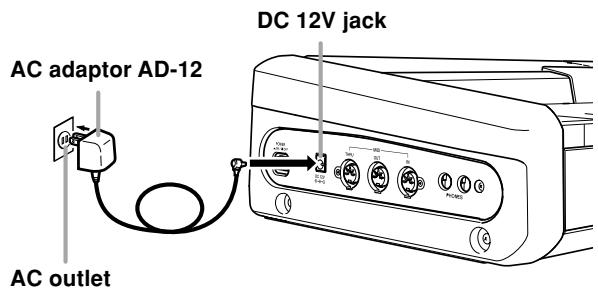
Playing Back All the demo Tunes
The following procedure plays back the demo tunes in sequence.
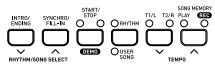
While holding down the FUNCTION button, press the DEMO button at the same time.
- This starts sequential playback of the demo tunes.
- You can play along with the demo tunes on the keyboard, if you want. Tone assigned to the keyboard is the one that is preset for the demo tune that is playing.
Press the DEMO button again to stop demo tune play.
Note the following important precautions to avoid damage to the power cord.
- During Use
- Never pull on the cord with excessive force.
- Never repeatedly pull on the cord.
- Never twist the cord at the base of the plug or connector.
- The power cord should not be stretched tight while it is in use.
- During Movement
- Before moving the keyboard, be sure to unplug the AC adaptor from the power outlet.
- During Storage
- Loop and bundle the power cord, but never wind it around the AC adaptor.
IMPORTANT!
- Make sure that the product is turned off before connecting or disconnecting the AC adaptor.
- Using the AC adaptor for a long time can cause it to become warm to the touch. This is normal and does not indicate malfunction.
IMPORTANT!
- Whenever connecting external equipment, first set the VOLUME knob of the digital piano and the volume controller of the external equipment to relatively low volume settings. You can later adjust the volume to the level you want after connections are complete.
- Be sure also to refer to the documentation that comes with the external equipment for its proper connection procedures.
Connecting Headphones
Connect commercially available headphones to the digital piano's PHONES jacks. This cuts off the built-in speakers, which means you can practice even late at night without disturbing others. To protect your hearing, make sure that you do not set the volume level too high when using headphones.
[Left Side Panel]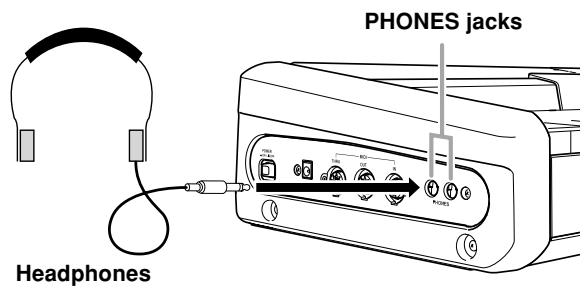
Connecting an audio or musical instrument amplifier
Connecting to an audio or musical instrument amplifier provides even clearer, more powerful sound through external speakers.
3Guitar amplifier, keyboard amplifier, etc.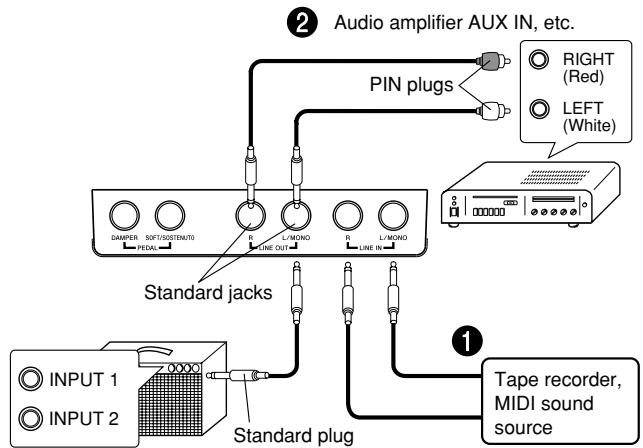
Playing Output from External Equipment through the Piano's Speakers ①
LINE IN R jack input sounds through the piano's right speaker, while LINE IN L/MONO jack input sounds through the left speaker. Connecting to the LINE IN L/MONO jack only causes the same output to be produced from both speakers. It is up to you to purchase connecting cables that are compatible with the equipment you are connecting.
Connecting to Audio Equipment ②
Use commercially available cables to connect the external audio equipment to the piano's LINE OUT jacks as shown in Figure ②. LINE OUT R jack output is right channel sound, while LINE OUT L/MONO jack output is left channel sound. It is up to you to purchase connecting cables like the ones shown in the illustration for connection of audio equipment. Normally in this configuration you must set the audio equipment's input selector to the setting that specifies the terminal (such as AUX IN) to which the piano is connected. Use the piano's VOLUME knob to adjust the volume level.
Connecting to a Musical Instrument Amplifier ③
Use commercially available cables to connect the amplifier to the piano's LINE OUT jacks as shown in Figure ③. LINE OUT R jack output is right channel sound, while LINE OUT L/MONO jack output is left channel sound. Connecting to the LINE OUT L/MONO jack only outputs a mixture of both channels. It is up to you to purchase connecting cable like the one shown in the illustration for connection of the amplifier. Use the piano's VOLUME knob to adjust the volume level.
Connecting to a PEDAL Jack
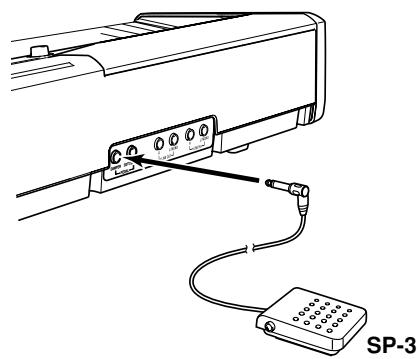
Depending on the type of operation you want the pedal (SP-3) to perform, connect the pedal's cable to the digital piano's PEDAL DAMPER jack or PEDAL SOFT/SOSTENUTO jack. If you want to use both jacks at the same time, you need to purchase another optionally available pedal.
See "Using the Piano's Pedals" on page E-11 for information about using a pedal.
[Back Panel]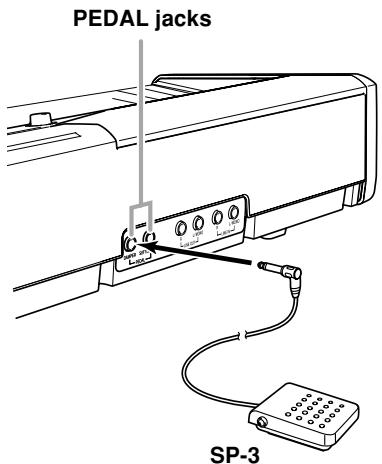
PEDAL connector
You can connect the optionally available Pedal Unit (SP-30) to the PEDAL connector. You can then use the pedals for expression that is similar to that available on an acoustic piano.
[Bottom]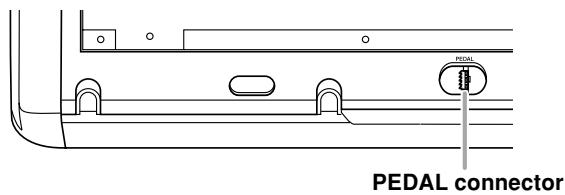
Accessories and Options
Use only the accessories and options specified for this digital piano. Use of non-authorized items creates the danger of fire, electric shock, and personal injury.
Selecting and Playing a Tone
Your piano has the following types of tones built in.
| Main Tones | 12 |
| Variation Tones | 12 |
| Advanced Tones | 40 |
| GM Tones | 128 |
| Drum Sets | 10 |
Selecting Main Tones and Variation Tones
Press the POWER button.
POWER button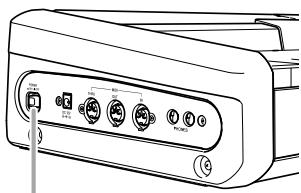
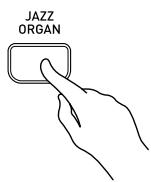
Use the VOLUME knob to adjust the volume level. Press one of the 12 TONE buttons to select the tone you want.
- The names of the main tones are marked above the TONE buttons.
Example: To select JAZZ ORGAN
4 Press the VARIATION button so the indicator lamp above it is lit.
- This selects the variation tone assigned to each TONE button. Example: CLAVI
- For information about variation tone assigned to each button, see the Tone List on page A-1.
5 To toggle between the main tone (VARIATION indicator lamp off) and variation tone (VARIATION indicator lamp on), press the VARIATION button or the TONE button.
NOTE
- Changing the main tone, variation tone or advanced tone selection causes DSP to switch automatically to the default setting for the newly selected tone. This causes any notes that are sounding at the time of the change to be interrupted momentarily. The DSP will be set to the default setting for the newly selected tone when the note resumes. (*See page E-10)
Selecting an Advanced Tone, GM Tone, or Drum Set
You can use the following procedure to assign one of the piano's 40 Advanced Tones, 128 GM tones, or 10 drum sets to the ADVANCED TONES/GM TONES button.
Press the ADVANCED TONES/GM TONES button.
- This selects the tone that is currently assigned to the ADVANCED TONES/GM TONES button.
- The display continues to display the tune or rhythm number.
Use the Tone List on page A-1 to find the advanced tone, GM tone, or drum set number you want.
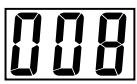
Example: 008 (MARIMBA)
3 While holding down the FUNCTION button, press the ADVANCED TONES/GM TONES button. Remember to keep the FUNCTION button depressed.
- This causes the tone number of the tone that is currently assigned to the ADVANCED TONES/ GM TONES button to appear on the display.
Example: 080 (GM VIOLIN) /
4 While holding down the FUNCTION button, use the keyboard keys shown below to input the tone number of the tone you want to assign to the ADVANCED TONES/GM TONES button.
Example: 008 (MARIMBA)
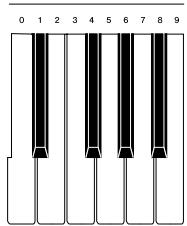
- This displays the number of the assigned tone.
After inputting the tone number you want, release the FUNCTION button to exit the GM tone setting screen.
NOTE
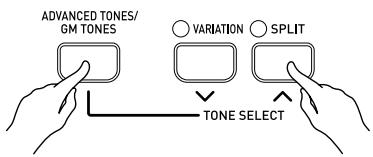
- You can also select a tone by holding down the ADVANCED TONES/GM TONES button as you use the TONE SELECT [√] and [▲] buttons to scroll through tone numbers on the display.
- The tone that you assign to the ADVANCED TONES/GM TONES button is retained until you turn off the keyboard.
- If a drum set is assigned to the ADVANCED TONES/GM TONES button, keyboard keys sound drum sounds when you press them. See page A-3 for information about the drum sounds that are assigned to each of the keyboard keys.
Selecting the ADVANCED TONES/GM TONES Button Variation Tone
To assign a variation tone to the ADVANCED TONES/GM TONES button, perform the steps under "Selecting an Advanced tone, GM Tone, or Drum Set" on page E-7. After step 1, however, press the VARIATION button so the indicator lamp above it is lit.
- After you assign a tone as the variation tone, you can select it by pressing the ADVANCED TONES/GM TONES button.
Adjusting the Brilliance of a Tone
You can adjust the clarity and sharpness of a tone to suit your music and personal preferences.
1 Holding down the FUNCTION button, press the BRILLIANCE buttons to adjust the brilliance of a tone to the level that you want.
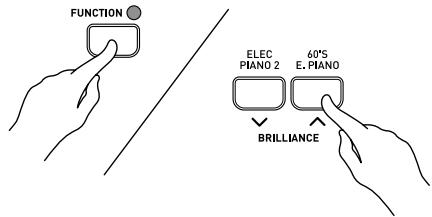
[V]: produces a more mellow sound [^]: produces a brighter sound
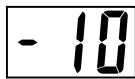
- To return the brilliance setting to its initial default, hold down the FUNCTION button and press both of the BRILLIANCE buttons at the same time.
Layering Two Tones
Use the following procedure to layer two tones, so they sound at the same time.
Of the two TONE buttons you press to layer two tones, the one on the left is the main tone, while the one on the right is the layered tone.
PREPARATION
- If you plan to use a variation tone, perform the procedure on page E-7 to select the variation tone for the applicable TONE button(s) before starting this procedure.
Simultaneously press the TONE buttons of the two tones that you want to layer.
Example: Press GRAND PIANO 1 button and STRINGS button at the same time.
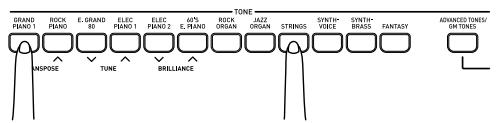
- If the layer tone is a variation tone, the indicator lamp above the VARIATION button will light.
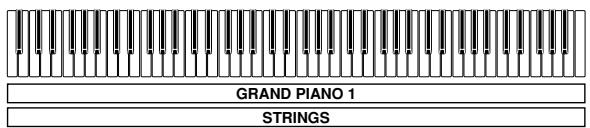
- The tones are now layered.
After you are finished using the layered tones, press one of the TONE buttons again to unlayer them.
NOTE
- Note that you cannot layer the main tone and variation tone assigned to the same TONE button.
Adjusting the Volume Balance between Two Layered Tones
While holding down the FUNCTION button, use the keyboard keys shown below to adjust the volume of the layered tones.
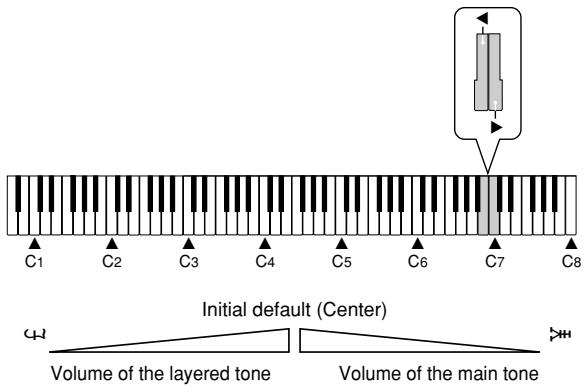
- To return the volume setting to its initial default, hold down the FUNCTION button and press both of the keys at the same time.
Assigning Different Tones to the Left and Right Sides of the Keyboard
You can assign different tones to keys on the left side and the right side of the keyboard.

Press the TONE button of the tone you want to select for the high (right) range. Example: GRAND PIANO 1. Press the SPLIT button. - This causes the SPLIT indicator lamp to light. Press the TONE button of the tone you want to select for the low (left) range. - The keyboard is now split between the two tones. Example: STRING 4. After you are finished using the split keyboard, press the SPLIT button again to unsplit it. - This causes the SPLIT indicator lamp to go out.
Specifying the Keyboard Tone Split Point
While holding down the SPLIT button, press the keyboard key where you want the left limit of the high range (right) tone to be.
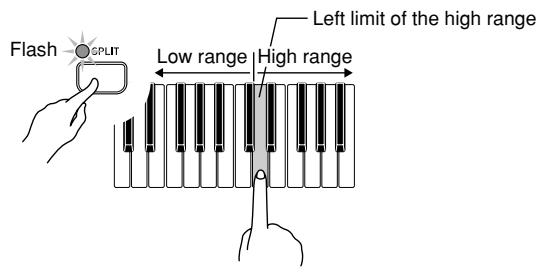
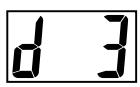
NOTE
- The split point setting also controls the point where the keyboard splits between the accompaniment keyboard (pages E-14, 15) and the melody keyboard. Moving the split point also affects the sizes of the accompaniment keyboard and the melody keyboard.
Using Tone Effects
Reverb: Makes your notes resonate
Chorus: Adds more breadth to your notes
Turning Effects On and Off
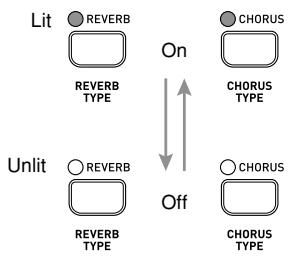
Each press of the REVERB or CHORUS button toggles the setting as shown below.
- You can determine the status of the effects by checking the REVERB and CHORUS indicator lamps.
Changing the Effect Type
There are four reverb and four chorus types.
1 Turn on the effect you want to change. 2 While holding down the FUNCTION button, press the REVERB or CHORUS button to cycle through the effect type settings as shown below.
[Reverb]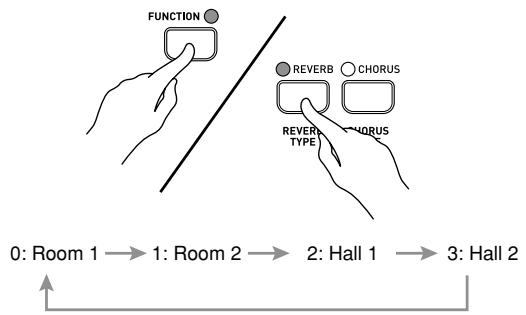
[Chorus]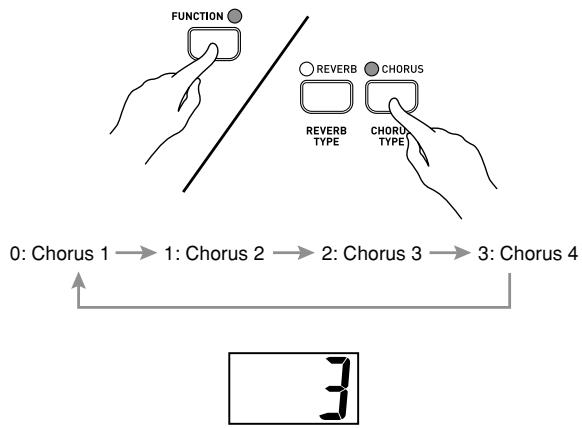
About DSP
DSP makes it possible to digitally produce complex acoustic effects.
The DSP is assigned to each tone whenever you turn on digital piano power.
Turning DSP On and Off
While holding down the FUNCTION button, press one of the keyboard keys shown below to turn DSP on or off.
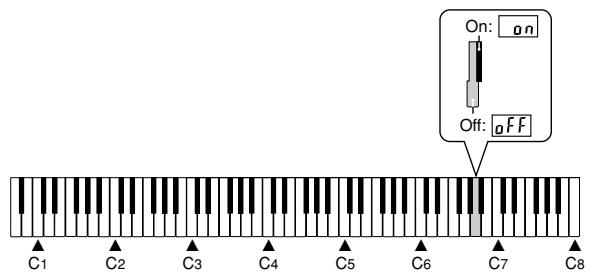
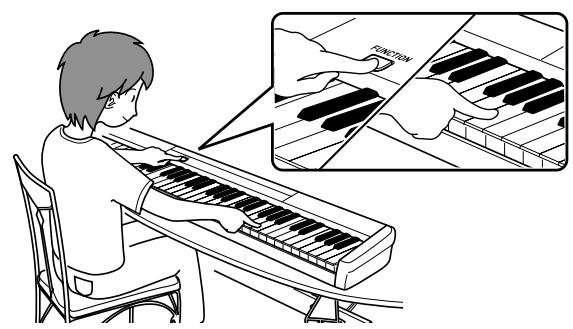
NOTE
- Under initial default settings, DSP is on for the main tone, and layer and split are turned off. DSP can be applied to only one part as shown below.
| Main Tone | Layer Tone | Split Tone | |
| Initial Defaults | On | Off | Off |
| Layer Tone DSP On | Off | On | Off |
| Split Tone DSP On | Off | Off | On |
- You can turn chorus on or off for each main tone, layer tone, and split tone part.
- You cannot turn reverb on or off for each main tone, layer tone, and split tone part.
Using the Piano's Pedals
The digital piano is equipped with two pedal jacks, one for a damper pedal and one for a soft/sostenuto pedal.
Pedal functions
- Damper Pedal
Pressing the damper pedal while playing will cause the notes you play to reverberate for a very long time. When GRAND PIANO 1 is selected as the tone, using this pedal causes notes to reverberate just like the pedal on an acoustic grand piano.
- Soft Pedal
Pressing this pedal while playing weakens notes played on the keyboard after the pedal was pressed, and makes them sound softer.
Sostenuto Pedal
Only the notes of the keys that are depressed when this pedal is pressed are sustained until the pedal is released.
Selecting the Pedal Function
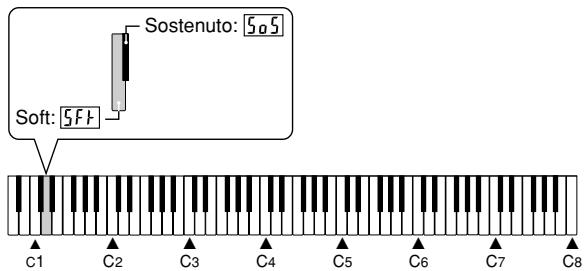
A pedal connected to the piano's PEDAL jack can operate as either a soft pedal or a sostenuto pedal. When you turn on the keyboard, the pedal is initially configured for soft pedal operation. You can perform the following operation to select either soft or sostenuto for the pedal operation.

While holding down the FUNCTION button, use the keyboard keys shown below to select either soft or sostenuto.
Adjusting the Effect Applied when the Damper Pedal is Pressed Half Way (With optional SP-30 only)
You can specify to what extent the damper effect should be applied when you press the damper pedal half way. A setting in the range of 0 (no effect) to 42 (same effect as full press) can be specified.

While holding down the FUNCTION button, press one of the keyboard keys shown below to specify the setting you want.
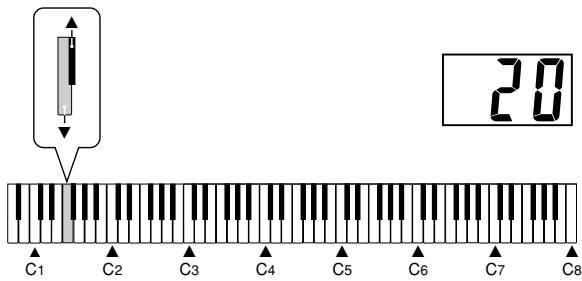
: Decreases the effect : Increases the effect
- To return the volume setting to its initial default, hold down the FUNCTION button and press both of the keys at the same time.
You can select from among 120 built-in rhythms. Rhythms 0 through 109 include percussion instrument sounds, but rhythms 110 through 119 do not. See the next page for information about how to use rhythms 110 through 119.
Press the RHYTHM button so the RHYTHM indicator lamp (above the button) is lit.
Each press of the button toggles between the upper indicator lamp and lower indicator lamp.
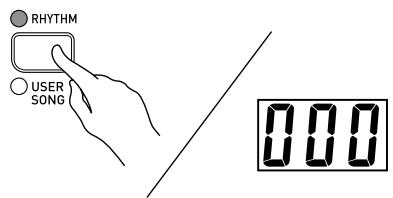
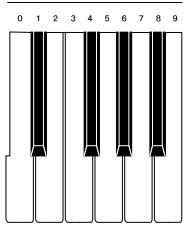
2 While holding down the FUNCTION button, use the keyboard keys shown below to input a rhythm number.
- If you want your accompaniment rhythm to include percussion instrument sounds, select a rhythm in the range of 0 through 109.
Press the START/STOP button.
- This starts the rhythm.
4 Press the START/STOP button again to stop the rhythm.
NOTE
- You can also cycle through the available rhythms in step 2 by holding down the FUNCTION button and pressing the RHYTHM/SONG SELECT [√] or [▲] button.
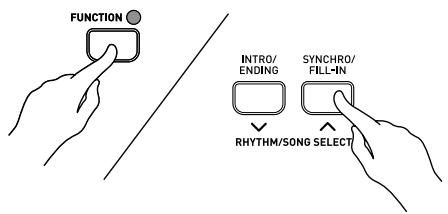
- Pressing the two RHYTHM/SONG SELECT buttons at the same time selects rhythm 0.
To adjust the tempo
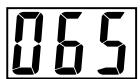
While holding down the FUNCTION button, use the TEMPO [√] and [A] buttons to change the tempo (speed).
- To return to its standard tempo setting, press the TEMPO [√] and [▲] buttons at the same time.
NOTE
- You can also use keyboard keys to change the tempo setting.
(1) While holding down the FUNCTION button, press the TEMPO button. (2) While keeping the FUNCTION button depressed, use the keyboard keys shown below to input a number.
* Tempo Range: 30 to 255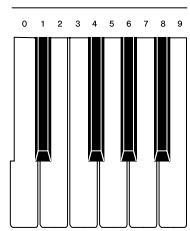
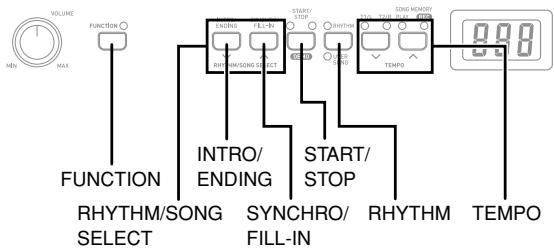

Using Auto Accompaniment
With auto accompaniment, the keyboard automatically plays rhythm, bass, and chord parts in accordance with chords you select using simplified keyboard fingerings, or chords you play. Auto accompaniment makes it feel like you have your own private backup group with you all the time.
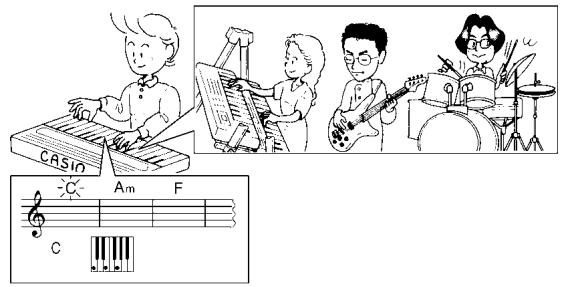
NOTE
- Rhythms 110 through 119 consist of chord accompaniments only, without any drums or other percussion instruments. These rhythms do not sound unless CASIO CHORD, FINGERED, or FULL RANGE CHORD is selected as the accompaniment mode. With such rhythms, make sure that CASIO CHORD, FINGERED, or FULL RANGE CHORD is selected before you try playing chords.
To play with auto accompaniment
PREPARATION
- Select the rhythm you want to use and adjust the tempo.

Select one of the three chord modes (MODE).
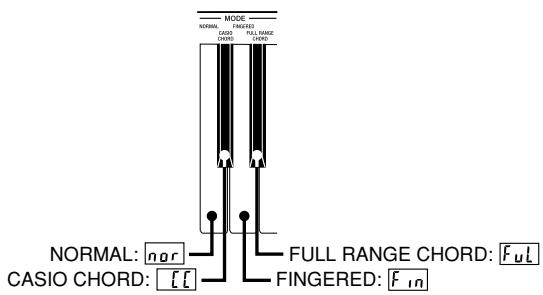
Here we will select the CASIO CHORD mode. See page E-14 for information about how to use the chord modes.

Press the SYNCHRO/FILL-IN button.
- This configures the piano so rhythm and chord accompaniment will start automatically when you press any keys within the accompaniment keyboard range.

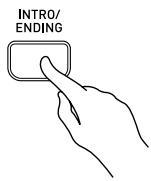
Press the INTRO/ENDING button.
- This configures the piano so accompaniment starts with an intro pattern.

Use a CASIO CHORD fingering to play the first chord within the accompaniment keyboard range.
- This will cause the intro pattern for the selected rhythm to play, followed by the auto accompaniment rhythm and chord pattern.

Use CASIO CHORD fingerings to play other chords.
- See "How to Play Chords" on page E-14 for information about how to finger chords with the various chord modes.
- You can insert a fill-in pattern while an auto accompaniment is playing by pressing the SYNCHRO/FILL-IN button. A fill-in helps to change the mood of the auto accompaniment pattern.

To stop auto accompaniment play, press the INTRO/ENDING button.
- This will play an ending pattern for the selected rhythm before stopping auto accompaniment play.
NOTE
- You can start or stop auto accompaniment play without an intro or ending pattern by pressing the START/STOP button in steps 3 and 6.
- You can adjust the volume of auto accompaniment. For more information see "Adjusting Accompaniment Volume" on page E-24.
How to Play Chords
The way you finger chords depends on the current chord mode.
■ Normal
In this mode there is no auto accompaniment, so you can play all of piano's keys for standard-fingering chords or melody notes.
CASIO CHORD
This method of chord play makes it possible for anyone to easily play chords, regardless of previous musical knowledge and experience. The following describes the CASIO CHORD "Accompaniment keyboard" and "Melody keyboard", and tells you how to play CASIO CHORDs.
CASIO CHORD Accompaniment Keyboard and Melody Keyboard
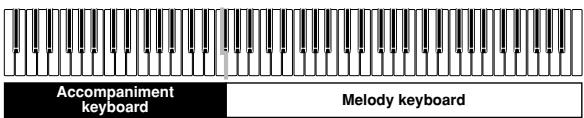
IMPORTANT!
- The accompaniment keyboard can be used for playing chords only. No sound will be produced if you try playing single melody notes on the accompaniment keyboard.
- The split point (page E-9) is the point that separates the Auto Accompaniment area and the melody area of the keyboard. You can change the location of the split point, which also changes the sizes of the keyboard areas.
Chord Types
CASIO CHORD accompaniment lets you play four types of chords with minimal fingering.
| Chord Types | Example |
| Major chords Press one accompaniment key. Note that the chord produced when you press an accompaniment keyboard key does not change octave, regardless of which key you use to play it. | C Major (C) JOYCE FERMAAB BCCODE E |
| Minor chords (m) To play a minor chord, keep the major chord key depressed and press any other accompaniment keyboard key located to the right of the major chord key. | C minor (Cm) JOYCE FERMAAB BCCODE E |
| Seventh chords (7) To play a seventh chord, keep the major chord key depressed and press any other two accompaniment keyboard keys located to the right of the major chord key. | C seventh (C7) JOYCE FERMAAB BCCODE E |
| Minor seventh chords (m7) To play a minor seventh chord, keep the major chord key depressed and press any other three accompaniment keyboard keys located to the right of the major chord key. | C minor seventh (Cm7) JOYCE FERMAAB BCCODE E |
NOTE
- It makes no difference whether you press black or white keys to the right of a major chord key when playing minor and seventh chords.
FINGERED
In this mode, you specify chords by playing them as you would on a piano, inside the accompaniment keyboard range. To specify a C-chord, you would play C-E-G.
FINGERED Accompaniment Keyboard and Melody Keyboard
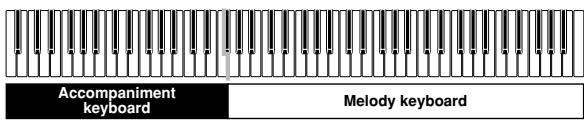
IMPORTANT!
- The accompaniment keyboard can be used for playing chords only. No sound will be produced if you try playing single melody notes on the accompaniment keyboard.
- The split point (page E-9) is the point that separates the Auto Accompaniment area and the melody area of the keyboard. You can change the location of the split point, which also changes the sizes of the keyboard areas.
C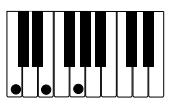
Cm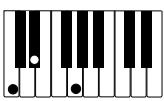
Cdim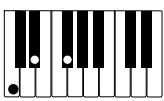
Caug *1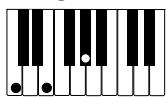
Csus4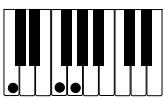
C7*2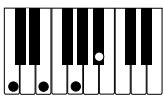
Cm7*2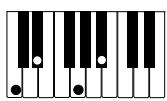
Cmaj7*2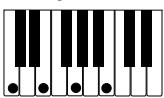
Cm7b5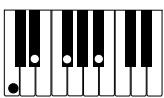
C75*1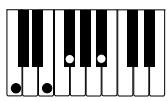
C7sus4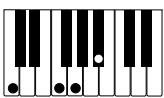
Cadd9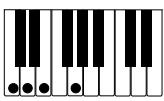
Cmadd9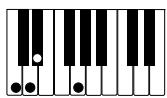
CmM7*2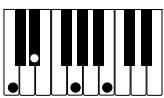
Cdim7*1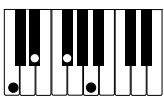
NOTE
- See the "Fingered Chord Chart" on page A-4 for details on playing chords with other roots.
1: Inverted fingerings cannot be used. The lowest note is the root. 2: The same chord can be played without pressing the 5th G.
NOTE
Except for the chords specified in note*1 above, inverted fingerings (i.e. playing E-G-C or G-C-E instead of C-E-G) will produce the same chords as the standard fingering. Except for the exception specified in note*2 above, all of the keys that make up a chord must be pressed. Failure to press even a single key will not play the desired FINGERED chord.
■ FULL RANGE CHORD
This accompaniment method makes it possible to play a total of 38 chord variations: the 15 available with FINGERED plus 23 additional variations. The keyboard interprets any input of three or more keys that matches a FULL RANGE CHORD pattern to be a chord. Any multi-key input that is not a FULL RANGE CHORD pattern is interpreted as melody play. Because of this, there is no need for a separate accompaniment keyboard, and the entire keyboard from end-to-end can be used for both melody and chords.
FULL RANGE CHORD Accompaniment Keyboard and Melody Keyboard

Chords Recognized by This Piano
The following table identifies patterns that are recognized as chords by FULL RANGE CHORD.
| Pattern Type | Number of Chord Variations |
| FINGERED | The 15 chord patterns shown under "FINGERED" on page E-14. |
| Standard Fingerings | 23 standard chord fingerings. The following are examples of the 23 chords available with C as the bass note. C6·Cm6·C69 Db/C DcE F G A b C B B C Dbm C Dm Fm Gm Am B m Ddim C Ab7 F7 Fm7 Gm7 A badd9 C C C C C C |
Example: To play the chord C major and C/E.
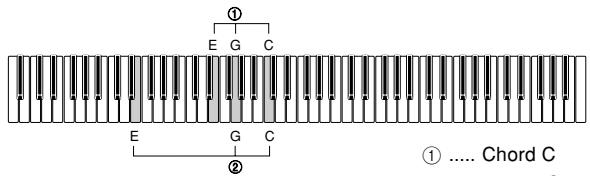
① ....Chord C ②....Chord C
NOTE
- If there are more than six semitones between the lowest note and the next note to the right, the lowest note is interpreted as a bass note.
Playing Tunes You Download from the Internet
You can save music data for up to 10 tunes you download from the Internet to the digital piano's user song area (No. 0 through 9). Once you store a song in digital piano memory, you can play it back using the following procedure.

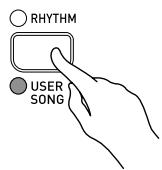
Press the USER SONG button so the USER SONG indicator lamp (below the button) is lit.
Each press of the button toggles between the upper indicator lamp and lower indicator lamp.

While holding down the FUNCTION button, press the keyboard keys shown below to input a tune number.
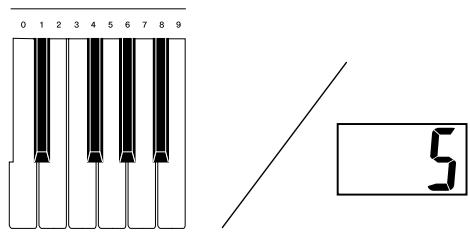

Press the START/STOP button.
- This starts the playback of the tune.

Press the START/STOP button again to stop tune playback.
NOTE
- You can also cycle through the available tunes in step 2 by holding down the FUNCTION button and pressing the RHYTHM/SONG SELECT [√] or [▲] button.
- Pressing the two RHYTHM/SONG SELECT buttons at the same time selects tune 0.
- You cannot use layer or split while playing a tune.
SONG SELECT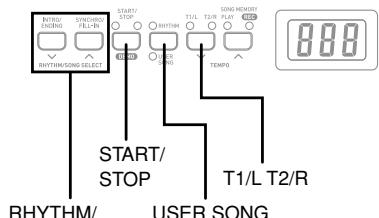

Practicing a Tune
You can turn off the left hand part or right hand part of the user song and play along on the digital piano. With song data, the left-hand part is assigned to MIDI Channel 3, while the right-hand part is assigned to MIDI Channel 4.
PREPARATION
- Select the tune you want to practice and adjust the tempo (See "To adjust the tempo" on page E-12).
- The maximum tempo setting for each tune is double the initial default tempo of the tune.
- A number of tunes have tempo changes part way through in order to produce specific musical effects.
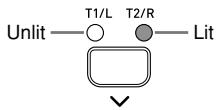
1 Use the T1/L T2/R button to turn parts on or off. - The indicator lamps above the button show the current on/off status of the parts.
Press the START/STOP button. - This starts playback of the tune, without the part you selected in step 1.
3 Play the missing part on the piano's keyboard. 4 Press the START/STOP button again to stop song playback.
What is registration memory?
Registration memory lets you save up to 32 (4 areas × 8 banks) digital piano setups (tone, rhythm, tempo, etc.) for instant recall whenever you need them.
Registration Memory Setup Data
The following are the settings that can be saved for each registration memory setup.
- Tone Rhythm
- Tempo
- Layer setting
- Split setting
- Split point Effect setting DSP setting
- Brilliance setting
- Accompaniment Volume
- Transpose setting
- Pedal function setting
- Damper pedal setting
- SYNCHRO/FILL-IN button setting
- MODE setting
NOTE
- All of the registration memory banks are preset with default data.
- Registration memory functions are disabled while you are using the User Song, Song Memory or demo tune function.
How registration memory organizes its data
Registration memory has four banks, and each bank contains four areas. Use the BANK button to select a bank, and the REGISTRATION buttons to select an area.
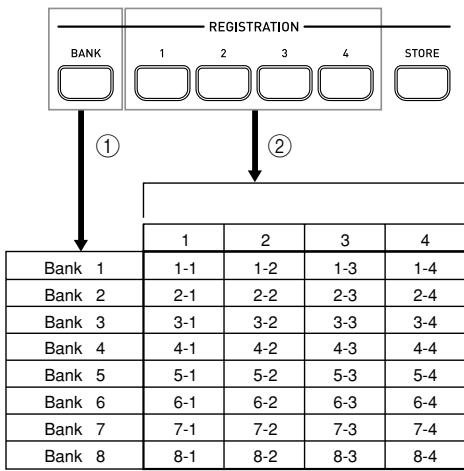
① Each press of the BANK button cycles through the bank numbers, from 1 to 8. (2) Pressing a REGISTRATION button (1 to 4) selects the corresponding area in the currently selected bank.
NOTE
- Storing a new setup to a registration memory area replaces the setup that was previously stored there.
To store a setup in registration memory
On the digital piano, configure the tone, rhythm, and other settings you want to save as your setup.
- See "Registration Memory Setup Data" (page E-18) for more information.
Use the BANK button to select the registration memory bank where you want to save the setup.
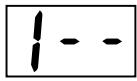
- This causes the number of the selected bank to appear on the display for about two seconds. If you do not perform the following step within that time, the bank selection screen will disappear.
Example: Bank 1 selected
WARNING
- The following step will replace the setup currently in the area you select with the new setup. Make sure you do not need the current setup before performing the next step.
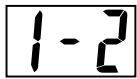
3 While holding down the STORE button, press the REGISTRATION button (1 to 4) that corresponds to the area where you want to store the setup.
- You can also change the bank selection at this time by pressing the BANK button while holding down the STORE button.
Example: After button 2 is pressed
4 Release the REGISTRATION and STORE buttons.
To recall a setup from registration memory
1 Use the BANK button to select the registration memory bank that contains the setup you want to recall.
- This causes the number of the selected bank to appear on the display for about two seconds. If you do not perform the following step within that time, the bank selection screen will disappear.
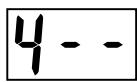
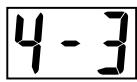
Press the REGISTRATION button (1 to 4) for the area that contains the setup you want to recall.
NOTE
- If you press a REGISTRATION button without selecting a bank first, the digital piano will recall the setup from the applicable area in the bank you previously last selected.
Registration memory contents are retained even when you turn off the digital piano power (page E-25).
Recording to and Playing Back from Song Memory
You can store the notes you play in Song Memory for later playback.
NOTE
- You cannot use layer or split with Song Memory record operation.
Tracks
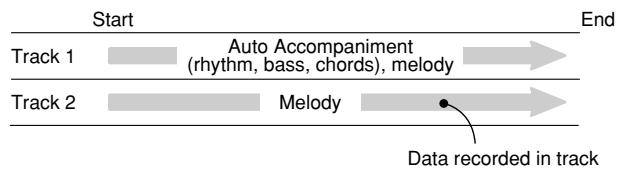
The song memory of this piano records and plays back notes much like a standard tape recorder. There are two tracks, each of which can be recorded separately. Besides notes, each track can be assigned its own tone number. During playback you can adjust the tempo to change the speed of playback.
Song Memory Capacity
- You can store a total of up to about 10,000 notes (Track 1 + Track 2) in Song Memory.
- Recording stops automatically if the number of notes in Song Memory exceeds the maximum while you are recording. This is indicated by the REC indicator lamp turning off.
Other Song Memory Data
The following data is included when recording to Song Memory: keyboard play, selected tone, tempo setting (Track 1 only), pedal operations, reverb and chorus settings, DSP on/off setting, brilliance setting, accompaniment volume setting, selected rhythm (Track 1 only), chord mode (Track 1 only), and intro/fill-in/ending control (Track 1 only).
Recorded Data Storage
This digital piano has a lithium battery to supply power to retain memory contents even while power is off.* The life of the lithium battery is five years after the date of manufacture of the digital piano. Be sure to contact your CASIO service provider about having the lithium battery replaced every five years.
- Never turn off piano power while a record operation is in progress.
IMPORTANT!
- If the data recorded in a single track uses up all the available Song Memory capacity, you will not be able to record anything in the other track.
- Recording new data to a track automatically deletes any data previously stored in that track.
- Turning off power while a record operation is in progress deletes anything recorded up to that point.
- CASIO COMPUTER CO., LTD. shall not be held responsible for any losses by you or any third party due to loss of data caused by malfunction or repair of this digital piano, or by battery replacement.
SONG MEMORY Button Operation
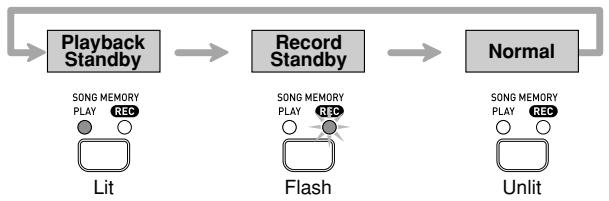
Each press of the SONG MEMORY button cycles through the functions shown below.

Recording Your Keyboard Play
You can record to either track with or without playback of the other track.
To record to one track without playing back the other
When recording a different tune to Track 2 after recording to Track 1, make sure you carefully read the notes under steps 1 and 2 before actually performing the steps.

Press the SONG MEMORY button so the PLAY indicator lamp is lit.
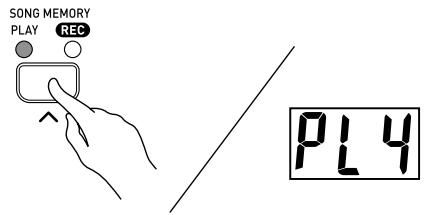
- Select the tone and effects you want to use in your recording, and configure the tempo settings.
NOTE
- If you are recording a different tune to Track 2 after recording to Track 1, press the T1/L T2/R button to turn off the TRACK 1/LEFT indicator lamp.

Press the SONG MEMORY button so the REC indicator lamp is flashing.
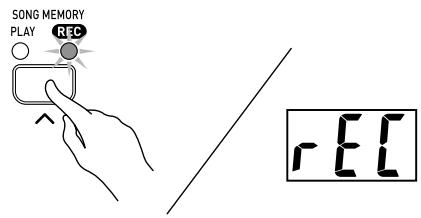
- At this time the TRACK 1/LEFT indicator lamp should also be flashing. This indicates that the piano is standing by for recording to Track 1.
NOTE
- If you want to record to Track 2, press the T1/L T2/R button here. This will cause the TRACK2/ RIGHT indicator lamp to flash, which indicates that the piano is standing by for recording to Track 2.
- If you want to use a rhythm and/or auto accompaniment during recording (to Track 1 only), select the rhythm and chord mode.

Start playing something on the keyboard.
- This will automatically start recording.
- Actually, there are a variety of different ways to start the record operation. See "Starting the Record Operation" below for more information.

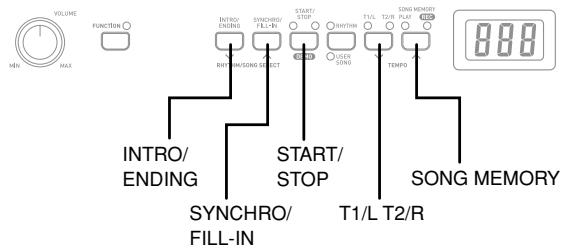
When you are finished, press the START/ STOP button to stop recording.
- If you are using a rhythm, you can stop recording with an ending pattern by pressing the INTRO/ENDING button.
- Stopping recording causes the REC indicator lamp to go out, and the indicator lamp above the button of the track to which you recorded to light.
- To play back the track you just recorded, press the START/STOP button again.

After you are finished recording or playing back, press the SONG MEMORY button so the PLAY lamp or REC lamp turns off.
Starting the Record Operation
You can use any of the following methods to start a record operation in step 2 of the above procedure.
■ When recording to Track 1 with rhythm or auto accompaniment
- Press the START/STOP button to start recording.
- Press the SYNCHRO/FILL-IN button to put the piano into synchro start standby. Recording will start when you finger a chord in the accompaniment range of the keyboard.
- Press the INTRO/ENDING button to put the piano into synchro start standby. Recording will start and an intro pattern will play when you finger a chord in the accompaniment range of the keyboard.
■ When recording to Track 1 without rhythm or auto accompaniment - Recording will start as soon as you play anything on the keyboard. When recording to Track 2 - Press the START/STOP button or play something on the keyboard to start recording.
To record to a track while playing back from the other
After you finish recording, you can play back Track 1 and Track 2 at the same time.
Example: To record to Track 2 while playing back the contents of Track 1
Press the SONG MEMORY button so the PLAY indicator lamp is lit.
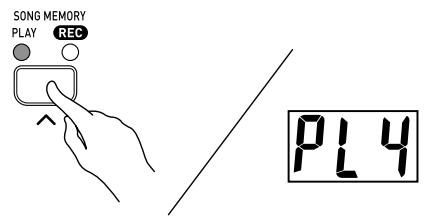
- Select the tone and effects you want to use while recording.
Press the T1/L T2/R button so the TRACK 1/LEFT indicator is lit.
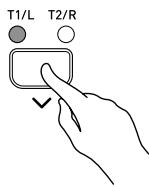
Press the SONG MEMORY button again.
- This causes the TRACK 1/LEFT indicator lamp to flash. Press the T1/L T2/R button so that the TRACK 2/RIGHT indicator lamp flashes, indicating that the piano is standing by for recording to Track 2. 4. Press the START/STOP button or play something on the keyboard to start simultaneous playback from Track 1 and recording to Track 2. When you are finished, press the START/STOP button again to stop recording.
Playing Back from Song Memory
Press the SONG MEMORY button so the PLAY indicator lamp is lit.

Use the T1/L T2/R button to select the track you want to play back.
- The indicator lamps above the button show the currently selected track.
- To play back Track 1, the TRACK 1/LEFT indicator lamp should be lit.
- To play back Track 2, the TRACK 2/RIGHT indicator lamp should be lit.
- To play back Track 1 and Track 2, both indicator lamps should be lit.
Press the START/STOP button.
- This starts playback of the track you selected.
- You can change the tempo setting as a track is playing.
- You cannot change the tone setting during playback.
- Press the START/STOP button again to stop playback.
Deleting Song Memory Data
IMPORTANT!
- The procedure below deletes all of the data from the selected track. Note that the delete operation cannot be undone. Check to make sure you really do not need the data in Song Memory before you perform the following steps.
Press the SONG MEMORY button so the REC indicator lamp is flashing.
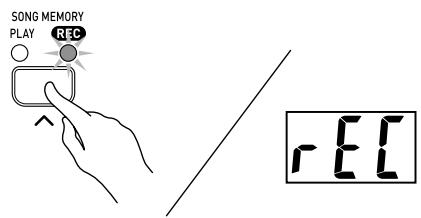
Use the T1/L T2/R button to select the track you want to delete.
- The indicator lamps above the button show the currently selected track.
- To delete Track 1, the TRACK 1/LEFT indicator lamp should be flashing.
- To delete Track 2, the TRACK 2/RIGHT indicator lamp should be flashing.
Hold down the SONG MEMORY button until the REC indicator lamp stops flashing and remains lit.
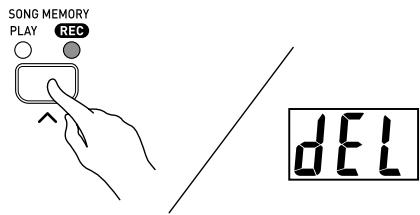
4 Press the T1/L T2/R button.
- This deletes the selected track and enters the standby state.
Adjusting Accompaniment Volume
Perform the following operation to change the volume level of the rhythm and chord accompaniment.

While holding down the FUNCTION button, use the keyboard keys shown below to raise (▲) or lower (▼) the accompaniment volume.
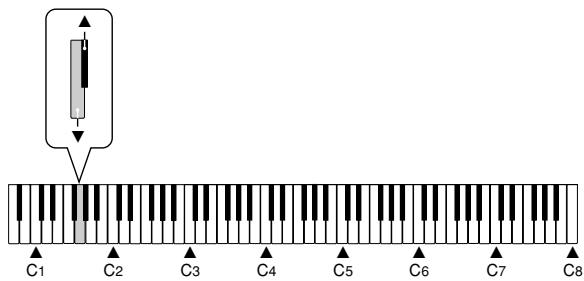
△: Raises the accompaniment volume ▽: Lowers the accompaniment volume
Changing the Keyboard Touch
This setting changes the relative touch of the keyboard keys.

While holding down the FUNCTION button, press one of the keyboard keys shown below.
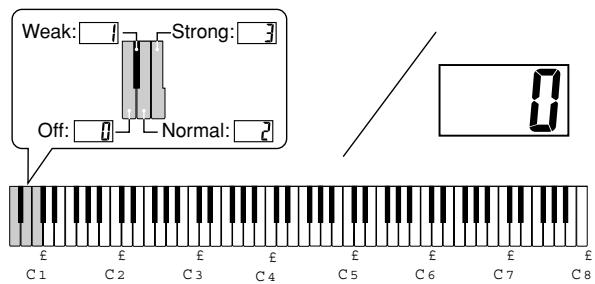
Off
Weak (Strong sound is produced even when relatively light pressure is applied.)
Normal
Strong (Normal sound is produced even when relatively strong pressure is applied.)
Changing the Piano Key
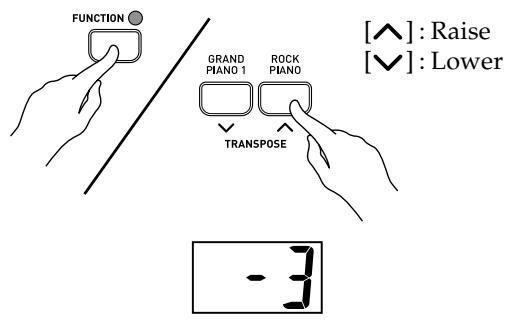
Use this setting to raise or lower the overall key of the keyboard in semitone steps.

Holding down the FUNCTION button, press the TRANSPOSE buttons to raise or lower the overall key of the keyboard.
NOTE
- To return the piano key to C, hold down the FUNCTION button and press the TRANSPOSE [√] and [▲] buttons at the same time. After using Transpose to raise the keyboard to a high key, notes played at the highest range of the keyboard may not sound properly for certain tones.
Changing the Pitch of the Piano to Match Another Instrument
Use this setting to raise or lower the overall pitch of the piano. The setting range is plus or minus 50 cents (100 cents = 1 semitone) from the standard pitch of A4 = 440.0 Hz.

Holding down the FUNCTION button, press the TUNE buttons to raise or lower the overall pitch of the piano.
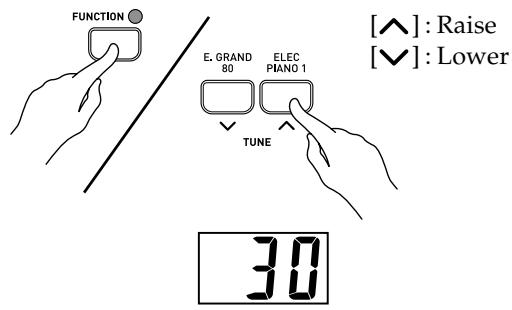
- Each press of the button changes the current setting by approximately 1 cent (1/100 semitone).
NOTE
- Holding down the FUNCTION button and pressing the TUNE buttons [√] and [▲] at the same time returns tuning to the standard A4 = 440.0Hz.
Using Digital Piano Setup Memory
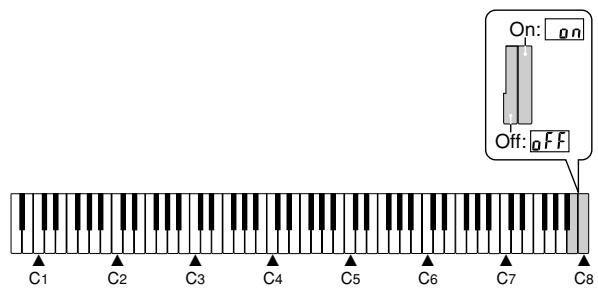
When setup memory is turned on, the digital piano will remember its setup* whenever you turn it off. If you turn off setup memory, settings will be cleared when you turn off the digital piano.
■Turning off the digital piano while in the rhythm mode
The next time you turn on the digital piano, non-local control setting (see "Using MIDI" below) will be configured in accordance with setup memory.
- Turning off the digital piano while in the user song mode
The next time you turn on the digital piano, the following settings will be configured in accordance with setup memory.
Rhythm selection, accompaniment volume, keyboard touch, pedal type, damper pedal setting, layered tone volume balance, split point, send channel, accomp MIDI out

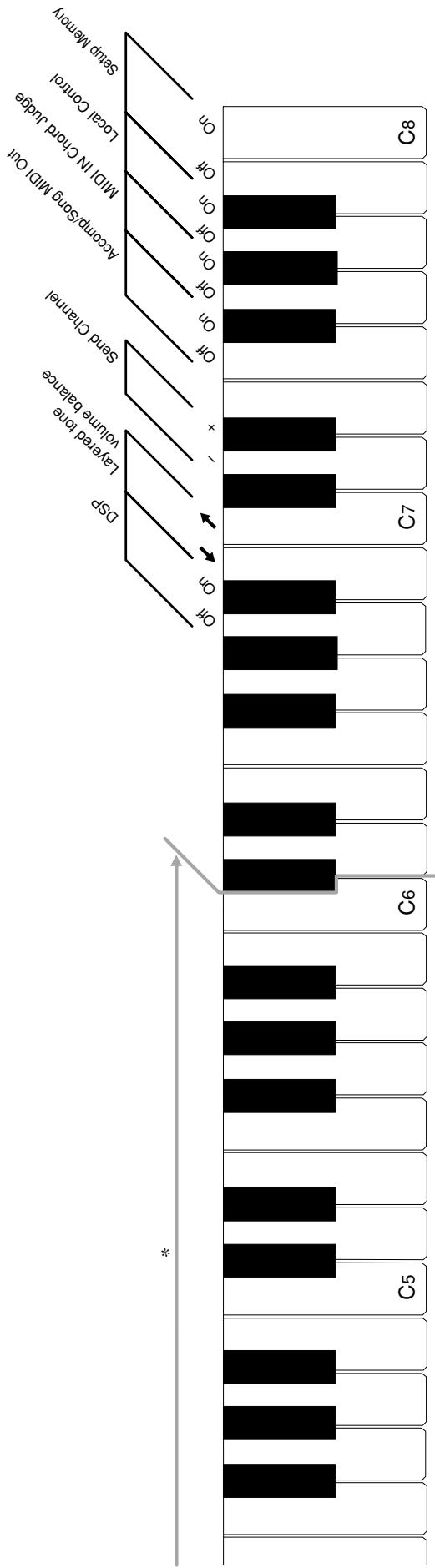
While holding down the FUNCTION button, press one of the keyboard buttons shown below to turn setup memory on or off.
Using MIDI
What is MIDI?
The letters MIDI stand for Musical Instrument Digital Interface, which is the name of a worldwide standard for digital signals and connectors that makes it possible to exchange musical data between musical instruments and computers (machines) produced by different manufacturers.
NOTE
- For detailed information about MIDI Implementation, visit the CASIO website at: http://world.casio.com/.
MIDI Connections
To use a computer or other MIDI device to record and playback the MIDI data produced by this keyboard, you must connect the MIDI IN and MIDI OUT terminals of both devices in order to send and receive data.
There is a third MIDI terminal named MIDI THRU, which passes any MIDI messages received by the MIDI IN terminal on to another device.
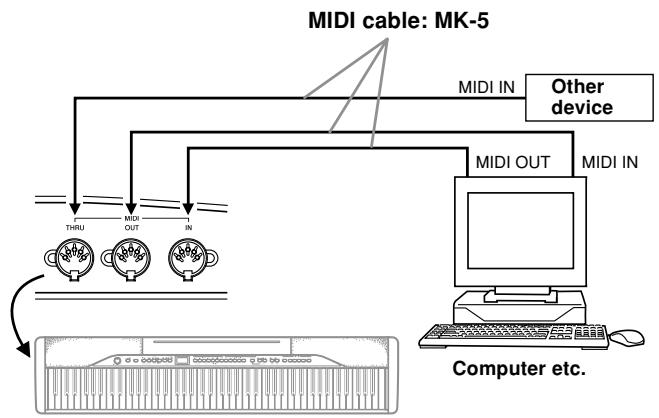
MIDI Settings
1 Send Channel
Use this setting to specify one of the MIDI channels (1 through 16) as the Send Channel for sending MIDI messages to an external device.
2 Accomp/Song MIDI Out
Use this setting to specify whether or not MIDI messages for the piano's auto accompaniment and song memory playback should be sent.
MIDI IN Chord Judge
Specifies whether chord judge should be performed on accompaniment range MIDI Note On messages received from an external device.
Local Control
This setting controls whether or not power is cut off internally from the piano's keyboard and sound source. Turning off Local Control cuts off power to the keyboard and source, which means that the piano does not produce any sound when played. This comes in handy when you want to turn off the piano's keyboard and use its auto accompaniment feature to accompany an external sequencer or other device.
While holding down the FUNCTION button, press one the keyboard keys shown below to configure the setting you want.
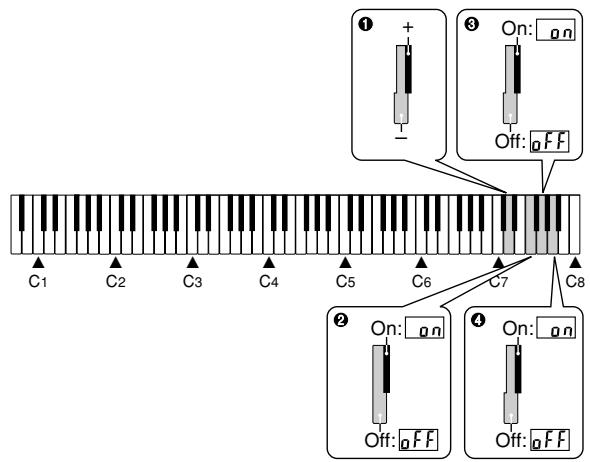
1 Send Channel
- : Decreases value +: Increases value
Accomp/Song MIDI Out
Off
On
MIDI IN Chord Judge
Off
On
Local Control
Off
On
Saving the Song Data You Download from the Internet
You can transfer song data from your computer to the digital piano. You can store up to 10 tunes as user songs 0-9. For SMF data you purchase or create, you need to use an SMF Converter to convert it to SMF 0 format before transferring it to the digital piano.
To install the SMF Converter

On the computer to which you plan to connect, install the SMF Converter that comes on the CD-ROM that comes bundled with the digital piano.
- On the CD-ROM, double-click "SMFConv-e.exe", and then follow the instructions that appear on your computer screen to install SMF Converter.
- Before installing SMF Converter, be sure to read the contents of the "smfreadme.txt" file in each language folder on the CD-ROM. For information about using SMF Converter, double-click "index.html" in the [help] folder, which was created when you installed SMF Converter. You can also access user documentation from the Windows [Start] menu by clicking [Programs] - [CASIO] - [SMF Converter] - [manual].
- A browser that supports frames (like Internet Explorer 4 or Netscape Navigator 4.04 or higher) is required to view the SMF Converter manual.
Minimum Computer System Requirements
- Operating System:
Windows 98SE
Windows Me
Windows XP
- Storage: At least 10MB free HDD space
- MIDI interface
- You can also obtain a copy of the SMF Converter by downloading it at the Web page shown below. After downloading, install the software on your computer.
CASIO MUSIC SITE
http://music.casio.com/
- In addition to the software itself, the CASIO MUSIC SITE will also provide you with information about its installation and use. You can also find out about the latest news about your digital piano and other CASIO musical instruments, and much more.
To connect to a computer
Be sure to turn off the digital piano and your computer before connecting them. You should also set the volume controller of the digital piano to a relatively low volume.

Connect the digital piano's MIDI interface to your computer's MIDI interface.
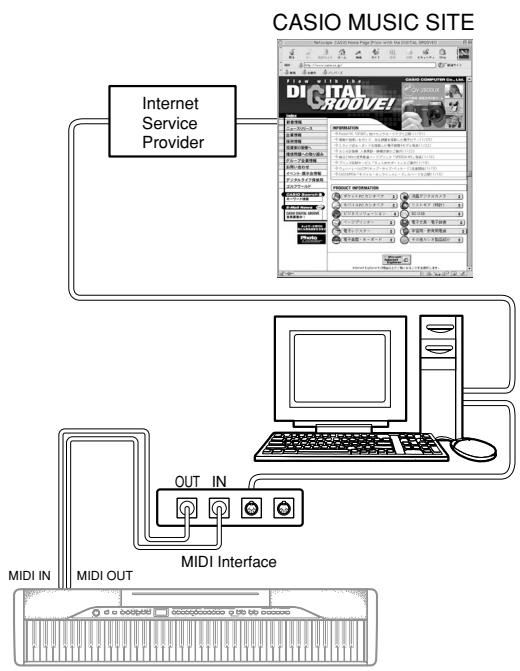

Turn on the digital piano, and then turn on your computer or other connected device.

Start up the software you want to use on your computer.
NOTE
- Performing a digital piano operation while transferring data between it and a computer may interrupt the data transfer. Do not perform any digital piano operations while data transfer is in progress.
| Symptom | Possible Cause | Action | Reference |
| No sound produced when keyboard keys are pressed. | 1. VOLUME knob set to MIN.2. Headphones connected to the digital piano.3. Local Control turned off.4. Check the current accompaniment mode setting. Normally, the accompaniment keyboard will not produce any note while CASIO CHORD or FINGERED is selected as the accompaniment mode. | 1. Move the VOLUME knob more towards MAX.2. Disconnect the headphones from the digital piano.3. Turn on Local control.4. Change the accompaniment mode to NORMAL. | Page E-7Page E-5Page E-26Page E-14 |
| Keyboard out of tune. | 1. The piano key is set to a value other than C.2. Incorrect pitch setting of the piano. | 1. Change the piano key setting to C, or turn the digital piano power off and then back on again.2. Correct the pitch setting, or turn the digital piano power off and then back on again. | Page E-25Page E-25 |
| No sound produced by demo tune play. | 1. VOLUME knob set to MIN.2. Headphones connected to the digital piano. | 1. Move the VOLUME knob more towards MAX.2. Disconnect the headphones from the digital piano. | Page E-7Page E-5 |
| Memory contents deleted. | Lithium battery is dead. | Contact your CASIO Service Provider for replacement of the lithium battery. | Page E-30 |
| No sound produced by connected external MIDI sound source when the digital piano keys are pressed. | 1. The digital piano Send Channel does not match the Send Channel of the MIDI sound source.2. Volume or expression setting of the external sound source is set to 0. | 1. Change the Send Channel settings so they are identical.2. Change the volume or expression setting of the external sound source to an appropriate value. | Page E-26See the documentation that comes with the external sound source. |
| A tone's quality and volume sounds slightly different depending where it is played on the keyboard. | This is an unavoidable result of the digital sampling process,* and does not indicate malfunction.* Multiple digital samples are taken for the low range, middle range, and high range of the original musical instrument. Because of this, there may be a very slight difference in tonal quality and volume between sample ranges. | ||
| Model: | PX-310 | ||
| Keyboard: | 88 piano keys (with touch response) | ||
| Polyphony: | 32 notes, maximum | ||
| Tones: | 12 panel tones + 12 variation tones + 40 advanced tones + 128 GM tones + 10 drum sets; with layer, split | ||
| Digital Effects: | Reverb (4 types), Chorus (4 types), DSP, Brilliance | ||
| Demo Tunes: | Sequential looping of all 3 tunes (Original) | ||
| Auto Accompaniment: | Number of Rhythms: 120 Tempo Range: 30 to 255 Controllers: START/STOP, INTRO/ENDING, SYNCHRO/FILL-IN Modes: Normal, CASIO CHORD, FINGERED, FULL RANGE CHORD Accompaniment Volume: Adjustable | ||
| User Songs: | Number of Tunes: 10 tunes maximum (Approximately 145 KB*) * Based on 1 KB = 1024 bytes Part On/Off: Left hand, right hand | ||
| Song Memory: | Operations: Real-time recording, playback Capacity: Approximately 10,000 notes (2 tracks total) Memory Backup: Built-in lithium battery (Battery Life: 5 years) | ||
| Registration Memory: | Number of Memory Areas: 32 (4 sets × 8 banks) | ||
| Pedals: | Damper, Soft/Sostenuto (Selectable) | ||
| Other Functions: | Touch: 3 types, off Transpose: 1 octave (F# to C to F) Tuning: A4 = 440.0Hz ±50 cents (adjustable) | ||
| MIDI: | 16 multi-timbre receive | ||
| Input/Output: | Headphones: Stereo mini jacks × 2 Pedal: Standard jacks × 2 LINE OUT (R)(L/MONO): Standard jacks × 2 Output impedance: 2.3kΩ Output voltage: 1.0V (RMS) MAX LINE IN (R)(L/MONO): Standard jacks × 2 Input impedance: 9.0kΩ Input voltage: 200mV Power: 12V DC MIDI (THRU) (OUT) (IN) Pedal connector (for optional SP-30 only) | ||
| Speakers: | (12cm × 6cm OVAL) × 2 + φ5cm × 2 (Output: 8.0W + 8.0W) | ||
| Power Supply: | AC Adaptor: AD-12 | ||
| Power Consumption: | 12V --- 18W | ||
| Dimensions: | 132.3 × 27.8 × 13.2cm (52 1/16 × 10 15/16 × 5 3/16 inch) | ||
| Weight: | Approximately 11.9 kg (26.2 lbs) | ||
- Design and specifications are subject to change without notice.
Locating the Unit
Avoid the following locations.
- Areas exposed to direct sunlight and high humidity
- Areas subjected to very low temperatures
- Near a radio, TV, video deck, or tuner (unit can cause interference with audio or video signals)
Care of the Unit
- Never use benzene, alcohol, thinner or other such chemicals to clean the exterior of the unit.
- To clean the keyboard, use a soft cloth dampened with a weak solution of a mild neutral detergent and water. Wring out all excess moisture from the cloth before wiping.
Lithium Battery
This unit is equipped with a lithium battery to provide power needed to retain memory contents while unit power is turned off. Should the lithium battery go dead, all memory contents will be lost whenever you turn unit power off. The normal life of the lithium battery is five years from the time that the battery was installed. Be sure to periodically contact your retailer or authorized service provider to have the lithium battery replaced. Note that you will be charged separately for lithium battery replacement.
- Note that CASIO COMPUTER CO., LTD. shall not be held liable for any damages or losses or any claims by third parties arising from corruption or loss of data caused by malfunction or repair of the unit, or from battery replacement.
You may notice lines in the finish of the case of this product. These lines are the result of the molding process used to shape the plastic of the case. They are not cracks or breaks in the plastic, and are no cause for concern.
NOTE
- Unauthorized reproduction of this manual in its entirety or in part is expressly forbidden. All rights reserved.
- CASIO COMPUTER CO., LTD. shall not be held liable for any damages or losses or any claims by third parties arising from use of this product or this manual.
- The contents of this manual are subject to change without notice.
While the FUNCTION button is depressed, the keyboard keys can be used to perform a variety of different setting functions. - A value next to a note name indicates the relative position of the note on the keyboard as shown below. * The notes of the keys sound when pressed, even if the FUNCTION button is depressed.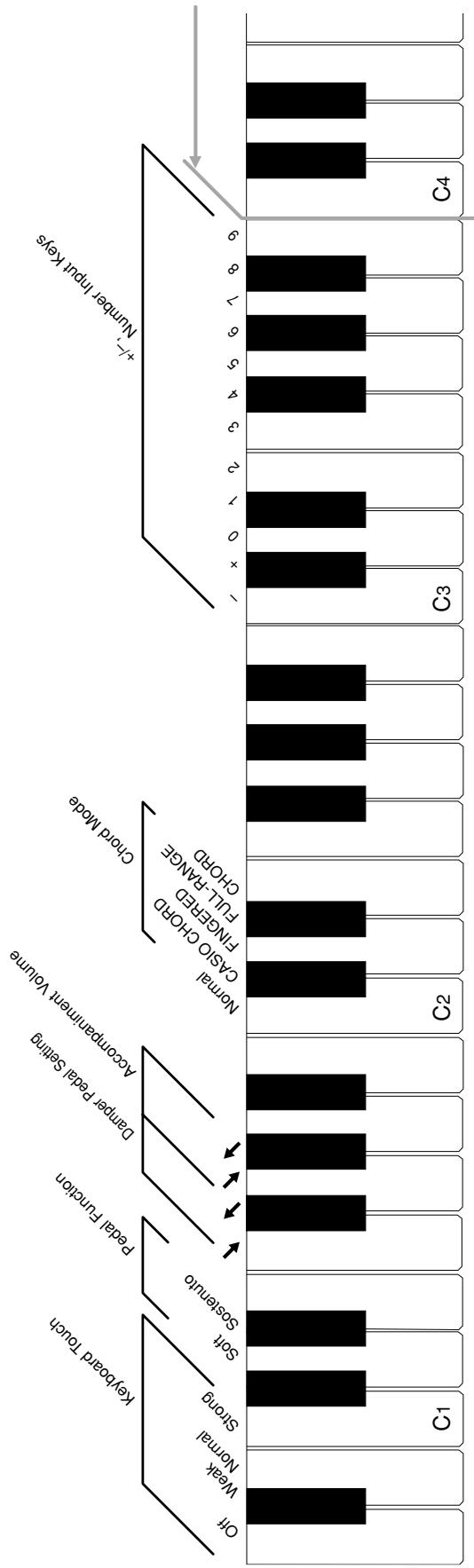
Tone List/Lista de sonidos
- Rhythms 110 through 119 consist of chord accompaniments only, without any drums or other percussion instruments. These rhythms do not sound unless CASIO CHORD, FINGERED, or FULL RANGE CHORD is selected as the accompaniment mode. With such rhythms, make sure that CASIO CHORD, FINGERED, or FULL RANGE CHORD is selected before you try playing chords.
NOTA
Mode 1: OMNI ON, POLY
Mode 2: OMNI ON, MONO
O: Yes
Mode 3: OMNI OFF, POLY
Mode 4: OMNI OFF, MONO
X: No

This recycle mark indicates that the packaging conforms to the environmental protection legislation in Germany.
- IMPORTANT SAFETY INSTRUCTIONS
- NOTICE
- FCC WARNING
- IMPORTANT
- GENERAL GUIDE E
- POWER SUPPLY E
- CONNECTIONS E
- PLAYING WITH DIFFERENT TONES..... E
- PLAYING RHYTHMS......E
- PLAYING TUNES YOU DOWNLOAD FROM THE INTERNET .... E
- USING REGISTRATION MEMORY .... E
- RECORDING TO AND PLAYING BACK FROM SONG MEMORY .E
- OTHER SETTINGS E
- TROUBLESHOOTING. E
- SPECIFICATIONS. E
- OPERATIONAL PRECAUTIONS ......E
- SETTING CONTROL KEY CHART ....E
- APPENDIX A
- MIDI IMPLEMENTATION CHART
- NOTE
- ABOUT THE FUNCTION BUTTON
- NUMERIC INPUT KEYS AND +/- KEYS
- POWER SUPPLY
- USING THE AC ADAPTOR
- SPECIFIED AC ADAPTOR: AD
- PLAYING BACK ALL THE DEMO TUNES
- DURING USE
- DURING MOVEMENT
- DURING STORAGE
- CONNECTING HEADPHONES
- CONNECTING AN AUDIO OR MUSICAL INSTRUMENT AMPLIFIER
- PLAYING OUTPUT FROM EXTERNAL EQUIPMENT THROUGH THE PIANO'S SPEAKERS ①
- CONNECTING TO AUDIO EQUIPMENT ②
- CONNECTING TO A MUSICAL INSTRUMENT AMPLIFIER ③
- CONNECTING TO A PEDAL JACK
- PEDAL CONNECTOR
- ACCESSORIES AND OPTIONS
- SELECTING AND PLAYING A TONE
- SELECTING MAIN TONES AND VARIATION TONES
- SELECTING AN ADVANCED TONE, GM TONE, OR DRUM SET
- SELECTING THE ADVANCED TONES/GM TONES BUTTON VARIATION TONE
- ADJUSTING THE BRILLIANCE OF A TONE
- LAYERING TWO TONES
- PREPARATION
- ADJUSTING THE VOLUME BALANCE BETWEEN TWO LAYERED TONES
- ASSIGNING DIFFERENT TONES TO THE LEFT AND RIGHT SIDES OF THE KEYBOARD
- SPECIFYING THE KEYBOARD TONE SPLIT POINT
- USING TONE EFFECTS
- TURNING EFFECTS ON AND OFF
- CHANGING THE EFFECT TYPE
- ABOUT DSP
- TURNING DSP ON AND OFF
- USING THE PIANO'S PEDALS
- PEDAL FUNCTIONS
- DAMPER PEDAL
- SOFT PEDAL
- SOSTENUTO PEDAL
- SELECTING THE PEDAL FUNCTION
- ADJUSTING THE EFFECT APPLIED WHEN THE DAMPER PEDAL IS PRESSED HALF WAY (WITH OPTIONAL SP-30 ONLY)
- TO ADJUST THE TEMPO
- USING AUTO ACCOMPANIMENT
- TO PLAY WITH AUTO ACCOMPANIMENT
- PRESS THE SYNCHRO/FILL-IN BUTTON
- PRESS THE INTRO/ENDING BUTTON
- HOW TO PLAY CHORDS
- NORMAL
- CASIO CHORD
- CASIO CHORD ACCOMPANIMENT KEYBOARD AND MELODY KEYBOARD
- CHORD TYPES
- FINGERED
- FINGERED ACCOMPANIMENT KEYBOARD AND MELODY KEYBOARD
- FULL RANGE CHORD
- FULL RANGE CHORD ACCOMPANIMENT KEYBOARD AND MELODY KEYBOARD
- CHORDS RECOGNIZED BY THIS PIANO
- PLAYING TUNES YOU DOWNLOAD FROM THE INTERNET
- PRACTICING A TUNE
- WHAT IS REGISTRATION MEMORY
- REGISTRATION MEMORY SETUP DATA
- HOW REGISTRATION MEMORY ORGANIZES ITS DATA
- TO STORE A SETUP IN REGISTRATION MEMORY
- WARNING
- TO RECALL A SETUP FROM REGISTRATION MEMORY
- RECORDING TO AND PLAYING BACK FROM SONG MEMORY
- TRACKS
- SONG MEMORY CAPACITY
- OTHER SONG MEMORY DATA
- RECORDED DATA STORAGE
- SONG MEMORY BUTTON OPERATION
- RECORDING YOUR KEYBOARD PLAY
- TO RECORD TO ONE TRACK WITHOUT PLAYING BACK THE OTHER
- STARTING THE RECORD OPERATION
- WHEN RECORDING TO TRACK 1 WITH RHYTHM OR AUTO ACCOMPANIMENT
- TO RECORD TO A TRACK WHILE PLAYING BACK FROM THE OTHER
- PLAYING BACK FROM SONG MEMORY
- DELETING SONG MEMORY DATA
- ADJUSTING ACCOMPANIMENT VOLUME
- CHANGING THE KEYBOARD TOUCH
- OFF
- CHANGING THE PIANO KEY
- CHANGING THE PITCH OF THE PIANO TO MATCH ANOTHER INSTRUMENT
- USING DIGITAL PIANO SETUP MEMORY
- USING MIDI
- WHAT IS MIDI
- MIDI CONNECTIONS
- MIDI SETTINGS
- SEND CHANNEL
- ACCOMP/SONG MIDI OUT
- MIDI IN CHORD JUDGE
- LOCAL CONTROL
- SAVING THE SONG DATA YOU DOWNLOAD FROM THE INTERNET
- TO INSTALL THE SMF CONVERTER
- MINIMUM COMPUTER SYSTEM REQUIREMENTS
- CASIO MUSIC SITE
- TO CONNECT TO A COMPUTER
- LOCATING THE UNIT
- CARE OF THE UNIT
- LITHIUM BATTERY
- TONE LIST/LISTA DE SONIDOS
- NOTA
Brand : CASIO
Model : PX-310
Category : Digital piano