GM-D515 - Receiver PIONEER - Free user manual and instructions
Find the device manual for free GM-D515 PIONEER in PDF.


User questions about GM-D515 PIONEER
0 question about this device. Answer the ones you know or ask your own.
Ask a new question about this device
Download the instructions for your Receiver in PDF format for free! Find your manual GM-D515 - PIONEER and take your electronic device back in hand. On this page are published all the documents necessary for the use of your device. GM-D515 by PIONEER.
USER MANUAL GM-D515 PIONEER
5 channel power amplifier
In case of trouble 2
About This Product 2
CAUTION 2
WARNING 2
Setting the Unit 3
Gain Control and Bass Level Control .... 3
BFC (Beat Frequency Control) Switch ..... 3
Cut Off Frequency Control 3
Power Indicator 4
HPF (High-Pass Filter)
Select Switch (CH A and CH B) 4
Connecting the Unit 5
Connection Diagram 6
Connecting the Power Terminal 7
Connecting the Speaker Output Terminals ..... 8
Connecting the Speaker wires 9
Installation 11
Example of installation on the floor mat or on the chassis 11
Specifications 12
Thank you for purchasing this PIONEER product. Before attempting operation, be sure to read this manual.
In case of trouble
When the unit does not operate properly, contact your dealer or the nearest authorized PIONEER Service Station.
About This Product
This product is a 5-channel Class D amp. Connect full range speakers to channels A and B, and a subwoofer to the SUB channel.
For the SUB channel, if both L (left) and R (right) are connected to the RCA input, output is a mixture of the L and R signals.

CAUTION
Never replace the fuse with one of greater value or rating than the original fuse. Use of an improper fuse could result in overheating and smoke and could cause damage to the product and injury including burns.
WARNING
- Always use the special red battery and ground wires ([RD-223] × 2), which are sold separately. Connect the battery wire directly to the car battery positive terminal (+) and the ground wire to the car body.
- Do not touch the amplifier with wet hands. Otherwise you may get an electric shock. Also, do not touch the amplifier when it is wet.
- For traffic safety and to maintain safe driving conditions, keep the volume low enough so that you can still hear normal traffic sound.
- Check the connections of the power supply and speakers if the fuse of the separately sold battery wire or the amplifier fuse blows. Detect the cause and solve the problem, then replace the fuse with another one of the same size and rating.
- To prevent malfunction of the amplifier and speakers, the protective circuit will cut the power supply to the amplifier (sound will stop) when an abnormal condition occurs. In such a case, switch the power to the system OFF and check the connection of the power supply and speakers. Detect the cause and solve the problem.
- Contact the dealer if you cannot detect the cause.
- To prevent an electric shock or short-circuit during connection and installation, be sure to disconnect the negative (−) terminal of the battery beforehand.
- Confirm that no parts are behind the panel when drilling a hole for installation of the amplifier. Be sure to protect all cables and important equipment such as fuel lines, brake lines and the electrical wiring from damage.
- DO NOT allow amplifier to come into contact with liquids due to, for example, the location where the amplifier is installed. Electrical shock could result. Also, amplifier and speaker damage, smoke, and overheating could result from contact with liquids. In addition, the amplifier surface and the surface of any attached speakers could become hot to the touch and minor burns could result.
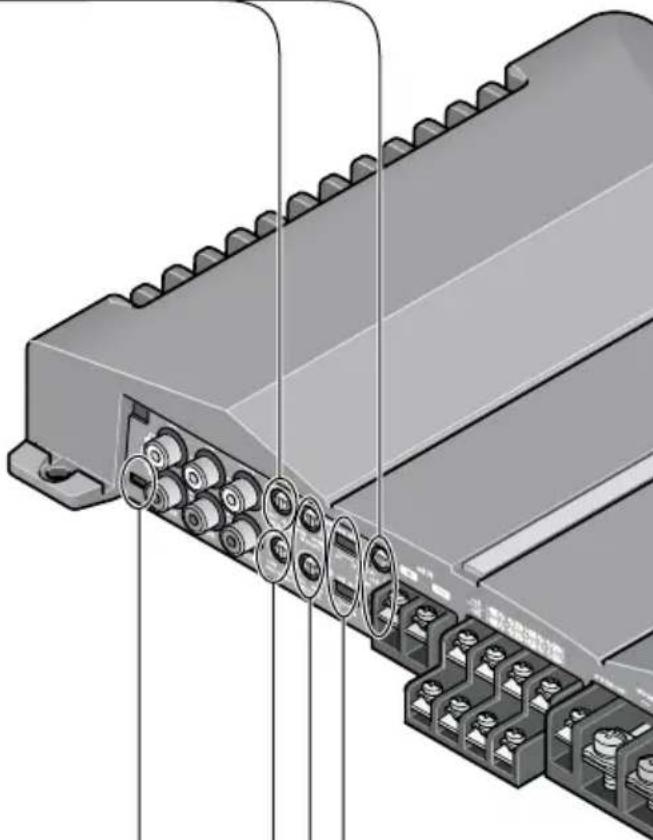
Gain Control and Bass Level Control
Adjusting the gain controls A and B and the bass level control (CH SUB) will help match the output of the car stereo to the Pioneer amplifier. Normally, set these controls to the “NORMAL (NORM.)” position. If the output is low, even when the volume of the car stereo is turned up, turn these controls clockwise. If there is distortion when the volume of the car stereo is turned up, turn these controls counter-clockwise.
- If you only use one input plug, set the gain controls for speaker outputs A and B to the same position.
- When using with an RCA equipped car stereo (standard output of 500 mV), set to the NORMAL position. When using with an RCA equipped Pioneer car stereo with max. output of 4 V or more, adjust level to match the car stereo output level.
- When you want to boost bass, turn the bass level control clockwise.
natural_image
3D diagram of an electronic device with multiple ports and connectors, no visible text or symbolsBFC (Beat Frequency Control) Switch
If you hear a beat while listening to an MW/LW broadcast with your car stereo, change the BFC switch using a small standard tip screwdriver.
Cut Off Frequency Control
You can select a cut off frequency from 40 to 240 Hz.
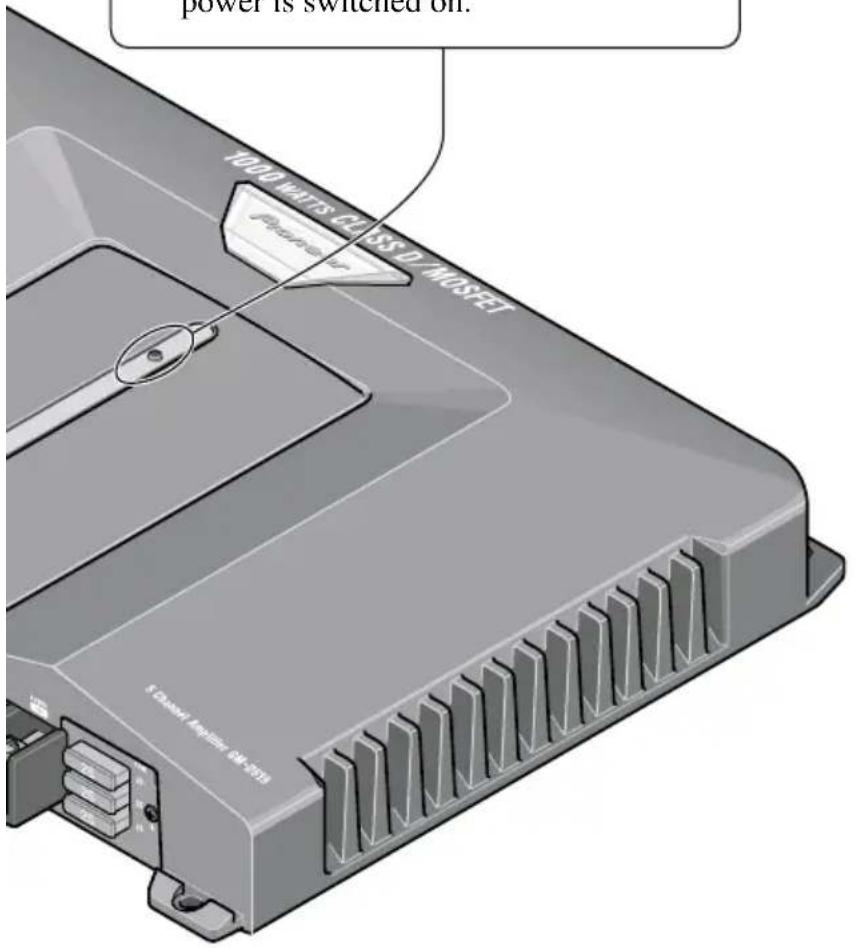
Power Indicator
The power indicator lights when the power is switched on.
text_image
power is switched on. 1000 MHz CLASS D/MOSFET 5 GHz Ampere (6k-703)HPF (High-Pass Filter) Select Switch (CH A and CH B)
Set the HPF select switch as follows according to the type of speaker that is connected to the speaker output connector and the car stereo system:
HPF Select Audio frequency range Speaker Remarks Switch to be output Type
OFF (Left) Full range Full range
HPF (Right) Low Frequency range to Full range Use if you want to cut the High Frequency range very low frequency range
because it is not necessary for the speakers you are using.

CAUTION
- Disconnect the negative (−) terminal of the battery to avoid the risk of short-circuit and damage to the unit.
- Secure the wiring with cable clamps or adhesive tape. To protect the wiring, wrap adhesive tape around it where they lie against metal parts.
-
Do not route wires where they will get hot, for example where the heater will blow over them. If the insulation heats up, it may become damaged, resulting in a short-circuit through the vehicle body.
-
Make sure that wires will not interfere with moving parts of the vehicle, such as the gearshift, handbrake or seat sliding mechanism.
- Do not shorten any wires. Otherwise the protection circuit may fail to work when it should.
- Never feed power to other equipment by cutting the insulation of the power supply wire to tap from the wire. The current capacity of the wire will be exceeded, causing overheating.
- Never replace the fuse with one of greater value or rating than the original fuse. Use of an improper fuse could result in overheating and smoke and could cause damage to the product and injury including burns.

CAUTION:
To prevent damage and/or injury
- Do not ground the speaker wire directly or connect a negative (-) lead wire for several speakers.
- This unit is for vehicles with a 12-volt battery and negative grounding. Before installing it in a recreational vehicle, truck or bus, check the battery voltage.
- If the car stereo is kept on for a long time while the engine is at rest or idling, the battery may go dead. Turn the car stereo off when the engine is at rest or idling.
-
If the system remote control wire of the amplifier is connected to the power terminal through the ignition switch (12 V DC), the amplifier will always be on when the ignition is on—regardless of whether the car stereo is on or off. Because of this, the battery could go dead if the engine is at rest or idling.
-
Speakers to be connected to the amplifier should conform with the standards listed below. If they do not conform, they may catch fire, emit smoke or become damaged. The speaker impedance must be 4 to 8 ohms. Subwoofer impedance must be from 2 to 8 ohms.
• Install and route the separately sold battery wire as far away as possible from the speaker wires. Install and route the separately sold battery wire, ground wire, speaker wires and the amplifier as far away as possible from the antenna, antenna cable and tuner. - Cords for this product and those for other products may be different colors even if they have the same function. When connecting this product to another product, refer to the supplied manuals of both products and connect cords that have the same function.
Speaker Channel Speaker Type Power
| Channel A (CH A) Other than subwoofer Max. input: Min. 100 W |
| Channel B (CH B) Other than subwoofer Max. input: Min. 100 W |
| Channel subwoofer Subwoofer Nominal input:(CH SUB) Min. 178 W (4 ΩDrive) |
Min. 338 W (2 ΩDrive)
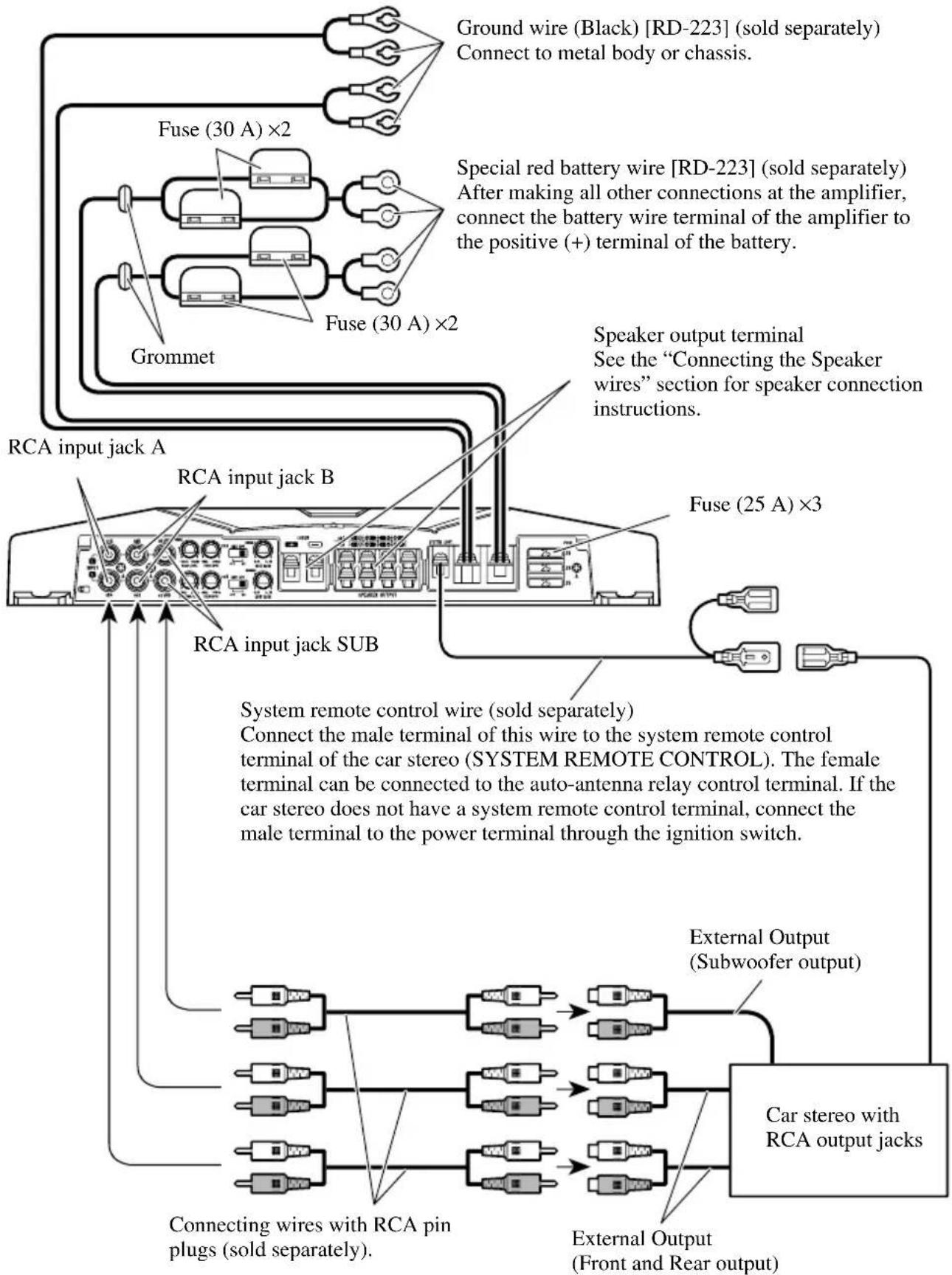
Connection Diagram
flowchart
graph TD
    A["Ground wire (Black) [RD-223"] (sold separately) Connect to metal body or chassis.] --> B["Fuse (30 A) ×2"]
    B --> C["Grommet"]
    C --> D["RCA input jack A"]
    D --> E["RCA input jack B"]
    E --> F["Fuse (25 A) ×3"]
    F --> G["External Output (Subwoofer output)"]
    G --> H["Car stereo with RCA output jacks"]
    H --> I["Connecting wires with RCA pin plugs (sold separately)."]
    I --> J["External Output (Front and Rear output)"]
    J --> K["System remote control wire (sold separately) Connect the male terminal of this wire to the system remote control terminal of the car stereo (SYSTEM REMOTE CONTROL). The female terminal can be connected to the auto-antenna relay control terminal. If the car stereo does not have a system remote control terminal, connect the male terminal to the power terminal through the ignition switch."]
    style A fill:#f9f,stroke:#333
    style B fill:#ccf,stroke:#333
    style C fill:#cfc,stroke:#333
    style D fill:#fcc,stroke:#333
    style E fill:#cff,stroke:#333
    style F fill:#ffc,stroke:#333
    style G fill:#fcc,stroke:#333
    style H fill:#fff,stroke:#333
    style I fill:#ccf,stroke:#333
    style J fill:#cfc,stroke:#333
    style K fill:#fcc,stroke:#333
Connecting the Power Terminal
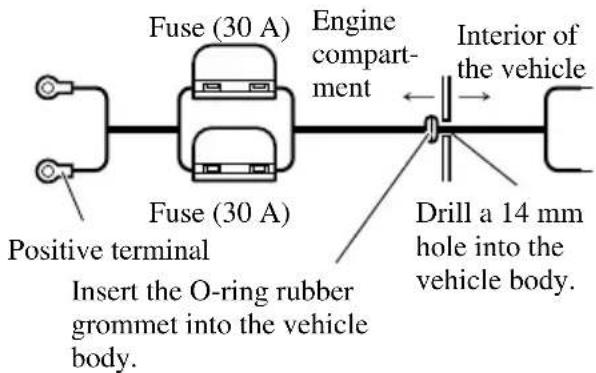
- Always use the special red battery and ground wires ([RD-223] × 2), which are sold separately. Connect the battery wire directly to the car battery positive terminal (+) and the ground wire to the car body.
1. Pass the battery wire from the engine compartment to the interior of the vehicle.
• After making all other connections to the amplifier, connect the battery wire terminal of the amplifier to the positive (+) terminal of the battery.
text_image
Fuse (30 A) Engine compartment Interior of the vehicle Positive terminal Insert the O-ring rubber grommet into the vehicle body. Drill a 14 mm hole into the vehicle body.2. Twist the battery wire, ground wire and system remote control wire.
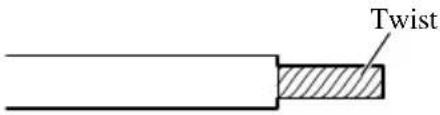
text_image
Twist3. Attach lugs to wire ends. Lugs not supplied.
- Use pliers, etc., to crimp lugs to wires.
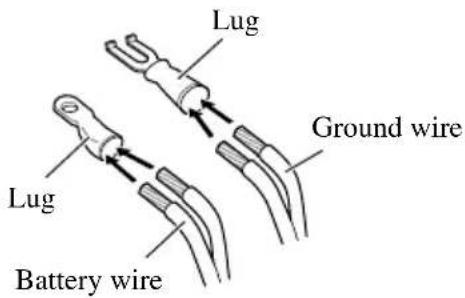
text_image
Lug Ground wire Lug Battery wire4. Connect the wires to the terminal.
- Fix the wires securely with the terminal screws.
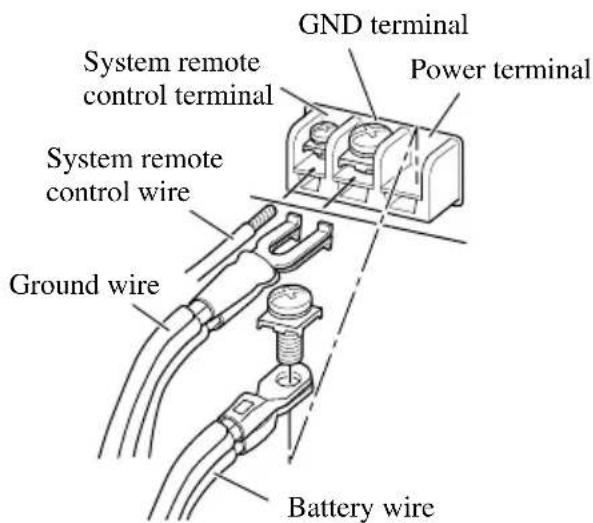
text_image
GND terminal Power terminal System remote control terminal System remote control wire Ground wire Battery wireWARNING
Failure to securely fasten the battery wire to the terminal using the terminal screws could cause the terminal area to overheat and could result in damage and injury including minor burns.
Connecting the Speaker Output Terminals
- Expose the end of the speaker wires using nippers or a cutter by about 10 mm and twist.

text_image
Twist 10 mm- Attach lugs to speaker wire ends. Lugs not supplied.
- Use pliers, etc., to crimp lugs to wires.
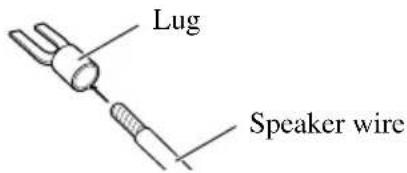
text_image
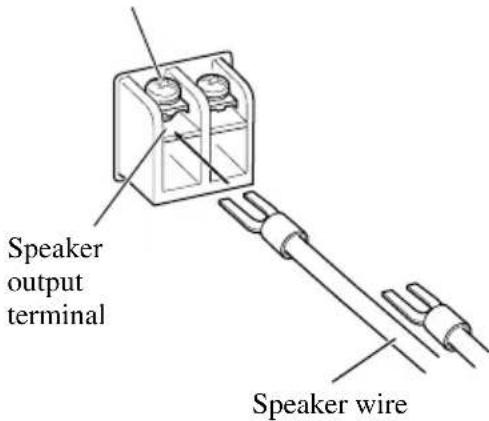
Lug Speaker wire- Connect the speaker wires to the speaker output terminals.
- Fix the speaker wires securely with the terminal screws.
Terminal screw

text_image
inal screw Speaker output terminal Speaker wireTerminal screw
text_image
Speaker output terminal Speaker wireConnecting the Speaker wires
CAUTION: A & B Channels
Diagram A - Proper

text_image
8 Ohm Speaker 8 Ohm Speaker + - Pioneer AmplifierA & B Channels 4 Ohm Installation
Diagram B - Improper

text_image
4 + Ohm Speaker 4 + Ohm Speaker + - Pioneer AmplifierA & B Channels 2 Ohm Installation
DO NOT install or use your Pioneer amplifier by wiring speakers rated at 4 Ohm (or lower) in parallel to achieve a 2 Ohm (or lower) speaker impedance (Diagram B) for A & B Channels. DO NOT install or use your Pioneer amplifier by wiring speakers rated at less than 4 Ohm speaker impedance for A & B Channels. Amplifier damage, smoke, and overheating could result from improper installation. The amplifier surface could also become hot to the touch and minor burns could result.
To properly install and achieve a 4 Ω impedance, wire two 8 Ωspeakers in parallel as shown (Diagram A) or use a single 4 Ωspeaker. For A & B Channels of the amplifier, follow the speaker output connection diagram as shown on the front of your amplifier, and wire two 8 Ωspeakers in parallel to achieve a 4 Ωload or use a single 4 Ωspeaker per channel.
If you have any questions or concerns, please contact your local authorized Pioneer dealer or call Pioneer customer service.
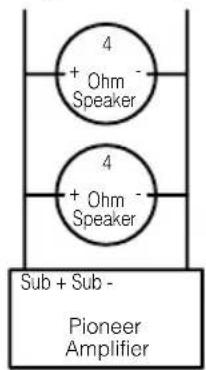
CAUTION: Sub Channel
Diagram C - Proper
text_image
4 + Ohm Speaker 4 + Ohm Speaker Sub + Sub - Pioneer AmplifierSub Channel 2 Ohm Installation
Diagram D - Improper

text_image
2 + Ohm - Speaker 2 + Ohm - Speaker Sub + Sub - Pioneer AmplifierSub Channel 1 Ohm Installation
DO NOT install or use your Pioneer amplifier by wiring speakers rated at 2 Ohm (or lower) in parallel to achieve a 1 Ohm (or lower) speaker impedance (Diagram D) for the Sub Channel. DO NOT install or use your Pioneer amplifier by wiring speakers rated at less than 2 Ohm speaker impedance for Sub Channel. Amplifier damage, smoke, and overheating could result from improper installation. The amplifier surface could also become hot to the touch and minor burns could result.
To properly install and achieve a 2 Ω impedance, wire two 4 Ωspeakers in parallel as shown (Diagram C) or use a single 2 Ωspeaker. For the Sub Channel of the amplifier, follow the speaker output connection diagram as shown on the front of your amplifier, and wire two 4 Ωspeakers in parallel to achieve a 2 Ωload or use a single 2 Ωspeaker per channel.
If you have any questions or concerns, please contact your local authorized Pioneer dealer or call Pioneer customer service.
Connect the speaker leads according to the figures shown below.

text_image
Speaker output terminal (Rent) Speaker output A (Right) RCA input jack A (CH A) (Rent) RCA input jack B (CH B) RCA input jack SUB (CH SUB) (Rent) Speaker output B (Left) Subwoofer outputCombination of Input and Output
flowchart
graph LR
    A["CH A"] --> B["Output"]
    C["CH A"] --> B
    D["CH B"] --> B
    E["CH SUB"] --> B
flowchart
graph LR
    A["Input CH A"] --> B["CH A"]
    C["Input CH SUB"] --> D["CH SUB"]
    B --> E["Output CH A"]
    D --> F["Output CH SUB"]

flowchart
graph LR
    A["CH A"] --> C["Output"]
    B["CH B"] --> C["Output"]
    C --> D["CH A"]
    C --> E["CH B"]
    C --> F["CH SUB"]

flowchart
graph LR
    A["Input"] --> B["CH A"]
    A --> C["CH B"]
    A --> D["CH SUB"]
    B --> E["CH A"]
    C --> F["CH B"]
    D --> G["CH SUB"]
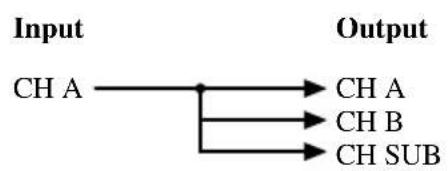
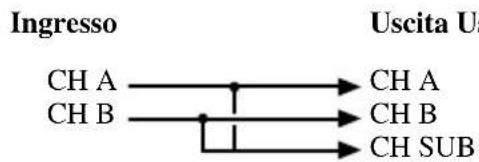
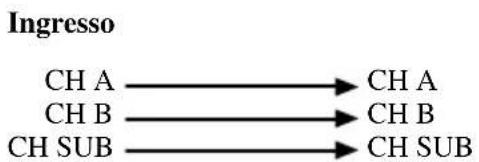
- If you use RCA input jack A only, speaker output for channel A, channel B and the SUB channel is output from channel A.
- If you use RCA input jacks A and B only, output from channel A and channel B is unchanged, but output from the SUB channel is a mixture of the channel A and channel B signals.
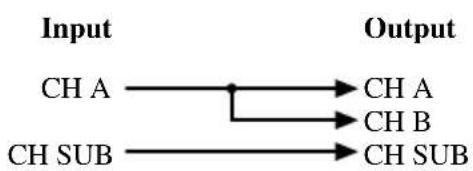
- If you use RCA input jack A and SUB only, channel A and channel B signals are output from channel A, but output from the SUB channel remains unchanged.
- When not using RCA input jack B or SUB, do not connect anything to them.

CAUTION
- Do not install in:
—Places where it could injure the driver or passengers if the vehicle stops suddenly.
—Places where it may interfere with the driver, such as on the floor in front of the driver's seat.
- Make sure that wires are not caught in the sliding mechanism of the seats, resulting in a short-circuit.
- Confirm that no parts are behind the panel when drilling a hole for installation of the amplifier. Protect all cables and important equipment such as fuel lines, brake lines and electrical wiring from damage.
• Install tapping screws in such a way that the screw tip does not touch any wire. This is important to prevent wires from being cut by vibration of the car, which can result in fire.
- DO NOT allow amplifier to come into contact with liquids due to, for example, the location where the amplifier is installed. Electrical shock could result. Also, amplifier and speaker damage, smoke, and overheating could result from contact with liquids. In addition, the amplifier surface and the surface of any attached speakers could become hot to the touch and minor burns could result.
• To ensure proper installation, use the supplied parts in the manner specified. If any parts other than the supplied ones are used, they may damage internal parts of the amplifier, or they may become loose causing the amplifier to shut down.
- Never replace the fuse with one of greater value or rating than the original fuse. Use of an improper fuse could result in overheating and smoke and could cause damage to the product and injury including burns.

CAUTION:
To prevent malfunction and/or injury
• To ensure proper heat dissipation of the amplifier, be sure of the following during installation.
—Allow adequate space above the amplifier for proper ventilation.
—Do not cover the amplifier with a floor mat or carpet.
- DO NOT allow amplifier to come into contact with liquids due to, for example, the location where the amplifier is installed. Electrical shock could result. Also, amplifier and speaker damage, smoke, and overheating could result from contact with liquids. In addition, the amplifier surface and
the surface of any attached speakers could become hot to the touch and minor burns could result.
- Do not install the amplifier on unstable places such as the spare tire board.
- The best location for installation differs with the car model and installation location. Secure the amplifier at a sufficiently rigid location.
- Make temporary connections first and check that the amplifier and the system operate properly.
• After installing the amplifier, confirm that the spare tire, jack and tools can be easily removed.
Example of installation on the floor mat or on the chassis
-
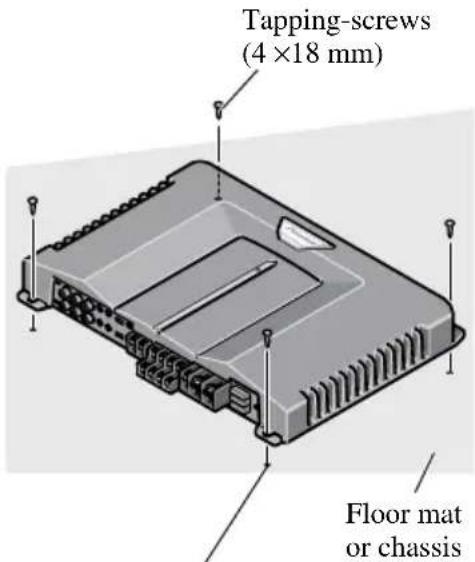
Place the amplifier where it is to be installed. Insert the supplied tapping screws (4 × 18 mm) into the screw holes. Push on the screws with a screwdriver so they make marks where the installation holes are to be located.
-
Drill 2.5 mm diameter holes at the point marked, and install the amplifier, either on the carpet or directly to the chassis.
text_image
Tapping-screws (4 × 18 mm) Floor mat or chassisDrill a 2.5 mm diameter hole
Specifications
Power source 14.4 V DC (10.8 — 15.1 V allowable)
Grounding system ...... Negative type
Current consumption 43.8 A (at continuous power, 4 Ω)
Average current drawn* 10.9 A (4 Ω for five channels)
Fuse 25 A × 3
Dimensions 350 (W) × 52 (H) × 268 (D) mm
Weight 3.9 kg (Leads for wiring not included)
Maximum power output .... Channel A/B: 100 W × 4 (4 Ω)
Channel SUB: 300 W × 1 (4 Ω) / 600 W × 1 (2 Ω)
Continuous power output 65 W × 4 (4 Ω) + 225 W × 1 (4 Ω)
(56 W × 4 (4 Ω) + 350 W × 1 (2 Ω))
(DIN45324, +B=14.4 V)
Load impedance 4 Ω (Channel A/B: 4 — 8 Ω allowable)
(Channel SUB: 2 — 8 Ωallowable)
Frequency response Channel A/B: 10 — 40,000 Hz (+0 dB, -1 dB)
Channel SUB: 5 — 240 Hz (+0.5 dB, -3 dB)
Signal-to-noise ratio 95 dB (IEC-A network)
Distortion Channel A/B: 0.01% (10 W, 1 kHz)
Channel SUB: 0.03% (10 W, 120 Hz)
Low pass filter (Channel SUB) Cut off frequency: 40 — 240 Hz
Cut off slope: -12 dB/oct
High pass filter (Channel A/B) Cut off frequency: 40 — 240 Hz
Cut off slope: -12 dB/oct
Bass level control (Channel SUB) -22 — +12 dB
(125 mV—6.5 V)
Level/gain control (Channel A/B) 200 mV — 6.5 V
Maximum input level/impedance RCA: 6.5 V/22 kΩ
Note:
- Specifications and the design are subject to possible modification without notice due to improvements.
\*Average current drawn
- The average current drawn is nearly the maximum current drawn by this unit when an audio signal is input. Use this value when working out total current drawn by multiple power amplifiers.
Contenido
natural_image
3D diagram of an electronic device with multiple ports and connectors, no visible text or symbolsflowchart
graph TD
    A["CH A"] --> C["CH A"]
    A --> D["CH B"]
    A --> E["CH SUB"]
Salida

Entrada

flowchart
graph LR
    A["CH A"] --> B["CH A"]
    C["CH SUB"] --> D["CH SUB"]
Entrada

flowchart
graph LR
    CHA["CH A"] --> CHA1["CH A"]
    CHB["CH B"] --> CHB1["CH B"]
    CHB --> CHSUB["CH SUB"]
    CHB -->|Feedback| CHA1
    CHB -->|Feedback| CHB1
    CHA1 --> CHA2["CH A"]
    CHB1 --> CHB2["CH B"]
Salida Salida

Entrada

flowchart
graph LR
    A["CH A"] --> B["CH A"]
    C["CH B"] --> D["CH B"]
    E["CH SUB"] --> F["CH SUB"]
(56 W × 4 (4 Ω) + 350 W × 1 (2 Ω))
(DIN45324, +B=14,4 V)
natural_image
3D diagram of an electronic device showing internal components and connectors (no text or symbols visible)flowchart
graph TD
    A["CH A"] --> B["CH A"]
    A --> C["CH B"]
    A --> D["CH SUB"]
Ausgang

Eingang

flowchart
graph LR
    A["CH A"] --> B["CH A"]
    C["CH SUB"] --> D["CH SUB"]
Eingang

flowchart
graph LR
    CHA["CH A"] --> CHA1["CH A"]
    CHB["CH B"] --> CHB1["CH B"]
    CHA1 --> CHSUB["CH SUB"]
flowchart
graph LR
    A["CH A"] --> B["CH A"]
    C["CH B"] --> D["CH B"]
    E["CH SUB"] --> F["CH SUB"]
Kanal SUB: 300 W × 1 (4 Ω) / 600 W × 1 (2 Ω)
(56 W × 4 (4 Ω) + 350 W × 1 (2 Ω))
(DIN45324, +B=14,4 V)
natural_image
3D diagram of an electronic device showing internal components and connectors (no text or symbols visible)flowchart
graph TD
    subgraph "Entrée"
        A1["CH A"] --> B1["CH A"]
        A1 --> C1["CH B"]
        A1 --> D1["CH SUB"]
    end
    subgraph "Sortie"
        E1["CH A"] --> F1["CH A"]
        E1 --> G1["CH B"]
        E1 --> H1["CH SUB"]
    end
    subgraph "Entrée"
        I1["CH A"] --> J1["CH A"]
        I1 --> K1["CH B"]
        I1 --> L1["CH SUB"]
    end
    subgraph "Sortie Sortie"
        M1["CH A"] --> N1["CH A"]
        M1 --> O1["CH B"]
        M1 --> P1["CH SUB"]
    end
    subgraph "Entrée"
        Q1["CH A"] --> R1["CH A"]
        Q1 --> S1["CH B"]
        Q1 --> T1["CH SUB"]
    end
Dimensions 350 (L) × 52 (H) × 268 (P) mm
(56 W × 4 (4 Ω) + 350 W × 1 (2 Ω))
(DIN45324, +B=14,4 V)
Impédance de charge 4 Ω (Voies A/B: 4 — 8 Ω permis)
(Voie SUB: 2 — 8 Ωpermis)
natural_image
3D diagram of an electronic device with multiple connectors and ports, no visible text or symbolsflowchart
graph LR
    A["CH A"] --> B["CH A"]
    C["CH SUB"] --> D["CH SUB"]
flowchart
graph LR
    A["CH A"] --> B["CH A"]
    C["CH B"] --> D["CH B"]
    E["CH SUB"] --> F["CH SUB"]
flowchart
graph LR
    A["CH A"] --> B["CH A"]
    C["CH B"] --> D["CH B"]
    E["CH SUB"] --> F["CH SUB"]
Dimensioni 350 (L) × 52 (A) × 268 (P) mm
(56 W × 4 (4 Ω) + 350 W × 1 (2 Ω))
(DIN45324, +B=14,4 V)
natural_image
3D diagram of an electronic device showing internal components and connectors (no text or symbols visible)flowchart
graph TD
    A["CH A"] --> B["CH A"]
    A --> C["CH B"]
    A --> D["CH SUB"]
Uitgang

Ingang

flowchart
graph LR
    A["CH A"] --> B["CH A"]
    C["CH SUB"] --> D["CH SUB"]
Ingang

flowchart
graph LR
    CHA["CH A"] --> CHA1["CH A"]
    CHB["CH B"] --> CHB1["CH B"]
    CHA1 --> CHSUB["CH SUB"]
    CHB1 --> CHSUB
    CHB1 --> CHSUB
Uitgang Uitgang

Ingang

flowchart
graph LR
    A["CH A"] --> B["CH A"]
    C["CH B"] --> D["CH B"]
    E["CH SUB"] --> F["CH SUB"]
(56 W × 4 (4 Ω) + 350 W × 1 (2 Ω))
(DIN45324, +B=14,4 V)
PIONEER ELECTRONICS (USA) INC.
P.O. Box 1540, Long Beach, California 90801-1540, U.S.A.
TEL: (800) 421-1404
PIONEER EUROPE NV
Haven 1087, Keetberglaan 1, B-9120 Melsele, Belgium
TEL: (0) 3/570.05.11
PIONEER ELECTRONICS ASIACENTRE PTE. LTD.
253 Alexandra Road, #04-01, Singapore 159936
TEL: 65-6472-7555
PIONEER ELECTRONICS AUSTRALIA PTY. LTD.
178-184 Boundary Road, Braeside, Victoria 3195, Australia
TEL: (03) 9586-6300
PIONEER ELECTRONICS OF CANADA, INC.
300 Allstate Parkway, Markham, Ontario L3R OP2, Canada
TEL: 1-877-283-5901
PIONEER ELECTRONICS DE MEXICO, S.A. de C.V.
Blvd.Manuel Avila Camacho 138 10 piso
Col.Lomas de Chapultepec, Mexico, D.F. 11000
TEL: 55-9178-4270
Published by Pioneer Corporation.
Copyright © 2004 by Pioneer Corporation.
All rights reserved.
Publication de Pioneer Corporation.
Copyright © 2004 Pioneer Corporation.