Inventa 200 - Sewing machine TERMOZETA - Free user manual and instructions
Find the device manual for free Inventa 200 TERMOZETA in PDF.


User questions about Inventa 200 TERMOZETA
0 question about this device. Answer the ones you know or ask your own.
Ask a new question about this device
Download the instructions for your Sewing machine in PDF format for free! Find your manual Inventa 200 - TERMOZETA and take your electronic device back in hand. On this page are published all the documents necessary for the use of your device. Inventa 200 by TERMOZETA.
USER MANUAL Inventa 200 TERMOZETA
text_image
TERMOZETA®
Inventa 200
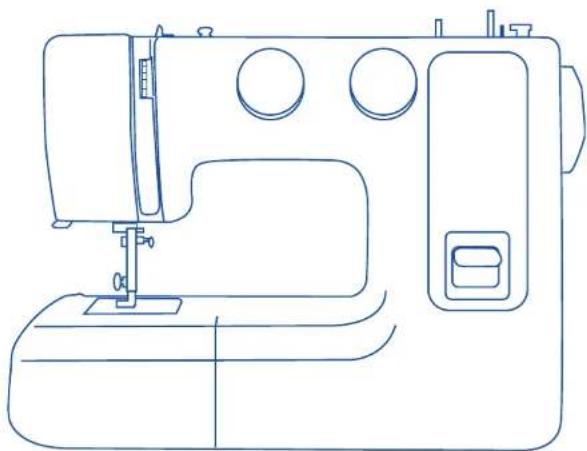
natural_image
Line drawing of a sewing machine with no text or symbolsLIBRETTO ISTRUZIONI
▶ INSTRUCTION MANUAL
LIBRO DE INSTRUCCIONES
TERMOZETA®
ITALIANO
text_image
Labeled diagram of a sewing machine with numbered parts for identification and assembly reference.
text_image
Technical diagram of a sewing machine with numbered parts for identificationITALIANO
▶ PARAGRAFO 2. PREPARAZIONE AL CUCITO

natural_image
Line drawing of a device connected to a power outlet with cable (no text or symbols)natural_image
Simple line drawing of a vehicle or platform with dashed lines indicating motion, no text or symbols present.text_image
Technical diagram showing mechanical assembly with labeled components and a magnified inset view of a component detail.natural_image
Illustration of a sewing machine needle stitching a component (no text or symbols)natural_image
Line drawing of hands using a tool to adjust or install a device (no text or symbols present)natural_image
Diagram showing two mechanical components with directional arrows indicating motion or force (no text or symbols)natural_image
Diagram showing a sewing machine with directional arrows indicating movement (no text or labels)natural_image
Line drawing of a sewing machine with a hand operating the base and a needle inserted (no text or symbols)natural_image
Technical line drawing of a mechanical device with two views: top shows a vertical component, bottom shows a tool with a handle (no text or symbols)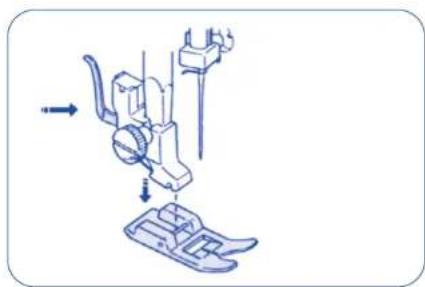
natural_image
Line drawing of a sewing machine with base and foot (no text or symbols)natural_image
Line drawing of a hand holding a tool above a mechanical component (no text or symbols)text_image
Diagram illustrating a mechanical or electrical setup with three labeled components and directional arrows indicating motion or transformation.natural_image
Line drawing of a sewing machine needle stitching a base, showing no text or symbolsnatural_image
Line drawing of a sewing machine needle stitching fabric (no text or symbols)natural_image
Diagram of a mechanical or electrical component with two circular components and a central hub, no visible text or symbols.natural_image
Diagram of a mechanical assembly with a spool and tool, showing a close-up of a component (no text or symbols present)
natural_image
Illustration of hands holding a circular object with an arrow indicating rotation (no text or symbols)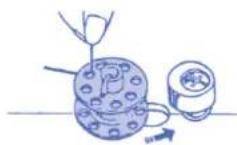
natural_image
Illustration of hands assembling a mechanical component with a circular housing and bolt holes (no text or symbols)natural_image
Illustration of a hand holding a medical device with a downward arrow indicating motion (no text or symbols)natural_image
Illustration of a hand holding a small object with a pointed tip, no text or symbols presenttext_image
Technical diagram of a mechanical device with labeled parts A through G, showing internal components and assembly structure.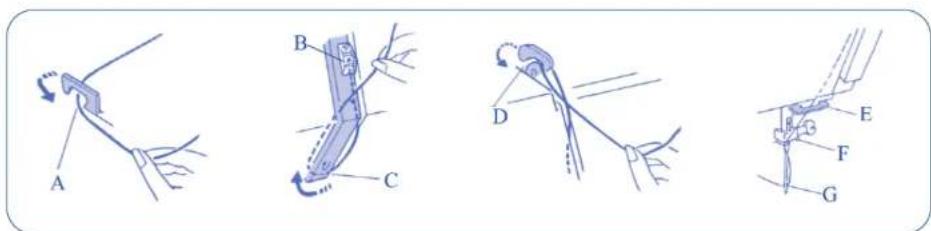
text_image
Technical diagram showing four different mechanical or structural configurations labeled A through G, with arrows indicating motion or assembly.natural_image
Illustration of a sewing machine needle stitching a fabric, with hands operating the mechanism (no text or symbols present)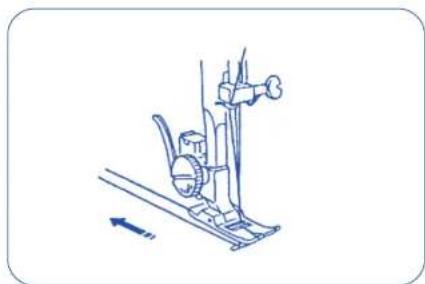
natural_image
Line drawing of a mechanical device with a lever and base, showing motion direction (no text or symbols)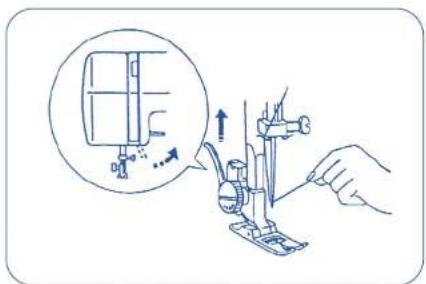
text_image
Diagram illustrating sewing process with labeled parts and directional arrows, including a magnified inset showing component details.text_image
Diagram illustrating a mechanical assembly process with numbered components and rotation arrowstext_image
3 4 1 A B C D E F G H I J K L BA 7 700000000000000000000000000000000000000000000000000000000000000000000000000000000000000000natural_image
Simple line drawing of a hand pressing a button into a rectangular block with an arrow (no text or symbols)natural_image
Line drawing of a sewing machine needle stitching fabric (no text or symbols)text_image
Diagram showing sewing machine operation with labeled steps ① and ②, illustrating thread positioning and fabric cutting.natural_image
Illustration of a sewing machine needle stitching fabric (no text or symbols)natural_image
Technical diagram showing a mechanical assembly with an inset close-up of a component (no text or symbols present)natural_image
Diagram of a mechanical device with a lever and foot, showing no text or symbolsnatural_image
Diagram showing a mechanical device with rotating components and a magnified inset of the component (no text or symbols)natural_image
Illustration of a sewing machine needle stitching fabric (no text or symbols)▶ Cucitura a zigzag
natural_image
Illustration of a person climbing a slope with a spring and falling object (no text or symbols)Sopraggitto
natural_image
Illustration of a person skiing down a slope with ropes and inclines (no text or symbols)Punto a sopraggitto
natural_image
Illustration of a sewing machine on a flatbed surface (no text or symbols)natural_image
Illustration of a sewing machine needle stitching fabric (no text or symbols)natural_image
Illustration of a laboratory instrument with a central lever and base mount (no text or symbols)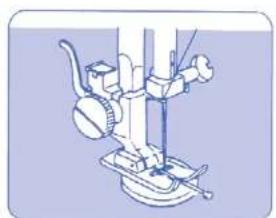
natural_image
Illustration of a laboratory apparatus with a test tube and tubing (no text or symbols visible)
natural_image
Simple line drawing of two identical objects on a horizontal line, no text or symbols presentCucitura bottoni
text_image
Technical diagram showing mechanical assembly steps with labeled components 3 and 4natural_image
Simple line drawing of a mechanical tool with spring and handle (no text or symbols)natural_image
Illustration of a sewing machine needle stitching fabric (no text or symbols visible)
natural_image
Pure diagram of a mechanical or structural component with no visible text, numbers, or symbolsnatural_image
Illustration of a boat with crew members on deck, no visible text or symbolsnatural_image
Diagram showing two rectangular objects with a blue arrow indicating rotation or movement (no text or symbols)text_image
Technical diagram showing a mechanical assembly with an arrow indicating rotation and a close-up of the component being machined.text_image
A B C D E F G H I J K L 1~4 5.5.natural_image
Illustration of a person working on a boat with a wavy line indicating speed (no text or symbols)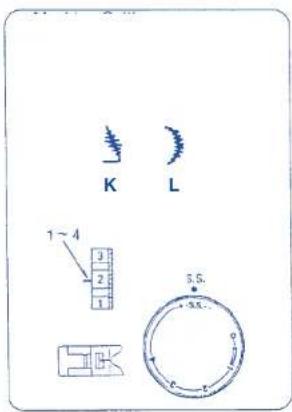
text_image
K L 1~4 3 2 1 5.5. 5.5.
natural_image
Illustration of a sewing machine stitching fabric (no text or symbols)text_image
D 1~4 3 2 1 S.S. S.S.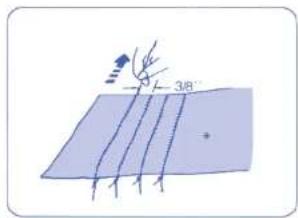
text_image
3B'natural_image
Illustration of hands cutting a fabric with a woven seam and arrow indicating direction (no text or symbols)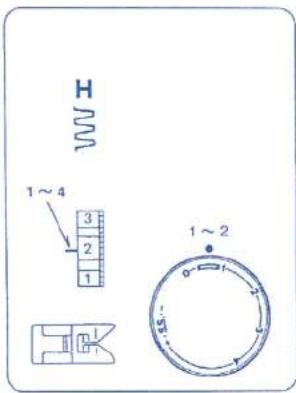
natural_image
Illustration of a sewing machine needle stitching fabric (no text or symbols)Nido d'ape
natural_image
Simple line drawing of a mechanical device with no text or symbolsnatural_image
Technical line drawing of a mechanical component with no visible text or symbolsnatural_image
Line drawing of a hand holding a mechanical component, with no visible text or symbolsnatural_image
Pure mechanical diagram showing gear and cam mechanism without any text or symbolsnatural_image
Line drawing of a sewing machine needle stitching on a workbench (no text or symbols)natural_image
Technical line drawing of an electronic component assembly (no text or symbols)text_image
Vite Vitenatural_image
Technical line drawings of a sewing machine with exploded and assembled views (no text or labels)▶ SAFETY REQUIREMENT

- This booklet is an integral part of the appliance and must be carefully read before use, since it provides important information on the installation, safety, use and maintenance of the appliance. Keep in a safe place.
- After removing the packaging make sure the appliance is undamaged and that no parts ng. If in doubt, do not use and contact an authorised Termozela service centre.
- Do not leave parts of packaging (plastic bags, foam polystyrene, nails, etc) within reach of children or unqualified persons since they are potential sources of danger.
- If the appliance comes with an earth plug, the electrical safety is ensured only when this plug is correctly connected to an effective earthing system in compliance with the existing electrical safety standards. Termozeta shall not be held responsible for any damages caused by the lack of a correct earthing system.
- Before connecting the plug to the power outlet check that the operating voltage of the appliance corresponds to the voltage of your mains supply. If in doubt, contact a qualified technician.
- Do not use adaptors, multiple plugs and extension leads. If necessary, only use devices that conform to the current safety standards making sure they are compatible with the power of the appliance. If in doubt, contact a qualified technician.
- Any installation not conforming to the above instructions may compromise your safety and cancel the guarantee.
- The machine is exclusively for domestic use for sewing fabrics.
- For safety reasons:
- do not use the appliance with bare feet and with wet hands or feet
- do not use the appliance outside the home
- do not leave the appliance exposed to atmospheric agents (sun, rain...)
- do not allow the machine to be used by children or by anyone with reduced physical or mental abilities or without experience unless they are supervised and instructed on its use.
- never pull on the power cord or on the appliance itself to disconnect the plug from the power outlet - do not leave the appliance unattended when it is plugged into the main power supply
- never immerse the appliance in water or other liquids.
- The power cord of the appliance must not be replaced by the user. If necessary, contact an authorised TERMOZETA service centre or qualified technician.
- Switch off and do not tamper with the appliance should it breakdown and/or not function properly. Contact an authorised TERMOZETA service centre for any repairs and ask for original spare parts.
- Make the appliance unserviceable at the end of its running life by unplugging it from the power outlet and cutting the power cord. Abide by the existing standards in your country for instructions on its disposal.
- Termozeta cannot be held responsible for any damages to people animals or things caused by incorrect installation or due to improper, incorrect or negligent use.
- Do not put fingers near the moving parts. Pay particular attention to the area around the sewing machine needle.
• Always use the correct needle plate otherwise the needle could break.
- Do not use bent needles.
- Do not push or pull the fabric during sewing. The needle could bend and break.
- Switch off the sewing machine ("0") whenever any adjustments have to be made in the needle area, e.g. change needle, thread a bobbin or change the foot etc.

INDEX
▶ SECTION 1. ESSENTIAL PARTS
Names of parts pag. 26
▶ SECTION 2. GETTING READY TO SEW
Connecting the machine to the power supply pag. 27
Extension table (accessory storage box) pag. 27
Thread and needle chart
Setting spool pins
Removing or Inserting the bobbin base
Winding the bobbing
Threading bobbin case
Threading the ma
Drawing up bobbin thread
Balancing needle thread tension
Pattern selector dial
Stitch length dial
Reverse stitch button
Seam guide line
Dropping the feed dogs
▶ SECTION 3. BASIC SEWING
Straight stitch sewing
To change the sewing directions
Zigzag stitching
▶ SECTION 4. UTILITY STITCHINGS
Overcasting pag. 36
Overedge stitch
Tricot stitch
Triple strength stitch
Sewing buttons
Buttonhole
Corded Buttonholes
Zipper Application
Blind stitch hemming
▶ SECTION 5. DECORATIVE STITCHING
Shell tuck
Stretch stitch patterns
Decorative satin stitch patterns
Smocking
Box stitching
▶ SECTION 6. CARE OF YOUR MACHINE
Dismantling and assembling hook race
Cleaning the feed dogs
Drive belt tension
Oiling the Machine
Trouble Shooting
▶ ENGLISH
▶ SECTION 1. ESSENTIAL PARTS
text_image
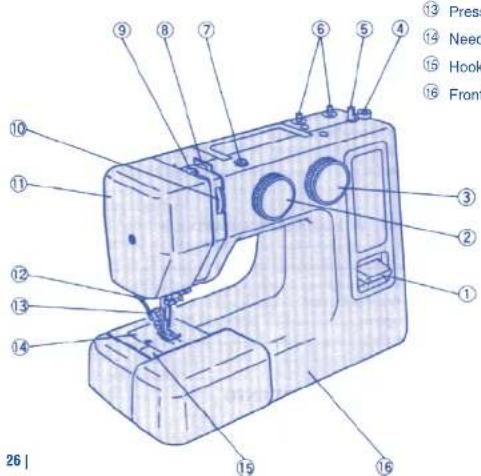
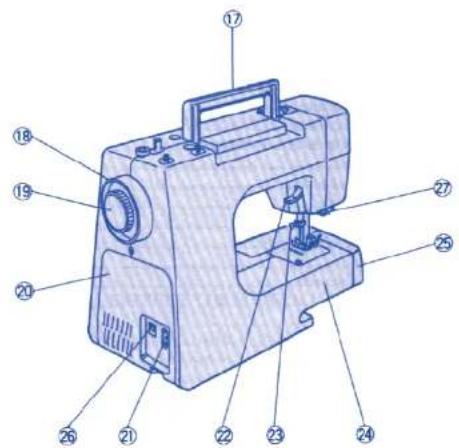
Labeled diagram of a sewing machine with numbered parts and Chinese annotations for parts like Press, Need, Hook, and Front.Names of Parts
① Reverse stitch button
② Pattern selector dial
③ Stitch length dial
④ Bobbin winder stopper
⑤ Bobbin winder spindle
⑥ Spool pins
⑦ Bobbin winder thread guide
⑧ Thread guide
⑨ Thread take-up lever
⑩ Thread tension dial
⑪ Face plate
⑫ Thread cutter
⑬ Presser foot holder
⑭ Needle plate
⑮ Hook cover
⑯ Front cover
⑰ Carrying handle
⑱ Balance wheel
⑲ Auto clutch knob
20 Belt cover
21 Cord socket
22 Presser foot lifter
② Needle clamp screw
24 Free arm
25 Extension table (accessory atorage box)
26 Power switch
text_image
Labeled diagram of a sewing machine with numbered parts for identification▶ PARAGRAFO 2. PREPARAZIONE AL CUCITO

natural_image
Line drawing of a device connected to a power outlet with cable (no text or symbols)- Connecting the machine to the power supply
Before connecting the power, make sure the voltage and frequency of your electrical power conform to the machine. Make sure the power switch is in the OFF position.
Fit the nonreversible plug into the cord socket and plug the machine in to the power supply.
Then turn the power switch on.
▶ Extension table (accessory storage box)
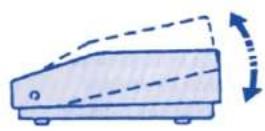
The extension table provides added sewing surface and can be easily removed for free arm sewing.
Foot Control
Sewing speed can be varied by the foot control.
The harder you press on the control, the faster the machine runs.
text_image
Technical diagram showing mechanical assembly with labeled components and a magnified inset view of a component detail.▶ Sewing light
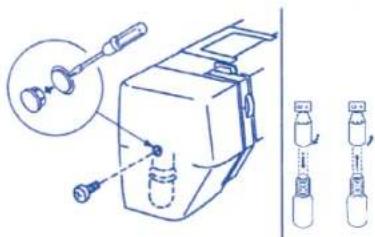
The sewing light is located behind the face plate.
To change the bulb, take the face plate off the sewing machine by removing the set screw.
Unplug the power supply before changing the bulb.
• To remove push and twist to the left
• To remove push and twist to the right
WARNING: use bulbs with a maximum power of 15W only.
natural_image
Technical illustration of a sewing machine needle stitching a component (no text or symbols)For free arm sewing
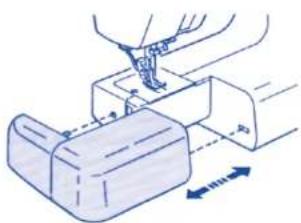
Pull the end of the extension table away from the machine, as illustrated.
For attaching the table
Push the extension table until its lugs fit into the machine.

natural_image
Line drawing of hands using a tool to adjust or install a device (no text or symbols present)▶ Accessory storage box
Sewing accessories are conveniently stored under the extension table.
▶ ENGLISH
natural_image
Technical line drawing of a sewing machine with no visible text or symbolsTo snap on and snap off the presser foot
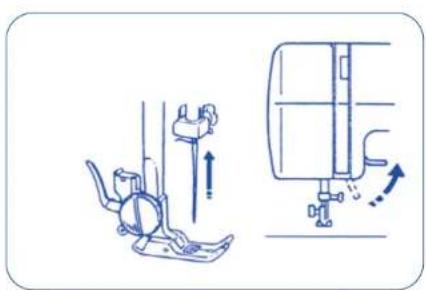
To snap off
Turn the balance wheel toward you to raise the needle to its highest position.
Raise the presser foot.

natural_image
Technical line drawing of a mechanical device with directional arrows indicating motion (no text or symbols)▶ Changing Needle
Raise the needle by turning the balance wheel toward you and lower the presser foot

natural_image
Line drawing of a sewing machine with a needle inserted, showing no text or symbolsPress the lever on the back of the foot holder. The presser foot will drop off.

natural_image
Technical line drawing of a mechanical device with two views: top shows a vertical component, bottom shows a tool with a handle (no text or symbols)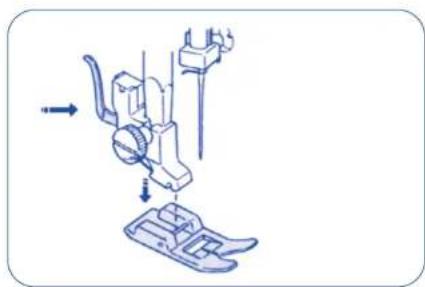
natural_image
Line drawing of a sewing machine with base and foot (no text or symbols)To snap on
Place the presser foot so the pin on the foot lies just under the groove of the foot holder.
Lower the foot holder to lock the foot in place.
Loosen the needle clamp screw by turning it counter-clockwise. Remove the needle from the clamp. Insert the new needle into the needle clamp with the flat side away from you. When inserting the needle into the clamp, push it up as far as it will go and tighten the clamp screw firmly with the screwdriver.
Check you needles frequently for barbed or blunted points. Snags and runs in knits, fine silks and silk-like fabrics are permanent and are almost always caused by a damaged needle.
THREAD AND NEEDLE CHART
Fabrics Threads Needle Size
Light weight Crepe de Chine, Voile, Fine silk 9 or 11
Lawn, Organdy, Georgette, Fine cotton
Tricot
Fine
synthetic
Fine cotton covered polyester
Medium weight
Linens, Cotton, Piqué, Serge,
50 Silk
11 or 14
Double Knits, Percale 50 to 80 Cotton
50 to 60
Synthetic
Cotton covered polyester
Heavy weight
Denim, Tweed, Gabardine,
Coating, Drapery and
upholstery fabricie
50 Silk
14 or 16
40 to 50 Cotton
40 to 50
Synthetic
Cotton covered polyester
• In general, fine threads and needles are used for sewing thin fabrics, and thicker threads and needles are used for sewing heavy fabrics.
Always test thread and needle size on a small piece of fabric which will be used for actual sewing.
• Use the same thread for needle and bobbin.
- When sewing very fine fabrics, sew over a piece of paper to prevent yarn distortion.
▶ ENGLISH

natural_image
Line drawing of a hand holding a tool above a mechanical component (no text or symbols)Setting spool pins
The spool pins are used for holding the spool of
thread in order to feed thread to the machine.
To use, pull up the spool pin. Push down for storage.

text_image
Diagram illustrating a mechanical or electrical setup with three labeled components and directional arrows indicating motion or transformation.① Upper thread
② Hole
① Tangle
NOTE: In case of using the thread which has tendency to tangle around the spool pin, thread through the hole of spool pin as shown. The hole should face to the thread spool.

natural_image
Line drawing of a sewing machine needle stitching a base, with no text or symbols presentRemoving or inserting the bobbin case Open the hook cover.

natural_image
Line drawing of a sewing machine needle stitching fabric (no text or symbols)Raise the needle by turning the balance wheel toward you. Take out the bobbin case by holding the latch.
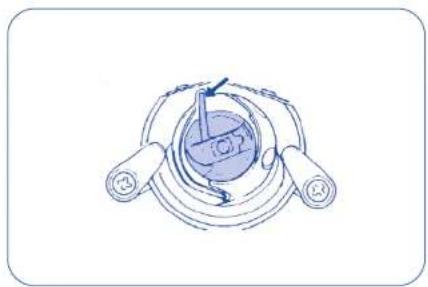
natural_image
Technical line drawing of a mechanical component with two circular parts and a central hub (no text or symbols)When inserting the bobbin case, place the horn into the recess of the hook race.
ENGLISH
natural_image
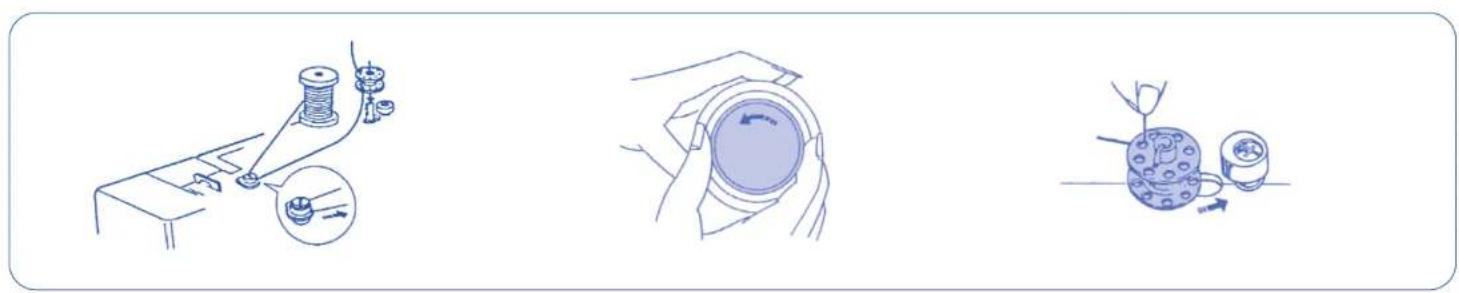
Three-step diagram showing a sewing machine, a close-up of the brush tip, and a hand holding a circular component (no text or symbols)Winding the bobbin
Draw the thread from spool. Guide the thread around the bobbin thread guide. Insert the thread through one of the holes in the bobbin from the inside to the outside.
Put the bobbin on the bobbin spindle, and push it to the right.
While holding the balance wheel with your left hand, turn the clutch knob counter-clockwise with your right hand.
With the free end of the thread held in your hand ,depress the foot control. Stop the machine when it has made a few turns, and cut the thread close to the hole in the bobbin.
Depress the foot control again. When the bobbin is fully wound, it will stop automatically. Return the bobbin winder to its original
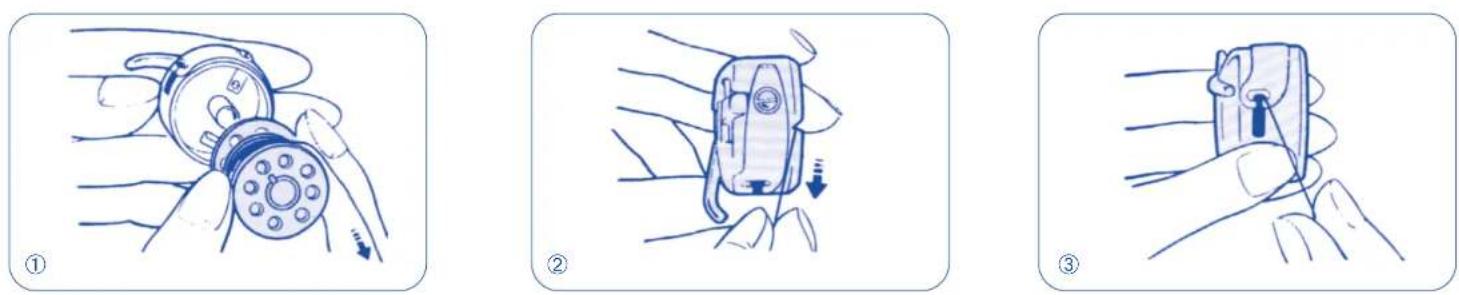
▶ Threading bobbin case
① Place the bobbin into the bobbin case. Make sure the thread
unwinds in the direction of arrow.
② Pull the thread into the bobbin case slot.
Draw the thread under the tension spring and into the delivery eye.
- Leave about 10 cm of free thread.
▶ ENGLISH
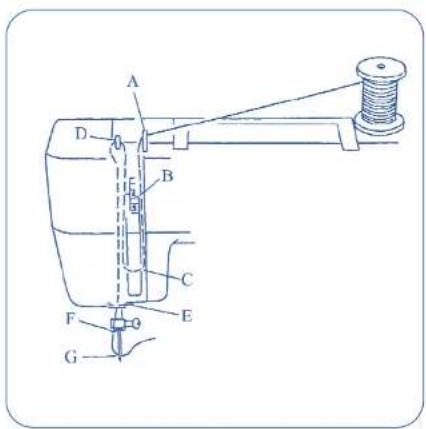
text_image
Technical diagram of a mechanical device with labeled parts A through G
text_image
Technical diagram showing four different mechanical or structural configurations labeled A through G, with arrows indicating motion or assembly.▶ Threading the machine
Raise take-up lever to its highest position by turning balance wheel toward you. Raise presser foot.
Place spool on spool pin as shown, with thread coming from the back of the spool.
A. Draw thread into thread guide using both hands.
B. While holding thread near spool.
C. Draw thread down into the tension area and then around the check spring holder.
D. Firmly draw thread up and through take-up lever from right to left.
E. Then draw thread down and slip it into the lower thread guide.
F.Slip thread into needle bar thread guide.
G. Thread needle eye from front to back.
NOTE: You may want to cut the end of thread with sharp scissors for easier needle threading.
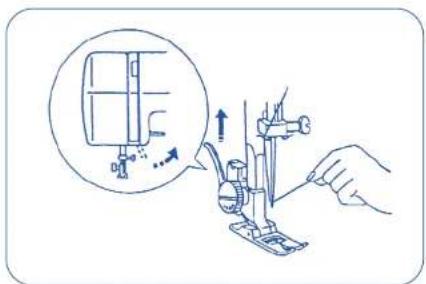
text_image
Diagram illustrating sewing process with labeled parts and directional arrows, including a magnified inset showing component details.
natural_image
Illustration of a sewing machine being adjusted for a hand, showing the blade and base (no text or symbols present)
natural_image
Line drawing of a mechanical device with a lever and base, showing motion direction (no text or symbols)▶ Drawing up bobbin thread
-
Raise the presser foot and hold the needle thread lightly with your left hand.
-
Turn the balance wheel slowly towards you with your right hand until the needle goe down and continue turning the balance wheel until the take-up lever is at its highest position. Lightly draw up the needle thread forming a loop of the bobbln thread.
-
Pull 15 cm of both threads back and under the presser foot.
ENGLISH
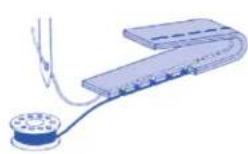
▶ Balancing needle thread tension
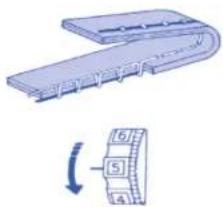
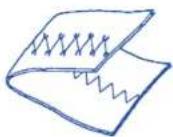
The needle thread and the bobbin thread should interlock in the center of two layers of fabric in straight seams.
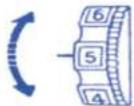
Set the desired number of the thread tension dial at setting mark.

text_image
Diagram showing a folded fabric or plastic strip with numbered parts and an upward arrow indicating rotation.Loosen the needle thread tension by moving the dial to a lower number.
natural_image
Technical illustration of a mechanical component with a curved arrow indicating rotation (no text or symbols)Tighten the needle thread tension by moving the dial to a higher number.
Thread tension for zigzag sewing
To obtain better zigzag stitches, the upper tension should be slightly weaker than in the case of straight sewing. The upper thread should appear slightly on the reverse side of the fabric.
▶ ENGLISH

text_image
0 1 2 3 4 + S. S. - S.S. S.S.
text_image
3 4 1 A B C D E F G H I J K L BA 7 KCTH DEDC▶ Pattern selector dial
Raise the needle above the fabrics and select the desired pattern at the setting mark by turning the pattern selector dial.
Selecting stretch stitch patterns
When sewing stretch stitch, set the stitch length dial at S.S.. When forward and reverse feeds become unbalanced depending upon the type of fabric, correct the balance as follows:
When patterns are compressed, correct it by turning the dial toward + . When patterns are drawn out, correct it by turning the dial toward - .
▶ Stitch length dial
The higher the number, the longer the stitch length. You can select the suitable stitch length for most fabrics.
natural_image
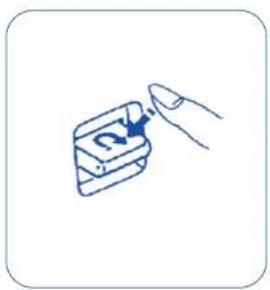
Simple line drawing of a hand pressing a button into a rectangular device (no text or symbols)▶ Reverse stitch button
As long as you keep the reverse stitch button depressed, the machine sews backwards.

natural_image
Line drawing of a sewing machine needle stitching fabric (no text or symbols)Seam guide line
The numbers on the needle plate indicate the distance between the center needle position and the line. The numbers in the front indicate in Millimeters. The numbers in the back indicate in inches.
text_image
Diagram showing sewing machine operation with labeled steps ① and ②, illustrating thread positioning and fabric cutting.▶ Dropping the feed dogs
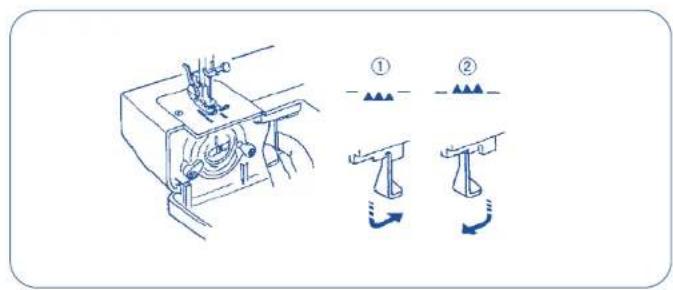
Machine setting
1. For dropping the feed dogs, press down the lever and move it to the direction of arrow as illustrated.
2. To raise the feed dogs, press down the lever and move it to the direction of arrow as illustrated. Feed dogs must always be up for normal sewing.
▶ SECTION 3. BASIC SEWING

text_image
A B 2 ~ 6 5 4 3 1.5 ~ 4 25
natural_image
Illustration of a sewing machine needle stitching fabric (no text or symbols)▶ Straight stitch sewing
Raise the presser foot and position the fabric next to a stitching guide line on the needle plate. Lower the needle into the fabric. Lower the presser foot and smooth the threads toward the back. Depress the foot control. Gently guide the fabric along the guide line letting the fabric feed by itself.
natural_image
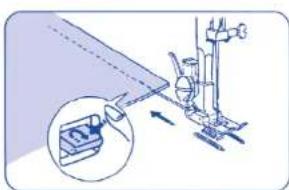
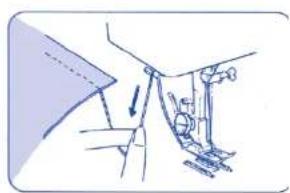
Technical diagram showing a mechanical assembly with an inset close-up of a component (no text or symbols visible)For fastening the ends of seams, press the reverse stitch button and sew several reverse stitches. Raise the presser foot and remove the fabric, drawing the threads to the back.
natural_image
Diagram of a mechanical device with a lever and guide mechanism (no text or labels)The threads are cut the proper length for starting the next seam.
▶ ENGLISH
natural_image
Illustration of a person climbing stairs with a magnified inset showing the motion trajectory (no text or symbols)To change the sewing directions
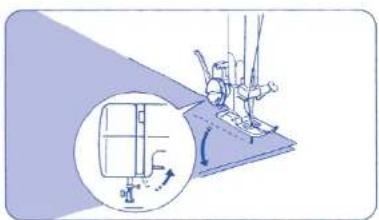
Stop the machine and turn the balance wheel toward you
to bring the needle do Raise the presser foot.
Pivol the fabric around the needle to change sewing direction as desired. Lower the presser foot and continue sewing.
text_image
2 ~ 5 4 3 2 ~ 4 5
natural_image
Illustration of a sewing machine needle stitching fabric (no text or symbols)Zigzag stitching
Machine setting
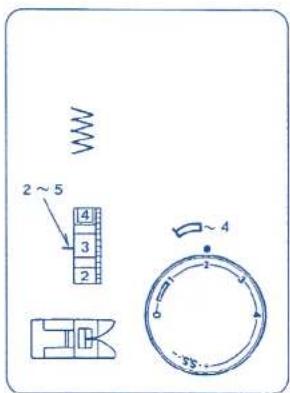
Simple zigzag stitching is widely used for overcasting, sewing on buttons etc.
▶ SECTION 4. UTILITY STITCHINGS
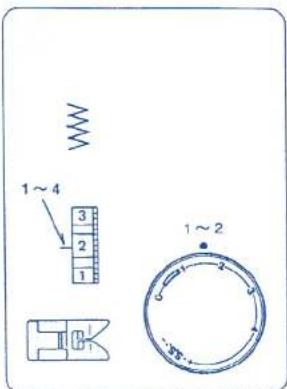
text_image
1 ~ 4 3 2 1 1 ~ 2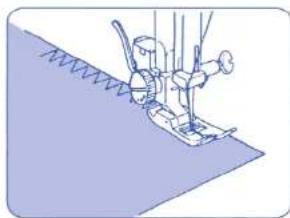
natural_image
Illustration of a person climbing a rope with a spring, no text or symbols presentOvercasting
Machine setting
This type of stitch is used on the seam allowance to prevent fabrics from fraying at raw edges.
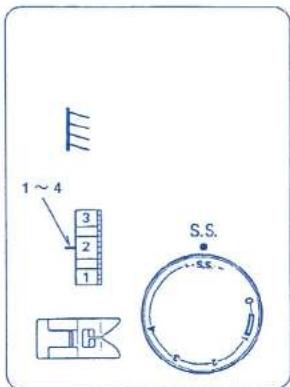
text_image
1 ~ 4 3 2 1 S.S.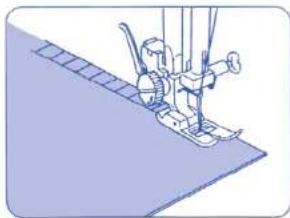
natural_image
Illustration of a person climbing a slope with ropes and equipment (no text or symbols)Overedge stitch
Machine setting
Overedge stitch will be done most successfully when the right side stitches of zigzag fall slightly off the edge of the fabrics.
ENGLISH
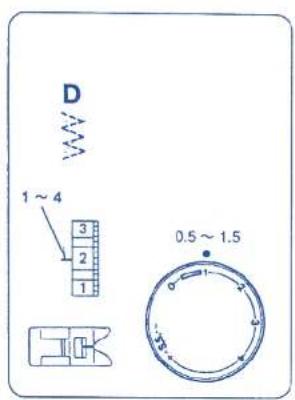
text_image
D 1 ~ 4 3 2 1 0.5 ~ 1.5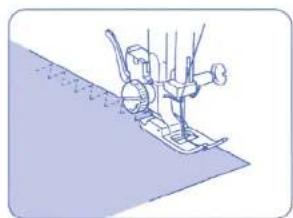
natural_image
Illustration of a sewing machine needle stitching fabric (no text or symbols)Tricot stitch Machine settin
Place the fabric under the presser foot so that the edge will be slightly inside the right hand side of the presser foot.
Guide the work so the right hand stitches fall at the edge of the fabric.

text_image
A B ≡ or ≡ ou ≡ o 2 ~ 6 5 4 3 S.S. S.S.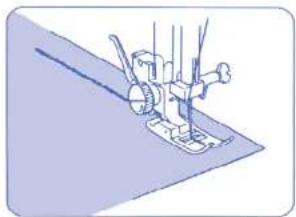
natural_image
Illustration of a sewing machine needle stitching fabric (no text or symbols)▶ Triple strength stitch
Machine setting
The stitch is sewn with two stitches forward and one stitch backward forming a seam that does not rip easily.
Garments should be basted for fitting before seaming.
▶ ENGLISH
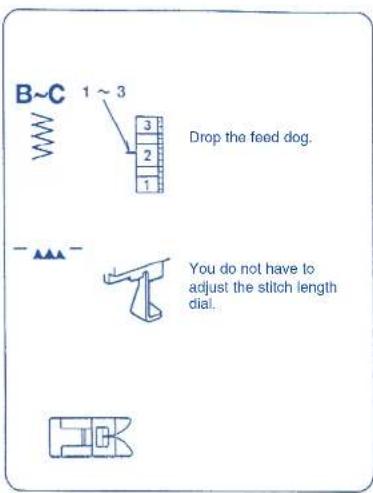
text_image
B~C 1 ~ 3 Drop the feed dog. You do not have to adjust the stitch length dial.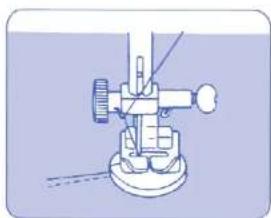
natural_image
Illustration of a laboratory apparatus with a central column and base mount (no text or symbols)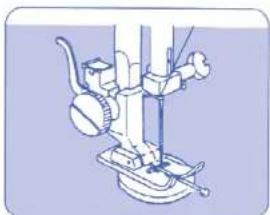
natural_image
Illustration of a laboratory instrument with a stand and tubing (no text or symbols)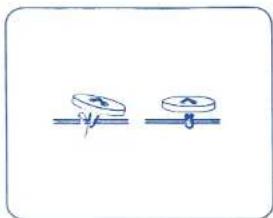
natural_image
Two identical diagrams showing a battery with a switch and a magnified view of the same device (no text or symbols)▶ Sewing buttons
A pin can be placed on top of the foot to form a shank. Set the pattern selector at B. Align the both holes of the button with the slot of the foot and place the left hole of the button just below the needle point. Lower the foot and turn the pattern selector until the needle point comes just above the right hole of the button. Sew about five stitches and raise needle. Set the pattern selector at B again and sew a few stitches to lock thread.
To strengthen the shank, cut the threads leaving a 20 cm tall. Bring the needle thread down through the hole in the button and wind it around the shank.
Draw the thread to the wrong side and knot.
Refer to "Dropping the feed dogs" paragraph to raise or drop the feed dog. After you finish sewing, set the drop feed lever to the original position.

text_image
3 2 1 4 1 ~ 5 3 2▶ Buttonhole
Machine setting
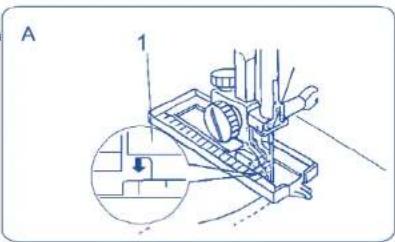
Before you sew the actual buttonles on the actual garment, make several practice buttonholes on a fabric sample.
Use interfacing on stretch fabrics.
text_image
A 1A. Select Bh1, Draw both threads to the left under the Insert the garment under the fool.
- Start mark

text_image
Technical diagram showing mechanical assembly steps with labeled components 3 and 4▶ Coreded buttonholes
(1) With the buttonhole foot raised, hook the filler cord on the spur at the back of the buttonhole foot. Bring the ends toward you under the buttonhole foot, clearing the front end. Hook the filler cord into the forks on the front of the buttonhole foot to hold them light. Lower the needle into the garment where the buttonhole will start and lower the foot.
(2) Sew the buttonhole according to the buttonhole sewing instructions. Depress the foot control gently and sew the buttonhole the same as in normal buttonhole sewing.
(3) Pull the left end of the filler cord to tighten it. Thread the end of the cord through a daming needle, draw it to the wrong side of the fabric and cut.
-
Spur
-
Spring holder
text_image
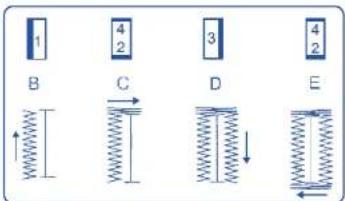
1 4 2 3 4 2 B C D EB. Lower the needle at the starting point. Then lower the buttonhole foot. Sew the required length of the left side of buttonhole and stop the machine.
C. Raise the needle to its highest position by turning the handwheel, then BH2, 4.
Sew five bartack stitches and stop the machine.
D. Raise the needle to its highest position and select BH3, sew the right side of buttonhole the same length as the left side and stop the machine.
E. Raise the needle and select the BH2,4, and sew five of the bartack stitches.

natural_image
Simple line drawing of a mechanical tool with spring and handle (no text or symbols)F. Raise the presser foot and draw out the fabric, cut both needle and bobbin threads leaving approximately 10cm of thread ends loose.
Draw the needle thread to the wrong side of the fabric by pulling the bobbin thread. Then, knot the threads.
G. Place a pin on the rear side of the bartack position so that you don't need to worry about cutting the opening with your seam ripper.
2. Seam ripper
▶ ENGLISH
text_image
A 3 ~ 6 5 4 3 2 1 0 -35°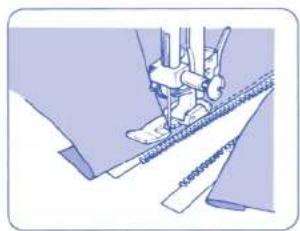
natural_image
Illustration of a sewing machine needle stitching fabric (no text or symbols visible)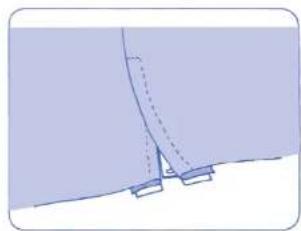
natural_image
Pure diagram of a mechanical or structural component with no visible text, numbers, or symbolsZipper application
Machine setting
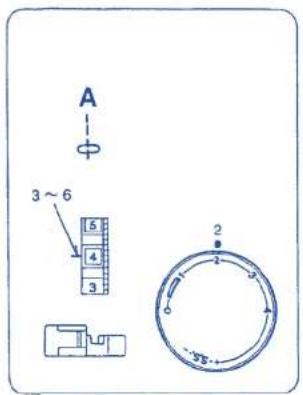
Pin or baste zipper tape to fabric and place it under the foot.
Smooth the threads toward the back and lower the foot.
To sew left side of the zipper, guide the edge of the zipper along the zipper teeth and stitch through garment and zipper tape.
Turn the fabric and sew the other side of the zipper in the same way as you did on the left side of the zipper.
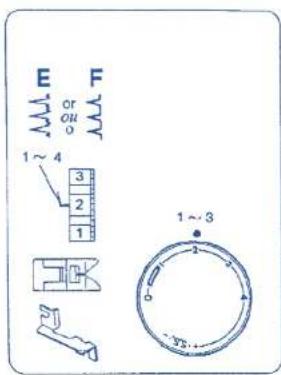
text_image
E F or ou o 1 ~ 4 3 2 1 1 ~ 3 0 0 0 0 0 0 0 0 0 0 0 0 0 0 0 0 0 0 0 0 0 0 0 0 0 0 0 0 0 0 0 0 0 0 0 0 0 0 0 0 0 0 0 0 0 0 0 0 0 0 1 ~ 4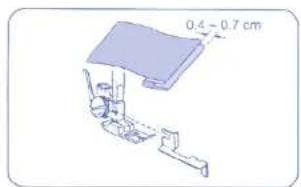
text_image
0.4 - 0.7 cmBlind stitch hemming
Machine setting
Fold up the fabric as illustrated.
Lower the presser foot, then loosen the foot holder screw to place the hem guide
between the screw and the shank of foot holder.
Tighten the screw making sure the wall of hem guide is placed in the middle of the toes of the presser foot.

natural_image
Pure technical line drawing of a mechanical assembly without any text, numbers, or symbolsRaise the presser foot and place the fabric under the foot so that the soft fold rests against the wall of hem guide.
Lower the foot, then stitch slowly for better control so that the zigzag stitches fall on the hem allowance and pierce the soft fold. While sewing, make sure the soft fold runs along the wall of hem guide.
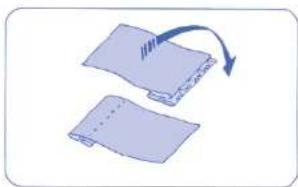
natural_image
Diagram showing two rectangular objects with a blue arrow indicating rotation or movement (no text or symbols)Spread the fabric flat with the right side facing up.
ENGLISH
▶ SECTION 5. DECORATIVE STITCHING
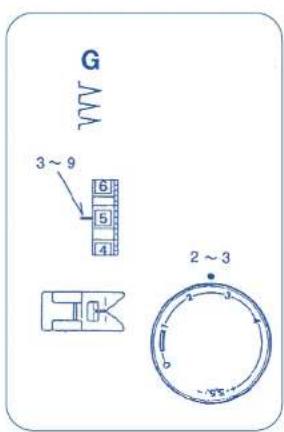
text_image
G MM 3 ~ 9 6 5 4 2 ~ 3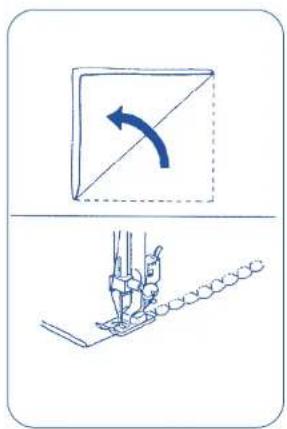
text_image
Technical diagram showing a mechanical assembly with an arrow indicating rotation and a close-up of the component being machined.▶ Shell tuck
Machine setting
Place the folded edge along the slot of foot. The needle should fall off the edge of the fabric on the right forming a tuck.
▶ ENGLISH

text_image
A B C D E F G H I J K L 1~4 5.5▶ Stretch stitch patterns
Machine setting
When forward and reverse feeds become unbalanced depending upon the type of fabric, correct the balance by turning the stitch length dial as follows:
when patterns are compressed, correct it by turning the dial toward + .
When patterns are drawn out, correct it by turning the dial toward - .

natural_image
Illustration of a person working on a boat with a wavy line indicating speed (no text or symbols)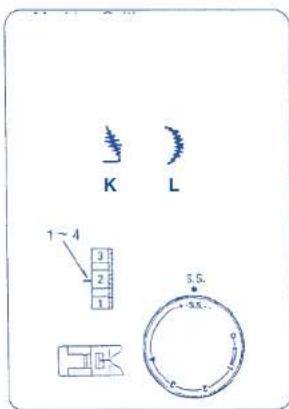
text_image
K L 1~4 3 2 1 5.5. 3.1.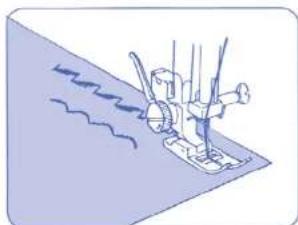
natural_image
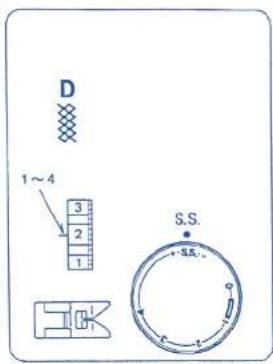
Illustration of a sewing machine stitching fabric (no text or symbols)▶ Decorative satin stitch patterns
Machine setting
Sew a row of stitches and adjust the thread tension so the upper thread should appear on the reverse side of the fabric.
Test the stitch on the actual fabric for the best results.
ENGLISH
text_image
D 1~4 3 2 1 S.S. S.S.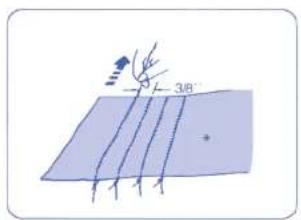
text_image
3dBWrong side of fabric

natural_image
Illustration of hands cutting a fabric with a woven seam and arrow indicating direction (no text or symbols)
text_image
1~4 3 2 1 1~2 0.5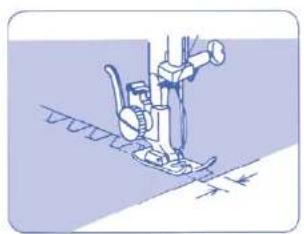
natural_image
Illustration of a sewing machine needle stitching fabric (no text or symbols)Smocking
Machine setting
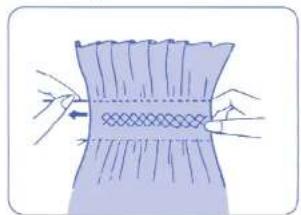
With the stitch length at "4", sew straight stitching lines 8/9 cm apart across the area to be smocked.
Knot the threads along one edge, Pull the bobbin threads and distribute the gathers evenly. Secure the threads at the other end. Sew the decorative stitch between the gathering stitches.
Pull out the gathering stitches.
NOTE: loosen the top thread tension to make gathering easier.
Box stitching
Use this stitch to join heavy weight interlining.
▶ ENGLISH
▶ SECTION 6. CARE OF YOUR MACHINE

natural_image
Simple line drawing of a mechanical device with no text or symbolsWARNING: Switch off and unplug the machine before carrying out any maintenance or adjustment.
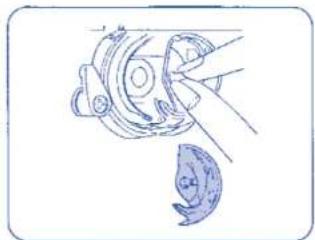
Dismantling and assembling hook race To dismantle hook race: Raise the needle to its highest position and open the hook cover. Open the hinged latch of bobbin case and take it out of the machine.

natural_image
Technical line drawing of a mechanical component with no visible text or symbolsOpen the hook race ring holders and remove the hook race ring.
natural_image
Line drawing of a hand holding a mechanical component, with no visible text or symbolsRemove the hook Clean the hook race with a brush and a soft dry cloth.

natural_image
Technical line drawing of a mechanical assembly with no visible text or symbolsTo assemble hook race Hold the hook by the center pin and fit it carefully back into the hook race, forming a perfect circle with the shuttle driver. Attach the hook race ring making sure bottom pin fits into the notch. Lock the hook race ring by turning the holders back into position. Insert the bobbin case.
natural_image
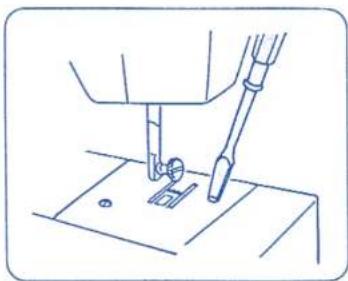
Line drawing of a sewing machine needle stitching fabric (no text or symbols)- Cleaning the feed dogs Remove the needle and the presser foot. Remove the needle plate set screws and remove the needle plate.

natural_image
Technical line drawing of an electronic component assembly (no text or symbols)With a brush, clean out dust and lint clogging on the feed dog teeth. Reset the needle plate.
text_image
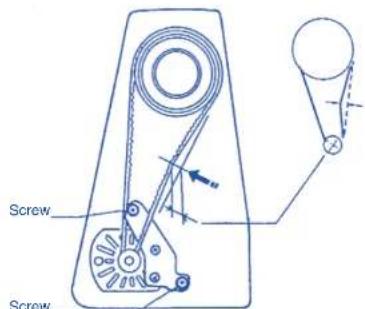
Screw ScrewWhen replacing motor belt, please leave 10 mm slack.
- Drive belt tension To adjust the belt tension, take off the belt cover and loosen the fixing screws about one turn with a screwdriver. This will allow the motor to move downward or upward. Then firmly tighten the screw, making sure the belt has the correct tension.
CAUTION: Do not tighten the belt too tightly.
ENGLISH

natural_image
Technical line drawings of a sewing machine showing exploded and assembled views (no text or labels)▶ Oiling the machine
① Face plate
② Hook cover
Apply a few drops of fine quality sewing machine oil to the points indicated by the arrows in the figures.
For a machine in constant use, oil two or three times a year.
In case the machine does not work smoothly due to standing idle for some time, apply a few drops of kerosene at the oiling points, and run the machine rapidly for a minute.
Before oiling, wipe off the oiling points.
▶ ENGLISH
▶ Trouble shooting
| Condition Cause Reference | ||
| The machine does not run smoothly and is noisy 2. The feed dog is packed with lint See page 46 | 1. Threads have been caught in hoot mechanism | See page 46 |
| The needle thread breaks 1. The needle thread is not threaded properly See page 322. The needle thread tension is too light See page 333. The needle is bent or blunt See page 284. The needle is incorrectly inserted See page 285. The fabric is not being drawn to the back when sewing is finished6. The thread is either too heavy or too fine for the needle | See page 35See page 29 | |
| The bobbin thread breaks | 1. The bobbin thread is not threaded properly in the bobbin case2. Lint has collected in the bobbin case3. The bobbin is damaged and doesn't turn smoothly | See page 32Clean the bobbin caseExchange bobbin |
| The needle breaks | 1. The needle is Incorrectly Inserted2. The needle is bent or blunt See page 283. The needle clamp screw is loose4. The tension of the needle thread is too tight5. The fabric is not drawn to the back when sewing is finished6. The needle is too fine for the fabric being sewn7. The Pattern selector dial had been turned while the needle was in the material | See page 28See page 28See page 32See page 35See page 29See page 34 |
| Skipped stitches | 1. The needle is incorrectly inserted2. The needle is bent or blunt See page 283. The needle and/or threads are not suitable for the work being sown4. A BLUE TIPPED needle is not being used for sewing stretch, very fine fabrics and synthetics5. The needle thread is not threaded properly See page 32 | See page 28See page 29See page 29 |
| Seam puckering | 1. The needle thread tension is too light2. The machine is not threaded correctly3. The needle is too heavy for the cloth being sewn4. The stitches are too coarse for the fabric being sewnWhen sewing extremely light weight materials, place a sheet of paper underneath the fabric | See page 33See page 32See page 29Make the stitches denser |
| Condition Cause Reference | |
| The cloth is not feeding smoothly 1. The feed dog is packed with lint See page 462. The stitches are too fine Eseguire dei punti | più grossi |
| The machine does not work 1. The machine is not plugged in See page 272. A thread is caught in the hook race See page 463. Clutch knob is disengaged for the bobbin winding See page 31 | |
| The buttonhole stitches are not balanced | 1. The stitch length is not suitable for the fabric being sewn2. The work is being pulled or held back Do not force the fabricSee page 33for guiding |
INVENTA 200
Type 803002
220-240 V - 50 Hz - 85 W
Made in P.R.C


Termozeta S.p.A. reserves the right to introduce technical and/or aesthetic changes to its products intended to improve performances. Termozeta is an international trademark. Copyright © 1995. All rights reserved. Termozeta S.p.A. - Via Magenta, 41/43 - 20010 Bareggio (MI) Italy
▶ ESPAÑOL
▶ PRESCRIPCIONES DE SEGURIDAD

text_image
Labeled diagram of a sewing machine with numbered parts for identificationtext_image
Technical diagram of a sewing machine with numbered parts for identification▶ ESPAÑOL
natural_image
Line drawing of a device connected to a power outlet with cable (no text or symbols)text_image
Technical diagram showing mechanical assembly with labeled components and a magnified inset view of a component detail.Luz para coser
natural_image
Technical illustration of a sewing machine needle stitching a component (no text or symbols)▶ Costura de brazo libre
natural_image
Line drawing of hands using a tool to adjust or install a device (no text or symbols present)Caja accesorios
natural_image
Diagram showing two mechanical components with directional arrows indicating motion or force (no text or symbols)natural_image
Diagram showing a sewing machine with directional arrows indicating movement (no text or labels)natural_image
Line drawing of a sewing machine with a hand operating the base and needle inserted (no text or symbols)natural_image
Technical line drawing of a mechanical device with two views: top shows a vertical component, bottom shows a tool with a handle (no text or symbols)
natural_image
Line drawing of a sewing machine with base and foot (no text or symbols)natural_image
Line drawing of a hand holding a tool above a mechanical component (no text or symbols)text_image
Diagram illustrating a mechanical or electrical setup with three labeled components and directional arrows indicating motion or transformation.① Hilo superior
② Agujero
① Enredo

natural_image
Line drawing of a sewing machine needle stitching a base, showing no text or symbolsnatural_image
Line drawing of a sewing machine needle stitching fabric (no text or symbols)natural_image
Diagram of a mechanical or electrical component with two circular components and a central hub, no visible text or symbols.natural_image
Three-step diagram showing a mechanical assembly with a spool, a close-up of a component, and a close-up of a cylindrical component (no text or symbols)text_image
Three-step diagram illustrating a hand holding a device, showing step ①, step ②, and step ③ with directional arrows indicating movement.text_image
Technical diagram of a mechanical device with labeled parts A through G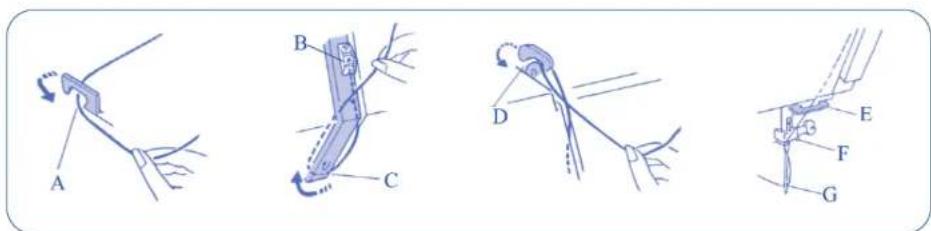
text_image
Technical diagram showing four different mechanical or structural configurations labeled A through G, with arrows indicating motion or assembly.text_image
Diagram showing a sewing machine with a magnified view of the component being adjusted, indicating mechanical assembly or repair.
natural_image
Illustration of a sewing machine needle being adjusted, showing hand positioning and tool path (no text or symbols)
natural_image
Line drawing of a mechanical device with a lever and base, showing motion direction (no text or symbols)text_image
Diagram illustrating a mechanical assembly process with numbered components and rotation arrowstext_image
3 4 1 A B C D E F G H I J K L BA TBD HND WDC WDC WDC WDC WDC WDC WDC WDC WDC WDC WDC WDC WDC WDC WDC WDC WDC WDC WDC WDC WDC WDC WDC WDC WDC WDC WDC WDC WDC WDC WDC WDC WDC WDCnatural_image
Simple line drawing of a hand pressing a button into a rectangular device (no text or symbols)Botón puntos atrás
natural_image
Line drawing of a sewing machine needle stitching fabric (no text or symbols)Línea guía costura
text_image
Diagram showing sewing machine operation with labeled steps ① and ②, illustrating thread positioning and fabric cutting.Bajar el gancho
natural_image
Illustration of a sewing machine needle stitching fabric (no text or symbols)natural_image
Technical diagram showing a mechanical assembly with an inset close-up of a component (no text or symbols present)natural_image
Diagram of a mechanical linkage or lever mechanism with no visible text or symbolsnatural_image
Diagram showing a mechanical device with rotating components and a magnified inset of the component (no text or symbols)natural_image
Illustration of a sewing machine needle stitching fabric (no text or symbols)▶ Costura en zigzag
natural_image
Illustration of a person climbing a rope with a spring, no text or symbols presentPor encima
natural_image
Illustration of a person skiing down a slope with ropes and inclines (no text or symbols)Punto por encima
natural_image
Illustration of a sewing machine on a flatbed surface (no text or symbols)natural_image
Illustration of a sewing machine needle stitching fabric (no text or symbols)natural_image
Illustration of a laboratory instrument with a central lever and base mount (no text or symbols)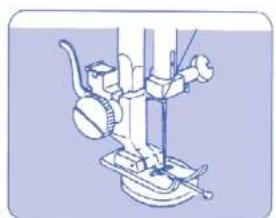
natural_image
Illustration of a laboratory apparatus with a test tube and tubing (no text or symbols visible)
natural_image
Simple line drawing of two identical objects on a horizontal line, no text or symbols presentCostura botones
text_image
Technical diagram showing mechanical assembly steps with labeled components 3 and 4Ojales canalé
natural_image
Simple line drawing of a mechanical tool with spring and handle (no text or symbols)natural_image
Illustration of a sewing machine needle stitching fabric (no text or symbols visible)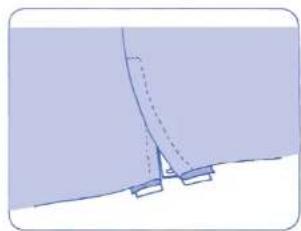
natural_image
Pure diagram of a mechanical or structural assembly without any text, numbers, or symbolsnatural_image
Illustration of a boat with crew members on deck, no visible text or symbolsnatural_image
Diagram showing two rectangular objects with a blue arrow indicating rotation or movement (no text or symbols)text_image
Technical diagram showing a mechanical assembly with an arrow indicating rotation and a close-up of the component being machined.Dobladillo curvo
text_image
A B C D E F G H I J K L 1~4 S.S.natural_image
Illustration of a person working on a boat with a wavy line indicating speed (no text or symbols)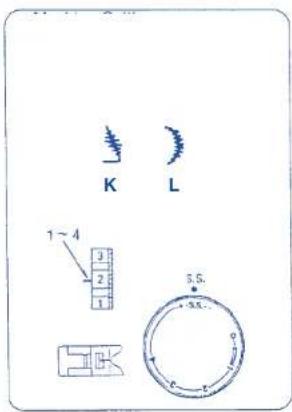
text_image
K L 1~4 3 2 1 5.5. 5.5.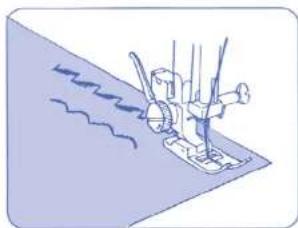
natural_image
Illustration of a sewing machine stitching fabric (no text or symbols)text_image
D 1~4 3 2 1 S.S. S.S.
text_image
3dBRevés del tejido
natural_image
Illustration of hands cutting a fabric with a woven seam and arrow indicating direction (no text or symbols)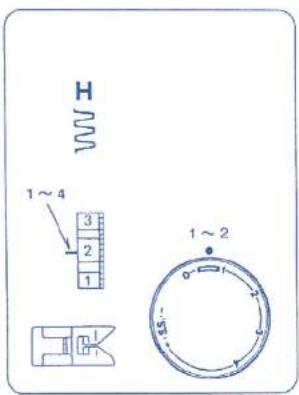
text_image
1~4 3 2 1 1~2
natural_image
Illustration of a sewing machine needle stitching fabric (no text or symbols)Nido de abeja
natural_image
Line drawing of a mechanical device with a handle and lever (no text or symbols)natural_image
Technical line drawing of a mechanical component with no visible text or symbolsnatural_image
Line drawing of a hand holding a mechanical component with a curved base (no text or symbols)flowchart
graph TD
    A[" fan "] --> B[" gear "]
    B --> C[" belt "]
    C --> D[" loop "]
    D --> E[" end"]
natural_image
Line drawing of a sewing machine needle stitching on a workbench (no text or symbols)natural_image
Technical line drawing of a mechanical assembly with no visible text or symbolsnatural_image
Technical line drawings of three different sewing machine components (no text or labels)In accordance with European Directives 2002/95/CE, 2002/96/CE and 2003/108/CE on the restriction of the use of dangerous substances in electric and electronic equipment as well as their waste disposal.
- The barred symbol of the rubbish bin shown on the equipment indicates that, at the end of its useful life, the product must be collected separately from other waste.
- Therefore, any products that have reached the end of their useful life must be given to waste disposal centres specialising in separate collection of waste electrical and electronic equipment, or given back to the retailer at the time of purchasing new similar equipment, on a one for one basis.
• The adequate separate collection for the subsequent start-up of the equipment sent to be recycled, treated and disposal of in an environmentally compatible way contributes to preventing possible negative effects on the environment and health and optimises the recycling and reuse of components making up the apparatus. - Abusive disposal of the product by the user involves application of the administrative sanctions according to the laws in force.
106 SPIAN
