
SBB 850 A1 BREAD MAKER - Bread maker SILVERCREST - Free user manual and instructions
Find the device manual for free SBB 850 A1 BREAD MAKER SILVERCREST in PDF.



| Product type | Bread machine |
| Brand | SILVERCREST |
| Model | SBB 850 A1 |
| Power supply | 220-240 V ~ 50 Hz, 850 W |
| Maximum capacity | Up to 1250 g of bread |
| Number of programs | 12 (Normal, French, Whole Wheat, Sweet, Super Rapid, Dough, Pasta, Buttermilk, Gluten-Free, Cake, Jam, Bake) |
| Timer delay | Up to 15 hours |
| Browning levels | Light, medium, dark, rapid |
| Adjustable bread weight | 750 g, 1000 g, 1250 g |
| Accessories included | Baking pan (1250 g), 2 kneading paddles, measuring cup, measuring spoon, paddle extractor |
| Keep warm function | Up to 60 minutes after baking |
| Memory after power cut | Up to 10 minutes |
| Care and cleaning | Clean with a damp cloth; do not immerse; do not put in dishwasher |
| Safety | Do not cover, do not use without pan, do not touch hot surfaces |
| Warranty | 3 years |
Frequently Asked Questions - SBB 850 A1 BREAD MAKER SILVERCREST
User questions about SBB 850 A1 BREAD MAKER SILVERCREST
0 question about this device. Answer the ones you know or ask your own.
Ask a new question about this device
Download the instructions for your Bread maker in PDF format for free! Find your manual SBB 850 A1 BREAD MAKER - SILVERCREST and take your electronic device back in hand. On this page are published all the documents necessary for the use of your device. SBB 850 A1 BREAD MAKER by SILVERCREST.
USER MANUAL SBB 850 A1 BREAD MAKER SILVERCREST
GB Bread Maker IE Operating instructions SE Bread Maker
Operating instructions
FI Bread Maker
Operating instructions
DK Bread Maker
Content
Page
| Safety Notices | 2 |
| Appliance Overview | 3 |
| Accessories | 3 |
| Intended Use | 3 |
| Before the first usage | 4 |
| Properties | 4 |
| Control panel | 5 |
| Programme | 6 |
| Timer-Function | 7 |
| Before baking | 8 |
| Baking bread | 8 |
| Error Messages | 10 |
| Cleaning and Care | 10 |
| Technical data | 11 |
| Disposal | 11 |
| Warranty and Service | 12 |
| Importer | 12 |
| Programme sequence | 13 |
| Troubleshooting the Bread Baking Machine | 17 |
Read the operating instructions carefully before using the device for the first time and preserve this booklet for later reference. Pass this manual on to whoever might acquire the device at a future date.
⚠️ Safety Notices
- Please read the operating instructions through completely before using the appliance for the first time!
- Danger of suffocation! Children can suffocate through the improper use of packaging materials. Dispose of them immediately after unpacking or store them in a place that is out of reach of children.
- After unpacking, check the appliance for damage that may have occurred during transportation. If necessary, contact your supplier.
- Place the appliance on a dry, flat and heat-resistant surface.
- Do not place the appliance near inflammable materials or explosive/ignitable gases. A minimum distance of 10 cm must be maintained to all other materials.
- Ensure that the ventilation slots of the appliance are kept free at all times. Risk of overheating!
- Before plugging the appliance in, check that the electricity type and mains voltage matches the information given on the type plate.
- Do not place the power cable over sharp edges or close to hot surfaces or objects. These may damage the insulation of the power cable.
- Never leave the appliance unsupervised whilst in use.
- To avoid the risk of tripping accidents the appliance is provided with a short power cable. • Only use the appliance inside buildings.
- Never place the appliance on or close to a gas or electric cooker, a hot oven or any other source of heat. Risk of overheating!
- Never cover the appliance with a tea-towel or other material. Heat and steam must be able to escape. A fire could occur if the appliance is covered with an inflammable material or comes into contact with inflammable materials, e.g. curtains.
- If you use an extension cable, ensure that the maximum permitted power rating for the cable corresponds to that of the bread baking machine.
- Place the extension cable in such a way as to prevent anyone from tripping over it or unintentionally pulling on it.
- Always check the power cable and plug before use. Should the power cable of the appliance become damaged, to avoid the risk of injury or a fatality it must be replaced by the manufacturer, the manufacturer's customer service or a similarly qualified specialist.
- The use of ancillaries not recommended by the manufacturer could cause damage to the appliance. Only use the appliance for its intended purposes. Non-compliance invalidates all claims under the warranty.
- Start a baking programme only when a baking mould is fitted in. If a mould is not fitted, it could cause irreparable damage to the appliance.
- If children are in the vicinity, supervise the appliance particularly well! If the appliance is not in use, and also before cleaning it, remove the plug from the power socket. Allow the appliance to cool down before removing individual parts.
- This appliance is not intended for use by individuals (including children) with restricted physical, physiological or intellectual abilities or deficiencies in experience and/or knowledge unless they are supervised by a person responsible for their safety or receive from this person instruction in how the appliance is to be used. Children should be supervised to ensure that they do not play with the appliance.
- This appliance complies with standard safety regulations. Inspection, repair and technical maintenance may only be performed by a qualified specialist. Non-compliance invalidates all claims under the warranty.
- Do not place any objects on the appliance and do not cover it during operation. Risk of fire!
- Caution! The bread maker becomes very hot during operation. Do not touch the appliance until it has cooled down, or use oven gloves.
- Before taking out or inserting accessories, unplug the power cable and allow the appliance to cool down.
- Do not transport the Bread Baking Machine if the baking mould contains hot or fluid contents, e.g. jams. There is a danger of being burnt!
- During use, NEVER come into contact with the rotating kneading paddles. There is also a risk of personal injury!
- Do not pull on the cable to remove the plug, rather, pull the plug itself from the socket.
- When not in use, and before cleaning the appliance, remove the power cable from the wall socket.
- Do not use the Bread Baking Machine for the storage of foods or utensils.
- Never lay aluminium foil or other metallic objects in the Bread Baking Machine. This could lead to a short circuit. There would be a risk of fire!
- Never place the bread machine in water or other liquids. Risk of fatal electrical shocks!
- Do not clean the appliance with abrasive sponge cleaning pads. Should particles break away from the sponge and come into contact with electrical components, you could receive an electric shock.
- Do not use an external timing switch or a separate remote control system to operate the appliance.
- Never use the appliance without a baking mould or with an empty one. This would irreparably damage the appliance. Always close the lid during operation.
- NEVER remove the baking mould during operation.
- When baking, NEVER exceed the amount of 700 g of flour and NEVER add more than 1 1/4 packets (approx. 26 g) of dry yeast. The dough could spill over and cause a fire!
- When in use, the temperature of the outer surfaces and the door can be very high. Risk of Burns!
Appliance Overview
1 Viewing window 2 Appliance lid 3 Ventilation slits 4 Power cable 5 Control panel

Caution! Hot surfaces!
Accessories
6 2 kneading paddles 7 Baking mould for bread weights up to 1250 g 8 Measuring cup 9 Measuring spoon 10 Kneading paddle remover
Concise instruction sheet - Recipe book - Operating manual
Intended Use
Use your Bread Baking Machine for baking bread and making jams or marmalades in domestic areas only.
Do not use the appliance for drying foodstuffs or other objects. Do not use the Bread Baking Machine outdoors.
Use only the ancillaries recommended by the manufacturer. Non-recommended accessories may cause damage to the appliance.
Before the first usage
Disposal of the packaging material
Unpack your appliance and dispose of the packaging material in accordance with your local regulations.
Initial cleaning
Wipe the baking mould ⑦, kneading paddles ⑥ and outer surfaces of the bread baking machine with a clean, damp cloth before putting it into operation. Do not use abrasive scrubbers or cleaning powders. Remove the protective foil on the control panel ⑤.
Pre-heating
i Please take note of the following notice regarding the first usage:
For the first heating up ONLY, place the empty baking mould ⑦ into the appliance. Close the appliance lid ②. Select the programme 12, as described in the section "PROGRAMMMES" then press the button Start/Stop B, to warm up the appliance for 5 minutes. To terminate the programme, after 5 minutes press the button Start/Stop B until a long signal tone is heard.
As the heating elements are lightly greased, a slight smell may occur when first putting the appliance into operation. This is harmless and stops after a short time. Provide for sufficient ventilation, for example, open a window.
Allow the appliance to cool down completely and once again wipe the baking mould ⑦, kneading paddles ⑥ and the outer surfaces of the Bread Baking Machine with a clean moist cloth.

Risk of fire! Do not allow the Bread Baking Machine to warm up for more than 5 minutes with an empty baking mould ⑦. There is a real danger of overheating.
Properties
With this Bread Baking Machine you have the possibility to bake bread according to your taste.
- You can choose from 12 different baking programmes. • You can employ ready-to-use baking mixtures.
- You can knead dough for buns and noodles and also prepare marmalades and jams.
- With the "Gluten Free" programme, you can bake gluten-free baking mixtures and recipes with gluten-free flours, such as cornflour, buckwheat flour, and potato starch.
Control panel
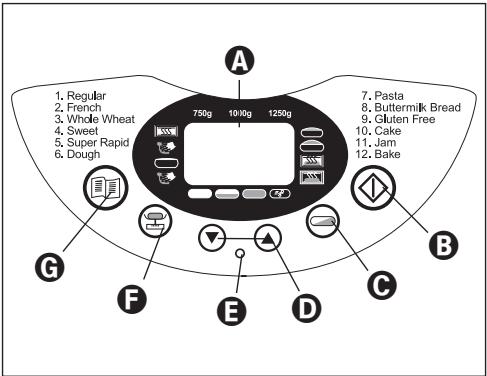
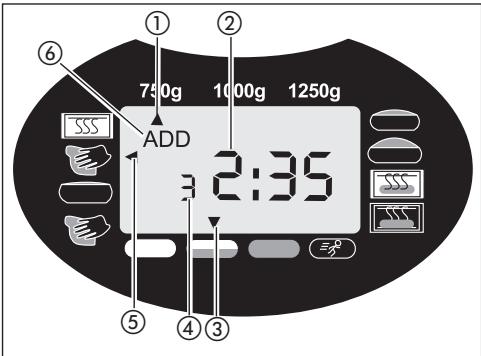
A Display
Display for
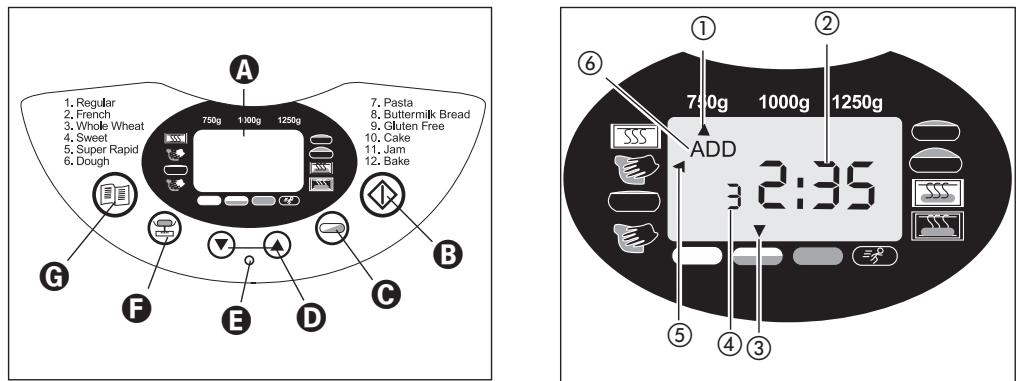
① selection of the weight (750 g, 1000 g, 1250 g) ② the remaining baking time in minutes and the programmed time ③ the selected level of browning (light □, medium □, dark □, Rapid ≡) ④ the selected program number ⑤ the programme sequence ⑥ the addition of ingredients ("ADD")
B Start / Stop

To start and stop an operation or to delete a time-programming.
To interrupt the operation, briefly press the Start/Stop button B until a signal tone sounds and the time in the display A flashes. By pressing the Start/Stop button B again within 10 minutes, the operation can be continued. If you forget to restart the programme, it will automatically continue after 10 minutes.
To completely terminate the operation or to delete a programming, press the Start/Stop button Ⓑ for 3 seconds until a long signal tone sounds.
Note:
Do not press the Start/Stop button Ⓑ if you want to simply check the condition of the bread. You can watch the baking operation through the viewing window.
⚠️ Please note:
When pressing all buttons, an acoustic signal must be audible, unless the appliance is in operation.
© Level of browning (or Rapid mode)

Select the browning level or switch to the Rapid mode (light/medium/dark/Rapid). Press the Browning Level button C repeatedly until the arrow is located above the desired browning level. For Programmes 1 - 4, you can activate the Rapid mode by repeatedly pressing the Browning Level button C to shorten the baking process. Press the Browning Level button C repeatedly until the arrow appears over "Rapid". A browning level cannot be selected with Programmes 6, 7, and 11.
D Timer ▼ ▲
Time-delayed baking.
Note:
Time-delayed baking cannot be arranged with Programme 11.
E Operation indicator lamp
The operation indicator lamp E indicates with its glowing that a programme is currently running. If you want to start a programme time-delayed by using the timer function, the operation indicator lamp E first glows when the programme itself starts, not when the timer is activated.
F Bread weight
Select the bread weight (750 g / 1000 g / 1250 g). Press the button repeatedly until the arrow appears under the desired weight. The weight details (750 g / 1000 g / 1250 g) relate to the amount of ingredients placed in the baking mould ⑦.
Note:
The default setting when switching the appliance on is 1250 g. You cannot adjust the bread weight with Programmes 6, 7, 11, and 12.
G Programme selection (Menu)
Call-up of the desired baking programme (1-12). In the display A appears the Programme number and the corresponding baking time.
Memory Function
When being switched on again after a power failure of up to approx. 10 minutes, the program will continue from the same point. This is however not valid when erasing/terminating the baking process or pressing the button Start/Stop Ⓑ until an extended signal tone sounds.
Viewing window 1
You can observe the baking process through the window 1.
Programme
Select the desired programme with the button Programme selection G. The corresponding programme number is shown in the display A. The baking times are dependant on the selected Programme combinations. See the chapter "Programme sequence".
Programme 1: Regular
For white and mixed breads mainly consisting of wheat flour or rye flour. The bread has a compact consistency. Set the browning of the bread with the button browning level ©.
Programme 2: French
For light breads from well-milled flour. As a rule, the bread is light and has a crispy crust.
Programme 3: Whole Wheat
For breads made from robust flours, e.g. whole wheat flour and whole rye flour. The bread will be more compact and heavy.
Programme 4: Sweet
For breads with ingredients like fruit juices, coconut flakes, raisins, dried fruit, chocolate or additional sugar. Due to an extended rising phase the bread will be lighter and airier.
Programme 5: Super Rapid
Less time is required for kneading, rising and baking. For this Programme, however, use only such recipes that do not contain any heavy ingredients or heavy varieties of flour. Note that in this programme the bread is less aerated and may not be quite so tasty.
Programme 6: Dough (kneading)
For the preparation of yeast dough for buns, pizza or plaits. In this Programme no baking is done.
Programme 7: Pasta
For the preparation of pasta dough. In this Programme no baking is done.
Programme 8: Buttermilk bread
For breads made with buttermilk or yoghurt.
Programme 9: Gluten Free
For breads made of gluten-free flours and baking mixtures. Gluten-free flours require longer for the absorption of liquids and have differing rising properties.
Programme 10: Cake
In this programme the ingredients are kneaded, allowed to rise and then baked. Use baking powder for this programme.
Programme 11: Jam
For making jams, preserves, jellies and fruit spreads.
Programme 12: Bake
For the after-baking of breads that are not brown enough, not baked through or ready-made dough. All kneading and rising processes are dispensed with in this programme. The bread is kept warm for up to one hour after the baking process. This prevents the bread from becoming too moist.
Programme 12 bakes the bread for 60 minutes. To terminate these functions prematurely, press the Start/Stop button Ⓑ until a long signal tone is heard. To switch the appliance off, remove the power plug from the wall socket.
Note:
With the programmes 1, 2, 3, 4, 5, 6, 8 and 9 a signal tone sounds during the programme process and "ADD" ⑥ appears in the display.
As soon as possible after it sounds add the other ingredients, such as fruit or nuts.
The ingredients will not be crushed by the kneading paddle 6.
If you have set the timer, you can put all the ingredients into the baking mould ⑦ at the beginning. In this case, however, fruits and nuts should be cut into smaller pieces before inserting them.
Timer-Function
The timer function allows you to do time-delayed baking.
With the arrow buttons ▲ and ▼ D enter in the desired completion time for the baking process. The maximum time delay amounts to 15 hours.
⚠ Warning! Before you bake a particular type of bread with time delay first try out the recipe under observation, to ensure that the relationships of the ingredients to each other are correct, the dough is not too firm or too thin, and that the amounts are not too large and could possibly overflow. Risk of fire!
Select a Programme. The display Ⓐ indicates the required baking time.
With the arrow key ▲ D you can postpone the end of the Programme. The first activation pushes the completion time back to the next full interval of 10 minutes. Each subsequent activation of the arrow key ▲ D pushes the completion time back by 10 minutes. You can accelerate this procedure by holding the button pressed down. The display shows you the whole period of the baking time and delay time. On a possible exceeding of the possible time delay you can correct the time with the arrow button ▼ D. Confirm the programming of the timer with the Start/Stop button B. The colon on the display A flashes and the programmed time starts to run. As soon as the programme starts, the operation indicator lamp E glows.
When the baking process has been completed, ten acoustic signals are sounded and the display Ⓐ indicates 0:00.
Example:
It is 8:00 a.m. and you would like to have fresh bread in 7 hours and 30 minutes, in other words at 3:30 p.m. First of all select Programme 1 and then press the arrow button D until 7:30 appears in the display A, as the time period to be allowed for completion is one of 7 hours and 30 minutes.
Note: The timer function cannot be activated with the Programme "Jam".
Note
With time-delayed baking, please do not use perishable ingredients such as milk, eggs, fruit, yoghurt, onions, etc.
Before baking
For a successful baking process, please consider the following factors:
Ingredients
Note
Take the baking mould ⑦ out of the housing before putting in the ingredients. Should ingredients drop into the baking area, a fire may be caused by them burning on the heating elements.
• Always place ingredients into the baking mould ⑦ in the sequence specified. - All ingredients should be at room temperature, to ensure an optimal rising result from the yeast. - Ensure that you measure the ingredients precisely. Even negligible deviations from the quantities specified in the recipe may affect the baking results.
Note
NEVER use quantities larger than those specified. Too much dough could rise out of the baking mould ⑦, drop onto the hot heating elements, and cause a fire.
Baking bread
Preparation
Pay heed to the safety instructions in this manual. Place the Bread Baking Machine on a level and firm surface.
- Pull the baking mould ⑦ upwards and out of the appliance.
- Push the kneading paddles ⑥ onto the drive shafts in the baking mould ⑦. Make sure they are firmly in place.
- Place the ingredients for your recipe into the baking mould ⑦ in the specified order. First add the liquids, sugar, and salt, then the flour, adding the yeast as the last ingredient.
Note
Ensure that the yeast does not come into contact with salt or fluids.
- Place the baking mould ⑦ back in the appliance. Ensure that it engages correctly.
- Place the baking mould ⑦ back in the appliance. Ensure that it engages correctly.
- Close the appliance lid ②.
- Insert the power plug into the wall socket. A signal tone sounds and in the display A appears the Programme number and the time-duration for Programme 1.
- Select your programme with the Programme select button E. Each input is confirmed with a signal tone.
- If necessary, select the size of bread you want to bake with the button F.
- Select the browning level C for your bread. In the display A the arrow shows you what you have selected, light, medium or dark. Here you can also select the setting "Rapid" to shorten the time period in which the dough rises.
Note
A browning level cannot be selected with the programmes 6, 7 and 11.
The function "Rapid" is only available with Programmes 1-4.
A bread weight level cannot be selected with the Programmes 6, 7, 11 and 12.
- You now have the option of setting the end time of your programme using the timer function. You can enter in a maximum time delay of up to 15 hours.

Note
This function is not available for Programme 11.
Starting the Programme
Now start the programme with the Start/Stop button B.
i
Note: The Programmes 1, 2, 3, 4, 6, 8 and 9 start with a 10 to 30 minute pre-heat phase (except Rapid, see Table for Programme Sequences). The kneading paddles ⑥ do not move themselves. That is not an error of the machine.
The Programme automatically carries out the various operations.
You can watch the programme sequence via the window ① of your Bread Baking Machine.
Occasionally, condensation may collect in the window during baking ①. The appliance lid ② can be opened during the kneading phase.

Note
Do not open the appliance lid ② during the rising or baking phases. The bread could collapse.
Ending the Programme
When the baking process has been completed, ten acoustic signals are sounded and the display Ⓐ indicates 0:00.
At the end of the programme the appliance automatically changes to a keep-warm mode for up to 60 minutes.

Note
This is not applicable to Programmes 6, 7 and 11.
In this mode, warm air circulates inside the appliance. The keep warm period can be prematurely terminated by pressing down the Start/Stop button Ⓑ until the signal tone sounds.

Warning
Before opening the appliance lid ② remove the power plug from the wall socket.
When not in use, the appliance should never be plugged in!
Taking out the bread
When handling the hot baking mould, ⑦ always use pot holders or oven gloves.
Hold the baking mould ⑦ tilted over a grid and shake it lightly until the bread slides out of the baking mould ⑦.
If the bread does not slip off the kneading paddles 6, carefully remove the kneading paddles 6 using the supplied kneading paddle remover 10.

Note
Do not use any metal objects which may cause scratches on the non-stick coating.
After removing the bread, immediately rinse the baking mould ⑦ with warm water. This prevents the kneading paddles ⑥ from sticking to the driving shaft.
Tip: If you remove the kneading paddles ⑥ after the last kneading of the dough, the bread will remain intact when you remove it from the baking mould ⑦.
- Briefly press the Start/Stop button B to interrupt the programme at the very start of the baking phase or, remove the power plug from the wall socket. Ensure that you re-insert the power plug within 10 minutes so that the baking process can be continued.
- Open the appliance lid ② and remove the baking mould ⑦. You can take the dough out with floured hands and remove the kneading paddles ⑥.
- Lay the dough back into the baking mould ⑦. Replace the baking mould ⑦ and close the appliance lid ②.
- Insert the power plug into the wall socket. The baking programme continues from where it was stopped.
Allow the bread to cool for 15-30 minutes before eating it.
Before cutting the bread, ensure that the kneading paddles have been removed ⑥.
Error Messages
- If the display A shows "HHH" after the programme has been started, it indicates that the temperature in the Bread Baking Machine is still too high. Stop the programme and remove the power plug. Open the appliance lid ② and allow the machine to cool down for 20 minutes before re-using it.
- If a new Programme cannot be started directly after the Bread Baking Machine has completed a baking process, it means the appliance is still too hot. In this case the display panel reverts to the default setting (Programme 1). Open the appliance lid ② and allow the machine to cool down for 20 minutes before re-using it.
Warning
Do not attempt to take the appliance into use before it has cooled itself down. This functions only with Programme 12.
- If the display shows "EEO", "EE1" or "LLL" after the programme has been started, first of all switch the Bread Baking Machine off and then back on by removing and then re-inserting the power plug from/into the wall socket. Should the error display continue, make contact with Customer Services.
Cleaning and Care
Warning
Before cleaning it, always remove the power plug from the wall socket and allow the appliance to cool down completely.
Protect the appliance against moisture, this could cause you to receive an electric shock.
Please also observe the safety instructions.
⚠️ Important
The appliance and its ancillaries are not suitable for being cleaned in a dish washing machine!
Housing, lid, baking space
Remove all particles left behind inside the baking area using a wet cloth or a slightly wet soft sponge. Wipe the housing and the lid too, only with a moist cloth or sponge.
- Ensure that the interior is completely dry. For easier cleaning, the appliance lid ② can be removed from the housing:
- Open the appliance lid ② until the wedge-shaped hinge cams pass through the openings of the hinge guides. • Pull the appliance lid ② out of the hinge guides.
- To reassemble the appliance lid ②, guide the hinge cams through the opening of the hinge guides.
Baking moulds and kneading paddles
The surfaces of the baking moulds ⑦ and kneading paddles ⑥ have a non-stick coating. When cleaning the appliance do not use aggressive detergents, cleaning powders or objects that may cause scratches to the surfaces.
Due to moisture and vapours the surfaces of various parts may undergo changes in their appearance over a period of time. This has no influence on the function nor does it reduce the quality of the baking results.
Before cleaning, take the baking moulds ⑦ and kneading paddles ⑥ out of the baking area. Wipe the outside of the baking moulds ⑦ with a damp cloth.
⚠️ Important
Never submerse the baking mould ⑦ in water or other liquids.
Clean the interior areas of the baking mould ⑦ with warm soapy water.
If the kneading paddles ⑥ are encrusted and it is difficult to dissolve, fill the baking mould ⑦ with hot water for approx. 30 minutes.
If the mountings of the kneading paddles ⑥ are clogged, you can clean them carefully with a wooden toothpick.
Do not use any chemical cleaning agents or solvents to clean the Bread Baking Machine.
Technical data
Model: Bread Baking Machine SBB 850 A1
Nominal voltage: 220-240V~50Hz
Power consumption: 850 Watt
Disposal

Do not dispose of the appliance in your normal domestic waste. This product is subject to the European guideline 2002/96/EC.
Dispose of the appliance through an approved disposal centre or at your community waste facility.
Observe the currently applicable regulations.
In case of doubt, please contact your waste disposal centre.

Dispose of all packaging materials in an environmentally friendly manner.
Warranty and Service
You receive a 3-year warranty for this device as of the purchase date. The device has been manufactured with care and meticulously examined before delivery.
Please retain your receipt as proof of purchase. In the case of a warranty claim, please make contact by telephone with our service department. Only in this way can a post-free despatch for your goods be assured.
The warranty covers only claims for material and manufacturing defects, but not transport damage, worn parts, e.g the baking mould or the kneading paddles, or damage to fragile components. This product is intended for domestic use only, it is not intended for commercial applications.
In the event of misuse and improper handling, use of force and modifications not carried out by our authorized service branch, the warranty will become void. Your statutory rights are not restricted in any way by this warranty.
The warranty period is not extended by repairs made under the warranty. This applies also to replaced and repaired parts. Damages or defects discovered after purchase are to be reported directly after unpacking, at the latest two days after the purchase date.
Repairs carried out after lapse of the warranty period are subject to charge.
GB DES UK LTD
Tel.: 0871 5000 700 (£ 0.10 / minute)
e-mail: support.uk@kompernass.com
IE Kompernass Service Ireland
Tel.: 1850 930 412 (0,082 EUR/Min.)
Standard call rates apply. Mobile operators may vary.
e-mail: support.ie@kompernass.com
CY Kompernass Service Cyprus
Tel.: 800 9 44 01
e-mail: support.cy@kompernass.com
Importer
KOMPERNASS GMBH
BURGSTRASSE 21
D-44867 BOCHUM
www.kompernass.com
Program sequence
| Programme | 1. Regular | 2. French | ||||||||||
| Level of browning | LightMediumDark | Rapid | LightMediumDark | Rapid | ||||||||
| Size | 750 g | 1000 g | 1250 g | 750 g | 1000 g | 1250 g | 750 g | 1000 g | 1250 g | 750 g | 1000 g | 1250 g |
| Time (Hours) | 2:58 | 3:05 | 3:15 | 2:14 | 2:20 | 2:25 | 3:13 | 3:18 | 3:25 | 2:18 | 2:25 | 2:30 |
Preheat (Min)  | 15 | 15 | 20 | N/A | N/A | N/A | 10 | 10 | 15 | N/A | N/A | N/A |
Kneading 1 (min)  | 12 | 13 | 13 | 12 | 13 | 13 | 12 | 12 | 15 | 12 | 13 | 13 |
Rise 1 (Min)  | 25 | 25 | 25 | 10 | 10 | 10 | 20 | 20 | 20 | 10 | 10 | 10 |
Kneading 2 (min)  | 23A*5 | 25A5 | 25A5 | 21A5 | 22A5 | 22A5 | 23A*8 | 25A8 | 25A8 | 21A5 | 22A5 | 22A5 |
Rise 2 (Min)  | 30 | 30 | 30 | 18 | 18 | 18 | 43 | 41 | 35 | 18 | 18 | 18 |
| Rise 3 (Min) [4WGB] | 30 | 30 | 30 | 30 | 30 | 30 | 35 | 35 | 35 | 30 | 30 | 30 |
Bake (min)  | 56 | 60 | 65 | 56 | 60 | 65 | 60 | 65 | 70 | 60 | 65 | 70 |
Keep-Warm time(Min)  | 60 | 60 | 60 | 60 | 60 | 60 | 60 | 60 | 60 | 60 | 60 | 60 |
| Insert ingredients(Time remaining) | 2:01 | 2:05 | 2:10 | 1:49 | 1:53 | 1:58 | 2:26 | 2:29 | 2:28 | 1:53 | 1:58 | 2:03 |
| Pre-adjustment of the time | 15h | 15h | 15h | 15h | 15h | 15h | 15h | 15h | 15h | 15h | 15h | 15h |
* 3A means that the Bread Baking Machine kneads for 3 minutes and simultaneously the signal tone sounds to add ingredients and the display notice "ADD" ⑥ appears.
| Programme | 3. Whole Wheat | 4. Sweet | ||||||||||
| Level of browning | LightMediumDark | Rapid | LightMediumDark | Rapid | ||||||||
| Size | 750 g | 1000 g | 1250 g | 750 g | 1000 g | 1250 g | 750 g | 1000 g | 1250 g | 750 g | 1000 g | 1250 g |
| Time (Hours) | 3:18 | 3:25 | 3:35 | 2:24 | 2:30 | 2:35 | 2:56 | 3:01 | 3:10 | 2:10 | 2:16 | 2:20 |
Preheat (Min)  | 15 | 15 | 20 | N/A | N/A | N/A | 10 | 10 | 15 | N/A | N/A | N/A |
Kneading 1 (min)  | 11 | 12 | 12 | 11 | 13 | 13 | 12 | 12 | 12 | 11 | 12 | 12 |
| Rise 1 (Min) [67BW] | 30 | 30 | 30 | 10 | 10 | 10 | 25 | 25 | 25 | 10 | 10 | 10 |
Kneading 2 (min)  | 23A8 | 25A8 | 25A8 | 22A5 | 22A5 | 22A5 | 24A*6 | 25A6 | 25A6 | 21A6 | 22A6 | 22A6 |
Rise 2 (Min)  | 38 | 38 | 38 | 23 | 23 | 23 | 35 | 35 | 35 | 18 | 18 | 18 |
Rise 3 (Min)  | 35 | 35 | 35 | 35 | 35 | 35 | 30 | 30 | 30 | 30 | 30 | 30 |
Bake (min)  | 56 | 60 | 65 | 56 | 60 | 65 | 52 | 56 | 60 | 52 | 56 | 60 |
Keep-Warm time (Min)  | 60 | 60 | 60 | 60 | 60 | 60 | 60 | 60 | 60 | 60 | 60 | 60 |
| Insert ingredients (Time remaining) | 2:17 | 2:21 | 2:26 | 1:59 | 2:03 | 2:08 | 2:03 | 2:07 | 2:11 | 1:46 | 1:50 | 1:54 |
| Pre-adjustment of the time | 15h | 15h | 15h | 15h | 15h | 15h | 15h | 15h | 15h | 15h | 15h | 15h |
* 4A means that the Bread Baking Machine kneads for 4 minutes and simultaneously the signal tone sounds to add ingredients and the display notice "ADD" ⑥ appears.
| Programme | 5. Super Rapid | 6. Dough | 7. Pasta | 8. Buttermilk bread | 9. Gluten Free | ||||||
| Level of browning | Light Medium Dark | N/A | N/A | Light Medium Dark | Light Medium Dark | ||||||
| Size | 750 g | 1000 g | 1250 g | N/A | N/A | 750 g | 1000 g | 1250 g | 750 g | 1000 g | 1250 g |
| Time (Hours) | 1:15 | 1:18 | 1:20 | 1:50 | 0:15 | 3:17 | 3:21 | 3:30 | 3:40 | 3:45 | 3:55 |
Preheat (Min)  | N/A | N/A | N/A | 10 | N/A | 25 | 25 | 30 | 15 | 15 | 20 |
Kneading 1 (min)  | 8 | 8 | 8 | 12 | 15 | 10 | 10 | 10 | 12 | 12 | 12 |
Rise 1 (Min)  | N/A | N/A | N/A | 10 | N/A | 20 | 20 | 20 | 20 | 20 | 20 |
Kneading 2 (min)  | N/A2A5 | N/A2A5 | N/A2A5 | N/A3A5 | N/AN/AN/A | 25A*8 | 25A8 | 25A8 | 23A8 | 23A8 | 23A8 |
| Rise 2 (Min) [ZBA8] | N/A | N/A | N/A | 25 | N/A | 45 | 45 | 45 | 50 | 50 | 50 |
Rise 3 (Min)  | 20 | 20 | 20 | 45 | N/A | 30 | 30 | 30 | 50 | 50 | 50 |
Bake (min) | 40 | 43 | 45 | N/A | N/A | 52 | 56 | 60 | 60 | 65 | 70 |
Keep-Warm time (Min) | 60 | 60 | 60 | N/A | N/A | 60 | 60 | 60 | 60 | 60 | 60 |
| Insert ingredients (Time remaining) | 1:05 | 1:08 | 1:10 | 1:15 | N/A | 2:15 | 2:19 | 2:23 | 2:48 | 2:53 | 2:58 |
| Pre-adjustment of the time | 15h | 15h | 15h | 15h | 15h | 15h | 15h | 15h | 15h | 15h | 15h |
* 5A means that the Bread Baking Machine kneads for 5 minutes and simultaneously the signal tone sounds to add ingredients and the display notice "ADD" ⑥ appears.
| Programme | 10. Cake | 11. Jam | 12. Bake | ||
| Level of browning | LightMediumDark | N/A | LightMediumDark | ||
| Size | 750 g | 1000 g | 1250 g | N/A | N/A |
| Time (Hours) | 1:30 | 1:35 | 1:40 | 1:20 | 1:00 |
Preheat (Min)  | N/A | N/A | N/A | N/A | N/A |
Kneading 1 (min)  | 15 | 15 | 15 | N/A | N/A |
Rise 1 (Min)  | N/A | N/A | N/A | 15Heat + kneading | N/A |
Kneading 2 (min)  | N/AN/AN/A | N/AN/AN/A | N/AN/AN/A | N/AN/AN/A | N/AN/AN/A |
Rise 2 (Min)  | N/A | N/A | N/A | N/A | N/A |
Rise 3 (Min)  | N/A | N/A | N/A | 45Heat + kneading | N/A |
Bake (min)  | 60 | 65 | 70 | 20Rise | 60 |
| 15 Rise | 15 Rise | 15 Rise | |||
Keep-Warm time(Min)  | 60 | 60 | 60 | N/A | 60 |
| Insert ingredients(Time remaining) | N/A | N/A | N/A | N/A | N/A |
| Pre-adjustment of the time | 15h | 15h | 15h | N/A | 15h |
Troubleshooting the Bread Baking Machine
| What do I do if the kneading paddle gets stuck in the 6 baking mould 7 after baking? | Fill the baking mould 7 with hot water and twist the kneading paddle 6 to loosen the encrustation underneath. |
| What happens if the finished bread is left inside the bread maker? | Through the "Keep-warm function" it is ensured that the bread is kept warm for ca. 1 hour and that it is also protected against moisture. If the bread remains in the baking machine for longer than 1 hour, it may become moist. |
| Are the baking mould 7 and the kneading paddle 6 suitable for cleaning in a dishwasher? | No. Please clean the baking mould 7 and the kneading paddle 6 by hand. |
| Why doesn't the dough get stirred, even if the motor is running? | Check to see if the kneading paddle 6 and the baking mould 7 have properly engaged. |
| What do I do if the kneading paddle 6 gets stuck in the loaf? | Remove the kneading paddle 6 with the kneading paddle remover 10. |
| What happens if there is a power failure when a Programme is running? | In the case of power failure for up to 10 minutes, the bread maker will complete the last implemented programme through to the end. |
| How long does it take to bake bread? | Please take note of the exact times given in the table "Programme sequence". |
| What size breads can I bake? | You can bake breads with weights of 750 g - 1000 g - 1250 g. |
| Why can't I use the Timer function while baking with fresh milk? | Fresh products such as milk or eggs spoil if they remain in the appliance for too long. |
| What has happened if the Bread Baking Machine does not work after the Start/Stop button 8 has been pressed? | Some baking processes, such as "Warming up" or "Rise" are difficult to recognise. Using the table „Programme sequence", check which programme section is currently in operation. Check to see if you have correctly pressed the Start/Stop button 8. Check to see if the power plug is connected to the wall socket. |
| The appliance crushes the added raisins. | To avoid the breaking up of ingredients such as fruit or nuts, add them to the dough after the signal has sounded. |
| Ohjelma | 10. Kakkutaikina | 11. Hillo | 12. Paisto | ||
| Ruskistusaste | VaaleaNormaaliTumma | --- | VaaleaNormaaliTumma | ||
| Koko | 750 g | 1000 g | 1250 g | --- | --- |
| Aika (tunneissa) | 1:30 | 1:35 | 1:40 | 1:20 | 1:00 |
| Esilämmitys (min): [SSS] | --- | --- | --- | --- | --- |
| Vaivaus 1 (min) [IMAGE] | 15 | 15 | 15 | --- | --- |
| Kohotus 1 (min) [IMAGE] | --- | --- | --- | 15Lämpö + vaivaus | --- |
| Vaivaus 2 (min) [IMAGE] | --- | --- | --- | --- | --- |
| --- | --- | --- | --- | --- | |
| Kohotus 2 (min) [IMAGE] | --- | --- | --- | --- | --- |
| Kohotus 3 (min) [IMAGE] | --- | --- | --- | 45Lämpö + vaivaus | --- |
| Paisto (min) [SSS] | 60 | 65 | 70 | 20Kohotus | 60 |
| 15kohotus | 15kohotus | 15kohotus | |||
| Lämpimänäpito(min): [IMAGE] | 60 | 60 | 60 | --- | 60 |
| Ainesten lisääminen(jäljellä olevat tunnit) | --- | --- | --- | --- | --- |
| Ajan esiasetus | 15h | 15h | 15h | --- | 15h |
A Display
Display of
Program 9: Gluten-free
A Display
Program 9: Gluten-free
A Display
Display for
Program 9: Gluten-free
Recipe Book SBB 850 A1

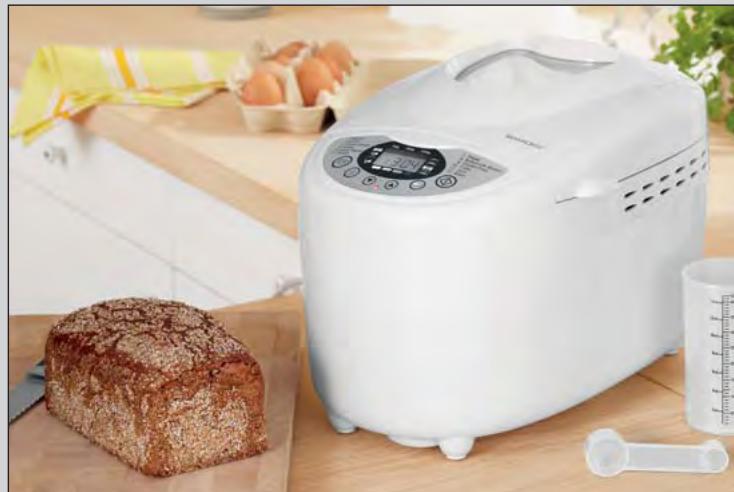
GB Recipe Book IE
FI Recipe Booklet
SE Recipe Booklet
DK Recipe Booklet
DE Recipe Booklet AT CH
Useful information about ingredients 2
Baking tips 3
Ready-to-use baking mixtures 4
Slicing and storing bread 4
Recipes for approx. 1000 g bread 5
Programme 1 Regular....5
Programme 2 French....6
Programme 3 Whole Wheat....6
Programme 4 Sweet....7
Programme 5 Super Rapid....8
Programme 6 Dough (knead)....8
Programme 7 Pasta....9
Programme 8 Buttermilk bread....9
Programme 9 Gluten Free....9
Programme 10 Cake....10
Programme 11 Jam....10
Troubleshooting the recipes 12
Useful information about ingredients
FLOUR
Most of the commercially available varieties of flour, such as wheat or rye flour, are suitable for baking. The type designation for flour types may vary from country to country. With the baking program "gluten-free", gluten-free flour types such as corn, buckwheat or potato flour can be used. You can also use ready-to-use baking mixtures. Programmes 1 and 2 are ideal for adding small proportions (10-20%) of grains or groats. In case of larger proportions of whole grain (70-95%) use programme 3. The following types of flour are used in the recipes:
| Flour type | Description |
| Type 405 | standard wheat flour |
| Type 550 | strong wheat flour, for finely pored doughs |
| Type 997 | standard rye flour |
| Type 812 | Wheat flour, for light mixed breads |
| Type 1050 | dark wheat flour for mixed breads or savoury pastries |
| Type 1150 | Rye flour with a high mineral content |
YEAST
In the fermentation process, yeast splits the sugar and carbohydrate contained in the dough and converts them into carbon dioxide, which causes the dough to rise. Yeast is available in different forms: as dry yeast, as fresh yeast or as fast fermenting yeast.
We recommend using dry yeast for the bread maker to obtain the best results.
If you are using fresh yeast instead of dry yeast, observe the instructions given on the packaging. In general, 1 packet of dry yeast corresponds to about 21 g of fresh yeast and is suitable for approx. 500 g of flour. Always store yeast in the refrigerator, as heat decomposes it. Before use, check the expiry date. After opening the package, unused yeast should be carefully wound up and stored in the refrigerator.
Note:
For recipes suggested in this recipe book, we recommend the use of dry yeast.
SUGAR
Sugar has a decisive influence on both the degree of browning and the taste of the bread. The use of crystal sugar is assumed for the recipes in this book. Do not use powdered sugar, unless it is expressly specified. Sweeteners are not suitable as alternatives to sugar.
SALT
Salt is important for the taste as well as the degree of browning. Salt also has an inhibiting effect on yeast fermentation. Therefore, do not exceed the quantity of salt specified in the recipes. Salt can be dispensed with for dietary reason. In such cases, the dough may rise faster than usual.
LIQUIDS
Liquids like milk, water or reconstituted milk powder can be used for making bread. Milk adds to the taste of the bread and softens the crust, whereas pure water gives a crispy crust. In some recipes, the use of fruit juices is indicated in order to give a particular flavour to the bread.
EGGS
Eggs enrich the bread and give it a softer structure. Use eggs of the largest size class when baking the recipes given in this recipe book.
FATS: BAKING FAT, BUTTER OR OIL
Baking fats, butter and oil make the yeast-based bread mellow. The unique form of crust and structure in French-style breads is due to its fat-free ingredients. However, bread stays fresh longer if fat has been used in its making. If you use butter directly from the refrigerator, cut it into small bits to optimise mixing with the dough during the kneading phase.
GLUTEN-FREE
Celiac disease, in adults also called sprue, is a chronic disease that is triggered by eating foods that contain gluten. The protein gluten (gliadin) contained in wheat and spelt and similar proteins in rye, barley and oats cause damage to the mucous membrane of the small intestine. Only special bread from health food shops or from one's own kitchen that has been prepared with gluten-free flours may be eaten.
However, baking bread and cake with gluten-free flour takes some practice. Such flours require longer for the uptake of liquids and have different rising properties. Gluten-free flours must also be thickened or fluffed with gluten-free thickening agents. These are for example cream of tartar, yeast, sourdough from maize or rice flour, baking agents with a maize basis or binding agents such as guar flour, carob corn flour, kudzu, pectin, arrowroot starch or carrageen. It is also necessary to give up the familiar taste of bread. The consistency of gluten-free breads is also different to that of wheat meal breads.
MEASURING THE INGREDIENTS
Along with our Automatic Bread Maker, you will receive the following measuring cups, which make the task of measuring the ingredients easier for you:
1 Measuring cup with quantity level markings 1 Large measuring spoon corresponding to one tablespoon (tbsp.) 1 Small measuring spoon corresponding to one teaspoon (tsp.)
Place the measuring cup on a flat surface. Make sure that the quantities reach the measuring lines correctly. When measuring dry ingredients, make sure that the measuring cup is dry.
Baking tips
Baking in different climatic regions
In areas located at higher altitudes, the lower atmospheric pressure causes yeast to ferment faster.
Hence, less yeast is required here.
In dry regions, the flour will be drier and requires more liquids.
In humid regions, the flour will be more moist and thus absorbs a lesser amount of liquids. In such areas, more flour is required.
Ready-to-use baking mixtures
You can also use ready-to-use baking mixtures with this bread maker.
Follow the manufacturer's instructions on the packaging.
The following table provides you with examples of conversion for some of the baking mixtures.
Slicing and storing bread
You can achieve the best results if you place the freshly baked bread on a grill before slicing it and allow it to cool down for 15 to 30 minutes. Use a bread slicing machine or a toothed knife to slice the bread. Unconsumed bread can be stored at room temperature for up to 3 days in suitable plastic bags or containers. If you wish to store the bread for longer periods (up to 1 month), you should freeze it. Since homemade bread does not contain preservatives, it spoils faster than commercially manufactured bread.
| Baking mixtures | for a loaf of ca. 750 g |
| Multigrain health bread | 500 g baking mixture350 ml water |
| Sunflower seed bread | 500 g baking mixture350 ml water |
| Rustic whole grain bread | 500 g baking mixture370 ml water |
| Farmhouse bread | 500 g baking mixture350 ml water |
| Ciabatta | 500 g baking mixture360 ml water1 tsp. olive oil |
The ready-to-use baking mixtures available at Lidl are especially suitable for this Bread Baking Machine. Follow the preparation instructions on the packaging.
Recipes for approx. 1000 g bread
Note: To achieve a better baking result, prepare the dough with a mixer. Then place the finished dough in the baking mould. Using the button "Bread weight" enter the weight 1000 g. Select the desired degree of browning for your bread. Please note that the quantities given are intended as guiding values. Small variations may arise in the baking result.
Programme 1 Regular
Sunflower bread
300 ml lukewarm milk
1 tbsp. butter
540 g flour of type 550
5 tbsp. sunflower seeds
1 tsp. salt
1/2 tsp. sugar
1 packet of dry yeast
Sourdough bread
50 g sourdough
350 ml water
1.5 tbsp. butter
1.5 tsp. salt
1 tsp. sugar
180 g flour of type 997
360 g flour of type 1050
1 packet of dry yeast
Farmhouse bread
300 ml milk
1.5 tsp. salt
2 eggs
1.5 tbsp butter/margarine
540 g flour type 1050
1 tbsp sugar
1 packet dry yeast
Potato bread
300 ml water/milk
2 tbsp butter
1 egg
90 g pressed, cooked potatoes
1 tsp salt
2 tbsp sugar
540 g flour type 550
1 packet dry yeast
Herb bread
350 ml buttermilk
1 tsp. salt
1.5 tbsp. butter
1 tbsp. sugar
540 g flour of type 550
4 tbsp. finely chopped parsley
3/4 packet of dry yeast
Pizza bread
300 ml water
1 tbsp. oil
1 tsp. salt
1 tsp. sugar
1 tsp. dried oregano
2 tbsp. grated Parmesan
50 g thinly sliced salami
540 g flour of type 550
3/4 packet of dry yeast
Beer bread
150 ml water
150 ml lager beer
540 g flour of type 550
3 tbsp. buckwheat flour
1.5 tbsp. bran
1 tsp. salt
3 tbsp. sesame seeds
1.5 tbsp. malt extract (syrup)
1/2 packet of dry yeast
150 ml sourdough starter
Cornbread
350 ml water
1 tbsp. butter
540 g flour of type 550
3 tbsp. corn semolina
1/2 chopped apple with peel
3/4 packet of dry yeast
Programme 2 French
"Classic" white bread
320 ml water/milk
2 tbsp. butter
1.5 tsp. salt
2 tbsp. sugar
600 g wheat flour of type 550
1 packet of dry yeast
Light white bread
320 ml water
20 g butter
1.5 tsp salt
1.5 tsp sugar
600 g wheat flour type 405
1 packet dry yeast
1 egg
Honey bread
320 ml water
1.5 tsp salt
2.5 tsp olive oil
1.5 tbsp honey
600 g flour type 550
1 packet dry yeast
Poppy seed bread
300 ml water
540 g flour of type 550
1 tsp. sugar
1 tsp. salt
75 g ground poppy seeds
1 tbsp. butter
1 pinch of nutmeg
3/4 packet of dry yeast
1 tbsp. grated Parmesan
Paprika bread
310 ml water
1.5 tsp salt
1.5 tsp. oil
1.5 tsp. paprika powder
530 g flour of type 812
1 packet of dry yeast
130 g red pepper, finely diced
Programme 3 Whole Wheat
Rye whole grain bread
75 g sourdough
325 ml warm water
2 tbsp. honeydew
350 g rye whole grain flour
150 g wheat whole grain flour
1 tbsp. carob seed flour
1/2 tbsp. salt
1 packet of dry yeast
Spelt bread
350 ml buttermilk
360 g spelt whole grain flour
90 g rye whole grain flour
90 g spelt groats
50 g sunflower seeds
1 tsp. salt
1/2 tsp. sugar
75 ml sourdough starter
3/4 packet of dry yeast
Wheat groats bread
350 ml water
1 tsp. salt
2 tbsp. butter
1.5 tbsp. honey
360 g flour of type 1050
180 g wheat whole grain flour
50 g wheat groats
3/4 packet of dry yeast
Whole grain bread
350 ml water
25 g butter
1 tsp. salt
1 tsp. sugar
270 g flour of type 1050
270 g wheat whole grain flour
3/4 packet of dry yeast
Rye bread
300 ml water
1.5 tbsp. butter
1.5 tbsp. vinegar
1 tsp. salt
1.5 tbsp. sugar
180 g rye flour of type 1150
360 g flour of type 1050
1 packet of dry yeast
Seven grain bread
300 ml water
1.5 tbsp. butter
1 tsp. salt
2.5 tbsp. sugar
240 g flour of type 1050
240 g wheat whole grain flour
60 g 7 grain flakes
3/4 packet of dry yeast
Brown bread
400 ml warm water
160 g wheat flour of type 550
200 g coarse rye whole grain groats
180 g fine rye groats
1 tsp. salt
100 g sunflower seeds
100 ml dark treacle
1 packet of dry yeast
1 package of dry sourdough
Programme 4 Sweet
Raisin bread
300 ml water
2.5 tbsp. butter
1.5 tbsp. honey
1 tsp. salt
540 g wheat flour of type 405
100 g raisins
3/4 packet of dry yeast
Raisin nut bread
300 ml water
1.5 tbsp. butter
1 tsp. salt
1 tbsp. sugar
540 g flour of type 405
100 g raisins
3 tbsp. chopped walnuts
3/4 packet of dry yeast
Chocolate bread
400 ml milk
100 g low fat curd cheese
1.5 tsp. salt
1.5 tsp. sugar
600 g wheat whole grain flour
10 tbsp. cocoa
100 g chopped whole milk chocolate
1 packet of dry yeast
Use whole milk or semi-sweet chocolate.
If you brush the dough with 1 tbsp. milk after kneading, the crust will be darker.
Sweet bread
300 ml water/milk
2 tbsp. butter
2 eggs
1.5 tsp. salt
1.5 tbsp. honey
600 g flour of type 550
1 packet of dry yeast
Programme 5 Super Rapid
White bread express
360 ml water
5 tbsp. oil
4 tsp. sugar
4 tsp. salt
630 g wheat flour of type 405
1 packet of dry yeast
Pepper almond bread
300 ml water
540 g flour of type 550
1 tsp. salt
1 tsp. sugar
2 tbsp. butter
100 g flaked almonds (roasted)
1 tbsp. pickled green peppercorn
3/4 packet of dry yeast
Carrot bread
330 ml water
1.5 tbsp. butter
600 g flour of type 550
90 g finely chopped carrots
2 tsp. salt
1.5 tsp. sugar
1 packet of dry yeast
Programme 6 Dough (knead)
Pizza dough (for 2 Pizzas)
300 ml water
1 tbsp. olive oil
3/4 tsp. salt
2 tsp. sugar
450 g wheat flour of type 405
1 packet of dry yeast
Whole grain pizza dough
300 ml water
1 tbsp. olive oil
3/4 tsp. salt
1 tbsp. honey
450 g wheat whole grain flour
50 g wheat germ
1 packet of dry yeast
Roll out the dough and let it rise for about 10 minutes.
Top the dough as desired and bake the pizza at
180°C for approx. 20 minutes.
Bran rolls
200 ml water
50 g butter
3/4 tsp. salt
1 egg
3 tbsp. sugar
500 g flour of type 1050
50 g wheat bran
1 packet of dry yeast
Pretzels
200 ml water
1/4 tsp. salt
360 g flour of type 405
1/2 tsp. sugar
1/2 packet of dry yeast
Form the dough into pretzels. Then coat the pretzels with 1 whisked egg and spread coarse salt over top (a total of 1-2 tbsp. coarse salt for about 12 pretzels). Bake the pretzels at approx. 230°C for approx.
15-20 minutes.
French baguettes
300 ml water
1 tbsp. honey
1 tsp. salt
1 tsp. sugar
540 g flour of type 550
1 packet of dry yeast
Form loaves out of the dough and cut into the top side of the shaped baguettes at an angle. Let the dough rise for approx. 30-40 minutes. Bake at approx. 175°C for approx. 25 minutes.
Programme 7 Pasta
5 Eggs (room temperature)
or 300 ml water
250 g soft wheat flour of type 405
250 g hard wheat flour of type 1050
Programme 8 Buttermilk bread
Buttermilk bread (type 1)
350 ml buttermilk
2 tbsp. butter
2 tsp. salt
3 tbsp. sugar
600 g wheat flour of type 1050
1 packet of dry yeast
Buttermilk bread (type 2)
250 ml buttermilk
130 ml water
600 g wheat flour of type 1050
60 g rye flour of type 997
1.5 tsp. salt
1 packet of dry yeast
Yoghurt bread
250 ml water or milk
150 g yoghurt
1 tsp. salt
1 tsp. sugar
500 g flour of type 550
3/4 packet of dry yeast
Curd cheese bread
200 ml water/milk
3 tbsp. oil
260 g curd cheese (40% fat content)
600 g wheat flour
1.5 tsp salt
1.5 tsp. sugar
1 packet of dry yeast
Programme 9 Gluten Free
Gluten-free potato bread
440 ml water
1.5 tbsp. oil
400 g gluten-free flour mixture
(e.g. "Mix B" from Schär)
1.5 tsp. salt
1.5 tsp. sugar
1 1/4 packet of dry yeast
230 g cooked potatoes, peeled and pressed
Gluten-free yoghurt bread
350 ml water
150 g natural yoghurt
1.5 tbsp. oil
1.5 tbsp. vinegar
100 g gluten-free flour
(e.g. millet, rice, buckwheat)
400 g gluten-free flour mixture
(e.g. "Mix B" from Schär)
1.5 tsp salt
1.5 tsp sugar
1 1/4 packet of dry yeast
1 tsp guar seed or carob seed flour
Gluten-free seed bread
250 ml water
200 ml milk
1.5 tbsp oil
500 g gluten-free flour mixture
1.5 tsp salt
1.5 tsp sugar
1 1/4 packet of dry yeast
100 g seeds (e.g. sunflower seeds)
Gluten-free rice bread
350 ml water
200 g natural yoghurt
1.5 tbsp. oil
1.5 tbsp. vinegar
200 g rice flour
300 g gluten-free flour mixture
1.5 tsp salt
1.5 tsp. sugar
1 1/4 packet of dry yeast
1 tsp. guar seed or carob seed flour
Programme 10 Cake
Ready-to-use cake mixes work excellently with this programme.
Follow the preparation instructions on the packaging.
Programme 11 Jam
Jams and marmalades can be quickly and easily prepared in the Bread Baking Machine. Even when you have never done it before, you should give it a try. You will acquire an especially delicious, good tasting sweetened fruit preserve.
Proceed as follows:
- Wash the fresh ripe fruit. Hard skinned fruits such as apples, peaches, pears etc may need peeling.
- Always use the amount specified, as this is adjusted exactly to the programme JAM. Otherwise, the mixture will cook too early and pour over.
- Weigh the fruit, cut it into small pieces (max. 1 cm) or mash it, then place it in the container.
- Add the gelling sugar in the given amount. Use only this type, not household sugar, as the preserve will then not be firm.
- Mix the fruit with the sugar and start the Programme, which will now run completely automatically.
- After the Programme has ended, pour the jam into glasses and seal them well.
Orange marmalade
350 g oranges
150 g lemons
500 g gelling sugar
Strawberry jam
500 g strawberries
500 g gelling sugar
2-3 tbsp. lemon juice
Berry jam
500 g thawed berries
500 g gelling sugar
1 tbsp. lemon juice
Mix all ingredients in the baking mould.
Enjoy your meal!
These recipes are provided without guarantee. All ingredients and preparation information are guiding values. Expand these recipe suggestions based on your personal experiences. We hope you enjoy the recipes and wish you "bon appetit".
Troubleshooting the recipes
| Why does my bread occasionally have some flour on the side crusts? | Your dough may be too dry.. Next time, take particular care with measuring the ingredients. Add up to 1 tbsp. of additional liquid. |
| Why do I need to add the ingredients in a particular sequence? | This is the best way to prepare the dough. Using the timer function prevents the yeast from mixing with the liquid before the dough is stirred. |
| Why is the dough only partly kneaded? | Check to see if the kneading paddle and the baking mould are correctly positioned. Also check the consistency of the dough and add 1/2 to 1 tbsp. of liquids or flour, one or more times after kneading.With baking mixtures: The amount of ready to use baking mixture and the ingredients are not matched to the capacity of the baking mould. Reduce the quantities of the ingredients. |
| Why has the bread not risen? | The yeast used was too old or no yeast was added. |
| When should I add nuts and fruits to the dough? | You will hear a signal tone when you should add the ingredients.. If you add these ingredients to the dough at the start, the nuts or fruit may get crushed at the time of kneading. |
| The baked bread is too moist. | Check the consistency of the dough 5 Min. after the start of the kneading process and, if necessary, add more flour. |
| There are air bubbles on the surface of the bread. | You may have used too much yeast.. |
| The bread rises and then collapses. | The dough is perhaps rising too fast. To prevent this, reduce the water quantity and/or increase the quantity of salt and/or reduce the quantity of yeast. |
| Can other recipes also be used? | You can use other recipes, however, pay attention to the ingredient amounts. Get to know your appliance well and the recipes given here, before you try out your own recipes. NEVER exceed the volume of 700 gr of flour.Adjust the quantities of your recipes to the quantities specified for the recipes given in this booklet. |
Program 1 Normal....29
Program 2 Luftig....30
Program 3 Fullkorn....30
Program 4 Söt....31
Program 5 Express....32
Program 6 Deg (knåda)....32
Program 7 Pastadeg....33
Program 8 Buttermilk Bread....33
Program 9 Gluten-Free....33
Program 10 Cake....34
Program 11 Marmalade....34
Pizza dough (for 2 pizzas)
3 dl water
1 tbsp olive oil
3/4 tsp salt
2 tsp sugar
Program 1 Normal....41
Program 2 Let....42
Program 3 Whole Grain....42
Program 4 Sweet....43
Program 5 Express....44
Program 6 Dough (kneading) 44
Program 7 Pasta...45


- CONTENT
- PAGE
- ⚠️ SAFETY NOTICES
- APPLIANCE OVERVIEW
- ACCESSORIES
- INTENDED USE
- BEFORE THE FIRST USAGE
- DISPOSAL OF THE PACKAGING MATERIAL
- INITIAL CLEANING
- PRE-HEATING
- PROPERTIES
- CONTROL PANEL
- A DISPLAY
- B START / STOP
- NOTE
- ⚠️ PLEASE NOTE
- © LEVEL OF BROWNING (OR RAPID MODE)
- D TIMER ▼ ▲
- E OPERATION INDICATOR LAMP
- F BREAD WEIGHT
- G PROGRAMME SELECTION (MENU)
- MEMORY FUNCTION
- VIEWING WINDOW
- PROGRAMME
- PROGRAMME 1: REGULAR
- PROGRAMME 2: FRENCH
- PROGRAMME 3: WHOLE WHEAT
- PROGRAMME 4: SWEET
- PROGRAMME 5: SUPER RAPID
- PROGRAMME 6: DOUGH (KNEADING)
- PROGRAMME 7: PASTA
- PROGRAMME 8: BUTTERMILK BREAD
- PROGRAMME 9: GLUTEN FREE
- PROGRAMME 10: CAKE
- PROGRAMME 11: JAM
- PROGRAMME 12: BAKE
- TIMER-FUNCTION
- EXAMPLE
- BEFORE BAKING
- INGREDIENTS
- BAKING BREAD
- PREPARATION
- STARTING THE PROGRAMME
- ENDING THE PROGRAMME
- WARNING
- TAKING OUT THE BREAD
- ERROR MESSAGES
- CLEANING AND CARE
- ⚠️ IMPORTANT
- HOUSING, LID, BAKING SPACE
- BAKING MOULDS AND KNEADING PADDLES
- TECHNICAL DATA
- DISPOSAL
- WARRANTY AND SERVICE
- GB DES UK LTD
- IE KOMPERNASS SERVICE IRELAND
- CY KOMPERNASS SERVICE CYPRUS
- IMPORTER
- TROUBLESHOOTING THE BREAD BAKING MACHINE
- PROGRAM 9: GLUTEN-FREE
- RECIPE BOOK SBB 850 A
- USEFUL INFORMATION ABOUT INGREDIENTS
- BAKING TIPS
- READY-TO-USE BAKING MIXTURES
- SLICING AND STORING BREAD
- RECIPES FOR APPROX. 1000 G BREAD
- TROUBLESHOOTING THE RECIPES
- FLOUR
- YEAST
- SUGAR
- SALT
- LIQUIDS
- EGGS
- FATS: BAKING FAT, BUTTER OR OIL
- GLUTEN-FREE
- MEASURING THE INGREDIENTS
- BAKING IN DIFFERENT CLIMATIC REGIONS
- PROGRAMME 1 REGULAR
- SUNFLOWER BREAD
- SOURDOUGH BREAD
- FARMHOUSE BREAD
- POTATO BREAD
- HERB BREAD
- PIZZA BREAD
- BEER BREAD
- CORNBREAD
- PROGRAMME 2 FRENCH
- CLASSIC" WHITE BREAD
- LIGHT WHITE BREAD
- HONEY BREAD
- POPPY SEED BREAD
- PAPRIKA BREAD
- PROGRAMME 3 WHOLE WHEAT
- RYE WHOLE GRAIN BREAD
- SPELT BREAD
- WHEAT GROATS BREAD
- WHOLE GRAIN BREAD
- RYE BREAD
- SEVEN GRAIN BREAD
- BROWN BREAD
- PROGRAMME 4 SWEET
- RAISIN BREAD
- RAISIN NUT BREAD
- CHOCOLATE BREAD
- SWEET BREAD
- PROGRAMME 5 SUPER RAPID
- WHITE BREAD EXPRESS
- PEPPER ALMOND BREAD
- CARROT BREAD
- PROGRAMME 6 DOUGH (KNEAD)
- PIZZA DOUGH (FOR 2 PIZZAS)
- WHOLE GRAIN PIZZA DOUGH
- BRAN ROLLS
- PRETZELS
- FRENCH BAGUETTES
- PROGRAMME 7 PASTA
- PROGRAMME 8 BUTTERMILK BREAD
- BUTTERMILK BREAD (TYPE 1)
- BUTTERMILK BREAD (TYPE 2)
- YOGHURT BREAD
- CURD CHEESE BREAD
- PROGRAMME 9 GLUTEN FREE
- GLUTEN-FREE POTATO BREAD
- GLUTEN-FREE YOGHURT BREAD
- GLUTEN-FREE SEED BREAD
- GLUTEN-FREE RICE BREAD
- PROGRAMME 10 CAKE
- PROGRAMME 11 JAM
- ORANGE MARMALADE
- STRAWBERRY JAM
- BERRY JAM
- ENJOY YOUR MEAL
Brand : SILVERCREST
Model : SBB 850 A1 BREAD MAKER
Category : Bread maker