
ESTM1150 - Hand blender AEG-ELECTROLUX - Free user manual and instructions
Find the device manual for free ESTM1150 AEG-ELECTROLUX in PDF.



| Product type | Immersion blender |
| Brand | AEG-ELECTROLUX |
| Model | ESTM1150 |
| Power | 400 W |
| Supply voltage | 230 V ~ 50 Hz |
| Number of speeds | 2 (I and II) |
| Blade material | Stainless steel |
| Body material | Plastic |
| Main functions | Blend, mix, grind, emulsify, crush soups and cooked foods, prepare cocktails and shakes |
| Included accessories | Mixing tool, wall bracket |
| Maximum continuous use time | 1 minute |
| Required cooling time | 1 minute |
| Safety | Do not immerse the motor block; do not use with wet hands; do not mix paints; do not use in hot fat; unplug before cleaning or changing accessories |
| Cleaning and maintenance | Wipe the motor block with a damp cloth; wash the mixing tool under running water; do not use abrasive products; do not wash in dishwasher (not recommended) |
| Compatibility with optional accessories | Chopper and egg beater (model ESTM1155) |
| Wall mounting | Wall bracket included for vertical storage |
| Environmental protection | Recyclable packaging; appliance to be recycled at waste disposal center (WEEE symbol) |
| Standards | CE (2006/95/EC, 89/336/EEC) |
Frequently Asked Questions - ESTM1150 AEG-ELECTROLUX
User questions about ESTM1150 AEG-ELECTROLUX
0 question about this device. Answer the ones you know or ask your own.
Ask a new question about this device
Download the instructions for your Hand blender in PDF format for free! Find your manual ESTM1150 - AEG-ELECTROLUX and take your electronic device back in hand. On this page are published all the documents necessary for the use of your device. ESTM1150 by AEG-ELECTROLUX.
USER MANUAL ESTM1150 AEG-ELECTROLUX
natural_image
Line drawing of a handheld electric shaver with a bulb and handle (no text or symbols)GB Operating instructions....8
natural_image
Line drawing of a small electric shaver with a handle and spout, showing internal components and motion arrows (no text or symbols)2
1
natural_image
Line drawing of a hairdryer with a handle and cable, showing a rotating arm mechanism (no text or symbols)3
natural_image
Simple line drawing of a container with a handle and spout (no text or symbols)B.
natural_image
Simple line drawing of a conical tool inside a container (no text or symbols)C.
natural_image
Line drawing of a pitcher with handle and spout (no text or symbols)Lock
natural_image
Line drawing of a mechanical device with a conical top and base (no text or symbols)- A.
C.
natural_image
Simple line drawing of a beaker with a flared rim (no text or symbols)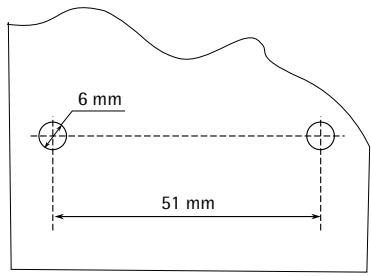
D
Please read these operating instructions through carefully.
Above all please follow the safety instructions on the first few pages of these operating instructions! Please keep the operating instructions for future reference. If applicable pass these instructions on to the next owner of the appliance.

With the warning triangle and/or by means of key words (Danger!, Caution!, Attention!), information is emphasized which is important for your safety or the correct functioning of the appliance. It is essential that this information is observed.

This symbol guides you step by step through the operating procedure for your appliance.

After this symbol you receive supplementary information on the practical application and use of the appliance.

Tips and information about the economical and environmentally friendly use of the appliance are marked with the clover.
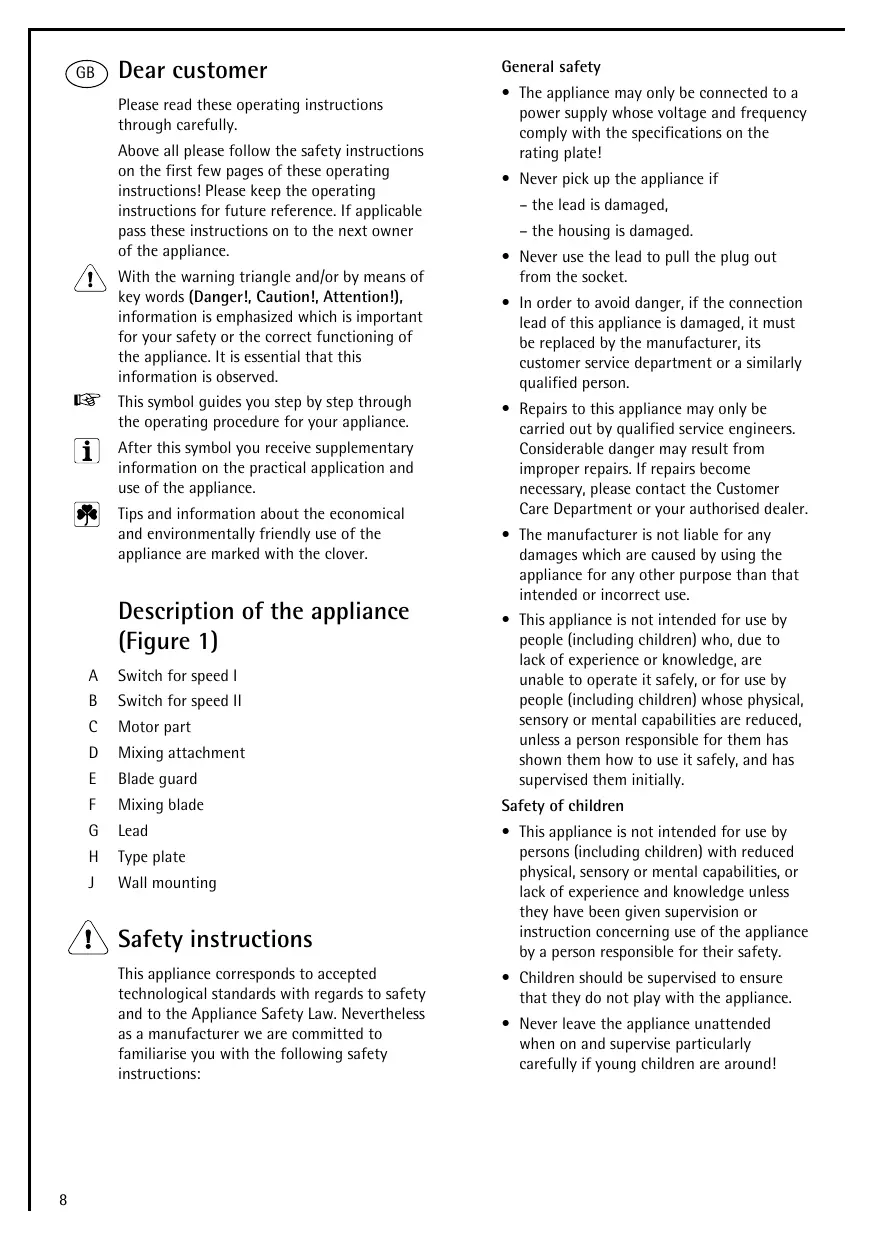
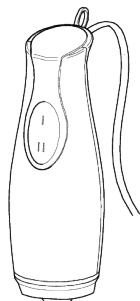
Description of the appliance (Figure 1)
A Switch for speed I
B Switch for speed II
C Motor part
D Mixing attachment
E Blade guard
F Mixing blade
G Lead
H Type plate
J Wall mounting

Safety instructions
This appliance corresponds to accepted technological standards with regards to safety and to the Appliance Safety Law. Nevertheless as a manufacturer we are committed to familiarise you with the following safety instructions:
General safety
- The appliance may only be connected to a power supply whose voltage and frequency comply with the specifications on the rating plate!
- Never pick up the appliance if
- the lead is damaged,
- the housing is damaged.
- Never use the lead to pull the plug out from the socket.
- In order to avoid danger, if the connection lead of this appliance is damaged, it must be replaced by the manufacturer, its customer service department or a similarly qualified person.
- Repairs to this appliance may only be carried out by qualified service engineers. Considerable danger may result from improper repairs. If repairs become necessary, please contact the Customer Care Department or your authorised dealer.
- The manufacturer is not liable for any damages which are caused by using the appliance for any other purpose than that intended or incorrect use.
- This appliance is not intended for use by people (including children) who, due to lack of experience or knowledge, are unable to operate it safely, or for use by people (including children) whose physical, sensory or mental capabilities are reduced, unless a person responsible for them has shown them how to use it safely, and has supervised them initially.
Safety of children
- This appliance is not intended for use by persons (including children) with reduced physical, sensory or mental capabilities, or lack of experience and knowledge unless they have been given supervision or instruction concerning use of the appliance by a person responsible for their safety.
- Children should be supervised to ensure that they do not play with the appliance.
- Never leave the appliance unattended when on and supervise particularly carefully if young children are around!
When using your appliance
- Ensure fingers are kept away from the moving mixing blade. This could result in injury!
- Keep hands and utensils out of container while blending to reduce the risk of severe injury to persons or damage to the blender. A scraper may be used but must be used only when the blender is not running.
- Never use the mixer if you have wet hands.
- Do not use this appliance to stir paints (lacquers, polyesters etc.) This could result in an explosion!
- Never use the appliance in hot fat (there is a danger of splashes and you could burn yourself).
- The appliance should be switched off and unplugged before any cleaning or maintenance work is done on it.
- Never clean the motor part under running water or submerge it in washingup water.
- Avoid letting the mixing attachment runnig dry for more than max. 15 seconds.
- The mixing attachment is only to be inserted into or removed from the appliance when it is switched off.
- The blender can be used to mix food in any suitable bowl. Standard household plastic mixing bowls are the ideal choice, if these are sufficiently deep, rounded and non-slip.
- To reduce the risk of injury, never place cutting blade on base without first putting bowl properly in place.
- Be sure chopper lid is securely locked in place before operating appliance.
- Never switch on the appliance until the working attachment is in the mixing bowl with the ingredients to be processed. Always wait until the attachment stops before you remove the bowl.
- Do not hold any hard objects (e.g. a spoon, knife or whisk) against the moving attachment and do not touch it with your hand. The appliance cannot be used for chopping ice or blending hard and dry substance, such as nut, candy. Otherwise the blade could be blunted.
- The use of accessory not recommended by the manufacturer may cause injuries to persons.
- Do not operate the appliance for other than its intended use.
- Do not stand the appliance upright for storage but lay it down flat, otherwise there is a danger of an accident.
- When you have finished working with the appliance, switch it off and unplug it from the electricity supply.
Disposal

Packaging material
The packaging materials are environmentally friendly and can be recycled. The plastic components are identified by markings, e.g. >PE<, >PS<, etc. Please dispose of the packaging materials in the appropriate container at the community waste disposal facilities.

Old appliance

on the product or on The symbol 📄 on the product or on its packaging indicates that this product may not be treated as household waste. Instead it shall be handed over to the applicable collection point for the recycling of electrical and electronic equipment. By ensuring this product is disposed of correctly, you will help prevent potential negative consequences for the environment and human health, which could otherwise be caused by inappropriate waste handling of this product. For more detailed information about recycling of this product, please contact your local city office, your household waste disposal service or the shop where you purchased the product.
Operation
You can use the blender e.g. for
- produce mixed drinks,
- mixing liquids,
- cutting up fruit and vegetables very small,
- producing emulsions (e.g. mayonnaise, sauces, cremes, toppings, and deserts based on dairy products),
- making pruée for vegetable soups or boiled baby-food,
- preparing cocktails and shakes.
Preparing for use
Before using for the first time, it is advisable for reasons or hygiene to clean the mixing attachment. Dry the mixing attachment well before using it.
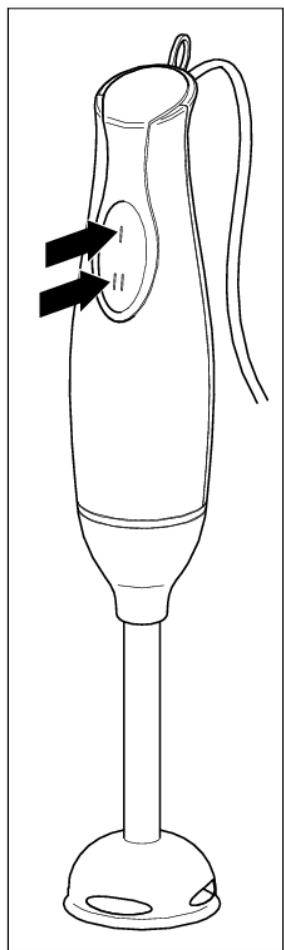
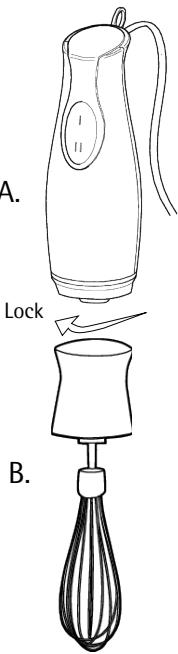
Inserting/removing the mixing attachment (Figure 3)
Before inserting or releasing the mixing attachment, switch off the blender and remove the plug from the mains socket!
Insert the mixing attachment to the motor part and lock it by turning clockwise.
Tor remove, unlock the mixing attachment by turning it anticlockwise.
Working with the blender
The appliance can be used for up to 1 minute without stopping. It should be allowed to cool afterwards for at least 1 minute.
Important: Blades are very sharp, handle with care. Ensure that the hand-held blender is unplugged from the power outlet before assembling or removing attachments.
Insert the blender deep into the bowl, then press switch A (for speed I) or switch B (for speed II) (Figure 2).
i Start all types of processing at speed I. This will avoid powdery foods and liquids spraying out.
Light upward and downward movements of the blender permit the material being worked on to be handled in the best possible way. Please make sure that:
- the mixing attachment never has more than two-thirds of its length immersed in the material,
- the mixing bowl is never more than two-thirds full (to avoid the danger of splashes).
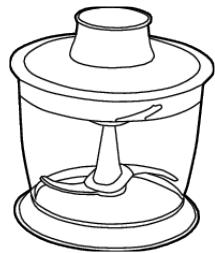
Working with the chopper (ESTM1155) Figure 4.
Max operation duration under high speed per time cannot exceed 1 minute, and 1 minute rest time must be maintained at two consecutive cycles.
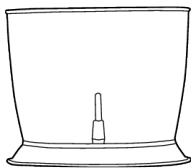
Place the chopper bowl on a clean, level surface.
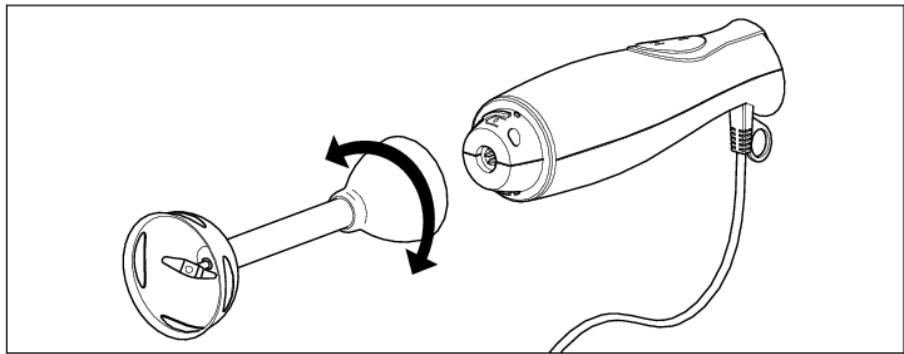
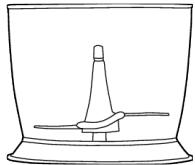
Assemble the stainless steel blade into the chopper bowl, as shown in position A.
Place food into the chopper bowl.
Note: remove the bone of the meat, cut small piece (approximately 10-15 mm), then place the meat into the bowl, the max quantity of meat can't exceed 200g in every blending.
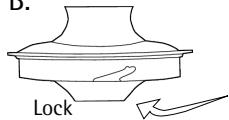
Attach the lid onto the chopper bowl and turn it in clockwise direction until it locks into position (see position B). To detach the lid, turn in adverse direction.
Insert the top part of the chopper into the hole of the chopper lid, and turn in clockwise direction to lock (see position C).
Plug the appliance to power outlet and depress the switch to begin operation.
To stop the appliance, release the switch at the top of the motor unit.
Caution: To reduce the risk of injury, never place cutting blade on base without first putting bowl properly in place.
Be sure chopper lid is securely locked in place before operating appliance.
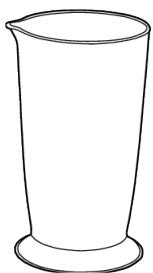
Working with the egg white beater (ESTM1155) Figure 5.
Max operation duration under high speed per time cannot exceed 1 minute, and 1 minute rest time must be maintained at two consecutive cycles.
To assemble the egg white beater with the motor unit, turn the motor unit clockwise direction until tightened. To disassemble, turn in the adverse direction (see position A).
Plug the hand-held blender to power outlet.
Place egg white into the cup, generally, put two egg white is enough (see position B).
Lower the hand-held blender into food and depress the switch at the top of the motor unit (see position C).
To stop the hand-held blender release the switch at the top of the motor unit.
Fixing wall bracket Figure 6.
You can fix the wall bracket as following:

Drill two same holes in wall and strictly follow the dimension as indicated.

Knock two plastic tubes in them with hammer.

Secure the bracket on wall with another two screws.
Cleaning and maintenance

Ensure that the hand-held blender is unplugged from the power outlet before assembling or removing attachments for cleaning or maintaining.
Note: Do not immerse the detachable stem of the blender in water because overtime the lubrication on the bearings may wash away.

Wash the detachable stem under running water, without the use of abrasive cleaner or detergents. After finishing cleaning the detachable stem, place it upright so that any water which may have got in, can drain out.

Wash the cup, bowl, beater and blade in warm soapy water.

The mixing attachment, the bowl and the beater are not recommended to place in dishwashing machine as the plastic component deteriorate through prolonged use of dishwasher cleaning.

Unplug the motor unit. Wipe the motor unit with a damp cloth. Never immerse it in water for cleaning as an electric shock may occur.

Dry thoroughly.

Caution: Blades are very sharp, handle with care.

Reassemble the blender shaft to motor unit then place it upright in wall bracket (see Figure 6.) or hang it up for saving space.
Quick cleaning
Between processing tasks, hold the hand-held blender in the cup half filled with water and turn on for a few seconds.
Technical data
Mains voltage: 230 V, 50 Hz
Power consumption: 400 W
Maximum continuous operating time: 1 minute
CE ; This appliance conforms with the following EC Directives:
• Low Voltage Directive 2006/95/EC
• EMC Directive 89/336/EEC with amendments 92/31/EEC and 93/68/EEC
F
Chère cliente, Cher client,
- D
- Description of the appliance (Figure 1)
- Safety instructions
- General safety
- Safety of children
- Disposal
- Packaging material
- Old appliance
- Operation
- Preparing for use
- Working with the blender
- Working with the chopper (ESTM1155) Figure 4.
- Working with the egg white beater (ESTM1155) Figure 5.
- Fixing wall bracket Figure 6.
- Cleaning and maintenance
- Quick cleaning
- Technical data
- F
- Chère cliente, Cher client,
Brand : AEG-ELECTROLUX
Model : ESTM1150
Category : Hand blender