
HVL-F56AM - External Flash SONY - Free user manual and instructions
Find the device manual for free HVL-F56AM SONY in PDF.


| Product type | External flash |
| Brand | SONY |
| Model | HVL-F56AM |
| Dimensions (L × H × D) | 77.5 × 132 × 95.5 mm |
| Weight | 370 g |
| Power supply | 4 AA batteries (alkaline, lithium, or Ni-MH) |
| Guide number | 56 (at 85 mm, ISO 100, meters) |
| Flash coverage | 17 mm to 85 mm (motorized zoom) |
| Flash modes | TTL, manual (M), multi-flash (MULTI) |
| High-speed sync (HSS) | Yes |
| Wireless flash | Yes (WL) |
| Bounce flash | Swivel head: up 90°, down 7°, left/right 180° |
| Pilot lamp | Test, modeling (continuous 4 s) |
| AF illuminator | Range 0.5 m to 10 m (with 50 mm f/1.0 lens) |
| Operating temperature | 0 °C to 40 °C |
| Maintenance | Clean with a soft, dry cloth. Avoid solvents. |
| Safety | Do not expose to water. Remove batteries when not in use. Do not disassemble. |
| Included accessories | Flash, mini stand, case, set of documents |
| Optional accessories | FA-CC1AM cable, FA-CS1AM shoe, FA-EC1AM extension cable, FA-TC1AM triple connector, FA-EB1AM external battery adapter |
Frequently Asked Questions - HVL-F56AM SONY
User questions about HVL-F56AM SONY
0 question about this device. Answer the ones you know or ask your own.
Ask a new question about this device
Download the instructions for your External Flash in PDF format for free! Find your manual HVL-F56AM - SONY and take your electronic device back in hand. On this page are published all the documents necessary for the use of your device. HVL-F56AM by SONY.
USER MANUAL HVL-F56AM SONY
Operating Instructions
Operating Instructions
Operating Instructions
Before operating the product, please read this manual thoroughly and retain it for future reference.
WARNING
To reduce fire or shock hazard, do not expose the unit to rain or moisture.
Tape over lithium battery contacts to avoid short-circuit when disposing of batteries, and follow local regulations for battery disposal.
Keep batteries or things that could be swallowed away from young children. Contact a doctor immediately if an object is swallowed.
Immediately remove the batteries and discontinue use if...
- the product is dropped or subjected to an impact in which the interior is exposed.
- the product emits a strange smell, heat, or smoke.
Do not disassemble. Electric shock may occur if a high voltage circuit inside the product is touched.
IMPORTANT SAFETY INSTRUCTIONS
When using your photographic equipment, basic safety precautions should always be followed, including the following:
Read and understand all instructions before using.
Close supervision is necessary when any appliance is used by or near children. Do not leave appliance unattended while in use.
Care must be taken as burns can occur from touching hot parts.
Do not operate appliance with a damaged cord or if the appliance has been dropped or damaged- until it has been examined by a qualified serviceman.
Let appliance cool completely before putting away. Loop cord loosely around appliance when storing.
To reduce the risk of electric shock, do not immerse this appliance in water or other liquids.
To reduce the risk of electric shock, do not disassemble this appliance, but take it to a qualified serviceman when service or repair work is required. Incorrect reassembly can cause electric shock when the appliance is used subsequently.
The use of an accessory attachment not recommended by the manufacturer may cause a risk of fire, electric shock, or injury to persons.
Batteries may become hot or explode due to improper use.
Use only the batteries specified in this instruction manual.
Do not install the batteries with the polarity (+/-) reversed.
Do not subject batteries to fire or high temperatures.
Do not attempt to recharge (except for rechargeable batteries), short or disassemble.
Do not mix batteries of different types, brands or ages.
SAVE THESE INSTRUCTIONS
CAUTION
Do not touch the flashtube during operation, it may become hot when the flash fires.
For customers in Europe
Disposal of Old Electrical & Electronic Equipment (Applicable in the European Union and other European countries with separate collection systems)
This symbol on the product or on its packaging indicates that this product shall not be treated as household waste. Instead it shall be handed over to the applicable collection point for the recycling of electrical and electronic equipment. By ensuring this product is disposed of correctly, you will help prevent potential negative consequences for the environment and human health, which could otherwise be caused by inappropriate waste handling of this product. The recycling of materials will help to conserve natural resources. For more detailed information about recycling of this product, please contact your local Civic Office, your household waste disposal service or the shop where you purchased the product.
For the customers in the U.S.A.
CAUTION
You are cautioned that any changes or modifications not expressly approved in this manual could void your authority to operate this equipment.
NOTE:
This equipment has been tested and found to comply with the limits for a Class B digital device, pursuant to Part 15 of the FCC Rules.
These limits are designed to provide reasonable protection against harmful interference in a residential installation.
This equipment generates, uses, and can radiate radio frequency energy and, if not installed and used in accordance with the instructions, may cause harmful interference to radio communications.
However, there is no guarantee that interference will not occur in a particular installation. If this equipment does cause harmful interference to radio or television reception, which can be determined by turning the equipment off and on, the user is encouraged to try to correct the interference by one or more of the following measures:
- Reorient or relocate the receiving antenna.
- Increase the separation between the equipment and receiver.
- Connect the equipment into an outlet on a circuit different from that to which the receiver is connected.
- Consult the dealer or an experienced radio/TV technician for help.
Table of contents
Features 6
Name of parts. 7
Control panel. 8
Data panel 9
Preparations
Inserting batteries 10
Attachment and removal of the flash 12
Auto power ON/OFF 13
Basics
Program auto flash (The basics) 14
Recording modes 17
Apprifications
Zoom flash coverage 19
Test flash / Modeling flash ... 22
Bounce flash 24
Close-up photography (downward bounce) 27
Data panel illuminator.....28
AF illuminator. 29
Mode and select buttons.....30
Manual flash (M) 32
High-speed sync (HSS) 35
Wireless flash mode (WL)....37
Connecting camera and flash by cable. 43
Setting power level (LEVEL) 44
Multiple flash (MULTI)......46
Reset to default settings.....51
Custom setting 52
Additional Information
Accessories. 55
Notes on use 57
Maintenance 58
Specifications 59
Before use
For details, refer to the operating instructions supplied with your camera.
This flash is not dust-proof, splash-proof or waterproof.
Do not place this flash in the following locations
Regardless of whether this unit is in use or in storage, do not place it in any of the following locations. Doing so may lead to a malfunction.
- Placing this flash in locations subject to direct sunlight such as on dashboards or near a heater may cause this unit to deform or malfunction.
- Locations with excessive vibration
- Locations with strong electromagnetism
- Locations with excessive sand In locations such as the seashore and other sandy areas or where dust clouds occur, protect the unit from sand and dust. This may lead to a malfunction.
Features
- The HVL-F56AM is a compact, clip-on flash that provides a large flash output with a guide number 56 (85 mm position, ISO 100 · m).
- The built-in wide panel expands flash coverage to a focal length of 17 mm.
- The HVL-F56AM assures highly reliable ADI (Advanced Distance Integration) flash metering when used in combination with compatible lenses.
- The HVL-F56AM supports wireless high-speed sync photography.
- The flash head tilts 90° upward, 180° left and 90° right to bounce flash (with lock function) and 10° downward for close-up photography.
- This function may not be available on some camera models.
Name of parts
Inside terminal
- Accessory terminal (43)
- External-power terminal (56)
Built-in wide panel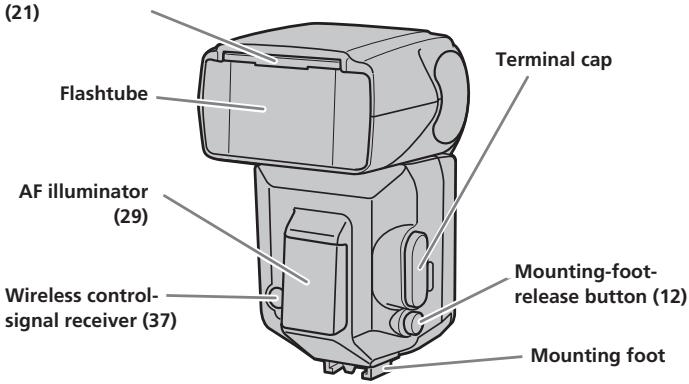
Remove the protective sheet from the front of the AF illuminator before use.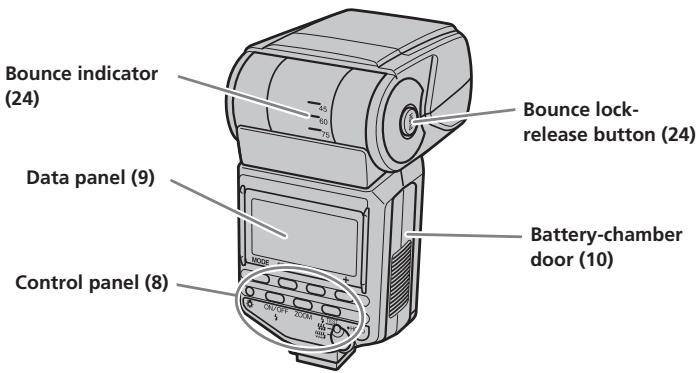
Control panel
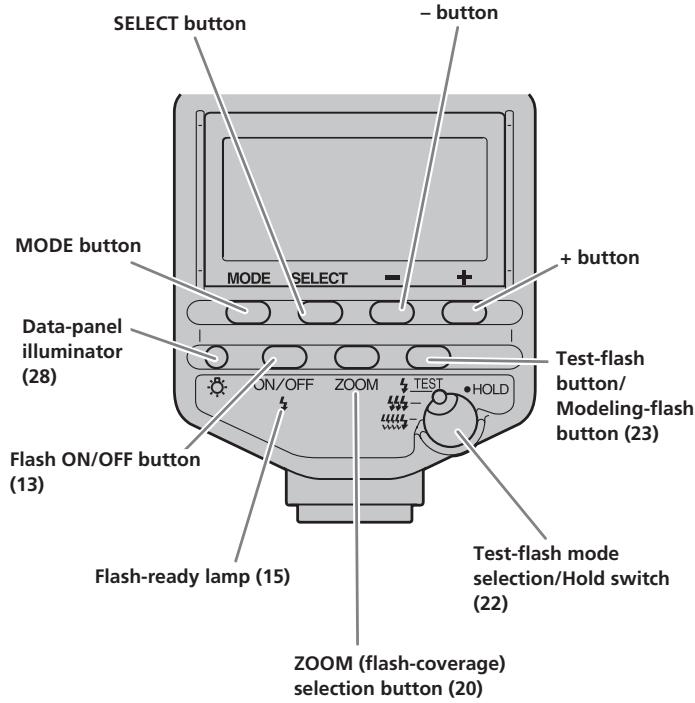
Data panel
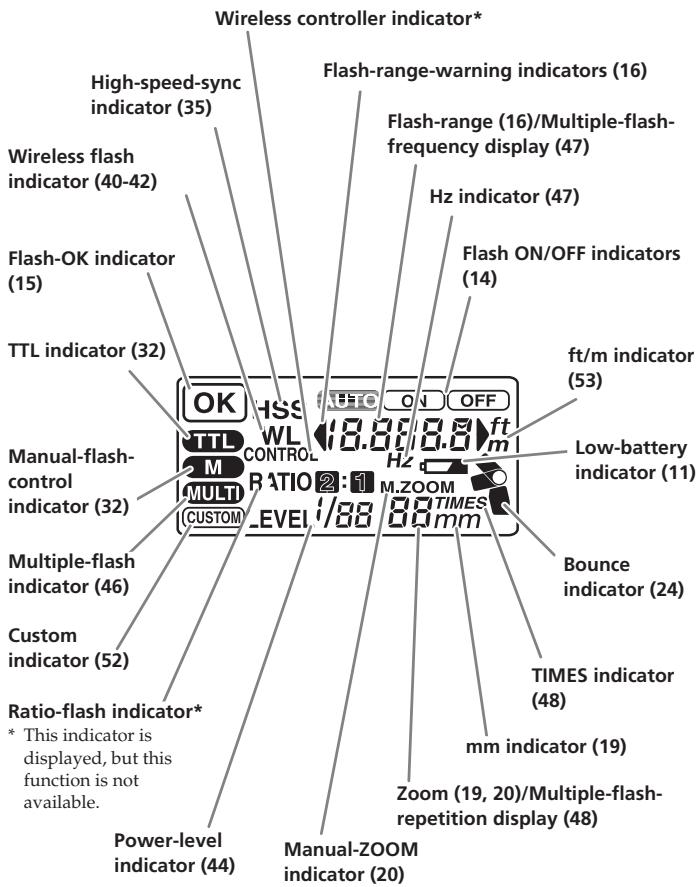
On this page, all indicators are displayed for explanatory purposes.
Inserting batteries
The HVL-F56AM may be powered by: *Batteries are not supplied.
- Four AA-size alkaline batteries
- Four AA-size lithium batteries
- Four AA-size rechargeable nickel-metal hydride (Ni-MH) batteries. Always ensure that rechargeable nickel-metal hydride batteries are charged in the specified charger unit.
1. Open the battery-chamber door as shown.
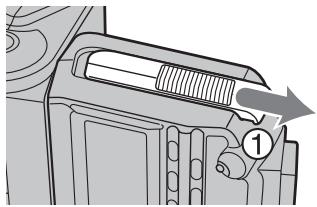
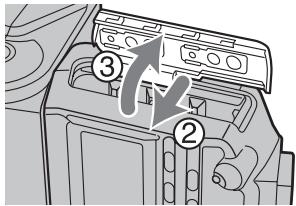
2. Insert the batteries in the battery chamber as in the diagram.
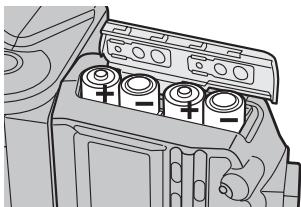
3. Close the battery-chamber door.
- Follow the reverse steps when opening the battery-chamber door.
- The indicator appears on the data panel. If it does not appear, press the flash ON/OFF button.
Checking Batteries
The indicator on the data panel blinks when the batteries are low.
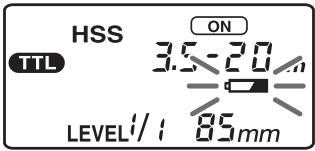
blinking
Changing the batteries is recommended. The flash can still be used in this state if the flash-ready lamp on the rear of the unit is lit.
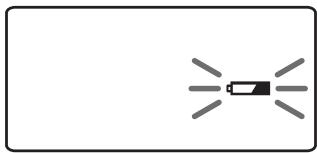
Only blinking
Flash cannot be used. Insert new batteries.
- If nothing appears when the flash ON/OFF button is pressed, check the orientation of the batteries.
Attachment and removal of the flash
Attaching the flash to the camera
Push the mounting foot firmly onto the camera until it stops.
- The flash is locked in place automatically.
- If the built-in flash in the camera is protruding, lower it before attaching the flash unit.
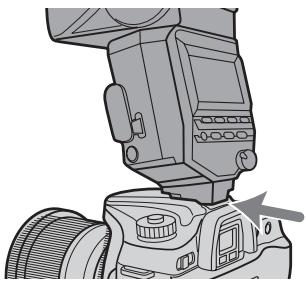
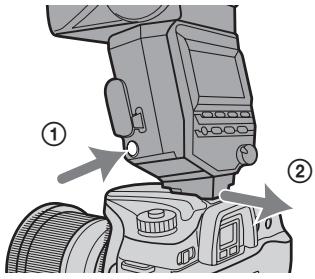
Removing the flash from the camera
While pressing the mounting-foot release button ①, remove the flash ②.
Auto power ON/OFF
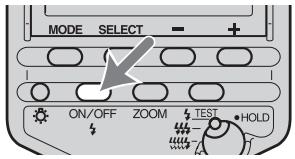
Press the flash ON/OFF button on the back side of the flash.
Power of the flash turns it on.

When the flash is switched on, ON will appear on the data panel indicator.
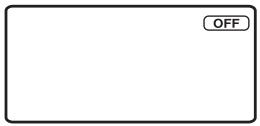
If you press the flash ON/OFF button while the flash is turned on, the flash switches off and OFF appears on the data panel indicator.
OFF disappears after 8 seconds.
Auto power off
When the camera or flash is not used for four minutes, power switches off and data panel indicators disappear automatically to save the batteries.
- In wireless flash photography (p. 37), data panel indicators disappear after 60 minutes.
- The customized settings enable you to disable auto power off or change the auto power off time (p. 53).
Program auto flash (The basics)
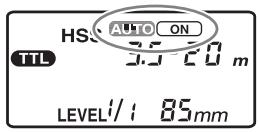
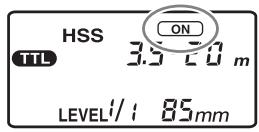
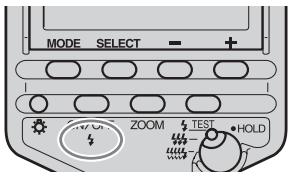
1 Select the P mode on the camera. 2 Press the flash ON/OFF button to display AUTO ON or ON
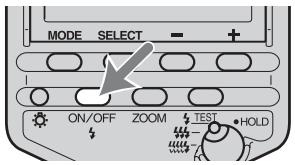
- AUTO and ON appear with Autoflash. Only ON appears with Fill-flash.
3 Press the shutter button partway down and make sure that the subject is within the flash range.
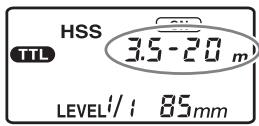
See page 16 for details on the flash range.
4 When the flash is charged, press the shutter button to take a photo.
- The flash is charged when the indicators on the rear of the unit and in the camera viewfinder are both lit.
When the correct exposure has been obtained for the photo just taken, OK is displayed in the data panel for approximately four seconds.
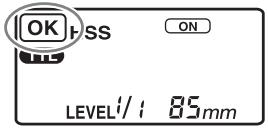
- The photo will be under-exposed if taken before charging is complete.
- Press the shutter button after making sure that charging is complete when using the flash with the self-timer.
- Either Autoflash or Fill-flash is selected, depending on your camera. For details, refer to the operating instructions of your camera.
- If your camera has AUTO mode or Scene Selection mode, they are dealt with here as program auto.
Flash range
Press the shutter button partway down.
The flash range for the proper exposure is displayed on the data panel. Make sure that the subject is within this range and then take the photo.
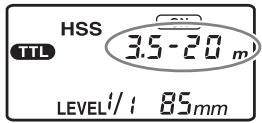
The range that can be displayed on the data panel is from 1.5 m to 28 m (0.7 m to 28 m for downward bounce; see p. 27). When the distance is beyond this range, or is lit on either side of the viewfinder.
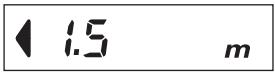
Proper exposure is obtained at less than 1.5 m.
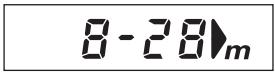
Proper exposure is obtained from 8 m to 28 m or more.
- The flash range is not shown when using flash bounce above and to the left or right, with wireless flash, or when off-camera cables are used.
- When photographing beyond the lower limit of the flash range, the photo may be over-exposed despite OK being displayed, or the bottom of the picture may darken. Always photograph within the indicated flash range.
Recording modes
Aperture priority flash photography (A)
1 Select the A mode on the camera. 2 Press the flash ON/OFF button to display ON.
- Fill-flash is selected.
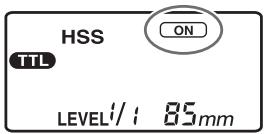
3 Set the aperture and focus the subject.
- Reduce the aperture (i.e. increase the f-stop) to reduce the flash range, or open the aperture (i.e. reduce the f-stop) to increase the flash range.
- The shutter speed is automatically set.
4 Press the shutter button when charging is complete.
Shutter speed priority flash photography (S)
1 Select the S mode on the camera. 2 Press the flash ON/OFF button to display ON.
- Fill-flash is selected.
3 Set the shutter speed, and focus the subject. 4 Press the shutter button when charging is complete.
Manual exposure mode flash photography (M)
1 Select the M mode on the camera. 2 Press the flash ON/OFF button to display ON.
- Fill-flash is selected. 3 Set the aperture and shutter speed, and focus the subject.
- Reduce the aperture (i.e. increase the f-stop) to reduce the flash range, or open the aperture (i.e. reduce the f-stop) to increase the flash range. 4 Press the shutter button when charging is complete.
Zoom flash coverage
Auto zoom
This flash automatically switches zoom coverage to cover a range of focal lengths from 24 mm to 85 mm when photographing (auto zoom). Normally, you do not need to switch the zoom coverage manually.
24 mm focal length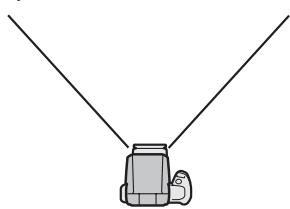
85 mm focal length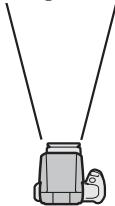
- Press the shutter button partway down to display the zoom coverage set automatically.
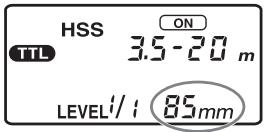
- Auto zoom coverage is set as follows:
| Focal length in use | Coverage |
| 24 mm - 27 mm | 24 mm |
| 28 mm - 34 mm | 28 mm |
| 35 mm - 49 mm | 35 mm |
| 50 mm - 69 mm | 50 mm |
| 70 mm - 84 mm | 70 mm |
| 85 mm or more | 85 mm |
- When a lens having a focal length of less than 24 mm is used with auto zoom, "24 mm" blinks. Use of the built-in wide panel (p. 21) is recommended in this case to prevent darkening at the periphery of the image.
Manual zoom
You can manually set the zoom coverage regardless of the focal length of the lens in use.
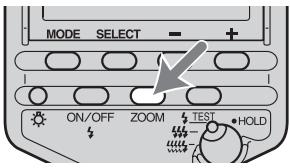
Press the ZOOM button to display the desired zoom coverage.
- Zoom coverage is changed in the following order.
Auto zoom → 24 mm → 28 mm → 35 mm → 50 mm → 70 mm → 85 mm
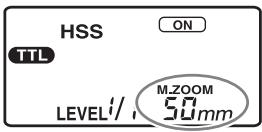
- When zoom is set manually, "M.ZOOM" is displayed above zoom coverage.
- If the zoom coverage is set to less than the focal length of the lens in use, the periphery of the screen darkens.
Built-in wide panel (17 mm zoom angle)
Pulling out the built-in wide panel expands flash coverage to a focal length of 17 mm.
Pull out the adaptor.
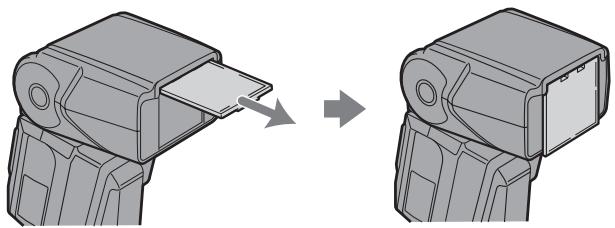
- The zoom coverage display on the data panel shows "17 mm." The flash range is also displayed.
- When storing the wide panel, insert it completely.
- When photographing a flat subject from the front at a focal length of about 17 mm, the periphery of the screen may darken slightly because the focal distances at the center and periphery of the screen are different.
- When using a wide-angle lens with a focal length below 17 mm, the periphery of the screen may darken.
Test-flash/Modeling flash
You can try one or more test flashes before shooting. This is particularly convenient for checking shadows in wireless flash photography when the flash is separated from the camera.
- Modeling flash is used to check shadows on the subject before taking photos.
1 Set the test-flash mode selection/hold switch to the desired mode.
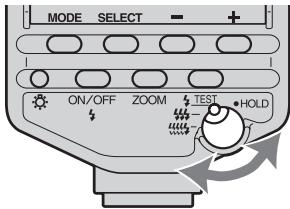

Flash once at the set light level (LEVEL 1/1 to 1/32).
- Use this test-flash mode when a flash meter is used in manual flash mode (p. 32).
- In multiple flash mode (p. 46), while pressing the test-flash button, the flash flashes the number of times you have set.

Flash three times at a rate of two flashes per second (guide number 5.6 at 24 mm position).
Used to roughly verify shadows.

Flash 4 seconds at a rate of 40 flashes per second (guide number 1.4 at 24 mm position).
- Convenient for verifying detailed shadows for macro photography.
HOLD The setting prevents incorrect operation.
- All flash operations are locked except the test-flash button and data panel illuminator. The camera can be operated so you can take photographs.
2 Press the test-flash/modeling-flash button when charging is complete.
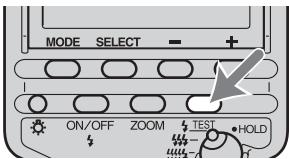
- Do not press the shutter button while the flash is in use.
- The strength of shadows will differ from that during actual photography.
- When using the flash in a bright place or outdoors or when using a bounce flash, shadows are lighter so verification is more difficult.
Bounce flash
Using the flash with a wall directly behind the subject produces strong shadows on the wall. By directing the flash at the ceiling you can illuminate the subject with reflected light, reducing the intensity of the shadows and producing a softer light on the screen.
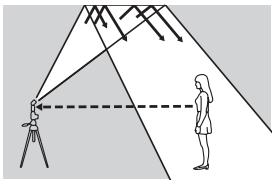
Bounce flash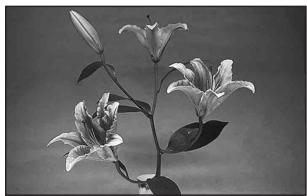
Normal flash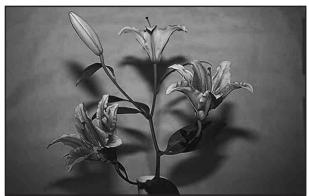
Rotate the flash upwards or to the left and right while pressing the bounce lock-release button.
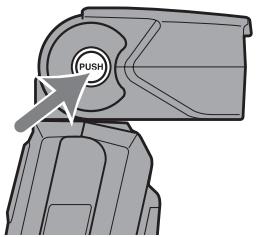
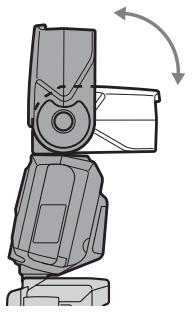
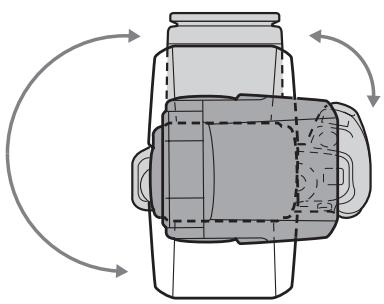
- The bounce indicator appears on the data panel.
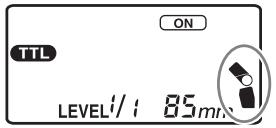
The flash may be set to the following angles.
- Upwards: 45°, 60°, 75°, 90°
- Downwards: 10° (see "Close-up Photography" p. 27)
- Right: 30°, 45°, 60°, 75°, 90°
- Left: 30°, 45°, 60°, 75°, 90°, 120°, 150°, 180°
- The bounce lock engages at the 0° position. When the flash is returned to the original position, the lock-release button does not need to be pressed.
- When the flash is rotated upwards or to the left and right, the flash range is not displayed on the data panel. High-speed sync is also cleared.
- Use a white ceiling or wall to reflect the flash. A colored surface may color the light. High ceilings or glass are not recommended.
Adjusting bounce angle
Simultaneously using direct light and bounced light from the flash produces uneven lighting. Determine the bounce angle with respect to the distance to the reflective surface, the distance from the camera to the subject, the focal length of the lens, etc.
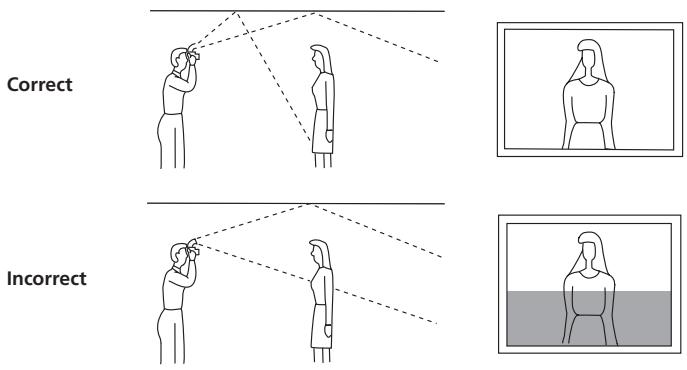
When flash is bounced upwards
Determine the angle in relation to the following table.
| Focal length of lens | Bounce angle |
| 70 mm minimum | 45° |
| 28-70 mm | 60° |
| 28 mm maximum | 75°, 90° |
Bouncing to Left and Right
Rotating the flash by 90° to bounce light sideways is recommended. If an angle of less than 90° is used, care should be taken to ensure that direct light from the flash does not illuminate the subject.
Close-up photography (downward bounce)
Tilt the flash slightly downwards when photographing objects between 0.7 m and 1.5 m from the camera to ensure accurate illumination.
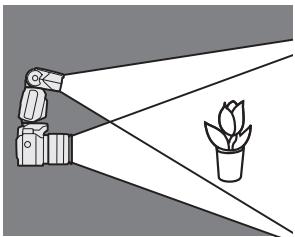
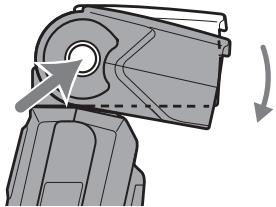
Rotate the flash downwards while pressing the bounce lock-release button.
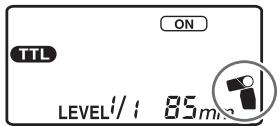
- The downward bounce indicator appears on the data panel. The rotation angle is 10°
- When photographing at a distance closer than 0.7m , the flash will not be able to completely cover the subject and the bottom of the picture will be darker. Use an off-camera or macro flash.
Data panel illuminator
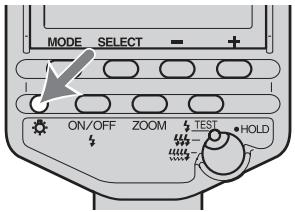
Illuminates the data panel at low-light levels.
Press the data panel illuminator.
- The data panel is illuminated for approximately eight seconds. This period is extended if the flash is used during this time.
- Press the button again while the data panel is illuminated to extinguish the data panel illuminator.
AF illuminator
In low-light or when subject contrast is low, when the shutter button is pressed partway down for Auto Focus, the red lamp on the front of the flash unit will light. This is the AF illuminator used as an aid in Auto Focus.
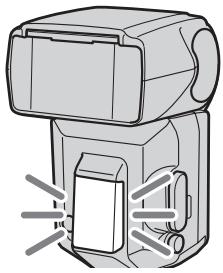
- The AF illuminator operates even when the flash is off.
- The camera AF illuminator does not operate while the flash AF illuminator is operating.
- The AF illuminator does not operate while Continuous AF is used in focusing mode (when continually focusing on a moving subject).
- The AF illuminator may not operate if the focal length of the lens is greater than 300mm . The flash will not operate when removed from the camera.
Mode and select buttons
The mode, select, +, and - buttons are used to select the functions described on the next page.
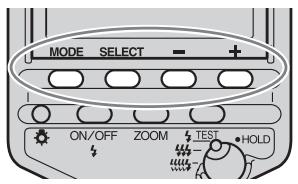
The functions are selected with the following basic procedure. See the relevant pages for details.
1. Select the major item with the mode button. 2. Select the minor item with the select button. 3. Make the setting with the + and - buttons. 4. Press the select button* repeatedly until blinking stops.
- Also possible with the mode button or flash ON/OFF button.
| Selected with the mode button | Selected with the select button | Selected with + and - buttons (items in Italics are default settings) |
| TTL (32) | HSS (35) | ON,OFF |
| WL (37) | OFF,ON, CONTROL | |
| RATIO* | OFF, 2:1, 2:1* | |
| LEVEL (44) | 1/1,1/2, 1/4, 1/8, 1/16, 1/32 | |
| M (32) | HSS (35) | ON,OFF |
| WL (37) | OFF,ON | |
| LEVEL (44) | 1/1,1/2, 1/4, 1/8, 1/16, 1/32 | |
| MULTI (46) | Hz | 100, 50, 40, 30, 20, 10, 9, 8, 7, 6, 5, 4, 3, 2, 1 |
| TIME | -- (unlimited), 40, 35, 30, 25, 20, 15,10,9,8,7,6,5,4,3,2 | |
| LEVEL | 1/8, 1/16, 1/32 |
Figures in parentheses after each item indicate the page numbers.
- Pressing the + and - buttons simultaneously for three seconds restores the default settings (p. 51).
- Multiple settings which cannot be changed are not displayed.
- This indicator is displayed, but this function is not available. Use the OFF setting.
Manual flash (M)
Normal TTL flash metering automatically adjusts the flash intensity to provide the proper exposure for the subject. Manual flash provides a fixed flash intensity irrespective of the brightness of the subject and the camera setting.
- Manual flash can only be used when the camera is in the M mode. In other modes, TTL measuring is automatically selected.
- As manual flash is not affected by the reflectivity of the subject, it is convenient for use with subjects with extremely high or low reflectivity.
TTL flash metering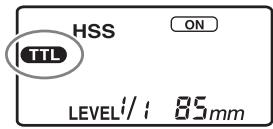
Manual flash metering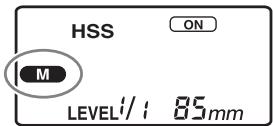
1. Select the M mode on the camera. 2. Press the mode button to display M on the data panel.
- The modes change in the following order.
TTL, M, MULTI
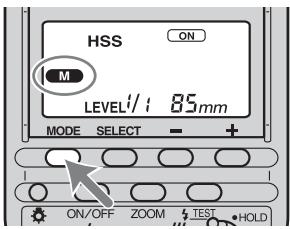
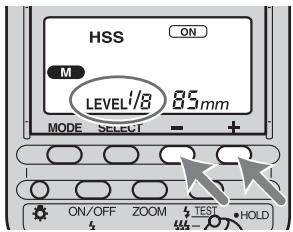
3 Press the + or - button to select the power level to set.
The power level can be selected from the following: 1/1, 1/2, 1/4, 1/8, 1/16, 1/32. For details on setting the power level, refer to page 44.
- When the shutter button is pressed partway down, the distance where the proper exposure will be obtained will appear in the data panel.
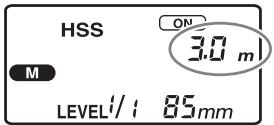
4.5 m
Proper exposure is obtained at less than 1.5 m.
28 m
Proper exposure is obtained at more than 28 m.
- The flash OK indicator is not displayed after a photo is taken with manual flash.
- Using custom functions, manual flash may be selected without setting the camera in the M mode (p. 53).
TTL flash
Manual flash provides a fixed flash intensity irrespective of the brightness of the subject and the camera setting. TTL* flash measures the light from the subject that is reflected through the lens.
Some cameras enable P-TTL metering, which adds pre-flash to TTL metering, and ADI metering, which adds distance data to the P-TTL metering.
This flash defines all P-TTL and ADI metering as TTL flash and displays TTL on the data panel.
*TTL = through the lens
- ADI metering is possible in combination with a lens with a built-in distance encoder.
Before using the ADI metering function, check whether your lens has a built-in distance encoder by referring to the specifications in the operating instructions supplied with your lens.
High-speed sync (HSS)
High-speed sync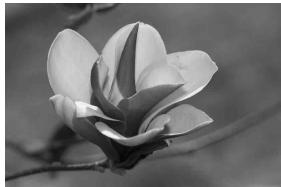
Normal flash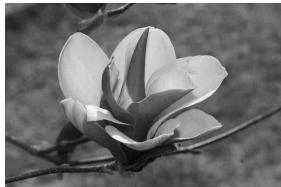
High-speed sync eliminates the restrictions of flash sync speed and enables the flash to be used through the entire shutter speed range of the camera. The increased selectable aperture range allows flash photography with a wide aperture, leaving the background out of focus and accentuating the front subject. Even when photographing at a wide f-stop in the A mode or M mode, when the background is very bright and the shot will normally be over-exposed, you can adjust the exposure by using the high-speed shutter.
1 Press the mode button to display TTL or M on the data panel.
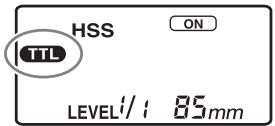
2 Press the select button to blink "HSS."
- The currently selected high-speed sync setting (ON/OFF) also blinks simultaneously.
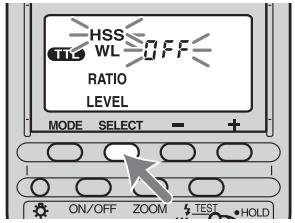
3 Press the + or - button to select ON.
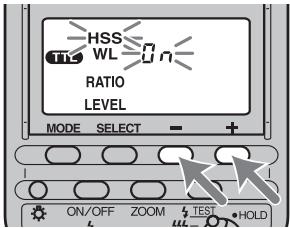
4 Press the select button repeatedly until blinking stops.
"HSS" remains on the data panel. - High-speed sync is cleared when OFF is selected with the procedure described above, and a shutter speed faster than the sync speed can no longer be set. - It is recommended that photos be taken in bright locations. When photographing in dark areas the shutter speed will not exceed the sync speed, even when ON is selected. - The flash range with high-speed sync is smaller than for normal flash photography. Make sure that the subject is within the displayed flash range before taking the photo. - High-speed sync cannot be used with multiple flash or bounce flash in the upwards, left, and right directions. - When using a flash meter or color meter, high-speed sync cannot be used because it interferes with proper exposure. Either select OFF to clear it or select a shutter speed lower than the sync speed.
Flash Sync Speed
Flash photography is generally associated with a maximum shutter speed referred to as the flash sync speed. This restriction does not apply to cameras designed for high-speed sync (HSS) photography (p. 35), since they allow flash photography at the maximum shutter speed of the camera.
Wireless flash mode (WL)
Photographs taken with the flash attached to the camera are flat as shown in photo ①. In such cases, remove the flash from the camera and position it to obtain a more three-dimensional effect as shown in photo ②.
When taking this type of photograph with a single lens reflex camera, the camera and the flash unit are most commonly connected by a cable. This flash eliminates the need for a cable to transmit signals to the flash unit by using the light of the built-in flash itself as a signal. The correct exposure is determined automatically by the camera.
Normal flash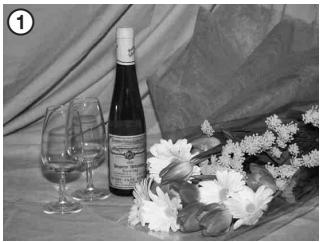
Wireless flash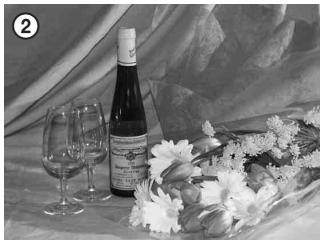
Wireless Flash Range
The wireless flash uses a light signal from the built-in flash as a trigger to operate the off-camera flash unit. Follow the points below when positioning the camera, flash, and subject.
Photograph in dark locations indoors. - If you rotate the flashtube using bounce-flash function (p. 24) so that the wireless control-signal receiver points toward the camera, it will be easier for the flash to receive a signal from the camera. - Place the off-camera flash within the gray area in the following diagram.
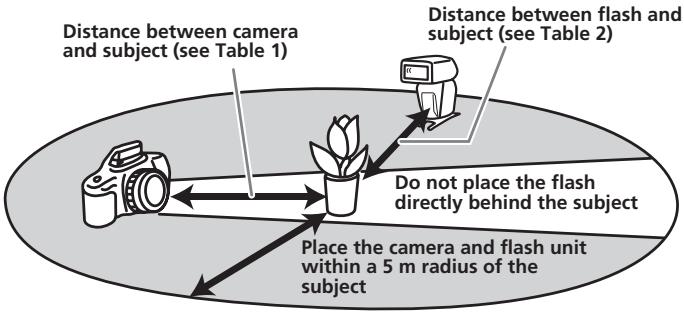
Distance camera-HVL-F56AM-subject
| Distance camera-subject(Table 1) | Distance HVL-F56AM - subject (Table 2) | |||||||
| Other than HSS | HSS | |||||||
| Shutter speed | All shutter speeds | Maximum 1/60 sec | 1/60 to sync speed | 1/250 sec | 1/500 sec | 1/1000 sec | 1/2000 sec | 1/4000 sec |
| Aperture | ||||||||
| 2.8 | 1.4 - 5 | 1.4 - 5 | 1 - 5 | 1 - 5 | 1 - 3.5 | 1 - 2.5 | 1 - 1.7 | 1 - 1.2 |
| 4 | 1 - 5 | 1 - 5 | 1 - 5 | 1 - 3.5 | 1 - 2.5 | 1 - 1.7 | 1 - 1.2 | - |
| 5.6 | 1 - 5 | 1 - 5 | 1 - 5 | 1 - 2.5 | 1 - 1.7 | 1 - 1.2 | - | - |
Units: m
- The distances in the above table assume the use of ISO 100. If ISO 400 is used the distances must be multiplied by a factor of two (assume a limit of 5 m).
- With wireless flash, the flash range is not shown on the data panel.
Notes on wireless flash
- You cannot use a flash meter or color meter in wireless flash mode because the camera's built-in pre-flash goes off.
- Test flash for the wireless flash is in the currently selected test flash mode. Three flashes occur with and flashes continue for four seconds with One flash occurs at the HOLD position.
- The zoom position for the HVL-F56AM is automatically set to 24 mm. A zoom position other than 24 mm is not recommended.
- In wireless flash mode, ADI metering is canceled and P-TTL flash metering is used automatically (p. 34).
- Multiple flash cannot be used.
- If another wireless flash is being used nearby, you can change the channel using custom settings to prevent interference (p. 52).
- When photographing with the wireless flash, the flash may in rare cases go off by mistake due to ambient static electricity or electromagnetic noise.
When the flash is not in use, turn it off using the flash ON/OFF button.
Attaching and removing the mini-stand
- Use the supplied mini-stand when the flash unit is separate from the camera.
- You can attach the flash unit to a tripod using the tripod socket holes in the mini-stand.
Attachment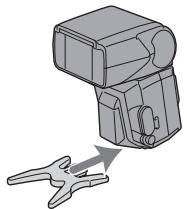
Removal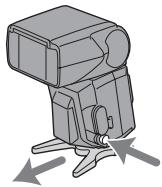
[1] Photography with wireless flash
Use only an off-camera flash unit, using the light from the built-in flash as a signal.
![SONY HVL-F56AM - [1] Photography with wireless flash - 1](/content/2019/11/102608/images/112d4c6b479f470557708bbc9a91f7bc204a3da304dbc9a12aae788235783745.jpg)
1 Attach the flash to the camera and turn the power of the flash and camera on. 2 Set the camera to wireless flash.
- When the camera is set to wireless the flash is also set to wireless automatically, and WL is displayed on the data panel. The flash channel information is transmitted to the camera.
3 Remove the flash from the camera and raise the built-in flash. 4 Set up the camera and flash.
See page 38 for details.
5 Make sure that the built-in flash and the flash are fully charged.
- The flash-ready indicator lights up in the viewfinder when the built-in flash is fully charged.
- The AF illuminator on the front blinks, and the flash-ready indicator on the rear lights up, when the flash is fully charged.
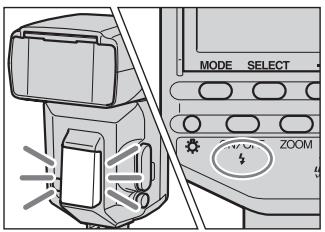
6 Use test flash to check the flash.
- The test flash method differs depending on the camera used. For details, see the operation instructions of your camera.
- If the test flash does not work, change the position of the camera, flash and subject, or point the wireless control-signal receiver towards the camera.
7 Check again that the built-in flash and the flash are fully charged, and press the shutter button to take the photo.
- Do not take photos when RATIO is displayed on the data panel. The exposure may not be correct.
[2] Setting wireless flash by flash only
Once you have performed the wireless flash setup in step [1], if you continue to use the same camera and flash combination without changing the wireless channel, then you can also set the flash and camera separately to wireless.
Camera setting:
Set to the wireless flash mode.
For details, refer to the operating instructions supplied with your camera.
Flash setting:
1 Press the mode button to display TTL or M. 2 Press the select button repeatedly to blink "WL."
- The current wireless setting "OFF" is also displayed.
3 Press the + or - button to blink "WL On." 4 Press the select button repeatedly until blinking stops.
Connecting camera and flash by cable
Using the off-camera cables FA-CC1AM (optional) allows photography with flash units separate from the camera. Up to four flash units can be connected together. Being able to take photographs without having to consider the positioning of the flash unit provides considerable freedom to create a variety of shadow effects on the subject.
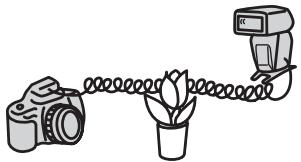
- Flash units with accessory terminals can be connected directly.
1 Remove the terminal cap. 2 Plug the cable into the accessory terminal.
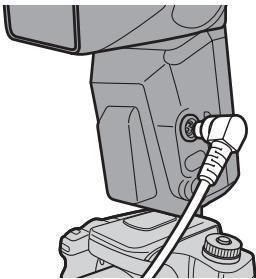
- In this mode, ADI metering will be canceled and Pre-flash TTL metering will be used automatically (p. 34).
- High-speed sync in the P mode cannot be used when the flash is connected with the off-camera cable FA-CC1AM (optional).
- All the flash units are at the same power level.
Setting power level (LEVEL)
The power level for the flash can be adjusted.
1 Press the select button to display "LEVEL" on the data panel.
- The current level is displayed.
- This step is not required when manual flash is selected. Go to step 2.
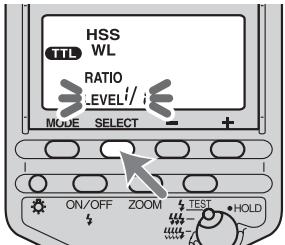
2 Press the + or - button to select the power level to be set.
- With TTL or manual flash photography the power level may be selected from the following: 1/1, 1/2, 1/4, 1/8, 1/16, 1/32.
- With multiple flash photography the power level may be selected from the following: 1/8, 1/16, 1/32.
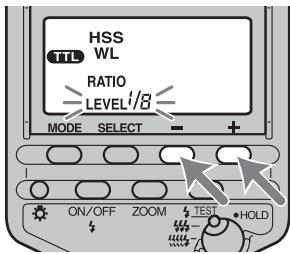
3 Press the select button.
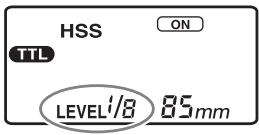
- When the power level is changed, the distance displayed on the data panel changes accordingly.
- Power level settings can be set independently for TTL photography (TTL), manual flash photography (M), and multiple photography (MULTI).
- In TTL flash photography, the power level will be adjusted with the selected level at its maximum.
- In manual flash photography, if the power level is set at 1/1, then the flash will go off at full power. The power level range (e.g., 1/1 to 1/2) corresponds to the aperture range (e.g., F4 to 5.6).
Multiple flash (MULTI)
The flash is triggered a number of times while the shutter is open (multiple flash). Multiple flash allows motion of the subject to be captured in a photograph for later analysis.
- The camera must be set to the M mode for multiple flash photography. Multiple flash can only be used if the camera supports the M mode.
1 Set the camera to the M mode. 2 Press the mode button to display MULT on the data panel.

3 Press the select button to blink "Hz."
- The current multiple flash frequency (flashes per second) is displayed on the data panel.
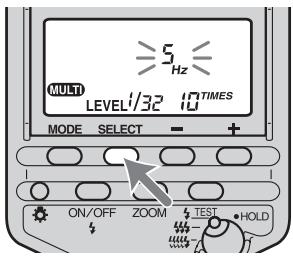
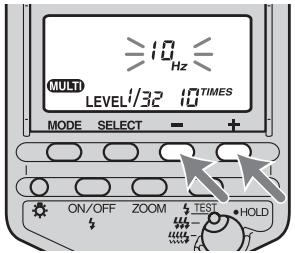
4 Press the + or - button to select the flash frequency.
- The flash frequency may be selected from the following: 100, 50, 40, 30, 20, 10, 9, 8, 7, 6, 5, 4, 3, 2, 1.
- Keep the + or - button pressed down to repeatedly change the value.
5 Press the select button to blink "TIMES."
- The current number of flashes for multiple flash is displayed on the data panel.
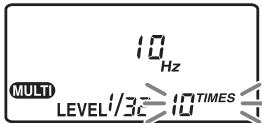
6 Press the + or - button to select the number of flashes.
- The number of flashes may be selected from the following: --, 40, 35, 30, 25, 20, 15, 10, 9, 8, 7, 6, 5, 4, 3, 2.
- Keep the + or - button pressed down to repeatedly change the value.
- When "--" is selected, flashes continue at the set frequency while the shutter is open.
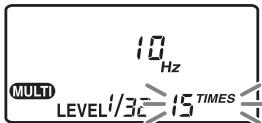
7 Press the select button to blink "LEVEL" on the data panel.
- The current power level is displayed.
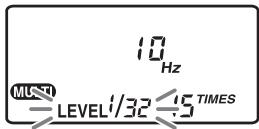
8 Press the + or - button to select the power level to set.
The power level may be selected from the following: 1/8, 1/16, 1/32.
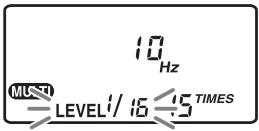
9 Press the select button.
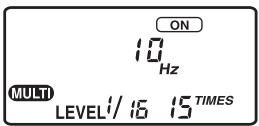
10 Set the shutter speed and aperture.
- The shutter speed is calculated as follows to suit the selected flash frequency and number of flashes: Number of flashes (TIME) ÷ Flash frequency (Hz) ≤ Shutter speed. For example, when ten flashes and 5 Hz are selected, 10 ÷ 5 = 2 requires a shutter speed of longer than two seconds.
11 When the flash is fully charged, press the shutter button to take the photo.
- The distance at which the proper exposure is obtained with a single flash is displayed on the data panel.
- To prevent shaking, the use of a tripod is recommended during multiple flash photography.
- Test flash will flash at the selected frequency/number/level while the test-flash button is being pressed if the selection switch is at or HOLD.
- The use of custom settings allows the camera to be set up for manual flash photography without selecting the M mode (p. 54).
Maximum number of continuous flashes
The maximum number of continuous flashes during multiple flash photography is limited by the charge in the battery. Use the following values as a guide.
With alkaline batteries
| Power level | Flash frequency (Hz) | ||||||||||||||
| 100 | 50 | 40 | 30 | 20 | 10 | 9 | 8 | 7 | 6 | 5 | 4 | 3 | 2 | 1 | |
| 1/8 | 3 | 4 | 4 | 4 | 5 | 5 | 5 | 5 | 5 | 6 | 6 | 7 | 7 | 7 | 10 |
| 1/16 | 5 | 6 | 7 | 8 | 8 | 9 | 9 | 10 | 10 | 10 | 10 | 10 | 15 | 20 | 40 |
| 1/32 | 10 | 10 | 10 | 15 | 15 | 20 | 20 | 20 | 25 | 30 | 40 | 40* | 40* | 40* | 40* |
With nickel-metal hydride batteries (When using 1550 mAh)
| Power level | Flash frequency (Hz) | ||||||||||||||
| 100 | 50 | 40 | 30 | 20 | 10 | 9 | 8 | 7 | 6 | 5 | 4 | 3 | 2 | 1 | |
| 1/8 | 3 | 4 | 4 | 4 | 5 | 5 | 5 | 5 | 5 | 6 | 6 | 7 | 7 | 10 | 20 |
| 1/16 | 5 | 6 | 7 | 8 | 8 | 9 | 9 | 10 | 10 | 10 | 10 | 15 | 20 | 40 | 40* |
| 1/32 | 10 | 15 | 15 | 15 | 15 | 20 | 25 | 25 | 30 | 40 | 40* | 40* | 40* | 40* | 40* |
*40 signifies more than 40.
- The maximum number of flashes varies with the type of battery and its condition. If the external battery adaptor FA-EB1AM (optional) is used, the maximum number of flashes increases beyond the values given above.
Reset to default settings
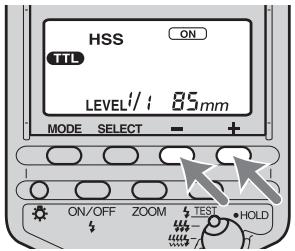
Press the + and - buttons together for three seconds.
Most flash functions return to default settings.
| Item | Default settings | Page |
| Flash on/off | On (Auto on or on) | 13 |
| Flash coverage (zoom) | Auto zoom (85 mm) | 19 |
| Flash mode (TTL/M/MULTI) | TTL | 32 |
| High speed sync (HSS) | On | 35 |
| Wireless flash (WL) | Off | 37 |
| Ratio control (RATIO)* | Off | - |
| Power level in TTL/M (LEVEL) | 1/1 | 44 |
| Power level in multiple flash (LEVEL) | 1/32 | 49 |
| Frequency in multiple flash (Hz) | 5 | 47 |
| Repetition in multiple flash (TIMES) | 10 | 48 |
- This indicator is displayed, but this function is not available. Custom setting is not reset.
Custom setting
The various flash settings may be changed as necessary. The following five items may be changed.
- Wireless channel setting (channels 1 to 4)
- Flash range units (m/ft)
- Time to auto power off (4 minutes/15 minutes/60 minutes/none)
- Time to auto power off when using wireless flash (60 minutes/none)
- Recording modes in which manual flash and multiple flash may be set (M mode only/all modes)
1 Press the select button for 3 seconds.
- The first item (wireless channel setting) is displayed.
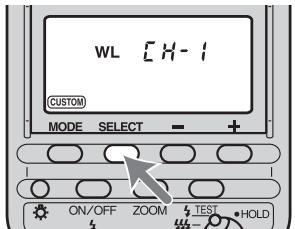
2 Press the select button to select the item, and press the + or - button to select the desired setting.
Each time the select button is pressed, the above five items appear on the data panel (see following page).
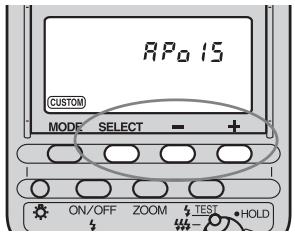
1. Wireless channel setting
Channel 1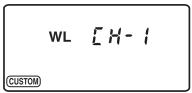
Channel 2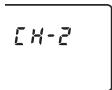
Channel 3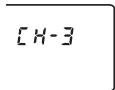
Channel 4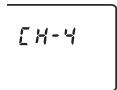
2. Flash range units (m/ft)
m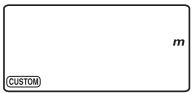
ft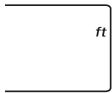
3. Time to auto power off
4 minutes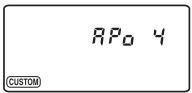
15 minutes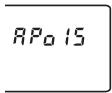
60 minutes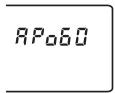
none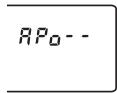
4. Time to auto power off when using wireless flash
60 minutes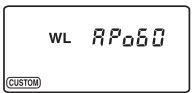
none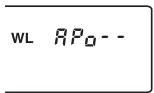
5. Recording modes in which manual flash and multiple flash may be set
M mode only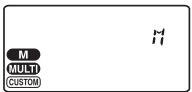
All modes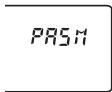
3 Press the mode button.
- The data panel returns to the original display.
- When a setting other than the default setting is selected in custom 3, 4 or 5, CUSTOM remains on the data display.
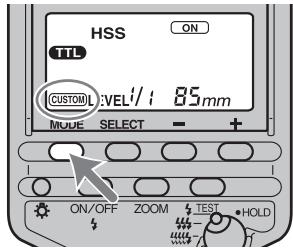
- After changing the wireless flash channel (see 1. Wireless channel setting), attach the flash to the camera, and press the shutter button partway down to transmit the flash channel information to the camera.
- When "All modes" is selected (see 5. Recording modes in which manual flash and multiple flash may be set), manual flash and multiple flash photography may be used in all recording modes.
- The proper exposure may not be obtained with photography in modes other than the M mode, and use of the M mode is therefore recommended.
- The selected settings are maintained even when the flash unit is turned off, or the battery is removed.
Accessories
Off-Camera Accessories
- Off-camera cable FA-CC1AM
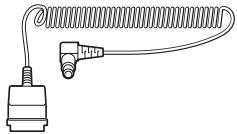
- Off-camera shoe FA-CS1AM

- Extension cable FA-EC1AM
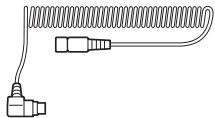
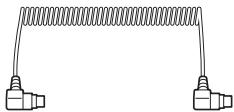
Multi flash cable FA-MC1AM
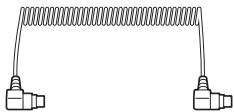
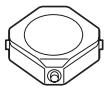
- Triple connector FA-TC1AM
The flash can be used from any position removed from the camera.
- The off-camera cable can be connected directly to the flash's accessory terminal without using the off-camera shoe.
The off-camera cable FA-CC1AM can be further extended.
Connecting flashes with multi flash cables enables photography with multiple flash units.
Connecting the off-camera cable FA-CC1AM or extension cable FA-EC1AM enables photography with up to three flashes at the same time.
External Battery Adaptor FA-EB1AM

The external battery adaptor contains six AA-size batteries. It reduces charging time by half, and doubles the number of flashes possible.
Notes on use
While shooting
- This flash unit generates strong light, so it should not be used directly in front of the eyes.
Batteries
- The battery level displayed on the data panel may be lower than the actual battery capacity, temperature, and storage conditions. The displayed battery level is restored to the correct value after the flash has been used a few times. When the battery level indicator blinks to indicate that the flash cannot be used, pressing the flash ON/OFF button a number of times may result in restoration of the correct battery level display. If the battery level is still not restored, replace the battery.
- When using lithium batteries, if the batteries become hot due to high temperature or continuous use, the battery level indicator may blink and the flash may not work for a while. Wait for the batteries to cool down before using the flash again.
- Nickel-metal hydride batteries can lose power suddenly. If the battery level indicator starts blinking or the flash can no longer be used while taking pictures, change or recharge the batteries.
- The flash frequency and number of flashes provided by new batteries may vary from the values shown in the table, depending on the time elapsed since manufacture of the batteries.
Temperature
- The flash unit may be used over a temperature range of 0°C to 40°C.
- Do not expose the flash unit to extremely high temperatures (e.g., in direct sunlight inside a vehicle) or high humidity.
- The response of the data panel slows as the temperature decreases, and the panel darkens at high temperatures. Restore it to normal temperature if these problems occur.
- To prevent condensation forming on the flash, place it in a sealed plastic bag when bringing it from a cold environment into a warm environment. Allow it to reach room temperature before removing it from the bag.
- Battery capacity decreases at colder temperatures. Keep your camera and spare batteries in a warm inside pocket when shooting in cold weather. The battery indicator may blink even when there is some power left in the batteries in cold weather. Batteries will regain some of their capacity when warmed to normal operating temperature.
- This flash unit is not waterproof. Be careful not to bring it into contact with water or sand when using it at the seashore, for example. Contact with water, sand, dust, or salt may result in a malfunction.
Maintenance
Remove this unit from the camera. Clean the flash with a dry soft cloth. If the flash has been in contact with sand, wiping will damage the surface, and it should therefore be cleaned gently using a blower. In the event of stubborn stains, use a cloth lightly dampened with a mild detergent solution, and then wipe the unit clean with a dry soft cloth. Never use strong solvents, such as thinner or benzine, as these damage the surface finish.
Specifications
Guide number
Normal flash (ISO 100)
| Power level | Flash Coverage Setting (mm) | ||||||
| 17 | 24 | 28 | 35 | 50 | 70 | 85 | |
| 1/1 | 18 | 30 | 32 | 38 | 44 | 50 | 56 |
| 1/2 | 12 | 21 | 22 | 26 | 31 | 35 | 38 |
| 1/4 | 9 | 15 | 16 | 19 | 22 | 25 | 27 |
| 1/8 | 6.4 | 10 | 11 | 13 | 15 | 17 | 19 |
| 1/16 | 4.5 | 7.5 | 8 | 9 | 11 | 12 | 13 |
| 1/32 | 3.2 | 5.3 | 5.7 | 6.7 | 7.8 | 8.8 | 9.7 |
Wireless flash (ISO 100)
| Power level | Flash Coverage Setting (mm) | ||||||
| 17 | 24 | 28 | 35 | 50 | 70 | 85 | |
| 1/1 | 14 | 25 | 26 | 30 | 35 | 41 | 42 |
HSS flat flash (flash with HSS, ISO 100)
| Shutter speed | Flash Coverage Setting (mm) | ||||||
| 17 | 24 | 28 | 35 | 50 | 70 | 85 | |
| 1/250 | 6.7 | 12 | 13 | 15 | 17 | 19 | 22 |
| 1/500 | 4.5 | 8.6 | 9.5 | 10 | 12 | 13 | 16 |
| 1/1000 | 3.5 | 6 | 6.7 | 7.5 | 9 | 9.5 | 11 |
| 1/2000 | 2.4 | 4.3 | 4.5 | 5 | 6 | 6.7 | 8 |
| 1/4000 | 1.7 | 3 | 3.5 | 3.7 | 4.5 | 4.7 | 5.6 |
| 1/8000 | 1.2 | 2.1 | 2.4 | 2.5 | 3 | 3.5 | 4 |
| 1/12000 | 1 | 1.8 | 2 | 2.1 | 2.5 | 2.8 | 3.5 |
Frequency/Repetition
| Alkaline | Lithium | Nickel hydride (1550 mAh) | |
| Frequency (sec) | 0.2 - 11 | 0.2 - 13 | 0.2 - 8 |
| Repetition (times) | 90 - 3200 | 250 - 8000 | 80 - 2800 |
- Repetition is the approximate number of times that are possible before a new battery is completely dead.
Flash coverage
| Flash coverage | Flash Coverage Setting (mm) | ||||||
| 17 | 24 | 28 | 35 | 50 | 70 | 85 | |
| Top-bottom (°) | 115 | 60 | 53 | 45 | 34 | 26 | 23 |
| Left-right (°) | 125 | 78 | 70 | 60 | 46 | 36 | 31 |
Continuous 40 flashes at 5 flashes per second flash performance (Normal flash, power level 1/32, nickel-metal hydride battery)
AF illuminator Autoflash at low contrast and low brightness For wide focus area Operating range (with a 50 mm lens attached to alpha 100 Central area: 0.5 m to 10 m Peripheral areas: 0.5 m to 3 m)
Flash control Flash control using pre-flash, TTL direct metering, Manual flash
Dimension (Approx.) W 77.5 x H 132 x D 95.5 mm (31/8 x 51/4 x 4 inches)
Mass (Approx.) 370 g (13.1 oz)
Included items Flash (1), Mini-stand (1), Case (1), Set of printed documentation
Functions in these operating instructions depend on testing conditions at our firm.
Design and specifications are subject to change without notice.
Trademark
alpha is a trademark of Sony Corporation.
Use only an off-camera flash unit, using the light from the built-in flash as a signal.
Printed on 70% or more recycled paper using VOC (Volatile Organic Compound)-free vegetable oil based ink.
- WARNING
- IMPORTANT SAFETY INSTRUCTIONS
- SAVE THESE INSTRUCTIONS
- CAUTION
- FOR CUSTOMERS IN EUROPE
- DISPOSAL OF OLD ELECTRICAL & ELECTRONIC EQUIPMENT (APPLICABLE IN THE EUROPEAN UNION AND OTHER EUROPEAN COUNTRIES WITH SEPARATE COLLECTION SYSTEMS)
- FOR THE CUSTOMERS IN THE U.S.A
- NOTE
- TABLE OF CONTENTS
- PREPARATIONS
- BASICS
- APPRIFICATIONS
- ADDITIONAL INFORMATION
- BEFORE USE
- FEATURES
- NAME OF PARTS
- CONTROL PANEL
- DATA PANEL
- INSERTING BATTERIES
- CHECKING BATTERIES
- BLINKING
- ONLY BLINKING
- ATTACHMENT AND REMOVAL OF THE FLASH
- ATTACHING THE FLASH TO THE CAMERA
- REMOVING THE FLASH FROM THE CAMERA
- AUTO POWER ON/OFF
- AUTO POWER OFF
- PROGRAM AUTO FLASH (THE BASICS)
- PRESS THE SHUTTER BUTTON PARTWAY DOWN AND MAKE SURE THAT THE SUBJECT IS WITHIN THE FLASH RANGE
- WHEN THE FLASH IS CHARGED, PRESS THE SHUTTER BUTTON TO TAKE A PHOTO
- FLASH RANGE
- PRESS THE SHUTTER BUTTON PARTWAY DOWN
- RECORDING MODES
- APERTURE PRIORITY FLASH PHOTOGRAPHY (A)
- SHUTTER SPEED PRIORITY FLASH PHOTOGRAPHY (S)
- MANUAL EXPOSURE MODE FLASH PHOTOGRAPHY (M)
- ZOOM FLASH COVERAGE
- AUTO ZOOM
- MANUAL ZOOM
- PRESS THE ZOOM BUTTON TO DISPLAY THE DESIRED ZOOM COVERAGE
- BUILT-IN WIDE PANEL (17 MM ZOOM ANGLE)
- PULL OUT THE ADAPTOR
- TEST-FLASH/MODELING FLASH
- SET THE TEST-FLASH MODE SELECTION/HOLD SWITCH TO THE DESIRED MODE
- HOLD THE SETTING PREVENTS INCORRECT OPERATION
- PRESS THE TEST-FLASH/MODELING-FLASH BUTTON WHEN CHARGING IS COMPLETE
- BOUNCE FLASH
- ADJUSTING BOUNCE ANGLE
- WHEN FLASH IS BOUNCED UPWARDS
- BOUNCING TO LEFT AND RIGHT
- CLOSE-UP PHOTOGRAPHY (DOWNWARD BOUNCE)
- DATA PANEL ILLUMINATOR
- PRESS THE DATA PANEL ILLUMINATOR
- AF ILLUMINATOR
- MODE AND SELECT BUTTONS
- MANUAL FLASH (M)
- PRESS THE + OR - BUTTON TO SELECT THE POWER LEVEL TO SET
- TTL FLASH
- HIGH-SPEED SYNC (HSS)
- PRESS THE MODE BUTTON TO DISPLAY TTL OR M ON THE DATA PANEL
- PRESS THE SELECT BUTTON TO BLINK "HSS
- PRESS THE + OR - BUTTON TO SELECT ON
- PRESS THE SELECT BUTTON REPEATEDLY UNTIL BLINKING STOPS
- FLASH SYNC SPEED
- WIRELESS FLASH MODE (WL)
- WIRELESS FLASH RANGE
- NOTES ON WIRELESS FLASH
- ATTACHING AND REMOVING THE MINI-STAND
- [1] PHOTOGRAPHY WITH WIRELESS FLASH
- MAKE SURE THAT THE BUILT-IN FLASH AND THE FLASH ARE FULLY CHARGED
- USE TEST FLASH TO CHECK THE FLASH
- CHECK AGAIN THAT THE BUILT-IN FLASH AND THE FLASH ARE FULLY CHARGED, AND PRESS THE SHUTTER BUTTON TO TAKE THE PHOTO
- [2] SETTING WIRELESS FLASH BY FLASH ONLY
- CAMERA SETTING
- FLASH SETTING
- CONNECTING CAMERA AND FLASH BY CABLE
- SETTING POWER LEVEL (LEVEL)
- PRESS THE SELECT BUTTON TO DISPLAY "LEVEL" ON THE DATA PANEL
- PRESS THE + OR - BUTTON TO SELECT THE POWER LEVEL TO BE SET
- PRESS THE SELECT BUTTON
- MULTIPLE FLASH (MULTI)
- PRESS THE SELECT BUTTON TO BLINK "HZ
- PRESS THE + OR - BUTTON TO SELECT THE FLASH FREQUENCY
- PRESS THE SELECT BUTTON TO BLINK "TIMES
- PRESS THE + OR - BUTTON TO SELECT THE NUMBER OF FLASHES
- PRESS THE SELECT BUTTON TO BLINK "LEVEL" ON THE DATA PANEL
- SET THE SHUTTER SPEED AND APERTURE
- WHEN THE FLASH IS FULLY CHARGED, PRESS THE SHUTTER BUTTON TO TAKE THE PHOTO
- MAXIMUM NUMBER OF CONTINUOUS FLASHES
- RESET TO DEFAULT SETTINGS
- CUSTOM SETTING
- PRESS THE SELECT BUTTON FOR 3 SECONDS
- PRESS THE SELECT BUTTON TO SELECT THE ITEM, AND PRESS THE + OR - BUTTON TO SELECT THE DESIRED SETTING
- WIRELESS CHANNEL SETTING
- FLASH RANGE UNITS (M/FT)
- TIME TO AUTO POWER OFF
- TIME TO AUTO POWER OFF WHEN USING WIRELESS FLASH
- RECORDING MODES IN WHICH MANUAL FLASH AND MULTIPLE FLASH MAY BE SET
- PRESS THE MODE BUTTON
- ACCESSORIES
- OFF-CAMERA ACCESSORIES
- EXTERNAL BATTERY ADAPTOR FA-EB1AM
- NOTES ON USE
- WHILE SHOOTING
- BATTERIES
- TEMPERATURE
- MAINTENANCE
- SPECIFICATIONS
- TRADEMARK
Brand : SONY
Model : HVL-F56AM
Category : External Flash