
SCD590 - Baby monitor PHILIPS - Free user manual and instructions
Find the device manual for free SCD590 PHILIPS in PDF.


| Product type | Baby monitor |
| Brand | PHILIPS |
| Model | SCD590 |
| Transmission technology | DECT (digital) |
| Maximum outdoor range | 300 meters |
| Typical indoor range | 50 meters |
| Baby unit power supply | 9V DC 300 mA adapter or 4 AA 1.5V batteries (not included) |
| Parent unit power supply | Rechargeable Ni-MH AAA 1.2V batteries (included) or 9V DC 300 mA charger |
| Parent unit battery life | Up to 8 hours |
| Charging time | 16 hours |
| Number of parent units | 2 |
| Main functions | Intercom (Talk), nightlight, paging (Page), microphone sensitivity adjustment, silent monitoring |
| Safety | Connection indicator (green/red), low battery indication, recommended safety distance (1 meter) |
| Cleaning | Damp cloth only |
| Warranty | 2 years (according to the manual) |
| Included accessories | 2 power adapters, charger, belt clip, neck strap |
Frequently Asked Questions - SCD590 PHILIPS
User questions about SCD590 PHILIPS
0 question about this device. Answer the ones you know or ask your own.
Ask a new question about this device
Download the instructions for your Baby monitor in PDF format for free! Find your manual SCD590 - PHILIPS and take your electronic device back in hand. On this page are published all the documents necessary for the use of your device. SCD590 by PHILIPS.
USER MANUAL SCD590 PHILIPS

PHILIPS
1
ENGLISH 6
ESPAÑOL 18
FRANÇAIS 31
Introduction
Philips is dedicated to producing caring, reliable products that give parents the reassurance they need. This Philips baby monitor provides round-the-clock support by ensuring you can always hear your baby clearly without any distracting noise. The DECT technology guarantees zero interference from other wireless appliances and a clear signal between the parent unit and baby unit. The baby monitor allows you to hear your baby at a distance of up to 300 metres/900 feet in open air.
Philips Baby Care, taking care together

IMPORTANT SAFETY INSTRUCTIONS
This baby monitor is intended as an aid. It is not a substitute for responsible and proper adult supervision and should not be used as such.
Some of the following information may not apply to your particular product; however, when using baby monitor equipment, basic safety precautions should always be followed to reduce the risk of fire, electric shock and injury to persons, including the following:
1 Read this user manual carefully before using the product and keep it for future reference.
2 Follow all warnings and instructions marked on the product.
3 Use this product for its intended household use as described in this manual. Do not use attachments not recommended by Philips Electronics North America Corporation.
4 Unplug this product from the wall outlet before cleaning. Do not use liquid cleaners or aerosol cleaners. Use a damp cloth for cleaning.
5 Products should not be used while you are in a bathtub, shower or pool. Immersion of the product in water could cause an electrical shock.
6 Slots and openings in the cabinet back or bottom are provided for ventilation, to protect it from overheating. These openings should not be blocked or covered. The openings should never be blocked by placing the product on the bed, sofa, rug, or other similar surface. This product should not be placed in a built-in installation unless proper ventilation is provided.
7 This product should be operated only from the type of power source indicated on the type plate of the adapters (I - ①, II - ②). If you are not sure of the type of power supply to your home, consult your dealer or local power company.
8 Do not allow anything to rest on the power cord. Do not locate this product where the cord will be abused by persons walking on it.
9 Do not overload wall outlets and extension cords as this can result in the risk of fire or electric shock.
10 Never push objects of any kind into this product through cabinet slots as they may touch dangerous voltage points or short out parts that could result in a risk of fire or electric shock. Never spill liquid of any kind on the product.
11 To reduce the risk of electric shock, do not disassemble this product, but take it to a qualified service personnel when service or repair work is required. Opening or removing covers (except battery compartment covers) may expose you to dangerous voltage or other risks. Incorrect reassembly can cause electric shock when the appliance is subsequently used.
12 Do not expose the product to extreme temperatures such as areas near a hot radiator or stove or in a hot car.
13 Do not place lighted candles, cigarettes, cigars, etc., on the product.
14 Unplug this product from the wall outlet, discontinue use and return the product to the Philips Service Location for examination and repair under the following conditions:
A. When the power supply cord or plug is damaged or frayed.
B. If the product has been exposed to rain or water.
C. If the product does not operate normally by following the operating instructions.
D. If the product's cabinet has been damaged.
E. If the product exhibits a distinct change in performance.
15 Do not place this product on an unstable cart, stand or table. The product may fall, causing serious damage to the product.
16 Make sure the baby unit and adapter cable are always out of reach of the baby (at least 1 meter / 3 feet away).
17 Never place the baby unit inside the baby's bed or playpen.
18 Never cover the baby monitor (with a towel, blanket, etc.).
If your product utilizes batteries, the following additional precautions should be observed:
1 Use only the type and size of the battery(ies) specified in the user manual.
2 Do not dispose of the battery(ies) in fire. They may explode. Check with local regulations for possible special disposal instructions.
3 Exercise care in handling battery(ies) in order not to short out the battery(ies) with conducting materials such as rings, bracelets and keys. Overcharging, short circuiting, reverse charging, mutilation, or incineration of the cells and the batteries must be avoided to prevent one or more of the following occurrences: release of toxic materials, release of hydrogen and/or oxygen gas, rise in surface temperature.
4 Do not attempt to recharge the battery(ies) provided with or identified for use with this product that are not intended to be charged. The battery(ies) may leak corrosive electrolyte or explode.
5 Do not attempt to rejuvenate the battery(ies) provided with or identified for use with this product by heating them. Sudden release of the battery(ies) electrolyte may occur causing burns or irritation to eyes or skin.
6 If and when necessary, these cells or batteries must be replaced with identical new ones from the same manufacturer. If a cell or a battery to be replaced is connected with other cells or batteries in series, it is recommended that the other cells or batteries be replaced with new ones at the same time.
7 Reverse polarity installation of the cell or the battery(ies) in the end product must be avoided. Reverse insertion of battery(ies) can cause charging, and that may result in leakage or explosion.
8 Remove battery(ies) from this product if storing over 30 days because the battery(ies) could leak and damage the product.
9 Discard ‘dead’ battery(ies) as soon as possible since ‘dead’ batteries are more likely to leak in a product. If a cell or a battery has leaked or vented, it should be replaced immediately using protective gloves.
10 Do not store this product, or the battery(ies) provided with or identified for use with this product, in high-temperature areas. Batteries that are stored in a freezer or refrigerator for the purpose of extending shelf life should be protected from condensation during storage and defrosting. Batteries should be stabilized at room temperature prior to use after cold storage.
11 If your product use rechargeable battery(ies), charge the battery(ies) only in accordance with the instructions and limitation specified in the user manual.
12 Risk of explosion if batteries are replaced by an incorrect type. For the parent unit, always use rechargeable batteries.
SAVE THESE INSTRUCTIONS

CAUTION: Unplug power cord before replacing batteries.

Use only the adapter supplied with this baby monitor. Incorrect adapter polarity or voltage can seriously damage the baby monitor.
Adapters for baby unit and charger:
Input: 120 VAC 60 Hz
Output: 9VDC 300 mA

CAUTION: THERE IS A RISK OF EXPLOSION IF THE BATTERIES ARE REPLACED BY AN INCORRECT TYPE. DISPOSE OF USED BATTERIES ACCORDING TO THE INSTRUCTIONS.
Use 1.5V AA size alkaline batteries only for baby unit (batteries not supplied).
Use 1.2V AAA size Ni-MH rechargeable batteries only for parent unit (batteries supplied).
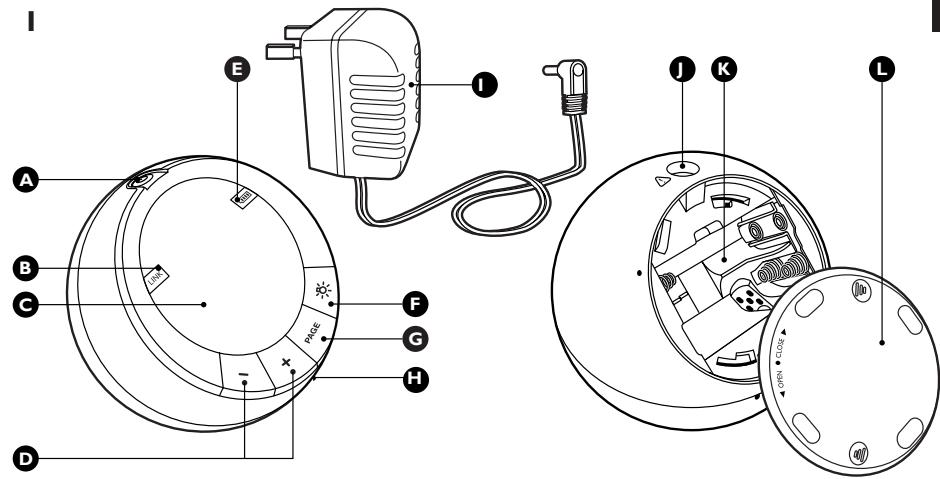
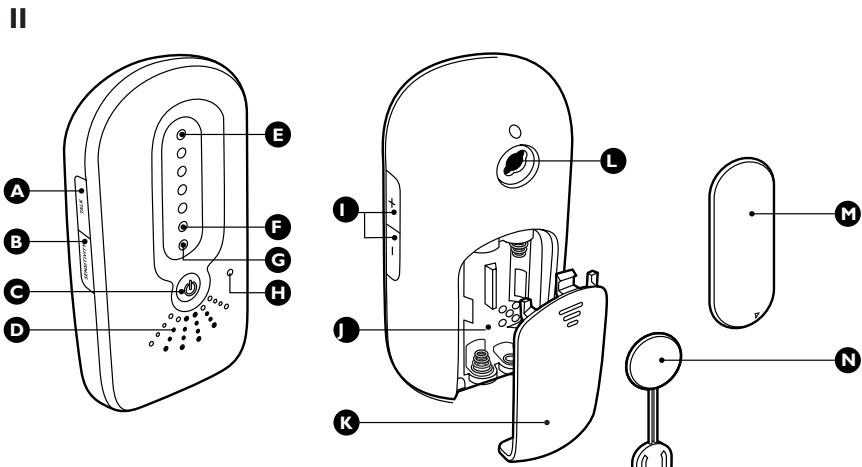
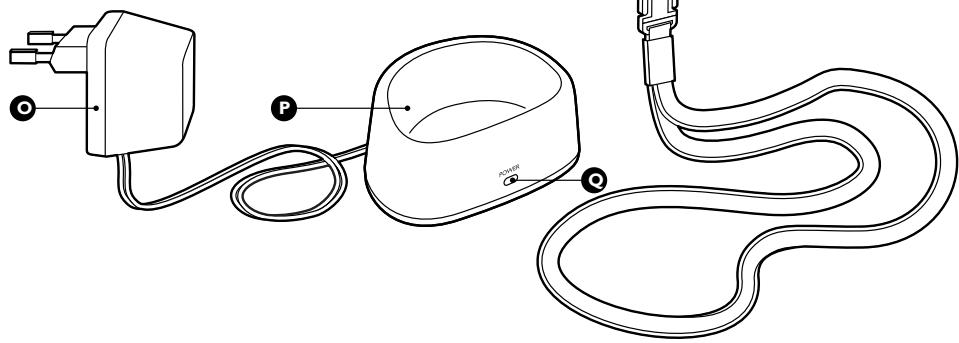
General description (Fig. 1)
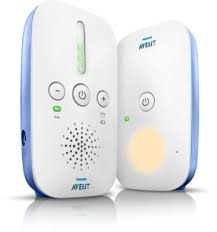
I Baby unit
A On/off button
B Connection light
© Nightlight
D Volume control (+/-)
Battery-low light
F Nightlight button
G Page button
H Microphone
I Adapter
J Socket for small plug
K Battery compartment
Battery compartment lid
II Parent unit (2x)
A Talk button
B Sensitivity button
C On/off button
D Loudspeaker
E Sound-level lights
F Connection light
G Battery-low light
H Microphone
Volume control (+/-)
J Battery compartment
K Battery compartment lid
L Recess for belt clip
M Belt clip
N Neck strap
Adapter
P Charger
Q Charging light
Important
Read these instructions for use carefully before using the appliance and save them for future reference.
This baby monitor is intended as an aid. It is not a substitute for responsible and proper adult supervision and should not be used as such.
Check if the voltage that is indicated on the adapter corresponds to the local mains voltage before you connect the appliance.
Use and store the appliance at a temperature between 50° F and 104° F.
The appliance is suitable for mains voltages from 120V.
Do not expose the baby monitor to extreme cold or heat or to direct sunlight.
Make sure the baby unit and the cord are always out of reach of the baby (at least 1 metre/3 feet away).
Never place the baby unit inside the baby's bed or playpen.
Never cover the baby monitor with a towel or blanket.
Never immerse any part of the baby monitor in water or any other liquid.
Never use the baby monitor in moist places or close to water.
Except for the battery compartments, do not open the housing of the baby unit and parent units in order to prevent electric shock.
▶ Only use the adapters supplied.
The adapters contain a transformer. Do not cut off the adapters to replace them with other plugs, as this will cause a hazardous situation.
Since continuous transmission is prohibited, you only hear your baby when it makes sounds.
If the one of the adapters is damaged, always have it replaced by one of the original type in order to avoid a hazard.
Preparing for use
Your can use the baby monitor corded or battery operated.
Baby unit
You can use the baby unit corded or battery operated. Even if you are going to use the unit corded, we advise you to insert batteries. This guarantees automatic back-up in case of power supply failure.
Cord operation
1 Put the small plug in the baby unit.
2 Put the adapter in a wall socket. (Fig. 2)
Battery operation
The baby unit runs on four 1.5-volt R6 AA batteries (not included). We strongly advise you to use Philips LR6 PowerLife batteries.
Make sure your hands and the unit are dry when you insert the batteries.
1 Turn the battery compartment lid to the left (◀ OPEN) with the palm of your hand and remove it. (Fig. 3)
2 Insert four 1.5-volt AA batteries. (Fig. 4)
Make sure the + and - poles of the batteries point in the right direction.
3 Reattach the battery compartment lid by turning it to the right (▶ CLOSE) with the palm of your hand. (Fig. 5)
The baby unit is now ready for battery- operated use.
Note: When the batteries are running low, the battery-low light on the baby unit starts burning continuously.
Parent units
The parent units run on two rechargeable 1.2-volt AAA NiMh batteries (included).
Make sure your hands and the units are dry when you insert the batteries.
Do not mix old and new batteries or different types of batteries.
Remove the batteries if you are not going to use the baby unit for a month or more.
1 Slide the battery compartment lid downwards and remove it. (Fig. 6)
2 Insert the two rechargeable batteries supplied. (Fig. 7)
Make sure the + and - poles of the batteries point in the right direction.
3 Reattach the battery compartment lid by sliding it upwards ('click'). (Fig. 8)
4 Put the adapter in a wall socket.
5 Place the parent unit in the charger. (Fig. 9)
The power-on light goes on. (Fig. 10)
6 Leave the parent unit in the charger until the batteries are fully charged.
Charging takes at least 16 hours.
Charging will take longer than 16 hours when the parent unit is switched on during charging. To shorten the charging time, switch off the parent unit.
The power-on light stays on, even when the batteries are fully charged.
When the parent unit is fully charged, it has a cordless operation time of at least 8 hours.
Note: The operating time of 8 hours is based on the assumption that the baby unit will be transmitting 25% of the time and is in standby mode for the rest of the time (when the baby does not make any sound).
Note: When the parent unit batteries are charged for the first time, the operating time will be less than 8 hours. The rechargeable batteries only reach their full capacity after you have charged and discharged them four times.
Note: When the parent unit is not in the charger, the batteries gradually discharge, even when the parent unit is switched off.
Note: When the batteries run low, the battery-low light on the parent unit starts to blink. Place the parent unit in the charger to recharge the batteries.
Using the appliance
Use this baby monitor for its intended household use as described in this manual.
1 Place the parent unit and the baby unit in the same room to test the connection. (Fig. 11) Make sure the baby unit is at least 1 metre/3 feet away from the parent unit.
2 Press and hold the on/off button on the baby unit for 2 seconds. (Fig. 12)
The nightlight lights up briefly.
The connection light burns red briefly and then starts blinking green as the baby unit tries to establish connection with the parent unit.
3 Press and hold the on/off button on the parent unit for 2 seconds. (Fig. 13)
The sound level lights burn orange briefly.
The battery-low light burns red briefly.
The sound level lights burn orange briefly. The battery-low light burns red briefly.
The connection light burns red briefly and then starts blinking green as the parent unit tries to establish connection with the baby unit.
The connection lights on the parent unit and the baby unit blink green until connection has been established.
It takes about 30 seconds before a connection is established.
When a connection has been established between the parent unit and the baby unit, the connection lights on both units burn green continuously. (Fig. 14)
If no connection has been established after 30 seconds, both connection lights burn red and the parent unit beeps from time to time.
4 Place the baby unit at least 1 metre/3 feet away from your baby. (Fig. 15)
5 Position the parent unit within the operating range of the baby unit. Make sure it is at least 1 metre/3 feet away from the baby unit. For more information on the operating range, see section ‘Operating range’ below. (Fig. 11)
Operating range
The operating range of the baby monitor is 300 metres/900 feet in open air. Depending on the surroundings and other disturbing factors, this range may be smaller. Indoors the operating range is up to 50 metres/150 feet.
| Dry materials | Material thickness | Loss of range |
| Wood, plaster, cardboard, glass (without metal, wires or lead) | < 30cm/12in | 0-10% |
| Brick, plywood | < 30cm/12in | 5-35% |
| Reinforced concrete | < 30cm/12in | 30-100% |
| Metal grilles or bars | < 1cm/0.4in | 90-100% |
| Metal or aluminium sheets | < 1cm/0.4in | 100% |
For wet and moist materials, the range loss may be up to 100%.
Features
Extra parent unit
This appliance comes with two parent units instead of one, so that your baby can be monitored by two persons at the same time.
Adjusting loudspeaker volume
1 Briefly press the volume + and – buttons on the baby unit until the desired loudspeaker volume for the baby unit has been reached. (Fig. 16)
2 Briefly press the volume + and – buttons on the parent unit until the desired loudspeaker volume for the parent unit has been reached. (Fig. 17)
Note: If you press the volume + and - buttons too long, the volume will not be adjusted.
Note: If the volume is set to a high level, the units consume more power.
Talk function
You can use the talk button on the parent unit to talk to your baby (e.g to comfort your baby).
1 Press and hold the talk button and talk clearly into the microphone. (Fig. 18)
2 Release the talk button when you have finished talking.
Note: When you press the talk button, you can no longer hear your baby.
Microphone sensitivity
With the sensitivity button on the parent unit you can set the sound that is picked up by the baby unit to the desired level. When the microphone sensitivity is at maximum level, the baby unit picks up all sounds (including your baby's breathing, when loud enough).
You can only change the microphone sensitivity if the connection between the baby unit and the parent unit has been established. This is the case when the connection lights on the parent unit and the baby unit burn green continuously.
1 Briefly press the sensitivity button on the parent unit. (Fig. 19)
The sound-level lights show the current sensitivity level for approximately 2 seconds.
2 Briefly press the volume + and – buttons on the parent unit until the desired microphone sensitivity for the baby unit has been reached. (Fig. 17)
Note: If you press the sensitivity button and/or the volume + and - buttons too long, the microphone sensitivity will not be adjusted.
3 The sound-level lights show the newly selected sensitivity level for approximately 2 seconds:
- 1 light burns = minimum sensitivity level
- All 5 lights burn = maximum sensitivity level. At this level, the baby unit is in continuous transmission mode
Note: When the sensitivity of the baby unit is set to a high level, it picks up more sounds and therefore transmits more often. As a result, the unit consumes more power.
Silent baby monitoring
1 Briefly press the volume – button on the parent unit until the volume is switched off completely. (Fig. 20)
The volume is completely switched off when all sound-level lights are out.
As long as the baby unit does not detect a sound, all sound-level lights on the parent unit are out.
When the baby unit detects a sound, the sound-level lights on the parent unit go on.
Nightlight
1 Briefly press the nightlight button on the baby unit to switch on the nightlight.
2 Briefly press the nightlight button again to switch off the nightlight. (Fig. 21)
The nightlight gradually dims before it goes out completely.
3 Switch off the night light when operating the baby unit on batteries. This saves power.
Note: If you press the nightlight button too long, the nightlight will not go on or out.
Tip: Do not use the nightlight when you operate the baby unit on batteries. This saves power.
Belt clip and neck strap
If the parent unit is sufficiently charged, you can take it with you inside and outside the house with the belt clip or neck strap. This allows you to monitor your baby while you are moving around.
Connecting the belt clip
Insert the small pin on the back of the belt clip into the opening on the back of the parent unit (1). Turn the belt clip to the left (2) until it locks into position ('click'). (Fig. 22)
Disconnecting the belt clip
Turn the belt clip to the right (in the direction of ▶) (1) and take it out of the opening (2). (Fig. 23)
Connecting the neck strap
Insert the small pin at the end of the neck strap into the opening on the back of the parent unit (1). Turn the neck strap to the left (2) until it locks into position ('click'). (Fig. 24)
Disconnecting the neck strap
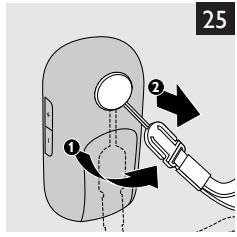
Turn the neck strap to the right (in the direction of ▶) (1) and take it out of the opening (2). (Fig. 25)
Paging function
If you have misplaced the parent unit and its volume is switched off, you can use the page button on the baby unit to locate the parent unit.
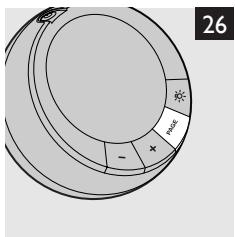
1 Briefly press the page button on the baby unit. The parent unit then produces a paging alert tone. (Fig. 26)
2 To stop the paging alert tone, briefly press the page button again or press any button on the parent unit.
Note: If you press the page button too long, the parent unit will not produce the paging alert tone.
Reset function
This function allows you to reset the parent unit and baby unit to the default settings. You can use this function if problems occur that cannot be solved by following the suggestions in chapter 'Frequently asked questions'. You have to reset each unit separately.
1 Press and hold the on/off button for 2 seconds to switch on the units.
2 Press and hold the “-volume” button as soon as the connection lights on the units start burning.
The units have now been reset to the default factory settings.
Default settings
Parent unit
- Loudspeaker volume: 1
- Microphone sensitivity: 3
Baby unit
- Loudspeaker volume: 3
- Nightlight: off
Cleaning and maintenance
Do not immerse the parent units and the baby unit in water and do not clean them under the tap.
Do not use liquid cleaners or aerosol cleaners.
1 Unplug the parent units and the baby unit.
2 Clean the parent units and the baby unit with a damp cloth.
Environment
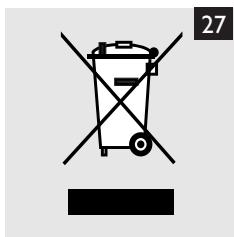
Do not throw away the appliance with the normal household waste at the end of its life, but hand it in at an official collection point for recycling. By doing this, you help to preserve the environment. (Fig. 27)
Batteries contain substances that may pollute the environment. Always remove the batteries before you discard and hand in the appliance at an official collection point. Dispose of the batteries at an official collection point for batteries.
Assistance
For assistance, call toll free:
1-800-243-7884
Or visit our website:
www.philips.com
Information is available 24 hours a day, 7 days a week.
Warranty
FULL TWO YEAR WARRANTY
Philips Electronics North America Corporation warrants each new Philips Babycare Product against defects in materials or workmanship for a period of two years from the date of purchase, and agrees to repair or replace any defective product without charge.
IMPORTANT: This warranty does not cover damage resulting from accident, misuse or abuse, lack of reasonable care, the affixing of any attachment not provided with the product or loss of parts or subjecting the product to any but the specified voltage.* Use of unauthorized replacement parts will void this warranty.
PHILIPS ELECTRONICS NORTH AMERICA CORPORATION WILL NOT PAY FOR WARRANTY SERVICE PERFORMED BY A NON-AUTHORIZED REPAIR SERVICE AND WILL NOT REIMBURSE THE CONSUMER FOR DAMAGE RESULTING FROM WARRANTY SERVICE PERFORMED BY A NON-AUTHORIZED REPAIR SERVICE. NO RESPONSIBILITY IS ASSUMED FOR ANY SPECIAL, INCIDENTAL OR CONSEQUENTIAL DAMAGES.
In order to obtain warranty service, simply ship the product postage prepaid to the Philips Norelco Service Location (information available online at www.philips.com or at 1-800-243-7884). It is suggested that for your protection you return shipments of product by insured mail, insurance prepaid. Damage occurring during shipment is not covered by this warranty.
NOTE: No other warranty, written or oral, is authorized by Philips Electronics North America Corporation.
This warranty gives you specific legal rights, and you may also have other rights which vary from state to state. Some states do not allow the exclusion or limitation of incidental or consequential damages, so the above exclusion and limitations may not apply to you.
* Read enclosed instructions carefully.
Manufactured for:
Philips Domestic Appliances and Personal Care Company
A Division of Philips Electronics North America Corporation
1010 Washington Blvd., Stamford, CT 06912-0015

LISTED
This symbol on the product's nameplate means it is listed by Underwriters' Laboratories, Inc.
PHILIPS is a Registered Trademark of Koninklijke Philips Electronics N.V.
©2006 Philips Electronics North America Corporation. All Rights Reserved
Compliance information
The FCC ID number is located on the cabinet bottom of Parent Unit and in battery compartment of Baby Unit.
The term ‘IC:’ before the certification number signifies that Industry Canada technical specifications were met. This certification means that the equipment meets certain radio communications and operational requirements.
This device complies with Part 15 of the FCC Rules and ICES-003 of Industry Canada. Operation is subject to the following two conditions: (1) this device may not cause harmful interference, and (2) this device must accept any interference received, including interference that may cause undesired operation. This device complies also with RSS-213 of Industry Canada.
Radio Interference
This equipment has been tested and found to comply with the limits for a Class B digital device, pursuant to Part 15 of the FCC Rules and applicable Industry Canada specifications. These limits are designed to provide reasonable protection against harmful interference in a residential installation. This equipment generates, uses and can radiate radio frequency energy and, if not installed and used in accordance with the instructions, may cause harmful interference to radio communications. However, there is no guarantee that interference will not occur in a particular installation. If this equipment does cause harmful interference to radio or television reception, which can be determined by turning the equipment off and on, the user is encouraged to try to correct the interference by one or more of the following measures:
- Reorient or relocate the receiving antenna.
- Increase the separation between the equipment and receiver.
- Connect the equipment into an outlet on a circuit different from that to which the receiver is connected.
RF Radiation Exposure Statement
This equipment complies with FCC RF radiation exposure limits set forth for an uncontrolled environment. This equipment should be installed and operated with a minimum distance of 20 centimeters between the radiator and your body. For hand held operation, this equipment has been tested and meets the FCC RF exposure guidelines. Use of other accessories may not ensure compliance with FCC RF exposure guidelines. For body worn operation, this product has been tested and meets the FCC RF exposure guideline when used with the belt clip or neck strap supplied with this product. User must maintain a separation distance of 3mm between the back of the unit and the body to ensure compliance. Use of other accessories may not ensure compliance with FCC RF exposure guidelines. This transmitter must not be co-located or operating in conjunction with any other antenna or transmitter. This equipment complies also with Industry Canada RSS-102 with respect to Canada's Health Code 6 for Exposure of Humans to RF Fields.
Do not attempt to repair or modify this equipment
Any repairs or alterations made by the user to the equipment may cause the equipment void in product warranty and compliance. Refer servicing to authorized or designated service centers.
Frequently asked questions
This chapter lists the questions most frequently asked about the appliance. If you can't find the answer to your question, contact the Customer Care Centre in your country.
| Question | Answer |
| Why don't the connection lights burn at all? | There may be a connection problem. Check if the baby unit is connected to the mains or if the batteries are inserted properly and are not empty. Check if the batteries of the parent unit are properly inserted and still sufficiently charged. If the parent unit is in the charger, check if the charger is connected to the mains. Also check if the parent unit and the baby unit are switched on. |
| Why do the connection lights burn red while the parent unit beeps? | The baby unit and the parent unit may be out of range of each other. Reduce the distance between the units. |
| Why does the appliance produce a high-pitched noise? | The units may be too close to each other. Make sure the parent unit and the baby unit are at least 1 metre/3 feet away from each other. |
| The volume of the parent unit may be set too high. Decrease the volume of the parent unit. | |
| Why don't I hear a sound/ Why can't I hear my baby cry? | The volume of the parent unit may be set too low or may be switched off. Increase the volume of the parent unit. |
| The microphone sensitivity level may be set too low or may be switched off. Set the microphone sensitivity level on the parent unit to a higher level. | |
| The baby unit and the parent unit may be out of range of each other. Reduce the distance between the units. | |
| Why does the parent unit react too quickly to other sounds? | The baby unit also picks up other sounds than those of your baby. Move the baby unit closer to the baby (but observe the minimum distance of 1 metre/3 feet). |
| The microphone sensitivity level may be set too high. Decrease the microphone sensitivity level on the parent unit. | |
| Why does the parent unit react to baby's crying slowly? | The microphone sensitivity level may be set too low or may be switched off. Increase the microphone sensitivity level on the parent unit. |
| Why does the battery-low light on the baby unit and/or parent unit burn? | The batteries are running low. Replace the batteries of the baby unit and/or recharge the batteries of the parent unit. |
| Why do the batteries of the baby unit run low quickly? | The microphone sensitivity level on the parent unit may be set too high, which causes the baby unit to transmit more often. Decrease the microphone sensitivity level on the parent unit.The volume on the baby unit may be set too high, which causes the baby unit to consume a lot of energy. Decrease the volume on the baby unit. |
| Why does the charging time of the parent unit exceed 16 hours? | The parent unit may be switched on during charging. Switch off the parent unit. |
| The specified operating range of the baby monitor is 300 metres/900 feet. Why does my baby monitor manage a much smaller distance than that? | The specified range is only valid outdoors in open air. Inside your house, the operating range is limited by the number type of walls and/or ceilings in between. Inside the house the operating range will be up to 50 metres/150 feet. |
| Why is the connection lost every now and then? Why are there sound interruptions? | The baby unit and the parent unit are probably close to the outer limits of the operating range. Try a different location or decrease the distance between the units. Please note that it takes about 30 seconds each time before a connection between the units is established. |
| What happens during a power failure? | If the parent unit is sufficiently charged, it will continue to operate during a power failure, both inside and outside the charger. If there are batteries in the baby unit, it will automatically switch to battery-operated use in case of power failure. |
| Is my baby monitor secure from eavesdropping and interference? | The DECT technology of this baby monitor guarantees no interference from other equipment and no eavesdropping. |
| Some buttons do not seem to work when I press them. What do I do wrong? | You should press all buttons (except the on/off buttons and the talk button) briefly. If you press them too long, they will not work. |
| The operating time of the parent unit is supposed to be at least 8 hours. Why is the operating time of my parent unit shorter? | When the parent unit batteries have been charged for the first time, the operating time will be less than 8 hours. The batteries only reach their full capacity after you have charged and discharged them at least four times. |
| The volume of the parent unit may be set too high, which causes the parent unit to consume a lot of energy. Decrease the volume of the parent unit | |
| The microphone sensitivity level on the parent unit may be set too high, which causes the parent unit to consume a lot of energy. Decrease the microphone sensitivity level on the parent unit. |
Introducción
Philips Baby Care, taking care together

Philips Domestic Appliances and Personal Care Company
A Division of Philips Electronics North America Corporation
Philips Domestic Appliances and Personal Care Company
Une division de Philips Electronics North America Corporation
1010 Washington Blvd., Stamford, CT 06912-0015

Specifications are subject to change without notice.
Trademarks are the property of Koninklijke Philips Electronics N.V. or their respective owners.
2006 © Koninklijke Philips Electronics N.V. All rights reserved.
www.philips.com
- INTRODUCTION
- PHILIPS BABY CARE, TAKING CARE TOGETHER
- IMPORTANT SAFETY INSTRUCTIONS
- IF YOUR PRODUCT UTILIZES BATTERIES, THE FOLLOWING ADDITIONAL PRECAUTIONS SHOULD BE OBSERVED
- SAVE THESE INSTRUCTIONS
- CAUTION: THERE IS A RISK OF EXPLOSION IF THE BATTERIES ARE REPLACED BY AN INCORRECT TYPE. DISPOSE OF USED BATTERIES ACCORDING TO THE INSTRUCTIONS
- GENERAL DESCRIPTION (FIG. 1)
- I BABY UNIT
- II PARENT UNIT (2X)
- IMPORTANT
- PREPARING FOR USE
- BABY UNIT
- CORD OPERATION
- BATTERY OPERATION
- PARENT UNITS
- USING THE APPLIANCE
- OPERATING RANGE
- FEATURES
- EXTRA PARENT UNIT
- ADJUSTING LOUDSPEAKER VOLUME
- TALK FUNCTION
- MICROPHONE SENSITIVITY
- SILENT BABY MONITORING
- NIGHTLIGHT
- BELT CLIP AND NECK STRAP
- CONNECTING THE BELT CLIP
- DISCONNECTING THE BELT CLIP
- CONNECTING THE NECK STRAP
- DISCONNECTING THE NECK STRAP
- PAGING FUNCTION
- RESET FUNCTION
- DEFAULT SETTINGS
- CLEANING AND MAINTENANCE
- ENVIRONMENT
- ASSISTANCE
- WARRANTY
- FULL TWO YEAR WARRANTY
- PHILIPS ELECTRONICS NORTH AMERICA CORPORATION WILL NOT PAY FOR WARRANTY SERVICE PERFORMED BY A NON-AUTHORIZED REPAIR SERVICE AND WILL NOT REIMBURSE THE CONSUMER FOR DAMAGE RESULTING FROM WARRANTY SERVICE PERFORMED BY A NON-AUTHORIZED REPAIR SERVICE. NO RESPONSIBILITY IS ASSUMED FOR ANY SPECIAL, INCIDENTAL OR CONSEQUENTIAL DAMAGES
- COMPLIANCE INFORMATION
- RADIO INTERFERENCE
- RF RADIATION EXPOSURE STATEMENT
- DO NOT ATTEMPT TO REPAIR OR MODIFY THIS EQUIPMENT
- FREQUENTLY ASKED QUESTIONS
- INTRODUCCIÓN
Brand : PHILIPS
Model : SCD590
Category : Baby monitor