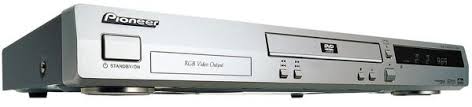
DV 454 - Lecteur dvd PIONEER - Notice d'utilisation et mode d'emploi gratuit
Retrouvez gratuitement la notice de l'appareil DV 454 PIONEER au format PDF.


| Intitulé | Description |
|---|---|
| Type de produit | Lecteur DVD |
| Caractéristiques techniques principales | Lecture de DVD, CD, et CD-R/RW |
| Alimentation électrique | AC 220-240V, 50/60Hz |
| Dimensions approximatives | 430 x 40 x 250 mm |
| Poids | 2,2 kg |
| Compatibilités | Compatible avec les formats DVD-Video, DVD-R, DVD-RW, CD-DA, CD-R, CD-RW |
| Fonctions principales | Lecture de disques, fonction de répétition, lecture aléatoire |
| Entretien et nettoyage | Nettoyer avec un chiffon doux, ne pas utiliser de produits chimiques agressifs |
| Pièces détachées et réparabilité | Disponibilité limitée des pièces, consulter un professionnel pour les réparations |
| Sécurité | Ne pas exposer à l'humidité, éviter les chocs électriques, débrancher lors d'un orage |
| Informations générales utiles | Vérifier la compatibilité des disques avant utilisation, garantie de 2 ans |
FOIRE AUX QUESTIONS - DV 454 PIONEER
Questions des utilisateurs sur DV 454 PIONEER
0 question sur cet appareil. Repondez a celles que vous connaissez ou posez la votre.
Poser une nouvelle question sur cet appareil
Téléchargez la notice de votre Lecteur dvd au format PDF gratuitement ! Retrouvez votre notice DV 454 - PIONEER et reprennez votre appareil électronique en main. Sur cette page sont publiés tous les documents nécessaires à l'utilisation de votre appareil DV 454 de la marque PIONEER.
MODE D'EMPLOI DV 454 PIONEER
DVD Player
DV-454
DV-350
IMPORTANT
The lightning flash with arrowhead symbol, within an equilateral triangle, is intended to alert the user to the presence of uninsulated "dangerous voltage" within the product's enclosure that may be of sufficient magnitude to constitute a risk of electric shock to persons.
CAUTION
RISK OF ELECTRIC SHOCK DO NOT OPEN
CAUTION:
TO PREVENT THE RISK OF ELECTRIC SHOCK,DO NOT REMOVE COVER (OR BACK).NO USER-SERVICEABLE PARTS INSIDE.REFERSERVICINGTOQUALIFIED SERVICE PERSONNEL.

The exclamation point within an equilateral triangle is intended to alert the user to the presence of important operating and maintenance (servicing) instructions in the literature accompanying the appliance.
H002En
Replacement and mounting of an AC plug on the power supply cord of this unit should be performed only by qualified service personnel.
IMPORTANT
FOR USE IN THE UNITED KINGDOM
The wires in this mains lead are coloured in accordance with the following code:
Blue : Neutral
Brown :Live
If the plug provided is unsuitable for your socket outlets, the plug must be cut off and a suitable plug fitted.
The cut-off plug should be disposed of and must not be inserted into any 13 amp socket as this can result in electric shock. The plug or adaptor or the distribution panel should be provided with 5 A fuse. As the colours of the wires in the mains lead of this appliance may not correspond with coloured markings identifying the terminals in your plug, proceed as follows;
The wire which is coloured blue must be connected to the terminal which is marked with the letter N or coloured black.
The wire which is coloured brown must be connected
to the terminal which is marked with the letter L or coloured red.
Do not connect either wire to the earth terminal of a three pin plug.
NOTE
After replacing or changing a fuse, the fuse cover in the plug must be replaced with a fuse cover which corresponds to the colour of the insert in the base of the plug or the word that is embossed on the base of the plug, and the appliance must not be used without a fuse cover. If lost replacement fuse covers can be obtained from: your dealer.
Only 5 A fuses approved by B.S.I. or A.S.T.A to B.S. 1362 should be used.
H005B_En
CAUTION
This product contains a laser diode of higher class than 1. To ensure continued safety, do not remove any covers or attempt to gain access to the inside of the product.
Refer all servicing to qualified personnel.
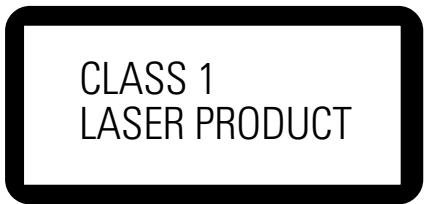
The following caution label appears on your unit.
Location: rear of the unit
H018A_En
This product complies with the Low Voltage Directive (73/23/EEC, amended by 93/68/EEC), EMC Directives (89/336/EEC, amended by 92/31/EEC and 93/68/EEC).
H015A_En
CAUTION: THE STANDBY/ON BUTTON IS SECONDARY CONNECTED AND THEREFORE DOES NOT SEPARATE THE UNIT FROM MAINS POWER IN STANDBY POSITION. THEREFORE INSTALL THE UNIT SUITABLE PLACES EASY TO DISCONNECT THE MAINS PLUG IN CASE OF THE ACCIDENT. THE MAINS PLUG OF UNIT SHOULD BE UNPLUGGED FROM THE WALL SOCKET WHEN LEFT UNUSED FOR A LONG PERIOD OF TIME.
H017B_En
WARNING: THE APPARATUS IS NOT WATERPROOFS, TO PREVENT FIRE OR SHOCK HAZARD, DO NOT EXPOSE THIS APPARATUS TO RAIN OR MOISTURE AND DO NOT PUT ANY WATER SOURCE NEAR THIS APPARATUS, SUCH AS VASE, FLOWER POT, COSMETICS CONTAINER AND MEDICINE BOTTLE ETC.
H001A_En
On the top of the player
| CAUTION : VISIBLE AND INVISIBLE LASER RADIATION WHEN OPEN. AVOID EXPOSURE TO BEAM. | |
| VORSICH : SICHTRARE UND UNSICHTRARE LASER STRAHLUNG, WENNADECKUNG GEÖFNETN Nicht DEM STRAHL AUSSEZENI | |
| ADVARSEL : SYNGLO OG USYNLG LASERSTRALING VED ABNING UNDGÁ UDSATTÉTSE FOR STRALING. | |
| VARNING : SYNGLO OCH OSYNLG LASERSTRALING NAR DENDA DEL AR OPNND BETRAKTIA EJ STRALEN. | |
| VARO ! AVATTAASSA AL TISTUT NAKYVA JA NAKYMATTOMÁLLE LASERSATEIL YLLÉ. ÀLÀ KATO SALESGEN. | |
| CUIDADO : RADIACION LASER VISIBLE E IN VISIBLE AL ESTAR ABIERTO. EVITAR EXPOSICION AL RAYO. VRRV1872 |
WARNING: BEFORE PLUGGING IN THE UNIT FOR THE FIRST TIME, READ THE FOLLOWING SECTION CAREFULLY. THE VOLTAGE OF THE AVAILABLE POWER SUPPLY DIFFERS ACCORDING TO COUNTRY OR REGION. BE SURE THAT THE POWER SUPPLY VOLTAGE OF THE AREA WHERE THIS UNIT WILL BE USED MEETS THE REQUIRED VOLTAGE (E.G., 230V OR 120V) WRITTEN ON THE REAR PANEL. H041A.En
WARNING: NO NAKED FLAME SOURCES, SUCH AS LIGHTED CANDLE, SHOULD BE PLACED ON THE APPARATUS. IF NAKED FLAME SOURCES ACCIDENTALLY FALL DOWN, FIRE SPREAD OVER THE APPARATUS THEN MAY CAUSE FIRE. H044.En
OPERATING ENVIRONMENT
Operating environment temperature and humidity:
+5°C - +35°C (+41°F - +95°F); less than 85% RH (cooling vents not blocked)
Do not install in the following locations
- LOCATION EXPOSED TO DIRECT SUNLIGHT OR STRONG ARTIFICIAL LIGHT
- LOCATION EXPOSED TO HIGH HUMIDITY, OR POORLY VENTILATED LOCATION H045_EN
WARNING: Slot and openings in the cabinet are provided for ventilation and to ensure reliable operation of the product and to protect it from overheating, to prevent fire hazard, the openings should never be blocked and covered with items, such as newspapers, table-cloths, curtains, etc. Also do not put the apparatus on the thick carpet, bed, sofa, or fabric having a thick pile. H040_En
When disposing of used batteries, please comply with governmental regulations or environmental public instruction's rules that apply in your country or area.
H048 En
This product is for general household purposes. Any failure due to use for other than household purposes (such as long-term use for business purposes in a restaurant or use in a car or ship) and which requires repair will be charged for even during the warranty period.
K041_EN
This product incorporates copyright protection technology that is protected by method claims of certain U.S. patents and other intellectual property rights owned by Macrovision Corporation and other rights owners. Use of this copyright protection technology must be authorized by Macrovision Corporation, and is intended for home and other limited viewing uses only unless otherwise authorized by Macrovision Corporation. Reverse engineering or disassembly is prohibited.
This product includes FontAvenue® fonts licenced by NEC corporation. FontAvenue is a registered trademark of NEC Corporation.
Thank you for buying this Pioneer product.
Please read through these operating instructions so you will know how to operate your model properly. After you have finished reading the instructions, put them away in a safe place for future reference.
01 Before You Start
Features 6
What's in the box 7
Putting the batteries in the remote control .... 7
Using the remote control 7
Disc / Content Format Playback
Compatibility 8
General Disc Compatibility 8
CD-R/RW Compatibility 8
DVD-R/RW Compatibility 8
PC Created Disc Compatibility 8
Compressed Audio Compatibility 9
Titles, chapters and tracks 9
DVD-Video regions 9
02 Connecting Up
Rear panel connections 10
Easy connections 11
Connecting using the S-Video output 12
Connecting using the AV connector output .... 12
Connecting to an AV receiver 13
03 Controls and Displays
Front panel 15
Display 16
Remote control 17
04 Getting Started
Switching on 19
Let's Get Started 19
Using the on-screen displays 20
Setting up with the Setup Navigator 21
Playing discs 23
Basic playback controls 24
Front panel controls 25
DVD-Video disc menus 25
Video CD PBC menus 26
05 Playing Discs
Introduction 27
Using the Disc Navigator to browse
the contents of a disc 27
Scanning discs 28
Playing in slow motion 28
Frame advance/frame reverse 28
Looping a section of a disc 29
Using repeat play 29
Using random play 30
Creating a program list. 31
Editing a program list. 33
Other functions available from the program menu 33
Searching a disc 34
Switching subtitles 34
Switching DVD audio language 34
Switching audio channel when playing a Video CD 35
Zooming the screen 35
Switching camera angles 35
Displaying disc information 36
06 The Audio Settings Menu
Audio DRC 37
Virtual Surround 37
07 The Initial Settings Menu
Using the Initial Settings menu 39
Digital Audio Out settings 39
Digital Out 39
Dolby Digital Out 39
DTS Out 40
96kHz PCM Out 40
MPEG Out 40
Video Output settings 41
TV Screen 41
AV Connector Out 41
S-Video Out 41
Language settings 42
Audio Language 42
Subtitle Language 42
DVD Menu Language 43
Subtitle Display 43
Display settings 43
OSD Language 43
On Screen Display 43
Angle Indicator 44
Options 44
Parental Lock 44
Registering a new password 44
Changing your password 45
Setting/changing the
Parental Lock level 45
Setting/changing the Country Code ...46
08 Additional Information
Taking care of your player and discs 47
Handling discs 47
Storing discs 47
Discs to avoid 47
Cleaning the pickup lens 48
Problems with condensation 48
Hints on installation 48
Moving the player 48
Power cord caution 48
Screen sizes and disc formats 49
Widescreen TV users 49
Standard TV users 49
Resetting the player 49
Language code list 50
Country code list 50
Selecting languages using the language code list 51
Glossary 51
Setting the TV system 53
Watching NTSC on a PAL TV (MOD.PAL) 53
Specifications 54
Features
24-bit/192kHz compatible DAC
This player is fully compatible with high sampling-rate discs, capable of delivering better-than-CD sound quality in terms of dynamic range, low-level resolution and high-frequency detail.
Excellent audio performance with Dolby\*1 Digital and DTS\*2 software
DO LDBY
DIGITAL

DIGITALOU
When connected to a suitable AV amplifier or receiver, this player gives great surround sound with Dolby Digital and DTS discs.
TruSurround*3 and Virtual Dolby Digital
TruSurround
by SRS(0)
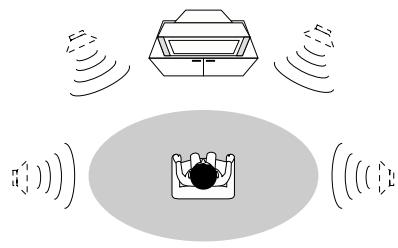
TruSurround/Virtual Dolby Digital creates a realistic surround-sound effect from any Dolby Digital source using just two speakers (see page 37).
Picture zoom
While a DVD or Video CD is playing, you can zoom in on any part of the picture at up to 4x magnification for a closer look (see page 35).
MP3 compatibility
This player is compatible with CD-R, CD-RW and CD-ROM discs that contain MP3 audio tracks (see Compressed Audio Compatibility on page 9).
Graphical on-screen displays
Setting up and using your DVD player is made very easy using the graphical on-screen displays.
Energy saving design
This player features an auto power-off function. If the player is not used for over 30 minutes, it automatically switches itself into standby.
This unit is designed to use 0.3 W of power when in standby mode.
1 Manufactured under license from Dolby Laboratories. "Dolby" and the double-D symbol are trademarks of Dolby Laboratories.
2 "DTS" is a registered trademark of Digital Theater Systems, Inc.
*3 TruSurround and the (●)® symbol are trademarks of SRS Labs, Inc. TruSurround technology is incorporated under license from SRS Labs, Inc.
What's in the box
Please confirm that the following accessories are in the box when you open it.
Remote control
AA/R6P dry cell batteries x2
- Audio/video cable (red/white/yellow plugs)
Power cable
These operating instructions
Warranty card
Putting the batteries in the remote control
1 Open the battery compartment cover on the back of the remote control.
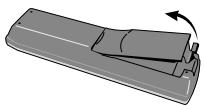
2 Insert two AA/R6P batteries into the battery compartment following the indications ( ,) inside the compartment.
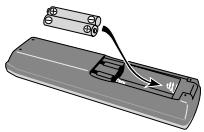
3 Close the cover.
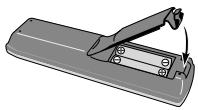

Note
Incorrect use of batteries can result in hazards such as leakage and bursting. Please observe the following:
- Don't mix new and old batteries together.
- Don't use different kinds of battery together—although they may look similar, different batteries may have different voltages.
- Make sure that the plus and minus ends of each battery match the indications in the battery compartment.
- Remove batteries from equipment that isn't going to be used for a month or more.
- When disposing of used batteries, please comply with governmental regulations or environmental public instruction's rules that apply in your country or area.
H048 En
Using the remote control
Keep in mind the following when using the remote control:
- Make sure that there are no obstacles between the remote and the remote sensor on the unit.
- The remote has a range of about 7 meters.
- Remote operation may become unreliable if strong sunlight or fluorescent light is shining on the unit's remote sensor.
- Remote controllers for different devices can interfere with each other. Avoid using remotes for other equipment located close to this unit.
- Replace the batteries when you notice a fall off in the operating range of the remote.
Disc / Content Format Playback Compatibility
General Disc Compatibility
- This player was designed and engineered to be compatible with software containing one or more of the following logos.

DVD-Video

Audio CD

Video CD

CD-R

CD-RW
- Other formats, including but not limited to the following, are not playable in this player:
DVD-Audio / SACD / Photo CD / DVD-RAM / DVD-ROM / CD-ROM
(except those that contain MP3 files formatted as specified in the "Compressed Audio Compatibility" section.)
DVD-R/RW and CD-R/RW discs (Audio CDs and Video CDs) recorded using a DVD Recorder, CD Recorder or Personal Computer may not be playable on this machine. This may be caused by a number of possibilities, including but not limited to: the type of disc used; the type of recording; or damage, dirt or condensation on either the disc or the player's pick-up lens.
Special note about particular formats or software follows below:
CD-R/RW Compatibility
- This unit will play CD-R and CD-RW discs recorded in CD Audio, Video CD, or MP3 audio formatting. However, any other content may cause the disc not to play, or create noise/distortion in the output.
- This unit cannot record CD-R or CD-RW discs.
- Un-finalized CD-R/RW discs recorded in CD Audio can be played, but not all Table of Contents (playing time, etc...) will be displayed.
DVD-R/RW Compatibility
- This unit will play DVD-R/RW discs that were recorded using the DVD Video format.
- This unit will not play DVD-RW discs that were recorded using the Video Recording format.
This unit cannot record DVD-R/RW discs - Un-finalized DVD-R/RW discs cannot be played in this player.
PC Created Disc Compatibility
- If you record a disc using a Personal Computer, even if it is recorded in a "compatible format" as listed above, there will be cases in which the disc may not be playable in this machine due to the setting of the application software used to create the disc. In these particular incidences, check with the software publisher for more detailed information.
DVD-R/RW and CD-R/RW software disc boxes also have additional compatibility information.
Compressed Audio Compatibility
- This unit will play compressed audio files formatted in the MPEG-1 Audio Layer 3 format (MP3) with a 32, 44.1 or 48kHz fixed bit rate. Incompatible files will not play and "UNPLAYABLE" will be displayed on the unit.
- Variable Bit-Rate (VBR) files are playable, but playing time may not be shown correctly.
- The CD-ROM used to compile your MP3 files must be ISO 9660 Level 2 compliant.
- CD physical format: Mode1, Mode2 XA Form1.
- This player only plays tracks that are named with the file extension“.mp3” or“.MP3”
- This player is not compatible with multi-session discs. If you try and play a multi-session disc, only the first session will be played.
- Use CD-R or CD-RW media for recording your MP3 files. The disc must be finalized in order to play in this unit.
- This player can recognize a maximum of 250 folders or 250 tracks. Discs containing more than 250 folders or 250 tracks will play, but only the first 250 folders / tracks.
- Folder and track names (excluding the ".mp3" extension) are displayed.
- There are many different recording bitrates available to encode your MP3 files. This unit was designed to be compatible with all of them. Audio encoded at 128Kbps should sound close to regular CD Audio quality. This player will play lower bit-rate MP3 tracks, but please note that the sound quality becomes noticeably worse at lower bit-rates.
Titles, chapters and tracks
DVD discs are generally divided into one or more titles. Titles may be further subdivided into chapters.
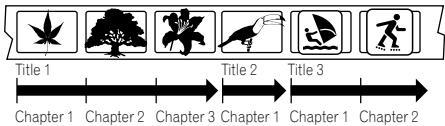
CDs and Video CDs are divided into tracks.
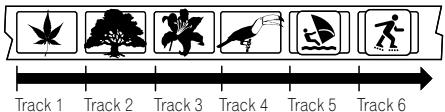
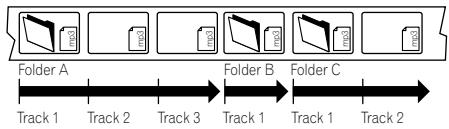
CD-ROMs containing MP3 files are divided into folders and tracks. Folders may also contain further sub folders.
DVD-Video regions
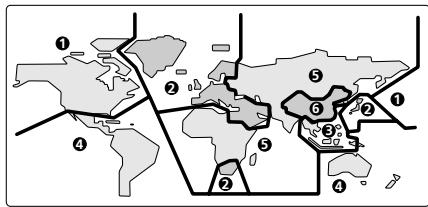
All DVD-Video discs carry a region mark on the case somewhere that indicates which region(s) of the world the disc is compatible with. Your DVD player also has a region mark, which you can find on the rear panel. Discs from incompatible regions will not play in this player. Discs marked ALL will play in any player.
The diagram below shows the various DVD regions of the world.
Rear panel connections
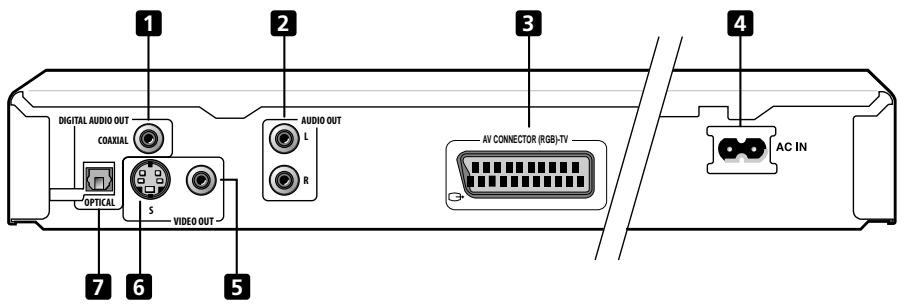
When connecting this player up to your TV, AV receiver or other components, make sure that all components are switched off and unplugged.
1 DIGITAL AUDIO OUT - COAXIAL
This is a digital audio output for connection to a PCM, Dolby Digital, DTS and/or MPEG-compatible AV receiver that has a coaxial digital input.
Connect using a commercially available coaxial digital audio cable.
2 AUDIO OUT L / R
This pair of analog audio outputs connects to your TV, AV receiver or stereo system. Even if you are connecting up one of the digital outputs, we still recommend you connect these jacks.
Use the supplied audio/video cable when connecting these jacks. Match the colors of the jacks and cables for correct stereo sound.
3 AV CONNECTOR (RGB) - TV
This is a combined audio and video output for connection to a TV that has a SCART input. Connect using a SCART cable. The type of video output can be switched to suit your TV. See page 12 and 41.
4 AC IN
Connect the supplied power cord here, then plug into a power outlet.
5VIDEO OUT
This is a standard video output that you can connect to your TV or AV receiver using the supplied audio/video cable.
6 S (S-Video output)
This is an S-video output that you can use instead of the video output described in 5 above.
7 DIGITAL AUDIO OUT - OPTICAL
(DV-454 only)
This is a digital audio output for connection to a PCM, Dolby Digital, DTS and/or MPEG-compatible AV receiver that has an optical digital input.
Connect using a commercially available optical digital audio cable.

Tip
- You may find it useful to have the manuals supplied with your other components handy when connecting this player.
- If you come across any unfamiliar terms in this section of the manual, take a look at the Glossary starting on page 51.
Easy connections
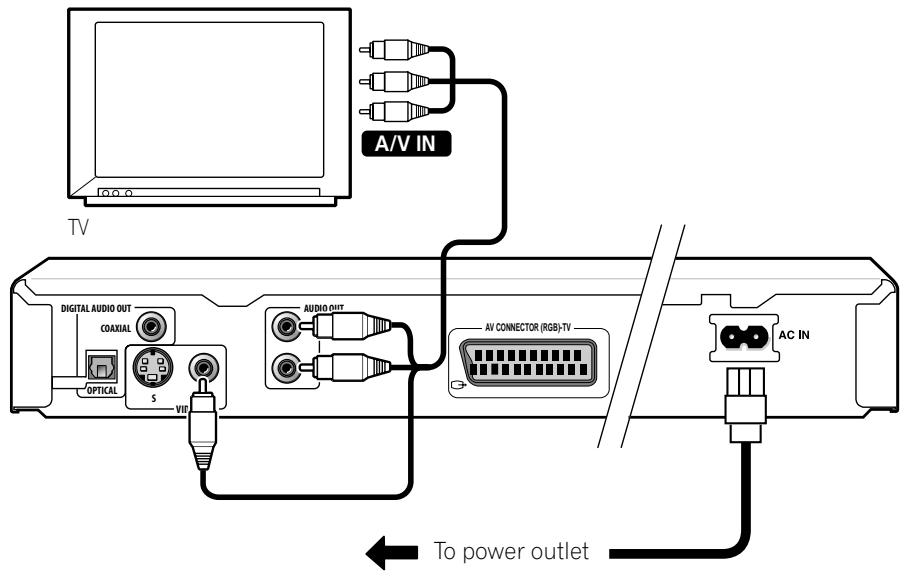
The setup described here is a basic setup that allows you to play discs using just the cables supplied with the player. In this setup, stereo audio is played through the speakers in your TV.

Important
- This player is equipped with copy protection technology. Do not connect this player to your TV via a VCR (or your VCR via this player) using AV cables, as the picture from this player will not appear properly on your TV. (This player may also not be compatible with some combination TV/VCRs for the same reason; refer to the manufacturer for more information.)
1 Connect the VIDEO OUT and AUDIO OUT jacks to a set of A/V inputs on your TV.
Use the supplied audio/video cable, connecting the red and white plugs to the audio outputs and the yellow plug to the video output. Make sure you match up the left and right audio outputs with their corresponding inputs for correct stereo sound.
See below if you want to use a SCART cable for the audio/video connection, or an S-Video cable for the video connection.
2 Connect the supplied AC power cord to the AC IN inlet, then plug into a power outlet.

Important
- Before unplugging the player from the power outlet, make sure you first switch it into standby using either the front panel STANDBY/ON button, or the remote control, and wait of the -OFF-message to disappear from the player's display.
- For the above reasons, do not plug this player into a switched power supply found on some amplifiers and AV receivers.
Connecting using the S-Video output
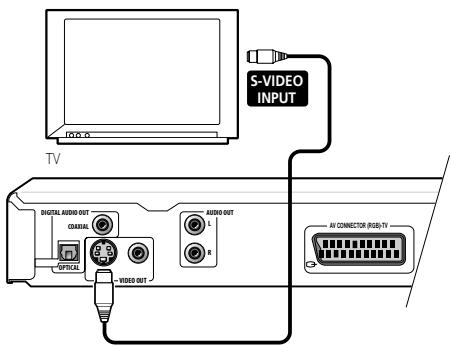
If your TV has an S-Video input, you can use this instead of the standard (composite) output for a better quality picture.
1 Use an S-Video cable (not supplied) to connect the S-VIDEO OUT to an S-Video input on your TV (or monitor or AV receiver).
Line up the small triangle above the jack with the same mark on the plug before plugging in.
Connecting using the AV connector output
If your TV has a SCART-type AV input, you can use a SCART cable to connect this player to your TV. This type of connection carries both the sound and the picture, so there's no need to connect up the AUDIO OUT L/R and VIDEO OUT jacks.
1 Use a SCART cable (not supplied) to connect the AV CONNECTOR (RGB)-TV to an AV input on your TV.
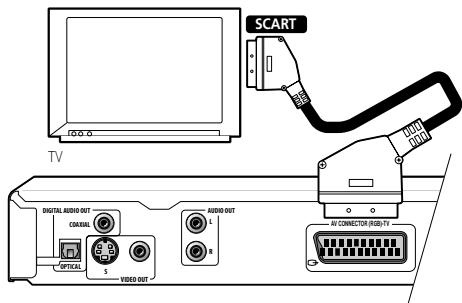
This connector can output standard (composite), S-Video or RGB component video. The default setting is standard, which should work with all TVs. Consult the manual that came with your TV to see if you can use one of the higher quality settings. See page 41 for how to change the video output.

Note
- SCART cables are available in several configurations. Make sure that the one you get will work with this player and your TV/monitor. You can find the pin assignments on page 54.
Connecting to an AV receiver
To enjoy multichannel surround sound you need to connect this player to an AV receiver using a digital output. The DV-454 has both coaxial and optical digital jacks; use whichever is convenient. The DV-350 has only a coaxial jack.
In addition to a digital connection, we recommend also connecting using the stereo analog connection.
You'll probably also want to connect a video output to your AV receiver. You can use any of the video outputs available on this player (the illustration shows a standard (composite) connection).
1 Connect one of DIGITAL OUT jacks on this player to a digital input on your AV receiver.
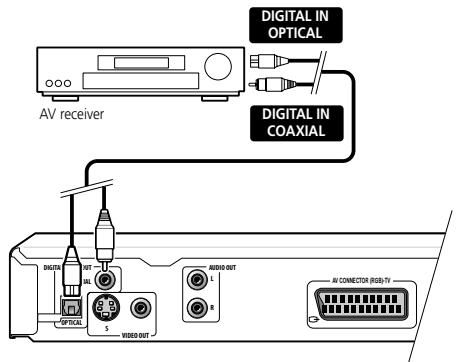
This enables you to listen to multichannel surround sound.
For an optical connection, use an optical cable (not supplied) to connect the OPTICAL DIGITAL OUT jack to an optical input on your AV receiver.
For a coaxial connection, use a coaxial cable (similar to the supplied video cable) to connect the COAXIAL DIGITAL OUT jack to a coaxial input on your AV receiver.
2 Connect the analog AUDIO OUT L/R and VIDEO OUT jacks on this player to a set of analog audio and video inputs on your AV receiver.
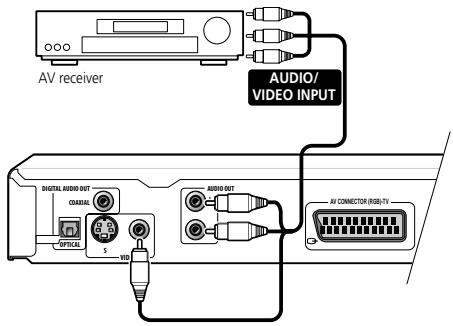
The diagram shows standard video connections, but you can alternatively use the S-Video or SCART cable connections if they're available.
3 Connect the AV receiver's video output to a video input on your TV.

Tip
- You usually have to connect the same kind of video cable between your DVD player and AV receiver, and between your AV receiver and TV.

FAQ
- My TV doesn't have any inputs to connect the DVD player. How can I watch DVDs?
Unfortunately, if your TV has no inputs you can't use this player with it.
- My VCR is already connected to my TV, so there aren't any spare inputs. What should I do?
If all your TV's inputs are already in use, you can buy a video input selector from an electronics store, which effectively gives you more inputs.
- My TV only has one input for the sound. What should I plug it into?
If you don't mind mono sound, you can buy a stereo RCA-to-mono RCA cable from an electronics store. Connect the stereo end to this player and the mono end to your TV.
If you want stereo sound, connect this player to your amplifier or stereo system using a stereo audio cable.
- I connected the DVD player to my AV receiver, and although the sound is fine, there's no picture. What did I do wrong?
Make sure that the type of video connection from the DVD player to your AV receiver is the same as that from the receiver to your TV. Most AV receivers won't convert from one kind of connection to another.
Front panel
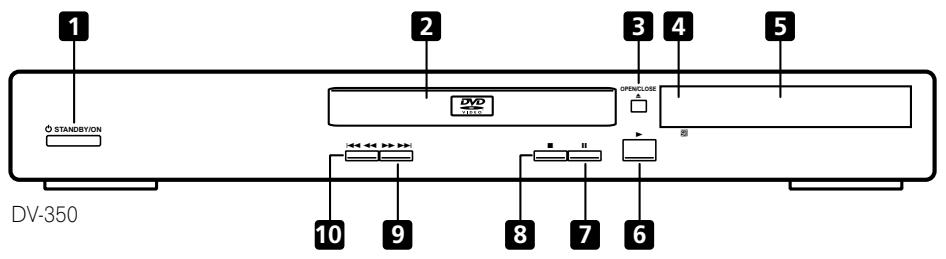
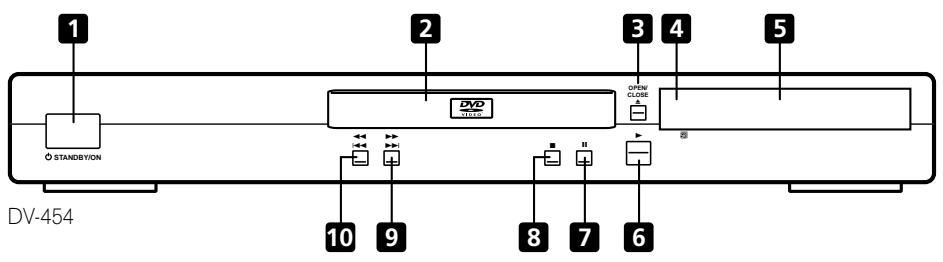
1 STANDBY/ON
Press to switch the player on or into standby
2 Disc tray
3 ▲ OPEN/CLOSE
Press to open or close the disc tray
4 Remote control sensor
The remote control has a range of up to about 7m
5 Display
See page 16 for a description of the display
6
Press to start or resume playback
711
Press to pause playback. Press again to restart
8
Press to stop the disc (you can resume playback by pressing (play))
9 1
- Press and hold for fast forward scanning
- Press to jump to the next chapter or track
10
- Press and hold for fast reverse scanning
- Press to jump back to the beginning of the current chapter or track, then to previous chapters/tracks
Display
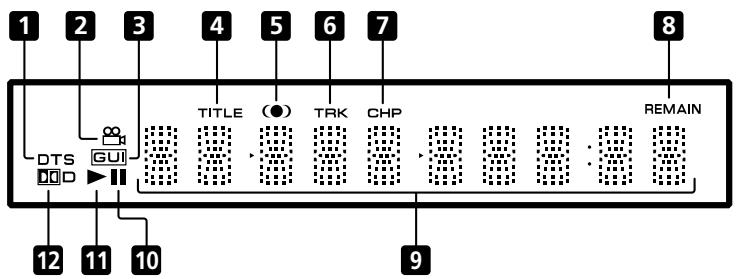
1 DTS
Lights when a DTS soundtrack is playing
2
Lights during multi-angle scenes on a DVD disc
3 GUI (Graphical User Interface)
Lights when a menu is displayed on-screen
4 TITLE
Indicates that the character display is showing a DVD title number
5 (●)
Lights when V TruSurround is selected
6 TRK
Indicates that the character display is showing a CD or Video CD track number
7 CHP
Indicates that the character display is showing a DVD chapter number
8 REMAIN
Lights when the character display is showing the time or number of tracks/titles/chapters remaining
9 Character display
10 II
Lights when a disc is paused
11
Lights when a disc is playing
12 DDD
Lights when a Dolby Digital soundtrack is playing
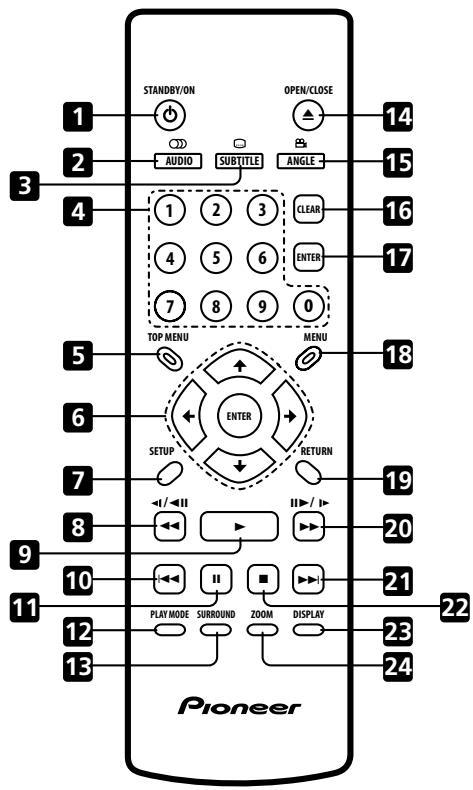
Remote control
1 STANDBY/ON
Press to switch the player on or into standby
2 AUDIO
Press to select the audio channel or language (pages 34-35)
3 SUBTITLE
Press to select a subtitle display (page 34)
4 Number buttons
5 TOP MENU
Press to display the top menu of a DVD disc
6 ENTER & cursor control buttons
Use to navigate on-screen displays and menus. Press ENTER to select an option or execute a command
7 SETUP
Press to display (or exit) the on-screen display
8 and /ll
Use for reverse slow motion playback, frame reverse and reverse scanning. See page 28
9
Press to start or resume playback
10
Press to jump to the beginning of the current chapter or track, then to previous chapters/ tracks
11 II
Press to pause playback; press again to restart
12 PLAY MODE
Press to display the Play Mode menu (pages 29-34) (You can also get to the Play Mode menu by pressing SETUP and selecting Play Mode)
13 SURROUND
Press to activate/switch off VTruSurround
14 ▲ OPEN/CLOSE
Press to open or close the disc tray
15 ANGLE
Press to change the camera angle during DVD multi-angle scene playback (page 35)
16 CLEAR
Press to clear a numeric entry
17 ENTER
Use to select menu options, etc. (works exactly the same as the ENTER button in 6 above)
18 MENU
Press to display a DVD disc menu, or the Disc Navigator if a CD, Video CD or MP3 disc is loaded
19 RETURN
Press to return to a previous menu screen
20 ▶ and II▶/I
Use for forward slow motion playback, frame advance and forward scanning. (page 28)
21
Press to jump to the next chapter or track
22
Press to stop the disc (you can resume playback by pressing (play))
23 DISPLAY
Press to display information about the disc playing (page 36)
24 ZOOM
Press to change the zoom level (page 35)
Switching on
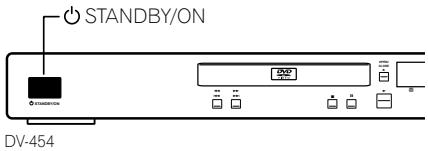
After making sure that everything is connected properly and that the player is plugged in, press STANDBY/ON on the front panel, or on the remote control to switch the player on.
Also, switch on your TV and make sure that it is set to the input you connected the DVD player to.

FAQ
- My DVD player switches on but there is nothing displayed on my TV.
Make sure that the TV is set to the correct video input (not a TV channel). For example, if you connected this player to the VIDEO 1 inputs on your TV, switch your TV to VIDEO 1.

Note
- This player features a screen saver and an auto power off function. If the player is stopped and no button is pressed for five minutes, the screen saver starts. If the disc tray is closed but no disc is playing and no control is pressed for 30 minutes, the player automatically goes into standby.
Let's Get Started
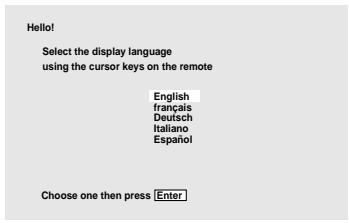
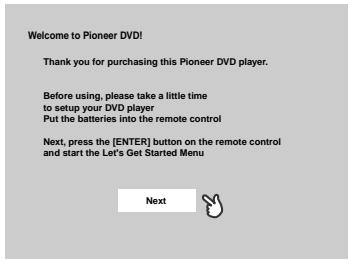
When you switch on the player for the first time, you should see a welcome screen displayed on your TV. From here you can set up the language and the kind of TV you have, then either use the Setup Navigator to make more settings, or jump right in and start playing some discs.
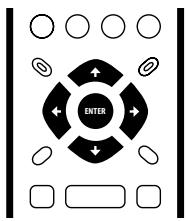
1 Use the / (cursor up/down) buttons to choose a language, then press ENTER.
2 Press ENTER to move on to the next screen.
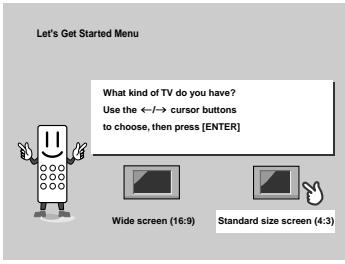
3 Use the / (cursor left/right) buttons to select either 'Wide screen (16:9)' or 'Standard size screen (4:3)' according to the kind of TV you have, then press ENTER.
4 Press ENTER again to finish setting up.
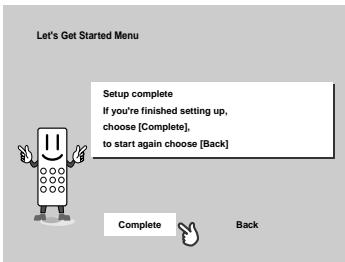
- Select Back then press ENTER if you want to go back and change the setting you just made.
Using the on-screen displays
For ease of use, this player makes extensive use of graphical on-screen displays (OSDs). You should get used to the way these work as you'll need to use them when setting up the player, using some of the playback features, such as program play, and when making more advanced settings for audio and video. All the screens are navigated in basically the same way, using the cursor buttons to change the highlighted item and pressing ENTER to select it.

Important
- Throughout this manual, 'Select' means use the cursor buttons to highlight an item on-screen, then press ENTER.
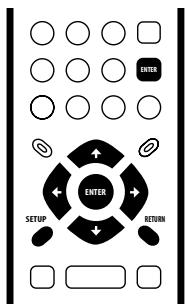
| Button | What it does |
| SETUP | Display/exit the on-screen display |
| ← ↑ → | Changes the highlighted menu item |
| ENTER | Selects the highlighted menu item (both ENTER buttons work in exactly the same way) |
| RETURN | Returns to the main menu without saving changes |

Tip
- The button guide at the bottom of every OSD screen shows you which buttons you'll need to use for that screen.
Setting up with the Setup Navigator
Using the Setup Navigator you can make a number of other initial settings for this player. We recommend using the Setup Navigator, especially if you connected this player to an AV receiver for playing surround sound. To answer some of the questions about digital audio formats you may need to look at the instructions that came with your AV receiver.
1 If a disc is playing, press (stop).
Also turn on your TV and make sure that it is set to the correct video input.
2 Press SETUP.
The on-screen display (OSD) appears.
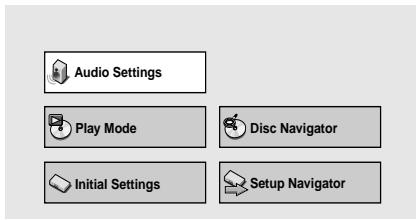
3 Select 'Setup Navigator'.
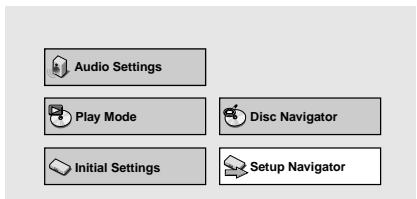
4 Select a DVD language.
Some DVD discs feature on-screen menus, soundtracks and subtitles in several languages. Set your preferred language here.
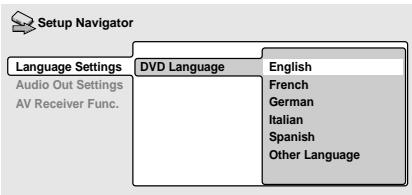
Note that the language you choose here may not be available on all discs.
- If you want to select a language other than those listed, select Other Language. See Selecting languages using the language code list on page 51 for detailed information.
5 Did you connect this player to an amplifier or AV receiver?
Select Connected or Not Connected.

- If you selected Not Connected here, that completes setup using the Setup Navigator. Press ENTER to exit.
6 Did you connect this player to an AV receiver using a digital output?
Select Connected or Not Connected.
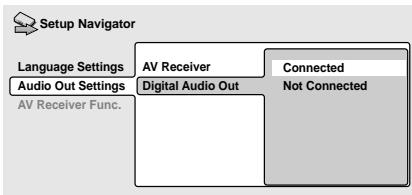
- If you selected Not Connected here, that completes setup using the Setup Navigator. Press ENTER to exit.
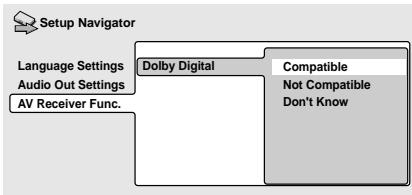
7 Is your AV receiver Dolby Digital compatible?
Select Compatible, Not Compatible or Don't Know.
8 Is your AV receiver DTS compatible?
Select Compatible, Not Compatible or Don't Know.

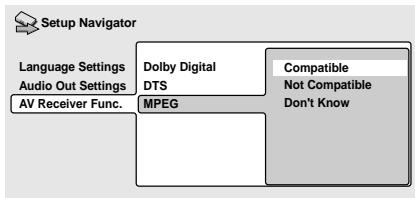
9 Is your AV receiver MPEG compatible?
Select Compatible, Not Compatible or Don't Know.
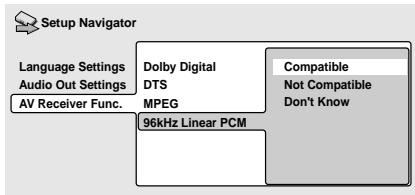
10 Is your AV receiver compatible with 96kHz Linear PCM audio?
Select Compatible, Not Compatible or Don't Know.
11 Press ENTER to complete the setup, or press SETUP to quit the Setup Navigator without making any changes.
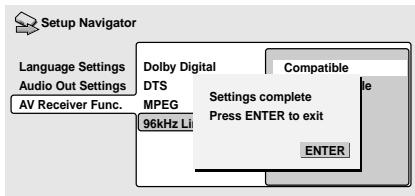
Congratulations, setup is complete!
Playing discs
The basic playback controls for playing DVD, CD, Video CD and MP3 discs are covered here. Further functions are detailed in the next chapter.
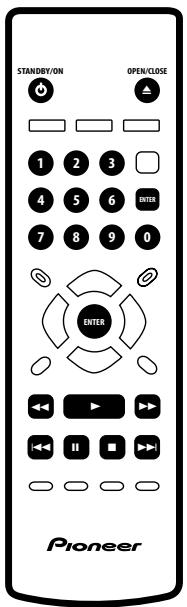
1 If the player isn't already on, press STANDBY/ON to switch it on.
If you're playing a DVD or Video CD, also turn on your TV and make sure that it is set to the correct video input.
2 Press OPEN/CLOSE to open the disc tray.
3 Load a disc.
Load a disc with the label side facing up, using the disc tray guide to align the disc (if you're loading a double-sided DVD disc, load it with the side you want to play face down).

4 Press (play) to start playback.
If you're playing a DVD or Video CD, a menu may appear. See pages 25, 26 for how to navigate these.
If you're playing an MP3 disc, it may take a few seconds before playback starts, depending on the complexity of the file structure on the disc.

FAQ
After I load a DVD disc, it ejects automatically after a few seconds!
Most likely, the disc is the wrong region for your player. The region number should be printed on the disc; check it against the region number of the player (which you can find on the rear panel). See also page 9.
If the region number is OK, it may be that the disc is damaged or dirty. Clean the disc and look for signs of damage.
See also page 47.
- Why won't the disc I loaded play?
First check that you loaded the disc the right way up (label side up), and that it's clean and not damaged. See page 47 for information on cleaning discs.
If a disc loaded correctly won't play, it's probably an incompatible format or disc type, such as DVD-Audio or DVD-ROM.
See page 8 for more on disc compatibility.
- I have a widescreen TV so why are there black bars at the top and bottom of the screen when I play some discs?
Some movie formats are such that even when played on a widescreen TV, black bars are necessary at the top and bottom of the screen. This is not a malfunction.
- I have a standard (4:3) TV and set the player to show widescreen DVDs in pan & scan format, so why do I still get black bars top and bottom with some discs?
Some discs override the display preferences of the player, so even if you have 4:3 (Pan & Scan) selected, those discs will still be shown in letterbox format. This is not a malfunction.
- My AV receiver is definitely compatible with 96kHz Linear PCM audio, but it doesn't seem to work with this player. What's wrong?
For digital copy-protection purposes, some 96kHz DVD discs are automatically downsampled to 48kHz. This is not a malfunction. With these kinds of discs, if you want to enjoy high-quality analog audio, set Digital Out to Off (page 39), and 96kHz PCM Out to 96kHz (page 40).
Basic playback controls
The table below shows the basic controls on the remote for playing discs. The following chapter covers more playback features in more detail.
| Button | What it does |
| ► | Starts playback. DVD and Video CD: if the display shows RESUME, playback starts from the resume point. |
| II | Pauses a disc that's playing, or restarts a paused disc. |
| ■ | Stops playback. DVD and Video CD: Display shows RESUME. Press■(stop) again to cancel the resume function. |
| ↔ | Press to start fast reverse scanning. Press▶ (play) to resume normal playback. |
| ► | Press to start fast forward scanning. Press▶ (play) to resume normal playback. |
| ↓← | Skips to the start of the current track or chapter, then to previous tracks/chapters. |
| ►I | Skips to the next track or chapter. |
| Numbers | Use to enter a title/track number. Press ENTER to select (or wait a few seconds). · If the disc is stopped, play-back starts from the selected title (for DVD) or track number (for CD/Video CD/MP3). · If the disc is playing, playback jumps to the start of the selected chapter or track. |
Front panel controls
The (play), (stop), and (pause) buttons on the front panel work in exactly the same way as their remote control equivalents. The combined scan/skip buttons on the front panel (I and ) work slightly differently from the remote buttons.
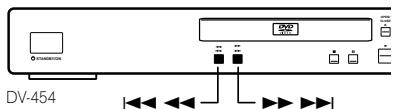
Press and hold for fast scan; press for track/ chapter skip.

Important
- You may find with some DVD discs that some playback controls don't work in certain parts of the disc. This is not a malfunction.
- Track skip and number buttons for track selection do not work with unfinalized CD-R/RW discs.
DVD-Video disc menus
Many DVD-Video discs contain menus from which you can select what you want to watch. They may give access to additional features, such as subtitle and audio language selection, or special features such as slideshows. See the disc packaging for details.
Sometimes DVD-Video menus are displayed automatically when you start playback; others only appear when you press MENU or TOP MENU.
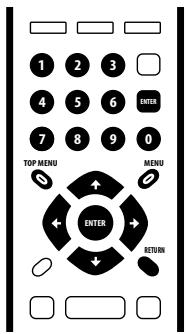
| Button | What it does |
| TOP MENU | Displays the 'top menu' of a DVD disc—this varies with the disc. |
| MENU | Displays a DVD disc menu—this varies with the disc and may be the same as the 'top menu'. |
| ← ↑ ↓ → | Moves the cursor around the screen. |
| ENTER | Selects the current menu option. |
| RETURN | Returns to the previously displayed menu screen. |
| Numbers | Highlights a numbered menu option (some discs only). Press ENTER to select. |
Video CD PBC menus
Some Video CDs have menus from which you can choose what you want to watch. These are called PBC (Playback control) menus.
You can play a PBC Video CD without having to navigate the PBC menu by starting playback using a number button to select a track, rather than the (play) button.
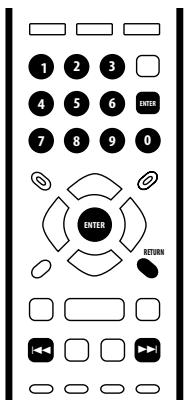
| Button | What it does |
| RETURN | Displays the PBC menu. |
| Numbers | Use to enter a numbered menu option. Press ENTER to select. |
| ← | Displays the previous menu page (if there is one). |
| ► | Displays the next menu page (if there is one). |
Introduction
Most of the features described in this chapter make use of on-screen displays. For an explanation of how to navigate these, see Using the on-screen displays on page 20.
Many of the functions covered in this chapter apply to DVD discs, Video CDs, CDs and MP3 discs, although the exact operation of some varies slightly with the kind of disc loaded.
Some DVD discs restrict the use of some functions (random or repeat, for example). This is not a malfunction.
When playing Video CDs, some of the functions are not available during PBC playback. If you want to use them, start the disc playing using a number button to select a track.
Using the Disc Navigator to browse the contents of a disc
Use the Disc Navigator to browse through the contents of a disc to find the part you want to play. You can use the Disc Navigator when a disc is playing or stopped.
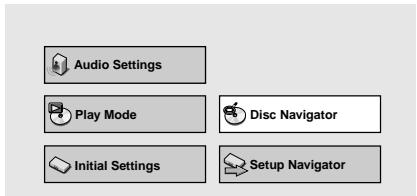
1 Press SETUP and select 'Disc Navigator' from the on-screen display.
Alternatively, if a CD, Video CD or MP3 disc is loaded, you can press MENU, which takes you straight to the Disc Navigator screen.
2 Select what you want to play.
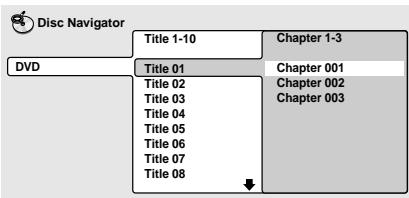
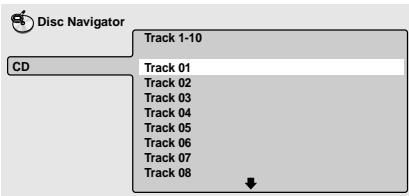
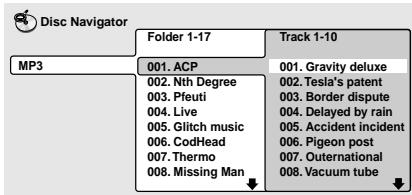
Depending on the type of disc you have loaded, the Disc Navigator looks slightly different.
The screen for DVD discs shows the titles on the left and the chapters on the right. Select a title, or a chapter within a title.
The screen for CDs and Video CDs shows a list of tracks.
The screen for an MP3 disc shows the folder names on the left and the track names on the right (note that if there are more than 16 folders or names that contain accented or non-roman characters, tracks and folders may show up with generic names - F_033, T_035, etc.).
Select a folder, or a track within a folder.
Playback starts after you press ENTER.

Tip
- The Disc Navigator is not available unless there is a disc loaded.
- It's not possible to use the Disc Navigator when playing a Video CD in PBC mode, or an unfinalized CD-R/RW disc.
- Another way to find a particular place on a disc is to use one of the search modes. See Searching a disc on page 34.
Scanning discs
You can fast-scan discs forward or backward at various different speeds.
1 During playback, press or to start scanning.
2 Press repeatedly to increase the scanning speed.
- MP3s can only be scanned at one speed.
- The scanning speed is shown on-screen.
3 To resume normal playback, press (play).

Note
Sound can be heard while scanning audio CDs and MP3 discs.
- When scanning a Video CD or MP3 track, playback automatically resumes at the end or beginning of the track.
- There is no sound while scanning DVDs and Video CDs, and no subtitles while scanning DVDs.
Depending on the disc, normal playback may automatically resume when a new chapter is reached on a DVD disc.
Playing in slow motion
You can play DVDs and Video CDs at four different forward slow motion speeds, and DVDs also at two reverse speeds.
1 During playback, press II (pause).
2 Press and hold / or II>1 until slow motion playback starts.
- The slow motion speed is shown on-screen.
- There is no sound during slow motion playback.
3 Press repeatedly to change the slow motion speed.
- The slow motion speed is displayed on-screen.
4 To resume normal playback, press (play).

Note
Video CD only supports forward slow motion playback.
- The picture quality during slow motion playback is not as good as during normal playback.
Depending on the disc, normal playback may automatically resume when a new chapter is reached.
Frame advance/frame reverse
You can advance or back up a DVD disc frame-by-frame. With Video CDs, you can only use frame advance.
1 During playback, press II (pause).
2 Press / or / to reverse or advance a frame at a time.
3 To resume normal playback, press (play).

Note
- The picture quality when using frame reverse is not as good as frame advance.
Depending on the disc, normal playback may automatically resume when a new chapter is reached. - When changing direction with a DVD disc, the picture may 'move' in an unexpected way. This is not a malfunction.
Looping a section of a disc
The A-B Repeat function allows you to specify two points (A and B) within a track (CD and Video CD) or title (DVD) that form a loop which is played over and over.
A-B Repeat is not available with MP3 discs, Video CDs in PBC mode, or unfinalized CD-R/RW discs.
1 During playback, press PLAY MODE and select 'A-B Repeat' from the list of functions on the left.
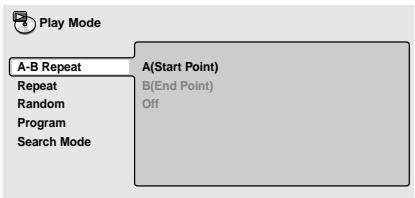
2 Press ENTER on 'A(Start Point)' to set the loop start point.
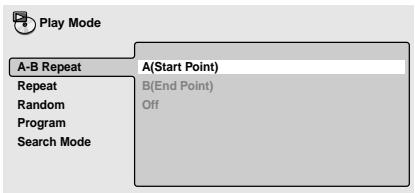
3 Press ENTER on 'B(End Point)' to set the loop end point.
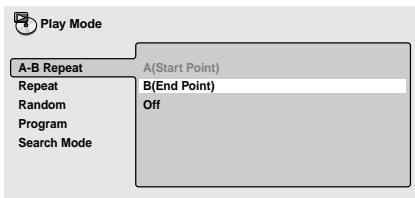
After pressing ENTER, playback jumps back to the start point and plays the loop.
- The minimum loop time is 2 seconds.
4 To resume normal playback, select 'Off' from the menu.
Using repeat play
There are various repeat play options, depending on the kind of disc loaded. It's also possible to use repeat play together with program play to repeat the tracks/chapters in the program list (see Creating a program list on page 31).
Repeat play is not available with Video CDs in PBC mode, or unfinalized CD-R/RW discs.
1 During playback, press PLAY MODE and select 'Repeat' from the list of functions on the left.
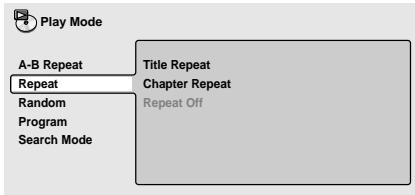
2 Select a repeat play option.
If program play is active, select Program Repeat to repeat the program list, or Repeat Off to cancel.
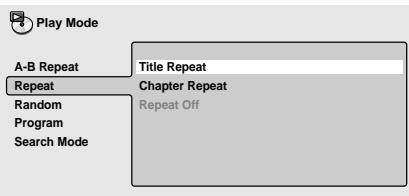
For DVD discs, select Title Repeat or Chapter Repeat (or Repeat Off).
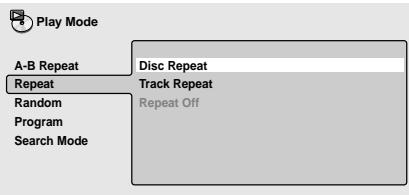
For CDs and Video CDs, select Disc Repeat or Track Repeat (or Repeat Off).
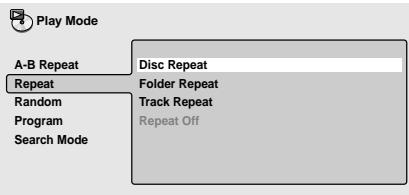
For MP3 discs, select Disc Repeat, Folder Repeat or Track Repeat (or Repeat Off).

Note
- You can't use repeat and random play at the same time.
- If you switch camera angle during repeat play, repeat play is canceled.
Using random play
Use the random play function to play titles or chapters (DVD) or tracks (CD, Video CD and MP3 discs) in a random order.
You can set the random play option when a disc is playing or stopped.
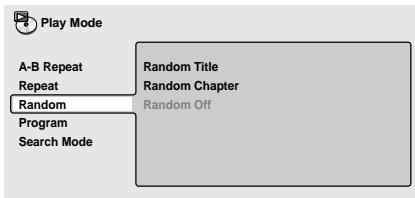
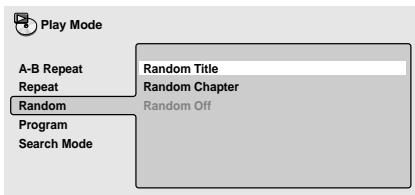
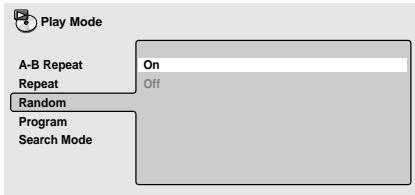
1 Press PLAY MODE and select 'Random' from the list of functions on the left.
2 Select a random play option.
For DVD discs, select Random Title or Random Chapter (or Random Off)
For CDs, Video CDs and MP3 discs, select On or Off to switch random play on or off. (Note that when used with MP3 discs, only tracks from within the current folder are played.)

Tip
- To stop the disc and cancel random playback, press ■ (stop).
- To cancel random playback without stopping playback, press CLEAR. The disc will play to the end, then stop.
- During random play, the I▲ and >按钮 function a little differently to normal: I▲ returns to the beginning of the current track/chapter. You can't go back further than this. > selects another track/chapter at random from those remaining.
- You can't use random play together with program or repeat play.

Note
- You can't use random play with Video CDs playing in PBC mode, or unfinalized CD-R/RW discs.
Creating a program list
This feature lets you program the play order of titles/chapters/folders/tracks on a disc.
Program play is not available with Video CDs playing in PBC mode, or unfinalized CD-R/RW discs.
1 Press PLAY MODE and select 'Program' from the list of functions on the left.

Play Mode
A-B Repeat
Repeat
Random
Program
Search Mode
Create/Edit
Playback Start
Playback Stop
Program Delete
Program Memory
Off
2 Select 'Create/Edit' from the list of program options.
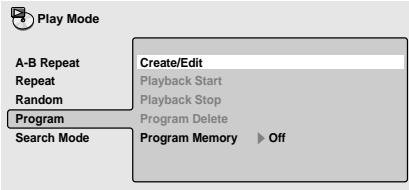
The Program edit screen that appears depends on the kind of disc loaded.
On the left side is the program list, then to the right is a list of titles (if a DVD disc is loaded), tracks (for CDs and Video CDs), or folder names (for MP3 discs). On the far right is a list of chapters (for DVD) or track names (for MP3).
3 Select a title, chapter, folder or track for the current step in the program list.
For a DVD disc, you can add a whole title, or a chapter within a title to the program list.
- To add a title, select the title.
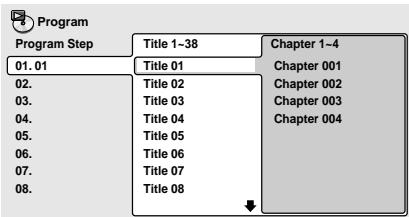
- To add a chapter, first highlight the title, then press (cursor right) and select a chapter from the list.
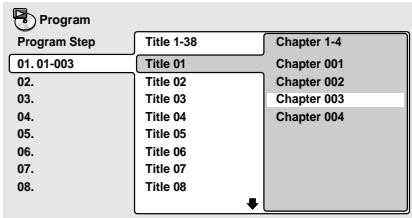
For a CD or Video CD, select a track to add to the program list.
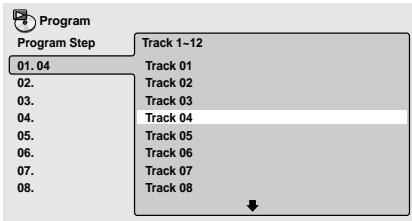
For an MP3 disc, you can add a whole folder, or a track within a folder to the program list.
- To add a folder, select the folder.
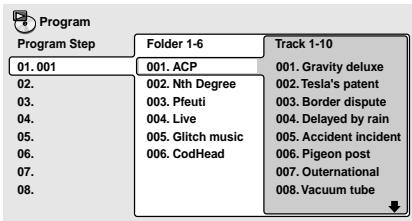
- To add a track, first find the folder, then press (cursor right) and select a track name from the list.
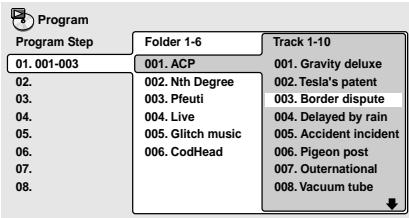
After pressing ENTER to select the title/ chapter/folder/track, the step number automatically moves down one.
4 Repeat step 3 to build up a program list.
A program list can contain up to 24 titles/chapters/folders/tracks.
5 To play the program list, press (play).
Program play remains active until you turn off program play (see below), erase the program list (see below), eject the disc or switch off the player.

Tip
- To save your program list and exit the program edit screen without starting playback, press PLAY MODE or SETUP. (Don't press RETURN - your program list won't be saved.)
- During program play, press▶I to skip to the next program step.
- Press CLEAR during playback to switch off program play. Press while stopped to erase the program list.
Editing a program list
After creating a program list, you can add, delete and change steps.
1 Press PLAY MODE and select 'Program' from the list of functions on the left.
2 Select 'Create/Edit' from the list of program options.
3 To clear a step, highlight the step number and press CLEAR.
4 To insert a step in the middle of the program list, highlight the step where you want the new step to appear, then select a title/chapter/folder/track to add.
After pressing ENTER, the new step is inserted into the list.
5 To add a step to the end of the program list, highlight the next free step then select a title/chapter/folder/track to add.

Tip
- To save your program list and exit the program edit screen without starting playback, press PLAY MODE or SETUP.
- If you want to exit the program edit screen without saving the changes you made, press RETURN.
Other functions available from the program menu
As well as creating and editing a program list, you can start program play, cancel program play, erase the program list, and memorize a program list from the Play Mode menu.
1 Press PLAY MODE and select 'Program' from the list of functions on the left.
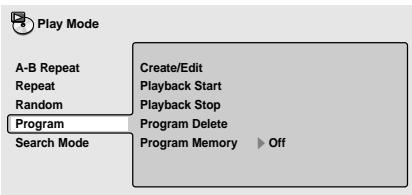
2 Select a program play function.
Create/Edit - See above
- Playback Start - Starts playback of a saved program list
- Playback Stop - Turns off program play, but does not erase the program list
- Program Delete - Erases the program list and turns off program play
- Program Memory (DVD only) - Select On to save the program list for the disc loaded. (Select Off to cancel the program memory for the disc loaded)

Tip
- Program lists are saved for the disc loaded. When you load a disc with a saved program list, program play is automatically turned on.
- You can save program lists for up to 24 discs. After that, the oldest one is replaced with the new one saved.
Searching a disc
You can search DVD discs by title or chapter number, or by time. CDs can be searched by track number, and Video CDs by track number or time. MP3 discs can be searched by folder or track number.
1 Press PLAY MODE and select 'Search Mode' from the list of functions on the left.
The search options that appear depend on the kind of disc loaded. The screen below shows the DVD search options.
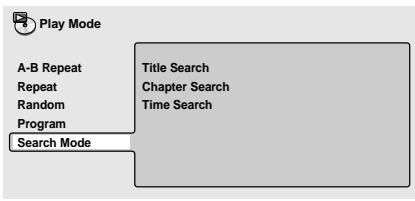
2 Select a search mode.
3 Use the number buttons to enter a title, chapter, folder or track number, or a time.
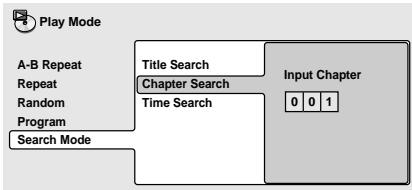
- For a time search, enter the number of minutes and seconds into the currently playing title (DVD) or track (Video CD) you want playback to resume from. For example, press 4, 5, 0, 0 to have playback start from 45 minutes into the disc. For 1 hour, 20 minutes and 30 seconds, press 8, 0, 3, 0.
4 Press ENTER to start playback.

Note
The disc must be playing in order to use time search.
Search functions are not available with Video CDs in PBC mode, or unfinalized CD-R/RW discs.
Switching subtitles
Some DVD discs have subtitles in one or more languages; the disc box will usually tell you which subtitle languages are available. You can switch subtitle language during playback.
1 Press SUBTITLE repeatedly to select a subtitle option.

Current / Total
e 1/2
English
- To set subtitle preferences, see Subtitle Language on page 42.
Switching DVD audio language
When playing a DVD disc recorded with dialog in two or more languages, you can switch audio language during playback.
1 Press AUDIO repeatedly to select an audio language option.

Current /Total
Audio
1/2
French
Dolby Digital 3/2.1CH
- To set audio language preferences, see Audio Language on page 42.
Switching audio channel when playing a Video CD
When playing a Video CD, you can switch between stereo, just the left channel or just the right channel.
1 Press AUDIO repeatedly to select an audio channel option.
O
Audio
Stereo
Zooming the screen
Using the zoom feature you can magnify a part of the screen by a factor of 2 or 4, while watching a DVD or Video CD.
1 During playback, use the ZOOM button to select the zoom factor.
Normal
2x
4x
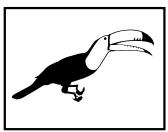
Normal
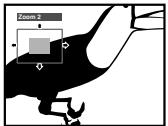
Zoom 2
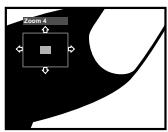
Zoom 4
- Since DVD and Video CD has a fixed resolution, picture quality will deteriorate, especially at 4x zoom. This is not a malfunction.
2 Use the cursor buttons to change the zoomed area.
You can change the zoom factor and the zoomed area freely during playback.
- If the navigation square at the top of the screen disappears, press ZOOM again to display it.

Note
- We do not recommend using DVD menus when the screen is zoomed as menu options will not be highlighted.
- If you are displaying subtitles, these will disappear when the screen is zoomed. They will reappear when you return the screen to normal,
Switching camera angles
Some DVD discs feature scenes shot from two or more angles—check the disc box for details.
When a multi-angle scene is playing, a icon appears on screen to let you know that other angles are available (this can be switched off if you prefer—see page 44).
1 During playback (or when paused), press ANGLE to switch angle.
Displaying disc information
Various track, chapter and title information, as well as the video transmission rate for DVD discs, can be displayed on-screen while a disc is playing.
1 To show/switch the information displayed, press DISPLAY.
When a disc is playing, the information appears at the top of the screen. Keep pressing DISPLAY to change the displayed information.
DVD displays
| Play | DVD | |||
| Current / Total | Elapsed | Remain | Total | |
| Title | 11/38 | 2.05 | 4.57 | 7.02 |
| (1) French | ... | English | ... | 1 |
| Audio | Dolby Digital 3/2.1CH | Substitute | Angle | |
| Play | DVD | |||
| Current / Total | Elapsed | Remain | Total | |
| Chapter | 11/38 | 2.05 | 4.57 | 7.02 |
| Tr. Rate | HHHHHHHHHHHH | 8.6Mbps | ||
- CD and Video CD displays
| Play | CD | |||
| Current /Total | Elapsed | Remain | Total | |
| Track | 2/16 | 1.07 | 4.40 | 5.47 |
| Play | CD | |||
| Elapsed | Remain | Total | ||
| Disc | 28.00 | 30.20 | 58.20 | |
- MP3 disc displays
| Play | MP3 | |||
| Current / Total | Elapsed | Remain | Total | |
| Track | 1/17 | 0.18 | 12.42 | 13.00 |
| Track Name | Outernational | |||
| Play | MP3 |
| Current / Total | |
| Folder | 2/7 |
| Folder Name | ACP |

Tip
- You can see disc information (number of titles/chapters, tracks, folders and so on) from the Disc Navigator screen. See Using the Disc Navigator to browse the contents of a disc on page 27.
Audio DRC
- Default setting: Off
When watching Dolby Digital DVDs at low volume, it's easy to lose the quieter sounds completely—including some of the dialog. Switching Audio DRC (Dynamic Range Control) to On can help by bringing up the quieter sounds, while controlling loud peaks. How much of a difference you hear depends on the material you're listening to. If the material doesn't have wide variations in volume, you may not notice much change.
1 Press SETUP and select 'Audio Settings' from the on-screen display.
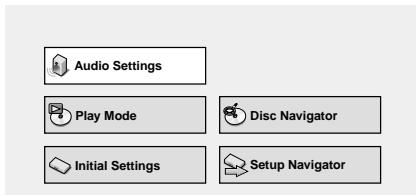
2 Highlight Audio DRC, then use the buttons (cursor left/right) to change to 'On' or 'Off', as required.
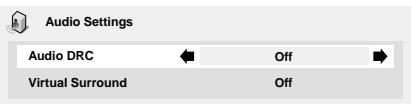
3 Press ENTER to make the setting and exit the Audio Settings screen.

Note
Audio DRC is only effective with Dolby Digital audio sources.
Audio DRC is only effective through the digital output when Digital Out is set to On, and Dolby Digital Out is set to Dolby Digital > PCM. See page 39.
- The effect of Audio DRC depends on your speakers and AV receiver settings.
Virtual Surround
- Default setting: Off
Switch on Virtual Surround to enjoy surround sound effects from just two speakers.
When you play a Dolby Digital soundtrack, Virtual Dolby Digital, which uses TruSurround technology from SRS, produces a deep, realistic 3D soundspace from a pair of stereo speakers.
TruSurround by SRS(●)
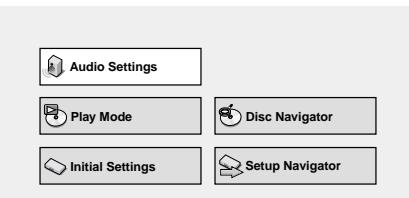
1 Press SETUP and select 'Audio Settings' from the on-screen display.
2 Highlight Virtual Surround, then use the / buttons (cursor left/right) to change to 'Dv/TruSurround' or 'Off', as required.
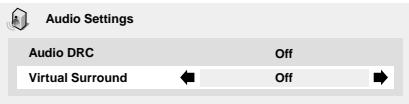
3 Press ENTER to make the setting and exit the Audio Settings screen.

Tip
- You can also use the SURROUND button on the remote control to switch Virtual Surround on (DOV/TruSurround)/Off.

Note
- Virtual Surround doesn't work with DTS or 96kHz linear PCM audio, or during MP3 playback, through either the analog or digital outputs.
- If the player is outputting Dolby Digital or MPEG bitstream audio (in other words, no conversion to PCM), Virtual Surround has no effect on the audio from the digital output. See pages 39-40 for how to set up the digital output formats.
How good the surround effect is varies with the disc.
Using the Initial Settings menu
The Initial Settings menu gives you complete control in setting up your DVD player, including audio, and video output settings, audience limitation settings, among others. If an option is grayed out it means that it cannot be changed at the current time. This is usually because a disc is playing. Stop the disc, then change the setting.
1 Press SETUP and select 'Initial Settings' from the on-screen display.
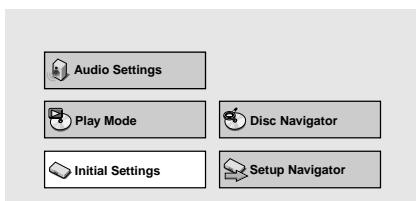
2 Select the setup category from the list on the left, then select an item from the menu list to the right.
3 Make the setting you want.

Note
- The language options shown in the on-screen display illustrations on the following pages may not correspond to those available in your country or region.
Digital Audio Out settings
Digital Out
- Default setting: On
You only need to make this setting if you connected this system to an AV receiver (or other component) using one of the digital outputs.
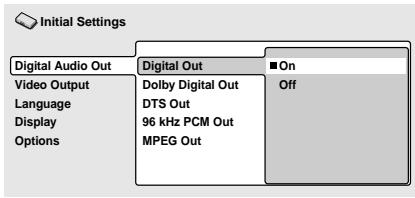
If at any time you need to switch off the digital audio output, set this to Off, otherwise leave it On.
Note that you can't switch on/off the optical and coaxial outputs individually.
Dolby Digital Out
- Default setting: Dolby Digital
You only need to make this setting if you connected this system to an AV receiver (or other component) using one of the digital outputs.
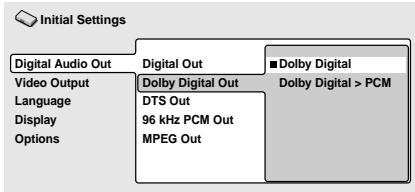
If your AV receiver (or other connected component) is Dolby Digital compatible, set to Dolby Digital, otherwise set to Dolby Digital > PCM.
DTS Out
- Default setting: Off
You only need to make this setting if you connected this system to an AV receiver (or other component) using one of the digital outputs.
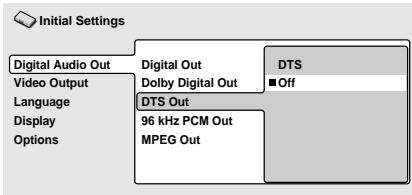
If your AV receiver (or other connected component) has a built-in DTS decoder, set this to DTS, otherwise set to Off. Check the manual that came with the other component if you're unsure whether it is DTS compatible.

Note
- If you set to DTS with a non-DTS compatible amplifier, noise will be output when you play a DTS disc.
96kHz PCM Out
- Default setting: 96kHz > 48kHz
You only need to make this setting if you connected this system to an AV receiver (or other component) using one of the digital outputs.
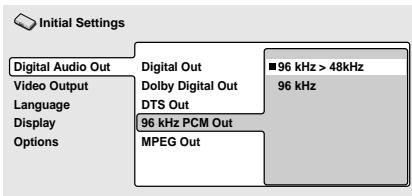
If your AV receiver (or other connected component) is compatible with high sampling rates (96 kHz), set this to 96kHz, otherwise set it to 96kHz > 48kHz (96 kHz audio is converted to a more compatible 48 kHz). Check the manual that came with the other component if you're unsure whether it is 96 kHz compatible.
MPEG Out
- Default setting: MPEG > PCM
You only need to make this setting if you connected this system to an AV receiver (or other component) using one of the digital outputs.
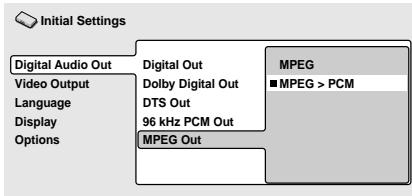
If your AV receiver (or other connected component) is compatible with MPEG audio, set this to MPEG, otherwise set it to MPEG > PCM (MPEG audio is converted to more compatible PCM audio). Check the manual that came with the other component if you're unsure whether it is MPEG audio compatible.
Video Output settings
TV Screen
- Default setting: 4:3 (Letter Box)
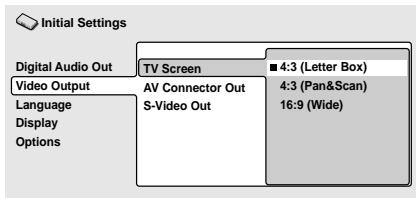
If you have a widescreen TV, select the 16:9 (Wide) setting—widenscreen DVD software is then shown using the full screen area. When playing software recorded in conventional (4:3) format, the settings on your TV will determine how the material is presented—see the manual that came with your TV for details on what options are available.
If you have a conventional TV, select either 4:3 (Letter Box) or 4:3 (Pan & Scan). In Letter Box mode, widescreen software is shown with black bars at the top and bottom of the screen. Pan & Scan chops the sides off widenscreen material to make it fit the 4:3 screen (so even though the image looks larger on the screen, you're actually seeing less of the picture). See also page 49.
AV Connector Out
- Default setting: Video
You only need to make this setting if you connected this player to your TV using the AV SCART-type connector.

Important
- If you make a setting here that is incompatible with your TV, the TV may not display any picture at all. If this happens either switch everything off
and reconnect to the TV using either the supplied audio/video cable, or an S-Video cable (see pages 11 and 12 for more on this).
- SCART cables come in various configurations. Make sure you use the correct one for your TV/monitor. See page 54 for the SCART pin assignment diagram.
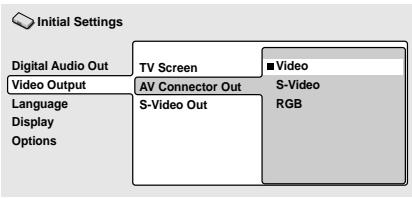
- Video - Standard video, compatible with all TVs.
- S-Video - Higher quality, but check your TV for compatibility.
- RGB - Best quality, but check your TV for compatibility.
S-Video Out
- Default setting: S2
You only need to make this setting if you connected this player to your TV using an S-Video cord.
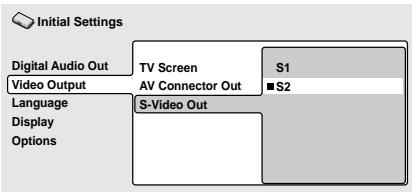
If you find that the picture is stretched or distorted on the default S2 setting, try changing it to S1.
Language settings
Audio Language
- Default setting: English
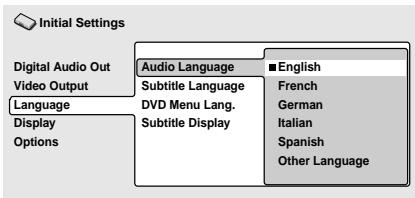
This setting is your preferred audio language for DVD discs. If the language you specify here is recorded on a disc, the system automatically plays the disc in that language.
The DVD format recognizes 136 different languages. Select Other Language if you want to specify a language other than those listed. See also Selecting languages using the language code list on page 51.

Tip
- You can switch between the languages recorded on a DVD disc during playback using the AUDIO button. (This does not affect this setting.) See page 34.
- Some DVD discs set the audio language automatically when loaded, overriding the audio language you set in the Initial Settings menu.
- Discs with two or more audio languages usually allow you to select the audio language from the disc menu. Press MENU to access the disc menu.
Subtitle Language
- Default setting: English
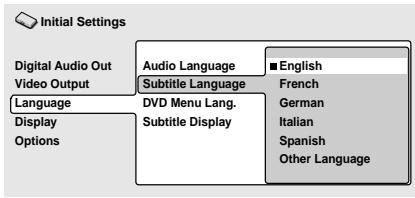
This setting is your preferred subtitle language for DVD discs. If the language you specify here is recorded on a disc, the system automatically plays the disc with those subtitles.
The DVD format recognizes 136 different languages. Select Other Language if you want to specify a language other than those listed. See also Selecting languages using the language code list on page 51.

Tip
- You can change or switch off the subtitles on a DVD disc during playback using the SUBTITLE button. (This does not affect this setting.) See page 34.
- Some DVD discs set the subtitle language automatically when loaded, overriding the subtitle language you set in the Initial Settings menu.
- Discs with two or more subtitle languages usually allow you to select the subtitle language from the disc menu. Press MENU to access the disc menu.
DVD Menu Language
- Default setting: w/Subtitle Lang.
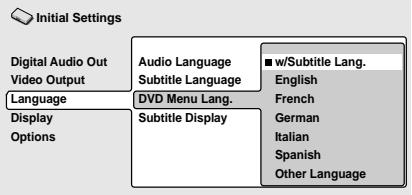
Some multilingual discs have disc menus in several languages. This setting specifies in which language the disc menus should appear. Leave on the default setting for menus to appear in the same language as your Subtitle Language—see page 42.
The DVD format recognizes 136 different languages. Select Other Language if you want to specify a language other than those listed. See also Selecting languages using the language code list on page 51.
Subtitle Display
- Default setting: On
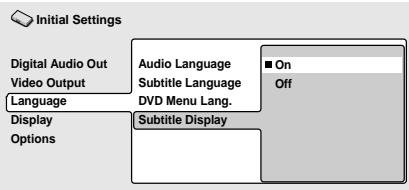
When set to On, the player displays subtitles according to the Subtitle Language setting. Set to Off to switch subtitles off altogether.
Display settings
OSD Language
- Default setting: English
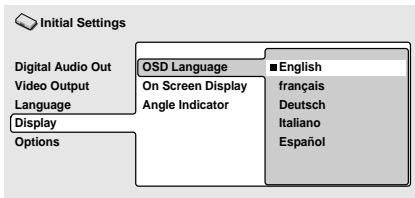
This sets the language of this player's on-screen displays.
On Screen Display
- Default setting: On
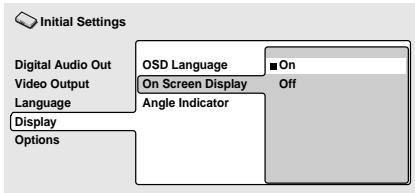
This sets whether operation displays are shown on-screen (Play, Resume, Scan and so on.)
Angle Indicator
- Default setting: On
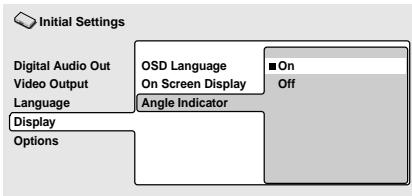
If you prefer not to see the camera icon on-screen during multi-angle scenes on DVD discs, change this setting to Off.
Options
Parental Lock
- Default level: Off
- Default password: none
- Default country code: us (2119)
Some DVD Video discs feature a Parental Lock level. If your player is set to a lower level than the disc, the disc won't play. This gives you some control about what your children watch on your DVD player.
Some discs also support the Country Code feature. The player does not play certain scenes on these discs, depending on the country code you set.
Before you can set the Parental Lock level or the Country Code you must register a password. As the password owner, you can change the Parental Lock level or Country Code whenever you like. You can also change the password.

Note
- Not all discs that you may consider inappropriate for your children use the Parental Lock feature. These discs will always play without requiring the password first.
- If you forget your password, you'll need to reset the player to it's factory settings (page 49), then register a new password.
Registering a new password
You must register a password before you can change the Parental Lock level or enter a Country Code.
1 Select 'Password'.
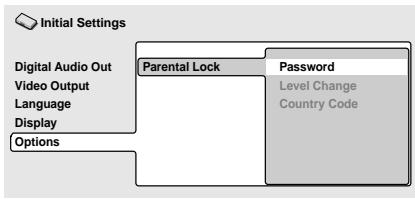
2 Use the number buttons to enter a 4-digit password.
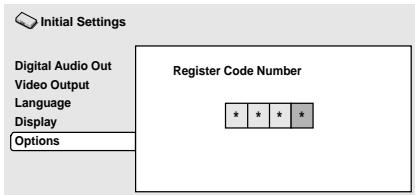
The numbers you enter show up as asterisks (^*) on-screen.
3 Press ENTER to register the password and return to the Options menu screen.
If you forget your password, you can reset the system then register a new one. See page 49 for how to reset the player.
Changing your password
To change your password, confirm your existing password then enter a new one.
1 Select 'Password Change'.
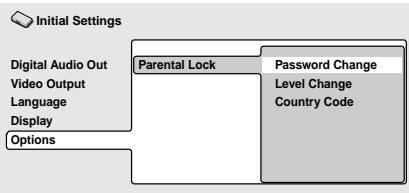
2 Use the number buttons to enter your existing password, then press ENTER.
- The numbers appear as asterisks as you enter them.
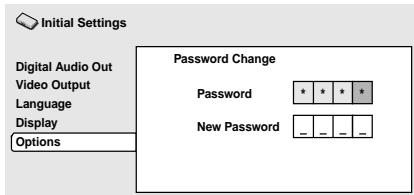
3 Enter a new password.
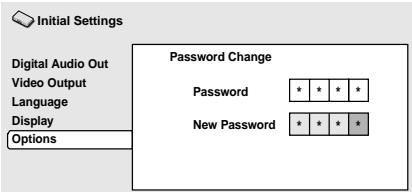
4 Press ENTER to register the new password and return to the Options menu screen.
Setting/changing the Parental Lock level
1 Select 'Level Change'.
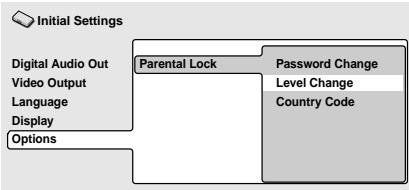
2 Use number buttons to enter your password, then press ENTER.
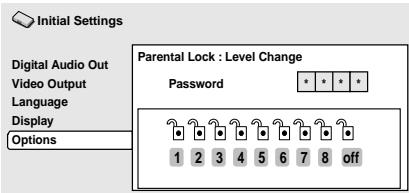
3 Select a new level.
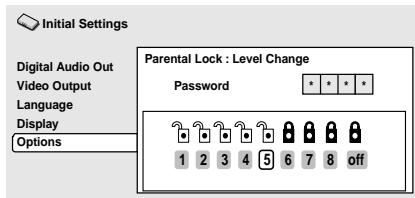
Press (cursor left) repeatedly to lock more levels (more discs will require the password); press (cursor right) to unlock levels. You can't lock level 1.
4 Press ENTER to set the new level and return to the Options menu screen.
Setting/changing the Country Code
You may also want to refer to the Country code list on page 50.
1 Select 'Country Code'.
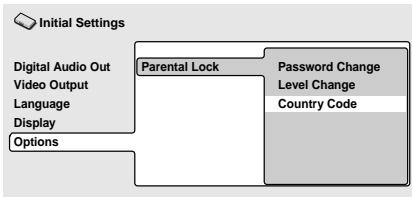
2 Use number buttons to enter your password, then press ENTER.
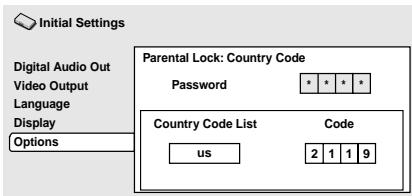
3 Select a country code.
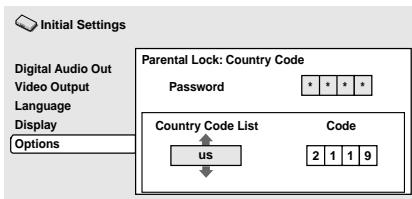
There are two ways you can do this.
- Select by code letter: Use / (cursor up/down) to change the country code.
- Select by code number: Press (cursor right) then use the number buttons to enter the 4-digit country code (you can find the Country code list on page 50.)
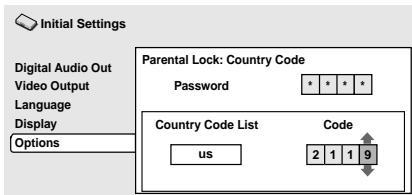
4 Press ENTER to set the new Country Code and return to the Options menu screen.

Note
- Changing the country code does not take effect until the next disc is loaded (or the current disc is reloaded).
Taking care of your player and discs
Handling discs
When holding discs of any type, take care not to leave fingerprints, dirt or scratches on the disc surface. Hold the disc by its edge or by the center hole and edge.
Damaged or dirty discs can affect playback performance. Take care also not to scratch the label side of the disc. Although not as fragile as the recorded side, scratches can still result in a disc becoming unusable.
Should a disc become marked with fingerprints, dust, etc., clean using a soft, dry cloth, wiping the disc lightly from the center to the outside edge as shown in the diagram below.
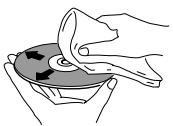
Wipe lightly from the center of the disc using straight strokes.
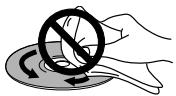
Don't wipe the disc surface using circular strokes.
If necessary, use a cloth soaked in alcohol, or a commercially available CD/DVD cleaning kit to clean a disc more thoroughly. Never use benzine, thinner or other cleaning agents, including products designed for cleaning vinyl records.
Storing discs
Although CDs and DVD discs are more durable than vinyl records, you should still take care to handle and store discs correctly. When you're not using a disc, return it to its case and store upright. Avoid leaving discs in excessively cold, humid, or hot environments (including under direct sunlight).
Don't glue paper or put stickers onto the disc, or use a pencil, ball-point pen or other sharp-tipped writing instrument. These could all damage the disc.

For more detailed care information see the instructions that come with discs.
Do not load more than one disc into the player at a time.
Discs to avoid
Discs spin at high speed inside the player. If you can see that a disc is cracked, chipped, warped, or otherwise damaged, don't risk using it in your player--you could end up damaging the unit.
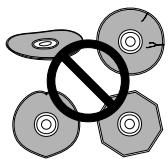
This unit is designed for use with conventional, fully circular discs only. Use of shaped discs is not recommended for this product. Pioneer disclaims all liability arising in connection with the use of shaped discs.
Cleaning the pickup lens
The DVD player's lens should not become dirty in normal use, but if for some reason it should malfunction due to dust or dirt, consult your nearest Pioneer-authorized service center. Although lens cleaners for CD players are commercially available, we do not recommend using them since some may damage the lens.
Problems with condensation
Condensation may form inside the player if it is brought into a warm room from outside, or if the temperature of the room rises quickly. Although the condensation won't damage the player, it may temporarily impair its performance. For this reason you should leave it to adjust to the warmer temperature for about an hour before switching on and using.
Hints on installation
We want you to enjoy using this unit for years to come, so please bear in mind the following points when choosing a suitable location for it:
Do...
Use in a well-ventilated room.
Place on a solid, flat, level surface, such as a table, shelf or stereo rack.
Don't...
× Use in a place exposed to high temperatures or humidity, including near radiators and other heat-generating appliances.
× Place on a window sill or other place where the player will be exposed to direct sunlight.
× Use in an excessively dusty or damp environment.
× Place directly on top of an amplifier, or other component in your stereo system that becomes hot in use.
X Use near a television or monitor as you may experience interference—especially if the television uses an indoor antenna.
X Use in a kitchen or other room where the player may be exposed to smoke or steam.
X Use on a thick rug or carpet, or cover with cloth—this may prevent proper cooling of the unit.
× Place on an unstable surface, or one that is not large enough to support all four of the unit's feet.
Moving the player
If you need to move the player, first press STANDBY/ON on the front panel to turn the player off. Wait for -OFF- to disappear from the display, then unplug the power cord. Never lift or move the unit during playback—discs rotate at a high speed and may be damaged.
Power cord caution
Handle the power cord by the plug part. Do not pull out the plug by tugging the cord, and never touch the power cord when your hands are wet, as this could cause a short circuit or electric shock. Do not place the unit, a piece of furniture, or other object on the power cord or pinch the cord in any other way. Never make a knot in the cord or tie it with other cords. The power cords should be routed so that they are not likely to be stepped on. A damaged power cord can cause a fire or give you an electric shock. Check the power cord once in a while. If you find it damaged, ask your nearest Pioneer authorized service center or your dealer for a replacement.
Screen sizes and disc formats
DVD-Video discs come in several different screen aspect ratios, ranging from TV programs, which are generally 4:3, to CinemaScope widenscreen movies, with an aspect ratio of up to about 7:3.
Televisions, too, come in different aspect ratios; 'standard' 4:3 and widenscreen 16:9.
Widescreen TV users
If you have a widescreen TV, the TV Screen setting (page 41) of this player should be set to 16:9 (Wide).
When you watch discs recorded in 4:3 format, you can use the TV controls to select how the picture is presented. Your TV may offer various zoom and stretch options; see the instructions that came with your TV for details.
Please note that some movie aspect ratios are wider than 16:9, so even though you have a widescreen TV, these discs will still play in a 'letterbox' style with black bars at the top and bottom of the screen.
Standard TV users
If you have a standard TV, the TV Screen setting (page 41) of this player should be set to 4:3 (Letter Box) or 4:3 (Pan&Scan), depending on which you prefer.
Set to 4:3 (Letter Box), widescen discs are shown with black bars top and bottom.
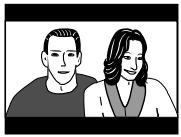
Set to 4:3(Pan&Scan), widenscreen discs are shown with the left and right sides cropped. Although the picture looks larger, you don't actually see the whole picture.
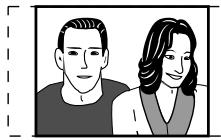
Please note that many widenscreen discs override the player's settings so that the disc is shown in letterbox format regardless of the setting.

Tip
- Using the 16:9 (Wide) setting with a standard 4:3 TV, or either of the 4:3 settings with a widescreen TV, will result in a distorted picture.
Resetting the player
Use this procedure to reset all the player's settings to the factory default.
1 Switch the player into standby.
2 Using the front panel buttons, hold down the (stop) button and press STANDBY/ON to switch the player back on.
All the player's settings are now reset, and you should see the 'Let's Get Started' screen.
Language code list
Language (Laguage code letter), Language code
Japanese (ja), 1001
English (en), 0514
French (fr), 0618
German (de), 0405
Italian (it), 0920
Spanish (es), 0519
Chinese (zh), 2608
Dutch (nl), 1412
Portuguese (pt), 1620
Swedish (sv), 1922
Russian (ru), 1821
Korean (ko), 1115
Greek (el), 0512
Afar (aa), 0101
Abkhazian (ab), 0102
Afrikaans (af), 0106
Amharic (am), 0113
Arabic (ar), 0118
Assamese (as), 0119
Aymara (ay), 0125
Azerbaijan (az), 0126
Bashkir (ba), 0201
Byelorussian (be), 0205
Bulgarian (bg), 0207
Bihari (bh), 0208
Bislama (bi), 0209
Bengali (bn), 0214
Tibetan (bo), 0215
Breton (br), 0218
Catalan (ca), 0301
Corsican (co), 0315
Czech (cs), 0319
Welsh (cy), 0325
Danish (da), 0401
Bhutani (dz), 0426
Esperanto (eo), 0515
Estonian (et), 0520
Basque (eu), 0521
Persian (fa), 0601
Finnish (fi), 0609
Fiji (fj), 0610
Faroese (fo), 0615
Frisian (fy), 0625
Irish (ga), 0701
Scots-Gaelic (gd), 0704
Galician (gl), 0712
Guarani (gn), 0714
Gujarati (gu), 0721
Hausa (ha), 0801
Hindi (hi), 0809
Croatian (hr), 0818
Hungarian (hu), 0821
Armenian (hy), 0825
Interlingua (ia), 0901
Interlingue (ie), 0905
Inupiak (ik), 0911
Indonesian (in), 0914
Icelandic (is), 0919
Hebrew (iw), 0923
Yiddish (ji), 1009
Javanese (jw), 1023
Georgian (ka), 1101
Kazakh (kk), 1111
Greenlandic (kl), 1112
Cambodian (km), 1113
Kannada (kn), 1114
Kashmiri (ks), 1119
Kurdish (ku), 1121
Kirghiz (ky), 1125
Latin (la), 1201
Lingala (In), 1214
Laothian (lo), 1215
Lithuanian (lt), 1220
Latvian (lv), 1222
Malagasy (mg), 1307
Maori (mi), 1309
Macedonian (mk), 1311
Malayalam (ml), 1312
Mongolian (mn), 1314
Moldavian (mo), 1315
Marathi (mr), 1318
Malay (ms), 1319
Maltese (mt), 1320
Burmese (my), 1325
Nauru (na), 1401
Nepali (ne), 1405
Norwegian (no), 1415
Occitan (oc), 1503
Oromo (om), 1513
Oriya (or), 1518
Panjabi (pa), 1601
Polish (pl), 1612
Pashto,Pushto (ps),1619
Quechua (qu), 1721
Rhaeto-Romance (rm), 1813
Kirundi (rn), 1814
Romanian (ro), 1815
Kinyarwanda (rw), 1823
Sanskrit (sa), 1901
Sindhi (sd), 1904
Sangho (sg), 1907
Serbo-Croatian (sh), 1908
Sinhalese (si), 1909
Slovak (sk), 1911
Slovenian (sl), 1912
Samoan (sm), 1913
Shona (sn), 1914
Somali (so), 1915
Albanian (sq), 1917
Serbian (sr), 1918
Siswati (ss), 1919
Sesotho (st), 1920
Sundanese (su), 1921
Swahili (sw), 1923
Tamil (ta), 2001
Telugu (te), 2005
Tajik (tg), 2007
Thai (th), 2008
Tigrinya (ti), 2009
Turkmen (tk), 2011
Tagalog (tl), 2012
Setswana (tn), 2014
Tonga (to), 2015
Turkish (tr), 2018
Tsonga (ts), 2019
Tatar (tt), 2020
Twi (tw), 2023
Ukrainian (uk), 2111
Urdu (ur), 2118
Uzbek (uz), 2126
Vietnamese (vi), 2209
Volapuk (vo), 2215
Wolof (wo), 2315
Xhosa (xh), 2408
Yoruba (yo), 2515
Zulu (zu), 2621
Country code list
Country, Country code, Country code letter
Argentina, 0118, ar
Australia, 0121, au
Austria, 0120, at
Belgium, 0205, be
Brazil, 0218, br
Canada, 0301, ca
Chile, 0312, cd
China, 0314, cn
Denmark, 0411, dk
Finland, 0609, fi
France, 0618, fr
Germany, 0405, de
Hong Kong, 0811, hk
India, 0914, in
Indonesia, 0904, id
Italy, 0920, it
Japan, 1016.jp
Korea, Republic of, 1118, kr
Malaysia, 1325, my
Mexico, 1324, mx
Netherlands, 1412, nl
New Zealand, 1426, nz
Norway, 1415. no
Pakistan, 1611, pk
Philippines, 1608, ph
Portugal, 1620, pt
Russian Federation, 1821, ru
Singapore, 1907, sg
Spain, 0519, es
Sweden, 1905, se
Switzerland, 0308, ch
Taiwan, 2023, tw
Thailand, 2008, th
United Kingdom, 0702, gb
United States of America, 2119, us
Selecting languages using the language code list
Some of the language options (such as 'DVD Language' in the Setup Navigator) allow you to set your preferred language from any of the 136 languages listed in the language code list on the previous page.
1 Select 'Other Language'.
2 Use the / (cursor left/right) buttons to select either a code letter or a code number.
3 Use the + / (cursor up/down) buttons to select a code letter or a code number.
See the language code list on the previous page for a complete list of languages and codes.
Glossary
Analog audio
An electrical signal that directly represents sound. Compare this to digital audio which can be an electrical signal, but is an indirect representation of sound. See also Digital audio.
Aspect ratio
The width of a TV screen relative to its height. Conventional TVs are 4:3 (in other words, the screen is almost square); widenscreen models are 16:9 (the screen is almost twice as wide as it is high).
Digital audio
An indirect representation of sound by numbers. During recording, the sound is measured at discrete intervals (44,100 times a second for CD audio) by an analog-to-digital converter, generating a stream of numbers. On playback, a digital-to-analog converter generates an analog signal based on these numbers. See also Sampling frequency and Analog audio.
Dolby Digital

Using a maximum of 5.1 channels of audio, this high quality surround system is used in many of the finer movie theaters around the world.
The on-screen display shows which channels are active, for example showing 3/2.1. The 3 being the two front channels and the center channel; the 2 being the surround channels, and the .1 being the LFE channel.
DTS

DTS stands for Digital Theater System. DTS is a surround system different from Dolby Digital that has become a popular surround sound format for movies.
Dynamic range
The difference between the quietest and loudest sounds possible in an audio signal (without distorting or getting lost in noise). Dolby Digital and DTS soundtracks are capable of a very wide dynamic range, delivering dramatic cinema-like effects.
File extension
A tag added to the end of a filename to indicate the type of file. For example, ".mp3" indicates an MP3 file.
MP3
MP3 (MPEG1 audio layer 3) is a compressed audio file format. Files are recognized by their file extension ".mp3" or ".MP3".
MPEG audio
An audio format used on Video CDs and some DVD discs. This unit can convert MPEG audio to PCM format for wider compatibility with digital recorders and AV amplifiers. See also PCM.
MPEG video
The video format used for Video CDs and DVDs. Video CD uses the older MPEG-1 standard, while DVD uses the newer and much better quality MPEG-2 standard.
PCM (Pulse Code Modulation)
The most common system of encoding digital audio, found on CDs and DAT. Excellent quality, but requires a lot of data compared to formats such as Dolby Digital and MPEG audio. For compatibility with digital audio recorders (CD, MD and DAT) and AV amplifiers with digital inputs, this unit can convert Dolby Digital, DTS and MPEG audio to PCM. See also Digital audio.
PBC (PlayBack Control) (Video CD only)
A system of navigating a Video CD through on-screen menus recorded onto the disc. Especially good for discs that you would normally not watch from beginning to end all at once—karaoke discs, for example.
Regions (DVD-Video only)
These associate discs and players with particular areas of the world. This unit will only play discs that have compatible region codes. You can find the region code of your unit by looking on the rear panel. Some discs are compatible with more than one region (or all regions).
Sampling frequency
The rate at which sound is measured to be turned into digital audio data. The higher the rate, the better the sound quality, but the more digital information is generated. Standard CD audio has a sampling frequency of 44.1kHz , which means 44,100 samples (measurements) per second. See also Digital audio.
Setting the TV system
The default setting of this player is AUTO, and unless you notice that the picture is distorted when playing some discs, you should leave it set to AUTO. If you experience picture distortion with some discs, set the TV system to match your country or region's system. Doing this, however, may restrict the kinds of disc you can watch. The table below shows what kinds of disc are compatible with each setting (AUTO, PAL and NTSC).
1 If the player is on, press STANDBY/ON to switch it to standby.
2 Using the front panel controls, hold down then press STANDBY/ON to switch the TV system.
The TV system changes as follows:
$$ A U T O \rightarrow N T S C $$
$$ \mathrm {N T S C} \rightarrow \mathrm {P A L} $$
$$ \mathrm {P A L} \rightarrow \mathrm {A U T O} $$
The player's display shows "Welcome Pioneer", then indicates the new setting.

Note
- You have to switch the player into standby (press STANDBY/ON) before each change.
| Disc | Player setting | |||
| Type | Format | NTSC | PAL | AUTO |
| DVD | NTSC | NTSC | MOD.PAL | NTSC |
| PAL | — | PAL | PAL | |
| Video CD | NTSC | NTSC | MOD.PAL | NTSC |
| PAL | NTSC | PAL | PAL | |
| CD / no disc | — | NTSC | PAL | NTSC or PAL |
Watching NTSC on a PAL TV (MOD. PAL)
Most models of the newly developed countdown PAL TV system detect 50Hz (PAL)/60 Hz (NTSC) and automatically switch vertical amplitude, resulting in a display without vertical shrinkage.
If your PAL TV does not have a V-Hold control, you may not be able to watch NTSC discs because of picture roll. If the TV has a V-Hold control, adjust it until the picture stops rolling.
On some TVs, the picture may shrink vertically, leaving black bands at the top and bottom of the screen. This is not a malfunction; it is caused by the NTSC to PAL conversion.
Specifications
General
System DVD player
Power requirements ..AC 220-240 V,50/60 Hz
Power consumption .14 W
Power consumption (standby) .0.3 W
Weight .2.5 kg
Dimensions DV-454 .420W × 55H × 278D mm DV-350 .420W × 55H × 276D mm
Operating temperature +5^ to +35^ Operating humidity . 5 % to 85% (no condensation)
S-Video output
Y (luminance) - Output level 1 Vp-p (75 Ω)
C (color) - Output level 286 mVp-p (75 Ω)
Jack S-Video jack
Video output
Output level 1 Vp-p (75 Ω)
Jack RCA jack
AV connector output
AV Connector (21-pin connector assignment)
AV connector output............ 21-pin connector
This connector provides the video and audio signals for connection to a compatible colour TV or monitor.
2018161412108642
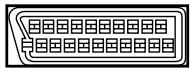
21 19 17 15 13 11 9 7 5 3 1
PIN no.
- Audio 2/R out 11. G out
- Audio 1/L out 15. R or C out
- GND 17. GND
- B out 19. Video out or Y out
- Status 21. GND
Audio output (1 stereo pair)
Output level . During audio output 200 mVrms (1 kHz, -20 dB)
Number of channels 2
Jacks RCA jack
Digital audio characteristics
Frequency response. 4 Hz to 44 kHz (DVD fs: 96 kHz)
S/N ratio. 118 dB
Dynamic range. 101 dB
Total harmonic distortion. 0.0016%
Wow and flutter. Limit of measurement ( ± 0.001% W. PEAK) or lower
Digital output
Optical digital output (DV-454 only) Optical digital jack Coaxial digital output .RCA jack
Accessories
Audio/video cable 1
Power cable 1
Remote control 1
AA/R6P dry cell batteries 2
Operating Instructions 1
Warranty card 1

Note
- The specifications and design of this product are subject to change without notice, due to improvement.
Published by Pioneer Corporation. Copyright © 2002 Pioneer Corporation. All rights reserved.
PIONEER CORPORATION
4-1, Meguro 1-Chome, Meguro-ku, Tokyo 153-8654, Japan
PIONEER ELECTRONICS (USA) INC.
P.O. BOX 1540, Long Beach, California 90801-1540, U.S.A.
PIONEER ELECTRONICS OF CANADA, INC.
300 Allstate Parkway, Markham, Ontario L3R OP2, Canada
PIONEER EUROPE NV
Haven 1087, Keetberglaan 1, B-9120 Melsele, Belgium TEL: 03/570.05.11
PIONEER ELECTRONICS AUSTRALIA PTY. LTD.
178-184 Boundary Road, Braeside, Victoria 3195, Australia, TEL: [03] 9586-6300
PIONEER ELECTRONICS DE MEXICO S.A. DE C.V.
San Lorenzo 1009 3er Piso Desp. 302 Col. Del Valle Mexico D.F. C.P. 03100 TEL: 55-5688-52-90