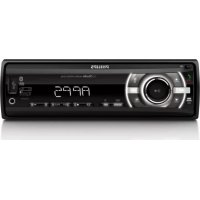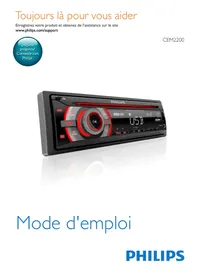
CE135BT - Autoradio PHILIPS - Notice d'utilisation et mode d'emploi gratuit
Retrouvez gratuitement la notice de l'appareil CE135BT PHILIPS au format PDF.


| Type d'appareil | Autoradio |
| Connectivité | Bluetooth |
| Affichage | Écran LCD |
| Lecture audio | MP3, WMA |
| Commandes au volant | Compatible |
| Entrée auxiliaire | Oui |
| Radio | FM/AM |
| Puissance de sortie | Non précisé |
| Alimentation | 12 V DC |
| Dimensions | Standard DIN simple |
| Microphone intégré | Oui |
| Prise USB | Non précisé |
| Fonction mains libres | Oui |
| Compatibilité smartphone | Oui |
| Couleur | Noir |
FOIRE AUX QUESTIONS - CE135BT PHILIPS
Questions des utilisateurs sur CE135BT PHILIPS
0 question sur cet appareil. Repondez a celles que vous connaissez ou posez la votre.
Poser une nouvelle question sur cet appareil
Téléchargez la notice de votre Autoradio au format PDF gratuitement ! Retrouvez votre notice CE135BT - PHILIPS et reprennez votre appareil électronique en main. Sur cette page sont publiés tous les documents nécessaires à l'utilisation de votre appareil CE135BT de la marque PHILIPS.
MODE D'EMPLOI CE135BT PHILIPS
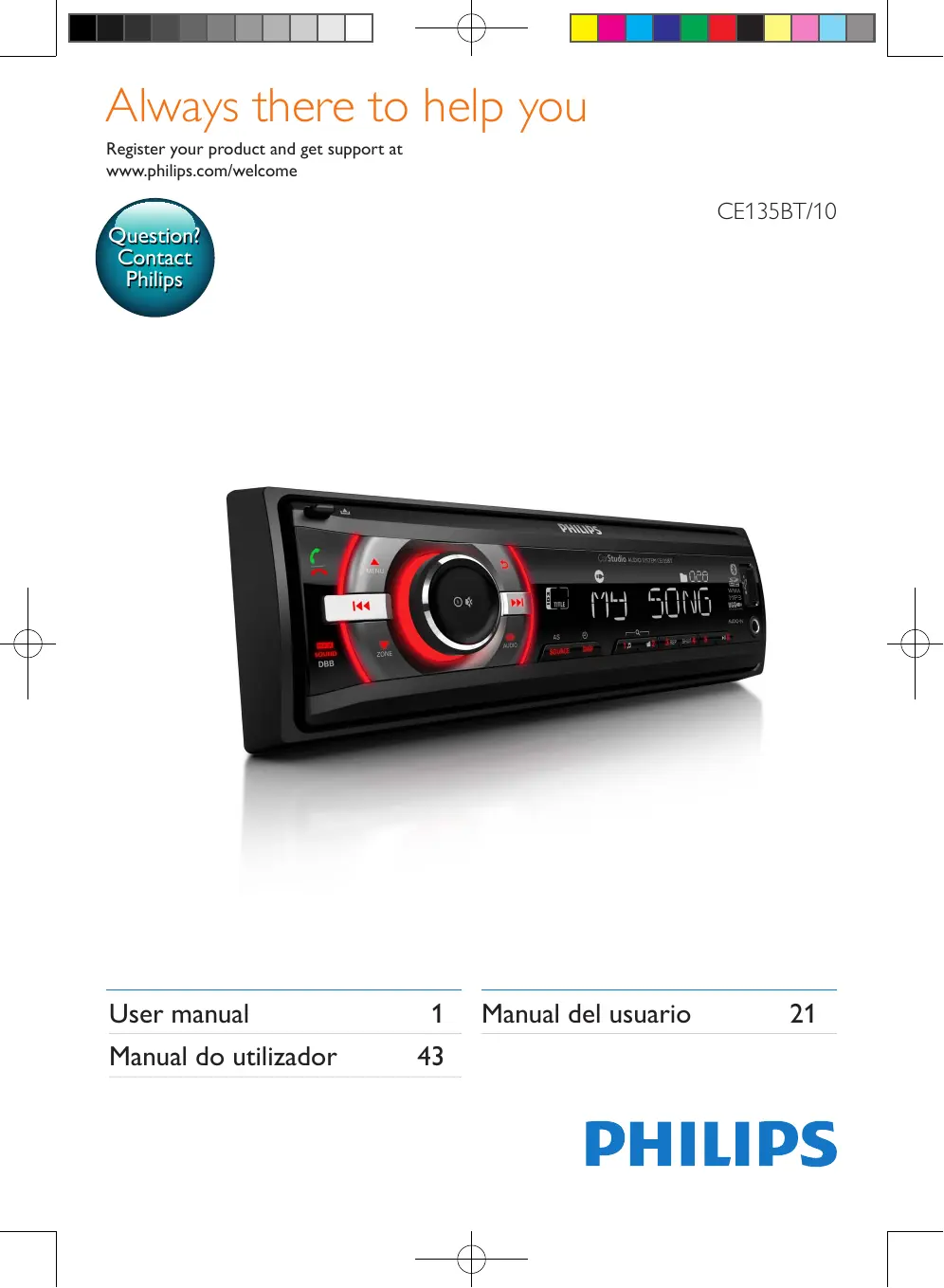
Always there to help you
Register your product and get support at
www.philips.com/welcome
text_image
Question? Contact PhilipsCE135BT/10
text_image
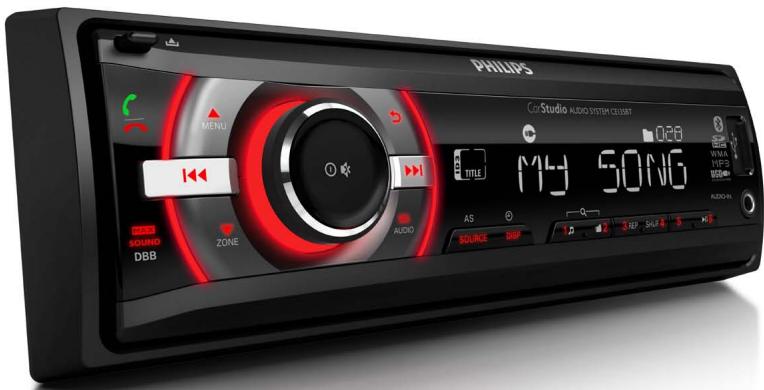
PHILIPS CovStudio AUDIO SYSTEM CERIART MENU D8B 02B MY SONG SOUND DBB ZONE AUDIO AS SOURCE DHIP 1.0 12P 34Hz 5MHz VIF3 300MHz AUDIO N1User manual 1
Manual do utilizador 43
Manual del usuario 21
Contents
1 Safety 2
2 Your car audio system 3
Introduction 3
What's in the box 3
Overview of the system 4
3 Install the car audio system 6
Connect wires 7
Mount into the dashboard 8
Attach the front panel 9
4 Get started 10
For the first time use 10
Set the clock 10
Select a source 10
5 Listen to radio 10
Select a tuner region 10
Select a tuner sensitivity 10
Enable the RDS function 11
Search for a radio station 11
Store radio stations in memory 11
6 Play from a storage device 12
7 Use Bluetooth devices 13
Connect a device 13
Play audio from a Bluetooth device 14
Make a call 14
8 Listen to an external device 15
9 Charge your USB device 15
10 Adjust sound 16
11 Reset the system 16
12 Product information 17
Product Information 17
13 Troubleshooting 18
14 Notice 19
Compliance 19
Care of the environment 19
Trademark notice 19
Copyright 19
1 Safety
Read and understand all instructions before you use this device. If damage is caused by failure to follow instructions, the warranty does not apply.
- Modification of the product could result in hazardous radiation of EMC or other unsafe operation.
- The device is designed for negative ground (earth) 12V DC operation only.
• To ensure safe driving, adjust the volume to a safe and comfortable level. - Improper fuses can cause damage or fire. When you need to change the fuse, consult a professional.
- Use only the supplied mounting hardware for a safe and secure installation.
- To avoid short circuits, do not expose the device to rain or water.
- The device shall not be exposed to dripping or splashing.
- Do not place any sources of danger on the device (e.g. liquid filled objects, lighted candles).
- Never insert objects into the ventilation slots or other openings on the device.
- Clean the device with soft, damp cloth. Never use substances such as alcohol, chemicals or household cleaners on the device.
2 Your car audio system
DRM protected WMA files (.wav, .m4a,
.m4p, .mp4, and .aac)
WMA files in lossless format
Introduction
With this system, you can:
- enjoy audio from USB storage devices, SD/SDHC card, and other external players, and Bluetooth device.
- listen to radio stations.
You can enrich sound output with these sound effects:
• Dynamic bass boost (DBB)
• Digital sound control (DSC)
playable media:
-
USB storage device
• Compatibility: USB 2.0, USB 1.1
• Class support: MSC (Mass Storage Class)
• Maximum capacity: 32 GB -
SD/SDHC card
• Maximum capacity: 32 GB -
Files
• File system: FAT16, FAT32
• Maximum number of folders: 99
• Maximum number of tracks/files: 999
• Maximum level of directory: 8 - .mp3 files Sampling frequencies: 32 kHz, 44.1 kHz, 48 kHz Bitrates: 8-320 kbps and variable bitrates
- .wma files
Versions: V4, V7, V8, V9 (L1 and L2)
Sampling frequencies: 44.1 kHz, 48 kHz
Bitrates: 64-192 kbps and variable bitrates
• ID3 tag V2.0 or later
• Unsupported files: AAC, WAV, and PCM files
What's in the box
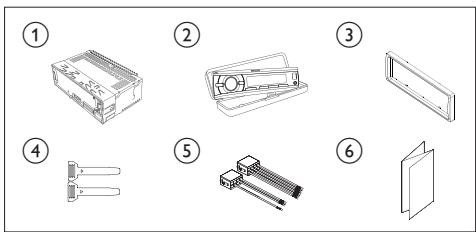
Check and identify the contents of the package:
text_image
Diagram showing six labeled components of electronic devices, including a box, panel, and connectors.① Main unit (with a sleeve)
② Carrying case (with front panel included)
③ Trim plate
④ Disassembly tool X 2
⑤ ISO male connector X 2
⑥ User manual
Overview of the system
text_image
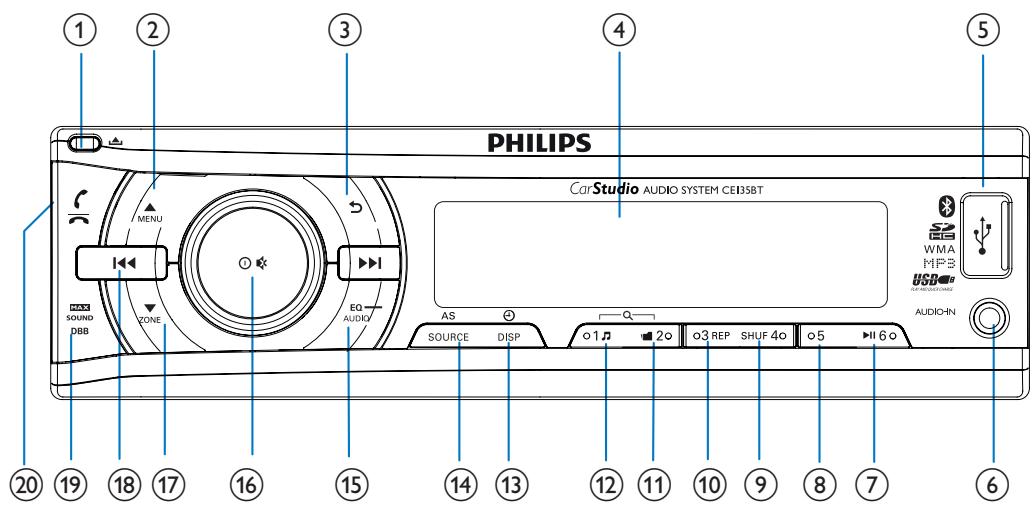
PHILIPS Car Studio AUDIO SYSTEM CE135BT WMA MP3 USB AVIO-IN SOURCE DISP 01 20 03 REP SHUF 40 05 160 ① ② ③ ④ ⑤ MENU ZONE EQ AUDIO MAX SOUND DBB 20 19 18 17 16 15 14 13 12 11 10 9 8 7 6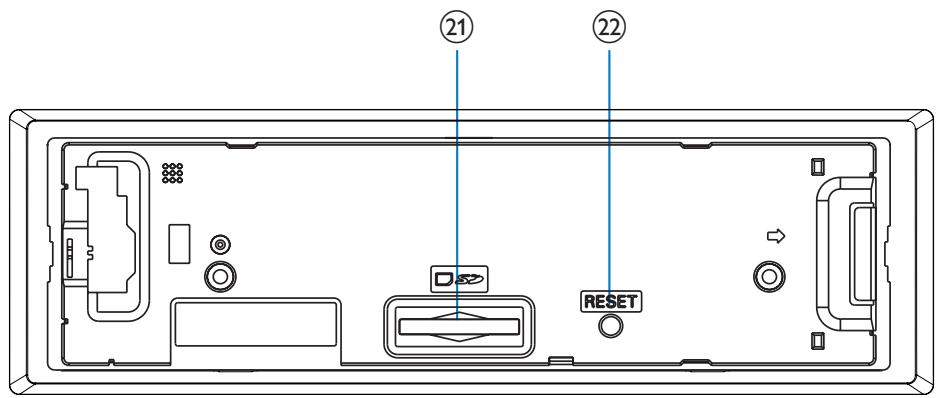
text_image
②1 ②2 RESET①
- Unlock the front panel.
② ▲ MENU
- For .wma and .mp3 tracks, press to select the previous folder.
- Press and hold to access the system menu.
- Press to select a tuner band.
③
• Return to the previous menu.
④ LCD screen
⑤
- Connect to a USB storage device.
⑥ AUDIO IN
- Connect to the audio output socket (usually the headphone socket) of an external device.
⑦ ▶II6
- Start, pause, or resume the play of tracks.
• In radio mode, press to select the preset radio station of No. 6.
- In radio mode, press and hold to store the current radio station at channel No. 6.
⑧ 5
• In radio mode, press to select the preset radio station of No. 5.
- In radio mode, press and hold to store the current radio station at channel No. 5.
⑨ SHUF 4
• In radio mode, press to select the preset radio station of No. 4.
- In radio mode, press and hold to store the current radio station at channel No. 4.
- For .wma and .mp3 tracks, press repeatedly to select a play mode: play all tracks randomly ([SHU ALL]), play tracks in the current folder randomly ([SHU FLD]), or play all tracks in the storage device in sequence ([SHU OFF]).
⑩ 3 REP
- In radio mode, press to select the preset radio station of No. 3.
- In radio mode, press and hold to store the current radio station at channel No. 3.
- For .wma and .mp3 tracks, press repeatedly to select a repeat mode: repeat the current track ([REP ONE]), repeat all tracks in the current folder ([RPT FLD]), or repeat all tracks in the storage device ([RPT ALL]).
⑪ 2
• In radio mode, press to select the preset radio station of No. 2.
- In radio mode, press and hold to store the current radio station at channel No. 2.
- For .wma and .mp3 tracks, press to access the folder list.
⑫ 1 ♪
• In radio mode, press to select the preset radio station of No. 1.
- In radio mode, press and hold to store the current radio station at channel No. 1.
- For .wma and .mp3 tracks, press to access the track list.
⑬ ⊕ /DSP
- Press repeatedly to display available information about the current track.
- Press repeatedly to display available RDS information.
- Press and hold to display the set clock.
⑭ AS/SOURCE
- Press repeatedly select a source.
- In radio mode, press and hold to activate the automatic search of radio stations.
15 EQ AUDIO
- Press repeatedly to select a preset sound equalizer.
- Press and hold to activate the setup of bass, treble, balance, and fader.
16 ①
- Press to turn on the system.
- Press and hold to turn off the system.
- Press to mute the speakers or release them from mute status.
- Press to confirm an option.
- Rotate to switch between menu options.
- Rotate to adjust the volume level.
17 ZONE
- For .wma and .mp3 tracks, press to select the next folder.
- Press and hold to activate the selection of listening zones.
- Press to select a tuner band.
18 |◀◀/▶▶|
- Tune to a radio station.
- Press to skip to the previous/next track.
- Press and hold to rewind a track or search fast forward.
19
- Press to enable or disable the maximum volume.
- Press and hold to enable or disable the DBB (dynamic bass boost) sound effect.
20
- Press to hang up a call.
- Press and hold to reject an incoming call.
⑳ Slot for SD/SDHC card
- Insert an SD/SDHC card.
⑳ RESET
- Press to reset the system to factory default settings.
3 Install the car audio system

Caution
- Use the controls only as stated in this user manual.
Always follow the instructions in this chapter in sequence.
These instructions are for a typical installation. However, if your car has different requirements, make the adjustment accordingly. If you have any question regarding installation kits, consult your local retailer.

Note
- This system is designed for negative ground (earth) 12V DC operation only.
- Always install this system in the car dashboard. Other locations can be dangerous as the rear of the system heats up during use.
- To avoid short-circuit: before you connect, make sure that the ignition is off.
- Make sure that you connect the yellow and red power supply leads after all other leads are connected.
- Make sure that all loose leads are insulated with electrical tape.
- Make sure that the leads do not get caught under screws iron parts that will move (e.g. seat rail).
- Make sure that all ground (earth) leads are run to a common ground (earth) point.
- Use only the supplied mounting hardware for a safe and secure installation.
- Improper fuses can cause damage or fire. When you need to change the fuse, consult a professional.
- When you connect other devices to this system, make sure that the rating of the car circuit is higher than the total fuse value of all the connected devices.
- Never connect speaker wires to the metal body or chassis of the car.
- Never connect speaker wires with stripes to one another.
Connect wires

Note
- Make sure that all loose leads are insulated with electrical tape.
- Consult a professional to connect wires as instructed below.
1 Check the car's wiring carefully and connect them to the the ISO male connectors.
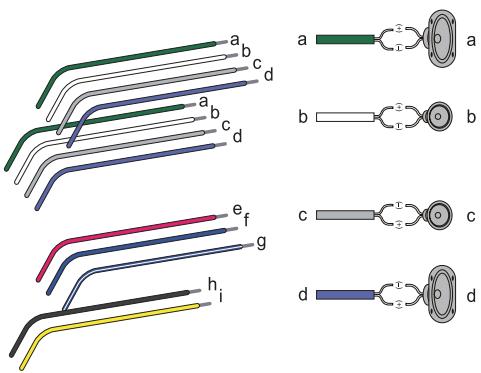
text_image
a b c d a b c d e f g h i| ISO male connectors | Connect to | |
| a | Green strip, black-edged green strip | Rear left speaker |
| b | White strip, black-edged white strip | Front left speaker |
| c | Gray strip, black-edged gray strip | Front right speaker |
| d | Purple strip, black-edged purple strip | Rear right speaker |
| e | Red strip | Ignition key +12V DC when ON/ACC |
| f | Blue strip | Motor/electric antenna relay control lead |
| g | White-edged blue strip | Amplifier relay control lead |
| h | Black strip | Ground |
| i | Yellow strip | To the +12V car battery which is energized at all times |
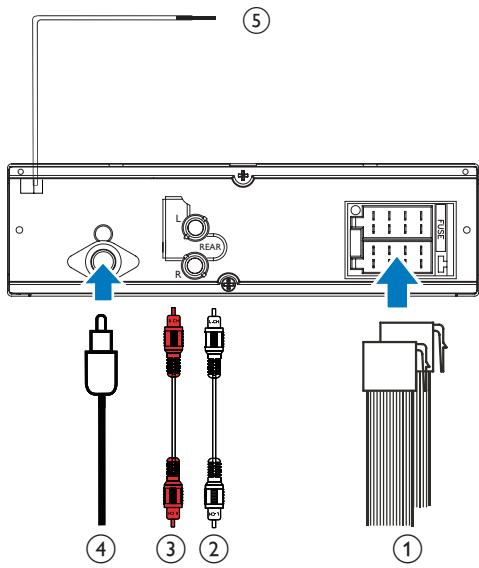
2 Connect the antenna and amplifier as illustrated, if applicable.
text_image
Diagram of a device rear panel with labeled components and connectors, showing numbered parts and directional arrows.| Sockets on rear panel | External sockets or connectors | |
| 1 | For ISO male connectors | As indicated above |
| 2 | REAR L | Rear left speaker |
| 3 | REAR R | Rear right speaker |
| 4 | ANTENNA | Antenna |
| 5 | Purple strip | OE remote control module |

Tip
- The pin arrangement for the ISO connectors depends on the type of your vehicle. To avoid damage to the unit, connect properly.
Mount into the dashboard
- If the car does not have an on-board drive or navigation computer, disconnect the negative terminal of the car battery.
- If the car battery is not disconnected, to avoid short-circuit, make sure that the bare wires do not touch each other.
1 Make sure that the car dashboard opening is within these measurements:
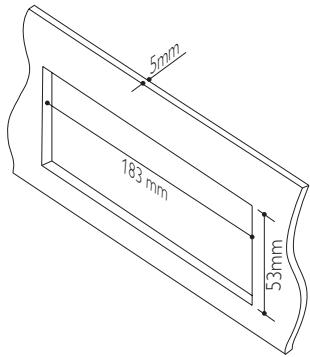
text_image
5mm 183 mm 53mm2 Remove the mounting sleeve with the supplied disassembly tools.
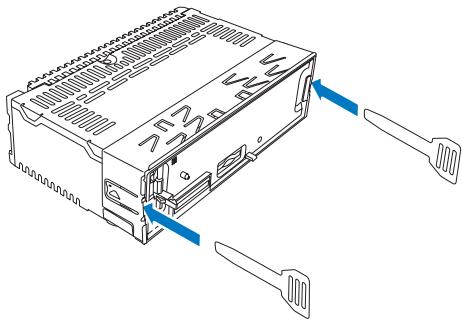
natural_image
Technical line drawing of a computer chassis with two tool holders and blue arrows indicating assembly or connection (no text or symbols present)3 Install the sleeve into the dashboard and bend the tabs outward to fix the sleeve.
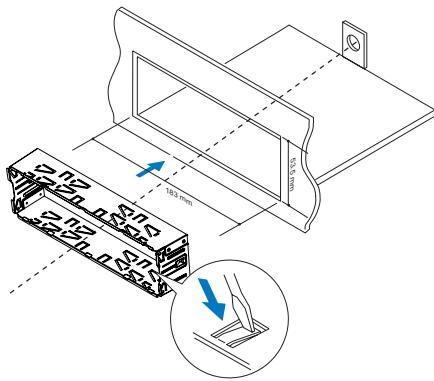
text_image
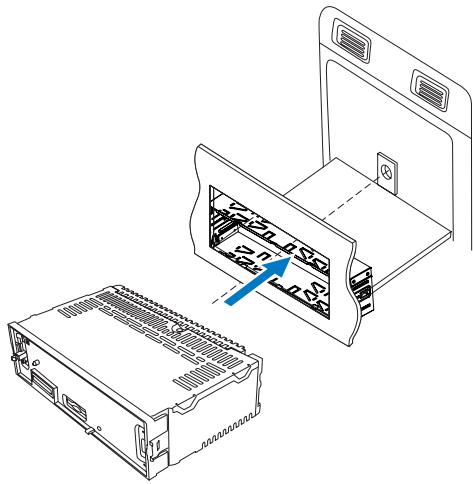
163 mm 163.5 mm4 Slide the unit into the dashboard until you hear a "click".
natural_image
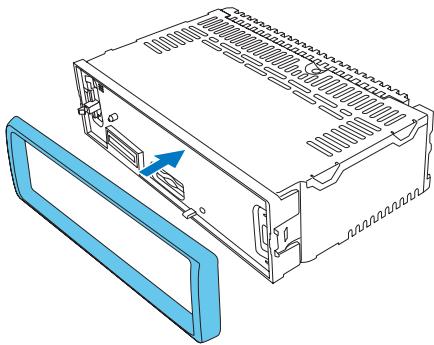
Technical line drawing of an electronic device showing internal components and a separate housing (no text or symbols)5 Attach the trim plate.
natural_image
Illustration of a computer chassis with a blue plastic cover and a directional arrow indicating a component (no text or symbols present)6 Reconnect the negative terminal of the car battery.
Attach the front panel
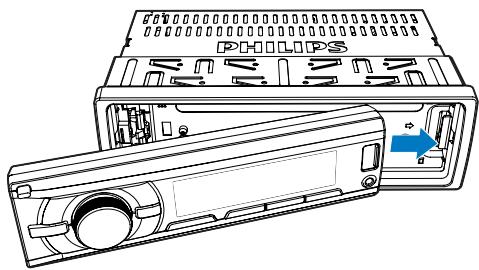
1 Insert the notch on the front panel to the chassis on the main unit.
natural_image
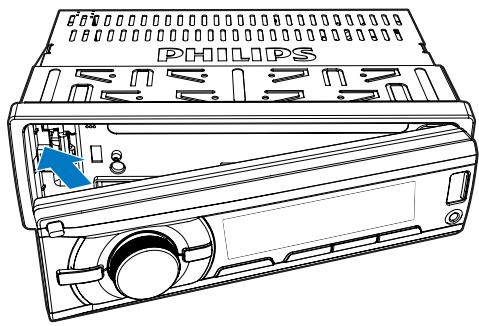
Technical line drawing of a Philips air conditioner unit with internal components and ventilation slots (no text or symbols)2 Press the left end of the front panel inwards until it is securely locked with a "click".
natural_image
Line drawing of a Philips air conditioner unit with ventilation grilles and a blue arrow indicating the component (no text or symbols beyond branding)Detach the front panel

Note
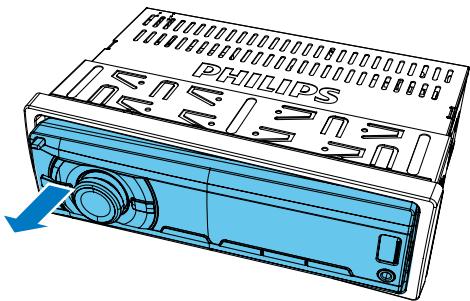
- Before you insert an SD/SDHC card or reset the system, detach the front panel.
- Before you detach the front panel, make sure that the system is turned off.
1 Press ▲ to release the front panel.
2 Pull the front panel outwards to remove it.
natural_image
3D technical illustration of a Philips device casing with a blue arrow indicating direction (no text or symbols on the diagram itself)4 Get started
For the first time use
1 Press ⏻ to turn on the system.
→ [PHILIPS] is displayed and the device turns to radio mode automatically.
Set the clock
1 Press and hold ▲ to access the system menu.
2 Press ▲ / ▼ repeatedly until [CLK] is displayed with time digits blinking.
3 Rotate Ⓞ ✦ anti-clockwise to set the hour.
4 Rotate ⏻ clockwise to set the minute.
Select a source
Press AS/SOURCE repeatedly to select a source.
• [RADIO]: Listen to FM/AM radio.
• [AUDIO IN]: Listen to the audio input through the AUDIO IN socket.
- [USB]: When a USB storage device is connected and recognized, you can select this source to play audio files that are stored on it.
- [SD/SDHC]: When an SD/SDHC card is inserted and recognized, you can select this source to play audio files that are stored on it.
5 Listen to radio
Select a tuner region
You can select a radio region that matches your location.
1 Press and hold ▲ to access the system menu.
2 Press ▲ / ▼ repeatedly until one of the following options is displayed.
• [AREA EUROPE] (Western Europe)
• [AREA ASIA] (Asia Pacific)
• [AREA M--EAST] (Middle East)
• [AREA AUST] (Australia)
• [AREA RUSSIA] (Russia)
• [AREA USA] (United States)
• [AREA LATIN] (Latin America)
3 Rotate to select a region.
Select a tuner sensitivity
To search for radio stations with strong signals only or more radio stations, you can change the tuner sensitivity.
1 Press and hold ▲ to access the system menu.
2 Press ▲ / ▼ repeatedly until [LOC ON] or [LOC OFF] is displayed.
3 Rotate ⏻ to select a setting.
• [LOC ON]: Search for radio stations with strong signals only.
• [LOC OFF]: Search for radio stations with strong and weak signals.
Enable the RDS function

Note
• The RDS function is enabled by default.
- Only when the RDS function is enabled, RDS related settings can be accessed.
1 Press and hold ▲ to access the system menu.
2 Press ▲ / ▼ repeatedly until [RDS ON] or [RDS OFF] is displayed.
3 Rotate ⏻ to select [RDS ON].
→ The RDS function is enabled.
- To disable the RDS function, rotate ⏻ to select [RDS OFF].
Search for a radio station
Search for a radio station automatically
Press ◀◀ or ▶▶I to search for the previous or next radio station with strong signals.
Search for a radio station manually
1 Press and hold ◀◀ or ▶▶ I until [M] blinks.
2 Press ◀◀ or ▶▶I repeatedly until the target frequency is displayed.
Store radio stations in memory

Note
- You can store a maximum of six stations in each band.
Store radio stations automatically
1 Switch the source to [RADIO].
2 Press BAND, ▲ MENU, or ▼ ZONE repeatedly to select a band.
3 Press and hold AS/SOURCE until [STORE---] is displayed.
→ After the search is complete, the first stored radio station is broadcast automatically.
• To select a stored radio station, press 1 ♪, ▶ 2, 3 REP, SHUF 4, 5, or ▶6.
Store radio stations manually
1 Press BAND, ▲ MENU, or ▼ ZONE repeatedly to select a tuner band.
2 Tune to the radio station that you want to store.
3 Press and hold 1 🎥, ▶2, 3 REP, SHUF 4, 5 , or ▶6 to store the radio station at the selected channel.
• To select a stored radio station, press 1 ⏻, ▼ 2, 3 REP, SHUF 4, 5, or ▶6.
6 Play from a storage device
natural_image
Line drawing of a CD-ROM device with a close-up of its internal port, showing no text or symbols.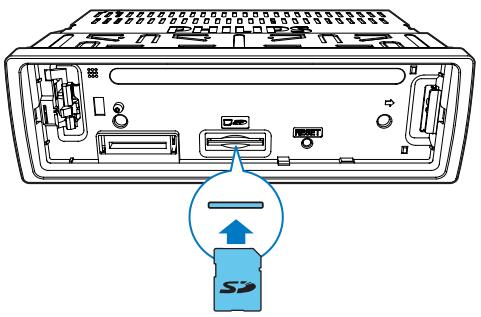
text_image
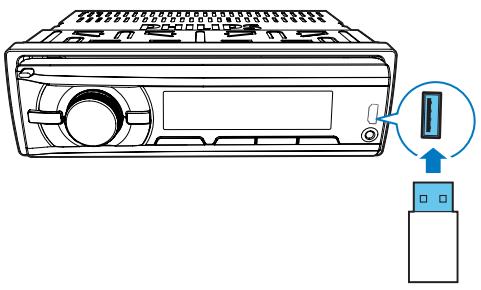
Diagram of a computer drive bay with labeled ports and an icon indicating upload or download process.1 Connect a compatible USB storage device or SD/SDHC card.
- For an SD/SDHC card, detach the front panel first, insert the card into the card slot, and then attach the front panel.
2 Switch the source to [USB] or [SD/SDHC].
- When a USB storage device is connected and recognized, the system switches the source to [USB] automatically.
3 If the play does not start, press ▶6.
| Button | Function |
| ▲/ ▼ | Press repeatedly to select a folder. |
| ▶II 6 | Pause or resume play. |
| I◀◀/ ▶▶▶I | Press to play the previous or next track. |
| I◀◀/ ▶▶▶I | Press and hold to rewind a track or search forward fast. |
| 4/DISP | Press repeatedly to display available information about the current track. |
| 3 REP | Press repeatedly to select a repeat mode:• [REP ONE]: repeat the current track,• [RPT FLD]: repeat all tracks in the current folder, or• [RPT ALL]: repeat all tracks in the storage device. |
| SHUF 4 | Press repeatedly to select a play mode:• [SHU ALL]: play all tracks randomly,• [SHU FLD]: play tracks in the current folder randomly, or• [SHU OFF]: play all tracks in the storage device in sequence. |
7 Use Bluetooth devices
With this car audio system, you can listen to audio from a player or make a call through Bluetooth.
Connect a device

Note
- Philips does not guarantee the compatibility with all Bluetooth devices.
- Before pairing a device with this system, read its user manual for Bluetooth compatibility.
- Make sure that Bluetooth function is enabled on your device, and your device is set as visible to all other Bluetooth devices.
- At one time, you can connect only one Bluetooth device to this system.
- The operational range between this system and a Bluetooth device is approximately 3 meters (9 feet).
- Any obstacle between this system and a Bluetooth device can reduce the operational range.
- Keep away from any other electronic device that may cause interference.
On your device, follow the steps below.
1 Search for Bluetooth devices.
2 In the device list, select CE135BT.
3 Enter the default password "0000", and then confirm the password entry.
If the pairing succeeds, [PAIRED] is displayed on the LCD screen of this system.
4 Enable or permit the connection with CE135BT.
→ If the connection succeeds, [CONNECTED] scrolls and ⚙ is displayed on the LCD screen of this system.
If the connection fails, [FAILED] is displayed on the LCD screen of this system.
Disconnect a device
1 Press and hold MENU to access the system menu.
2 Press ▲ / ▼ repeatedly until [DISCONN] is displayed.
3 Press ⏻
→ [WAIT] is displayed with -, --, and --- blinking alternately until [DISCNN OK] scrolls.

Tip
- You can also complete the disconnection on your device.
Reconnect a device
Some Bluetooth devices support the automatic reconnection with a paired Bluetooth device. If your device does not support automatic reconnection, reconnect it with this system manually.
1 Press and hold MENU to access the system menu.
2 Press ▲ / ▼ repeatedly until [CONNECT] is displayed.
3 Press ⏻
→ [WAIT] is displayed with -, --, and --- blinking alternately until [CONNECTED] scrolls or [FAILED] appears.
→ If [CONNECTED] scrolls, this system is reconnected to the last connected device.

Tip
- You can also complete the reconnection on your device.
Play audio from a Bluetooth device
If the connected Bluetooth device supports Advanced Audio Distribution Profile (A2DP), you can listen to tracks that are stored on the device through the system. If the device also supports Audio Video Remote Control Profile (AVRCP) profile, you can control play on the system or with its remote control.
1 Play a track on the connected device.
2 Press SOURCE repeatedly to switch the source to [BT AUDIO].
→ Play starts automatically.
• To pause or resume play, press ▶6.
- To skip to the previous or next track, press ◀◀◀ / ▶▶▶.

Note
- If the connected device does not support the AVRCP profile, control play on the connected device.
Make a call

Note
- Keep the Bluetooth connection active between the system and your mobile phone.
Call a number
On your mobile phone, call a number.
→ [CALLING] is displayed.
Pick up an incoming call
When the system receives an incoming call, the phone number or [PHONE IN] is displayed.
Press ↗ to answer the call.
Reject an incoming call
Press and hold 🔔 until [END] is displayed.
End a call
To end an on-going call, press 📞.
8 Listen to an external device
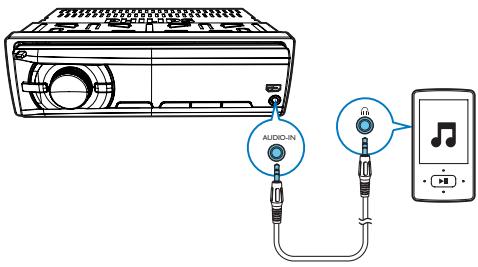
You can use the system to amplify the audio input from an external device, for example, MP3 player.
text_image
Diagram showing audio connection between a projector and a music player via audio jack, with labeled components and connections.1 Switch the source to AUDIO IN.
2 Connect an audio in cable to
- the AUDIO IN socket on the system, and
- the audio output socket (usually the headphone socket) on the external device.
3 Play the external device.
9 Charge your USB device
You can charge your USB device, for example, smart phone, with this product.

Note
- The output voltage through the USB socket is 5 V with output currency 0.5 A.
Connect your USB device to this product with USB cable. Once the USB device is connected and recognized, it begins to charge automatically.
10 Adjust sound
The following operations are applicable to all supported media.
| Button | Function |
| 1 ✘ | Rotate to increase or decrease the volume level. |
| 2 ✘ | Press to mute the speakers or release them from mute status. |
| 3000 AUDIO DBB | Press to enable or disable the maximum volume. |
| 3000 SOUND DBB | Press and hold to enable or disable the Dynamic Bass Boost (DBB) effect. |
| EQ AUDIO | Press repeatedly to select a sound equalizer. |
| EQ AUDIO | 1 Press and hold to activate the setup of customized sound equalizer.2 Press repeatedly to select an option: [BAS] (bass), [TRE] (treble), [BAL] (balance), or [FAD] (fader).3 Rotate 1 ✘ to adjust the setting. |
11 Reset the system
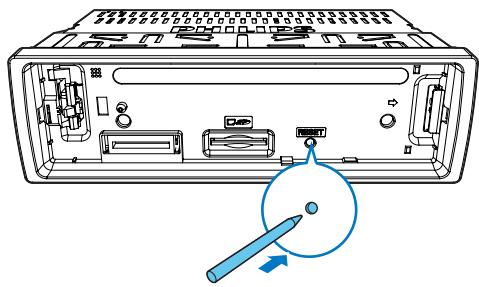
If the system works abnormally, reset the system to factory default settings.
natural_image
Diagram of a computer chassis showing internal components and a blue circular arrow pointing to a button (no text or symbols present)1 Detach the front panel.
2 Press the RESET button with the tip of a ball-point pen or toothpick.
All settings are reset to factory default.
12 Product information

Note
- Product information is subject to change without prior notice.
Product Information
General
| Power supply | 12 V DC (11 V - 16 V), negative ground |
| Fuse | 15 A |
| Suitable speaker impedance | 4 - 8 Ω |
| Maximum power output | 50 W × 4 |
| Continuous power output | 22 W × 4 RMS (4 Ω 10%T.H.D.) |
| Pre-Amp output voltage | 2.5 V |
| Aux-in level | ≥ 500 mV |
| Dimension (W× H × D) | 188 × 58 × 110 (mm) |
| Weight | 0.63 kg |
Radio
| Frequency range - FM | 87.5 - 108.0 MHz (100kHz per step in auto search and 50kHz per step in manual search) |
| Usable sensitivity - FM (S/N = 20 dB) | 8 μV |
| Frequency range - AM(MW) | 522 - 1620 KHz (9 kHz) |
| 530 - 1710 kHz (10 kHz) |
| Usable sensitivity - AM(MW) (S/N = 20 dB) | 30 μV |
Bluetooth
| Output power | Class 2 |
| Frequency band | 2.4000 GHz - 2.4835 GHz ISM Band |
| Range | 3 meters(free space) |
| Standard | Bluetooth 2.0 specification |
Compatible USB devices:
- USB flash memory: USB 1.1 host with interface reading all speed support (1.1, 2.0)
- USB flash players: USB 1.1 host with interface reading all speed support (1.1, 2.0)
Supported formats:
• USB or memory file format: FAT12, FAT16, FAT32
- MP3 bit rate (data rate): 32-320 Kbps and variable bit rate
• WMA V4, V7, V8, V9 (L1, L2)
• MP3 sampling frequencies: 8-48 kHz
- MP3 Bit-rates: 8\~320 (kbps), variable bit rates
• WMA sampling frequencies: 32 kHz, 44.1 kHz, 48 kHz
- WMA Bit-rates: 32\~192 (kbps), variable bit rates
- Directory nesting up to a maximum of 8 levels
• Number of albums/folders: CD maximum 99, USB or memory maximum 99
• Number of tracks/titles: CD maximum 999 (depending on number of album), USB or memory maximum 999
• ID3 tag v2.0 or later
Unsupported formats:
- Empty albums: an empty album is an album that does not contain MP3/WMA files, and is not be shown in the display.
- Unsupported file formats are skipped. For example, Word documents (.doc) or MP3 files with extension .dlf are ignored and not played.
• AAC, WAV, PCM audio files - DRM protected WMA files (.wav, .m4a, .m4p, .mp4, .aac)
• WMA files in Lossless format
13 Troubleshooting

Warning
• Never remove the casing of this product.
To keep the warranty valid, never try to repair the product yourself.
If you encounter problems when using this product, check the following points before requesting service. If the problem remains unsolved, go to the Philips Web page (www.philips.com/support). When you contact Philips, make sure that the product is nearby and the model number and serial number are available.
No power or no sound
- The power supply from car battery is cut off, or the car battery runs out of energy. Power the system with car battery.
- Car engine is not on. Turn the car engine on.
- Cable is not correctly connected. Check connections.
• The fuse is burnt. Replace the fuse.
• Volume is too low. Adjust volume. - If the above solutions cannot help, press the RESET button.
• Make sure that the current track is in a compatible format.
Noise during broadcast
• Signals are too weak. Select other stations with stronger signals.
• Check the connection of the car antenna.
- Change the broadcast setting from stereo to mono.
Preset stations are erased.
- Battery cable is not correctly connected. Connect the battery cable to the terminal that is always live.
Display shows ERR-12.
• Data error. Check the USB storage device or SD/SDHC card.
14 Notice
Any changes or modifications made to this device that are not expressly approved by WOOX Innovations may void the user's authority to operate the equipment.
Compliance
CE1177
This product complies with the radio interference requirements of the European Community.
A copy of the EC declaration of Conformity is available in the Portable Document Format (PDF) version of the user manual at www.philips.com/support.
Care of the environment

Your product is designed and manufactured with high quality materials and components, which can be recycled and reused.

When this crossed-out wheeled bin symbol is attached to a product it means that the product is covered by the European Directive 2002/96/EC. Please inform yourself about the local separate collection system for electrical and electronic products.
Please act according to your local rules and do not dispose of your old products with your normal household waste.
Correct disposal of your old product helps to prevent potential negative consequences for the environment and human health.
Environmental information
All unnecessary packaging has been omitted. We have tried to make the packaging easy to separate into three materials: cardboard (box), polystyrene foam (buffer) and polyethylene (bags, protective foam sheet.)
Your system consists of materials which can be recycled and reused if disassembled by a specialized company. Please observe the local regulations regarding the disposal of packaging materials, exhausted batteries and old equipment.
Trademark notice

Windows Media and the Windows logo are trademarks, or registered trademarks of Microsoft Corporation in the United States and/or other countries.
Other trademarks and trade names are those of their respective owners.
Copyright
2013 © WOOX Innovations Limited. All rights reserved.
Philips and the Philips' Shield Emblem are registered trademarks of Koninklijke Philips N.V. and are used by WOOX Innovations Limited under license from Koninklijke Philips N.V."
Specifications are subject to change without notice. WOOX reserves the right to change products at any time without being obliged to adjust earlier supplies accordingly.