
3111 - Montre CITIZEN WATCH - Notice d'utilisation et mode d'emploi gratuit
Retrouvez gratuitement la notice de l'appareil 3111 CITIZEN WATCH au format PDF.


| Type de produit | Montre analogique à quartz |
| Marque | CITIZEN WATCH |
| Modèle | 3111 |
| Mouvement | Quartz analogique |
| Précision | ±20 secondes par mois (à température normale) |
| Plage de température de fonctionnement | -10°C à +60°C |
| Pile | SR616SW (280-73) |
| Autonomie de la pile | Environ 2 ans |
| Affichage de l'heure | Heures, minutes, secondes par aiguilles |
| Fonction date | Indicateur de jour (31 jours, correction manuelle en fin de mois de 30 jours) |
| Sous-cadran | Deuxième fuseau horaire (réglable par incréments d'une heure) |
| Bague rotative | Échelle de calcul (navigation, conversion, multiplication, division, etc.) |
| Correction rapide du fuseau horaire | Oui, par pression sur le bouton A (recule d'une heure par pression) |
| Correction de la date | Oui, par couronne en position intermédiaire (rotation gauche incrémente, droite inopérante) |
| Étanchéité | Variable selon modèle (consulter les indications sur le cadran et le fond du boîtier) |
| Entretien du boîtier et du verre | Nettoyer avec un chiffon doux et sec |
| Entretien du bracelet métal | Laver à l'eau savonneuse avec une brosse douce, rincer et sécher |
| Entretien du bracelet cuir | Essuyer avec un chiffon doux et sec |
| Précautions d'utilisation | Éviter champs magnétiques, températures extrêmes (sauna, tableau de bord), chocs, solvants |
| Sécurité de la pile | Garder hors de portée des enfants ; remplacer par un professionnel dès que possible |
FOIRE AUX QUESTIONS - 3111 CITIZEN WATCH
Questions des utilisateurs sur 3111 CITIZEN WATCH
0 question sur cet appareil. Repondez a celles que vous connaissez ou posez la votre.
Poser une nouvelle question sur cet appareil
Téléchargez la notice de votre Montre au format PDF gratuitement ! Retrouvez votre notice 3111 - CITIZEN WATCH et reprennez votre appareil électronique en main. Sur cette page sont publiés tous les documents nécessaires à l'utilisation de votre appareil 3111 de la marque CITIZEN WATCH.
MODE D'EMPLOI 3111 CITIZEN WATCH
Sommaire
- Généralités 3 2. Structure 3
- Réglage de la montre principale 4
- Réglage de la date 5
- Réglage du sous-compteur 6
- Utilisation de la lunette graduée 10
- Précautions 16
- Spécifications 23
1. Généralités
Vous pouvez régler l'heure par incréments d'une heure grâce à un bouton-poussoir, sans arrêter la montre.
2. Structure
*L'apparence peut varier selon le modèle.
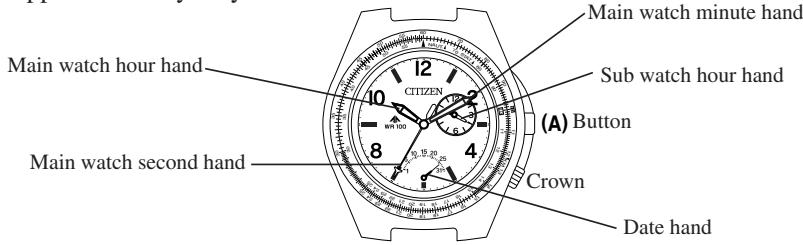
Le sous-compteur est synchronisé avec la montre principale. L'aiguille des jours indique la date de la montre principale.
3. Réglage de la montre principale
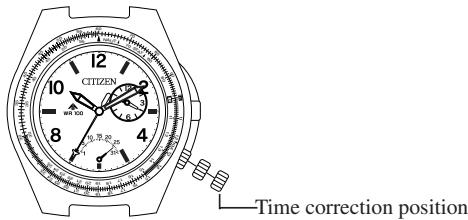
(1) Lorsque l'aiguille des secondes est à 0 seconde, tirez la couronne jusqu'à la position de réglage de l'heure. (2) Tournez la couronne pour régler la montre principale. - Le changement de date se produit à 0 h (minuit). Ne confondez pas AM et PM lors du réglage. - Pour un réglage plus précis, il est conseillé d'avancer l'aiguille des minutes de 4 à 5 minutes au-delà de l'heure exacte, puis de la reculer. (3) Après avoir réglé l'heure sur un signal horaire, remettez la couronne en position normale.
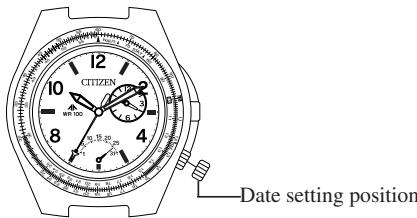
4. Réglage de la date
- L'aiguille des jours indique la date de la montre principale. (1) Tirez la couronne jusqu'à la position de réglage de la date. (2) Tournez la couronne pour régler la date.
- Tourner la couronne une fois vers la gauche incrémente la date. La tourner vers la droite ne fonctionne pas.
- La date varie sur une période de 31 jours. Lorsque le mois se termine le 30 ou plus tôt, vous devez régler la date manuellement le premier jour du mois suivant.
- Ne réglez pas la date entre 19h00 et 1h00, car la date pourrait ne pas s'incrémenter le lendemain. Déplacez l'aiguille et réglez la date en évitant cette plage horaire. Après le réglage, ajustez à nouveau la montre principale.
5. Réglage de la montre auxiliaire (correction du décalage horaire)
*Vous pouvez régler l'heure par incréments d'une heure par rapport à la montre principale.
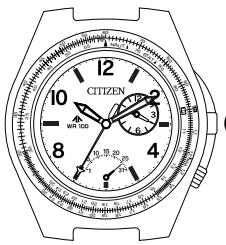
(1) Appuyez une fois sur le bouton (A) et l'aiguille des heures de la montre auxiliaire recule d'une heure (dans le sens inverse des aiguilles d'une montre).
Appuyez sur le bouton (A) autant de fois que nécessaire pour corriger le décalage horaire par rapport à la montre principale.
Bouton (A)
(Exemple) Pour régler la montre auxiliaire à l'heure de Londres lorsque la montre principale affiche 10h10 à Tokyo.
Le décalage horaire entre Tokyo et Londres est de -9 heures. Quand il est 10h10 à Tokyo, il est 1h10 à Londres. Pour corriger le décalage horaire :
(2) Appuyez neuf fois sur le bouton (A) pour reculer l'aiguille des heures de la montre auxiliaire de 9 heures, jusqu'à 1 heure.
| City name | Time difference | Daylight savings time | City name | Time difference | Daylight savings time |
| Universal time constant | ±0 | — | Tokyo | +9 | × |
| London | ±0 | ○ | Sydney | +10 | ○ |
| Paris | +1 | ○ | Noomea | +11 | × |
| Rome | +1 | ○ | Auckland | +12 | ○ |
| Cairo | +2 | ○ | Honolulu | -10 | × |
| Istanbul | +2 | ○ | Anchorage | -9 | ○ |
| Moscow | +3 | ○ | Los Angeles | -8 | ○ |
| Kuwait | +3 | × | Denver | -7 | ○ |
| Dubai | +4 | × | Chicago | -6 | ○ |
| Karachi | +5 | × | Mexico City | -6 | × |
| Dacca | +6 | × | New York | -5 | ○ |
| Bangkok | +7 | × | Montreal | -5 | ○ |
| Singapore | +8 | × | Caracas | -4 | × |
| Hong Kong | +8 | × | Rio de Janeiro | -3 | ○ |
| Beijing | +8 | × | Buenos Aires | -3 | × |
- Les villes (régions) qui utilisent l'heure d'été sont indiquées par un , tandis que celles qui ne l'utilisent pas sont indiquées par un ×.
- Le décalage horaire et l'utilisation de l'heure d'été de chaque ville peuvent changer selon le pays.
6. Utilisation de la lunette rotative
Le design de la lunette peut varier selon le modèle.
[Fonction de calcul]
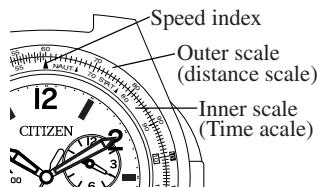
Veuillez noter les points suivants lors de l'utilisation de cette fonction. Utilisez la fonction de calcul de cette montre uniquement comme guide. Ces échelles n'indiquent pas la position du point décimal.
A. Calcul de navigation
1) Temps requis
Exemple : Obtenez le temps requis pour le vol d'un avion à 180 nœuds sur 450 milles marins.
Réponse : Alignez "18" sur l'échelle extérieure avec l'INDEX DE VITESSE (▲) sur l'échelle intérieure. Ensuite, "45" sur l'échelle extérieure correspond à "2:30" sur l'échelle intérieure (échelle de temps). Ainsi, le temps requis pour le vol est de 2 heures et 30 minutes.
2) Nœuds (vitesse de l'air)
Exemple : Obtenez les nœuds (vitesse de l'air) pour 240 milles marins avec un temps de vol de 1 heure et 20 minutes.
Réponse : Alignez "24" sur l'échelle extérieure avec "1:20" sur l'échelle intérieure (échelle de temps). Ensuite, l'INDEX DE VITESSE (▲) sur l'échelle intérieure correspond à "18" sur l'échelle extérieure. Ainsi, la vitesse de l'air pour le vol est de 180 nœuds.
3) Distance de vol
Exemple : Obtenez la distance aérienne lorsque la vitesse de l'air est de 210 nœuds et le temps de vol est de 40 minutes.
Réponse : Alignez « 21 » sur l'échelle extérieure avec l'INDEX DE VITESSE (▲) sur l'échelle intérieure. Ensuite, « 40 » sur l'échelle intérieure correspond à « 14 » sur l'échelle extérieure. Ainsi, la distance air du vol est de 140 milles marins.
4) Taux de consommation de carburant
Exemple : Obtenez le taux de consommation de carburant (gallons/heure) lorsque le temps de vol est de 30 minutes et la consommation de carburant est de 120 gallons.
Réponse : Alignez « 12 » sur l'échelle extérieure avec « 30 » sur l'échelle intérieure. Ensuite, l'INDEX DE VITESSE (▲) sur l'échelle intérieure correspond à « 24 » sur l'échelle extérieure. Ainsi, la consommation de carburant est de 240 gallons par heure.
5) Consommation de carburant
Exemple : Obtenez la consommation de carburant requise pour un vol lorsque le taux de consommation de carburant est de 250 gallons par heure et le temps de vol est de 6 heures.
Réponse : Alignez « 25 » sur l'échelle extérieure avec l'INDEX DE VITESSE (▲) sur l'échelle intérieure. Ensuite, « 6:00 » sur l'échelle intérieure (échelle de temps) correspond à « 15 » sur l'échelle extérieure. Ainsi, la consommation de carburant est de 1 500 gallons.
6) Temps de vol estimé
Exemple : Obtenez le temps de vol estimé lorsque le taux de consommation de carburant est de 220 gallons par heure et que l'avion a 550 gallons de carburant.
Réponse : Alignez « 22 » sur l'échelle extérieure avec l'INDEX DE VITESSE (▲) sur l'échelle intérieure. Ensuite, « 55 » sur l'échelle extérieure correspond à « 2:30 » sur l'échelle intérieure (échelle de temps). Ainsi, le temps de vol estimé est de 2 heures et 30 minutes.
7) Différence d'altitude
La différence d'altitude peut être obtenue à partir du taux de descente et du temps de descente.
Exemple : Obtenez la différence d'altitude lorsqu'un avion continue de descendre pendant 23 minutes à un taux de 250 pieds par minute.
Réponse : Alignez « 25 » sur l'échelle extérieure avec « 10 » sur l'échelle intérieure. Ensuite, « 23 » sur l'échelle intérieure correspond à « 57,5 » sur l'échelle extérieure. Ainsi, la différence d'altitude est de 5 750 pieds.
8) Taux de montée (ou de descente)
La vitesse de montée (ou de descente) peut être obtenue à partir du temps nécessaire pour atteindre une altitude.
Exemple : Obtenir la vitesse de montée lorsqu'un avion atteint une altitude de 7 500 pieds après avoir grimpé pendant 16 minutes.
Réponse : Alignez « 75 » sur l'échelle extérieure avec « 16 » sur l'échelle intérieure. Ensuite, « 10 » sur l'échelle intérieure correspond à « 47 » sur l'échelle extérieure. Ainsi, la vitesse de montée est de 470 pieds par minute.
9) Temps de montée (ou de descente)
Le temps nécessaire pour la montée peut être obtenu à partir de l'altitude à atteindre et de la vitesse de montée (ou de descente).
Exemple : Obtenir le temps de montée lorsqu'un avion doit monter à 6 300 pieds à une vitesse de 550 pieds par minute.
Réponse : Alignez « 55 » sur l'échelle extérieure avec « 10 » sur l'échelle intérieure. Ensuite, « 63 » sur l'échelle extérieure correspond à « 11,5 » sur l'échelle intérieure. Ainsi, le temps de montée est de 11 minutes et 30 secondes.
10) Conversion
Exemple : Convertir 30 milles terrestres en milles marins et en kilomètres.
Opération : Alignez « 30 » sur l'échelle extérieure avec STAT (▲) sur l'échelle intérieure. Ensuite, NAUT (▲) sur l'échelle intérieure correspond à « 26 » milles marins sur l'échelle extérieure, et « 12 km » (s) sur l'échelle intérieure correspond à « 48,2 » km sur l'échelle extérieure.
B. Fonctions de calcul générales
1) Multiplication
Exemple : 20 × 15
Opération : Alignez « 20 » sur l'échelle extérieure avec « 10 » sur l'échelle intérieure. Ensuite, « 15 » sur l'échelle intérieure correspond à « 30 » sur l'échelle extérieure. Tenez compte de la position de la virgule décimale et ajoutez un zéro pour obtenir 300. Notez qu'avec les échelles de cette montre, la position de la virgule décimale ne peut pas être obtenue.
2) Division
Exemple : 250/20
Opération : Alignez « 25 » sur l'échelle extérieure avec « 20 » sur l'échelle intérieure. Ensuite, « 10 » sur l'échelle intérieure correspond à « 12,5 » sur l'échelle extérieure. Tenez compte de la position de la virgule décimale pour obtenir 12,5.
3) Proportion
Exemple : 30 / 20 = 60 / x
Opération : Alignez « 30 » sur l'échelle extérieure avec « 20 » sur l'échelle intérieure. Ensuite, « 60 » sur l'échelle extérieure correspond à « 40 » sur l'échelle intérieure. À ce stade, la proportion pour chaque valeur sur les échelles intérieure et extérieure est de 30:20.
4) Racine carrée
Exemple : Racine carrée de 225
Opération : Tournez lentement l'échelle extérieure et trouvez une valeur qui correspond à la fois à « 22,5 » sur l'échelle extérieure et à « 10 » sur l'échelle intérieure. Dans cet exemple, « 22,5 » sur l'échelle extérieure correspond à « 15 » sur l'échelle intérieure, et « 10 » sur l'échelle intérieure correspond à « 15 » sur l'échelle extérieure. Ainsi, la réponse est 15.
7. Précautions
ATTENTION : Performance d'étanchéité à l'eau
Il existe plusieurs types de montres étanches, comme indiqué dans le tableau suivant.
L'unité « bar » est approximativement égale à 1 atmosphère.
- WATER RESIST(ANT) xx bar peut également être indiqué comme W.R. xx bar.
| Indication | Specification | |
| Dial | Case (Case back) | |
| WATER RESIST or no indication | WATER RESIST(ANT) | Water-resistant to 3 atmospheres |
| WR 50 or WATER RESIST 50 | WATER RESIST(ANT) 5 bar or WATER RESIST(ANT) | Water-resistant to 5 atmospheres |
| WR 100/200 or WATER RESIST 100/200 | WATER RESIST(ANT) 10bar/20 bar or WATER RESIST(ANT) | Water-resistant to 10 / 20 atmospheres |
Pour une utilisation correcte dans les limites de conception de la montre, confirmez le niveau d'étanchéité à l'eau de votre montre, comme indiqué sur le cadran et le boîtier, et consultez le tableau.
| Examples of use | ||||
| Minor exposure to water (washing face, rain, etc.) | Moderate exposure to water (washing, kitchen work, swimming, etc.) | Marine sports (skin diving) | Scuba diving (with air tank) | Operation of the crown or button with moisture visible |
| OK | NO | NO | NO | NO |
| OK | OK | NO | NO | NO |
| OK | OK | OK | NO | NO |
- Étanchéité à l'eau pour un usage quotidien (jusqu'à 3 atmosphères) : Ce type de montre est étanche à une exposition mineure à l'eau. Par exemple, vous pouvez porter la montre en vous lavant le visage ; cependant, elle n'est pas conçue pour être utilisée sous l'eau.
- Étanchéité améliorée pour un usage quotidien (jusqu'à 5 atmosphères) : Ce type de montre résiste à une exposition modérée à l'eau. Vous pouvez porter la montre en nageant ; cependant, elle n'est pas conçue pour la plongée sous-marine.
- Étanchéité améliorée pour un usage quotidien (jusqu'à 10/20 atmosphères) : Ce type de montre peut être utilisé pour la plongée sous-marine ; cependant, elle n'est pas conçue pour la plongée avec bouteilles ou la plongée saturée utilisant de l'hélium.
ATTENTION
- N'actionnez PAS la couronne ou les boutons avec des doigts mouillés ou lorsque la montre est mouillée. L'eau peut pénétrer dans la montre et compromettre son étanchéité.
- Si la montre est utilisée dans l'eau de mer, rincez-la à l'eau douce après utilisation et essuyez-la avec un chiffon sec.
- Si de l'humidité a pénétré dans la montre, ou si l'intérieur du verre est embué et ne devient pas clair en un jour, apportez immédiatement la montre à votre revendeur ou au centre de service Citizen pour réparation. Laisser la montre dans un tel état permettra la formation de corrosion à l'intérieur.
- Si de l'eau de mer pénètre dans la montre, placez la montre dans une boîte ou un sac en plastique et apportez-la immédiatement pour réparation. Sinon, la pression à l'intérieur de la montre augmentera et des pièces (verre, couronne, boutons, etc.) pourraient se détacher.
ATTENTION : Gardez votre montre propre.
- La poussière et la saleté ont tendance à se déposer dans les interstices du fond du boîtier ou du bracelet. La poussière et la saleté accumulées peuvent provoquer de la corrosion et tacher vos vêtements. Nettoyez la montre de temps en temps.
Nettoyage de la montre
- Utilisez un chiffon doux pour essuyer la saleté, la transpiration et l'eau du boîtier et du verre.
- Utilisez un chiffon doux et sec pour essuyer la transpiration et la saleté du bracelet en cuir.
- Pour nettoyer un bracelet en métal, en plastique ou en caoutchouc, lavez la saleté avec de l'eau savonneuse douce. Utilisez une brosse douce pour enlever la poussière et la saleté coincées dans les interstices du bracelet en métal. Si votre montre n'est pas étanche, apportez-la à votre revendeur.
REMARQUE : Évitez d'utiliser des solvants (diluant, benzine, etc.), car ils peuvent altérer le fini.
AVERTISSEMENT : Manipulation de la pile
- Gardez la pile hors de portée des jeunes enfants. Si un enfant avale la pile, contactez immédiatement un médecin.
ATTENTION : Remplacement de la pile
- Pour le remplacement de la pile, confiez votre montre à votre revendeur ou au centre de service Citizen.
- Remplacez la pile dès que possible si sa durée de vie est expirée. Laisser une pile usagée dans la montre peut provoquer une fuite, ce qui peut gravement endommager la montre.
ATTENTION : Environnement d'utilisation
- Utilisez la montre dans la plage de température de fonctionnement spécifiée dans le manuel d'instructions.
L'utilisation de la montre à des températures en dehors de la plage spécifiée peut entraîner une détérioration des fonctions ou même l'arrêt de la montre.
- N'utilisez PAS la montre dans des endroits exposés à des températures élevées, comme un sauna.
Cela peut provoquer des brûlures cutanées.
- Ne laissez PAS la montre dans un endroit exposé à des températures élevées, comme la boîte à gants ou le tableau de bord d'une voiture.
Cela peut entraîner une détérioration de la montre, comme la déformation des pièces en plastique.
- Ne placez PAS la montre à proximité d'un aimant.
La précision du chronométrage sera altérée si vous placez la montre près d'équipements de santé magnétiques tels qu'un collier magnétique, une fermeture magnétique de porte de réfrigérateur ou de sac à main, ou l'écouteur d'un téléphone portable. Si cela se produit, éloignez la montre de l'aimant et réglez à nouveau l'heure.
- Ne placez pas la montre à proximité d'appareils électroménagers générant de l'électricité statique.
Le fonctionnement peut devenir inexact si la montre est exposée à une forte électricité statique, comme celle émise par un écran de télévision.
- Ne soumettez pas la montre à un choc violent, comme la faire tomber sur un sol dur.
- Évitez d'utiliser la montre dans un environnement où elle pourrait être exposée à des produits chimiques ou à des gaz corrosifs.
Si des solvants, tels que le diluant et la benzine, ou des substances contenant de tels solvants entrent en contact avec la montre, une décoloration, une fusion, des fissures, etc. peuvent en résulter. Si la montre entre en contact avec le mercure utilisé dans les thermomètres, le boîtier, le bracelet ou d'autres pièces peuvent se décolorer.
8. Spécifications
Modèle : 3111 - Type : montre à quartz analogique - Précision : ± 20 secondes par mois (lorsqu'elle est portée à des températures normales de +5 °C à +35 °C / 41 °F à 95 °F) - Plage de température de fonctionnement : -10 °C à +60 °C / 14 °F à 140 °F - Circuit intégré : C/MOS-LSI (un) Caractéristiques supplémentaires : sous-cadran Date (avec correction facile) - Pile : petite pile argent (une) Durée de vie de la pile : environ 2 ans Référence de la pile : 280-73 (SR616SW)
- Les spécifications sont sujettes à modification sans préavis pour amélioration.


- SOMMAIRE
- GÉNÉRALITÉS
- STRUCTURE
- RÉGLAGE DE LA MONTRE PRINCIPALE
- RÉGLAGE DE LA DATE
- RÉGLAGE DE LA MONTRE AUXILIAIRE (CORRECTION DU DÉCALAGE HORAIRE)
- UTILISATION DE LA LUNETTE ROTATIVE
- CALCUL DE NAVIGATION
- TEMPS DE VOL ESTIMÉ
- DIFFÉRENCE D'ALTITUDE
- TAUX DE MONTÉE (OU DE DESCENTE)
- TEMPS DE MONTÉE (OU DE DESCENTE)
- CONVERSION
- FONCTIONS DE CALCUL GÉNÉRALES
- MULTIPLICATION
- DIVISION
- PROPORTION
- RACINE CARRÉE
- PRÉCAUTIONS
- ATTENTION : PERFORMANCE D'ÉTANCHÉITÉ À L'EAU
- ATTENTION
- ATTENTION : GARDEZ VOTRE MONTRE PROPRE
- NETTOYAGE DE LA MONTRE
- AVERTISSEMENT : MANIPULATION DE LA PILE
- ATTENTION : REMPLACEMENT DE LA PILE
- ATTENTION : ENVIRONNEMENT D'UTILISATION
- SPÉCIFICATIONS
Marque : CITIZEN WATCH
Modèle : 3111
Catégorie : Montre