
3111 - Wristwatch CITIZEN WATCH - Free user manual and instructions
Find the device manual for free 3111 CITIZEN WATCH in PDF.


| Product Type | Analog quartz watch |
| Brand | CITIZEN WATCH |
| Model | 3111 |
| Movement | Analog quartz |
| Accuracy | ±20 seconds per month (at normal temperature) |
| Operating temperature range | -10°C to +60°C |
| Battery | SR616SW (280-73) |
| Battery life | Approximately 2 years |
| Time display | Hours, minutes, seconds by hands |
| Date function | Day indicator (31 days, manual correction at end of 30-day months) |
| Sub-dial | Second time zone (adjustable in one-hour increments) |
| Rotating bezel | Calculation scale (navigation, conversion, multiplication, division, etc.) |
| Quick time zone correction | Yes, by pressing button A (retreats one hour per press) |
| Date correction | Yes, by crown in intermediate position (left rotation increments, right rotation ineffective) |
| Water resistance | Varies by model (refer to indications on dial and case back) |
| Care of case and crystal | Clean with a soft, dry cloth |
| Care of metal bracelet | Wash with soapy water using a soft brush, rinse and dry |
| Care of leather strap | Wipe with a soft, dry cloth |
| Usage precautions | Avoid magnetic fields, extreme temperatures (sauna, dashboard), shocks, solvents |
| Battery safety | Keep out of reach of children; replace by a professional as soon as possible |
Frequently Asked Questions - 3111 CITIZEN WATCH
User questions about 3111 CITIZEN WATCH
0 question about this device. Answer the ones you know or ask your own.
Ask a new question about this device
Download the instructions for your Wristwatch in PDF format for free! Find your manual 3111 - CITIZEN WATCH and take your electronic device back in hand. On this page are published all the documents necessary for the use of your device. 3111 by CITIZEN WATCH.
USER MANUAL 3111 CITIZEN WATCH
- General 3 2. Structure 3
- Adjusting the main watch 4
- Adjusting the date 5
- Adjusting the sub-watch 6
- Using the Register Ring 10
- Precautions 16
- Specifications 23
1. General
You can adjust the time in units of hour by one-touch button operation without stopping the watch.
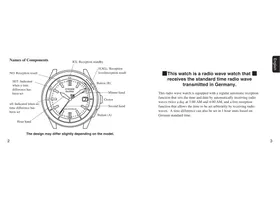
2. Structure
*Appearance may vary with model.
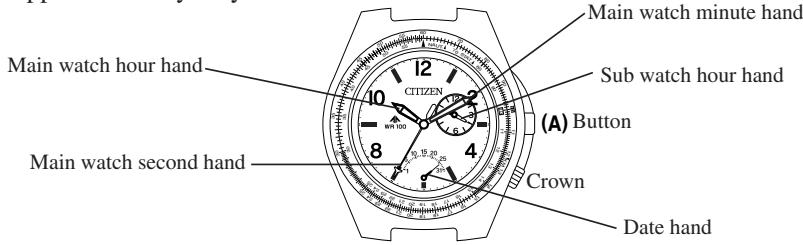
The sub-watch is synchronous with the main watch. The day hand indicates the date of the main watch.
3. Adjusting the main watch
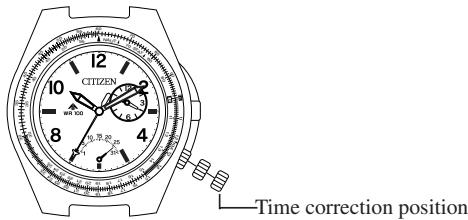
(1) When the second hand is at 0 second, pull the crown out to the position where you can adjust the time. (2) Turn the crown to adjust the main watch. - It is at 0:00 am when the date increments. Don't mistake am for pm when adjusting the time. - To adjust the time more accurately, it will be convenient to advance the minute hand 4-5 minutes ahead of the right value and turn it back. (3) After adjusting the time in reference to a time signal, return the crown to the normal position.
4. Adjusting the date
- The day hand indicates the date of the main watch. (1) Pull the crown out to the position where you can adjust the date. (2) Turn the crown to adjust the date.
- Turning the crown once to the left will increment the date value. Turning it to the right does not work.
- The date varies in a period of 31 days. When the month ends at the 30th or earlier, you have to adjust the date at the first of the next month manually.
- Don't adjust the date in between 7:00 pm and 1:00 am because the date might not increment on the next day. Move the hand and adjust the date, avoiding that time zone. After adjustment, adjust the main watch again.
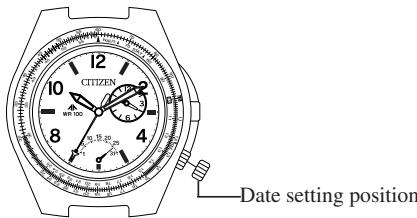
5. Adjusting the sub-watch (correcting time difference)
*You can adjust the time in units of hour in reference to the main watch.
(1) Press the (A)-button once and the hour hand of the sub-watch goes back by an hour (counterclockwise).
Press the (A)-button as many times as needed to correct time difference in reference to the main watch.
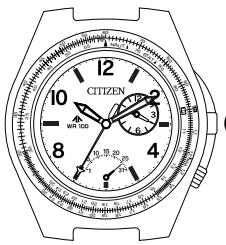
(A) Button
(Example) To adjust the sub-watch to the time at London when the main watch reads 10:10 am at Tokyo.
The time difference between Tokyo and London is -9 hours. When it is 10:10 am at Tokyo, the time at London is 1:10 am. To correct the time difference:
(2) Press the (A)-button nine times to move the hour hand of the sub-watch 9 hours back to 1 o'clock.
| City name | Time difference | Daylight savings time | City name | Time difference | Daylight savings time |
| Universal time constant | ±0 | — | Tokyo | +9 | × |
| London | ±0 | ○ | Sydney | +10 | ○ |
| Paris | +1 | ○ | Noomea | +11 | × |
| Rome | +1 | ○ | Auckland | +12 | ○ |
| Cairo | +2 | ○ | Honolulu | -10 | × |
| Istanbul | +2 | ○ | Anchorage | -9 | ○ |
| Moscow | +3 | ○ | Los Angeles | -8 | ○ |
| Kuwait | +3 | × | Denver | -7 | ○ |
| Dubai | +4 | × | Chicago | -6 | ○ |
| Karachi | +5 | × | Mexico City | -6 | × |
| Dacca | +6 | × | New York | -5 | ○ |
| Bangkok | +7 | × | Montreal | -5 | ○ |
| Singapore | +8 | × | Caracas | -4 | × |
| Hong Kong | +8 | × | Rio de Janeiro | -3 | ○ |
| Beijing | +8 | × | Buenos Aires | -3 | × |
- Cities (regions) in which daylight savings time is used are indicated with a , while those in which it is not are indicated with an × .
- The time difference and use of daylight savings time of each city are subject to change by the particular country.
6. Using the Register Ring
The bezel design may vary depending on the model.
[Calculation function]
Note the following points when using this function. Use the calculation function of this watch only as a guide. These scales do not indicate the position of the decimal point.
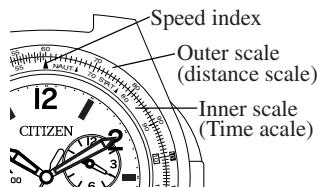
A. Navigational calculation
1) Time required
Example: Obtain the time required for the flight of an aircraft at 180 knots for 450 nautical miles.
Answer: Align "18" on the outer scale with the SPEED INDEX (▲) on the inner scale. Then, "45" on the outer scale corresponds to "2:30" on the inner scale (time scale). Thus, the time required for the flight is 2 hours and 30 minutes.
2) Knots (air speed)
Example: Obtain the knots (air speed) for 240 nautical miles with a flight time of 1 hour and 20 minutes.
Answer: Align "24" on the outer scale with "1:20" on the inner scale (time scale). Then, the SPEED INDEX (▲) on the inner scale corresponds to "18" on the outer scale. Thus, the air speed for the flight is 180 knots.
3) Flight distance
Example: Obtain the air distance when the air speed is 210 knots and the flight time is 40 minutes.
Answer: Align "21" on the outer scale with the SPEED INDEX (▲) on the inner scale. Then, "40" on the inner scale corresponds to "14" on the outer scale. Thus, the air distance of the flight is 140 nautical miles.
4) Rate of fuel consumption
Example: Obtain the rate of fuel consumption (gallons per hour) when the flight time is 30 minutes and the fuel consumption is 120 gallons.
Answer: Align "12" on the outer scale with "30" on the inner scale. Then, the SPEED INDEX (▲) on the inner scale corresponds to "24" on the outer scale. Thus, the fuel consumption is 240 gallons per hour.
5) Fuel consumption
Example: Obtain the fuel consumption required for a flight when the rate of fuel consumption is 250 gallons per hour and the flight time is 6 hours.
Answer: Align "25" on the outer scale with the SPEED INDEX (▲) on the inner scale. Then, "6:00" on the inner scale (time scale) corresponds to "15" on the outer scale. Thus, the fuel consumption is 1,500 gallons.
6) Estimated flight time
Example: Obtain the estimated flight time when the rate of fuel consumption is 220 gallons per hour and the aircraft has 550 gallons of fuel.
Answer: Align "22" on the outer scale with the SPEED INDEX (▲) on the inner scale. Then, "55" on the outer scale corresponds to "2:30" on the inner scale (time scale). Thus, the estimated flight time is 2 hours and 30 minutes.
7) Difference in altitude
The difference in altitude can be obtained from the rate of descent and the descent time.
Example: Obtain the difference in altitude when an aircraft continues descending for 23 minutes at a rate of 250 feet per minute.
Answer: Align "25" on the outer scale with "10" on the inner scale. Then, "23" on the inner scale corresponds to "57.5" on the outer scale. Thus, the difference in altitude is 5,750 feet.
8) Rate of climb (or descent)
The rate of climb (or descent) can be obtained from the time required to reach an altitude.
Example: Obtain the rate of climb when an aircraft reaches an altitude of 7,500 feet after climbing for 16 minutes.
Answer: Align "75" on the outer scale with "16" on the inner scale. Then, "10" on the inner scale corresponds to "47" on the outer scale. Thus, the rate of climb is 470 feet per minute.
9) Time of climb (or descent)
The time required for climb can be obtained from the altitude to be reached and the rate of climb (or descent).
Example: Obtain the time of climb when an aircraft is to climb to 6,300 feet at a rate of 550 feet per minute.
Answer: Align "55" on the outer scale with "10" on the inner scale. Then, "63" on the outer scale corresponds to "11.5" on the inner scale. Thus, the time of climb is 11 minutes and 30 seconds.
10) Conversion
Example: Convert 30 statute miles into nautical miles and kilometers.
Operation: Align "30" on the outer scale with STAT (▲) on the inner scale. Then, NAUT (▲) on the inner scale corresponds to "26" nautical miles on the outer scale, and "12 km" (s) on the inner scale corresponds to "48.2" km on the outer scale.
B. General Calculation Functions
1) Multiplication
Example: 20 × 15
Operation: Align "20" on the outer scale with "10" on the inner scale. Then, "15" on the inner scale corresponds to "30" on the outer scale. Take into account the position of the decimal point and add one zero to obtain 300. Note that with the scales of this watch, the position of the decimal point cannot be obtained.
2) Division
Example: 250/20
Operation: Align "25" on the outer scale with "20" on the inner scale. Then, "10" on the inner scale corresponds to "12.5" on the outer scale. Take into account the position of the decimal point to obtain 12.5.
3) Proportion
Example: 30 / 20 = 60 / x
Operation: Align "30" on the outer scale with "20" on the inner scale. Then, "60" on the outer scale corresponds to "40" on the inner scale. At this point, the proportion for every value on the inner and outer scales is 30:20.
4) Square root
Example: Square root of 225
Operation: Turn the outer scale slowly and find a value that corresponds to both "22.5" on the outer scale and "10" on the inner scale. In this example, "22.5" on the outer scale corresponds to "15" on the inner scale, and "10" on the inner scale corresponds to "15" on the outer scale. Thus, the answer is 15.
7. Precautions
CAUTION: Water-resistance performance
There are several types of water-resistant watches, as shown in the following table.
The unit "bar" is roughly equal to 1 atmosphere.
- WATER RESIST(ANT) xx bar may also be indicated as W.R. xx bar.
| Indication | Specification | |
| Dial | Case (Case back) | |
| WATER RESIST or no indication | WATER RESIST(ANT) | Water-resistant to 3 atmospheres |
| WR 50 or WATER RESIST 50 | WATER RESIST(ANT) 5 bar or WATER RESIST(ANT) | Water-resistant to 5 atmospheres |
| WR 100/200 or WATER RESIST 100/200 | WATER RESIST(ANT) 10bar/20 bar or WATER RESIST(ANT) | Water-resistant to 10 / 20 atmospheres |
For correct use within the design limits of the watch, confirm the level of water-resistance of your watch, as indicated on the dial and case, and consult the table.
| Examples of use | ||||
| Minor exposure to water (washing face, rain, etc.) | Moderate exposure to water (washing, kitchen work, swimming, etc.) | Marine sports (skin diving) | Scuba diving (with air tank) | Operation of the crown or button with moisture visible |
| OK | NO | NO | NO | NO |
| OK | OK | NO | NO | NO |
| OK | OK | OK | NO | NO |
- Water-resistance for daily use (to 3 atmospheres): This type of watch is water-resistant to minor exposure to water. For example, you may wear the watch while washing your face; however, it is not designed for use underwater.
- Upgraded water-resistance for daily use (to 5 atmospheres): This type of watch is water-resistant to moderate exposure to water. You may wear the watch while swimming; however, it is not designed for use while skin diving.
- Upgraded water-resistance for daily use (to 10/20 atmospheres): This type of watch may be used for skin diving; however, it is not designed for scuba or saturated diving using helium gas.
CAUTION
- Do NOT operate the crown or button with wet fingers or when the watch is wet. Water may enter the watch and compromise water-resistance.
- If the watch is used in seawater, rinse with fresh water afterward and wipe with a dry cloth.
- If moisture has entered the watch, or if the inside of the crystal is fogged up and does not become clear within a day, immediately take the watch to your dealer or Citizen Service Center for repair. Leaving the watch in such a state will allow corrosion to form inside.
- If seawater enters the watch, place the watch in a box or plastic bag and immediately take it in for repair. Otherwise, pressure inside the watch will increase, and parts (crystal, crown, buttons, etc.) may come off.
CAUTION: Keep your watch clean.
- Dust and dirt tend to be deposited in gaps in the back of the case or band. Deposited dust and dirt may cause corrosion and soil your clothing. Clean the watch occasionally.
Cleaning the Watch
- Use a soft cloth to wipe off dirt, perspiration and water from the case and crystal.
- Use a soft, dry cloth to wipe off perspiration and dirt from the leather band.
- To clean a metal, plastic, or rubber watchband, wash away dirt with mild soap and water. Use a soft brush to remove dust and dirt jammed in the gaps in the metal band. If your watch is not water-resistant, take it to your dealer.
NOTE: Avoid using solvents (thinner, benzine, etc.), as they may mar the finish.
WARNING: Handling of the battery
- Keep the battery out of the reach of small children. If a child swallows the battery, contact a physician immediately.
CAUTION: Replacing the battery
- For replacement of the battery, take your watch to your dealer or Citizen Service Center.
- Replace the battery as soon as possible if the service life of the battery has expired. Leaving a depleted battery in the watch may result in leakage, which can damage the watch severely.
CAUTION: Operating environment
- Use the watch within the operating-temperature range specified in the instruction manual.
Using the watch where temperatures are outside the specified range may result in deterioration of functions or even stoppage of the watch.
- Do NOT use the watch in places where it is exposed to high temperature, such as in a sauna.
Doing so may result in a skin burn.
- Do NOT leave the watch in a place where it is exposed to high temperature, such as the glove compartment or dashboard of a car.
Doing so may result in deterioration of the watch, such as deformation of plastic parts.
- Do NOT place the watch close to a magnet.
Timekeeping will become inaccurate if you place the watch close to magnetic health equipment such as a magnetic necklace or a magnetic latch of a refrigerator door or handbag clasp or the earphone of a mobile phone. If this has occurred, move the watch away from the magnet and reset the time.
- Do NOT place the watch close to household appliances that generate static electricity.
Timekeeping may become inaccurate if the watch is exposed to strong static electricity, such as that emitted from a TV screen.
- Do NOT subject the watch to a strong shock such as dropping it onto a hard floor.
- Avoid using the watch in an environment where it may be exposed to chemicals or corrosive gases.
If solvents, such as thinner and benzine, or substances containing such solvents come in contact with the watch, discoloration, melting, cracking, etc. may result. If the watch comes in contact with mercury used in thermometers, the case, band, or other parts may become discolored.
8. Specifications
Model: 3111 - Type: analog quartz watch - Accuracy: Within ±20 seconds per month (when worn at normal temperatures +5°C to +35°C / 41°F to 95°F) - Operating temperature range: -10°C to +60°C / 14°F to 140°F - IC: C/MOS-LSI (one) Additional features: sub-watch Date (with easy correction) - Battery: small silver battery (one) Battery life: Approximately 2 years Battery No.: 280-73 (SR616SW)
- Specifications are subject to change for improvement without prior notice.


- GENERAL
- STRUCTURE
- ADJUSTING THE MAIN WATCH
- ADJUSTING THE DATE
- ADJUSTING THE SUB-WATCH (CORRECTING TIME DIFFERENCE)
- USING THE REGISTER RING
- NAVIGATIONAL CALCULATION
- ESTIMATED FLIGHT TIME
- DIFFERENCE IN ALTITUDE
- RATE OF CLIMB (OR DESCENT)
- TIME OF CLIMB (OR DESCENT)
- CONVERSION
- GENERAL CALCULATION FUNCTIONS
- MULTIPLICATION
- DIVISION
- PROPORTION
- SQUARE ROOT
- PRECAUTIONS
- CAUTION: WATER-RESISTANCE PERFORMANCE
- CAUTION
- CAUTION: KEEP YOUR WATCH CLEAN
- CLEANING THE WATCH
- WARNING: HANDLING OF THE BATTERY
- CAUTION: REPLACING THE BATTERY
- CAUTION: OPERATING ENVIRONMENT
- SPECIFICATIONS
Brand : CITIZEN WATCH
Model : 3111
Category : Wristwatch