
G67 - Wristwatch CITIZEN WATCH - Free user manual and instructions
Find the device manual for free G67 CITIZEN WATCH in PDF.


| Brand | CITIZEN WATCH |
| Model | G67 |
| Type | Analog solar-powered watch |
| Movement | Quartz (32,768 Hz) |
| Precision | ±15 seconds per month on average (at normal temperature) |
| Display | Hour and minute hands |
| Power supply | Solar cell + rechargeable secondary battery |
| Power reserve (full charge) | Approximately 8 months |
| Power reserve after warning | Approximately 8 days |
| Insufficient charge warning function | Yes (minute hand moves every minute) |
| Overcharge prevention function | Yes |
| Time setting reminder function | Yes (irregular movement after stop) |
| Operating temperature | −10°C to +60°C |
| Water resistance | Varies by model (see indications on dial and case) |
| Case and glass maintenance | Soft cloth |
| Leather strap maintenance | Dry cloth |
| Metal, plastic or rubber strap maintenance | Soapy water and soft brush |
| Avoid cleaning with | Solvents (thinner, benzene, etc.) |
| Usage precautions | Avoid magnetic fields, strong shocks, high temperatures (sauna, dashboard), chemicals |
| Recommended periodic inspection | Every 2 to 3 years |
| Replacement parts | Use genuine Citizen parts |
| Secondary battery | Rechargeable, not replaceable periodically; do not use any other type of battery |
Frequently Asked Questions - G67 CITIZEN WATCH
User questions about G67 CITIZEN WATCH
0 question about this device. Answer the ones you know or ask your own.
Ask a new question about this device
Download the instructions for your Wristwatch in PDF format for free! Find your manual G67 - CITIZEN WATCH and take your electronic device back in hand. On this page are published all the documents necessary for the use of your device. G67 by CITIZEN WATCH.
USER MANUAL G67 CITIZEN WATCH
- Features 3 2. Before Using 4
- Setting the Time 5
- Unique Functions of Solar-Powered Watches 6
Insufficient Charge Warning Function - Time Setting Warning Function Overcharge Prevention Function
- Charging Times 10
- Handling Precautions 12
- Charging Precautions
- Replacing the Secondary Battery 13
- Precautions 14
- Specifications 20
1. Features
This watch is a small-size woman's solar-powered watch with two hands, provided with a solar cell beneath the dial that converts light energy into electrical energy to power the watch.
2. Before Using
This watch is a solar-powered watch.
Before using it, charge the watch sufficiently by exposing it (the face) to light.
- In the case the watch has stopped moving due to an insufficient charge, charge the watch by exposing it to sunlight or other intense light.
This watch uses a secondary battery to store electrical energy. This secondary battery is a clean energy battery that does not contain mercury or other harmful substances. Once fully charged, the watch will continue to run for about eight months without recharging.
In order to use this watch comfortably, try to keep the watch charged at all times. There is no risk of overcharging no matter how often the watch is charged.
It is recommended to try to charge the watch every day.
3. Setting the Time
(1) Pull the crown out to the time correction position. (2) Turn the crown to set the time. (3) The watch will start to run when the crown is securely pushed in to the normal position.
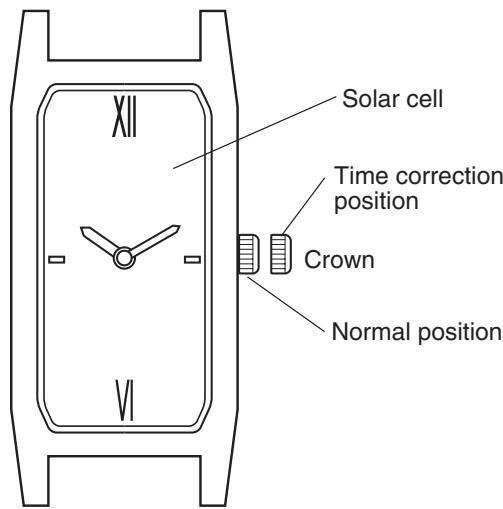
The design may differ according to the model.
4. Unique Functions of Solar-Powered Watches
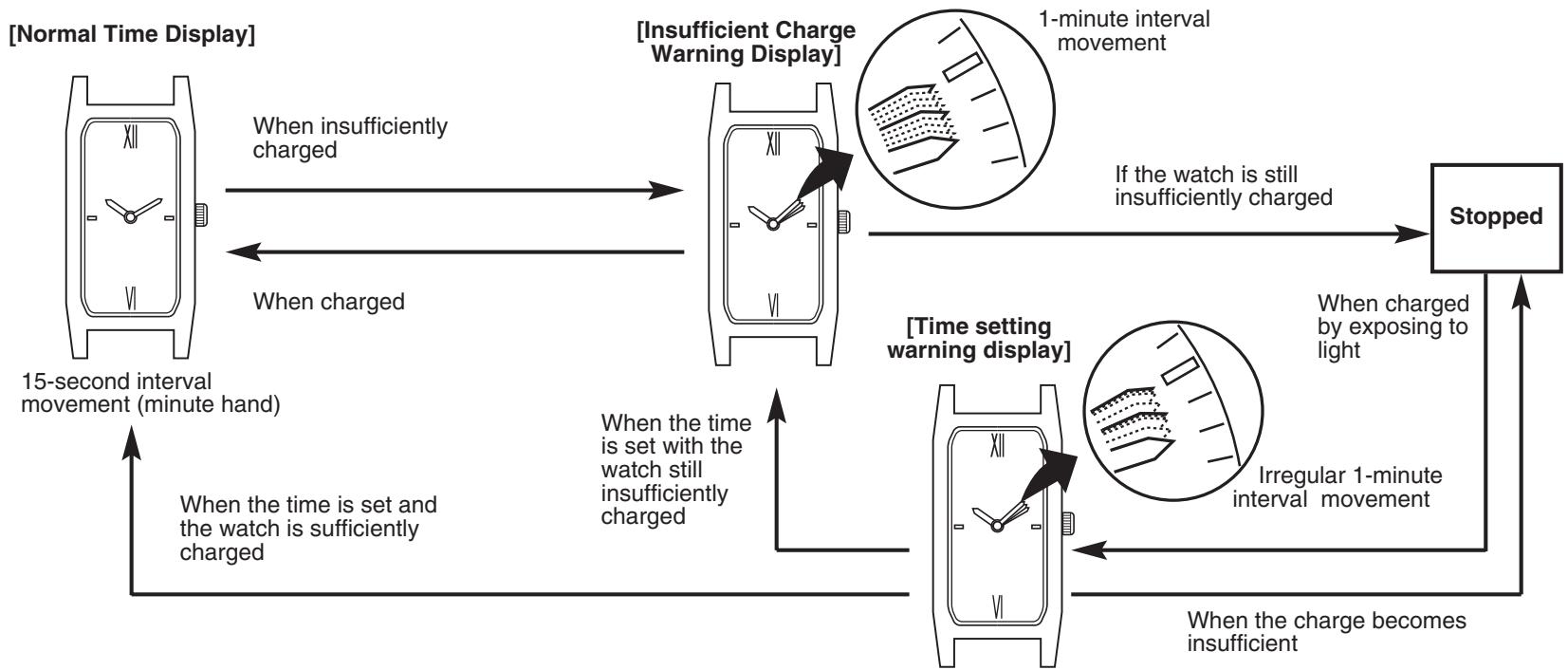
This watch is provided with a function that causes a warning function to be activated when the watch is insufficiently charged that alters the display to inform the wearer of insufficient charge.
Insufficient Charge Warning Function>
The minute hand moves by 1-minute interval movement (in which the minute hand moves regularly every minute) to indicate that the watch is insufficiently charged. Although the watch will keep the correct time at this time, after about 8 days have passed since the start of 1-minute interval movement, the watch ends up stopping as a result of being insufficiently charged. Sufficiently recharge the watch by exposing to light so that the minute hand returns to normal movement (in which the minute hand moves every 15 seconds).
[1-minute interval movement]: Minute hand moves regularly once every minute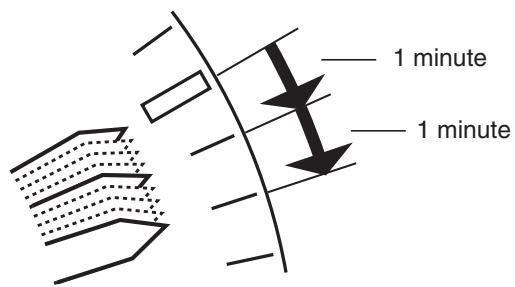
Although the watch hands will begin to move when again exposed to light after the watch has stopped, since the time is incorrect, the minute hand moves in irregular 1-minute interval movement (in which the minute hand moves irregularly every minute) to indicate that the time is incorrect. Reset the time and sufficiently recharge the watch. Irregular 1-second interval movement will continue until the time has been reset even if the watch is sufficiently recharged.
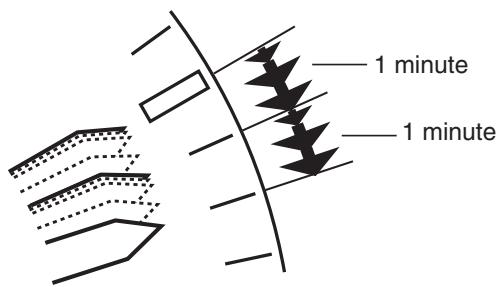
[Irregular 1-minute interval movement]:
Minute hand moves irregularly once every minute
When the secondary battery becomes fully charged, the overcharging prevention function is activated to prevent the battery from being charged further, enabling the watch to be recharged without worrying about overcharging.
5. Charging Times
Recharging time varies according to the watch model (such as the color of the dial). The times in the table below should therefore only be used as a rough reference. * Charging time refers to the amount of time during which the watch is continuously exposed to light.
| Illuminance (lx) | Environment | Charging Time | ||
| One day usage | Charging time from the stopped state to normal hand movement (15-second interval movement) | Full charge time | ||
| 500 | Inside an ordinary office | 3 hours | 35 hours | ----- |
| 1,000 | Under a fluorescent lamp (30 W) at a distance of 60-70 cm (24-28 in) | 1.5 hours | 15 hours | ----- |
| 3,000 | Under a fluorescent lamp (30 W) at a distance of 20 cm (8 in) | 30 minutes | 5 hours | 120 hours |
| 10,000 | Outdoors, cloudy | 8 minutes | 1.5 hours | 35 hours |
| 100,000 | Outdoors, summer and sunny under direct sunlight | 2 minutes | 13 minutes | 6 hours |
Full charge time: Time to fully recharge the watch after it has stopped. One day usage: Time required for recharging the watch to run for 1 day with normal hand movement (15-second interval movement).
6. Handling Precautions
Please note that if you wear long sleeves, the watch can easily become insufficiently charged as a result of the watch being covered and not being exposed to light. The watch will continue to run properly if it is placed in as bright a location as possible even when not being worn.
Charging Precautions
- Allowing the watch to reach high temperatures during recharging can damage the watch. Avoid recharging in locations that can reach high temperatures (about 60°C / 140°F or higher).
Examples: · Charging by placing the watch in close proximity to a light source that easily becomes hot such as an incandescent lamp or halogen lamp.
- Charging the watch in a location that can easily become hot such as on an automobile dashboard
- When charging using the light from an incandescent lamp, charge while being careful that the watch does not become excessively hot by placing at a distance of at least 50 cm (20in) from the lamp
7. Replacing the Secondary Battery
Unlike ordinary batteries, the secondary battery used in this watch can be repeatedly charged and discharged and is not required to be periodically replaced.
CAUTION
Never use a battery other than the secondary battery specified for this watch.
The watch is designed so that a different kind of battery cannot be used to operate it. If a different kind of battery, such as a silver battery, is used by chance, there is a danger that it will overcharge and burst, causing damage to the watch and even to the human body.
8. Precautions
CAUTION: Water-resistance performance
There are several types of water-resistant watches, as shown in the following table.
The unit "bar" is roughly equal to 1 atmosphere. * WATER RESIST(ANT) xx bar may also be indicated as W.R. xx bar.
| Indication | Specifications | |
| Dial | Case (case back) | |
| WATER RESIST or no indication | WATER RESIST(ANT) | Water-resistant to 3 atmospheres |
| WR 50 or WATER RESIST 50 | WATER RESIST(ANT) 5 bar or WATER RESIST(ANT) | Water-resistant to 5 atmospheres |
| WR 100/200 or WATER RESIST 100/200 | WATER RESIST(ANT) 10bar/20 bar or WATER RESIST(ANT) | Water-resistant to 10/20 atmospheres |
For correct use within the design limits of the watch, confirm the level of water-resistance of your watch, as indicated on the dial and case, and consult the table.
| Examples of use | ||||
| Minor exposure to water (washing face, rain, etc.) | Moderate exposure to water (washing, kitchen work, swimming, etc.) | Marine sports (skin diving) | Scuba diving (with air tank) | Operation of the crown with moisture visible |
| OK | NO | NO | NO | NO |
| OK | OK | NO | NO | NO |
| OK | OK | OK | NO | NO |
- Water-resistance for daily use (to 3 atmospheres): This type of watch is water-resistant to minor exposure to water. For example, you may wear the watch while washing your face; however, it is not designed for use underwater.
- Upgraded water-resistance for daily use (to 5 atmospheres): This type of watch is water-resistant to moderate exposure to water. You may wear the watch while swimming; however, it is not designed for use while skin diving.
- Upgraded water-resistance for daily use (to 10/20 atmospheres): This type of watch may be used for skin diving; however, it is not designed for scuba or saturated diving using helium gas.
CAUTION
- Be sure to use the watch with the crown pressed in (normal position). If your watch has a screw-type crown, be sure to tighten the crown completely.
- Do NOT operate the crown with wet fingers or when the watch is wet. Water may enter the watch and compromise water-resistance.
- If the watch is used in seawater, rinse with fresh water afterward and wipe with a dry cloth.
- If moisture has entered the watch, or if the inside of the crystal is fogged up and does not become clear within a day, immediately take the watch to your dealer or Citizen Service Center for repair. Leaving the watch in such a state will allow corrosion to form inside.
- If seawater enters the watch, place the watch in a box or plastic bag and immediately take it in for repair. Otherwise, pressure inside the watch will increase, and parts (crystal, crown, buttons, etc.) may come off.
CAUTION: Keep your watch clean.
- Leaving dust and dirt deposited between the case and crown may result in difficulty in pulling the crown out. Rotate the crown while in its normal position, from time to time, to loosen dust and dirt and then brush it off.
- Dust and dirt tend to be deposited in gaps in the back of the case or band. Deposited dust and dirt may cause corrosion and soil your clothing. Clean the watch occasionally.
Cleaning the Watch
- Use a soft cloth to wipe off dirt, perspiration and water from the case and crystal.
- Use a soft, dry cloth to wipe off perspiration and dirt from the leather band.
- To clean a metal, plastic, or rubber watchband, wash away dirt with mild soap and water. Use a soft brush to remove dust and dirt jammed in the gaps in the metal band. If your watch is not water-resistant, take it to your dealer.
NOTE: Avoid using solvents (thinner, benzine, etc.), as they may mar the finish.
CAUTION: Operating environment
- Use the watch within the operating-temperature range specified in the instruction manual. Using the watch where temperatures are outside the specified range, may result in deterioration of functions or even stoppage of the watch.
- Do NOT use the watch in places where it is exposed to high temperature, such as in a sauna.
Doing so may result in a skin burn. - Do NOT leave the watch in a place where it is exposed to high temperature, such as the glove compartment or dashboard of a car.
Doing so may result in deterioration of the watch, such as deformation of plastic parts.
- Do NOT place the watch close to a magnet.
Timekeeping will become inaccurate if you place the watch close to magnetic health equipment such as a magnetic necklace or a magnetic latch of a refrigerator door or handbag clasp or the earphone of a mobile phone. If this has occurred, move the watch away from the magnet and reset the time. - Do NOT place the watch close to household appliances that generate static electricity.
Timekeeping may become inaccurate if the watch is exposed to strong static electricity, such as is emitted from a TV screen.
- Do NOT subject the watch to a strong shock such as dropping it onto a hard floor.
- Avoid using the watch in an environment where it may be exposed to chemicals or corrosive gases.
If solvents, such as thinner and benzine, or substances containing such solvents come in contact with the watch, discoloration, melting, cracking, etc. may result. If the watch comes in contact with mercury used in thermometers, the case, band or other parts may become discolored.
Periodical inspections
Your watch needs inspection once in every two or three years for safety and long use.
To keep your watch water-resistant, the packing needs to be replaced regularly. Other parts need to be inspected and replaced if necessary.
Ask for Citizen genuine parts upon replacement.
9. Specifications
- Model: G67X
- Type: Analog solar-powered watch
- Timekeeping accuracy: ±15 seconds per month on average (when worn at normal temperatures of +5°C to +35°C / 41°F to 95°F)
- Quartz frequency: 32.768 Hz (Hz = frequency per second)
- Operating temperature range: -10°C to +60°C / 14°F to 140°F
- Display functions: Hours, minutes (2 hands)
- Additional functions
- Insufficient charge warning function
- Time setting warning function
- Overcharging prevention function
- Continuous operating times:
- From fully charged to stopped: About 8 months
- From the insufficient charge warning display to stopped: About 8 days
- Battery: Secondary battery, 1 pc.
- Specifications are subject to change without notice.


- FEATURES
- BEFORE USING
- SETTING THE TIME
- UNIQUE FUNCTIONS OF SOLAR-POWERED WATCHES
- INSUFFICIENT CHARGE WARNING FUNCTION
- [IRREGULAR 1-MINUTE INTERVAL MOVEMENT]
- CHARGING TIMES
- HANDLING PRECAUTIONS
- CHARGING PRECAUTIONS
- REPLACING THE SECONDARY BATTERY
- CAUTION
- PRECAUTIONS
- CAUTION: WATER-RESISTANCE PERFORMANCE
- CAUTION: KEEP YOUR WATCH CLEAN
- CLEANING THE WATCH
- CAUTION: OPERATING ENVIRONMENT
- PERIODICAL INSPECTIONS
- SPECIFICATIONS
Brand : CITIZEN WATCH
Model : G67
Category : Wristwatch