
CLUE - Jeu de société HASBRO - Notice d'utilisation et mode d'emploi gratuit
Retrouvez gratuitement la notice de l'appareil CLUE HASBRO au format PDF.


| Type de produit | Jeu de société |
| Marque | Hasbro |
| Modèle | Clue (Cluedo) |
| Nombre de joueurs | 3 à 6 joueurs |
| Âge recommandé | 8 ans et plus |
| Dimensions de la boîte (approx.) | 40 cm × 27 cm × 5 cm |
| Poids (approx.) | 0,8 kg |
| Type d'alimentation | Aucune (jeu non électronique) |
| Contenu de la boîte | 1 plateau de jeu, 6 pions suspects, 6 armes miniatures, 1 paquet de cartes (6 suspects, 6 armes, 9 pièces), 1 bloc-notes d'enquête, 1 enveloppe « Dossier confidentiel », 1 dé |
| Fonction principale | Jeu de déduction : résoudre un meurtre en identifiant le coupable, l'arme et la pièce |
| Mécanismes de jeu | Déplacement au dé, suggestions, accusations, passages secrets |
| Durée d'une partie | Environ 30 à 60 minutes |
| Entretien et nettoyage | Nettoyer les pièces avec un chiffon doux et sec. Ranger dans la boîte après utilisation. |
| Sécurité | Contient de petites pièces. Ne convient pas aux enfants de moins de 3 ans. Risque d'étouffement. |
| Pièces détachées et réparabilité | Non applicable (jeu complet). En cas de perte, contacter le service client Hasbro. |
| Langue des règles | Français (notice incluse) |
| Origine | États-Unis, fabriqué par Hasbro |
FOIRE AUX QUESTIONS - CLUE HASBRO
Questions des utilisateurs sur CLUE HASBRO
0 question sur cet appareil. Repondez a celles que vous connaissez ou posez la votre.
Poser une nouvelle question sur cet appareil
Téléchargez la notice de votre Jeu de société au format PDF gratuitement ! Retrouvez votre notice CLUE - HASBRO et reprennez votre appareil électronique en main. Sur cette page sont publiés tous les documents nécessaires à l'utilisation de votre appareil CLUE de la marque HASBRO.
MODE D'EMPLOI CLUE HASBRO
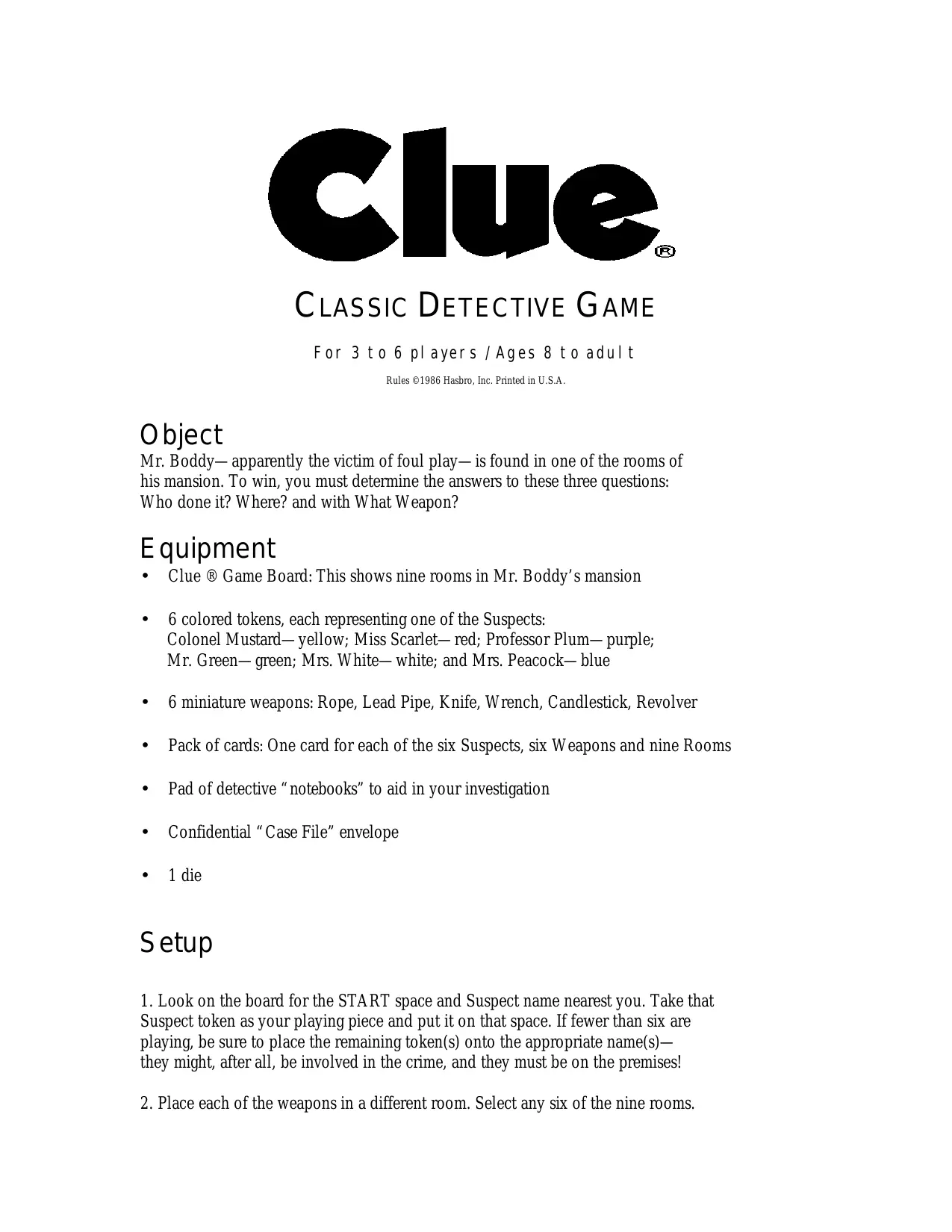
Clue®
CLASSIC DETECTIVE GAME
For 3 to 6 players / Ages 8 to adult
Rules ©1986 Hasbro, Inc. Printed in U.S.A.
Object
Mr. Boddy—apparently the victim of foul play—is found in one of the rooms of his mansion. To win, you must determine the answers to these three questions: Who done it? Where? and with What Weapon?
Equipment
- Clue® Game Board: This shows nine rooms in Mr. Boddy's mansion
- 6 colored tokens, each representing one of the Suspects: Colonel Mustard—yellow; Miss Scarlet—red; Professor Plum—purple; Mr. Green—green; Mrs. White—white; and Mrs. Peacock—blue
- 6 miniature weapons: Rope, Lead Pipe, Knife, Wrench, Candlestick, Revolver
- Pack of cards: One card for each of the six Suspects, six Weapons and nine Rooms
- Pad of detective "notebooks" to aid in your investigation
- Confidential "Case File" envelope
1 die
Setup
- Look on the board for the START space and Suspect name nearest you. Take that Suspect token as your playing piece and put it on that space. If fewer than six are playing, be sure to place the remaining token(s) onto the appropriate name(s)—they might, after all, be involved in the crime, and they must be on the premises!
-
Place each of the weapons in a different room. Select any six of the nine rooms.
-
Place the empty envelope marked "Case File CONFIDENTIAL" onto the "X" in the center of the board.
- Sort the pack of cards into three groups: Suspects, Rooms and Weapons. Shuffle each group separately and place each face down on the table. Then—so no one can see them—take the top card from each group and place it into the envelope. The Case File now contains the answers to the questions: Who? Where? What Weapon?
- Shuffle together the three piles of remaining cards. Then deal them face down clockwise around the table. (It doesn't matter if some players receive more cards than others.) Secretly look at your own cards: Because they're in your hand, they can't be in the Case File—which means none of your cards was involved in the crime!
- Take a detective's notebook sheet and, so no one can see what you write, fold it in half: Check off the cards that are in your hand, if you wish.
- Miss Scarlet—the player with the red token—always plays first. Play then proceeds, in turn, to the first player's left.
GAME PLAY
Moving Your Token
On each turn, try to reach a different room of the mansion. To start your turn, move your token either by rolling the die or, if you're in a corner room, using a Secret Passage:
Rolling
Roll the die and move your token the number of squares you rolled.
- You may move horizontally or vertically, forward or backward, but not diagonally.
- You may change directions as many times as your roll will allow. You may not, however, enter the same square twice on the same turn.
You may not enter or land on a square that's already occupied by another suspect.
Secret Passages
The rooms in opposite corners of the mansion are connected by Secret Passages. If you're in one of these rooms at the start of your turn, you may, if you wish, use a Secret Passage instead of rolling. To move through a Secret Passage, announce that you wish to do so, then move your token to the room in the opposite corner.
Entering and Leaving a Room
You may enter or leave a room either by rolling the die and moving through a door, or by moving through a Secret Passage.
- A door is the opening in the wall, not the space in front of the doorway. When you pass through a door, do not count the doorway itself as a space.
- You may not pass through a door that's blocked by an opponent's token.
- As soon as you enter a room, stop moving. It doesn't matter if you roll a number that's higher than you need to enter.
-
You may not re-enter the same room on a single turn.
-
It is possible that your opponents might block any and all doors and trap you in a room. If this happens, you must wait for someone to move and un-block a door so you can leave!
Making a Suggestion
As soon as you enter a room, make a Suggestion. By making Suggestions throughout the game, you try to determine—by process of elimination—which three cards are in the confidential Case File envelope. To make a Suggestion, move a Suspect and a Weapon into the room that you just entered. Then suggest that the crime was committed in that Room, by that Suspect, with that Weapon.
Example: Let's say that you're Miss Scarlet and you enter the Lounge. First move another Suspect—Mr. Green, for instance—into the Lounge. Then move a weapon—the Wrench, perhaps—into the Lounge. Then say, "I suggest the crime was committed in the Lounge by Mr. Green with the Wrench."
Remember two things:
- You must be in the Room that you mention in your Suggestion.
- Be sure to consider all tokens—including spare Suspects and including yourself!—as falling under equal suspicion.
Proving a Suggestion True or False
As soon as you make a Suggestion, your opponents, in turn, try to prove it false. The first to try is the player to your immediate left. This player looks at his or her cards to see if one of the three cards you just named is there. If the player does have one of the cards named, he or she must show it to you and no one else. If the player has more than one of the cards named, he or she selects just one to show you.
If that opponent has none of the cards that you named, then the chance to prove your Suggestion false passes, in turn, to the next player on the left.
As soon as one opponent shows you one of the cards that you named, it is proof that this card cannot be in the envelope. End your turn by checking off this card in your notebook. (Some players find it helpful to mark the initials of the player who showed the card.) If no one is able to prove your Suggestion false, you may either end your turn or make an Accusation now.
Making an Accusation
When you think you've figured out which three cards are in the envelope, you may, on your turn, make an Accusation and name any three elements you want. First say, "I accuse (Suspect) of committing the crime in the (Room) with the (Weapon)."
Then, so no one else can see, look at the cards in the envelope.
In a Suggestion, the Room you name must be the Room where your token is located.
But in an Accusation, you may name any room.
Remember: You may make only one Accusation during a game.
If Your Accusation Is Incorrect
If any one of the cards that you named is not inside the Case File:
- Secretly return all three cards to the envelope.
-
You may make no further moves in the game, and therefore cannot win, but you do remain involved in the investigation.
-
You do continue to try to prove your opponents' Suggestions false.
- Your opponents may continue to move your token into the various Rooms where they make Suggestions.
- If after making a false Accusation your token is blocking a door, move it into that room so that other players may enter.
Winning
You win the game if your Accusation is completely correct--that is, if you find in the envelope all three of the cards that you named. When this happens, take out all three cards and lay them out for everyone to see.
Special Notes About Suggestions
- When you make a suggestion, you may, if you wish, name one or more of the cards that you hold in your own hand. You might want to do this to gain information or to mislead your opponents.
- You may, if you wish, make a Suggestion and an Accusation on the same turn.
- You may make only one Suggestion after entering a particular room. To make your next Suggestion, you must either enter a different room or, sometime after your next turn, re-enter the room that you most recently left. You may not forfeit a turn to remain in a particular room. But if you're trapped in a room because your opponents are blocking the door(s), you must remain there until a door is unblocked and you can move out of the Room.
- You may make a Suggestion that includes a Suspect or Weapon that's already in your Room. In this case, transferring one or both of those items is not necessary. When a transfer is necessary, leave the item(s) in the new location after the Suggestion is made.
- If yours was the Suspect transferred, you may, on your next turn, do one of two things: Move from the Room in one of the usual ways OR Make a Suggestion for that room. If you decide to make a Suggestion, do not roll the die or move your token.
- There is no limit to the number of Suspects or Weapons that may be in one Room at one time.
TO ORDER ADDITIONAL DETECTIVE NOTEPADS
You may order extra notepads directly from Parker Brothers at the address below. Please enclose a check for (1.50 each (includes postage and handling), and allow 6-8 weeks.

We will be happy to answer questions about this game.
Write to: Consumer Relations, Parker Brothers,
P.O.Box 1012,Beverly,MA 01915.