
CTK-496 - Clavier numérique CASIO - Notice d'utilisation et mode d'emploi gratuit
Retrouvez gratuitement la notice de l'appareil CTK-496 CASIO au format PDF.


| Type de produit | Clavier numérique portable |
| Marque et modèle | CASIO CTK-496 |
| Nombre de touches | 61 touches de taille standard, 5 octaves |
| Polyphonie | 12 notes maximum (6 pour certains timbres) |
| Sonorités (timbres) | 100 timbres intégrés (inclut des sons d'orchestre, synthétisés, etc.) |
| Rythmes | 100 rythmes intégrés |
| Banque de chansons (Song Bank) | 100 morceaux intégrés |
| Accompagnement automatique | Oui, avec modes CASIO CHORD et FINGERED |
| Affichage | Écran LCD graphique avec portée, clavier graphique, nom d'accord, doigtés, etc. |
| Fonctions MIDI | Connecteurs MIDI IN/OUT, compatible General MIDI |
| Transposition | -6 à +5 demi-tons |
| Accordage | Réglable de -50 à +50 cents (LA4 = 440 Hz ±50 cents) |
| Contrôle du tempo | 20 à 255 battements par minute, 236 paliers |
| Haut-parleurs | 2 × 2,0 W |
| Prises et connecteurs | Prise casque/sortie (stéréo standard), prise sustain (standard), prise micro (avec molette de volume), MIDI IN/OUT, DC 9V |
| Alimentation | 6 piles AA (autonomie : environ 4 h en alcalines, 2 h en manganèse) ou adaptateur secteur CASIO AD-5 (9V DC) |
| Mise hors tension automatique | Oui, après environ 6 minutes d'inactivité (sur piles uniquement, désactivable) |
| Dimensions (L × P × H) | 95,6 × 35,4 × 13,2 cm |
| Poids | Environ 3,8 kg (sans piles) |
| Entretien et nettoyage | Débrancher avant nettoyage ; utiliser un chiffon doux légèrement humide avec un détergent neutre ; ne pas utiliser de diluant ni de produits chimiques |
| Sécurité | Ne pas démonter, ne pas exposer à l'humidité, utiliser uniquement l'adaptateur spécifié, tenir à l'écart des jeunes enfants (risque d'étouffement avec le sachet plastique) |
| Reparabilité et pièces détachées | Contacter un revendeur agréé ou un centre de service CASIO ; aucune pièce réparable par l'utilisateur |
FOIRE AUX QUESTIONS - CTK-496 CASIO
Questions des utilisateurs sur CTK-496 CASIO
0 question sur cet appareil. Repondez a celles que vous connaissez ou posez la votre.
Poser une nouvelle question sur cet appareil
Téléchargez la notice de votre Clavier numérique au format PDF gratuitement ! Retrouvez votre notice CTK-496 - CASIO et reprennez votre appareil électronique en main. Sur cette page sont publiés tous les documents nécessaires à l'utilisation de votre appareil CTK-496 de la marque CASIO.
MODE D'EMPLOI CTK-496 CASIO
CTK-496
CTK-700
GUIDE DE L'UTILISATEUR
GUIA DEL USUARIO
DIRECTIVES ÉTABLIES PAR LES RÈGLES FCC POUR L'UTILISATION DE L'APPAREIL AUX ÉTATS-UNIS (non applicables dans d'autres régions).
AVIS
Cet équipement a été testé et déclaré conforme aux limites d'un appareil numérique de classe B, conformément à la partie 15 des règles FCC. Ces limites sont conçues pour fournir une protection raisonnable contre les interférences nuisibles dans une installation résidentielle. Cet équipement génère, utilise et peut émettre de l'énergie radiofréquence et, s'il n'est pas installé et utilisé conformément aux instructions, peut causer des interférences nuisibles aux communications radio. Cependant, il n'y a aucune garantie que des interférences ne se produiront pas dans une installation particulière. Si cet équipement provoque des interférences nuisibles à la réception radio ou télévision, ce qui peut être déterminé en éteignant et en allumant l'équipement, l'utilisateur est encouragé à essayer de corriger les interférences par une ou plusieurs des mesures suivantes :
Réorienter ou déplacer l'antenne de réception. - Augmenter la distance entre l'équipement et le récepteur. - Connecter l'équipement à une prise sur un circuit différent de celui auquel le récepteur est connecté. - Consulter le revendeur ou un technicien radio/TV expérimenté pour obtenir de l'aide.
AVERTISSEMENT FCC
Les changements ou modifications non expressément approuvés par la partie responsable de la conformité pourraient annuler le droit de l'utilisateur à utiliser l'équipement.
Important !
Veuillez noter les informations importantes suivantes avant d'utiliser ce produit.
- Avant d'utiliser l'adaptateur AD-5 en option pour alimenter l'appareil, assurez-vous de vérifier d'abord l'adaptateur secteur pour tout dommage. Vérifiez soigneusement le cordon d'alimentation pour détecter toute rupture, coupure, fil exposé et autres dommages graves. Ne laissez jamais les enfants utiliser un adaptateur secteur gravement endommagé.
- N'essayez jamais de recharger des piles.
- N'utilisez pas de piles rechargeables.
- Ne mélangez jamais des piles anciennes avec des piles neuves.
- Utilisez des piles recommandées ou des types équivalents.
- Assurez-vous toujours que les pôles positif (+) et négatif (-) sont orientés correctement comme indiqué près du compartiment à piles.
- Remplacez les piles dès que possible après tout signe de faiblesse.
- Ne court-circuitez pas les bornes des piles.
- Le produit n'est pas destiné aux enfants de moins de 3 ans.
- Utilisez uniquement l'adaptateur CASIO AD-5.
- L'adaptateur secteur n'est pas un jouet.
- Assurez-vous de débrancher l'adaptateur secteur avant de nettoyer le produit.
Félicitations pour votre choix de l'instrument de musique électronique CASIO.
- Avant d'utiliser l'instrument, assurez-vous de lire attentivement les instructions contenues dans ce manuel.
- Veuillez conserver toutes les informations pour référence future.
Symboles
Divers symboles sont utilisés dans ce guide de l'utilisateur et sur le produit lui-même pour garantir une utilisation sûre et correcte du produit, et pour prévenir les blessures à l'utilisateur et à d'autres personnes ainsi que les dommages matériels. Ces symboles ainsi que leurs significations sont présentés ci-dessous.

DANGER
Ce symbole indique une information qui, si elle est ignorée ou appliquée de manière incorrecte, présente un danger de mort ou de blessure grave.

AVERTISSEMENT
Cette indication précise les points qui présentent un risque de mort ou de blessure grave si le produit est utilisé de manière incorrecte en ignorant cette indication.

ATTENTION
Cette indication précise les points qui présentent un risque de blessure ainsi que les points pour lesquels il y a une probabilité de dommages matériels uniquement si le produit est utilisé de manière incorrecte en ignorant cette indication.
Exemples de symboles

Ce symbole triangulaire (△) signifie que l'utilisateur doit être prudent. (L'exemple à gauche indique une prudence concernant un choc électrique.)

Ce cercle avec une barre oblique (O) signifie que l'action indiquée ne doit pas être effectuée. Les indications à l'intérieur ou à proximité de ce symbole sont spécifiquement interdites. (L'exemple à gauche indique que le démontage est interdit.)

Le point noir (●) signifie que l'action indiquée doit être effectuée. Les indications à l'intérieur de ce symbole sont des actions qui sont spécifiquement instruites d'être effectuées. (L'exemple à gauche indique que la fiche d'alimentation doit être débranchée de la prise électrique.)
DANGER
Piles alcalines
Effectuez les étapes suivantes immédiatement si du liquide s'échappant de piles alcalines entre en contact avec vos yeux.
- Ne vous frottez pas les yeux ! Rincez-les avec de l'eau.
- Contactez immédiatement votre médecin. Laisser du liquide de pile alcaline dans vos yeux peut entraîner une perte de vision.

AVERTISSEMENT
Fumée, odeur étrange, surchauffe
Continuer à utiliser le produit alors qu'il émet de la fumée, une odeur étrange ou de la chaleur présente un risque d'incendie et de choc électrique. Suivez immédiatement les étapes suivantes.
- Coupez l'alimentation.
- Si vous utilisez l'adaptateur secteur pour l'alimentation, débranchez-le de la prise murale.
- Contactez votre revendeur d'origine ou un prestataire de services CASIO agréé.
Adaptateur secteur
- Une mauvaise utilisation de l'adaptateur secteur présente un risque d'incendie et de choc électrique. Assurez-vous toujours de respecter les précautions suivantes.
- Veillez à n'utiliser que l'adaptateur secteur spécifié pour ce produit.
- N'utilisez qu'une source d'alimentation dont la tension est conforme à la valeur nominale indiquée sur l'adaptateur secteur.
- Ne surchargez pas les prises de courant et les rallonges.
- Une mauvaise utilisation du cordon d'alimentation de l'adaptateur secteur peut l'endommager ou le casser, présentant un risque d'incendie et de choc électrique. Assurez-vous toujours de respecter les précautions suivantes.
- Ne placez jamais d'objets lourds sur le cordon et ne l'exposez pas à la chaleur.
- Ne tentez jamais de modifier le cordon ou de le soumettre à des flexions excessives.
- Ne tordez jamais le cordon et ne l'étirez jamais.
- Si le cordon d'alimentation ou la prise est endommagé, contactez votre revendeur d'origine ou un fournisseur de services agréé CASIO.


- Ne touchez jamais à l'adaptateur secteur avec les mains mouillées.
Cela risque de provoquer un choc électrique.
- Utilisez l'adaptateur secteur dans un endroit où il ne sera pas éclaboussé d'eau. L'eau présente un risque d'incendie et de choc électrique.
- Ne placez pas un vase ou tout autre récipient contenant un liquide sur l'adaptateur secteur. L'eau présente un risque d'incendie et de choc électrique.
Piles
Une mauvaise utilisation des piles peut provoquer une fuite, ce qui peut endommager les objets à proximité, ou une explosion, ce qui présente un risque d'incendie et de blessures. Respectez toujours les précautions suivantes.
- Ne tentez jamais de démonter les piles ou de les court-circuiter.
- N'exposez jamais les piles à la chaleur et ne les jetez pas au feu.
- Ne mélangez jamais des piles usagées avec des piles neuves.
- Ne mélangez jamais des piles de types différents.
- Ne rechargez pas les piles.
- Assurez-vous que les extrémités positive (+) et négative (-) des piles sont orientées correctement.
Ne pas incinérer le produit.
Ne jamais jeter le produit au feu.
Cela pourrait provoquer une explosion, entraînant un risque d'incendie et de blessures.
Eau et corps étrangers
La pénétration d'eau, d'autres liquides ou de corps étrangers (tels que des morceaux de métal) dans le produit présente un risque d'incendie et de choc électrique. Prenez immédiatement les mesures suivantes.
- Mettez l'appareil hors tension.
- Si vous utilisez l'adaptateur secteur, débranchez-le de la prise murale.
- Contactez votre revendeur d'origine ou un réparateur agréé CASIO.
Démontage et modification
N'essayez jamais de démonter ce produit ou de le modifier de quelque manière que ce soit. Cela présente un risque de choc électrique, de brûlure ou d'autres blessures. Confiez toute inspection, tout réglage et tout entretien internes à votre revendeur d'origine ou à un réparateur agréé CASIO.


Chute et chocs
L'utilisation continue de ce produit après qu'il a été endommagé par une chute ou un impact violent présente un risque d'incendie et de choc électrique. Prenez immédiatement les mesures suivantes.
- Mettez l'appareil hors tension.
- Si vous utilisez l'adaptateur secteur, débranchez-le de la prise murale.
- Contactez votre revendeur d'origine ou un réparateur agréé CASIO.
Sacs en plastique
Ne placez jamais le sac en plastique dans lequel le produit est livré sur votre tête ou dans votre bouche. Cela présente un risque de suffocation.
Une attention particulière doit être apportée à cette précaution en présence de jeunes enfants.
Ne montez pas sur le produit ou le support.*
Monter sur le produit ou le support peut le faire basculer ou l'endommager. Une attention particulière doit être apportée à cette précaution en présence de jeunes enfants.
Emplacement
Évitez de placer le produit sur un support instable, sur une surface inégale ou dans tout autre endroit instable. Un emplacement instable peut faire tomber le produit, créant un risque de blessure.


ATTENTION
Adaptateur secteur
- Une mauvaise utilisation de l'adaptateur secteur présente un risque d'incendie et de choc électrique. Assurez-vous toujours de respecter les précautions suivantes.
- Ne placez pas le cordon électrique près d'une cuisinière ou d'autres sources de chaleur.
- Ne tirez jamais sur le cordon pour débrancher la prise électrique. Saisissez toujours l'adaptateur secteur pour débrancher.
- Une utilisation incorrecte de l'adaptateur secteur présente un risque d'incendie et de choc électrique. Veillez toujours à respecter les précautions suivantes.
- Insérez l'adaptateur secteur dans la prise murale jusqu'au bout.
- Débranchez l'adaptateur secteur de la prise murale en cas d'orage ou avant de partir en voyage ou pour une absence prolongée.
- Au moins une fois par an, débranchez l'adaptateur secteur de la prise murale et essuyez toute poussière accumulée autour des broches de la fiche.
Déplacement du produit
Avant de déplacer le produit, débranchez toujours l'adaptateur secteur de la prise murale et déconnectez tous les autres câbles et cordons de connexion. Laisser les cordons connectés présente un risque de dommages aux cordons, d'incendie et de choc électrique.
Nettoyage
Avant de nettoyer le produit, débranchez toujours l'adaptateur secteur de la prise murale en premier. Laisser l'adaptateur secteur branché présente un risque de dommages à l'adaptateur secteur, d'incendie et de choc électrique.
Piles
Une mauvaise utilisation des piles peut provoquer une fuite, entraînant des dommages aux objets à proximité, ou une explosion, créant un risque d'incendie et de blessures. Veillez toujours à respecter les précautions suivantes.
- Utilisez uniquement les piles spécifiées pour ce produit.
- Retirez les piles du produit si vous prévoyez de ne pas l'utiliser pendant une longue période.


Connecteurs
Connectez uniquement les appareils et équipements spécifiés aux connecteurs du produit. La connexion d'un appareil ou d'un équipement non spécifié présente un risque d'incendie et de choc électrique.
Emplacement
Évitez les emplacements suivants pour ce produit. De tels emplacements présentent un risque d'incendie et de choc électrique.
- Zones soumises à une humidité élevée ou à de grandes quantités de poussière.
- Dans les zones de préparation des aliments ou d'autres zones soumises à des fumées d'huile.
- À proximité d'équipements de climatisation, sur un tapis chauffant, dans des zones exposées à la lumière directe du soleil, à l'intérieur d'un véhicule garé au soleil, ou dans toute autre zone soumettant le produit à des températures élevées.
Écran d'affichage
- Ne poussez jamais sur le panneau LCD de l'écran et ne le soumettez pas à des chocs violents. Cela pourrait fissurer le verre du panneau LCD, créant un risque de blessure.
- Si le panneau LCD se fissure ou se brise, ne touchez jamais le liquide à l'intérieur du panneau. Le liquide du panneau LCD peut provoquer une irritation cutanée.
- Si du liquide de panneau LCD pénètre dans votre bouche, rincez immédiatement votre bouche avec de l'eau et contactez votre médecin.
- Si du liquide de panneau LCD pénètre dans vos yeux ou entre en contact avec votre peau, rincez à l'eau claire pendant au moins 15 minutes, puis contactez un médecin.
Volume sonore
N'écoutez pas de musique à des volumes très élevés pendant de longues périodes. Une attention particulière doit être portée à cette précaution lors de l'utilisation d'écouteurs. Des réglages de volume élevés peuvent endommager votre audition.
Objets lourds
Ne placez jamais d'objets lourds sur le produit.
Le fait de procéder ainsi peut rendre le produit lourd en haut, ce qui peut le faire basculer ou faire tomber l'objet, créant un risque de blessure corporelle.


Assemblage correct du support*
Un support mal assemblé peut basculer, faire tomber le produit et créer un risque de blessure corporelle.

Assurez-vous d'assembler correctement le support, en suivant les instructions d'assemblage fournies avec celui-ci. Assurez-vous de monter correctement le produit sur le support.
- Le support est disponible en option.
IMPORTANT !
Lorsque vous utilisez des piles, assurez-vous de les remplacer ou de passer à une autre source d'alimentation dès que vous remarquez l'un des symptômes suivants.
- Voyant d'alimentation faible, l'instrument ne s'allume pas
- Affichage qui scintille, est faible ou difficile à lire
- Volume anormalement faible du haut-parleur/casque, distorsion de la sortie sonore
- Interruption occasionnelle du son lors de la lecture à volume élevé
- Coupure soudaine de l'alimentation lors de la lecture à volume élevé
- Scintillement ou affaiblissement de l'affichage lors de la lecture à volume élevé
- Sortie sonore continue même après avoir relâché une touche
- Un son totalement différent de celui sélectionné
- Rythme anormal et lecture de la banque de chansons
- Perte de puissance, distorsion du son ou volume faible lors de la lecture à partir d'un ordinateur ou d'un périphérique MIDI connecté
- Volume du microphone anormalement faible, distorsion de l'entrée du microphone
- Voyant d'alimentation faible lorsque le microphone est utilisé
- Coupure de courant soudaine lors de l'utilisation du microphone
Félicitations pour votre choix de cet instrument de musique CASIO. Ce clavier vous offre les caractéristiques et fonctions suivantes.
100 sonorités
- Choisissez parmi des sons orchestraux, des sons synthétisés et plus encore.
100 rythmes
- 100 rythmes polyvalents contribuent à donner vie à toutes vos performances au clavier.
Accompagnement automatique
- Jouez simplement un accord et les parties de rythme, de basse et d'accords correspondantes se jouent automatiquement.
Banque de chansons de 100 airs
- Une large sélection de favoris, dont « ODE À LA JOIE » et « JINGLE BELLS », est à votre disposition pour votre plaisir d'écoute ou pour jouer en accompagnement. Une opération simple supprime la partie mélodie ou la partie accompagnement de l'air, vous permettant de jouer sur le clavier.
Système d'information musicale
- Un grand écran LCD affiche graphiquement les doigtés, les touches du clavier à presser et les notes, rendant le jeu au clavier plus informatif et agréable que jamais.
Compatibilité MIDI
- La connexion à un autre périphérique MIDI vous permet de faire sonner les notes à la fois sur ce clavier et sur le périphérique connecté en jouant sur ce clavier. Vous pouvez même lire des données MIDI préenregistrées disponibles dans le commerce.

Entretien de votre clavier
Évitez la chaleur, l'humidité ou la lumière directe du soleil.
N'exposez pas excessivement l'instrument à la lumière directe du soleil, ne le placez pas près d'un climatiseur ou dans un endroit extrêmement chaud.
Ne l'utilisez pas près d'un téléviseur ou d'une radio.
Cet instrument peut provoquer des interférences vidéo ou audio avec la réception TV et radio. Si cela se produit, éloignez l'instrument du téléviseur ou de la radio.
N'utilisez pas de laque, du diluant ou des produits chimiques similaires pour le nettoyage.
Nettoyez le clavier avec un chiffon doux imbibé d'une solution faible d'eau et d'un détergent neutre. Trempez le chiffon dans la solution et essorez-le jusqu'à ce qu'il soit presque sec.
Évitez d'utiliser l'instrument dans des zones soumises à des températures extrêmes.
Une chaleur extrême peut rendre les chiffres sur l'écran LCD faibles et difficiles à lire. Cette condition devrait se corriger d'elle-même lorsque le clavier revient à une température normale.
REMARQUE
- Vous pouvez remarquer des lignes dans la finition du boîtier de ce clavier. Ces lignes sont le résultat du processus de moulage utilisé pour façonner le plastique du boîtier. Ce ne sont pas des fissures ou des cassures dans le plastique, et il n'y a pas lieu de s'inquiéter.
Précautions de sécurité. E-1
Introduction E-5
Entretien de votre clavier . . . . . E-5
Sommaire. E-6
Guide général. E-8
Utilisation de l'écran E-10
Référence rapide de la banque de chansons
Référence E-11
Lecture d'un air de la banque de chansons. E-11
Alimentation E-13
Utilisation des piles E-13
Utilisation de l'adaptateur secteur. E-14
Mise hors tension automatique E-14
Réglages E-14
Connexions E-15
Prise casque/sortie E-15
Prise Sustain (Terminal E-15)
Accessoires et options (E-15)
Opérations de base (E-16)
Jouer du clavier (E-16)
Sélection d'une tonalité (E-16)
Utilisation de la prise microphone (E-17)
Accompagnement automatique (E-18)
Sélection d'un rythme (E-18)
Jouer un rythme (E-18)
Réglage du tempo (E-19)
Utilisation de l'accompagnement automatique (E-19)
Utilisation d'un motif de remplissage (E-21)
Démarrage synchronisé de l'accompagnement avec la lecture du rythme (E-21)
Réglage du volume de l'accompagnement (E-21)
Utilisation de la banque de chansons (E-22)
Lecture d'un morceau de la banque de morceaux...... E-22
Affichage du mode Banque de morceaux. E-23
Réglage du tempo d'un morceau de la banque de morceaux E-23
Changement du timbre de la mélodie d'un morceau de la banque de morceaux E-24
Jouer avec un morceau de la banque de morceaux ... E-24
Son d'applaudissements. E-25
Lecture de tous les morceaux de la banque de morceaux en succession E-25
Utilisation du livre d'accords .... E-26
Recherche d'un accord à l'aide du livre d'accords. E-27
Réglages du clavier E-29
Transposition du clavier E-29
Accordage du clavier. E-29
MIDI E-30
Qu'est-ce que le MIDI ? E-30
MIDI général. E-30
Modification des réglages MIDI E-31
Dépannage E-32
Spécifications E-33
Annexe A-1
Liste des sonorités A-1
Tableau des notes A-2
Tableau des accords doigtés A-4
Liste des instruments de percussion A-6
Liste des rythmes A-7
Tableau de mise en œuvre MIDI
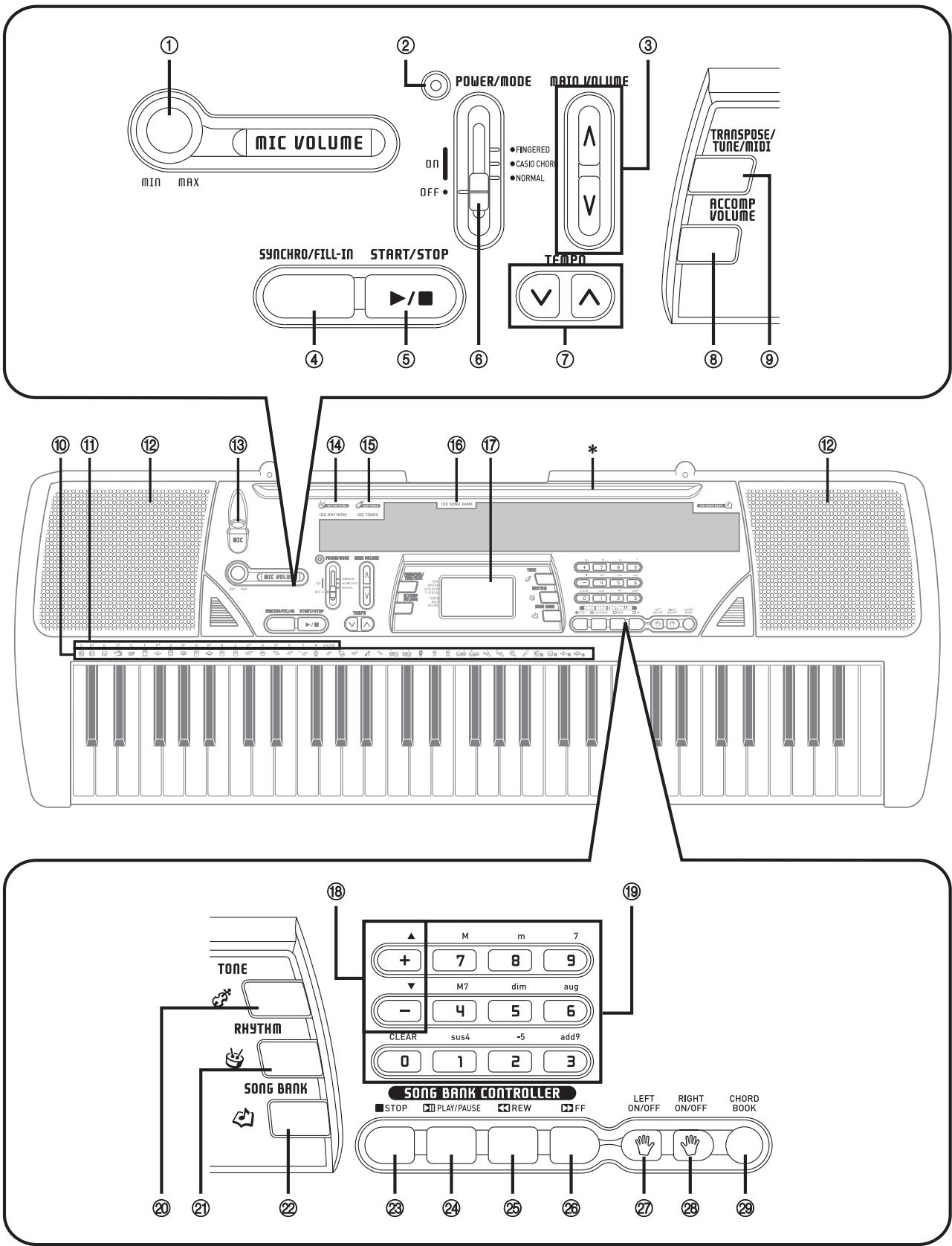
- Les illustrations de ce mode d'emploi montrent le CTK-496.
① Bouton MIC VOLUME ② Voyant d'alimentation ③ Boutons MAIN VOLUME ④ Bouton SYNCHRO/FILL-IN ⑤ Bouton START/STOP ⑥ Interrupteur POWER/MODE ⑦ Boutons TEMPO ⑧ Bouton ACCOMP VOLUME ⑨ Bouton TRANSPOSE/TUNE/MIDI ⑩ Liste des instruments de percussion ⑪ Noms des fondamentales d'accords ⑫ Haut-parleur ⑬ Prise MIC IN ⑭ Liste des rythmes ⑮ Liste des sonorités ⑯ Liste du banque de morceaux ⑰ Écran
18 Boutons [+] / [-]
- Les valeurs négatives ne peuvent être modifiées qu'en utilisant [+] et [-] pour augmenter et diminuer la valeur affichée.
Boutons numériques / Boutons de spécification d'accords
- Pour la saisie de nombres afin de modifier les réglages affichés.
- Pour la saisie des données de spécification d'accords lors de l'utilisation du Chord Book.
Bouton TONE ② Bouton RHYTHM ② Bouton SONG BANK Bouton STOP 24 Bouton PLAY/PAUSE 25 Bouton REW Bouton FF Bouton LEFT ON/OFF 28 Bouton RIGHT ON/OFF Bouton CHORD BOOK
Panneau arrière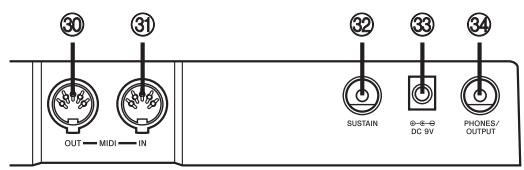
Borne MIDI OUT ③ Borne MIDI IN Borne SUSTAIN Borne DC 9V 34 Borne PHONES/OUTPUT
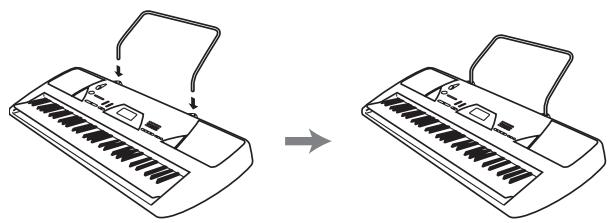
*Fixation du pupitre
Insérez les deux extrémités du pupitre fourni avec le clavier dans les deux trous sur la surface supérieure.
Utilisation de l'écran
- Voici comment l'écran apparaît lorsque la banque de chansons est utilisée.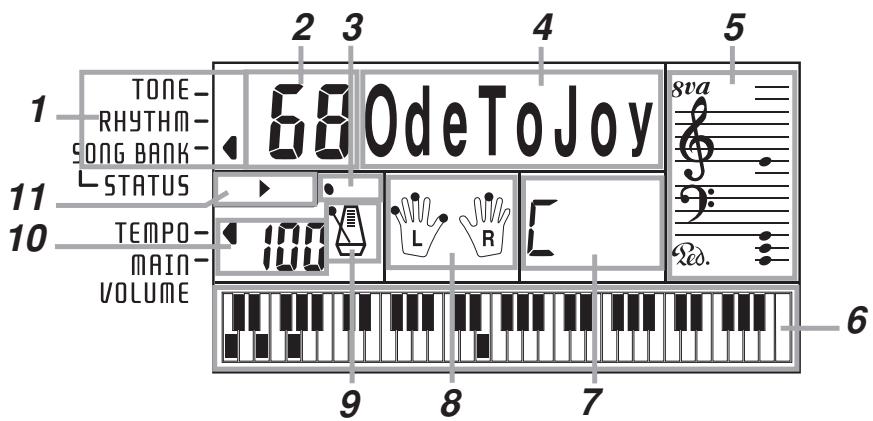
- Un indicateur apparaît à côté du type de réglage que vous effectuez actuellement (TONE, RHYTHM, SONG BANK).
- Numéro de tonalité, numéro de rythme, numéro de chanson, valeur de réglage du clavier
- Rythme, accompagnement automatique, battements de la banque de chansons
- Nom de tonalité, nom de rythme, nom de chanson, nom de mode, nom de réglage du clavier
- Représentation en portée musicale des notes et accords que vous jouez au clavier. Un indicateur de pédale apparaît lorsque la pédale du clavier est enfoncée. Un indicateur d'octave (8va) apparaît lorsque vous jouez des notes dans la plage de C#6 à C7 pour indiquer que leur notation réelle est une octave plus haute que celle affichée à l'écran.
- Utilise un clavier graphique pour afficher les notes et accords joués au clavier ou pendant la lecture de la banque de chansons.
- Accompagnement automatique, banque de chansons, noms d'accords du recueil d'accords.
- Les points indiquent les doigtés pendant la lecture de la banque de chansons. "L" et "R" indiquent les parties de la main gauche et de la main droite.
- Rythme, accompagnement automatique, tempo des morceaux de la banque de chansons.
- Rythme, accompagnement automatique, réglage du volume des morceaux de la banque de chansons.
- Indicateurs du contrôleur de la banque de chansons.
REMARQUE
- Les exemples d'affichage présentés dans ce mode d'emploi sont fournis à titre d'illustration uniquement. Le texte et les valeurs réels qui apparaissent à l'écran peuvent différer des exemples présentés dans ce mode d'emploi.
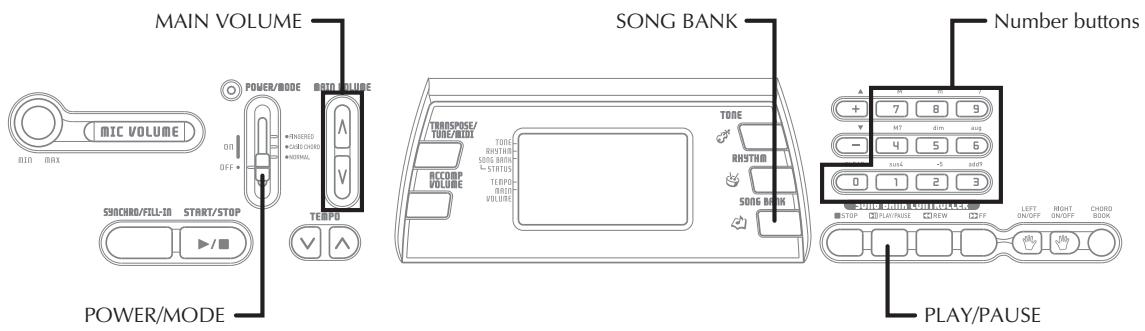
Une sélection de 100 morceaux de la banque de chansons est intégrée pour votre plaisir d'écoute ou pour jouer en accompagnement. Une opération simple permet de couper la partie mélodie ou la partie accompagnement du morceau, vous permettant de jouer au clavier. Voir "Utilisation de la banque de chansons" à la page F-22 pour plus de détails sur la lecture avec les morceaux de la banque de chansons.
Lecture d'un morceau de la banque de chansons
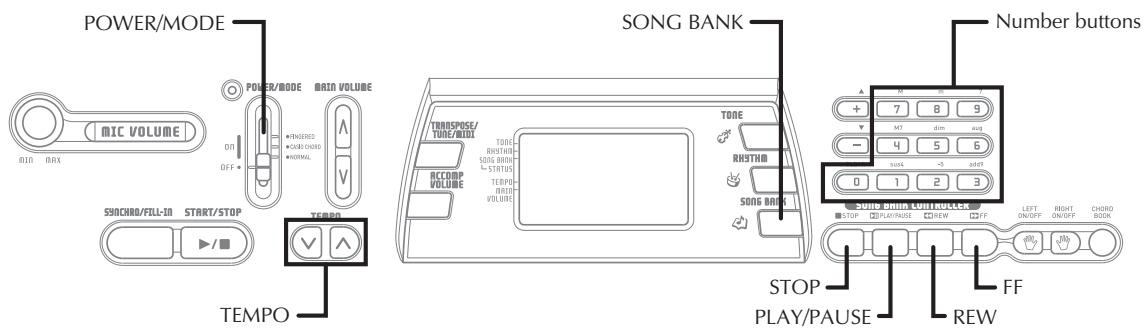
Pour lire un morceau de la banque de chansons
1. Réglez le commutateur POWER/MODE sur NORMAL. Utilisez les boutons MAIN VOLUME pour baisser le volume du clavier à un niveau relativement faible.
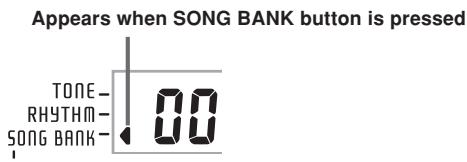
Appuyez sur le bouton SONG BANK pour entrer dans le mode Banque de chansons.
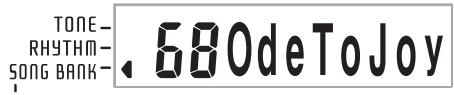
Utilisez la liste de la banque de chansons pour trouver le morceau que vous voulez lire, puis utilisez les boutons numériques pour saisir le numéro à deux chiffres du morceau.
Exemple : Pour sélectionner "68 ODE TO JOY", saisissez 6 puis 8.
Appuyez sur le bouton PLAY/PAUSE pour démarrer la lecture du morceau.
- La mélodie est jouée en boucle sans fin, recommençant après avoir atteint la fin.
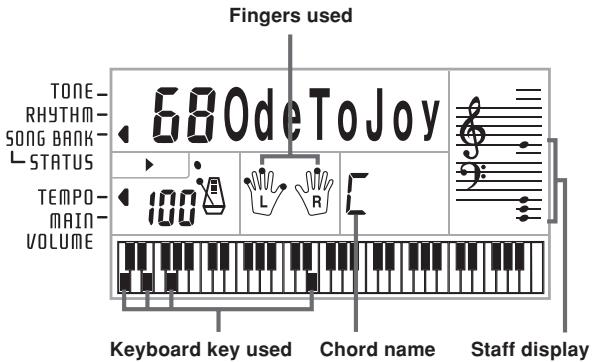
- L'écran affiche les touches du clavier (sur le clavier graphique), les doigtés (avec les indicateurs de doigté), les notes de musique (sur la portée) et les noms d'accords.
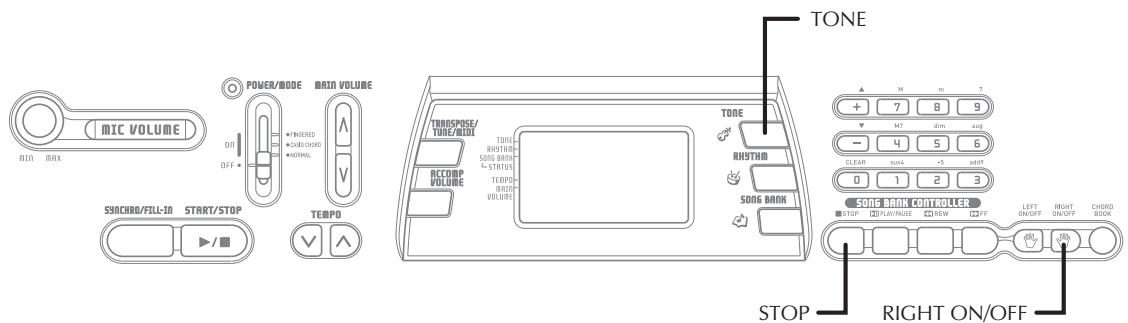
Appuyez sur le bouton ON/OFF de la main droite pour désactiver la partie mélodie de la main droite et essayez de jouer en même temps sur le clavier.
- Le clavier graphique et les indicateurs de doigté de l'écran vous montrent les notes de la mélodie à jouer.
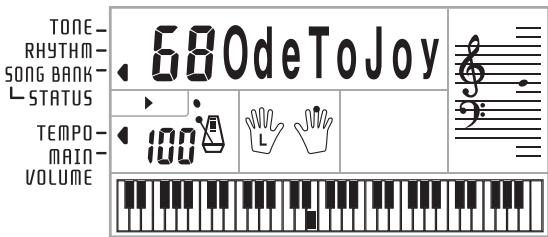
Appuyez à nouveau sur le bouton ON/OFF de la main droite pour réactiver la partie mélodie. - Vous pouvez également activer et désactiver la partie accompagnement en appuyant sur le bouton ON/OFF de la main gauche. Appuyez sur le bouton STOP pour arrêter la lecture du morceau de la banque de chansons. Appuyez sur le bouton TONE pour quitter le mode Banque de chansons et revenir à l'écran de sélection des sons et des rythmes.
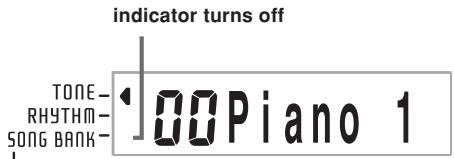
REMARQUE
- Vous pouvez également effectuer les opérations suivantes pendant la lecture d'un morceau de la banque de chansons.
- Pause : Appuyez sur le bouton PLAY/PAUSE.
- Avance rapide : Appuyez sur le bouton FF (avance rapide).
- Retour rapide : Appuyez sur le bouton REW (retour rapide).
Ce clavier peut être alimenté par le courant d'une prise murale standard (en utilisant l'adaptateur secteur spécifié) ou par des piles. Assurez-vous toujours d'éteindre le clavier lorsque vous ne l'utilisez pas.
Utilisation des piles
Assurez-vous toujours d'éteindre le clavier avant d'insérer ou de remplacer les piles.
Pour insérer les piles
1 Retirez le couvercle du compartiment à piles.
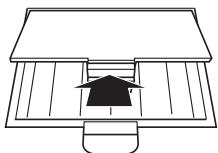
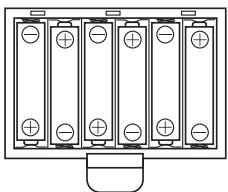
2 Insérez 6 piles de taille AA dans le compartiment à piles.
- Assurez-vous que les extrémités positive (+) et négative (-) sont orientées correctement.
3 Insérez les languettes du couvercle du compartiment à piles dans les trous prévus à cet effet et fermez le couvercle.
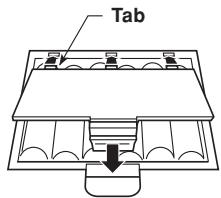
Le clavier peut ne pas fonctionner correctement si vous insérez ou remplacez les piles alors que l'alimentation est allumée. Si cela se produit, éteignez puis rallumez le clavier pour rétablir un fonctionnement normal.
Informations importantes sur les piles
La durée de vie approximative des piles est indiquée ci-dessous.
Piles alcalines : 4 heures*
Piles au manganèse : 2 heures*
- La valeur ci-dessus correspond à la durée de vie standard des piles à température normale, avec le volume du clavier réglé sur moyen. Des températures extrêmes ou un volume très élevé peuvent réduire la durée de vie des piles.
L'un des symptômes suivants indique un niveau de charge faible. Remplacez les piles dès que possible si l'un de ces symptômes se produit.
- Voyant d'alimentation faible
- L'instrument ne s'allume pas
- Affichage qui scintille, est faible ou difficile à lire
- Volume anormalement faible du haut-parleur/casque, distorsion du son
- Interruption occasionnelle du son lors d'une lecture à volume élevé
- Coupure de courant soudaine lors d'une lecture à volume élevé
- Scintillement ou atténuation de l'affichage lors d'une lecture à volume élevé
- Émission sonore continue même après avoir relâché une touche
- Sonorité totalement différente de celle sélectionnée
- Lecture anormale du motif rythmique et de la banque de chansons
- Perte de puissance, distorsion du son ou faible volume lors de la lecture depuis un ordinateur ou un périphérique MIDI connecté
- Volume microphone anormalement faible, distorsion de l'entrée microphone
- Voyant d'alimentation faible lorsque le microphone est utilisé
- Coupure de courant soudaine lors de l'utilisation du microphone
AVERTISSEMENT
Une mauvaise utilisation des piles peut provoquer une fuite, entraînant des dommages aux objets environnants, ou une explosion, créant un risque d'incendie et de blessures. Assurez-vous toujours de respecter les précautions suivantes.
- Ne tentez jamais de démonter les piles ou de les court-circuiter.
- N'exposez jamais les piles à la chaleur et ne les jetez pas au feu.
- Ne mélangez jamais des piles usagées avec des piles neuves.
- Ne mélangez jamais des piles de types différents.
- Ne chargez pas les piles.
- Assurez-vous que les extrémités positive (+) et négative (-) des piles sont orientées correctement.
ATTENTION
Une mauvaise utilisation des piles peut provoquer une fuite, entraînant des dommages aux objets environnants, ou une explosion, créant un risque d'incendie et de blessures. Assurez-vous toujours de respecter les précautions suivantes.
- Utilisez uniquement les piles spécifiées pour ce produit.
- Retirez les piles du produit si vous ne prévoyez pas de l'utiliser pendant une longue période.

Utilisation de l'adaptateur secteur
Assurez-vous d'utiliser uniquement l'adaptateur secteur spécifié pour ce clavier.
Adaptateur secteur spécifié : AD-5
[Panneau arrière]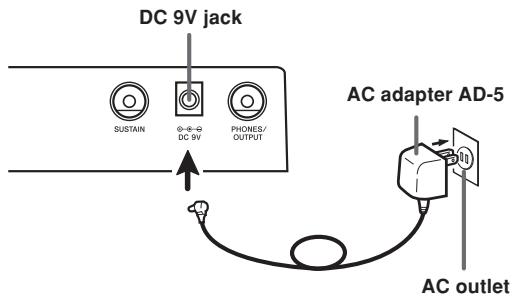
Tenez également compte des avertissements et précautions importants suivants lors de l'utilisation de l'adaptateur secteur.

AVERTISSEMENT
Une mauvaise utilisation de l'adaptateur secteur crée un risque d'incendie et de choc électrique. Assurez-vous toujours de respecter les précautions suivantes.
- Veillez à utiliser uniquement l'adaptateur secteur spécifié pour ce produit.
- Utilisez uniquement une source d'alimentation dont la tension est conforme à la valeur nominale indiquée sur l'adaptateur secteur.
- Ne surchargez pas les prises électriques et les rallonges.
- Ne placez jamais d'objets lourds sur le cordon et ne l'exposez pas à la chaleur.
- Ne tentez jamais de modifier le cordon ni de le soumettre à des flexions excessives.
- Ne tordez jamais le cordon et ne l'étirez pas.
- Si le cordon d'alimentation ou la fiche est endommagé, contactez votre revendeur d'origine ou un fournisseur de services agréé CASIO.
- Ne touchez jamais l'adaptateur secteur avec les mains mouillées. Cela risquerait de provoquer un choc électrique.
- Utilisez l'adaptateur secteur dans un endroit où il ne sera pas éclaboussé d'eau. L'eau présente un risque d'incendie et de choc électrique.
- Ne placez pas un vase ou tout autre récipient contenant un liquide sur l'adaptateur secteur. L'eau présente un risque d'incendie et de choc électrique.

ATTENTION
Une mauvaise utilisation de l'adaptateur secteur présente un risque d'incendie et de choc électrique. Assurez-vous toujours de respecter les précautions suivantes. - Ne placez pas le cordon électrique près d'une cuisinière ou d'autres sources de chaleur.
- Ne tirez jamais sur le cordon pour débrancher la prise électrique. Saisissez toujours l'adaptateur secteur pour le débrancher.
- Insérez l'adaptateur secteur dans la prise murale jusqu'au bout.
- Débranchez l'adaptateur secteur de la prise murale pendant les orages ou avant de partir en voyage ou pour une absence prolongée.
- Au moins une fois par an, débranchez l'adaptateur secteur de la prise murale et essuyez toute poussière accumulée autour des broches de la fiche.
IMPORTANT !
- Assurez-vous que le clavier est éteint avant de brancher ou de débrancher l'adaptateur secteur.
- L'utilisation prolongée de l'adaptateur secteur peut le faire chauffer au toucher. Cela est normal et n'indique pas un dysfonctionnement.
Extinction automatique
Lorsque vous utilisez l'alimentation par piles, l'alimentation du clavier s'éteint automatiquement si vous le laissez sans aucune opération pendant environ 6 minutes. Dans ce cas, utilisez l'interrupteur POWER/MODE pour rallumer l'alimentation.
REMARQUE
- L'extinction automatique est désactivée (elle ne fonctionne pas) lorsque vous utilisez l'adaptateur secteur pour alimenter le clavier.
Pour désactiver l'extinction automatique
Maintenez enfoncé le bouton TONE tout en allumant le clavier pour désactiver l'extinction automatique.
REMARQUE
- Lorsque l'extinction automatique est désactivée, le clavier ne s'éteint pas automatiquement, quelle que soit la durée pendant laquelle il reste sans aucune opération.
- L'extinction automatique est automatiquement activée chaque fois que vous allumez le clavier.
Réglages
Tous les réglages du clavier reviennent à leurs valeurs par défaut chaque fois que l'alimentation du clavier est rallumée après avoir été éteinte par l'interrupteur POWER/MODE ou par l'extinction automatique.
Borne Phones/Sortie
Avant de brancher un casque ou un autre équipement externe, assurez-vous d'abord de baisser le volume du clavier et de l'équipement connecté. Vous pouvez ensuite ajuster le volume au niveau souhaité une fois les connexions terminées.
[Panneau arrière]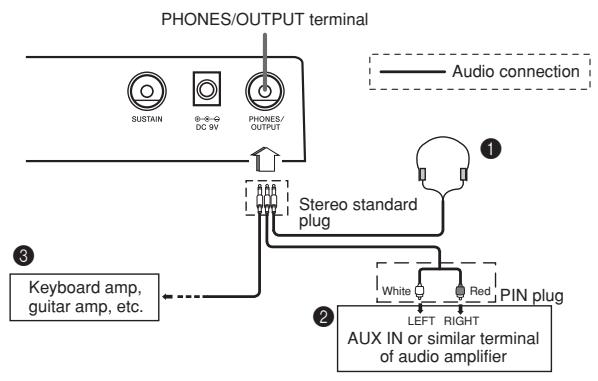
Connexion de casques (Figure 1)
La connexion d'un casque coupe la sortie des haut-parleurs intégrés du clavier, vous permettant ainsi de jouer même tard le soir sans déranger personne.
Équipement audio (Figure 2)
Connectez le clavier à un équipement audio à l'aide d'un cordon de connexion disponible dans le commerce, muni d'une fiche standard à une extrémité et de deux fiches PIN à l'autre extrémité. Notez que la fiche standard que vous connectez au clavier doit être une fiche stéréo, sinon vous ne pourrez sortir qu'un seul des canaux stéréo. Dans cette configuration, vous réglez normalement le sélecteur d'entrée de l'équipement audio sur la borne (généralement marquée AUX IN ou similaire) où le cordon du clavier est connecté. Consultez la documentation utilisateur fournie avec votre équipement audio pour plus de détails.
Amplificateur d'instrument de musique (Figure 3)
Utilisez un cordon de connexion disponible dans le commerce* pour connecter le clavier à un amplificateur d'instrument de musique.
- Assurez-vous d'utiliser un cordon de connexion qui a une fiche standard stéréo à l'extrémité que vous connectez au clavier, et un connecteur qui fournit une entrée à deux canaux (gauche et droite) à l'amplificateur auquel vous vous connectez. Un mauvais type de connecteur à l'une ou l'autre extrémité peut entraîner la perte d'un des canaux stéréo.
Lorsqu'il est connecté à un amplificateur d'instrument de musique, réglez le volume du clavier à un niveau relativement bas et effectuez les réglages de volume de sortie à l'aide des commandes de l'amplificateur.
[Exemple de connexion]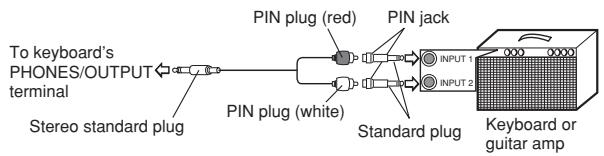
REMARQUE :
- Vous pouvez également connecter la borne MIDI du clavier à un ordinateur ou à un séquenceur. Voir "MIDI" à la page E-30 pour plus de détails.
Borne de prise Sustain
Vous pouvez connecter une pédale de sustain en option (SP-3 ou SP-20) à la borne de prise SUSTAIN pour activer les fonctions décrites ci-dessous.
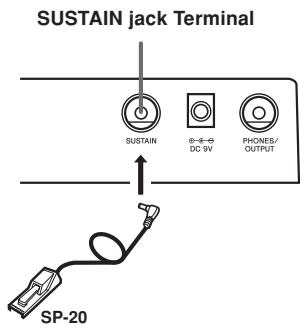
Pédale de sustain
- Avec les sons de piano, l'enfoncement de la pédale fait résonner les notes, un peu comme la pédale forte d'un piano.
- Avec les sons d'orgue, l'enfoncement de la pédale fait continuer les notes jusqu'à ce que la pédale soit relâchée.
Accessoires et options
N'utilisez que les accessoires et options spécifiés pour ce clavier. L'utilisation d'articles non autorisés présente un risque d'incendie, de choc électrique et de blessure.
Cette section fournit des informations sur les opérations de base du clavier.
Jouer du clavier
Pour jouer du clavier
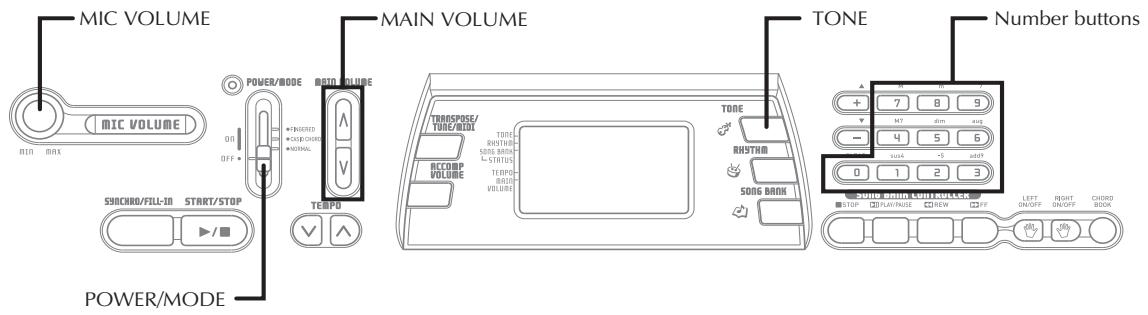
1. Réglez l'interrupteur POWER/MODE sur NORMAL. Utilisez les boutons MAIN VOLUME pour baisser le volume du clavier.
- Il est toujours bon de régler le volume du clavier à un niveau relativement bas avant de jouer.
- Appuyer sur [▲] ou [▼] fait apparaître le réglage de volume actuel sur l'écran. Appuyez à nouveau sur [▲] ou [▼] pour modifier le réglage.
3. Jouez quelque chose sur le clavier.
Sélection d'un son
Ce clavier est équipé de 100 sons intégrés. Utilisez la procédure suivante pour sélectionner le son que vous souhaitez utiliser.
Pour sélectionner un son
1. Trouvez le son que vous souhaitez utiliser dans la liste TONE et notez son numéro.
- Tous les sons disponibles ne sont pas indiqués sur la liste des sons imprimée sur le pupitre du clavier. Pour une liste complète, voir « Liste des sons » à la page A-1. Appuyez sur le bouton TONE.
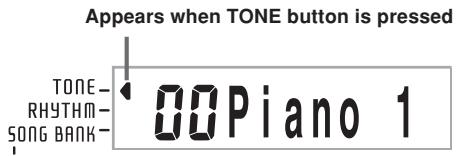
3 Utilisez les boutons numériques pour saisir le numéro à deux chiffres du son que vous souhaitez sélectionner. Exemple : Pour sélectionner « 26 WOOD BASS », saisissez 2 puis 6.

- Les notes jouées au clavier seront alors émises avec un son de contrebasse acoustique.
REMARQUE
- Saisissez toujours les deux chiffres du numéro de son, y compris le zéro initial (le cas échéant). Si vous ne saisissez qu'un chiffre et vous arrêtez, l'affichage effacera automatiquement votre saisie après quelques secondes.
- Vous pouvez également incrémenter le numéro de son affiché en appuyant sur ([+) et le décrémenter en appuyant sur ([-]). Les sons d'effets sonores tels que 77 VEHICULE rendent le mieux lorsque vous maintenez une touche du clavier enfoncée.
Sons combinés
Voici la description des deux types de sons combinés disponibles.
Sons superposés (numéros de sons : 80 à 89)
Exemple : 80 STR PIANO
Ce son superpose un son de cordes à un son de piano, de sorte que les deux retentissent lorsqu'une touche du clavier est enfoncée.
Sons divisés (numéros de sons : 90 à 96)
Exemple : 90 BASS/PIANO
Ce son divise le clavier de sorte qu'une plage est assignée à un son de basse et une autre plage à un son de piano.

Sons de percussion
Exemple : 99 PERCUSSION
Cette sonorité attribue divers sons de percussion au clavier. Voir la « Liste des instruments de percussion » à la page A-6 pour plus de détails.
Sonorités d'effets sonores
Avec les sonorités d'effets sonores 77 à 79, le type de son produit dépend de l'octave où se trouve la touche que vous appuyez. Lorsque 78 PHONE est sélectionné, les types de sons disponibles sont PUSH TONE 1, PUSH TONE 2, RING 1, RING 2 et BUSY SIGNAL.
Polyphonie
Le terme polyphonie fait référence au nombre maximal de notes que vous pouvez jouer en même temps. Le clavier a une polyphonie de 12 notes, ce qui inclut les notes que vous jouez ainsi que les rythmes et les motifs d'accompagnement automatique joués par le clavier. Cela signifie que lorsqu'un rythme ou un motif d'accompagnement automatique est joué par le clavier, le nombre de notes (polyphonie) disponible pour le jeu au clavier est réduit. Notez également que certaines sonorités n'offrent qu'une polyphonie de 6 notes.
REMARQUE
- Lorsqu'un rythme ou un accompagnement automatique est en cours de lecture, le nombre de sons joués simultanément est réduit.
Échantillonnage numérique
Un certain nombre de sonorités disponibles sur ce clavier ont été enregistrées et traitées à l'aide d'une technique appelée échantillonnage numérique. Pour garantir un niveau élevé de qualité tonale, des échantillons sont prélevés dans les registres grave, médium et aigu, puis combinés pour vous fournir des sons étonnamment proches des originaux. Vous pouvez remarquer de très légères différences de volume ou de qualité sonore pour certaines sonorités lorsque vous les jouez à différentes positions sur le clavier. C'est un résultat inévitable de l'échantillonnage multiple, et ce n'est pas un signe de dysfonctionnement.
Utilisation de la prise microphone
La connexion d'un microphone disponible dans le commerce à la prise MIC IN permet de chanter en accompagnement des morceaux intégrés du clavier ou de la sortie d'un périphérique MIDI. Lors de la connexion d'un microphone, assurez-vous de régler d'abord le volume MIC sur un niveau relativement bas, puis ajustez au niveau souhaité après la connexion.

Réglez le bouton MIC VOLUME du côté « MIN ».

Activez l'interrupteur ON/OFF du microphone.

Utilisez le bouton MIC VOLUME pour régler le volume du microphone au niveau souhaité.
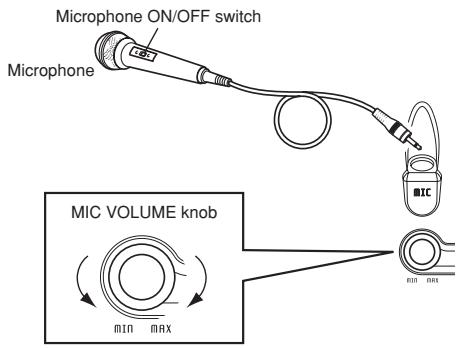
IMPORTANT !
- Veillez à utiliser l'interrupteur ON/OFF du microphone pour l'éteindre et à le débrancher du clavier lorsque vous ne l'utilisez pas.
Type de microphone recommandé
- Microphone dynamique (fiche standard)
IMPORTANT !
- Veillez à débrancher le microphone du clavier lorsque vous ne l'utilisez pas.
Larsen (bruit de retour)
L'une des conditions suivantes peut provoquer un larsen (bruit de retour).
- Couvrir la tête du microphone avec la main
- Positionner le microphone trop près d'un haut-parleur
Si un larsen se produit, essayez de tenir le microphone plus loin de la tête et éloignez-vous de tout haut-parleur à proximité.
Bruit statique
L'éclairage fluorescent peut provoquer un bruit statique dans le signal du microphone. Si cela se produit, éloignez-vous de l'éclairage que vous pensez être à l'origine du bruit.
Ce clavier joue automatiquement les parties de basse et d'accords en fonction des accords que vous jouez. Les parties de basse et d'accords sont jouées avec des sons et des tonalités automatiquement sélectionnés pour correspondre au rythme que vous utilisez. Tout cela signifie que vous obtenez des accompagnements complets et réalistes pour les notes de mélodie que vous jouez avec la main droite, créant ainsi l'ambiance d'un ensemble à une personne.
Sélection d'un rythme
Ce clavier vous offre 100 rythmes passionnants que vous pouvez sélectionner en suivant la procédure ci-dessous.
Pour sélectionner un rythme
1. Trouvez le rythme souhaité dans la liste des rythmes et notez son numéro de rythme.
- Tous les rythmes disponibles ne figurent pas sur la liste imprimée sur le panneau du clavier. Pour une liste complète, reportez-vous à la « Liste des rythmes » à la page A-7.
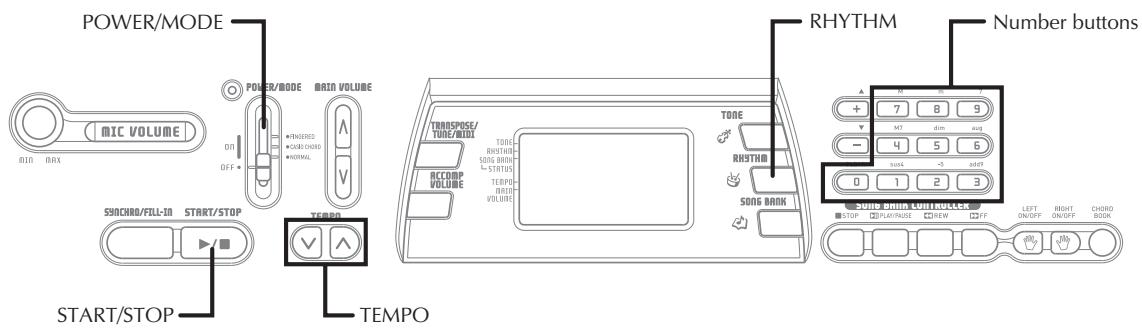
2. Appuyez sur le bouton RHYTHM.
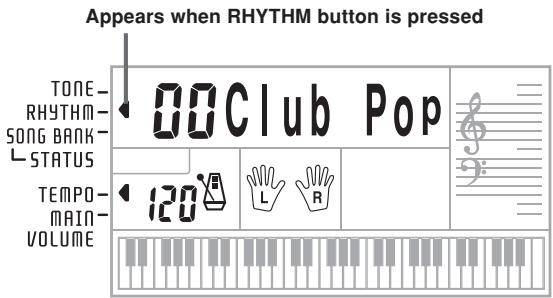
3. Utilisez les touches numériques pour saisir le numéro à deux chiffres du rythme souhaité. Exemple : Pour sélectionner « 64 WALTZ », saisissez 6 puis 4.
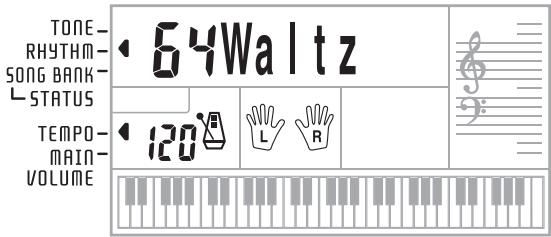
REMARQUE
- « 00 CLUB POP » est le réglage de rythme par défaut à la mise sous tension du clavier.
- Vous pouvez également incrémenter le numéro de rythme affiché en appuyant sur [+] et le décrémenter en appuyant sur [-].
Lecture d'un rythme
Utilisez la procédure suivante pour démarrer et arrêter la lecture d'un rythme.
Pour jouer un rythme
1. Réglez l'interrupteur POWER/MODE sur NORMAL. 2. Appuyez sur le bouton START/STOP pour démarrer la lecture du rythme sélectionné. 3. Pour arrêter la lecture du rythme, appuyez à nouveau sur le bouton START/STOP.
REMARQUE
- Toutes les touches du clavier sont des touches de mélodie lorsque l'interrupteur POWER/MODE est réglé sur NORMAL.
Réglage du tempo
Vous pouvez régler le tempo du jeu rythmique dans une plage de 20 à 255 battements par minute. Le réglage du tempo s'applique à la lecture des accords d'accompagnement automatique et aux opérations de la banque de morceaux.
Pour régler le tempo
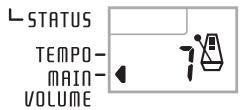
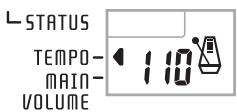
Utilisez les boutons TEMPO ( /) pour régler le tempo.
: augmente la valeur du tempo. : diminue la valeur du tempo.
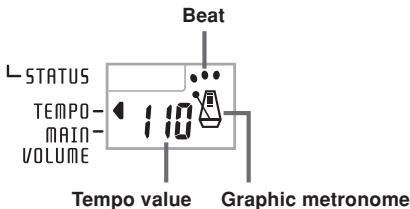
Exemple : maintenez enfoncé le bouton jusqu'à ce que la valeur 110 s'affiche.
REMARQUE
- Appuyer simultanément sur les deux boutons TEMPO (▲ et ) réinitialise le tempo à la valeur par défaut du rythme sélectionné.
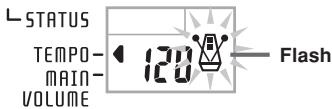
À propos du métronome graphique
Le métronome graphique apparaît à l'écran avec la valeur du tempo et le battement d'un rythme ou d'un air intégré. Le métronome graphique vous aide à garder le tempo pendant que vous jouez avec un rythme ou un air intégré.
Utilisation de l'accompagnement automatique
La procédure suivante décrit comment utiliser la fonction d'accompagnement automatique du clavier. Avant de commencer, vous devez d'abord sélectionner le rythme que vous souhaitez utiliser et régler le tempo de ce rythme à la valeur souhaitée.
Pour utiliser l'accompagnement automatique
1 Réglez le commutateur POWER/MODE sur CASIO CHORD ou FINGERED. Appuyez sur le bouton START/STOP pour lancer la lecture du rythme sélectionné.
3 Jouez un accord.
- La procédure réelle à utiliser pour jouer un accord dépend de la position actuelle de l'interrupteur POWER/MODE. Reportez-vous aux pages suivantes pour plus de détails sur le jeu d'accords.
CASIO CHORD.......Cette page
FINGERED Page E-20
Doigté de base de l'accord actuel (Peut être différent de l'accord réellement joué sur le clavier.)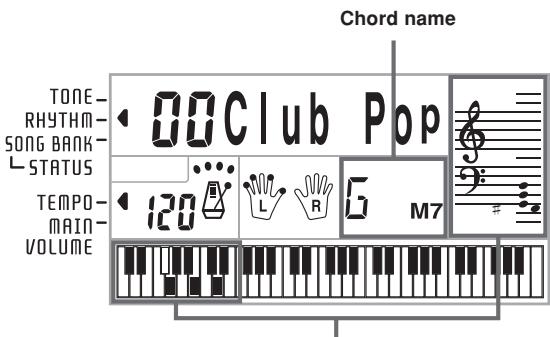
4 Pour arrêter la lecture de l'accompagnement automatique, appuyez à nouveau sur le bouton START/STOP.
CASIO CHORD
Cette méthode de jeu d'accords permet à tout le monde de jouer facilement des accords, quelle que soit sa connaissance ou son expérience musicale. Ce qui suit décrit le "clavier d'accompagnement" et le "clavier mélodie" de CASIO CHORD, et explique comment jouer les accords CASIO CHORD.
Clavier d'accompagnement CASIO CHORD et clavier mélodie
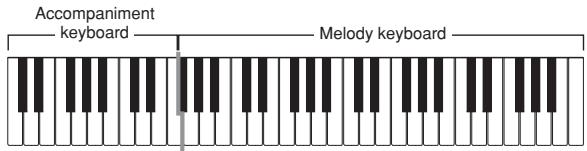
REMARQUE
- Le clavier d'accompagnement ne peut être utilisé que pour jouer des accords.
Aucun son ne sera produit si vous essayez de jouer des notes de mélodie simples sur le clavier d'accompagnement.
Types d'accords
L'accompagnement CASIO CHORD permet de jouer quatre types d'accords avec un doigté minimal.
| Chord types | Example |
| Major chords Major chord names are marked above the keys of the accompaniment keyboard. Note that the chord produced when you press an accompaniment keyboard does not change octave, regardless of which key you use to play it. | C Major (C) C major (C) C major (C) C major (C) C major (C) C major (C) C major (C) C major (C) C major (C) C major (C) C major (C) C major (C) C major (C) C major (C) C major (C) C major (C) C major (C) C major (C) C major (C) C major (C) C major (C) C minor (C) C minor (C) C minor (C) C minor (C) C minor (C) C minor (C) C minor (C) C minor (C) C minor (C) C minor (C) C minor (C) C minor (C) C minor (C) C minor (C) C minor (C) C minor (C) C minor (C) C minor (C) C minor (C) C minor (C) C major (C) C major (C) C major (C) C major (C) C major (C) C major (C) C major (C) C major (C) C major (C) C major (C) C major (C) C major (C) C major (C) C major (C) C major (C) C major (C) C major (C) C major (C) C major (C) C Major (C) C Major (C) C Major (C) C Major (C) C Major (C) C Major (C) C Major (C) C Major (C) C Major (C) C Major (C) C Major (C) C Major (C) C Major (C) C Major (C) C Major (C) C Major (C) C Major (C) C Major (C) C Major (C) C Major (C) C major (C) C major (C) C major (C) C major (C) C major (C) C major (C) C major (C) C major (C) C major (C) C major (C) C major (C) C major (C) C major (C) C major (C) C major (C) C major (C) C major (C) C major (C) C major (C) |
| Minor chords (m) To play a minor chord, keep the major chord key depressed and press any other accompaniment keyboard key located to the right of the major chord key. | C minor (Cm) C minor (Cm) C minor (Cm) C minor (Cm) C minor (Cm) C minor (Cm) C minor (Cm) C minor (Cm) C minor (Cm) C minor (Cm) C minor (Cm) C minor (Cm) C minor (Cm) C minor (Cm) C minor (Cm) C minor (Cm) C minor (Cm) C minor (c) C minor (c) C minor (c) C minor (c) C minor (c) C minor (c) C minor (c) C minor (c) C minor (c) C minor (c) C minor (c) C minor (c) C minor (c) C minor (c) C minor (c) C minor (c) C minor (c) C minor (c) C minor (c) C minor (c) C minor (e) C minor (e) C minor (e) C minor (e) C minor (e) C minor (e) C minor (e) C minor (e) C minor (e) C minor (e) C minor (e) C minor (e) C minor (e) C minor (e) C minor (e) C minor (e) C minor (e) C minor (e) C minor (e) C minor (e) C minor (c) C minor (c) C minor (c) C minor (c) C minor (c) C minor (c) C minor (c) C minor (c) C minor (c) C minor (c) C minor (c) C minor (c) C minor (c) C minor (c) C minor (c) C minor (c) C minor (c) C minor (c) C minor (c) C minor (d) C minor (d) C minor (d) C minor (d) C minor (d) C minor (d) C minor (d) C minor (d) C minor (d) C minor (d) C minor (d) C minor (d) C minor (d) C minor (d) C minor (d) C minor (d) C minor (d) C minor (d) C minor (d) C minor (d) C minor (c) C minor (c) C minor (c) C minor (c) C minor (c) C minor (c) C minor (c) C minor (c) C minor (c) C minor (c) C minor (c) C minor (c) C minor (c) C minor (c) C minor (c) C minor (c) C minor (c) C minor (c) C minor (c) C minor (b) C minor (b) C minor (b) C minor (b) C minor (b) C minor (b) C minor (b) C minor (b) C minor (b) C minor (b) C minor (b) C minor (b) C minor (b) C minor (b) C minor (b) C minor (b) C minor (b) C minor (b) C minor (b) C minor (b) C minor (c) C minor (c) C minor (c) C minor (c) C minor (c) C minor (c) C minor (c) C minor (c) C minor (c) C minor (c) C minor (c) C minor (c) C minor (c) C minor (c) C minor (c) C minor (c) C minor (c) C minor (c) C minor (c) C minor (a) C minor (a) C minor (a) C minor (a) C minor (a) C minor (a) C minor (a) C minor (a) C minor (a) C minor (a) C minor (a) C minor (a) C minor (a) C minor (a) C minor (a) C minor (a) C minor (a) C minor (a) C minor (a) C minor (a) C minor (c) C minor (c) C minor (c) C minor (c) C minor (c) C minor (c) C minor (c) C minor (c) C minor (c) C minor (c) C minor (c) C minor (c) C minor (c) C minor (c) C minor (c) C minor (c) C minor (c) C minor (c) C minor (c) C minor (r) C minor (r) C minor (r) C minor (r) C minor (r) C minor (r) C minor (r) C minor (r) C minor (r) C minor (r) C minor (r) C minor (r) C minor (r) C minor (r) C minor (r) C minor (r) C minor (r) C minor (r) C minor (r) C minor (r) C minor (c) C minor (c) C minor (c) C minor (c) C minor (c) C minor (c) C minor (c) C minor (c) C minor (c) C minor (c) C minor (c) C minor (c) C minor (c) C minor (c) C minor (c) C minor (c) C minor (c) C minor (c) C minor (c) C minor (s) C minor (s) C minor (s) C minor (s) C minor (s) C minor (s) C minor (s) C minor (s) C minor (s) C minor (s) C minor (s) C minor (s) C minor (s) C minor (s) C minor (s) C minor (s) C minor (s) C minor (s) C minor (s) C minor (s) C minor (c) C minor (c) C minor (c) C minor (c) C minor (c) C minor (c) C minor (c) C minor (c) C minor (c) C minor (c) C minor (c) C minor (c) C minor (c) C minor (c) C minor (c) C minor (c) C minor (c) C minor (c) C minor (c) C minor (t) C minor (t) C minor (t) C minor (t) C minor (t) C minor (t) C minor (t) C minor (t) C minor (t) C minor (t) C minor (t) C minor (t) C minor (t) C minor (t) C minor (t) C minor (t) C minor (t) C minor (t) C minor (t) C minor (t) C minor (c) C minor (c) C minor (c) C minor (c) C minor (c) C minor (c) C minor (c) C minor (c) C minor (c) C minor (c) C minor (c) C minor (c) C minor (c) C minor (c) C minor (c) C minor (c) C minor (c) C minor (c) C minor (c) C minor (f) C minor (f) C minor (f) C minor (f) C minor (f) C minor (f) C minor (f) C minor (f) C minor (f) C minor (f) C minor (f) C minor (f) C minor (f) C minor (f) C minor (f) C minor (f) C minor (f) C minor (f) C minor (f) C minor (f) C minor (c) C minor (c) C minor (c) C minor (c) C minor (c) C minor (c) C minor (c) C minor (c) C minor (c) C minor (c) C minor (c) C minor (c) C minor (c) C minor (c) C minor (c) C minor (c) C minor (c) C minor (c) C minor (c) C minor (g) C minor (g) C minor (g) C minor (g) C minor (g) C minor (g) C minor (g) C minor (g) C minor (g) C minor (g) C minor (g) C minor (g) C minor (g) C minor (g) C minor (g) C minor (g) C minor (g) C minor (g) C minor (g) C minor (g) C minor (c) C minor (c) C minor (c) C minor (c) C minor (c) C minor (c) C minor (c) C minor (c) C minor (c) C minor (c) C minor (c) C minor (c) C minor (c) C minor (c) C minor (c) C minor (c) C minor (c) C minor (c) C minor (c) C minor (n) C minor (n) C minor (n) C minor (n) C minor (n) C minor (n) C minor (n) C minor (n) C minor (n) C minor (n) C minor (n) C minor (n) C minor (n) C minor (n) C minor (n) C minor (n) C minor (n) C minor (n) C minor (n) C minor (n) C minor (n) C minor (n) C minor (n) C minor (n) C minor (n) C minor (n) C minor (n) C minor (n) C minor (n) C minor (n) C minor (n) C minor (n) C minor (n) C minor (n) C minor (n) |
REMARQUE
- Peu importe que vous appuyiez sur les touches blanches ou noires à droite d'une touche d'accord majeur lorsque vous jouez des accords mineurs ou de septième.
FINGERED
FINGERED vous propose un total de 15 types d'accords différents. Ce qui suit décrit le "clavier d'accompagnement" et le "clavier mélodie" FINGERED, et vous explique comment jouer un accord de do fondamental avec FINGERED.
Clavier d'accompagnement FINGERED et clavier mélodie
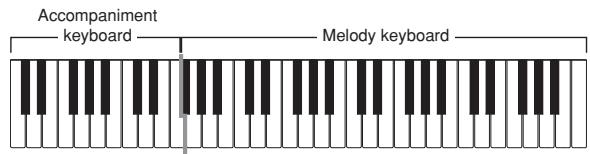
REMARQUE
- Le clavier d'accompagnement ne peut être utilisé que pour jouer des accords. Aucun son ne sera produit si vous essayez de jouer des notes de mélodie simples sur le clavier d'accompagnement.
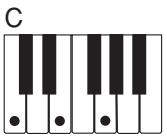
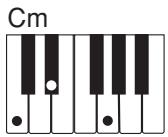
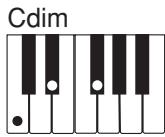
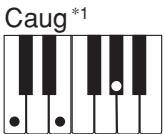
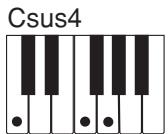
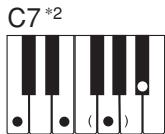
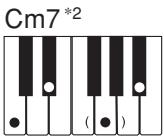
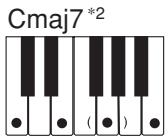
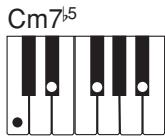
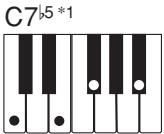
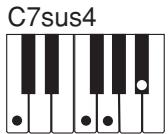
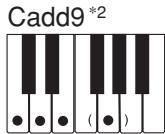
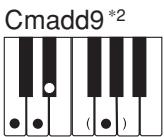
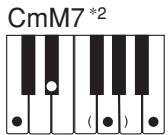
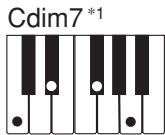
Voir le "Tableau des accords FINGERED" à la page A-4 pour plus de détails sur la façon de jouer des accords avec d'autres fondamentales.
1 : Les inversions ne peuvent pas être utilisées. La note la plus grave est la fondamentale. 2 : Le même accord peut être joué sans appuyer sur la quinte sol.
REMARQUE
Sauf pour les accords spécifiés dans la note *1 ci-dessus, les inversions (c'est-à-dire jouer mi-sol-do ou sol-do-mi au lieu de do-mi-sol) produiront les mêmes accords que le doigté standard. Sauf pour l'exception spécifiée dans la note *2 ci-dessus, toutes les touches qui composent un accord doivent être enfoncées. Si vous n'appuyez pas sur une seule touche, l'accord FINGERED souhaité ne sera pas joué.
Utilisation d'un motif de remplissage
Les motifs de remplissage vous permettent de modifier momentanément le motif rythmique pour ajouter une variation intéressante à vos performances.
La procédure suivante décrit comment utiliser la fonction de remplissage.
Pour insérer un remplissage
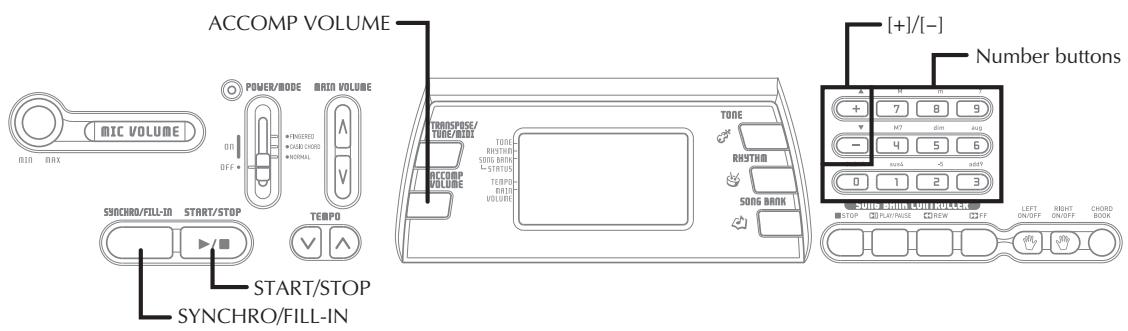
Appuyez sur le bouton START/STOP pour démarrer la lecture rythmique. Appuyez sur le bouton SYNCHRO/FILL-IN pour insérer un motif de remplissage pour le rythme que vous utilisez.
Démarrage synchro de l'accompagnement avec la lecture rythmique
Vous pouvez configurer le clavier pour démarrer le jeu rythmique en même temps que vous jouez l'accompagnement sur le clavier.
La procédure suivante décrit comment utiliser le démarrage synchro. Avant de commencer, vous devez d'abord sélectionner le rythme que vous souhaitez utiliser, régler le tempo et utiliser le commutateur POWER/MODE pour sélectionner la méthode de jeu d'accords que vous souhaitez utiliser (CASIO CHORD, FINGERED).
Pour utiliser le démarrage synchro
Appuyez sur le bouton SYNCHRO/FILL-IN pour mettre le clavier en mode veille de démarrage synchro.
2 Jouez un accord sur le clavier d'accompagnement et le motif rythmique commence automatiquement à jouer.
REMARQUE
- Si le commutateur POWER/MODE est réglé sur NORMAL, seul le rythme joue (sans accord) lorsque vous jouez sur le clavier d'accompagnement.
- Pour annuler la veille de démarrage synchro, appuyez à nouveau sur le bouton SYNCHRO/FILL-IN.
Réglage du volume d'accompagnement
Vous pouvez régler le volume des parties d'accompagnement sur une valeur comprise entre 0 (minimum) et 9.
Appuyez sur le bouton ACCOMP VOLUME.
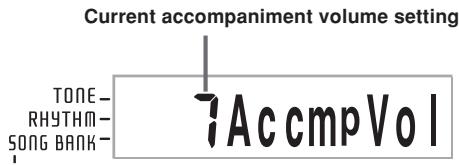
Utilisez les boutons numériques ou les boutons [+]/[-] pour modifier la valeur de volume actuelle. Exemple : 5

REMARQUE
- La valeur de volume d'accompagnement actuelle affichée à l'étape 1 s'efface automatiquement de l'écran si vous ne saisissez rien dans les cinq secondes environ.
- Appuyer simultanément sur les boutons [+] et [-] règle automatiquement le volume d'accompagnement sur 7.
Une sélection de 100 airs de la banque de chansons est intégrée pour votre plaisir d'écoute ou pour jouer en accompagnement. Vous pouvez désactiver la partie de la main gauche ou de la main droite pour vous entraîner avec la partie restante, et l'écran vous montre même quelles touches presser et quels doigts utiliser.
Lecture d'un air de la banque de chansons
Pour lire un air de la banque de chansons
1. Réglez le commutateur POWER/MODE sur NORMAL, FINGERED ou CASIO CHORD. 2. Ajustez le volume principal et le volume d'accompagnement. Appuyez sur le bouton SONG BANK pour entrer en mode Banque de chansons.
Apparaît lorsque le bouton SONG BANK est enfoncé
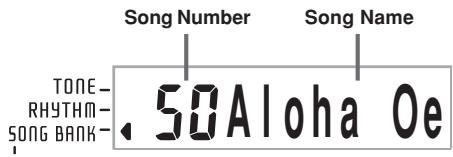
Utilisez la liste de la banque de chansons pour trouver l'air que vous voulez lire, puis utilisez les boutons numériques pour saisir le numéro à deux chiffres de l'air.
Exemple : Pour sélectionner "50 ALOHA OE", saisissez 5 puis 0.
REMARQUE
- "00 MY HEART WILL GO ON (THÈME DE "TITANIC")" est le réglage initial par défaut de la banque de chansons lorsque vous allumez le clavier.
- Vous pouvez également incrémenter le numéro d'air affiché en appuyant sur [+] et le décrémenter en appuyant sur [-].
- Avant de passer à l'étape suivante, qui démarre réellement la lecture, vous pouvez régler le tempo (page E-19), sélectionner un son (page E-16) pour la partie mélodie, ou désactiver la partie de la main gauche ou de la main droite (page E-24).
Appuyez sur le bouton PLAY/PAUSE pour démarrer la lecture de l'air.
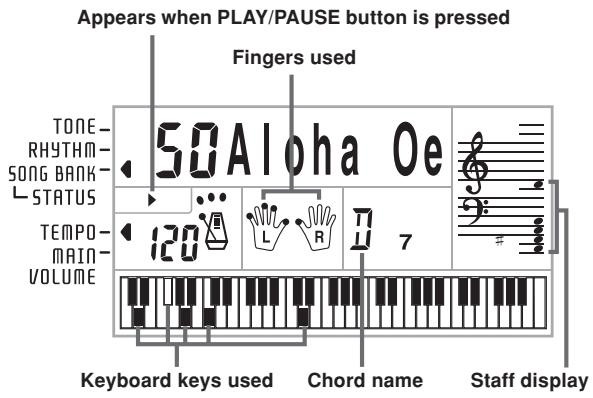
6. Appuyez sur le bouton STOP pour arrêter la lecture de l'air de la banque de chansons.
Pour mettre en pause la lecture d'un air de la banque de chansons
Pendant la lecture d'un air de la banque de chansons, appuyez sur le bouton PLAY/PAUSE pour le mettre en pause.
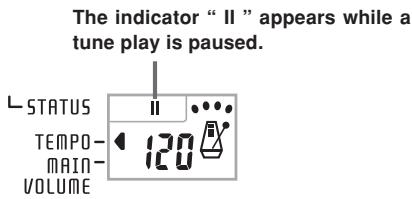
Pour reprendre la lecture, appuyez à nouveau sur LECTURE/PAUSE.
Pour un retour rapide pendant la lecture
Pendant la lecture, maintenez enfoncé le bouton REW.
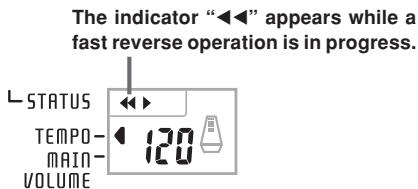
- Des bips sonores retentissent pendant le retour rapide pour vous donner une idée de votre position dans le morceau. 1 bip : indique un changement de mesure. 2 bips : indique le début du morceau.
Pour reprendre la lecture normale, relâchez le bouton REW.
Pour une avance rapide pendant la lecture
Pendant la lecture, maintenez enfoncé le bouton FF.
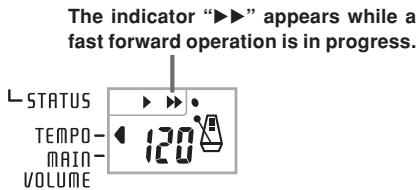
- Des bips sonores retentissent pendant l'avance rapide pour vous donner une idée de votre position dans le morceau. 1 bip : indique un changement de mesure. 3 bips : indique la fin du morceau.
Pour reprendre la lecture normale, relâchez le bouton FF.
REMARQUE
Chaque fois que vous sélectionnez un nouveau morceau de la banque de morceaux, le timbre, le tempo et le rythme programmés pour ce morceau sont automatiquement sélectionnés. Vous pouvez modifier le timbre et le tempo d'un morceau pendant la lecture, mais vous ne pouvez pas modifier le rythme. - Vous pouvez également régler le volume d'accompagnement (page E-21) pour les morceaux 00 à 80.
Affichage du mode Banque de morceaux
Dans le mode Banque de morceaux, l'écran affiche diverses informations sur le morceau en cours de lecture.
[Affichage de lecture]
![CASIO CTK-496 - [Affichage de lecture] - 1](/content/2025/01/129446/images/3d07bde2aadaa2187621292fe65a15b08a3037362709ab742c3fdd772292812c.jpg)
REMARQUE
- Les noms d'accords ne sont pas affichés pour les morceaux 81 à 99.
Réglage du tempo d'un morceau de la banque de morceaux
Pour changer le tempo d'un morceau de la banque de morceaux
Le tempo peut être réglé dans une plage de 20 à 255 battements par minute. Le réglage du tempo peut être ajusté pendant que le morceau est arrêté, en lecture ou en pause.
Utilisez les boutons TEMPO [Δ / ] pour ajuster le tempo.
: chaque pression augmente la valeur : chaque pression diminue la valeur
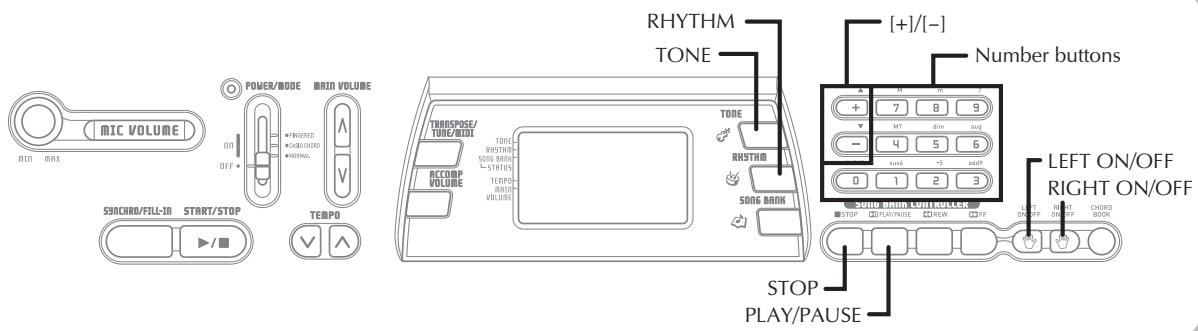
REMARQUE
- Appuyer simultanément sur les boutons TEMPO [Δ] et [] ramène le tempo au réglage prédéfini pour le morceau sélectionné.
- Les morceaux 81 à 99 de la banque de morceaux sont arrangés de sorte que leur tempo change en cours de morceau. Si vous utilisez la procédure ci-dessus pour changer le tempo pendant la lecture de l'un de ces morceaux, le tempo que vous réglez est utilisé pour tout le morceau sans changement en cours de route.
Changement du timbre de la mélodie d'un morceau de la banque de morceaux
Vous pouvez sélectionner l'un des 100 timbres du clavier pour jouer la partie mélodie d'un morceau de la banque de morceaux. Le réglage du timbre peut être modifié pendant que le morceau est arrêté ou en lecture.

Pendant la lecture d'un morceau, appuyez sur le bouton TONE.
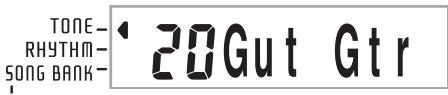

Trouvez le timbre souhaité dans la liste des timbres, puis utilisez les boutons numériques ou les boutons [+] et [-] pour spécifier le numéro du timbre.
Exemple : Pour sélectionner "30 VIOLON", saisissez 3 puis 0.

REMARQUE
- Appuyer simultanément sur les boutons [+] et [-] sélectionne "00 PIANO 1".
- Pour les morceaux à deux mains (81 à 99), vous pouvez sélectionner des sonorités pour la partie de main gauche et pour la partie de main droite.
- Pour rétablir les réglages d'origine d'un morceau de la banque de morceaux, il suffit de le sélectionner à nouveau.
Jouer en accompagnement d'un morceau de la banque de morceaux
Chaque morceau de la banque de morceaux comporte une partie de main gauche (accompagnement) et une partie de main droite (mélodie). Vous pouvez désactiver la partie de main gauche ou la partie de main droite d'un morceau et jouer la partie restante au clavier.
| Tune Numbers | 00 to 80 | 81 to 99 |
| Accompaniment Type | Auto-accompaniment | Piano Solo |
| Left-hand Part | Auto-accompaniment (percussion, bass, chords) | Left-hand notes |
| Right-hand Part | Melody | Right-hand notes |
Pour jouer en accompagnement d'un morceau de la banque de morceaux

Effectuez les étapes 1 à 4 de la section "Pour écouter un morceau de la banque de morceaux" à la page E-22 pour sélectionner le morceau avec lequel vous voulez jouer.

Appuyez sur le bouton RIGHT ON/OFF ou LEFT ON/OFF pour la partie que vous voulez désactiver.
- Appuyez sur le bouton RIGHT ON/OFF pour désactiver la partie de main droite (mélodie), ou sur le bouton LEFT ON/OFF pour désactiver la partie de main gauche (accompagnement).
- L'état activé/désactivé de chaque partie est indiqué par les lettres (L et R) qui apparaissent à l'intérieur des graphiques de mains sur l'écran. Une partie est activée lorsque sa lettre est affichée, et désactivée lorsque sa lettre n'est pas affichée.
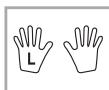
Appuyez sur le bouton PLAY/PAUSE pour lancer la lecture du morceau de la banque de morceaux.
- Seule la partie (mélodie ou accompagnement) qui est activée est jouée, vous pouvez donc jouer l'autre partie au clavier.
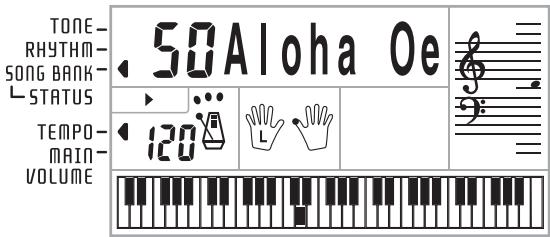
- Les touches que vous devez presser sont indiquées sur le clavier graphique de l'écran.
- Vous pouvez appuyer sur les boutons RIGHT ON/OFF et LEFT ON/OFF pour activer ou désactiver des parties pendant la lecture.
4 Pour arrêter la lecture, appuyez sur le bouton STOP.
Accompagnement automatique des morceaux (numéros de morceaux 00 à 80)
Pendant la lecture de ces morceaux en mode Banque de morceaux, la méthode de spécification des accords pour la main gauche est toujours FINGERED pour ces morceaux, quel que soit le réglage du commutateur POWER/MODE.
Morceaux à deux mains (numéros de morceaux 81 à 99)
Pendant la lecture de ces morceaux en mode Banque de morceaux, tout le clavier fonctionne comme une mélodie, quel que soit le réglage du commutateur POWER/MODE.
REMARQUE
- Avec les morceaux à deux mains (81 à 99), vous ne pouvez pas désactiver simultanément les parties de la main gauche et de la main droite. La désactivation d'une partie active automatiquement l'autre.
- Le morceau de la banque de morceaux sélectionné continue de se répéter jusqu'à ce que vous arrêtiez la lecture en appuyant sur le bouton STOP.
- Le réglage du volume d'accompagnement (page E-21) n'affecte que les morceaux d'accompagnement automatique (00 à 80).
- Les noms d'accords ne sont pas affichés pendant la lecture des morceaux à deux mains (81 à 99).
- La désactivation des parties de la main gauche et de la main droite des morceaux d'accompagnement automatique (00 à 80) entraîne la lecture d'un accompagnement obligato.
Son d'applaudissements
Chaque fois que vous désactivez la partie de la main gauche ou de la main droite d'un morceau de la banque de morceaux et que vous le lisez, un son d'applaudissements est produit lorsque le morceau atteint la fin.
Pour désactiver le son d'applaudissements
Appuyez simultanément sur le bouton STOP et sur le bouton LEFT ON/OFF ou RIGHT ON/OFF.

- Appuyer à nouveau simultanément sur le bouton STOP et sur le bouton LEFT ON/OFF ou RIGHT ON/OFF réactive le son d'applaudissements.
Lecture de toutes les mélodies de la banque de morceaux en succession
1 Utilisez le bouton TONE ou RHYTHM pour passer à un mode autre que le mode Banque de morceaux.
- Assurez-vous qu'un point n'est pas affiché à côté de l'indicateur SONG BANK.
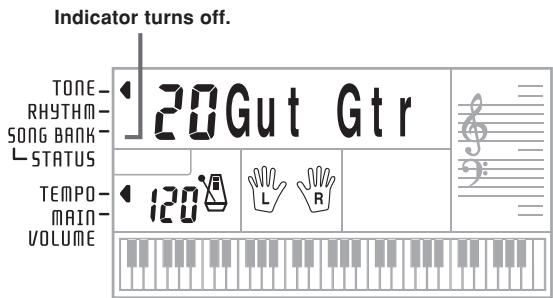
Appuyez sur le bouton PLAY/PAUSE pour démarrer la lecture des mélodies de la banque de morceaux à partir de la mélodie 00.
3 Pour arrêter la lecture des mélodies de la banque de morceaux, appuyez sur le bouton STOP.
- La mise en pause de la lecture annule automatiquement la lecture consécutive de toutes les mélodies de la banque de morceaux. La reprise de la lecture provoque la lecture répétée de la mélodie actuelle uniquement.
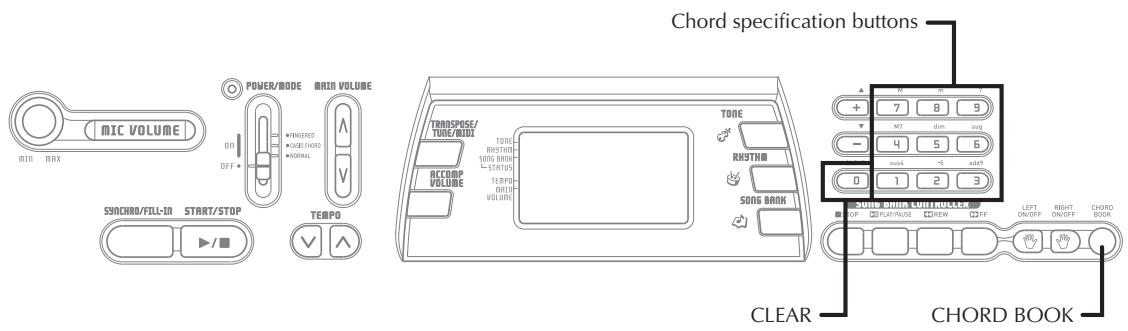
La fonction Chord Book de ce clavier vous permet de rechercher des informations sur les accords rapidement et facilement. Il suffit de saisir le nom de l'accord et les touches du clavier à presser, les doigts à utiliser et les notes qui composent l'accord apparaissent à l'écran avec le nom de l'accord.
Qu'est-ce qu'un accord ?
Un accord est composé d'une note fondamentale, sur laquelle sont empilées un certain nombre d'autres notes. Une variété d'accords différents peut être créée en changeant les notes empilées sur une fondamentale.
Notes empilées Fondamentale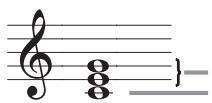
Noms des accords
Les accords sont nommés en utilisant des lettres majuscules de A à G, qui indiquent la note fondamentale de l'accord. Si la note fondamentale est dièse ou bémol, l'accord lui-même est dièse ou bémol. Un nom d'accord peut également être suivi d'un numéro de degré ou d'autres symboles qui indiquent certaines caractéristiques de l'accord.
| C Root | Sharp F# Root | Flat B# Root | Minor Am Root | Sharp Diminished C# root |
| Seventh G7-Degree Root | Major seventh FM7 Root | Degree | Sus fourth ESUS4 Root | |
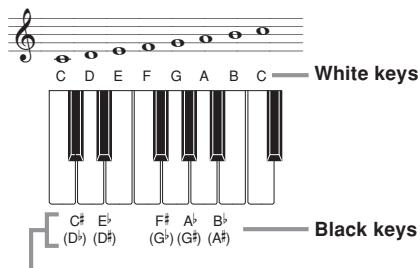
Les dièses et les bémols peuvent être désignés par l'un ou l'autre des noms indiqués ici. Les noms de la rangée supérieure de cette illustration sont utilisés par ce clavier, car ce sont les noms les plus couramment utilisés en notation musicale.
Formes inversées
Il existe plusieurs façons de jouer le même accord. Une forme différente de la forme de base mais qui produit le même accord est appelée une "forme inversée".
Tous les éléments suivants sont des accords de do.

Recherche d'un accord à l'aide du livre d'accords
Appuyez sur le bouton CHORD BOOK pour entrer dans le mode Livre d'accords.
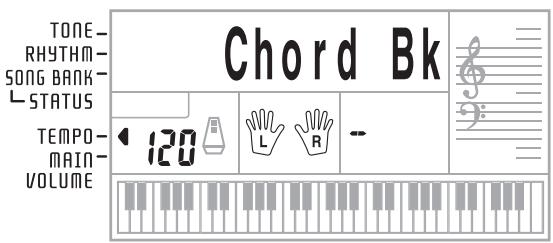
Appuyez sur le bouton CLEAR.
- Cette étape est nécessaire pour effacer tout nom d'accord précédemment saisi.
3 Si le nom d'accord que vous prévoyez de saisir n'est pas un accord majeur, utilisez les boutons de spécification d'accord pour spécifier le type d'accord.
- Les types d'accords sont indiqués par les petites lettres au-dessus des boutons de spécification d'accord. Les accords non majeurs comprennent les accords mineurs, de septième, de sus4, etc. Voir la page E-28 pour plus de détails sur les boutons de spécification d'accord.
- Ignorez l'étape 3 si vous souhaitez saisir un nom d'accord majeur.
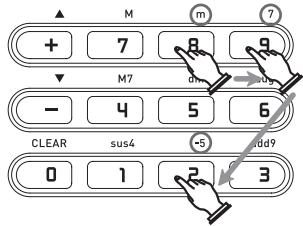
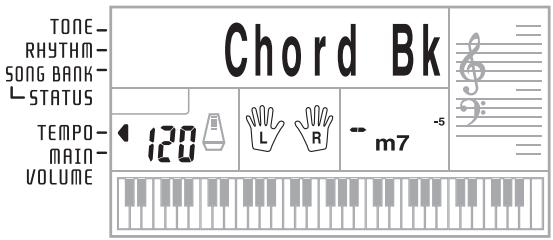
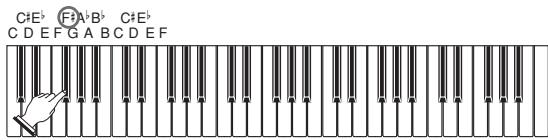
Appuyez sur la touche du clavier d'accompagnement qui correspond à la note fondamentale de l'accord.
- Un tiret apparaît à la place du nom de l'accord si l'accord ne peut pas être reconnu par le clavier.
- Pour spécifier F , par exemple, appuyez sur la touche F .
- La touche sur laquelle vous appuyez est indiquée sur le clavier graphique et l'accord correspondant retentit.
$
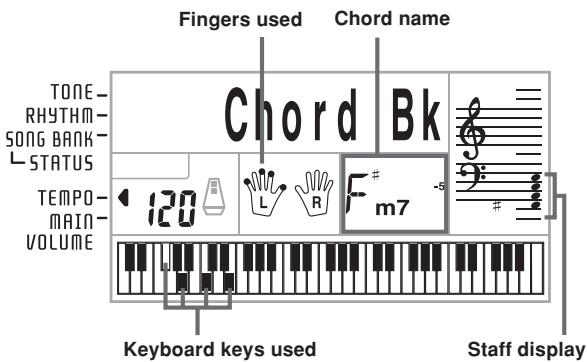
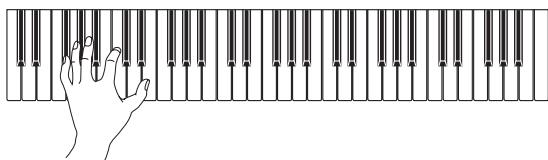
Vérifiez que le nom de l'accord affiché est celui que vous souhaitez. Si ce n'est pas le cas, répétez la procédure à partir de l'étape 2. Si l'accord est correct, vous pouvez voir son doigté sur le clavier graphique. Essayez de jouer l'accord sur le clavier.
REMARQUE
- Les doigtés affichés à l'écran sont des doigtés standard. Vous pouvez également utiliser d'autres doigtés pour les adapter à la taille de vos mains ou pour faciliter l'enchaînement avec les accords voisins.
- Vous pouvez également utiliser les boutons [+] et [-] pour changer le nom d'accord affiché.
- Le son utilisé pour jouer les accords sur le clavier d'accompagnement en mode Chord Book est le même que celui de la partie d'accompagnement du rythme sélectionné avant d'entrer dans le mode Chord Book. Selon le rythme sélectionné, certaines notes composant un accord peuvent être omises lorsque vous jouez l'accord sur le clavier d'accompagnement en mode Chord Book. Cela est dû à la fonction de conversion interne des accords, aux arrangements et aux limitations de polyphonie. Par conséquent, vous devez toujours jouer les accords indiqués à l'écran sur le clavier mélodique (la plage où les noms d'accords ne sont pas imprimés au-dessus des touches).
Touches de modification du nom d'accord
| Chord Type | Symbol and Name | Reference | Modifier Key |
| major | C (C major) | ||
| minor | Cm (C minor) | +7 8 9 +4 5 6 +2 3 0 1 2 3 | |
| aug | Caug (C augmened) | C+5 | +7 8 9 +4 5 6 +2 3 0 1 2 3 |
| sus 4 | Csus4 (C sustained forth) | +7 8 9 +4 5 6 +2 3 0 1 2 3 | |
| dim | Cdim (C diminished) | C° | +7 8 9 +4 5 6 +2 3 0 1 2 3 |
| 7th | C7 (C seventh) | +7 8 9 +4 5 6 +2 3 0 1 2 3 | |
| M7 | CM7 (C major seventh) | Cmaj7 CΔ7 | +7 8 9 +4 5 6 +2 3 0 1 2 3 |
| minor 7 | Cm7 (C minor seventh) | +7 8 9 +4 5 6 +2 3 0 1 2 3 | |
| minor M7 | CmM7 (C minor Major seventh) | +7 8 9 +4 5 6 +2 3 0 1 2 3 | |
| minor 7-5 | Cm7-5 (C minor seventh flat five) | C° | +7 8 9 +4 5 6 +2 3 0 1 2 3 |
| Chord Type | Symbol and Name | Reference | Modifier Key |
| 7sus 4 | C7sus4 (C seventh sus fourth) | +78+45+3 | |
| add 9 | Cadd9 (C add ninth) | +78+45+3 | |
| m add 9 | Cm add9 (C minor add ninth) | +78-45+3 | |
| 7th-5 | Cs7-5 (C seventh flat five) | C7*5 | +78+45+3 |
| dim7 | Cdim7 (C diminished seventh) | +78+45+3 |
REMARQUE
- Étant donné que les doigtés d'accords affichés à l'écran sont sélectionnés pour permettre le jeu d'accords sur le clavier d'accompagnement, des formes d'accords renversés (page E-26) sont souvent suggérées. Les formes d'accords renversés sont utiles pour apprendre à jouer des variations d'accords qui permettent de passer d'un accord à un autre avec un mouvement minimal de la main. Ces formes sont pratiques lors de l'utilisation de l'accompagnement automatique FINGERED.
- Lorsqu'un nom d'accord est affiché à l'écran, vous pouvez appuyer sur les touches du clavier d'accompagnement pour découvrir les doigtés du même accord avec une basse différente.
- Vous pouvez également faire défiler les noms d'accords à l'aide des boutons [+] et [-].
- Les doigtés d'accords affichés à l'écran sont formés en utilisant uniquement les touches de la plage du clavier d'accompagnement (les 18 touches les plus à gauche). Les accords qui ne peuvent pas être formés avec les touches de cette plage ne sont pas affichés.
Transposition du clavier
La transposition vous permet d'élever ou d'abaisser la tonalité globale du clavier par demi-tons. Par exemple, si vous souhaitez jouer un accompagnement pour un chanteur dont la tonalité est différente de celle du clavier, utilisez simplement la transposition pour changer la tonalité du clavier.
Pour transposer le clavier
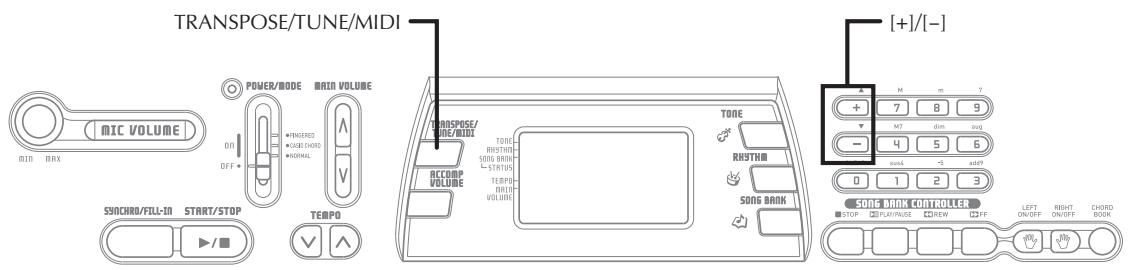
Appuyez sur le bouton TRANSPOSE/TUNE/MIDI jusqu'à ce que l'écran de transposition apparaisse.
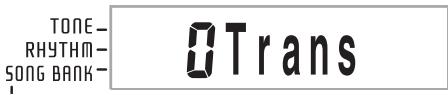
Utilisez [+] et [-] pour modifier le réglage de transposition du clavier.
Exemple : Pour transposer le clavier de cinq demi-tons vers le haut.
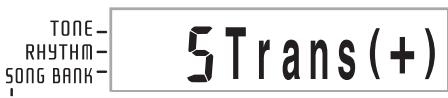
NOTE
- Le clavier peut être transposé dans une plage de -6 à +5.
- Le réglage de transposition par défaut est "0" lorsque le clavier est allumé.
- Si vous laissez l'écran de transposition affiché pendant environ cinq secondes sans rien faire, l'écran s'efface automatiquement.
- Le réglage de transposition affecte également l'accompagnement automatique.
- La lecture d'un morceau de la banque de morceaux ramène automatiquement le réglage de transposition à sa valeur par défaut standard de "0".
- La plage de hauteur autorisée pour la transposition dépend du timbre utilisé. Si une opération de transposition amène une note en dehors de la plage de hauteur du timbre utilisé, le clavier joue automatiquement la même note dans l'octave la plus proche qui se trouve dans la plage de hauteur du timbre utilisé.
Accorder le clavier
La fonction d'accordage permet d'accorder finement le clavier pour correspondre à l'accordage d'un autre instrument de musique.
Pour accorder le clavier
Appuyez deux fois sur le bouton TRANSPOSE/TUNE/MIDI pour afficher l'écran d'accordage.

Utilisez [+] et [-] pour modifier le réglage d'accordage du clavier.
Exemple : Pour baisser l'accordage de 20.
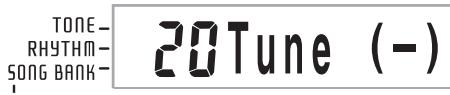
NOTE
- Le clavier peut être accordé dans une plage de -50 cents à +50 cents. *100 cents équivalent à un demi-ton.
- Le réglage d'accord par défaut est "00" lorsque l'alimentation du clavier est activée.
- Si vous laissez l'écran d'accord affiché pendant environ cinq secondes sans rien faire, l'écran est automatiquement effacé.
- Le réglage d'accord affecte également l'accompagnement automatique.
- La lecture d'un morceau de la banque de chansons ramène automatiquement le réglage d'accord à sa valeur par défaut standard de "00".
Qu'est-ce que le MIDI ?
Les lettres MIDI signifient Musical Instrument Digital Interface, qui est le nom d'une norme mondiale pour les signaux numériques et les connecteurs qui permet d'échanger des données musicales entre des instruments de musique et des ordinateurs (machines) produits par différents fabricants.
Connexions MIDI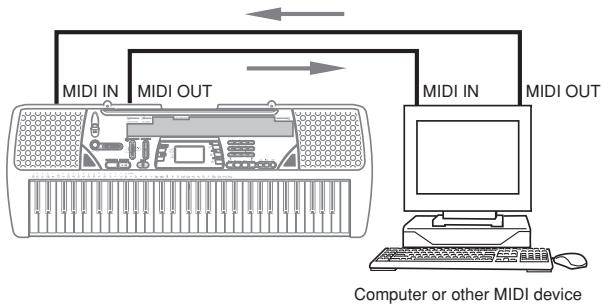
General MIDI
General MIDI standardise les données MIDI pour tous les types de sources sonores, quel que soit le fabricant. General MIDI spécifie des facteurs tels que la numérotation des sons, les sons de batterie et les canaux MIDI disponibles pour toutes les sources sonores. Cette norme permet à tout équipement MIDI de reproduire les mêmes nuances lors de la lecture de données General MIDI, quel que soit le fabricant de la source sonore.
Bien que la source sonore de ce clavier ne soit pas compatible General MIDI, vous pouvez toujours connecter le clavier à un ordinateur ou à un autre équipement MIDI pour lire des données General MIDI largement disponibles dans les magasins, sur les réseaux informatiques et à partir d'autres sources.
REMARQUE
- Les données General MIDI composées d'un grand nombre de parties peuvent ne pas être lues correctement sur ce clavier.
- Vous aurez plus de succès en lisant des données General MIDI qui ont peu de parties et qui sont composées de données sur les canaux 1, 2, 3, 4 et 10.
Messages
Il existe une grande variété de messages définis dans la norme MIDI, et cette section détaille les messages particuliers qui peuvent être envoyés et reçus par ce clavier.
NOTE ON/OFF
Ce message envoie des données lorsqu'une touche est enfoncée (NOTE ON) ou relâchée (NOTE OFF).
Un message NOTE ON/OFF comprend un numéro de note (pour indiquer la note dont la touche est enfoncée ou relâchée) et une vélocité (pression sur le clavier, valeur de 1 à 127).
La vélocité de NOTE ON est toujours utilisée pour déterminer le volume relatif de la note. Ce clavier ne reçoit pas de données de vélocité NOTE OFF.
Chaque fois que vous enfoncez ou relâchez une touche sur ce clavier, le message NOTE ON ou NOTE OFF correspondant est envoyé avec une vélocité constante depuis la borne MIDI OUT.
REMARQUE
- La hauteur d'une note dépend du timbre utilisé, comme indiqué dans le tableau des notes en page A-2. Chaque fois que ce clavier reçoit un numéro de note hors de sa plage pour ce timbre, le même timbre dans l'octave disponible la plus proche est substitué.
CHANGEMENT DE PROGRAMME
C'est le message de sélection de timbre. PROGRAM CHANGE peut contenir des données de timbre dans la plage de 0 à 127.
Un message PROGRAM CHANGE (0 à 99) est envoyé via la borne MIDI OUT de ce clavier chaque fois que vous changez manuellement son numéro de timbre. La réception d'un message PROGRAM CHANGE provenant d'une machine externe modifie le réglage de timbre de ce clavier (cette page).
Ce clavier peut envoyer des données de timbre dans la plage de 00 à 99 et recevoir des données de timbre dans la plage de 0 à 127.
PITCH BEND
Ce message transporte des informations de pitch bend pour faire glisser la hauteur vers le haut ou vers le bas en douceur pendant le jeu au clavier. Ce clavier n'envoie pas de données de pitch bend, mais il peut en recevoir.
CONTROL CHANGE
Ce message ajoute des effets tels que vibrato et changements de volume appliqués pendant le jeu au clavier.
Les données CONTROL CHANGE comprennent un numéro de contrôle (pour identifier le type d'effet) et une valeur de contrôle (pour spécifier l'état marche/arrêt et la profondeur de l'effet).
Voici une liste des données pouvant être reçues via CONTROL CHANGE.
| Effect | Control Number |
| VOLUME | 7 |
| HOLD1* | 64 |
| MODULATION | 1 |
- L'appui sur la pédale envoie l'effet de sustain (HOLD1) (numéro de contrôle 64).
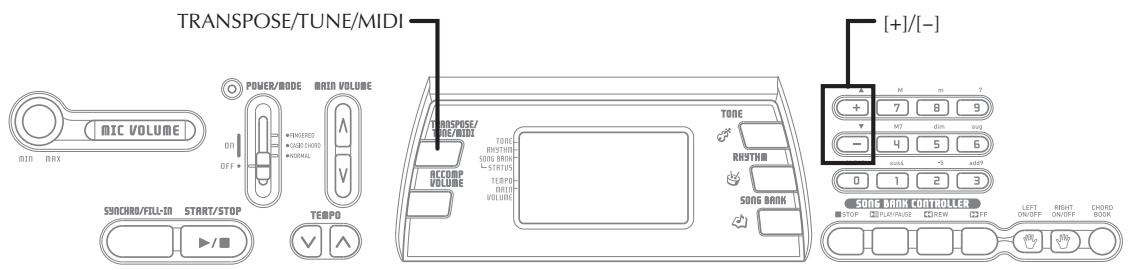
Modification des réglages MIDI
Ce clavier permet de modifier les réglages de deux paramètres MIDI : TONE MAP et KEYBOARD CHANNEL.
Pour modifier les paramètres MIDI

Appuyez sur le bouton TRANSPOSE/TUNE/MIDI trois ou quatre fois pour sélectionner le paramètre souhaité.
Appuyez trois fois sur le bouton TRANSPOSE/TUNE/MIDI : KEYBOARD CHANNEL.
Appuyez quatre fois sur le bouton TRANSPOSE/TUNE/MIDI : TONE MAP.
Exemple : Pour sélectionner le paramètre TONE MAP.

Utilisez [+] et [-] pour modifier le réglage du paramètre.
Exemple : Pour modifier la valeur du paramètre TONE MAP sur "G" (GM).
- Si vous dépassez accidentellement le paramètre souhaité, continuez d'appuyer sur le bouton TRANSPOSE/TUNE/MIDI jusqu'à ce que le paramètre souhaité réapparaisse à l'écran.
- Si vous laissez l'écran de sélection des paramètres affiché pendant environ cinq secondes sans rien faire, l'écran de sélection des paramètres est automatiquement effacé.
Paramètres et leurs affichages
CANAL TECLADO (Canal básico) (Por defecto: 01)
Este parámetro especifica el canal de envío de mensajes MIDI del teclado.
MAPA DE SONIDOS G/N (Por defecto: N)
N: Este ajuste especifica el mapa de sonidos normal, que permite recibir un valor de cambio de programa en el rango de 0 a 99. Solo se pueden reproducir los sonidos que corresponden a los 100 sonidos incorporados de este teclado, y los números de sonido fuera de este rango se ignoran.
G: Este ajuste especifica el mapa de sonidos General MIDI, que permite recibir un valor de cambio de programa en el rango de 0 a 127. Cada uno de los 128 sonidos General MIDI se asigna automáticamente a uno de los 100 sonidos incorporados del teclado como se muestra en la página A-2. Seleccione este ajuste cuando desee escuchar datos General MIDI desde una computadora u otro equipo externo.
NOTA
- Tocar una melodía del Banco de Canciones hace que todos los parámetros MIDI vuelvan a sus ajustes predeterminados.
- Los datos del Banco de Canciones no se pueden enviar como datos MIDI.
- No se pueden recibir mensajes MIDI mientras el teclado está en el Modo Banco de Canciones.
| Problem | Possible Cause | Action | See page |
| No keyboard Sound | 1. Power supply problem. | 1. Correctly attach the AC adaptor, make sure that batteries poles (+/-) are facing correctly, and check to make sure that batteries are not dead. | Pages E-13, 14 |
| 2. Power is not turned on. | 2. Set the POWER/MODE switch to the NORMAL position. | Page E-16 | |
| 3. Volume setting is too low. | 3. Use the MAIN VOLUME buttons to increase volume. | Page E-16 | |
| 4. The POWER/MODE switch is in the CASIO CHORD or FINGERED position. | 4. Normal play is not possible on the accompaniment keyboard while the POWER/MODE switch is set to CASIO CHORD or FINGERED. Change the POWER/MODE switch setting to NORMAL. | Page E-16 | |
| Any of the following symptoms while using battery power. | Low battery power | Replace the batteries with a set of new ones or use the AC adaptor. | Pages E-13, 14 |
| • Dim power indicator • Instrument does not turn on • Display that is flickering, dim, or difficult to read • Abnormally low speaker/headphone volume • Distortion of sound output • Occasional interruption of sound when playing at high volume • Sudden power failure when playing at high volume • Flickering or dimming of the display when playing at high volume • Continued sound output even after you release a key | • A tone that is totally different from the one that is selected • Abnormal rhythm pattern and Song Bank play • Loss of power, sound distortion, or low volume when playing from a connected computer or MIDI device • Abnormally low microphone volume • Distortion of microphone input • Dim power supply indicator when a microphone is used • Sudden power failure when using the microphone | ||
| Auto Accompaniment does not sound. | Auto accompaniment volume is set to 0. | Use the ACCOMP VOLUME button to increase the volume. | Page E-21 |
| The key or tuning does not match when playing along with another instrument. | The tuning or transpose parameter is set to a value other than 0 or 00. | Change the transpose or tuning parameter value to 0 or 00. | Page E-29 |
| Missing Song Bank tune. | 1. Left-hand or right-hand part is turned off. | 1. Check the display to see if the indicator for one of the parts is not displayed. If so, press the part's button (LEFT ON/OFF, RIGHT ON/OFF) to turn it on. | Page E-24 |
| 2. Accompaniment volume is set to 0. | 2. Adjust accompaniment volume. | Page E-21 | |
| No sound is produced when playing MIDI data from a computer. | MIDI cables are not connected properly. | Connect MIDI cables properly. | Page E-30 |
| The bass notes of General MIDI data being played back by a computer are one octave too low. | TONE MAP is turned “N”. | Change TONE MAP parameter to “G”. | Page E-31 |
| Playing on the keyboard produces an unnatural sound when connected to a computer. | The computer's MIDI THRU function is turned on. | Turn off the MIDI THRU function on the computer or turn off LOCAL CONTROL on the keyboard. | See the documentation that comes with your computer or sequencer. |
| Static noise when a microphone is connected. | 1. Use of a microphone that is a different from the type that is recommended. | 1. Use a recommended type microphone. | Page E-17 |
| 2. Use of the microphone in the vicinity of fluorescent lighting. | 2. Move the microphone away from source of the static. | Page E-17 | |
| No microphone sound | 1. Microphone volume setting is too low. | 1. Increase the microphone volume setting. | Page E-17 |
| 2. Microphone on/off switch is set to OFF. | 2. Change the microphone on/off switch setting to ON. | Page E-17 | |
| Model: | CTK-496/CTK-700 |
| Keyboard: | 61 standard-size keys, 5 octaves |
| Tones: | 100 |
| Polyphony: | 12 notes maximum (6 for certain tones) |
| Auto Accompaniment | |
| Rhythm Patterns: | 100 |
| Tempo: | Variable (236 steps, ↓ = 20 to 255) |
| Chords: | 2 fingering methods (CASIO CHORD, FINGERED) |
| Rhythm Controller: | START/STOP, SYNCHRO/FILL-IN |
| Accomp Volume: | 0 to 9 (10 steps) |
| Song Bank | |
| Tunes: | 100 |
| Controllers: | PLAY/PAUSE, STOP, REW, FF, LEFT ON/OFF (ACCOMP), RIGHT ON/OFF (MELODY) |
| Display | |
| Name display: | TONE, RHYTHM, SONG BANK name/number, keyboard settings name/value |
| Tempo: | Tempo value, metronome, synchro standby, beat indicator, volume setting |
| Chord: | Chord name, Chord form |
| Fingering: | Fingering indicators, parts |
| Song Bank Status: | PLAY, PAUSE, REW, FF |
| Staff: | 5 octaves with sharp and flat indications, pedal symbol, octave symbol |
| Keyboard: | 5 octaves |
| MIDI: | 5 multi-timbre receive |
| Other Functions | |
| Transpose: | 12 steps (-6 semitones to +5 semitones) |
| Tuning: | Variable (A4 = approximately 440Hz ±50 cents) |
| Volume: | 0 to 9 (10 steps) |
| Terminals | |
| MIDI Terminals: | IN, OUT |
| Sustain Terminal: | Standard jack |
| Phones/Output Terminal: | Stereo standard jack (Output is monaural.) |
| Output Impedance: 78Ω | |
| Output Voltage: 4V (RMS) MAX | |
| 9V DC | |
| Standard jack (with microphone volume knob) | |
| Input impedance: 40kΩ | |
| Input sensitivity: 10mV | |
| Power Supply: | |
| Batteries: | Dual power supply system |
| Battery Life: | 6 AA-size batteries |
| AC Adaptor: | Approximately 4 hours continuous operation on alkaline batteries |
| Approximately 2 hours continuous operation on manganese batteries | |
| AD-5 | |
| Auto Power Off: | Turns power off approximately 6 minutes after last key operation. Enabled under battery power only, can be disabled manually. |
| Speaker Output: | 2.0W + 2.0W |
| Power Consumption: | 9V ... 7.7W |
| Dimensions: | 95.6 x 35.4 x 13.2 cm (3711/16x1315/16x53/16inch) |
| Weight: | Approximately 3.8kg (8.4lbs) (without batteries) |
Lista de sonidos
Lista de sonidos
| PIANO | |
| 00 | PIANO 1 |
| 01 | PIANO 2 |
| 02 | HONKY-TONK |
| 03 | STUDIO PIANO |
| 04 | ELEC PIANO 1 |
| 05 | ELEC PIANO 2 |
| 06 | ELEC PIANO 3 |
| 07 | ELEC PIANO 4 |
| 08 | HARPSICHORD |
| 09 | CLAVELECTRO |
| ORGAN | |
| 10 | ELEC ORGAN 1 |
| 11 | ELEC ORGAN 2 |
| 12 | ELEC ORGAN 3 |
| 13 | ELEC ORGAN 4 |
| 14 | CHURCH ORGAN |
| 15 | PIPE ORGAN |
| 16 | REED ORGAN |
| 17 | ACCORDION |
| 18 | BANDONEON |
| 19 | HARMONICA |
| GUITAR/BASS | |
| 20 | GUT GUITAR |
| 21 | ACOUS GUITAR |
| 22 | JAZZ GUITAR |
| 23 | ELEC GUITAR |
| 24 | MUTE GUITAR |
| 25 | DIST GUITAR |
| 26 | WOOD BASS |
| 27 | ELEC BASS |
| 28 | SLAP BASS |
| 29 | BANJO |
| STRINGS/ENSEMBLE | |
| 30 | VIOLIN |
| 31 | CELLO |
| 32 | HARP |
| 33 | STRINGS 1 |
| 34 | STRINGS 2 |
| 35 | STRINGS 3 |
| 36 | SYNTH-STR 1 |
| 37 | SYNTH-STR 2 |
| 38 | CHOIR |
| 39 | VOICE OOH |
| BRASS | |
| 40 | TRUMPET |
| 41 | TUBA |
| 42 | BRASS ENS |
| 43 | FR.HORN 1 |
| 44 | FR.HORN 2 |
| 45 | BRASS 1 |
| 46 | BRASS 2 |
| 47 | SYN-BRASS 1 |
| 48 | SYN-BRASS 2 |
| 49 | SYN-BRASS 3 |
| REED/PIPE | |
| 50 | SOPRANO SAX |
| 51 | ALTO SAX |
| 52 | TENOR SAX |
| 53 | OBOE |
| 54 | CLARINET |
| 55 | PICCOLO |
| 56 | FLUTE |
| 57 | RECORDER |
| 58 | PAN FLUTE |
| 59 | WHISTLE |
| SYNTH-SOUND I | |
| 60 | SYN-LEAD 1 |
| 61 | SYN-LEAD 2 |
| 62 | SYN-LEAD 3 |
| 63 | SYN-CALLIOPE |
| 64 | SYN-PAD 1 |
| 65 | SYN-PAD 2 |
| 66 | SYN-PAD 3 |
| 67 | GLASS HMCA |
| 68 | COUNTRY FARM |
| 69 | SYN-BASS |
| SYNTH-SOUND II | |
| 70 | PEARL DROP |
| 71 | COSMIC SOUND |
| 72 | SOUNDTRACK |
| 73 | SPACE PAD |
| 74 | VOICE BASS |
| 75 | APPLAUSE |
| 76 | SYNTH-SFX |
| 77 | VEHICLE |
| 78 | PHONE |
| 79 | FUNNY |
| LAYER | |
| 80 | STR PIANO |
| 81 | STR E.PIANO |
| 82 | CHOIR E.P |
| 83 | CHOIR ORGAN |
| 84 | STR GUITAR |
| 85 | STR HARP |
| 86 | BRASS STR |
| 87 | VIB PAD |
| 88 | 12 STR GTR |
| 89 | CHOIR STR |
| SPLIT/PERCUSSION | |
| 90 | BASS/PIANO |
| 91 | BASS/E.PIANO |
| 92 | BASS/VIB |
| 93 | BASS/GUT GTR |
| 94 | V.BASS/OOH |
| 95 | STR/PIANO |
| 96 | STR/TRUMPET |
| 97 | VIBRAPHONE |
| 98 | MARIMBA |
| 99 | PERCUSSION |
Tabla de notas
Tabla de notas
| (1) | (2) | (3) | (4) |
| 00 | 12 | A | 000 |
| 01 | 12 | A | 001 |
| 02 | 6 | A | 003 |
| 03 | 6 | A | 002 |
| 04 | 12 | A | 004 |
| 05 | 12 | A | 005 |
| 06 | 6 | A | 008 |
| 07 | 6 | A | 009 |
| 08 | 12 | A | 006 |
| 09 | 12 | A | 007 |
| (1) | (2) | (3) | (4) |
| 10 | 12 | A | 016 |
| 11 | 12 | A | 017 |
| 12 | 12 | A | 018 |
| 13 | 6 | A | 015 |
| 14 | 12 | A | 019 |
| 15 | 6 | A | 104 |
| 16 | 12 | A | 020 |
| 17 | 6 | A | 021 |
| 18 | 12 | A | 023 |
| 19 | 12 | A | 022 |
| (1) | (2) | (3) | (4) |
| 20 | 12 | A | 024 |
| 21 | 12 | A | 025 |
| 22 | 12 | A | 026 |
| 23 | 12 | A | 027 |
| 24 | 12 | A | 028 |
| 25 | 12 | A | 029, 030, 031, 084 |
| 26 | 12 | B | 032 |
| 27 | 12 | B | 033, 034, 035 |
| 28 | 12 | B | 036, 037 |
| 29 | 12 | A | 105 |
| (1) | (2) | (3) | (4) |
| 30 | 12 | A | 040, 041 |
| 31 | 12 | B | 042, 043 |
| 32 | 12 | A | 045, 046, 047 |
| 33 | 12 | A | 048, 055 |
| 34 | 12 | A | 049 |
| 35 | 6 | A | 044 |
| 36 | 12 | A | 050 |
| 37 | 6 | A | 051 |
| 38 | 12 | A | 091, 052 |
| 39 | 12 | A | 053 |
| (1) | (2) | (3) | (4) |
| 40 | 12 | A | 056 |
| 41 | 12 | B | 058 |
| 42 | 6 | A | 057 |
| 43 | 12 | B | 060 |
| 44 | 6 | B | 059 |
| 45 | 12 | B | 061 |
| 46 | 6 | B | 069 |
| 47 | 12 | B | 062 |
| 48 | 6 | B | 063, 083 |
| 49 | 6 | B | 070 |
| (1) | (2) | (3) | (4) |
| 50 | 12 | A | 064 |
| 51 | 12 | A | 065 |
| 52 | 12 | A | 066, 067 |
| 53 | 12 | A | 068 |
| 54 | 12 | A | 071 |
| 55 | 12 | C | 072 |
| 56 | 12 | A | 073 |
| 57 | 12 | A | 074, 079 |
| 58 | 12 | A | 075, 076, 077 |
| 59 | 12 | A | 078 |
| (1) | (2) | (3) | (4) |
| 60 | 12 | A | 087 |
| 61 | 6 | A | 081, 086 |
| 62 | 12 | A | 080 |
| 63 | 6 | A | 082 |
| 64 | 6 | A | 089 |
| 65 | 6 | A | 090 |
| 66 | 6 | A | 095 |
| 67 | 6 | A | 092, 093, 098 |
| 68 | 6 | A | 054, 085, 094 |
| 69 | 12 | B | 038 |
| (1) | (2) | (3) | (4) |
| 70 | 6 | A | 096 |
| 71 | 6 | A | 103 |
| 72 | 6 | A | 097 |
| 73 | 6 | A | 101 |
| 74 | 12 | B | 039 |
| 75 | 12 | D | 126, 127 |
| 76 | 6 | A | 102 |
| 77 | 6 | D | 125 |
| 78 | 12 | D | 124 |
| 79 | 6 | D | 123 |
| (1) | (2) | (3) | (4) |
| 80 | 6 | A | 106 |
| 81 | 6 | A | 088, 107 |
| 82 | 6 | A | 108 |
| 83 | 6 | A | 109 |
| 84 | 6 | A | 099, 110 |
| 85 | 6 | A | 111 |
| 86 | 6 | B | 112 |
| 87 | 6 | A | 113 |
| 88 | 6 | A | 114 |
| 89 | 6 | A | 115 |
| (1) | (2) | (3) | (4) |
| 90 | 12 | E | 100, 116 |
| 91 | 6 | E | 117 |
| 92 | 12 | E | 118 |
| 93 | 12 | E | 119 |
| 94 | 12 | E | 120 |
| 95 | 12 | E | 121 |
| 96 | 12 | E | 122 |
| 97 | 12 | A | 010, 011, 014 |
| 98 | 12 | A | 012, 013 |
| 99 | 12 | D |
(1): Número de sonido (2): Polifonía máxima (3): Tipo de rango (4): Número General MIDI correspondiente
(1): Número de sonido (2): Polifonía máxima (3): Tipo de rango (4): Número General MIDI correspondiente
- Voir l'illustration ci-dessous pour une description des types de plage (A à E).
- Les numéros General MIDI correspondants sont les numéros General MIDI en vigueur lorsque le réglage de la carte des sons est "G".
- Voir l'illustration [2] pour une description des plages (A à E).
- Les noms General MIDI correspondants sont les noms General MIDI qui seront en vigueur lorsque le réglage de la carte des sons est "G".
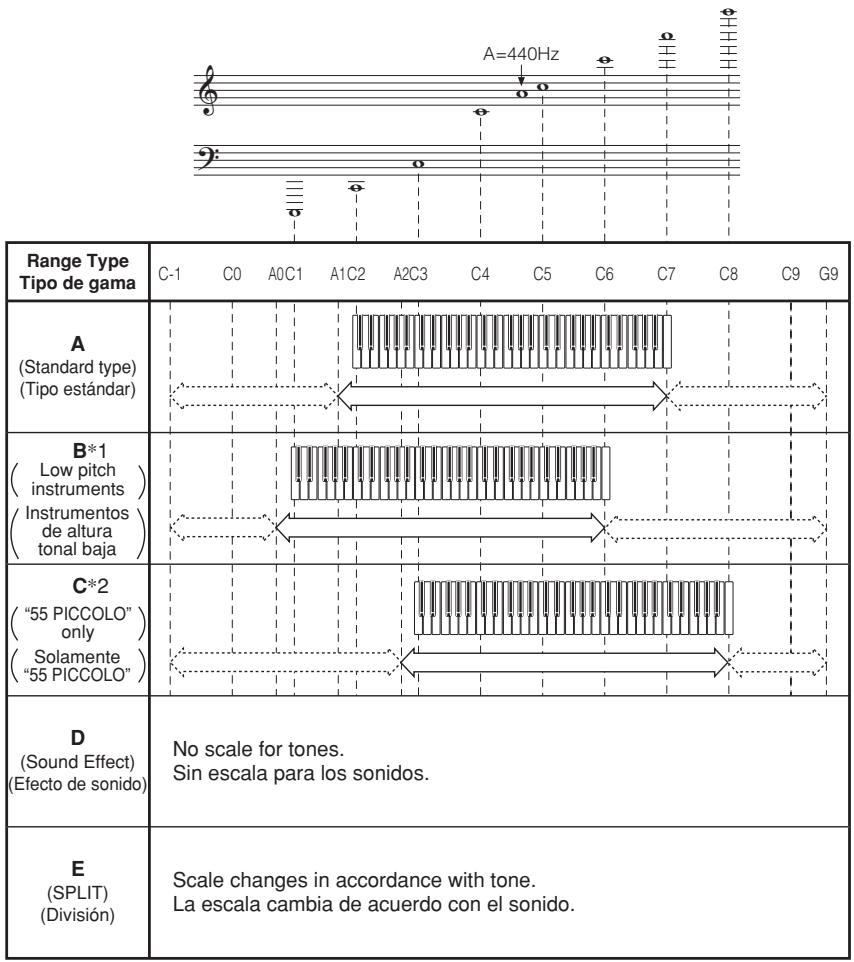

......Plage de jeu du clavier
Plage d'exécution du clavier

......Plage jouable
(en utilisant la transposition ou la réception MIDI)
Plage exécutable
(en utilisant la transposition ou la réception MIDI)

Plage dans laquelle la même note est jouée dans l'octave la plus proche en fonction de la transposition et de l'opération de réception des données MIDI.
Plage dans laquelle la même note est jouée dans l'octave la plus proche en fonction de la transposition et de l'opération de réception des données MIDI.
1 Avec les données MIDI reçues, les notes sont jouées une octave plus bas. 1 Avec les données MIDI reçues, les notes sont jouées une octave plus bas. 2 Avec les données MIDI reçues, les notes sont jouées une octave plus haut. 2 Avec les données MIDI reçues, les notes sont jouées une octave plus haut.
Tableau des accords Fingered
Tableaux d'accords Fingered
Ce tableau montre les doigtés de la main gauche (y compris les formes inversées) pour un certain nombre d'accords couramment utilisés. Ces indications de doigté apparaissent également sur l'écran du clavier. Les accords marqués d'un astérisque (*) ne peuvent pas être joués en mode Fingered sur ce clavier.
Ce tableau montre les doigtés (y compris les formes inversées) pour un certain nombre d'accords couramment utilisés. Ces indications de doigté apparaissent également sur l'écran du clavier.
Sur ce clavier, les accords marqués d'un astérisque (*) ne peuvent pas être joués en mode de doigté.
: Numéros des doigts de la main gauche
| Chord Root | M | m | 7 | m7 | dim7 | M7 | m7-5 | dim |
| C | [5,3,1] | [5,3,1] | [5,3,2,1] | [5,3,2,1] | [5,3,2,1] | [5,3,2,1] | [5,3,2,1] | [5,3,2] |
| C# (D#) | [5,3,1] | [5,3,1] | [5,3,2,1] | [5,3,2,1] | [5,3,2,1] | [5,3,2,1] | [5,3,2,1] | [5,3,2] |
| D | [5,3,1] | [5,3,1] | [5,3,2,1] | [5,3,2,1] | [5,3,2,1] | [5,3,2,1] | [5,3,2,1] | [5,3,2] |
| E# (D#) | [5,3,1] | [5,3,1] | [5,3,2,1] | [5,3,2,1] | [5,3,2,1] | [5,3,2,1] | [5,3,2,1] | [5,3,2] |
| E | [5,3,1] | [5,3,1] | [5,3,2,1] | [5,3,2,1] | [5,3,2,1] | [5,3,2,1] | [5,3,2,1] | [5,3,2] |
| F | [5,3,1] | [5,3,1] | [5,3,2,1] | [5,3,2,1] | [5,3,2,1] | [5,3,2,1] | [5,3,2,1] | [5,3,2] |
| F# (G#) | [5,3,1] | [5,3,1] | [5,3,2,1] | [5,3,2,1] | [5,3,2,1] | [5,3,2,1] | [5,3,2,1] | [5,3,2] |
| G | [5,3,1] | [5,3,1] | [5,3,2,1] | [5,3,2,1] | [5,3,2,1] | [5,4,2,1] | [5,3,2,1] | [5,3,2] |
| A# (G#) | [5,3,1] | [5,3,1] | [5,4,2,1] | [5,4,2,1] | [5,3,2,1] | [5,4,2,1] | [5,4,2,1] | [5,3,2] |
| A | [5,3,1] | [5,3,1] | [5,4,2,1] | [5,4,2,1] | * | [5,4,2,1] | [5,4,2,1] | [5,3,2] |
| B# (A#) | [5,3,1] | [5,3,1] | [5,4,2,1] | [5,4,2,1] | * | [5,4,2,1] | [5,4,2,1] | [5,3,2] |
| B | [5,2,1] | [5,2,1] | [5,3,2,1] | [5,3,2,1] | * | [5,3,2,1] | [5,4,2,1] | [5,3,2] |
| ChordRootType | aug | sus4 | 7 sus4 | m add9 | m M7 | 7-5 | add9 |
| C | [5,3,1] | [5,2,1] | [5,3,2,1] | [4,3,2,1] | [5,3,2,1] | [5,3,2,1] | [4,3,2,1] |
| [5,3,1] | [5,2,1] | [5,3,2,1] | [4,3,2,1] | [5,3,2,1] | [5,3,2,1] | [4,3,2,1] | |
| D | [5,3,1] | [5,2,1] | [5,3,2,1] | [4,3,2,1] | [5,3,2,1] | [5,3,2,1] | [4,3,2,1] |
| [5,3,1] | [5,2,1] | [5,3,2,1] | [4, 3,2,1] | [5,3,2,1] | [5,3,2,1] | [4,3,2,1] | |
| E(D#) | [5,3,1] | [5,2,1] | [5,3,2,1] | [4,3,2,1] | [5,3,2,1] | [5,3,2,1] | [4,3,2,1] |
| [5,3,1] | [5,2,1] | [5,3,2,1] | [4,5,2,1] | [5,3,2,1] | [5,3,2,1] | [4,3,2,1] | |
| F | [5,3,1] | [5,2,1] | [5,3,2,1] | [4,3,2,1] | [5,3,2,1] | [5,3,2,1] | [4,3,2,1] |
| [5,3,1] | [5,2,1] | [5,3,2,1] | [4,4,2,1] | [5,3,2,1] | [5,3,2,1] | [4,3,2,1] | |
| G | [5,3,1] | [5,2,1] | [5,3,2,1] | [4,3,2,1] | [5,4,2,1] | [5,3,2,1] | [4,3,2,1] |
| [5,3,1] | [5,2,1] | [5,4,2,1] | [4,3,2,1] | [5,4,2,1] | [5,4,2,1] | [4,3,2,1] | |
| A | [5,3,1] | [5,2,1] | [5,4,2,1] | [4,3,2,1] | [5,4,2,1] | [5,4,2,1] | [4,3,2,1] |
| [5,3,1] | [5,2,1] | [5,4,2,1] | [4,3,2,1] | [5,4,2,1] | [5,4,2,1] | [4,3,2,1] | |
| B(A#) | * | [5,2,1] | [5,3,2,1] | [5,3,2,1] | [5,3,2,1] | [4,3,2,1] | [5,3,2,1] |
| * | [5,2,1] | [5,3,2,1] | [5,3,2,1] | [5,3,2,1] | [4,3,2,1] | [5,3,2,1] |
Liste des instruments de percussion
Liste des instruments de percussion
- PERCUSSION (son 99) attribue 39 sons de percussion au clavier comme illustré ci-dessous. Le son attribué à chaque touche est indiqué au-dessus du clavier.
- PERCUSSION (son 99) attribue 39 sons de percussion au clavier comme illustré ci-dessous. Les sons attribués à chaque touche sont indiqués au-dessus du clavier.
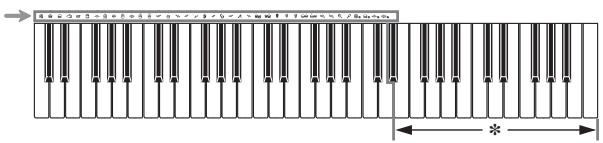
- Aucun son n'est produit lorsque les touches de cette plage sont enfoncées.
- Aucun son n'est produit lorsque les touches de cette plage sont enfoncées.
| BASS DRUM | OPEN HI-HAT | COWBELL | LOW TIMBALE |
| SIDE STICK | LOW-MID TOM | CRASH CYMBAL 2 | HIGH AGOGO |
| ACOUSTIC SNARE | HIGH-MID TOM | CLAVES | LOW AGOGO |
| HAND CLAP | CRASH CYMBAL 1 | RIDE CYMBAL 2 | CABASA |
| ELECTRIC SNARE | HIGH TOM | HIGH BONGO | MARACAS |
| LOW FLOOR TOM | RIDE CYMBAL 1 | LOW BONGO | VOICE BASS DRUM |
| CLOSED HI-HAT | CHINESE CYMBAL | MUTE HIGH CONGA | VOICE SNARE |
| HIGH FLOOR TOM | RIDE BELL | OPEN HIGH CONGA | VOICE CLOSED HI-HAT |
| PEDAL HI-HAT | TAMBOURINE | LOW CONGA | VOICE OPEN HI-HAT |
| LOW TOM | SPLASH CYMBAL | HIGH TIMBALE |
Liste des rythmes
Liste des rythmes
| POPS I | |
| 00 | CLUB POP |
| 01 | VOCAL POP |
| 02 | RAP POP |
| 03 | FUNKY POP 1 |
| 04 | SOUL BALLAD |
| 05 | POP BALLAD |
| 06 | LOVE BALLAD |
| 07 | FUNKY POP 2 |
| 08 | EPIC BALLAD |
| 09 | LITE POP |
| POPS II | |
| 10 | 16 BEAT SHFL |
| 11 | 16 BEAT POP |
| 12 | 16 BEAT FUNK |
| 13 | 8 BEAT POP |
| 14 | 8 BEAT SOUL |
| 15 | 8 BEAT SHFL |
| 16 | DANCE POP 1 |
| 17 | DANCE POP 2 |
| 18 | POP FUSION |
| 19 | FOLKIE POP |
| ROCK I | |
| 20 | ROCK WALTZ |
| 21 | SLOW ROCK 1 |
| 22 | SLOW ROCK 2 |
| 23 | SOFT ROCK 1 |
| 24 | SOFT ROCK 2 |
| 25 | SOFT ROCK 3 |
| 26 | POP ROCK 1 |
| 27 | POP ROCK 2 |
| 28 | 50'S ROCK |
| 29 | 60'S SOUL |
| ROCK II | |
| 30 | 4 BEAT ROCK |
| 31 | ROCK |
| 32 | HEAVY ROCK |
| 33 | 8 BEAT ROCK |
| 34 | STRAIGHT ROCK |
| 35 | HEAVY METAL |
| 36 | TWIST |
| 37 | NEW ORLNS R&R |
| 38 | CHICAGO BLUES |
| 39 | R&B |
| JAZZ/FUSION | |
| 40 | BIG BAND |
| 41 | SLOW SWING |
| 42 | SWING |
| 43 | FOX TROT |
| 44 | JAZZ WALTZ |
| 45 | MODERN JAZZ |
| 46 | COOL |
| 47 | HARD BOP |
| 48 | ACID JAZZ |
| 49 | LATIN FUSION |
| DANCE/FUNK | |
| 50 | VOCAL GROOVE |
| 51 | RAVE |
| 52 | CLUB GROOVE |
| 53 | TECHNO |
| 54 | TRANCE |
| 55 | HOUSE |
| 56 | GROOVE SOUL |
| 57 | DISCO |
| 58 | RAP |
| 59 | FUNK |
| EUROPEAN | |
| 60 | POLKA 1 |
| 61 | POLKA 2 |
| 62 | MARCH 1 |
| 63 | MARCH 2 |
| 64 | WALTZ |
| 65 | VIENNESE WALTZ |
| 66 | FRENCH WALTZ |
| 67 | SLOW WALTZ |
| 68 | SERENADE |
| 69 | TANGO 1 |
| LATIN I | |
| 70 | BOSSA NOVA |
| 71 | SAMBA |
| 72 | MAMBO |
| 73 | RHUMBA |
| 74 | CHA-CHA-CHA |
| 75 | MERENGUE |
| 76 | REGGAE |
| 77 | BOLERO |
| 78 | TANGO 2 |
| 79 | LAMBADA |
| LATIN | II/VARIOUS I |
| 80 | PUNTA |
| 81 | CUMBIA |
| 82 | SKA |
| 83 | TEX-MEX |
| 84 | SALSA |
| 85 | FOLKLORE |
| 86 | PASODOBLE |
| 87 | RUMBA CATALANA |
| 88 | SEVILLANA |
| 89 | FOLK |
| VARIOUS II | |
| 90 | COUNTRY |
| 91 | BLUEGRASS |
| 92 | TOWNSHIP |
| 93 | FAST GOSPEL |
| 94 | SLOW GOSPEL |
| 95 | ADANI |
| 96 | BALADI |
| 97 | BAROQUE |
| 98 | ENKA |
| 99 | NEW AGE |
Modèles CTK-496/CTK-700 Tableau de mise en œuvre MIDI Version : 1.0
| Function ... | Transmitted | Recognized | Remarks | |
| Basic Channel | Default Changed | 1 | 1-4, 10 | |
| 1-16 | 1-4, 10 | |||
| Mode | Default Messages Altered | Mode 3 X | Mode 3 X | |
| ********** | ********** | |||
| Note Number | True voice | 36-96 | 0-127 | *1: Depends on tone |
| ********** | 36-96 *1 | *1: Depende en el sonido | ||
| Velocity | Note ON Note OFF | O 9nH V = 75,100 *2 X 9nH V = 0 | O 9nH V = 1-127 X 9nH V = 0,8nH V = *3 | *3 = no relation *3 = sin relacion |
| After Touch | Key's Ch's | X X | X X | |
| Pitch Bender | X | O | ||
| Control Change | 1 6, 38 7 10 11 | X X X X X | O X O X X | Modulation Data entry Volume Pan Expression |
| 64100, 101120121 | O X X X | O X X X | Hold1 RPN LSB, MSB All sound off Reset all controller |
| Program Change :True # | O 0-99********** | O 0-127 *4********** | |
| System Exclusive | X | X | |
| System : Song Pos Common : Song Sel : Tune | X X X | X X X | |
| System : Clock Real Time : Commands | X X | X X | |
| Aux : Local ON/OFF Messages : Active Sense : Reset | X X X | X O O | |
| Remarks | *2 V(Velocity)=100 when note on data when the main volume value of this unit is 9 to 2, and V=75 when the main volume value is 1 or 0. *2 V (Velocity) = 100 cuando datos de activación denota cuando el valor de volumen principal de estaunidad es 9 a 2, y V = 75 cuando el valor de volumen principal es 1 o 0. *4 Depends on GM tone map setting (page E-31). *4 Depende en el ajuste del mapa de sonidos GM (págrina S-31). | ||
Mode 1 : OMNI ON, POLY Mode 2 : OMNI ON, MONO O : Oui Mode 3 : OMNI OFF, POLY Mode 4 : OMNI OFF, MONO X : Non

Ce symbole de recyclage indique que l'emballage est conforme à la législation sur la protection de l'environnement en Allemagne.
Marque de recyclage indiquant que l'emballage est conforme à la législation sur la protection de l'environnement en Allemagne.
CASIO
- CTK
- GUIDE DE L'UTILISATEUR
- GUIA DEL USUARIO
- DIRECTIVES ÉTABLIES PAR LES RÈGLES FCC POUR L'UTILISATION DE L'APPAREIL AUX ÉTATS-UNIS (NON APPLICABLES DANS D'AUTRES RÉGIONS)
- AVIS
- AVERTISSEMENT FCC
- IMPORTANT
- SYMBOLES
- DANGER
- AVERTISSEMENT
- ATTENTION
- EXEMPLES DE SYMBOLES
- PILES ALCALINES
- FUMÉE, ODEUR ÉTRANGE, SURCHAUFFE
- ADAPTATEUR SECTEUR
- PILES
- NE PAS INCINÉRER LE PRODUIT
- EAU ET CORPS ÉTRANGERS
- DÉMONTAGE ET MODIFICATION
- CHUTE ET CHOCS
- SACS EN PLASTIQUE
- NE MONTEZ PAS SUR LE PRODUIT OU LE SUPPORT
- EMPLACEMENT
- DÉPLACEMENT DU PRODUIT
- NETTOYAGE
- CONNECTEURS
- ÉCRAN D'AFFICHAGE
- VOLUME SONORE
- OBJETS LOURDS
- ASSEMBLAGE CORRECT DU SUPPORT
- SONORITÉS
- RYTHMES
- ACCOMPAGNEMENT AUTOMATIQUE
- BANQUE DE CHANSONS DE 100 AIRS
- SYSTÈME D'INFORMATION MUSICALE
- COMPATIBILITÉ MIDI
- ENTRETIEN DE VOTRE CLAVIER
- ÉVITEZ LA CHALEUR, L'HUMIDITÉ OU LA LUMIÈRE DIRECTE DU SOLEIL
- NE L'UTILISEZ PAS PRÈS D'UN TÉLÉVISEUR OU D'UNE RADIO
- N'UTILISEZ PAS DE LAQUE, DU DILUANT OU DES PRODUITS CHIMIQUES SIMILAIRES POUR LE NETTOYAGE
- ÉVITEZ D'UTILISER L'INSTRUMENT DANS DES ZONES SOUMISES À DES TEMPÉRATURES EXTRÊMES
- REMARQUE
- PRÉCAUTIONS DE SÉCURITÉ. E
- INTRODUCTION E
- ENTRETIEN DE VOTRE CLAVIER . . . . . E
- SOMMAIRE. E
- GUIDE GÉNÉRAL. E
- RÉFÉRENCE RAPIDE DE LA BANQUE DE CHANSONS
- RÉFÉRENCE E
- ALIMENTATION E
- CONNEXIONS E
- OPÉRATIONS DE BASE (E-16)
- ACCOMPAGNEMENT AUTOMATIQUE (E-18)
- UTILISATION DE LA BANQUE DE CHANSONS (E-22)
- UTILISATION DU LIVRE D'ACCORDS .... E
- RÉGLAGES DU CLAVIER E
- MIDI E
- DÉPANNAGE E
- SPÉCIFICATIONS E
- ANNEXE A
- TABLEAU DE MISE EN ŒUVRE MIDI
- FIXATION DU PUPITRE
- UTILISATION DE L'ÉCRAN
- LECTURE D'UN MORCEAU DE LA BANQUE DE CHANSONS
- POUR LIRE UN MORCEAU DE LA BANQUE DE CHANSONS
- UTILISATION DES PILES
- POUR INSÉRER LES PILES
- RETIREZ LE COUVERCLE DU COMPARTIMENT À PILES
- INSÉREZ 6 PILES DE TAILLE AA DANS LE COMPARTIMENT À PILES
- INSÉREZ LES LANGUETTES DU COUVERCLE DU COMPARTIMENT À PILES DANS LES TROUS PRÉVUS À CET EFFET ET FERMEZ LE COUVERCLE
- INFORMATIONS IMPORTANTES SUR LES PILES
- UTILISATION DE L'ADAPTATEUR SECTEUR
- ADAPTATEUR SECTEUR SPÉCIFIÉ : AD
- EXTINCTION AUTOMATIQUE
- POUR DÉSACTIVER L'EXTINCTION AUTOMATIQUE
- RÉGLAGES
- BORNE PHONES/SORTIE
- CONNEXION DE CASQUES (FIGURE 1)
- ÉQUIPEMENT AUDIO (FIGURE 2)
- AMPLIFICATEUR D'INSTRUMENT DE MUSIQUE (FIGURE 3)
- BORNE DE PRISE SUSTAIN
- PÉDALE DE SUSTAIN
- ACCESSOIRES ET OPTIONS
- JOUER DU CLAVIER
- POUR JOUER DU CLAVIER
- SÉLECTION D'UN SON
- POUR SÉLECTIONNER UN SON
- SONS COMBINÉS
- SONS SUPERPOSÉS (NUMÉROS DE SONS : 80 À 89)
- SONS DIVISÉS (NUMÉROS DE SONS : 90 À 96)
- SONS DE PERCUSSION
- SONORITÉS D'EFFETS SONORES
- POLYPHONIE
- ÉCHANTILLONNAGE NUMÉRIQUE
- UTILISATION DE LA PRISE MICROPHONE
- TYPE DE MICROPHONE RECOMMANDÉ
- LARSEN (BRUIT DE RETOUR)
- BRUIT STATIQUE
- SÉLECTION D'UN RYTHME
- POUR SÉLECTIONNER UN RYTHME
- LECTURE D'UN RYTHME
- POUR JOUER UN RYTHME
- RÉGLAGE DU TEMPO
- POUR RÉGLER LE TEMPO
- À PROPOS DU MÉTRONOME GRAPHIQUE
- UTILISATION DE L'ACCOMPAGNEMENT AUTOMATIQUE
- POUR UTILISER L'ACCOMPAGNEMENT AUTOMATIQUE
- JOUEZ UN ACCORD
- CASIO CHORD
- CLAVIER D'ACCOMPAGNEMENT CASIO CHORD ET CLAVIER MÉLODIE
- TYPES D'ACCORDS
- FINGERED
- CLAVIER D'ACCOMPAGNEMENT FINGERED ET CLAVIER MÉLODIE
- UTILISATION D'UN MOTIF DE REMPLISSAGE
- POUR INSÉRER UN REMPLISSAGE
- DÉMARRAGE SYNCHRO DE L'ACCOMPAGNEMENT AVEC LA LECTURE RYTHMIQUE
- POUR UTILISER LE DÉMARRAGE SYNCHRO
- RÉGLAGE DU VOLUME D'ACCOMPAGNEMENT
- LECTURE D'UN AIR DE LA BANQUE DE CHANSONS
- POUR LIRE UN AIR DE LA BANQUE DE CHANSONS
- POUR METTRE EN PAUSE LA LECTURE D'UN AIR DE LA BANQUE DE CHANSONS
- POUR UN RETOUR RAPIDE PENDANT LA LECTURE
- POUR UNE AVANCE RAPIDE PENDANT LA LECTURE
- AFFICHAGE DU MODE BANQUE DE MORCEAUX
- [AFFICHAGE DE LECTURE]
- RÉGLAGE DU TEMPO D'UN MORCEAU DE LA BANQUE DE MORCEAUX
- POUR CHANGER LE TEMPO D'UN MORCEAU DE LA BANQUE DE MORCEAUX
- CHANGEMENT DU TIMBRE DE LA MÉLODIE D'UN MORCEAU DE LA BANQUE DE MORCEAUX
- JOUER EN ACCOMPAGNEMENT D'UN MORCEAU DE LA BANQUE DE MORCEAUX
- POUR JOUER EN ACCOMPAGNEMENT D'UN MORCEAU DE LA BANQUE DE MORCEAUX
- ACCOMPAGNEMENT AUTOMATIQUE DES MORCEAUX (NUMÉROS DE MORCEAUX 00 À 80)
- MORCEAUX À DEUX MAINS (NUMÉROS DE MORCEAUX 81 À 99)
- SON D'APPLAUDISSEMENTS
- POUR DÉSACTIVER LE SON D'APPLAUDISSEMENTS
- LECTURE DE TOUTES LES MÉLODIES DE LA BANQUE DE MORCEAUX EN SUCCESSION
- QU'EST-CE QU'UN ACCORD
- NOMS DES ACCORDS
- FORMES INVERSÉES
- RECHERCHE D'UN ACCORD À L'AIDE DU LIVRE D'ACCORDS
- TRANSPOSITION DU CLAVIER
- POUR TRANSPOSER LE CLAVIER
- NOTE
- ACCORDER LE CLAVIER
- POUR ACCORDER LE CLAVIER
- QU'EST-CE QUE LE MIDI
- GENERAL MIDI
- MESSAGES
- NOTE ON/OFF
- CHANGEMENT DE PROGRAMME
- PITCH BEND
- CONTROL CHANGE
- MODIFICATION DES RÉGLAGES MIDI
- POUR MODIFIER LES PARAMÈTRES MIDI
- PARAMÈTRES ET LEURS AFFICHAGES
- CANAL TECLADO (CANAL BÁSICO) (POR DEFECTO: 01)
- MAPA DE SONIDOS G/N (POR DEFECTO: N)
- NOTA
- LISTA DE SONIDOS
- TABLA DE NOTAS
- TABLEAU DES ACCORDS FINGERED
- TABLEAUX D'ACCORDS FINGERED
- LISTE DES INSTRUMENTS DE PERCUSSION
- LISTE DES RYTHMES
- CASIO
Marque : CASIO
Modèle : CTK-496
Catégorie : Clavier numérique