
TKG RFG 1000 - Refrigerator KALORIK - Free user manual and instructions
Find the device manual for free TKG RFG 1000 KALORIK in PDF.


| Product Type | Refrigerator |
| Brand | Kalorik |
| Model | TKG RFG 1000 |
| Capacity | 100 L |
| Color | White |
| Energy Class | A+ |
| Annual Energy Consumption | 100 kWh |
| Noise Level | 38 dB |
| Dimensions (W x D x H) | 50 x 50 x 85 cm |
| Weight | 25 kg |
| Voltage | 220-240 V, 50 Hz |
| Climate Class | N-ST |
| Temperature Control | Adjustable thermostat |
| Interior Light | Yes |
| Door Reversibility | Yes |
| Defrosting | Manual |
| Cleaning | Wipe with damp cloth |
| Safety Certifications | CE, RoHS |
| Warranty | 1 year |
Frequently Asked Questions - TKG RFG 1000 KALORIK
User questions about TKG RFG 1000 KALORIK
0 question about this device. Answer the ones you know or ask your own.
Ask a new question about this device
Download the instructions for your Refrigerator in PDF format for free! Find your manual TKG RFG 1000 - KALORIK and take your electronic device back in hand. On this page are published all the documents necessary for the use of your device. TKG RFG 1000 by KALORIK.
USER MANUAL TKG RFG 1000 KALORIK
Please read these instructions carefully before using the appliance.
Important: People (including children) who are not able to use the appliance in a safe way, due to their physical, sensorial or mental capacity or their lack of experience or knowledge, must never use the appliance except if they are supervised by a person responsible for their safety or if they previously received instructions concerning the safe use of the appliance.
Close supervision is necessary to prevent children from using the appliance as a toy.
☐ Check that your mains voltage corresponds to that stated on the appliance.
☐ Never leave the appliance unsupervised when in use.
☐ This cooler is an electrical appliance. Therefore, do not operate it with wet hands, while standing on a wet surface or while standing in water.
☐ Never leave the appliance unsupervised when taking beverages out or putting them in the cooler. Keep out of reach of children or incompetent persons.
From time to time check the cord for damages. Never use the appliance if cord or appliance shows any signs of damage.
☐ Never move the appliance by pulling the cord. Make sure the cord cannot get caught in any way. Do not wind the cord around the appliance and do not bend it. Keep the power cord away from sources of heat.
☐ Only use the appliance for domestic purposes and in the way indicated in these instructions.
Should the cord be damaged, it must be replaced by a competent qualified service (*).
☐ Never use the appliance near hot surfaces or in the sunlight.
☐ Never use the appliance outside and always place it in a dry environment.
☐ Stand the appliance on a table or flat surface in order to avoid its fall. Ensure that there is at least a 10cm clearance at the sides and a 8cm clearance at the back of the cooler in order to allow adequate ventilation. Kitchen units (cupboards) should be at least 5cm away from the appliance in order to assure adequate ventilation.
☐ Do not place any other object on top of the appliance.
☐ Never use accessories that are not recommended by the producer. They could constitute a danger to the user and risk to damage the appliance.
☐ Plug the appliance immediately into the power outlet, do not use any extension cord or multiple power socket.
☐ Do not place hot beverages into the appliance but let them cool down to room temperature beforehand.
☐ Close the cooler door immediately after putting in any items so the inside temperature will not rise dramatically.
☐ When positioned or if moving the appliance, ensure that it is not set horizontally or declined more than 45° or turned upside down.
Should you notice any kind of damage on the appliance, please unplug it immediately and contact a competent qualified service ® .
☐ All repairs should be made by a competent qualified service (1).
☐ Unplug the appliance before cleaning or when it is not in use.
☐ To avoid risk of child entrapment, leave the shelves in place so children can not easily climb inside even when the appliance is in routine use or not in use at home.
Keep ventilation openings, in the appliance enclosure or in the built-in structure, clear of obstruction.
Do not use mechanical devices or other means to accelerate the defrosting process, other than those recommended by the manufacturer.
Do not damage the refrigerant circuit.
Do not use electrical appliances inside the food storage compartments of the appliance, unless they are of the type recommended by the manufacturer.
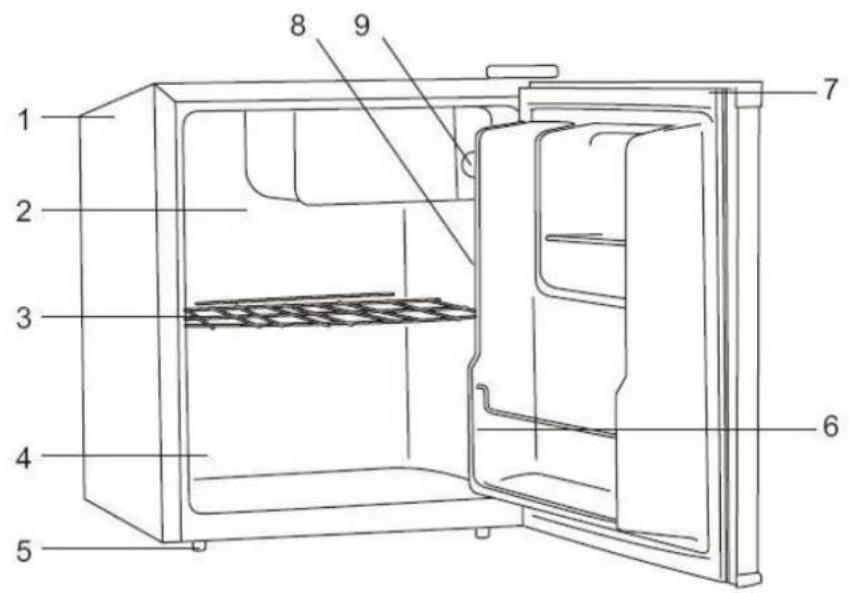
- Cabinet
- Freezer Compartment Door
- Drip Tray
- Crisper box
-
Leveling legs
-
Bottle Racks
- Recessed Handle
8 Door switch - Temperature Control Knob

Fax +32 2 359 95 50
Copies of the I/B. Please reproduce them without any changes except under special instruction from Team International BELGIUM. The pages must be reproduced and folded in order to obtain a booklet A5 (+/- 148.5 mm width x 210 mm height). When folding, make sure you keep the good numbering when you turn the pages of the I/B. Don't change the page numbering. Keep the language integrity.
CORRECT POSITIONING
Ventilation
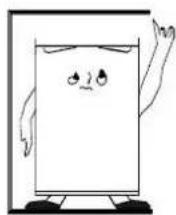
For easy heat dissipation, low power consumption and maximum efficiency, the refrigerator should be kept in a well ventilated area. There should be space of at least 100mm around the refrigerator and at least 200mm clear of the roof. There should be enough space to allow the door to open 160 degrees.
Power Supply
The refrigerator is only applied with power supply of single phase alternating current of (220-240)V\~/50Hz; 230V\~/60Hz. If fluctuation of voltage in the district user is of so large that the voltage exceeds the above scope, for safety sake, be sure to apply a.c. automatic voltage regulator to the refrigerator. The refrigerator must employ a special power socket instead of common one with other electric appliances. Its plug must match the socket with ground wire.

Power Cord
The cord should never be lengthened or folded or allowed to coil during operation. The cord should never be kept close to the compressor or at the back of the refrigerator as the surface temperature is always high when operating. Any contact of the cord with the compressor could damage the insulation or cause leakage.

Protection from Moisture
Avoid placing the unit in a wet or damp area as moisture would cause rust on metal parts. Never spray the unit directly with water as this would result in poor insulation and may cause current leakage.


Fax +32 2 359 95 50
Copies of the I/B. Please reproduce them without any changes except under special instruction from Team International BELGIUM. The pages must be reproduced and folded in order to obtain a booklet A5 (+/- 148.5 mm width x 210 mm height). When folding, make sure you keep the good numbering when you turn the pages of the I/B. Don't change the page numbering. Keep the language integrity.
Protection from Heat
The refrigerator should be far away from any heat source or direct sunshine.

Fixing Stable
Floor on which refrigerator will be placed must be flat and solid. It should not be laid on any soft material such as foam plastic, etc. If the refrigerator is not on the same level, adjust the screws accordingly. The refrigerator should not be placed near anything which may echo.

Keep Away from Danger
Do not place the refrigerator near any volatile or combustible elements like gas, petrol, alcohol, lacquer and banana oil. These should not be stored in the refrigerator at all.

Moving
When fixed or moved, the refrigerator can not be set horizontally or declined to more than 45° or upside-down.

CAUTIONS
★ Water contained in food or getting into air inside the refrigerator by opening doors may form a layer of frost inside, It will weaken the refrigerator when the frost is thick, while it is more than 2mm thick, you should defrost.
★ Defrosting in freezer chamber is operated manually. Before defrosting, take the food, the ice tray and the shelf out into the cold storing chamber temporarily then set the knob of the temperature regulator to position "0" (where the compressor will stop working) and leave the door open until ice and frost dissolve thoroughly deposited at the bottom drip tray of the freezer chamber. Take out the drip tray and discard the water carefully. In the case of speeding up the defrosting, you may put a bowl of warm water (about 50°C) into the freezer chamber, and be sure to set the knob of the temperature regulator to original position after defrosting.
It is not advisable to heat the freezer chamber directly with hot water or hair dryer while defrosting to prevent deformation of the inner case.
★ Avoid using sharp objects to scrape the ice and frost as these may damage the inner casing or the surface of the evaporator.
★ If the supply cord of this appliance is damaged, it must only be replaced by a repair agent recommended by manufacture or store as special tools are required.
CHANGING THE REVERSIBLE DOOR
This refrigerator has been built with the door hinges on the right. If you wish to change the opening direction, follow the instructions below:
- Remove the upper hinge cover(6) first
- Remove the two screws (1) that hold the upper hinge (5) (right side) to the frame. Take away the upper hinge (5).
- Lift the door and place it on a padded surface to prevent scratching it.
- Remove the two screws(8) that hold the lower hinge(2) and Make sure to Remove the lower hinge(2).
-
Remove the left front leg (4) and transfer it to the right side.
-
Remove the hole cover plate(7) to the right side.
-
Before placing this lower hinge(2), remove the bolt-pin (9) and reverse the direction of the lower hinge(2). Then install the lower hinge (2) onto the left side of the lower frame with two screws (8).
-
Insert the bolt-pin(9) to the lower hinge (2).
-
Set the door to its place making sure the door seat at the lower hinge(2)
10..While holding the door in the closed position secure the upper hinge (5) in the top frame of left side with two screws (1). Please remember that do not tighten the two screws(1) until the top of the door is levelled with the counter top.
- Install the upper hinge cover(6) on the upper hinge..

FIGURE 1

FIGURE 2
FIGURE 1 - REPRESENTS POSITION OF COMPONENTS PRIOR TO DOOR REVERSAL.
FIGURE 2 - REPRESENTS POSITION OF COMPONENTS AFTER DOOR REVERSAL.
MAINTENANCE
★ The refrigerator should be cleaned and maintained once a month.
When performing maintenance, make sure that the power plug is first disconnect from the power outlet.
★ Wipe the inner and outer surface of the refrigerator and its accessories with wet cloth. If they are too dirty, scrub them with neutral detergent, and then clean them with water and dry them with clean cloth. After this, a small quantify of glass wax is recommended to polish the refrigerator surface with a flannelette.
For cleaning, don't use hot water, diluent, petrol, alcohol, kerosene, washing powder, cleanser, aikailinous detergent, acid, Chemical cloth, etc. So as not to damage the lacquer coat and plastics. It is forbidden than the refrigerator is directly sprayed with water. Otherwise, it would cause rusty or weaken the insulation.
★ Be careful to upkeep the sealing rubber bars of the doors. They should always be cleaned.
★ If the plastic parts in refrigerator remain contaminated for a long time by oil (animal or vegetable), they will be easy aged and possibly cracked. The drain pan gets dirty very easily if it is not cleaned regularly, bad odours will be produced, get into the habit of cleaning this pan regularly.
9 TKG RFG 1000 - 100716
TROUBLESHOUTING
- When the refrigerator does not work
Check if there is a power failure.
Check if the power plug is plugged into the power outlet.
Check that the fuse has not blown. - When the refrigerator is cooling excessively
The temperature control dial may be set too high.
If you place foodstuffs containing a lot of moisture directly under the cool air outlets, they will freeze easily. This does not indicate a malfunction. - When the refrigerator is not cooling sufficiently
The door may not have been closed properly.
The door gaskets may be damaged.
The temperature control dial may not be set properly.
To allow proper ventilation make sure there is enough space between the refrigerator and the surface, around the refrigerator as well as between the top of the refrigerator and the roof. - When the defrosting water overflows inside the refrigerator and onto the floor.
Check that the drain pipe and the drain hose are not clogged.
Check that the drain pan is housed properly. - When condensation form on the outside of the refrigerator.
Condensation may form on the outside when the humidity is high such as during a wet season. This is the same result as the condensation formed when chilled water is poured into a glass. It does not, therefore, indicate a failure, wipe dry with a dry cloth. - When you hear a sound like water flowing.
A sound like water flowing is the refrigerant flowing. It does not indicate a malfunction. - When the cabinet's side panel heats up
The side panel of the cabinet will heat up when the door is opened or closed frequently, when starting the unit and when the unit operates in summer with high ambient outside temperature, In such case, do not touch the panel, it results from the dissipation of the heat from inside the cabinet, and it does not mean that something is wrong with the refrigerator.
PROTECTION OF THE ENVIRONMENT – DIRECTIVE 2002/96/EC
In order to preserve our environment and protect human health, the waste electrical and electronic equipment should be disposed of in accordance with specific rules with the

implication of both suppliers and users. For this reason, as indicated by the symbol on the rating label or on the packaging, your appliance should not be disposed of as unsorted municipal waste. The user has the right to bring it to a municipal collection point performing waste recovery by means of reuse, recycling or use for other applications in accordance with the directive.

Copies of the I/B. Please reproduce them without any changes except under special instruction from Team International BELGIUM. The pages must be reproduced and folded in order to obtain a booklet A5 (+/- 148.5 mm width x 210 mm height). When folding, make sure you keep the good numbering when you turn the pages of the I/B. Don't change the page numbering. Keep the language integrity.
VENTILACION
PROTECCION CONTRA HUMEDAD

Fax +32 2 359 95 50
Copies of the I/B. Please reproduce them without any changes except under special instruction from Team International BELGIUM. The pages must be reproduced and folded in order to obtain a booklet A5 (+/- 148.5 mm width x 210 mm height). When folding, make sure you keep the good numbering when you turn the pages of the I/B. Don't change the page numbering. Keep the language integrity.
ESTABILIDAD
MANTENER ALEJADO DE PELIGRO
MOVIMIENTO
PRECAUCIONES:
FIGURE 1


Fax +32 2 359 95 50
Copies of the I/B. Please reproduce them without any changes except under special instruction from Team International BELGIUM. The pages must be reproduced and folded in order to obtain a booklet A5 (+/- 148.5 mm width x 210 mm height). When folding, make sure you keep the good numbering when you turn the pages of the I/B. Don't change the page numbering. Keep the language integrity.
Fixação estável
Mover
CUIDADOS
FIGURE 1

FIGURE 2
FIGURA 1 : REPRESENTA A POSIÇÃO DOS COMPONENTES DA PORTA NA POSIÇÃO REVERSÍVEL.
FIGURA 2 : REPRESENTA A POSIÇÃO DOS COMPONENTES DA PORTA DEPOIS DE REVERTIDA.
MANUTENÇÃO
Copies of the I/B. Please reproduce them without any changes except under special instruction from Team International BELGIUM. The pages must be reproduced and folded in order to obtain a booklet A5 (+/- 148.5 mm width x 210 mm height). When folding, make sure you keep the good numbering when you turn the pages of the I/B. Don't change the page numbering. Keep the language integrity.

Fax +32 2 359 95 50
Copies of the I/B. Please reproduce them without any changes except under special instruction from Team International BELGIUM. The pages must be reproduced and folded in order to obtain a booklet A5 (+/- 148.5 mm width x 210 mm height). When folding, make sure you keep the good numbering when you turn the pages of the I/B. Don't change the page numbering. Keep the language integrity.

Back cover page (last page)
Assembly page 28/28
- CORRECT POSITIONING
- VENTILATION
- POWER SUPPLY
- POWER CORD
- PROTECTION FROM MOISTURE
- PROTECTION FROM HEAT
- FIXING STABLE
- KEEP AWAY FROM DANGER
- MOVING
- CAUTIONS
- CHANGING THE REVERSIBLE DOOR
- MAINTENANCE
- TROUBLESHOUTING
- PROTECTION OF THE ENVIRONMENT – DIRECTIVE 2002/96/EC
- VENTILACION
- PROTECCION CONTRA HUMEDAD
- ESTABILIDAD
- MANTENER ALEJADO DE PELIGRO
- MOVIMIENTO
- PRECAUCIONES
- FIXAÇÃO ESTÁVEL
- MOVER
- CUIDADOS
- MANUTENÇÃO
Brand : KALORIK
Model : TKG RFG 1000
Category : Refrigerator