 EasyManual
LVX 9-44 - Dishwasher SCHOLTES - Free user manual and instructions
Find the device manual for free LVX 9-44 SCHOLTES in PDF.



Download the instructions for your Dishwasher in PDF format for free! Find your manual LVX 9-44 - SCHOLTES and take your electronic device back in hand. On this page are published all the documents necessary for the use of your device. LVX 9-44 by SCHOLTES.
USER MANUAL LVX 9-44 SCHOLTES
Instructions for installation and use
Geschirrspuler
A Raccordement electrolyque
Safety Is a Good Habit to Get Into
NOTICE
Carefully read the instructions contained in this manual, as they provide important information which is essential to safe and proper installation, use and maintenance of the appliance.
This appliance complies with the following EEC directives:
- 73/23/EEC (Low Voltage) and subsequent modifications;
- 89/336/EEC (ElectromagneticCompatibility) and subsequent modifications.
- 97/17/EEC (Labelling)
-2002/96/EC (Waste Electrical and Electronic Equipment)
1. Carefully dispose of the packing material.
2. After removing the packing, check to make sure that the appliance is not damaged. If in doubt, contact a qualified professional.
3. The dishwasher must only be used by adults for the washing of household dishes and cooking utensils.
4.Fundamental rules to follow when using the appliance:
- Never touch the dishwasher when barefoot or with wet hands or feet;
- We discourage the use of extension cords and multiple sockets;
- During installation, the power supply cord must not be excessively or dangerously bent or flattened;
-
If the appliance is not operating properly or maintenance must be performed, disconnect the appliance from the power supply.
-
Keep detergents out of the reach of children, who must also be kept away from the dishwasher when it is open.
- This appliance cannot be installed outdoors, not even if the area in which it is installed is covered by a roof; it is also very dangerous to leave it exposed to the rain and elements.
- Do not touch the heating element during or after a wash cycle.
- The door should not be left open as it may create a dangerous obstacle.
- Do not lean or sit on the door when it is open, as this could overturn the dishwasher.
10.If the appliance malfunctions, turn off water supply to the appliance and disconnect the plug from the wall socket. Then, consult the section entitled, "Troubleshooting." If you cannot resolve the problem, contact a service centre.
11.Appliances which are no longer being used must be made inoperable by cutting the power supply cord and removing the door lock.
To maintain the EFFICIENCY and SAFETY of this appliance, we recommend:
- call only the Service Centers authorized by the manufacturer
- always use original Spare Parts
Close-up View (control panel)
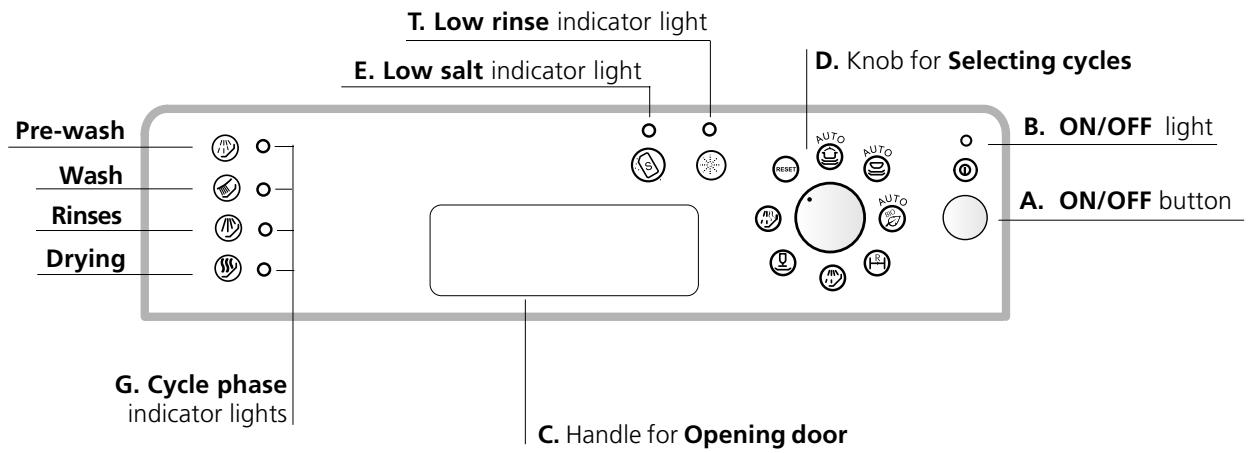
A. ON-OFF Button
B. ON-OFF Light
C. Handle For Opening Door
D. Knob For Selecting Cycles
E. Low Salt Indicator Light
G. Cycle phase indicator lights
T. Low rinse aid indicator light
Close-up View (Interior)
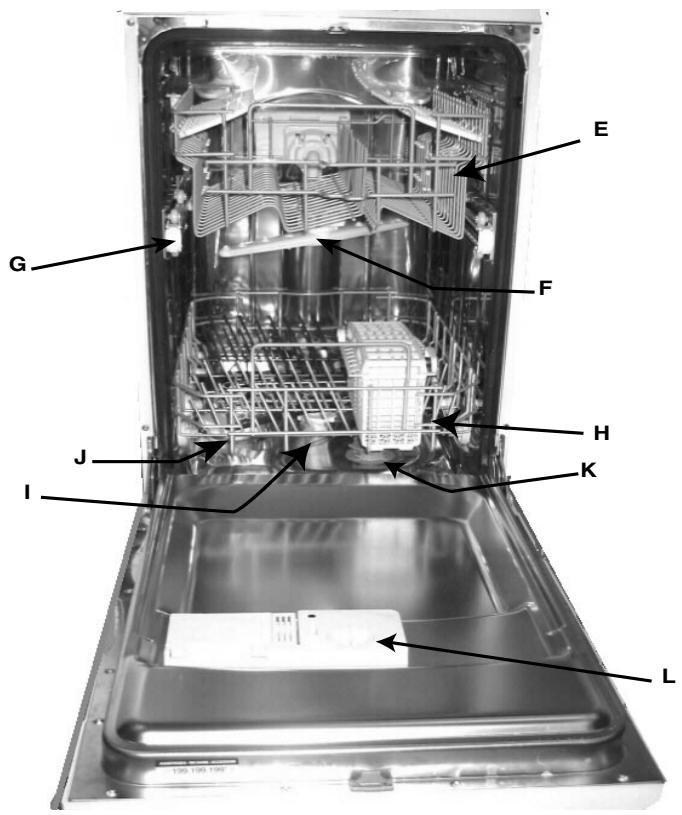
E. Upper Rack
F. Top Sprayer Arm
G. Rack Height Adjustor
H. Lower Rack
I. Bottom Sprayer Arm
J. Salt Container Cap
K. Washing Filter
L. Detergent and Rinse Aid Dispenser
| Technical characteristics | |
| Width | cm. 44,5 |
| Depth | cm. 57 |
| Height | cm. 82÷90 |
| Capacity | 9 standard place settings |
| Mains water pressure | 4,3 -145 psi 0,03 ÷ 1MPa (0,3 ÷10 bar) |
| Power voltage | See data plate |
| Total absorber power | See data plate |
| Fuse | See data plate |
Salt
The hardness of the water varies from place to place. If hard water is used in the dishwasher, deposits will form on the dishes and utensils.
The appliance is equipped with a special softener that uses a salt specifically designed to eliminate lime and minerals from the water.
Loading the Salt into the Softener
Always use salt intended for use with dishwashers.
The salt container is located beneath the lower rack and should be filled as follows:
- Remove the lower rack and then unscrew and remove the cap from the salt container;
- If you are filling the container for the first time, fill it with water;
- Place the end of the funnel (supplied) into the hole and
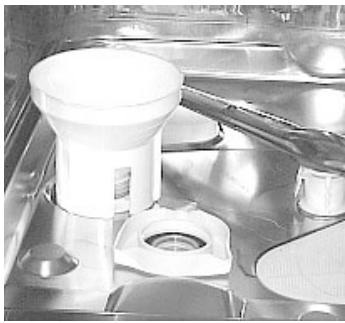
introduce about 2kg of salt. It is normal for a small amount of water to come out of the salt container.
4. Carefully screw the cap back on.
The salt container should be filled up when the low salt indicator light "E" flashes.
Your appliance will remind you to do so for 5 consecutive wash cycles.
A Warning: To prevent rust from forming, we advise you to load the salt before starting a wash cycle.
Adjusting Salt Consumption
The dishwasher is designed to allow for adjusting the amount of salt consumed based on the harness of the water used. This is intended to optimize and customize the level of salt
consumption so that it remains at a minimum.
Your Local Water Board can supply the degree of hardness of the water in your area.
To adjust salt consumption, proceed as follows:
1) Unscrew the cap from the salt container.
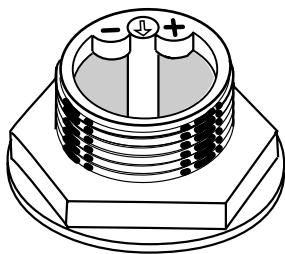
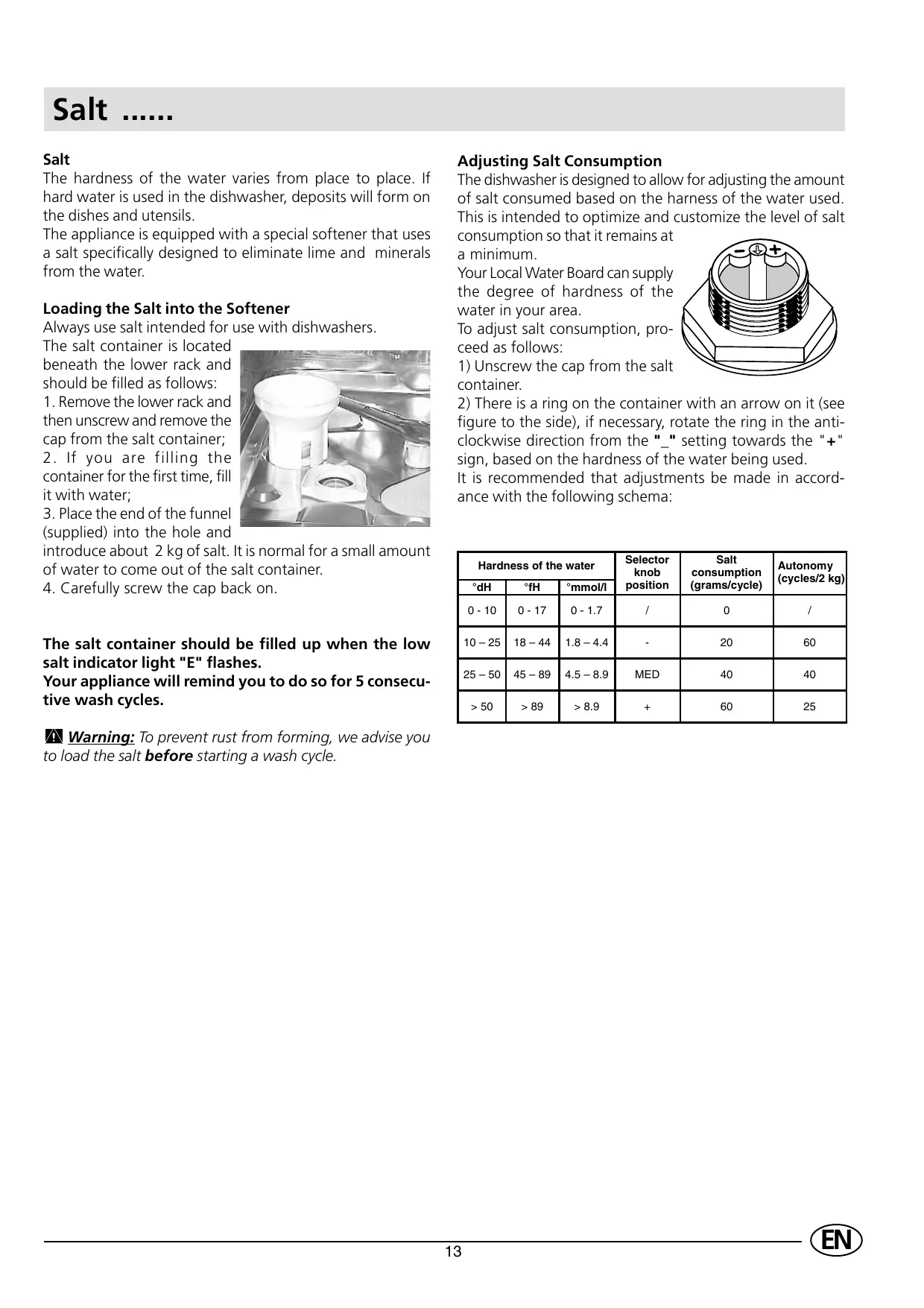
2) There is a ring on the container with an arrow on it (see figure to the side), if necessary, rotate the ring in the anticlockwise direction from the "_ " setting towards the "+" sign, based on the hardness of the water being used.
It is recommended that adjustments be made in accordance with the following schema:
| Hardness of the water | Selector knob position | Salt consumption (grams/cycle) | Autonomy (cycles/2 kg) | ||
| °dH | °fH | °mmol/l | |||
| 0 - 10 | 0 - 17 | 0 - 1.7 | / | 0 | / |
| 10 - 25 | 18 - 44 | 1.8 - 4.4 | - | 20 | 60 |
| 25 - 50 | 45 - 89 | 4.5 - 8.9 | MED | 40 | 40 |
| > 50 | > 89 | > 8.9 | + | 60 | 25 |
Detergent and Rinse Aid ....
Detergent
Detergent specifically intended for use with dishwashers must be used. The dispenser must be refilled before the start of each wash cycle following the instructions provided in the "Wash Cycle Table." The detergent dispenser is located on the inside panel of the door.
Loading the detergent
To open lid "A", press button "B". The cleaning detergent should be introduced into the two containers "C" and "D" up to the rim.
After pouring in the detergent, replace the lid, pressing down until it clicks.
Dishwasher detergent in tablets is now available on the market, in which case you should place one tablet into container "D" and replace the lid.
- To obtain the best results from each washing and drying cycle, powder detergent, rinse aid liquid and salt should be used.
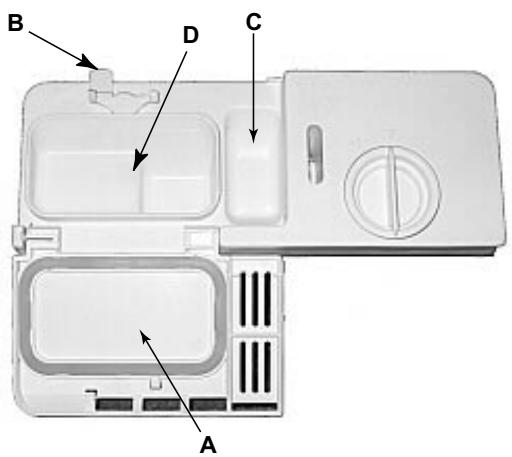
Notice: To facilitate closing the cover, remove any excess detergent on the edges of the dispenser.
Rinse Aid
This product makes dishes sparkle more as it improves their drying. The rinse aid container is situated on the inside of the door: It should be filled up when the low rinse aid indicator light "T" flashes.
Loading the Rinse Aid
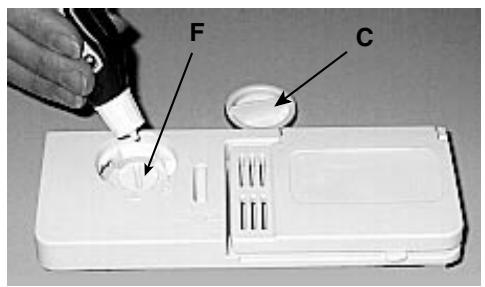
To open the dispenser, turn the "C" cap in the anti-clockwise direction and then pour in the rinse aid, making sure not to overfill. The amount of rinse aid used for each cycle can be regulated by turning the "F" dose adjustor, located beneath the "C" cap, with a screwdriver. There are 6 different settings; the normal dosage setting is 4.
Important:
Proper dosage of the rinse aid improves drying. If drops of water remain on the dishes or spotting occurs, the dosage adjustor should be turned to a higher setting. If the dishes have white streaks, turn the dosage adjustor to a lower setting.
Warning
Three-in-one dishwasher tablets are now available on the market, and combine detergent, salt and rinse aid all in one.
If the water in your area is hard or very hard, we still recommend you pour extra salt into the relevant dispenser to prevent the formation of white streaks on your dishes or on the interior of the appliance.
Using a three-in-one product means it is no longer necessary to put rinse aid into the relevant container.
If you want to achieve perfectly dry dishes, you may add rinse aid as long as the dosage adjuster is set to no.2.
In any case, please read the manufacturer's instructions on the packet.
If you use only these products, it is normal for the salt and rinse aid indicator lights to flash permanently after a certain number of cycles.
Loading the Dishwasher
Before placing the dishes in the dishwasher, remove the larger food particles to prevent the filter from becoming clogged, which results in reduced performance.
If the pots and pans have baked-on food that is extremely hard to remove, we recommend that they be allowed to soak before they are washed. This will eliminate the need for extra wash cycles.
Pull out the racks to facilitate loading the dishwasher.
How to Use the Lower Rack
We recommend that you place the most difficult to clean items on the bottom rack: pots, pans, lids, serving dishes and bowls, as shown in the figure to the right.
It is preferable to place serving dishes and lids on the sides of the racks in order to avoid blocking the rotation of the top spray arm.
-
Pots, serving bowls, etc. must always be placed top down.
-
Deep pots should be slanted to allow the water to flow out.
The lower rack has tip-up sectors (see figure B), so you can place even more saucepans and frying pans or make room for the larger one
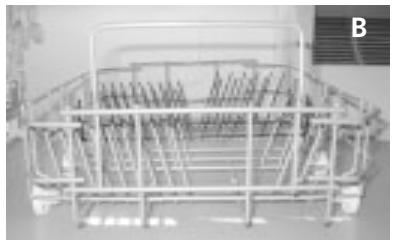
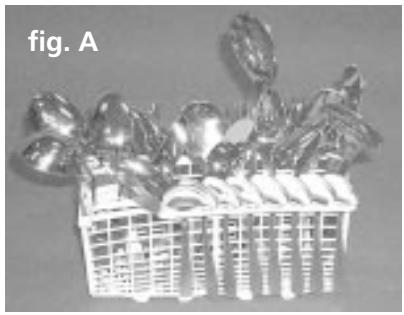
Place the cutlery with the handles at the bottom; if the basket is the one with side inserts, then insert the tea spoons one by one into the slots (see figure A).
This basket is equipped with one removable grid: insert the cutlery one by one into the slots, with the handles at the bottom.
4 Insert the cutlery into the basket: Knives and other utensils with sharp edges must be placed in the cutlery basket with the points facing downwards, or they must be positioned horizontally in the tip-up compartments on the upper rack. Position all cutlery items so that they don't touch.
It is best if you place longer utensils horizontally at the front of the upper rack. It is best if you place longer utensils horizontally at the front of the upper rack.
How to Use the Upper Rack
Place delicate and lightweight dishes in the upper rack: glasses, tea cups and coffee cups, saucers - but plates too - shallow salad bowls, slightly dirty frying pans and shallow pans.
Position light weight dishes in such a way as to avoid their being moved by the spray of water.
The appliance can also be equipped with one or two tip-up compartments onto which you can place mugs and cups, as well as long sharp knives and serving cutlery.
After loading the dishes, remember to check that the blades on the sprayer arms can turn freely without hitting against any dishes.
Load examples
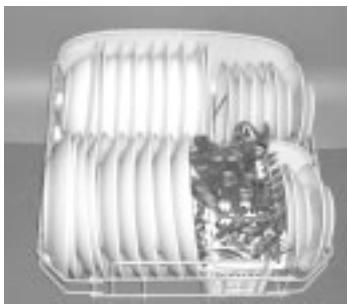
Bottom Rack
Top Rack
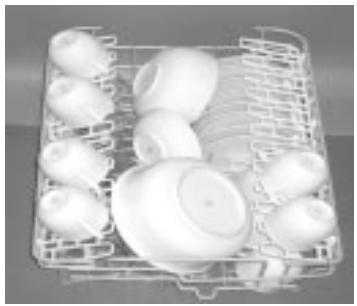
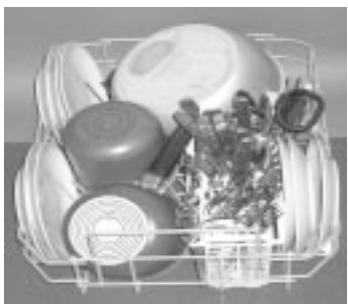
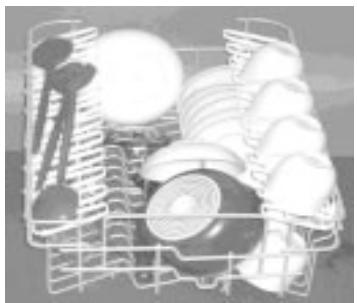
How to adjust the Upper rack
The top rack can be adjusted using the two rack heights (top and bottom).
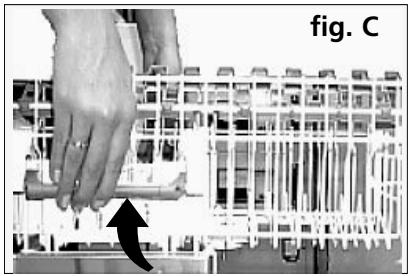
The upper rack can be adjusted for height by using the knobs located on the sides of the rack itself (see figure C)
Turning on the Appliance
How to start a wash cycle...
Turn on the water tap completely and press ON-OFF button "A". you will hear a short beep and indicator light "B" lights up. Now the appliance is on and awaiting instructions.
Starting and selecting the cycle.
To select the wash cycle, turn knob "D" clockwise until the reference notch on the knob corresponds with the number or symbol for the cycle you wish to set (have a look at the wash cycle table on page 17).
After a few seconds, you will hear a short beep: the wash cycle has begun and we do not recommend you change it.
Cycle phase indicator lights
The dishwasher is provided with 4 indicator lights "G" which come on in sequence as the appliance is performing that specific phase of the wash cycle.
These phases are:

pre-wash,

wash,

rinses,

drying
Cancelling or modifying a wash cycle in progress......
You can modify the wash cycle in progress, if it has only just started. Turn the knob anti-clockwise until it reaches the Reset position and, after a few seconds, you will hear 4 beeps and indicator light "G" will turn off. This is to inform you that all the settings have been cancelled.
You are now free to re-set the correct wash cycle.
If you have left out a dish...
You can interrupt the wash cycle by pressing the ON-OFF button, insert the dish you had forgotten and press the ON-OFF button again.
The cycle will start up from where you interrupted it.
There's been a power failure? Have you opened the dishwasher door?
The wash cycle stops and then restarts when the electricity comes back on or when you shut the door.
At the end of the wash cycle....
The end of the wash cycle is indicated by two short beeps and the flashing of the drying phase indicator light.
Turn the knob anti-clockwise to Reset in order to reset all the settings.

Warning:
Press button "A" to turn the appliance off, unplug the appliance from the electricity socket to cut off the power supply; the power supply cable should consequently be easily accessible.
Turn off the water tap.
Wait a few minutes before unloading the dishes: they are very hot! If you wait a little while, they dry better thanks to the steam.
Empty the lower rack first.
Make sure the wash cycle has ended before removing the dishes!

Warning:
If opening the door soon after the end of the programme, or during it, stand away from the Dishwasher, to avoid possible injury from hot steam.
Wash Cycle Table
Dishwasher washing guarantees your dishes will be cleaned in a hygienic setting for safer, cleaner results.
If the crockery is only lightly soiled or if it has been rinsed with water before being placed in the dishwasher, reduce the amount of detergent used accordingly.
| Cycle | Cycle selection instructions | Cycle description | Detergent for pre-wash + wash | Rinse Aid | Wash cycle duration (tolerance ±10%) Hrs. Min. |
| Auto Intensive | Very dirty dishes and pans (not to be used for delicate items) | Pre-wash with hot water at 40°C Wash at 63°C 2 Cold rinse Hot rinse at 67°C Drying | 3+24 g | * | 2:00' |
| Auto Normal | Cycle for normally dirty pans and dishes. Standard daily cycle. | Wash at 60°C Cold rinse Hot rinse at 70°C Drying | 27 g | * | 1:33' |
| Rapid & Dry | Environmentally-friendly cycle, with low energy consumption levels, suitable for normally dirty pans and dishes. | Pre-wash with cold water Wash at 48°C Cold rinse Hot rinse at 60°C Drying | 3+24 g | * | 2:25' |
| Economic and fast cycle to be used for slightly dirty dishes. Run cycle immediately after use. Without drying | Short wash at 48°C. Hot rinse at 67°C Drying | 20 g. | * | 0:44' | |
| Soak | Preliminary wash cycle for dishes and pans awaiting completion of the load with the dishes from the next meal. | Short cold wash to prevent food from drying onto the dishes. | 0:12' | ||
| Crystal | Special cycle to be used for more delicate items which are sensitive to high temperatures. Run cycle immediately after use. | Wash at 52°C Rinse at 45°C Hot rinse at 65°C Drying | 20 g | * | 1:30' |
| Rinse & Dry | Rinse and drying cycle for dishes that are seldom used and are only dusty. | Hot rinse at 67°C Drying | * | 0:36' |
Energy Saving Tips
-
It is important to try and run the dishwasher when it is fully loaded in order to save on energy. In order to prevent odors from forming and food from caking onto the dishes, you can run the hold cycle.
-
Choose the right wash cycle: the choice of cycle depends on the type of dishware, cookware and utensils being washed and how dirty they are.
-
Use the right amount of detergent: if you use too much detergent, the result will not be cleaner dishes, but, rather, a greater negative impact on the environment.
-
There is no utility in rinsing dishes, cookware and utensils before placing them in the dishwasher.
How to Keep Your Dishwasher in Shape
After Every Wash
After every wash, turn off the water supply to the appliance and leave the door slightly ajar so that moisture and odors are not trapped inside.
Remove the Plug
Before cleaning or performing maintenance, always remove the plug from the socket. Do not run risks.
No Solvents or Abrasive Cleaning Products
To clean the exterior and rubber parts of the dishwasher, do not use solvents or abrasive cleaning products. Rather, use only a cloth and warm soapy water.
To remove spots or stains from the surface of the interior, use a cloth dampened with water and a little white vinegar, or a cleaning product made specifically for dishwashers.
When You Go on Holiday
When you go on holiday, it is recommended that you run a wash cycle with the dishwasher empty and then remove the plug from the socket, turn off the water supply and leave the door of the appliance slightly ajar. This will help the seals last longer and prevent odors from forming within the appliance.
Moving the Appliance
If the appliance must be moved, try to keep it in the vertical position. If absolutely necessary, it can be positioned on its back.
Seals
One of the factors that cause odors to form in the dishwasher is food that remains trapped in the seals. Periodic cleaning with a damp sponge will prevent this from occurring.
Disposal of old electrical appliances
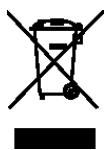
The European Directive 2002/96/EC on Waste Electrical and Electronic Equipment (WEEE), requires that old household electrical appliances must not be disposed of in the normal unsorted municipal waste stream. Old appliances must be collected separately in order to optimise the recovery and recycling of the materials they contain and reduce the impact on human health and the environment.
The crossed out "wheeled bin" symbol on the product reminds you of your obligation, that when you dispose of the appliance it must be separately collected.
Consumers should contact their local authority or retailer for information concerning the correct disposal of their old appliance.
Cleaning and Special Maintenance
The filter assembly
If you want consistent good results from your dishwasher, you need to clean the filter assembly.
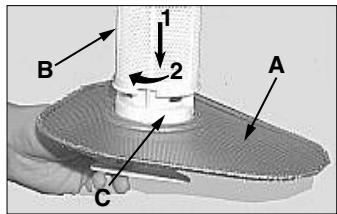
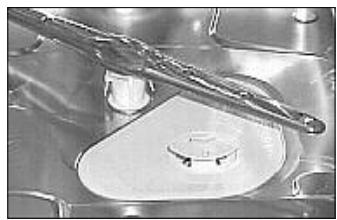
The food particles are removed from the wash water, allowing it to be recirculated during the cycle, filtered perfectly. For this reason, it is a good idea to remove the larger food particles trapped inside the cup "C" and the semi-circular filter A after each wash; pull the cup handle upwards to remove them. Just rinse them under running water.
The entire filter assembly should be cleaned thoroughly once a month: cup C + semi-circular filter A + cylindrical filter B.
Rotate filter "B" anticlockwise to remove it.
For cleaning, use a non metallic brush.
Reassemble the filter parts (as shown in the figure) and reinsert the whole assembly into the dishwasher. Position it into its housing and press downwards.
The dishwasher is not to be used without filters. Improper replacement of the filters may reduce the efficiency of the wash and even damage your dishwasher.
Cleaning the Sprayer Arms
It may happen that food particle become encrusted on the sprayer arms and block the holes (see "Close up view (interior)", letters F-I). Check the sprayer arms periodically and clean them when needed.
Troubleshooting
It may occur that the dishwasher does not function or does not function properly. Before calling for assistance, let us see what can be done first: have you forgot to press one of the buttons or to perform an essential operation?
The Dishwasher Does Not Start
Have you checked whether:
- the plug is pushed into the socket correctly;
- the power is on in the house;
- the door is closed properly;
- the ON-OFF switch is on "ON";
- the water supply is turned on.
The Dishwasher Does Not Load Water
Have you checked whether:
- the water is turned on and the hose is connected properly;
- the water supply to the house is on and has sufficient pressure;
- the water supply hose is crimped or bent;
- the filter for the water supply hose is clogged.
The Dishes Are Not Clean
Have you put the right amount of detergent into the dispenser? Is the wash cycle suitable for the dishes you have placed inside the appliance?
Are the filter and microfilter clean?
Can the sprayer arms turn freely?
The Dishwasher Does Not Drain
Have you checked whether:
- the drain hose is crimped or bent.
Lime Deposits or a White Film Form on the Dishes
Have you checked whether:
- the lid to the salt container is closed properly;
- the rinse aid dosage is correct.
Error messages.
Your dishwasher is equipped with a safety system which is able to detect any operating anomalies. These anomalies are reported by
one or two wash cycle indicator lights "G" flashing rapidly.
Take a note of which lights are flashing, turn the appliance off and call for technical assistance.
Tap off alarm
If you have forgotten to turn the water tap on, your appliance will remind you of this by sounding a few short beeps for a few minutes. Turn the tap on and your appliance will start up again after a few minutes. Were you to be absent when these beeps are sounded, the appliance will be blocked automatically and indicator lights 2 and 3 (wash and rinses) will flash rapidly. Turn the appliance off at the ON-OFF button, turn on the water tap and wait approximately 20 seconds before turning the appliance back on; the selected wash cycle will start up again.
Clogged filter alarm
If the appliance is blocked and indicator lights 1 (pre-wash) and 3 (rinses) flash rapidly, this means the filter is clogged by large particles of food residue. Turn the appliance off, clean the filter thoroughly and reposition it in its seat as illustrated on this page. Then turn it back on. The selected wash cycle will start up again.
Water load solenoid valve malfunction alarm.
If indicator light 2 (wash) flashes rapidly, TURN the dishwasher OFF AND BACK ON AGAIN after one minute. If the alarm persists, first turn off the water tap to avoid any flooding and then cut off the electricity supply and call for technical assistance.
If, despite all these checks, the dishwasher still does not function and/or the problem persists, contact the nearest authorised service centre and provide them with the following information:
- the nature of the problem;
- the model type number (Mod. ...) and the serial number (S/N ..., which are indicated on the plate located on the side of the inner part of the door.
Never call on unauthorised technicians and refuse to allow parts to be installed that are not original spare parts.
Installation
Positioning the Appliance
Position the appliance in the desired location. The back should rest against the wall behind it, and the sides, along the adjacent cabinets or wall. The dishwasher is equipped with water supply and drain hoses that can be positioned to the right or the left to facilitate proper installation.
Levelling the Appliance
Once the appliance is positioned, adjust the feet (screwing them in or out) to adjust the height of the dishwasher, making it level. In any case, the appliance should not be inclined more than 2^ .
If the appliance is level, it will help ensure proper performance.
Adjustment of Back Feet
Insert the appliance in the cutout and then adjust the height of the machine using the screws located at the bottom front. Use a screwdriver to turn the screws in the clockwise direction to raise the dishwasher and in the anticlockwise direction to lower it.
Cold water connection.
This electric household appliance should be connected to the water mains using the cold water supply hose provided with the appliance only. Do not use a different hose. In the event of replacements, use original spare parts only.
Connect the cold water supply hose to a 3/4 gas threaded connection, placing the small filter provided between the hose and connection, taking care to screw it tightly onto the tap.
If the water hoses are new or have been out of use for an extended period of time, let the water run to make sure it is clear and free of impurities before making the connection. If this precaution is not taken, the water inlet could get blocked, causing damage to your dishwasher.
- It is strongly recommended to use a new hose to connect the dishwasher to the water supply line, and the old hose set should not be reused. Asking to specialized shop or an authorized service technician (see Service).
Hot Water Connection
The water supply to the appliance can also be connected to the house's hot water line (centralised system, heating system), as long as it does not exceed a temperature of 60^ C.
In this case, the wash cycle time will be shortened by about 15 minutes and the wash efficiency slightly reduced.
The connection must be made to the hot water line following the same procedures as those for the connection to the cold water line.
Anti-flooding protection
Your dishwasher is provided with a special system which blocks the water supply in the event of leaks inside the
appliance. It is further equipped with a water inlet hose comprising an outer clear hose and an inner red hose, which can both withstand extremely high pressures. Should the inner hose break, the outer hose will consequently turn red. Safety in the event of flooding is ensured by the second clear hose that contains the former. It is vital that you check the outer hose regularly: if you see it has turned bright red, then you know you have to replace it as soon as possible. Call for an authorised technical engineer to come and replace it.
Drain Hose Connection
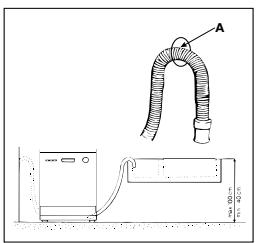
Insert the drain hose into a drain pipe with a minimum diameter of 4 cm., or let it run into the sink, making sure to avoid bending or crimping it. The free end of the hose must be at a height between 40 and 100 cm.and must not be immersed in water.
Electrical Connection
After making sure that the voltage and frequency values for the current in the home correspond to those on the rating plate (located on the stainless steel inner door of the appliance) and that the electrical system is sized for the maximum voltage on the rating plate, insert the plug into an electrical socket which is earthed properly (the earthing of the appliance is a safety requirement mandated by law). If the electrical socket to which the appliance must be connected is not appropriate for the plug, replace the plug, rather than using adpators or the like as they could cause overheating and burns.
Caution:
-
Once the appliance has been installed, the electrical plug and socket should remain accessible.
-
If the power supply cable is damaged, it must be replaced by the manufacturer or its Technical Assistance Service in order to prevent all potential hazards. (See Assistance)
-
The cable should not be bent or compressed.
-
The Company shall not be held responsible for any incidents that occur if these regulations are not observed..
Condensation-proof tape.
On some models, a transparent condensation-proof adhesive tape has been provided.
It should be stuck onto the lower side of your wooden worktop to protect it from the formation of condensation.
When not provided, this tape can be requested as a spare part from authorised retailers.
60044 Fabriano (AN) Italy
Tel +39 0732 6611
www.scholtes.com
Document number: 195060902.00 - 11/2006