
TEPPAN YAKI SF - Hob SCHOLTES - Free user manual and instructions
Find the device manual for free TEPPAN YAKI SF SCHOLTES in PDF.



| Product type | Teppanyaki cooking plate |
| Brand | SCHOLTES |
| Model | TEPPAN YAKI SF |
| Power supply | Single phase, 220-240 V ~ 50/60 Hz |
| Total power | 2000 W |
| Number of cooking zones | 1 |
| Control type | Rotary knobs (ON/OFF and temperature adjustment) |
| Indicators | ON/OFF, temperature indicator, residual heat |
| Temperature range | From 130°C to 200°C (max) |
| Thermostat | Yes, automatic temperature maintenance |
| Surface material | Stainless steel |
| Included accessories | Spatula, sealing gasket, centering springs |
| Installation type | Built-in (semi-flush) or freestanding |
| Safety | Residual heat indicator, automatic shut-off not specified |
| Cleaning | Damp sponge, non-abrasive detergent, no steam cleaner |
| Repairability | Spare parts available via authorized service, cable replacement by technician |
| Standards | CE (2006/95/EC, 89/336/EC, 93/68/EC) |
Frequently Asked Questions - TEPPAN YAKI SF SCHOLTES
User questions about TEPPAN YAKI SF SCHOLTES
0 question about this device. Answer the ones you know or ask your own.
Ask a new question about this device
Download the instructions for your Hob in PDF format for free! Find your manual TEPPAN YAKI SF - SCHOLTES and take your electronic device back in hand. On this page are published all the documents necessary for the use of your device. TEPPAN YAKI SF by SCHOLTES.
USER MANUAL TEPPAN YAKI SF SCHOLTES
natural_image
Circular arrangement of black oval shapes on white background (no text or symbols)Scholtès
natural_image
Technical line drawing of a mechanical assembly with front and side views (no text or symbols)natural_image
Simple line drawing of a tool or plunger with a handle and base, no text or symbols present.Electrical connection
Description of the appliance, 12
Control panel
Start-up and use, 13-14
Switching on and operating the hob
Switching off the hob
Safety devices
Technical description of the models
Practical advice on using the appliance
Precautions and tips, 15
General safety
Disposal
Care and maintenance, 16
Switching the appliance off
Cleaning the appliance

natural_image
Circular arrangement of black oval shapes on white background (no text or symbols)Scholtès
! Please keep this instruction booklet in a safe place for future reference. If the appliance is sold, given away or moved, please sure the booklet is also passed on to the new owners so that they may benefit from the advice contained within it.
! Please read this manual carefully: it contains important information concerning the safe operation, installation and maintenance of the appliance.
Positioning
! Keep all packaging material out of reach of children. It may present a choking or suffocation hazard (see Precautions and tips).
! The appliance must be installed by a qualified professional in accordance with the instructions provided. Incorrect installation may damage property or cause harm to people or animals.
Built-in appliance
Use an appropriate cabinet to ensure that the appliance operates properly:
- the supporting surface must be heat-resistant up to a temperature of approximately 100irc C;
- avoid installing the hob above a dishwasher: if this cannot be avoided, place a waterproof separation device between the two appliances;
- depending on the hob you want to install (see figure), the cabinet must have the following dimensions:

Installing semi-flush hobs (TEPPAN YAKI SF)
All the necessary precautions must be taken in order to install the appliance in conformity with current accident-prevention regulations (CEI-UNI-CIG) relating to gas and electrical connections. To ensure sit-on hobs installed in kitchen cabinets operate correctly, the minimum distances indicated should be observed (see figure). All adjacent surfaces and the back panel should also be able to withstand an overheating temperature of 65irc C.

Securing the appliance to the cabinet
The appliance must be installed on a perfectly level supporting surface.
Any deformities caused by improper fixing could alter the features and the operation of the hob.
- Before fitting the hob to the worktop, position the seal provided along the perimeter of the hob, as illustrated in the figure.

natural_image
Technical line drawing of a mechanical assembly with front and top views (no text or symbols)- The installation cavity should have the dimensions indicated in the figure accompanying the previous paragraph.
Fix the hob as follows:
- Use the screws supplied to fit the 4 alignment springs in the holes provided at the central point of each side of the part underneath the hob.
- Place the hob in the cavity, make sure it is in a central position and push down on the whole perimeter until the hob adheres well to the supporting surface.
! The screws for the alignment springs must remain accessible.
! In order to adhere to safety standards, the appliance must not come into contact with electrical parts once it has been installed.

! All parts that ensure the safe operation of the appliance must not be removable without the aid of a tool.
! Where the hob is not installed over a built-in oven, a wooden panel must be installed as insulation. This must be placed at a minimum distance of 20 mm from the lower part of the hob.
Electrical connection
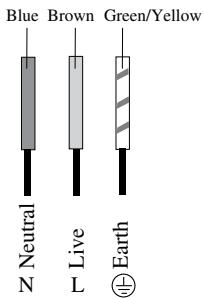
Hobs equipped with a three-pole power supply cable are designed to operate with alternating current at the voltage and frequency indicated on the data plate (this is located on the lower part of the appliance). The earth wire in the cable has a green and yellow cover. If the appliance is to be installed above a built-in electric oven, the electrical connection of the hob and the oven must be carried out separately, both for electrical safety purposes and to make extracting the oven easier.
Single-phase connection
If the hob has a supply cable fitted, connect it to the mains, using the colours as a guide (see adjacent diagram). The yellow-green wire should be 5 cm longer than the other wires.
Connecting the electricity supply cable to the mains
The appliance must be directly connected to the mains using an omnipolar switch with a minimum contact opening of 3 mm installed between the appliance and the mains. The switch must be suitable for the charge indicated and must comply with current electrical regulations (the earthing wire must not be interrupted by the switch). The supply cable must be positioned so that it does not come into contact with temperatures higher than 50irc C at any point.
! The installer must ensure that the correct electrical connection has been performed and that it is fully compliant with safety regulations.
Before connecting the appliance to the power supply, make sure that:
- the appliance is earthed and the plug is compliant with the law;
- the socket can withstand the maximum power of the appliance, which is indicated on the data plate located on the appliance itself;
- the voltage falls within the range of values indicated on the data plate;
- the socket is compatible with the plug of the appliance. If the socket is incompatible with the plug, ask an authorised technician to replace it. Do not use extension cords or multiple sockets.
! Once the appliance has been installed, the power supply cable and the electrical socket must be easily accessible.
! The cable must not be bent or compressed.
! The cable must be checked regularly and replaced by authorised technicians only.
! The manufacturer declines any liability should these safety measures not be observed.
Description of the appliance
GB
Control panel
The control panel described in this manual is only a representative example: it may not exactly match the panel on your appliance.

• ON/OFF knob switches the appliance on and off.
- ON/OFF indicator light signals that the appliance is switched on or that the heating zone is still hot.
- TEMPERATURE indicator light indicates that the oven is heating up to the set temperature.
- TEMPERATURE ADJUSTMENT knob is used to set the temperature to the desired value.
! The glue applied on the gaskets leaves traces of grease on the glass. Before using the appliance, we recommend you remove these with a special non-abrasive cleaning product. During the first few hours of use there may be a smell of rubber which will disappear very quickly.
Switching on and operating the hob
- Turn the ON/OFF knob towards the right, until it reaches the position.
- Adjust the temperature to the desired value using the TEMPERATURE ADJUSTMENT knob.
- This will switch on the hotplate and the corresponding ON/OFF and TEMPERATURE indicator lights.
- When the TEMPERATURE indicator light switches off, this means that the set temperature has been reached.
- A thermostat ensures the temperature remains constant, at the set level. During the subsequent heating phase, the TEMPERATURE indicator light switches on again.
Switching off the hob
To switch off the appliance, turn the ON/OFF in an anti-clockwise direction, from the 1 position to the "O" position.
Safety devices
Heat indicators
If, after the appliance has been used, the RESIDUAL HEAT indicator light remains lit, this means that the heating zone is still hot (temperature over 60°C); do not touch it. The indicator light will switch off once the hotplate has cooled down.
Technical description of the models
| Hobs | TEPPAN YAKI FTEPPAN YAKI SF |
| Cooking zone | Power (W) |
| Total power | 2000 |
Practical advice on using the appliance
Food may be prepared directly on the surface of the hob, with or without the use of fat or oil.

natural_image
Simple line drawing of a trowel or plunger (no text or symbols)During cooking, the palette knife (supplied with the appliance) may be used to turn/flip food.
! The surface of the hob may be marked by the palette knife; however, this will not affect its performance.
Recommended power levels for various types of cooking:
| DISH TO BE COOKED | TEMPERATURE (°C) | ADVICE/NOTES |
| FISH | ||
| Red bream (fillets) | between 150° and 200° | between 2 min. and 4 min. on each side, depending on thickness |
| Rock-fish (fillets) | between 150° and 200° | between 2 min. and 4 min. on each side, depending on thickness |
| Salmon (fillets) | between 150° and 200° | between 2 min. and 4 min. on each side, depending on thickness |
| Sardines and mullet (small fish) | between 150° and 200° | between 2 min. and 4 min. on each side |
| Mackerel (medium-sized fish) | 150° | between 4 min. and 5 min. on each side |
| Bream (medium-sized fish) | 150° | between 4 min. and 5 min. on each side |
| Monkfish (large fish) | between 130° and 150° | between 8 min. and 10 min. on each side, then 180° for browning the surface |
| Salmon steak | between 150° and 200° | between 2 min. and 7 min. on each side, depending on the thickness and the desired cooking level |
| Cod steak | between 150° and 200° | between 2 min. and 7 min. on each side, depending on the thickness and the desired cooking level |
| Tuna steak | between 150° and 200° | between 2 min. and 7 min. on each side, depending on the thickness and the desired cooking level |
| Shrimps and prawns | 200° max. | between 4 min. and 7 min. |
| Breadcrumbsbed fish | 150° | between 2 min. and 4 min. on each side |
| MEAT | ||
| Chops: pork, lamb and veal | 200° | between 2 min. and 10 min. on each side, depending on the thickness and the desired cooking level |
| Beef or veal rib (very thick) | between 150° and 200° | between 10 min. and 15 min. on each side, MAX. temperature for browning on the outside |
| Steaks and cutlets: beef, veal and poultry | 200° max. | between 1 min. and 3 min. on each side |
| Sausages | between 150° and 200° | 10 min. |
| Wurstel | Max. | 18 min. |
| Beef, chicken (minced meat) | 200° max. | |
| FRUIT AND VEGETABLES | ||
| Potatoes: finely sliced or diced | 200° max. | |
| Onions, leeks, carrots, peppers (finely chopped) | 200° max. | |
| Aubergines and courgettes (sliced) | between 150° and 200° | |
| Pineapple, mango, apples and pears (sliced fruit) | 200° | |
| Grilled courgettes | 200° | 12 min. |
| Grilled peppers | Max. | 30 min. |
| OTHER | ||
| Toasted bread | between 150° and 200° | 30 sec. on each side |
| Pancakes | 200° | 3 min. |
| Eggs, fried | between 150° and 200° | |
! The cooking times listed above are intended as guidelines only and may be modified according to personal tastes.
! This appliance has been designed and manufactured in compliance with international safety standards. The following warnings are provided for safety reasons and must be read carefully.
CE This appliance conforms to the following European Economic Community directives:
- 2006/95/EEC dated 12/12/06 (Low Voltage) and subsequent amendments;
- 89/336/EEC dated 03/05/89 (Electromagnetic Compatibility) and subsequent amendments;
- 93/68/EEC dated 22/07/93 and subsequent amendments.
General safety
! Make sure that the air inlet behind the fan grille is never obstructed. The built-in hob should, in fact, be provided with suitable ventilation for the cooling of the electronic components used in the appliance.
! We advise against the installation of an induction hob above an under-the-counter refrigerator (heat) or above a washing machine (vibrations). In fact, there would be insufficient space for the ventilation of electronic components.
- The appliance was designed for domestic use inside the home and is not intended for commercial or industrial use.
- The appliance must not be installed outdoors, even in covered areas. It is extremely dangerous to leave the appliance exposed to rain and storms.
- Do not touch the appliance when barefoot or with wet or damp hands and feet.
- The appliance must be used by adults only for the preparation of food, in accordance with the instructions provided in this booklet. Do not use the hob as a worktop or chopping board.
-
Make sure that power supply cables of other electrical appliances do not come into contact with the hot parts of the hob.
-
When unplugging the appliance, always pull the plug from the mains socket; do not pull on the cable.
- Never perform any cleaning or maintenance work without having disconnected the appliance from the electricity mains.
-
The appliance should not be operated by people (including children) with reduced physical, sensory or mental capacities, by inexperienced individuals or by anyone who is not familiar with the product. These individuals should, at the very least, be supervised by someone who assumes responsibility for their safety or receive preliminary instructions relating to the operation of the appliance.
-
Do not let children play with the appliance.
- Do not place metal objects (knives, spoons, pan lids, etc.) on the hob as they may become hot.
Disposal
- When disposing of packaging material: observe local legislation so that the packaging may be reused.
- The European Directive 2002/96/EC relating to Waste Electrical and Electronic Equipment (WEEE) states that household appliances should not be disposed of using the normal solid urban waste cycle. Exhausted appliances should be collected separately in order to optimise the cost of re-using and recycling the materials inside the machine, while preventing potential damage to the atmosphere and to public health. The crossed-out dustbin is marked on all products to remind the owner of their obligations regarding separated waste collection.
For further information relating to the correct disposal of exhausted household appliances, owners may contact the relevant public service or their local dealer.
Care and maintenance
GB
Switching the appliance off
Disconnect your appliance from the electricity supply before carrying out any work on it.
Cleaning the appliance
! Do not use abrasive or corrosive detergents (for example, products in spray cans for cleaning barbecues and ovens), stain removers and anti-rust products.
! Never use steam cleaners or pressure cleaners on the appliance.
! Do not use abrasive or corrosive products to clean the steel frame.
! Clean the appliance every time it has been used. This will prevent the build-up of residue, which could become hard to remove if left to accumulate.
Stainless steel can be marked by hard water which has been left on the surface for a long time, or by cleaning products containing phosphorus.
After cleaning, it is advisable to rinse the surface well and dry it thoroughly. If water is spilt on the surface, dry it quickly and thoroughly.
- It is usually sufficient simply to wash the hob using a damp sponge and dry it with absorbent kitchen towel.
- To remove more stubborn dirt, use the palette knife (supplied with the appliance). Remove spills as soon as possible, without waiting for the appliance to cool, to prevent residues from forming crusty deposits. Always rub in the direction of the metal brushing (across the appliance) to avoid scratching the surface.
- Always remember to rinse the appliance well with clean water and dry it thoroughly: residues can become encrusted during subsequent cooking processes.

Italiano, 1

English,9

Français, 17

Espanol, 25

Português, 33

Nederlands, 41

Deutsch, 49
TEPPAN YAKI F TEPPAN YAKI SF

natural_image
Circular pattern composed of evenly spaced black petal-like shapes radiating outward (no text or symbols)Scholtès
Sommaire
Installation, 18-19
Positionnement
natural_image
Technical line drawing of a mechanical assembly with front and side views (no text or symbols)natural_image
Simple line drawing of a tool or plunger with a handle and base, no text or symbols present.natural_image
Circular arrangement of black oval shapes radiating outward from center (no text or symbols)Scholtès
Sumario
Instalación, 26-27
Montaje
Conexión eléctrica
natural_image
Technical line drawing of a mechanical assembly with front and side views (no text or symbols)natural_image
Simple line drawing of a tool or plunger with a handle and blade (no text or symbols)natural_image
Circular arrangement of black oval shapes radiating outward from center (no text or symbols)Scholtès
natural_image
Technical line drawing of a mechanical assembly with front and top views (no text or symbols)natural_image
Simple line drawing of a tool or plow with a rectangular handle and flat blade, no text or symbols present.natural_image
Circular pattern composed of evenly spaced black petal-like shapes radiating outward (no text or symbols)Scholtès
Inhoud
Installatie, 42-43
Plaatsing
natural_image
Technical line drawing of a mechanical assembly with front and side views (no text or symbols)natural_image
Simple line drawing of a tool or plunger with a handle and base, no text or symbols present.natural_image
Circular pattern composed of evenly spaced black petal-like shapes radiating outward (no text or symbols)Scholtès
Inhaltsverzeichnis
Installation, 50-51
Aufstellung
Elektroanschluss
natural_image
Technical line drawing of a door frame and a mechanical component (no text or symbols)natural_image
Simple line drawing of a tool or plunger with a handle and blade (no text or symbols)- Positioning
- Built-in appliance
- Installing semi-flush hobs (TEPPAN YAKI SF)
- Securing the appliance to the cabinet
- Fix the hob as follows:
- Electrical connection
- Single-phase connection
- Connecting the electricity supply cable to the mains
- Description of the appliance
- Control panel
- Switching on and operating the hob
- Switching off the hob
- Safety devices
- Heat indicators
- Practical advice on using the appliance
- General safety
- Disposal
- Care and maintenance
- Switching the appliance off
- Cleaning the appliance
- Sommaire
- Sumario
- Instalación, 26-27
- Inhoud
- Inhaltsverzeichnis
- Installation, 50-51
Brand : SCHOLTES
Model : TEPPAN YAKI SF
Category : Hob