
VT-2603 W - Yogurt maker Vitek - Free user manual and instructions
Find the device manual for free VT-2603 W Vitek in PDF.


| Product Type | Yogurt maker |
| Brand | Vitek |
| Model | VT-2603 W |
| Power Supply | 220-240 V ~50 Hz, 12 W |
| Number of Glass Cups | 6 |
| Cup Lids | 6 |
| Cottage Cheese Pots | 2 |
| Pot Lids | 2 |
| Baskets | 2 |
| Preparation Time Range | 1 to 19 hours |
| Default Preparation Time | 9 hours |
| Display | LED indicating remaining time |
| Main Functions | Yogurt, cottage cheese, farmer cheese preparation |
| Safety Features | Auto shut-off after program, overheat protection (not specified) |
| Body Material | Plastic |
| Cup Material | Glass |
| Cleaning Method | Hand wash removable parts with warm water and neutral detergent; wipe body with damp cloth |
| Storage | In a dry, cool place away from children |
| Operating Life | 3 years |
| Guarantee | Contact dealer with proof of purchase |
| Accessories Included | 6 glass cups, 6 cup lids, 2 cheese pots, 2 pot lids, 2 baskets, instruction manual |
Frequently Asked Questions - VT-2603 W Vitek
User questions about VT-2603 W Vitek
0 question about this device. Answer the ones you know or ask your own.
Ask a new question about this device
Download the instructions for your Yogurt maker in PDF format for free! Find your manual VT-2603 W - Vitek and take your electronic device back in hand. On this page are published all the documents necessary for the use of your device. VT-2603 W by Vitek.
USER MANUAL VT-2603 W Vitek
ENGLISH
YOGURT MAKER
Description
- Yogurt maker lid
- Body
- ON/OFF button
- Display
- Preparation time setting button
- Cup lid
- Glass cup
- Cheese pots
- Cheese pot lids
- Baskets
SAFETY MEASURES
Before using the unit, read these instructions carefully. Keep these instructions for further reference. Use the unit according to its intended purpose only, as it is stated in this user manual. Mishandling the unit can lead to its breakage and cause harm to the user or damage to his/her property.
- Before switching on make sure that your home mains voltage corresponds to the voltage specified on the unit body.
• The power cord should not:
- touch hot objects,
– be immersed into water,
– run over sharp edges of furniture,
– be used for carrying the unit.
- Do not touch the unit, the power cord or power plug with wet hands.
- In order to avoid fire do not use adapters for connecting the unit to the mains.
- Check the cord insulation integrity periodically.
- Never use the unit if the power cord or the power plug is damaged, the unit works improperly or after it was dropped. Contact an authorized service center for all repair issues.
- The unit is intended for preparing of natural yogurt and cottage cheese. Use the unit according to its intended purpose only.
• Use only the attachments supplied. - Place the unit on a heat-resistant flat stable surface, away from sources of heat, direct sunlight and in vibration-proof places.
- During unit operation do not leave the lid of the yogurt maker open.
- Yogurt cups are made of glass. Handle them carefully and do not expose them to extreme temperature difference!
- Never leave the yogurt maker unattended, if its power plug is inserted into the socket.
- Do not place or keep the unit in places where it can fall into a bath or a sink filled with water; do
not immerse the unit body, cord or power plug into water or other liquids.
- If the unit was dropped into water, unplug it immediately. And only then you can take it out of water.
• Always unplug the unit immediately after usage and before cleaning. - When unplugging the unit, pull the plug but not the cord.
- For children safety reasons do not leave polyethylene bags, used as a packaging, unattended.
- Attention! Do not allow children to play with polyethylene bags or film. Danger of suffocation!
- This unit is not intended for usage by children or disabled persons unless they are given all the necessary and understandable instructions by a person who is responsible for their safety on safety measures and information about danger that can be caused by improper usage of the unit.
BEFORE USING THE UNIT FOR THE FIRST TIME After the unit transportation or storage at low temperature it is necessary to keep it for at least two hours at room temperature before switching on.
- Take the unit out of the package and remove the packaging materials that can prevent the unit operation.
- Ensure that the unit is intact, do not use it in case of damages.
- Before connecting the unit to the mains, make sure that unit operating voltage corresponds to your home mains voltage.
- Place the unit on a flat stable heat-resistant surface away from containers filled with water, sources of heat, direct sunlight and in vibration- & shock-proof places.
- Wash the lids (6, 9), cups (7), pots (8) and baskets (10) in warm water with neutral detergent.
- Disinfect the lids (6, 9); to do this, scald them. Place the baskets (10) into the pots (8), fill the pots (8) and cups (7) with boiling water and leave them for 5-10 minutes.
– Dry all the removable parts thoroughly. - Clean the lid (1) of the yogurt maker, unit body (2) and the process chamber with a slightly damp cloth, and then wipe it dry.
ENGLISH
BEFORE YOU START
Milk
- You can use «raw» (fresh) milk, pasteurized or sterilized milk for yogurt making.
- Yogurt made of «raw» (fresh) or sterilized milk with added dry milk is thicker and heavier. Use sterilized non-perishable milk to prepare thick yogurt with less fat content.
- You can use cow's or goat's milk to make cottage cheese/ cheese. When you make cottage cheese of goat's milk, much whey is produced and finished product is thicker.
- Using of milk from different manufacturers gives different results. Try different brands and sorts of milk to get the product that meets your requirements.
Milk preparation
- The temperature of milk effects the yogurt/cottage cheese preparation time, the optimal milk temperature is 40-43°(milk is hot, but doesn't scorch).
- The temperature of milk must not exceed 40-43°, otherwise lactobacteria, used for yogurt/cottage cheese making, will die.
- Heat the sterilized milk to 40-43°C to reduce yogurt preparation time and improve the quality of the finished product.
- Bring «raw» (fresh) and pasteurized milk to boil and keep boiling for several minutes, then let it cool down to 40-43°.
• Skim off the milk foam after boiling.
Ferment for yogurt preparing
- As ferment you can use manufactured natural yogurt with the content of lactobacteria not less than 100 mln per 100 g. per 100 g.
- It is desirable that the yogurt used as ferment is of the same fat content with the milk. Otherwise the whey can separate that will impair the quality and consistency of the finished products.
- Mix the yogurt (100 g per 1 l milk) carefully with prepared milk and pour it into the cups (7).
- You can use special ferment, that you can buy at the pharmacy and healthy food shops. Ferment usually looks like dry mix. Dissolve the dry ferment in a small amount of milk, then mix it with the rest of milk.
- You can use the yogurt made by yourself as ferment for the next portion. Keep this ferment in the fridge for no longer than 7 days. You can use the ferment made by yourself repeatedly for up to 8 times.
Ferment for cottage cheese preparing
- Use fresh cottage cheese as ferment (100 g cottage cheese per 1 l milk) Stir the cottage cheese with some milk first, then pour the remaining milk and mix them thoroughly. The quality of the product depends on homogeneity of milk and cottage cheese mixture.
- You can add 1 tablespoonful of lemon juice to accelerate the whey separation process.
- You can use the ferment made by yourself repeatedly for up to 5 times. Keep the ready ferment in the fridge for no longer than 7 days.
- You can also use special ferments (renin, ren-net extract etc.), that you can buy at the pharmacy and healthy food shops, to make cottage cheese.
Cookware
- All the cookware used for yogurt making should be sterile. Scald the lids (6, 9), cups (7), pots (8) and baskets (10), as well as a saucepan for boiling milk, spoons and kitchen.
Preparation time
- If you use warm milk with necessary amount of ferment, average yogurt preparation time is 6 hours.
- If you use colder milk, the yogurt preparation time increases up to 8-10 hours.
- If you didn't use enough ferment, the yogurt preparation time can increase up to 10-12 hours.
- Average cottage cheese preparation time is 10-14 hours. If you use the cottage cheese previously made in the yogurt maker as ferment, the cottage cheese preparation time can reduce to 8-10 hours.
- Extremely low temperature in the room can increase the preparation time.
Note:
- You can set the preparation time within the range from 1 to 19 hours.
- The remaining cooking time will be shown on the display (4) in hours during the preparation.
- Keep the yogurt prepared in the yogurt maker in the fridge for about 2 hours.
Storage life
- Storage life of ready cultured milk foods depends on conditions of fermentation (quality of milk, cleanness of the cookware used etc.), storage conditions and used milk.
• Average storage life of prepared yogurt or cottage cheese is no longer than 7 days.
ENGLISH
PREPARATION OF YOGURT (basic recipe)
- Prepare milk.
— Add ferment and mix thoroughly.
— Pour the mixture into the cups (7).
Note: Wipe the spilled milk from the cups (7) with a slightly damp cloth.
— Open the lid of the yogurt maker (1).
- Place the cups (7) into the process chamber of the unit.
— Close the lid of the yogurt maker (1).
— Insert the power plug into the mains socket.
- Switch the unit on by pressing and holding the button (3) ⏻ within three seconds, the symbol "9" will show on the display (4) (default preparation time is 9 hours).
- If you don't press any buttons, the unit switches to the preparation mode automatically.
- To set the preparation time press and hold the button (5) Ⓛ within three seconds, time index on the display (4) will flash. Pressing the button (5) Ⓛ gradually, set the necessary preparation time (see "Preparation time").
- 10 seconds after the preparation time setting the unit switches to the preparation mode (time index on the display (4) stops flashing).
- Once the preparation program is finished, the symbol, "0" will be shown on the display, you'll hear two sound signals and the unit will be switched off.
- If you wish to switch the unit off during preparation process, press and hold the button (3) ⏻ within three seconds.
- Unplug the power cord from the mains socket after you switch the unit off.
Note:
- Do not move the yogurt maker during preparation process. This can spoil the consistency of the product.
- Sometimes the fermentation process can not pass completely, and the yogurt will be watery. In this case you should repeat the yogurt preparation process.
- After finishing of yogurt preparation remove the cups (7), cover them with lids (6) and put them to the fridge for 2-4 hours. Lactobacteria will stop growing, and the yogurt will become thicker.
Note: Do not put the cups (7) into the freezer.
- You can add small pieces of fruit, honey, muesli etc. to the prepared yogurt.
- Keep the prepared yogurt in the fridge for no longer than 7 days.
PREPARATION OF COTTAGE CHEESE (basic recipe)
- Prepare milk – the whole one preferable - and fresh cottage cheese. Having added a little milk to get a homogeneous mixture whip the cottage cheese carefully with a whisk. While whipping the mixture pour the rest of the milk.
- Add whey ferment or some lemon juice and mix thoroughly.
- Set the baskets (10) into the pots (8), so that the baskets (10) are at the bottom of the cheese pot (8).
- Fill the pots (8) with the prepared mixture. Note: Wipe any dirt from the cups (8) with a slightly damp cloth.
— Open the lid of the yogurt maker (1).
— Place the pot (8) in the process chamber.
- Close the lid of the yogurt maker (1).
— Insert the power plug into the socket.
- Switch the unit on by pressing and holding the button (3) ⏻ within three seconds, the symbol "9" will show on the display (4) (default preparation time is 9 hours).
If you don't press any buttons, the unit is switched to the preparation mode automatically.
- To set the preparation time press and hold the button (5) Ⓛ within three seconds, time index on the display (4) will flash. Pressing the button (5) Ⓛ gradually, set the necessary preparation time (see "Preparation time").
- When preparation program is finished, the symbol,"0" will be shown on the display, you'll hear two sound signals and the unit will be switched off.
- If you wish to switch the unit off during preparation process, press and hold the button (3) ⏻ within three seconds.
- Unplug the power cord from the mains socket after you switch the unit off.
Note:
- Do not move the yogurt maker during making process. This can spoil the consistency of the product.
- Sometimes the fermentation process can not pass completely, and the cheese will be watery. In this case you should repeat the cheese preparation process.
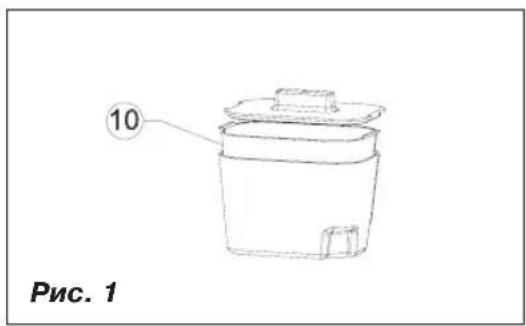
- After finishing cheese preparation remove the baskets (10) turn them by 180^ , put them back into the pots (8) (fig. 1) and cover with the lids (9); in about 15 minutes the ferment will flow down to the pot (8).
ENGLISH
— Pour the ferment out of the pot (8).
Note: If you wish to get thicker cottage cheese, increase the retention time up to 2-4 hours. If you are going to use the cottage cheese for farmer cheese preparation later, the retention time should be from 12 to 24 hours.
- Pour off the whey from the pots (8), turn over the baskets (10), so that the baskets (10) are at the bottom of the cottage cheese pots (8).
— Put the cottage cheese pots (8) into the fridge for 2-4 hours to stop the lactobacteria growth.
Note: Do not put the pots (8) into the freezer.
- You can add small pieces of fruit, honey, muesli etc. to the prepared cottage cheese.
- Keep the prepared cottage cheese in the fridge for no longer than 7 days.
PREPARATION OF FARMER CHEESE
- After finishing of cottage cheese preparation program remove the baskets (10), turn them by 180^ , put them back into the pots (8) (fig. 1) and cover with the lids (9). Put the pots (8) into the fridge for about 12-24 hours to trickle down the whey. Pour off the separated whey from the pot (8) from time to time.
Notes:
- To accelerate the whey separation process, part carefully the curds in several parts; mind not to damage the walls of the baskets (10).
- If you wish you can slightly salt the ready curds. Mind that salt increases the amount of the separated whey.
- You can either eat the ready product at once or use it as a base for preparing of other type of farmer cheese.
Note: The quality of the ready cheese depends on type and quality of the used milk and ferments, as well as on conditions of the room where the cheese ripens.
CLEANING AND CARE
— Unplug the unit and let it cool down completely before cleaning.
- Do not immerse the unit, the power cord and the plug of the unit into water or other liquids.
- Do not use detergents, abrasives and any solvents to clean the unit.
- Clean the unit body with a slightly damp cloth and then wipe dry.
- Wash the lids (6, 9), cups (7), pots (8) and the baskets (10) with warm water and neutral detergent, rinse and dry them thoroughly.
Attention!
Be careful when handling the glass cups (7)! Do not expose them to extreme temperatures difference, this can damage the glass!
STORAGE
- Before storage make sure that the unit body and all pots are clean and dry.
- Keep the unit away from children in a dry cool place.
DELIVERY SET
- Yogurt maker - 1 pc.
- Glass cups - 6 pc.
- Cup lids - 6 pc.
- Cottage cheese pots - 2 pc.
- Bowl lids - 2 pc.
- Baskets - 2 pc.
- Instruction manual - 1 pc.
TECHNICAL SPECIFICTAIONS
Power supply: 220-240 V \~50 Hz Maximal power consumption: 12 W
The manufacturer preserves the right to change the specifications of the unit without a preliminary notification.
Unit operating life is 3 years
Guarantee
Details regarding guarantee conditions can be obtained from the dealer from whom the appliance was purchased. The bill of sale or receipt must be produced when making any claim under the terms of this guarantee.

This product conforms to the EMC-Requirements as laid down by the Council Directive 2004/108/EC and to the Low Voltage Regulation (2006/95/EC)
DEUTSCH
JOGHURT- UND QUARKMASCHINE
Beschreibung
A production date of the item is indicated in the serial number on the technical data plate. A serial number is an eleven-unit number, with the first four figures indicating the production date. For example, serial number 0606xxxxxxx means that the item was manufactured in June (the sixth month) 2006.
De

- ENGLISH
- YOGURT MAKER
- Description
- SAFETY MEASURES
- BEFORE USING THE UNIT FOR THE FIRST TIME After the unit transportation or storage at low temperature it is necessary to keep it for at least two hours at room temperature before switching on.
- BEFORE YOU START
- Milk
- Milk preparation
- Ferment for yogurt preparing
- Ferment for cottage cheese preparing
- Cookware
- Preparation time
- Note:
- Storage life
- PREPARATION OF YOGURT (basic recipe)
- PREPARATION OF COTTAGE CHEESE (basic recipe)
- PREPARATION OF FARMER CHEESE
- Notes:
- CLEANING AND CARE
- Attention!
- STORAGE
- DELIVERY SET
- TECHNICAL SPECIFICTAIONS
- Unit operating life is 3 years
- Guarantee
- DEUTSCH
- JOGHURT- UND QUARKMASCHINE
- Beschreibung
- De
Brand : Vitek
Model : VT-2603 W
Category : Yogurt maker