
6542 - Bread maker OBH NORDICA - Free user manual and instructions
Find the device manual for free 6542 OBH NORDICA in PDF.


| Product Type | Bread maker |
| Model | 6542 |
| Brand | OBH Nordica |
| Power | 600 W |
| Voltage | 230 V |
| Programmes | 12 (Normal, French, Whole Wheat, Quick, Sweet, Superfast I, Superfast II, Dough, Jam, Cake, Sandwich, Bake) |
| Bread Sizes | 600 g and 750 g |
| Crust Control | Light, Medium, Dark |
| Timer | Up to 13 hours |
| Keep Warm Function | Yes, up to 60 minutes |
| Bread Pan | Non-stick coating, aluminum |
| Kneading Bar | Removable, non-stick |
| Accessories | Measuring cup (220 ml), measuring spoon (tsp 5 ml, tbsp 15 ml) |
| Display | Digital, shows remaining time and programme |
| Control Panel | Menu, Gram, Timer +/-, Crust, Start/Stop |
| Safety Features | Thermal cut-out, auto shutdown |
| Cleaning | Wipe exterior with damp cloth; hand wash bread pan and kneading bar; do not use dishwasher or abrasive cleaners |
| Spare Parts Available | Bread pan, kneading bar |
| Reparability | Contact service station for repairs; do not disassemble yourself |
| Certifications | CE, RoHS (implied) |
Frequently Asked Questions - 6542 OBH NORDICA
User questions about 6542 OBH NORDICA
0 question about this device. Answer the ones you know or ask your own.
Ask a new question about this device
Download the instructions for your Bread maker in PDF format for free! Find your manual 6542 - OBH NORDICA and take your electronic device back in hand. On this page are published all the documents necessary for the use of your device. 6542 by OBH NORDICA.
USER MANUAL 6542 OBH NORDICA
natural_image
White rice cooker with digital display showing 3:00, no visible text or symbols on the device itself.
natural_image
Black-and-white photo of sliced bread next to a small bowl with a spoon, placed on a reflective surface (no text or symbols visible)Type 6542
Dele
DisplayA.
Låg med vindueB.
HåndtagC.
KabinetD.
Menu-knapE.
OBH Nordica Denmark A/S
Ole Lippmanns Vej 1
2630 Taastrup
Tlf.: 43 350 350
www.obhnordica.dk
Tekniske data
OBH Nordica 6542
600 W
230 v
Delar
A. Display
B. Lock med fönster
C. Handtag
D. Hölje
E. Meny-knapp
F. Gram-knapp (brödstorlek = 600 eller 750 g
G. Timer - & +
H. Gräddnings-knapp
I. Start-/Stopp-knapp
J. Program
K. Brödform
L. Knådare
Tillbehör:
Program: Whole wheat
600 g 750 g
2 dl 2,5 dl
1,5 msk 2 msk
1,5 tsk 2 tsk
3,5 dl 4,5 dl
1 dl 1,5 dl
1,5 dl 2 dl
(3,32 tim) (3,40 tim)
Kavring
Vatten 2 dl 2,5 dl
Sirap
Mörkt lantbrödsmjöl
Salt 1,5 tsk 2 tsk
Stött/mald kummin
Program: Whole wheat
600 g 750 g
4 tsk 1,5 msk
6 dl 7,5 dl
1,5 tsk 2 tsk
(3,32 tim) 3,40 tim)
Mörkt lantbröd
Vatten 2 dl 2,5 dl
Program: Whole wheat
600 g 750 g
1 msk 1,5 msk
1,5 msk 2 msk
6 dl 7,5 dl
1,5 tsk 2 tsk
(3,32 tim) (3,40 tim)
Vörtbröd
Öl eller porter
Program: Whole wheat (3,32 tim)
Fruktbröd 750 g
Standardmjölk 1,75 dl
Ägg 1 ägg
OBH Nordica Sweden AB
Box 58
163 91 SPÅNGA
Tfn: 08 - 445 79 00
www.obhnordica.se
Tekniska data
OBH Nordica 6542
600 W
230 V

Trinn 6 Tiden "3:00" vises i displayet
Slik stiller man inn timer
Program: Normal (Dark) (2,53t) (3t)
Kavring 600 g 750 g
Vann 2 dl 2,5 dl
Sirup 4 ts 1,5 ss
MixWells mørk basismel el. 3 dl
Semper med melk 4,5 dl
Semper grov melmiks 2 dl
Salt 1 ts
Tørrgjær 1,5 ts
Program: Normal (3 t)
Müsslibrød 750 g
Vann 3,5 dl
Olje 2 ss
Finax melmiks el. Italiensk melmiks
EI MixWells Lyst basismel el.
MixWells lyst gluten og laktosefritt 6 dl
El Semper glutenfritt miks med melk
El Semper fin miks 6,5 dl
Müssli (f.eks Finax) 1 dl
Salt 1 ts
Tørrgjær 1 ts
OBH Nordica Norway AS
Postboks 5334, Majorstuen
0304 Oslo
Tlf: 22 96 39 30
Faks: 22 96 39 40
www.obhnordica.no
Tekniske data
OBH Nordica 6542
600 W
230 V


natural_image
Illustration of a bucket with labeled parts K and L (no text or symbols beyond labels)A displej
B kryt s průzorem
C u c h o
D těl e s o
E tlačítko nabídky

natural_image
Close-up of a small bucket with labeled parts K and L (no additional text or symbols)
A Wyświetlacz
G Timer - & +
Before the bread maker is being used for the first time, the instruction manual should be read carefully, and saved for future use.
Wipe the housing with a damp cloth. Wash the bread pan and the kneading bar in lukewarm water with a little detergent.
The non-stick coating is best preserved if the bread pan (on the inside) and the kneading bar before being used for the first time are given a coating of cooking oil, and then put in an oven (150 ^ C) for about 10 minutes. When they both cooled off, remove access oil with kitchen paper. This procedure can be repeated in the future.
When you connect the plug to an outlet for the first time you will hear a loud beep sound and the display will show "3:00". The appliance is now ready for use. Note! When the appliance is new it might release some smell when using if for the first time. This is normal and does not affect result nor function.
Parts of the appliance and control panel
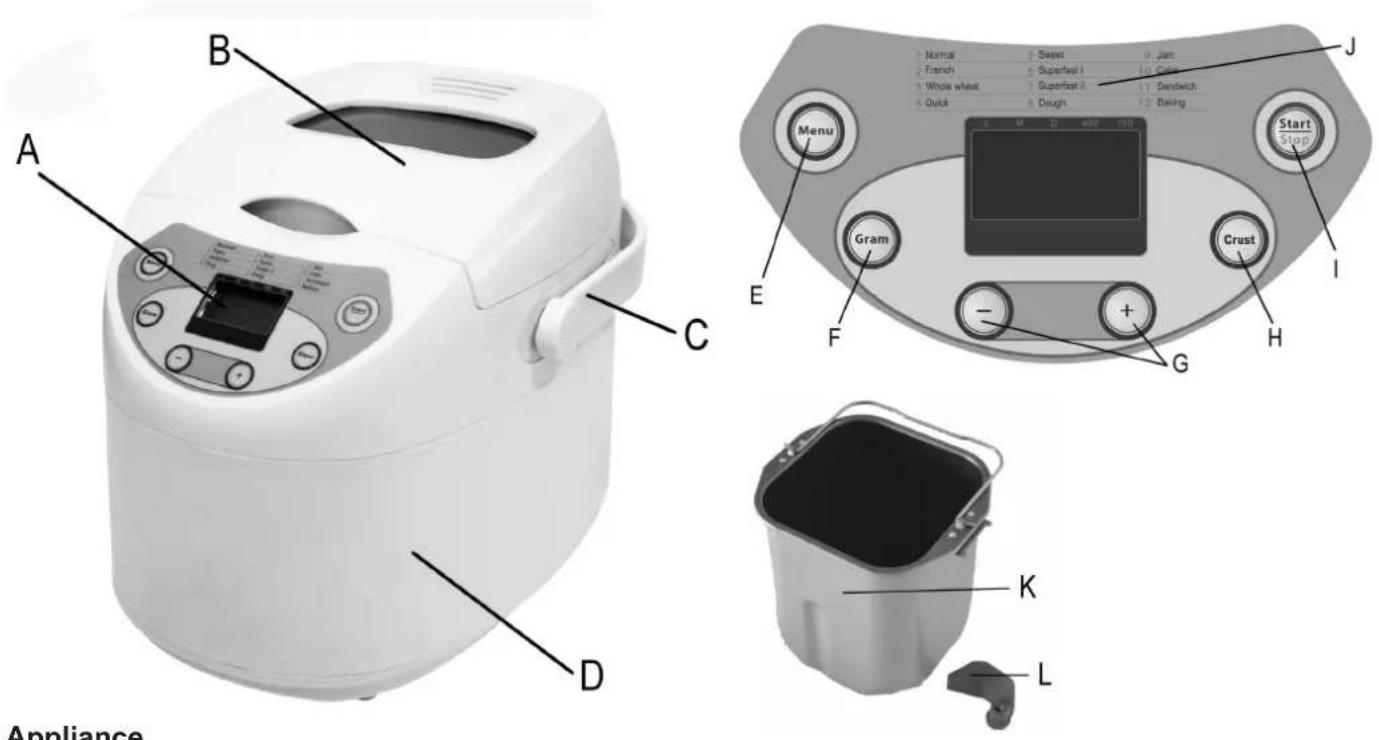
Appliance
A. Display
B. Lid with window
C. Handle
D. Cover
E. Menu button
F. Gram button (bread size = 600 or 750 g)
G. Timer -/+
H. Crust button
I. Start/Stop button
J. Programme
K. Bread pan
L. Kneading bar
Accessories
a. Measuring cup (max. 220 ml = 2,2 dl)
b. Measuring spoon: teaspoon/tsp = 5 ml and table spoon/tbs = 15 ml
Display
Menu
Press this button to choose one of the programmes available. These programmes are listed later in this manual. Each time you press the button you hear a beep and the number of the programme changes.
Currant programme shows in the display. This bread maker has 12 programmes.
Start/Stop
Starts and stops the programme selected. If you need to change programme, press the button for a few seconds and you can then change programme.
Start - press the button and a beep sounds. The colon sign between hours and minutes blinks and the countdown begins.
Stop - to interrupt a programme, press the button until you hear a beep. The beep confirms the programme has been interrupted.
Crust
By pressing the crust button you can select whether the crust should be light, medium or dark.
Gram button (bread size)
Press the button to choose size of bread, 600 or 750 g.
Timer -/+
Is used to adjust the time for starting a programme. By pressing + and - you adjust the time backward or forward by 10 minutes at a time. See section further in this manual.
On or off?
How can you check if a programme is finished or not? If the colon sign between hours and minutes blinks, the programme is still running. If the colon sign lights steady the programme is finished.
Error in the display
If the display shows "H:HH" after programme start, this means that the appliance needs to cool. Open the lid and let the appliance cool before you start a new programme. If the display shows "E:2-E:5" or "E:8", pull the plug and contact a service station.
PROGRAMME
To check how long a certain programme runs, check "Recipes" and "Programme overview".
1. Normal
For baking white bread and bread made of wheat and rye flour mixture. This programme is most frequently used and can be used for almost any type of bread.
2. French
For baking white bread with longer kneading and baking time than Normal, a more crispy crust.
3. Whole Wheat
For baking wholemeal bread. The bread will not rise as much as a white bread, as the flour used is more coarse and darker.
4. Quick
Quick programme for baking white bread. The bread will be smaller than if you use Normal programme.
5. Sweet
For baking sweet wheat breads.
6. Superfast I
Extra fast programme for white bread 600 g within 58 minutes.
7. Superfast II
Extra fast programme for white bread 750 g within 58 minutes.
8. Dough
For preparation of dough which afterwards is to be baked in a normal oven. A beep sounds when the dough is ready and can be lifted from the pan.
9. Jam
For making jam and marmalade. Note! Make sure to remove all seeds since they might damage the coating of the pan. Place all ingredients in the bread pan and choose programme Jam. Press start and the appliance start to heat the ingredients. After that, the appliance will start to mix and at the end cool the ingredients. When the programme is ready you will hear a beep. You can then pour the marmalade/jam into a jar and let it cool completely before storing in the refrigerator.
10. Cake
For baking sweet bread made with baking powder, powdered ammonia, or baking soda. Bread baked with this programme does not rise as much and gets more compact. The timer function can not be used since you do not add any yeast. Place all ingredients in the bread pan. Choose programme and before you press Start, stir all ingredients with a wooden spoon - this gives better kneading.
11. Sandwich
For baking white sandwich bread with soft crust. Note! With this programme you can not choose crust since it is already pre-set.
12. Bake
For extra baking and warming up of finished bread. The kneading bar will not rotate and the preset time of 60 minutes can be interrupted at any time when the requested result is obtained.
Baking process
Step 1 Open the lid and remove the baking pan by turning it anti-clockwise and pulling it up.
Step 2 Place the kneading bar in the middle of the bread pan. If the kneading bar is not placed correctly there is a risk that the ingredients are not blended and kneaded well. Before you put the kneading bar in place, make sure that there are no bread crusts on the driving shaft or in the hole of the kneader.
Step 3 Add the various ingredients, which all needs to be room tempered, to the baking pan in the following order:
- Half of the flour.
- Fluid (water, milk)
- Butter/oil
- Egg - if it is included in the recipe.
- The rest of the flour
- Sugar (place it in one corner of the bread pan).
- Salt (place the salt on the opposite side).
- Yeast (place the yeast in the middle).
Note! If the baking programme should not be started immediately it is important that the yeast does not get in contact with the fluid.
Step 4 Put the baking pan back in place by placing it in the baking chamber and turning it clockwise.
Check that pan and kneading bar are put properly in place, otherwise the appliance will not work.
Step 5 Close the cover and connect the plug to the outlet (230V).
Step 6 Time "3:00" shows in the display.
Step 7 Choose a programme by pressing Menu.
Step 8 Choose crust setting by pressing Crust (light, medium or dark). The chosen setting is showed at the top of the display. with " ".
Step 9 Choose bread size by pressing Gram. The chosen setting is showed at the top of the display with "Δ".
Step 10 Set the timer with +/-. See more regarding timer setting later in the manual.
Step 11 Press Start, the colon sign between hours and minutes starts blinking and the countdown starts.
Note! For the following programmes you can not choose bread size: Fast, Superfast I, Superfast II, Dough, Jam, Cake and Bake.
Time is displayed in hours and minutes. For example: Programme 1, Normal, Crust Medium, 750 g takes 2 hours and 53 minutes.
Under the kneading process (also see “Programme overview”) you hear a beep. After that it is ok to add ingredients as for example dried berries, nuts or similar. Open the lid and add the ingredients, close the lid and the kneading process continues. Note! Let the berries, raisins and nuts soak first and let them dry on kitchen paper. Make sure that the ingredients are not too big or sharp since they may damage the non-stick coating.
Step 12 When the bread is ready you will hear double beeps and the display shows "0:00". Press Stop for several seconds. When the bread maker beeps again it is a sign that the programme is ended.
Pull the plug and open the lid. Lift up the baking pan with pot-holders - be careful with the hot parts of the appliance! Let the bread cool in the baking pan for at least 10-15 minutes. Turn the bread pan upside down and shake.
Note! The bread pan is made of aluminium and will break if you hit or press on the sides of the pan. After baking the hot pan is fragile and can not be overloaded. If the bread does not come loose directly, carefully turn the button part off the driving shaft until the bread come loose. Carefully remove the kneading bar if it is stucked in the bread. Let the bread cool on a grid. It is recommended to start cutting the bread after 15-20 minutes. If you do not have the possibility to remove the bread from the bread maker it automatically switches to “keep warm” mode up to 60 minutes. This is not included in the time schedule for the programmes.
How to set the timer
The timer has to be set before pressing Start.
Follow the above 9 steps as described above to "Bake bread", after that, do as follows: choose programme, choose crust and size. Press the Timer button to increase or decrease the time which is shown in the display. See section "Display".
All programmes have a preset time, which shows how long time the individual programme will last if the bread maker is started right away. When the timer function is used, additional time should be added as shown below:
Example:
The time is 20:30 and the bread should be ready by 7:00 the next morning, i.e. in 10 hours and 30 minutes. If the programme Normal is selected and the display shows 2:53, the time is increased by pressing the Timer button “+” until the display shows 10:30. The time is reduced by pressing Timer button “-”. Maximum time for the timer function is 13 hours.
If the timer is programmed, ingredients such as milk, yoghurt, eggs, cheese etc, should not be placed in the bread pan.
Ingredients
Dough liquids
Water is good for white as well as dark meal breads.
Milk gives bread a finer texture and a more soft crust. Use dry milk when using the timer function instead of fresh milk, which easily gets sour at room temperature.
Junket or yoghurt gives a somewhat sour taste and a fine texture. Long timing should not be used as these products also may get sour at room temperature.
Oils and fats
Oil, margarine or butter makes the bread more succulent, less crumbly and the bread will stay fresh longer.
Use liquid margarine, margarine or butter, melted or room tempered. May be left out, if so wanted.
Sugar, syrup and honey
Accelerate the raising, give taste and colour to the bread. May be left out, if so wanted.
Flour
Wheat flour can be used for all recipes and has excellent baking qualities.
Light bolted rye flour and sifted rye flour are flour mixtures which do not have to be mixed with wheat flour.
Darker and more coarse flour mixtures such as bolted rye flour (dark and with 4 cereals), rye flour (fine and coarse) and graham flour do not have the same ability to generate gluten, and therefore the bread will not become as high as with other mixtures. These mixtures need to be mixed with wheat flour to obtain a good result.
Salt
Has a positive effect on generating gluten, gives a more even structure and emphasizes the taste in the bread. May be reduced to taste.
Bran, cereal and flakes
Add fibres to the bread. Substitute about 0.5 dl of the flour for white breads with oat or wheat bran, rye flakes or crushed wheat or rye grains. Place the crushed grains in the dough liquid, so that they can soak liquid during the timer time.
Raisins, almonds, seeds etc
Adds taste to the bread. A too big portion may retard rising. Preferably to be added during the second kneading after the beep.
Spices
Added for the taste, most common are anise, fennel, cumin and crushed bitter orange peel. Also try oregano or sweet basil.
Yeast
In most cases dry yeast should be used. The raising power quickly deteriorates when the packet has been opened. Therefore, fold up the packet carefully, and keep it in the refrigerator. For the quick programme the portion of yeast should be doubled in order for the rising to start in time (fresh yeast can be used with programmes which are started right away. Use approx. 25 gr. for 2.5 dl liquid).
Tips for a successful result
- Check that the kneading bar and the baking pan are mounted correct.
- Use room tempered ingredients 18-21C. If room temperature is exceeding 25C, ingredients should be cold, and timer function should be avoided.
-
Do not use old ingredients, and be careful to measure the correct portion, preferably use kitchen scale when measuring.
-
Also be careful and add the ingredients in the right order. Place the yeast in a hollow in the flour when using the timer function. Rising may start too soon if the yeast gets in contact with the liquid.
- Do not use too big a portion of coarse flour and grains or similar, which retard the raising power.
- Important: A bread made of coarse flour and heavy ingredients will not become as high as, and does not get the same nice round crust, as a bread made solely with light flour. Instead it will get a compact and succulent texture, and will become better if resting until the next day.
- Do not open the lid during the baking process.
1 tablespoon = 1 tbs = 15 ml
1 teaspoon = 1 tsp = 5 ml
1 pinch = 1 ml
RECIPES (time table you find last in each recipe. Some recipes only states one (1) bread size since you will not get a satisfying result for the other size.
Recipes - based on ingredients available on the Danish market
White tin loaf
ingredients 600 g 750 g
water 2 dl 2,5 dl
oil or liquid margarine 1 tbs 1,5 tbs
wheat-flour or wheat-flour special 5,5 dl 6,5 dl
sugar 1,5 tsp 2 tsp
salt 1,5 tsp 2 tsp
dry yeast 1,5 tsp 2 tsp
Programme: Normal (2,53 hours) (3,00 hours)
Lingonberry bread
ingredients 600 g 750 g
water 1,5 dl 2 dl
lingonberry jam 1 dl 1,5 dl
oil or liquid margarine 1 tbs 1,5 tbs
olive oil 2 tbs 2,5 tbs
pressed garlic 1-2 cloves 2-3 cloves
wheat-flour or wheat-flour special 5,5 dl 6,5 dl
finely grate Parmesan 0,5 dl 0,75 dl
salt 1,5 tsp 2 tsp
dry yeast 1,5 tsp 2 tsp
Programme: Normal (2,53 hours) (3,00 hours)
Greek bread
Ingredients 600 g 750 g
yoghurt 0,5 dl 0,75 dl
water 1,5 dl 2,5 dl
olive oil 1,5 tbs 2 tbs
sifted rye flour 6 dl 7,5 dl
oregano 1,5 tsp 2 tsp
salt 1,5 tsp 2 tsp
dry yeast 1,5 tsp 2 tsp
Programme: French (3,40 hours) (3,50 hours)
Nobis bread 600 g 750 g
water 2 dl 2,5 dl
oil 1,5 tbs 2 tbs
wheat-flour or wheat-flour special 4,5 dl 5,5 dl
whole weat flour 1 dl 1,5 dl
salt 1,5 tsp 2 tsp
dry yeast 1,5 tsp 2 tsp
Programme: French (3,40 hours) (3,50 hours)
Farmers bread 600 g 750 g
| water | 2 dl 2,5 dl |
| oil | 1,5 tbs 2 tbs |
| wheat flour | 6 dl 6,5 dl |
| salt 1,5 tsp 2 tsp | |
| dry yeast 1,5 tsp 2 tsp | |
| Programme: French (3,40 hours) (3,50 hours) | |
Coarse rye bread 600 g 750 g
| water 2 dl 2,5 dl | |
| oil or fluid margarine | 1,5 tbs 2 tbs |
| syrup 1,5 tsp 2 tsp | |
| wheat-flour or wheat-flour special | 3,5 dl 4,5 dl |
| wheat-bran | 1 dl 1,5 dl |
| 4 kind of corn farmhouse bread wheat-flour | 1,5 dl 2 dl |
| salt | 1,5 tsp 2 tsp |
| dry yeast 1,5 tsp 2 tsp | |
| Programme: Whole wheat | (3,32 hours) (3,40 hours) |
Sweetened rye bread 600 g 750 g
| water 2 dl 2,5 dl | |
| syrup 4 tsp | 1,5 tbs |
| dark farmhouse bread flour | 6 dl 7,5 dl |
| salt | 1,5 tsp 2 tsp |
| grinded caraway | 1,5 tsp 2 tsp |
| dry yeast 1,5 tsp 2 tsp | |
| Programme: Whole wheat | (3,32 hours) (3,40 hours) |
Dark farmhouse bread 600 g 750 g
| water 2 dl 2,5 dl | |
| oil or liquid margarine 1 tbs | 1,5 tbs |
| syrup 1,5 tbs 2 tbs | |
| dark farmhouse bread flour | 6 dl 7,5 dl |
| salt | 1,5 tsp 2 tsp |
| bread spices | 1,5 tsp 2 tsp |
| dry yeast 1,5 tsp 2 tsp | |
| Programme: Whole wheat | (3,32 hours) (3,40 hours) |
Wort bread 600 g 750 g
| beer or stout | 2 dl 2,5 dl | |
| oil or liquid margarine 2 tbs | 2,5 tbs | |
| syrup 2 tbs | 2,5 tbs | |
| sifted rye flour | 3,5 dl 4,5 dl | |
| wheat flour or wheat flour special 1,5 dl | 2 dl | |
| salt | 1 tsp | 1,5 tsp |
wort with spices (Santa Maria) 1 dl 1,5 dl
dry yeast 2 tsp 2,5 tsp
Programme: Whole wheat (3,32 hours) (3,40 hours)
Spelt bread (bread with low glycemic intex GI) 600 g
water 3,5 dl
dry yeast 1,5 tsp
olive oil 1 tbs
spelt flour 5,5 dl
sesame seed 1 tbs
mineral salt 1 tsb
Programme: Whole wheat (3,32 hours)
Fruit bread 750 g
milk 1,75 dl
egg 1
liquid margarine or soft butter 2 tbs
wheat flour 4,5 dl
sugar 0,25 dl
crushed cardamom 1 tsp
dry yeast 1 tsp
raisin (added when the beep sounds during second kneading) 0,5 dl
cake filling (added when the beep sounds during second kneading) 0,5 dl
Programme: Sweet (2,50 hours)
Saffron bread
milk 2 dl
liquid margarine or soft butter 2 tbs
wheat flour 4 dl
salt a pinch
sugar 1,5 tbs
saffron 0,25 gr
dry yeast 1 tbs
currant (added when the beep sounds during second kneading) 0,5 dl
Programme: Sweet (2,50 hours)
Long rusks
milk 2 dl
liquid margarine or soft butter 2,5 tbs
wheat flour 5,5 dl
salt a pinch
sugar 2 tbs
dry yeast 1,5 tsp
Programme: Sweet
Let the bread cool under a baking cloth. Cut in 2 cm thick slices and cut each slice in 3-4 long pieces. Place them on a plate and toast in the oven (in the middle section) 200^ C until golden, about 5-7 minutes. Place the rusks in a roasting pan and after dry at 100^ C for 2 hours with the oven door slightly opened.
| White quick bread | 600 g | 750 g |
| water (45-50 degrees) | 2 dl | 2,5 dl |
| oil or liquid margarine | 0,5 tbs | 1 tbs |
| wheat flour | 5 dl | 7,5 dl |
| sugar 1 tbs | 1,5 tbs | |
| salt | 1 tsp | 1,5 tsp |
| dry yeast | 1 tsp | 1,5 tsp |
Programme: 600 g bread is bakes with Superfast I and 750 g with Superfast II (both 0,58 hours)
Soured milk bread 600 g
soured milk 3 dl
syrup 0,5 dl
wheat flour 3,5 dl
wholemeal flour 3 dl
rasins 1,5 dl
salt 1 tsp
bicarbonate 2 tsp
Program: Quick (1,40 hours)
Sandwich bread 600 g 750 g
water 2 dl 2,5 dl
oil or liquid margarine 2 tbs 2,5 tbs
wheat-flour 5,5 dl 6,5 dl
milk powder 2 tbs 2,5 tbs
sugar 1,5 tsp 2 tsp
salt 1,5 tsp 2 tsp
dry yeast 1,5 tsp 2 tsp
Programme: Sandwich (2,55 hours) (3,00 hours)
Olive- and feta buns 750 g
water 2,5 dl
oil or liquid margarine 1,5 tbs
wheat flour 6,5 dl
salt 1 tsp
dry yeast 1,5 tsp
Programme: Dough (1,3 hours)
Filling
Feta cheese 150 g
Black olives without seeds ca 25 chopped
Place the dough on a flour powdered surface. Split the dough in two. Roll each dough to a rectangle. Spread the cheese and chopped olives over the dough and roll from the long side as a swiss roll. Cut in 12 pieces and place them with the section surface upwards on a greased plate or oven paper. Let them rise covered for ca 30 minutes. Bake in the middle section of the oven for 8-10 minutes at 225 degrees.
Pizza
water 1,5 dl
oil 2 tbs
wheat flour 4,5 dl
salt 1 tsp
dry yeast 1,5 tsp
Filling
tomato paste 1 dl
grated cheese 8 dl
optional filling
dried oregano, basil or thyme
Programme: Dough (1,3 hours)
Place the dough on a flour powdered surface and shape it like a large flat-long shaped bun. Place it on a greased oven paper and roll it directly on the paper so it is almost covered. Place the paper on top of a moistened towel so that it won't slip. Add tomato paste, ham, mushrooms etc and end with the cheese.
Bake for 15-20 minutes at 250 degrees in the middle section of the oven. Top with herbs.
Crank's buns 750g
water 2,5 dl
graham wholemeal 4 dl (240 g)
wheat-flour 2,5 dl (150 g)
brown sugar 1 tsp
salt 1 tsp
dry yeast 2 tsp
Programme: Dough (1,30 hours)
Place the ready dough on flour powdered table. Form the dough to 12 oval buns. Place them on an oven plate. Allow to rise covered approx 30 minutes. Bake in middle of oven at 225^ C for 8-10 minutes.
Strawberry jam
fresh strawberries ca 500 g (ca 1 litre massed or thinly sliced)
jam sugar 3 dl
lemon 3 tbs fresh pressed or 1 tbs concentrated
Programme: Jam (1,20 hours)
Mix all ingredients in the bowl before start. Pour the warm jam when ready, into clean small glass jars and put the lid on whlie warm. Let cool and place in the fridge to set over night.
Raspberry jam
Frozen or fresh raspberries 500 g thawed, let them run off
jam sugar 3 dl
Programme: Jam (1,20 hours)
Citrus marmalade
| oranges | 4-5 un-peeled = 6 dl (500 g) peeled and thinly sliced pieces |
| lemon | 1 peeled and sliced thinly |
| jam sugar | 3 dl |
| Programme: Jam | (1,20 hours) |
Read the instructions under "Strawberry jam".
Bread free of gluten
The bread can be diversified in taste and fibre-contents by adding some of the suggested extra ingredients. Avoid timer-setting. Bread free of gluten is only recommended to bake in 750 g for best result. The recipes are made for 750 g setting.
White tin loaf 750 g
| water | 4 dl |
| oil | 2,5 tbs |
| Finax flour mix or italian flour mix | |
| MixWells light base flour or light gluten-and lactose free | 8 dl |
Or Semper mix with
| milk or Semper fine mix | 8,5 dl |
| salt | 1 tsp (heaped) |
| dry yeast | 1 tsp (heaped) |
| Programme: Normal and light setting | (3,00 hours) |
The bred will be light at the top but will have nice colour around. If you bake at Medium you will have a nice colour at the top but darker around. Extra ingredients: 2-3 tsp bread seasoning, 3-4 tbs sun flower seeds.
White tin bread with buchwheat 750 g
| water | 4 dl |
| oil | 2,5 tbs |
Finax flour mix or italian flour mix
MixWells light base flour or light gluten-
and lactose free 7,5 dl
Or Semper mix with
Programme: Normal and light setting (3,00 hours)
Extra ingredients: 2-3 tsp bread seasoning, 3-4 tbs sunflower seed.
Soured milk bread 750 g
soured milk 3 dl
syrup 0,5 dl
Finax gluten free flour mix or
MixWells light base flour 3,5 dl
Finax coarse flour mix or MixWells
dark base flour 3 dl
rasins 1,5 dl
salt 1 tsp
bicarbonate 2 tsp
Programme: Quick and light setting (1,40 hours)
Mix bread 750 g
water 3,5 dl
oil 1 tbs
syrup 1 tbs
Finax gluten free flour mix or MixWells
light base flour 4 dl
Finax coarse flour mix or MixWells dark
base flour or 3 dl
Semper with milk 4,5 dl
Semper coarse flour mix 2 dl
salt 1 tsp
dry yeast 1,5 tsp
Programme: Normal (3,00 hours)
Granola bread 750 g
water 3,5 dl
oil 2 tbs
Finax flour mix or italian flour mix
MixWells light base flour or light gluten-
and lactose free 6 dl
Or Semper gluten free mix with
bread seasoning in wanted 1,5 tsp
Programme: Normal (3,00 hours)
Retailer of gluten free flour used in the recipes:
www.mixwell.se phone: 021-35 09 60
Programme overview
| Programme Timer | 1. kneading | 2. kneading | Pause | 3. kneading | Pause Shaping Pause Rise Baking | Keep warm | |||||
| 1 Normal 600 g | 13:00-2:53 | 2 m | 7 m | 20 m | 14 m^* | 20 m | 30 s | 4 1/2 m | 45 m | 60 m | 60 m |
| Normal 750 g | 13:00-3:00 | 2 m | 8 m | 20 m | 15 m^* | 20 m | 30 s | 4 1/2 m | 45 m | 65 m | 60 m |
| 2 French 600 g | 13:00-3:40 | 2 m | 14 m | 40 m | 19 m^* | 20 m | 30 s | 9 1/2 m | 50 m | 65 m | 60 m |
| French 750 g | 13:00-3:50 | 2 m | 16 m | 40 m | 22 m^* | 20 m | 30 s | 9 1/2 m | 50 m | 70 m | 60 m |
| 3 Whole Wheat 600 g | 13:00-3:32 2 | m 7 m 25 | m 18 m | 20 m | 30 s | 14 1/2 m | 70 m 55 m | 60 m | |||
| Whole Wheat 750 g | 13:00-3:40 2 | m 8 m 25 | m 25 m | 20 m | 30 s | 14 1/2 m | 70 m 60 m | 60 m | |||
| 4 Quick | 13:00-1:40 2 | m 5 m 5 m | 7 m 55 s | 0 m | 5 s | 0 m | 0 m | 80 m | 60 m | ||
| 5 Sweet 600 g | 13:00-2:50 | 2 m | 8 m | 5 m | 20 m^* | 20 m | 30 s | 9 1/2 m | 55 m | 50 m | 60 m |
| Sweet 750 g | 13:00-2:55 | 2 m | 8 m | 5 m | 20 m^* | 20 m | 30 s | 9 1/2 m | 55 m | 55 m | 60 m |
| 6 Superfast I - 600 g | 13:00-0:58 | 2 m | 10 m | 0 m | 0 m | 0 m | 0 s | 0 m | 11 m | 35 m | 60 m |
| 7 Superfast II - 750 g | 13:00-0:58 | 1 m | 8 m | 0 m | 0 m | 0 m | 0 s | 0 m | 9 m | 40 m | 60 m |
| 8 Dough | 1:30 | 2 m | 18 m | 0 m | 0 m | 20 m | 30 s | 9 1/2 m | 40 m | 0 m | 0 m |
| 9 Jam | 1:20 | 0 m | 0 m | 15 m | 0 m | 0 m | 0 s | 0 m | 45 m | 0 m | 20 m |
| 10 Cake | 2:50 | 2 m | 8 m | 5 m | 20 m^* | 29 m | 30 s | 30 s | 35 m | 70 m | 60 m |
| 11 Sandwich 600 g | 13:00-2:55 | 3 m | 12 m | 40 m | 5 m^* | 24 m | 30 s | 30 s | 40 m | 50 m | 60 m |
| Sandwich 750 g | 13:00-3:00 | 3 m | 12 m | 40 m | 5 m^* | 24 m | 30 s | 30 s | 40 m | 55 m | 60 m |
| 12 Only Baking | 0:10-1:00 | 0 m | 0 m | 0 m | 0 m | 0 m | 0 s | 0 m | 0 m | 10 totalt 60 m | 60 m |
Timer: 13:00 is the maximum timer setting and the time above that, is the total time for the programme.
Paus: the baking machine pauses and the dough is rising.
Shaping: the kneading bar rotates several times to shape the bread.
Keep warm: The machine keeps the bread warm for 60 minutes.
* The beep signal indicates that you can add extra ingredients, sounds during the third kneading. m = minutes and s = seconds.
At the first pause the dough will have a temperature of ca 26^ C, at the second and third pause 32-33^ C and the rising process occurs at 35^ C temperature.
Problems that may occur and ways to solve them
Different factors can influence the baking result. Below you will find examples and solutions how you can solve the problems.
The bread has collapsed
If the bread has collapsed completely the dough has been too moist. Add less fluid. When you use fruit and vegetables, let them drain first and dry them before you add them. You can also use a lighter flour. Another cause might be that the dough may have risen too long. Use 1-2 g less yeast. Too much dough fluid can also cause bread collapse or that the flour that has been added need less fluid than the recipe declares. Add 10-20 ml less fluid for next baking.
The bread is doughy in the middle
If the middle is doughy and not baked enough, the flour may be the cause. This can happen with coarse flour as wholemeal- or rye flour. Try with one extra kneading process when one of these flours is used: when the appliance has ended the first kneading, shut off the appliance. Set the same programme again and press Start. The machine will start another kneading process and more air comes into the dough. You can also try to set the baking degree on “Dark” which gives a slightly higher temperature.
The bread has rised too much
If the bread gets bigger than normal you have added too much yeast. Check the amount and type of yeast.
Too much sugar can also over activate the yeast. Use less sugar and be careful with dried fruit and honey. Try to add 10-20 ml less fluid but be careful. If you reduce the fluid too much it will arrest the rising process.
If you use too finely grounded flour it can cause over rising. These types of flour do not need as much yeast as normal grounded flour.
The bread gets too dry
Use less flour or add 1 tbs extra fluid.
When the bread maker mix heavy doughs or when you use a programme with longer kneading time it might make the bread maker shake during process.
Make sure to place it on a steady flat surface and not too close to the edge of the bench.
The bread is not enough baked
When you use wholemeal flour the bread crust might be too pale or not baked enough.
Check the use-by date on the yeast.
The yeast might also be affected by the temperature of the dough fluid.
Check how much salt you have added, too much salt may affect the rising/baking.
The bread gets burnt and stuck to the bowl
The bowl is scratched and/or the non stick coating is damaged. Replace with a new bowl.
FAQ - frequently asked questions
Question: Why does the size (height) and shape of the bread vary?
Answer: Size and shape may vary depending on the temperature of the ingredients, quality and quantity of the ingredients.
Question: My bread did not rise, why?
Answer: You forgot to add the yeast, too small amount of yeast or too old yeast.
Question: How does the timer work?
Answer: You can not set the timer for less than 2:53 hours or more than 13 hours. The timer needs a minimum of 2 hours and 53 minutes to work through all phases in the programme. The ingredients can be unusable if they are placed in the baking machine earlier than 13 hours before starting. For more information see "How to set the timer".
Question: Why can't I add extra ingredients to the base ingredients already from the beginning?
Answer: To get the right shape of the bread and/or dough and be able to rise, you have to wait to add dried fruit etc. There is a risk that these ingredients is smashed during kneading process and they might get stuck together and not evenly spread in the dough. Add extra ingredients after first beep signal. You can not add extra ingredients if you choose one of the quick programmes.
Question: Can you use fresh milk instead of water?
Answer: Yes, but not if you use the timer. Add the same amount fluid as mentioned in the recipe.
Question: I can't get the bread out of the bread pan, what do I do?
Answer: Maybe the non-stick coating in your pan is damaged or the bread has not cooled enough. If the coating is damaged we recommend to order a new one. Remove the pan from the machine directly after the programme ends, let the bread cool for 15-20 minutes. Turn the pan upside down and shake it until the bread loosen. Let it cool for another 15-20 minutes before you slice it.
Question: The kneading bar gets stuck in the bread after removing the bread from the pan, is this normal?
Answer: It is completely normal. Let the bread cool and then remove the kneading bar. You can also cut a small opening and remove it.
Question: How do I clean the inside of the baking machine if dough has run over?
Answer: You can clean the inside with oven cleaning. Be careful to protect the heating element. You can clean the heating element by starting a complete programme once or twice without any ingredients. This will burn eventual rest from the element.
Question: I can't eat bread that includes sugar. Can you make sugar free bread in the bread machine?
Answer: Yes it is possible. Exclude the sugar from the base recipes. If you do, you should also exclude the salt.
Question: My bread collapses when the programme goes from rising to baking. Why?
Answer: Either you have added too much yeast or too much fluid. Maybe the flour you use needs less fluid then the recipe says. It is recommended to try to add 10-20 ml less fluid.
Question: When I bake with raisins, all raisins gets stuck in the bottom of the bread. How do I avoid this?
Answer: The dough is probably too compact and can not spread the raisins evenly. Add 10-20 ml extra fluid. This makes the dough more elastic and the raisins will mix better with the dough. Make sure that the raisins are not too moist.
Question: Can I use fresh yeast instead of dry yeast?
Answer: Fresh yeast can be used with the programmes that starts directly (not timer). Crumble the yeast first of all and place it in the bottom of the pan, then add the water/fluid end after that the rest of the ingredients. Use ca 25 g to 2,5 dl fluid. Use 25 g to coarse bread and 50 g to light bread.
Question. The crust sometimes gets light and sometimes dark, why?
Answer: You can adjust this with the button "Crust".
Question: What has happened if the bread get so high that it comes in contact with the lid?
Answer: Too much yeast and/or sugar was added, which makes too much air in the dough and increased rising.
Question: Why can't I add fruit when I use some of the quick programmes?
Answer: The time for rising is shorter and if you add extra ingredients it will affect the baking time and the result will not be good.
Question: The baking machine is kneading slower when I make coarse bread, why?
Answer: This is normal. The machine can handle it but it might be a good idea to add 1 extra tbs fluid to the dough.
Question: Can you shut off or lower the noise of the beep signal?
Answer: No unfortunately not. The sound level is pre-set and meant to be heard during day time when you have a lot of noises around you.
Cleaning and maintenance
Unplug the appliance and let the machine cool before cleaning. Do not use steel wool, rough sponges, scouring powder or other scratching agents. Make sure that the machine and equipment are completely dry before storing.
Cover
Wipe cover, window, display and lid with a damp cloth and some mild detergent. Dry after.
Oven
Dry bread crusts with a damp cloth. Dry after. Note! Do not touch the heating element since it is fragile. You can clean the heating element by starting a complete programme once or twice without any ingredients. This will burn eventual rest from the element.
Baking pan and kneading bar
Clean pan and kneading bar in warm water after each use. Do not use washing detergent (not necessary) or brush that can scratch the non-stick coating. If the kneading bar is stucked on the inner driving shaft, pour some water in the bottom of the pan. Leave it for a while to loosen the bread rests. Make sure to clean the driving shaft carefully. Do not leave water in the pan for too long and do not immerse it in water.
Do not wash the bread pan or kneading bar in the dishwasher.
After some time the bread pan can shift colour. This is caused by moist and heat but does not affect the performance of the appliance.
Safety instructions
- Read the instruction manual carefully before use, and save it for future use.
- Plug the appliance to a household outlet of 230V only, and use the appliance only for the intended use.
- Always unplug the appliance from the mains supply when the baking pan is put in or taken out, after use, before cleaning or if disorder is experienced.
- Immediately unplug the appliance if water comes into the baking chamber or into the appliance.
- The appliance must not be immersed into water or other liquids.
- This appliance is not intended for use by persons (including children) with reduced physical, sensory or mental capabilities, or lack of experience and knowledge, unless they have been given supervision or instruction concerning the use of the appliance by a person responsible for their safety.
- Children should be supervised to ensure that they do not play with the appliance. Children are not always able to understand potential risks. Teach children a responsible handling of electrical appliances.
- Check that the cord is not hanging over the edge of the table.
- Do not place the kettle on or near hotplates, open fire or the like.
- The appliance should only be used under supervision.
- Check that the appliance is placed on a stable base, especially when the timer function is used, and
when the appliance is working without supervision, e.g. overnight.
- Do not cover the appliance, and do not place things on top of it.
- Caution! Do not touch the hot surfaces of the appliance. Use potholders.
- Caution! Do not touch the rotating parts.
- Only use original accessories.
- Never use the appliance outside the house.
- CAUTION: In order to avoid a hazard due to inadvertent resetting of the thermal cut-out, this appliance must not be supplied through an external switching device, such as a timer, or connected to a circuit that is regularly switched on and off by the utility.
- Always examine appliance, cord and plug for damage before use. If the supply cord is damaged, it must be replaced by the manufacturer, or his service agent or a similarly qualified person in order to avoid a hazard.
- The electrical installation must comply with the present legislation concerning additional protection in the form of a residual current device (RCD) with a rated residual operating current not exceeding 30 mA). Check with your installer.
- The appliance is for domestic use only.
- If the appliance is used for other purposes than intended, or is it not handled in accordance with the instruction manual, the full responsibility for any consequences will rest with the user. Any damages to the product or other things are not covered by the warranty.
Disposal of the appliance

Legislation requires that all electrical and electronic equipment must be collected for reuse and recycling. Electrical and electronic equipment marked with the symbol indicating separate collection of such equipment must be returned to a municipal waste collection point.
Warranty
Claims according to current law. Cash receipt with purchase date shall be enclosed with any claims. When raising a claim the appliance must be returned to the store of purchase.
OBH Nordica Sweden AB
Box 58
163 91 Spånga
Phone: 08-445 79 00
www.obhnordica.se
Technical data
OBH Nordica 6542
600 W
230 V

These instructions are subject to alterations or improvements.

natural_image
Black-and-white photo of a modern rice cooker with open lid, showing its closed lid and digital display, next to a hand holding a piece of bread and a small bowl (no text or symbols visible on main subject)


- Dele
- OBH Nordica Denmark A/S
- Tekniske data
- Delar
- Tillbehör:
- g 750 g
- Kavring
- Mörkt lantbröd
- Vörtbröd
- OBH Nordica Sweden AB
- Tekniska data
- Slik stiller man inn timer
- Kavring 600 g 750 g
- Müsslibrød 750 g
- OBH Nordica Norway AS
- Appliance
- Accessories
- Display
- Menu
- Start/Stop
- Crust
- Gram button (bread size)
- Timer -/+
- On or off?
- Error in the display
- PROGRAMME
- Normal
- French
- Whole Wheat
- Quick
- Sweet
- Superfast I
- Superfast II
- Dough
- Jam
- Cake
- Sandwich
- Bake
- Baking process
- How to set the timer
- Example:
- Ingredients
- Dough liquids
- Oils and fats
- Sugar, syrup and honey
- Flour
- Salt
- Bran, cereal and flakes
- Raisins, almonds, seeds etc
- Spices
- Yeast
- Tips for a successful result
- Recipes - based on ingredients available on the Danish market
- White tin loaf
- Lingonberry bread
- Greek bread
- Nobis bread 600 g 750 g
- Spelt bread (bread with low glycemic intex GI) 600 g
- Fruit bread 750 g
- Saffron bread
- Long rusks
- Soured milk bread 600 g
- Sandwich bread 600 g 750 g
- Olive- and feta buns 750 g
- Filling
- Pizza
- Crank's buns 750g
- Strawberry jam
- Raspberry jam
- Bread free of gluten
- Soured milk bread 750 g
- Mix bread 750 g
- Granola bread 750 g
- Retailer of gluten free flour used in the recipes:
- Problems that may occur and ways to solve them
- The bread has collapsed
- The bread is doughy in the middle
- The bread has rised too much
- The bread gets too dry
- The bread is not enough baked
- The bread gets burnt and stuck to the bowl
- FAQ - frequently asked questions
- Question: How does the timer work?
- Question: Why can't I add extra ingredients to the base ingredients already from the beginning?
- Question: Can you use fresh milk instead of water?
- Question: I can't get the bread out of the bread pan, what do I do?
- Question: The kneading bar gets stuck in the bread after removing the bread from the pan, is this normal?
- Question: How do I clean the inside of the baking machine if dough has run over?
- Question: I can't eat bread that includes sugar. Can you make sugar free bread in the bread machine?
- Question: My bread collapses when the programme goes from rising to baking. Why?
- Question: When I bake with raisins, all raisins gets stuck in the bottom of the bread. How do I avoid this?
- Question: Can I use fresh yeast instead of dry yeast?
- Question. The crust sometimes gets light and sometimes dark, why?
- Question: What has happened if the bread get so high that it comes in contact with the lid?
- Cleaning and maintenance
- Cover
- Oven
- Baking pan and kneading bar
- Safety instructions
- Disposal of the appliance
- Warranty
- Technical data
Brand : OBH NORDICA
Model : 6542
Category : Bread maker