TC-PG 1100 - Generator EINHELL - Free user manual and instructions
Find the device manual for free TC-PG 1100 EINHELL in PDF.


| Product Type | Generator |
| Brand | Einhell |
| Model | TC-PG 1100 |
| Continuous Power | 1100 W |
| Peak Power | 1200 W |
| Engine Type | 4-stroke petrol |
| Displacement | 85 cm³ |
| Fuel Tank Capacity | 4.5 L |
| Running Time at 50% Load | Approx. 6 hours |
| Noise Level | 95 dB(A) |
| Dimensions (L x W x H) | 430 x 380 x 380 mm |
| Weight | 20 kg |
| Socket Type | 230 V ~ 50 Hz, 1 x Schuko |
| Overload Protection | Automatic circuit breaker |
| Low Oil Shutdown | Yes |
| Maintenance | Check oil level before use; clean air filter every 50 hours; replace spark plug annually |
| Safety Features | Earth terminal, spark arrestor, heat shield |
| Spare Parts Availability | Air filter, spark plug, oil filter, fuel cap available from Einhell service |
| Repairability | Modular design; user-replaceable parts with basic tools |
Frequently Asked Questions - TC-PG 1100 EINHELL
User questions about TC-PG 1100 EINHELL
0 question about this device. Answer the ones you know or ask your own.
Ask a new question about this device
Download the instructions for your Generator in PDF format for free! Find your manual TC-PG 1100 - EINHELL and take your electronic device back in hand. On this page are published all the documents necessary for the use of your device. TC-PG 1100 by EINHELL.
USER MANUAL TC-PG 1100 EINHELL
GB Original operating instructions Power Generator
8


South America
-2-
natural_image
Close-up of a gloved hand pressing a 3D printer component with a visible part labeled '18' (no text or symbols beyond the number)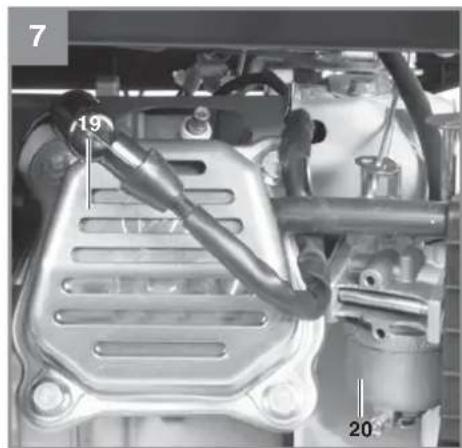
natural_image
Close-up of a mechanical engine component with visible parts and numbered callouts (no readable text or symbols)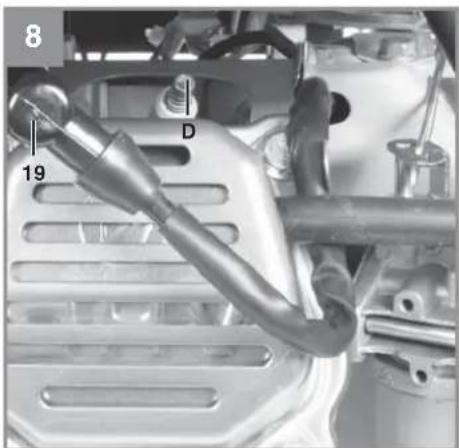
natural_image
Close-up of a mechanical component with labeled parts (D, 19) and no readable text or symbols beyond labels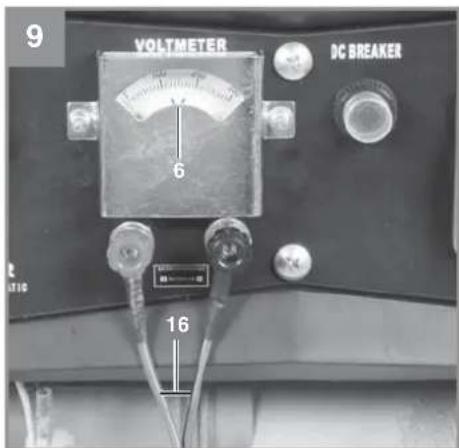

E
Peligro!
When using the equipment, a few safety precautions must be observed to avoid injuries and damage. Please read the complete operating instructions and safety regulations with due care. Keep this manual in a safe place, so that the information is available at all times. If you give the equipment to any other person, hand over these operating instructions and safety regulations as well. We cannot accept any liability for damage or accidents which arise due to a failure to follow these instructions and the safety instructions.
Explanation of the warning signs on the machine (Fig. 10)
- Danger! Read the operating instructions.
- Warning! Hot parts. Keep your distance.
- Danger! Switch off the engine before refueling.
- Danger! Never operate in non-ventilated rooms.
1. Safety regulations
Danger!
Read all safety regulations and instructions.
Any errors made in following the safety regulations and instructions may result in an electric shock, fire and/or serious injury.
Keep all safety regulations and instructions in a safe place for future use.
• No changes may be made to the generator.
- Only original parts may be used for maintenance and accessories.
• Important: Danger of poisoning, do not inhale
emissions.
• Children are to be kept away from the generator.
- Important: Risk of burns. Do not touch the exhaust system or drive unit.
- Wear suitable ear protection when in the vicinity of the equipment.
- Important: Petrol and petrol fumes are highly combustible or explosive.
- Never operate the generator in non-ventilated rooms or in easily inflammable adjacency. When operating the generator in rooms with good ventilation, the exhaust gases must be channeled directly outdoors through an exhaust hose. Important: Toxic exhaust gases can escape despite the exhaust hose. Due to the fire hazard, never direct the exhaust hose towards inflammable materials.
- Risk of explosion: Never operate the genera-
tor in rooms with combustible materials.
- The speed preset by the manufacturer is not allowed to be changed. The generator or connected equipment may be damaged.
- Secure the generator against shifting and toppling during transport.
- Place the generator at least 1m away from buildings and the equipment connected to it.
- Place the generator in a secure, level position. Do not turn, tip or change the generator's position while it is working.
• Always switch off the engine when transporting and refueling the generator.
• Make sure that when you refuel the generator no fuel is spilt on the engine or exhaust pipe.
- Never operate the generator in rain or snow.
• Never touch the generator with wet hands.
- Guard against electric danger. When working outdoors, use only extension cables that are approved for outdoor use and which are marked accordingly (H07RN..).
- The overall length of the extension cables used may not exceed 50 m for 1.5 mm ^2 and 100 m for 2.5 m ^2 .
- No changes may be made to the settings of the motor or generator.
• Repairs and adjustment work may only be carried out by authorized trained personnel.
- Do not refuel or empty the tank near open lights, fire or sparks. Do not smoke!
- Do not touch any mechanically driven or hot parts. Do not remove the safety guards.
- Do not expose the tools to damp or dust. Permissible ambient temperature – 10 to +40 °C, max. altitude above sea level 1000 m, relative humidity: 90 % (non-condensing)
- The generator is driven by a combustion engine, which produces heat in the area of the exhaust (on the opposite side of the sockets) and the exhaust outlet. You should therefore keep clear of these surfaces because of risk of skin burns.
- The values quoted in the technical data for sound power level (LWA) and sound pressure level (LWM) are emission values and not necessarily reliable workplace values. As there is a correlation between emission and immission levels, the values are not a reliable basis for deciding on any additional precautions which may be needed. Factors influencing the actual user immission level include the properties of the work area, other sound sources etc., the number of machines and other processes in the vicinity, as well as the time span in which the operator is subjected to the
GB
noise. Also, the permitted immission level can vary from country to country. Nevertheless, with this information the user is able to make a better assessment of the dangers and risks involved.
- Never use a faulty or damaged electrical equipment (this also applies to extension cables and plug connections).
• Electric supply cables and connected equipment must be in perfect condition. - The generator is to be operated only with equipment whose voltage specifications conform with the generator's output voltage.
- Never connect the generator to the power supply (socket-outlet).
- Keep the cable length to the consumer as short as possible.
- Dispose of soiled maintenance material and operating materials at the appropriate collection point.
- Recycle packaging material, metal and plastics.
2. Layout and items supplied
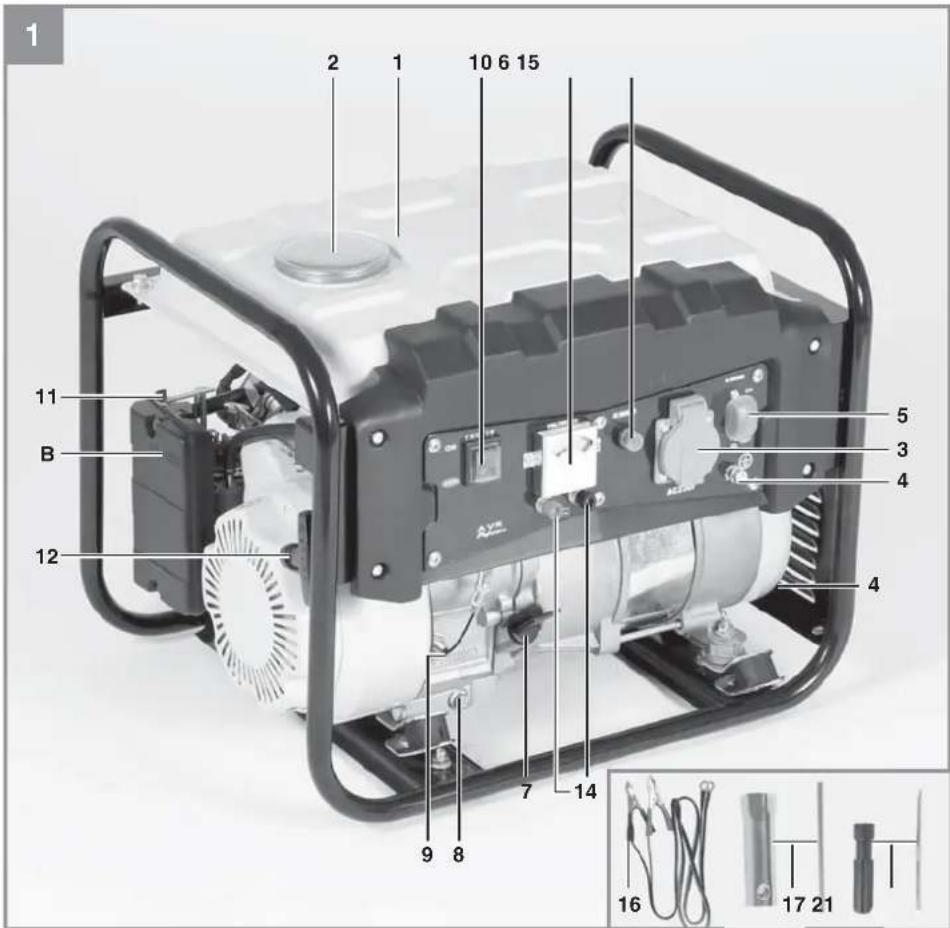
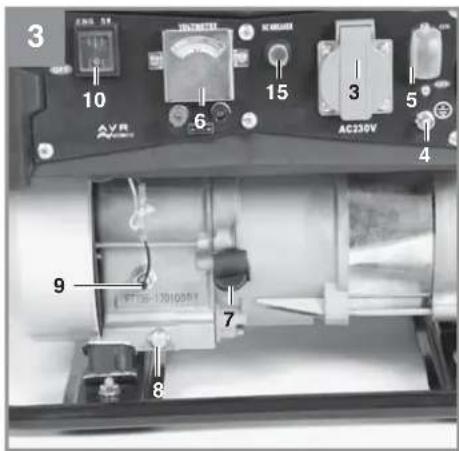
2.1 Layout (Fig. 1-4)
1Tank
2 Tank over
3 Socket 230 V\~ 50 Hz
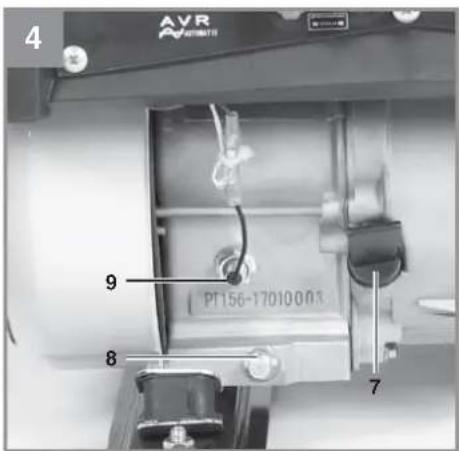
4 Earthining connection
5 Security breaker
6 Voltmeter
7 Plug oil
8 Oil drain screw
9 Protector against lack of oil
10 ON/OFF switch
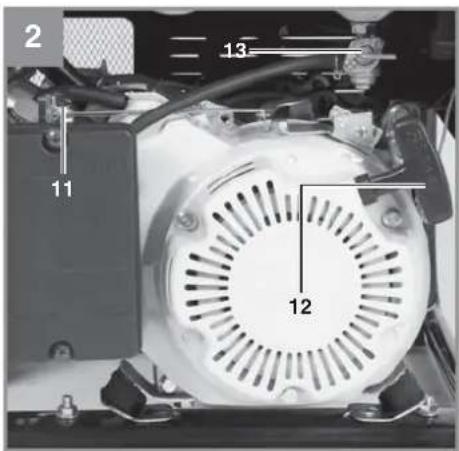
11 Reversing starter
12 Starting device
13 Petrol plug ON/
14 DC connection terminals
15 Breaker
16 Charging cables 12 Vcc
17 Spark plug wrench
18 Air fi Iter
19 Spark plug connector
20 Carburettor
21 Screwdriver
2.2 Items supplied
Please check that the article is complete as specified in the scope of delivery. If parts are missing, please contact our service center or the sales outlet where you made your purchase at the latest within 5 working days after purchasing the product and upon presentation of a valid bill of purchase. Also, refer to the warranty table in the service information at the end of the operating instructions.
- Open the packaging and take out the equipment with care.
- Remove the packaging material and any packaging and/or transportation braces (if available).
- Check to see if all items are supplied.
- Inspect the equipment and accessories for transport damage.
- If possible, please keep the packaging until the end of the guarantee period.
Danger!
The equipment and packaging material are not toys. Do not let children play with plastic bags, foils or small parts. There is a danger of swallowing or suff ocating!
Power generator
• Original operating instructions
3. Proper use
The device is designed for applications operated with a alternating current source. Be sure to observe the restrictions in the safety instructions. The generator is intended to provide electric tools and light sources with electricity. When using the device with household appliances, please check their suitability in accordance with the relevant manufacturer's instructions. In case of doubt, ask an authorized dealer of the respective appliance.
The equipment is to be used only for its prescribed purpose. Any other use is deemed to be a case of misuse. The user / operator and not the manufacturer will be liable for any damage or injuries of any kind caused as a result of this.
GB
Please note that our equipment has not been designed for use in commercial, trade or industrial applications. Our warranty will be voided if the machine is used in commercial, trade or industrial businesses or for equivalent purposes.
4. Technical data
See warranty card of your country.
5. Before starting the equipment
Connecting to earth
The housing is allowed to be connected to earth in order to discharge static electricity. To do this, connect one end of a cable to the earth connection on the generator (Fig. 3/4) and the other end to an external earth (for example an earthing rod).
6. Operation
Notice! Before using the appliance for the first time the tank must be filled with petrol. Add aprox 0,6 ltrs of oil to the oil deposit.
- Check the fuel level and top it up if necessary
• Make sure that the generator has sufficient ventilation
• Make sure that the ignition cable is secured to the spark plug - Inspect the immediate vicinity of the generator
- Disconnect any electrical equipment which may already be connected to the generator
6.1 Starting the engine
• Open the petrol cock (13) by turning it down
- Move the ON/OFF switch (10) to position „ON” with the key.
- Move the choke lever (11) to position
- Start the engine with the reversing starter (12) by pulling the handle forcefully. If the engine does not start, pull the handle again.
- Push the choke lever (11) back again after the engine has started.
Warning!
When starting with the reserve starter, the motor may recoil suddenly as it starts up, resulting in hand injuries. Wear protective gloves when starting the equipment.
6.2 Connecting consumers to the generator
- Connect the appliance you want to use to the 230 V\~ socket. (Fig. 1/ pic. 3)
Notice! This socket may be loaded continuously (S1) with 900W and temporarily (S2) for a maximum of 3 minutes with 1100W. The generator is suitable for 230 V\~ a.c. appliances.
- Do not connect the generator to the household network as this may result in damage to the generator itself or to other electrical appliances in your home.
Note: Some electrical appliances (power jigsaws, drills, etc.) may have a higher level of power consumption when used in difficult conditions.
6.3 Switching off the engine
- Before you switch off the generator, allow it to run briefly with no consumers so that it can „cool down”
- Move the ON/OFF switch (10) to position „OFF" with the key.
- Close the petrol cock
Notice! The generator is equipped with an overload cut-out.
This shuts down the socket (3). You can reactivate the socket (5) by pressing the overload cut-out (3).
Notice! If this happens, reduce the electric power you are taking from the generator or remove any defective connected appliances.
GB
7. Cleaning, maintenance, storage and ordering of spare parts
Switch off the motor and pull the spark plug boot from the spark plug before doing any cleaning and maintenance work on the equipment.
Notice! Switch off the machine immediately and contact your service station:
• In the event of unusual vibrations or noise
- If the engine appears to be overloaded or misfires
7.1 Cleaning
- Keep all safety devices, air vents and the motor housing free of dirt and dust as far as possible. Wipe the equipment with a clean cloth or blow it with compressed air at low pressure.
• We recommend that you clean the device immediately each time you have finished using it. - Clean the equipment regularly with a moist cloth and some soft soap. Do not use cleaning agents or solvents; these could attack the plastic parts of the equipment. Ensure that no water can seep into the device.
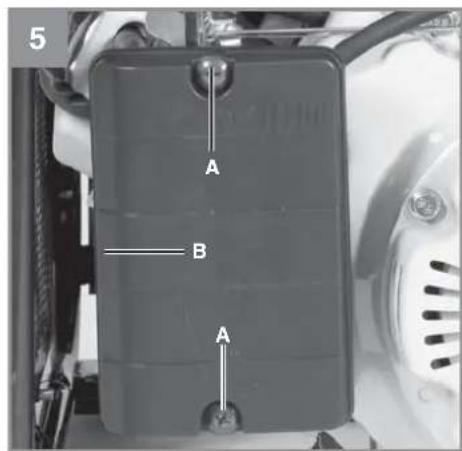
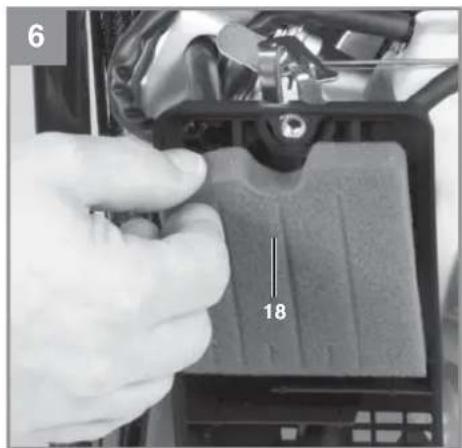
7.2. Air fi Iter (Fig. 18)
- The air filter should be cleaned after every 30 hours of operation.
- Open the 2 screws (5a) and remove the air filter cover (Fig. 5B).
- Remove the filter element (Fig. 6-18).
- Clean the filter element with soapy water, rinse with clear water and leave to dry well before re-installing.
• Assemble in reverse order
7.3. Spark plug (Fig. 7)
Check the spark plug for dirt and grime after 10 hours of operation and if necessary clean with a copper wire brush. Thereafter service the spark plug after every 50 hours of operation.
• Pull off the spark plug boot with a twist.
- Remove the spark plug with the supplied spark plug wrench.
• Assemble in reverse order
7.4 Changing the oil and checking the oil level (before using the machine)
The motor oil is best changed when the motor is at working temperature.
• Only use motor oil (15W40).
- Place the generator on a slightly inclined surface so that the oil drain plug is at the lower end.
- Open the oil filler plug.
- Open the oil drain plug and let the hot engine oil drain out into a drip tray.
- After the old oil has drained out, close the oil drain plug and place the generator on a level-surface again
- Fill in engine oil up to the top mark on the oil dip stick (approx. 0.6 liters).
- Important: Do not screw the dipstick in to check the oil level, simply insert it up to the thread.
- Dispose of the waste oil properly.
7.5 Automatic oil cut-out
The automatic oil cut-out responds if there is too little oil in the engine. In this case it will not be possible to start the engine or it will cut out automatically after a short period of time. It cannot be started again until the engine oil has been topped up (see point 7.4)
7.6 Storage
Notice! If you fail to follow these instructions correctly, deposits may form on the interior of the carburetor which may result in the engine being more difficult to start or the machine suffering permanent damage.
- Carry out all the maintenance work.
- Drain the fuel out of the tank (use a conventional plastic petrol pump from a DIY store for this purpose).
- When the fuel has been drained, start the engine.
- Allow the engine to run at idling speed until it stops. This will clean the remainder of the fuel out of the carburetor.
- Leave the machine to cool (approx. 5 minutes).
- Remove the spark plug (see point 7.3).
- Clean the exterior housing of the machine.
- Store the machine in a cold, dry place where it is out of the reach of ignition sources and infl ammable substances.
GB
Restarting
- Remove the spark plug.
- Pull the starter cable several times to clean the oil residue out of the combustion chamber.
- Clean the spark plug contacts or fit a new spark plug.
- Fill the tank.
Transport
To transport the machine, first empty the petrol tank as described in section 2 in the section entitled "Storage". Clean coarse dirt off the machine with a brush or hand brush.
7.5 Automatic oil cut-out
The automatic oil cut-out responds if there is too little oil in the engine. In this case it will not be possible to start the engine or it will cut out automatically after a short period of time. It cannot be started again until the engine oil has been topped up (see point 7.4)
7.6 Ordering replacement parts:
Please quote the following data when ordering replacement parts:
• Type of machine
• Article number of the machine
• Identification number of the machine
• Replacement part number of the part required
8. Disposal and recycling
The equipment is supplied in packaging to prevent it from being damaged in transit. The raw materials in this packaging can be reused or recycled. The equipment and its accessories are made of various types of material, such as metal and plastic. Never place defective equipment in your household refuse. The equipment should be taken to a suitable collection center for proper disposal. If you do not know the whereabouts of such a collection point, you should ask in your local council offices.
GB
9. Troubleshooting
| Fault Possible cause Remedy | ||
| Engine does not start | Automatic oil cut-out has not responded | Check the oil level, top up with engine oil |
| No fuel | Refuel | |
| Generator has too little or no voltage | Controller or capacitor defective | Contactyourdealer |
| Overcurrent circuit-breaker has triggered | Actuate the circuit-breaker and reduce the consumers | |
| Air fi Iter dirty | Clean or replace the fi Iter | |
GB

Never place any electric power tools in your household refuse.
To comply with European Directive 2012/19/EC concerning old electric and electronic equipment and its implementation in national laws, old electric power tools have to be separated from other waste and disposed of in an environment-friendly fashion, e.g. by taking to a recycling depot.
Recycling alternative to the return request:
As an alternative to returning the equipment to the manufacturer, the owner of the electrical equipment must make sure that the equipment is properly disposed of if he no longer wants to keep the equipment. The old equipment can be returned to a suitable collection point that will dispose of the equipment in accordance with the national recycling and waste disposal regulations. This does not apply to any accessories or aids without electrical components supplied with the old equipment.
The reprinting or reproduction by any other means, in whole or in part, of documentation and papers accompanying products is permitted only with the express consent of the iSC GmbH.
Subject to technical changes
AR
e-mail. homeservice2008@hotmail.com
(Línea Eléctrica)
e-mail. servicyc@yahoo.com
Cali - Valle del Cauca
S.I.E. Service Solutions
Avenida Ferrocarril No. 32B 26, La Francia
Tel. +57 (8) 266 0606 - 2644013
e-mail. repuestos@sieservice.com
Servifer del Tolima
Carrera 4 Tamana No. 31 - 45, La Francia
Tel. +57 316 8084916
e-mail. sfdeltolima@gmail.com
La Dorada - Caldas
Tecnibobinados
Dir. Carrera 2 No. 20 - 71, Barrio Obrero
Tel. +57 312 2120634
e-mail.tecnobibinados-jair@hotmail.com
Leticia - Amazonas
Dir. Carrera 50 No. 41 – 90, Palace
Tel. +57 (4) 444 3215
e-mail.emergenciatecnica@hotmail.com
Granada - Meta
Dir. Carrera 2 No. 8 – 23, San Agustín
Tel. 314 4737985
E-mail. odilioval@hotmail.com
Monteria – Cordoba
CRG Servitools
Calle 38 No. 2 – 18, Centro
Tel. +57 322 6953118 - 304 5386810
e-mail. crgservitools@hotmail.com
Nariño - Pasto
Dir. Carrera 7 No. 3 – 16, Centro
Tel. +57 (8) 872 2126
ventas@construequiposdelhuila.com
CO
Pereira – Risaralda
Electrocenter
Dir. Carrera 7 No. 29 - 33, Centro
Tel. +57 (6) 345 3689
e-mail. electrocenter_pereira@hotmail.com
Pitalito – Huila
Agrotec Pitalito
Dir. Carrera 6 No. 3 – 45, Ba Trinidad
Tel. +57 319 2604410
e-mail. agrotecpitalito@hotmail.com
Santa Marta – Magdalena
Comercializadora Metropolitana Ltda
Dir. Calle 11 No. 5 - 82, Centro
Tel. +57 (5) 431 4323
metropolitanacomercializadora@gmail.com
Saravena – Arauca
Cacharrería Acxel
Dir. Calle 27 No. 13 – 13
Tel. +57 (7) 882 1639
e-mail. cacharreriacxel@hotmail.com
Sincelejo – Sucre
Electroaires de la costa
Dir. Carrera 18 No. 23 – 67, Centro
Tel. +57 (5) 276 5031
e-mail. frioairescosta@hotmail.com