
Concentro - Loudspeaker ELAC - Free user manual and instructions
Find the device manual for free Concentro ELAC in PDF.


| Product Type | 4-way floorstanding speaker |
| Brand | ELAC |
| Model | Concentro |
| Dimensions (H x W x D) | 1450 x 320 x 480 mm |
| Weight | 68 kg |
| Power Handling | Passive, external amplifier recommended 250-500 W |
| Frequency Response | 24 Hz - 50 kHz |
| Nominal Impedance | 4 Ω |
| Sensitivity | 89 dB (2.83 V/1 m) |
| Power Handling (RMS) | 300 W |
| Speaker Type | JET 5 (tweeter), 1x 130 mm (midrange), 2x 180 mm (woofer), 2x 220 mm (subwoofer) |
| Cone Material | Aluminium sandwich AS-XR |
| Enclosure Type | Bass-reflex with front port |
| Key Features | High-fidelity sound reproduction, 4-way crossover, dual binding posts for bi-wiring/bi-amping |
| Maintenance and Cleaning | Dust with a soft dry cloth; do not use chemical products |
| Safety | Stable on level floor; do not expose to humidity or direct sunlight |
| Spare Parts and Repairability | ELAC after-sales service; repair by authorized center |
| General Information | Designed in Germany; high-gloss lacquered finish. |
Frequently Asked Questions - Concentro ELAC
User questions about Concentro ELAC
0 question about this device. Answer the ones you know or ask your own.
Ask a new question about this device
Download the instructions for your Loudspeaker in PDF format for free! Find your manual Concentro - ELAC and take your electronic device back in hand. On this page are published all the documents necessary for the use of your device. Concentro by ELAC.
USER MANUAL Concentro ELAC
natural_image
Exterior view of modern white and gray electronic speakers with circular speaker windows (no text or symbols visible)ELAC The life of sound.
Congratulations on the purchase of your ELAC speaker system that has been designed in accordance with strict quality and environmental requirements.
Please note the enclosed safety instructions. Please follow the instructions and keep the safety instructions. Heed all warnings on the appliance and in the manual.
This manual will help you make the most of your speaker system. We recommend keeping this manual in a safe place for future reference.

flowchart
graph TD
    A["1"] --> B["Process Step"]
    B --> C["2"]
    style A fill:#f9f,stroke:#333
    style B fill:#ccf,stroke:#333
    style C fill:#cfc,stroke:#333

Connecting the speakers to a stereo system
Operating, connecting the speakers to the hi-fi equipment

natural_image
Pure electrical circuit lines without any symbolsConnect the loudspeakers to the amplifier of your hi-fi system. For this, only one cable per loudspeaker is required.
- The cable must be bipolar. The positive and negative pole should be clearly marked in order to avoid inverted polarity. The length of the cable depends on the place where you are going to install the hi-fi system. Trim the cable, so there is 20-30% excess cable. The length of the cable determines the cross-section of the cable. With a length of 5 m per loudspeaker, the cross-section of a copper lead should be at least 2 qmm 2 . With a length of 10 m, the smallest cross-section should be 4 qmm 2 , etc. Under these conditions, the Ohms resistance remains practically constant and negligible. In order to reduce the cable's inductive behaviour (reducing treble) you should rather use stranded wire than solid wire.
■ We presume, that the electric components of a hi-fi system are completely mounted and connected.
- Please switch off all components (Power).
- Place the two speakers on the floor (e. g.), next to each other, each baffle placed next to each baffle.
- Now connect the speaker cables to the output terminals of the amplifier. Twist the cable ends in order to create a large area of contact. Please ensure, that the left amplifier channel is connected to the left speaker (left to left/right to right).
- It is important to match the polarity of both speakers. The positive poles of the amplifier outputs must be connected to the positive poles of the inputs of the speaker (red terminals).
- The hi-fi system is now ready to run. The volume control of the amplifier shall be turned to less than 14 . Before you switch on the amplifier, switch on all other units of the hi-fi system.
Now listen to a piece of music you know very well. The sound of it might appear different because the speakers respond to each other and do not emit the sound towards the room.
If the bass sounds very strong, the polarization of the hi-fi system has been carried out correctly.
Connecting the speakers to a stereo system

- Switch off the hi-fi system to perform the following test: inverting the polarization of the speaker. Listen to the particular piece of music again. The tonal response should provide poor bass now. This effect can be heard if the mono/stereo button on the amplifier is switched on. Therefore, please try mono mode. Do not forget to switch back to stereo mode again later. If there is an inverse effect of the one described above, there is an error in regard of the polarization. This could result from the loudspeaker cables at the amplifier or at the loudspeakers. Therefore, check the polarization of your loudspeaker. You can do this by means of a torch battery (1.5...4.5 V). Connect the positive pole of the battery to the red terminal of the speaker and connect the negative pole to the black terminal. The woofer diaphragm should move forward now. If you can't eliminate the error in polarization, replace the positive pole of one speaker cable with a negative pole. This way, the entire hi-fi system should be polarized accurately.
- Now check the connection of the two stereo channels. While listening to the test programme, turn the balance control of your amplifier to the right and then to the left side. As a result, either the left or the right loudspeaker is responding. If this is not the case, there is an error in the connection of the speakers with the amplifier terminals.
- By means of test records or test CD's, you can control the connections at your amplifier (CD player, etc). If the results of all tests are successful, the connection of the speakers is correct.
- Define the place in your room where you would like to install your loudspeakers. Please switch off all components, disconnect the speakers and route the cables in a way, o that tripping over is avoided.
■ After reconnecting the speakers, your hi-fi system is ready to run. - The last step shall help to optimize the positioning of the loudspeakers (please refer to the instructions given in the previous chapters)
Connecting the speakers to a stereo system
Bi-Wiring/Bi-Amping operation

input midrange/treble
jumper
input woofer
Some of our speakers allow separate operation of the treble/midrange and the woofer by means of two amplifiers (Bi Amping) or by means of separate connecting cables (Bi Wiring). For this purpose, the speakers are provided with double terminals. The two pairs of connecting jacks that are provided with jumpers were designed for standard operation (with one amplifier). For Bi Wiring/Bi Amping, the jumpers must be removed. The passive crossover networks of the individual drivers remain in operation. This way, the use of special filter crossover networks is not required.
Connecting the speakers to a stereo system
Bi-Wiring

One pair of connecting jacks is used for the connection to the network of the midrange/tweeter. The other pair is used for the connection to the network of the woofer. Due to separate wiring (Bi Wiring), a decoupling of the two legs is obtained. This reduces cross-talking between the midrange/tweeter leg and the woofer leg.
There are different types of connecting cables that can be used. For example, low-inductance cables are suitable for the treble area and particularly large cables are suitable for the woofer area.
Connecting the speakers to a stereo system
Bi-Amping

If both legs are operated through separate output stages, it is possible to choose amplifiers that allow the transmission of high, midrange or low frequencies. With separate volume controls for both legs, it will be easier to provide a sound balance that offers perfect adaption to the living room environment (room acoustics).
Please note, that different models of output stages may not provide the same volume when fed by one source through a y adapter.
The reason for this lies in different amplification factors that occur between the input and the output levels.
To ensure, that the sound balance will not be defined at random, the amplifiers provide level controls that enable perfect adjustment of the desired sound balance.
It would be advantageous to choose a high-quality amplifier for one of the two stereo output stages. Its volume control can be used to adjust the desired sound balance. The other output stage would be a puristic element that does not offer any adjustment options.
It is important to mention, that there must be prestages for adjusting the volume and programmes. If the prestige provides only one output, a standard cable for the Y adapter can be used.
Explanatory Note on Specifications
On the back of this manual (respectively attachment) you will find the specifications of your loudspeaker
Specifications include:
- Dimensions Height x Width x Depth (in mm)
- Gross Volume (in litres)
- Weight (in kg)
- Driver Units: number and type of drivers
- Nominal Power (in watts)
- Peak Power (in watts)
- Frequency Range (in hertz)
- Sensitivity (in dB/W/m and in dB/2.83Vm)
- Nominal Impedance (in ohms)
- Minimum Impedance (in ohms at hertz)
- Recommended Amplifier Power (in watts/channel)
Dimensions refer to the outer dimensions of the loudspeakers. Likewise the Gross Volume gives information on the weight of the loudspeaker
Drive Units give information on the number and type of drivers of a loudspeaker.
The Nominal Power of a loudspeaker describes how much electric power may be supplied to the loudspeaker during a long period of time without damaging the loudspeaker through overheating of the drivers. To determine the nominal power, a statistical mixture of different frequencies with different volumes is used as electric signal. This "composite signal" is selected so as to correspond on average to the spectral distribution of different kinds of music. Thus the total power supplied to the speaker in the determination of the nominal power is distributed to all the drive units at a particular ratio. If the electric power corresponding to the nominal power were delivered to a single driver, it would normally be destroyed.
The Peak Power defines the short-time power handling of a loudspeaker e.g. with respect to music pulses. The destruction of a loudspeaker by exceeding the peak power is mostly caused by mechanical damages of the drivers, e.g. increased deflection of the diaphragm.
The Frequency Range of a loudspeaker is defined by the upper and lower cut-off frequencies of the SPL frequency response. At the cut-off frequencies the sound pressure level decreases by 8dB (factor 2.5) as compared to the midrange. Given a standard domestic room, the effective lower cut-off frequency may deviate from standard values due to room resonances.
The Sensitivity of a loudspeaker specifies the sound pressure produced in a free-field room at a distance of 1 meter from the loudspeaker if 1 Watt electric power is ‘transformed’ in the speaker.
Additionally, a further sensitivity value is given referring to an input signal of 2.83 volts.
The Nominal Impedance of your loudspeaker normally is 4, 6 or 8 ohms.
Minimal impedances in ohms are given together with the corresponding frequency
The Recommended Amplifier Power is given as a range. The lower limit can be recommended only if it does not exceed a moderate volume too distinctly.
Warranty / Product control / Disposal
Your loudspeakers are maintenance-free. Changes in acoustical behaviour decrease over the years so that the human ear will probably change even more than the speaker actually does.

Clean your speakers only with a soft, dry and smooth cloth,
or with a dust brush. Do not use scouring powder, alcohol, benzene, French polish, or other agents. Do not expose your speakers to a relatively high humidity. Temperature variations, humidity and excessive sunlight may damage the speaker and result in optical changes. In the case of malfunction of your speakers apply to an expert. Your special dealer will be pleased to help you. If a loudspeaker should be destroyed through improper use by a second person the repair requires special know-how in order to provide accurate performance of your speaker.
Warranty
The terms of warranty are regulated individually by the law in the different countries and by the terms of the international ELAC representatives respectively. If you have not bought your appliance in Germany, please check the terms with your retailer. Warranty can be given by any special retailer who has been authorised by ELAC or the respective international representative to distribute ELAC products (EU contract retailers). In the case of warranty, the complete appliance together with the warranty card and the receipt has to be handed over to the retailer.
Many of today's modern furniture are coated with multiple varnishes and plastics which may be treated with chemical agents. Some of these agents might contain substances which cauterize or soften the rubber feet. Therefore, we would like to advise you to place an anti-slip mat underneath the loudspeaker.
Production Control
Every production step is controlled individually. Each part of a loudspeaker (e.g. driver or crossover network) is tested several times, from the purchase until the final assembly. In the final control every loudspeaker is tested acoustically, i.e. skilled ears check the acoustic quality of each frequency range.
Our loudspeakers are examined with respect to polarity (incl. polarity of single drivers), distortion, and the SPL frequency responses. In this the speaker passes a computerised test desk evaluating the appliance independently and releasing it for packaging if the measuring values are within tolerance.
To be able to observe the tolerance limits, variations e.g. in membrane weight, the magnetic field strength, or the values of the electric components must be severely restricted, since inaccuracies of single components may add up in the total system. To achieve maximum production quality, compliance with ELAC quality criteria and guidelines can be regarded as the most important duty.
Loudspeaker Disposal
Please keep the cardboard box and packaging. Since the box and packaging represent the ideal container for the appliance, you should keep them for future transports.
Material-Specific Disposal
If you want to discard the packaging, please do not put it in the household waste, since here it will be mixed up with other residual materials. Please, do not give the material to collecting points for paper or other materials, but take it to the dealer's. The packaging represents an important recoverable material. It consists of EPS (Styrofoam packing parts), PE (bag, foam sheet, and packing parts) as well as cardboard, which should be returned to the material resources cycle for recycling. We have an agreement with your special dealer to take back and dispose of the material in a way that guarantees material-specific disposal. Thus, please, take the packaging back to your dealer for disposal.

Recycling: Support the environmentally-friendly disposal of electronic industry waste. Old electronic and electrical appliances must not be disposed of in the same manner as regular household waste! Environmentally-friendly recycling must take place according to each country's regulations.
natural_image
Technical diagram of a circular connector with two cylindrical pins and a terminal block, showing polarity indicators (no text or symbols)natural_image
Technical diagram of a circular connector with two cylindrical pins and a cable, no text or symbols presentnatural_image
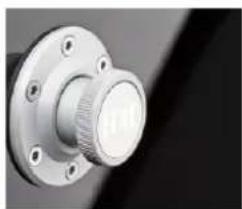
Technical diagram of a circular connector with two cylindrical components and a terminal block, no text or symbols present.Your loudspeaker is equipped with ELAC's innovative VX-JET technology. This technology for the first time allows, to adjust the loudspeaker to your personal gusto and to special room conditions. By means of the adjusting knob on the rear baffle of the speaker, you are able to adjust the relation between direct sound (the sound which is directly distributed from the speaker to your ear) and reverberant sound (the sound which is distributed by reflections on walls and ceilings to your ear). So, you are not changing the sound of the speaker but its directivity pattern in the middle/high range. This paper should help you to adjust your speaker optimally.

natural_image
Simple diagram of a yellow cone with a black square at the base (no text or symbols)In case your listening place is more than 4 m away from the speakers and you have a very spatial or reverberant sound impression, you should move the VX-JET to the inside (turning the adjusting knob out).

natural_image
Close-up of a metallic mechanical component with flanged ends and a central cylindrical shaft (no text or symbols visible)
natural_image
Close-up of a mechanical component with concentric rings and central yellow-yellow core (no visible text or symbols)
natural_image
Simple diagram showing a yellow cone with a black square at its apex (no text or symbols)The mid position of the adjusting knob marks the neutral and basic position. This is suitable for listening distances of 3 - 4 m. The VX-JET is located in the same plane as the front of the loudspeaker.

natural_image
Close-up of a hand holding a metallic knob with a button, no visible text or symbols
natural_image
Close-up of a mechanical component with concentric rings and central yellow section (no visible text or symbols)
natural_image
Simple diagram showing a yellow triangular shape pointing to a black square with a small black rectangle at the top (no text or symbols)In case the listening distance is less than 3 m and you have the impression that the sound is not spatial enough, you should move the VX-JET to the front (turning the adjusting knob in).
natural_image
Close-up of a metallic mechanical knob with flange and bolt holes (no text or symbols visible)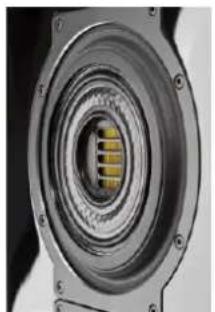
natural_image
Close-up of a mechanical component with concentric rings and central slots (no visible text or symbols)Anhang / Addendum
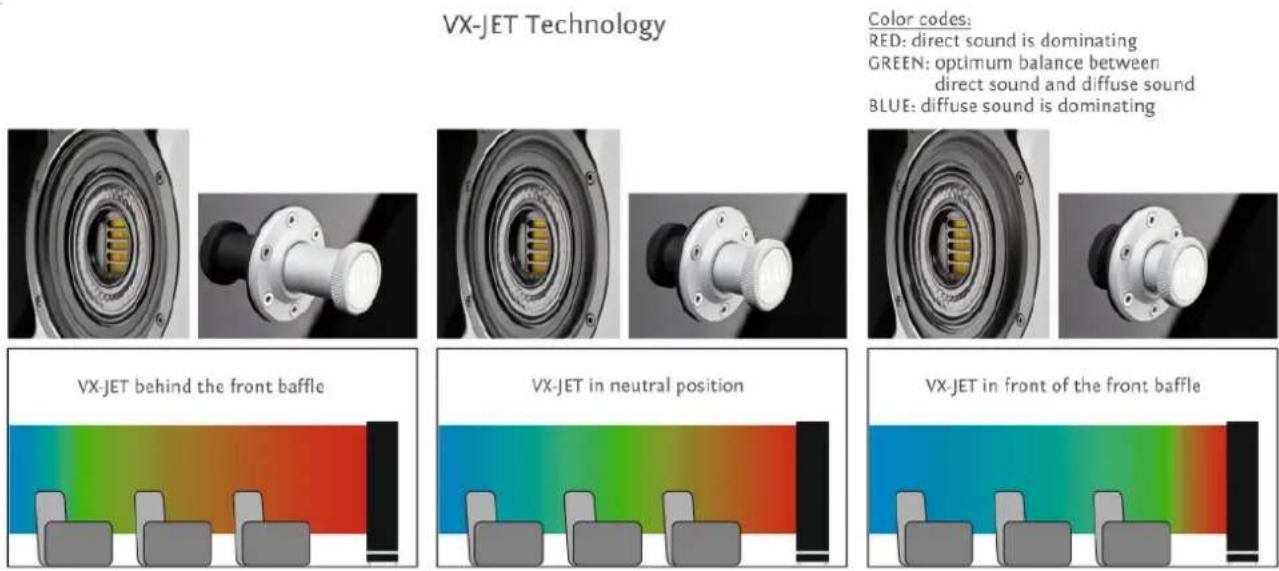
Color codes:
RED: direct sound is dominating
GREEN: optimum balance between direct sound and diffuse sound
BLUE: diffuse sound is dominating
Specifications as stated on label or supplement

ELAC The life of sound.

ELAC Electroacoustic GmbH
Errors and omissions excepted. Specifications and design features subject to change without notice.
- Connecting the speakers to a stereo system
- Operating, connecting the speakers to the hi-fi equipment
- Bi-Wiring/Bi-Amping operation
- Bi-Wiring
- Bi-Amping
- Explanatory Note on Specifications
- Specifications include:
- Warranty / Product control / Disposal
- Clean your speakers only with a soft, dry and smooth cloth,
- Warranty
- Production Control
- Loudspeaker Disposal
- Material-Specific Disposal
- Anhang / Addendum
Brand : ELAC
Model : Concentro
Category : Loudspeaker