 ManualGo.com
 KD-7402 - Car stereo JVC - Free user manual and instructions
Find the device manual for free KD-7402 JVC in PDF.


Download the instructions for your Car stereo in PDF format for free! Find your manual KD-7402 - JVC and take your electronic device back in hand. On this page are published all the documents necessary for the use of your device. KD-7402 by JVC.
USER MANUAL KD-7402 JVC
Cover_KD-DV7402_001A_f.indd 2
2/22/08 12:17:24 PM ENGLISH Thank you for purchasing a JVC product. Please read all instructions carefully before operation, to ensure your complete understanding and to obtain the best possible performance from the unit.
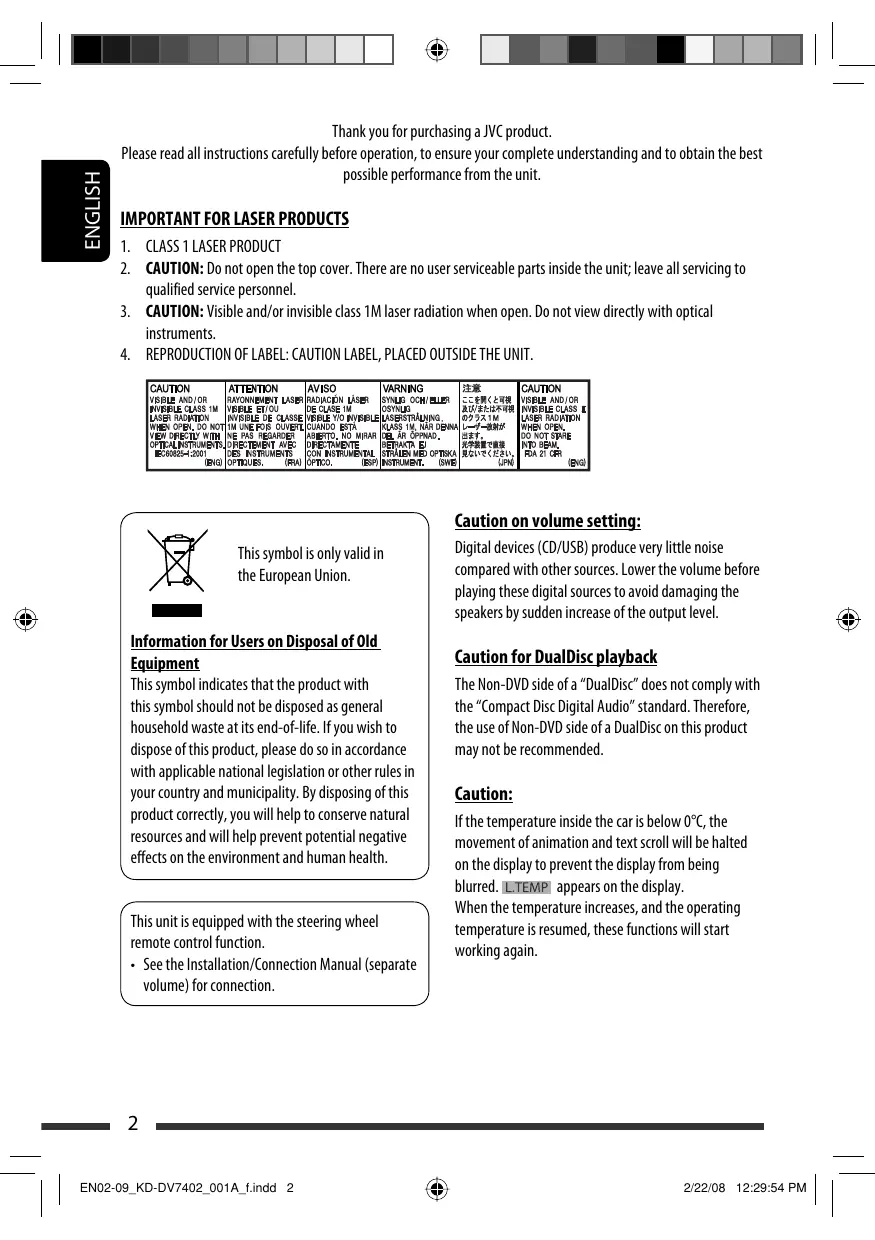
IMPORTANT FOR LASER PRODUCTS 1. CLASS 1 LASER PRODUCT 2. CAUTION: Do not open the top cover. There are no user serviceable parts inside the unit; leave all servicing to qualified service personnel. 3. CAUTION: Visible and/or invisible class 1M laser radiation when open. Do not view directly with optical instruments. 4. REPRODUCTION OF LABEL: CAUTION LABEL, PLACED OUTSIDE THE UNIT.
Caution on volume setting: This symbol is only valid in the European Union.
Information for Users on Disposal of Old Equipment This symbol indicates that the product with this symbol should not be disposed as general household waste at its end-of-life. If you wish to dispose of this product, please do so in accordance with applicable national legislation or other rules in your country and municipality. By disposing of this product correctly, you will help to conserve natural resources and will help prevent potential negative effects on the environment and human health.
This unit is equipped with the steering wheel remote control function. • See the Installation/Connection Manual (separate volume) for connection.
Digital devices (CD/USB) produce very little noise compared with other sources. Lower the volume before playing these digital sources to avoid damaging the speakers by sudden increase of the output level.
Caution for DualDisc playback The Non-DVD side of a “DualDisc” does not comply with the “Compact Disc Digital Audio” standard. Therefore, the use of Non-DVD side of a DualDisc on this product may not be recommended.
Caution: If the temperature inside the car is below 0°C, the movement of animation and text scroll will be halted on the display to prevent the display from being blurred. appears on the display. When the temperature increases, and the operating temperature is resumed, these functions will start working again.
2 EN02-09_KD-DV7402_001A_f.indd 2
• Your preset adjustments will also be erased (except the registered Bluetooth device, see pages 28 and 29).
How to forcibly eject a disc
“Please Eject” appears on the display.
• Be careful not to drop the disc when it ejects. • If this does not work, reset your unit.
WARNINGS: (To prevent accidents and damage)
ENGLISH How to reset your unit
• DO NOT install any unit or wire any cable in a location where; – it may obstruct the steering wheel and gearshift lever operations. – it may obstruct the operation of safety devices such as air bags. – it may obstruct visibility. • DO NOT operate the unit while driving. • If you need to operate the unit while driving, be sure to look around carefully. • The driver must not watch the monitor while driving. If the parking brake is not engaged, “DRIVER MUST NOT WATCH THE MONITOR WHILE DRIVING.” appears on the monitor, and no playback picture will be shown. – This warning appears only when the parking brake lead is connected to the parking brake system built in the car (refer to the Installation/Connection Manual). For security reasons, a numbered ID card is provided with this unit, and the same ID number is imprinted on the unit’s chassis. Keep the card in a safe place, as it will help the authorities to identify your unit if stolen.
For safety... • Do not raise the volume level too much, as this will block outside sounds, making driving dangerous. • Stop the car before performing any complicated operations.
Temperature inside the car... If you have parked the car for a long time in hot or cold weather, wait until the temperature in the car becomes normal before operating the unit.
3 EN02-09_KD-DV7402_001A_f.indd 3
2/22/08 9:15:56 AM ENGLISH How to use the M MODE and SEL buttons
Detaching the control panel
If you use M MODE or SEL (select), the display and some controls (such as the number buttons, 4 /¢ buttons, 5/∞ buttons, and the control dial) enter the corresponding control mode. Ex.: When you press number button 1 after pressing M MODE, to operate the FM tuner.
Avoid touching the connectors.
Attaching the control panel To use these controls for original functions, press M MODE again. • However, pressing SEL makes the unit enters a different mode. • Waiting for about 15 seconds (or 30 seconds for Bluetooth sources) without pressing any of these buttons will automatically cancels the control.
Opening and closing the control panel Indication language: In this manual, English indications are used for purposes of explanation. You can select the indication language on the monitor on the “LANGUAGE” setting (see page 50).
Listening to the radio Disc operations
• Operations using the control panel • Operations using the remote controller (RM-RK252)
Listening to the USB device Dual Zone operations
EXTERNAL DEVICES Listening to the Bluetooth® devices
• Using the Bluetooth cellular phone • Using the Bluetooth audio player
Listening to the CD changer Listening to the DAB tuner Listening to the iPod
When connecting with the USB cable Operations using the control screen When connecting with the interface adapter Selecting the playback modes
Listening to the other external components
SETTINGS Selecting a preset sound mode General settings — PSM Disc setup menu Bluetooth settings
REFERENCES Maintenance More about this unit Troubleshooting Specifications
DVD Recording format, file type, etc
DVD Video (Region Code: 2) *
Non-DVD side VCD (Video CD) SVCD (Super Video CD) CD-ROM CD-I (CD-I Ready) CD Recordable/Rewritable CD-DA (CD-R/-RW) DivX/MPEG1/MPEG2 • ISO 9660 level 1, level 2, Romeo, MP3/WMA/WAV Joliet AAC JPEG/MPEG4 * If you insert a DVD Video disc of an incorrect Region Code, “REGION CODE ERROR” appears on the monitor. *2 DVD-R recorded in multi-border format is also playable (except for dual layer discs). DVD-RW dual layer discs are not playable. *3 It is possible to play back finalized +R/+RW (Video format only) discs. +RW double layer discs are not playable. *4 To reproduce DTS sound, use the DIGITAL OUT terminal (see also pages 51 and 59). 1
6 EN02-09_KD-DV7402_001A_f.indd 6
2/20/08 12:15:38 PM ENGLISH Preparation Cancel the display demonstration and set the clock • See also pages 45 and 46.
Cancel the display demonstrations
Enter the PSM settings.
Select “Demo,” then “Off.”
Set the clock Select “Clock Hr” (hour), then adjust the hour. Select “Clock Min” (minute), then adjust the minute. Select “24H/12H,” then “24Hours” or “12Hours.”
Finish the procedure.
Changing the display information and pattern • When the power is turned off: Check the current clock time
Ex.: When tuner is selected as the source
Source operation display
Audio level meter display (see “LevelMeter” on page 45)
INTRODUCTIONS EN02-09_KD-DV7402_001A_f.indd 7
2/20/08 12:15:39 PM ENGLISH Basic operations Using the control panel
1 • DAB: Select DAB service.
*1 Holding SOURCE will enter Bluetooth menu if a Bluetooth phone is connected. *2 You cannot select these sources if they are not ready or not connected. *3 For storing preset phone number, see page 32.
8 EN02-09_KD-DV7402_001A_f.indd 8
2/20/08 12:15:40 PM Using the remote controller (RM-RK252)
ENGLISH Installing the battery
R03/LR03/AAA Insert the batteries into the remote controller by matching the polarity (+ and –) correctly.
Caution: Battery shall not be exposed to excessive heat such as sunshine, fire, or the like. If the effectiveness of the remote controller decreases, replace both batteries. Before using the remote controller: • Aim the remote controller directly at the remote sensor on the unit. • DO NOT expose the remote sensor to bright light (direct sunlight or artificial lighting).
IMPORTANT: If Dual Zone is activated (see page 27), the remote controller only functions for operating the DVD/CD player. Remote sensor
button • Turns the power on if pressed briefly or attenuates the sound when the power is on. • Turns the power off if pressed and held. Continued on the next page
/ ¢ buttons • TUNER: – Searches for stations automatically if pressed briefly. – Searches for stations manually if pressed and held. • DAB: – Select ensembles if pressed briefly. – Searches for ensembles if pressed and held. • DISC/USB/USB-iPod/CD-CH: – Reverse skip/forward skip if pressed briefly. – Reverse search/forward search if pressed and held. • BT-AUDIO: Reverse skip/forward skip if pressed briefly. • iPod: – Reverse skip/forward skip if pressed briefly. – Reverse search/forward search if pressed and held. In menu selecting mode: – Selects an item if pressed briefly. (Then, press ∞ to confirm the selection.) – Skips 10 items at a time if pressed and held.
3 VOL (volume) + / – buttons
• Adjusts the volume level. 2nd VOL (volume) buttons • Adjust the volume level through the 2nd AUDIO OUT plug when pressed with SHIFT button (see page 27). 4 *2 ASPECT button
• Not applicable for this unit. 5*1
PHONE button • Answer incoming calls. • Enters “Redial” menu when a Bluetooth phone is connected [Hold].
DVD-Video/DivX: Shows the disc menu. DVD-VR: Shows the Original Program screen. VCD: Resumes PBC playback. USB-iPod: Enters the search mode menu (see page 39).
8 *2 OSD (on-screen display) button
• Shows the on-screen bar. 9 SHIFT button
• Functions with other buttons. p DISP (display) button
• Changes the display information. q 1 / ¡ buttons
• DVD-Video: Slow motion playback (during pause). • DVD-VR/VCD: Forward slow motion playback (during pause). • DISC/USB/USB-iPod: Reverse search/forward search. w*1 SOURCE button
• Selects the source.
10 EN10-19_KD-DV7402_001A_f.indd 10
• DISC/USB/USB-iPod/BT-AUDIO: Starts/ pauses playback. r
DIRECT button • DISC/USB: Enters direct search mode for chapter/title/program/playlist/folder/track when pressed with SHIFT button (see page 20 for details). CLR (clear) button • DISC/USB: Erases the misentry when pressed with SHIFT button.
e 3 (play) / 8 (pause) button
*1 When Dual Zone is activated, these buttons cannot be used. *2 Functions as number buttons/* (asterisk)/# (hash) when pressed with SHIFT button. – TUNER/DAB: Selects the preset stations/services (1 – 6). – DISC: Enters chapter/title/program/playlist/folder/ track number after entering search mode by pressing SHIFT and DIRECT (see page 20 for details).
• DVD-Video: Makes selection/settings. • CD-CH: Changes discs in the magazine. @ / # buttons
• DVD-Video: Makes selection/settings. • DivX/MPEG Video: Skips back or forward by about five minutes.
ENT (enter) button • Confirms selection. i *2 DUAL button
• Activates or deactivates Dual Zone. o SURROUND button
• Not applicable for this unit.
OPERATIONS EN10-19_KD-DV7402_001A_f.indd 11
2/20/08 12:16:00 PM ENGLISH Listening to the radio 1
Search for a station to listen—Auto Search. Manual Search: Hold either one of the buttons until “M” lights up on the display, then press it repeatedly. • When receiving an FM stereo broadcast with sufficient signal strength, lights up on the display.
When an FM stereo broadcast is hard to receive
1 3 2 Local FM stations with the strongest signals are searched and stored automatically in the selected FM band.
Reception improves, but stereo effect will be lost. • lights up on the display.
Exit from the setting.
Ex.: Storing FM station of 92.5 MHz into preset number 4 of the FM1 band.
Using the number buttons
FM station automatic presetting —SSM (Strong-station Sequential Memory)
You can preset up to six stations for each band.
While listening to a station...
12 EN10-19_KD-DV7402_001A_f.indd 12
2/20/08 12:16:01 PM Listening to the preset station on the Preset Station List
Display the Preset Station List, then select the preset station you want to listen to.
Change to the selected station.
• When is shown on the display, you can move back to the previous screen by pressing number button 3.
Follow steps 1 and 2 of “Using the number buttons” on page 12. • By holding 5 / ∞, the Preset Station List will also appear (go to step 4).
Display the Preset Station List.
Select the preset number you want to store into.
The following features are available only for FM RDS stations.
Searching for FM RDS programme — PTY Search You can tune in to a station broadcasting your favorite programme by searching for a PTY code. • When appears on the display, you can move back to the previous display by pressing number button 3. • When / appears on the display, you can move to the other lists by pressing number button 5 or 6 repeatedly.
• You can move to the lists of the other FM bands by pressing number button 5 ( ) or 6( ) repeatedly.
The six preset PTY codes appears on the display.
Continued on the next page
OPERATIONS EN10-19_KD-DV7402_001A_f.indd 13
2/20/08 12:16:03 PM ENGLISH
Select a PTY code. You can select a PTY code from the 29 preset PTY codes or from the six stored PTY codes.
Select one of the PTY codes.
Store the selected PTY code.
• To store your favorite programme types, see the following.
Start searching for your favorite programme.
Ex.: When “Classics” is selected in step 4
If there is a station broadcasting a programme of the same PTY code as you have selected, that station is tuned in.
Storing your favorite programme types
Repeat steps 3 to 5 to store other PTY codes into other preset numbers.
Exit from the setting.
You can store six favorite programme types. • When appears on the display, you can move back to the previous display by pressing number button 3.
Activating TA/PTY Standby Reception
Select a preset number (“Preset1”– “Preset6”) you want to store into.
TA Standby Reception
either lights up or flashes on the display. • If lights up, the unit temporarily will switch to Traffic Announcement (TA), if available, from any source other than AM. The volume changes to the preset TA volume level if the current level is lower than the preset level (see page 47). • If flashes, TA Standby reception is not yet activated. Tune in to another station providing the RDS signals. To deactivate TA Standby Reception, press TP again. goes off.
Tracing the same programme— Network-Tracking Reception When driving in an area where FM reception is not sufficient enough, this unit automatically tunes in to another FM RDS station of the same network, possibly broadcasting the same programme with stronger signals (see the illustration below).
Exit from the setting.
either lights up or flashes on the display. • If lights up, the unit temporarily will switch to your favorite PTY programme from any source other than AM. • If flashes, PTY Standby reception is not yet activated. Tune in to another station (or service) providing the RDS signals.
Programme A broadcasting on different frequency areas (01 – 05)
When shipped from the factory, Network-Tracking Reception is activated. To change the Network-Tracking Reception setting, see “AF-Regn’l” on page 47. • When the DAB tuner is connected, refer to “Tracing the same programme—Alternative Frequency Reception (DAB AF)” on page 36.
To deactivate PTY Standby Reception, select “Off” in step 2. goes off.
Automatic station selection— Programme Search
• When a DAB tuner is connected, TA/PTY Standby Reception also searches for services. (See also page 35.) • The unit will not switch to Traffic Announcement or PTY programme when a call connection is established through the “BT-PHONE.”
Usually when you press the number buttons, the preset station is tuned in. If the signals from the FM RDS preset station are not sufficient for good reception, this unit, using the AF data, tunes in to another frequency broadcasting the same programme as the original preset station is broadcasting. • The unit takes some time to tune in to another station using programme search. • See also page 47.
Available PTY codes News, Affairs, Info, Sport, Educate, Drama, Culture, Science, Varied, Pop M (music), Rock M (music), Easy M (music), Light M (music), Classics, Other M (music), Weather, Finance, Children, Social, Religion, Phone In, Travel, Leisure, Jazz, Country, Nation M (music), Oldies, Folk M (music), Document
OPERATIONS EN10-19_KD-DV7402_001A_f.indd 15
ENGLISH PTY Standby Reception
2/20/08 12:16:06 PM ENGLISH Disc operations Before performing any operations... Turn on the monitor to watch the playback picture. If you turn on the monitor, you can also control playback of other discs by referring to the monitor screen. (See pages 22 – 25.) The disc type is automatically detected, and playback starts automatically (for DVD: automatic start depends on its internal program). If the current disc does not have any disc menu, all tracks will be played repeatedly until you change the source or eject the disc. If “ ” appears on the monitor when pressing a button, the unit cannot accept the operation you have tried to do. • In some cases, without showing “ ,” operations will not be accepted.
Open the control panel.
Start playback if necessary.
Make sure to detach the USB device before opening the control panel, as it might block the opening mechanism. • To detach the USB device, see page 26. Playback starts automatically.
To stop play and eject the disc
Prohibiting disc ejection
• Press SOURCE to listen to another playback source. To cancel the prohibition, repeat the same procedure.
16 EN10-19_KD-DV7402_001A_f.indd 16
2/20/08 12:16:08 PM Operations using the control panel
ENGLISH Pressing (or holding) the following buttons allows you to...
Disc type (Number buttons) *3 [Press] Select chapter [Hold] Reverse/fast-forward chapter *1
During stop: Locate title During play/pause: Locate chapter
[Press] Select chapter [Hold] Reverse/fast-forward chapter *1
Select program number/ playlist number
During stop: Locate program During play/pause: Locate chapter
[Press] Select track [Hold] Reverse/fast-forward track *2
Locate particular folder directly
[Press] Select track [Hold] Reverse/fast-forward track *1 [Press] Select track [Hold] Reverse/fast-forward track *1
[Press] Select track [Hold] Reverse/fast-forward track *1
Locate particular track directly (PBC not in use) Locate particular folder directly Locate particular track directly
*1 Search speed: *2 Search speed: *3 Press to select number 1 to 6; hold to select number 7 to 12.
Continued on the next page
OPERATIONS EN10-19_KD-DV7402_001A_f.indd 17
2/20/08 12:16:09 PM ENGLISH After pressing M MODE, press the following buttons to...
Disc type Skip 10 chapters (during play or pause)
Repeat Chapter: Repeat current chapter Repeat Title: Repeat current title
Skip 10 chapters (during play or pause)
Repeat Chapter: Repeat current chapter Repeat Program: Repeat current program (not available for Playlist Playback)
Skip 10 tracks (within the same folder)
Repeat Track: Repeat current track Repeat Folder: Repeat current folder
Random Folder: Randomly play all tracks of current folder, then tracks of next folders Random All: Randomly play all tracks
Skip 10 tracks (PBC not in use)
Repeat Track: Random All: Repeat current track (PBC not in Randomly play all tracks (PBC use) not in use)
Skip 10 tracks (within the same folder)
Repeat Track: Repeat current track Repeat Folder: Repeat current folder
Random Folder: Randomly play all tracks of current folder, then tracks of next folders Random All: Randomly play all tracks
Repeat Track: Repeat current track
Random All: Randomly play all tracks
• You can also cancel the playback mode by selecting “Off” or press number button 4 (
18 EN10-19_KD-DV7402_001A_f.indd 18
• When is shown on the display, you can move back to the previous screen by pressing number button 3.
Change to the selected item. A If File List is selected The list disappears and playback starts.
ENGLISH Selecting a folder/track on the list (only for MP3/WMA/WAV file)
B If Folder List is selected
• If the current folder is selected, File List appears, then repeat steps 4 and 5 A to start playback. • If another folder is selected, playback starts from the 1st file of the selected folder.
Ex.: When “File” is selected in step 3 • You can move to the other lists by pressing ) or 6 ( ) number button 5 ( repeatedly.
OPERATIONS EN10-19_KD-DV7402_001A_f.indd 19
Start play/Pause (if pressed during play)
Start play/Pause (if pressed during play)
Reverse/forward track search *4 (No sound can • Reverse/forward chapter search *1 (No sound can be heard.) be heard.) • Slow motion *2 during pause (No sound can be heard.) * DVD-VR: Reverse slow motion does not work. [Press] Select chapter (during play or pause) [Press] Select track (during play or pause) [Hold] Reverse/fast-forward chapter search *3 [Hold] Reverse/fast-forward track search *5 (No sound can be heard.)
• DVD-Video: Select title (during play or pause) • DVD-VR: Select playlist/program (during play or pause)
• Skip back or forward the scenes by about five minutes • Select chapter
2/20/08 12:16:23 PM ENGLISH Stop play
Start play/Pause (if pressed during play)
Start play/Pause (if pressed during play)
Start play/Pause (if pressed during play)
Reverse/forward track search *1 Reverse/forward track search *1 • Forward slow motion *2 during pause. (No sound can be heard.) * Reverse slow motion does not work.
Reverse/forward track search *1
[Press] Select track (during play or pause) [Hold] Reverse/fast-forward track search *3 (No sound can be heard.)
[Press] Select track (during play or pause) [Hold] Reverse/fast-forward track search *3
[Press] Select track (during play or pause) [Hold] Reverse/fast-forward track search *3 Select folder
• For DivX/MPEG Video/MP3/WMA/WAV, track is searched within the same folder. • To erase a misentry, press CLR (clear) while holding SHIFT. • To return to the previous screen, press RETURN. *1 *2 *3 *4 *5
Search speed: Slow motion speed: Search speed: Search speed: Search speed:
Continued on the next page
OPERATIONS EN20-27_KD-DV7402_001A_f.indd 21
2/20/08 12:16:29 PM ENGLISH Using menu driven features... (DVD-Video/ DVD-VR) 1 Press TOP M/MENU to enter the menu screen. 2 Press % / fi / @ * / # * to select an item you want
to start play. 3 Press ENT (enter) to confirm. * Not applicable for DVD-VR.
Operations using the on-screen bar (DVD/DVD-VR/DivX/MPEG Video/VCD) These operations are possible on the monitor using the remote controller.
Make a selection. If pop-up menu appears...
to enter the desired number. 3 Press ENT (enter) to confirm.
• To resume PBC, press TOP M/MENU.
• To cancel pop-up menu, press RETURN. • For entering time/numbers, see the following.
Entering time/numbers Press % / fi to change the number, then press @ / # to move to the next entry. • Each time you press % / fi, the number increases/ decreases by one value. • After entering the numbers, press ENT (enter). • It is not required to enter the zero and tailing zeros (the last two digits in the example below). Ex.: Time search DVD: _:_ _:_ _ (Ex.: 1:02:00) Press % once, then # twice to go to the third entry, % twice, then press ENT (enter).
To remove the on-screen bar
22 EN20-27_KD-DV7402_001A_f.indd 22
2/20/08 12:16:31 PM On-screen bar
ENGLISH Ex.: DVD-Video
Information Operation
1 Disc type 2 • DVD-Video/DTS-CD: Audio signal format type
and channel • VCD: PBC 3 Playback mode *1 DVD-Video: T. RPT: Title repeat C. RPT: Chapter repeat DVD-VR: C. RPT: Chapter repeat PG. RPT: Program repeat DivX/MPEG Video: T. RPT: Track repeat F. RPT: Folder repeat F. RND: Folder random A. RND: All random VCD *2: T. RPT: Track repeat A. RND: All random 4 Playback information Current title/chapter Current program/chapter Current playlist/chapter Current track Current folder/track 5 Time indication Elapsed playing time of the disc (For DVD-Video, elapsed playing time of the current title/program/ playlist.) DVD-Video/DVD-VR: Remaining title/program/playlist time VCD: Remaining disc time Elapsed playing time of the current chapter/track *3 Remaining time of the current chapter/track *3
Play Forward/reverse search Forward/reverse slow-motion Pause Stop 7 Operation icons Change time indication (see 5) Time Search (Enter the elapsed playing time of the current title/program/ playlist or of the disc.) Title Search (by its number) Chapter Search (by its number) Track Search (by its number) Change the audio language or audio channel Change or turn off the subtitle language Change the view angle Repeat play *1 Random play *1 *1 For repeat play/random play, see also page 18. *2 While PBC is not in use. *3 Not applicable for DVD-VR.
OPERATIONS EN20-27_KD-DV7402_001A_f.indd 23
2/20/08 12:16:32 PM ENGLISH Operations using the control screen (DivX/MPEG Video/MP3/WMA/WAV/CD) These operations are possible on the monitor using the remote controller.
Show the control screen. DivX/MPEG Video: Press 7 during play. MP3/WMA/WAV/CD: Automatically appear during play. Select “Folder” column or “Track” column (except for CD).
7 Track information 8 Track list with the current track selected
To select a playback mode 1 While control screen is displayed...
Playback mode selection screen appears on the folder list section of the control screen. 2 Select a playback mode.
Select a folder or track. RANDOM:
F. RPT (folder repeat):
Repeat current folder
T. RPT (track repeat):
Repeat current track
A. RND (all random):
Randomly play all tracks
F. RND Randomly play all tracks of (folder random): current folder, then tracks of next folders 4 Confirm the selection.
Ex.: MP3/WMA/WAV disc 1 2 3 4 5 6
Current folder number/total folder number Folder list with the current folder selected Selected playback mode Elapsed playing time of the current track Operation mode icon ( 3, 7, 8, ¡, 1 ) Current track number/total number of tracks in the current folder (total number of tracks on the disc)
List screen (DivX/MPEG Video/MP3/WMA/ WAV)
3 Current page/total number of the pages included
in the list 4 Current folder/track (highlighted bar)
List screen (DVD-VR) You can use ORIGINAL PROGRAM or PLAY LIST screen anytime while playing DVD-VR with its data recorded. 1 Select a list screen.
ENGLISH Operations using the list screen
Before playing, you can display the folder list/track list to confirm the contents and start playing a track.
Display the folder list while stop.
Select an item from the folder list.
• Track list of the selected folder appears. • To go back to the folder list, press RETURN.
Select a track to start playing. or
• MP3/WMA/WAV: Control screen appears (see page 24).
1 Program/playlist number 2 Recording date 3 Recording source (TV station, the input
terminal of the recording equipment, etc.) Start time of recording Title of the program/playlist * Current selection (highlighted bar) Creating date of playlist Number of chapters Playback time * The title of the original program or playlist may not be displayed depending on the recording equipment. 4 5 6 7 8 9
2 Select an item from the list.
1 Current folder number/total folder number 2 Current track number/total number of tracks in the
OPERATIONS EN20-27_KD-DV7402_001A_f.indd 25
2/20/08 12:16:34 PM ENGLISH Listening to the USB device You can connect a USB mass storage class device such as a USB memory, portable HDD, etc. to the unit. • You can also connect an Apple iPod to the USB input jack. For details of the operations, see pages 37 – 41. This unit can play DivX/MPEG Video/MP3/WMA/WAV tracks stored in a USB device. All tracks will be played repeatedly until you change the source or detach the USB device.
Turn on the monitor to watch the playback picture if you play back a DivX/MPEG file. You can also control playback by referring to the monitor screen. (See also pages 22 – 25.) • See pages 20 – 25 for operation using the remote controller. • See pages 50, 51, and 56 for more settings. If “ ” appears on the monitor when pressing a button, the unit cannot accept the operation you have tried to do. • In some cases, without showing “ ,” operations will not be accepted. If a USB device has been attached... Playback starts from where it has been stopped previously. • If a different USB device is currently attached, playback starts from the beginning.
To stop play and detach the USB device Straightly pull it out from the unit. • Press SOURCE to listen to another playback source.
You can operate the USB device in the same way you operate the files on a disc. (See pages 16 – 25.) • You cannot select “USB” when Dual Zone is in use (see page 27).
Cautions: • Avoid using the USB device if it might hinder your safety driving. • Do not pull out and attach the USB device repeatedly while “Reading” is shown on the display. • Do not start the car engine if a USB device is connected. • This unit may not be able to play the files depending on the type of USB device. • Operation and power supply may not work as intended for some USB devices. • You cannot connect a computer to the USB input terminal of the unit. • Make sure all important data has been backed up to avoid losing the data. • Do not leave a USB device in the car, expose to direct sunlight, or high temperature to avoid deformation or cause damages to the device. • Some USB devices may not work immediately after you turn on the power. • For more details about USB operations, see page 56.
26 EN20-27_KD-DV7402_001A_f.indd 26
2/20/08 12:16:36 PM You can enjoy disc playback on the external monitor connected to the VIDEO output terminal and 2nd AUDIO OUT plugs while listening to any source (other than “AM” and “USB”) through the speakers. • You cannot select “AM” or “USB” as the source when Dual Zone is activated. • When Dual Zone is in use, you can only operate the DVD/CD player using the remote controller. For operations, see pages 20 – 25.
ENGLISH Dual Zone operations
These operations are possible on the monitor using the remote controller.
Activate Dual Zone. • DUAL indicator lights up on the display. The main source automatically changes to “DISC.” To select a different source (main source) to listen through the speakers, press SOURCE on the control panel. • By using the buttons on the control panel, you can operate the newly selected source without affecting Dual Zone operations.
Adjust the volume through the 2nd AUDIO OUT plug.
To cancel Dual Zone operations
Operate the DVD/CD player using the remote controller by referring to the monitor screen.
On the control panel: 1
• DUAL indicator goes off.
2 Enter Dual Zone settings.
Activate or deactivate Dual Zone.
The source automatically changes to “DISC” when Dual Zone is activated.
OPERATIONS EN20-27_KD-DV7402_001A_f.indd 27
2/20/08 12:16:37 PM ENGLISH Listening to the Bluetooth ® devices For Bluetooth operations, it is required to connect the Bluetooth Adapter (KS-BTA200) to the CD changer jack on the rear of this unit. • Refer also to the instructions supplied with the Bluetooth adapter and the Bluetooth device. • Refer to the list (included in the box) to check the countries where you may use the Bluetooth ® function. To use a Bluetooth device through the unit (“BT-PHONE” and “BT-AUDIO”) for the first time, you need to establish Bluetooth wireless connection between the unit and the device. • Once the connection is established, it is registered in the unit even if you reset your unit. Up to five devices can be registered in total. • Only one device can be connected at a time for each source (“BT-PHONE” and “BT-AUDIO”).
Registering a Bluetooth device
Registering using “Open” Preparation: Operate the device to turn on its Bluetooth function.
Select “BT-PHONE” or “BT-AUDIO.”
Enter a PIN (Personal Identification Number) code to the unit. • You can enter any number you like (1-digit to 16-digit number). [Initial: 0000] • To enter a PIN code less than 4-digit, firstly delete the initial PIN code (0000) by pressing number button 5 ( ). * Some devices have their own PIN code. Enter the specified PIN code to the unit.
Registration (Pairing) methods Use either of the following items in the Bluetooth menu to register and establish the connection with a device. • Select “BT-PHONE” or “BT-AUDIO” as the source to operate the Bluetooth menu. Open
Make the unit ready to establish a new Bluetooth connection. Connection is established by operating the Bluetooth device.
Make the unit ready to establish a new Bluetooth connection. Connection is established by operating the unit.
is shown on the display, you can • When move back to the previous screen by pressing number button 3.
1 Move to the next (or previous) number
Select a device you want to connect.
3 Repeat steps 1 and 2 until you finish
• For available devices... 1 Enter the specific PIN code of the device to the unit. Refer to the instructions supplied with the device to check the PIN code. 2 Use the Bluetooth device to connect. Now connection is established and you can use the device through the unit.
entering a PIN code. 4 Confirm the entry.
“Open...” flashes on the display.
Use the Bluetooth device to search and connect. On the device to be connected, enter the same PIN code you have just entered for this unit. “Connected (and device name)” appears on the display. Now connection is established and you can use the device through the unit.
• For special device... Use “Open” or “Search” to connect.
Connecting/disconnecting/deleting a registered device
Select “BT-PHONE” or “BT-AUDIO.”
Select a registered device you want to connect/disconnect/delete.
• Select “Search” to search for available devices. The unit searches and displays the list of the available devices. If no available device is detected, “Device not found” appears.
• Select “Special” to connect a special device. The unit displays the list of the preset devices.
• Select “Connect” or “Disconnect” to connect/disconnect the selected device.
The device remains registered even after you disconnect the device. Use “Connect“ (or activate “Auto Connect”) to connect the same device from next time on. (See the following and page 52.)
2 Select a number or blank space.
Connecting a device Perform steps 1 – 3 on page 28, then...
Continued on the next page
EXTERNAL DEVICES EN28-33_KD-DV7402_001A_f.indd 29
2/20/08 12:16:53 PM ENGLISH
• Select “Delete,” then confirm the selection.
Press number button 3 to select “No” or return to the previous screen. You can set the unit to connect the Bluetooth device automatically when the unit is turned on. (See “Auto Connect” on page 52.)
Using the Bluetooth cellular phone
Establish the connection with a device, then make a call (or settings using the Bluetooth menu). (See pages 31 and 52.)
When a call comes in....
When a text message comes in....
The source is automatically changed to “BT-PHONE.”
If the cellular phone is compatible with Text Message (notified through JVC Bluetooth adapter) and “Message Info” is set to “Auto” (see page 52), the unit rings and “Received Message” appears on the display to inform you of the message arrival.
When “Auto Answer” is activated.... The unit answers the incoming calls automatically, see page 52. • When “Auto Answer” is deactivated, press any button (except /control dial) to answer the incoming call. To end the call Hold any button (except
* Displayed only when your cellular phone is equipped with these functions. – If not displayed, try to transfer the phone book memory of the cellular phone to this unit. (Refer to the instruction manual supplied with your cellular phone.) – With some cellular phones, the phone book memory is transferred automatically.
ENGLISH Making a call You can make a call using one of the Dial Menu items. • When is shown on the display, you can move back to the previous screen by pressing number button 3.
Select the name/phone number you want to call.
How to enter phone number
Select the method to make a call.
Move the entry position. • Redial *: Shows the list of the phone numbers you have dialed. Go to the following step. • Received *: Shows the list of the received calls. Go to the following step. • Phonebook *: Shows the phone book of the connected cellular phone. Go to the following step. • Missed *: Shows the list of the missed calls. Go to the following step. • Number: Shows the phone number entry screen. See “How to enter phone number” on the right column. • Voice Dial (Only accessible when the connected cellular phone has the voice recognition system): Speak the name (registered words) you want to call.
Continued on the next page
EXTERNAL DEVICES EN28-33_KD-DV7402_001A_f.indd 31
2/20/08 12:16:55 PM ENGLISH Using voice command
Select a phone number. You can also enter a new phone number (see also “How to enter phone number” on page 31) to store.
Select a preset number to store.
“Say...” appears on the display.
Speak the name (registered words) you want to call. • You can also use voice command from the Dial Menu. Select “Voice Dial” from the Dial Menu. • If your cellular phone does not support the voice recognition system, “Error” appears on the display.
To call a preset number While in Bluetooth phone....
Presetting the phone number You can preset up to six phone numbers. is shown on the display, you can • When move back to the previous screen by pressing number button 3.
Display the phone number you want to preset by using one of the “Dial Menu” items.
Using the Bluetooth audio player • Operations and display indications differ depending on their availability on the connected audio player.
Select “BT-AUDIO.” If playback does not start automatically, operate the Bluetooth audio player to start playback. • If playback does not pause when you change the source, operate the Bluetooth audio player to pause playback.
Reverse skip/forward skip Start/pause playback Enter setting menu (Device list)
• Refer also to pages 29 and 30 for connecting/ disconnecting/deleting a registered device. Bluetooth Information: If you wish to receive more information about Bluetooth, visit the following JVC web site: <http:// www.jvc-victor.co.jp/english/car/>.
32 EN28-33_KD-DV7402_001A_f.indd 32
2/20/08 12:16:56 PM ENGLISH Listening to the CD changer It is recommended to use a JVC MP3-compatible CD changer with your unit. You can connect a CD changer to the CD changer jack on the rear of the unit. • You can only play conventional CDs (including CD Text) and MP3 discs. Preparation: Make sure “Changer” is selected for the external input setting, see page 47.
Select a disc to start playing. [Press] For selecting disc number 1 – 6. [Hold] For selecting disc number 7 – 12.
[Press] Select track [Hold] Reverse/fast-forward track * MP3: Select folders
* By holding either one of the buttons, you can display the Disc List (see page 19).
To select a disc/folder/track on the list See “Selecting a folder/track on the list (only for MP3/ WMA/WAV file)” on page 19. Select “Disc” in step 3 to display the Disc List of the CD changer.
After pressing M MODE, press the following buttons to... Skip 10 tracks MP3: Within the same folder Repeat Track: Repeat current track Repeat Folder: MP3: Repeat all tracks of current folder Repeat Disc: Repeat all tracks of the current disc Random Folder: MP3: Randomly play all tracks of the current folder, then tracks of the next folder Random Disc: Randomly play all tracks of current disc Random All: Randomly play all tracks of the discs in the magazine • You can also cancel the playback mode by selecting ). “Off” or press number button 4 (
EXTERNAL DEVICES EN28-33_KD-DV7402_001A_f.indd 33
2/20/08 12:16:57 PM ENGLISH Listening to the DAB tuner Before operating, connect the JVC DAB tuner, KT-DB1000 (separately purchased) to the CD changer jack on the rear of the unit. Preparation: Make sure “Changer” is selected for the external input setting, see page 47.
Searching for an ensemble.
Select a service (either primary or secondary) to listen to.
Manual Search: Hold either one of the buttons until “M” flashes on the display, then press it repeatedly.
When surrounding sounds are noisy
Some services provide Dynamic Range Control (DRC) signals together with their regular programme signals. DRC will reinforce the low level sounds to improve your listening.
Exit from the setting.
appears on the display. will be highlighted only when receiving DRC signals from the tuned service.
Storing DAB services in memory
Select one of the DRC signals levels (1, 2, or 3).
• As the number increases, the effect becomes stronger.
You can preset six DAB services (primary) for each band. • When appears on the display, you can move back to the previous display by pressing number button 3. Ex.: Storing an ensemble (primary service) into the preset number 4 of the DAB 1 band. Using the number buttons
Listening to the preset service using the Preset Service List
Select an ensemble (primary service).
Preset number “P4” appears on the display.
Display the Preset Service List, then select the preset DAB service you want to listen to.
Change to the selected DAB service.
Follow steps 1 and 2 of “Using the number buttons” on page 34 and above. • By holding 5 / ∞, the Preset Service List will appear (go to step 4).
Display the Preset Service List.
Activating/deactivating TA/PTY Standby Reception • Operations are exactly the same as explained on pages 14 and 15 for FM RDS stations. • You cannot store PTY codes separately for the DAB tuner and for the FM tuner.
Select a preset number you want to store into.
• You can move to the lists of the other DAB bands by pressing number button 5 ( ) or 6( ) repeatedly, but you cannot store the selected service into these bands.
Announcement Standby Reception Announcement Standby Reception allows the unit to switch temporarily to your favorite service (announcement type). To activate the Announcement Standby Reception and select the announcement type
Store the service. Preset number “P4” appears on the display.
Activating the Announcement Standby Reception. Display the currently selected announcement type.
Continued on the next page
EXTERNAL DEVICES EN34-43_KD-DV7402_001A_f.indd 35
2/20/08 12:13:36 PM Selecting an announcement type.
Exit from the setting.
either lights up or flashes on the playback display. • If lights up, Announcement Standby Reception is activated. • If flashes, Announcement Standby Reception is not yet activated. To activate, tune in to another service providing the related signals. will stop flashing and remain lit. To deactivate the Announcement Standby Reception Select “Announce Off” in step 2 on page 35. goes off.
• While receiving an FM RDS station: When driving in an area where a DAB service is broadcasting the same programme as the FM RDS station is broadcasting, this unit automatically tunes in to the DAB service. When shipped from the factory, Alternative Frequency Reception is activated. To deactivate the Alternative Frequency Reception, see page 47.
To show the Dynamic Label Segment (DLS) information While listening to an ensemble that supports DLS....
Lights up when receiving a service providing Dynamic Label Segment (DLS)—DAB radio text.
Announcement types Travel, Warning, News, Weather, Event, Special, Rad Inf (Radio Information), Sports, Finance
Tracing the same programme— Alternative Frequency Reception (DAB AF)
• The DLS display will be temporarily canceled when you operate the unit.
You can keep listening to the same programme by activating the Alternative Frequency Reception. • While receiving a DAB service: When driving in an area where a service cannot be received, this unit automatically tunes in to another ensemble or FM RDS station, broadcasting the same programme.
36 EN34-43_KD-DV7402_001A_f.indd 36
2/20/08 12:13:37 PM ENGLISH Listening to the iPod You can connect an Apple iPod using the following cable or adapter:
USB 2.0 cable (supplied for the iPod)
USB input jack on the control panel
Interface adapter for iPod, KS-PD100 (not supplied)
CD changer jack on the rear of the unit Preparation: Make sure “Changer” is selected for the external input setting, see page 47.
USB Audio and Video cable for iPod, KS-U19 (not supplied)
USB input jack and AV-IN input jack on the control panel • Turn on the monitor to watch the video.
You can control playback from the unit. Disconnecting the iPod will stop playback. Press SOURCE to listen to another playback source. For details, refer also to the manual supplied for your iPod. See also page 57.
Caution: • Avoid using the iPod if it might hinder your safety while driving. • Make sure all important data has been backed up to avoid losing the data.
When connecting with the USB cable Connect using USB 2.0 cable (supplied for iPod):
Connect using USB Audio and Video cable for iPod, KS-U19 (not supplied): AV-IN input jack USB input jack
USB cable supplied for your iPod
KS-U19 (not supplied)
Playback starts automatically from where it had been paused previously.* * Not applicable for video files. Continued on the next page
EXTERNAL DEVICES EN34-43_KD-DV7402_001A_f.indd 37
2/20/08 12:13:38 PM ENGLISH
[Press] Go to the next or previous track [Hold] Fast-forward or reverse the track during playback [Hold] Enter main menu
Operations using the control screen • These operations are possible on the monitor using the remote controller. • Connect your iPod to the USB input jack on the control panel using the USB cable supplied for your iPod, or KS-U19 for watching video file.
[Press] Pause/resume playback.
Turn on the monitor.
Selecting a track from the menu
Confirm the selection.
Control screen appears on the monitor. 1 Current category number/total category
number 2 Category list with the current category
• By holding ¢ , you can start play back the selected item directly. • By holding 4 , you can exit from the menu. • By holding 5/∞, you can fast skip in every layer of the main menu.
selected 3 Elapsed playing time of the current track 4 Operation mode icon ( 3, 7, 8, ¡, 1 ) 5 Current track number/total number of tracks
in the current category 6 Track information 7 Track list with the current track selected
Menu items: For Music: “Playlists,” “Artists,” “Albums,” “Songs,” “Podcasts,” “Genres,” “Composers,” or “Audiobooks” For Videos: “Video Playlists,” “Movies,” “Music Videos,” “TV Shows,” or “Video Podcasts” • If a track is selected, playback starts automatically. • If the selected item has another layer, you will enter the layer. Repeat steps 2 and 3 until the desired track is played.
Select the desired item.
If the selected item has another layer, you will enter the layer. Repeat this step until the desired track is played.
1 Enter Search Mode menu. or
To select a playback mode/change the speed of the Audiobooks
ENGLISH To select a track from Search Mode
1 While control screen is displayed...
Playback mode selection screen appears on the category list section of the control screen. 2 Select an item.
3 Select a playback mode/speed. 2 Select a menu item.
Search modes category: For Music: “Playlists,” “Artists,” “Albums,” “Songs,” “Podcasts,” “Genres,” “Composers,” or “Audiobooks” For Videos: “Video Playlists,” “Movies,” “Music Videos,” “TV Shows,” or “Video Podcasts” • Available Search Modes depend on the type of your iPod.
REPEAT ONE Same as “Repeat One.”
REPEAT ALL Same as “Repeat All.”
Same as “Shuffle Albums.”
Same as “Shuffle Songs.”
NORMAL Plays at normal speed.
FASTER Plays faster.
SLOWER Plays slower.
* Functions only if you select “All Albums” or “All” in “Albums” of the main “MENU.”
• To return to the previous search mode screen, press MENU. • To return to the control screen, press RETURN.
Continued on the next page
2/20/08 12:13:41 PM ENGLISH
4 Confirm the selection.
• You can also change the settings from the PSM (Preferred Setting Mode) items. See “AudioBooks” on page 47.
Selecting a track from the menu
When connecting with the interface adapter
Confirm the selection.
• By holding 4 /¢ , you can fast skip during song search in the main menu. • If a track is selected, playback starts automatically. • If the selected item has another layer, you will enter the layer. Repeat steps 2 and 3 until the desired track is played. Playback starts automatically from where it had been paused previously. • If an iPod has been connected, press SOURCE to select “iPod” to listen to music.
Selecting the playback modes After pressing M MODE, press the following buttons to... Repeat One: Same as “Repeat One.” Repeat All: Same as “Repeat All.” Repeat Off: Cancels.
[Press] Go to the next or previous track [Hold] Fast-forward or reverse the track during playback [Press] Enter main menu when you press 5. Pause/resume playback when ∞ is pressed.
Random Album *2: Same as “Shuffle Albums.” Random Song: Same as “Shuffle Songs.” Random Off: Cancels.
*1 Not applicable for video files. *2 Functions only if you select “All Albums” or “All” in “Albums” of the main “MENU.”
40 EN34-43_KD-DV7402_001A_f.indd 40
2/20/08 12:13:45 PM ENGLISH The menu selecting mode will be canceled: • If no operations are performed for about: – 5 seconds for iPod connected through KS-PD100. – 15 seconds for iPod connected to the USB input jack. • When you confirm the selection of a track.
Listening to the other external components You can connect an external component to: • CD changer jack on the rear of this unit using the following adapters: – Line Input Adapter, KS-U57 – AUX Input Adapter, KS-U58 Preparation: Make sure “Ext In” is selected for the external input setting, see page 47. • AV-IN (video) input jack on the control panel. Preparation: Make sure to connect and turn on the monitor to watch the playback picture. If the parking brake is not engaged, “Parking Brake” appears on the display and no playback video on the monitor. For connection, see Installation/Connection Manual (separate volume). • LINE IN terminals on the rear of this unit.
Select “EXT IN,” “LINE IN,” or “AV IN.”
Turn on the connected component and start playing the source. Adjust the volume.
Adjust the sound as you want (see pages 43 and 44).
Continued on the next page
EXTERNAL DEVICES EN34-43_KD-DV7402_001A_f.indd 41
2/20/08 12:13:47 PM ENGLISH Connecting an external component to the AV-IN input jack
Portable Video/Audio player * AV mini plug cable (supplied)
* Portable Video/Audio player of this pin-allocation can be connected: 1
Adjusting the sound You can adjust the sound characteristics to your preference. • When is shown on the display, you can move back to the previous screen by pressing number button 3 or 6.
• For “EQ” setting, see above.
Adjust the selected setting item. A Fad/Bal (Fader/Balance) 1 Press number button 1 ( ) to move to the “Fad/Bal” adjustment display. 2 Adjust the speaker output balance by pressing: 5 / ∞: between the front and rear speakers. [F6 to R6]
• If “Bypass” is selected, you can listen to the original sound mode recorded. lights up on the display.
/¢ : between the left and right speakers. [L6 to R6] B Subwoofer 1 Press number button 1 ( ) to move to the “Subwoofer” adjustment display. 2 Use 4 /¢ to select a cutoff frequency to the subwoofer. • Off *: All signals are sent to the subwoofer. • 55Hz: Frequencies higher than 55 Hz are cut off. • 85Hz: Frequencies higher than 85 Hz are cut off. • 120Hz: Frequencies higher than 120 Hz are cut off. 3 Turn the control dial to adjust the subwoofer output level. [0 to 8] 4 Press number button 1 ( ) to move to another setting level. 4 /¢ : select the quality of LPF. [–12dB/oct or –24dB/oct] Control dial: Turn the control dial to select the subwoofer phase. [0deg (normal) or 180deg (reverse)] Continued on the next page
* If “Off” is selected in step 2, you can only adjust the subwoofer phase. C Hi Pass (Hi Pass Filter) Turn the control dial to select the cutoff frequency to the front/rear speakers. Set this to match the LPF setting. • Off: All signals are sent to the front/rear speakers. • 62Hz: Frequencies lower than 62 Hz are cut off. • 95Hz: Frequencies lower than 95 Hz are cut off. • 135Hz: Frequencies lower than 135 Hz are cut off. D VolAdjust, [–5 to +5] Turn the control dial to adjust the input level of each source (except FM). Adjust to match the input level of the FM sound level. • Before making an adjustment, select the source you want to adjust. E Loudness, [Off or On] Turn the control dial to select “Off” or “On.” When “On” is selected, low and high frequencies sound are boosted to produce a well-balanced sound at low volume level.
Select a frequency range to adjust.
Adjust the sound elements of the selected frequency range. 1 Press 4 /¢ to select the frequency band, then press 5 / ∞ to enhanced level for the selected frequency band. [–6 to +6] 2 Press number button 5 ( ), then turn the control dial to select the frequency. 3 Press number button 5 ( ), then turn the control dial to select the quality slope (Q).
Repeat steps 3 and 4 to adjust the other frequency bands.
Store the adjustments.
Exit from the setting.
Preset value setting for each sound mode
Storing your own sound modes
You can adjust the sound modes and store your own adjustments in memory. is shown on the display, you can • When move back to the previous screen by pressing number button 6.
2/20/08 12:14:41 PM You can change PSM (Preferred Setting Mode) items listed in the table below and on pages 46 – 48.
Enter the PSM settings.
Select a PSM category.
ENGLISH General settings — PSM 4
Adjust the selected PSM item.
Finish the procedure.
By pressing either one of the buttons repeatedly, you can also move to the item of the other categories.
: Display demonstration will be activated automatically if no operation is done for about 20 seconds, [7]. : Cancels.
LevelMeter Audio level meter
: Select the different level meter patterns. • Press DISP to show the selected level meter.
Clock Disp *1 Clock display
: Clock time is shown on the display when the power is turned off. : Cancels; pressing DISP will show the clock time for about 5 seconds when the power is turned off, [7].
*1 If the power supply is not interrupted by turning off the ignition key of your car, it is recommended to select “Off” to save the car’s battery. Continued on the next page
CLOCK Clock Hr Hour adjustment
Clock Min 00 – 59 Minute adjustment
24H/12H Time display mode
: See also page 7 for setting.
Clock Adj Clock adjustment
: The built-in clock is automatically adjusted using the CT (clock time) data in the RDS signal. : Cancels.
Dims the display when you turn on the headlights. Cancels. Dims the display and button illumination. Set the timer for dimmer, [48]. Any hour – Any hour : Initial: 18 – 7
: Positive pattern will be selected during the day time *4; while negative pattern will be used during the night time *4. : Positive pattern of the display. : Negative pattern of the display.
: Shows the tag while playing MP3/WMA/WAV tracks. : Cancels.
Auto Off On Time Set
: For track information: scrolls the track information only once. For DAB text: scrolls the detailed DAB text. : For track information: repeats the scroll (in 5-second intervals). For DAB text: scrolls the detailed DAB text. : For track information: cancels. For DAB text: shows only headline if any. • Pressing DISP for more than one second can scroll the display regardless of the setting. : : : :
*2 Some characters or symbols will not be shown correctly (or will be blanked) on the display. *3 Adjustable only when “Dimmer” is set to “Time Set.” *4 Depends on the “Dimmer” setting.
46 EN44-51_KD-DV7402_001A_f.indd 46
: When the currently received signals become weak, the unit switches to another station or service (the programme may differ from the one currently received), [15]. : When the currently received signals become weak, the unit switches to another station broadcasting the same programme. : Cancels (not selectable when “DAB AF” is set to “On”).
TA Vol Traffic announcement volume
IF Band Intermediate frequency band
: Increases the tuner selectivity to reduce interference noises between adjacent stations. (Stereo effect may be lost.) : Subject to interference noises from adjacent stations, but sound quality will not be degraded and the stereo effect will remain.
• On DAB AF *6 Alternative frequency reception • Off
: Traces the programme among DAB services and FM RDS stations, [36]. : Cancels.
Telephone Telephone muting
• Muting 1/ Muting 2 • Off
: Select either one which mutes the sounds while using a cellular phone. : Cancels.
AudioBooks *8 Speed control of “Audiobook”
• Normal • Faster • Slower
: You can select the playback speed of the “Audiobook” sound file in your iPod. • Initial selected item depends on your iPod setting.
ENGLISH Category Indication
Depends on the amplifier gain control. Displayed only when DAB tuner is connected. Displayed only when one of the following sources is selected—TUNER, DAB, DISC, USB, LINE IN, AV IN, or Bluetooth. Displayed only when an iPod is connected to the USB input jack and playback is controlled from the unit.
Continued on the next page
SETTINGS EN44-51_KD-DV7402_001A_f.indd 47
2/20/08 12:14:50 PM Amp Gain Amplifier gain control
Setting, [reference page]
• High PWR : Volume 00 – Volume 50 • Low PWR : Volume 00 – Volume 30 (Select if the maximum power of each speaker is less than 50 W to prevent damaging the speaker.)
• On Rear Spk *9 Rear speaker output • Off
: Select this to turn on the rear speaker output. : Cancels.
Color Sel Color selection
Initial: All Source; Color: Pale
: Select your favorite display color for each source (or for all sources), [48, 49].
Color Set Color setting
: Create your own colors, and select them for the display color, [49]. Day Color : User color during the day time *10. NightColor : User color during the night time *10. 00 — 11 : Initial: Day Color: 07, NightColor: 05 00 — 11 : Initial: Day Color: 07, NightColor: 05 00 — 11 : Initial: Day Color: 07, NightColor: 05
Key Illum • Red Illumination switch • Green
: You can select some of the buttons illumination according to your preference.
*9 Displayed only when Dual Zone is activated (see page 27). *10 Depends on the “Dimmer” setting.
Setting the time for dimmer
Adjust the dimmer start time. 1 Turn the control dial to set the dimmer start time. 2 Press ¢ to select “To.” Then, turn the control dial to set the dimmer end time.
Exit from the setting.
• When is shown on the display, you can move back to the previous screen by pressing number button 3.
Follow steps 1 to 3 on page 45. • In step 2, select “DISP.” • In step 3, select “Dimmer.” Select “Time Set.”
Changing the display color You can select your favorite display color for each source (or all sources). • When is shown on the display, you can move back to the previous screen by pressing number button 3 or 6.
48 EN44-51_KD-DV7402_001A_f.indd 48
Follow steps 1 to 3 on page 45. • In step 2, select “COLOR.” • In step 3, select “Color Sel.”
Repeat steps 3 and 4 to select the color for each source (except when selecting “All Source” in step 3).
Exit from the setting.
ENGLISH Setting the display color
Creating your own color—User Color
All Source *1 Ô DISC Ô Changer *3 (or Ext In*2) Ô Line In Ô USB Ô FM Ô AM Ô DAB *3 Ô iPod *3 Ô BT Phone *3 Ô BT Audio *3 Ô AV In Ô (back to the beginning) *1 When you select “All Source,” you can use the same color for all the sources. *2 Depends on the “Ext Input” setting, see page 47. *3 Displayed only when the target component is connected.
You can create your own colors—“Day Color” or “NightColor.”
Follow steps 1 to 3 on page 45. • In step 2, select “COLOR.” • In step 3, select “Color Set.”
Select “Day Color” or “NightColor.”
Select a primary color.
Adjust the level (00 to 11) of the selected primary color.
Repeat steps 3 and 4 to adjust other primary colors.
Exit from the setting.
2/21/08 5:26:48 PM ENGLISH Disc setup menu These operations are possible on the monitor using the remote controller.
Enter the disc setup menu while stop.
Select an item you want to set up.
• To cancel pop-up menu, press RETURN.
To return to normal screen
MENU LANGUAGE Select the initial disc menu language. Refer also to “Language codes” on page 60.
AUDIO LANGUAGE Select the initial audio language. Refer also to “Language codes” on page 60.
SUBTITLE Select the initial subtitle language or remove the subtitle (OFF). Refer also to “Language codes” on page 60.
ON SCREEN LANGUAGE Select the language for the on screen display.
MONITOR TYPE Select the monitor type to watch a wide screen picture on your monitor.
PICTURE LANGUAGE Menu
DIGITAL AUDIO OUTPUT Select the signal format to be emitted through the DIGITAL OUT (Optical) terminal. • OFF : Cancels. • PCM ONLY : Select for an amplifier or a decoder incompatible with Dolby Digital, DTS, MPEG Audio, or when connecting to a recording device. • DOLBY DIGITAL/PCM : Select for an amplifier or a decoder compatible with Dolby Digital. • STREAM/PCM : Select for an amplifier or a decoder compatible with Dolby Digital, DTS, and MPEG Audio.
DOWN MIX When playing back a multi-channel disc, this setting affects the signals reproduced through the LINE OUT jacks (and through the DIGITAL OUT terminal when “PCM ONLY” is selected for “DIGITAL AUDIO OUTPUT”). • SURROUND COMPATIBLE : Select to enjoy multi-channel surround audio by connecting an amplifier compatible with Dolby Surround. • STEREO : Normally select this.
D. RANGE COMPRESSION You can enjoy a powerful sound at low or middle volume levels while playing a Dolby Digital software. • AUTO : Select to apply the effect to multi-channel encoded software (excluding 1-channel and 2-channel software). • ON : Select to always use this function.
DivX REGISTRATION This unit has its own Registration Code. Once you have played back a disc in which the Registration Code recorded, this unit’s Registration Code is overwritten for copyright protection.
2/20/08 12:14:55 PM ENGLISH Bluetooth settings You can change the settings listed on the right column according to your preference. is shown on the display, you can • When move back to the previous screen by pressing number button 3.
Select “BT-PHONE” or “BT-AUDIO.”
*1 Displayed only when a Bluetooth phone is connected. *2 Appears only when a Bluetooth phone is connected and it is compatible with text message (notified through JVC Bluetooth adapter). *3 Bluetooth Audio: Shows only “Version.”
Setting menu ( : Initial) Auto Connect When the unit is turned on, the connection is established automatically with... Off: No Bluetooth device. Last: The last connected Bluetooth device. Order: The available registered Bluetooth device found at first. Auto Answer Only for the device being connected for “BT-PHONE.” On: The unit answers the incoming calls automatically. Off: The unit does not answer the calls automatically. Answer the calls manually. Reject: The unit rejects all incoming calls. Message Info Only for the device being connected for “BT-PHONE.” Auto: The unit informs you of the arrival of a message by ringing and displaying “Received Message.” Manual: The unit does not inform you of the arrival of a message. MIC setting (microphone setting) Only for the device being connected for “BT-PHONE.” Adjust the built-in microphone volume, [LEVEL 01/02/03]. Version The Bluetooth software and hardware versions are shown.
Change the setting accordingly.
SETTINGS EN52-59_KD-DV7402_001A_f.indd 52
2/20/08 12:14:13 PM How to clean the connectors Frequent detachment will deteriorate the connectors. To minimize this possibility, periodically wipe the connectors with a cotton swab or cloth moistened with alcohol, being careful not to damage the connectors.
Moisture condensation Moisture may condense on the lens inside the unit in the following cases: • After starting the heater in the car. • If it becomes very humid inside the car. Should this occur, the unit may malfunction. In this case, eject the disc and leave the unit turned on for a few hours until the moisture has evaporated.
How to handle discs When removing a disc from its case, Center holder press down the center holder of the case and lift the disc out, holding it by the edges. • Always hold the disc by the edges. Do not touch its recording surface. When storing a disc in its case, gently insert the disc around the center holder (with the printed surface facing up). • Make sure to store discs in cases after use.
To keep discs clean A dirty disc may not play correctly. If a disc does become dirty, wipe it with a soft cloth in a straight line from center to edge. • Do not use any solvents (for example, conventional record cleaner, spray, thinner, benzine, etc.) to clean discs.
To play new discs New discs may have some rough spots around the inner and outer edges. If such a disc is used, this unit may reject the disc. To remove these rough spots, rub the edges with a pencil or ball-point pen, etc.
Do not use the following discs: Single CD (8 cm disc)
Sticker and sticker residue
Transparent or semi-transparent parts on its recording area
REFERENCES EN52-59_KD-DV7402_001A_f.indd 53
2/20/08 12:14:17 PM ENGLISH More about this unit Basic operations Turning on the power • By pressing SOURCE on the unit, you can also turn on the power. If the source is ready, playback also starts.
Turning off the power • If you turn off the power while listening to a track, playback will start from where it had been stopped previously next time you turn on the power.
General • If you change the source while listening to a disc, playback stops. Next time you select “DISC” as the playback source, playback will start from where it had been stopped previously. • After ejecting a disc or removing a USB device, “No Disc” or “No USB” appears and you cannot operate some of the buttons. Insert another disc, reattach a USB device, or press SOURCE to select another playback source.
Tuner operations Storing stations in memory • During SSM search... – All previously stored stations are erased and the stations are stored anew. – Received stations are preset in No. 1 (lowest frequency) to No. 6 (highest frequency). – When SSM is over, the station stored in No. 1 will be automatically tuned in. • When storing a station manually, the previously preset station is erased when a new station is stored in the same preset number.
FM RDS operations • Network-Tracking Reception requires two types of RDS signals—PI (Programme Identification) and AF (Alternative Frequency) to work correctly. Without receiving these data correctly, Network-Tracking Reception will not operate correctly. • If a Traffic Announcement is received by TA Standby Reception, the volume level automatically changes to the preset level (TA Vol) if the current level is lower than the preset level. • When Alternative Frequency Reception is activated (with AF selected), Network-Tracking Reception is also activated automatically. On the other hand, Network-Tracking Reception cannot be deactivated without deactivating Alternative Frequency Reception. (See pages 15 and 36.) • TA Standby Reception and PTY Standby Reception will be temporarily canceled while listening to an AM station. • If you want to know more about RDS, visit <http://www.rds.org.uk>.
Disc operations General • In this manual, words “track” and “file” are interchangeably used. • This unit can only play back audio CD (CD-DA) files if different type of files are recorded in the same disc.
Inserting a disc • When a disc is inserted upside down, “Please Eject” appears on the display. Press OPEN, then 0 to eject the disc.
Ejecting a disc • If the ejected disc is not removed within 15 seconds, the disc is automatically inserted again into the loading slot to protect it from dust. Playback starts automatically.
54 EN52-59_KD-DV7402_001A_f.indd 54
– WMA files which are not based upon Windows Media® Audio. – WMA files copy-protected with DRM. – Files which have the data such as ATRAC3, etc. – AAC files and OGG files.
• After ejecting a disc, “NO DISC” appears and you cannot operate some of the buttons. Insert another disc or press SOURCE to select another playback source.
Playing Recordable/Rewritable discs • This unit can recognize a total of 5 000 files and 250 folders (a maximum of 999 files per folder). • This unit can recognize a total 25 characters for file/ folder names. • Use only “finalized” discs. • This unit can play back multi-session discs; however, unclosed sessions will be skipped while playing. • This unit may be unable to play back some discs or files due to their characteristics or recording conditions. • Rewritable discs may require a longer readout time.
Playing DVD-VR files • For details about DVD-VR format and playlist, refer to the instructions supplied with the recording equipment.
Playing MP3/WMA/WAV files • The maximum number of characters for folder and file names is 25 characters; 128 characters for MP3/ WAV and 64 characters for WMA tag information. • This unit can play back files with the extension code <.mp3>, <.wma>, or <.wav> (regardless of the letter case—upper/lower). • This unit can show the names of albums, artists (performer), and Tag (Version 1.0, 1.1, 2.2, 2.3, or 2.4) for the MP3/WMA/WAV files. • This unit can display only one-byte characters. No other characters can be correctly displayed. • This unit can play back files recorded in VBR (variable bit rate). Files recorded in VBR have a discrepancy in elapsed time indication. • This unit cannot play back the following files: – MP3 files encoded with MP3i and MP3 PRO format. – MP3 files encoded with Layer 1/2. – WMA files encoded with lossless, professional, and voice format.
Playing DivX files • This unit can play back DivX files with the extension code <.divx>, <.div>, <.avi> (regardless of the letter case—upper/lower). • This unit supports DivX Media Format files, <.divx> or <.avi>. • This unit can display a unique registration code— DivX Video-on-Demand (VOD—a kind of Digital Rights Management). For activation and more details, visit <www.divx.com/vod>. • Audio stream should conform to MP3 or Dolby Digital. • This unit does not support GMC (Global Motion Compression). • The file encoded in the interlaced scanning mode may not be played back correctly. • This unit cannot play back the following files: – Files encoded in Codec (Compressor-decompressor) other than DivX Codec. • The maximum bit rate for video signals (average) is 4 Mbps. • If you want to know more about DivX, visit <http://www.divx.com>.
Playing MPEG Video files • This unit can play back MPEG Video files with the extension code <.mpg>, <.mpeg>, or <.mod>*. * <.mod> is an extension code used for the MPEG-2 files recorded by JVC Everio camcorders. • Audio stream should conform to MPEG1 Audio Layer 2. • This unit cannot playback the following files: – WMV (Windows Media Video) files – RM (Real Media) format files • The maximum bit rate for video signals (average) is 4 Mbps. Continued on the next page
REFERENCES EN52-59_KD-DV7402_001A_f.indd 55
2/20/08 12:14:19 PM ENGLISH Changing the source • If you change the source, playback also stops (without ejecting the disc). Next time you select “DISC” for the playback source, disc play starts from where it has been stopped previously.
• This unit cannot assure proper functions or supply power to all types of USB devices. • For MPEG1/2 files: The maximum bit rate for video signals (average) is 2 Mbps.
Bluetooth operations General
USB operations • Connecting a USB device automatically changes the source to “USB.” • While playing from a USB device, the playback order may differ from the one from other players. • This unit may be unable to play back some USB devices or some files due to their characteristics or recording conditions. • Depending on the shape of the USB devices and connection ports, some USB devices may not be attached properly or the connection might be loose. • When connecting a USB mass storage class device, refer also to its instructions. • Connect one USB mass storage class device to the unit at a time. Do not use a USB hub. • This unit is compatible with the USB Full-Speed. • If the connected USB device does not have the correct files, “No File” appears. • This unit can play back MP3 files recorded in VBR (variable bit rate). • The maximum number of characters for folder and file names is 25 characters; 128 characters for MP3/ WAV and 64 characters for WMA Tag information. • This unit can recognize a total of 5 000 files and 250 folders (999 files per folder). • The unit cannot recognize a USB mass storage class device whose rating is other than 5 V and exceeds 500 mA. • USB devices equipped with special functions such as data security functions cannot be used with the unit. • Do not use a USB device with 2 or more partitions. • This unit may not recognized a USB device connected through a USB card reader. • This unit may not play back files in a USB device properly when using a USB extension cord.
• While driving, do not perform complicated operation such as dialing the numbers, using phone book, etc. Stop your car in a safe place before you perform these operations. • Some Bluetooth devices may not be connected to this unit depending on the Bluetooth version of the device. • This unit may not work for some Bluetooth devices. • Connecting condition may vary depending on the circumstances around you. • When the unit is turned off, the device is disconnected. appears when the connection is established. Appears when the Bluetooth phone is connected. Appears when the Bluetooth audio player is connected. Appears when the Bluetooth phone and Bluetooth audio player are connected.
Icons for phone types These icons indicate the phone type set on the device: : Cellular phone
Warning messages for Bluetooth operations • Connection Error: The device is registered but the connection has failed. Use “Connect” to connect the device again. (See page 29.)
56 EN52-59_KD-DV7402_001A_f.indd 56
2/20/08 12:14:20 PM DAB • PTY Standby Reception works for the DAB tuner only using a Dynamic PTY, but not a Static PTY. • Only the primary DAB service can be preset even when you store a secondary service. • A previously preset DAB service is erased when a new DAB service is stored in the same preset number.
iPod • Controllable iPod (connected through....): (A) KS-PD100: – iPod with dock connector (3rd Generation) – iPod with click wheel (4th Generation) – iPod nano (1st & 2nd *1 Generation) – iPod mini (1st Generation) – iPod video (5th Generation) *2 – iPod photo (B) USB input jack: – iPod nano (1st & 2nd Generation) – iPod video (5th Generation) *3 *1 When you connect the iPod nano to the interface adapter, be sure to disconnect the headphones; otherwise, no sound is heard.
*2 It is not possible to browse video files on the “Videos” menu while the iPod is connected to the interface adapter. *3 To watch the video with its audio, connect the iPod using the USB Audio and Video cable (not supplied). • Update your iPod to the latest software version before using it with this unit. – You can check the software version of your iPod under “About” in the “Setting” menu of the iPod. – For details about updating your iPod, visit <http://www.apple.com>. • While the unit is being turned on, the iPod is charged through this unit. • iPod shuffle and iPhone cannot be used with this unit. • You can control the iPod from this unit when “JVC” or “ ” appears on the iPod display after connection. • The song order displayed on the selection menu of this unit may differ from that of the iPod. • If playback is stopped, select a track from the selection menu or press 3/8 (BAND) to play back the same track again. • The text information may not be displayed correctly: – Some characters such as accented letters cannot be shown correctly on the display. – Depends on the condition of communication between the iPod and the unit. • If the text information includes more than 16 characters, it scrolls on the display. This unit can display up to 128 characters.
• Error Try the operation again. If “Error” appears again, check if the device supports the function you have tried. • Device not found No available Bluetooth device is detected by “Search...”. • Loading... The unit is updating the phone book and/or text messages. • Please Wait... The unit is preparing to use the Bluetooth function. If the message does not disappear, turn off and turn on the unit, then connect the device again (or reset the unit). • Reset 08 Check the connection between the adapter and this unit.
Notice: When operating an iPod, some operations may not be performed correctly or as intended. In this case, visit the following JVC web site: – For the USB connection: <http://www.jvcvictor.co.jp/english/car/> – For the inferface adapter connection: <http://www.jvc.co.jp/english/car/support/ ks-pd100/index.html>
Continued on the next page
REFERENCES EN52-59_KD-DV7402_001A_f.indd 57
2/20/08 12:14:21 PM ENGLISH General settings—PSM • “Auto” setting for “Dimmer” may not work correctly on some vehicles, particularly on those having a control dial for dimming. In this case, change the “Dimmer” setting to any other than “Auto.” • If “LCD Type” is set to “Auto,” the display pattern will change to the “Positive” or “Negative” pattern depending on the “Dimmer” setting. • If you change the “Amp Gain” setting from “High PWR” to “Low PWR” while the volume level is set higher than “Volume 30,” the unit automatically changes the volume level to “Volume 30.”
Disc setup menu • When the language you have selected is not recorded on a disc, the original language is automatically used as the initial language. In addition, for some discs, the initial languages settings will not work as you set due to their internal disc programming. • When you select “16:9” for a picture whose aspect ratio is 4:3, the picture slightly changes due to the process for converting the picture width. • Even if “4:3 PAN SCAN” is selected, the screen size may become “4:3 LETTERBOX” for some discs.
About sounds reproduced through the rear terminals • Through the analog terminals (Speaker out/ LINE OUT): 2-channel signal is emitted. When playing a multi-channel encoded disc, multi-channel signals are downmixed. DTS sound cannot be reproduced. (AUDIO—DOWN MIX: see page 51.) • Through DIGITAL OUT (optical): Digital signals (Linear PCM, Dolby Digital, DTS, MPEG Audio) are emitted through this terminal. (For more details, see table on page 59.) To reproduce multi-channel sounds such as Dolby Digital, DTS, and MPEG Audio, connect an amplifier or a decoder compatible with these multi-channel sources to this terminal, and set “DIGITAL AUDIO OUTPUT” correctly. (See page 51.) • About Dual Zone: Through the 2nd AUDIO OUT, 2-channel signal is emitted. When playing a multi-channel encoded disc, multi-channel signals are downmixed. (See page 27.)
On-screen guide icons Available characters Upper case
During playback, the following guide icons may appear for a while on the monitor. : Playback : Pause : DVD-Video/VCD: Forward slow motion : DVD-Video: Reverse slow motion : Forward search : Reverse search DVD: The following icons appear at the beginning of a scene containing: : Multi-subtitle languages : Multi-audio languages : Multi-angle views
58 EN52-59_KD-DV7402_001A_f.indd 58
2/20/08 12:14:22 PM Output signals through the DIGITAL OUT terminal
ENGLISH Output signals are different depending on the “DIGITAL AUDIO OUTPUT” setting on the setup menu (see page 51).
Output Signal Playback Disc
48 kHz, 16 bits stereo Linear PCM Audio CD with DTS DivX/
48 kHz, 16 bits stereo Linear PCM
32/44.1/48 kHz, 16 bits Linear PCM MP3/WMA
32/44.1/48 kHz, 16 bits Linear PCM WAV
44.1 kHz, 16 bits stereo Linear PCM
* Digital signals may be emitted at 20 or 24 bits (at their original bit rate) through the DIGITAL OUT terminal if the discs are not copy-protected.
Continued on the next page
BN Bengali, Bangla HU Hungarian
SH Serbo-Croatian TW Twi
2/20/08 12:15:09 PM ENGLISH Troubleshooting What appears to be trouble is not always serious. Check the following points before calling a service center.
• Sound cannot be heard from the speakers.
• Adjust the volume to the optimum level. • Check the cords and connections.
• The unit does not work at all.
Reset the unit (see page 3).
• “Connect Error” appears on the display.
Remove the control panel, wipe the connector, then attach it again (see page 4).
• SSM automatic presetting does not work.
Store stations manually.
• Static noise while listening to the radio.
Connect the antenna firmly.
• Disc cannot be played back.
Insert the disc correctly.
• Disc can be neither played back nor ejected.
• Unlock the disc (see page 16). • Eject the disc forcibly (see page 3).
• Recordable/Rewritable discs cannot be played back. • Tracks on the Recordable/Rewritable discs cannot be skipped.
• Insert a finalized disc. • Finalize the discs with the component which you have used for recording.
• Disc cannot be recognized.
Eject the disc forcibly (see page 3).
• Sound and pictures are sometimes interrupted or distorted.
• Stop playback while driving on rough roads. • Change the disc. • Check the cords and connections.
• No playback picture (DVD-Video/DivX/MPEG/ Parking brake wire is not connected properly. (See VCD) appears on the monitor. Installation/Connection Manual.) • No picture appears on the monitor at all.
• Connect the video cord correctly. • Select a correct input on the monitor.
• The left and right edges of the picture are missing on the monitor.
Select “4:3 LETTERBOX” (see page 50).
Continued on the next page
• Disc cannot be played back.
• Change the disc. • Record the tracks using a compliant application in the appropriate discs (see page 6). • Add the extension code <.divx>, <.div>, <.avi>, <.mpg>, <.mpeg>, <.mp3>, <.wma>, or <.wav> to the file names.
• Noise is generated.
Skip to another track or change the disc.
• Tracks cannot play back as you have intended Playback order is determined when files are recorded. them to play. • Longer readout time is required (“Reading” keeps flashing on the display).
Readout time varies due to the complexity of the folder/file configuration. Do not use too many hierarchies and folders.
• No sound can be heard when picture is displayed while playing a DivX/MPEG Video file.
• Record the audio track using MP3 or Dolby Digital as the audio stream of DivX files. • Record the audio track using MPEG1 Audio Layer 2 as the audio stream for MPEG Video files.
• Elapsed playing time is not correct.
This sometimes occurs during playback. This is caused by how the tracks are recorded.
• “Please Eject” appears on the display.
Insert a disc that contains tracks of appropriate formats.
• Correct characters are not displayed (e.g. album name).
This unit can only display letters (capital: A – Z, small: a – z), numbers, and a limited number of symbols (see page 58).
• Noise is generated.
• The track played back is not a playable file format (MP3/WMA/WAV). Skip to another file. • Do not add the extension code <.mp3>, <.wma>, or <.wav> to non-MP3/WMA/WAV tracks.
• Tracks cannot play back as you have intended Playback order may differs from the one played back them to play. using other players. • “Reading” keeps flashing on the display.
• Readout time varies depending on the USB device. • Do not use too many hierarchy, folders and empty folders.* • Turn off the power then on again. • Do not pull out or connect the USB device repeatedly while “Reading” is displayed on the display. * Folder that is physically empty or folder that contains data but does not contain valid MP3/WMA/WAV track.
62 EN60-67_KD-DV7402_001A_f.indd 62
• “No File” flashes on the display. • “No USB” appears on the display.
Connect a USB device that contains tracks encoded in an appropriate format.
• “Not Support” appears on the display and track skips.
The track is unplayable.
• “Read failed” appears on the display.
The connected USB device may be malfunctioning, or may not have been formatted correctly. The files included in the USB device are corrupted.
• Correct characters are not displayed (e.g. album name).
For available characters, see page 58.
• While playing a track, sound is sometimes interrupted.
The tracks have not been properly copied into the USB device. Copy tracks again into the USB device, and try again.
• The sound is interrupted or skipped during playback of a USB device.
• Turn off, then turn on the unit. • Connect the device again, when the sound is not yet restored.
• Bluetooth device does not detect the unit.
The unit can be connected with one Bluetooth cellular phone and one Bluetooth audio device at a time. While connecting a device, this unit cannot be detected from another device. Disconnect currently connected device and search again.
• The unit does not detect the Bluetooth device.
• Check the Bluetooth setting of the device. • Search from the Bluetooth device. After the device detects the unit, select “Open...” on the unit to connect the device. (See page 28.)
• The unit does not make pairing with the Bluetooth device.
• Enter the same PIN code for both the unit and target device. • Select the device name from “Special,” then try to connect again. (See page 29.)
• Phone sound quality is poor.
• Reduce the distance between the unit and the Bluetooth cellular phone. • Move the car to a place where you can get a better signal reception.
Continued on the next page
• The sound is interrupted or skipped during playback of a Bluetooth audio player.
• Reduce the distance between the unit and the Bluetooth audio player. • Turn off, then turn on the unit. • When the sound is not yet restored: Connect the player again.
• The connected audio player cannot be controlled.
Check whether the connected audio player supports AVRCP (Audio Video Remote Control Profile). (Operations depend on the connected audio player.)
• “No Disc” appears on the display.
Insert a disc into the magazine.
• “No Magazine” appears on the display.
Insert the magazine.
• “Reset 08” appears on the display.
Connect this unit and the CD changer correctly and press the reset button of the CD changer.
• “Reset 01” – “Reset 07” appears on the display.
Press the reset button of the CD changer.
• The CD changer does not work at all.
Reset the unit (see page 3).
• “No DAB Signal” appears on the monitor.
Move to an area with stronger signals.
• “Reset 08” appears on the monitor.
Connect this unit and the DAB tuner correctly and reset the unit (see page 3).
• The DAB tuner does not work at all.
Check the cords and connections.
• “Antenna Power NG” appears on the monitor.
Reconnect this unit and the DAB tuner correctly and reset the unit (see page 3).
64 EN60-67_KD-DV7402_001A_f.indd 64
2/20/08 12:15:16 PM Remedy/Cause
• The iPod does not turn on or does not work. • Check the connecting cable and its connection. • Update the firmware version. • Charge the battery. • The sound is distorted.
Deactivate the equalizer either on this unit or the iPod.
• “Disconnect” appears on the display.
• Check the connecting cable and its connection. • Charge the battery.
The headphones are disconnected during playback. Restart the playback operation (see page 37).
• No sound can be heard when connecting an • Disconnect the headphones from the iPod nano. iPod nano. • Update the firmware version of the iPod nano. • “No File” appears on the display.
No tracks are stored. Import tracks to the iPod.
• “Reset 01” – “Reset 07” appears on the display.
Disconnect the adapter from both this unit and iPod. Then, connect it again.
• “Reset 08” appears on the display.
Check the connection between the adapter and this unit.
• The iPod’s controls do not work after disconnecting from this unit.
• Manufactured under license from Dolby Laboratories. Dolby and the double-D symbol are trademarks of Dolby Laboratories. • “DTS” and “DTS Digital Out” are registered trademarks of DTS, Inc. • “DVD Logo” is a trademark of DVD Format/Logo Licensing Corporation registered in the US, Japan and other countries. • DivX, DivX Ultra Certified, and associated logos are trademarks of DivX, Inc. and are used under license. • Official DivX® Ultra Certified product • Plays all versions of DivX® video (including DivX® 6) with enhanced playback of DivX® media files and the DivX® Media Format • Microsoft and Windows Media are either registered trademarks or trademarks of Microsoft Corporation in the United States and/or other countries. • The Bluetooth word mark and logos are owned by the Bluetooth SIG, Inc. and any use of such marks by Victor Company of Japan, Limited (JVC) is under license. Other trademarks and trade names are those of their respective owners. • iPod is a trademark of Apple Inc., registered in the U.S. and other countries. • This product incorporates copyright protection technology that is protected by U.S. patents and other intellectual property rights. Use of this copyright protection technology must be authorized by Macrovision, and is intended for home and other limited viewing uses only unless otherwise authorized by Macrovision. Reverse engineering or disassembly is prohibited.
Continuous Power Output (RMS):
19 W per channel into 4 Ω, 40 Hz to 20 000 Hz at no more than 0.8% total harmonic distortion
AUDIO AMPLIFIER SECTION Equalizer Control Range:
4 Ω (4 Ω to 8 Ω allowance) Frequency:
Band 1: 68 Hz, 100 Hz, 150 Hz Band 2: 210 Hz, 320 Hz, 460 Hz Band 3: 680 Hz, 1 kHz, 1.5 kHz Band 4: 2.1 kHz, 3.2 kHz, 4.6 kHz Band 5: 6.8 kHz, 10 kHz, 15 kHz
±10 dB Signal to Noise Ratio: Audio Output Level:
70 dB Digital (DIGITAL OUT: Optical):
Signal wave length: 660 nm Output level: –21 dBm to –15 dBm
PAL Video Output (composite): Other Terminal:
87.5 MHz to 108.0 MHz
(MW) 522 kHz to 1 620 kHz
(LW) 144 kHz to 279 kHz FM Tuner:
11.3 dBf (1.0 μV/75 Ω)
50 dB Quieting Sensitivity:
16.3 dBf (1.8 μV/75 Ω)
Alternate Channel Selectivity (400 kHz): 65 dB MW Tuner: LW Tuner:
2/20/08 12:15:17 PM Signal Detection System: Non-contact optical pickup (semiconductor laser)
DVD/CD PLAYER SECTION Frequency Response:
16 Hz to 22 000 Hz 16 Hz to 20 000 Hz
96 dB/98 dB Wow and Flutter:
Less than measurable limit
MPEG-1: 32 kHz, 44.1 kHz, 48 kHz MPEG-2: 16 kHz, 22.05 kHz, 24 kHz
Sampling Frequency: MPEG Video: 32 kHz, 44.1 kHz, 48 kHz
USB Standards: Data Transfer Rate:
MPEG-1: 32 kHz, 44.1 kHz, 48 kHz MPEG-2: 16 kHz, 22.05 kHz, 24 kHz
22.05 kHz, 32 kHz, 44.1 kHz, 48 kHz
Quantization Bit Rate:
ENGLISH Number of Channels:
DC 14.4 V (11 V to 16 V allowance)
Allowable Operating Temperature:
0°C to +40°C Dimensions (W × H × D):
Installation Size (approx.):
182 mm × 52 mm × 159 mm
Panel Size (approx.):
188 mm × 58 mm × 12 mm
1.5 kg (excluding accessories)
Design and specifications are subject to change without notice.
REFERENCES EN60-67_KD-DV7402_001A_f.indd 67
Ansagetypen Travel, Warning, News, Weather, Event, Special, Rad Inf (Radio Information), Sports, Finance
48 kHz, 16 Bit Stereo-Linear-PCM * 48 kHz, 16 Bit Stereo-Linear-PCM 48 kHz, 16 Bit
48 kHz, 16 Bit Stereo-Linear-PCM
48 kHz, 16 Bit Stereo-Linear-PCM 48 kHz, 16 Bit
32/44,1/48 kHz, 16 Bit Linear-PCM MP3/WMA
32/44,1/48 kHz, 16 Bit Linear-PCM WAV
44,1 kHz, 16 Bit Stereo-Linear-PCM
22,05 kHz, 32 kHz, 44,1 kHz, 48 kHz
Full Speed: Low Speed:
48 kHz, 16 bits stéréo Linear PCM
32/44,1/48 kHz, 16 bits Linear PCM MP3/WMA
32/44,1/48 kHz, 16 bits Linear PCM WAV
44,1 kHz, 16 bits stéréo Linear PCM
Kies “BT-PHONE” of “BT-AUDIO”.
Kies “BT-PHONE” of “BT-AUDIO”.
Mededelingentypes Travel, Warning, News, Weather, Event, Special, Rad Inf (Radio Information), Sports, Finance
Kies “EXT IN”, “LINE IN” of “AV IN”.
Kies “Day Color” of “NightColor”.
Kies “BT-PHONE” of “BT-AUDIO”.
48 kHz, 16 bit stereo lineair PCM 48 kHz, 16 bit
DTS ALLEEN PCM NEDERLANDS Weergavedisc
48 kHz, 16 bit stereo lineair PCM
32/44,1/48 kHz, 16 bit lineair PCM MP3/WMA
32/44,1/48 kHz, 16 bit lineair PCM WAV
44,1 kHz, 16 bit stereo lineair PCM
Having TROUBLE with operation? Please reset your unit Refer to page of How to reset your unit
EN, GE, FR, NL © 2008 Victor Company of Japan, Limited