CT126 - Riding mower HUSQVARNA - Free user manual and instructions
Find the device manual for free CT126 HUSQVARNA in PDF.
Download the instructions for your Riding mower in PDF format for free! Find your manual CT126 - HUSQVARNA and take your electronic device back in hand. On this page are published all the documents necessary for the use of your device. CT126 by HUSQVARNA.
USER MANUAL CT126 HUSQVARNA
Readtheinstructions carefully. Be familiar with the controls and the proper use of the equipment. Never allow children or people unfamiliar with the instruc- tions to use the lawnmower. Local regulations may restrict the age of the operator. Never mow while people, especially children, or pets are nearby. Keep in mind that the operator or user is responsible for accidents or hazards occurring to other people or their property. Do not carry passengers. All drivers should seek and obtain professional and practi- cal instruction. Such instruction should emphasize: - the need for care and concentration when working with ride-on machines; -__ control of aride-on machine sliding on a slope will not be regained by the application of the brake. The main reasons for loss of control are: a) insufficient wheel grip; b) being driven too fast; c) inadequate braking; d) the type of machine is unsuitable for its task; e) lack of awareness of the effect of ground conditions, especially slopes; f) incorrect hitching and load distribution. Il. PREPARATION To reduce the risk of fire - before use, when refueling and at the end of each mowing session - inspect and remove any debris buildup from the tractor, mower and behind al guards. While mowing, always wear substantial footwear and long trousers. Do not operate the equipment when barefoot or wearing open sandals. fhoroughiy inspect the area where the equipment is to be used and remove all objects which may be thrown by the machine. WARNING - Petrol is highly flammable. - Store fuel in containers specifically designed for this purpose. - Refuel outdoors only and do not smoke while refuel- ing. - Add fuel before starting the engine. Never remove the cap of the fuel tank or add petrol while the engine is running or when the engine is hot. - If petrol is spilled, do not attempt to start the engine but move the machine away from the area of spillage and avoid creating any source of ignition until petrol vapors have dissipated. -__ Replace all fuel tanks and container caps securely. Replace faulty silencers. Before using, always visually inspect to see that the blades, blade bolts and cutter assembly are not worn or damaged. Replace worn or damaged blades and bolts in sets to preserve balance. On multi-bladed machines, take care as rotating one blade can cause other blades to rotate. Il. OPERATION Do not operate the engine in a confined space where dangerous carbon monoxide fumes can collect. Mow only in daylight or in good artificial light. Before attempting to start the engine, disengage all blade attachment clutches and shift into neutral. Do not use on slopes of more than 5°. Remember there is no such thing as a “safe” slope. Travel on grass slopes requires particular care. To guard against overturning; -_ donotstoporstartsuddenly when going up or downhill; -__ engage clutch slowly, always keep machine in gear, especially when traveling downhill; - machine speeds should be kept low on slopes and during tight turns; - stay alert for humps and hollows and other hidden hazards; - never mow across the face of the slope, unless the lawnmower is designed for this purpose. Use care when pulling loads or using heavy equipment. - Use only approved drawbar hitch points. - Limit loads to those you can safely control. - Do not turn sharply. Use care when reversing. - Use counterweight(s) or wheel weights when sug- gested in the instruction handbook. Watch out for traffic when crossing or near roadways. Stop the blades from rotating before crossing surfaces other than grass. When using any attachments, never direct discharge of material toward bystanders nor allow anyone near the machine while in operation. Never operate the lawnmower with defective guards, shields or without safety protective devices in place. Do not change the engine governor settings or overspeed the engine. Operating the engine atexcessive speed may increase the hazard of personal injury. Before leaving the operator's position: -__ disengage the power take-off and lower the attach- ments; -__ change into neutral and set the parking brake; -__ stop the engine and remove the key. Disengage drive to attachments, stop the engine, and disconnectthe spark plug wire(s) orremovetheignition key - before cleaning blockages or unclogging chute; -__ beforechecking, cleaningorworkingonthe lawnmower; - after striking a foreign object. Inspect the lawnmower for damage and make repairs before restarting and operating the equipment; - _ifthe machine starts to vibrate abnormally (check immediately). Disengage drive to attachments when transporting or not in use. Stop the engine and disengage drive to attachment - before refueling; -_ before removing the grass catcher; - before making height adjustment unless adjustment can be made from the operator's position. Reduce the throttle setting during engine run-out and, if the engine is provided with a shut-off valve, turn the fuel off at the conclusion of mowing.
Keep all nuts, bolts and screws tight to be sure the equip- ment is in safe working condition. Never store the equipment with petrol in the tank inside a building where fumes may reach an open flame or spark. Allow the engine to cool before storing in any enclo- sure. To reduce the fire hazard, keep the engine, silencer, bat- tery compartment and petrol storage area free of grass, leaves, or excessive grease. Check the grass catcher frequently for wear or deteriora- tion. Replace worn or damaged parts for safety. If the fuel tank has to be drained, this should be done outdoors. On multi-bladed machines, take care as rotating one blade can cause other blades to rotate. When machine is to be parked, stored or left unattended, lowerthecuitingmeans unless a positive mechanical lock is used.
WARNING: Always disconnectspark plug wire and
place wire where it cannot contact spark plug in order to prevent accidental starting when setting up, transporting, adjusting or making repairs.
DANGER, KEEP HANDS AND FEET AWAY
INSTALL SEAT Remove the hardware securing seat to the cardboard packing and set the hardware aside for assembly of seat to tractor. Remove the cardboard packing and discard. NOTE: Checkthattheflexis correctly connected to the safety switch (1) on the seat holder. Place seat on seat pan so pads are positioned over large slotted hole in pan (2). Push down on seat to engage pads in slots and pull seat towards rear of tractor. Tighten the bolt securely (3). ADJUST SEAT Lift up adjustment lever (4) and slide seat until a comfort- able position is reached which allows you to press clutch/ brake pedal all the way down. Release lever to lock seat in position.
A. Front of tractor A. _ Frontal de tractor
INSTALL BATTERY NOTE: If battery is put into service after month and year indicated on label, charge battery for minimum of one hour at 6-10 amps.
WARNING: Before installing battery remove metal brace-
lets, wristwatch bands, rings, etc. from your person. Touching these items to battery could result in burns.
WARNING: Positive terminal must be connected first to
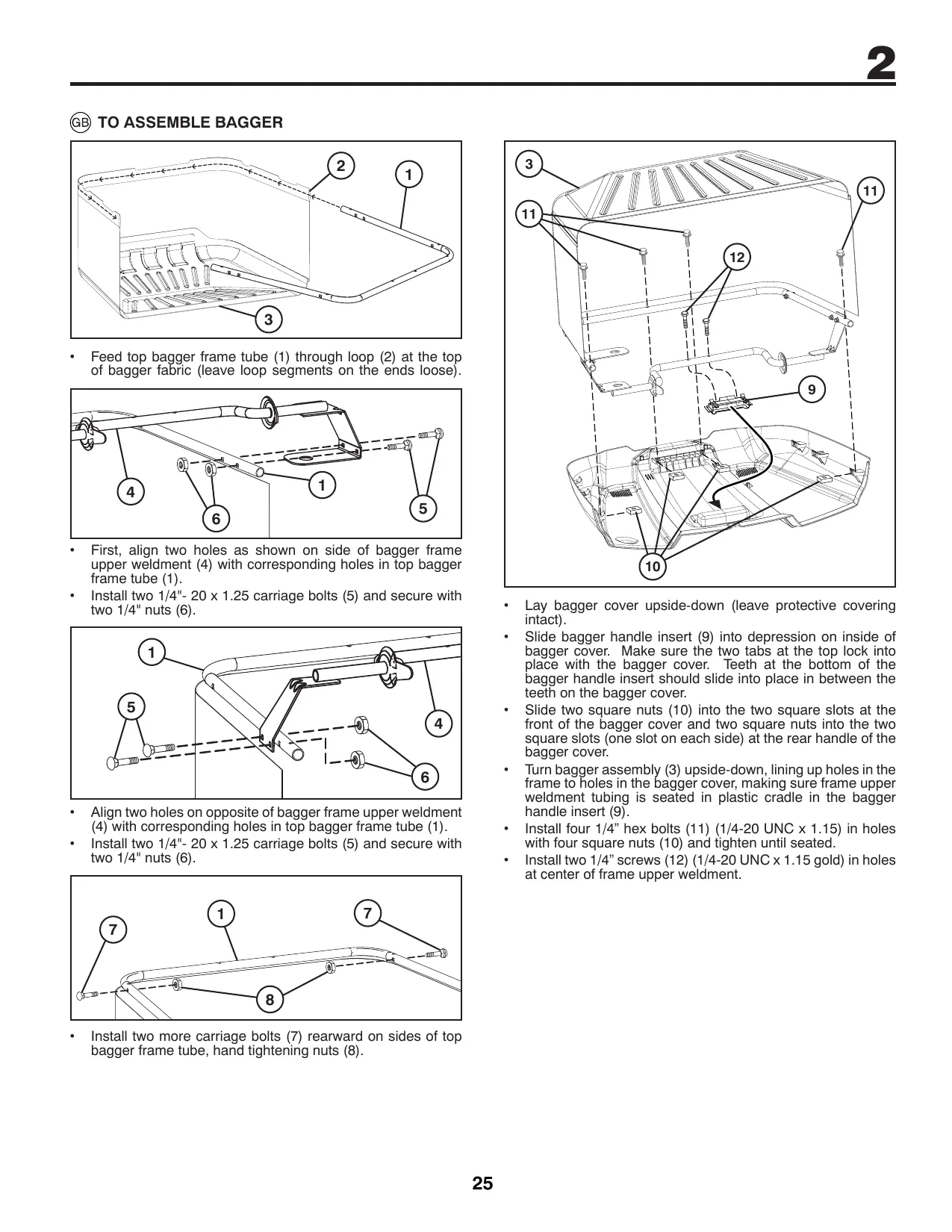
Feed top ba of bagger fal gger frame tube (1) through loop (2) at the top ric (leave loop segments on the ends loose). + First, align two holes as shown on side of bagger frame upper weldment (4) with corresponding holes in top bagger frame tube (1). + Install two 1/4"- 20 x 1.25 carriage bolts (5) and secure with two 1/4" nuts (6). Align two holes on opposite of bagger frame upper weldment (4) with corresponding holes in top bagger frame tube (1). Install two 1/4"- 20 x 1.25 carriage bolts (5) and secure with two 1/4" nuts (6). +__ Install two more carriage bolts (7) rearward on sides of top bagger frame tube, hand tightening nuts (8).
Lay bagger cover upside-down (leave protective covering intact). Slide bagger handle insert (9) into depression on inside of bagger cover. Make sure the two tabs at the top lock into place with the bagger cover. Teeth at the bottom of the bagger handle insert should slide into place in between the teeth on the bagger cover. Slide two square nuts (10) into the two square slots at the front of the bagger cover and two square nuts into the two square slots (one slot on each side) at the rear handle of the bagger cover. Turn pagger assembly (3) upside-down, lining up holes in the frame to holes in the bagger cover, making sure frame upper weldment tubing is seated in plastic cradle in the bagger handle insert (9). Install four 1/4” hex bolts (11) (1/4-20 UNC x 1.15) in holes with four square nuts (10) and tighten until seated. Install two 1/4” screws (12) (1/4-20 UNC x 1.15 gold) in holes at center of frame upper weldment.
Turn assembly right-side up. Install two 1\4” carriage bolts (13) at bottom of front bagger frame (14), hand tightening lock nuts (15). Feed front bagger frame (14) up through fabric loops at front of bagger. Snap bottom of front bagger frame (14) into snap feature at front of bagger bottom. Slide bagger fabric loop segments at the ends of bag onto top bagger frame tubing. Slide two 1\4” hex bolts (16) through holes at top of the front bagger frame and thread into nuts inside the tubing of top bagger frame. Slide plastic clip (17) down into bagger fabric loop on right side and snap to front bagger frame (14) 101 mm (4 inches) from top of front bagger frame tube. Uninstall lock nuts (21) at rear of top bagger frame and at bottom of front bagger frame and attach cross braces (22) on each side. Reinstall lock nuts (21) and tighten until fully seated.
Slide rubber seal (23) to top of metal bagger handle (24). Slide bagger handle (24) down through bagger cover and frame upper weldment holes. Slide clevis pin (25) through hole at bottom of bagger handle and slide retainer spring (26) into hole at the end ofthe clevis pin until it locks into place Push plastic closeout (27) back so that it snaps into place behind retaining ribs (28). Line up holes in grass deflector (29) with bosses in bagger cover. First install 1/4" hex bolt (30) (1/4"-15 x 1/2") into the side as shown. Then install 1/4" hex bolt (31) (1/4"-15 x 1/2") into the top as shown.
+ Before installation, tractor engine must be shut off and parking brake engaged. + Standing behind the tractor with the bagger removed fromthe backplate (1), identify the bag full switch (2) area. (See Fig 1) Fig. 1 Fig. 3 + Take bagger full lever (3) and insert tab(4) into upper slot and rotate until lever (3) snaps into position (See Figs. 2 and 3) + Forthe heaviest/wet grasses, do not attach paddle (5). + For lighter grasses use the paddie (5) on setting “1”, “2”, or “3” (‘3” being for the lightest or dry grass). + Choose your setting and rotate the bagger paddle (5) so that the desired number (setting) faces you. +__ Place paddie (5) on lever (3) so that tab (6) at the bottom of the bagger full lever (3) goes through appropriate rectangular slot and make sure holes in bagger full lever (3) and paddle (5) line up. +__ Feed screw (7) through bagger full paddie (5) and lever (3) holes and fasten using nut (8) (See Fig. 3) + Setting may be changed by loosening fasteners (7 and 8), removing/rotating paddie (5), and tightening again.
TOINSTALL BAGGER COMPONENT TO TRACTOR
+ Before installation, tractor engine must be shut off and parking brake engaged. + Install latch springs (1) in mounting holes on back plate. + Insert hex bolt (2) through each latch spring hole and corresponding hole in back plate. + Fasten lock nut (3) to bolt on the other side of back plate.
Install bagger cover panel (1) by angling plastic posts at front of cover panel (1) into corresponding slots at the front of the bagger top. Swing back end of cover panel (1) down until it rests on bagger cover. Slide whole bagger cover panel (1) rearwards so that teeth under the opening in the cover panel slide into the teeth in the handle portion of the bagger cover. Apply push nuts (2) to plastic posts to secure cover panel (1) in the front. Secure rear side of cover panel (1) to bagger top, and fasten by threading two screws (3) up through rear bagger top handle into the cover panel (1).
2. Throttle and choke control
The accelerator control regulates the motor speed and also the speed of the blades. If the lever is in its forward position the choke function is connected. If the lever is in its reverse position the motor is in neutral. Full speed lies between these two positions.
5. Connection/disconnection of the cutting unit
6. Quick lifting/lowering of the cutting unit
There are four different positions for the ignition key: OFF All electric current broken. ROSON Reverse Operation System (ROS) connected ON Electric current connected. START Start motor connected. Reverse Operation System (ROS) - Allows operation of mower deck or other powered attachment while in reverse (See section 5 - "Driving") WARNING! Never leave the key in the ignition lock when leaving the machine on its own.
Connect the parking brake in the following way:
1. Press down the brake pedal to bottom position.
2. Move the parking brake lever upwards and hold in this
Starting of motor Make sure that the cutting unit is in the transport position (top position) and that the lever for connection/disconnection of the cutting unit is in the disconnection position.
ROS "ON" ROS "AN" ROS "ON" (©) ROS "ON" ROS "ON" ROS "ON" Reverse Operation System (ROS) Your tractor is squipped with a Reverse Operation System (ROS). Any attempt by the operator to travel in the reverse direction with the attachment clutch engaged will shut off the engine unless ignition key is placed in the ROS "ON" position. WARNING! Backing up with the attachment clutch engaged while mowingis strongly discouraged. Turningthe ROS "ON", toallowreverse operation withthe attachment clutch engaged, should only be done whenthe operator decidesitis necessary to reposition the machine with the attachment engaged. Do not mow in reverse unless absolutely necessary.
Maintenance NOTE: Periodic maintenance should be performed on a regular basis in order to keep your tractor in good running condition.
To service engine See engine manual. Oil drain valve Remove cap and install drain tube. To open valve, push in slightly, turn counterclockwise and pull out. To close valve, push in and turn clockwise. Remove drain tube and install cap. Cap Drain Tube Wartung des Motors Im Handbuch des Motors nachschlagen
Operator Presence System and Reverse Opera- tion System (ROS) Be sure operator presence and reverse operation systems are working properly. lf your tractor does not function as described, repair the problem immediately. + The engine should not start unless the brake pedal is fully depressed, and the attachment clutch control is in the disengaged position. CHECK OPERATOR PRESENCE SYSTEM: + Whentheengineis ranning. any attempt by the operator to leave the seat without first setting the parking brake should shut off the engine. + Whenthe engine is running and the attachment clutch is engaged, any attempt by the operator to leave the seat should shut off the engine. + The attachment clutch should never operate unless the operator is in the seat.
Blades For best results mower blades must be kept sharp. Replace bent or damaged blades. Sharpening can be carried out with a file or grinding disc. NOTE: It is very important that both blades are sharpened equally to avoid imbalance. BLADE REMOVAL: + Raise mower to highest position to allow access to blades. + Remove blade bolt securing blade. + Install new or resharpened blade with trailing edge up towards deck as shown. IMPORTANT: To ensure proper assembly, center hole in blade must align with star on mandrel assembly. + Reassemble blade bolt and tighten securely (45-55 Ft. Lbs. torque). IMPORTANT: Special blade bolt is grade 8 heat treated.
To Check Brake If tractor requires more than five (5) feet to stop at highest speed in highest gear on a level, dry concrete or paved sur- face, then brake must be serviced. You may also check brake by:
1. Park tractor on a level, dry concrete or paved surface,
depress brake pedal all the way down and engage park- ing brake.
2. Make sure transaxle is in neutral (N).
.… Park tractor on a level surface. Engage parking brake. Lower attachment lift lever to its lowest position. . Remove any dirt or grass clippings which may have accu- mulated around mandrels and entire upper deck surface. . Remove belt from clutch pulley (M), mandrel pulley (R), and all idler pulleys (V)
MOWER DRIVE BELT INSTALLATION
.… Install belt around both mandrel pulleys (R) and around idler pulleys (V) as shown. Install belt onto clutch pulley (M). IMPORTANT: Check belt for proper routing in all mower pulley grooves.
To Level Mower Make sure tires are properly inflated to the PSI shown on tires. lftires are over or under inflated, it may affect the ap- pearance of your lawn and lead you to think the mower is not adjusted properly.
VISUAL SIDE-TO-SIDE ADJUSTMENT
1. Withalltires properlyinflated andif your lawn appears un-
evenly cut, determine which side of moweris cutting lower.
2. With a 3/4" or adjustable wrench, turn lift link adjustment
nut (A) to the left to lower the mower, or, to the right to raise the mower (Fig. 1). NOTE: Each full turn of adjustment nut will change mower height about 3/16".
3. Test your adjustment by mowing some uncut grass and
visually checkingthe appearance. Readjust, ifnecessary, until you are satisfied with the results.
PRECISION SIDE-TO-SIDE ADJUSTMENT
1. Withalltires properlyinflated, park tractor on level ground
or driveway. À CAUTION: Blade is sharp. Protect your hands with gloves and/or wrap blade with heavy cloth.
2. Raise mower to its highest position.
3. Atbothsides ofmower, position blade at side and measure
the distance (A) from bottom edge of blade to the ground. The distance should be the same on both sides (Fig. 2).
4. lf adjustment is necessary, see step 2 in Visual Adjust-
ment instructions above.
5. Recheck measurements, adjust if necessary until both
FRONT-TO-BACK ADJUSTMENT IMPORTANT: Deck must be level side-to-side. To obtain the best cutting results, the mower blades should be adjusted so the front tip is 1/8" to 3/8" lower than the rear tip when the mower is in its highest position. À CAUTION: Blade is sharp. Protect your hands with gloves and/or wrap blade with heavy cloth. + Raise mower to highest position. + Position blade so the tip is pointing straight forward. Measure distance (B) to the ground at front and rear tip ofthe blade (Fig. 3). + lffront tip of blade is not 1/8" to 3/8" lower than the rear tip, go to the front of tractor. + With an 11/16" or adjustable wrench, loosen jam nut A several turns to clear adjustment nut B. *__ Witha3/4'oradjustablewrench, turnfrontlinkadjustment nut (B) clockwise (Itighten) to raise the front of mower, or, counterclockwise (loosen) to lowerthe front mower (Fig. 4). NOTE: Eachfull turn ofthe adjustment nut will change mower height about 1/8". + Recheck measurements, adjust if necessary until front tip of blade is 1/8" to 3/8" lower than the rear tip. + Hold adjustment nut in position with wrench and tighten jam nut securely against adjustment nut.
ADJUSTMENT Thetransaxle should be inneutral whenthe gearshiftleveris in neutral (N) (lock gate) position. The adjustment is preset atthe factory; however, ifadjustment is needed, proceed as follows: + Make sure transaxle is in neutral (N). NOTE: Whenthetractor rear wheels movefreely, thetransaxle is in neutral. + Loosen adjustment bolt in front of the right rear wheel. + Position the gear shift lever in the neutral (N) position. + Tighten adjustment bolt securely. NOTE: |f additional clearance is needed to get to adjustment bolt, move mower deck height to the lowest position.
Your tractor's deck is equipped with a washout port on its surface as partofits deckwash system. ltshould be utilized after eachuse. + Drive the tractor to a level, clear spot on your lawn, near enough to a water spigot for your garden hose to reach. IMPORTANT : Make certain the tractor's discharge chute is di- rected AWAY from your house, garage, parked cars, etc. Remove bagger chute or mulch cover if attached. + Make sure the PTO (Blade Engage) is not engaged, set the parking brake, and stop the engine. + Thread the nozzle adapter (A) (packaged with your tractor's Operator's Manual) onto the end of your garden hose (B). +_ Pull back the lock collar of the nozzle adapter and push the adapter onto the deck washout port at the left end of the mower deck (C). Release the lock collar to lock the adapter on the nozzle. IMPORTANT : Tug hose ensuring connection is secure. + Turn the water on. + Whilesittinginthe operator's position onthetractor, re-startthe engine and place the throttle lever in the Fast "© position. IMPORTANT: Recheck the area making certain the area is clear. + Move the tractor's PTO (Blade Engage) to the ON position. Remain in the operators position with the cutting deck en- gaged until the deck is cleaned. Move the tractor's PTO (Blade Engage) to the OFF position. Turn the ignition key to the STOP position to turn the tractor's engine off. Turn the water off. Pull back the lock collar of the nozzle adapter to disconnect the adapter from the nozzle washout port. Move the tractor to a dry area, preferably a concrete or paved area. Engage the mower deck PTO to remove excess water and to help dry before putting the tractor away.
WARNING: A broken or missing washout fitting
could expose you or otherstothrown objects from contact with the blade. + __Replace broken or missing washout fitting immediately, prior to using mower again. + Plug any holes in mower with bolts and locknuts.
7. Troubleshooting. 7. Stôrungssuche.
Engine will not start
1. No fuel in fuel tank.
3. Plug connection defective.
4. Dirt in carburetor or fuel pipe.
Start motor will not turn engine Battery flat. Poor contact between cable and battery pole. Connection/disconnection level in wrong position. Main fuse defective. Ignition lock defective. Safety contact for clutch/brake pedal defective. Clutch/brake pedal not pushed down. NONESON Engine runs unevenly Gear too high. Plug defective. Carburetor incorrectly set. Air filter blocked. Fuel tank ventilation blocked. Ignition setting defective. Dirt in fuel pipe. NONBON A Engine feels weak
1. Air filter blocked.
3. Dirt in carburetor or fuel pipe.
4. Carburetor incorrectly set.
Engine overheats Engine overloaded. Air inlet or cooling fins blocked. Fan damaged. Too little or no oil in engine. Ignition setting defective. Plug defective. DHEON Battery does not charge
2. One or several cells defective.
3. Poor contact between battery poles and cables.
Lighting does not function
2. Switch defective.
3. Unbalance in one or both blades resulting from damage
or poor balancing after sharpening. Uneven cutting results Blades blunit. Cutting unit skew. Long or wet grass. Grass stuck under cover. Different air pressures in tires on left and right side. Gear too high. Drive belt slipping. NONESON
2. De bougie is defect.
1. De zekering is defect.
2. De schakelaar is defect.
532 42 22-18 Rev. 1 03.27.09 AP (() Husqvarna Printed in the U.S.A.
ManualGo.com