
AR 4023 DVD - Car stereo AEG - Free user manual and instructions
Find the device manual for free AR 4023 DVD AEG in PDF.


| Product Type | Car Stereo with DVD Player |
| Brand | AEG |
| Model | AR 4023 DVD |
| Form Factor | 1-DIN |
| Dimensions (W x H x D) | 178 x 50 x 165 mm |
| Weight | 1.5 kg |
| Power Supply | 12V DC (car battery) |
| Max Power Output | 4 x 50 W |
| Display | LCD with touchscreen (2.8 inch) |
| Playback Media | DVD, CD, MP3, WMA, JPEG |
| Connectivity | USB, SD card slot, AUX-in, Bluetooth |
| Radio Tuner | AM/FM with RDS |
| Bluetooth Version | 4.2 |
| Audio Output | 4-channel RCA preamp outputs |
| Video Output | Composite video out |
| Remote Control | Included (IR) |
| Steering Wheel Control | Compatible (adapter may be required) |
| Additional Features | Equalizer, subwoofer control, anti-shock |
| Safety | Detachable faceplate for theft prevention |
| Package Contents | Stereo unit, wiring harness, mounting kit, remote control |
| Dust and Moisture Protection | Not specified (typical for interior use) |
Frequently Asked Questions - AR 4023 DVD AEG
User questions about AR 4023 DVD AEG
0 question about this device. Answer the ones you know or ask your own.
Ask a new question about this device
Download the instructions for your Car stereo in PDF format for free! Find your manual AR 4023 DVD - AEG and take your electronic device back in hand. On this page are published all the documents necessary for the use of your device. AR 4023 DVD by AEG.
USER MANUAL AR 4023 DVD AEG
3"/7.6 cm Car Radio with DVD/USB/Card Reader
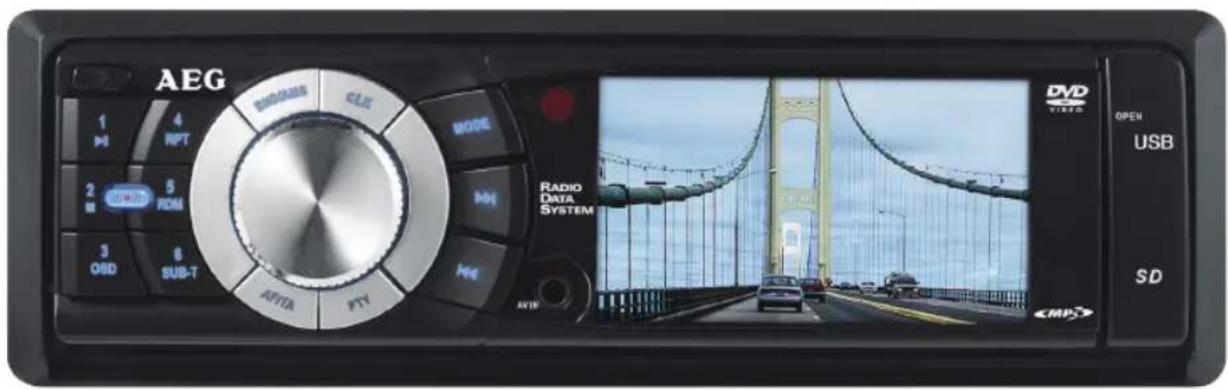
DEUTSCH
Inhalt
Overview of the Components ......Page 3
Instruction Manual Page 24
Safety Information Page 24
Road Safety Page 24
Safety Information when installing and
connecting the radio Page 24
Important Information
for installing your carradio! Page 25
Installation Page 25
Connection Page 26
Operating Instructions......Page 26
Starting up Page 26
Operation (Illustration 2: Control Panel)......Page 27
About the DVD-Player Page 30
Changing the default settings ......Page 32
Technical Data Page 35
Troubleshooting Page 35
Handling a CD/DVD Page 36
Index Page 38
Menu Overview Page 39
Overview of the Components
natural_image
Technical line drawing of a mechanical assembly with labeled components (no text or symbols present)h
Anschluss
a) TA Traffic Annonouncement
natural_image
Simple line drawing of a hand pressing down on a circular object (no text or symbols)Installationstipps 6
L
Illustration 1: Remote Control
1 ▶ PLAY/PAUSE:
CD/MP3/DVD mode: Starting playback, stopping picture/track.
2 ☒: To switch off the sound.
3 TITLE:
To show the title menu of the DVD (depending on the DVD).
4 SUB-T: For changing the subtitle languages in DVD mode (if available).
5 SETUP: To start the setup menu.
6 ANGLE: To select the viewing angle (if available).
7 SLOW: Slow motion. Film continues playing with the "▶II" button.
8 ZOOM: For zooming in and out in DVD Mode.
9 SEL:
Radio Mode:
Select sound/picture mode.
10 AUDIO: DVD Mode: Change audio languages (depending on the DVD).
11 Numerical buttons:
a) Radio Mode:
- Press briefly (0-6): Station selection.
- Press longer (0-6): Station storage.
b) CD/MP3/DVD mode:
For direct selection of chapter or song number.
12 GOTO: For direct accessing of a section on the CD/DVD.
13 10+: for selecting the chapters/tracks above 9. Pressing again increases by a further 10.
14 OSD: CD/MP3/DVD Mode: Switching the display.
15 PBC: Activate/deactivate Playback Control with VCD.
16 VOL +/-: To increase/reduce the volume.
SEEK+/▶Radio mode: Manual channel Search. CD/MP3/DVD Mode: To jump to the next chapter or song.
SEEK-/Radio mode: Manual Station Search. CD/MP3/DVD Mode: To return to the previous chapter or song.
17 RDM: In CD/MP3/DVD Mode: Random playback.
18 AMS/RPT:
a) Radio Mode:
- Press briefly: Automatic Station Search.
- Press longer: Automatic station storage.
b) DVD Mode: To repeat title, chapters, etc.
19 ST/PROG:
a) Radio Mode: Stereo/Mono switching.
b) CD/MP3/DVD Mode: Display Playlist.
20 ■: Stop play.
21 Cursor buttons:
DVD mode: Navigation in screen menu.
22 ENTER: Confirming the input.
23 BND/SYS:
a) Radio Mode: Switching the 3 FM and 2 MW levels.
b) CD/MP3/DVD mode: AUTO/NTSC/PAL Colour system switch.
24 To activate standby mode.
25 MODE: Operating mode selection (CD/DVD, AV, Radio etc.).
Illustration 2: Control Panel - see Operation.
Instruction Manual
Thank you for choosing our product. We hope you enjoy using our product.

Safety Information
Read the operating instructions carefully before putting the appliance into operation and keep the instructions including the warranty, the receipt and, if possible, the box with the internal packing.
• Use the device only for the intended purpose.
- The device should be installed in such a way that existing ventilation holes are not covered.
- Never open the housing of the device. Incorrect repairs can constitute a considerable risk for the user. If the device is damaged it should not be used, but repaired by a specialist.
These symbols may be found on the machine and are intended to indicate the following:

The symbol with an exclamation mark should advise the user of important operation or maintenance instructions in the accompanying documentation.

Devices bearing this symbol work with a "class 1 laser" for tracing the CD/DVD. The built-in safety switches should prevent the user being exposed to dangerous laser light, which is invisible to the human eye, when the CD compartment is opened.
Under no circumstances should these safety switches be bypassed or manipulated, as this could result in a danger of exposure to the laser light.
Symbols in these Instructions for Use
Important information for your safety is specially marked. It is essential to comply with these instructions in order to avoid accidents and prevent damage to the machine:

WARNING:
This warns you of dangers to your health and indicates possible injury risks.

CAUTION:
This refers to possible hazards to the machine or other objects.

NOTE: This highlights tips and information.
Children and Frail Individuals
- In order to ensure your children's safety, please keep all packaging (plastic bags, boxes, polystyrene etc.) out of their reach.

WARNING!
Caution! Do not allow small children to play with the foil as there is a danger of suffocation!
Road Safety

WARNING:
- Road safety is of paramount importance. You should therefore use your car radio at all times in such a way that you are able to cope with the current traffic situation.
- Please remember that at a speed of 30 mph (50 kph) you travel 15 yards (14 metres) in one second.
- We advise you not to operate the radio in critical situations.
- It must be possible to hear the sirens of police and fire brigade vehicles etc. from inside the vehicle in good time.
- When driving you should therefore not turn the radio volume up excessively.
- For safety reasons a lock connected to the hand-brake of the vehicle prevents certain functions of the device from operating when the vehicle is moving. In order to be able to use these functions please stop in a safe place and put on the handbrake.
- Please note that it is not permitted to operate the DVD player when the vehicle is moving or if the engine is running!
- In order to avoid serious road accidents, the device should be installed in such a way that you are not hindered when operating the steering wheel, gear lever etc.
- Similarly, safety aspects such as airbags and your clear view of the road must not be obstructed either
- Under no circumstances should any additional monitor that is connected be installed in such a way that it can be seen by the driver when the vehicle is moving!
Safety Information when installing and connecting the radio
- First disconnect the minus pole and then the plus pole of the battery. (connection in the reverse order.)

NOTE:
Please note: Once the battery has been disconnected the information is lost from all volatile memory. Please note the safety information provided by the vehicle manufacturer.
- The main fuse must be installed as closely as possible (not more than 30 cm away) to the plus pole of the battery so that the car is protected from any cable fire caused, for example, by an accident. If the above is not complied with the insurance protection no longer applies.
- The cross-section of the plus and minus cable must not exceed 1.5 mm ^2 .
Installation Tips:
- Cable protection sleeves protect cables against fraying on sharp body parts.
- The insulation of the cables must not be damaged during installation.
- It is essential to use the correct tools when installing car hi-fi.
Depending on the model, your vehicle may deviate from the above description. We do not accept any liability for damage caused by installation or connection errors or for consequential damage.
Important Information for installing your carradio!
- The screws (h) of the transport locking device should be removed before installation, as otherwise the CD cannot be inserted.
- The device is designed for the minus pole of the battery, which must be connected to the body of the vehicle. Please check this before installation.
-
When installing/connecting your device please note that not every vehicle is equipped with an "ISO connection". In this case we recommend the use of an ISO adapter specifically designed for your vehicle.
Adapters are available from car accessory shops and/or from your vehicle workshop. -
Depending on the specific car type, different wiring connection of the "Duration +" wire (Constant current connection) are available. (However, this is necessary for storing the radio stations.)
In order to guarantee all functions, installation in line with these instructions is essential. In cases of doubt please contact an authorised car workshop.
Due to the various types of motor vehicles and motor manufacturers, it is not possible to guarantee that the pin assignment of the ISO plug is correct, even if the ISO plug connections fit together mechanically. It may therefore be necessary to modify the electrical connection or use vehicle-specific adapters.
i NOTE:
If the device is correctly connected, the radio can be switched on and off via the ignition. If the stored stations are lost, this indicates that the radio is not receiving any "continuous +", current which is required for storing the ations.
CAUTION:
Where there is a connection to "continuous +" without the ignition being switched on, the car battery might be drained of power even if the radio is switched off. This may even result in the battery becoming completely flat.
- The angle of inclination when a car radio is installed must not exceed 20^ , as in the case of greater angles of inclination the function of the car radio (CD Player) can no longer be guaranteed.
- Depending on the specific car type, interferences can be possibly arise during radio/CD/DVD operation. These interferences can avoid easily with an additional Interferences filter. Your car radio is originally prepared with an Interference Filter already. In these case, please contact your authorized car dealer.
- When installing your radio please ensure that there is enough space at the rear of the radio to ensure sufficient cooling.
- For the antenna connection there are two different norms. The first of these is the old (50 ohm) version with a long protruding round contact on the vehicle and a round socket on the radio end. The second is the ISO-standardised antenna plug (150 ohm). Adapters for both formats are available from accessory manufacturers and/or your car workshop.
i NOTE:
Important information for VW/Audi vehicles: The antenna in your vehicle may be an active antenna. This requires a power supply which is only provided by the original car radio. If this is the case, use an antenna adapter for phantom power supply. Antenna adapters can be found in car accessory outlets and/or at your car repair shop.
Installation
Please install the car radio as shown below.
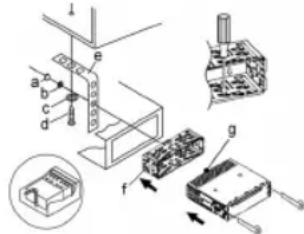
a Nut
b Spring washer
c Plain washer
d Screw
e Mounting bracket
f Slide-in housing
g Threaded bolt
h i NOTE:
Note: Retaining screws during transport (please remove before installation)
i Extraction tool (spanner for dismantling)
j Frame
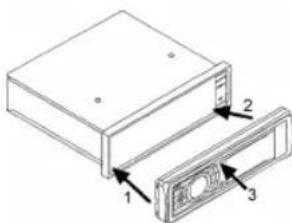
First place the control panel in position on the left hand side and then lock it in place on the right. Then turn the control element up until it locks.
Connection
Connect the device as shown in the diagram.
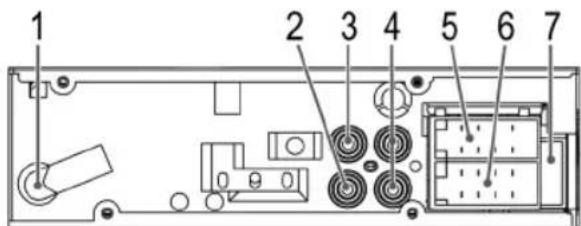
1 Antenna connection
2 VIDEO OUT Jack
3 SUBWOOFER OUT Jack
4 LINE OUT (Preamp output):
Audio Cinch output L/R for amplifier
5 ISO connection B (Speaker)
6 ISO connection A (Power supply)
7 Car fuse (15 A)
PIN Assignment of the ISO connection
The PIN assignment of the ISO connection may vary between several vehicle models, in spite of the plugs and sockets being of identical design. Before installation, you must therefore compare and check whether the PIN assignment of the ISO connection matches the assignment in the vehicle.
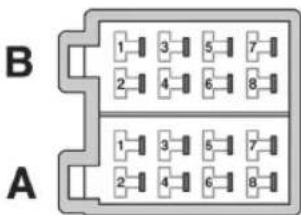
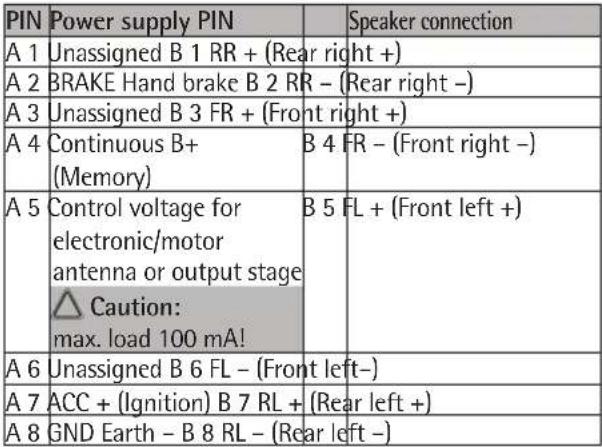 |
△ CAUTION:
- Do not attach the removable control panel until after connection of the cables.
- Please use loudspeakers with an impedance of 4 ohm.
• The loudspeaker cables must be unearthed.
• If a subwoofer is connected, an amplifier is required.
- The earth connection cable (BRAKE) must be connected in order for DVD pictures to be played back to the monitor. If the cable has not been properly connected the message "ATTENTION YOU CAN NOT USE THIS FUNCTION WHILE DRIVING" appears.
Operating Instructions
-
If the front control panel is removed while in the Radio or CD Mode, the device continues the playback for a few minutes and then switches off.
-
Any errors (ERROR) occurring during operation can be corrected by pressing the RESET button. Use a piece of wire or similar item to press the RESET button (15) in order to return the electronics to its original state.
-
If the interior of the vehicle becomes very hot, for example after standing in direct sunlight for a prolonged period, do not switch on the player until the inside of the vehicle has cooled down a little after you have been driving for a few minutes.
-
In order to keep the removable control panel in a safe place you should always use the protective case provided.
-
Playback of CDs/DVD produced by the user cannot be guaranteed due to the large variety of software and CD/DVD media available.
-
Playing back video files via USB or Memory card: In rare cases, short-term audio or video interference may occur during playback of video files via USB or memory cards. Due to the different compression methods and bit rates depending on the content of the picture, the flow of data may be "sluggish".
Should there be problems with playback, stop the file by using the Pause button. Wait a few seconds and start playing the file again.
Starting up
Remote control battery installation
WARNING:
Leaking out battery acid can damage your health. Remove the battery from the battery compartment as soon as it is exhausted or if the remote control is not going to be used for a longer period of time. Wipe up leaked out battery acid with a cloth. In case of skin contact immediately wash the affected area. Seek medical advice if battery acid has been swallowed. In case of contact with your eyes wash out the eyes and seek medical advice.
△ CAUTION:
When disposing of old batteries you should strictly comply with the legal and environmental regulations applicable in your country. Do not throw batteries into fire!
i NOTE:
- The lithium cell in the battery compartment of the remote control has been secured for transport with a foil.
Before initial use please remove this foil so that the remote control is ready for operation.
- The lifetime of the enclosed battery may be shortened because of storage.
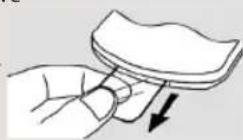
The battery of the remote control is a long-life lithium cell. If the range of the remote control is reduced during use, please proceed as follows:
- Open the battery compartment on the back of the remote control.
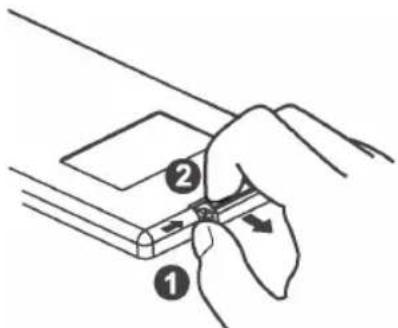
- Replace the cell by a battery of the same type (CR 2025). Ensure correct polarity.
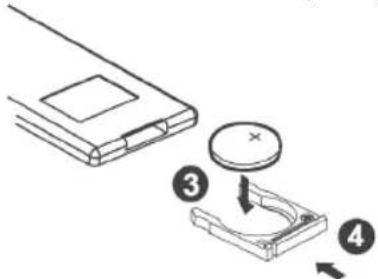
- Then close the battery lid.
If the remote control is not used for a prolonged period, remove the batteries in order to prevent battery acid leaking.
WARNING:
Do not expose the batteries to high temperatures or direct sunlight. Never throw batteries into the fire. There is a danger of explosion!
△ CAUTION:
Batteries are not to be disposed of together with domestic wastes. Dispose of the used batteries at the relevant collection bin or at your dealer's.
i NOTE:
The signals from the remote control are transmitted to the device by infrared light. You should therefore ensure that the device is not in direct sunlight. This might make transmission of the signals from the remote control to the device impossible.
Effective range of the remote control
Point the remote control at the remote control sensor on the right next to the display on the front of the device. The distance between remote control and sensor should not exceed 5 m. The angle of the remote control to the remote control sensor to right, left, top and bottom should not exceed 30°.
Operation (Illustration 2: Control Panel)
i NOTE:
Some keys are to be found both on the device itself and on the remote control. Keys with the same designation have the same function.
1 Button
Press the ▲button to release and detach the front control panel.
2 Ob/Off Button
Press this button to switch the device on. Keep this button pressed to switch the device off.
MUT
Switches off the volume quickly. "MUTE" appears on the display. To cancel this function, press the MUT button again.
3 BND/AMS Button
a) Radio Operation
Press once shortly:
Briefly press the BND/AMS button to switch between FM (FM) and AM (medium wave) bands. The designation of the corresponding level FM 1, FM2, FM3, AM1, AM2 appears in the LCD display. Press and hold down:
Hold down the BND/AMS button to start the automatic station search. The stations are stored in ascending order of frequency.
b) CD/MP3/DVD mode
Switch between the colour systems PAL, NTSC and AUTO.
4 CLK button
a) Display the time
Press this button in CD-, USB-, CARD-, or AV mode to briefly display the time in the lower right hand corner of the LCD display.
b) Setting the time manually
- Hold down the button to set the time manually, if it is not automatically set via the RDS signal. Automatic setting of the time may take a few minutes. The hours flash.
- Set the time with the multifunction control (12). Press the CLK button. The minutes flash.
- Set the time with the multifunction control (12). The settings are automatically applied.
5 MODE Button
Press this button to select the CD/DVD player, AV-, or radio mode.
i NOTE:
The CD, USB and CARD Mode can only be selected if you have connected or inserted the corresponding storage device.
6 Buttons
a) In Radio mode:
For manually setting the radio station.
b) In CD/DVD mode:
Press the ◀ or ▶ button briefly to jump forwards or backwards. If you would like to scroll the titles of the tracks keep the ◀ or ▶ row button pressed.
7 IR (Infrared)
Sensor for the remote control.
8 LCD (liquid crystal display)
9 AV IN Jack
To connect analogue replay devices. Using this socket it is possible to hear the sound of other playback devices such as MP3 players, CD players etc. through the loudspeaker.
- Please connect the external device with a 3.5 mm stereo jack plug to the AV IN socket.
- Press the MODE button (6) repeatedly until "AV" appears in the display.
- You now hear the sound from the external device played back through the loudspeakers.
- With the multifunction controller (12) you can change the volume.
- For the remaining procedure please see the operating instructions of the external sound source.
i NOTE:
Adjust the volume of the external device to a comfortable level.
10 PTY button
Radio Operation:
PTY Selection of the Programme Type Besides the station name, some FM stations also transmit information on the type of programme. This information can be displayed by your car radio.
Examples of such types of programme are:
SPORT NEWS POP CLASSICS
With the PTY function you can specifically select stations transmitting a particular type of programme. Press the PTY button, to activate the function. Then turn the multifunction control (13) to make the selection in the PTY. The message "PTY SEEK" then appears briefly in the display.
When PTY has been selected the radio starts searching for corresponding PTY information and stops when the PTY information has been found.
If the searched program type is not found, the device returns to the last listened to radio station. If the PTY information being searched for no longer exists, the PTY function automatically switches to normal mode.
11 AF/TA Button
a) TA Traffic Announcement
(Priority for Traffic Information) The TA function is activated by pressing the AF/TA button briefly. The TA symbol appears in the display. During radio operation in one FM frequency band the search for a traffic announcement station is started automatically (SEEK TA).
If an FM station is being received which transmits the latest traffic announcements from time to time, the TP display lights up.
When the TA function is switched on, the FM traffic announcements automatically interrupt CD operation (The word TRAFFIC appears in the display).
i NOTE:
The volume for traffic information is present and cannot be adjusted.
After the traffic announcement has finished, the programme that was previously running is resumed.
Interruption of the TA Function:
If you would like to interrupt the current traffic announcement, press the AF/TA button briefly. The TA mode is switched off as a result.
b) Radio Operation
AF (Alternative Frequencies) REG Function AF is a function that works with the help of RDS (Radio Data System) and can only be used with FM stations. The radio searches in the background for the best frequency reception of the station that has been tuned into.
If the AF function has been switched on, the radio continuously tests the signal strength of the AF frequency. The test interval for each AF frequency depends on the signal strength of the current station and varies from a few minutes in the case of a strong signal to a few seconds in the case of weak signals. Whenever the new AF frequency is stronger than the station that is currently tuned in, the radio switches to this frequency for a short time and the message "NEW FREQUENCY" is displayed for one to two seconds. As the mute time during the frequency change and the test time is very short, this is almost inaudible during the normal programme.
The AF function is activated by holding down the AF/TA button and the status of the AF function is indicated by an AF symbol in the display.
- If the AF symbol appears in the display, the AF function is switched on and RDS transmission data is being received.
- If the AF symbol flashes in the display, the AF function is selected but no RDS signal can be received at the moment.
- Press the AF/TA button long again to switch off this function. The AF symbol in the display goes off.
12 VOL Multifunction controller (Volume)
In the standard playback mode the Multifunction controller is used for adjusting the volume. If the SEL button is pressed beforehand, changes can be made in the menus, e.g. sound mode.
SEL button (Select)
- Press the multifunction control (12) or press the SEL button (9 on the remote control) to display the following selection menus: VIDEO SETUP (only in CD/DVD/ AV Mode), AUDIO SETUP, SYSTEM SETUP.
- Using the ▶/▲ buttons, select the individual options in the menus.
• Make changes using the Multifunction control.
VIDEO SETUP (only in CD/DVD/ AV Mode)
In this menu you can make various adjustments to the screen.
BRIGHTNESS, CONTRAST, SHARPNESS, SATURATION and HUE for NTSC only.
AUDIO SETUP
Make adjustments to the sound here.
BASS, TREBLE, BALANCE, FADER (Fade control), EQ (Equaliser), and LOUD (Loudness).
In the EQ Menu you have the choice of the following options: FLAT, ROCK, POP, CLASSIC, JAZZ.
i NOTE:
- The BASS and TREBLE settings can only be changed if you have selected the equaliser option FLAT.
- Use the Loudness function (LOUD ON) to extend the sound in the low volume range. Treble and Bass are increased.
SYSTEM SETUP
- CLOCK
The time can be manually set here if it is not automatically set through the RDS Signal. The automatic setting of the time may take several minutes.
• SUB
In this menu you can switch the subwoofer output on the back of the device ON or OFF.
- DEFAULT RESTORE
The factory defaults are restored.
13 Station buttons (1-6) preselected buttons and miscellaneous functions in CD/DVD mode
a) Radio Operation
Pressing these buttons briefly directly selects a preset radio station. If these buttons are pressed for more than one second, the station currently being listened to is stored under the selected station button.
b) CD/DVD Operation
The following functions can be switched on and off by pressing the corresponding button.
1▶II Button
Press the ▶Button to interrupt playback of the CD/DVD (pause function). Press this button again to continue listening to the CD.
i NOTE:
Playback of CDs produced by the user cannot be guaranteed due to the large variety of software and CD media available.
ENGLISH
Playing back Music in MP3 Format
With this device it is possible to play back pieces of music in MP3 format. The device also supports all standard CD types: CD, CD-RW, CD-R.
This machine of is able to play MP3 CDs. Up to 200 tracks can be compressed and stored on these CDs. Your machine detects an MP3 CD automatically (MP3 appears in the display).
Please note:
There are a number of different recording and compression methods, as well as quality differences between CDs/DVDs and self-recorded CDs/DVDs.
Furthermore, the music industry does not adhere to fixed standards (copy protection).
For these reasons it is possible that in rare cases there are problems with the playback of CDs/DVDs and MP3 CDs. This is not a malfunction of the device.
2 ■ button
Press this button to stop playback.
30SD button
Press this button to switch the display.
4RPT button
Activates the repeat function. Select the required repeat mode by repeatedly pressing the button.
5RDM button
The DVD, MP3/CD tracks are played at random.
Press this button again to cancel this function.
6SUB-T button
For changing the subtitle language in DVD-Mode (if available).
14 RESET (Reset)
See Section "Operating Instructions" point 2 on page 26.
15 Eject Button
Press this button to eject the CD/DVD.
16 CD/DVD Slit
Insert the CD/DVD with the labelled side facing upwards gently into the CD/DVD slot until the device draws in the CD/DVD automatically.

CAUTION:
Only 12 cm discs can be played with this device!
17 SD/MMC Card Slot
If you want to play data of a SD/MMC Card, plug it into the slot provided until you hear a click. The side with the contacts must face to the right. The word READ CARD appears in the display.
The data are automatically played back.
Press down the SD/MMC Card again to remove it.
i NOTE:
- Should the memory card not be automatically selected press the MODE button again.
- To select a specific track navigate using the cursor buttons in the File menu and select the track with ENTER.
18 USB Connection
If you would like to play back data contained on a USB stick, please insert the stick into the opening provided. e word READ USB appears in the display. The data is played back automatically.
i NOTE:
- Should the USB storage device not be automatically selected press the MODE button again.
- To select a specific track navigate using the cursor buttons in the File menu and select the track with ENTER.
- Please note: The USB connection is only designed for playing back data from storage devices and not for charging from other external devices (e.g. Smartphones). Only a low power (100 mA) power supply can be guaranteed. This USB connection is not designed for the use of e.g. external 2.5" hard drives, which may have starting currents of up to 1100 mA.
Please connect your Smartphone or iPod or rather iPhone to the according AUX-IN port for the play-back of your music files.
About the DVD-Player
With this DVD-Player you can play a vast variety of DVDFormats → "Technical data".
However, you must be aware that in many cases DVDs are encrypted with a so-called "Regional Code". This specifies for which region in the world the DVD is intended. As an example, the DVDs marked with regional code "1" are intended for the USA and Canada. DVDs with regional code "2" are for use in Europe.
i NOTE:
With your DVD-Player you can only play DVDs with regional code "2". There are both lots of burning and compressing methods as well as high quality differences in (burned) CDs/DVDs. Moreover, the music industry has not yet agreed on a fixed standard for copy protection. This may, in very isolated cases, result in problems when relaying CDs, DVDs and MP3 CDs. This is no malfunction of the player.
Furthermore, there may be isolated problems when playing CDs or DVDs which were created on a PC (e.g. holiday photographs). In case of problems check the settings of the DVD writing program on your computer. You should in particular make sure that the DVD has been finalized. For further information on this matter please refer to the operating manual of your recorder.
Terminology
- Track: "Track" means the sections of an Audio CD. This may be, for example, a song, the suite of a symphony etc.
- Title/Chapter: Video DVDs are subdivided into "Title" and "Chapter". A "Title" may be e.g. a specific film, the "Chapter" however may be subsections of this film.
- MPEG4: Also suitable for playing back files which are MPEG-4 (short for Moving Picture Experts Group-4) compressed. MPEG-4 is a compression method through which a large amount of data can be reduced without a noticeable loss of picture and sound quality.
i NOTE:
Full compatibility with globally available compression methods cannot be guaranteed, in particular if there are several sound tracks or subtitles in play. Even MPEG 4 Files with integrated special functions such as menu, subtitles etc. are not always supported. This is not a malfunction of the device.
Input Not Possible

If a function or input which you have selected is not valid, the adjacent symbol is shown on the screen.
Using the DVD-Menu
Normally each DVD has its own menu. Here you can choose the chapter, make settings, etc. This menu is specific for the DVD and can thus not be explained in detail.
Press the TITLE button (Fig. 1/3), to access the DVD-menu. Use the Cursor Buttons (Fig. 1/21) to navigate in the Menu. Press the ENTER button (Fig. 1/22) to confirm.
If you are in a menu area for direct chapter selection, you can enter the number of this chapter with the Numerical Buttons (Fig. 1/11) on the remote control.
Changing audio-language
Press the AUDIO button (Fig. 1/10) several times to change the Audio language. The available audio languages depend on the DVD.
Showing subtitles
Press the SUB-T button (Fig. 1/4) to display the current subtitle status. Press the button several times if you would like to activate or deactivate the subtitle function or if you want to choose a different subtitle language. The available subtitle languages depend on the DVD.
Stopping the reply
- Press the "button (Fig. 1/20) during replay. The replay stops.
- Press the "II" button (Fig. 1/1) again, to continue the replay from the last position.
- Press the "button (Fig. 1/20) twice to stop the replay completely. Press the "button (Fig. 1/1) again, to replay the CD/DVD from the beginning.
Selecting previous chapter/track
Press the "SEEK-" button (Fig. 1/16) to jump to the start of the previous chapter or track.
Selecting next chapter/track
Press the "SEEK+" button (Fig. 1/16) to jump to the start of the next chapter or track.
Selecting track directly
Enter the number of the desired chapter/track with the Numerical Buttons on the remote control (Fig. 1/11).
Replay of the track starts after a short while.
Using fast forward or reverse
The DVD-Player has a fast forward and a fast reverse feature.
- Quickly press SEEK+ (Fig. 1/16) or SEEK-(Fig. 1/16), to start fast forward or fast rewind. The current replay direction and the speed, e.g. "FORWARD x 2" is now displayed on screen.
- Quickly press the ▶SEEK+ or ▶SEEK- button repeatedly, to change the speed. The speed can be accelerated by factor 2x, 4x, 8x, 16x or 20x.
- Press the "▶II" button (Fig. 1/1) to restart the "normal" replay when the desired section is reached.
Start Passage via the menu
You can conveniently control any passage of a medium using the screen menu. Proceed as follows:
- Press the GOTO button (Fig. 1/12). The menu appears on the screen.
- Select the desired option using the cursor buttons (Fig. 1/21).
- Now enter the point from which playback should start. Depending on the type of medium this may be a track number, a chapter, or the time. Use the numerical buttons (Fig. 1/11) to enter the point. Then press the ENTER button (Fig. 1/22).
Create a Playlist
In certain circumstances you may want to play e.g. the title of a DVD not in the order specified by the manufacturer. You can use the "Create Playlist" function to create a separate playback sequence. Proceed as follows:
32
ENGLISH
- Press the ST/PROG button (Fig. 1/19). You will now see a table. Enter the required sequence here.
i NOTE:
Your playlist will be lost when the device is switched off or when a new CD/DVD is inserted.
- Use the cursor buttons to navigate in the table (Fig. 1/21).
- Enter the desired title and the chapter (for DVDs) or a track (for CDs/MP3s) in the respective table position. Use the numerical buttons to do this (Fig. 1/11).
- Save your entries by selecting the "Play" command on the bottom border of the table using the cursor buttons (Fig. 1/21).
- Confirm the command by pressing the ENTER button (Fig. 1/22) of the remote control.
Clear Playlist
- Press the ST/PROG button. You will now see a table.
- Use the cursor buttons to control the "Clear" function on the bottom border of the table.
- Confirm the command by pressing the ENTER button of the remote control.
- To hide the table again, press the ST/PROG button.
Enlarging a screen section
You can change the screen section when viewing DVDs, VCDs or images.
Press the ZOOM button (Fig. 1/8) to change the screen section. Press the button several times to select the suitable zoom factor or to return to the original zoom factor.

NOTE:
With the cursor buttons (Fig. 1/21) you can move through the zoomed image.
Changing the viewing angle
Some DVDs offer the possibility to select the viewing angle.
Press the ANGLE button (Fig. 1/6) to change the viewing angle.

NOTE:
If changing the Viewing Angle is not possible, the symbol 🔗 will be displayed.
Repeat pressing the the button to choose a different viewing angle, or to return to the original viewing angle.
Changing the default settings
A large number of default settings can be comfortably changed via the screen menu.
Press the SETUP-button (Fig. 1/5) on the remote control to start the menu for changing the default settings (only in DVD mode).
i NOTE:
Many of these default settings can be changed via both the remote control and the menu. The difference is: If you change the default settings via the remote control, these changes will only be valid until the DVD-Player is switched off or the DVD is changed.
However, any changes made in the menu are permanent.
Understanding the menu structure
The Setup menu has two menu levels:
- Main menu: The main level is represented by graphical symbols.
- Sub-menu: The corresponding sub-menu options can be found under each of the main menu options.
Using the menu
Navigation and selection
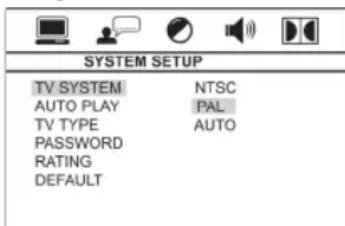
- Use the Cursor Buttons (Fig. 1/21)(, ▶) on the remote control to browse through the main menu.
- In contrast to this, you must use the Cursor Buttons (▲) to move in the sub-menu.
- Select a menu option with the ENTER-button (Fig. 1/22).
- Use the ENTER-button also to select an option (e.g. "PAL" in the illustration on the top). The selected option is now highlighted.
- Press the cursor button return to the submenu.
Slide control
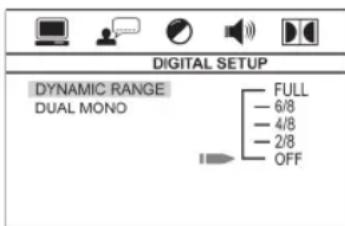
In some menus you will find slide controls. The slide control is used as follows:
- Select with the ENTER-button.
- Move the control with the Cursor Buttons (▲).▼
- Confirm the entry with the ENTER-button.
Overview of the main menu
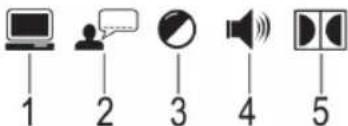
- General Settings (1)
• Language settings (2)
• Video settings (3)
• Speaker settings (4)
• Digital settings (5)
i NOTE:
Some of the menu settings can only be selected in stop mode (depending on the DVD).
General Settings
TV-System
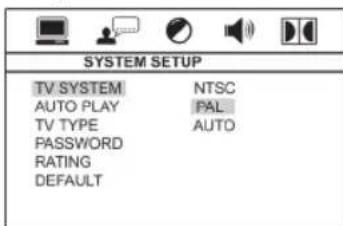
Match the output of the DVD-Player to the colour transfer system of your replay device. The following options are available:
• PAL: A system commonly used in Europe.
- AUTO: Select this setting if your replay device is a multisystem unit.
• NTSC: A system primarily used in North America.
i NOTE:
By pressing the BND/SYS (Fig. 1/23) you can also switch between the options.
Auto Play
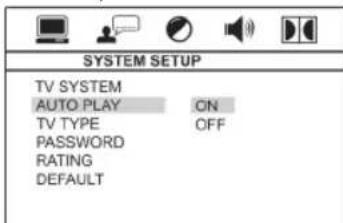
If the function is activated the DVD Menu is skipped and the playback of the main movie begins automatically.
TV Type
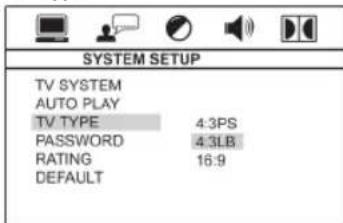
Here you can adapt the output of the DVD-Player to the TV aspect.
Concerning the background: If you do not have a wide screen TV the TV-aspect will be 4:3. However, most feature films have an aspect of 16:9, the image is therefore too wide for the TV screen.
Here you can specify how the replay of the film is to be adapted to the replay device:
- 4:3/PS: You will only see the middle section of the film. The borders will be cut off ("Pan-Scan").
- 4:3/LB: You will see the complete width of the film. The film is thus reduced in size, whereby black bars appear below and above the film ("Letter-Box").
- 16:9: Select this option if you use a wide screen TV for replay. Please note that films, that have been recorded with TV-aspect 4:3 can still be replayed using aspect 4:3. This means, that replaying this film will not require the complete wide screen area of the television.
i NOTE:
The setting "4:3/PS" is not supported by all DVDs.
Password
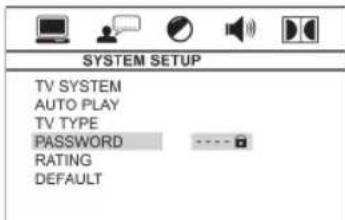
If you want to operate the DVD-Player with a child protection system, you must first enter a password. This password safeguards the settings for the child protection system, so that it can only be changed by yourself.
In order to change the password, you must first enter the current password. The master password is "0000".
i NOTE:
If you forgot your password, you can deactivate the child protection system with this password.
Proceed as follows to change the password:
- Enter the present password in the "Password", line with the numerical buttons (Fig. 1/11) of the remote control. To prevent the password from being read by unauthorized persons only the characters "XXXX" will appear on the screen. Confirm your entry with the ENTER button (Fig. 1/22).
- Now enter your new password in the row "Password". Confirm your entry with the ENTER button (Fig. 1/22).
Rating (Child protection)
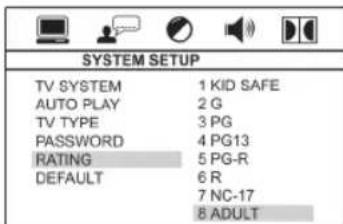
Some DVD contain information concerning the target group. This method is comparable with the rating of cinema films ("Suitable only for persons of 12 years and over" e.g.).
If you have the child protection option activated a probably existing corresponding information is read from the DVD and compared with the value pre-set by you. If a DVD is intended for an older age group than the one pre-set by you, the DVD cannot be played. You can select the following options for child protection after unlocking the password protection:
• Kid Safe: Suitable for children.
• G: Suitable for all age groups.
- PG: The presence of parents is recommended. Some scenes may be unsuitable for children.
- PG 13: The presence of parents is strictly recommended. Some scenes may be unsuitable for children under the age of 13.
• PGR: The presence of parents is strictly necessary.
• R: Young persons under the age of 17 may only view this film in the presence of an adult.
- NC17: Children and juveniles under the age of 17 are not allowed to watch this film.
• Adult: The film must only be watched by adults.
Factory setting
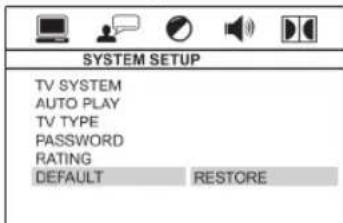
Select the command "Default/Restore" if you want to re-set the player to the factory implemented default settings. Any settings you have made will be lost.
Language Settings
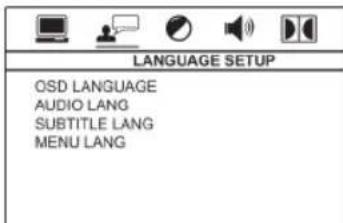
You can make various language settings here:
- OSD language: Here you can select the language of the onscreen displays.
• Audio language: Here you can select the preferred language for the audio output. - Subtitle language: Here you can select the preferred language for the subtitles accompanying the film.
- Menu language: Here you can select the preferred language for the DVD menus.
Video Settings
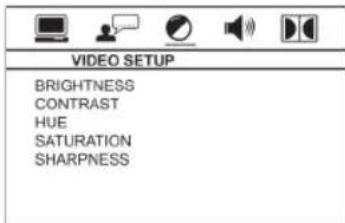
You can make various settings to adjust the video signal.
- Brightness
- Contrast
- Hue (NTSC only)
- Saturation
- Sharpness
Speaker setup
Downmix
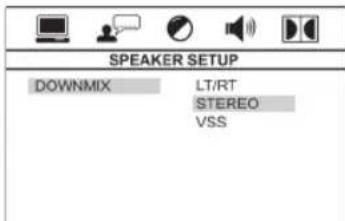
Change the characteristics of the speaker output:
- LT/RT: Choose this setting if you want to play the DVD with the Pro Logic Dolby stereo effect. This produces a almost real 2-channel replay effect.
- Stereo: Choose this setting if you want to play a DVD, that has been produced in the 5.1-Audio format, as 2-channel stereo sound.
• VSS: Use this setting to simulate surround playback.
Digital setup
Dynamic Range
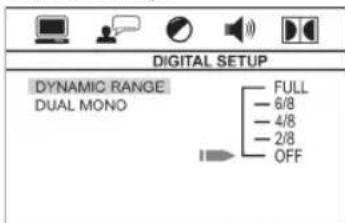
The term "Dynamic Range" describes the ratio of quietest and loudest sound. If the dynamic range is very large, you will experience very quiet and very loud sounds.
This may cause replay problems. Let us assume that you are watching a DVD in a relatively loud environment. You can now increase the volume to be able to hear also the very quiet passages, however with the disadvantage that loud passages will be unacceptably loud. In this case it would make sense to compress the dynamic range (i.e. reduce) and increase the output volume at the same time.
- FULL -2/8: The dynamic range is compressed slightly (2/8) to full (FULL).
- OFF: The dynamic range is not compressed at all (default).
Dual Mono
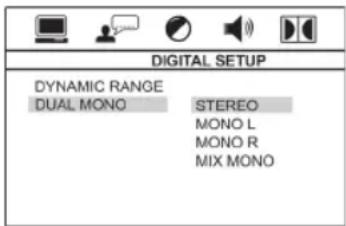
The Audio output is normally in stereo. Here you have the possibility to choose Mono-output instead of Stereo-output.
• Stereo: The Audio output is in Stereo (default).
- Mono L: The Audio output is in Mono. In this case the signal of the "left" stereo channel is transmitted to all speakers.
- Mono R: The Audio output is in Mono. In this case the signal of the "right" stereo channel is transmitted to all speakers.
- Mix Mono: The Audio output is in Mono. In this case the signal of the "both" stereo channel is transmitted to all speakers.
Technical data
General
Supply voltage ....DC 12 V (negative earthing) Power consumption ....15 A max. Power ....4 x 80 W PMPO Monitor ....7.6 cm/3" TFT
FM band
Frequency range.... 87.5 MHz \~ 108.0 MHz Effective sensitivity .... 10 dBμ.
AM band
Frequency range....522 kHz \~ 1600 kHz Effective sensitivity ....36 dB .
(Line-Out)
Signal format ....PAL/NTSC Video Output (Composite Video) ....1.0 V (P-P) 75 Ω
CD/DVD player
System ....MP3 Audio System Suitable CDs ....CD/CD-R/CD-RW/MP3/DVD/VCD Disks (12 cm disks)
Playable bit rates ....32 - 320 kBit/s Housing dimensions ....178 W x 50 H x 203 D Regionalcode ....2 (=Europe, Greenland, South Africa, Egypt and Middle East, Japan)
Net weight 1.23 kg
Subject to technical changes without prior notice!
This device has been tested according to all relevant current CE guidelines, such as electromagnetic compatibility and low voltage directives, and has been constructed in accordance with the latest safety regulations.
Troubleshooting
Before going through the checklist please make all the connections first. If you still have questions after going through the checklist, please consult your local customer service representative.
| Fault Symptoms | Cause Solution | |
| CDs are drawn only half way into the CD tray. | The transport screws have not been removed. | Remove the transport screws. |
| After inserting a CD the device automatically switches to Radio mode. | The CD is inserted the wrong way round. | Insert the CD right way round. |
| CD cannot be selected using the MODE button. | There is no CD inserted. | Insert a CD. |
| The CD does not play back after being inserted into the device. | The volume control is set too low. | Turn up the volume. |
| The device has not been correctly connected. | Check the +12 V and earth connection. | |
| CD works intermittently (dropouts). | The surface of the road is uneven. | Wait until the road becomes smoother before playing the CD. |
| The device is not firmly installed. | Install the device firmly. Ensure that the rear attachment is used if the vehicle does not have any suitable retainer for the rear section of the device. | |
| CD works intermittently (dropouts). | The CD is damaged. | Try another CD. If this works correctly, the first CD is probably damaged. |
| The CD is dirty. Clean the CD. | ||
| The device may have been installed in the vehicle at the wrong angle. | Please note that a maximum inclination of 20° degrees should not be exceeded! | |
| No function. The | ignition is Turn the | ignition key to "ON" or "ACC". |
| switched off. Replace the fuse by another 15 A fuse. | ||
| Device cannot be switched on or off via the ignition. | Incorrect connection (each car manufacturer wires the ISO connection in the vehicle differently). | Please contact your car workshop or a vehicle specialist for connection adapters may specifically for your model. |
| The device does not work correctly (EJECT, LOAD, PLAY). | The microcomputer has been interfered with by electromagnetic fields. | Remove the CD and insert it again. |
| Switch the device off and on again. | ||
| The device cannot be operated, but "hangs up". | The control processor of the device may have been blocked by overvoltage or undervoltage in the vehicle electrical system. | Press the RESET button. |
| No radio reception. | The antenna cable is not connected. | Insert the antenna cable firmly into the antenna socket of the device. |
| Poor radio reception. | It is possible that your vehicle has a special antenna (phantom-powered antenna.) | Please contact your car workshop or a vehicle specialist. (For other manufacturers there are specific phantom power supply adapters and voltage adapters available.) |
| In automatic search mode the radio does not stop at a transmitting station. | The transmission signals are too weak. | Tune in to a radio station manually. |
| Fault Symptoms | Cause Solution | |
| DVD cannot be played. | DVD not finalised. | Use a finalised DVD. |
| Audio or Video interference from video files which are played back via USB or memory card. | Data flow is "sluggish". (See section "Operating Instructions" on page 7 for a detailed explanation). | Pause play using the ▶II Tbutton. Wait a few seconds and re-start playback. |
Handling a CD/DVD
Cleaning the CD
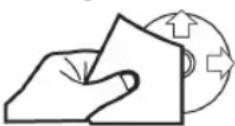
Before playing a CD, wipe it off with a clean, dust-free cleaning cloth. Pull out the CD in the direction of the arrow.
△ CAUTION: do not use any solvents such as petrol or thinning agents. commercially available cleaning substances or antistatic sprays will damage the device.
Inserting the CD
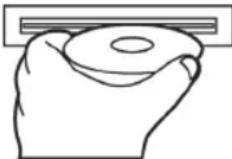
If the CD is inserted with the printed side facing downwards, the device may be damaged. Always insert the CD with the label facing upwards.
△ CAUTION: if there is already a cd in the cd slit, do not try to insert a second cd. this may damage the device.
Touching the CD
natural_image
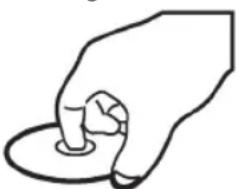
Simple line drawing of a hand holding a circular object (no text or symbols)Always hold CDs by the edge. In order to keep the CD clean do not touch the surface.
△ CAUTION:
- Do not attach any stickers or adhesive tape to the CD.
- Do not expose the CD to direct sunlight or sources of heat such as heating pipes. Do not leave CDs in the car if it is parked in direct sunlight as this will lead to a considerable rise in the temperature inside the car.
- Check all CDs for cracks, scratches and warping before you play them. It is possible that CDs that are damaged in this way cannot be played back correctly. Such CDs should not be used.
- Use only standard commercially available circular CDs with a 12 cm diameter! CDs with an 8 cm diameter or CDs with contours, e.g. of a butterfly or heart, are not suitable. It is possible that such CDs may not only be destroyed themselves, but may also destroy the drive of the CD player. We cannot accept liability for damage caused by the use of unsuitable CDs.
Index
A
Adjust the volume 29
AF 28
AMS button 27
AV IN 28
B
BND Button 27
C
CD Handling 36
Connection 26
CLK button 28
D
DVD Player 30
E
Eject button 30
Ejecting the CD 30
Equaliser settings (AUDIO SETUP) 29
H
Handling a CD 36
|
Important Additional Installation Information....25
Installation 25
Installation (Safety Information) 24
Installation Tips 25
M
Memory card ....30
MODE Button 28
Mono Switch 23
MUT button (Mute switch) 27
Mute switch (see MUT)....27
0
Operating instructions 26
Operation 27
P
Play / Pause (▶II)....29
PTY button 28
R
RDM button (Random playback) 30
Remote control batteries 26
Remote control buttons 23
Removing the control panel 27
Repeat function (RPT) 30
RESET button (Reset) 30
Road Safety 24
RPT button (Repeat) 30
S
Safety Information 24
SEL Button 29
ST/PROG Button (Switching to Stereo) 23
Starting up 26
Stereo Switch 23
Switching off 27
Switching on 27
T
TA (Traffic Announcements) 28
Technical Data 35
Time (see CLK) 28
Traffic channel (see TA) 28
Troubleshooting 35
U
USB Port 30
V
VOL Multifunction button 29
Menu overview
| SYSTEM SETUP | |
| TV SYSTEM NTSC | PALAUTO |
| AUTO PLAY ON | OFF |
| TV TYPE 4:3 PS | 4:3 LB16:9 |
| PASSWORD - - - - | ### |
| RATING 1 KID SAFE | 2 G3 PG4 PG135 PG-R6 R7 NC-178 ADULT |
| DEFAULT RESTORE | |
| LANGUAGE SETUP |
| OSD LANGUAGE |
| AUDIO LANG |
| SUBTITLE LANG |
| MENU LANG |
| VIDEO SETUP |
| BRIGTHNESS |
| CONTRAST |
| HUE |
| SATURATION |
| SHARPNESS |
| SPEAKER SETUP | |
| DOWNMIX LT/RT | STEREOVSS |
| DIGITAL SETUP | |
| DYNAMIC RANGE | |
| DUAL MONO STEREO | MONO LMONO RMIX MONO |


GARANTIE-KARTE
Guarantee card
AR 4023 DVD
24 Monate Garantie gemäß Garantie-Erklärung 24 months guarantee according to guarantee declaration