
GZ-181D - Water heaters Guzzanti - Free user manual and instructions
Find the device manual for free GZ-181D Guzzanti in PDF.


| Product Type | Pasteuriser / Water Heater |
| Brand | Guzzanti |
| Model | GZ-181D |
| Tank Material | Stainless Steel |
| Water Tank Capacity | Approximately 35 L (when full, device weighs over 35 kg) |
| Temperature Range | 30°C to 100°C |
| Timer Range | 1 to 120 minutes |
| Display | LCD digital display (set and current temperature, timer) |
| Controls | Thermostat knob with on/off push, timer knob |
| Safety Features | Overheat protection (alarm and auto shut-off), boil-dry protection, steam warning |
| Cleaning | Hand wash only with damp cloth; do not immerse; use vinegar for descaling |
| Maintenance | Periodic cleaning of outlet tap; replace silicone washers if needed |
| Accessories Included | Lid, insert grid, outlet tap |
| Optional Accessories | Heavy duty gloves, rubber apron, bottles, bottle brush, steamer juice extractor top |
| Intended Use | Preserving fruit and vegetables in jars, pasteurising juice, mulled drinks, boiling water |
| Warranty | Invalidated by improper use; repair by specialists only |
Frequently Asked Questions - GZ-181D Guzzanti
User questions about GZ-181D Guzzanti
0 question about this device. Answer the ones you know or ask your own.
Ask a new question about this device
Download the instructions for your Water heaters in PDF format for free! Find your manual GZ-181D - Guzzanti and take your electronic device back in hand. On this page are published all the documents necessary for the use of your device. GZ-181D by Guzzanti.
USER MANUAL GZ-181D Guzzanti
natural_image
Black-and-white photo of a stainless steel rice cooker with glass jars and beverages, no visible text or symbols.Návod k obsluze Návod na obsluhu Instrukcja obsługi Használati útmutató Navodila za uporabo Gebrauchsanleitung Instruction manual
KONZERVOVÁNÍ OVOCE A ZELENINY (POKYNY)
natural_image
Four diagrams showing a container with liquid and beakers, each containing a side arm (no text or symbols)natural_image
Symbol of a trash bin crossed with no text or numbers, representing waste sorting or disposal (no text present)
natural_image
Four diagrams showing a container with liquid and beakers, each containing a side arm (no text or symbols)natural_image
Symbol of a trash bin crossed with no text or numbers, representing waste sorting or disposal (no text present)
natural_image
Four-panel diagram showing a container with liquid and two beakers inside, no text or symbols present.natural_image
Symbol of a trash bin crossed with no text or numbers, representing waste sorting or disposal (no text present)
natural_image
Symbol of a trash bin crossed with no text or numbers, representing waste sorting or restriction (no text present)
natural_image
Symbol of a trash bin crossed with no text or numbers, representing environmental protection (no text present)natural_image
Four diagrams showing a beaker with liquid and submerged objects, likely illustrating a chemical or physical process (no text or symbols present)EINKOCHEN VON APFELSAFT
natural_image
Symbol of a trash bin crossed with no text or numbers, representing waste sorting or disposal (no text present)
Do not use this appliance until you have read and understood every part of this instruction booklet.
Improper use could cause harm and will invalidate the warranty.
IMPORTANT SAFETY INFORMATION
This appliance complies with the relevant safety regulations and should only be repaired by specialists. Improper repairs may result in considerable danger to the user and will invalidate the warranty. The appliance is designed for domestic use only and not for commercial use.
Warning! The appliance gets very hot and is therefore unsuitable for use by children. It must be operated by a competent person in accordance with these instructions.
Safety Precautions: As with the handling of all hot liquids, you need to take precautions to guard against burns. You should protect your hands, arms, body and face.
Warnings!
The appliance must be placed on a stable, flat surface. Do not put on a hot surface or near a naked flame.
The power supply cord must be unwound completely when in use and kept dry at all times.
Always fill the pasteuriser tank with water before switching on. Never fill the tank directly from a water tap. The pasteuriser and its electrical parts must not come into contact with a wet surface.
Do not overfill the tank. The level of the liquid in the tank must not exceed 4cm below the upper rim. If overfilled, hot liquid may boil over resulting in a risk of scalding.
When full, the pasteuriser will weigh over 35kg. Do not attempt to move when full.
Before connecting to the mains, ensure the mains voltage is identical with the details on the rating label. Only connect to an AC outlet.
Never immerse in water.
Never move the appliance when full or hot.
Take care not to touch any hot parts. The insulated handles will be the only cool part to touch.
In case of signs of damage to the pasteuriser, the power supply cord, or plug immediately disconnect from the power supply!
Keep the power supply cord away from hot parts.
There is a risk of scalding from escaping steam - take care when lifting the lid.
Do not allow the tank to boil dry.
Should the tank boil dry, a safety feature will prevent it from overheating.
Allow the appliance to cool down before refilling with water as there is a risk of scalding due to the sudden development of steam.
Unplug from the mains if there are any problems during use.
Ensure the pasteuriser is unplugged from the mains after each use.
Take extreme care when dispensing hot liquid from the outlet tap
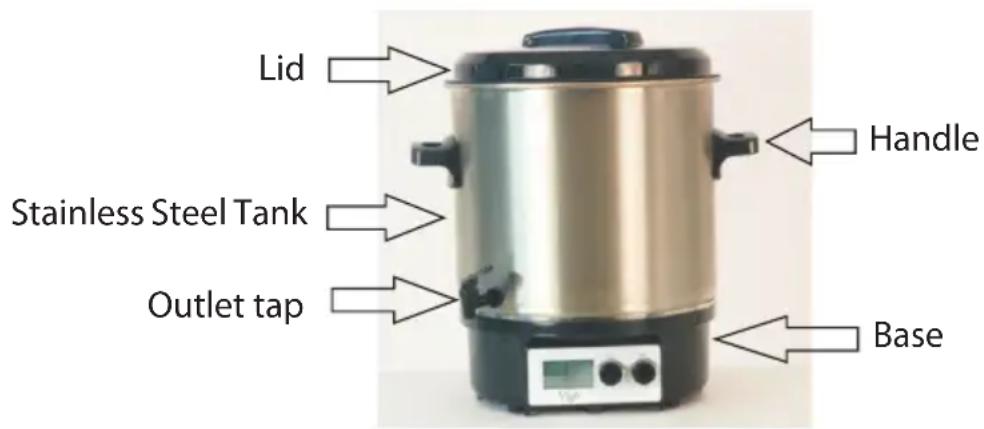
BEFORE USING FOR THE FIRST TIME
Thoroughly clean the inside of the pasteuriser with a soft cloth using warm soapy water (never use abrasive cleaners or scourers) and rinse ensuring that the electrical parts do not come into contact with water.
Never immerse in water.
Fill the pasteuriser with approximately 5 litres of water.
Set the temperature knob to 100^ C and press to start and bring the water to the boil.
Important: allow the water to cool before discarding.
During first use there may be a slight smell from the appliance; this will disappear after a short period of use.
PRESERVING FRUIT & VEGETABLES (GUIDELINES)
Preserving fruit and vegetables in jars keeps natural flavours and textures fairly intact without the use of any chemical preserving agents.
- Extreme care should be taken when preserving vegetables using this method. Vegetables do not contain sufficient natural acids to prohibit the growth of bacteria. We strongly recommend you carry out research before preserving vegetables.
- Fruit contains natural acids.
- Cleanliness and thorough/appropriate preparation of fruit & vegetables are imperative for the shelf life of products.
- Fruit and vegetables should be of good quality, fresh and ripe.
• Prepare the fruit or vegetables according to the recipe you are using. - Use purpose-made rubber sealed preserving jars with clip or screw lids, i.e., Week or Kilner jars. You should follow the jar manufacturer's instructions for precise details on each aspect of their use.
- Visibly check lids and jars and discard any that are chipped or damaged.
- Ensure the seals are sound. Replace seals regularly to ensure good closure.
- Wash the jars thoroughly in hot soapy water, rinse in fresh water and turn upside down on a clean cloth to dry.
• The jars and seals should be completely clean. - Place the seals in fresh water until they are used.
(Important: Do not use any porous, damaged or over-stretched seals - these could let in contaminants from the air, spoiling the contents of the jar). - Fill the jars according to the recipe, typically leaving a gap of up to 2 cm below the rim. If preserving pulpy food, i.e., apple puree etc., typically leave a gap of 3 to 4 cm below the rim.
- Place a clean seal on the jar, and close tightly with spring clips, screw-on lids or braces.
Before Setting the timer:
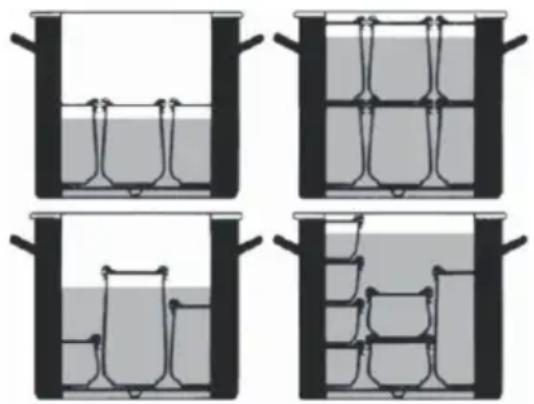
- Place the filled and sealed jars on the insert grid in the Pasteuriser tank - always use the grid - never place the jars directly onto the base.
- The temperature of the water to be poured in the tank should be the same as the temperature of the food contained in the jars to ensure a uniform heating process.
Add cold water for glass jars with cold contents; for preserving jars with hot contents i.e. if the food to be preserved was pre-cooked, add correspondingly hot water.
- The preserving jars should be % to % submerged in water; if you double stack the jars, the upper jars must be % submerged. See illustration below.
natural_image
Four-panel diagram showing a container with liquid and a beaker inside, each containing a side arm (no text or symbols)- Place the lid on top of the pasteuriser, ensuring it is closely fitted. Please note, the jars may rise up to the bow of the pasteuriser lid. This is not a problem, provided the lid closely fits preventing steam from escaping.
- Connect the pasteuriser to the power socket.
TEMPERATURE AND TIMINGS
The time and temperature for preserving varies according to the acidity of the fruit and vegetables. Extreme care should be taken when preserving vegetables using this method. Vegetables do not contain sufficient natural acids to prohibit the growth of bacteria. We strongly recommend you carry out research before preserving vegetables.
Fruit contains natural acids. For guidelines on the appropriate temperature and preserving times for preserving a range of fruit and vegetables, please see the Table for cooking' below and refer to the recipe you are using.
Table for cooking (guidelines)
| Fruit | Vegetables | ||||
| Currants | 85°C | 20 min. | Cauliflower | boil | 90 min. |
| Apple puree | 90°C | 30 min. | Beans | boil | 120 min. |
| Pears | 90°C | 30 min. | Broad beans | boil | 90 min. |
| Strawberries | 75°C | 25 min. | Peas | boil | 120 min. |
| Blueberries | 85°C | 25 min. | Dill pickles | 90°C | 30 min. |
| Raspberries | 80°C | 30 min. | Carrots | boil | 90 min. |
| Cherries | 80°C | 30 min. | Turnips | boil | 90 min. |
| Plums | 90°C | 30 min. | Pumpkin | 90°C | 30 min. |
| Peaches | 90°C | 30 min. | Brussel sprouts | boil | 120 min. |
| Apricots | 90°C | 30 min. | Asparagus | boil | 120 min. |
| Rhubarb | boil | 30 min. | Savoy | boil | 120 min. |
| Gooseberries | 80°C | 30 min. | Tomatoes | 90°C | 30 min. |
SETTING THE THERMOSTAT & TIMER:
The appliance is fitted with an electric synchronised timer with digital display panel. The left hand side of the panel shows the set temperature (upper) and current temperature (lower) in degrees Celsius. The right hand panel shows the time set in minutes.
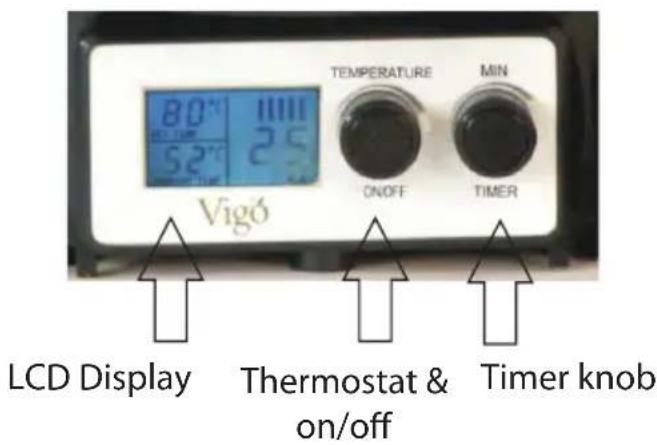
- Set the desired temperature by turning the left hand knob - scaled between 30°C and 100°C.
- Set the desired time with the right hand knob - scaled between 1 and 120 minute. If no time shows in the display push the knob to activate.
- Press the left hand knob to turn on the heater - a succession of 6 vertical bars will show above the timer display to indicate that the heater is on.
- When the set temperature has been reached (set temperature = current temperature) an alarm sounds and the timer starts (indicated by an hourglass timer symbol). This is the start of the pasteurisation/cooking time.
- When the set time has elapsed the alarm sounds repeatedly.
- Push the on/off button to stop the appliance.
NB The heating up time is not included in the preserving time. The preserving time starts when the selected temperature has been reached; the timer will start to run from this point.
NB If the pasteuriser is not used or the controls not altered for 5 minutes the display will turn off. To show the display again, press one of the knobs.
OVERHEATING PROTECTION:
If there is insufficient water in the pasteuriser tank, an alarm sounds and a flashing symbol will display of a pan filling with liquid (upper left hand side of timer screen). Immediately add more water to a level sufficient for the process being performed. If water is not added the pasteuriser will automatically turn off and must be allowed to cool before adding water and re-starting.
AFTER PRESERVING:
- Wearing appropriate protection for handling hot items, carefully remove the preserving jars.
- Lid fasteners should be left on until the jars have cooled completely.
- Preserved food and drinks are best stored in a dry, cool and dark place.
- Once you have finished pasteurising disconnect from the power supply.
- Drain the tank completely. This can be done by opening the outlet tap and allowing the water to drain into a suitable heat-resistant container.
CLEANING
• Always disconnect the appliance from the mains supply prior to cleaning.
- Allow pasteuriser to cool.
• Clean the tank using a damp cloth.
- Wipe the outside of the pasteuriser with a damp cloth.
Warning! Ensure the power supply cord is protected from wet/dampness.
Warning! Never immerse the appliance in water.
Warning! Make sure that no water or steam infiltrates the underside of the appliance.
Warning! Never use steam-jet cleaners.
Warning! Never use abrasives, steel wool or sharp, scratchy objects to clean the pasteuriser.
NB Calcareous residues, which may have formed, can be removed from time to time with some vinegar diluted in water or with an appropriate de-scaling agent. If you clean using the vinegar in water or with the de-scaling agent, fill the tank with clean water afterwards and bring to the boil. This is necessary as a calcareous deposit may affect both the heating performance and the temperature control.
OUTLET TAP
From time to time the tap should be unscrewed from the tank and cleaned. With the pasteuriser disconnected from the power supply and completely cooled, disconnect and clean the tap accordingly: With one hand grip the tap and with the other hold the plastic nut on the inside of the tank. Turn the tap anticlockwise to unscrew. The knurled cap at the top of the tap can then be unscrewed to release the tapmechanism. Clean component parts with warm, soapy water. Rinse, dry and replace.
Be sure to replace the silicone washers on the inside and outside of the tank and hand tighten the nut to make a seal. The tap should be secured but not overtightened.
PASTEURISING APPLE JUICE
- Apples should be clean and free from bruising or mould. The rule is 'juice only apples you would be happy to eat'.
- Crush and press apples to produce fresh juice and, if desired, strain out any large particles of fruit from the juice.
- Pasteurise immediately, or for a clearer juice leave to settle overnight in a clean closed container.
- Only use clean, sound glass screw-cap bottles. Vigo supplies bottles suitable for juice pasteurisation.
- Before filling, check to see if the glass bottle has a fill level expressed in mm embossed around the base. Fill to this level but do not overfill as the juice will expand when heated.
• If the bottle does not have a fill level marked you must leave a gap at the top to allow for expansion of the juice when heated. - Fill the bottles with juice. Remember to leave a gap at the top for heat expansion.
- Loosely apply the screw caps. Do not screw down completely.
- Carefully place the filled bottles on top of the grid in the pasteuriser tank. Always use the grid - never place the bottles directly onto the base.
- Fill the tank with water to within an inch or two (25-50mm) of the top of the bottle.
- Place the lid on top of the pasteuriser, ensuring it is closely fitted.
- Connect the pasteuriser to the power socket and switch on.
- Effective pasteurisation requires that the juice is heated to at least 70cC and held at that temperature for 20 minutes. It is best to set the thermostat to 75°C and set timer to 25 minutes (See Setting the thermostat & timer).
• After pasteurisation is complete, carefully remove the bottles wearing the appropriate protection.
• Fully tighten the caps. - Carefully lay each filled bottle on its side so that the hot juice comes into full contact with the seal on the inside of the cap. Allow to cool in this position.
Pear JuiCe
Pasteurisation is only effective if the juice is sufficiently acid.
While English eating and cooking apples are almost certain to contain sufficient acid (about 4g or more per litre of juice), pears are unlikely to contain sufficient acid and great care has to be taken when pasteurising pear juice: a minimum of 4g of acid per litre of juice must be added - we recommend a 50/50 mixture of malic and citric acids (both available from Vigo).
Dissolve the acid in a little warm water or juice before mixing into the bulk juice prior to bottling. If in any doubt, we recommend that pear juice is not pasteurised.
OTHER USES
The pasteuriser is ideal for the preparation of large quantities of mulled cider or wine - set the thermostat at around 70^ C. To use without the timer, push the timer knob in. The minute display will clear and a horizontal figure of '8' symbol will be displayed. Operate the on/off thermostat control as required.
It can be used as an urn. To boil water set the thermostat to 100^ C.
Ensure you clean the pasteuriser throughly after each use - see 'Cleaning' above.
Optional Extras from Vigo:
• Heavy Duty Lined Rubber Gloves (99073/74 & 47)
• Waterproof Rubber Apron (99067)
• Bottles with Caps (97642) - sold in packs of 24
• Replacement Caps (97449) - packed of 100
• Bottle Brush (94259)
• Bottle Drainer Tree (96105/06)
• Bottle Rinser (96103)
- Steam Juice Extractor Top (96411): The pasteuriser can be transformed into a juice extractor with the Steamer Juice Extractor Top. Perfect if you want to make cordials or extract juice from stoned fruits, berries, or hard fruits like crab apples, etc.
DISPOSAL OF USED ELECTRICAL AND ELECTRONIC EQUIPMENT
natural_image
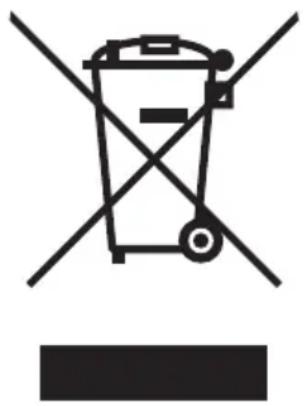
Symbol of a trash bin crossed with no text or numbers, representing environmental restriction (no text present)This symbol on products or original documents means that used electric or electronic products must not be added to ordinary municipal waste. For proper disposal, renewal and recycling hand over these appliances to determined collection points. Alternatively, in some European Union states or other European countries you may return your appliances to the local retailer when buying an equivalent new appliance. Correct disposal of this product helps save valuable natural resources and prevents potential negative effects on the environment and human health, which could result from improper waste disposal. Ask your local authorities or collection facility for more details. In accordance with national regulations penalties may be imposed for the incorrect disposal of this type of waste.
For business entities in European Union states
If you want to dispose of electric or electronic appliances, ask your retailer or supplier for the necessary information.
Disposal in other countries outside the European Union.
This symbol is valid in the European Union. If you wish to dispose of this product, request the necessary information about the correct disposal method from the local council or from your retailer.
- KONZERVOVÁNÍ OVOCE A ZELENINY (POKYNY)
- EINKOCHEN VON APFELSAFT
- IMPORTANT SAFETY INFORMATION
- Warnings!
- BEFORE USING FOR THE FIRST TIME
- PRESERVING FRUIT & VEGETABLES (GUIDELINES)
- Before Setting the timer:
- TEMPERATURE AND TIMINGS
- SETTING THE THERMOSTAT & TIMER:
- OVERHEATING PROTECTION:
- AFTER PRESERVING:
- CLEANING
- OUTLET TAP
- PASTEURISING APPLE JUICE
- Pear JuiCe
- OTHER USES
- Optional Extras from Vigo:
- DISPOSAL OF USED ELECTRICAL AND ELECTRONIC EQUIPMENT
- For business entities in European Union states
- Disposal in other countries outside the European Union.
Brand : Guzzanti
Model : GZ-181D
Category : Water heaters