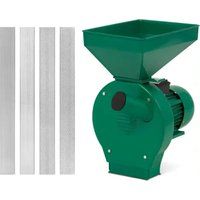
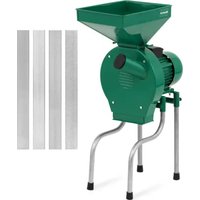
WIE-FC-200 - Flour mill Wiesenfield - Free user manual and instructions
Find the device manual for free WIE-FC-200 Wiesenfield in PDF.


| Product type | Flour mill (grain grinder) |
| Brand | Wiesenfield |
| Model | WIE-FC-200 |
| Nominal voltage | 230 V ~ / 50 Hz |
| Nominal power | 1100 W |
| No-load motor speed | Up to 2800 rpm |
| Insulation class | B |
| Protection rating | IP44 |
| Dimensions (L × W × H) | 420 × 300 × 500 mm |
| Weight | 19 kg |
| Production efficiency | 250 kg/h |
| Matrix hole diameters | 1.0 / 2.0 / 3.0 / 4.0 mm |
| Hopper capacity | 7 L |
| Hopper diameter | 60 cm |
| Compatible materials | Cereals, wheat, rye, barley, rice, corn, beans, peanuts, animal feed, spices, chili |
| Main function | Grinding grains into flour of different fineness depending on the chosen matrix |
| Fineness adjustment | Interchangeable matrix (holes of different diameters) |
| Safety | Do not open the lid during operation; provide a magnet to remove metals; stop feeding in case of blockage |
| Maintenance | Bearing lubrication every 300 hours; cleaning after use; keep dry |
| Wear parts | Hammers, powder sieve, matrices (consumables) |
| Warranty / Repairability | Spare parts available (hammers, sieves, matrices, bearings) |
| Included accessories | Several matrices of different diameters |
Frequently Asked Questions - WIE-FC-200 Wiesenfield
User questions about WIE-FC-200 Wiesenfield
0 question about this device. Answer the ones you know or ask your own.
Ask a new question about this device
Download the instructions for your Flour mill in PDF format for free! Find your manual WIE-FC-200 - Wiesenfield and take your electronic device back in hand. On this page are published all the documents necessary for the use of your device. WIE-FC-200 by Wiesenfield.
USER MANUAL WIE-FC-200 Wiesenfield
This User Manual has been translated for your convenience using machine translation. Reasonable efforts have been made to provide an accurate translation; however, no automated translation is perfect nor is it intended to replace human translators. The official User Manual is the English version. Any discrepancies or differences created in the translation are not binding and have no legal effect for compliance or enforcement purposes. If any questions arise related to the accuracy of the information contained in the User Manual, please refer to the English version of those contents which is the official version.
Technical data
| Parameter description Parameter value | ||
| Product name | Flour mill | |
| Model | WIE-FC-200 | WIE-FC-300 |
| Rated voltage [V~] / frequency [Hz] | 230/50 | |
| Rated power [W] | 1100 | |
| Motor speed without load [rpm] | up to 2800 | |
| Insulation class | I | |
| Insulation grade | B | |
| Protecting degree | IP44 | |
| Duty cycle | S1 | |
| Dimensions [length x width x height; mm] | 420 x 300 x 500 | 490 x 395 x 785 |
| Weight [kg] | 19 | 21 |
| Production efficiency [kg/h] | 250 | |
| Die hole diameters [mm] | 1.02.03.04.0 | |
| Inlet hopper capacity [L] | 7 | |
| Hopper diameter [cm] | 60 | |
Structure and working principle
The function of the machine is to crush the grain, wheat, rye, barley, rice, corn, bean, peanut, feed, flavoring, hot pepper etc. to a flour (powder). The powder can be used to feed animals. The most advantage of this machine is that you can change die to get difference flour powder granulation. If you want rough fineness flour then you should use the big hole die; if you want the fine fineness flour then you should use the small hole die.
Structure: The machine consists of a machine shuck, machine cover, main shaft, motive gear assembly (rotor), mesh, powder sifting, inlet hopper, and outlet hopper, etc.
Work theory: After the material is pushed into the crushing chamber, the material is crushed under the action of teeth assembly (rotor) rotating rapidly in the crusher chamber. The material was hit and robbed to powder, and then discharged from the powder outlet under the centrifugal force and air flow.
Assembling and use
- The alignment between the motor pulley and the machine pulley should be maintained, and the V-belt should be properly assembled to ensure the machine operates according to its specifications.
- After installing the machine, verify the completeness and tightness of all components, especially in high-speed areas such as the rotor.
- Before use, ensure the machine is in optimal condition. Check the tightness and alignment of all parts, as well as the adjustability and flexibility of transmission devices. The machine should operate without any abnormal noises.
- Open the cover to clean the feeder and working units, then close it. Rotate the pulley to ensure there are no obstructions and that the machine operates smoothly.
- Before starting, ensure the sifter is properly connected to the main shaft, the aperture of the sifter is set, and the pressure in the hop-pocket is correct.
- After completing all checks, trial-run the machine to ensure it operates according to specifications. A new machine should run idle for 2 to 3 minutes before its first use.
- This machine does not include a magnet for removing iron; you must provide one yourself. Ensure there is no metal or stone in the machine.
- While the machine is running, gradually feed material into the machine, starting with a small amount and increasing to normal levels. Avoid overloading to prevent blockages.
- Operators should stand beside the feeder inlet and must not touch the inside or open the cover while the machine is running.
- If the machine becomes blocked, turn off the power and resolve the issue. (Note: Do not insert hands, wooden bars, or iron bars into the machine at this time.)
- When work is complete, wait for the powders to flow out from the outlet, then allow the machine to idle for 1 to 2 minutes. Close the inlet board to prevent debris from entering the machine. Finally, open the cover to clean out any residue and keep the machine dry to prevent dampness and mold.
Troubleshooting
| Faults | Possible reasons | Dissolving Methods |
| Inefficient crushing or uneven granularity. | 1. Speed is too low.2. Mesh is damaged or does not meet requirements.3. Hammer pieces are worn.4. Raw material is too wet.5. Auto-reversing driving shaft is damaged. | 1. Maintain the rated speed.2. Replace the mesh.3. Replace the hammer pieces.4. Dry the raw material before processing.5. Maintain or replace the driving shaft. |
| Bearing temperature is too high. | 1. Quality and quantity of lubricating grease are unsuitable.2. Bearing is excessively worn.3. Material feeding volume is too large. | 1. Replace with suitable lubricating grease.2. Replace the worn bearing.3. Control the material feeding volume to the appropriate level. |
| Machine vibrates and makes noise. | 1. Connecting parts are loose.2. Rotor is unbalanced.3. Auto-reversing driving shaft is damaged. | 1. Tighten the connecting parts.2. Balance the rotor.3. Maintain or replace the driving shaft. |
Maintenance
- Ensure the bearing lubricating oil is sufficient and clean. Clean the bearings regularly. Typically, lubricating oil should be added after the machine has been running for 300 hours. Pay close attention to the bearing temperature during machine operation.
- Periodically inspect hammer pieces and powder mesh, as these are the most susceptible to damage. If any damaged parts are found, replace them immediately.
- Dies are consumable parts and should be replaced if worn out.
Packaging and transportation
- Upon receiving products from the factory, verify that the packing list, spare parts, and user guide are all included in the container.
- Protect the equipment from rain, moisture, and pressure during transport and storage.

Pakiranje i transport
Pakiranje in transport
For the disposal of the device please consider and act according to the national and local rules and regulations.
CONTACT
expondo Polska sp. z o.o. sp. k.
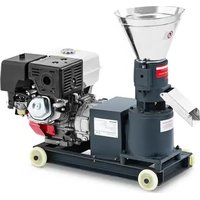

Brand : Wiesenfield
Model : WIE-FC-200
Category : Flour mill