
ASP21-4in1 - Vacuum Cleaner SCHEPPACH - Free user manual and instructions
Find the device manual for free ASP21-4in1 SCHEPPACH in PDF.


| Product type | Wet/dry vacuum cleaner |
| Brand | Scheppach |
| Model | ASP21-4in1 |
| Power | 1200 W |
| Mains voltage | 220-240 V~, 50/60 Hz |
| Tank capacity | 20 L (water) |
| Max suction power | 16 kPa |
| Protection rating | IPX4 |
| Protection class | II |
| Functions | Dry, wet, cold ash vacuuming, blowing |
| Filter types | Foam filter (wet), pleated filter (dry), paper filter bag (optional) |
| Included accessories | Suction hose, floor brush, crevice nozzle, 3 plastic extensions, aluminum tube, handle, 4 swivel casters |
| Safety | Overflow float valve, automatic shut-off when tank is full |
| Max ash temperature | 40 °C (cold ash only) |
| Prohibited use | Flammable liquids, explosive substances, reactive dusts |
| Maintenance | Clean filters after each use, empty tank |
| Storage | Dry, dark, frost-free place, 5-30 °C |
| Weight (estimated) | Approximately 6 kg |
Frequently Asked Questions - ASP21-4in1 SCHEPPACH
User questions about ASP21-4in1 SCHEPPACH
0 question about this device. Answer the ones you know or ask your own.
Ask a new question about this device
Download the instructions for your Vacuum Cleaner in PDF format for free! Find your manual ASP21-4in1 - SCHEPPACH and take your electronic device back in hand. On this page are published all the documents necessary for the use of your device. ASP21-4in1 by SCHEPPACH.
USER MANUAL ASP21-4in1 SCHEPPACH
natural_image
Black and white photo of a Cheppach vacuum cleaner with attached hose and control panel (no visible text or symbols on device body)| DE | Nass-Trocken-AschesaugerOriginalbedienungsanleitung | 5 |
| GB | Wet, dry and ash vacuum cleanerTranslation of original instruction manual | 16 |
| FR | Aspirateur eau, poussières et cendresTraduction des instructions d'origine | 26 |
natural_image
Top-down view of a black industrial vacuum cleaner with attached pipes and control panel (no visible text or symbols)Günzburger Straße 69
D-89335 Ichenhausen
Verehrter Kunde
Explanation of the symbols on the equipment
Symbols are used in this manual to draw your attention to potential hazards. The safety symbols and the accompanying explanations must be fully understood. The warnings themselves will not rectify a hazard and cannot replace proper accident prevention measures.
| ⚠ Attention! | Warning! Danger to life, risk of injury or damage to the tool are possible by ignoring!. |
 | Caution - Read the operating instructions to reduce the risk of inquiry |
 | Protection class II. |
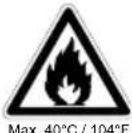 | For cold ashes only! Matter exceeding a temperature of 40°C (104°F) poses a fire risk! |
Table of contents: Page:
-
Introduction 18
-
Device description 18
-
Scope of delivery 19
-
Proper use 19
-
Safety instructions 19
-
Technical data 20
-
Installation 21
-
Operation 22
-
Maintenance and cleaning 22
-
Storage 23
-
Electrical connection 23
-
Disposal and recycling 24
-
Troubleshooting 25
1. Introduction
Manufacturer:
scheppach
Günzburger Straße 69
D-89335 Ichenhausen
Dear Customer,
We hope your new tool brings you much enjoyment and success.
Note:
According to the applicable product liability laws, the manufacturer of the device does not assume liability for damages to the product or damages caused by the product that occurs due to:
- Improper handling,
• Non-compliance of the operating instructions, - Repairs by third parties, not by authorized service technicians,
• Installation and replacement of non-original spare parts,
• Application other than specified, - A breakdown of the electrical system that occurs due to the non-compliance of the electric regulations and VDE regulations 0100, DIN 57113 / VDE0113.
We recommend:
Read through the complete text in the operating instructions before installing and commissioning the device.
The operating instructions are intended to help the user to become familiar with the machine and take advantage of its application possibilities in accordance with the recommendations.
The operating instructions contain important information on how to operate the machine safely, professionally and economically, how to avoid danger, costly repairs, reduce downtimes and how to increase reliability and service life of the machine.
In addition to the safety regulations in the operating instructions, you have to meet the applicable regulations that apply for the operation of the machine in your country.
Keep the operating instructions package with the machine at all times and store it in a plastic cover to protect it from dirt and moisture. Read the instruction manual each time before operating the machine and carefully follow its information. The machine can only be operated by persons who were instructed concerning the operation of the machine and who are informed about the associated dangers. The minimum age requirement must be complied with.
In addition to the safety requirements in these operating instructions and your country's applicable regulations, you should observe the generally recognized technical rules concerning the operation of woodworking machines.
We accept no liability for damage or accidents which arise due to non-observance of these instructions and the safety information.
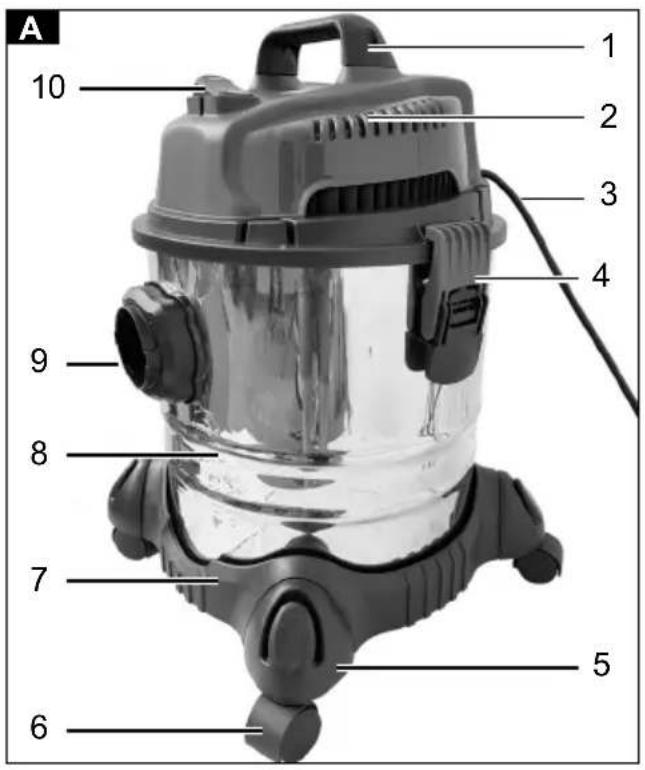
2. Device description
- Handle
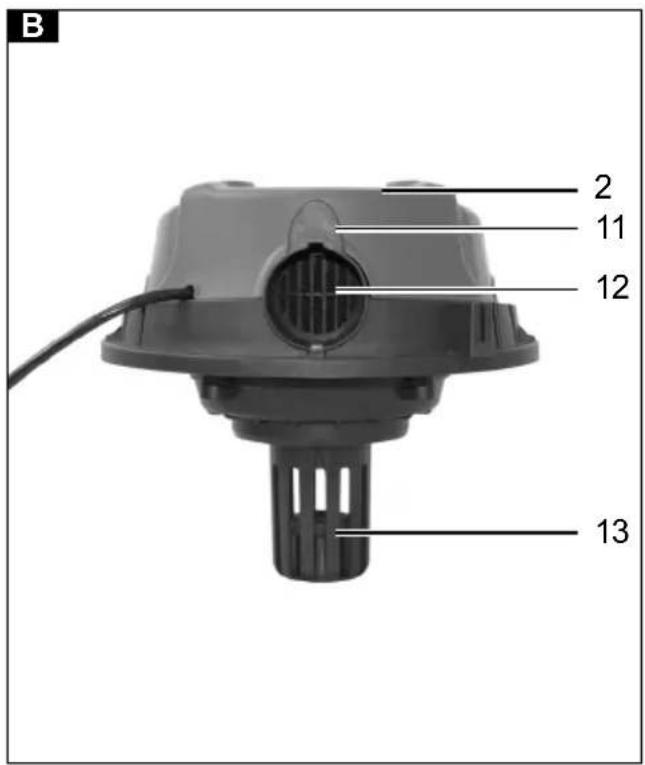
- Machine head
- Connection cable
- Locking hooks
-
Castor mounts (4x)
-
Castors (4x)
- Castor mounting base
- Stainless steel container
- Suction connection
- On/off switch
- Top cable holder
- Connection for blower function
- Filter basket with safety float valve
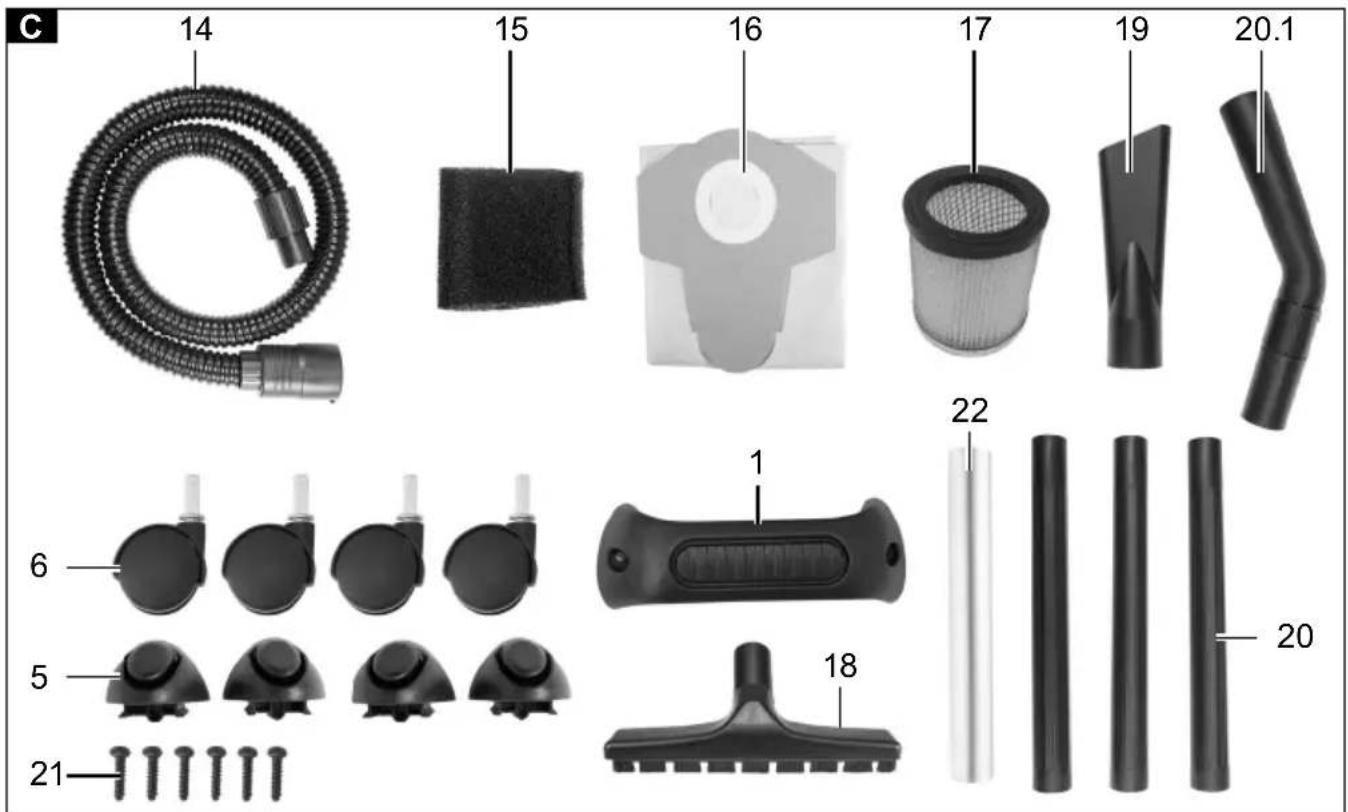
3. Scope of delivery
- Suction hose
- Foam filter
- Paper filter bag
- HEPA filter
- Floor nozzle
- Joint nozzle
- Plastic extension tube (3x)
20.1 Handle - Screw 6x
- Aluminium tube
4. Proper use
The wet and dry vacuum cleaner is designed for wet and dry vacuuming using the appropriate filter. The appliance is not suitable for the vacuuming of combustible, explosive or harmful substances.
The equipment is to be used only for its prescribed purpose. Any other use is deemed to be a case of misuse. The user / operator and not the manufacturer will be liable for any damage or injuries of any kind caused as a result of this.
Please note that our equipment has not been designed for use in commercial, trade or industrial applications.
Our warranty will be voided if the equipment is used in commercial, trade or industrial businesses or for equivalent purposes.
5. Safety instructions
⚠️ DANGER!
- The appliance may only be connected to alternating current. The voltage must correspond with the type plate on the appliance.
- Never touch the mains plug and the socket with wet hands.
- Do not pull the plug from the socket by pulling on the connecting cable.
- Check the power cord with mains plug for damage before every use. To avoid risks, arrange immediately the exchange by an authorized customer service or a skilled electrician, if the power cord is damaged.
- To avoid accidents due to electrical faults we recommend the use of sockets with a line-side current-limiting circuit breaker (max. 30 mA nominal tripping current).
- Turn off the appliance and remove the mains plug prior to any care and maintenance work.
• Repair works may only be performed by the authorised customer service.
⚠ WARNING!
- This appliance is not intended for use by persons with limited physical, sensory or mental capacities or lacking experience and/or skills, unless such persons are accompanied and supervised by a person in charge of their safety or they have received precise instructions on the use of this appliance and have understood the resulting risks.
• Children may only use this appliance if they are over the age of 8 and supervised by a person in charge of their safety, or if they have received instructions on the use of this appliance and have understood the resulting risks.
• Children must not play with this appliance.
- Supervise children to prevent them from playing with the appliance.
- Cleaning and user maintenance must not be performed by children without supervision.
- Keep packaging film away from children - risk of suffocation!
- Switch the appliance off after every use and prior to every cleaning/maintenance procedure.
- Risk of fire. Do not vacuum up any burning or glowing objects.
- The appliance may not be used in areas where a risk of explosion is present.
- Immediately switch the appliance off or pull the power plug if foam forms or liquids escape!
- Do not use abrasives, glass or universal cleaners! Never immerse the appliance in water.
• For cold ash only, see manual!
- Do not vacuum any soot or flammable substances.
• Always check hoses and vacuum cleaner for heating when vacuuming.
• Always empty and clean vacuum cleaner before and after vacuuming.
"Cold ashes" are ashes that have cooled for a sufficient time and no longer contain pockets of embers.
This can be determined by sifting through the ashes with a metal implement before using the equipment. The cold ashes emit no further perceptible heat radiation.
Certain materials may produce explosive vapours or mixtures when agitated by the suction air! Never vacuum up the following materials:
- Explosive or combustible gases, liquids and dust particles (reactive dust particles)
- Reactive metal dust particles (such as aluminium, magnesium, zinc) in combination with highly alkaline or acidic detergents
- Undiluted, strong acids and alkalies
• Organic solvents (such as petrol, paint thinners, acetone, heating oil).
In addition, these substances may cause the appliance materials to corrode.
⚠ WARNING!
This electric tool generates an electromagnetic field during operation. This field can impair active or passive medical implants under certain conditions. In order to prevent the risk of serious or deadly injuries, we recommend that persons with medical implants consult with their physician and the manufacturer of the medical implant prior to operating the electric tool.
6. Technical data
Mains voltage 220-240V\~
50/60 Hz
Power 1200W
Water tank capacity 20 l
| Suction performance 16 kPa |
| Protection category IPX4 |
| Protection class II |
Technical changes reserved!
7. Installation
ATTENTION!
Prior to use, ensure that the device has been correctly and fully assembled.
Unpacking (Fig. A+B+C)
Release the locking hooks (4) and remove the machine head (2). The accessories are located inside the stainless steel container (8).
Only the plastic extension tubes (3x) (8) are located outside the stainless steel container, in the packaging. Remove all of the accessories from the stainless steel container (8).
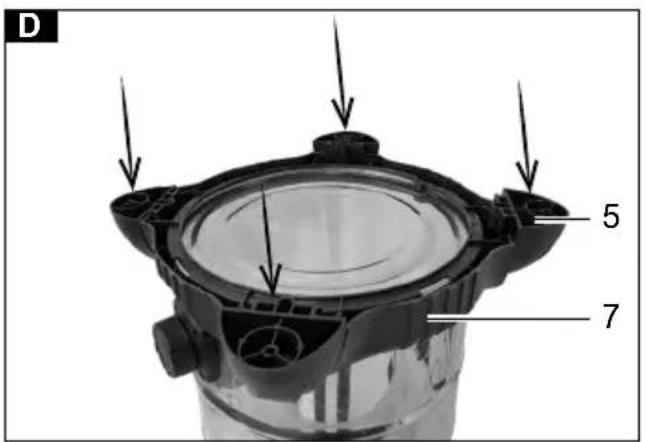
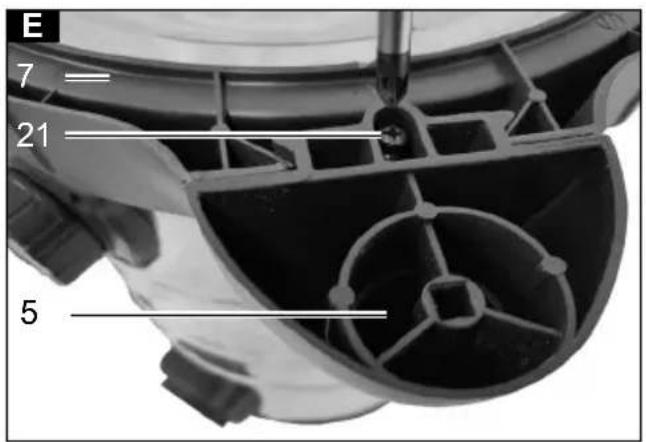
Installing the castor mounts (fig. D+E)
- Turn the stainless steel container (9) upside-down (the machine head (2) must be removed).
- Push the castor mounts (5) into the cut-outs provided on the wheel mounting base (7). (4x)
- Fasten the castor mounts (5) with a screwdriver (not included in the delivery) and one screw each (21). (4x)
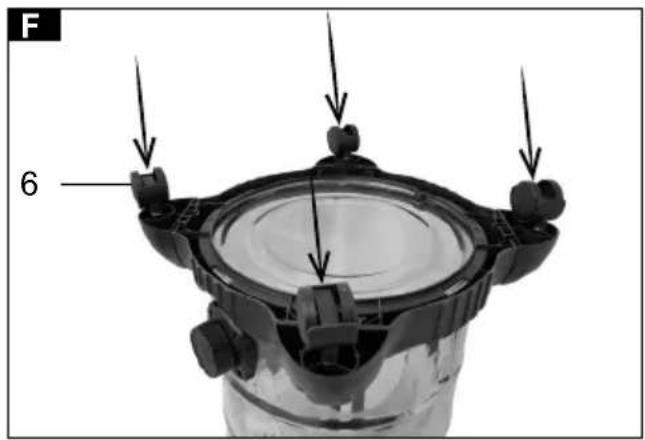
Installing the castors (fig. F)
Press the four castors (6) into the holes in the castor mounts (5).
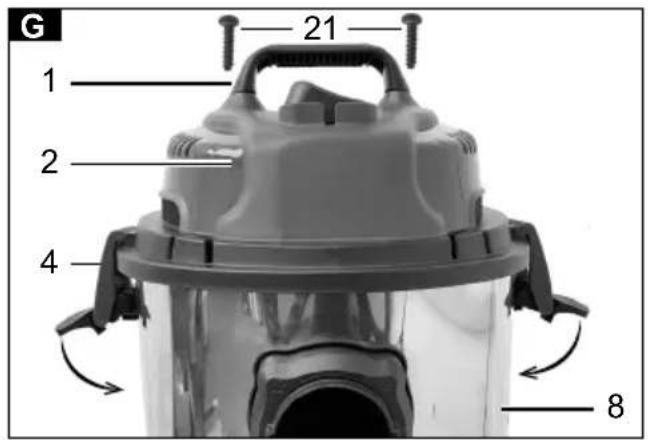
Installing the machine head (2) and the handle (1)(Fig. G)
- Place the machine head (2) on the stainless steel container (8). Secure the machine head (2) with the locking hooks (4). When installing the machine head (2), ensure that the locking hooks (4) latch into place correctly.
- Place the handle (1) on the machine head (2) and fasten it with two screws (21) with a screwdriver (not included in the delivery).
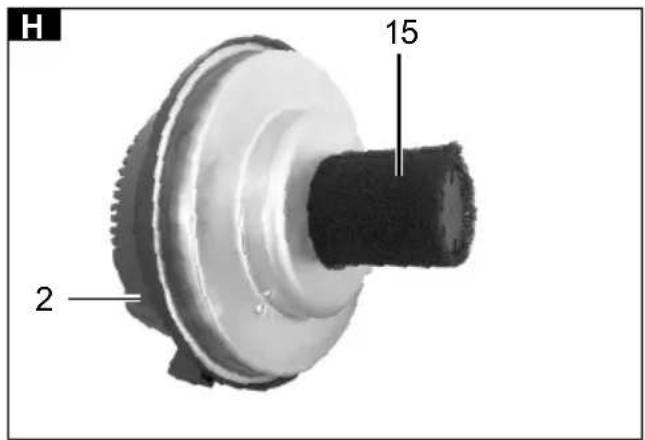
Installing the foam filter (H) (fig. 3+8)
Never use the device without filter! Always ensure that the filters are correctly fitted!
Installing the foam filter (15): For wet vacuuming, slide the foam filter (15) provided over the filter basket with safety float valve (13).
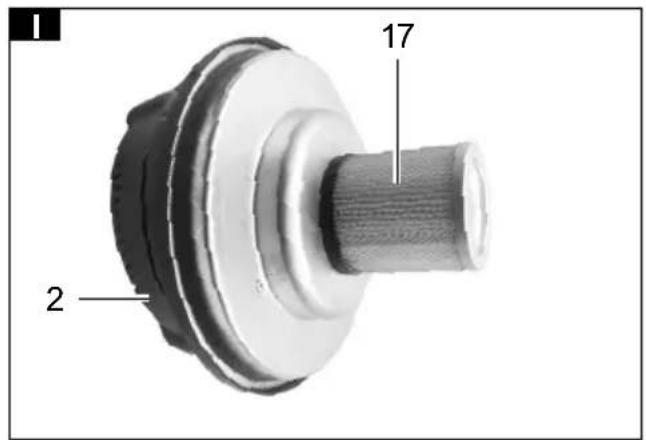
Installing the HEPA filter (17) (fig. I)
For dry vacuuming, slide the HEPA filter (17) provided over the filter basket with safety float valve (13). The HEPA filter (17) is only suitable for dry vacuuming!
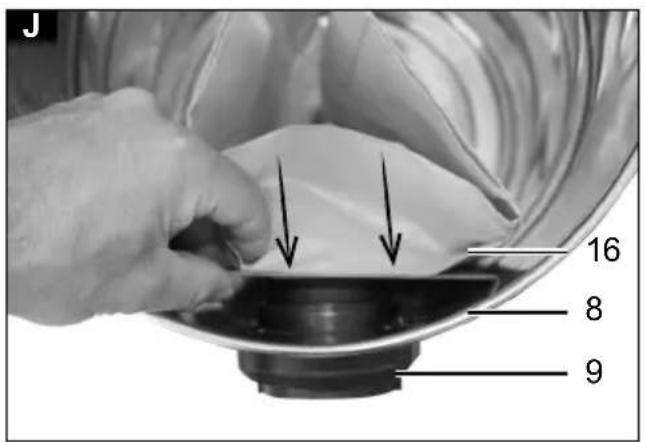
Installing the paper filter bag (16) (fig. J)
It is recommended to use an additional paper filter bag (16) when vacuuming fine, dry dirt. Slide the paper filter bag (16) over the suction opening in the stainless steel container (9). The paper filter bag (16) is only suitable for dry vacuuming. The paper filter bag (16) makes it easier to dispose of the dust collected.
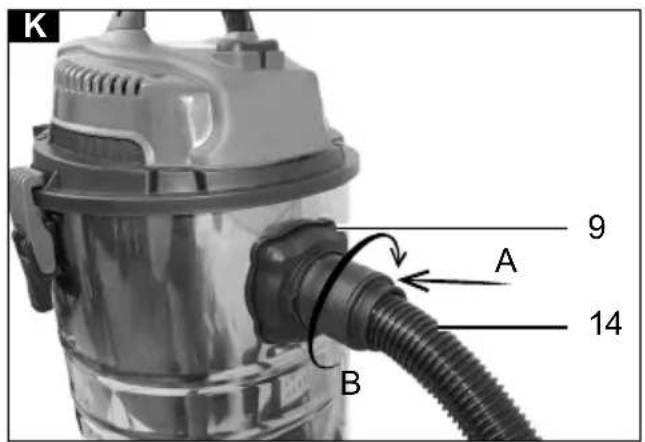
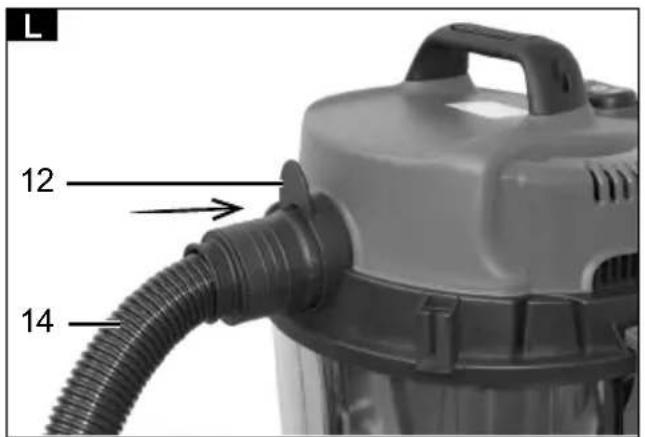
Installing the suction hose (fig. K+L)
Connect the suction hose (14) to the corresponding port, depending on the desired use, on the wet and dry vacuum.
Vacuuming:
Connect the suction hose (14) to the suction hose port (9). To do so, slide the end of the suction hose (14) with the two nipples into the suction hose port (9) (A). Insert the two nipples into the recesses.
Once the suction hose is fully inserted, turn it clockwise (B).
Blowing:
Connect the suction hose (14) to the suction hose port (12). Slide the end of the suction hose (14) with the two nipples into the blowing function connection port (12). Insert the two nipples into the recesses. It is not necessary to turn it here.
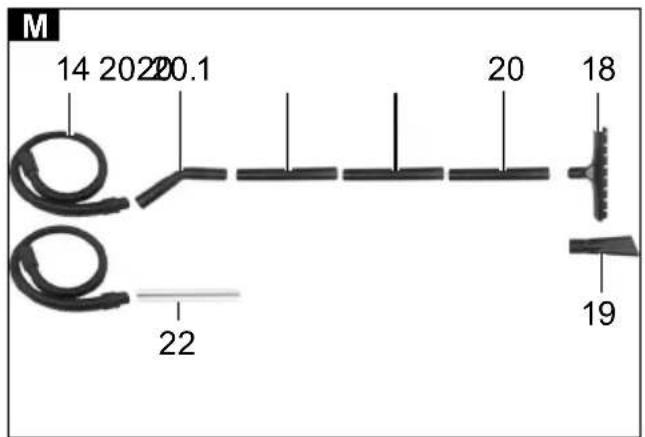
Installing the plastic extension tubes (20), handle (20.1), suction hose (14) and nozzle (18+19) (fig. M)
Wet and Dry vacuuming
Assemble the plastic extension tubes (20) by pushing them together.
Connect the assembled plastic extension tubes with the handle (20.1).
Fit the floor nozzle (18) or joint nozzle (19) to the other end of the assembled plastic extension tubes.
Ash cleaning
Connect the aluminium tube (22) with the suction hose (14)
8. Operation
⚠ WARNING!
Switch the device off if liquid or foam emerges with the exhaust air during wet vacuuming.
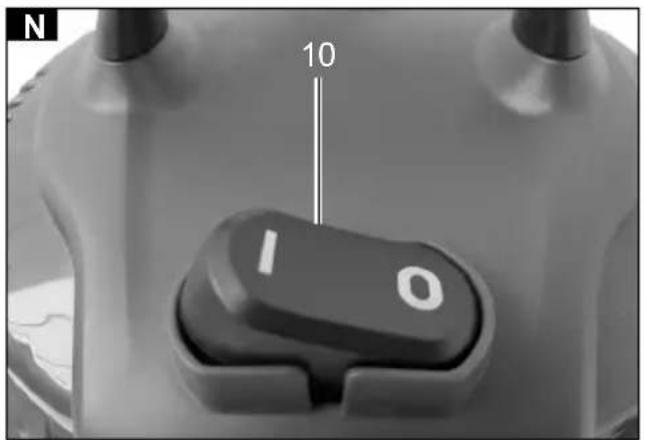
Switching on/off (fig. N)
The on/off switch (10) has two settings
- Switch setting 0: Off
- Switch setting I: On
Press the on/off switch (10) to switch on.
Switch setting I: On
Press the on/off switch (10) again to switch the device off. Switch setting 0: Off
Dry vacuuming and ash cleaning (fig. I) ⚠ WARNING!
The vacuuming of glowing embers and of materials that are combustible, explosive or harmful to health is prohibited. There is a risk of injury!
Use the HEPA filter (17) for dry vacuuming and ash cleaning. The paper filter bag (16) can be used in addition. This ensures that the HEPA filter (17) remains free of dust for longer and maintains the vacuum power for longer.
In addition, the disposal of the dust is also easier.
Always ensure that the filters are correctly fitted.
Wet vacuuming (fig. H)
Use the foam filter (15) for wet vacuuming. Ensure that the foam filter (15) is correctly fitted.
If the stainless steel container (8) is full, the safety float valve (13) closes the suction port and suction operation is interrupted.
⚠ WARNING!
The device is not suitable for vacuuming flammable liquids. For wet vacuuming, use the only the foam filter (15) provided. To remove the liquid vacuumed up from the stainless steel container, take off the machine head (2) by releasing the locking hooks (4) from the stainless steel container (8). Pour out the liquid residue.
9. Maintenance and cleaning
⚠ WARNING!
Prior to any adjustment, maintenance or service work disconnect the mains power plug!
Cleaning
It is recommended to clean the device after each use. Do not spray the device with water or clean it under running water. This can result in electric shocks and can damage the device.
Residual liquid remains in the stainless steel container (8). To remove residual liquid, take off the machine head (2) by releasing the locking hooks (4) from the stainless steel container (8). Pour out the liquid residue. Clean the container with a damp cloth.
- Replace paper filter bag when full
• Always keep the device clean. Do not use cleaning agents or solvents. - Keep the ventilation slots clean and free of dirt and dust.
- Clean the device only with a soft brush or a damp cloth.
- Clean the foam filter (16) with a little soap and running water and then leave it to air dry.
Maintenance
The device is maintenance-free.
Service information
Please note that the following parts of this product are subject to normal or natural wear and that the following parts are therefore also required for use as consumables.
Wear parts*:
* Not necessarily included in the scope of delivery!
- Foam filter
- Paper filter bag
- HEPA filter
10. Storage
Store the device and its accessories in a dark, dry and frost-proof place that is inaccessible to children. The optimum storage temperature is between 5 and 30°C. Store the electrical tool in its original packaging.
Cover the electrical tool in order to protect it from dust and moisture.
Store the operating manual with the electrical tool.
- Wind the mains cable around the top cable holder (11) at the connection port for the blower function (12).
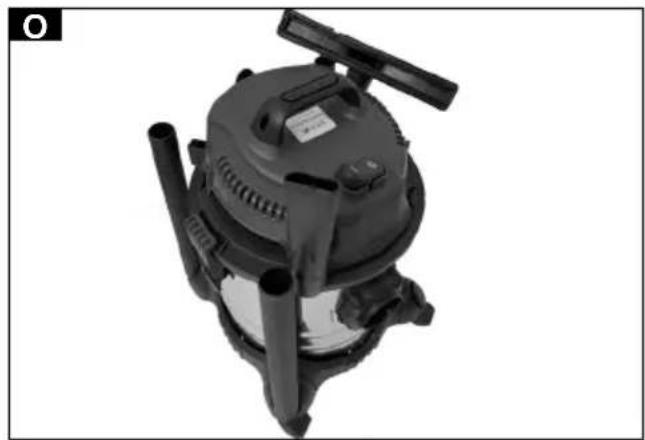
- There are four recesses on the top side of the machine head (2) for storing the floor nozzle (18), the joint nozzle (19) and the aluminium tube (22). There are also recesses on the wheel mounting base (5) for attaching the metal extension tube.
- The remaining accessories can be stored in the stainless steel container (8).
11. Electrical connection
The electrical motor installed is connected and ready for operation. The connection complies with the applicable VDE and DIN provisions.
The customer's mains connection as well as the extension cable used must also comply with these regulations.
Important information
In the event of an overloading the motor will switch itself off. After a cool-down period (time varies) the motor can be switched back on again.
Damaged electrical connection cable
The insulation on electrical connection cables is often damaged.
This may have the following causes:
• Passage points, where connection cables are passed through windows or doors.
- Kinks where the connection cable has been improperly fastened or routed.
- Places where the connection cables have been cut due to being driven over.
- Insulation damage due to being ripped out of the wall outlet.
- Cracks due to the insulation ageing.
Such damaged electrical connection cables must not be used and are life-threatening due to the insulation damage.
Check the electrical connection cables for damage regularly. Make sure that the connection cable does not hang on the power network during the inspection.
Electrical connection cables must comply with the applicable VDE and DIN provisions. Only use connection cables with the marking „H05VV-F“.
The printing of the type designation on the connection cable is mandatory.
AC motor
- The mains voltage must be 230 V\~
- Extension cables up to 25 m long must have a cross-section of 1.5 mm ^2 .
Connections and repairs of electrical equipment may only be carried out by an electrician.
Please provide the following information in the event of any enquiries
12. Disposal and recycling
The equipment is supplied in packaging to preven it from being damaged in transit. The raw materials in this packaging can be reused or recycled. The equipment and its accessories are made of various types of material, such as metal and plastic. Defective components must be disposed of as special waste. Ask your dealer or your local council.
Old devices must not be disposed of with household waste!
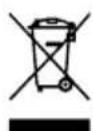
This symbol indicates that this product must not be disposed of together with domestic waste in compliance with the Directive (2012/19/EU) pertaining to waste electrical and electronic equipment (WEEE). This product must be disposed of at a designated collection point. This can occur, for example, by handing it in at an authorised collecting point for the recycling of waste electrical and electronic equipment. Improper handling of waste equipment may have negative consequences for the environment and human health due to potentially hazardous substances that are often contained in electrical and electronic equipment. By prop-
erly disposing of this product, you are also contributing to the effective use of natural resources. You can obtain information on collection points for waste equipment from your municipal administration, public waste disposal authority, an authorised body for the disposal of waste electrical and electronic equipment or your waste disposal company.
13. Troubleshooting
The following table shows fault symptoms and describes remedial measures in the event of your machine failing to work properly. If you cannot localise and rectify the problem with this, please contact your service workshop.
| Fault Possible cause Remedy | ||
| Motor does not run | Check whether the plug is plugged in. | Plug the mains plug back in to the socket. |
| Check whether there is power to the socket. | Call an electrician. | |
| Check whether the vacuum cleaner on/off switch is switched on. | Switch the on/off switch on. | |
| Reduced vacuuming power | Is the brush blocked? | Switch the vacuum cleaner off to remove the blockages. |
| Is the dust bag full of dust? Remove | move and empty the dust bag. | |
| Is the filter full of dust? Remove | and empty the filter. | |
Günzburger Straße 69
D-89335 Ichenhausen
Cher client,
| CE - Konformitätserklärung Originalkonformitätserklärung CE - Declaration of Conformity CE - Déclaration de conformité | CE | |
| DE | erklärt folgende Konformität gemäß EU-Richtlinie und Normen für den Artikel | |
| GB | hereby declares the following conformity under the EU Directive and standards for the following article | |
| FR | déclare la conformité suivante selon la directive UE et les normes pour l'article | |
| IT | dichiara la seguente conformità secondo le direttive e le normative UE per l'articolo | |
| HU | az EU-irányelv és a vonatkozó szabványok szerinti következo megfeleloségi nyilatkozatot teszi a termékre | |
| SI | izjavlja sledeco skladnost z EU-direktivo in normami za artikel | |
Marke / Brand:
| 2006/42/EC | |
| Annex IVNotified Body:Notified Body No.:Certificate No.: | |
Standard references:
EN 60335-2-2:2010+A11:2012+A1:2013; EN 60335-1:2012+A11:2014+A13:2017; EN 62233:2008; EN 55014-1:2017; EN 55014-2:2015; EN 61000-3-2:2014; EN 61000-3-3:2013
Subject to change without notice
Apparent defects must be notified within 8 days from the receipt of the goods. Otherwise, the buyer's rights of claim due to such defects are invalidated. We guarantee for our machines in case of proper treatment for the time of the statutory warranty period from delivery in such a way that we replace any machine part free of charge which provably becomes unusable due to faulty material or defects of fabrication within such period of time. With respect to parts not manufactured by us we only warrant insofar as we are entitled to warranty claims against the upstream suppliers. The costs for the installation of the new parts shall be borne by the buyer. The cancellation of sale or the reduction of purchase price as well as any other claims for damages shall be excluded.
Garantie FR

- Verehrter Kunde
- Explanation of the symbols on the equipment
- Table of contents: Page:
- Introduction
- Manufacturer:
- Dear Customer,
- Note:
- We recommend:
- Device description
- Scope of delivery
- Proper use
- Safety instructions
- ⚠️ DANGER!
- ⚠ WARNING!
- Technical data
- Installation
- ATTENTION!
- Unpacking (Fig. A+B+C)
- Installing the castor mounts (fig. D+E)
- Installing the castors (fig. F)
- Installing the machine head (2) and the handle (1)(Fig. G)
- Installing the foam filter (H) (fig. 3+8)
- Installing the HEPA filter (17) (fig. I)
- Installing the paper filter bag (16) (fig. J)
- Installing the suction hose (fig. K+L)
- Vacuuming:
- Blowing:
- Wet and Dry vacuuming
- Ash cleaning
- Operation
- Switching on/off (fig. N)
- Dry vacuuming and ash cleaning (fig. I) ⚠ WARNING!
- Wet vacuuming (fig. H)
- Maintenance and cleaning
- Cleaning
- Maintenance
- Service information
- Storage
- Electrical connection
- Important information
- Damaged electrical connection cable
- AC motor
- Disposal and recycling
- Old devices must not be disposed of with household waste!
- Troubleshooting
- Cher client,
- Standard references:
- Garantie FR
Brand : SCHEPPACH
Model : ASP21-4in1
Category : Vacuum Cleaner