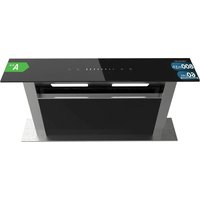
Bolero Flux ET 608000 - Basket CECOTEC - Free user manual and instructions
Find the device manual for free Bolero Flux ET 608000 CECOTEC in PDF.


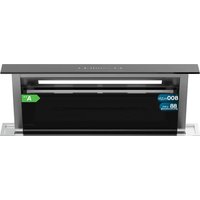
| Product type | Worktop extractor hood |
| Brand | Cecotec |
| Model | Bolero Flux ET 608000 (02925) |
| Power supply | 220-240 V ~ 50 Hz |
| Total power | 213 W |
| Motor power | 210 W |
| Maximum airflow | 800 m³/h |
| Energy class | A++ |
| Annual energy consumption | 24.9 kWh/year |
| Noise level (max speed) | 68 dB(A) |
| Noise level (min speed) | 47 dB(A) |
| Noise level (Boost) | 75 dB(A) |
| Lighting | 2 x LED 1.5 W (rectangular 120x33 mm) |
| Number of speeds | 8 |
| Main functions | Extractor motor, LED lighting, delayed shut-off (1-8 min), electric push rod |
| Grease filter | Metallic, dishwasher-safe |
| Carbon filter | Optional, replaceable (163 x 163 x 10 mm) |
| Safety systems | Overheat protection, delayed automatic shut-off |
| Maintenance | Clean every 2 months with hot water and mild detergent |
| Repairability | LED bulb replaceable by after-sales service, spare parts available |
| Warranty and after-sales service | Contact Cecotec at +34 9 63 21 07 28 |
Frequently Asked Questions - Bolero Flux ET 608000 CECOTEC
User questions about Bolero Flux ET 608000 CECOTEC
0 question about this device. Answer the ones you know or ask your own.
Ask a new question about this device
Download the instructions for your Basket in PDF format for free! Find your manual Bolero Flux ET 608000 - CECOTEC and take your electronic device back in hand. On this page are published all the documents necessary for the use of your device. Bolero Flux ET 608000 by CECOTEC.
USER MANUAL Bolero Flux ET 608000 CECOTEC
natural_image
3D rendering of a modern stainless steel enclosure with vertical supports and a central slatted opening (no text or symbols visible)EN • The coding in this manual is generic and applies to all code variants of the appliance.
Read these instructions thoroughly before using the appliance. Keep this instruction manual for future reference or new users.
This appliance can be used by children aged 8 years and above and people with reduced physical, sensory, or mental capabilities or lack of experience and knowledge if they have been given supervision or instruction concerning use of the appliance in a safe way and understand the hazards involved. Children must not play with the appliance. Cleaning and user maintenance should not be carried out by unsupervised children.
This appliance is designed for domestic use only and is not intended for bars, restaurants, farmhouses, hotels, motels, and offices.
If the power cable is damaged, it must be replaced by the official Cecotec Technical Support Service or similar qualified personnel to avoid risks.
You must allow the appliance to be disconnected from the power supply after installation.
There must be adequate ventilation of the room when the kitchen hood is used at the same time as gas or other fuel burning appliances.
There is a risk of fire if cleaning is not carried out according to the instructions.
Do not flambé under the kitchen hood.
CAUTION: Accessible parts can become hot when used with cooking appliances.
Air must not be discharged into a duct that is used to exhaust fumes from appliances burning gas or other fuels.
The air discharge regulations must be complied with.
Things you should never do:
I. Do not attempt to use the kitchen hood without the mesh filter or if the filter is excessively dirty or greasy!
II. Do not leave pans unattended during use because overheated fats or oils may catch fire.
Accumulation of grease in the kitchen hood can cause a fire hazard. Clean the appliance according to the instructions in this manual.
Exercise extreme caution when cleaning the appliance. Risk of burns and/or cuts. We recommend the use of gloves.
Never leave open flames near the kitchen hood.
If the kitchen hood is damaged, do not attempt to use it.
When the kitchen hood and other non-electrically powered appliances are in simultaneous operation, the negative pressure in the room must not exceed 4 Pa (4 x 10⁻⁵ bar).
Important! Always disconnect the power supply during installation and maintenance.
The kitchen hood must be installed in accordance with the installation instructions and in compliance with all measurements.
All installation work must be carried out by a competent person or a qualified electrician.
Dispose of the packaging material carefully. Children are vulnerable to it.
Pay attention to sharp edges inside the kitchen hood, especially during installation and cleaning.
Make sure that the duct does not have bends sharper than 90 degrees, as this will reduce the efficiency of the kitchen hood.
Warning: Failure to install the screws or fastening device in accordance with these instructions may result in electrical hazards.
Warning: Before accessing the electrical terminals, all power supply circuits must be disconnected.
There must be adequate ventilation of the room when the kitchen hood is used at the same time as gas or other fuel burning appliances.
Warning: The appliance and its accessible parts may become hot during operation. Be careful not to touch any accessible parts. Children under 8 years old must stay away, unless they are supervised.
Local air discharge regulations must be complied with.
For safety reasons, only use the supplied fixing or mounting screws (if applicable, depending on the model) or screws of the same size as those recommended in this instruction manual.
You must not use a steam cleaner.
Never try to put out the fire with water. Instead, turn off the appliance and smother the flame with, e.g., a fireproof lid or blanket.
Never use extension leads, multiple socket connections or external timer connection elements.
If the power cord is damaged, it must be replaced by the official Cecotec Technical Support Service or by similarly qualified technicians to prevent hazards.
The appliance must not be operated if the power supply cable is damaged or cut.
If the appliance stops working or malfunctions abnormally, disconnect it from the mains and contact the official Cecotec Technical Support Service.
Cecotec disclaims all liability for any damage or injury caused as a result of failure to follow the installation and/or operating instructions contained in this instruction manual.
INSTRUCTIONS DE SÉCURITÉ
- Control panel
- Main body
- Motor
NOTE:
The graphics in this manual are schematic representations and may not exactly match the product.
2. BEFORE USE
- This appliance is packaged in a way as to protect it during transport. Take the appliance out of its box and remove all packaging materials. You can keep the original box and other packaging elements in a safe place to prevent damage to the appliance if you need to transport it in the future. In case the original packaging is disposed of, make sure all packaging materials are recycled accordingly.
- Make sure all parts and components are included and in good conditions. If there is any piece missing or in bad conditions, contact the official Cecotec Technical Support Service immediately.
Box content
- Downdraft kitchen hood
- Assembly kit
- Instruction manual
- Filters
Do not remove the serial number of the appliance in order to keep a correct traceability of it in case of assistance.
3. INSTALLATION
Before Installation
- Before installing the extractor hood, make sure that the area is clean to prevent it from sucking in dust or dirt.
- Please note that the extractor hood must not share the same ventilation duct with other appliances that use gas or other fuses.
- To facilitate air outlet, the ventilation duct should have a curvature of ≥ 120^ and should be
ENGLISHENGLISH
connected to the outside wall.
- After installation, ensure that the kitchen hood is level to prevent grease build-up on the end (Fig. 2).
Dimensions
- Figure 3 shows the dimensions required for the installation of the extractor hood.
- For the installation of the extractor hood it is recommended to use the following tools (NOT INCLUDED): gloves, crosshead screwdriver, work surface, ladder, saw, ruler, electric drill.
Diagram for drilling
Figure 4 shows the hole to be drilled for the installation of the extractor hood.
Installation
Fig. 5
- Kitchen hood body
- Motor assembly housing
- M4*8 screw (x2)
- ST4*14 screw (x2)
- Mounting bracket (x2)
-
Electrical junction box
-
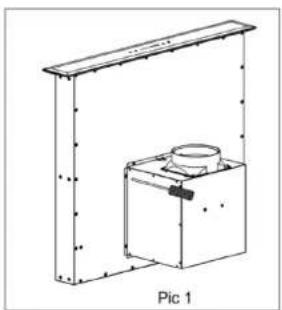
First, remove the motor assembly housing from the extractor hood body (Fig. 6).
- Place the extractor hood body in the installation hole that you have previously drilled (Fig. 7).
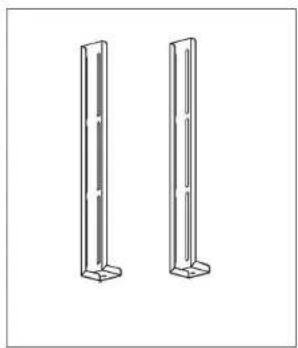
- Prepare the two mounting brackets (Fig. 8).
- Attach the extractor hood and the worktop to the mounting brackets using screws. There should be a 2 mm gap between the mounting brackets and the worktop (Fig. 9).
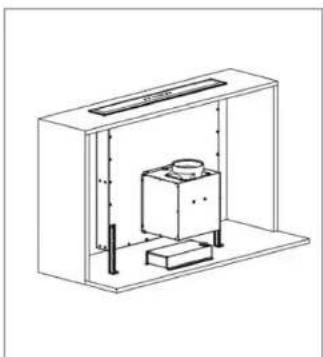
- Reinstall the motor assembly housing back into the extractor hood body. Install the electrical junction box (Fig. 10).
- Carry out the wiring as shown in figure 11. There are two terminals on the back of the extractor hood. Terminal 'a' is connected to the switch wire of the electrical junction box and terminal 'b' is connected to the other wires of the electrical junction box (including the LED light wire and the electric push rod wire).
- There is a motor wire located at the point marked "e", connect this wire to terminal "d". Point "c" shows the power switch in the electrical junction box (Fig. 12).
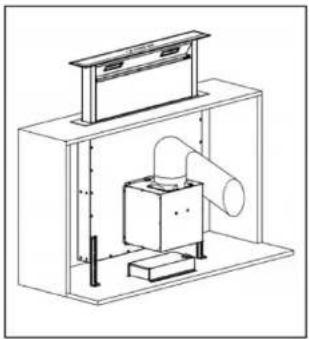
- Drill a 160 mm diameter hole in the worktop cabinet and then connect the exhaust duct to the air outlet of the extractor hood and to the hole in the worktop cabinet respectively (Fig. 13).
Electrical connections
Connect the power cord plug to a suitable 220-240 V-/50 Hz socket. The kitchen hood must be connected to an earthed installation.
4. OPERATION
4.1 Control panel
Fig. 14
- Delay end function icon
- Light function icon
- Settings icons for Speed / Light / Delay end functions
- Extractor motor function icon
- Power i can (ON/OFF)
Delay end function icon
When the extractor hood is in operation, press this icon to switch off the appliance, lights and push rod after 5 minutes.
When the extractor hood is in operation, press this icon and it will flash for 5 seconds. While it is flashing, with the settings icons you can select the time of the Delay end function, between 1 and 8 minutes, corresponding to the 8 levels of adjustment.
Light function icon
Press this icon and the light will turn on. The icon will flash for 5 seconds. While it is flashing, you can also use the settings icons to adjust the brightness level of the light. Press the light icon again to turn the light off.
Settings icons
With these icons you can adjust the level of the following functions: speed, light, delay end. The settings icons go from the lowest to the highest level, from left to right. There are a total of 8 levels.
Extractor motor function icon
Press this icon to turn on the extractor motor, if you press it again it will turn off.
When the extractor hood is in operation, you can also use the settings icons to select the speed level from 1 to 8 (from less to more speed).
Power Icon (ON/OFF)
This icon is used to control the extractor hood. Press and hold this icon for 3 seconds, the push rod will open and the extractor hood will rise. Then the light will turn on and the extractor hood will start running at low speed. If you press and hold this icon for 3 seconds, the push rod will
ENGLISHENGLISH
close and the extractor hood will lower. The light will then turn off and the extractor hood will stop operating.
NOTE: Remember that the switch located in the electrical junction box must be in the ON position.
NOTE: Kitchen hoods are equipped with an overheating protection system that acts to prevent possible incidents when the motor temperature exceeds the operating limit value.
5. CLEANING AND MAINTENANCE
Grease filter removal process
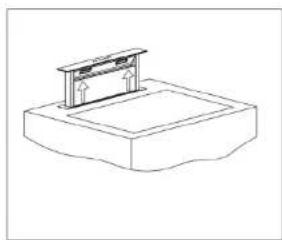
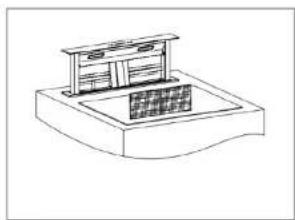
- First lift the front glass about 20 mm, as shown in figure 15.
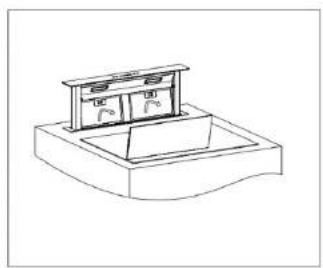
- Then remove it by pulling it outwards as shown in figure 16.
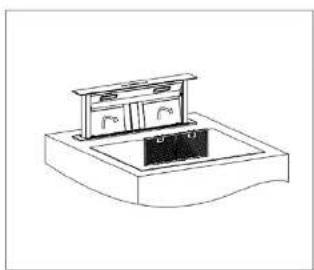
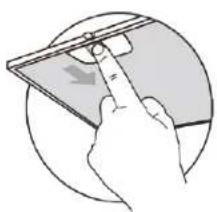
- Press the filter latch downwards and then remove it, as shown in figure 17.
Grease filter cleaning Fig.1B
Do not use corrosive detergents to clean grease from the mesh filters. Regular cleaning of the filters will prolong the life of the appliance and keep it in good working order. Follow the instructions below:
- Cleaning method 1: Immerse the mesh filters in hot water (40-50 °C), add neutral detergent and let them soak for 2 to 3 minutes. Protect yourself with gloves and clean the filters with a soft brush or scouring pad. Do not apply too much force, as filters are very delicate and can be easily damaged.
- Cleaning method 2: If you wish, you can also wash the filters in the dishwasher at a temperature of approx. 60 °C.
Instructions for cleaning the kitchen hood
Before cleaning, do not forget to switch off the power supply to the appliance.
A To protect the main body from corrosion over a long period of time, the kitchen hood should be cleaned with hot water and non-corrosive detergent every two months.
B Please do not use abrasive detergent, or it will damage the kitchen hood body.
C Do not get the motor or other electrical parts wet, as this will cause damage to the appliance.
D The carbon filter must not be exposed to heat.
Carbon filter (Included in selected models only)
This type of filter has activated carbon and purifies air and absorbs cooking odours. The activated carbon becomes saturated after a period of time, which will reduce the adsorption
capacity of the filter. The carbon filter cannot be washed nor cleaned in any way. When its service life comes to an end you must replace it with a new one.
- It is recommended to check the condition of carbon filters regularly, at least two or three times a year. Its replacement will depend on how the kitchen hood is used, as well as the daily operating time.
- In case of very frequent frying, shorten the time interval for checking and/or replacing the carbon filters.
Installing the carbon filters
The carbon filters are located behind the grease filters. To remove the carbon filters, proceed as follows:
- Remove the grease filters.
- Lift the carbon filter and then move it outwards to remove it (Fig. 19).
- To replace the carbon filters, proceed in reverse order.
- Carbon filters must not be exposed to heat.
Carbon filter dimensions
The kitchen hood uses two carbon filters with the following dimensions:
Product reference: 02925
Product: Bolero Flux ET 608000 Glass Black A++
Carbon filter dimensions: 163 x 163 x 10 mm
Product reference: 02926
Product: Bolero Flux ET 908000 Glass Black A++
Carbon filter dimensions: 273.5 x 162 x 10 mm
Replacing the light bulb/LED
Please note:
- The light bulb/LED must be replaced by the official Cecotec Technical Support Service or similarly qualified technicians.
- Always disconnect the power supply before performing any operation on the appliance. When handling the bulb, make sure that it has cooled down completely before any direct contact with your hands.
- When handling the bulbs, hold them with a cloth or gloves to prevent sweat from coming into contact with the bulb, as this may reduce the bulb life.
Note:
- Before changing the light bulb/LED, make sure that the appliance is switched off and unplugged.
ENGLISHENGLISH
- Protect yourself from danger when changing the light bulb/LED, e.g. by wearing gloves.
- TROUBLESHOOTING
| Error Possible cause | Possible solution | |
| The light is on, but the motor does not work | The exhaust duct is obstructed | Remove the obstruction |
| The condenser is damaged | Replace the condenser. To do so, contact the official Cecotec Technical Support Service | |
| The motor is jammed, or the bearing is damaged | Replace the motor. To do so, contact the official Cecotec Technical Support Service | |
| The motor has a loose internal cable or releases a bad smell | Replace the motor. To do so, contact the official Cecotec Technical Support Service | |
| The light and the motor do not work | In addition to the above, check the following: | |
| The light is damaged. | Replace the light. To do so, contact the official Cecotec Technical Support Service | |
| Power cable is loose. | Connect the cables according to the wiring diagram. To do so, contact the official Cecotec Technical Support Service | |
| There is oil dripping from the grease filter mesh | The filter is very dirty | Clean or replace the grease filter mesh immediately |
| The kitchen hood vibrates | The motor fan blade is damaged and causes vibration | Replace the motor fan blade |
| The motor is not securely fastened | Check the motor. To do so, contact the official Cecotec Technical Support Service | |
| The body is not securely fixed | Fix the body to the ceiling firmly. To do so, contact the official Cecotec Technical Support Service | |
| Insufficient suction | Distance between the body and the gas hob is too large | Readjust the distance |
| There is too much ventilation in the room due to open doors or windows | Choose a new installation place and reassemble the appliance | |
| The kitchen hood is tilted | The fastening screw is not sufficiently tightened | Reposition the kitchen hood horizontally and tighten the screws. |
| The suspension screw is not sufficiently tightened | Reposition the kitchen hood horizontally and tighten the screws. |
If none of these situations match your problem, do not attempt to disassemble or repair the appliance by yourself. Repairs carried out by unqualified people may result in injury or serious malfunctions. Contact the official Cecotec Technical Support Service. The repair must be carried out by an authorised technician, and you must only use original spare parts.
Unauthorised self-maintenance or maintenance will affect the safe use of the product and the application of the warranty policy.
NOTE:

Any electrical repairs to this appliance must conform to local and/or state laws. Please contact the official Cecotec Technical Support Service in case of doubt and before carrying out any of the above operations. Always disconnect the device from the power supply when opening it.
ENGLISHENGLISH
7. TECHNICAL SPECIFICATIONS
Product reference: 02925
Product: Bolero Flux ET 608000 Glass Black A++
Rated voltage: 220 - 240 V
Rated frequency: 50 Hz
Total power: 213 W
Motor: 210 W
Air flow rate: 800 m³/h
Bulb: 2 × 1,5 W
Bulb type: rectangular LED light
Bulb dimensions: 120 x 33 mm
ILCOS D Code: DBL-1.5-S-120/33
Product reference: 02926
Product: Bolero Flux ET 908000 Glass Black A++
Rated voltage: 220 - 240 V
Rated frequency: 50 Hz
Total power: 215 W
Motor: 210 W
Air flow rate: 800 m³/h
Bulb: 1×5 W
Bulb type: rectangular LED light
Bulb dimensions: 539 x 23 mm
ILCOS D Code: DBL-5-S-539/23
| Symbol | Value | Quantity | ||
| Model reference | 02925 | 02926 | ||
| Annual energy consumption | AEC_indep | 24.9 | 27.1 | kWh/a |
| Time increment factor | 0.6 | 0.6 | ||
| Fluid dynamic efficiency | FDE_indep | 37.9 | 37.6 | |
| Energy Efficiency Index (EEIw) | EEI_indep | 33.9 | 34.4 | |
| Measured air flow at the maximum efficiency point | Q_eLW | 305 | 322.6 | m3/n |
| Air pressure measured at maximum efficiency point | P_BLP | 457 | 470 | Pa |
| Maximum airflow Q | m/s | Highest setting: 582 | Highest setting: 617.6 | m2/h |
| Lowest setting: 312.1 | Lowest setting: 324.9 | |||
| Air flow "Boost" function - 815.3 | 861.4 | |||
| Electrical input power measured at maximum efficiency point | W_BEP | 102.1 | 111.9 | W |
| Rated power of the lighting system | W_L | 3.5 | 3.5 | W |
| Measured illuminance of the illumination system on the cooking surface | E_max | 83 | 77 | lux |
| Standby power consumption P | s | N/A | N/A | W |
| Power consumption in OFF mode | P_o | 0.46 | 0.46 | W |
| Noise level (Highest setting) L | V_in | 68 | 68 | dB |
| Noise level (Lowest setting) L | V_in | 47 | 47 | dB |
| Sound level (Boost) L | V_in | 75 dB | ||
This appliance features a light source with an energy efficiency grade A++.
The appliance power consumption when off is 0.46 W, following the guidelines of EN 50564:2011 and the European regulations 1275/2008/EC and B01/2013/EC. For this purpose, the appliance is connected to the mains without performing any function. The switch/knob of the appliance was set to the OFF position.
Technical specifications may change without prior notification to improve product quality. Made in China | Designed in Spain
8. DISPOSAL OF OLD ELECTRICAL AND ELECTRONIC APPLIANCES

This symbol indicates that, according to the applicable regulations, the appliance and/or batteries must be disposed of separately from household waste. When this product reaches the end of its shelf life, you should dispose of the cells/
batteries/accumulators and take them to a collection point designated by the local authorities. Consumers must contact their local authorities or retailer for information concerning the correct disposal of old appliances and/or their batteries. Compliance with the above guidelines will help protecting the environment.
9. TECHNICAL SUPPORT AND WARRANTY
Cecotec shall be liable to the end user or consumer for any lack of conformity that exists at the time of delivery of the product under the terms, conditions and deadlines established by the applicable regulations.
Repairs should be carried out by qualified personnel.
If at any moment you detect any problem with your product or have any doubt, do not hesitate to contact the official Cecotec Technical Support Service at +34 96 321 07 28.
10. COPYRIGHT
The intellectual property rights over the texts in this manual belong to CECOTEC INNOVACIONES, S.L. All rights reserved. The contents of this publication may not, in whole or in part, be reproduced, stored in a retrieval system, transmitted, or distributed by any means (electronic, mechanical, photocopying, recording or similar) without the prior authorization of CECOTEC INNOVACIONES, S.L.
11. SIMPLIFIED DECLARATION OF CONFORMITY
CE Cecotec Innovaciones hereby declares that this appliance complies with the essential requirements and other relevant provisions of the regulations applicable in the European Union. This appliance has been designed, manufactured and tested to meet the required safety and quality standards. The full text of the EU Declaration of Conformity can be found on the following website: https://cecotec.es/es/information/declaration-of-conformity
1. PIÈCES ET COMPOSANTS
lng.1
ILCOS Kod D: DBL 1.5 S 120/33
ILCOS Kod D: DBL-S-S-539/23
Fig./Img./Abb./Afb./Rys.5
natural_image
Technical line drawing of a mechanical assembly with a rectangular frame and a small box, labeled 'Pic 1' (no text or symbols on the diagram itself)Fig./Img./Abb./Afb./Rys.6

natural_image
Technical line drawing of a mechanical assembly with a bracket and mounting base (no text or symbols)Fig./Img./Abb./Afb./Rys.7
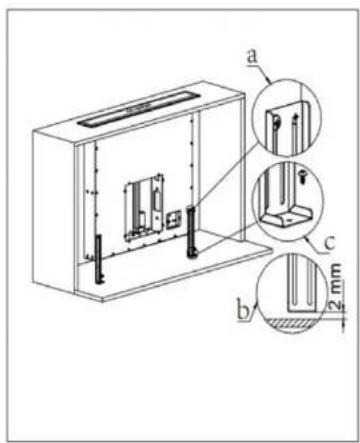
Fig./Img./Abb./Afb./Rys.9
natural_image
Two identical vertical metal frame structures with mounting feet, shown from different angles (no text or symbols)Fig./Img./Abb./Afb./Rys.8
natural_image
Technical line drawing of a mechanical device inside a transparent enclosure, showing internal components and mounting base (no text or symbols)Fig./Img./Abb./Afo./Rys.10
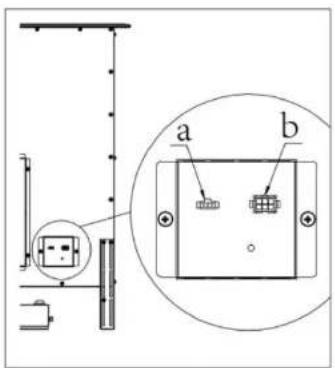
Fig./Img./Abb./Afb./Rys.11
natural_image
Technical line drawing of a mechanical device with no visible text or symbolsFig./Img./Abb./Afo./Rys.13
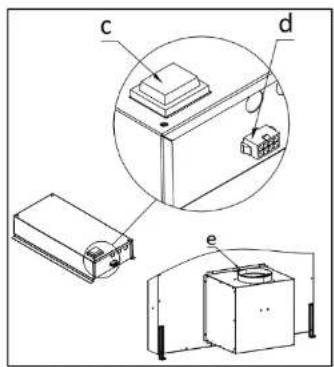
Fig./img./Abb./Afb./Rys.12


12345



Fig./Img./Abb./Afo./Rys.14
natural_image
Simple line drawing of a rectangular pool with an overhead structure (no text or symbols)Fig./Img./Abb./Afo./Rys.15
natural_image
Line drawing of a mechanical device with a top component and base (no text or symbols)Fig./Img./Abb./Afb./Rys.16
natural_image
Isometric line drawing of a simple electrical enclosure or enclosure with no text or symbolsFig./Img./Abb./Afb./Rys.17
natural_image
Illustration of a hand holding a tablet with a finger pointing at it, enclosed in a circular frame (no text or symbols)Fig./Img./Abb./Afb./Rys.18
natural_image
Simple line drawing of a rectangular structure with a grid pattern on top (no text or symbols)Fig./Img./Abb./Afb./Rys. 19
www.cecotec.es
- INSTRUCTIONS DE SÉCURITÉ
- BEFORE USE
- Box content
- INSTALLATION
- Before Installation
- ENGLISHENGLISH
- Dimensions
- Diagram for drilling
- Installation
- Electrical connections
- OPERATION
- Control panel
- Delay end function icon
- Light function icon
- Settings icons
- Extractor motor function icon
- Power Icon (ON/OFF)
- CLEANING AND MAINTENANCE
- Grease filter removal process
- Grease filter cleaning Fig.1B
- Instructions for cleaning the kitchen hood
- Carbon filter (Included in selected models only)
- Installing the carbon filters
- Carbon filter dimensions
- Product reference: 02925
- Product reference: 02926
- Replacing the light bulb/LED
- TECHNICAL SPECIFICATIONS
- DISPOSAL OF OLD ELECTRICAL AND ELECTRONIC APPLIANCES
- TECHNICAL SUPPORT AND WARRANTY
- COPYRIGHT
- SIMPLIFIED DECLARATION OF CONFORMITY
- PIÈCES ET COMPOSANTS
Brand : CECOTEC
Model : Bolero Flux ET 608000
Category : Basket